

Dynamics and Logics of Civil War
Open accessThe DOI matches its Crossref record; 153 of the 154 references it cites were found in a registry or an index, and 1 are not checked yet; 6 of the 101 sources its claims cite were checked for support.
Abstract
This article reviews the literature on civil war. We focus on the most recent period of scholarly activity, beginning in the early 2000s when the publication of prominent quantitative studies triggered a surge in the empirical research of civil war as a well-defined conceptual category. We identify three explanatory logics that have dominated much of this literature and that view civil wars as a consequence of greed, grievances, and opportunities, respectively. We evaluate the arguments and findings of these theoretical approaches with respect to each of the main phases of war: outbreak, wartime dynamics, conflict termination, and postwar recovery. The article concludes by identifying key challenges confronting future civil war research. In particular, we emphasize the continuing need to advance theories that bridge the main explanatory logics as well as the different phases of conflict. Researchers should also pay more attention to defining the appropriate spatiotemporal scope of their studies.
Verified 2026-11-22 · 1 reference not checked yet
Overview
CoChat Summary
TL;DR
This is a review essay that synthesizes civil-war research around three explanatory logics—grievance, greed, and opportunities—and organizes the literature by conflict phase: onset, wartime violence, termination, and aftermath. Its main argument is that future work should bridge these logics and phases rather than treat them as separate “horse races.”
Key findings
- The paper argues that civil-war scholarship has been shaped by three ideal-typical logics: grievance-based accounts, greed-based accounts, and opportunity-based accounts, but that these are “deeply intertwined.”
- It states that much of the early-2000s literature favored opportunity/weak-state explanations; it cites Fearon and Laitin (2003) as the most influential onset account and says the article became “the most-cited” on civil war.
- For civil-war termination, it highlights evidence that wars last longer when rebels can finance themselves through contraband or control peripheral territory, and that irregular conflicts last longer than conventional wars and are more often government victories.
- For the aftermath of war, it notes evidence that power-sharing arrangements are more stable when they are multifaceted, and that post-conflict peace may require both territorial autonomy and central governmental power sharing.
Methods
- This is a narrative literature review, not an original empirical study.
- It synthesizes published work mainly in political science, with some coverage of economics and sociology; the authors say they focus on the most recent period of civil-war research and use Web of Science publication trends as descriptive context.
- The main analytic approach is comparative review across four phases of civil war: initiation, violence during war, termination, and aftermath.
Limitations
- The paper does not present new data or a new statistical analysis; it is a review, so its claims depend on the cited literature rather than direct estimation. [evident from the text]
- The authors explicitly note that the literature they review is often overgeneralized in space and time, relying heavily on global cross-national designs and strong assumptions of unit homogeneity.
- They also say the field lacks enough meta-studies and that many micro-level findings are hard to aggregate beyond the cases that generated them.
Model-written summary. Check it against the paper before relying on it.
Integrity signals
Registry
Cites
Statistics
Figures
Verification
Claims the paper makes
5 Valid · 6 Not valid · 78 Not checked · 28 Own results and interpretations
The cited sources support only part of this claim — read each source’s verdict below.
In the paper
“Furthermore, the original argument fails to take the obvious endogeneity of oil extraction into account (Ross 2015), and also overlooks that petroleum revenues may actually reduce conflict by helping governments bribe or suppress the opposition (Paine 2016).”
What the sources say
- Partly supportedcites Ross 2015 matched to “What Have We Learned about the Resource Curse?” (2015) sourceExperimental — accuracy not yet measured
Ross's review does treat the endogeneity of extraction-based measures as a live issue: in 'WHAT ARE NATURAL RESOURCES AND HOW ARE THEY MEASURED?' he writes that 'resource curse skeptics suggest that any measures that are influenced by local decisions about resource extraction... might be endogenous to the outcomes we care about,' and the INTRODUCTION lists endogeneity/omitted-variable bias as the third debate over whether the curse is real or illusory. But the paper nowhere says the ORIGINAL resource-curse argument failed to account for endogeneity; the objection is credited to skeptics (Haber & Menaldo 2011, Wacziarg 2012) and Ross explicitly counters it, arguing in the INTRODUCTION that 'the first objection (that the appearance of a resource curse is due to endogenous or omitted variables) is contradicted by a large body of evidence' and in LOOKING AHEAD that bad outcomes 'almost certainly reduce a country's income from its extractive sector.' The citing sentence therefore states as an established oversight what this source presents as a contested objection that the evidence rejects. (LLM, conf=0.78)
plain- Asserted: passes — The authors put it forward as true.
- Checkable: passes — It can be checked against evidence.
- Load-bearing: unclear — It is unclear whether the paper’s conclusions depend on it.
- Based: passes — The paper gives a reason why it holds.
- Partly supported
Every source the paper cites for this claim was checked and supports it.
In the paper
“Using EPR's geocoded data on ethnic settlement areas, Cederman, Weidmann and Gleditsch (2011) extend the study of political exclusion to economic inequality, in order to show that ethnic groups that are poorer and richer than the country's average income are more likely to stage rebellion.”
What the sources say
- Supportedcites Cederman, Weidmann and Gleditsch (2011) matched to “Horizontal Inequalities and Ethnonationalist Civil War: A Global Comparison” (2011) source
The Conclusion states that 'ethnic groups both above and below the country average in terms of per capita income are overrepresented in civil conflict,' and the Empirical Analysis section (Models 4 and 5, Table 2) reports significant positive coefficients for both low_ratio and high_ratio, confirming H1a and H1b. The methods sections confirm the basis in the geocoded GeoEPR extension of EPR (Wucherpfennig et al.) overlaid with G-Econ/Nordhaus luminosity estimates, and Model 3/Figure 5 jointly test economic inequality alongside political exclusion (H2), matching the citing sentence's framing. Group-level conflict onset is coded via NSA2EPR links to rebel organizations, i.e. groups 'staging rebellion'. (LLM, conf=0.92)
plainstates an association- Asserted: passes — The authors put it forward as true.
- Checkable: passes — It can be checked against evidence.
- Load-bearing: passes — The paper’s conclusions depend on it.
- Based: passes — The paper gives a reason why it holds.
- Supported
Every source the paper cites for this claim was checked and supports it.
In the paper
“Based on these data, Cederman, Wimmer and Min (2010) show that excluded ethnic groups, especially those that suffered status reversals, are overrepresented in conflict statistics.”
What the sources say
- Supportedcites Cederman, Wimmer and Min (2010) matched to “Why Do Ethnic Groups Rebel? New Data and Analysis” (2010) source
The paper’s EPR-based table reports a higher rate of ethnic-conflict onset for excluded groups (0.66% of group-years) than for included groups (0.23%). The Data Analysis section also finds that a recent downgrade in power status significantly increases conflict propensity among excluded groups. The supplied passages do not provide page numbers. (LLM, conf=0.94)
plainstates an association- Asserted: passes — The authors put it forward as true.
- Checkable: passes — It can be checked against evidence.
- Load-bearing: passes — The paper’s conclusions depend on it.
- Based: passes — The paper gives a reason why it holds.
- Supported
The cited sources support only part of this claim — read each source’s verdict below.
In the paper
“At the individual level, civil wars expose participants and victims to long-term harm in terms of educational achievement, employment, and physical and psychological health (Blattman and Annan 2010; Canetti-Nisim et al. 2009).”
What the sources say
- Partly supportedcites Blattman and Annan 2010 matched to “The Consequences of Child Soldiering” (2010) sourceExperimental — accuracy not yet measured
The Abstract and Introduction (pp. 1, 4) support the participant side of the claim for one civil war: 'schooling falls by nearly a year, skilled employment halves, and earnings drop by a third,' with effects persisting years after service. However, three parts of the claim are not attributable to this paper: (1) harm to 'victims' is expressly excluded — 'We do not identify the general impact of war on non-combatants' (Intro, p. 4) and 'The disparity between war-exposed youth and unexposed youth is a different impact altogether ... that is not addressed by this study' (Conclusions, p. 24); (2) physical health harm is not a reported finding — the only physical measure is a serious-injury indicator whose abduction effect is small and used mainly in a wage decomposition (Tables 4/9, pp. 37, 39); (3) psychological harm is stated flatly in the claim, whereas the source hedges it as 'mild on average' and 'present in a relative minority' (Psychosocial impacts, p. 16; Abstract, p. 1). The setting is also Ugandan LRA recruits, not civil wars generally, though the paper does discuss limited generalizability (Conclusions, p. 25). (LLM, conf=0.82)
- Partly supportedcites Canetti-Nisim et al. 2009 matched to “A New Stress-Based Model of Political Extremism: Personal Exposure to Terrorism, Psychological Distress, and Exclusionist Political Attitudes” (2009) sourceExperimental — accuracy not yet measured
The Discussion and Conclusion (page unavailable) says exposure to terrorism may cause psychological distress lasting months or years; the Results also find higher distress among exposed respondents. The study concerns Israeli Jews exposed to terrorism, not civil-war participants and victims, and it does not establish long-term harm to educational achievement, employment, or physical health. (LLM, conf=0.88)
plainstates a cause- Asserted: passes — The authors put it forward as true.
- Checkable: passes — It can be checked against evidence.
- Load-bearing: unclear — It is unclear whether the paper’s conclusions depend on it.
- Based: passes — The paper gives a reason why it holds.
- Partly supported
A result the paper reports from its own data — it cites no other source for it, so there is none to check. The quote shows it is in the paper.
In the paper
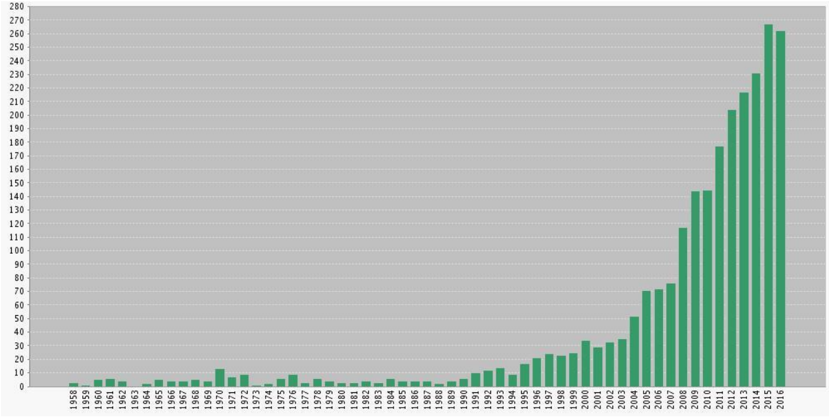
“Based on data drawn from the Web of Science , Figure 1 shows how the publication trend of articles covering civil war in political science, economics, and sociology slowly increases after the end of the Cold War and then takes off in the early 2000s after decades of very low publication activity.”
plainstates a cause- Asserted: passes — The authors put it forward as true.
- Checkable: passes — It can be checked against evidence.
- Load-bearing: unclear — It is unclear whether the paper’s conclusions depend on it.
- Based: passes — The paper gives a reason why it holds.
50 more claims
Create a free account to see all 117 claims and to verify the 20 references still open.
- It may state two separate claims as one. 24
- Probably not a substantial claim. 52
Claims other papers make about this one
Each is checked against this paper’s own text: does it say what the citing paper says it does?
The source backs part of the claim, not all of it — or backs it for a different population, condition or comparison.
In the citing paper
“Many consequences of the pandemic such as poor health, poverty and economic recession can lead to significant individual frustration, and are well-established predictors of armed conflict (Cederman & Vogt, 2017).”
From COVID-19 and armed conflict (2021) · cites this paper as Cederman & Vogt, 2017
Experimental — accuracy not yet measuredThe source backs part of the claim, not all of it — or backs it for a different population, condition or comparison.
In the citing paper
“Countries with a medium level of democracy and highly repressive regimes are empirically much more likely to experience civil wars than consolidated democracies (Cederman & Vogt, 2017).”
From COVID-19 and armed conflict (2021) · cites this paper as Cederman & Vogt, 2017
Experimental — accuracy not yet measured
Citations
Cites
The clash of civilizations and the remaking of world order
(1997) · Long Range Planning · doi:10.1016/s0024-6301(97)80966-1 · Cited by 7,457
Ethnicity, Insurgency, and Civil War
FEARON, J. D., & LAITIN, D. D. (2003) · American Political Science Review · doi:10.1017/s0003055403000534 · Cited by 7,366
Eley, G., & Gellner, E. (1984) · Contemporary Sociology · doi:10.2307/2070853 · Cited by 6,911
Greed and grievance in civil war
Collier, P. (2004) · Oxford Economic Papers · doi:10.1093/oep/gpf064 · Cited by 6,101
McAdam, D., Tarrow, S., & Tilly, C. (2001) · doi:10.1017/cbo9780511805431 · Cited by 5,558
States and Social Revolutions: A Comparative Analysis of France, Russia and China
Skocpol, T. (1979) · Cambridge University Press · doi:10.1017/cbo9780511815805 · Cited by 5,408 · cited 1×
“Reflecting the ideological confrontation between the super powers, civil wars were typically studied as “peasant rebellions” (Scott 1976) or “social revolutions” (Skocpol 1979).”
BackgroundThe Clash of Civilizations and the Remaking of the World Order
Evans, P., & Huntington, S. P. (1997) · Contemporary Sociology · doi:10.2307/2654621 · Cited by 4,865
From Mobilization to Revolution
Tilly, C. (2017) · Collective Violence, Contentious Politics, and Social Change · doi:10.4324/9781315205021-5 · Cited by 3,999
Armed Conflict 1946-2001: A New Dataset
GLEDITSCH, N. P., WALLENSTEEN, P., ERIKSSON, M., SOLLENBERG, M., & STRAND, H. (2002) · Journal of Peace Research · doi:10.1177/0022343302039005007 · Cited by 3,846 · cited 1×
“…civil war always concerns an incompatibility in terms of political control.1 Following the conventions of the Uppsala Conflict Data Program (N. P. Gleditsch et al. 2002, 619), we speak of governmental civil wars if the main objective of the challenger is full governmental control of the state.”
Background(1970) · Medical Entomology and Zoology · Cited by 3,500
Research works printed but not linked: 2
- Hechter Michael, 1975, Internal Colonialism: The Celtic Fringe in British National Development, 1536-1966
- Kaplan, Robert D. 1994. "The Coming Anarchy." Atlantic Monthly 273: 44-76.
Cited by
Illiberal peace? Authoritarian modes of conflict management
Lewis, D., Heathershaw, J., & Megoran, N. (2018) · Cooperation and Conflict · doi:10.1177/0010836718765902 · Cited by 190
“Theories of conflict are often roughly categorised in three groups, ascribing causal power to grievances, to economic greed or to simple opportunity, arising from state weakness (Cederman and Vogt, 2017).”
BackgroundMulti-method evidence for when and how climate-related disasters contribute to armed conflict risk
Ide, T., Brzoska, M., Donges, J. F., & Schleussner, C.-F. (2020) · Global Environmental Change · doi:10.1016/j.gloenvcha.2020.102063 · Cited by 168
Principles of Conflict Economics: A Primer for Social Scientists
Anderton, C. H., & Carter, J. R. (2009) · Cambridge University Press eBooks · doi:10.1017/9781316875506 · Cited by 133
Ide, T. (2021) · World Development · doi:10.1016/j.worlddev.2020.105355 · Cited by 85
Feminist international relations: some research agendas for a world in transition
Prügl, E., & Tickner, J. A. (2018) · European Journal of Politics and Gender · doi:10.1332/251510818x15272520831193 · Cited by 70
Ethnic Stratification and the Equilibrium of Inequality: Ethnic Conflict in Postcolonial States
Vogt, M. (2017) · International Organization · doi:10.1017/s0020818317000479 · Cited by 60
Self-citationForensic conflict studies: Making sense of war in the social media age
Hauter, J. (2021) · Media War & Conflict · doi:10.1177/17506352211037325 · Cited by 63
“Reviews of the conflict studies literature highlight a wide variety of approaches and findings (see, for example, Cederman and Vogt, 2017; Dixon, 2009; Levy, 1998).”
BackgroundCivil war as a social process: actors and dynamics from pre- to post-war
Shesterinina, A. (2022) · European Journal of International Relations · doi:10.1177/13540661221095970 · Cited by 67
Aid, exclusion, and the local dynamics of insurgency in Afghanistan
Karell, D., & Schutte, S. (2018) · Journal of Peace Research · doi:10.1177/0022343318777566 · Cited by 47
“To do so, we build on current disaggregated designs used to study local conflict dynamics (Cederman & Vogt, 2017) and examine the effects of wartime aid projects on insurgent activity in the case of contemporary Afghanistan.”
BackgroundCatastrophes, Confrontations, and Constraints: How Disasters Shape the Dynamics of Armed Conflicts
Ide, T. (2023) · The MIT Press eBooks · doi:10.7551/mitpress/14970.001.0001 · Cited by 65
Delegated Interstate War: Introducing an Addition to Armed Conflict Typologies
Hauter, J. (2019) · Journal of Strategic Security · doi:10.5038/1944-0472.12.4.1756 · Cited by 44
War termination and women's political rights
Joshi, M., & Olsson, L. (2020) · Social Science Research · doi:10.1016/j.ssresearch.2020.102523 · Cited by 42
People's Wars in China, Malaya, and Vietnam
Opper, M. H. (2019) · University of Michigan Press eBooks · doi:10.3998/mpub.11413902 · Cited by 35
Sovereignty Rupture as a Central Concept in Quantitative Measures of Civil War
Sambanis, N., & Schulhofer-Wohl, J. (2019) · Journal of Conflict Resolution · doi:10.1177/0022002719842657 · Cited by 36
“Cederman and Gleditsch (2009) discuss the move toward disaggregation; and Cederman and Vogt (2017) discuss civil war trends drawing on the logic of civil war as a dyadic conflict.”
BackgroundCyber legalism: why it fails and what to do about it
Kello, L. (2021) · Journal of Cybersecurity · doi:10.1093/cybsec/tyab014 · Cited by 41
Under the Banner of Islam: Turks, Kurds, and the Limits of Religious Unity
Türkmen, G. (2021) · doi:10.1093/oso/9780197511817.001.0001 · Cited by 35
Mobilization and Conflict in Multiethnic States
Vogt, M. (2019) · doi:10.1093/oso/9780190065874.001.0001 · Cited by 27
Self-citationSmith, C. Q. (2020) · Conflict Security and Development · doi:10.1080/14678802.2019.1705068 · Cited by 25
Fighting from the Pulpit: Religious Leaders and Violent Conflict in Israel
Freedman, M. (2019) · Journal of Conflict Resolution · doi:10.1177/0022002719832346 · Cited by 19
“In this context, it is important to distinguish between the logic of civil war onset and dynamics during civil wars (Cederman and Vogt 2017).”
BackgroundGender and the micro-dynamics of violent conflicts
Rigual, C., Prügl, E., & Kunz, R. (2022) · International Feminist Journal of Politics · doi:10.1080/14616742.2022.2083652 · Cited by 25
Gledhill, J. (2018) · Civil Wars · doi:10.1080/13698249.2018.1525676 · Cited by 19
“Still, the discourse of ‘opportunities’ is now common, and so discrete causal claims are often aggregated (by authors themselves or outside readers) under the broad umbrella of opportunity-based arguments (e.g., Taydas et al. 2011, Denny and Walter 2014, Cederman and Vogt 2017).”
BackgroundPeace Negotiations in Civil Conflicts: A New Dataset
Arı, B. (2022) · Journal of Conflict Resolution · doi:10.1177/00220027221111735 · Cited by 26
“Yet, the predominant research paradigm conceptualizes civil conflict as a bargaining failure (see Walter 2009; Cederman and Vogt 2017) without recognizing the fact that the belligerents often do not even engage in any direct communication at all.”
BackgroundIntegrating the Quantitative Research on the Onset and Incidence of Violent Intrastate Conflicts
Trinn, C., & Wencker, T. (2020) · International Studies Review · doi:10.1093/isr/viaa023 · Cited by 20
Aiding War or Peace? The Insiders’ View on Aid to Postconflict Transitions
Campbell, S. P., & Spilker, G. (2021) · The Journal of Politics · doi:10.1086/718353 · Cited by 16
Sakstrup, C., & Bartusevičius, H. (2024) · Social Psychological and Personality Science · doi:10.1177/19485506241253359 · Cited by 17
“Research on horizontal inequalities has generated extensive theoretical debate and volumi-nous empirical evidence, becoming one of the most influential lines of research in the study of political violence (Cederman & Vogt, 2017).”
“We Have Captured Your Women”: Explaining Jihadist Norm Change
Ahmad, A. (2019) · International Security · doi:10.1162/isec_a_00350 · Cited by 22
Karell, D., & Freedman, M. (2019) · Poetics · doi:10.1016/j.poetic.2019.101403 · Cited by 16
Democracy and Nationalism in Southeast Asia: From Secessionist Mobilization to Conflict Resolution
Bertrand, J. (2021) · Cambridge University Press eBooks · doi:10.1017/9781108868082 · Cited by 17
Ahmadnia, S., Christien, A. M., Spencer, P., Hart, T., & Barbosa, C. C. D. A. (2022) · World Bank, Washington, DC eBooks · doi:10.1596/38247 · Cited by 12
Making exit costly but efficient: the political economy of exit clauses and secession
Huysmans, M., & Crombez, C. (2019) · Constitutional Political Economy · doi:10.1007/s10602-019-09295-1 · Cited by 12
Ramos‐Vidal, I., Villamil, I., & Uribe, A. (2019) · International Journal of Environmental Research and Public Health · doi:10.3390/ijerph16020195 · Cited by 14
“War produces remarkable effects in social dynamics during the time in which the conflict is active and in the post-conflict stage [1].”
BackgroundTHE IMPACT OF EXPOSURE TO ARMED CONFLICT ON RISK AND AMBIGUITY ATTITUDESPreprint
Kıbrıs, A., & Uler, N. (2021) · SSRN Electronic Journal · doi:10.2139/ssrn.3838073 · Cited by 14
Schulte, F., & Trinn, C. (2024) · Aggression and Violent Behavior · doi:10.1016/j.avb.2024.101954 · Cited by 13
Community detectability and structural balance dynamics in signed networks
Morrison, M., & Gabbay, M. (2020) · Physical review. E · doi:10.1103/physreve.102.012304 · Cited by 10
“In the literature on civil wars and ethnic violence, some theories stress mechanisms in which ethnic or religious identity plays an intrinsic role in producing high levels of polarization and violence along identity lines while other theories stress the role of micro-processes of conflict among local actors rather tha…”
BackgroundSalelew, E., Assefa, Y. A., Getachew, R., Nenko, G., Fanta, B., Amare, T., Demilew, D., Dellie, E., Aschalew, A. Y., Asrade, G., et al. (2024) · BMC Women s Health · doi:10.1186/s12905-024-03161-5 · Cited by 12
Pax populi? An analysis of the conflict resolution potential of referendums on self-determination
Germann, M. (2022) · European Political Science Review · doi:10.1017/s1755773922000169 · Cited by 12
Ortiz, J. T. (2023) · Civil Wars · doi:10.1080/13698249.2023.2249321 · Cited by 9
“They underscore the general increase in empirical scholarship since the start of the new century due to the trend towards using quantitative methods (Cederman and Vogt 2017).”
BackgroundResultInfluentialGendered forms of authority and solidarity in the management of ethno-religious conflicts
Rigual, C., Udasmoro, W., & Onyesoh, J. (2022) · International Feminist Journal of Politics · doi:10.1080/14616742.2022.2084139 · Cited by 12
The politics of survival or business as usual? Exploring the effects of armed conflict on corruption
Lohaus, M., & Bussmann, M. (2021) · Journal of International Relations and Development · doi:10.1057/s41268-020-00186-9 · Cited by 6
“Wars seem to be conducive to trust and altruistic behaviour within social groups (Cederman and Vogt 2017: 14).”
The effects of African civil conflicts on FDI: The moderating role of bilateral political relations
Xiao, H., Tang, B., & Dai, L. Y. (2024) · China Economic Review · doi:10.1016/j.chieco.2024.102326 · Cited by 10
Glee and Grievance: Emotive Events and Campaign Size in Nonviolent Resistance
Gledhill, J., Duursma, A., & Shay, C. W. (2022) · Journal of Global Security Studies · doi:10.1093/jogss/ogac011 · Cited by 6
Computational approaches to conflict research from modeling and data to computational diplomacy
Cederman, L., & Girardin, L. (2023) · Journal of Computational Science · doi:10.1016/j.jocs.2023.102112 · Cited by 10
Self-citationDe-escalation and diplomacy: disasters as drivers of reduced conflict risks in the Indo-Pacific
Ide, T., Hayes, A., Larasati, I., & Canavan, C. (2025) · Australian Journal Of International Affairs · doi:10.1080/10357718.2025.2459316 · Cited by 6
“In other words, we understand armed conflict intensity to be a result of the opportunity structures and logistical hurdles armed groups face, as well as their strategic decisions in the face of these (Cederman and Vogt 2017; Fearon and Laitin 2003).”
Using machine learning to forecast conflict events for use in forced migration models
Xue, Y., Schincariol, T., Chadefaux, T., & Groen, D. (2025) · Scientific Reports · doi:10.1038/s41598-025-11812-2 · Cited by 7
Conflict Environments and Civil War Onset
Reid, L., Myrick, R., Kadera, K. M., & Crescenzi, M. J. C. (2019) · Journal of Global Security Studies · doi:10.1093/jogss/ogz064 · Cited by 10
Guns and lightning: Power law distributions in intrastate conflict intensity dynamics
Trinn, C., & Naumann, L. (2022) · Conflict Management and Peace Science · doi:10.1177/07388942221092126 · Cited by 6
Joining the fight: the Italian foreign fighters contingent of the Kurdish People's Protection Units
Corradi, E. (2022) · Italian Political Science Review/Rivista Italiana di Scienza Politica · doi:10.1017/ipo.2022.31 · Cited by 5
The Social Origins of Rebellion: Toward a New Quantitative Research Agenda
Koren, O., & Uzonyi, G. (2023) · Journal of Conflict Resolution · doi:10.1177/00220027231202037 · Cited by 5
“…grievances , namely how marginalized groups turn to war to address their ethnic, economic, or religious exclusion from the economy or politics (e.g., Cederman and Vogt 2017; Kalyvas 2001; Houle 2019; Paine 2019; Sambanis 2001; Thyne 2006), or their horizontal differences in access to power across…”
Not Too Distant: Grievance, Opportunity, and the Onset of Civil War
Lucas, C., Appel, B. J., & Prorok, A. K. (2022) · Civil Wars · doi:10.1080/13698249.2022.2122805 · Cited by 6
“However, many researchers today recognise that both grievance and opportunity are important predictors of civil conflict onset (Gurr 2000, Thomson 2016, 2018, Cederman and Vogt 2017, Lindemann and Wimmer 2018).”
BackgroundInfluentialWas Freedom Road a Dead End? Socio-Economic Effects of Reconstruction in the American SouthPreprint
Frieden, J., Grossman, R. S., & Lowery, D. (2024) · SSRN Electronic Journal · doi:10.2139/ssrn.4748019 · Cited by 5
Does Language Foster Reconciliation? Evidence From the Former Yugoslavia
Kumove, M. (2022) · Journal of Conflict Resolution · doi:10.1177/00220027211065416 · Cited by 6
“Theories of civil conflict are often categorised as either ‘greed’, ‘grievance’ or ‘opportunity’ explanations (Cederman and Vogt, 2017); language issues can play a role in all of these.”
BackgroundEdgerton, J. F. (2023) · Journal of Conflict Resolution · doi:10.1177/00220027231190914 · Cited by 5
“…stressing the importance of ethnic and economic inequality (Cederman et al. 2011), religious grievances and cleavages (Hassner 2010, 2011; Reynal-Querol 2002), and how language fractionalization increases the likelihood of civil con fl ict (Bormann et al. 2017; Cederman and Vogt 2017; Mabry 2011).”
Rebel Resource Efficiency and the Escalation of Civil Conflict
Reeder, B. W., Kwak, D., Smith, J. R., & Wales, M. D. (2022) · Journal of Global Security Studies · doi:10.1093/jogss/ogac034 · Cited by 5
Hentschel, F. (2018) · Journal of Conflict Resolution · doi:10.1177/0022002718792611 · Cited by 6
Cruz, A. P. N. (2024) · Civil Wars · doi:10.1080/13698249.2024.2368396 · Cited by 3
“…action and collective violence theory, political identities are included as a facilitator influenced by the macro-cleavage of the civil war (Cederman and Vogt 2017, Fumerton 2018), external support and local security dilemmas that at the same time influence the legitimation of violent…”
Nationality Questions and War: How Ethnic Configurations Affect Conflict Within and Between States
Cederman, L., Pengl, Y., Atzenhofer, D., & Girardin, L. (2025) · Journal of Conflict Resolution · doi:10.1177/00220027241312624 · Cited by 3
“More generally, this study contributes to a recent trend in con fl ict research that analyzes interactions between different types of political violence (Cederman and Vogt 2017; Kalyvas 2019).”
Self-citationHolt, B. (2022) · Contemporary South Asia · doi:10.1080/09584935.2022.2072475 · Cited by 3
“Most recently, an incorporation of the ‘micro-analytical turn’ in intrastate conflict studies has added a further layer of nuance to the historiography (Blattman and Miguel 2010; Cederman and Vogt 2017; Tarrow 2007).”
BackgroundRebel Group Protection Rackets: Simulating the Effects of Economic Support on Civil War Violence
Duffy, F., Klosek, K. C., Nardin, L. G., & Wagner, G. (2019) · Computational social sciences · doi:10.1007/978-3-030-29333-8_11 · Cited by 5
Magen, A., & Richemond-Barak, D. (2021) · Democratization · doi:10.1080/13510347.2021.1940968 · Cited by 3
Cyber Peace and Intrastate Armed Conflicts: Toward Cyber Peacebuilding?
Chenou, J.-M., & Bonilla-Aranzales, J. K. (2022) · Cambridge University Press eBooks · doi:10.1017/9781108954341.005 · Cited by 4
When Strength Becomes Weakness: Precolonial State Development, Monopoly on Violence, and Civil War
Sakstrup, C. (2023) · Comparative Political Studies · doi:10.1177/00104140231169017 · Cited by 3
“…today, and since intrastate armed con fl ict is robustly associated with population size (Collier & Hoef fl er, 2004; Fearon & Laitin, 2003; Hegre & Sambanis, 2006; for a recent review, see Cederman & Vogt, 2017), population size should work in the same direction as the proposed mechanism.”
BackgroundDuvendack, M., & Theuerkauf, U. G. (2024) · Conflict Management and Peace Science · doi:10.1177/07388942241244962 · Cited by 3
“We focus on the fi eld of civil war studies, as it is currently “ one of the most vibrant literatures in political science and the related social sciences ” (Cederman and Vogt, 2017: 1993; see also Figure 1 2 ).”
Schulte, F. (2019) · Österreichische Zeitschrift für Politikwissenschaft/ÖZP. Österreichische Zeitschrift für Politikwissenschaft · doi:10.15203/ozp.2660.vol47iss4 · Cited by 3
“Ethnic peace is not the result of an ‘invisible hand’, but rather of an emerging regime of accommodative institutions (Cederman and Vogt 2017).”
BackgroundÜnver, H. A. (2019) · SocArXiv (OSF Preprints) · doi:10.31235/osf.io/nj8gx · Cited by 5
“The remainder of the paper will discuss how ‘digital conflict studies’ field has incorporated the ‘technological turn’ in IR into its main theoretical thrust, by building upon and expanding the framework used by Lars-Erik Cederman and Manuel Vogt 13 on the main phases of conflicts: onset/initiation, resource mobilizat…”
Method‘Talkin’ ’bout a revolution’? The strategic narratives of the Syrian Democratic Council
Corradi, E. (2025) · Media War & Conflict · doi:10.1177/17506352251334901 · Cited by 2
“However, the large body of literature on civil war dynamics (see, for example, Arjona et al., 2015; Balcells and Stanton, 2021; Cederman and Vogt, 2017; Mampilly and Stewart, 2021; Mason and McLaughlin Mitchell, 2023; Shesterinina, 2022) paid little attention to how non-state actors developed forms…”
Information Exposure on Social Media and Fear of Civil War: Global Survey Evidence
Guan, M. (2025) · International Journal of Public Opinion Research · doi:10.1093/ijpor/edaf060 · Cited by 2
Wart, M. V., Hall, J. L., Barber, C. M., & McIntyre, M. M. (2024) · Administration & Society · doi:10.1177/00953997241244701 · Cited by 3
“Drivers of modern civil wars are viewed as a “consequence of greed, griev-ances, and opportunities” (Cederman & Vogt, 2017; Taylor, 2016).”
BackgroundDemocracy and Nationalism in Southeast Asia: From Secessionist Mobilization to Conflict Resolution
Bertrand, J. (2021) · Cited by 2
Exploring the worldwide impact of COVID-19 on conflict risk under climate change
Xie, X., Hao, M., Ding, F., Ide, T., Helman, D., Scheffran, J., Wang, Q., Qian, Y., Chen, S., Wu, J., et al. (2023) · Heliyon · doi:10.1016/j.heliyon.2023.e17182 · Cited by 2
“To better explore the effects of COVID-19 on conflict, we must dig into previous research on the relationship between COVID-19 and conflict and their respective fields in general [24].”
MethodTurbulence in Social Governance Processes: an Overview
", & Wart, M. V. (2023) · Transylvanian Review of Administrative Sciences · doi:10.24193/tras.si2023.1 · Cited by 2
Farag, M. (2024) · Civil Wars · doi:10.1080/13698249.2024.2302733 · Cited by 4
“In studying conflict, scholars have usually adopted one or more of the following explanations: greed, grievances and opportunities (Cederman and Vogt 2017).”
InfluentialSchulte, F. (2018) · SocArXiv (OSF Preprints) · doi:10.31235/osf.io/b6yxf · Cited by 2
The Logic of Translation on Civil Wars: Reflections on Arabic Translations, Market and Politics
Ghadban, O. A. (2024) · Civil Wars · doi:10.1080/13698249.2024.2361549 · Cited by 2
“The introduction of the civil wars literature to the Arabic scholarship is late by more than three decades, given that research on civil wars in English has been evolving since the 1990s (Cederman and Vogt 2017, Staniland 2023).”
Behavioral Economics and the Economics of Identity
Anderton, C. H., & Carter, J. R. (2019) · Cambridge University Press eBooks · doi:10.1017/9781316875506.006 · Cited by 1
Shaping Climate Migration in Bangladesh: Conflict and Violence Disputes
Noorana (2024) · Springer eBooks · doi:10.1007/978-981-99-8001-7_96-1 · Cited by 1
Insurgency, Border Contiguity, and Social Conflict in Neighbor Countries
Bukari, K. N., & Koren, O. (2025) · Journal of Conflict Resolution · doi:10.1177/00220027251353772 · Cited by 3
“Accordingly, while most studies arguably focus on the direct drivers of armed con fl ict (e.g., Cederman and Vogt 2017; Schultz 2015), there are also indirect ways that can lead to the intensi fi cation of systematic violence.”
Resilient to violence? One plus four hypotheses on the effect of democracy on domestic conflict
Basedau, M. (2025) · Democratization · doi:10.1080/13510347.2025.2559229 · Cited by 4
Leipziger, L. E., Aarslew, L. F., & Christensen, M. E. (2026) · Public Opinion Quarterly · doi:10.1093/poq/nfag029 · Cited by 2
Bertrand, J. (2021) · Cambridge University Press eBooks · doi:10.1017/9781108868082.008 · Cited by 1
Why Is Civil Conflict Path Dependent? A Cultural Explanation
Basuchoudhary, A. (2021) · Games · doi:10.3390/g12040093 · Cited by 1
Global Stasis as a Party System, or Welcome to World Civil War I
Каспэ, С. И., & Editor-in-Chief, P. J. (2024) · Russia in Global Affairs · doi:10.31278/1810-6374-2024-22-2-62-95 · Cited by 3
What we Don't see: Uncovering intercommunal violence through remote sensing
Naghizadeh, M. H. (2024) · Political Geography · doi:10.1016/j.polgeo.2024.103259 · Cited by 4
Friedens- und Konfliktforschung in der Schweiz: ein facettenreiches Patchwork
Goetschel, L., & Hellmüller, S. (2019) · Zeitschrift für Friedens- und Konfliktforschung · doi:10.1007/s42597-019-00011-2 · Cited by 1
The Power and Limits of Nonviolent Ethnic Movements: Evidence from Guatemala and Ecuador
Vogt, M. (2019) · Oxford University Press eBooks · doi:10.1093/oso/9780190065874.003.0008 · Cited by 1
Self-citationSakstrup, C. (2020) · Journal of Peace Research · doi:10.1177/0022343320913092 · Cited by 2
“Based on literature reviews (Dixon, 2009; Cederman & Vogt, 2017), sensitivity analyses (Hegre & Sambanis, 2006), and my own reading of the literature, I have chosen the following well-known factors as control variables: population size, wealth (GDP per capita), natural resources (oil production),…”
BackgroundAnderton, C. H., & Carter, J. R. (2019) · Cambridge University Press eBooks · doi:10.1017/9781316875506.004 · Cited by 2
Taking Global and Diffuse Risks Seriously
Magen, A., Richemond-Barak, D., & Stav, M. (2019) · Refubium (Universitätsbibliothek der Freien Universität Berlin) · doi:10.17169/refubium-30455 · Cited by 1
Anderton, C. H., & Carter, J. R. (2019) · Cambridge University Press eBooks · doi:10.1017/9781316875506.005 · Cited by 1
Sandler, T. M., Druckman, D., & Huth, P. K. (2017) · Journal of Conflict Resolution · doi:10.1177/0022002717721391 · Cited by 1
Sigurðsson, J. V., & Orning, H. J. (2021) · BRILL eBooks · doi:10.1163/9789004463981_001 · Cited by 1
Varieties of Onset: Heterogeneity and Relative Risks of Civil WarPreprint
Siberdt, B. (2023) · SSRN Electronic Journal · doi:10.2139/ssrn.4515970 · Cited by 2
Malik, A., Mirza, R. A., & Rehman, F. U. (2023) · WIDER Working Paper Series · doi:10.35188/unu-wider/2023/436-6 · Cited by 3
Bartusevičius, H., & Sakstrup, C. (2024) · doi:10.31234/osf.io/k3mdg · Cited by 1
Genocides and Other Mass Atrocities
Anderton, C. H., & Carter, J. R. (2019) · Cambridge University Press eBooks · doi:10.1017/9781316875506.014 · Cited by 1
Does Peace Trickle Down? Micro-Level Evidence from AfricaPreprint
Haaß, F., & Ottmann, M. (2017) · OSF Preprints (OSF Preprints) · doi:10.31219/osf.io/j8s5q
Two Logics of Ethnic Mobilization: Theoretical and Practical Implications
Vogt, M. (2019) · Oxford University Press eBooks · doi:10.1093/oso/9780190065874.003.0009
Self-citationVogt, M. (2019) · Oxford University Press eBooks · doi:10.1093/oso/9780190065874.003.0007
Self-citationA Theory of Ethnic Cleavages, Group Mobilization, and Conflict in Multiethnic States
Vogt, M. (2019) · Oxford University Press eBooks · doi:10.1093/oso/9780190065874.003.0002
Self-citationVogt, M. (2019) · Oxford University Press eBooks · doi:10.1093/oso/9780190065874.003.0006
Self-citationThe Logic of Violent Ethnic Competition: Evidence from Sub-Saharan Africa
Vogt, M. (2019) · Oxford University Press eBooks · doi:10.1093/oso/9780190065874.003.0005
Self-citation
Metadata
- Authors
- Cederman, L.-E., & Vogt, M.
- Affiliations
- ETH Zurich (CH)
- Corresponding author
- Cederman, Lars-Erik
- Venue
- Journal of Conflict Resolution
- Publisher
- SAGE Publications
- Published
- 2017-07-26
- Volume
- 61
- Issue
- 9
- Pages
- 1992-2016
- ISSN
- 0022-0027 (ISSN-L)
- 1552-8766
- OpenAlex
- W2738699469
- Cited by
- 214
- References
- 151
- Citations by year
- 2026: 30 · 2025: 16 · 2024: 21 · 2023: 16 · 2022: 17 · 2021: 36 · 2020: 10 · 2019: 58 · 2018: 6 · 2017: 3
- FWCI
- 40.43
- Type
- journal article
- Language
- en
- Open access
- green
- discovery.ucl.ac.uk
- Licence
- journals.sagepub.com/page/policies/text-and-data-mining-license (tdm)
- Locations
- Journal of Conflict Resolution (publishedVersion)
- UCL Discovery (University College London) (submittedVersion)
- RePEc: Research Papers in Economics (submittedVersion)
- Funders
- Schweizerischer Nationalfonds zur Förderung der Wissenschaftlichen Forschung (400240_171175)
- Topics
- Social Sciences › Sociology and Political Science › Political Conflict and Governance
- Social Sciences › Sociology and Political Science › Peacebuilding and International Security
- Social Sciences › Political Science and International Relations › Electoral Systems and Political Participation
- Keywords
- civil war, conflict termination, post-conflict reconstruction, greed, grievances, opportunity
About these checks
Registry, retraction, Cites and statistics results are computed, not judged, with one exception: a printed reference that no index lists is read once by a model before it counts as a citation error. Claims are extracted by a model and kept only when their quote appears verbatim in the text; each cited source is then checked, with a model’s help, for whether it says what the claim relies on. Those verdicts can be wrong — read the claim’s quote and the cited source before relying on one.
The claim verdicts this report counts are experimental: their accuracy is not yet measured.
A language model drew the claims from the paper on 2026-10-10, under version 3 of the claim definition (model deepseek-v4.1-flash, prompt extract-v3).
A second model labelled each claim on 2026-10-10 (model jev-1.13-20260917, definition revision gold-guideline-v0.2).
Cited sources are checked with a language model’s help (qwen3.8-omni-flash and gpt-6-sol).
Statistics and arithmetic are recomputed, not judged.
Confidence bands are shown only for fields calibrated on our annotated test set. None is calibrated yet, so no band is shown.
What counts as a claim ›How we measure confidence ›How we check this ›
Are you an author, or do you see a problem with this page? Request a review
Data sources
Bibliographic data: Semantic Scholar, OpenAlex, Crossref.
Contains information from the Semantic Scholar Academic Graph Datasets, made available under the ODC Attribution License (ODC-BY 1.0).
Semantic Scholar’s data is described in: Kinney, R., et al. (2023). The Semantic Scholar Open Data Platform. arXiv:2301.10140.
