

Dynamics and Logics of Civil War
Open accessThe DOI matches its Crossref record; 153 of the 154 references it cites were found in a registry or an index, and 1 are not checked yet; 6 of the 101 sources its claims cite were checked for support.
Abstract
This article reviews the literature on civil war. We focus on the most recent period of scholarly activity, beginning in the early 2000s when the publication of prominent quantitative studies triggered a surge in the empirical research of civil war as a well-defined conceptual category. We identify three explanatory logics that have dominated much of this literature and that view civil wars as a consequence of greed, grievances, and opportunities, respectively. We evaluate the arguments and findings of these theoretical approaches with respect to each of the main phases of war: outbreak, wartime dynamics, conflict termination, and postwar recovery. The article concludes by identifying key challenges confronting future civil war research. In particular, we emphasize the continuing need to advance theories that bridge the main explanatory logics as well as the different phases of conflict. Researchers should also pay more attention to defining the appropriate spatiotemporal scope of their studies.
Verified 2026-11-22 · 1 reference not checked yet
Overview
CoChat Summary
TL;DR
This is a review essay that synthesizes civil-war research around three explanatory logics—grievance, greed, and opportunities—and organizes the literature by conflict phase: onset, wartime violence, termination, and aftermath. Its main argument is that future work should bridge these logics and phases rather than treat them as separate “horse races.”
Key findings
- The paper argues that civil-war scholarship has been shaped by three ideal-typical logics: grievance-based accounts, greed-based accounts, and opportunity-based accounts, but that these are “deeply intertwined.”
- It states that much of the early-2000s literature favored opportunity/weak-state explanations; it cites Fearon and Laitin (2003) as the most influential onset account and says the article became “the most-cited” on civil war.
- For civil-war termination, it highlights evidence that wars last longer when rebels can finance themselves through contraband or control peripheral territory, and that irregular conflicts last longer than conventional wars and are more often government victories.
- For the aftermath of war, it notes evidence that power-sharing arrangements are more stable when they are multifaceted, and that post-conflict peace may require both territorial autonomy and central governmental power sharing.
Methods
- This is a narrative literature review, not an original empirical study.
- It synthesizes published work mainly in political science, with some coverage of economics and sociology; the authors say they focus on the most recent period of civil-war research and use Web of Science publication trends as descriptive context.
- The main analytic approach is comparative review across four phases of civil war: initiation, violence during war, termination, and aftermath.
Limitations
- The paper does not present new data or a new statistical analysis; it is a review, so its claims depend on the cited literature rather than direct estimation. [evident from the text]
- The authors explicitly note that the literature they review is often overgeneralized in space and time, relying heavily on global cross-national designs and strong assumptions of unit homogeneity.
- They also say the field lacks enough meta-studies and that many micro-level findings are hard to aggregate beyond the cases that generated them.
Model-written summary. Check it against the paper before relying on it.
Integrity signals
Registry
Cites
Statistics
Figures
Verification
Claims the paper makes
5 Valid · 6 Not valid · 78 Not checked · 28 Own results and interpretations
The cited sources support only part of this claim — read each source’s verdict below.
In the paper
“Furthermore, the original argument fails to take the obvious endogeneity of oil extraction into account (Ross 2015), and also overlooks that petroleum revenues may actually reduce conflict by helping governments bribe or suppress the opposition (Paine 2016).”
What the sources say
- Partly supportedcites Ross 2015 matched to “What Have We Learned about the Resource Curse?” (2015) sourceExperimental — accuracy not yet measured
Ross's review does treat the endogeneity of extraction-based measures as a live issue: in 'WHAT ARE NATURAL RESOURCES AND HOW ARE THEY MEASURED?' he writes that 'resource curse skeptics suggest that any measures that are influenced by local decisions about resource extraction... might be endogenous to the outcomes we care about,' and the INTRODUCTION lists endogeneity/omitted-variable bias as the third debate over whether the curse is real or illusory. But the paper nowhere says the ORIGINAL resource-curse argument failed to account for endogeneity; the objection is credited to skeptics (Haber & Menaldo 2011, Wacziarg 2012) and Ross explicitly counters it, arguing in the INTRODUCTION that 'the first objection (that the appearance of a resource curse is due to endogenous or omitted variables) is contradicted by a large body of evidence' and in LOOKING AHEAD that bad outcomes 'almost certainly reduce a country's income from its extractive sector.' The citing sentence therefore states as an established oversight what this source presents as a contested objection that the evidence rejects. (LLM, conf=0.78)
plain- Asserted: passes — The authors put it forward as true.
- Checkable: passes — It can be checked against evidence.
- Load-bearing: unclear — It is unclear whether the paper’s conclusions depend on it.
- Based: passes — The paper gives a reason why it holds.
- Partly supported
Every source the paper cites for this claim was checked and supports it.
In the paper
“Using EPR's geocoded data on ethnic settlement areas, Cederman, Weidmann and Gleditsch (2011) extend the study of political exclusion to economic inequality, in order to show that ethnic groups that are poorer and richer than the country's average income are more likely to stage rebellion.”
What the sources say
- Supportedcites Cederman, Weidmann and Gleditsch (2011) matched to “Horizontal Inequalities and Ethnonationalist Civil War: A Global Comparison” (2011) source
The Conclusion states that 'ethnic groups both above and below the country average in terms of per capita income are overrepresented in civil conflict,' and the Empirical Analysis section (Models 4 and 5, Table 2) reports significant positive coefficients for both low_ratio and high_ratio, confirming H1a and H1b. The methods sections confirm the basis in the geocoded GeoEPR extension of EPR (Wucherpfennig et al.) overlaid with G-Econ/Nordhaus luminosity estimates, and Model 3/Figure 5 jointly test economic inequality alongside political exclusion (H2), matching the citing sentence's framing. Group-level conflict onset is coded via NSA2EPR links to rebel organizations, i.e. groups 'staging rebellion'. (LLM, conf=0.92)
plainstates an association- Asserted: passes — The authors put it forward as true.
- Checkable: passes — It can be checked against evidence.
- Load-bearing: passes — The paper’s conclusions depend on it.
- Based: passes — The paper gives a reason why it holds.
- Supported
Every source the paper cites for this claim was checked and supports it.
In the paper
“Based on these data, Cederman, Wimmer and Min (2010) show that excluded ethnic groups, especially those that suffered status reversals, are overrepresented in conflict statistics.”
What the sources say
- Supportedcites Cederman, Wimmer and Min (2010) matched to “Why Do Ethnic Groups Rebel? New Data and Analysis” (2010) source
The paper’s EPR-based table reports a higher rate of ethnic-conflict onset for excluded groups (0.66% of group-years) than for included groups (0.23%). The Data Analysis section also finds that a recent downgrade in power status significantly increases conflict propensity among excluded groups. The supplied passages do not provide page numbers. (LLM, conf=0.94)
plainstates an association- Asserted: passes — The authors put it forward as true.
- Checkable: passes — It can be checked against evidence.
- Load-bearing: passes — The paper’s conclusions depend on it.
- Based: passes — The paper gives a reason why it holds.
- Supported
The cited sources support only part of this claim — read each source’s verdict below.
In the paper
“At the individual level, civil wars expose participants and victims to long-term harm in terms of educational achievement, employment, and physical and psychological health (Blattman and Annan 2010; Canetti-Nisim et al. 2009).”
What the sources say
- Partly supportedcites Blattman and Annan 2010 matched to “The Consequences of Child Soldiering” (2010) sourceExperimental — accuracy not yet measured
The Abstract and Introduction (pp. 1, 4) support the participant side of the claim for one civil war: 'schooling falls by nearly a year, skilled employment halves, and earnings drop by a third,' with effects persisting years after service. However, three parts of the claim are not attributable to this paper: (1) harm to 'victims' is expressly excluded — 'We do not identify the general impact of war on non-combatants' (Intro, p. 4) and 'The disparity between war-exposed youth and unexposed youth is a different impact altogether ... that is not addressed by this study' (Conclusions, p. 24); (2) physical health harm is not a reported finding — the only physical measure is a serious-injury indicator whose abduction effect is small and used mainly in a wage decomposition (Tables 4/9, pp. 37, 39); (3) psychological harm is stated flatly in the claim, whereas the source hedges it as 'mild on average' and 'present in a relative minority' (Psychosocial impacts, p. 16; Abstract, p. 1). The setting is also Ugandan LRA recruits, not civil wars generally, though the paper does discuss limited generalizability (Conclusions, p. 25). (LLM, conf=0.82)
- Partly supportedcites Canetti-Nisim et al. 2009 matched to “A New Stress-Based Model of Political Extremism: Personal Exposure to Terrorism, Psychological Distress, and Exclusionist Political Attitudes” (2009) sourceExperimental — accuracy not yet measured
The Discussion and Conclusion (page unavailable) says exposure to terrorism may cause psychological distress lasting months or years; the Results also find higher distress among exposed respondents. The study concerns Israeli Jews exposed to terrorism, not civil-war participants and victims, and it does not establish long-term harm to educational achievement, employment, or physical health. (LLM, conf=0.88)
plainstates a cause- Asserted: passes — The authors put it forward as true.
- Checkable: passes — It can be checked against evidence.
- Load-bearing: unclear — It is unclear whether the paper’s conclusions depend on it.
- Based: passes — The paper gives a reason why it holds.
- Partly supported
A result the paper reports from its own data — it cites no other source for it, so there is none to check. The quote shows it is in the paper.
In the paper
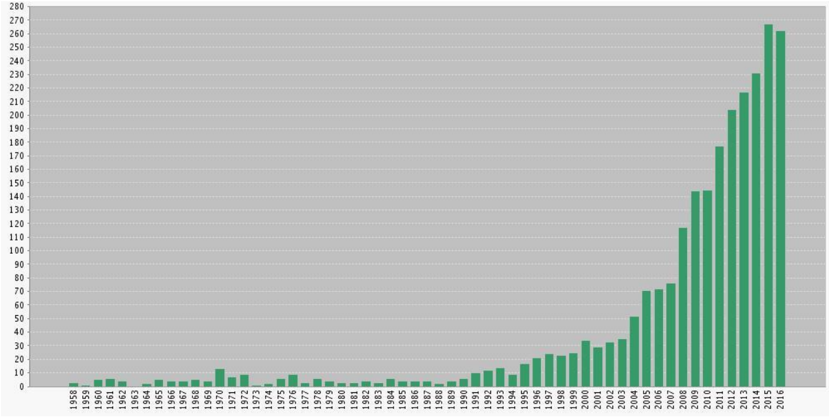
“Based on data drawn from the Web of Science , Figure 1 shows how the publication trend of articles covering civil war in political science, economics, and sociology slowly increases after the end of the Cold War and then takes off in the early 2000s after decades of very low publication activity.”
plainstates a cause- Asserted: passes — The authors put it forward as true.
- Checkable: passes — It can be checked against evidence.
- Load-bearing: unclear — It is unclear whether the paper’s conclusions depend on it.
- Based: passes — The paper gives a reason why it holds.
50 more claims
Create a free account to see all 117 claims and to verify the 20 references still open.
- It may state two separate claims as one. 24
- Probably not a substantial claim. 52
Claims other papers make about this one
Each is checked against this paper’s own text: does it say what the citing paper says it does?
The source backs part of the claim, not all of it — or backs it for a different population, condition or comparison.
In the citing paper
“Many consequences of the pandemic such as poor health, poverty and economic recession can lead to significant individual frustration, and are well-established predictors of armed conflict (Cederman & Vogt, 2017).”
From COVID-19 and armed conflict (2021) · cites this paper as Cederman & Vogt, 2017
Experimental — accuracy not yet measuredThe source backs part of the claim, not all of it — or backs it for a different population, condition or comparison.
In the citing paper
“Countries with a medium level of democracy and highly repressive regimes are empirically much more likely to experience civil wars than consolidated democracies (Cederman & Vogt, 2017).”
From COVID-19 and armed conflict (2021) · cites this paper as Cederman & Vogt, 2017
Experimental — accuracy not yet measured
Citations
Cites
The clash of civilizations and the remaking of world order
(1997) · Long Range Planning · doi:10.1016/s0024-6301(97)80966-1 · Cited by 7,457
Ethnicity, Insurgency, and Civil War
FEARON, J. D., & LAITIN, D. D. (2003) · American Political Science Review · doi:10.1017/s0003055403000534 · Cited by 7,366
Eley, G., & Gellner, E. (1984) · Contemporary Sociology · doi:10.2307/2070853 · Cited by 6,911
Greed and grievance in civil war
Collier, P. (2004) · Oxford Economic Papers · doi:10.1093/oep/gpf064 · Cited by 6,101
McAdam, D., Tarrow, S., & Tilly, C. (2001) · doi:10.1017/cbo9780511805431 · Cited by 5,558
States and Social Revolutions: A Comparative Analysis of France, Russia and China
Skocpol, T. (1979) · Cambridge University Press · doi:10.1017/cbo9780511815805 · Cited by 5,408 · cited 1×
“Reflecting the ideological confrontation between the super powers, civil wars were typically studied as “peasant rebellions” (Scott 1976) or “social revolutions” (Skocpol 1979).”
BackgroundThe Clash of Civilizations and the Remaking of the World Order
Evans, P., & Huntington, S. P. (1997) · Contemporary Sociology · doi:10.2307/2654621 · Cited by 4,865
From Mobilization to Revolution
Tilly, C. (2017) · Collective Violence, Contentious Politics, and Social Change · doi:10.4324/9781315205021-5 · Cited by 3,999
Armed Conflict 1946-2001: A New Dataset
GLEDITSCH, N. P., WALLENSTEEN, P., ERIKSSON, M., SOLLENBERG, M., & STRAND, H. (2002) · Journal of Peace Research · doi:10.1177/0022343302039005007 · Cited by 3,846 · cited 1×
“…civil war always concerns an incompatibility in terms of political control.1 Following the conventions of the Uppsala Conflict Data Program (N. P. Gleditsch et al. 2002, 619), we speak of governmental civil wars if the main objective of the challenger is full governmental control of the state.”
Background(1970) · Medical Entomology and Zoology · Cited by 3,500
Research works printed but not linked: 2
- Hechter Michael, 1975, Internal Colonialism: The Celtic Fringe in British National Development, 1536-1966
- Kaplan, Robert D. 1994. "The Coming Anarchy." Atlantic Monthly 273: 44-76.
Cited by
Items 101–200 of 203
Cleavage Types and Conflict in Multiethnic States: A Global Analysis
Vogt, M. (2019) · Oxford University Press eBooks · doi:10.1093/oso/9780190065874.003.0004
Self-citationInside Ethnic Movements: Ethnic Organizations as Catalysts of Competition or Emancipation
Vogt, M. (2019) · Oxford University Press eBooks · doi:10.1093/oso/9780190065874.003.0003
Self-citationProduction Possibilities and Economic Growth
Anderton, C. H., & Carter, J. R. (2019) · Cambridge University Press eBooks · doi:10.1017/9781316875506.002
Conclusion: United in Religion, Divided by Ethnicity?
Türkmen, G. (2021) · Oxford University Press eBooks · doi:10.1093/oso/9780197511817.003.0006
Ethnicity and “Muslim fraternity”
Türkmen, G. (2021) · Oxford University Press eBooks · doi:10.1093/oso/9780197511817.003.0001
“Islam as Cement”: The Way Out?
Türkmen, G. (2021) · Oxford University Press eBooks · doi:10.1093/oso/9780197511817.003.0003
“Green Kemalism”: The Evolving Role of Islam in the Kurdish Conflict
Türkmen, G. (2021) · Oxford University Press eBooks · doi:10.1093/oso/9780197511817.003.0002
Muslim Kurds: The Case for Religio-Ethnic Identity
Türkmen, G. (2021) · Oxford University Press eBooks · doi:10.1093/oso/9780197511817.003.0004
“Only Turks Can Lead a Muslim Union”: The Case for Ethno-Religious Identity
Türkmen, G. (2021) · Oxford University Press eBooks · doi:10.1093/oso/9780197511817.003.0005
Bargaining Theory of War and Peace
Anderton, C. H., & Carter, J. R. (2019) · Cambridge University Press eBooks · doi:10.1017/9781316875506.010
Moros of Mindanao: The Long and Treacherous Path to “Bangsamoro” Autonomy
Bertrand, J. (2021) · Cambridge University Press eBooks · doi:10.1017/9781108868082.006
Nature, Scope, and Interdependencies of Conflict and Economics
Anderton, C. H., & Carter, J. R. (2019) · Cambridge University Press eBooks · doi:10.1017/9781316875506.001
Nationalist Conflict in Democratic Contexts
Bertrand, J. (2021) · Cambridge University Press eBooks · doi:10.1017/9781108868082.003
Demonstrations, Grievance, and Civil Conflict
Basuchoudhary, A., Bang, J., David, J. A., & Sen, T. (2021) · Springer eBooks · doi:10.1007/978-3-030-81993-4_7
“Exit and Reframe”: From Cordillera “Nation” to “Indigenous Peoples”
Bertrand, J. (2021) · Cambridge University Press eBooks · doi:10.1017/9781108868082.007 · Cited by 1
Civil War as Discursive Dehumanisation
Pukallus, S. (2021) · Springer eBooks · doi:10.1007/978-3-030-86190-2_2
World Bank Engagement in Situations of Conflict
Independent Evaluation Group (2021) · World Bank, Washington, DC eBooks · doi:10.1596/36493
Bertrand, J. (2021) · Cambridge University Press eBooks · doi:10.1017/9781108868082.011
Bertrand, J. (2021) · Cambridge University Press eBooks · doi:10.1017/9781108868082.010
Bertrand, J. (2021) · Cambridge University Press eBooks · doi:10.1017/9781108868082.009
Bertrand, J. (2021) · Cambridge University Press eBooks · doi:10.1017/9781108868082.001
Conclusions for Theory and Policy
Ali, H. E., Cederman, L., & Weissberg, Y. A. (2022) · Springer eBooks · doi:10.1007/978-3-030-73558-6_9
Self-citationAli, H. E., & Cederman, L. (2022) · Springer eBooks · doi:10.1007/978-3-030-73558-6_1
Self-citationAnderton, C. H., & Carter, J. R. (2019) · Cambridge University Press eBooks · doi:10.1017/9781316875506.021
Anderton, C. H., & Carter, J. R. (2019) · Cambridge University Press eBooks · doi:10.1017/9781316875506.016
Anderton, C. H., & Carter, J. R. (2019) · Cambridge University Press eBooks · doi:10.1017/9781316875506.024
Arms Rivalry, Proliferation, and Arms Control
Anderton, C. H., & Carter, J. R. (2019) · Cambridge University Press eBooks · doi:10.1017/9781316875506.015
Brief Primer on Weapons Technologies
Anderton, C. H., & Carter, J. R. (2019) · Cambridge University Press eBooks · doi:10.1017/9781316875506.018
Anderton, C. H., & Carter, J. R. (2019) · Cambridge University Press eBooks · doi:10.1017/9781316875506.022
Anderton, C. H., & Carter, J. R. (2019) · Cambridge University Press eBooks · doi:10.1017/9781316875506.013
Anderton, C. H., & Carter, J. R. (2019) · Cambridge University Press eBooks · doi:10.1017/9781316875506.007
Geography and Technology of Conflict
Anderton, C. H., & Carter, J. R. (2019) · Cambridge University Press eBooks · doi:10.1017/9781316875506.009
Matrix Algebra Methods for Solving Network Models
Anderton, C. H., & Carter, J. R. (2019) · Cambridge University Press eBooks · doi:10.1017/9781316875506.020
Anderton, C. H., & Carter, J. R. (2019) · Cambridge University Press eBooks · doi:10.1017/9781316875506.011 · Cited by 1
Anderton, C. H., & Carter, J. R. (2019) · Cambridge University Press eBooks · doi:10.1017/9781316875506.012
Anderton, C. H., & Carter, J. R. (2019) · Cambridge University Press eBooks · doi:10.1017/9781316875506.023
Anderton, C. H., & Carter, J. R. (2019) · Cambridge University Press eBooks · doi:10.1017/9781316875506.025
Formal Bargaining Model of War and Peace
Anderton, C. H., & Carter, J. R. (2019) · Cambridge University Press eBooks · doi:10.1017/9781316875506.019
Anderton, C. H., & Carter, J. R. (2019) · Cambridge University Press eBooks · doi:10.1017/9781316875506.003
Anderton, C. H., & Carter, J. R. (2019) · Cambridge University Press eBooks · doi:10.1017/9781316875506.026
Bertrand, J. (2021) · Cambridge University Press eBooks · doi:10.1017/9781108868082.002
Agbedahin, K. (2020) · Peace Review · doi:10.1080/10402659.2020.1836444
Vogt, M. (2019) · Oxford University Press eBooks · doi:10.1093/oso/9780190065874.003.0001
Self-citationPapua: Failed Autonomy and Divided They Stand
Bertrand, J. (2021) · Cambridge University Press eBooks · doi:10.1017/9781108868082.005
Aceh: From Violent Insurgency to Broad-Based Autonomy
Bertrand, J. (2021) · Cambridge University Press eBooks · doi:10.1017/9781108868082.004 · Cited by 1
Anderton, C. H., & Carter, J. R. (2019) · Cambridge University Press eBooks · doi:10.1017/9781316875506.017
Bertrand, J. (2021) · Cambridge University Press eBooks · doi:10.1017/9781108868082.012
Conflict Success Functions and the Theory of Appropriation Possibilities
Anderton, C. H., & Carter, J. R. (2019) · Cambridge University Press eBooks · doi:10.1017/9781316875506.008
WITHDRAWN: Peace, Conflicts, and the Covid-19: A Meta-Analysis at Global LevelPreprint
Azadi, H., Ghazali, S., & Pour, M. (2023) · Research Square · doi:10.21203/rs.3.rs-2483921/v1
WITHDRAWN: Peace, Conflicts, and the Covid-19: A Meta-Analysis at Global LevelPreprint
(2023) · Research Square · doi:10.21203/rs.3.rs-2483921/v2
Çatışma dinamiklerinin etnik kimlikler üzerindeki etkisi: Suriye iç savaşı örneği
Sarı, A. (2023) · Istanbul Bilgi University · doi:10.47613/reflektif.2023.99
Elitlerin Etnik Kimlikleri Manipülasyonu: Suriye Örneği
Sarı, A. (2023) · Eskişehir Osmangazi Üniversitesi İktisadi ve İdari Bilimler Dergisi · doi:10.17153/oguiibf.1198111
Decision Making in Fragile Settings
Garcia, T. O. (2023) · eDiss (Georg-August-Universität Göttingen) · doi:10.53846/goediss-10138
Supplementary Material for Latin American Analyses
Vogt, M. (2019) · Oxford University Press eBooks · doi:10.1093/oso/9780190065874.005.0005
Self-citationVogt, M. (2019) · Oxford University Press eBooks · doi:10.1093/oso/9780190065874.002.0003
Self-citationVogt, M. (2019) · Oxford University Press eBooks · doi:10.1093/oso/9780190065874.002.0006
Self-citationEthnic Parties in Sub-Saharan Africa and Latin America
Vogt, M. (2019) · Oxford University Press eBooks · doi:10.1093/oso/9780190065874.005.0003
Self-citationVogt, M. (2019) · Oxford University Press eBooks · doi:10.1093/oso/9780190065874.005.0006
Self-citationThe EPR-ETH Data Set in Detail
Vogt, M. (2019) · Oxford University Press eBooks · doi:10.1093/oso/9780190065874.005.0001
Self-citationSupplementary Material for Global-Level Analyses
Vogt, M. (2019) · Oxford University Press eBooks · doi:10.1093/oso/9780190065874.005.0004
Self-citationCalculating Linguistic and Religious Segmentation
Vogt, M. (2019) · Oxford University Press eBooks · doi:10.1093/oso/9780190065874.005.0002
Self-citationTürkmen, G. (2021) · Oxford University Press eBooks · doi:10.1093/oso/9780197511817.002.0007
Türkmen, G. (2021) · Oxford University Press eBooks · doi:10.1093/oso/9780197511817.002.0003
Türkmen, G. (2021) · Oxford University Press eBooks · doi:10.1093/oso/9780197511817.002.0004
Türkmen, G. (2021) · Oxford University Press eBooks · doi:10.1093/oso/9780197511817.005.0001
Neighbours under the North Star: Civil wars in Finland and Korea
Park-Kang, S. (2024) · Asia Europe Journal · doi:10.1007/s10308-024-00697-x
“It is however possible to describe civil war as ‘armed combat within a sovereign state between an incumbent government and a nonstate challenger’ (Cederman and Vogt 2017: 1993).”
Abraham, J., Carlston, K., & Taninchev, S. B. (2024) · Small Wars and Insurgencies · doi:10.1080/09592318.2024.2393496 · Cited by 1
Productive and Destructive Group Contests: An Experimental Investigation
Cheikbossian, G., & Rosaz, J. (2024) · Journal of Conflict Resolution · doi:10.1177/00220027241290770
Dinamismo empresarial en contextos de conflicto armado en Colombia: un enfoque multidimensional
Quintero, F. A. C., & Silva, E. R. L. (2024) · European Public & Social Innovation Review · doi:10.31637/epsir-2025-1761
Kıbrıs, A., Cesur, R., Uler, N., & YILDIRIM, S. (2025) · SSRN Electronic Journal · doi:10.2139/ssrn.5175313
Por la Razón o por la Fuerza. La pacificación interna de América del Sur (1830-1929)
Madrid, R. L., & Schenoni, L. L. (2025) · AMÉRICA LATINA HOY · doi:10.14201/alh.31961
Escribà‐Folch, A., & Timoneda, J. C. (2025) · Oxford University Press eBooks · doi:10.1093/oxfordhb/9780198871996.013.4
Capitals Under Siege: Why Some Rebel Groups Achieve Victory While Others Fail
Uzonyi, G. (2025) · Comparative Political Studies · doi:10.1177/00104140251381767
“However, future scholars will likely fi nd it fruitful to consider how this “ opportunity-based ” logic can be integrated bargaining theories of con fl ict to provide a more holistic understanding of the civil war process (see Cederman & Vogt, 2017).”
The Russia-Ukraine War and Its Nature
Katchanovski, I. (2025) · Rethinking political violence · doi:10.1007/978-3-031-98724-3_9
How natural disasters spread conflict
Amarasinghe, A., Raschky, P. A., Zénou, Y., & Zhou, J. (2025) · European Economic Review · doi:10.1016/j.euroecorev.2025.105194 · Cited by 1
Does Ethnopolitical Exclusion Cause Civil War Onset via Grievances? Evidence from 15 Case Studies
Leipziger, L. E., Rørbæk, L. L., & Skaaning, S. (2025) · Perspectives on Politics · doi:10.1017/s1537592725103101 · Cited by 2
Admassu, T. F., & Tadesse, B. (2025) · Global Change Peace & Security · doi:10.1080/14781158.2025.2572070 · Cited by 2
“Grievance-based accounts view internal conflict as a response to political and socio-economic marginalisation, whereas greed-based explanations view conflict with individuals’ desire to maximise their profits (Cederman and Vogt 2017).”
The Positional Problem in civil wars
Perez, C. (2025) · Small Wars and Insurgencies · doi:10.1080/09592318.2025.2607403
Fontana, G., Kartsonaki, A., Neudorfer, N. S., & Wolff, S. (2026) · Oxford University Press eBooks · doi:10.1093/9780198993803.003.0006
Civil War Recurrence: The State of the Field
Fontana, G., Kartsonaki, A., Neudorfer, N. S., & Wolff, S. (2026) · Oxford University Press eBooks · doi:10.1093/9780198993803.003.0002
Fontana, G., Kartsonaki, A., Neudorfer, N. S., & Wolff, S. (2026) · Oxford University Press eBooks · doi:10.1093/9780198993803.003.0009
Conclusion: Preventing Civil War Recurrence
Fontana, G., Kartsonaki, A., Neudorfer, N. S., & Wolff, S. (2026) · Oxford University Press eBooks · doi:10.1093/9780198993803.003.0010
Fontana, G., Kartsonaki, A., Neudorfer, N. S., & Wolff, S. (2026) · Oxford University Press eBooks · doi:10.1093/9780198993803.003.0005
The Inclusion of Women in Post-Conflict Society
Fontana, G., Kartsonaki, A., Neudorfer, N. S., & Wolff, S. (2026) · Oxford University Press eBooks · doi:10.1093/9780198993803.003.0007
Fontana, G., Kartsonaki, A., Neudorfer, N. S., & Wolff, S. (2026) · Oxford University Press eBooks · doi:10.1093/9780198993803.002.0005
Fontana, G., Kartsonaki, A., Neudorfer, N. S., & Wolff, S. (2026) · Oxford University Press eBooks · doi:10.1093/9780198993803.002.0004
Introduction: Learning from Failure
Fontana, G., Kartsonaki, A., Neudorfer, N. S., & Wolff, S. (2026) · Oxford University Press eBooks · doi:10.1093/9780198993803.003.0001
Predicting the End of Recurrent Civil Wars
Fontana, G., Kartsonaki, A., Neudorfer, N. S., & Wolff, S. (2026) · Oxford University Press eBooks · doi:10.1093/9780198993803.003.0003
Fontana, G., Kartsonaki, A., Neudorfer, N. S., & Wolff, S. (2026) · Oxford University Press eBooks · doi:10.1093/9780198993803.003.0008
How to Prevent Civil War Recurrence: Learning from Failure
Fontana, G., Kartsonaki, A., Neudorfer, N. S., & Wolff, S. (2026) · doi:10.1093/9780198993803.001.0001
Recurrent and Non-Recurrent Civil Wars: Testing Hypotheses
Fontana, G., Kartsonaki, A., Neudorfer, N. S., & Wolff, S. (2026) · Oxford University Press eBooks · doi:10.1093/9780198993803.003.0004
Phạm, P. A., & Scholten, M. (2026) · Review of International Political Economy · doi:10.1080/09692290.2026.2629478 · Cited by 3
“QCA thus provides us with more external validity, making our results less prone to either overgeneralization or myopic micro-investigations (Cederman & Vogt, 2017).”
Angolan Contemporary Crónicas: A Constructive Lens
Trindade, A. D. (2026) · Palgrave studies in literary journalism · doi:10.1007/978-3-032-11627-7_3
Arjona, A. (2026) · Springer eBooks · doi:10.1007/978-3-032-06918-4_62-1 · Cited by 2
Exploring the Determinants of Civil War in Ethiopia: A Synthetic Approach
Waga, A. A. (2026) · SAGE Open · doi:10.1177/21582440251413882
“Studies, such as Cederman and Vogt (2017), Miguel et al. (2004), Gleditsch (2007), Djankov and Reynal-Querol (2010), and Buhaug and Gleditsch (2008), encourages researchers to employ a low threshold for coding battle-related deaths in wars.”
It takes three to tango: contested authority, violence, and rebel legitimacy in Colombia
Minatti, W. (2026) · Journal of Peace Research · doi:10.1093/jopres/xjag005
Three essays on conflict and economic performance in fragile countries
Rizvi, S. M. A.-E.-R. (2022) · theses.fr (ABES) · doi:10.70675/34797a64z4672z4dc0z9819z079edaef15c4 · Cited by 3
La médiation : un dispositif conceptuel pour repenser les Relations Internationales
Comair, C. (2023) · theses.fr (ABES) · doi:10.70675/e207de3bz0c7cz4d20zba9fza79be604da3a
Media Systems and Violent Conflicts: A Theoretical Framework and Patterns of Transformation
Farag, T., Neuberger, C., Kretzschmar, S., & Sehl, A. (2026) · The International Journal of Press/Politics · doi:10.1177/19401612261452109
Idler, A., Samper, J., & Tkacova, K. (2026) · International Studies Perspectives · doi:10.1093/isp/ekag004
Metadata
- Authors
- Cederman, L.-E., & Vogt, M.
- Affiliations
- ETH Zurich (CH)
- Corresponding author
- Cederman, Lars-Erik
- Venue
- Journal of Conflict Resolution
- Publisher
- SAGE Publications
- Published
- 2017-07-26
- Volume
- 61
- Issue
- 9
- Pages
- 1992-2016
- ISSN
- 0022-0027 (ISSN-L)
- 1552-8766
- OpenAlex
- W2738699469
- Cited by
- 214
- References
- 151
- Citations by year
- 2026: 30 · 2025: 16 · 2024: 21 · 2023: 16 · 2022: 17 · 2021: 36 · 2020: 10 · 2019: 58 · 2018: 6 · 2017: 3
- FWCI
- 40.43
- Type
- journal article
- Language
- en
- Open access
- green
- discovery.ucl.ac.uk
- Licence
- journals.sagepub.com/page/policies/text-and-data-mining-license (tdm)
- Locations
- Journal of Conflict Resolution (publishedVersion)
- UCL Discovery (University College London) (submittedVersion)
- RePEc: Research Papers in Economics (submittedVersion)
- Funders
- Schweizerischer Nationalfonds zur Förderung der Wissenschaftlichen Forschung (400240_171175)
- Topics
- Social Sciences › Sociology and Political Science › Political Conflict and Governance
- Social Sciences › Sociology and Political Science › Peacebuilding and International Security
- Social Sciences › Political Science and International Relations › Electoral Systems and Political Participation
- Keywords
- civil war, conflict termination, post-conflict reconstruction, greed, grievances, opportunity
About these checks
Registry, retraction, Cites and statistics results are computed, not judged, with one exception: a printed reference that no index lists is read once by a model before it counts as a citation error. Claims are extracted by a model and kept only when their quote appears verbatim in the text; each cited source is then checked, with a model’s help, for whether it says what the claim relies on. Those verdicts can be wrong — read the claim’s quote and the cited source before relying on one.
The claim verdicts this report counts are experimental: their accuracy is not yet measured.
A language model drew the claims from the paper on 2026-10-10, under version 3 of the claim definition (model deepseek-v4.1-flash, prompt extract-v3).
A second model labelled each claim on 2026-10-10 (model jev-1.13-20260917, definition revision gold-guideline-v0.2).
Cited sources are checked with a language model’s help (qwen3.8-omni-flash and gpt-6-sol).
Statistics and arithmetic are recomputed, not judged.
Confidence bands are shown only for fields calibrated on our annotated test set. None is calibrated yet, so no band is shown.
What counts as a claim ›How we measure confidence ›How we check this ›
Are you an author, or do you see a problem with this page? Request a review
Data sources
Bibliographic data: Semantic Scholar, OpenAlex, Crossref.
Contains information from the Semantic Scholar Academic Graph Datasets, made available under the ODC Attribution License (ODC-BY 1.0).
Semantic Scholar’s data is described in: Kinney, R., et al. (2023). The Semantic Scholar Open Data Platform. arXiv:2301.10140.
