

The Power of Brand Selfies
Open accessThe DOI matches its Crossref record; 55 of the 57 references it cites were found in a registry or an index.
Abstract
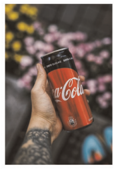
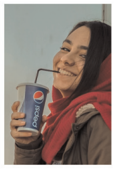
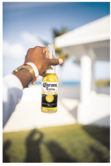
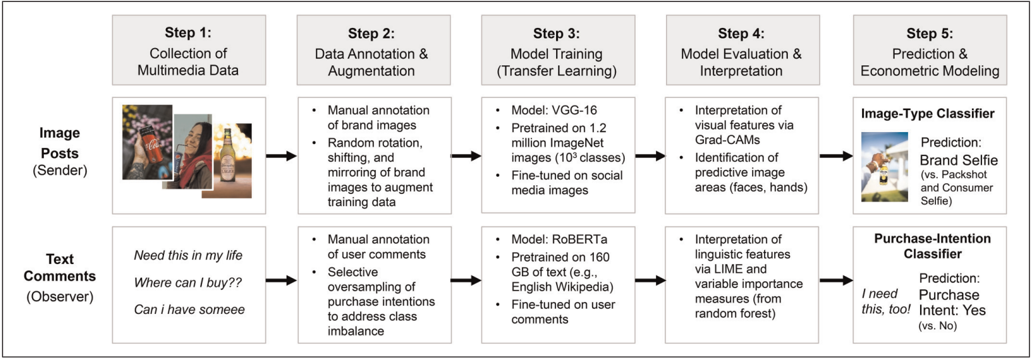
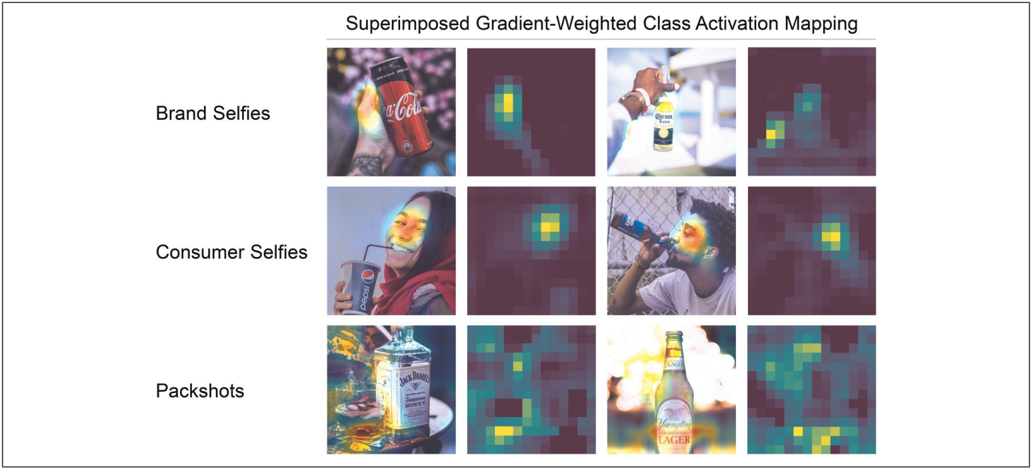
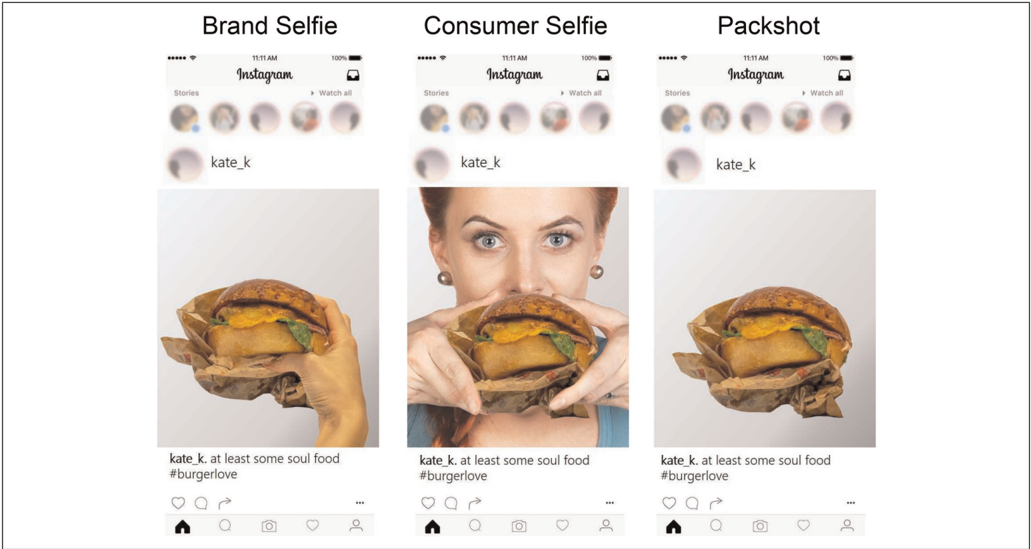
Smartphones have made it nearly effortless to share images of branded experiences. This research classifies social media brand imagery and studies user response. Aside from packshots (standalone product images), two types of brand-related selfie images appear online: consumer selfies (featuring brands and consumers’ faces) and an emerging phenomenon the authors term “brand selfies” (invisible consumers holding a branded product). The authors use convolutional neural networks to identify these archetypes and train language models to infer social media response to more than a quarter-million brand-image posts (185 brands on Twitter and Instagram). They find that consumer-selfie images receive more sender engagement (i.e., likes and comments), whereas brand selfies result in more brand engagement, expressed by purchase intentions. These results cast doubt on whether conventional social media metrics are appropriate indicators of brand engagement. Results for display ads are consistent with this observation, with higher click-through rates for brand selfies than for consumer selfies. A controlled lab experiment suggests that self-reference is driving the differential response to selfie images. Collectively, these results demonstrate how (interpretable) machine learning helps extract marketing-relevant information from unstructured multimedia content and that selfie images are a matter of perspective in terms of actual brand engagement.
Overview
The claims and statistics of this paper haven’t been checked yet.
Free: it reads the open-access text and checks the first 5 claims that cite a source we can check. Create a free account to check every claim.
Integrity signals
Registry
Cites
Statistics
Figures

Verification
Claims the paper makes
The claims and statistics of this paper haven’t been checked yet.
Free: it reads the open-access text and checks the first 5 claims that cite a source we can check. Create a free account to check every claim.
Claims other papers make about this one
Each is checked against this paper’s own text: does it say what the citing paper says it does?
The source backs part of the claim, not all of it — or backs it for a different population, condition or comparison.
In the citing paper
“RoBERTa, specifically fine-tuned on a corpus of over 5,000 social media posts [23], exhibits the highest accuracy in one of the Twitter dataset (see Table 2, Twitter Various II).”
From Sentiment Analysis in the Age of Generative AI (2024) · cites this paper as [23]
Experimental — accuracy not yet measured
Self-check
Percentages, sums and reported differences re-computed from the paper’s own numbers.
The self-check needs the paper’s full text.
Citations
Cites
Very Deep Convolutional Networks for Large-Scale Image Recognition
Simonyan, K., & Zisserman, A. (2014) · arXiv · doi:10.48550/arxiv.1409.1556 · Cited by 114,148 · cited 1×
“We chose VGG-16 as the underlying architecture because of its high performance on related tasks (Simonyan and Zisserman 2014).”
MethodImageNet: A large-scale hierarchical image database
Deng, J., Dong, W., Socher, R., Li, L.-J., Li, K., & Fei-Fei, L. (2009) · 2009 IEEE Conference on Computer Vision and Pattern Recognition · doi:10.1109/cvpr.2009.5206848 · Cited by 65,333 · cited 4×
“This approach allows us to adapt the CNN pretrained on the ImageNet data set to the particularities of user-generated social media images.”
MethodInfluentialPreacher, K. J., & Hayes, A. F. (2008) · Behavior Research Methods · doi:10.3758/brm.40.3.879 · Cited by 34,117 · cited 1×
“The statistical test based on 1,000 bootstrapping iterations to obtain standard errors for the (nonnormal) indirect effect of brand selfies (Preacher and Hayes 2008) also indicates mediation (confidence interval: [.22, .75], p .01).”
MethodGrad-CAM: Visual Explanations from Deep Networks via Gradient-Based Localization
Selvaraju, R. R., Cogswell, M., Das, A., Vedantam, R., Parikh, D., & Batra, D. (2017) · 2017 IEEE International Conference on Computer Vision (ICCV) · doi:10.1109/iccv.2017.74 · Cited by 24,513
"Why Should I Trust You?": Explaining the Predictions of Any Classifier
Ribeiro, M. T., Singh, S., & Guestrin, C. (2016) · Proceedings of the 22nd ACM SIGKDD International Conference on Knowledge Discovery and Data Mining · doi:10.1145/2939672.2939778 · Cited by 17,555
The Effect of Word of Mouth on Sales: Online Book Reviews
Chevalier, J. A., & Mayzlin, D. (2006) · Journal of Marketing Research · doi:10.1509/jmkr.43.3.345 · Cited by 6,003 · cited 2×
“For example, the amount and valence of aggregate UGC have proven useful as predictors of demand (Chevalier and Mayzlin 2006; Liu 2006), customerbased brand equity (Schweidel and Moe 2014), and stock returns (Colicev et al. 2018).”
BackgroundImageNet: A large-scale hierarchical image database
Deng, J. H., Dong, W. F., Socher, R., Li, L.-J., Li, K., & Fei-Fei, L. (2009) · IEEE Computer Society Conference on Computer Vision and Pattern Recognition/Proceedings - IEEE Computer Society Conference on Computer Vision and Pattern Recognition/Proceedings · doi:10.1109/cvprw.2009.5206848 · Cited by 2,714
Using Online Conversations to Study Word-of-Mouth Communication
Godes, D., & Mayzlin, D. (2004) · Marketing Science · doi:10.1287/mksc.1040.0071 · Cited by 2,601 · cited 1×
“The majority of this research has relied either on summaries of text content such as volume and valence (e.g., Chevalier and Mayzlin 2006; Godes and Mayzlin 2004; Liu 2006) or on automatic extraction of consumer perceptions in user-generated texts (e.g., Netzer et al. 2012; Timoshenko and Hauser…”
BackgroundThe self-reference effect in memory: A meta-analysis
Symons, C. S., & Johnson, B. T. (1997) · Psychological Bulletin · doi:10.1037/0033-2909.121.3.371 · Cited by 1,361 · cited 1×
“…to their own personal experiences in brand selfies can generate higher levels of cognitive elaboration and mental simulation of brand consumption (Bower and Gilligan 1979; Escalas 2007), which has been linked to higher levels of brand engagement (Elder and Krishna 2012; Symons and Johnson 1997).”
BackgroundWord of Mouth for Movies: Its Dynamics and Impact on Box Office Revenue
Liu, Y. (2006) · Journal of Marketing · doi:10.1509/jmkg.70.3.074 · Cited by 1,329 · cited 2×
“…this research has relied either on summaries of text content such as volume and valence (e.g., Chevalier and Mayzlin 2006; Godes and Mayzlin 2004; Liu 2006) or on automatic extraction of consumer perceptions in user-generated texts (e.g., Netzer et al. 2012; Timoshenko and Hauser 2019;…”
BackgroundMethod
Research works printed but not linked: 3
- Guido, Gianluigi, Marco Pichierri, and Giovanni Pino (2018), ' Effects of Face Images and Face Pareidolia on Consumers ' Responses to Print Advertising: An Empirical Investigation, ' Journal of Advertising Research , 58 (3), 1 -13.
- Liu, Yinhan, Myle Ott, Naman Goyal, Jingfei Du, Mandar Joshi, Danqi Chen, et al. (2019), ' RoBERTa: A Robustly Optimized BERT Pretraining Approach, ' arXiv , https://arxiv.org/abs/1907. 11692.
- Pennebaker, James W., Ryan L. Boyd, Kayla Jordan, and Kate Blackburn (2015), The Development and Psychometric Properties of LIWC2015 . Austin, TX: University of Texas at Austin.
Cited by
Uniting the Tribes: Using Text for Marketing Insight
Berger, J., Humphreys, A., Ludwig, S., Moe, W. W., Netzer, O., & Schweidel, D. A. (2020) · Journal of Marketing · doi:10.1177/0022242919873106 · Cited by 742
Self-citationMachine learning and AI in marketing–Connecting computing power to human insights
Ma, L., & Sun, B. (2020) · International Journal of Research in Marketing · doi:10.1016/j.ijresmar.2020.04.005 · Cited by 602
More than a Feeling: Accuracy and Application of Sentiment Analysis
Hartmann, J., Heitmann, M., Siebert, C., & Schamp, C. (2023) · International Journal of Research in Marketing · doi:10.1016/j.ijresmar.2022.05.005 · Cited by 356
Self-citationShrestha, Y. R., Krishna, V., & von Krogh, G. (2021) · Journal of Business Research · doi:10.1016/j.jbusres.2020.09.068 · Cited by 331
Algorithmic bias in machine learning-based marketing models
Akter, S., Dwivedi, Y. K., Sajib, S., Biswas, K., Bandara, R. J., & Michael, K. (2022) · Journal of Business Research · doi:10.1016/j.jbusres.2022.01.083 · Cited by 242
The power of generative marketing: Can generative AI create superhuman visual marketing content?
Hartmann, J., Exner, Y., & Domdey, S. (2025) · International Journal of Research in Marketing · doi:10.1016/j.ijresmar.2024.09.002 · Cited by 229
Self-citationSentiment Analysis in the Age of Generative AI
Krugmann, J. O., & Hartmann, J. (2024) · Customer Needs and Solutions · doi:10.1007/s40547-024-00143-4 · Cited by 189
“RoBERTa, specifically fine-tuned on a corpus of over 5,000 social media posts [23], exhibits the highest accuracy in one of the Twitter dataset (see Table 2, Twitter Various II).”
Self-citationHow Sensory Language Shapes Influencer’s Impact
Rizzo, G. L. C., Berger, J. A., Angelis, M. D., & Pozharliev, R. (2023) · Journal of Consumer Research · doi:10.1093/jcr/ucad017 · Cited by 203
Can Consumer-Posted Photos Serve as a Leading Indicator of Restaurant Survival? Evidence from Yelp
Zhang, M., & Luo, L. (2016) · Management Science · doi:10.1287/mnsc.2022.4359 · Cited by 197
Engagement That Sells: Influencer Video Advertising on TikTok
Yang, J., Zhang, J., & Zhang, Y. (2021) · Marketing Science · doi:10.1287/mksc.2021.0107 · Cited by 145
Advancing algorithmic bias management capabilities in AI-driven marketing analytics research
Akter, S., Sultana, S., Mariani, M. M., Wamba, S. F., Spanaki, K., & Dwivedi, Y. K. (2023) · Industrial Marketing Management · doi:10.1016/j.indmarman.2023.08.013 · Cited by 138
Marketing Insights from Multimedia Data: Text, Image, Audio, and Video
Grewal, R., Gupta, S., & Hamilton, R. (2021) · Journal of Marketing Research · doi:10.1177/00222437211054601 · Cited by 108
“Hartmann et al. (2021) obtain data from a vendor that has Twitter-firehose access to a random sample of 10% of all tweets. Lee (2021) obtains over 160,000 tweets of luxury brands of shoulder bags, which include over 91,000 images, and scrapes the official websites of the brands to obtain prices. Toubia (2021) download…”
BackgroundMethodInfluentialWords Meet Photos: When and Why Photos Increase Review Helpfulness
Ceylan, G., Diehl, K., & Proserpio, D. (2023) · Journal of Marketing Research · doi:10.1177/00222437231169711 · Cited by 121
Li, Y. (., & Wan, L. C. (2024) · Tourism Management · doi:10.1016/j.tourman.2024.104969 · Cited by 112
Leveraging the Power of Images in Managing Product Return Rates
Dzyabura, D., El Kihal, S., Hauser, J. R., & Ibragimov, M. (2023) · Marketing Science · doi:10.1287/mksc.2023.1451 · Cited by 71
Deng, N., & Liu, J. (2021) · Journal of Destination Marketing & Management · doi:10.1016/j.jdmm.2021.100632 · Cited by 101
Understanding videos at scale: How to extract insights for business research
Schwenzow, J., Hartmann, J., Schikowsky, A., & Heitmann, M. (2020) · Journal of Business Research · doi:10.1016/j.jbusres.2020.09.059 · Cited by 89
Self-citationMachine Learning and Marketing: A Systematic Literature Review
Duarte, V., Zúñiga-Jara, S., & Contreras, S. A. (2022) · IEEE Access · doi:10.1109/access.2022.3202896 · Cited by 95
Tchuente, D., Lonlac, J., & Kamsu-Foguem, B. (2023) · Computers in Industry · doi:10.1016/j.compind.2023.104044 · Cited by 85
Yoo, J. J. (2023) · Journal of Retailing and Consumer Services · doi:10.1016/j.jretconser.2023.103517 · Cited by 89
Athaide, G. A., Jeon, J., Raj, S. P., Sivakumar, K., & Xiong, G. (2024) · Journal of Product Innovation Management · doi:10.1111/jpim.12741 · Cited by 86
Kanuri, V. K., Hughes, C., & Hodges, B. T. (2023) · International Journal of Research in Marketing · doi:10.1016/j.ijresmar.2023.08.007 · Cited by 76
From words to pixels: text and image mining methods for service research
Ordenes, F. J. V., & Zhang, S. (2019) · Journal of service management · doi:10.1108/josm-08-2019-0254 · Cited by 73
Ordenes, F. J. V., & Silipo, R. (2021) · Journal of Business Research · doi:10.1016/j.jbusres.2021.08.036 · Cited by 66
Brüns, J. D., & Meißner, M. (2023) · Computers in Human Behavior · doi:10.1016/j.chb.2023.107891 · Cited by 55
Picture Perfect: Engaging Customers with Visual Generative AI
Heitmann, M., Jansen, T. P. J., Reisenbichler, M., & Schweidel, D. A. (2026) · Journal of Marketing · doi:10.1177/00222429251356993 · Cited by 55
Self-citationA review of policy levers to reduce meat production and consumption
Bryant, C. J., Couture, A. L., Ross, E., Clark, A., & Chapman, T. (2024) · Appetite · doi:10.1016/j.appet.2024.107684 · Cited by 53
Xiao, Q., Huang, W., Qu, L., & Li, X. (2024) · Journal of Retailing and Consumer Services · doi:10.1016/j.jretconser.2024.104136 · Cited by 49
Look the Part? The Role of Profile Pictures in Online Labor Markets
Troncoso, I., & Luo, L. (2020) · Marketing Science · doi:10.1287/mksc.2022.1425 · Cited by 49
Gu, W., Chan, K. W., Kwon, J., Dhaoui, C., & Septianto, F. (2023) · Industrial Marketing Management · doi:10.1016/j.indmarman.2023.04.012 · Cited by 60
Hartmann, J., Bergner, A., & Hildebrand, C. (2023) · Journal of Consumer Psychology · doi:10.1002/jcpy.1381 · Cited by 42
Self-citationConsuming for content? Understanding social media-centric consumption
Shah, D., Webster, E., & Kour, G. (2022) · Journal of Business Research · doi:10.1016/j.jbusres.2022.113408 · Cited by 47
Rogova, N., & Matta, S. (2022) · AMS Review · doi:10.1007/s13162-022-00237-z · Cited by 45
“Consumers actively engage in the use of digital networks, spreading online word of mouth or even posting brand selfies on their social media (Hartmann et al., 2021; Stephen, 2016).”
BackgroundWhat drives virtual influencers’ impact?
Rizzo, G. L. C., Ordenes, F. J. V., & Berger, J. A. (2026) · Journal of the Academy of Marketing Science · doi:10.1007/s11747-026-01185-x · Cited by 40
Natural Language Processing in Marketing
Hartmann, J., & Netzer, O. (2023) · Artificial Intelligence in Marketing · doi:10.1108/s1548-643520230000020011 · Cited by 38
Self-citationVisual Modality of Engagement: Conceptualization, Typology of Forms, and Outcomes
Azer, J., Blasco‐Arcas, L., & Alexander, M. (2023) · Journal of Service Research · doi:10.1177/10946705231190867 · Cited by 41
“Images of customers using the brand may result in more favorable brand-and other customer-related outcomes than pictures that lack facial presence (Hartmann et al. 2021), therefore, experiential VME could stimulate more favorable outcomes compared to evidential VME.”
BackgroundMethodResultInfluentialHartmann, J., Schwenzow, J., & Witte, M. (2023) · arXiv · doi:10.48550/arxiv.2301.01768 · Cited by 37
“…argumentation style, ChatGPT seldom speaks in the first person about itself (on average, only 1% of the words are first-person pronouns, SD = 2% ), which is significantly lower than the share humans commonly use in everyday language (36) and emphasizes ChatGPT’s seemingly objective reasoning.”
Self-citationPresentation of celebrities’ private life through visual social media
Klostermann, J., Meißner, M., Max, A., & Decker, R. (2022) · Journal of Business Research · doi:10.1016/j.jbusres.2022.113524 · Cited by 39
Lu, Z. Y., Jung, S., & Peck, J. (2023) · Journal of Consumer Research · doi:10.1093/jcr/ucad059 · Cited by 37
Caño-Marín, E., Soriano, D. R., Mardani, A., & González‐Tejero, C. B. (2023) · Sustainable Technology and Entrepreneurship · doi:10.1016/j.stae.2023.100047 · Cited by 44
A content-based metric for social media influencer marketing
Chang, S., & Wu, J. (2023) · Industrial Management & Data Systems · doi:10.1108/imds-05-2022-0303 · Cited by 44
Artificial Intelligence Applications to Customer Feedback Research: A Review
Lee, P. S., Chakraborty, I., & Banerjee, S. (2023) · Emerald Group Publishing Limited eBooks · doi:10.1108/s1548-643520230000020010 · Cited by 39
Baier, D., Decker, R., & Asenova, Y. (2025) · Schmalenbach Journal of Business Research · doi:10.1007/s41471-025-00208-7 · Cited by 38
Image features and demand in the sharing economy: A study of Airbnb
He, J., Li, B., & Wang, X. (2023) · International Journal of Research in Marketing · doi:10.1016/j.ijresmar.2023.04.001 · Cited by 36
Gaanoun, K., & Alsuhaibani, M. (2025) · Humanities and Social Sciences Communications · doi:10.1057/s41599-024-04181-0 · Cited by 31
Leveraging AI for Content Generation: A Customer Equity Perspective
Schweidel, D. A., Reisenbichler, M., Reutterer, T., & Zhang, K. (2023) · Emerald Group Publishing Limited eBooks · doi:10.1108/s1548-643520230000020006 · Cited by 42
Navigating the Digital Odyssey: AI-Driven Business Models in Industry 4.0
Ji, F. Q., Zhou, Y., Zhang, H., Cheng, G., & Luo, Q. (2024) · Journal of the Knowledge Economy · doi:10.1007/s13132-024-02096-4 · Cited by 40
“The intricate secondary effects observed underscore the complex relationships between TECH-AUTO-PRIV and TECH-INNP-PRIV pathways, revealing the multifaceted nature of ongoing digital transformation extensively studied by Frank et al. (2019) and Hartmann et al. (2021).”
Leveraging blockchain for industry funding: A social media analysis
González‐Tejero, C. B., Caño-Marín, E., Ulrich, K., & Escobar, S. G. (2024) · Sustainable Technology and Entrepreneurship · doi:10.1016/j.stae.2024.100071 · Cited by 30
Is Relevancy Everything? A Deep-Learning Approach to Understand the Effect of Image-Text Congruence
Cao, J., Li, X., & Zhang, L. (2025) · Management Science · doi:10.1287/mnsc.2022.01896 · Cited by 34
Beyond text: Marketing strategy in a world turned upside down
Wang, X., Bendle, N. T., & Pan, Y. (2024) · Journal of the Academy of Marketing Science · doi:10.1007/s11747-023-01000-x · Cited by 33
Video Influencers: Unboxing the MystiquePreprint
Rajaram, P., & Manchanda, P. (2020) · SSRN Electronic Journal · doi:10.2139/ssrn.3752107 · Cited by 32
Exaggeration of emotional responses in online communication
Caspi, A., & Etgar, S. (2023) · Computers in Human Behavior · doi:10.1016/j.chb.2023.107818 · Cited by 29
Dzyabura, D., Kihal, S. E., & Peres, R. (2021) · Springer eBooks · doi:10.1007/978-3-319-57413-4_38 · Cited by 28
Computer Vision Models for Image Analysis in Advertising Research
Li, H., & Zhang, N. (2024) · Journal of Advertising · doi:10.1080/00913367.2024.2407644 · Cited by 26
“Hartmann et al. (2021) investigated the influence of image quality in brand selfies on Twitter and Instagram, revealing its significant impact on brand engagement.”
Standing Out While Fitting In: Visual Design of Text Overlays in Social Media Communication
Farace, S., Ordenes, F. J. V., Herhausen, D., Grewal, D., & de Ruyter, K. (2025) · Journal of Marketing · doi:10.1177/00222429251322773 · Cited by 31
Gal, D., & Simonson, I. (2020) · Consumer Psychology Review · doi:10.1002/arcp.1068 · Cited by 34
How construal–regulatory mode fit increases social media sharing
Pham, T. N., Septianto, F., Mathmann, F., Jin, H. S., & Higgins, E. T. (2023) · Journal of Consumer Psychology · doi:10.1002/jcpy.1375 · Cited by 25
Detecting Hate Speech Utilizing Deep Convolutional Network and Transformer Models
Mittal, U. (2023) · International Conference on Electrical, Electronics, Communication and Computers (ELEXCOM) · doi:10.1109/elexcom58812.2023.10370502 · Cited by 25
“The Stemming technique has been applied to remove word suffix and to reduce them to their roots, and Lemmatization is implemented, to account the context and convert the word to its base root form[13][5].”
MethodEmerging Sources, Formats, Channels, Devices, and Audiences in Modern eWOM Communications
Filieri, R., Christodoulides, G., & Nicolau, J. L. (2025) · Psychology and Marketing · doi:10.1002/mar.22239 · Cited by 26
Schröder, N., Schultz, C. D., Paetz, F., Grządziel, A., & Clegg, M. (2025) · Schmalenbach Journal of Business Research · doi:10.1007/s41471-025-00214-9 · Cited by 34
Nanne, A. J., Antheunis, M. L., & van Noort, G. (2020) · Computers in Human Behavior · doi:10.1016/j.chb.2020.106628 · Cited by 26
Gestalt food presentation: Its influence on visual appeal and engagement in the Instagram context
Lee, J., Lim, H., & Kim, W. G. (2024) · Tourism Management · doi:10.1016/j.tourman.2024.105080 · Cited by 25
The Economics of Artificial Intelligence: A Marketing Perspective
Ding, M., & Goldfarb, A. (2023) · Emerald Group Publishing Limited eBooks · doi:10.1108/s1548-643520230000020002 · Cited by 26
Vyas, Y., & Vishwakarma, P. (2026) · International Journal of Consumer Studies · doi:10.1111/ijcs.70170 · Cited by 26
Designing Brand Cocreation Activities to Increase Digital Consumer Engagement
Dretsch, H. J., Kirmani, A., & Lundberg, J. (2023) · Journal of Interactive Marketing · doi:10.1177/10949968231191097 · Cited by 21
“…most of the papers examine factors inherent to one type of BICoC activity (e.g., brand stories, brand-related sel fi e images; Gensler et al. 2013; Hartmann et al. 2021), or consumers ’ motivations for consumer – brand engagement (De Vries et al. 2017; Haverila, Haverila, and McLaughlin 2022;…”
BackgroundRaza, M., Khalid, R., Loureirco, S. M. C., & Han, H. (2024) · Journal of Retailing and Consumer Services · doi:10.1016/j.jretconser.2024.103850 · Cited by 18
Confidence is Good? too Much, not so Much: Exploring the effects on crowdfunding success
Moy, N., Chan, H. F., Septianto, F., Mathmann, F., & Torgler, B. (2024) · Journal of Business Research · doi:10.1016/j.jbusres.2024.114711 · Cited by 18
How universities can use social media for student acquisition
Tran, H.-A., Evanschitzky, H., Ludwig, S., Nguyen, B., Grewal, D., Farrell, A. M., & Ackfeldt, A. (2026) · Journal of the Academy of Marketing Science · doi:10.1007/s11747-025-01131-3 · Cited by 20
“To measure signals of interaction, environment, and outcome quality in the tweets’ content, we fine-tuned a Bidirectional Encoder Representations from Transformers (BERT) model (Liu et al., 2019), using a semi-supervised learning approach (e.g., Hartmann et al., 2021).”
An AI Method to Score Celebrity Visual Potential
Feng, X., Zhang, S., Liu, X., Srinivasan, K., & Lamberton, C. P. (2021) · Journal of Marketing Research · doi:10.1177/00222437251323238 · Cited by 17
Brusch, I. (2022) · Information & Management · doi:10.1016/j.im.2022.103682 · Cited by 16
Industry-sensitive language modeling for business
Borchert, P., Coussement, K., Weerdt, J. D., & Caigny, A. D. (2024) · European Journal of Operational Research · doi:10.1016/j.ejor.2024.01.023 · Cited by 15
Mathmann, F., Chrysochou, P., Tiganis, A., & Martin, B. A. S. (2024) · Psychology and Marketing · doi:10.1002/mar.22114 · Cited by 15
Talking with Your Hands: How Hand Gestures Influence Communication
Rizzo, G. L. C., Berger, J. A., & Zhou, M. (2026) · Journal of Marketing Research · doi:10.1177/00222437251385922 · Cited by 17
Zuschke, N. (2023) · Journal of Behavioral Decision Making · doi:10.1002/bdm.2320 · Cited by 14
Deep Learning in Marketing: A Review and Research Agenda
Liu, X. (2023) · Emerald Group Publishing Limited eBooks · doi:10.1108/s1548-643520230000020014 · Cited by 24
Computer vision in branding: A conceptual framework and future research agenda
Li, Y., Lee, H. H. M., & Blasco‐Arcas, L. (2025) · Journal of Business Research · doi:10.1016/j.jbusres.2025.115329 · Cited by 16
Li, F. S., Ma, J., & Jin, X. (2025) · Tourism Management · doi:10.1016/j.tourman.2025.105199 · Cited by 13
Robustness of models addressing Information Disorder: A comprehensive review and benchmarking study
Fenza, G., Loia, V., Stanzione, C., & Gisi, M. D. (2024) · Neurocomputing · doi:10.1016/j.neucom.2024.127951 · Cited by 12
The impact of visual, auditory, textual stimuli on crowdfunding: evidence from tourism projects
Chen, Y., Hu, T., & Law, R. (2024) · Current Issues in Tourism · doi:10.1080/13683500.2024.2378608 · Cited by 12
“Hartmann et al. (2021) used ImageNet CNN and migration learning to find the occurrence of brand names in images.”
Wang, X., Ding, Y., & Hu, Y. (2025) · International Journal of Research in Marketing · doi:10.1016/j.ijresmar.2025.02.003 · Cited by 13
Dang, C., Kwan, C. M. C., Jia, J. S., & Shi, Y. (2025) · Journal of Marketing Research · doi:10.1177/00222437251373042 · Cited by 12
Hauser, J. R., Li, Z., & Mao, C. (2023) · Emerald Group Publishing Limited eBooks · doi:10.1108/s1548-643520230000020007 · Cited by 12
Let me take a #selfie #variety: How consumer selfie affects variety seeking
Jeong, H., Wang, C., & Suri, R. (2023) · Psychology and Marketing · doi:10.1002/mar.21827 · Cited by 13
Hey brand, let me take a selfie to get you out of the crisis
Raza, M., Khalid, R., & Raza, H. (2023) · Journal of Hospitality and Tourism Insights · doi:10.1108/jhti-05-2023-0334 · Cited by 14
-generAItor: Tree-in-the-loop Text Generation for Language Model Explainability and Adaptation
Spinner, T., Kehlbeck, R., Sevastjanova, R., Stähle, T., Keim, D. A., Deußen, O., & El‐Assady, M. (2024) · ACM Transactions on Interactive Intelligent Systems · doi:10.1145/3652028 · Cited by 15
“The sentiment is estimated by applying a three-class RoBERTa-based sentiment classifier, which was trained on social media posts [Hartmann et al. 2021].”
MethodWang, X., Xin-ying, H., Wu, Z., Du, J., & Zhu, L. (2024) · Journal of Retailing and Consumer Services · doi:10.1016/j.jretconser.2024.104172 · Cited by 11
Mining Consumer Mindset Metrics With User-Generated Content
Kübler, R. V., Adler, S. J., Welke, L., Sarstedt, M., & Pauwels, K. H. (2025) · Schmalenbach Journal of Business Research · doi:10.1007/s41471-025-00219-4 · Cited by 13
“Fewer studies, however, have gone one step further and used non-numeric UGC, such as images (Dzyabura et al. 2023; Hartmann et al. 2021), audio (Wang et al. 2021), or video (Zhou et al. 2021) to capture consumer or brand insights.”
Nanne, A. J., Antheunis, M. L., & van Noort, G. (2023) · Journal of Interactive Advertising · doi:10.1080/15252019.2023.2282967 · Cited by 11
“A common type of visual Br-UGC is a branded selfie, where consumers depict themselves together with the brand (Hartmann et al. 2021).”
BackgroundWang, F., Yue, M., Yuan, Q., & Cao, R. Z. (2024) · Marketing Intelligence & Planning · doi:10.1108/mip-12-2022-0570 · Cited by 10
Alyahya, M. A., Agag, G., & Abdelwahab, M. S. T. (2026) · Journal of Retailing and Consumer Services · doi:10.1016/j.jretconser.2026.104803 · Cited by 10
Marketing Through the Machine's Eyes: Image Analytics and Interpretability
Feng, X., Zhang, S., & Srinivasan, K. (2023) · Emerald Group Publishing Limited eBooks · doi:10.1108/s1548-643520230000020013 · Cited by 13
Bye-bye Bias: What to Consider When Training Generative AI Models on Subjective Marketing Metrics
Schamp, C., Hartmann, J., & Herhausen, D. (2024) · NIM Marketing Intelligence Review · doi:10.2478/nimmir-2024-0007 · Cited by 11
Self-citationClassification Using Decision Tree Ensembles
Hartmann, J. (2019) · Emerald Group Publishing Limited eBooks · doi:10.1108/978-1-83909-694-520211011 · Cited by 9
Self-citationA bibliometric and content analysis of marketing-finance interface research from 1986–2021
Liao, Q., Yang, L., & Lim, E. J. (2023) · Journal of Business & Finance Librarianship · doi:10.1080/08963568.2023.2263984 · Cited by 10
“An emerging trend in marketing research is the use of image (L. Liu et al., 2020; Dzyabura & Peres, 2021; Hartmann et al., 2021), audio (X. S. Wang et al., 2021), and video mining (Li et al., 2019).”
BackgroundGross, J., & Lunardo, R. (2023) · Marketing Letters · doi:10.1007/s11002-023-09707-1 · Cited by 10
“Given the opportunities provided by Instagram to post pictures and captions (Hartmann et al., 2021), we decided to use this platform for data collection.”
Wolfsteiner, E., Garaus, M., Wagner, U., & Girschick, A. (2022) · International Journal of Advertising · doi:10.1080/02650487.2022.2095836 · Cited by 10
Wang, Y., & Ying, X. (2026) · Journal of theoretical and applied electronic commerce research · doi:10.3390/jtaer21010024 · Cited by 9
“On the visual side, research on visual social media suggests that human face cues are strongly associated with attention and social presence; in influencer and brand-selfie contexts, showing a real human face can foster perceived closeness and parasocial relationships [31,32].”
Audio and Visual Analytics in Marketing and Artificial Empathy
Lu, S., Kim, H., Zhou, Y., Xiao, L., & Ding, M. (2022) · Foundations and Trends® in Marketing · doi:10.1561/1700000067 · Cited by 8
Ulqinaku, A., Kadić‐Maglajlić, S., & Sarial‐Abi, G. (2023) · Internet Research · doi:10.1108/intr-01-2023-0064 · Cited by 8
Park, S., Kim, D., Jeong, E., Jeong, D., & Park, E. (2025) · Technology in Society · doi:10.1016/j.techsoc.2025.102852 · Cited by 8
Metadata
- Authors
- Hartmann, J., Heitmann, M., Schamp, C., & Netzer, O.
- Affiliations
- Universität Hamburg (DE)
- Corresponding author
- Hartmann, Jochen
- Heitmann, Mark
- Schamp, Christina
- Netzer, Oded
- Venue
- Journal of Marketing Research
- Publisher
- SAGE Publications
- Published
- 2021-10-16
- Volume
- 58
- Issue
- 6
- Pages
- 1159-1177
- ISSN
- 0022-2437 (ISSN-L)
- 1547-7193
- OpenAlex
- W3198767726
- Cited by
- 184
- References
- 57
- Citations by year
- 2026: 45 · 2025: 42 · 2024: 39 · 2023: 37 · 2022: 15 · 2021: 4
- FWCI
- 32.92
- Type
- journal article
- Language
- en
- Open access
- hybrid
- doi.org
- Licence
- Locations
- Journal of Marketing Research (publishedVersion, cc-by-nc)
- ePubWU Institutional Repository (Wirtschaftsuniversität Wien) (submittedVersion, cc-by-nc)
- WU Research (submittedVersion, cc-by-nc)
- mediaTUM – the media and publications repository of the Technical University Munich (Technical University Munich) (submittedVersion)
- University of Groningen research database (University of Groningen / Centre for Information Technology) (submittedVersion, cc-by-nc)
- Funders
- German Research Foundation (HE 6703/1-2)
- Topics
- Social Sciences › Business, Management and Accounting › Marketing › Digital Marketing and Social Media
- Social Sciences › Business, Management and Accounting › Marketing › Consumer Behavior in Brand Consumption and Identification
- Social Sciences › Business, Management and Accounting › Marketing › Marketing and Advertising Strategies
- Keywords
- brand engagement, self-reference, purchase intention, display advertising, click-through rate, image classification, convolutional neural networks, model interpretability, Instagram, Twitter, smartphones
About these checks
Registry, retraction, Cites and statistics results are computed, not judged, with one exception: a printed reference that no index lists is read once by a model before it counts as a citation error. Claims are extracted by a model and kept only when their quote appears verbatim in the text; each cited source is then checked, with a model’s help, for whether it says what the claim relies on. Those verdicts can be wrong — read the claim’s quote and the cited source before relying on one.
Statistics and arithmetic are recomputed, not judged.
Confidence bands are shown only for fields calibrated on our annotated test set. None is calibrated yet, so no band is shown.
What counts as a claim ›How we measure confidence ›How we check this ›
Are you an author, or do you see a problem with this page? Request a review
Data sources
Bibliographic data: Semantic Scholar, OpenAlex, Crossref.
Contains information from the Semantic Scholar Academic Graph Datasets, made available under the ODC Attribution License (ODC-BY 1.0).
Semantic Scholar’s data is described in: Kinney, R., et al. (2023). The Semantic Scholar Open Data Platform. arXiv:2301.10140.
