

The DOI matches its Crossref record; 95 of the 96 references it cites were found in a registry or an index, and 1 are not checked yet.
Validation of the Psychological Insight Scale: A new scale to assess psychological insight following a psychedelic experience
Open accessAbstract
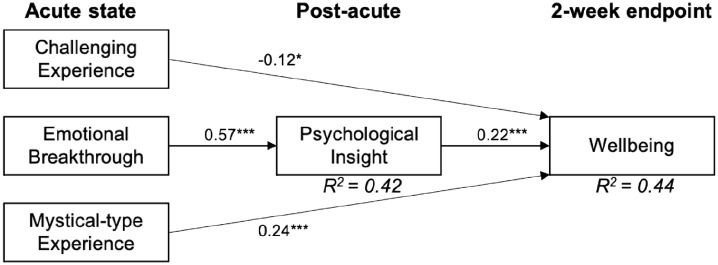
Introduction: As their name suggests, ‘psychedelic’ (mind-revealing) compounds are thought to catalyse processes of psychological insight; however, few satisfactory scales exist to sample this. This study sought to develop a new scale to measure psychological insight after a psychedelic experience: the Psychological Insight Scale (PIS). Methods: The PIS is a six- to seven-item questionnaire that enquires about psychological insight after a psychedelic experience (PIS-6) and accompanied behavioural changes (PIS item 7). In total, 886 participants took part in a study in which the PIS and other questionnaires were completed in a prospective fashion in relation to a planned psychedelic experience. For validation purposes, data from 279 participants were analysed from a non-specific ‘global psychedelic survey’ study. Results: Principal components analysis of PIS scores revealed a principal component explaining 73.57% of the variance, which displayed high internal consistency at multiple timepoints throughout the study (average Cronbach’s α = 0.94). Criterion validity was confirmed using the global psychedelic survey study, and convergent validity was confirmed via the Therapeutic-Realizations Scale. Furthermore, PIS scores significantly mediated the relationship between emotional breakthrough and long-term well-being. Conclusion: The PIS is complementary to current subjective measures used in psychedelic studies, most of which are completed in relation to the acute experience. Insight – as measured by the PIS – was found to be a key mediator of long-term psychological outcomes following a psychedelic experience. Future research may investigate how insight varies throughout a psychedelic process, its underlying neurobiology and how it impacts behaviour and mental health.
Overview
The claims and statistics of this paper haven’t been checked yet.
Run the check — free, no account needed. It reads the open-access text and checks the sources it cites.
Integrity signals
Registry
Cites
Statistics
Figures
Verification
Claims the paper makes
The claims and statistics of this paper haven’t been checked yet.
Run the check — free, no account needed. It reads the open-access text and checks the sources it cites.
Claims other papers make about this one
Each is checked against this paper’s own text: does it say what the citing paper says it does?
The cited source says what the claim attributes to it.
In the citing paper
“The Psychological Insight Scale (Peill et al., 2022) was developed to quantify psychological insight gained in the time following a psychedelic experience, rather than during a psychedelic experience, as the PIQ does.”
From Assessment of the acute subjective psychedelic experience: A review of patient-reported outcome measures in clinical research on classical psychedelics (2024) · cites this paper as Peill et al., 2022
Self-check
Percentages, sums and reported differences re-computed from the paper’s own numbers.
The self-check needs the paper’s full text.
Citations
Cites
Coefficient Alpha and the Internal Structure of Tests
Cronbach, L. J. (1951) · Psychometrika · doi:10.1007/bf02310555 · Cited by 43,931
Principles and Practice of Structural Equation Modeling
Tabri, N., & Elliott, C. M. (2012) · Canadian Graduate Journal of Sociology and Criminology · doi:10.15353/cgjsc.v1i1.3787 · Cited by 39,094
The Scree Test For The Number Of Factors
Cattell, R. B. (1966) · Multivariate Behavioral Research · doi:10.1207/s15327906mbr0102_10 · Cited by 13,554
The Warwick-Edinburgh Mental Well-being Scale (WEMWBS): development and UK validation
Tennant, R., Hiller, L., Fishwick, R., Platt, S., Joseph, S., Weich, S., Parkinson, J., Secker, J., & Stewart-Brown, S. (2007) · Health and Quality of Life Outcomes · doi:10.1186/1477-7525-5-63 · Cited by 5,031
Beyond the pleasure principle.
Freud, S. (1922) · The International Psycho-Analytical Press eBooks · doi:10.1037/11189-000 · Cited by 1,714
Ross, S., Bossis, A., Guss, J., Agin-Liebes, G., Malone, T., Cohen, B., Mennenga, S. E., Belser, A., Kalliontzi, K., Babb, J., et al. (2016) · Journal of Psychopharmacology · doi:10.1177/0269881116675512 · Cited by 1,698
Journal of Psychotherapy Practice and Research
Terrell, C. D. (1993) · JAMA · doi:10.1001/jama.1993.03510010107047 · Cited by 1,686
Griffiths, R. R., Richards, W. A., McCann, U., & Jesse, R. (2006) · Psychopharmacology · doi:10.1007/s00213-006-0457-5 · Cited by 1,684
Feldman, G., Hayes, A., Kumar, S., Greeson, J., & Laurenceau, J.-P. (2007) · Journal of Psychopathology and Behavioral Assessment · doi:10.1007/s10862-006-9035-8 · Cited by 1,630
Effects of Psilocybin-Assisted Therapy on Major Depressive Disorder: A Randomized Clinical Trial
Davis, A. K., Barrett, F. S., May, D. G., Cosimano, M. P., Sepeda, N. D., Johnson, M. W., Finan, P. H., & Griffiths, R. R. (2021) · JAMA Psychiatry · doi:10.1001/jamapsychiatry.2020.3285 · Cited by 1,301
Human hallucinogen research: guidelines for safety
Johnson, M., Richards, W., & Griffiths, R. (2008) · Journal of Psychopharmacology · doi:10.1177/0269881108093587 · Cited by 1,203
Psilocybin with psychological support for treatment-resistant depression: six-month follow-up
Carhart-Harris, R. L., Bolstridge, M., Day, C. M. J., Rucker, J., Watts, R., Erritzoe, D. E., Kaelen, M., Giribaldi, B., Bloomfield, M., Pilling, S., et al. (2018) · Psychopharmacology · doi:10.1007/s00213-017-4771-x · Cited by 970
Self-citationReligions, Values, and Peak-Experiences
Jones, R. G., & Maslow, A. H. (1965) · Journal for the Scientific Study of Religion · doi:10.2307/1384286 · Cited by 949
Griffiths, R., Richards, W., Johnson, M., McCann, U., & Jesse, R. (2008) · Journal of Psychopharmacology · doi:10.1177/0269881108094300 · Cited by 905
MacLean, K. A., Johnson, M. W., & Griffiths, R. R. (2011) · Journal of Psychopharmacology · doi:10.1177/0269881111420188 · Cited by 895
Roseman, L., Nutt, D. J., & Carhart-Harris, R. L. (2018) · Frontiers in Pharmacology · doi:10.3389/fphar.2017.00974 · Cited by 808
Self-citationSafety, tolerability, and efficacy of psilocybin in 9 patients with obsessive-compulsive disorder
Moreno, F. A., Wiegand, C. B., Taitano, E. K., & Delgado, P. L. (2006) · The Journal of Clinical Psychiatry · doi:10.4088/jcp.v67n1110 · Cited by 789
THE SELF-REFLECTION AND INSIGHT SCALE: A NEW MEASURE OF PRIVATE SELF-CONSCIOUSNESS
Grant, A. M., Franklin, J., & Langford, P. (2002) · Social Behavior and Personality: an international journal · doi:10.2224/sbp.2002.30.8.821 · Cited by 772
The Therapeutic Potential of Psychedelic Drugs: Past, Present, and Future
Carhart-Harris, R. L., & Goodwin, G. M. (2017) · Neuropsychopharmacology · doi:10.1038/npp.2017.84 · Cited by 706 · cited 1×
“A growing body of evidence supports the potential utility of psychedelic compounds for aiding the treatment of numerous psychiatric disorders (for reviews, see Aday et al., 2020; Andersen et al., 2021; Carhart-Harris and Goodwin, 2017).”
BackgroundSelf-citationPsychometric evaluation of the altered states of consciousness rating scale (OAV)
Studerus, E., Gamma, A., & Vollenweider, F. X. (2010) · PLoS ONE · doi:10.1371/journal.pone.0012412 · Cited by 683
Validation of the revised Mystical Experience Questionnaire in experimental sessions with psilocybin
Barrett, F. S., Johnson, M. W., & Griffiths, R. R. (2015) · Journal of Psychopharmacology · doi:10.1177/0269881115609019 · Cited by 637
Carbonaro, T. M., Bradstreet, M. P., Barrett, F. S., MacLean, K. A., Jesse, R., Johnson, M. W., & Griffiths, R. R. (2016) · Journal of Psychopharmacology · doi:10.1177/0269881116662634 · Cited by 596
Watts, R., Day, C., Krzanowski, J., Nutt, D., & Carhart-Harris, R. (2017) · Journal of Humanistic Psychology · doi:10.1177/0022167817709585 · Cited by 589
Self-citationGriffiths, R. R., Johnson, M. W., Richards, W. A., Richards, B. D., Jesse, R., MacLean, K. A., Barrett, F. S., Cosimano, M. P., & Klinedinst, M. A. (2018) · Journal of Psychopharmacology · doi:10.1177/0269881117731279 · Cited by 520
Gasser, P., Kirchner, K., & Passie, T. (2015) · Journal of Psychopharmacology · doi:10.1177/0269881114555249 · Cited by 456
Predicting responses to psychedelics: a prospective study
Haijen, E. C. H. M., Kaelen, M., Roseman, L., Timmermann, C., Kettner, H., Russ, S., Nutt, D., Daws, R. E., Hampshire, A. D. G., Lorenz, R., et al. (2018) · Frontiers in Pharmacology · doi:10.3389/fphar.2018.00897 · Cited by 417
Self-citationEmotional breakthrough and psychedelics: Validation of the Emotional Breakthrough Inventory
Roseman, L., Haijen, E., Idialu-Ikato, K., Kaelen, M., Watts, R., & Carhart-Harris, R. (2019) · Journal of Psychopharmacology · doi:10.1177/0269881119855974 · Cited by 413
Self-citationMacLean, K. A., Leoutsakos, J. S., Johnson, M. W., & Griffiths, R. R. (2012) · Journal for the Scientific Study of Religion · doi:10.1111/j.1468-5906.2012.01685.x · Cited by 405
Davis, A. K., Barrett, F. S., & Griffiths, R. R. (2020) · Journal of Contextual Behavioral Science · doi:10.1016/j.jcbs.2019.11.004 · Cited by 375
Barrett, F. S., Bradstreet, M. P., Leoutsakos, J.-M. S., Johnson, M. W., & Griffiths, R. R. (2016) · Journal of Psychopharmacology · doi:10.1177/0269881116678781 · Cited by 366 · cited 8×
“Studies have reported mixed results for the relationship between challenging experiences and long-term psychological outcome (Barrett et al., 2016; Carbonaro et al., 2016; Haijen et al., 2018).”
BackgroundMethodResultInfluentialThe Causal Foundations of Structural Equation Modeling
Pearl, J. (2012) · Defense Technical Information Center (DTIC) · doi:10.21236/ada557445 · Cited by 363
Andersen, K. A. A., Carhart‐Harris, R., Nutt, D. J., & Erritzoe, D. (2021) · Acta Psychiatrica Scandinavica · doi:10.1111/acps.13249 · Cited by 347
Self-citationPsychedelic Psychiatry’s Brave New World
Nutt, D., Erritzøe, D., & Carhart-Harris, R. L. (2020) · Cell · doi:10.1016/j.cell.2020.03.020 · Cited by 339
Self-citationKrygier, J. R., Heathers, J. A. J., Shahrestani, S., Abbott, M., Gross, J. J., & Kemp, A. H. (2013) · International Journal of Psychophysiology · doi:10.1016/j.ijpsycho.2013.06.017 · Cited by 327
Social Constraints, Intrusive Thoughts, and Mental Health after Prostate Cancer
Lepore, S. J., & Helgeson, V. S. (1998) · Journal of Social and Clinical Psychology · doi:10.1521/jscp.1998.17.1.89 · Cited by 321
Insight, Rumination, and Self-Reflection as Predictors of Well-Being
Harrington, R., & Loffredo, D. A. (2010) · The Journal of Psychology · doi:10.1080/00223980.2010.528072 · Cited by 317
Belser, A. B., Agin-Liebes, G., Swift, T. C., Terrana, S., Devenot, N., Friedman, H. L., Guss, J., Bossis, A., & Ross, S. (2017) · Journal of Humanistic Psychology · doi:10.1177/0022167817706884 · Cited by 311
Galderisi, S. (2018) · Giornale italiano di psicopatologia/Journal of psychopathology/Italian journal of psychopathology · Cited by 306
Psychedelic therapy for smoking cessation: qualitative analysis of participant accounts
Noorani, T., Garcia-Romeu, A., Swift, T. C., Griffiths, R. R., & Johnson, M. W. (2018) · Journal of Psychopharmacology · doi:10.1177/0269881118780612 · Cited by 285
Long-term effects of psychedelic drugs: A systematic review
Aday, J. S., Mitzkovitz, C. M., Bloesch, E. K., Davoli, C. C., & Davis, A. K. (2020) · Neuroscience & Biobehavioral Reviews · doi:10.1016/j.neubiorev.2020.03.017 · Cited by 279
The phenomenon of quantum change
Miller, W. R. (2004) · Journal of Clinical Psychology · doi:10.1002/jclp.20000 · Cited by 275
Classic Hallucinogens and Mystical Experiences: Phenomenology and Neural Correlates
Barrett, F. S., & Griffiths, R. R. (2017) · Current Topics in Behavioral Neurosciences · doi:10.1007/7854_2017_474 · Cited by 273
Effects of psilocybin therapy on personality structure
Erritzoe, D., Roseman, L., Nour, M. M., MacLean, K., Kaelen, M., Nutt, D. J., & Carhart‐Harris, R. L. (2018) · Acta Psychiatrica Scandinavica · doi:10.1111/acps.12904 · Cited by 267
Self-citationMaheswaran, H., Weich, S., Powell, J., & Stewart-Brown, S. (2012) · Health and Quality of Life Outcomes · doi:10.1186/1477-7525-10-156 · Cited by 265 · cited 1×
“Hence, this scale can be used to investigate the improvement or change in well-being within subject and at a group level (Maheswaran et al., 2012).”
MethodSanz, M. A. G., CONSTABLE, G., Lopez-Ibor, I., KEMP, R., & David, A. S. (1998) · Psychological Medicine · doi:10.1017/s0033291797006296 · Cited by 264
Cessation and reduction in alcohol consumption and misuse after psychedelic use
Garcia-Romeu, A., Davis, A. K., Erowid, F., Erowid, E., Griffiths, R. R., & Johnson, M. W. (2019) · Journal of Psychopharmacology · doi:10.1177/0269881119845793 · Cited by 225
Mixed Methods Research: Exploring the Interactive Continuum
Ridenour, C. S. (2010) · Asian Journal of English Language Teaching · doi:10.65961/ajelt-2010-1-013 · Cited by 210
Obsessive–compulsive disorder with poor insight: A three-year prospective study
Catapano, F., Perris, F., Fabrazzo, M., Cioffi, V., Giacco, D., Santis, V. D., & Maj, M. (2009) · Progress in Neuro-Psychopharmacology and Biological Psychiatry · doi:10.1016/j.pnpbp.2009.12.007 · Cited by 199
Brouwer, A., & Carhart-Harris, R. L. (2020) · Journal of Psychopharmacology · doi:10.1177/0269881120959637 · Cited by 174
Self-citationGarcia‐Romeu, A., Davis, A. K., Erowid, E., Erowid, F., Griffiths, R. R., & Johnson, M. W. (2020) · Frontiers in Psychiatry · doi:10.3389/fpsyt.2019.00955 · Cited by 171
Association Between Insight and Outcome of Psychotherapy: Systematic Review and Meta-Analysis
Jennissen, S., Huber, J., Ehrenthal, J. C., Schauenburg, H., & Dinger, U. (2018) · American Journal of Psychiatry · doi:10.1176/appi.ajp.2018.17080847 · Cited by 169
Davis, A. K., Barrett, F. S., So, S., Gukasyan, N., Swift, T. C., & Griffiths, R. R. (2021) · Journal of Psychopharmacology · doi:10.1177/0269881120967878 · Cited by 169
Davis, A. K., Clifton, J. M., Weaver, E. G., Hurwitz, E. S., Johnson, M. W., & Griffiths, R. R. (2020) · Journal of Psychopharmacology · doi:10.1177/0269881120916143 · Cited by 148
Socioeconomic gradients and mental health: implications for public health
Stewart-Brown, S. L., Samaraweera, P. C., Taggart, F. M., Kandala, N.-B., & Stranges, S. (2015) · The British Journal of Psychiatry · doi:10.1192/bjp.bp.114.147280 · Cited by 146
Belvederi Murri, M., Respino, M., Innamorati, M., Cervetti, A., Calcagno, P., Pompili, M., Lamis, D. A., Ghio, L., & Amore, M. (2015) · Schizophrenia Research · doi:10.1016/j.schres.2015.01.003 · Cited by 142
Carhart-Harris, R. L. (2018) · Current Opinion in Psychiatry · doi:10.1097/yco.0000000000000467 · Cited by 141
Self-citationPsychotherapy with lysergic acid diethylamide
EISNER, B. G., & COHEN, S. (1958) · The Journal of Nervous and Mental Disease · doi:10.1097/00005053-195812000-00006 · Cited by 138
Timmermann, C., Watts, R., & Dupuis, D. (2022) · Transcultural Psychiatry · doi:10.1177/13634615221082796 · Cited by 136
Self-citationBogenschutz, M. P., & Pommy, J. M. (2012) · Drug Testing and Analysis · doi:10.1002/dta.1376 · Cited by 130
Hanley, A. W., Nakamura, Y., & Garland, E. L. (2018) · Psychological Assessment · doi:10.1037/pas0000615 · Cited by 130
The mediating role of insight for long-term improvements in psychodynamic therapy.
Johansson, P., Høglend, P. A., Ulberg, R., Amlo, S., Marble, A., Bøgwald, K., Sørbye, Ø., Sjaastad, M. C., & Heyerdahl, O. (2010) · Journal of Consulting and Clinical Psychology · doi:10.1037/a0019245 · Cited by 125
Psychedelic microdosing: a subreddit analysis
Lea, T., Amada, N., & Jungaberle, H. (2020) · Journal of Psychoactive Drugs · doi:10.1080/02791072.2019.1683260 · Cited by 115 · cited 1×
“Many studies have suggested that insight is a common, if not fundamental, property of the psychedelic experience (Carbonaro et al., 2020; Carhart-Harris and Nutt, 2010; Davis et al., 2020b, 2021a; GarciaRomeu et al., 2019a; Lea et al., 2020; Savage et al., 1966; Sellers et al., 2018).”
BackgroundBrief mindfulness meditation improves emotion processing
Wu, R., Liu, L.-L., Zhu, H., Su, W.-J., Cao, Z.-Y., Zhong, S.-Y., Liu, X.-H., & Jiang, C.-L. (2019) · Frontiers in Neuroscience · doi:10.3389/fnins.2019.01074 · Cited by 110
The development of the inventory of countertransference behavior
Friedman, S. M., & Gelso, C. J. (2000) · Journal of Clinical Psychology · doi:10.1002/1097-4679(200009)56:9 · Cited by 109
Insight, but not self-reflection, is related to subjective well-being
Lyke, J. A. (2008) · Personality and Individual Differences · doi:10.1016/j.paid.2008.09.010 · Cited by 107
Carhart-Harris, R. L., & Nutt, D. (2010) · Journal of Substance Use · doi:10.3109/14659890903271624 · Cited by 106
Self-citationWilliams, M. T., Davis, A. K., Xin, Y., Sepeda, N. D., Grigas, P. C., Sinnott, S., & Haeny, A. M. (2021) · Drugs: Education, Prevention and Policy · doi:10.1080/09687637.2020.1854688 · Cited by 101
Stein, D. J., & Grant, A. M. (2014) · The Journal of Psychology · doi:10.1080/00223980.2013.810128 · Cited by 98
Grief and emotion: A social–functional perspective.
Bonanno, G. A. (2001) · American Psychological Association eBooks · doi:10.1037/10436-021 · Cited by 97
Clinical picture of obsessive-compulsive disorder with poor insight: A regression model
Bellino, S., Patria, L., Ziero, S., & Bogetto, F. (2005) · Psychiatry Research · doi:10.1016/j.psychres.2004.04.015 · Cited by 88
Evaluating self-reflection and insight as self-conscious traits
Silvia, P. J., & Phillips, A. G. (2010) · Personality and Individual Differences · doi:10.1016/j.paid.2010.09.035 · Cited by 84
Emotional experience and alliance contribute to therapeutic change in psychodynamic therapy.
Fisher, H., Atzil–Slonim, D., Bar‐Kalifa, E., Rafaeli, E., & Peri, T. (2016) · Psychotherapy · doi:10.1037/pst0000041 · Cited by 82
Olthof, M., Hasselman, F., Strunk, G., Aas, B., Schiepek, G. K., & Lichtwarck‐Aschoff, A. (2019) · Psychotherapy Research · doi:10.1080/10503307.2019.1633484 · Cited by 78
More Realistic Forecasting of Future Life Events After Psilocybin for Treatment-Resistant Depression
Lyons, T., & Carhart-Harris, R. L. (2018) · Frontiers in Psychology · doi:10.3389/fpsyg.2018.01721 · Cited by 77
Self-citationSantini, Z. I., Stougaard, S. W., Koyanagi, A., Ersbøll, A. K., Nielsen, L., Hinrichsen, C., Madsen, K. R., Meilstrup, C., Stewart-Brown, S. L., & Koushede, V. (2020) · European Journal of Public Health · doi:10.1093/eurpub/ckaa021 · Cited by 69
The epistemic innocence of psychedelic states
Letheby, C. (2016) · Consciousness and Cognition · doi:10.1016/j.concog.2015.11.012 · Cited by 67
Day trip to hell: A mixed methods study of challenging psychedelic experiences
Johnstad, P. G. (2021) · Journal of Psychedelic Studies · doi:10.1556/2054.2021.00155 · Cited by 61
Kolden, G. G. (1991) · Psychotherapy Research · doi:10.1080/10503309112331334071 · Cited by 60
Psilocybin and Obsessive Compulsive Disorder
WILCOX, J. A. (2014) · Journal of Psychoactive Drugs · doi:10.1080/02791072.2014.963754 · Cited by 58
Carbonaro, T. M., Johnson, M. W., & Griffiths, R. R. (2020) · Psychopharmacology · doi:10.1007/s00213-020-05533-9 · Cited by 56
Insight in Cognitive-Behavioral Therapy.
Holtforth, M. G., Castonguay, L. G., Boswell, J. F., Wilson, L. A., Kakouros, A. A., & Borkovec, T. D. (2007) · American Psychological Association eBooks · doi:10.1037/11532-003 · Cited by 56
Studies with psychedelic drugs in human volunteers
Sellers, E. M., Romach, M. K., & Leiderman, D. B. (2018) · Neuropharmacology · doi:10.1016/j.neuropharm.2017.11.029 · Cited by 42
Clinical insight in anorexia nervosa: Associated and predictive factors
Gorwood, P., Duriez, P., Lengvenyte, A., Guillaume, S., & Criquillion, S. (2019) · Psychiatry Research · doi:10.1016/j.psychres.2019.112561 · Cited by 42
Positive Affects and the Transformation of Suffering into Flourishing
Fosha, D. (2009) · Annals of the New York Academy of Sciences · doi:10.1111/j.1749-6632.2009.04501.x · Cited by 41
Hallucinogenic Drugs and their Psychotherapeutic Use.
Zelnick, H. M. (1964) · Journal of Medicinal Chemistry · doi:10.1021/jm00331a036 · Cited by 39
Moksha: Aldous Huxley's Classic Writings on Psychedelics and the Visionary Experience
Huxley, A., Horowitz, M., & Palmer, C. L. (1977) · Cited by 37
The effects of psychedelic (LSD) therapy on values, personality, and behavior.
Savage, C., Fadiman, J., Mogar, R. E., & Allen, M. H. (1966) · PubMed · Cited by 33
Gori, A., Craparo, G., Giannini, M., Loscalzo, Y., Caretti, V., Barbera, D. L., Manzoni, G. M., Castelnuovo, G., Tani, F., Ponti, L., et al. (2015) · Schizophrenia Research · doi:10.1016/j.schres.2015.10.014 · Cited by 32
Psychodynamic psychotherapy, insight, and therapeutic action
Lacewing, M. (2014) · Clinical Psychology: Science and Practice · doi:10.1111/cpsp.12065 · Cited by 27 · cited 2×
“…and experiences is thought to help reduce symptoms by enabling individuals to first understand their difficulties, reduce distorted negative beliefs and, eventually act on, and master these difficulties through conscious cognitive and behavioural changes (Lacewing, 2014; Rosenblatt, 2004).”
BackgroundTimmermann, C. B., Watts, R., & Dupuis, D. (2020) · doi:10.31234/osf.io/j5768 · Cited by 27
Self-citationHübner, S., Haijen, E. C. H. M., Kaelen, M., Carhart-Harris, R. L., & Kettner, H. (2021) · Journal of Medical Internet Research · doi:10.2196/25973 · Cited by 20
Self-citationCorrelation Between Insight Level and Suicidal Behavior/Ideation in Bipolar Depression
da Silva, R. D. A., Mograbi, D. C., Bifano, J., Santana, C. M. T., & Cheniaux, E. (2016) · Psychiatric Quarterly · doi:10.1007/s11126-016-9432-4 · Cited by 17
Insight, Working Through, and Practice: The Role of Procedural Knowledge
Rosenblatt, A. D. (2004) · Journal of the American Psychoanalytic Association · doi:10.1177/00030651040520011901 · Cited by 14
Nakajima, M., Takano, K., & Tanno, Y. (2017) · Personality and Individual Differences · doi:10.1016/j.paid.2017.08.033 · Cited by 14
Effective microprocesses in early sessions of dynamic psychotherapy.
Kolden, G. G. (1996) · PubMed · Cited by 11
Theory of Psychoanalytic Therapy
Altman, L. L. (1964) · Journal of the American Psychoanalytic Association · doi:10.1177/000306516401200312 · Cited by 5
Research works printed but not linked: 7
- Acock AC, 2014, A Gentle Introduction to Stata
- Dittrich A, 2010, 5D-ASC: Questionnaire for the assessment of altered states of consciousness – A short introduction
- Fisher FM, 2015, Therapy with Substance: Psycholytic Psychotherapy in the Twenty First Century
- Greenberg L, 1987, The Guilford Clinical Psychology and Psychotherapy Series – Emotion in Psychotherapy: Affect, Cognition, and the Process of Change
- Grof S, 1980, LSD Psychotherapy
- Pahnke WN, 1963, Drugs and Mysticism: An Analysis of the Relationship between Psychedelic Drugs and the Mystical Consciousness: A Thesis
- Savage C, 1966, International Journal of Neuropsychiatry, 2, 241
Cited by
Sorted by citations
Canalization and plasticity in psychopathology
Carhart-Harris, R. L., Chandaria, S., Erritzøe, D., Gazzaley, A. H., Girn, M., Kettner, H., Mediano, P. A. M., Nutt, D. J., Rosas, F. E., Roseman, L., et al. (2022) · Neuropharmacology · doi:10.1016/j.neuropharm.2022.109398 · Cited by 107
Self-citationKangaslampi, S. (2023) · Journal of Psychedelic Studies · doi:10.1556/2054.2023.00243 · Cited by 111
Schneier, F. R., Feusner, J., Wheaton, M. G., Gomez, G. J., Cornejo, G., Naraindas, A. M., & Hellerstein, D. J. (2023) · Journal of Psychiatric Research · doi:10.1016/j.jpsychires.2023.03.031 · Cited by 81
Levin, A. W., Lancelotta, R., Sepeda, N. D., Gukasyan, N., Nayak, S., Wagener, T. L., Barrett, F. S., Griffiths, R. R., & Davis, A. K. (2024) · PLoS ONE · doi:10.1371/journal.pone.0300501 · Cited by 82
Antidepressant effects of a psychedelic experience in a large prospective naturalistic sample
Nygart, V. A., Pommerencke, L. M., Haijen, E. C. H. M., Kettner, H., Kaelen, M., Mortensen, E. L., Nutt, D. J., Carhart-Harris, R. L., & Erritzøe, D. (2022) · Journal of Psychopharmacology · doi:10.1177/02698811221101061 · Cited by 79
Self-citation
Metadata
- Authors
- Peill, J. M., Trinci, K. E., Kettner, H., Mertens, L. J., Roseman, L., Timmermann, C., Rosas, F. E., Lyons, T., & Carhart-Harris, R. L.
- Affiliations
- Imperial College London (GB)
- University College London (GB)
- University of California, San Francisco (US)
- Corresponding author
- Trinci, Katie E
- ORCID
- Venue
- Journal of Psychopharmacology
- Publisher
- SAGE Publications
- Published
- 2022-01
- Volume
- 36
- Issue
- 1
- Pages
- 31-45
- ISSN
- 0269-8811 (ISSN-L)
- 1461-7285
- PMC
- PMC8801624
- OpenAlex
- W4206700491
- Cited by
- 141
- References
- 96
- Citations by year
- 2026: 23 · 2025: 22 · 2024: 36 · 2023: 47 · 2022: 13
- FWCI
- 26.94
- Type
- journal article
- Language
- en
- Open access
- hybrid
- doi.org
- Locations
- Journal of Psychopharmacology (publishedVersion, cc-by)
- PubMed Central (publishedVersion, cc-by)
- PubMed (publishedVersion)
- UCL Discovery (University College London) (submittedVersion)
- eScholarship (California Digital Library) (submittedVersion, cc-by)
- Spiral (Imperial College London) (submittedVersion, other-oa)
- Topics
- Social Sciences › Psychology › Clinical Psychology › Psychedelics and Drug Studies
- Social Sciences › Psychology › Social Psychology › Paranormal Experiences and Beliefs
- Social Sciences › Health › Religion, Spirituality, and Psychology
- Keywords
- psychological insight, psychedelic experience, scale validation, long-term well-being, subjective outcome measures
- MeSH terms
- Adult, Aged, Awareness, Female, Hallucinogens, Humans, Male, Middle Aged, Prospective Studies, Psychometrics, Surveys and Questionnaires, Principal Component Analysis, Young Adult
About these checks
Registry, retraction, Cites and statistics results are computed, not judged, with one exception: a printed reference that no index lists is read once by a model before it counts as a citation error. Claims are extracted by a model and kept only when their quote appears verbatim in the text; each cited source is then checked, with a model’s help, for whether it says what the claim relies on. Those verdicts can be wrong — read the claim’s quote and the cited source before relying on one.
Statistics and arithmetic are recomputed, not judged.
Confidence bands are shown only for fields calibrated on our annotated test set. None is calibrated yet, so no band is shown.
What counts as a claim ›How we measure confidence ›How we check this ›
Are you an author, or do you see a problem with this page? Request a review
