

Diffusion policy: Visuomotor policy learning via action diffusion
The DOI matches its Crossref record; 84 of the 87 references it cites were found in a registry or an index; 16 of the 39 sources its claims cite were checked for support.
Abstract
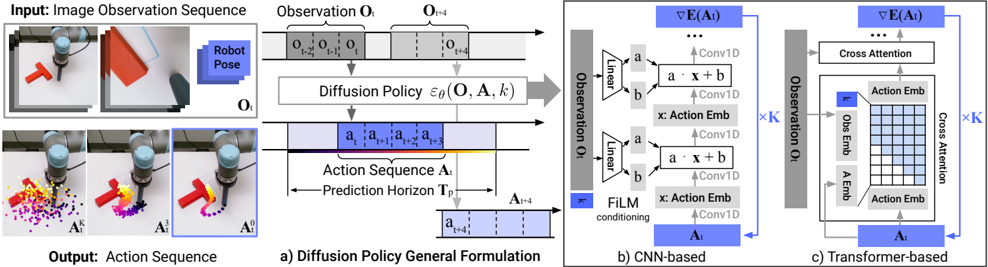
This paper introduces Diffusion Policy, a new way of generating robot behavior by representing a robot’s visuomotor policy as a conditional denoising diffusion process. We benchmark Diffusion Policy across 15 different tasks from 4 different robot manipulation benchmarks and find that it consistently outperforms existing state-of-the-art robot learning methods with an average improvement of 46.9%. Diffusion Policy learns the gradient of the action-distribution score function and iteratively optimizes with respect to this gradient field during inference via a series of stochastic Langevin dynamics steps. We find that the diffusion formulation yields powerful advantages when used for robot policies, including gracefully handling multimodal action distributions, being suitable for high-dimensional action spaces, and exhibiting impressive training stability. To fully unlock the potential of diffusion models for visuomotor policy learning on physical robots, this paper presents a set of key technical contributions including the incorporation of receding horizon control, visual conditioning, and the time-series diffusion transformer. We hope this work will help motivate a new generation of policy learning techniques that are able to leverage the powerful generative modeling capabilities of diffusion models. Code, data, and training details are available (diffusion-policy.cs.columbia.edu).
Overview
CoChat Summary
TL;DR
Diffusion Policy represents a visuomotor policy as a conditional denoising diffusion process over action sequences, using receding-horizon control, visual conditioning, and CNN or transformer backbones. Across 15 tasks from 4 benchmarks it reports an average 46.9% improvement over prior state-of-the-art, with strong real-world manipulation results.
Key findings
- Across 15 tasks from 4 robot manipulation benchmarks, Diffusion Policy consistently outperforms prior state-of-the-art with an average improvement of 46.9%; in simulation it reports best/average success rates such as 1.00/1.00 on Lift ph and 1.00/0.87 on ToolHang ph for DiffusionPolicy-T (Table 1).
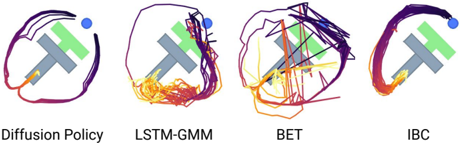
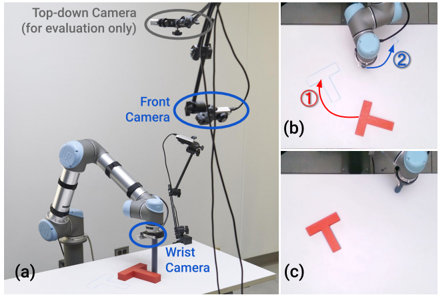
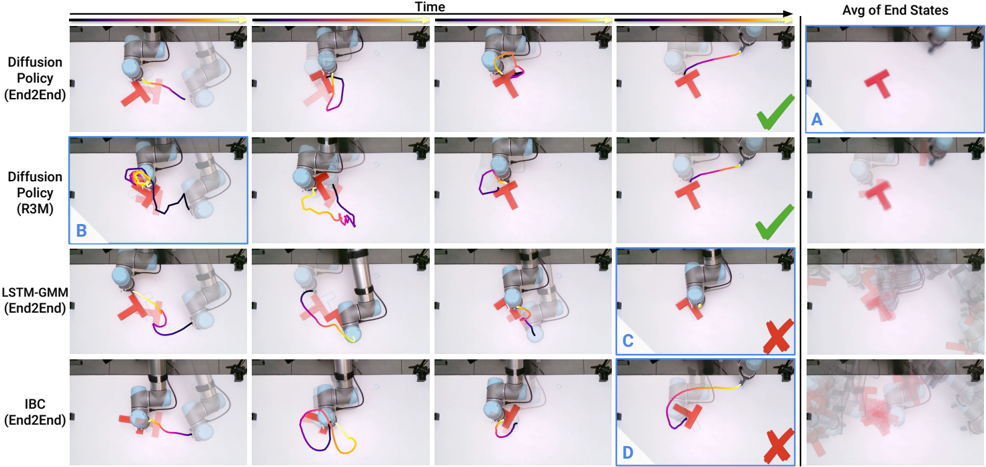
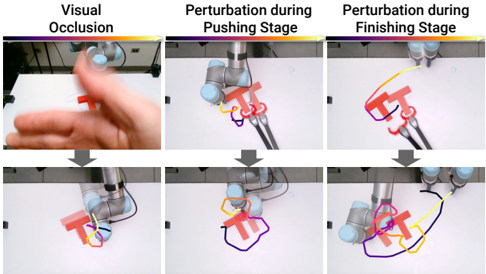
- Real-world Push-T: 95% success and 0.8 average IoU vs human 1.00 success and 0.84 IoU; best IBC and LSTM-GMM variants reached 0% and 20% success.
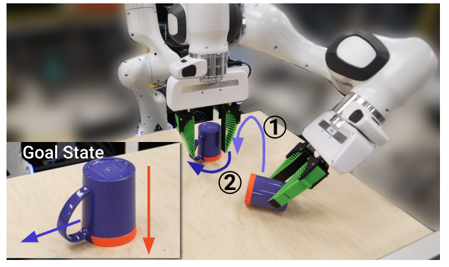
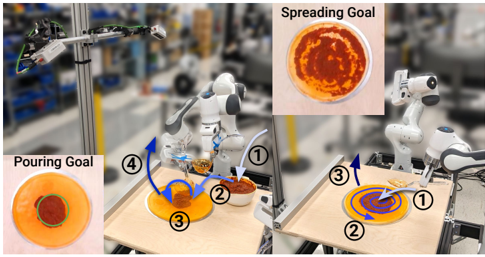
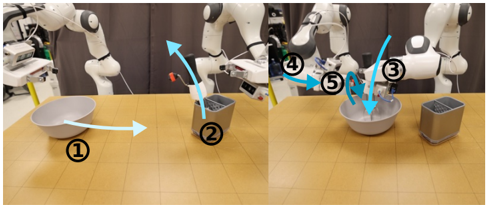
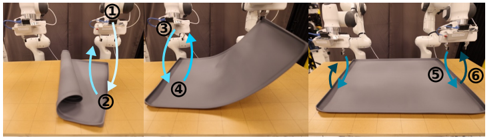
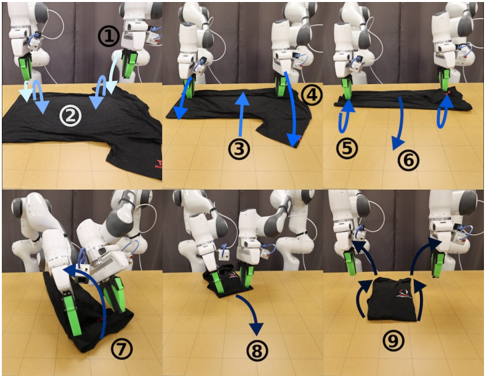
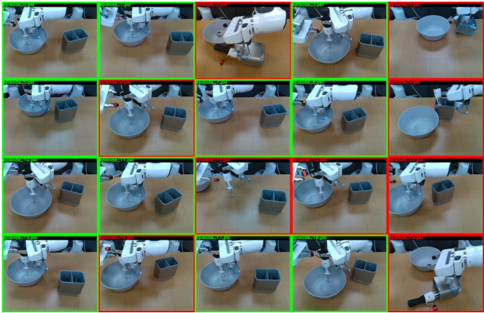
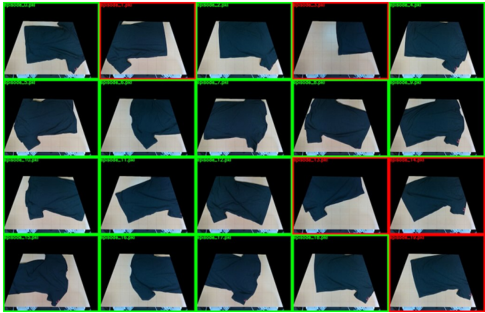
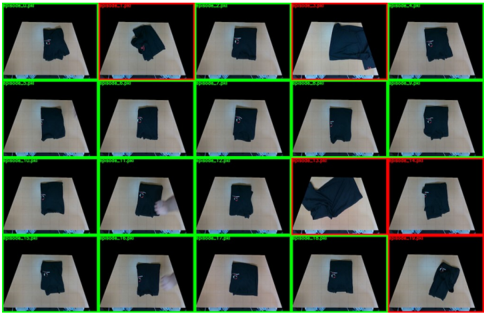
- Other real-world tasks: Mug Flipping 90% success over 20 trials (LSTM-GMM 0%); Sauce Pouring 0.74 IoU / 0.79 success vs human 0.79 / 1.00; Sauce Spreading 0.77 coverage / 1.00 success vs human 0.79 / 1.00; bimanual Egg Beater 55%, Mat Unrolling 75%, Shirt Folding 75%, each over 20 trials.
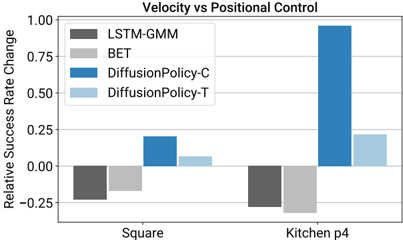
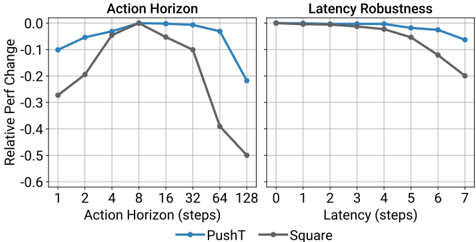
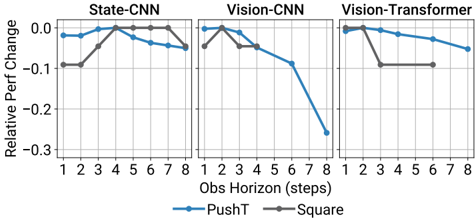
- Ablations: action horizon of 8 steps was optimal for most tested tasks; Diffusion Policy maintained peak performance with latency up to 4 steps; position control outperformed velocity control; DDIM with 100 training and 10 inference iterations enabled 0.1 s inference latency on an Nvidia 3080 GPU.
Methods
- Design: conditional DDPM/DDIM policy \(p(A_t|O_t)\) that predicts action sequences; uses receding-horizon control, visual conditioning, and either a CNN with FiLM or a time-series diffusion transformer.
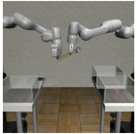
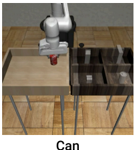
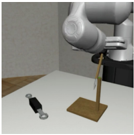
- Data/evaluation: 15 tasks from 4 benchmarks (Robomimic, Push-T, Block Push, Kitchen) plus real-world single-arm and bimanual tasks; simulation results averaged over 3 training seeds and 50 environment initial conditions (1500 experiments total; robomimic used 22 initializations due to an evaluation-code bug).
- Analysis: compares against LSTM-GMM, IBC, and BET; metrics include success rate, target-area coverage/IoU, and ablations on action horizon, latency, action space, vision encoder, and architecture.
Limitations
- Stated: inherits behavior cloning limitations such as suboptimal performance with inadequate demonstration data; higher computational cost and inference latency than simpler methods like LSTM-GMM, which action-sequence prediction only partially mitigates and may not suffice for high-rate control.
- Stated: transformer backbone is more sensitive to hyperparameters; CNN backbone performs poorly when action sequences change quickly and sharply through time, such as velocity command action space.
- Evident: real-world evaluations often use small trial counts (e.g., 20 trials per task), and bimanual success rates were 55–75%; simulation robomimic used only 22 initializations due to a bug; frozen pretrained vision encoders performed poorly, and ViT from scratch reached only 22% success on square.
Model-written summary. Check it against the paper before relying on it.
Integrity signals
Registry
Cites
Statistics
Figures
Verification
Claims the paper makes
12 Valid · 4 Not valid · 14 Not checked · 115 Own results and interpretations
The cited sources support only part of this claim — read each source’s verdict below.
In the paper
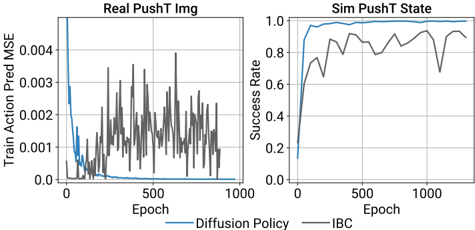
“In contrast, IBC Florence et al. (2021) is prone to training instability.”
What the sources say
- Partly supportedcites Florence et al. (2021) matched to “Implicit Behavioral Cloning” (2021) sourceExperimental — accuracy not yet measured
Section B.3.1 (page unavailable) says the authors use spectral normalization and gradient penalties for additional training stability, which supports stability being a concern for their Langevin-based approach. It does not say that IBC generally is prone to training instability; the Limitations section instead names computational cost and implementation complexity. (LLM, conf=0.82)
plain- Asserted: passes — The authors put it forward as true.
- Checkable: passes — It can be checked against evidence.
- Load-bearing: passes — The paper’s conclusions depend on it.
- Based: passes — The paper gives a reason why it holds.
- Partly supported
The cited sources support only part of this claim — read each source’s verdict below.
In the paper
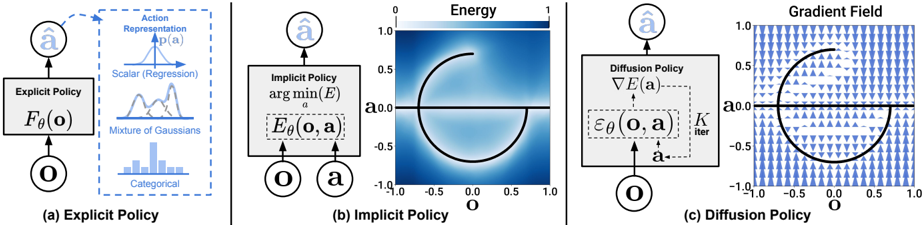
“Expressing multimodal action distributions. By learning the gradient of the action score function Song and Ermon (2019) and performing Stochastic Langevin Dynamics sampling on this gradient field, Diffusion policy can express arbitrary normalizable distributions Neal et al. (2011), which includes multimodal action distributions, a well-known challenge for policy learning.”
- Also stated in: § 4.1 Model Multi-Modal Action Distributions · p. 4 · boosted
“Diffusion Policy's ability to express multimodal distributions naturally and precisely is one of its key advantages.”
What the sources say
- Supportedcites Song and Ermon (2019) matched to “Generative Modeling by Estimating Gradients of the Data Distribution” (2019) source
Section 2.2 (p. 3) describes learning a distribution’s score and using Langevin dynamics to sample from it. Section 4.3 (p. 7) demonstrates sampling from a two-mode Gaussian mixture. The paper supports the cited method and its ability to represent multimodal distributions; applying it to action distributions is the citing authors’ context, not a result claimed by this source. (LLM, conf=0.88)
- Not matchedcites Neal et al. (2011)
An author–year citation the paper’s reference list doesn’t settle. We don’t search these by name.
boostedstates a cause- Asserted: passes — The authors put it forward as true.
- Checkable: passes — It can be checked against evidence.
- Load-bearing: passes — The paper’s conclusions depend on it.
- Based: passes — The paper gives a reason why it holds.
- Also stated in: § 4.1 Model Multi-Modal Action Distributions · p. 4 · boosted
The cited sources support only part of this claim — read each source’s verdict below.
In the paper
“However, existing implicit policies (Florence et al. 2021) are unstable to train due to the necessity of drawing negative samples when computing the underlying Info-NCE loss.”
What the sources say
- Partly supportedcites Florence et al. 2021 matched to “Implicit Behavioral Cloning” (2021) sourceExperimental — accuracy not yet measured
Section 2 says the implicit models are trained with negative counter-examples and an InfoNCE-style loss. Appendix B.3.1 discusses measures for additional training stability, but neither passage says that drawing negative samples makes these policies unstable to train. The claimed cause of instability is therefore unsupported. (LLM, conf=0.87)
plainstates a cause- Asserted: passes — The authors put it forward as true.
- Checkable: passes — It can be checked against evidence.
- Load-bearing: passes — The paper’s conclusions depend on it.
- Based: passes — The paper gives a reason why it holds.
- Partly supported
Every source the paper cites for this claim was checked and supports it.
In the paper
“In our control tasks, we empirically found that the Square Cosine Schedule proposed in iDDPM Nichol and Dhariwal (2021) works best for our tasks.”
What the sources say
- Supportedcites Nichol and Dhariwal (2021) matched to “Improved Denoising Diffusion Probabilistic Models” (2021) source
The citation identifies the origin of the squared-cosine noise schedule; the citing authors describe its performance on their control tasks as their own empirical finding. Section 3.2 (p. 4) proposes a cosine schedule and specifies the use of cos². (LLM, conf=0.92)
plainstates a cause- Asserted: passes — The authors put it forward as true.
- Checkable: passes — It can be checked against evidence.
- Load-bearing: unclear — It is unclear whether the paper’s conclusions depend on it.
- Based: passes — The paper gives a reason why it holds.
- Supported
The cited sources that could be checked couldn’t confirm or dispute this claim.
In the paper
“This shows that in order to perfectly clone a behavior that depends on the state, the learner must implicitly learn a (task-relevant) dynamics model Subramanian and Mahajan (2019); Zhang et al. (2020).”
What the sources say
- Not checked — no full text of the sourcecites Subramanian and Mahajan (2019) matched to “Approximate information state for partially observed systems” (2019) source
- Could not verifycites Zhang et al. (2020) matched to “Learning Invariant Representations for Reinforcement Learning without Reconstruction” (2020) sourceExperimental — accuracy not yet measured
The Introduction describes a representation that predicts task-relevant future states, and the method trains a latent dynamics model for reinforcement learning. Neither passage says that perfectly cloning state-dependent behavior requires a learner to implicitly learn such a model. Searches for imitation learning, behavior cloning, and that necessity claim found no supporting passage in our copy. (LLM, conf=0.76)
boostedstates a cause- Asserted: passes — The authors put it forward as true.
- Checkable: passes — It can be checked against evidence.
- Load-bearing: unclear — It is unclear whether the paper’s conclusions depend on it.
- Based: passes — The paper gives a reason why it holds.
79 more claims · 3 with their cited sources checked
Create a free account to see all 145 claims and to verify the 5 references still open.
- It may state two separate claims as one. 39
- Probably not a substantial claim. 33
- The quote only partly states this claim. 4
Claims other papers make about this one
Each is checked against this paper’s own text: does it say what the citing paper says it does?
The cited source doesn’t support the claim as written.
In the citing paper
“Inspired in part by human motor control [33], action chunking has recently emerged as the de facto standard in imitation learning for visuomotor control [68, 11].”
From Real-Time Execution of Action Chunking Flow Policies (2025) · cites this paper as [11]
Checked by a reasoning model — may be wrong.
Experimental — accuracy not yet measuredThe source backs part of the claim, not all of it — or backs it for a different population, condition or comparison.
In the citing paper
“Most simulated imitation learning benchmarks are quasi-static, and standard chunked execution with a long enough execution horizon can achieve near-perfect success rates [11].”
From Real-Time Execution of Action Chunking Flow Policies (2025) · cites this paper as [11]
Experimental — accuracy not yet measuredThe source backs part of the claim, not all of it — or backs it for a different population, condition or comparison.
In the citing paper
“This action head predicts a 'chunk”
From Octo: An Open-Source Generalist Robot Policy (2024) · cites this paper as [17]
Experimental — accuracy not yet measuredThe cited source says what the claim attributes to it.
In the citing paper
“Prior transformer-based policy designs typically encode input images with large ResNetstyle [32] encoders and fuse the resulting image features with a comparatively small transformer [10, 67, 81, 17, 98, 61, 83].”
From Octo: An Open-Source Generalist Robot Policy (2024) · cites this paper as [17]
The cited source says what the claim attributes to it.
In the citing paper
“While action chunking has enabled temporal consistency in high-frequency control tasks, it does not fully address the latency problem, leading to pauses or out-of-distribution jerky movements at chunk boundaries.”
From Real-Time Execution of Action Chunking Flow Policies (2025) · cites this paper as [11]
Self-check
Percentages, sums and reported differences re-computed from the paper’s own numbers.
Each contradiction between two passages listed here was confirmed by an independent check.
Rated minor: it would not touch a result — a value no result rests on, a p-value that stays on the same side of the significance level, or a conflict that is clerical, resolved elsewhere in the paper, or outside its own findings.
In the paper
§ 3.4 Accelerating Inference for Real-time Control · p. 4
“In our real-world experiments, using DDIM with 100 training iterations and 10 inference iterations enables 0.1s inference latency on a Nvidia 3080 GPU.”
§ A.4 Hyperparameters · p. 16
“We used DDIM Song et al. (2021) on realworld benchmarks to reduce the inference denoising iterations to 16 therefore reducing inference latency.”
Rated minor: it would not touch a result — a value no result rests on, a p-value that stays on the same side of the significance level, or a conflict that is clerical, resolved elsewhere in the paper, or outside its own findings.
In the paper
§ 5.1 Simulation Environments and datasets · p. 7
“the Franka Kitchen environment contains 7 objects for interaction and comes with a human demonstration dataset of 566 demonstrations”
§ 5.1 Simulation Environments and datasets · p. 7
“| Kitchen | 1 | 7 | 9 | 656 | 0 | 280 | No | No |”
Citations
Cites
Deep Residual Learning for Image Recognition
He, K., Zhang, X., Ren, S., & Sun, J. (2016) · 2016 IEEE Conference on Computer Vision and Pattern Recognition (CVPR) · doi:10.1109/cvpr.2016.90 · Cited by 235,474 · cited 1×
“Speci fi cally, we evaluated three different architectures: ResNet-18, ResNet-34 (He et al., 2016), and ViT-B/16 (Dosovitskiy et al., 2020).”
Vaswani, A., Shazeer, N., Parmar, N., Uszkoreit, J., Jones, L., Gomez, A. N., Kaiser, L., & Polosukhin, I. (2017) · arXiv · doi:10.48550/arxiv.1706.03762 · Cited by 120,404
U-Net: Convolutional Networks for Biomedical Image Segmentation
Ronneberger, O., Fischer, P., & Brox, T. (2015) · Lecture notes in computer science · doi:10.1007/978-3-319-24574-4_28 · Cited by 99,404 · cited 1×
“In this work, we examine two common network architecture types, convolutional neural networks (CNNs) (Ronneberger et al., 2015) and Transformers (Vaswani et al., 2017), and compare their performance and training characteristics.”
ImageNet: A large-scale hierarchical image database
Deng, J., Dong, W., Socher, R., Li, L.-J., Li, K., & Fei-Fei, L. (2009) · 2009 IEEE Conference on Computer Vision and Pattern Recognition · doi:10.1109/cvpr.2009.5206848 · Cited by 65,333
An Image is Worth 16x16 Words: Transformers for Image Recognition at Scale
Dosovitskiy, A., Beyer, L., Kolesnikov, A., Weissenborn, D., Zhai, X., Unterthiner, T., Dehghani, M., Minderer, M., Heigold, G., Gelly, S., et al. (2020) · arXiv · doi:10.48550/arxiv.2010.11929 · Cited by 47,472
U-Net: Convolutional Networks for Biomedical Image SegmentationPreprint
Ronneberger, O., Fischer, P., & Brox, T. (2015) · arXiv (Cornell University) · doi:10.48550/arxiv.1505.04597 · Cited by 17,820
Momentum Contrast for Unsupervised Visual Representation LearningPreprint
He, K., Fan, H., Wu, Y., Xie, S., & Girshick, R. B. (2019) · Computer Vision and Pattern Recognition · doi:10.48550/arxiv.1911.05722 · Cited by 16,321
Learning Transferable Visual Models From Natural Language Supervision
Radford, A., Kim, J. W., Hallacy, C., Ramesh, A., Goh, G., Agarwal, S., Sastry, G., Askell, A., Mishkin, P., Clark, J., et al. (2021) · arXiv · doi:10.48550/arxiv.2103.00020 · Cited by 15,293
Advances in neural information processing systems 7
(1996) · Computers & Mathematics with Applications · doi:10.1016/s0898-1221(96)90463-0 · Cited by 14,281
Advances in Neural Information Processing Systems 29
Teymur, O., Zygalakis, K., & Calderhead, B. (2016) · Cited by 13,887
Research works printed but not linked: 3
- Janner M, Du Y, Tenenbaum J and Levine S (2022b) Planning with diffusion for flexible behavior synthesis. In: Chaudhuri K, Jegelka S, Song L, Szepesvari C, Niu G and Sabato S (eds.) Proceedings of the 39th International Conference on Machine Learning , Proceedings of Machine Learning Research. PMLR.
- Wang Z, Hunt JJ and Zhou M (2023) Diffusion policies as an expressive policy class for offline reinforcement learning. In: The Eleventh International Conference on Learning Representations . URL https://openreview.net/ forum?id=AHvFDPi-FA .
- Welling M and Teh YW (2011) Bayesian learning via stochastic gradient langevin dynamics. In: Proceedings of the 28th international conference on machine learning (ICML-11) . pp. 681-688.
Cited by
Items 101–200 of 578
ConsistencyDrive: Efficient End-to-End Autonomous Driving with Consistency Models
Wang, J., & Zhang, Q. (2025) · International Conference on Control, Robotics and Cybernetics (CRC) · doi:10.1109/crc67523.2025.11288252 · Cited by 4
Mir, B. A., Nishwa, D. E., & Lee, S. W. (2026) · Healthcare · doi:10.3390/healthcare14050572 · Cited by 9
Simultaneous Tactile-Visual Perception for Learning Multimodal Robot Manipulation
Li, Y., Chen, Y., Zhao, Z., Li, P., Liu, T., Huang, S., & Zhu, Y. (2026) · IEEE Robotics and Automation Letters · doi:10.1109/lra.2026.3671701 · Cited by 20
“WeemployaTransformer-basedDiffusionPolicy[56],[57]to learn mappings from multimodal observations to robot actions, allowing dynamic attention across simultaneously provided visual, tactile, and proprioceptive signals.”
Wang, Y., Fang, Z., Zhao, L., & Chen, W. (2026) · IEEE Transactions on Automation Science and Engineering · doi:10.1109/tase.2026.3673004 · Cited by 10
“The model then computes attention over the remaining valid frames to construct the conditional representation.”
LaMP: Learning Vision-Language-Action Policy with 3D Scene Flow as Latent Motion Prior
Wang, X., Wang, C., Xu, Y., Ye, M., Zhang, F.-C., Tian, J., Zhan, X., Zhu, L., Lu, C., & Yang, L. (2026) · Lecture notes in computer science · doi:10.1007/978-3-032-37013-6_13 · Cited by 24
Performant robotic manipulation with real-world reinforcement learning
Lei, K., Li, H., Yu, D., Wei, Z., Guo, L., Jiang, Z., Wang, Z., Liang, S., & Xu, H. (2026) · Science Robotics · doi:10.1126/scirobotics.aed6267 · Cited by 83
One-Shot Transfer of Long-Horizon Extrinsic Manipulation Through Contact Retargeting
Wu, A., Wang, R., Chen, S., Eppner, C., & Liu, C. K. (2024) · IEEE/RSJ International Conference on Intelligent Robots and Systems (IROS) · doi:10.1109/iros58592.2024.10801356 · Cited by 15
“The robot learning community has explored many approaches, including variations of behavior cloning (e.g. [14, 36, 6, 24]) and fine-tuning a pretrained RL agent (e.g. [32, 31]).”
InfluentialDiffusion policy with Q-ensemble for offline reinforcement learning
Wang, D., Zhang, X., Hua, Q., Dong, C.-R., & Zhang, F. (2025) · International Journal of Machine Learning and Cybernetics · doi:10.1007/s13042-025-02780-0 · Cited by 3
“Current works applying diffusion models on RL mainly fall into three categories: (1) diffusion models are taken as planners [18 ]; (2) as policies [ 7, 19], and (3) as data synthesizers [20].”
DROP: Dexterous Reorientation via Online Planning
Li, A. H., Culbertson, P., Kurtz, V., & Ames, A. D. (2025) · Proceedings - IEEE International Conference on Robotics and Automation/Proceedings · doi:10.1109/icra55743.2025.11128433 · Cited by 26
“Promising directions include sampling from imitation-learned policies [41], learning value functions for rollout evaluation [42], and exploring alternate spline parameterizations [24] or action spaces [43].”
Empirical Analysis of Sim-and-Real Cotraining of Diffusion Policies For Planar Pushing from Pixels
Wei, A., Agarwal, A., Chen, B., Bosworth, R., Pfaff, N., & Tedrake, R. (2025) · IEEE/RSJ International Conference on Intelligent Robots and Systems (IROS) · doi:10.1109/iros60139.2025.11246304 · Cited by 31
“This suggests that practitioners should cotrain policies with a one-hot encoding of the environment and sample regularly [12].”
InfluentialSelf-citationBridging the Human to Robot Dexterity Gap Through Object-Oriented Rewards
Guzey, I., Dai, Y., Savva, G., Bhirangi, R., & Pinto, L. (2025) · Proceedings - IEEE International Conference on Robotics and Automation/Proceedings · doi:10.1109/icra55743.2025.11128690 · Cited by 41
“Towards this end, recent advances have enabled † Correspondence to irmakguzey@nyu.edu . the learning of multi-modal, long-horizon, and dexterous behaviors for two-fingered grippers [2, 3, 4, 5] using imitation learning (IL) from teleoperated robot data.”
One-Shot Dual-Arm Imitation Learning
Wang, Y., & Johns, E. (2025) · Proceedings - IEEE International Conference on Robotics and Automation/Proceedings · doi:10.1109/icra55743.2025.11128338 · Cited by 11
“Recent advancements in imitation learning [1, 2] have significantly improved the acquisition of visuomotor skills through human demonstrations.”
DemoStart: Demonstration-Led Auto-Curriculum Applied to Sim-to-Real with Multi-Fingered Robots
Bauzá, M., Chen, J. E., Dalibard, V., Gileadi, N., Hafner, R., Martins, M. F., Moore, J., Pevceviciute, R., Laurens, A., Rao, D., et al. (2025) · Proceedings - IEEE International Conference on Robotics and Automation/Proceedings · doi:10.1109/icra55743.2025.11127813 · Cited by 26
“Learning from human-teleoperated robots has led to some impressive results for relatively simple embodiments, for which effective teleoperation devices exist [1], [2], [3].”
SmolVLA: A Vision-Language-Action Model for Affordable and Efficient Robotics
Shukor, M., Aubakirova, D., Capuano, F., Kooijmans, P., Palma, S., Zouitine, A., Aractingi, M., Pascal, C., Russi, M., Marafioti, A., et al. (2025) · arXiv · doi:10.48550/arxiv.2506.01844 · Cited by 695
“Modern visuomotor policies (Zhao et al., 2023; Chi et al., 2023; Black et al., 2024) A less resource-intensive approach is to entirely exhaust the chunk A before predicting a new chunk of actions, a strategy we refer to as synchronous (sync) inference.”
RoboCasa: Large-Scale Simulation of Everyday Tasks for Generalist Robots
Nasiriany, S., Maddukuri, A., Zhang, L., Parikh, A., Lo, A., Joshi, A., Mandlekar, A., & Zhu, Y. (2024) · arXiv · doi:10.48550/arxiv.2406.02523 · Cited by 3
“Wealso experiment with diffusion policy [4].”
BackgroundProleptic Temporal Ensemble for Improving the Speed of Robot Tasks Generated by Imitation Learning
Park, H., Lim, D., Kim, S., & Park, S. (2025) · The Journal of Korea Robotics Society · doi:10.7746/jkros.2025.20.1.061 · Cited by 8
Xu, W., Tan, Z., Cao, Z., Ma, H., Wang, G., Wang, H., Wang, W., & Du, Z. (2025) · International Journal of Medical Robotics and Computer Assisted Surgery · doi:10.1002/rcs.70072 · Cited by 4
“This framework leverages diffusion policy [21] (DP) as its backbone to learn an autonomous suturing policy from suturing demonstrations, employing denoising diffusion probabilistic models (DDPMs) [32] and framing the generation of suturing trajectories as a conditional denoising diffusion process.”
InfluentialJoint Localization and Planning Using Diffusion
Beyer, L. L., & Karaman, S. (2025) · Proceedings - IEEE International Conference on Robotics and Automation/Proceedings · doi:10.1109/icra55743.2025.11127640 · Cited by 3
“Denoising diffusion probabilistic models [1] have shown to be a powerful tool for sampling from complicated, high-dimensional distributions, achieving state-of-the-art performance on tasks such as image generation [2], motion planning [3] and control [4].”
GHIL-Glue: Hierarchical Control with Filtered Subgoal Images
Hatch, K., Balakrishna, A., Mees, O., Nair, S., Park, S., Wulfe, B., Itkina, M., Eysenbach, B., Levine, S., Kollar, T., et al. (2025) · Proceedings - IEEE International Conference on Robotics and Automation/Proceedings · doi:10.1109/icra55743.2025.11128025 · Cited by 20
“Low-level language-conditioned behavior cloning diffusion policy [16] trained only on robot trajectories with language annotations.”
Self-citationAnticipatory and Adaptive Footstep Streaming for Teleoperated Bipedal Robots
Penco, L., Park, B., Fasano, S., Poddar, N., McCrory, S., Kitchel, N., Bialek, T., Anderson, D., Calvert, D., & Griffin, R. J. (2025) · IEEE-RAS International Conference on Humanoid Robots (Humanoids) · doi:10.1109/humanoids65713.2025.11203044 · Cited by 2
“Human operators can demonstrate tasks using the robot’s body, providing real-world data that is essential for training machine learning models and robotic policies [2, 3, 4].”
Son, D., & Park, S. (2025) · International Journal of Control Automation and Systems · doi:10.1007/s12555-025-0537-0 · Cited by 7
“Alterna-tively, the Diffusion Policy [8,9] employs denoising diffusion processes to generate action chunks, capturing the multi-modal distributions inherent in human demonstrations.”
Accelerating Residual Reinforcement Learning With Uncertainty Estimation
Dodeja, L., Schmeckpeper, K., Vats, S., Weng, T., Jia, M., Konidaris, G., & Tellex, S. (2025) · IEEE Robotics and Automation Letters · doi:10.1109/lra.2025.3636808 · Cited by 11
“Diffusion-based policy : We also test our method with a diffusion base policy[3].”
InfluentialComDrive: Comfort-Oriented End-to-End Autonomous Driving
Wang, J., Zhang, X., Xing, Z., Gu, S., Guo, X., Hu, Y., Song, Z., Zhang, Q., Long, X., & Yin, W. H. (2025) · IEEE/RSJ International Conference on Intelligent Robots and Systems (IROS) · doi:10.1109/iros60139.2025.11247215 · Cited by 31
DISCOVERSE: Efficient Robot Simulation in Complex High-Fidelity Environments
Jia, Y., Wang, G., Dong, Y., Wu, J., Zeng, Y., Lin, H., Wang, Z., Ge, H., Gu, W., Ding, K., et al. (2025) · IEEE/RSJ International Conference on Intelligent Robots and Systems (IROS) · doi:10.1109/iros60139.2025.11247559 · Cited by 10
“…mouse onto the mouse pad; 3) Pick-Up-Kiwifruit : grasp and pick up a kiwifruit; We use the publicly available ACT [20] and Diffusion Policy (DP) [21] for imitation learning, and we compare against three state-of-the-art simulators: MuJoCo [1], RoboTwin [6], and SplatSim [18], based on their…”
Sign-MExD: An Expert-Infused Diffusion Model for Sign Language Production
Shen, J., Stefanov, K., Chong, V. Y., Soon, L.-K., & Wong, K. (2025) · Asia-Pacific Signal and Information Processing Association Annual Summit and Conference (APSIPA ASC) · doi:10.1109/apsipaasc65261.2025.11249331 · Cited by 3
“However, a major limitation is their high computational cost; for example, standard architectures contain hundreds of millions of parameters [20] and require many denoising steps, affecting training and inference speeds.”
Li, Z., Deng, S. C., Zeng, C., et al. (2025) · IEEE Robotics and Automation Letters · doi:10.1109/lra.2025.3645656 · Cited by 2
“In contrast, transformer-based diffusion networks achieve higher action generation frequencies, as suggested in [17].”
Ma, X., Wen, Z., Hu, T., & Zheng, X. (2025) · International Conference on Machine Learning, Big Data and Business Intelligence (MLBDBI) · doi:10.1109/mlbdbi67855.2025.11331507 · Cited by 2
Twin-DP3: View-Invariant 3D Diffusion Policy With Digital Twin
Liu, X., Han, F., Cui, J., Lou, J., Ding, R., & Niu, J. (2026) · IEEE Robotics and Automation Letters · doi:10.1109/lra.2026.3655308 · Cited by 6
“Diffusion policy [1] addresses the problems by iteratively denoising noisy actions to produce diverse, stable high-dimensional samples.”
Application of Generative AI for Robotics Learning and Perceptions
Ravi Raj, K. G., & Demirkol, I. (2025) · International Conference on Control, Mechatronics and Automation (ICCMA) · doi:10.1109/iccma67641.2025.11369531 · Cited by 2
“This guarantees enhanced reliability in activities necessitating precise manipulation, especially in unorganized or dynamic environments [5], [6].”
Tsukakoshi, T., Miyake, T., OGATA, T., Wang, Y., AKAISHI, T., & Sugano, S. (2026) · IEEE Robotics and Automation Letters · doi:10.1109/lra.2026.3664535 · Cited by 6
“Diffusion Policy (DP) [31] is a method of generating robot behavior using a diffusion model, and is excellent at generating continuous movements that combine diversity and smoothness.”
A Coordinated Optimization Framework for Intelligent Agents With Online Evolutive Learning
Qian, L., Jin, J., Sun, P., Liu, J., Hu, B., Boukerche, A., & Song, L. (2026) · IEEE Internet of Things Journal · doi:10.1109/jiot.2026.3670365 · Cited by 5
FRMD: fast robot motion diffusion via trajectory-level consistency distillation
Shi, X., Hu, Y., & Jin, J. (2026) · Frontiers in Robotics and AI · doi:10.3389/frobt.2026.1751688 · Cited by 3
“Standard diffusion samplers require tens of denoising steps per action prediction (Chi et al., 2023; Song et al., 2020), leading to inference rates on the order of 1–2 Hz on typical robotic hardware.”
InfluentialRobotic perception and manipulation of deformable linear objects: A survey
Caporali, A., Cuiral-Zueco, I., Nicolás, G. L., & Palli, G. (2026) · The International Journal of Robotics Research · doi:10.1177/02783649261432253 · Cited by 16
Pu, Y., Zeng, X., Wang, Q., et al. (2026) · International Conference on Energy, Electrical and Power Engineering (CEEPE) · doi:10.1109/ceepe69795.2026.11552237 · Cited by 2
“The state value function V(s) and action value function Q(s,a) are important tools to measure the value of states or actions [19][20].”
Yu, X. W., Bai, C., Guo, H., Wang, C., & Wang, Z. (2024) · Information Sciences · doi:10.1016/j.ins.2024.121146 · Cited by 5
RoPotter: Toward Robotic Pottery and Deformable Object Manipulation with Structural Priors
Yoo, U., Hung, A., Francis, J., Oh, J., & Ichnowski, J. (2024) · IEEE-RAS International Conference on Humanoid Robots (Humanoids) · doi:10.1109/humanoids58906.2024.10769600 · Cited by 10
“Recently proposed approaches such as Implicit Behavior Cloning [9] and Diffusion Policy [10] have demonstrated an exceptional ability to learn complex manipulation skills given a reasonable number of human demonstrations, with some spatial generalizability and robustness to distractions [11].”
BackgroundMethodSHIKADA, G., Armleder, S., Ito, H., Cheng, G., & Ogata, T. (2024) · IEEE/RSJ International Conference on Intelligent Robots and Systems (IROS) · doi:10.1109/iros58592.2024.10801317 · Cited by 4
REALM: Real-Time Estimates of Assistance for Learned Models in Human-Robot Interaction
Hagenow, M., & Shah, J. (2025) · IEEE Robotics and Automation Letters · doi:10.1109/lra.2025.3560862 · Cited by 5
“The finite horizon can be achieved through either a dynamics model of the policy or an action representation that explicitly includes a horizon (e.g., as is common in robot diffusion models [1]).”
Generative AI in Embodied Systems: System-Level Analysis of Performance, Efficiency and Scalability
Wan, Z., Qian, J., Du, Y., Jabbour, J., Du, Y., Zhao, Y. K., Raychowdhury, A., Krishna, T., & Reddi, V. J. (2025) · IEEE International Symposium on Performance Analysis of Systems and Software (ISPASS) · doi:10.1109/ispass64960.2025.00013 · Cited by 8
“C. Single-Agent Embodied AI System: End-to-End Paradigm Besides the modularized paradigm, the end-to-end paradigm that directly outputs agent actions from the models is another approach for short-horizon embodied tasks [48], [49], [51]– [53].”
Self-citationVariable-Friction In-Hand Manipulation for Arbitrary Objects via Diffusion-Based Imitation Learning
Yan, Q., Ding, Z., Zhou, X., & Spiers, A. J. (2025) · Proceedings - IEEE International Conference on Robotics and Automation/Proceedings · doi:10.1109/icra55743.2025.11127479 · Cited by 3
“General tasks such as object-transportation or reorientation [9], and even complex domestic tasks such as cooking or chair rearranging [25] have been successfully tested with this approach.”
InfluentialForce-Conditioned Diffusion Policies for Compliant Sheet Separation Tasks in Bimanual Robotic Cells
Shukla, R., Talan, R., Moode, S., Dhanaraj, N., Kang, J. H., & Gupta, S. K. (2025) · Proceedings - IEEE International Conference on Robotics and Automation/Proceedings · doi:10.1109/icra55743.2025.11127816 · Cited by 10
“Diffusion models have the capability to learn complex, multimodal policies that capture this variability, enabling them to generalize more effectively to unseen scenarios [8].”
InfluentialRaggeDi: Diffusion-Based State Estimation of Disordered Rags, Sheets, Towels and Blankets
Ye, J., Li, W., Khan, S. J., & Chirikjian, G. S. (2025) · Proceedings - IEEE International Conference on Robotics and Automation/Proceedings · doi:10.1109/icra55743.2025.11128504 · Cited by 2
“The design of noise prediction network is based on [29].”
Adaptive Distance Functions via Kelvin Transformation
Muchacho, R. I. C., & Pokorny, F. T. (2025) · Proceedings - IEEE International Conference on Robotics and Automation/Proceedings · doi:10.1109/icra55743.2025.11128013 · Cited by 4
Moghani, M., Nelson, N., Ghanem, M., Diaz‐Pinto, A., Hari, K., Azizian, M., Goldberg, K., Huver, S. D., & Garg, A. (2025) · Proceedings - IEEE International Conference on Robotics and Automation/Proceedings · doi:10.1109/icra55743.2025.11127797 · Cited by 3
“BC approaches require a vast number of expert demonstrations to be able to generalize to unseen, in-domain variations and novel objects [7], [8].”
Li, T., Sun, S., Aditya, S. S., & Figueroa, N. (2025) · IEEE/RSJ International Conference on Intelligent Robots and Systems (IROS) · doi:10.1109/iros60139.2025.11246142 · Cited by 12
“Behavior Cloning (BC) [6] has gained significant attention and has become a common approach for imitation learning (IL) [1], [7]–[9].”
Progressive Optimal Path Sampling for Closed-Loop Optimal Control Design with Deep Neural Networks
Zhang, X., Long, J., Hu, W., Weinan, E., & Han, J. (2025) · Journal of Machine Learning · doi:10.4208/jml.250213 · Cited by 7
“First, with the optimal solution we have Recalling equation (A.11) and plugging (A.11) into (A.10), we know that Hence, which gives”
Liu, S., Liu, Y., Hu, L., et al. (2024) · SSRN Electronic Journal · doi:10.2139/ssrn.4803355 · Cited by 2
A Twin Dual-Arm Robot Testbed to Collect the Human Demonstration Data for Imitation Learning*
Kim, J.-H., Heo, S., Kim, S., Jung, H.-J., & Yoon, H. U. (2024) · Joint International Conference on Soft Computing and Intelligent Systems and International Symposium on Advanced Intelligent Systems (SCIS&ISIS) · doi:10.1109/scisisis61014.2024.10759864 · Cited by 1
“C. Chi et al. proposed an action diffusion with which a robot can generate a policy to perform a visuomotor tasks [5].”
A Cost-Efficient FOC-controlled Haptic Knob for Industrial Robot Programming with Force Feedback
Ding, J., Fu, X., Wei, T., et al. (2024) · 2022 IEEE 20th International Conference on Industrial Informatics (INDIN) · doi:10.1109/indin58382.2024.10774429 · Cited by 1
“More recently, haptic devices have been utilized for data collection of robot manipulation in imitation learning [12], [13].”
dGrasp: NeRF-Informed implicit grasp policies with supervised optimization slopes
Sóti, G., Huang, X., Wurll, C., & Hein, B. (2025) · Robotics and Autonomous Systems · doi:10.1016/j.robot.2025.104921 · Cited by 1
RPC: A Modular Framework for Robot Planning, Control, and Deployment
Bang, S. H., González, C., Moore, G., Kang, D., Seo, M., Gupta, R., & Sentis, L. (2025) · IEEE/SICE International Symposium on System Integration (SII) · doi:10.1109/sii59315.2025.10871130 · Cited by 1
Chen, D., Zhong, R., Chen, K., Shang, Z., Zhu, M., & Chung, E. (2025) · IEEE Transactions on Intelligent Transportation Systems · doi:10.1109/tits.2025.3565324 · Cited by 13
“Recently, diffusion models have been shown to account for diverse and complex behaviors, making them well-suited for learning from multi-modal demonstrations [15].”
GraphDiffusion: A Graph-conditioned Diffusion Model for Chip Placement
Fang, S., Xiang, L., Li, W., & He, Z. (2025) · IEEE International Symposium on Circuits and Systems proceedings · doi:10.1109/iscas56072.2025.11043281 · Cited by 1
Kube, D., Hadwiger, S., & Meisen, T. (2025) · Biomimetic Intelligence and Robotics · doi:10.1016/j.birob.2025.100249 · Cited by 5
Olfactory Inertial Odometry: Methodology for Effective Robot Navigation by Scent
France, K. K., & Daescu, O. (2025) · International Conference on Ubiquitous Robots (UR) · doi:10.1109/ur65550.2025.11078037 · Cited by 1
“We note that most success in modern visual-based pick-and-place tasks for robots is attributed to RL [18], so we expect olfactory-based tasks to also follow in this manner.”
Real-Time Diffusion Policies for Games: Enhancing Consistency Policies with Q-Ensembles
Zhang, R., Luo, Z., Sjölund, J., Mattsson, P., Gisslén, L., & Sestini, A. (2025) · IEEE Conference on Games (CoG) · doi:10.1109/cog64752.2025.11114163 · Cited by 4
“Following the work by Chi et al. [25], we use the closed-loop action-sequence prediction to promote consistent action generation and enhance execution robustness in both diffusion and consistency policies.”
Hu, S., Nagai, T., & Horii, T. (2025) · IEEE Robotics and Automation Letters · doi:10.1109/lra.2025.3598998 · Cited by 7
“Using the automatically collected dataset enriched with language labels and affordance information, we train a conditional diffusion model [34] to learn a multi-task robot manipulation policy.”
Human-Robot Cooperative Distribution Coupling for Hamiltonian-Constrained Social Navigation
Wang, W., Yu, C., Wang, Y., & Min, B. (2025) · Proceedings - IEEE International Conference on Robotics and Automation/Proceedings · doi:10.1109/icra55743.2025.11128561 · Cited by 4
MuST: Multi-Head Skill Transformer for Long-Horizon Dexterous Manipulation with Skill Progress
Gao, K., Wang, F., Aduh, E., Randle, D., & Shi, J. (2025) · Proceedings - IEEE International Conference on Robotics and Automation/Proceedings · doi:10.1109/icra55743.2025.11127280 · Cited by 4
“Extensive research has focused on learning dexterous skills through policy learning, both in reinforcement learning and imitation learning, with various input modalities, including vision sensory inputs [21], [22], robot states [1]–[3], [19], [23], [24] and language prompts [3], [25].”
Implicit Contact Diffuser: Sequential Contact Reasoning With Latent Point Cloud Diffusion
Huang, Z., He, Y., Lin, Y., & Berenson, D. (2025) · Proceedings - IEEE International Conference on Robotics and Automation/Proceedings · doi:10.1109/icra55743.2025.11128192 · Cited by 3
“Prior works studies different representations for object manipulations, such as key points [11], RGB image [12], [13], point cloud [14], [15] or mesh [16], [17], [18].”
InfluentialRoCoDA: Counterfactual Data Augmentation for Data-Efficient Robot Learning from Demonstrations
Ameperosa, E., Collins, J. A., Jain, M., & Garg, A. (2025) · Proceedings - IEEE International Conference on Robotics and Automation/Proceedings · doi:10.1109/icra55743.2025.11128694 · Cited by 29
“[1, 10] classify 3D subgoals for an end-effector to achieve, and [2, 11] predict latent actions using a CVAE, while [3–5] use diffusion, VQ-VAE, and causal convolution, respectively.”
CDM: Contact Diffusion Model for Multi-Contact Point Localization
Han, S. W., & Kim, M. J. (2025) · Proceedings - IEEE International Conference on Robotics and Automation/Proceedings · doi:10.1109/icra55743.2025.11127780 · Cited by 1
“In addition to efforts such as autonomous task execution [1], [2], another key focus is improving robots’ physical interaction capabilities to effectively handle unexpected collisions or contacts.”
STEER: Flexible Robotic Manipulation via Dense Language Grounding
Smith, L., Irpan, A., Arenas, M. G., Kirmani, S., Kalashnikov, D., Shah, D., & Xiao, T. G. (2025) · Proceedings - IEEE International Conference on Robotics and Automation/Proceedings · doi:10.1109/icra55743.2025.11127404 · Cited by 17
Robo-MUTUAL: Robotic Multimodal Task Specification via Unimodal Learning
Li, J., Wang, Z., Zheng, J., Zhou, X., Wang, G. F., Song, G., Liu, Y., Liu, J., Zhang, Y.-Q., Yu, J., et al. (2025) · Proceedings - IEEE International Conference on Robotics and Automation/Proceedings · doi:10.1109/icra55743.2025.11127531 · Cited by 9
“The policy is optimized with diffusion loss [64] for its superior effectiveness to model complex distributions [49], [65], [66].”
X-MOBILITY: End-to-End Generalizable Navigation via World Modeling
Liu, W., Zhao, H., Li, C., Biswas, J., Okal, B., Goyal, P., Chang, Y., & Pouya, S. (2025) · Proceedings - IEEE International Conference on Robotics and Automation/Proceedings · doi:10.1109/icra55743.2025.11128692 · Cited by 33
“To enhance the action policy, we also experimented with the diffusion policy [26], conditioning on policy state p t to jointly decode action commands and paths.”
Offline Adaptation of Quadruped Locomotion Using Diffusion Models
O'Mahoney, R., Mitchell, A. L., Yu, W., Posner, I., & Havoutis, I. (2025) · Proceedings - IEEE International Conference on Robotics and Automation/Proceedings · doi:10.1109/icra55743.2025.11128726 · Cited by 5
“These models exhibit several appealing properties including high accuracy, allowing for easy deployment of policies trained offline [22], an ability to generate variable length trajectories in a single step, allowing for long-horizon predictions that do not suffer from compounding error [13], and…”
Zhang, X., & Li, Y. (2025) · IEEE China Conference on System Simulation Technology and its Applications (CCSSTA) · doi:10.1109/ieeeconf65522.2025.11137342 · Cited by 1
“Since the introduction of Diffusion Policy [4], it has rapidly become one of the most widely adopted visuomotor policy in robotic manipulation.”
Self-Supervised Voice Denoising Network for Multi-Scenario Human–Robot Interaction
Li, M., Xu, W., Zeng, C., et al. (2025) · Biomimetics · doi:10.3390/biomimetics10090603 · Cited by 1
“In recent years, with the development of Vision–Language–Action (VLA) models [1–4] facilitating significant advancements in robotic manipulation, there has been growing interest in integrating action prompts and voice interaction.”
Yu, H., Jin, Y., He, Y., & Sui, W. (2025) · IEEE/CVF Conference on Computer Vision and Pattern Recognition Workshops (CVPRW) · doi:10.1109/cvprw67362.2025.00401 · Cited by 5
“The generative method based on diffusion models [43] [45] [46] [47] [19] [44](i.e., Diffusion Policy [9] [22]) has received extensive attention for its powerful generative ability and outstanding performance in high-dimensional continuous control tasks.”
Modality Selection and Skill Segmentation via Cross-Modality Attention
Jiang, J., Ota, K., Jha, D. K., & Kanezaki, A. (2025) · doi:10.23919/mva65244.2025.11175125 · Cited by 1
“We adopt a 1D-conditional U-Net diffusion model [11] as the backbone of our policy due to its demonstrated training stability and ability to model temporally correlated, multi-modal action distributions.”
InfluentialChang, Q., Li, C., Bhatta, K., & Waseem, M. (2025) · Journal of Computing and Information Science in Engineering · doi:10.1115/1.4070032 · Cited by 4
Learning Multimodal Attention for Manipulating Deformable Objects with Changing States
Saito, N., Tatsumi, M., Kubo, A., Suzuki, K., Ito, H., Sugano, S., & Ogata, T. (2025) · IEEE-RAS International Conference on Humanoid Robots (Humanoids) · doi:10.1109/humanoids65713.2025.11203083 · Cited by 4
“Finally, our model uses various sensory modality; not only vision as in many conventional research [21], [22], [25]– [28] but also tactile and force; that enable handling intrinsic and extrinsic properties.”
VLM-SFD: VLM-Assisted Siamese Flow Diffusion Framework for Dual-Arm Cooperative Manipulation
Chen, J., Jiang, Y., Huang, A., Li, Y., & Pan, W. (2025) · IEEE Robotics and Automation Letters · doi:10.1109/lra.2025.3627381 · Cited by 3
“2) Diffusion Policy (DP) [36].”
Elnady, M., & Ožana, Š. (2026) · Robotics and Autonomous Systems · doi:10.1016/j.robot.2026.105610 · Cited by 2
Leveraging GCN-based Action Recognition for Teleoperation in Daily Activity Assistance
Kwok, T. M., Li, J., & Hu, Y. H. (2025) · IEEE RO-MAN · doi:10.1109/ro-man63969.2025.11217719 · Cited by 3
“By integrating advanced motion planning techniques, such as reinforcement learning with diffusion policy learning from demonstration [19], [20], robots could assist users more effectively.”
Reliable Robotic Task Execution in the Face of Anomalies
Santhanam, B., Mitrevski, A., Thoduka, S., Houben, S., & Hassan, T. (2025) · IEEE Robotics and Automation Letters · doi:10.1109/lra.2025.3632090 · Cited by 4
“As Octo uses an underlying diffusion policy [24], it outputs a sequence of actions at each time step t .”
Autonomous Human-Robot Interaction via Operator Imitation
Christen, S., Müller, D., Serifi, A., Grandia, R., Wiedebach, G., Hopkins, M. A., Knoop, E., & Bächer, M. (2025) · IEEE/RSJ International Conference on Intelligent Robots and Systems (IROS) · doi:10.1109/iros60139.2025.11246153 · Cited by 6
“Crucially, the problem statement focuses on imitating the operator rather than the robot’s actions, offering several advantages over relearning low-level control actions [13].”
DnD Filter: Differentiable State Estimation for Dynamic Systems using Diffusion Models
Wan, Z., & Zhao, L. (2025) · IEEE/RSJ International Conference on Intelligent Robots and Systems (IROS) · doi:10.1109/iros60139.2025.11246156 · Cited by 2
“In robotics applications, recent studies, such as Diffusion Policy [30] and NoMaD [31], have shown the effectiveness of conditional diffusion models in generating action sequences by accurately capturing the inherently multi-modal nature of action distributions [32].”
AugInsert: Learning Robust Visual-Force Policies via Data Augmentation for Object Assembly Tasks
Diaz, R., Imdieke, A., Veeriah, V., & Desingh, K. (2025) · IEEE/RSJ International Conference on Intelligent Robots and Systems (IROS) · doi:10.1109/iros60139.2025.11247210 · Cited by 6
“We plan to extend our generalization studies using more advanced imitation learning frameworks, such as Diffusion Policy [30] and ACT [31], and compare their performance with our BC-MLP setup.”
FABG : End-to-end Imitation Learning for Embodied Affective Human-Robot Interaction
Zhang, Y., Liu, C., Fu, K., Zhou, W., Li, Q., & Zhang, J. (2025) · IEEE/RSJ International Conference on Intelligent Robots and Systems (IROS) · doi:10.1109/iros60139.2025.11246538 · Cited by 3
“Although existing studies have adopted interactive tools such as VR/AR controllers [10], [11], [12], 3D spatial mice [13], [14], smartphones [15], and haptic devices [16], [17], these solutions universally exhibit practical limitations: high-precision equipment incurs substantial costs, control…”
GraphGarment: Learning Garment Dynamics for Bimanual Cloth Manipulation Tasks
Chen, W., Li, K., Lee, D., Chen, X., Zong, R., & Kormushev, P. S. (2025) · IEEE/RSJ International Conference on Intelligent Robots and Systems (IROS) · doi:10.1109/iros60139.2025.11246283 · Cited by 15
“While significant progress has been made in manipulating rigid objects [2], [3], research in deformable object manipulation has largely focused on items with relatively simple topologies, such as ropes and square cloth.”
Zhang, D., Peng, J., Jiao, Y., Gu, J., Jingyi Yu, A., & Chen, J. (2025) · IEEE/RSJ International Conference on Intelligent Robots and Systems (IROS) · doi:10.1109/iros60139.2025.11245965 · Cited by 5
“Inspired by the recent successes of diffusion models in image generation [23] and 3D human motion estimation [24], we propose a conditional diffusion model-based framework.”
FlowNav: Combining Flow Matching and Depth Priors for Efficient Navigation
Gode, S., Nayak, A., Oliveira, D. N. P., Krawez, M., Schmid, C., & Burgard, W. (2025) · IEEE/RSJ International Conference on Intelligent Robots and Systems (IROS) · doi:10.1109/iros60139.2025.11246634 · Cited by 32
“An emerging trend in autonomous navigation [10], [13], [14] is to use diffusion policy [15] for action generation.”
Grasp EveryThing (GET): 1-DoF, 3-Fingered Gripper with Tactile Sensing for Robust Grasping
Burgess, M., & Adelson, E. H. (2025) · IEEE/RSJ International Conference on Intelligent Robots and Systems (IROS) · doi:10.1109/iros60139.2025.11247777 · Cited by 6
“Recently, their popularity has been reinforced by the rise of learning-from-demonstration style control policies, such as imitation learning and diffusion policy [2–4].”
Learning Adaptive Dexterous Grasping from Single Demonstrations
Shi, L., Liu, Y., Zeng, L., Ai, B., Hong, Z., & Su, H. (2025) · IEEE/RSJ International Conference on Intelligent Robots and Systems (IROS) · doi:10.1109/iros60139.2025.11246731 · Cited by 9
“Imitation learning methods [25], [26] are able to leverage real-world data collected with teleoperation systems [6]–[8], but real-robot data is costly to acquire and the policy is limited by the quality and amount of expert demonstrations.”
UF-RNN: Real-Time Adaptive Motion Generation Using Uncertainty-Driven Foresight Prediction
Hiruma, H., Ito, H., & Ogata, T. (2025) · IEEE/RSJ International Conference on Intelligent Robots and Systems (IROS) · doi:10.1109/iros60139.2025.11245661 · Cited by 1
“Meanwhile, Diffusion Policy [7] uses a denoising diffusion model to capture aleatoric uncertainty, offering stochastic action sampling in imitation learning tasks.”
Chen, H., Xin, Y., Li, H., et al. (2025) · Mathematics · doi:10.3390/math13233823 · Cited by 1
Transformer Driven Visual Servoing for Fabric Texture Matching Using Dual-Arm Manipulator
Tokuda, F., Seino, A., Kobayashi, A., Tang, K., & Kosuge, K. (2025) · IEEE Robotics and Automation Letters · doi:10.1109/lra.2025.3643335 · Cited by 3
“Diffusion Policy [12] learns visuomotor control through action diffusion, enabling robust imitation learning from demonstration data.”
Zhong, X., Zou, Z., Yu, J., Zhou, C., Zhong, X., & Hu, H. (2025) · IEEE Transactions on Automation Science and Engineering · doi:10.1109/tase.2025.3644186 · Cited by 1
Enhancing Diffusion Policy with Classifier-Free Guidance for Temporal Robotic Tasks
Lu, Y., Wang, S., Han, X., Zhang, X., Wu, Y., & He, Z. (2025) · IEEE International Conference on Tools with Artificial Intelligence (ICTAI) · doi:10.1109/ictai66417.2025.00150 · Cited by 4
“These meth-ods excel in tasks requiring multimodal action distributions, such as pushing or pouring, achieving significant performance improvements over traditional approaches [1].”
InfluentialVariational Shape Inference for Grasp Diffusion on $\mathrm{SE(3)}$
Bukhari, S. T., Agrawal, K., Kingston, Z. K., & Bera, A. (2025) · IEEE Robotics and Automation Letters · doi:10.1109/lra.2025.3645521 · Cited by 4
“…[9], [10] have gained significant popularity across computer vision [11], [12], [13], language modeling [14], [15], [16], robotics [17], [18], [19], and beyond, due to their ability to capture highly complex multimodal distributions without mode collapse, stable training [20], and flexibility…”
Optimization-Guided Diffusion for Interactive Scene Generation
Li, S., Ye, N., Li, T., Chitta, K., An, T., Su, P., Wang, B., Liu, H., Lv, C., & Li, H. (2026) · Lecture notes in computer science · doi:10.1007/978-3-032-37167-6_13 · Cited by 3
Zhang, A., Peng, G., Song, R., Wang, Z., Wang, C., & Zhao, C. (2025) · International Conference on Power System Technology (POWERCON) · doi:10.1109/powercon66300.2025.11295419 · Cited by 1
“Diffusion Policy and introduces diffusion processes for high-precision trajectory prediction, achieving 85% success in force-sensitive tasks (e.g., "insert USB") via iterative denoising [25], [26].”
VLM-Driven Skill Selection for Robotic Assembly Tasks
Kim, J.-J., Koh, D.-Y., & Kim, C.-H. (2025) · International Conference on Control, Automation and Systems (ICCAS) · doi:10.23919/iccas66577.2025.11301118 · Cited by 1
A Human–Robot Shared Strategy Considering Human Behavior Uncertainty and Interaction Disagreements
Fang, Z., Cao, C., Han, L., et al. (2026) · IEEE Transactions on Automation Science and Engineering · doi:10.1109/tase.2026.3652212 · Cited by 1
Gentle Manipulation of Long-Horizon Tasks Without Human Demonstrations
Zhou, J., Wu, Q., Jiang, H., Qin, X., Lou, Y., Xiong, X., & Xu, R. (2026) · IEEE Robotics and Automation Letters · doi:10.1109/lra.2026.3653406 · Cited by 1
“Unlike most previous works [36], [37], [38], DP [22] and ACT [11] employ a position control-based imitation learning algorithm.”
Warm-Starting Collision-Free Model Predictive Control With Object-Centric Diffusion
Haffemayer, A., Chapin, A., Jordana, A., Wojciechowski, K., Lamiraux, F., Mansard, N., & Petrík, V. (2026) · IEEE Robotics and Automation Letters · doi:10.1109/lra.2026.3662654 · Cited by 5
“Image-based representations [36] can lose geometric fidelity, whereas point clouds [34], [35] capture 3D geometry but are high-dimensional, unstructured, and require specialized networks to extract object-level features.”
Augmented Reality for RObots (ARRO): Pointing Visuomotor Policies Towards Visual Robustness
Mirjalili, R., Jülg, T., Walter, F., & Burgard, W. (2026) · IEEE Robotics and Automation Letters · doi:10.1109/lra.2026.3665444 · Cited by 13
“(4 ) We evaluate ARRO in multiple tasks and settings on Diffusion Policy [4], Octo [16], OpenVLA [17] and π 0 [18].”
Pan, Z., & Wang, W. (2026) · Machines · doi:10.3390/machines14020249 · Cited by 2
“Although some studies have attempted to integrate force sensing into intent estimation [20–22], most rely on complex dynamic modeling or computationally expensive diffusion policies [23–25], struggling to balance real-time performance and control precision.”
Metadata
- Authors
- Chi, C., Xu, Z., Feng, S., Cousineau, E., Du, Y., Burchfiel, B., Tedrake, R., & Song, S.
- Affiliations
- Columbia University (US)
- Toyota Research Institute (US)
- Massachusetts Institute of Technology (US)
- Corresponding author
- Chi, Cheng
- ORCID
- Venue
- The International Journal of Robotics Research
- Publisher
- SAGE Publications
- Published
- 2024-10-11
- Volume
- 44
- Issue
- 10-11
- Pages
- 1684-1704
- ISSN
- 0278-3649 (ISSN-L)
- 1741-3176
- OpenAlex
- W4403337227
- Semantic Scholar
- bdba3bd30a49ea4c5b20b43dbd8f0eb59e9d80e2
- Cited by
- 613
- References
- 40
- Citations by year
- 2026: 335 · 2025: 259 · 2024: 17
- FWCI
- 89.79
- Type
- journal article
- Language
- en
- Open access
- closed
- Licence
- journals.sagepub.com/page/policies/text-and-data-mining-license (tdm)
- Locations
- The International Journal of Robotics Research (publishedVersion)
- Funders
- Division of Civil, Mechanical and Manufacturing Innovation (2037101)
- Toyota Research Institute
- Division of Information and Intelligent Systems (2132519)
- Topics
- Physical Sciences › Computer Science › Artificial Intelligence › Reinforcement Learning in Robotics
- Physical Sciences › Engineering › Control and Systems Engineering › Robot Manipulation and Learning
- Physical Sciences › Computer Science › Artificial Intelligence › Domain Adaptation and Few-Shot Learning
- Keywords
- diffusion policy, visuomotor policy learning, robotic manipulation, Langevin dynamics, visual conditioning, model predictive control, high-dimensional action spaces, physical robots
About these checks
Registry, retraction, Cites and statistics results are computed, not judged, with one exception: a printed reference that no index lists is read once by a model before it counts as a citation error. Claims are extracted by a model and kept only when their quote appears verbatim in the text; each cited source is then checked, with a model’s help, for whether it says what the claim relies on. Those verdicts can be wrong — read the claim’s quote and the cited source before relying on one.
The claim verdicts this report counts are experimental: their accuracy is not yet measured.
A language model drew the claims from the paper on 2026-10-10, under version 3 of the claim definition (model deepseek-v4.1-flash, prompt extract-v3).
A second model labelled each claim on 2026-10-10 (model jev-1.13-20260917, definition revision gold-guideline-v0.2).
Cited sources are checked with a language model’s help (gpt-6-sol).
Statistics and arithmetic are recomputed, not judged.
Confidence bands are shown only for fields calibrated on our annotated test set. None is calibrated yet, so no band is shown.
What counts as a claim ›How we measure confidence ›How we check this ›
Are you an author, or do you see a problem with this page? Request a review
Data sources
Bibliographic data: Semantic Scholar, OpenAlex, Crossref.
Contains information from the Semantic Scholar Academic Graph Datasets, made available under the ODC Attribution License (ODC-BY 1.0).
Semantic Scholar’s data is described in: Kinney, R., et al. (2023). The Semantic Scholar Open Data Platform. arXiv:2301.10140.
