

Diffusion policy: Visuomotor policy learning via action diffusion
The DOI matches its Crossref record; 84 of the 87 references it cites were found in a registry or an index; 16 of the 39 sources its claims cite were checked for support.
Abstract
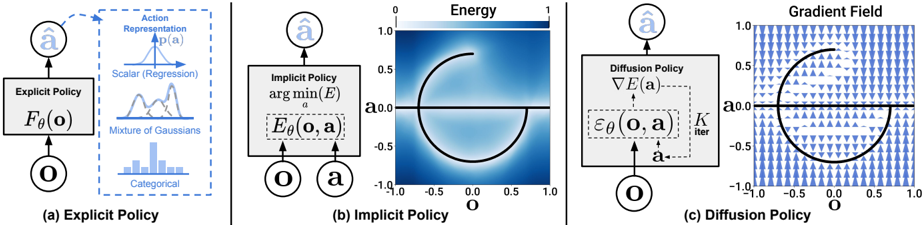
This paper introduces Diffusion Policy, a new way of generating robot behavior by representing a robot’s visuomotor policy as a conditional denoising diffusion process. We benchmark Diffusion Policy across 15 different tasks from 4 different robot manipulation benchmarks and find that it consistently outperforms existing state-of-the-art robot learning methods with an average improvement of 46.9%. Diffusion Policy learns the gradient of the action-distribution score function and iteratively optimizes with respect to this gradient field during inference via a series of stochastic Langevin dynamics steps. We find that the diffusion formulation yields powerful advantages when used for robot policies, including gracefully handling multimodal action distributions, being suitable for high-dimensional action spaces, and exhibiting impressive training stability. To fully unlock the potential of diffusion models for visuomotor policy learning on physical robots, this paper presents a set of key technical contributions including the incorporation of receding horizon control, visual conditioning, and the time-series diffusion transformer. We hope this work will help motivate a new generation of policy learning techniques that are able to leverage the powerful generative modeling capabilities of diffusion models. Code, data, and training details are available (diffusion-policy.cs.columbia.edu).
Overview
CoChat Summary
TL;DR
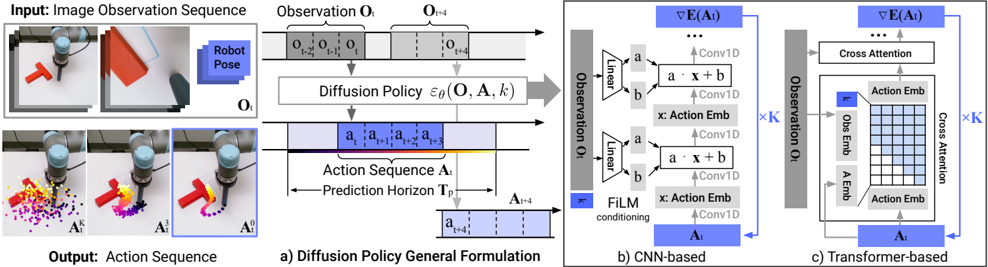
Diffusion Policy represents a visuomotor policy as a conditional denoising diffusion process over action sequences, using receding-horizon control, visual conditioning, and CNN or transformer backbones. Across 15 tasks from 4 benchmarks it reports an average 46.9% improvement over prior state-of-the-art, with strong real-world manipulation results.
Key findings
- Across 15 tasks from 4 robot manipulation benchmarks, Diffusion Policy consistently outperforms prior state-of-the-art with an average improvement of 46.9%; in simulation it reports best/average success rates such as 1.00/1.00 on Lift ph and 1.00/0.87 on ToolHang ph for DiffusionPolicy-T (Table 1).
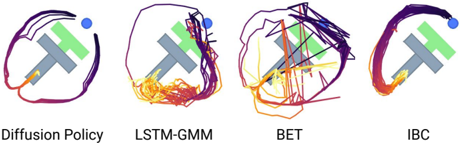
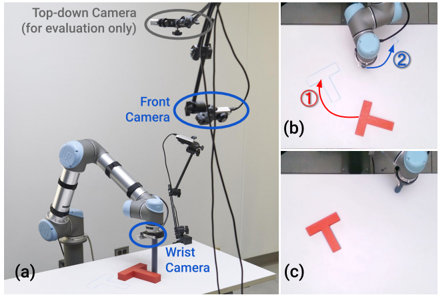
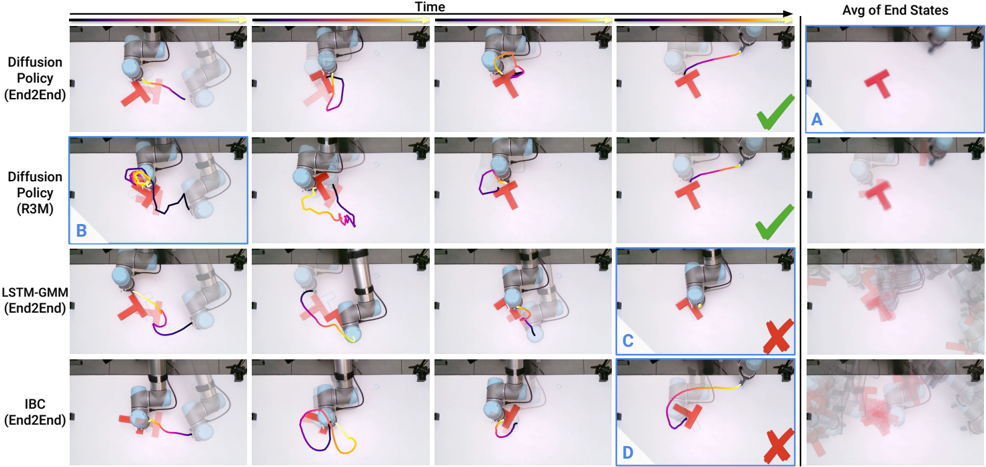
- Real-world Push-T: 95% success and 0.8 average IoU vs human 1.00 success and 0.84 IoU; best IBC and LSTM-GMM variants reached 0% and 20% success.
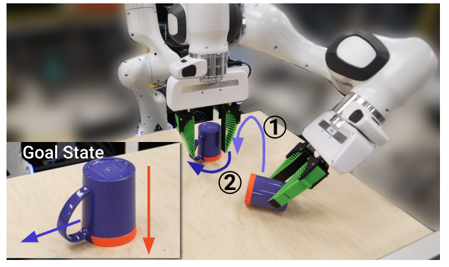
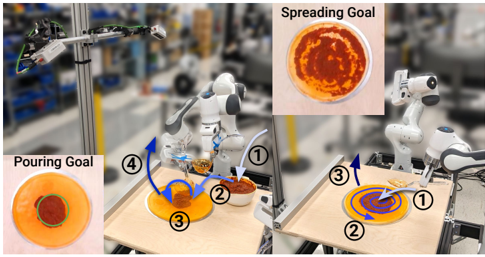
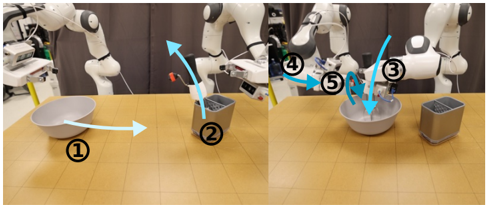
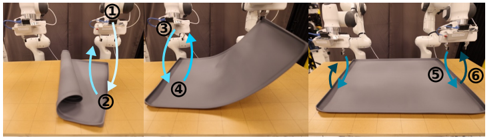
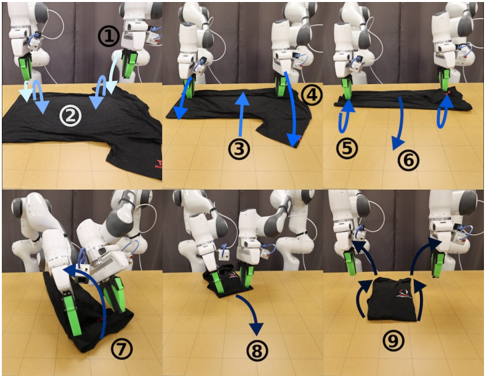
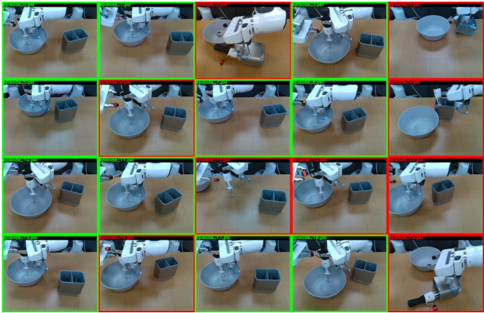
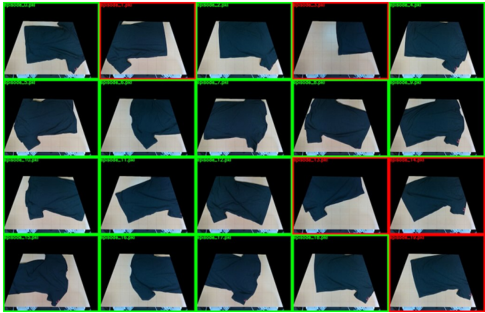
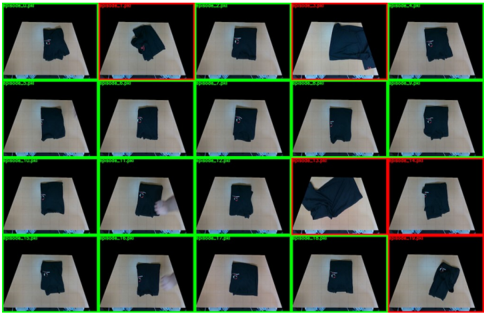
- Other real-world tasks: Mug Flipping 90% success over 20 trials (LSTM-GMM 0%); Sauce Pouring 0.74 IoU / 0.79 success vs human 0.79 / 1.00; Sauce Spreading 0.77 coverage / 1.00 success vs human 0.79 / 1.00; bimanual Egg Beater 55%, Mat Unrolling 75%, Shirt Folding 75%, each over 20 trials.
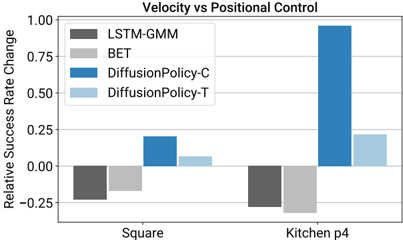
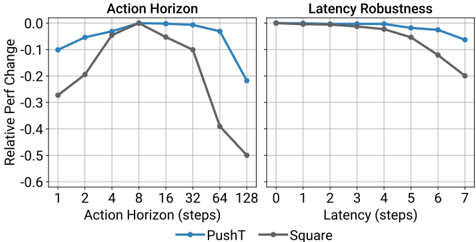
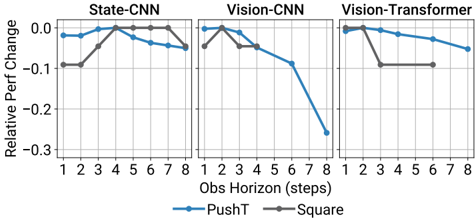
- Ablations: action horizon of 8 steps was optimal for most tested tasks; Diffusion Policy maintained peak performance with latency up to 4 steps; position control outperformed velocity control; DDIM with 100 training and 10 inference iterations enabled 0.1 s inference latency on an Nvidia 3080 GPU.
Methods
- Design: conditional DDPM/DDIM policy \(p(A_t|O_t)\) that predicts action sequences; uses receding-horizon control, visual conditioning, and either a CNN with FiLM or a time-series diffusion transformer.
- Data/evaluation: 15 tasks from 4 benchmarks (Robomimic, Push-T, Block Push, Kitchen) plus real-world single-arm and bimanual tasks; simulation results averaged over 3 training seeds and 50 environment initial conditions (1500 experiments total; robomimic used 22 initializations due to an evaluation-code bug).
- Analysis: compares against LSTM-GMM, IBC, and BET; metrics include success rate, target-area coverage/IoU, and ablations on action horizon, latency, action space, vision encoder, and architecture.
Limitations
- Stated: inherits behavior cloning limitations such as suboptimal performance with inadequate demonstration data; higher computational cost and inference latency than simpler methods like LSTM-GMM, which action-sequence prediction only partially mitigates and may not suffice for high-rate control.
- Stated: transformer backbone is more sensitive to hyperparameters; CNN backbone performs poorly when action sequences change quickly and sharply through time, such as velocity command action space.
- Evident: real-world evaluations often use small trial counts (e.g., 20 trials per task), and bimanual success rates were 55–75%; simulation robomimic used only 22 initializations due to a bug; frozen pretrained vision encoders performed poorly, and ViT from scratch reached only 22% success on square.
Model-written summary. Check it against the paper before relying on it.
Integrity signals
Registry
Cites
Statistics
Figures
Verification
Claims the paper makes
12 Valid · 4 Not valid · 14 Not checked · 115 Own results and interpretations
The cited sources support only part of this claim — read each source’s verdict below.
In the paper
“In contrast, IBC Florence et al. (2021) is prone to training instability.”
What the sources say
- Partly supportedcites Florence et al. (2021) matched to “Implicit Behavioral Cloning” (2021) sourceExperimental — accuracy not yet measured
Section B.3.1 (page unavailable) says the authors use spectral normalization and gradient penalties for additional training stability, which supports stability being a concern for their Langevin-based approach. It does not say that IBC generally is prone to training instability; the Limitations section instead names computational cost and implementation complexity. (LLM, conf=0.82)
plain- Asserted: passes — The authors put it forward as true.
- Checkable: passes — It can be checked against evidence.
- Load-bearing: passes — The paper’s conclusions depend on it.
- Based: passes — The paper gives a reason why it holds.
- Partly supported
The cited sources support only part of this claim — read each source’s verdict below.
In the paper
“Expressing multimodal action distributions. By learning the gradient of the action score function Song and Ermon (2019) and performing Stochastic Langevin Dynamics sampling on this gradient field, Diffusion policy can express arbitrary normalizable distributions Neal et al. (2011), which includes multimodal action distributions, a well-known challenge for policy learning.”
- Also stated in: § 4.1 Model Multi-Modal Action Distributions · p. 4 · boosted
“Diffusion Policy's ability to express multimodal distributions naturally and precisely is one of its key advantages.”
What the sources say
- Supportedcites Song and Ermon (2019) matched to “Generative Modeling by Estimating Gradients of the Data Distribution” (2019) source
Section 2.2 (p. 3) describes learning a distribution’s score and using Langevin dynamics to sample from it. Section 4.3 (p. 7) demonstrates sampling from a two-mode Gaussian mixture. The paper supports the cited method and its ability to represent multimodal distributions; applying it to action distributions is the citing authors’ context, not a result claimed by this source. (LLM, conf=0.88)
- Not matchedcites Neal et al. (2011)
An author–year citation the paper’s reference list doesn’t settle. We don’t search these by name.
boostedstates a cause- Asserted: passes — The authors put it forward as true.
- Checkable: passes — It can be checked against evidence.
- Load-bearing: passes — The paper’s conclusions depend on it.
- Based: passes — The paper gives a reason why it holds.
- Also stated in: § 4.1 Model Multi-Modal Action Distributions · p. 4 · boosted
The cited sources support only part of this claim — read each source’s verdict below.
In the paper
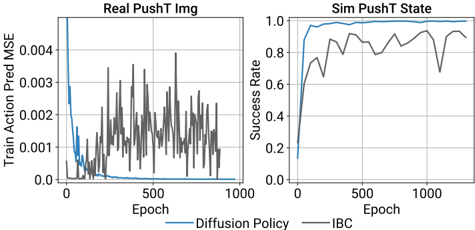
“However, existing implicit policies (Florence et al. 2021) are unstable to train due to the necessity of drawing negative samples when computing the underlying Info-NCE loss.”
What the sources say
- Partly supportedcites Florence et al. 2021 matched to “Implicit Behavioral Cloning” (2021) sourceExperimental — accuracy not yet measured
Section 2 says the implicit models are trained with negative counter-examples and an InfoNCE-style loss. Appendix B.3.1 discusses measures for additional training stability, but neither passage says that drawing negative samples makes these policies unstable to train. The claimed cause of instability is therefore unsupported. (LLM, conf=0.87)
plainstates a cause- Asserted: passes — The authors put it forward as true.
- Checkable: passes — It can be checked against evidence.
- Load-bearing: passes — The paper’s conclusions depend on it.
- Based: passes — The paper gives a reason why it holds.
- Partly supported
Every source the paper cites for this claim was checked and supports it.
In the paper
“In our control tasks, we empirically found that the Square Cosine Schedule proposed in iDDPM Nichol and Dhariwal (2021) works best for our tasks.”
What the sources say
- Supportedcites Nichol and Dhariwal (2021) matched to “Improved Denoising Diffusion Probabilistic Models” (2021) source
The citation identifies the origin of the squared-cosine noise schedule; the citing authors describe its performance on their control tasks as their own empirical finding. Section 3.2 (p. 4) proposes a cosine schedule and specifies the use of cos². (LLM, conf=0.92)
plainstates a cause- Asserted: passes — The authors put it forward as true.
- Checkable: passes — It can be checked against evidence.
- Load-bearing: unclear — It is unclear whether the paper’s conclusions depend on it.
- Based: passes — The paper gives a reason why it holds.
- Supported
The cited sources that could be checked couldn’t confirm or dispute this claim.
In the paper
“This shows that in order to perfectly clone a behavior that depends on the state, the learner must implicitly learn a (task-relevant) dynamics model Subramanian and Mahajan (2019); Zhang et al. (2020).”
What the sources say
- Not checked — no full text of the sourcecites Subramanian and Mahajan (2019) matched to “Approximate information state for partially observed systems” (2019) source
- Could not verifycites Zhang et al. (2020) matched to “Learning Invariant Representations for Reinforcement Learning without Reconstruction” (2020) sourceExperimental — accuracy not yet measured
The Introduction describes a representation that predicts task-relevant future states, and the method trains a latent dynamics model for reinforcement learning. Neither passage says that perfectly cloning state-dependent behavior requires a learner to implicitly learn such a model. Searches for imitation learning, behavior cloning, and that necessity claim found no supporting passage in our copy. (LLM, conf=0.76)
boostedstates a cause- Asserted: passes — The authors put it forward as true.
- Checkable: passes — It can be checked against evidence.
- Load-bearing: unclear — It is unclear whether the paper’s conclusions depend on it.
- Based: passes — The paper gives a reason why it holds.
79 more claims · 3 with their cited sources checked
Create a free account to see all 145 claims and to verify the 5 references still open.
- It may state two separate claims as one. 39
- Probably not a substantial claim. 33
- The quote only partly states this claim. 4
Claims other papers make about this one
Each is checked against this paper’s own text: does it say what the citing paper says it does?
The cited source doesn’t support the claim as written.
In the citing paper
“Inspired in part by human motor control [33], action chunking has recently emerged as the de facto standard in imitation learning for visuomotor control [68, 11].”
From Real-Time Execution of Action Chunking Flow Policies (2025) · cites this paper as [11]
Checked by a reasoning model — may be wrong.
Experimental — accuracy not yet measuredThe source backs part of the claim, not all of it — or backs it for a different population, condition or comparison.
In the citing paper
“Most simulated imitation learning benchmarks are quasi-static, and standard chunked execution with a long enough execution horizon can achieve near-perfect success rates [11].”
From Real-Time Execution of Action Chunking Flow Policies (2025) · cites this paper as [11]
Experimental — accuracy not yet measuredThe source backs part of the claim, not all of it — or backs it for a different population, condition or comparison.
In the citing paper
“This action head predicts a 'chunk”
From Octo: An Open-Source Generalist Robot Policy (2024) · cites this paper as [17]
Experimental — accuracy not yet measuredThe cited source says what the claim attributes to it.
In the citing paper
“Prior transformer-based policy designs typically encode input images with large ResNetstyle [32] encoders and fuse the resulting image features with a comparatively small transformer [10, 67, 81, 17, 98, 61, 83].”
From Octo: An Open-Source Generalist Robot Policy (2024) · cites this paper as [17]
The cited source says what the claim attributes to it.
In the citing paper
“While action chunking has enabled temporal consistency in high-frequency control tasks, it does not fully address the latency problem, leading to pauses or out-of-distribution jerky movements at chunk boundaries.”
From Real-Time Execution of Action Chunking Flow Policies (2025) · cites this paper as [11]
Self-check
Percentages, sums and reported differences re-computed from the paper’s own numbers.
Each contradiction between two passages listed here was confirmed by an independent check.
Rated minor: it would not touch a result — a value no result rests on, a p-value that stays on the same side of the significance level, or a conflict that is clerical, resolved elsewhere in the paper, or outside its own findings.
In the paper
§ 3.4 Accelerating Inference for Real-time Control · p. 4
“In our real-world experiments, using DDIM with 100 training iterations and 10 inference iterations enables 0.1s inference latency on a Nvidia 3080 GPU.”
§ A.4 Hyperparameters · p. 16
“We used DDIM Song et al. (2021) on realworld benchmarks to reduce the inference denoising iterations to 16 therefore reducing inference latency.”
Rated minor: it would not touch a result — a value no result rests on, a p-value that stays on the same side of the significance level, or a conflict that is clerical, resolved elsewhere in the paper, or outside its own findings.
In the paper
§ 5.1 Simulation Environments and datasets · p. 7
“the Franka Kitchen environment contains 7 objects for interaction and comes with a human demonstration dataset of 566 demonstrations”
§ 5.1 Simulation Environments and datasets · p. 7
“| Kitchen | 1 | 7 | 9 | 656 | 0 | 280 | No | No |”
Citations
Cites
Deep Residual Learning for Image Recognition
He, K., Zhang, X., Ren, S., & Sun, J. (2016) · 2016 IEEE Conference on Computer Vision and Pattern Recognition (CVPR) · doi:10.1109/cvpr.2016.90 · Cited by 235,474 · cited 1×
“Speci fi cally, we evaluated three different architectures: ResNet-18, ResNet-34 (He et al., 2016), and ViT-B/16 (Dosovitskiy et al., 2020).”
Vaswani, A., Shazeer, N., Parmar, N., Uszkoreit, J., Jones, L., Gomez, A. N., Kaiser, L., & Polosukhin, I. (2017) · arXiv · doi:10.48550/arxiv.1706.03762 · Cited by 120,404
U-Net: Convolutional Networks for Biomedical Image Segmentation
Ronneberger, O., Fischer, P., & Brox, T. (2015) · Lecture notes in computer science · doi:10.1007/978-3-319-24574-4_28 · Cited by 99,404 · cited 1×
“In this work, we examine two common network architecture types, convolutional neural networks (CNNs) (Ronneberger et al., 2015) and Transformers (Vaswani et al., 2017), and compare their performance and training characteristics.”
ImageNet: A large-scale hierarchical image database
Deng, J., Dong, W., Socher, R., Li, L.-J., Li, K., & Fei-Fei, L. (2009) · 2009 IEEE Conference on Computer Vision and Pattern Recognition · doi:10.1109/cvpr.2009.5206848 · Cited by 65,333
An Image is Worth 16x16 Words: Transformers for Image Recognition at Scale
Dosovitskiy, A., Beyer, L., Kolesnikov, A., Weissenborn, D., Zhai, X., Unterthiner, T., Dehghani, M., Minderer, M., Heigold, G., Gelly, S., et al. (2020) · arXiv · doi:10.48550/arxiv.2010.11929 · Cited by 47,472
U-Net: Convolutional Networks for Biomedical Image SegmentationPreprint
Ronneberger, O., Fischer, P., & Brox, T. (2015) · arXiv (Cornell University) · doi:10.48550/arxiv.1505.04597 · Cited by 17,820
Momentum Contrast for Unsupervised Visual Representation LearningPreprint
He, K., Fan, H., Wu, Y., Xie, S., & Girshick, R. B. (2019) · Computer Vision and Pattern Recognition · doi:10.48550/arxiv.1911.05722 · Cited by 16,321
Learning Transferable Visual Models From Natural Language Supervision
Radford, A., Kim, J. W., Hallacy, C., Ramesh, A., Goh, G., Agarwal, S., Sastry, G., Askell, A., Mishkin, P., Clark, J., et al. (2021) · arXiv · doi:10.48550/arxiv.2103.00020 · Cited by 15,293
Advances in neural information processing systems 7
(1996) · Computers & Mathematics with Applications · doi:10.1016/s0898-1221(96)90463-0 · Cited by 14,281
Advances in Neural Information Processing Systems 29
Teymur, O., Zygalakis, K., & Calderhead, B. (2016) · Cited by 13,887
Research works printed but not linked: 3
- Janner M, Du Y, Tenenbaum J and Levine S (2022b) Planning with diffusion for flexible behavior synthesis. In: Chaudhuri K, Jegelka S, Song L, Szepesvari C, Niu G and Sabato S (eds.) Proceedings of the 39th International Conference on Machine Learning , Proceedings of Machine Learning Research. PMLR.
- Wang Z, Hunt JJ and Zhou M (2023) Diffusion policies as an expressive policy class for offline reinforcement learning. In: The Eleventh International Conference on Learning Representations . URL https://openreview.net/ forum?id=AHvFDPi-FA .
- Welling M and Teh YW (2011) Bayesian learning via stochastic gradient langevin dynamics. In: Proceedings of the 28th international conference on machine learning (ICML-11) . pp. 681-688.
Cited by
Items 501–578 of 578
RobotMover: Learning to Move Large Objects From Human Demonstrations
Li, T., Truong, J., Yang, T.-Y., Clegg, A., Rai, A., Ha, S., & Puig, X. (2026) · IEEE Transactions on Robotics · doi:10.1109/tro.2026.3723958 · Cited by 8
“Despite significant progress in enabling robots to rearrange small items [1], [2], [3], [4], manipulating large objects presents a distinct set of challenges.”
Ren, B., He, S., Li, J., Chen, H., Liu, Y., & He, C. (2026) · International Conference on Intelligent Communications and Computing (ICICC) · doi:10.1109/icicc71012.2026.11637744
“Diffusion Policy transfers this idea to robot control by representing the policy as a conditional action-sequence generator [4].”
Yang, Z., Gong, B., Sun, M., Li, X., & Zhao, F. (2026) · Engineering Applications of Artificial Intelligence · doi:10.1016/j.engappai.2026.115988
Lightweight Gated Residual Late Fusion for Frozen Vision Priors in Vision-Only Diffusion Policies
Li, J., Zhao, Q., Wu, D., Shen, Y., Xu, X., Xiong, H., Shi, S., Li, J., Qi, J., & Hu, J. (2026) · IEEE International Conference on Mechatronics and Automation (ICMA) · doi:10.1109/icma69663.2026.11647476 · Cited by 1
“DP models robot action trajectories as a conditional denoising diffusion process, effectively mitigating mode collapse and achieving excellent performance on multi-stage manipulation tasks [1].”
InfluentialSystematic Literature Review of Vision-Language-Action Models for Generalist Robots
Cheema, U., Badr, Y., Le, T. M., & Fitzsimons, K. (2026) · Robotics · doi:10.3390/robotics15080160
Evolution of humanoid locomotion control
Gu, Y., Shi, G., Shi, F., Chang, I.-C., Wang, Y., Cheng, Q., Olkin, Z., López-Sánchez, I., Feng, Y., Zhang, J., et al. (2026) · Science Robotics · doi:10.1126/scirobotics.aed3973 · Cited by 8
Safe-Diff: Constrained Temporal Refinement of Generated Action PatternsPreprint
Guo, X., Wu, Y., & Chen, T. (2026) · SSRN Electronic Journal · doi:10.2139/ssrn.7311355
RMPflow-Based Collision Avoidance with Target Decomposition for Cross-Scale Micro-Assembly System
Liu, T., Zhang, X., Yang, Y., et al. (2026) · International Conference on Manipulation, Automation and Robotics at Small Scales (MARSS) · doi:10.1109/marss70227.2026.11655805
“Diffusion-based methods model trajectory distributions and generate high-quality motion candidates through an iterative denoising process, with the additional advantage of capturing multimodal trajectory distributions from data [11], [12].”
Pallet-ACT: A Unified Data-Training-Inference Framework for Industrial Robotic Palletizing
Lin, Y., Wang, J., Liu, B., Lv, Z., & Hei, X. (2026) · Information Communication Technologies Conference (ICTC) · doi:10.1109/ictc70246.2026.11650347
“…have significantly improved performance on complex visual tasks; these include diffusion-based policies for smooth trajectory generation [9], Transformer-based action chunking for long-horizon decision making [8], and large-scale vision-language-action models like RT-1 [10] and RT-2…”
Ma, H., Pan, H., Li, L., Su, H., & Yang, X. (2026) · International Journal of Humanoid Robotics · doi:10.1142/s0219843626400281
Han, L., Chen, G., & Zhao, T. (2026) · International Journal of Humanoid Robotics · doi:10.1142/s0219843626400268
Bimanual Tactile-Augmented Teleoperation for Contact-Rich Robotic Manipulation: A Pilot Evaluation
Shi, X., Bao, A., Zheng, H., & Zhao, P. (2026) · Applied Sciences · doi:10.3390/app16178383
A Multi-Obstacle Instruction-Following Benchmark with an Obstacle-Aware Manipulation Framework
Chen, J., & Luo, J. (2026) · IEEE/ASME International Conference on Advanced Intelligent Mechatronics · doi:10.1109/aim65483.2026.11658144
“Diffusion Policy [31] and its 3D extensions [32] model control as a trajectory distribution, capturing complex physical interaction.”
ReMoBot: Retrieval-Based Few-Shot Imitation Learning for Mobile Manipulation
Zhang, Y., Yang, W., Verdoja, F., Kyrki, V., & Pajarinen, J. (2026) · IEEE/ASME International Conference on Advanced Intelligent Mechatronics · doi:10.1109/aim65483.2026.11658109
“We hypothesize that 20 demonstrations( ∼ 600 samples per task) are insufficient, compared to prior work: Diffusion [33] uses over 200 demonstrations, and VINN [8] uses 71 for training.”
Residual QP-based Imitation Learning for Cooperative Bimanual Manipulation
Heo, E., 황찬식, An, J., et al. (2026) · IEEE/ASME International Conference on Advanced Intelligent Mechatronics · doi:10.1109/aim65483.2026.11658111
“Recent advances in behavior cloning, especially transformer-based policies, have significantly improved robotic imitation learning by enabling temporally consistent reproduction of demonstrated behaviors [1], [2], [4], [5].”
Tsunoda, K., Ito, H., Yamada, H., & NOGUCHI, N. (2026) · IEEE/ASME International Conference on Advanced Intelligent Mechatronics · doi:10.1109/aim65483.2026.11658242
“Robot-motion learning, using end-to-end approaches such as deep learning, enables robots to operate in diverse situations that cannot be handled using rule-based control programs [1],[2],[3],[4].”
Vision‐Language‐Action Models for Embodied Artificial Intelligence: A Comprehensive Survey
Xiong, N., Xu, M., Chen, W., Liu, J., Zhang, C., Wang, Y., & Yang, J. (2026) · Journal of Field Robotics · doi:10.1002/rob.70340
Toward Autonomous Contact-Rich Robotic Assembly: A Review of Imitation LearningPreprint
Wang, D., Luo, Y., Lu, H. X., Zhang, Y., Wang, Y., Huang, H., & Zang, Y. (2026) · SSRN Electronic Journal · doi:10.2139/ssrn.7360682
Wang, H., Zhang, S., Meng, X., & Li, G. (2026) · IEEE Robotics and Automation Letters · doi:10.1109/lra.2026.3728285 · Cited by 1
“Diffusion models have recently shown strong potential for robotic motion generation [12], [13], [14].”
GAS-Robo: Converting Scene Into a Grid-Action Space for LLM-Driven Open-Ended Robotic Manipulation
Li, H., Xie, S., Lin, Z., Xiao, Z., Wang, R., & Chen, X. (2026) · IEEE Robotics and Automation Letters · doi:10.1109/lra.2026.3728325
“Traditionalbehaviorcloningmethodsmap observationsdirectlytolow-levelactions[13],[14]withoutlan-guagepriors.”
Liu, X., Huang, J., 岡﨑, 威., Hou, L., Qiao, J., Liu, A., Huang, H., & Fengjuan, X. (2026) · Frontiers in Neurorobotics · doi:10.3389/fnbot.2026.1867375
CA-Safe DP: Integrating Coordinate Attention and Overshoot Recovery for Robotic Manipulation
Wu, Z., Shi, Y., Wang, Y., Cheng, R., Liu, W., & 张宗达 (2026) · IEEE Conference on Cybernetics and Intelligent Systems · doi:10.1109/cis-ram71614.2026.11668489
“It has therefore become a major paradigm for imitation learning and continuous robot control [7].”
InfluentialFEWT: Frequency‐Enhanced Wavelet‐Based Transformer for Multimodal Wheeled Bimanual Manipulation
Huang, J., Liu, H., Ma, Y., Shen, J., Zheng, Y., Wen, J., & Song, Z. (2026) · SmartBot · doi:10.1002/smb2.70058
“Second, Diffusion Policy [34] utilizes Diffusion Models [35] to fit complex multimodal action distributions.”
Sun, J., Luo, Y., Chu, Y., Wang, X., Jiang, Y., Zhao, X., & Zhao, Y. (2026) · Biomimetics · doi:10.3390/biomimetics11090622
“In contrast, contemporary robotic manipulation systems, particularly end-to-end visuomotor policies [9–12] and large vision–language–action models [13–15], typically lack explicit phase-level representations.”
Mitigating Covariate Shift in Offline Imitation Learning via Trajectory Synthesis
Wang, S., Xia, Y., Mei, Y., Cao, H., Wang, R., Zhang, X., Deng, F. Y., Sun, J. Q., Chen, J., & Wang, G. (2026) · IEEE Transactions on Automation Science and Engineering · doi:10.1109/tase.2026.3729780
CAD2Real: CAD-Grounded Skill Primitives and Vision-Language Planning for Precision Assembly
马文龙, Li, C., Wang, L., Hu, C., Yu, D., Shi, Y., & Lou, W. (2026) · IEEE Robotics and Automation Letters · doi:10.1109/lra.2026.3730294
“Imitation learning [13] and diffusion-based policies [14], [15], [16] support multimodal behavior but often require substantial data and domain randomization.”
Mobile manipulation of embodied robots: A survey on manipulators, methods, datasets and challengesPreprint
Chen, S., Xu, R., Zhang, K., Li, C., Yin, D., Pei, L., & Li, Q. (2026) · SSRN Electronic Journal · doi:10.2139/ssrn.7403472
End–Edge–Cloud Collaborative Fast–Slow Semantic Planning for Agricultural Field Robots
Gao, B., Gong, L., Sun, Y., Lin, G., Chen, J., Xu, Y., Li, Y., & Liu, C. (2026) · Agronomy · doi:10.3390/agronomy16171725
From Single-modal to Multimodal Perception in Intelligent Robotic Manipulators: A Review
Weng, T., Gao, J., Gong, M., Yang, H., Sui, X., Feng, L., Yang, D., & Xiaohu, B. A. I. (2026) · Journal of Bionic Engineering · doi:10.1007/s42235-026-01000-x
UF0-6D: Unified Flow-Based Zero-Shot 6D Object Pose Estimation Without Refinement
Guo, Y., Lim, C. H., Feng, Y., & Zhang, Y. (2026) · Lecture notes in computer science · doi:10.1007/978-3-032-37035-8_20
LightMambaVLA: Efficient Vision-Language-Action Modeling with State Space Models and Flow Matching
Niu, C., Li, L., Zhou, S., Zhang, Y., Hu, X., & Liu, Z. (2026) · International Conference on Computer Information Science and Application Technology (CISAT) · doi:10.1109/cisat71030.2026.11682592
“Current generative action heads, predominantly based on Diffusion Policies [5], rely on simulating Stochastic Differential Equations (SDEs), forcing a trade-off between trajectory quality and inference latency.”
Li, F., Ma, Y., Qian, C., Rao, W., & Shang, W. (2026) · IEEE Robotics and Automation Letters · doi:10.1109/lra.2026.3732837
“In learning-based robotic manipulation, researchers have successfully leveraged 2D visual observations to train robots for a variety of tasks [1], [2], [3].”
StructPolicy: Structure-Guided Imitation Learning Robust to Visual Domain Shifts
Du, Z., Wei, J., Lu, C., & Sun, J. (2026) · Lecture notes in computer science · doi:10.1007/978-3-032-37196-6_9
TSF-IL: Multimodal imitation learning with temporal-stage fusion
Tan, J., Xie, J., Lin, H., Wang, Z., & Ma, X. (2026) · Pattern Recognition Letters · doi:10.1016/j.patrec.2026.09.015
Miyoshi, H., & Kurita, S. (2026) · Advanced Robotics · doi:10.1080/01691864.2026.2726690
Yan, C., Zhang, Z., Zhang, Z., Wang, L., Wang, Y., & Lu, H. (2026) · Lecture notes in computer science · doi:10.1007/978-3-032-36969-7_2
System-Level Smart Robotic Harvesting for High-Value Greenhouse Crops: A Review
Wang, J., Xi, C., Chen, Y., Su, L., & Tang, Z. (2026) · Agronomy · doi:10.3390/agronomy16181795
Twin-DAgger: Synergizing Digital Twins and Human Corrections for Efficient Robot Manipulation
Li, J., Zhang, Z., Ding, K., Fei, F., Tang, Y., Liu, J., He, X., Chen, Z., Zhou, G., Ren, J., et al. (2026) · Lecture notes in computer science · doi:10.1007/978-3-032-37314-4_7
AdaDiff-VLA: Hybrid Reasoning via Mode Policy Learning for Vision-Language-Action Models
Liu, H., Liu, P., Liu, X., & Shu, T. (2026) · Lecture notes in computer science · doi:10.1007/978-3-032-38410-2_11
Data-driven Mobile Robot Exploration with Key-site Selective Memory
Li, X., Dong, H., Zhao, H., & Cai, Z. (2026) · Arabian Journal for Science and Engineering · doi:10.1007/s13369-026-11669-1
Manh, L. N. D., Hoang, H. N., Quoc, T. N., et al. (2026) · SSRN Electronic Journal · doi:10.2139/ssrn.7466141
DiffFNO: Fourier-Structured Diffusion Control for IoT-Enabled Building Energy Management
Zou, W., Han, Z., Cheng, B., Sun, Y., Liu, J., Liu, Z., & Zhou, H. (2026) · IEEE/CIC International Conference on Communications in China (ICCC) · doi:10.1109/iccc70295.2026.11680118
“Diffusion policies offer a more expressive action model for continuous control [9]–[11], while Fourier neural operators (FNOs) provide a useful spectral prior when low-frequency coordination is important [12], [13].”
Zhang, P., Hao, R., Zhang, M., Liang, X., Huang, K., Zhang, L., Jing, Y., Ma, Y., & Du, H. (2026) · International Conference on Big Data and Information Analytics (BigDIA) · doi:10.1109/bigdia71496.2026.11684676
“With the widespread application of large scale pretrained architectures, frontier research has begun utilizing conditional diffusion models to denoise and reconstruct action manifolds [37].”
Vision–Language–Action Models for Agricultural Robotics: A Review Towards Embodied Intelligence
Yang, X., He, J., Ye, L., Wu, Z., Tang, Y., & Luo, X. (2026) · Engineering · doi:10.1016/j.eng.2026.06.021 · Cited by 1
Advancements in reinforcement learning for robotic control: A comprehensive review
Fareh, R., Choutri, K., Siddique, T., Fadloun, S., & Khadraoui, S. (2026) · Biomimetic Intelligence and Robotics · doi:10.1016/j.birob.2026.100373
WIS: world-guided instruction semantic diffusion policy for predictive bimanual manipulation
Liu, X., Hou, L., Cheng, P., et al. (2026) · Frontiers in Neurorobotics · doi:10.3389/fnbot.2026.1940438
“Diffusion Policy formulated visuomotor control as a conditional denoising process and achieved strong performance across various manipulation benchmarks (Chi et al., 2025).”
Adaptive Mean Flow for Responsive Closed-Loop Robot Control
Vaaler, A., Job, M., Holden, C., & Egeland, O. (2026) · IEEE Robotics and Automation Letters · doi:10.1109/lra.2026.3734902
“All presented policies use a transformer architecture based on [5] as the policy network.”
InfluentialTracecritic-Diffuser: Execution-Trace Safety Critic for Safe Diffusion Planning
Wang, J., Cheng, Y., & Zhu, J. (2026) · International Conference on Electrical Engineering and Mechatronics Technology (ICEEMT) · doi:10.1109/iceemt71099.2026.11686400
“Recent diffusion-based planners address long-horizon planning by sampling diverse state-action trajectories from offline data [1], [2].”
BootDiffLights: Decentralized traffic signal control via diffusion-based reward generation
Hao, B., He, J., Zheng, J., Dong, W., Yang, Q., & Ma, X. (2026) · Applied Intelligence · doi:10.1007/s10489-026-07487-5
“Recently, diffusion models [9] have shown strong capabilities in modeling complex data distributions and have been applied to generative decision-making and reinforcement learning.”
Deng, X., Zhu, H., Zhang, L., Fu, Y., & Wang, S. (2026) · AI · doi:10.3390/ai7090373
Kinematic Smoothness Regularization for Action Chunking in Real-World Robotic Manipulation
Wu, S., Feng, Y., Li, W., Huo, Z., & Xing, F. (2026) · International Conference on Machine Manufacturing and Intelligent Control (ICMMIC) · doi:10.1109/icmmic70515.2026.11690539
“Diffusion Policy is a strong non-transformer example of expressive action-sequence modeling [4].”
A Progressive Diffusion-Based Imitation Learning Framework for Local Motion Planning
Lu, Z., Wang, N., He, K., & Huang, J. (2026) · Applied Sciences · doi:10.3390/app16199421
Actuator-aware diffusion motion planning for hyper-redundant tendon-driven continuum robots
Zhang, C., Liu, J., Wang, B., Fu, Z., & Liu, N. (2026) · Robotics and Autonomous Systems · doi:10.1016/j.robot.2026.105754
ActionDiT: A Causal Diffusion Transformer Policy for Long-Horizon Robotic Manipulation
Wang, L., Lin, Z., Fan, J., Yi, S., & Wang, F. (2026) · IEEE International Conference on Cyber Technology in Automation, Control, and Intelligent Systems · doi:10.1109/cyber71431.2026.11695478
“We follow the same data collection procedure as Diffusion Policy (DP) [5].”
InfluentialSun, C. (2026) · AI and Ethics · doi:10.1007/s43681-026-01400-z
Exo2EgoPolicy: Geometry-Aware Policy Transfer from Exocentric Human Demonstrations
Basak, H., Tabatabaee, H., Yang, X., Gayaka, S., Qiao, N., Sun, Y., Kuo, C.-H., Yin, Z., & Sun, M. (2026) · Lecture notes in computer science · doi:10.1007/978-3-032-36984-0_6
Tang, S., Hu, H., Yao, T., et al. (2026) · IEEE Transactions on Automation Science and Engineering · doi:10.1109/tase.2026.3737298
Fan, R., Wang, X., Shao, G., Tang, J., Wang, Y., & Xu, P. (2026) · Sensors · doi:10.3390/s26196134
Srivastava, R., Pathak, H., & Srivastava, S. (2026) · IEEE International Conference on Electronics, Computing and Communication Technologies (CONECCT) · doi:10.1109/conecct68978.2026.11700589
“The distribution of human-like activities from demonstration data has been shown to be well captured by diffusion models in particular [4].”
Mustapha, H., Wang, Z., Mehedi, I. M., Wu, Z., & Zhang, S. (2026) · International Conference on Computer Vision and Data Mining (ICCVDM) · doi:10.1109/iccvdm71812.2026.11709366
“…and Kang [15] showed that systematic measurement-pose selection yields sub-millimeter calibration accuracy in serial manipulators; Diffusion Policy [16] established generalizable visuomotor manipulation policies, and tabletop game-robot design work [17] emphasised closed-loop state consistency…”
Zhou, X., Feng, Y., Yan, X., Sun, J., Lu, Y., & Lu, J. (2026) · Buildings · doi:10.3390/buildings16193906
Agentic Test-Time Control for Robust Visuomotor Diffusion Policies
Cheng, X. (2026) · International Conference on Computer Vision and Data Mining (ICCVDM) · doi:10.1109/iccvdm71812.2026.11709141
“The problem is especially relevant for diffusion-based visuomotor policies, because the quality of generated action sequences depends directly on the fidelity of the conditioning observation [3].”
Robotic Hand‐Arm Coordinated Skill Learning for Tool Manipulation Tasks
Chen, J., Xie, L., Huang, B., Wang, S., Yang, S., Lee, W. W., Zeng, C., Yang, J., Liu, T., & Yang, C. (2026) · CAAI Transactions on Intelligence Technology · doi:10.1049/cit2.70185
Gao, B., Ren, Z., Ma, H., et al. (2026) · Procedia CIRP · doi:10.1016/j.procir.2026.04.005
Structured-VLA: An Explicit Structural Interface for Vision-Language-Action Control
Huang, P., Hu, J., Deng, J., Zhang, H., 王允宽, Chen, Z., Gao, M., & Sun, F. (2026) · IEEE International Conference on Automation Science and Engineering (CASE) · doi:10.1109/case69030.2026.11704245
Huang, P., Hu, J., Deng, J., et al. (2026) · 2022 IEEE 18th International Conference on Automation Science and Engineering (CASE) · doi:10.1109/case69030.2026.11704424
Depth-Guided Boundary-Aware Method for Contact-Rich Robotic Manipulation
Wang, W., Yang, J., & Cai, Z. (2026) · International Conference on Computer Science and Blockchain (CCSB) · doi:10.1109/ccsb71176.2026.11716373
Ren, Z., Ziao, L. I. U., Gao, B., Xia, L., & Pai, Z. (2026) · IEEE International Conference on Automation Science and Engineering (CASE) · doi:10.1109/case69030.2026.11704473
“Fusion-based methods synthesize human input and autonomous control into the final instruction, which can maintain control continuity [6], but are prone to intention conflicts and amplify contact stage jitter in dexterous tool operation [16].”
Domain-Augmented Inverse Reinforcement Learning for Robotic Textile Manipulation
Nguyen, P. K. D. T., Singh, R., & Iturrate, I. (2026) · IEEE International Conference on Automation Science and Engineering (CASE) · doi:10.1109/case69030.2026.11704148
“• We compare the performance of our GAIL-based imitation learning framework to Diffusion Policy [13], Fig.”
Anticipating interactions: a predictive diffusion framework for evolving bimanual manipulation
Liu, X., Fengjuan, X., He, X., Liu, A., Yan, L., Yang, J., Huang, H., & 岡﨑, 威. (2026) · Frontiers in Neurorobotics · doi:10.3389/fnbot.2026.1927097
Foundation models for dynamical systems: A unified survey of estimation, control, and forecasting
Wang, L., Li, X., Shi, T., Zhang, N., Zhan, G., Gao, H., Yang, R., Zeng, N., & Liu, Q. (2026) · Neurocomputing · doi:10.1016/j.neucom.2026.135322 · Cited by 1
Le, D. D. K., Jayasuriya, M., Hu, G., & Liu, D. (2026) · IEEE International Conference on Automation Science and Engineering (CASE) · doi:10.1109/case69030.2026.11704378
“We build upon the Diffusion Policy framework introduced by Chi et al. [1], which models action distributions using conditional denoising diffusion processes.”
Mei, J., Wu, X., Zhang, Y., Song, T., & Xiong, Z. (2026) · Proceedings - IEEE International Conference on Robotics and Automation/Proceedings · doi:10.1109/icra57385.2026.11697478
“Few-shot learning, leveraging meta-learning mechanisms, enabled models to quickly generalize to new tasks from a small number of demonstrations [32]–[34].”
A Multi-Scale Observation Encoder for Visuomotor Control with Diffusion Policy
Huang, Y., Yu, Z., & Chen, L. (2026) · International Conference on Robotics and Automation Sciences (ICRAS) · doi:10.1109/icras70064.2026.11717931
“Recent advances in generative modeling have led to diffusion policy [1], which formulates action generation as a conditional denoising diffusion process.”
Embodied AI for aerial manipulation: a survey
Jiang, J., Zhou, X., Chen, R., Yan, J., He, J., Zheng, X., Yang, Y., Li, Z., & Gao, H. (2026) · Technology · doi:10.67704/technol.2026.260007
Yang, Z., Liu, C., Zhou, Y., Lv, R., Cui, T., Yi, S., Zhu, H., Lu, I., & Sun, J. (2026) · arXiv · doi:10.48550/arxiv.2609.24093 · Cited by 2
“…across hands but produces static grasps; SPIDER (Pan et al., 2025) converts kinematic references into dynamically feasible trajectories through physics‑based sampling at high per‑trajectory cost; UniDexGrasp (Xu et al., 2023) learns goal‑conditioned grasping but stops at acquisition and lifting.”
InfluentialWorld Simulation with Video Foundation Models for Physical AI
NVIDIA, :, Ali, A., Bai, J., Bala, M., Balaji, Y., Blakeman, A., Cai, T., Cao, J., Cao, T., et al. (2025) · arXiv · doi:10.48550/arxiv.2511.00062 · Cited by 1
“Using these demonstrations, we train a UNet-based Diffusion Policy (Ren et al., 2025; Chi et al., 2023), which takes the single-image observation (processed via a small ViT) with gripper joint state and predicts chunks of actions consisting of the target end-effector poses and gripper commands for…”
Self-citationFAST: Efficient Action Tokenization for Vision-Language-Action Models
Pertsch, K., Stachowicz, K., Ichter, B., Driess, D., Nair, S., Vuong, Q., Mees, O., Finn, C., & Levine, S. (2025) · arXiv · doi:10.48550/arxiv.2501.09747 · Cited by 73
Metadata
- Authors
- Chi, C., Xu, Z., Feng, S., Cousineau, E., Du, Y., Burchfiel, B., Tedrake, R., & Song, S.
- Affiliations
- Columbia University (US)
- Toyota Research Institute (US)
- Massachusetts Institute of Technology (US)
- Corresponding author
- Chi, Cheng
- ORCID
- Venue
- The International Journal of Robotics Research
- Publisher
- SAGE Publications
- Published
- 2024-10-11
- Volume
- 44
- Issue
- 10-11
- Pages
- 1684-1704
- ISSN
- 0278-3649 (ISSN-L)
- 1741-3176
- OpenAlex
- W4403337227
- Semantic Scholar
- bdba3bd30a49ea4c5b20b43dbd8f0eb59e9d80e2
- Cited by
- 613
- References
- 40
- Citations by year
- 2026: 335 · 2025: 259 · 2024: 17
- FWCI
- 89.79
- Type
- journal article
- Language
- en
- Open access
- closed
- Licence
- journals.sagepub.com/page/policies/text-and-data-mining-license (tdm)
- Locations
- The International Journal of Robotics Research (publishedVersion)
- Funders
- Division of Civil, Mechanical and Manufacturing Innovation (2037101)
- Toyota Research Institute
- Division of Information and Intelligent Systems (2132519)
- Topics
- Physical Sciences › Computer Science › Artificial Intelligence › Reinforcement Learning in Robotics
- Physical Sciences › Engineering › Control and Systems Engineering › Robot Manipulation and Learning
- Physical Sciences › Computer Science › Artificial Intelligence › Domain Adaptation and Few-Shot Learning
- Keywords
- diffusion policy, visuomotor policy learning, robotic manipulation, Langevin dynamics, visual conditioning, model predictive control, high-dimensional action spaces, physical robots
About these checks
Registry, retraction, Cites and statistics results are computed, not judged, with one exception: a printed reference that no index lists is read once by a model before it counts as a citation error. Claims are extracted by a model and kept only when their quote appears verbatim in the text; each cited source is then checked, with a model’s help, for whether it says what the claim relies on. Those verdicts can be wrong — read the claim’s quote and the cited source before relying on one.
The claim verdicts this report counts are experimental: their accuracy is not yet measured.
A language model drew the claims from the paper on 2026-10-10, under version 3 of the claim definition (model deepseek-v4.1-flash, prompt extract-v3).
A second model labelled each claim on 2026-10-10 (model jev-1.13-20260917, definition revision gold-guideline-v0.2).
Cited sources are checked with a language model’s help (gpt-6-sol).
Statistics and arithmetic are recomputed, not judged.
Confidence bands are shown only for fields calibrated on our annotated test set. None is calibrated yet, so no band is shown.
What counts as a claim ›How we measure confidence ›How we check this ›
Are you an author, or do you see a problem with this page? Request a review
Data sources
Bibliographic data: Semantic Scholar, OpenAlex, Crossref.
Contains information from the Semantic Scholar Academic Graph Datasets, made available under the ODC Attribution License (ODC-BY 1.0).
Semantic Scholar’s data is described in: Kinney, R., et al. (2023). The Semantic Scholar Open Data Platform. arXiv:2301.10140.
