

Diffusion policy: Visuomotor policy learning via action diffusion
The DOI matches its Crossref record; 84 of the 87 references it cites were found in a registry or an index; 16 of the 39 sources its claims cite were checked for support.
Abstract
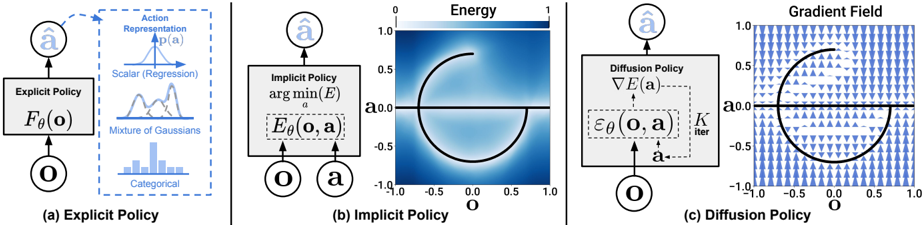
This paper introduces Diffusion Policy, a new way of generating robot behavior by representing a robot’s visuomotor policy as a conditional denoising diffusion process. We benchmark Diffusion Policy across 15 different tasks from 4 different robot manipulation benchmarks and find that it consistently outperforms existing state-of-the-art robot learning methods with an average improvement of 46.9%. Diffusion Policy learns the gradient of the action-distribution score function and iteratively optimizes with respect to this gradient field during inference via a series of stochastic Langevin dynamics steps. We find that the diffusion formulation yields powerful advantages when used for robot policies, including gracefully handling multimodal action distributions, being suitable for high-dimensional action spaces, and exhibiting impressive training stability. To fully unlock the potential of diffusion models for visuomotor policy learning on physical robots, this paper presents a set of key technical contributions including the incorporation of receding horizon control, visual conditioning, and the time-series diffusion transformer. We hope this work will help motivate a new generation of policy learning techniques that are able to leverage the powerful generative modeling capabilities of diffusion models. Code, data, and training details are available (diffusion-policy.cs.columbia.edu).
Overview
CoChat Summary
TL;DR
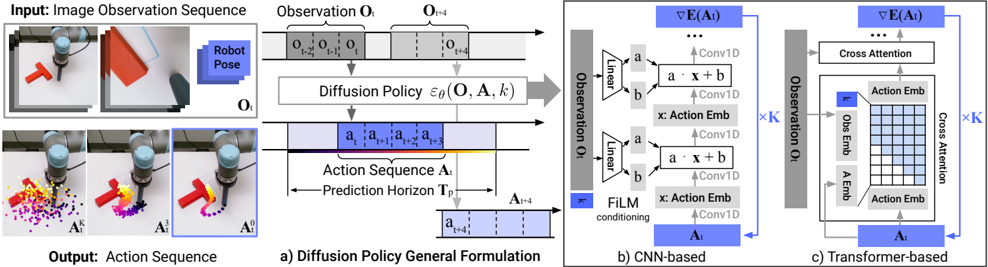
Diffusion Policy represents a visuomotor policy as a conditional denoising diffusion process over action sequences, using receding-horizon control, visual conditioning, and CNN or transformer backbones. Across 15 tasks from 4 benchmarks it reports an average 46.9% improvement over prior state-of-the-art, with strong real-world manipulation results.
Key findings
- Across 15 tasks from 4 robot manipulation benchmarks, Diffusion Policy consistently outperforms prior state-of-the-art with an average improvement of 46.9%; in simulation it reports best/average success rates such as 1.00/1.00 on Lift ph and 1.00/0.87 on ToolHang ph for DiffusionPolicy-T (Table 1).
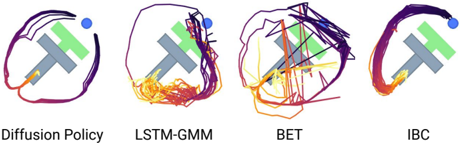
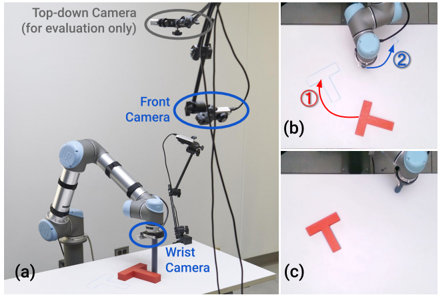
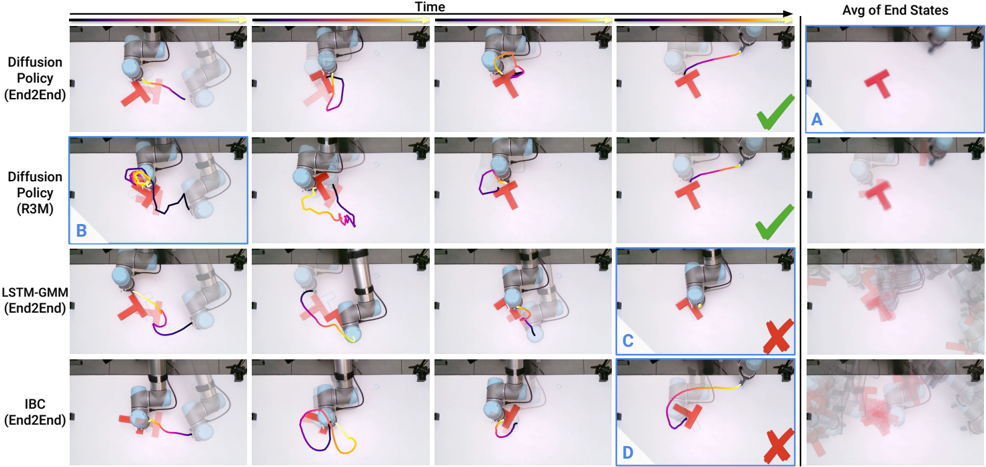
- Real-world Push-T: 95% success and 0.8 average IoU vs human 1.00 success and 0.84 IoU; best IBC and LSTM-GMM variants reached 0% and 20% success.
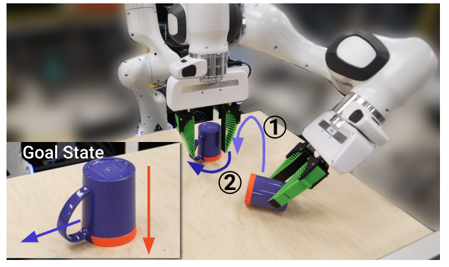
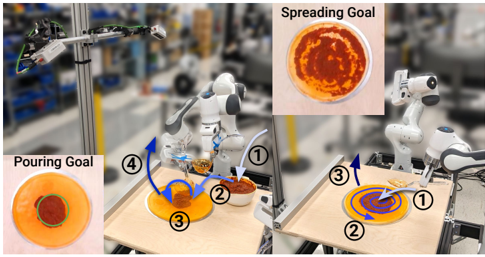
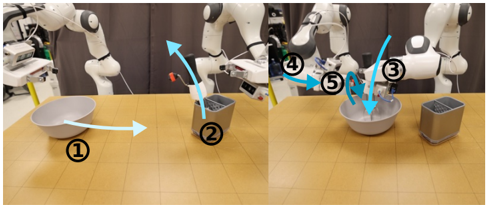
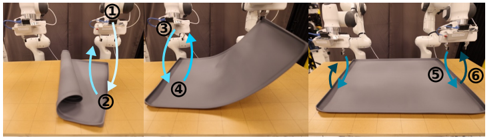
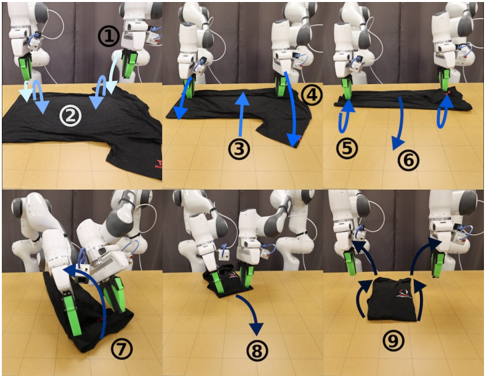
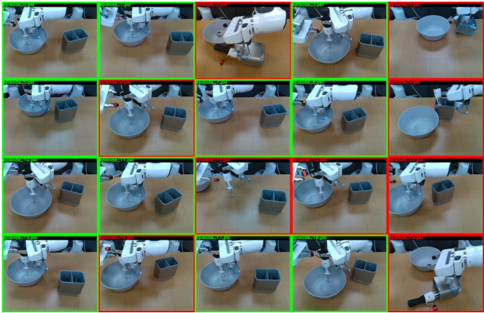
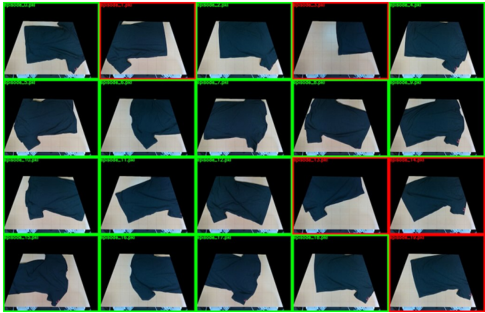
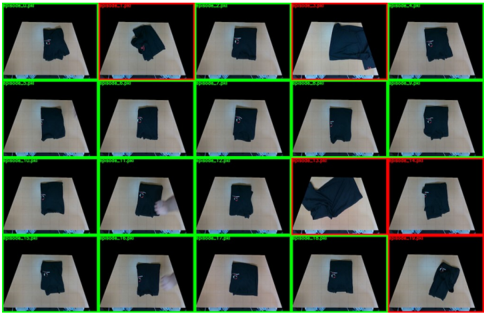
- Other real-world tasks: Mug Flipping 90% success over 20 trials (LSTM-GMM 0%); Sauce Pouring 0.74 IoU / 0.79 success vs human 0.79 / 1.00; Sauce Spreading 0.77 coverage / 1.00 success vs human 0.79 / 1.00; bimanual Egg Beater 55%, Mat Unrolling 75%, Shirt Folding 75%, each over 20 trials.
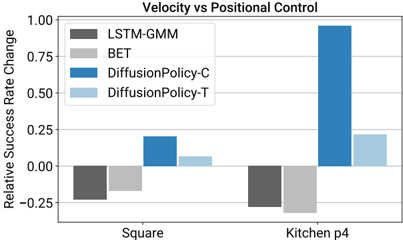
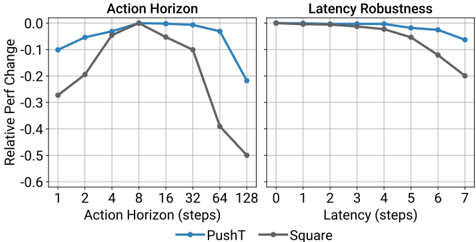
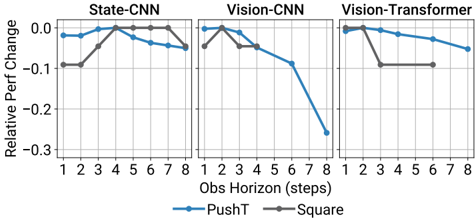
- Ablations: action horizon of 8 steps was optimal for most tested tasks; Diffusion Policy maintained peak performance with latency up to 4 steps; position control outperformed velocity control; DDIM with 100 training and 10 inference iterations enabled 0.1 s inference latency on an Nvidia 3080 GPU.
Methods
- Design: conditional DDPM/DDIM policy \(p(A_t|O_t)\) that predicts action sequences; uses receding-horizon control, visual conditioning, and either a CNN with FiLM or a time-series diffusion transformer.
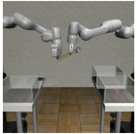
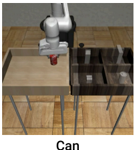
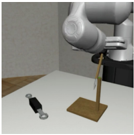
- Data/evaluation: 15 tasks from 4 benchmarks (Robomimic, Push-T, Block Push, Kitchen) plus real-world single-arm and bimanual tasks; simulation results averaged over 3 training seeds and 50 environment initial conditions (1500 experiments total; robomimic used 22 initializations due to an evaluation-code bug).
- Analysis: compares against LSTM-GMM, IBC, and BET; metrics include success rate, target-area coverage/IoU, and ablations on action horizon, latency, action space, vision encoder, and architecture.
Limitations
- Stated: inherits behavior cloning limitations such as suboptimal performance with inadequate demonstration data; higher computational cost and inference latency than simpler methods like LSTM-GMM, which action-sequence prediction only partially mitigates and may not suffice for high-rate control.
- Stated: transformer backbone is more sensitive to hyperparameters; CNN backbone performs poorly when action sequences change quickly and sharply through time, such as velocity command action space.
- Evident: real-world evaluations often use small trial counts (e.g., 20 trials per task), and bimanual success rates were 55–75%; simulation robomimic used only 22 initializations due to a bug; frozen pretrained vision encoders performed poorly, and ViT from scratch reached only 22% success on square.
Model-written summary. Check it against the paper before relying on it.
Integrity signals
Registry
Cites
Statistics
Figures
Verification
Claims the paper makes
12 Valid · 4 Not valid · 14 Not checked · 115 Own results and interpretations
The cited sources support only part of this claim — read each source’s verdict below.
In the paper
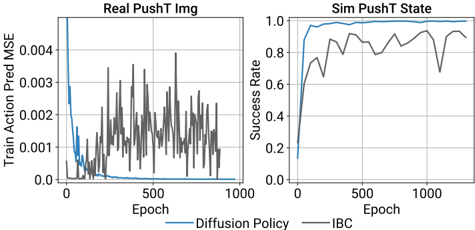
“In contrast, IBC Florence et al. (2021) is prone to training instability.”
What the sources say
- Partly supportedcites Florence et al. (2021) matched to “Implicit Behavioral Cloning” (2021) sourceExperimental — accuracy not yet measured
Section B.3.1 (page unavailable) says the authors use spectral normalization and gradient penalties for additional training stability, which supports stability being a concern for their Langevin-based approach. It does not say that IBC generally is prone to training instability; the Limitations section instead names computational cost and implementation complexity. (LLM, conf=0.82)
plain- Asserted: passes — The authors put it forward as true.
- Checkable: passes — It can be checked against evidence.
- Load-bearing: passes — The paper’s conclusions depend on it.
- Based: passes — The paper gives a reason why it holds.
- Partly supported
The cited sources support only part of this claim — read each source’s verdict below.
In the paper
“Expressing multimodal action distributions. By learning the gradient of the action score function Song and Ermon (2019) and performing Stochastic Langevin Dynamics sampling on this gradient field, Diffusion policy can express arbitrary normalizable distributions Neal et al. (2011), which includes multimodal action distributions, a well-known challenge for policy learning.”
- Also stated in: § 4.1 Model Multi-Modal Action Distributions · p. 4 · boosted
“Diffusion Policy's ability to express multimodal distributions naturally and precisely is one of its key advantages.”
What the sources say
- Supportedcites Song and Ermon (2019) matched to “Generative Modeling by Estimating Gradients of the Data Distribution” (2019) source
Section 2.2 (p. 3) describes learning a distribution’s score and using Langevin dynamics to sample from it. Section 4.3 (p. 7) demonstrates sampling from a two-mode Gaussian mixture. The paper supports the cited method and its ability to represent multimodal distributions; applying it to action distributions is the citing authors’ context, not a result claimed by this source. (LLM, conf=0.88)
- Not matchedcites Neal et al. (2011)
An author–year citation the paper’s reference list doesn’t settle. We don’t search these by name.
boostedstates a cause- Asserted: passes — The authors put it forward as true.
- Checkable: passes — It can be checked against evidence.
- Load-bearing: passes — The paper’s conclusions depend on it.
- Based: passes — The paper gives a reason why it holds.
- Also stated in: § 4.1 Model Multi-Modal Action Distributions · p. 4 · boosted
The cited sources support only part of this claim — read each source’s verdict below.
In the paper
“However, existing implicit policies (Florence et al. 2021) are unstable to train due to the necessity of drawing negative samples when computing the underlying Info-NCE loss.”
What the sources say
- Partly supportedcites Florence et al. 2021 matched to “Implicit Behavioral Cloning” (2021) sourceExperimental — accuracy not yet measured
Section 2 says the implicit models are trained with negative counter-examples and an InfoNCE-style loss. Appendix B.3.1 discusses measures for additional training stability, but neither passage says that drawing negative samples makes these policies unstable to train. The claimed cause of instability is therefore unsupported. (LLM, conf=0.87)
plainstates a cause- Asserted: passes — The authors put it forward as true.
- Checkable: passes — It can be checked against evidence.
- Load-bearing: passes — The paper’s conclusions depend on it.
- Based: passes — The paper gives a reason why it holds.
- Partly supported
Every source the paper cites for this claim was checked and supports it.
In the paper
“In our control tasks, we empirically found that the Square Cosine Schedule proposed in iDDPM Nichol and Dhariwal (2021) works best for our tasks.”
What the sources say
- Supportedcites Nichol and Dhariwal (2021) matched to “Improved Denoising Diffusion Probabilistic Models” (2021) source
The citation identifies the origin of the squared-cosine noise schedule; the citing authors describe its performance on their control tasks as their own empirical finding. Section 3.2 (p. 4) proposes a cosine schedule and specifies the use of cos². (LLM, conf=0.92)
plainstates a cause- Asserted: passes — The authors put it forward as true.
- Checkable: passes — It can be checked against evidence.
- Load-bearing: unclear — It is unclear whether the paper’s conclusions depend on it.
- Based: passes — The paper gives a reason why it holds.
- Supported
The cited sources that could be checked couldn’t confirm or dispute this claim.
In the paper
“This shows that in order to perfectly clone a behavior that depends on the state, the learner must implicitly learn a (task-relevant) dynamics model Subramanian and Mahajan (2019); Zhang et al. (2020).”
What the sources say
- Not checked — no full text of the sourcecites Subramanian and Mahajan (2019) matched to “Approximate information state for partially observed systems” (2019) source
- Could not verifycites Zhang et al. (2020) matched to “Learning Invariant Representations for Reinforcement Learning without Reconstruction” (2020) sourceExperimental — accuracy not yet measured
The Introduction describes a representation that predicts task-relevant future states, and the method trains a latent dynamics model for reinforcement learning. Neither passage says that perfectly cloning state-dependent behavior requires a learner to implicitly learn such a model. Searches for imitation learning, behavior cloning, and that necessity claim found no supporting passage in our copy. (LLM, conf=0.76)
boostedstates a cause- Asserted: passes — The authors put it forward as true.
- Checkable: passes — It can be checked against evidence.
- Load-bearing: unclear — It is unclear whether the paper’s conclusions depend on it.
- Based: passes — The paper gives a reason why it holds.
79 more claims · 3 with their cited sources checked
Create a free account to see all 145 claims and to verify the 5 references still open.
- It may state two separate claims as one. 39
- Probably not a substantial claim. 33
- The quote only partly states this claim. 4
Claims other papers make about this one
Each is checked against this paper’s own text: does it say what the citing paper says it does?
The cited source doesn’t support the claim as written.
In the citing paper
“Inspired in part by human motor control [33], action chunking has recently emerged as the de facto standard in imitation learning for visuomotor control [68, 11].”
From Real-Time Execution of Action Chunking Flow Policies (2025) · cites this paper as [11]
Checked by a reasoning model — may be wrong.
Experimental — accuracy not yet measuredThe source backs part of the claim, not all of it — or backs it for a different population, condition or comparison.
In the citing paper
“Most simulated imitation learning benchmarks are quasi-static, and standard chunked execution with a long enough execution horizon can achieve near-perfect success rates [11].”
From Real-Time Execution of Action Chunking Flow Policies (2025) · cites this paper as [11]
Experimental — accuracy not yet measuredThe source backs part of the claim, not all of it — or backs it for a different population, condition or comparison.
In the citing paper
“This action head predicts a 'chunk”
From Octo: An Open-Source Generalist Robot Policy (2024) · cites this paper as [17]
Experimental — accuracy not yet measuredThe cited source says what the claim attributes to it.
In the citing paper
“Prior transformer-based policy designs typically encode input images with large ResNetstyle [32] encoders and fuse the resulting image features with a comparatively small transformer [10, 67, 81, 17, 98, 61, 83].”
From Octo: An Open-Source Generalist Robot Policy (2024) · cites this paper as [17]
The cited source says what the claim attributes to it.
In the citing paper
“While action chunking has enabled temporal consistency in high-frequency control tasks, it does not fully address the latency problem, leading to pauses or out-of-distribution jerky movements at chunk boundaries.”
From Real-Time Execution of Action Chunking Flow Policies (2025) · cites this paper as [11]
Self-check
Percentages, sums and reported differences re-computed from the paper’s own numbers.
Each contradiction between two passages listed here was confirmed by an independent check.
Rated minor: it would not touch a result — a value no result rests on, a p-value that stays on the same side of the significance level, or a conflict that is clerical, resolved elsewhere in the paper, or outside its own findings.
In the paper
§ 3.4 Accelerating Inference for Real-time Control · p. 4
“In our real-world experiments, using DDIM with 100 training iterations and 10 inference iterations enables 0.1s inference latency on a Nvidia 3080 GPU.”
§ A.4 Hyperparameters · p. 16
“We used DDIM Song et al. (2021) on realworld benchmarks to reduce the inference denoising iterations to 16 therefore reducing inference latency.”
Rated minor: it would not touch a result — a value no result rests on, a p-value that stays on the same side of the significance level, or a conflict that is clerical, resolved elsewhere in the paper, or outside its own findings.
In the paper
§ 5.1 Simulation Environments and datasets · p. 7
“the Franka Kitchen environment contains 7 objects for interaction and comes with a human demonstration dataset of 566 demonstrations”
§ 5.1 Simulation Environments and datasets · p. 7
“| Kitchen | 1 | 7 | 9 | 656 | 0 | 280 | No | No |”
Citations
Cites
Deep Residual Learning for Image Recognition
He, K., Zhang, X., Ren, S., & Sun, J. (2016) · 2016 IEEE Conference on Computer Vision and Pattern Recognition (CVPR) · doi:10.1109/cvpr.2016.90 · Cited by 235,474 · cited 1×
“Speci fi cally, we evaluated three different architectures: ResNet-18, ResNet-34 (He et al., 2016), and ViT-B/16 (Dosovitskiy et al., 2020).”
Vaswani, A., Shazeer, N., Parmar, N., Uszkoreit, J., Jones, L., Gomez, A. N., Kaiser, L., & Polosukhin, I. (2017) · arXiv · doi:10.48550/arxiv.1706.03762 · Cited by 120,404
U-Net: Convolutional Networks for Biomedical Image Segmentation
Ronneberger, O., Fischer, P., & Brox, T. (2015) · Lecture notes in computer science · doi:10.1007/978-3-319-24574-4_28 · Cited by 99,404 · cited 1×
“In this work, we examine two common network architecture types, convolutional neural networks (CNNs) (Ronneberger et al., 2015) and Transformers (Vaswani et al., 2017), and compare their performance and training characteristics.”
ImageNet: A large-scale hierarchical image database
Deng, J., Dong, W., Socher, R., Li, L.-J., Li, K., & Fei-Fei, L. (2009) · 2009 IEEE Conference on Computer Vision and Pattern Recognition · doi:10.1109/cvpr.2009.5206848 · Cited by 65,333
An Image is Worth 16x16 Words: Transformers for Image Recognition at Scale
Dosovitskiy, A., Beyer, L., Kolesnikov, A., Weissenborn, D., Zhai, X., Unterthiner, T., Dehghani, M., Minderer, M., Heigold, G., Gelly, S., et al. (2020) · arXiv · doi:10.48550/arxiv.2010.11929 · Cited by 47,472
U-Net: Convolutional Networks for Biomedical Image SegmentationPreprint
Ronneberger, O., Fischer, P., & Brox, T. (2015) · arXiv (Cornell University) · doi:10.48550/arxiv.1505.04597 · Cited by 17,820
Momentum Contrast for Unsupervised Visual Representation LearningPreprint
He, K., Fan, H., Wu, Y., Xie, S., & Girshick, R. B. (2019) · Computer Vision and Pattern Recognition · doi:10.48550/arxiv.1911.05722 · Cited by 16,321
Learning Transferable Visual Models From Natural Language Supervision
Radford, A., Kim, J. W., Hallacy, C., Ramesh, A., Goh, G., Agarwal, S., Sastry, G., Askell, A., Mishkin, P., Clark, J., et al. (2021) · arXiv · doi:10.48550/arxiv.2103.00020 · Cited by 15,293
Advances in neural information processing systems 7
(1996) · Computers & Mathematics with Applications · doi:10.1016/s0898-1221(96)90463-0 · Cited by 14,281
Advances in Neural Information Processing Systems 29
Teymur, O., Zygalakis, K., & Calderhead, B. (2016) · Cited by 13,887
Research works printed but not linked: 3
- Janner M, Du Y, Tenenbaum J and Levine S (2022b) Planning with diffusion for flexible behavior synthesis. In: Chaudhuri K, Jegelka S, Song L, Szepesvari C, Niu G and Sabato S (eds.) Proceedings of the 39th International Conference on Machine Learning , Proceedings of Machine Learning Research. PMLR.
- Wang Z, Hunt JJ and Zhou M (2023) Diffusion policies as an expressive policy class for offline reinforcement learning. In: The Eleventh International Conference on Learning Representations . URL https://openreview.net/ forum?id=AHvFDPi-FA .
- Welling M and Teh YW (2011) Bayesian learning via stochastic gradient langevin dynamics. In: Proceedings of the 28th international conference on machine learning (ICML-11) . pp. 681-688.
Cited by
Items 401–500 of 578
Mag-VLA: Vision-Language-Action Model for Bimanual Magnetically Actuated Microrobot Manipulation
Wang, Y., Lu, K., Wei, L., & Zhang, D. (2026) · International Conference on Manipulation, Automation and Robotics at Small Scales (MARSS) · doi:10.1109/marss70227.2026.11655691 · Cited by 1
“Existing approaches include direct regression and action chunking [9], as well as diffusion-and flow-based generative policies [17], [18].”
GEM: Generative Supervision Helps Embodied Intelligence
Zhao, R., Li, B., Liu, Z., Liang, Y., Ye, J., Liu, F., Wu, D., Wang, Z., Yu, X., Rao, Y., et al. (2026) · Lecture notes in computer science · doi:10.1007/978-3-032-37447-9_34 · Cited by 7
Detecting Failures in Robot Manipulation via Distance‐Aware Temporal Modelling
Choi, H., & Kim, E. (2026) · Electronics Letters · doi:10.1049/ell2.70629
Ma, S., Zhang, C., Wang, C., Wang, Y., Wu, Y., Wang, Z., Tian, J., Zhu, Z., & Tang, Y. (2026) · Lecture notes in computer science · doi:10.1007/978-3-032-37362-5_9 · Cited by 9
GSAM: A Generalizable and Safe Robotic Framework for Articulated Object Manipulation
Shao, B., Xie, M., Su, H., Zhang, W., Li, M., Ding, Y., Giunchiglia, F., & Chen, C. (2026) · Lecture notes in computer science · doi:10.1007/978-3-032-36229-2_24 · Cited by 1
Human-Guided Online Reward Adaptation for Real-Robot Arm Manipulation
Zhou, T., Ao, H., Lu, H., Chen, G. J., Zhou, Z., Cui, T., Yu, C., & Yue, Y. (2026) · IEEE Robotics and Automation Letters · doi:10.1109/lra.2026.3699150 · Cited by 2
“2) IL Baselines: Diffusion Policy (DP) [21] and Action-Chunking Transformer (ACT) [22].”
Diffusion Models in Robotics: A Survey
Liu, X., Ma, K., Gao, C., & Shou, M. Z. (2026) · International Journal of Computer Vision · doi:10.1007/s11263-026-02893-1 · Cited by 3
“Theoretically, this convolutional bottleneck may obscure the high-frequency control signals and sharp action transitions essential for millimetric precision (Chi et al., 2023).”
InfluentialWang, Y., Zhang, R., Li, M., Shi, H., Wang, J., Huang, H., Wu, D., Fang, H.-S., Wang, W., Zheng, P., et al. (2026) · SSRN Electronic Journal · doi:10.2139/ssrn.6862443
Du, Y., Liu, L., & Zhang, Z. (2026) · IEEE Robotics and Automation Letters · doi:10.1109/lra.2026.3699256
“Pioneering works such as Diffuser [15] and Diffusion Policy [16] demonstrate that diffusion processes can capture multi-modal action distributions and long-horizon behaviors, addressing limitations of regression-based policies in stochastic and underactuated settings.”
Self-citationDIRA: Diffusion-Based Imitation-to-Reinforcement Adaptation for Task Automation of Surgical Robots
Wang, G., Sun, X., Xing, Y., Cao, R., Ma, Z., & Zhang, X. (2026) · IEEE Robotics and Automation Letters · doi:10.1109/lra.2026.3699185 · Cited by 1
“Imitation learning derives policies directly from expert demonstrations, allowing robots to acquire fine-grained bimanual manipulation skills for everyday tasks [3], [4].”
Mei, J., Wu, X., Zhang, Y., Song, T., & Xiong, Z. (2026) · IEEE Internet of Things Journal · doi:10.1109/jiot.2026.3698515 · Cited by 1
Medina, E. P., Bárcenas, E., Garcia-Garcia, R. A., Gonzalez-Villela, V. J., Pérez-Gaspar, M., & Rivas-Campos, F. (2026) · International Conference on Intelligent Environments (IE) · doi:10.1109/ie69249.2026.11539044
“…actions to categorical or scalar representations; implicit policies [18], which define an energy function whose minimization yields optimal behavior; and diffusion-based policies [16], [19], which model robot motion as a Langevin diffusion process, providing resilience against environmental noise.”
Active Jitter Suppression in VLA-Driven Robotics via Cascaded Tracking Differentiators
Tang, H., Weilin, C., Zhu, W., et al. (2026) · doi:10.1109/ipac69021.2026.11542954
“Architectures such as Google RT-1[1] and RT-2[2], Columbia University Diffusion Policy[3], UC Berkeley ACT and Octo[4], and the open-source community OpenVLA[5] and its SmolVLA[6] and [7] series are capable of integrating multimodal perception with language instructions to generate control…”
A Real-Time Robotic Diffusion Policy Accelerator Exploiting Self- and Cross-Guided Modal Similarity
Chen, B., Feng, X., Lin, J., Tang, C., Yang, H., & Liu, Y. (2026) · Design, Automation, and Test in Europe · doi:10.23919/date69613.2026.11539175
“Building on diffusion models’ strong expressiveness and stable likelihood-based training [13], [14], Diffusion Policy (DP) formulates robotic visuomotor control as a conditional denoising diffusion process for robust modeling of complex multi-modal action distributions [1], [15].”
PGDP: Physics-Guided Diffusion Policy for Multi-Rate Control in Contact-Rich Manipulation
Zhu, D., LI, Y., LI, Y., & Guo, S. (2026) · IEEE Robotics and Automation Letters · doi:10.1109/lra.2026.3701123
“Recent multi-rate methods adopt implicit re-finements untied to tactile safety and stability [21], [22], so the execution layer cannot suppress force spikes, edge loading or slip under disturbances [23], [24], [25].”
Liu, X., Fengjuan, X., Liu, S., Sun, X., Liu, Z., Li, G., & 岡﨑, 威. (2026) · Frontiers in Neurorobotics · doi:10.3389/fnbot.2026.1846433 · Cited by 1
“Extensive experiments on the RoboTwin 2.0 platform across six dual-arm robot configurations Diffusion Policy (DP3) baseline, achieving higher success rates using 50 automatically generated expert demonstrations in most comparisons, while introducing modest additional computational overhead.”
InfluentialStructure-Aware Diffusion Policy for Bimanual Cooperative Manipulation
Li, X., Zhang, J., Fu, L., Gu, L., Xiong, Y., & Li, S. (2026) · IEEE Robotics and Automation Letters · doi:10.1109/lra.2026.3701562
“Generative imitation learning, particularly diffusion-based policies [5], has become an effective framework for robotic manipulation because it can model multimodal action distributions and generate temporally consistent behaviors over long horizons [32], [33].”
Mei, J., Wu, X., Zhang, Y., Song, T., & Xiong, Z. (2026) · IEEE Transactions on Automation Science and Engineering · doi:10.1109/tase.2026.3701843 · Cited by 1
State-Space Modeling for Action Generation in Embodied Agents
Liu, W., Li, J., Li, A., Quan, S., Shui, Y., & Li, Y. (2026) · International Symposium on Intelligent Robotics and Systems (ISoIRS) · doi:10.1109/isoirs70157.2026.11545245
Surface Constraint Policy for Learning Surface-Constrained and Dynamically Feasible Robot Skills
Shuai, K., Zhang, J., Zhao, H., Wei, Z., Guo, Y., Pan, J., & Ding, H. (2026) · IEEE Transactions on Industrial Informatics · doi:10.1109/tii.2026.3694400 · Cited by 1
“For example, generative adversarial networks [10], action chunking with transformers [11], and diffusion-based approaches [8], [12], [14] involve attempting to directly map sensory inputs to complete action trajectories in an end-to-end fashion.”
InfluentialJoint-Guided Spatial and Semantic Sensitive Diffusion Policy for Robotic Manipulation
Zhang, H., Liu, S., Liu, Y., Ouyang, C., & Gan, Z. (2026) · International Conference on Multimedia Retrieval · doi:10.1145/3805622.3810612
Learning Soil-Adaptive Robotic Excavation via Diffusion Policy
Ma, Z., Zhang, J., Li, J. W., et al. (2026) · Conference on Fully Actuated System Theory and Applications (FASTA) · doi:10.1109/fasta70174.2026.11549281
Self-citationAsad, U., Khalid, A., Lughmani, W. A., Rasheed, S., & Khan, M. M. (2026) · Sensors · doi:10.3390/s26123810
“Recent developments include diffusion policies [24], which model robot action sequences as a conditional denoising process, and large-scale generalist policies such as π 0 [25] and OpenVLA [26], which fine-tune vision-language backbones on cross-embodiment manipulation data.”
DRIFT: Coordinating target intent and local geometry for diffusion-based trajectory generation
Zhao, J., Zheng, H., Zhong, Y., Zhang, Q., & Wu, S. (2026) · Expert Systems with Applications · doi:10.1016/j.eswa.2026.133261
A review of open-vocabulary semantic mapping and navigation with foundation models for mobile robots
Hagiwara, Y., & Hasegawa, S. (2026) · Advanced Robotics · doi:10.1080/01691864.2026.2738311
Liu, X., Fengjuan, X., Liu, Z., et al. (2026) · Frontiers in Neurorobotics · doi:10.3389/fnbot.2026.1849143
“Early works such as Diffusion Policy model action generation as a conditional denoising process, enabling the policy to capture complex, multimodal action distributions and improving robustness over deterministic mappings (Chi et al., 2025).”
Nonholonomic Dynamic Movement Primitives
Infantone, G., Grioli, G., & Bicchi, A. (2026) · IEEE Transactions on Robotics · doi:10.1109/tro.2026.3706555
“Diffusion policies [8] model action distributions through iterative denoising.”
DCoPilot: Generative AI-Empowered Policy Adaptation for Dynamic Data Center Operations
Li, M., Wang, R., Tan, R., & Wen, Y. (2026) · ACM/IEEE International Conference on Cyber-Physical Systems (ICCPS) · doi:10.1109/iccps68698.2026.00025 · Cited by 2
“While Diffusion Policy [5] achieves strong results in robotic manipulation with multiple valid actions per state, DC control is different.”
Time-Reversed BSDEs for Accurate Gradient Estimation in Diffusion Models
Mei, Y., & Taghvaei, A. (2026) · IEEE Control Systems Letters · doi:10.1109/lcsys.2026.3706462
“In many practical scenarios, however, it is desirable to steer the generation process toward outputs that satisfy additional objectives, preferences, or task-specific requirements.”
Ra C : Robot Learning for Long-Horizon Tasks by Scaling R ecovery a nd C orrection
Hu, Z., Wu, R., Enock, N., Li, J., Kadakia, R., Erickson, Z., & Kumar, A. (2026) · IEEE Transactions on Robotics · doi:10.1109/tro.2026.3706552 · Cited by 57
“Fitting various sources of data demands a high-capacity policy architecture, with sufficiently expressive output heads [1], [17],[45].”
InfluentialUncertainty-Aware Adaptive Velocity Scaling for Precise Robotic Manipulation
Ren, Z., 吴文杰, Lu, J., Gao, S., Gan, Z., & Gong, L. (2026) · International Conference on Artificial Intelligence and Industrial Technology Applications (AIITA) · doi:10.1109/aiita69518.2026.11567292
“Recent advancements in Imitation Learning (IL), particularly Diffusion Policies [1] and Transformer-based architectures (e.g., ACT) [2]–[4] , have revolutionized robotic manipulation through Action Chunking .”
Learning to Reposition Surgical Instruments via Diffusion Policy
Su, M., Tang, Y., Huang, Y., & Chu, X. (2026) · International Symposium on Autonomous Systems (ISAS) · doi:10.1109/icaisisas68969.2026.11567676
“Diffusion policy [17] addresses this challenge by learning the underlying multimodal action distribution directly from diverse human demonstrations.”
InfluentialOffline Goal-Conditioned RL with Analytical-Learning Synergy
Xia, Y., Zheng, K., Guo, F., et al. (2026) · Chinese Control and Decision Conference (CCDC) · doi:10.1109/ccdc69976.2026.11560327
“Goal-conditioned policy generation has been explored for performance control, including conditional diffusion [11], Up-side-Down RL [12], and Diffusion Policy [13].”
Action and Detection Chunking With Transformers Based on Experience Tree
Wang, B., Zhan, G., Shang, J., & Liu, Q. (2026) · IEEE Robotics and Automation Letters · doi:10.1109/lra.2026.3706944
“Currently, two mainstream approaches dominate: diffusion policy (DP) [35] and ACT.”
UniTeD: Unified Temporal Diffusion for Joint Perception and Planning in Autonomous Driving
Zhao, B., Zhao, X., Li, N., Cheng, E., & Ling, H. (2026) · Lecture notes in computer science · doi:10.1007/978-3-032-37132-4_16 · Cited by 3
Stage-aware and roughness-constrained diffusion policy for multi-stage robotic polishing
Ke, S., Zhang, J., Zhao, H., Wei, Z., Guo, Y., Wu, T., Guo, G., Zhou, H., Pan, J., & Ding, H. (2026) · Robotics and Computer-Integrated Manufacturing · doi:10.1016/j.rcim.2026.103417
RelAfford6D: Relational 6D Affordance Graphs for Constraint-Driven Robotic Manipulation
Zhang, G., He, Q., Xie, W., Wu, S., Ji, Y., Li, Q., Bayramli, B., Ding, Y., & Ҫirkinoğlu, H. O. (2026) · Lecture notes in computer science · doi:10.1007/978-3-032-37013-6_28 · Cited by 1
Cognition-inspired Robot Learning and Manipulation for Assembly in Semi-structured Environments
Wang, C., Yang, L. T., Lin, Z., Chen, G., Cheng, J., & Pang, J. (2026) · Autonomous Robots · doi:10.1007/s10514-026-10259-2
“…than training a mono-lithic end-to-end model that demands massive demonstration datasets and offers limited interpretability (Zhao et al., 2023; Chi et al., 2024; Xu et al., yyy), CRLM modu-larizes competence into interpretable symbolic representations (task decomposition, geometric priors,…”
Residual Reinforcement Learning for Robotic Assembly of Large-Scale Aerospace Components
Duan, X., Ma, G., Liu, W., Fang, K., & Wang, Y. (2026) · Lecture notes in computer science · doi:10.1007/978-3-032-29915-4_40
“Recent IL methods such as diffusion-based policies [3] and action-chunking [16] can capture long-horizon behaviors from limited demonstrations.”
Kamiguchi, S., & Nishio, T. (2026) · doi:10.1109/infocom59046.2026.11571408
“Recent advances in robot imitation learning, exemplified by ω 0 [1] and Diffusion Policy [2], have enabled robotic arms to execute increasingly sophisticated and complex tasks.”
simDP: Sim-to-Real Transfer with Shared Action Spaces
Jung, C., Choi, J., Yoo, S., & Ko, B. C. (2026) · Sensors · doi:10.3390/s26134079 · Cited by 1
“Following DP [2], we predict an H -step future action chunk a t : t + H − 1 = ( a t , a t + 1 , . . . , a t + H − 1 ) .”
InfluentialLearning Transferable Dynamics Priors from Action to World Modeling
Huang, Z. Z., Zhang, J., Liu, H. X., Zhang, C., Cheng, R., & Zhang, L. (2026) · Lecture notes in computer science · doi:10.1007/978-3-032-37550-6_25 · Cited by 10
Xu, D., Huang, Y., Tang, J., & Fang, S. (2026) · Measurement · doi:10.1016/j.measurement.2026.122349
Jin, Z., Wang, H., Sun, X., & Shao, Y. (2026) · Advanced Engineering Informatics · doi:10.1016/j.aei.2026.104823 · Cited by 1
“Compared to diffusion-based policies [68], QC-FQL factorizes multimodal behavior modeling and value optimization through teacher–student distillation, eliminating iterative sampling during online action selection.”
A Flexible Wrist With Anisotropic and Selectable Stiffness for Robust Contact-Rich Manipulation
Oh, S., Takahashi, T., Beltran-Hernandez, C. C., et al. (2026) · IEEE Robotics and Automation Letters · doi:10.1109/lra.2026.3709079
AutoSpeed: Annotation-Free Stage-Adaptive Motion Speed Learning for Robot Manipulation
Hu, Q., Qiu, Z., Zhao, J., Gan, Z., & Ding, W. (2026) · Lecture notes in computer science · doi:10.1007/978-3-032-37095-2_3 · Cited by 6
DexGraspDiffuser: Target-Coupled Grasp and Action Diffusion for Dexterous Grasping
Zhu, J., Yang, H., Yang, Z., & Guo, Y. (2026) · Biomimetics · doi:10.3390/biomimetics11070465
“Second, successful execution depends not only on the target grasp itself, but also on the coordinated use of object point clouds, robot body state, hand state, and real-time observations to continuously adjust actions during contact [13,14].”
Do, H. Q., Truong-Quoc, C., & Tran, Q. V. (2026) · Mechanisms and machine science · doi:10.1007/978-3-032-29469-2_19
Lou, J., & Zheng, L. (2026) · IEEE Access · doi:10.1109/access.2026.3709662
“Diffusion-based approaches [27], [28] can model multi-modal action distributions but require 50–1000 iterative denoising steps [29], making them unsuitable for sub-millisecond trading environments.”
Guo, X., Zheng, X., Xiao, T., Liu, J., & Li, K. (2026) · SSRN Electronic Journal · doi:10.2139/ssrn.7050279
NeuralPathLite: Fast and Robust Diffusion-Based Path Planning for Autonomous Navigation
Kumar, P., Gupta, P., & Sandhan, T. (2026) · IEEE Transactions on Automation Science and Engineering · doi:10.1109/tase.2026.3710089 · Cited by 1
Zhang, K., Yang, Y., Wang, L., Li, R., Ding, J., Li, C., Shang, H., & Xu, Y. (2026) · IEEE Robotics and Automation Letters · doi:10.1109/lra.2026.3710341
“Recently, the diffusion-based imitation learning [2], [3], [4], [5] has gained great research attention as a new policy paradigm.”
GeoDiff: Geometry-Conditioned Diffusion Policy for Refined Robotic Trajectory Generation
Xie, W., Zhuo, H. H., & Pan, R. (2026) · International Conference on Machine Intelligence Theory and Applications (MiTA) · doi:10.1109/mita69365.2026.11582496
“Despite recent progress , leading diffusion-based visuomotor policies (e.g., Diffusion Policy [6], 3D Diffusion Policy (DP3) [7]) typically condition on point clouds and proprio-ception while omitting explicit inter-object geometric relations that are critical for spatial reasoning, contact…”
InfluentialX-Distill: Cross-Architecture Vision Distillation for Visuomotor Learning
Shao, M., Zhang, F.-H., Zhang, G., Cheng, B.-Y., Xue, Z.-R., & Xu, H.-Z. (2026) · IEEE Robotics and Automation Letters · doi:10.1109/lra.2026.3711479 · Cited by 3
“WeuseaDiffusionPolicy [1] head, which generates action chunks conditioned on robot observations.”
Wang, L., Sheng, K., He, Z., Li, J., Qin, Y., Dai, H., Wang, X. F., Yang, J., Yan, Q., Liu, C., et al. (2026) · IEEE Transactions on Automation Science and Engineering · doi:10.1109/tase.2026.3711284 · Cited by 3
Semantic Knowledge-Guided Object-Goal Navigation for Robots in Localized Scenes
Zhang, C., Wu, J., Hou, J., Zhang, Y., Jia, H., & Ouyang, Z. (2026) · Lecture notes in computer science · doi:10.1007/978-981-92-2864-5_16
Language-Guided Diffusion Policies with Vision-Language Models for Robot Manipulation
Jia, X., Li, M., Han, B., & Yu, X. (2026) · Lecture notes in computer science · doi:10.1007/978-981-92-2864-5_32
Integrating Agglomerative Perception With One-Step Action Generation for Robotic Manipulation
Wang, S., Wang, L., Huo, H., Zhou, S., Xia, K., & Hua, G. (2026) · IEEE Transactions on Pattern Analysis and Machine Intelligence · doi:10.1109/tpami.2026.3713027
“Restrictions apply. such as diffusion policies [34], [67] and flow-based formulations [41], [43] attempt to integrate perception by conditioning visual features into the denoising or flow transport process.”
InfluentialEfficient Decentralized Multi-UAV Wildfire Monitoring via MCTS-Distilled Diffusion Policies
Wang, L., & Bronz, M. (2026) · International Conference on Unmanned Aircraft Systems (ICUAS) · doi:10.1109/icuas69441.2026.11598691
“Diffusion Policy [17] demonstrates how such models can efficiently learn decision policies by sampling future trajectories, making them well-suited for amortizing long-term planning tasks.”
SegDiff: Segmented Trajectory Diffusion for Consistent and Adaptive Robot Manipulation
Cao, H., Cao, W., Li, Q., Xie, S., Du, Z., Leng, J., Wu, Z., & Jiang, Y.-G. (2026) · Lecture notes in computer science · doi:10.1007/978-3-032-37577-3_36
CMIRL: Causal Morphology-Invariant Reinforcement Learning via Mechanism-Separated World Models
Lu, Y., & Liu, C. (2026) · Neural Processing Letters · doi:10.1007/s11063-026-11872-z
“Similarly, strong visuomotor policy learning approaches can excel within a training distribution, yet do not inherently guarantee robustness under systematic embodiment shifts [10].”
AdaStart: Uncertainty-Aware Adaptive Warm Starting for Diffusion-Based Robotic Control
Chen, Q., Ren, X., Xing, J., Liu, C., Lin, W., & Ye, C. (2026) · IEEE Robotics and Automation Letters · doi:10.1109/lra.2026.3713714
“D IFFUSION-BASED policies [1], [2] have recently demonstrated strong potential in robotic control, particularly in handling high-dimensional visual inputs and generating multi-modal action distributions.”
InfluentialMi, B., Ma, M., Yao, Y., Gao, X., Chen, J., Li, Y., Zhu, Z., Li, G., Yin, Z., Wang, T., et al. (2026) · Lecture notes in computer science · doi:10.1007/978-3-032-37422-6_36 · Cited by 6
Chen, C.-X., Zhou, N., Liang, X.-J., et al. (2026) · IEEE Robotics and Automation Letters · doi:10.1109/lra.2026.3715021
“Recent Koopman-based, diffusion-based, and flow-matching-based methods have shown strong potential for robot dynamics or manipulation policy modeling [11], [12], [13], [14].”
An Empirical Study of Action and Observation Spaces for Imitation Learning in Contact-Rich Pushing
Kim, K. S., Lee, H. J., Ryu, S. H., et al. (2026) · International Conference on Electrical Engineering/Electronics, Computer, Telecommunications and Information Technology (ECTI-CON) · doi:10.1109/ecti-con68836.2026.11608394
“We adopt diffusion policy [10] as the imitation learning framework due to its strong capability in modeling temporally consistent and multi-modal action distributions for long-horizon manipulation tasks.”
Beyond imitation: Robots that learn to work in the real world
Stork, J. A. (2026) · Science Robotics · doi:10.1126/scirobotics.aei2397
Mixture-of-experts action chunking transformers for high-precision robot imitation learning
Hung, P. C. F., & Islam, N. U. (2026) · Robotics and Autonomous Systems · doi:10.1016/j.robot.2026.105616 · Cited by 2
Robotic Assembly of Geometries with Complex Trajectories under UncertaintyPreprint
Negi, A., Velan, V., & Gupta, S. K. (2026) · SSRN Electronic Journal · doi:10.2139/ssrn.7181742
Yang, X., Shi, X., Mei, X., & Yun, X. (2026) · SSRN Electronic Journal · doi:10.2139/ssrn.7193869
Tool-Action Comprehension: A Cross-Morphology Imitation Learning Framework for Bimanual Manipulation
Fan, Y., Zhang, X., Zhao, J., Liu, X., Wu, H., Ye, J., & Zheng, G. (2026) · IEEE/ASME Transactions on Mechatronics · doi:10.1109/tmech.2026.3713779 · Cited by 1
“Restrictions apply. and the true future pose a ht + k from the human demonstration data The low-level policy π φ , a conditional diffusion model [30], generates a future H -step smooth and synchronized action trajectory A t = { a t , . . . , a t + H − 1 } based on the processed observation O t and…”
Vakili, A., Khojasteh, M. S., Veisi, M., & Salimi-Badr, A. (2026) · Indian International Conference on Artificial Intelligence · doi:10.1109/iicai70155.2026.11621054
“The forward diffusion process gradually perturbs the clean action 𝑎 (cid:2868) as: A sinusoidal time embedding γ(𝑡) encodes the diffusion timestep and is concatenated with the noisy action and state representation to form the input of a linear layer with Mish activation [14].”
InfluentialSun, C., Li, J., & Zhang, J. (2026) · SSRN Electronic Journal · doi:10.2139/ssrn.7201933
Adaptive Time Step Flow Matching for Autonomous Driving Motion Planning
Trivedi, A., Li, A., Elnoor, M., Ciftci, Y. U., Singh, A., D’sa, J., Bae, S., Isele, D., Padır, T., & Tariq, F. M. (2026) · IEEE Intelligent Vehicles Symposium · doi:10.1109/iv66570.2026.11623858 · Cited by 2
“Diffusion models have shown strong performance in robotic manipulation, where long-horizon planning is prioritized over fast reaction times [5].”
Li, C., Wang, L., Xu, H., Zhang, X., Wan, Z., & Zhu, X. (2026) · Frontiers in Robotics and AI · doi:10.3389/frobt.2026.1883320
“This receding-horizon strategy follows the action-chunking logic of Diffusion Policy (Chi et al., 2024), while FDP differs in how visual conditioning is constructed.”
InfluentialMultimodal fusion for complete motion trajectory reasoning in articulated object manipulation
Song, J., Wu, X., Qian, Q., Dai, J., Wang, J., Song, J., & Cui, Q. (2026) · Information Fusion · doi:10.1016/j.inffus.2026.104659
SVE: Stable variational encoder for end-to-end monocular navigation of unmanned aerial vehicles
Wu, X., Fang, J., Lai, Z., et al. (2026) · Expert systems with applications · doi:10.1016/j.eswa.2026.133887
Collaborative Control in Diffusion Models for Precise Image Generation: A Survey
Qi, J., Xu, W., Zhu, Q., Chu, X., & Wang, Y. (2026) · Mathematics · doi:10.3390/math14152737 · Cited by 1
IG-RFT: An Interaction-Guided RL Framework for VLA Models in Long-Horizon Robotic Manipulation
Su, Z., Kong, W., Dong, H., & Dong, H. (2026) · IEEE Transactions on Automation Science and Engineering · doi:10.1109/tase.2026.3719668 · Cited by 9
Language-Guided Dual-Mode Policy for Dual-Arm Manipulation
Jianghao, S., Mao, P., Wang, Y., & Guo, W. (2026) · Sensors · doi:10.3390/s26154883 · Cited by 1
“…of teleoperation platforms and imitation learning methods, the robot learning paradigm enables policies to learn the mapping from multimodal observations to continuous action sequences from expert demonstrations, providing a feasible technical path for acquiring complex manipulation skills [26,27].”
Diffusion Policy Framework for Optimal RCM Selection in Autonomous Laparoscope View Control
Li, X., Zhang, X., Zhang, J., Hou, W., Sun, L., & Lu, B. (2026) · International Conference on Control and Automation · doi:10.1109/icca69928.2026.11617997
“However, Diffusion Policy [16] employs diffusion models to generate high-precision and smooth actions based on observation images.”
Accelerator Polymorphism: Transcending Domain-Specific Architectures with Robotics
Xu, H., Oh, S., Lee, Y., Rajan, A. R. A., Mahapatra, R., Patil, O., Li, Y., Park, J., & Esmaeilzadeh, H. (2026) · Proceedings - International Symposium on Computer Architecture/Proceedings · doi:10.1109/isca66397.2026.00065 · Cited by 1
“Learning-based robotics has progressed from being primarily used in perception to planning [150–152], control [153–155], and end-to-end models which map sensory inputs directly to actuator commands [116, 156, 157].”
Zhao, X., Yan, L., Li, J., Wu, Y., & Tu, F. (2026) · Proceedings - International Symposium on Computer Architecture/Proceedings · doi:10.1109/isca66397.2026.00188 · Cited by 1
“DiT-based action planners [9], [44] excel at modeling continuous action generation, making them suitable for complex long-horizon robot tasks.”
Li, D., Dong, Z., Li, Z., Liu, W., & Chen, F. (2026) · International Conference on Control and Automation · doi:10.1109/icca69928.2026.11618207
“Inspired by [17], ResNet-18 (without pretraining) is used as the encoder for both RGB and depth images.”
Uncertainty-Gated Dual-path Probabilistic Depth Fusion for Robot Manipulation
Zhou, T., Ma, B., Satirapod, C., Gu, C., Pan, G., Yang, S., Yu, W., & Wang, S. (2026) · Youth Academic Annual Conference of Chinese Association of Automation (YAC) · doi:10.1109/yac71005.2026.11616164
Latent MeanFlow Policy Optimization for Offline Reinforcement Learning
Liu, T., Xu, X., Lan, Y., Huang, J., Zhang, X., & Zeng, L. (2026) · IEEE Transactions on Pattern Analysis and Machine Intelligence · doi:10.1109/tpami.2026.3720530 · Cited by 1
“9 Training Settings: We compare LaMPO with two state-of-the-art offline visuomotor policies: Diffusion Policy [46] and ACT [47].”
CDP: Composable Diffusion Policy for Manipulation
Xue, Z., Chen, M., Guan, Z., Li, J., Lu, J., & Lu, Z. (2026) · Youth Academic Annual Conference of Chinese Association of Automation (YAC) · doi:10.1109/yac71005.2026.11615639
“2) Goal Conditioning: Standard DP [4] often encodes task goals i m plicitly in global observations, which li m its precise control over specific m anipulation targets or contact locations at inference ti m e. CDP introduces explicit visual-spatial goal conditioning using a target bounding box (bbox)…”
InfluentialChen, G., Tang, Y., Jiang, G., et al. (2026) · International Conference on Control and Automation · doi:10.1109/icca69928.2026.11618278
“Each demonstration is a trajectory T i } associated with a target endpoint p ( i ) g ; training samples ( o t , p g , A ∗ ) are then obtained by sliding a temporal window over each trajectory, in line with recent action-chunking imitation-learning works [16], [17].”
Robotic Throwing Based on Deep Reinforcement Learning and Model Prediction
龙家桂, Wang, C., & Liu, H. (2026) · Youth Academic Annual Conference of Chinese Association of Automation (YAC) · doi:10.1109/yac71005.2026.11616244
“Robotic manipulation in unstructured environments remains a persistent and fundamental challenge [1, 2].”
Sun, S., & Liu, Y. (2026) · Robotics · doi:10.3390/robotics15080147
Combining exploration and imitation in contact-rich task learning on an articulated soft robot arm
Elstner, L., Kyrkjebø, E., & Stoelen, M. F. (2026) · Frontiers in Robotics and AI · doi:10.3389/frobt.2026.1885625
“Chi et al. (2025) introduce a new policy type that uses the diffusion process found in generating images from noise to instead generate an action sequence in the robot action space.”
Toward provably safe AI-driven perception and motion planning for robotic manufacturing: A review
Lee, H., Sim, Y., Jang, J., Yoon, B., Lee, H. G., Park, H., Kim, C.-J., & Jun, M. B. (2026) · Journal of Manufacturing Systems · doi:10.1016/j.jmsy.2026.07.014 · Cited by 1
On the Fragility of State-Space Augmentation in Diffusion-Based Robot Imitation Learning
Prosser, T., Plastropoulos, A., & Perrusquía, A. (2026) · International Conference on Control, Decision and Information Technologies · doi:10.1109/codit70676.2026.11630859
“We utilize a state-conditioned one-dimensional UNet architecture [3], illustrated in Fig.”
InfluentialIntent-driven embodied artificial intelligence
Zheng, N. (2026) · National Science Review · doi:10.1093/nsr/nwag476 · Cited by 1
PATHOS: A Pedagogical Method for Sequencing Instruction in Multi-Foundational Machine Learning
Garrido, D. R., Thorgeirsson, S., Meier, D., Pizza, L., Goswami, L., Solano, J., Cotrini, C., & Su, Z. (2026) · ACM Conference on International Computing Education Research (ICER) · doi:10.1145/3765964.3811657
Constraint-Manifold-Guided Diffusion and Mode-Aware Compliance for Bimanual Assembly
Fan, Y., Liu, Z., Li, C., Xiong, H., Pan, F., Zhao, Y., Liang, B., & Liu, J. (2026) · IEEE Transactions on Automation Science and Engineering · doi:10.1109/tase.2026.3722215 · Cited by 1
Teacher-Student Dexterous Grasping System for Cluttered Scenes with Sim-to-Real Transfer
Fang, S., Wang, R., & Chen, H. (2026) · IEEE China Conference on System Simulation Technology and its Applications (CCSSTA) · doi:10.1109/ccssta69471.2026.11635795
“Diffusion-based policies [16], [17] overcome this by modeling the full action distribution through iterative denoising, generating diverse, smooth, and collision-aware trajectories.”
U-GRA: Uncertainty-Gated Residual Adaptation for Physically Robust Three-Finger Grasping
Zhu, J., Gao, Z., Yang, Z., & Guo, Y. (2026) · Machines · doi:10.3390/machines14080924
Li, Y., & Sun, L. (2026) · IEEE China Conference on System Simulation Technology and its Applications (CCSSTA) · doi:10.1109/ccssta69471.2026.11633523
“It outperforms traditional behavioral cloning methods on various manipulation tasks, demonstrating the potential of generative policies in high-dimensional continuous control [19].”
InfluentialNostra: Enabling Robust Robot Imitation via Multimodal Latent Imagination
Saxena, V., Luo, Y., Koga, Y., & Xu, D. (2026) · IEEE Robotics and Automation Letters · doi:10.1109/lra.2026.3723333 · Cited by 1
“Note that unlike BC-LSTM [1] or Diffusion Policy [2], which only learn p ( z t | o t ) , we explicitly learn a latent prior p (cid:4) z 1: M t | z 1: M t − 1 (cid:5) so the policy can operate when some or all observations are missing.”
InfluentialYu, S., Sun, S., Lu, Y., et al. (2026) · Proceedings - International Conference on Image Processing · doi:10.1109/icip61757.2026.11630331
Metadata
- Authors
- Chi, C., Xu, Z., Feng, S., Cousineau, E., Du, Y., Burchfiel, B., Tedrake, R., & Song, S.
- Affiliations
- Columbia University (US)
- Toyota Research Institute (US)
- Massachusetts Institute of Technology (US)
- Corresponding author
- Chi, Cheng
- ORCID
- Venue
- The International Journal of Robotics Research
- Publisher
- SAGE Publications
- Published
- 2024-10-11
- Volume
- 44
- Issue
- 10-11
- Pages
- 1684-1704
- ISSN
- 0278-3649 (ISSN-L)
- 1741-3176
- OpenAlex
- W4403337227
- Semantic Scholar
- bdba3bd30a49ea4c5b20b43dbd8f0eb59e9d80e2
- Cited by
- 613
- References
- 40
- Citations by year
- 2026: 335 · 2025: 259 · 2024: 17
- FWCI
- 89.79
- Type
- journal article
- Language
- en
- Open access
- closed
- Licence
- journals.sagepub.com/page/policies/text-and-data-mining-license (tdm)
- Locations
- The International Journal of Robotics Research (publishedVersion)
- Funders
- Division of Civil, Mechanical and Manufacturing Innovation (2037101)
- Toyota Research Institute
- Division of Information and Intelligent Systems (2132519)
- Topics
- Physical Sciences › Computer Science › Artificial Intelligence › Reinforcement Learning in Robotics
- Physical Sciences › Engineering › Control and Systems Engineering › Robot Manipulation and Learning
- Physical Sciences › Computer Science › Artificial Intelligence › Domain Adaptation and Few-Shot Learning
- Keywords
- diffusion policy, visuomotor policy learning, robotic manipulation, Langevin dynamics, visual conditioning, model predictive control, high-dimensional action spaces, physical robots
About these checks
Registry, retraction, Cites and statistics results are computed, not judged, with one exception: a printed reference that no index lists is read once by a model before it counts as a citation error. Claims are extracted by a model and kept only when their quote appears verbatim in the text; each cited source is then checked, with a model’s help, for whether it says what the claim relies on. Those verdicts can be wrong — read the claim’s quote and the cited source before relying on one.
The claim verdicts this report counts are experimental: their accuracy is not yet measured.
A language model drew the claims from the paper on 2026-10-10, under version 3 of the claim definition (model deepseek-v4.1-flash, prompt extract-v3).
A second model labelled each claim on 2026-10-10 (model jev-1.13-20260917, definition revision gold-guideline-v0.2).
Cited sources are checked with a language model’s help (gpt-6-sol).
Statistics and arithmetic are recomputed, not judged.
Confidence bands are shown only for fields calibrated on our annotated test set. None is calibrated yet, so no band is shown.
What counts as a claim ›How we measure confidence ›How we check this ›
Are you an author, or do you see a problem with this page? Request a review
Data sources
Bibliographic data: Semantic Scholar, OpenAlex, Crossref.
Contains information from the Semantic Scholar Academic Graph Datasets, made available under the ODC Attribution License (ODC-BY 1.0).
Semantic Scholar’s data is described in: Kinney, R., et al. (2023). The Semantic Scholar Open Data Platform. arXiv:2301.10140.
