

The DOI matches its Crossref record; 35 of the 35 references it cites were found in a registry or an index; none of the 35 sources its claims cite is checked for support yet.
Does Far Transfer Exist? Negative Evidence From Chess, Music, and Working Memory Training
Open accessAbstract
Chess masters and expert musicians appear to be, on average, more intelligent than the general population. Some researchers have thus claimed that playing chess or learning music enhances children’s cognitive abilities and academic attainment. We here present two meta-analyses assessing the effect of chess and music instruction on children’s cognitive and academic skills. A third meta-analysis evaluated the effects of working memory training—a cognitive skill correlated with music and chess expertise—on the same variables. The results show small to moderate effects. However, the effect sizes are inversely related to the quality of the experimental design (e.g., presence of active control groups). This pattern of results casts serious doubts on the effectiveness of chess, music, and working memory training. We discuss the theoretical and practical implications of these findings; extend the debate to other types of training such as spatial training, brain training, and video games; and conclude that far transfer of learning rarely occurs.
Overview
AI snapshot
Written from the paper’s full text.
TL;DR
Across meta-analyses of chess, music, and working memory training, training produced small to moderate effects, but effects shrank to minimal or null when compared with active control groups. The authors conclude that far transfer of learning rarely occurs, and that cognitive ability correlates with chess/music expertise mainly because smarter individuals select into and excel in those domains.
Key findings
- Chess players’ overall cognitive ability was superior to non-chess players by half a standard deviation; chess skill correlated with fluid intelligence, processing speed, short-term/working memory, and comprehension knowledge.
- Overall training effects were small to moderate: chess 0.34 SD [0.24, 0.44], music 0.16 SD [0.09, 0.22], and working memory training 0.12 SD [0.06, 0.18].
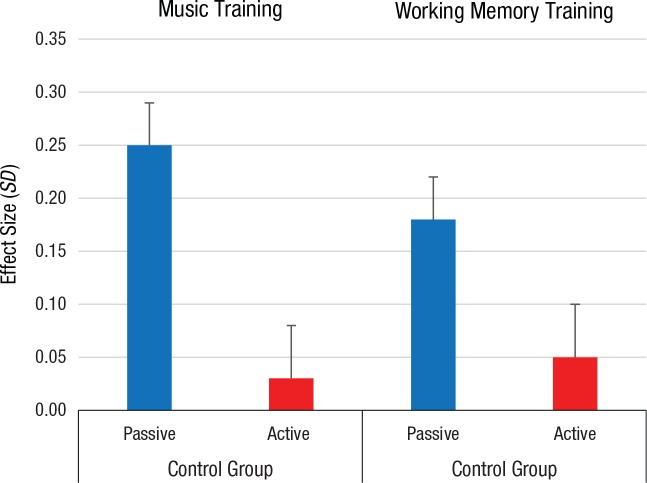
- Effects were inversely related to design quality: with active controls, music training was 0.03 SD [−0.07, 0.12], k = 54, versus 0.25 SD [0.17, 0.34], k = 64, with passive controls; working memory training was 0.05 SD [−0.05, 0.15], k = 40, versus 0.18 SD [−0.09, 0.26], k = 34. Chess had only one active-control study, with a minimal 0.10 SD effect.
- The only exception was robust near-transfer from working memory training to other memory tasks: 0.44 and 0.46 SD when compared with active and passive control groups, respectively.
Methods
- Meta-analyses of experimental studies in typically developing children and young adolescents tested chess and music instruction effects on academic attainment (literacy and mathematics) and cognitive skills, and working memory training effects on academic achievement, fluid intelligence, and cognitive control.
- The article also reviews meta-analytic correlational evidence on chess and music expertise and cognitive ability.
- Effects were pooled as standardized mean differences between treatment and control groups with 95% confidence intervals, comparing passive versus active control groups.
Limitations
- The paper states its conclusions apply at least with typically developing children and young adolescents; chess active-control evidence was limited to one study, and future interventions should include pretests and at least two control groups.
- Evident from the text: meta-analytic estimates depend on the available studies and their design quality, and the correlational evidence cannot establish causation, as the authors themselves note.
Model-written summary. Check it against the paper before relying on it.
Integrity signals
Registry
Cites
Statistics
Figures
Verification
Claims the paper makes
28 Not checked yet · 15 Own interpretation · 3 Own result
In the paper
“when the experimental groups were compared with active control groups—other filler activities to rule out possible placebo effects such as positive expectations about the training (Boot, Simons, Stothart, & Stutts, 2013) and the excitement induced by a novel activity—the overall effect sizes were minimal or null.”
§ Does Far Transfer Exist? Negative Evidence From Chess, Music, and Working Memory Training > Does Far Transfer Occur? Insights From Chess, Music, and WM Training > Experimental studies
What the sources say
- Not checked yetcites Boot et al., 2013
plain- Asserted: passes — The authors put it forward as true.
- Checkable: passes — It can be checked against evidence.
- Load-bearing: passes — The paper’s conclusions depend on it.
- Based: passes — The paper gives a reason why it holds.
In the paper
“the overall effect sizes were 0.25 SD, 95% CI = [0.17, 0.34], k = 64,3 and 0.03 SD, 95% CI = [−0.07, 0.12], k = 54, for the comparisons with passive and active control groups, respectively.”
§ Does Far Transfer Exist? Negative Evidence From Chess, Music, and Working Memory Training > Does Far Transfer Occur? Insights From Chess, Music, and WM Training > Experimental studies
What the sources say
- Not checked yetcites Sala & Gobet, 2017b
plain- Asserted: passes — The authors put it forward as true.
- Checkable: passes — It can be checked against evidence.
- Load-bearing: passes — The paper’s conclusions depend on it.
- Based: passes — The paper gives a reason why it holds.
In the paper
“the overall effect sizes were 0.18 SD, 95% CI = [−0.09, 0.26], k = 34, and 0.05 SD, 95% CI = [−0.05, 0.15], k = 40, for the comparisons with passive and active control groups, respectively”
§ Does Far Transfer Exist? Negative Evidence From Chess, Music, and Working Memory Training > Does Far Transfer Occur? Insights From Chess, Music, and WM Training > Experimental studies
What the sources say
- Not checked yetcites Sala & Gobet, 2017c
plain- Asserted: passes — The authors put it forward as true.
- Checkable: passes — It can be checked against evidence.
- Load-bearing: passes — The paper’s conclusions depend on it.
- Based: passes — The paper gives a reason why it holds.
In the paper
“Chess | 0.34 [0.24, 0.44]”
§ Does Far Transfer Exist? Negative Evidence From Chess, Music, and Working Memory Training > Does Far Transfer Occur? Insights From Chess, Music, and WM Training > Experimental studies
What the sources say
- Not checked yetcites Sala & Gobet, 2016, 2017b
plaindirect- Asserted: passes — The authors put it forward as true.
- Checkable: passes — It can be checked against evidence.
- Load-bearing: passes — The paper’s conclusions depend on it.
- Based: passes — The paper gives a reason why it holds.
A result the paper reports from its own data — it cites no other source for it, so there is none to check. The quote shows it is in the paper.
In the paper
“The size of the effects was inversely related to the quality of the experimental design.”
§ Does Far Transfer Exist? Negative Evidence From Chess, Music, and Working Memory Training > Does Far Transfer Occur? Insights From Chess, Music, and WM Training > Experimental studies
plaincorrelational- Asserted: passes — The authors put it forward as true.
- Checkable: passes — It can be checked against evidence.
- Load-bearing: passes — The paper’s conclusions depend on it.
- Based: passes — The paper gives a reason why it holds.
In the paper
“the overall effect sizes were 0.25 SD, 95% CI = [0.17, 0.34], k = 64,3 and 0.03 SD, 95% CI = [−0.07, 0.12], k = 54, for the comparisons with passive and active control groups, respectively.”
§ Does Far Transfer Exist? Negative Evidence From Chess, Music, and Working Memory Training > Does Far Transfer Occur? Insights From Chess, Music, and WM Training > Experimental studies
What the sources say
- Not checked yetcites Sala & Gobet, 2017b
plain- Asserted: passes — The authors put it forward as true.
- Checkable: passes — It can be checked against evidence.
- Load-bearing: passes — The paper’s conclusions depend on it.
- Based: passes — The paper gives a reason why it holds.
None of the sources cited for this claim have been checked yet.
In the paper
“The results showed small to moderate overall effect sizes—that is, the overall quantitative measure of the effectiveness of the training—in all three meta-analyses (Table 1).”
- Also stated in: § Abstract · plain
“The results show small to moderate effects.”
§ Does Far Transfer Exist? Negative Evidence From Chess, Music, and Working Memory Training > Does Far Transfer Occur? Insights From Chess, Music, and WM Training > Experimental studies
What the sources say
- Not checked yetcites Sala & Gobet, 2016, 2017b
- Not checked yetcites Sala & Gobet, 2017c
plain- Asserted: passes — The authors put it forward as true.
- Checkable: passes — It can be checked against evidence.
- Load-bearing: passes — The paper’s conclusions depend on it.
- Based: passes — The paper gives a reason why it holds.
- Also stated in: § Abstract · plain
In the paper
“Working memory | 0.12 [0.06, 0.18]”
§ Does Far Transfer Exist? Negative Evidence From Chess, Music, and Working Memory Training > Does Far Transfer Occur? Insights From Chess, Music, and WM Training > Experimental studies
What the sources say
- Not checked yetcites Sala & Gobet, 2017c
plain- Asserted: passes — The authors put it forward as true.
- Checkable: passes — It can be checked against evidence.
- Load-bearing: passes — The paper’s conclusions depend on it.
- Based: passes — The paper gives a reason why it holds.
In the paper
“the overall effect sizes were 0.18 SD, 95% CI = [−0.09, 0.26], k = 34, and 0.05 SD, 95% CI = [−0.05, 0.15], k = 40, for the comparisons with passive and active control groups, respectively”
§ Does Far Transfer Exist? Negative Evidence From Chess, Music, and Working Memory Training > Does Far Transfer Occur? Insights From Chess, Music, and WM Training > Experimental studies
What the sources say
- Not checked yetcites Sala & Gobet, 2017c
plain- Asserted: passes — The authors put it forward as true.
- Checkable: passes — It can be checked against evidence.
- Load-bearing: passes — The paper’s conclusions depend on it.
- Based: passes — The paper gives a reason why it holds.
A result the paper reports from its own data — it cites no other source for it, so there is none to check. The quote shows it is in the paper.
In the paper
“The only exception to this pattern was the robust near-transfer effect that WM training exerted on other memory tasks (0.44 and 0.46 SD when the treated groups were compared with active and passive control groups, respectively).”
§ Does Far Transfer Exist? Negative Evidence From Chess, Music, and Working Memory Training > Does Far Transfer Occur? Insights From Chess, Music, and WM Training > Experimental studies
boosteddirect- Asserted: passes — The authors put it forward as true.
- Checkable: passes — It can be checked against evidence.
- Load-bearing: passes — The paper’s conclusions depend on it.
- Based: passes — The paper gives a reason why it holds.
- It may state two separate claims as one. 10
- Probably not a substantial claim. 6
A result the paper reports from its own data — it cites no other source for it, so there is none to check. The quote shows it is in the paper.
In the paper
“the chess interventions included only one study with an active control group (with minimal effects: 0.10 SD).”
§ Does Far Transfer Exist? Negative Evidence From Chess, Music, and Working Memory Training > Does Far Transfer Occur? Insights From Chess, Music, and WM Training > Experimental studies
plainSingle case- Asserted: passes — The authors put it forward as true.
- Checkable: passes — It can be checked against evidence.
- Load-bearing: passes — The paper’s conclusions depend on it.
- Based: passes — The paper gives a reason why it holds.
It may state two separate claims as one.
In the paper
“we found that chess players’ overall cognitive ability was superior to that of non-chess players by half a standard deviation, a moderately large effect.”
§ Does Far Transfer Exist? Negative Evidence From Chess, Music, and Working Memory Training > Does Far Transfer Occur? Insights From Chess, Music, and WM Training > Comparison and correlational studies
What the sources say
- Not checked yetcites Sala et al., 2017
plaincorrelational- Asserted: passes — The authors put it forward as true.
- Checkable: passes — It can be checked against evidence.
- Load-bearing: unclear — It is unclear whether the paper’s conclusions depend on it.
- Based: passes — The paper gives a reason why it holds.
It may state two separate claims as one.
In the paper
“This outcome is in line with Thorndike and Woodworth’s (1901) common-elements theory.”
§ Does Far Transfer Exist? Negative Evidence From Chess, Music, and Working Memory Training > Does Far Transfer Occur? Insights From Chess, Music, and WM Training > Research in other domains
What the sources say
- Not checked yetcites Thorndike and Woodworth (1901)
plaincorrelational- Asserted: passes — The authors put it forward as true.
- Checkable: passes — It can be checked against evidence.
- Load-bearing: fails — The paper’s conclusions may not depend on it.
- Based: passes — The paper gives a reason why it holds.
Probably not a substantial claim. The paper’s conclusions may not depend on it.
In the paper
“Jaeggi, Buschkuehl, Jonides, and Perrig (2008), which presented an experiment in which participants who received training on a WM task showed an improvement on a fluid intelligence test (Raven’s Matrices).”
§ Does Far Transfer Exist? Negative Evidence From Chess, Music, and Working Memory Training > Does Far Transfer Occur? Insights From Chess, Music, and WM Training > The hypothesis underlying the potential occurrence of far transfer
What the sources say
- Not checked yetcites Jaeggi et al., 2008
plaindirect- Asserted: passes — The authors put it forward as true.
- Checkable: passes — It can be checked against evidence.
- Load-bearing: passes — The paper’s conclusions depend on it.
- Based: passes — The paper gives a reason why it holds.
Probably not a substantial claim.
None of the sources cited for this claim have been checked yet.
In the paper
“Lee, Lu, and Ko (2007) and Schellenberg (2006) found positive correlations between music skill, WM, and IQ.”
§ Does Far Transfer Exist? Negative Evidence From Chess, Music, and Working Memory Training > Does Far Transfer Occur? Insights From Chess, Music, and WM Training > Comparison and correlational studies
What the sources say
- Not checked yetcites Lee et al., 2007
- Not checked yetcites Schellenberg, 2006
plaincorrelational- Asserted: passes — The authors put it forward as true.
- Checkable: passes — It can be checked against evidence.
- Load-bearing: unclear — It is unclear whether the paper’s conclusions depend on it.
- Based: passes — The paper gives a reason why it holds.
It may state two separate claims as one.
A conclusion the paper draws from its own results — it cites no other source for it, so there is none to check. The quote shows it is in the paper.
In the paper
“cognitive ability (e.g., WM or general intelligence) is a predictor of chess skill and music skill, among many others”
§ Does Far Transfer Exist? Negative Evidence From Chess, Music, and Working Memory Training > Theoretical and Practical Implications
plaincorrelational- Asserted: passes — The authors put it forward as true.
- Checkable: passes — It can be checked against evidence.
- Load-bearing: passes — The paper’s conclusions depend on it.
- Based: passes — The paper gives a reason why it holds.
It may state two separate claims as one.
In the paper
“Like WM training, such programs have been proven to enhance participants’ performance on the task they train and, at best, some other similar tasks.”
§ Does Far Transfer Exist? Negative Evidence From Chess, Music, and Working Memory Training > Does Far Transfer Occur? Insights From Chess, Music, and WM Training > Research in other domains
What the sources say
- Not checked yetcites Simons et al., 2016
boosteddirect- Asserted: passes — The authors put it forward as true.
- Checkable: passes — It can be checked against evidence.
- Load-bearing: passes — The paper’s conclusions depend on it.
- Based: passes — The paper gives a reason why it holds.
It may state two separate claims as one.
In the paper
“Considering that spatial ability predicts attainment in mathematics (Wai, Lubinski, & Benbow, 2009)”
§ Does Far Transfer Exist? Negative Evidence From Chess, Music, and Working Memory Training > Does Far Transfer Occur? Insights From Chess, Music, and WM Training > Research in other domains
What the sources say
- Not checked yetcites Wai et al., 2009
plaincorrelational- Asserted: passes — The authors put it forward as true.
- Checkable: passes — It can be checked against evidence.
- Load-bearing: passes — The paper’s conclusions depend on it.
- Based: passes — The paper gives a reason why it holds.
Probably not a substantial claim.
A conclusion the paper draws from its own results — it cites no other source for it, so there is none to check. The quote shows it is in the paper.
In the paper
“An alternative explanation is that people with superior cognitive ability are more likely to engage and excel in chess and music.”
- Also stated in: § Conclusions and Future Directions · hedged
“Rather, smarter individuals are more likely to engage and excel in these fields.”
§ Does Far Transfer Exist? Negative Evidence From Chess, Music, and Working Memory Training > Does Far Transfer Occur? Insights From Chess, Music, and WM Training > The hypothesis underlying the potential occurrence of far transfer
hedgedcorrelational- Asserted: passes — The authors put it forward as true.
- Checkable: passes — It can be checked against evidence.
- Load-bearing: passes — The paper’s conclusions depend on it.
- Based: passes — The paper gives a reason why it holds.
It may state two separate claims as one.
- Also stated in: § Conclusions and Future Directions · hedged
In the paper
“In their systematic review, Simons et al. (2016) observe that no convincing evidence has been provided so far about the alleged generalized benefits of brain-training programs.”
§ Does Far Transfer Exist? Negative Evidence From Chess, Music, and Working Memory Training > Does Far Transfer Occur? Insights From Chess, Music, and WM Training > Research in other domains
What the sources say
- Not checked yetcites Simons et al., 2016
plain- Asserted: passes — The authors put it forward as true.
- Checkable: passes — It can be checked against evidence.
- Load-bearing: fails — The paper’s conclusions may not depend on it.
- Based: passes — The paper gives a reason why it holds.
Probably not a substantial claim. The paper’s conclusions may not depend on it.
In the paper
“Spatial ability has been found to be malleable by spatial training (Uttal et al., 2013).”
§ Does Far Transfer Exist? Negative Evidence From Chess, Music, and Working Memory Training > Does Far Transfer Occur? Insights From Chess, Music, and WM Training > Research in other domains
What the sources say
- Not checked yetcites Uttal et al., 2013
plaindirect- Asserted: passes — The authors put it forward as true.
- Checkable: passes — It can be checked against evidence.
- Load-bearing: fails — The paper’s conclusions may not depend on it.
- Based: passes — The paper gives a reason why it holds.
Probably not a substantial claim. The paper’s conclusions may not depend on it.
In the paper
“The second meta-analysis (Burgoyne et al., 2016) reported statistically significant correlations between chess skill and four broad measures of cognitive ability”
§ Does Far Transfer Exist? Negative Evidence From Chess, Music, and Working Memory Training > Does Far Transfer Occur? Insights From Chess, Music, and WM Training > Comparison and correlational studies
What the sources say
- Not checked yetcites Burgoyne et al., 2016
plaincorrelational- Asserted: passes — The authors put it forward as true.
- Checkable: passes — It can be checked against evidence.
- Load-bearing: unclear — It is unclear whether the paper’s conclusions depend on it.
- Based: passes — The paper gives a reason why it holds.
It may state two separate claims as one.
A conclusion the paper draws from its own results — it cites no other source for it, so there is none to check. The quote shows it is in the paper.
In the paper
“Although cognitive ability correlates with domain-specific skills—for example, smarter people are more likely to be stronger chess players and better musicians—there is little evidence that chess or music instruction makes people smarter.”
§ Does Far Transfer Exist? Negative Evidence From Chess, Music, and Working Memory Training > Conclusions and Future Directions
plain- Asserted: passes — The authors put it forward as true.
- Checkable: passes — It can be checked against evidence.
- Load-bearing: passes — The paper’s conclusions depend on it.
- Based: passes — The paper gives a reason why it holds.
It may state two separate claims as one.
A conclusion the paper draws from its own results — it cites no other source for it, so there is none to check. The quote shows it is in the paper.
In the paper
“If skills rarely generalize across different domains, then the most effective way to acquire a skill is to train that particular skill.”
§ Does Far Transfer Exist? Negative Evidence From Chess, Music, and Working Memory Training > Theoretical and Practical Implications
plaindirect- Asserted: passes — The authors put it forward as true.
- Checkable: fails — It may be too vague to check against evidence.
- Load-bearing: passes — The paper’s conclusions depend on it.
- Based: passes — The paper gives a reason why it holds.
Probably not a substantial claim. It may be too vague to check against evidence. It may state two separate claims as one.
None of the sources cited for this claim have been checked yet.
In the paper
“The occurrence of specific neural patterns (anatomical and functional) and absence of far-transfer effects on cognitive tests have been reported in domains such as music (e.g., Tierney, Krizman, & Kraus, 2015), chess (e.g., Hänggi, Brütsch, Siegel, & Jäncke, 2014), and video game training (e.g., Colom et al., 2012).”
§ Does Far Transfer Exist? Negative Evidence From Chess, Music, and Working Memory Training > Theoretical and Practical Implications
What the sources say
- Not checked yetcites Tierney, Krizman, & Kraus, 2015
- Not checked yetcites Hänggi, Brütsch, Siegel, & Jäncke, 2014
- Not checked yetcites Colom et al., 2012
plain- Asserted: passes — The authors put it forward as true.
- Checkable: passes — It can be checked against evidence.
- Load-bearing: passes — The paper’s conclusions depend on it.
- Based: passes — The paper gives a reason why it holds.
It may state two separate claims as one.
Claims other papers make about this one
Each is checked against this paper’s own text: does it say what the citing paper says it does?
The source backs part of the claim, not all of it — or backs it for a different population, condition or comparison.
In the citing paper
“Nevertheless, there is an increasing recognition that while domain-specific skills are eminently teachable, purely generic-cognitive skills are not teachable and attempts to teach them lead to dead-ends (Sala and Gobet 2017).”
From Cognitive Architecture and Instructional Design: 20 Years Later (2019) · cites this paper as Sala and Gobet 2017
Experimental — accuracy not yet measuredThe cited source says what the claim attributes to it.
In the citing paper
“The data summarised by Sala and Gobet (2017) provide a major justification for the post 1998 inclusion of evolutionary psychology into cognitive load theory.”
From Cognitive Architecture and Instructional Design: 20 Years Later (2019) · cites this paper as Sala and Gobet (2017)
The cited source says what the claim attributes to it.
In the citing paper
“Such findings are essential for this area to remain viable but there is little evidence of such results from any area (Sala and Gobet 2017).”
From Cognitive Architecture and Instructional Design: 20 Years Later (2019) · cites this paper as Sala and Gobet 2017
Self-check
Percentages, sums and reported differences re-computed from the paper’s own numbers.
Rated minor: it would not touch a result — a value no result rests on, a p-value that stays on the same side of the significance level, or a conflict that is clerical, resolved elsewhere in the paper, or outside its own findings.
In the paper
“the overall effect sizes were 0.18 SD, 95% CI = [−0.09, 0.26], k = 34”
§ Does Far Transfer Exist? Negative Evidence From Chess, Music, and Working Memory Training > Does Far Transfer Occur? Insights From Chess, Music, and WM Training > Experimental studies
Reported 0.18 · recomputed 0.085
Citations
Cites
Statistical Power Analysis for the Behavioral Sciences
Muller, K. E., & Cohen, J. (1989) · Technometrics · doi:10.2307/1270020 · Cited by 99,603
Statistical power analysis for the behavioral sciences
Cohen, J. (1990) · Computers Environment and Urban Systems · doi:10.1016/0198-9715(90)90050-4 · Cited by 65,417
Chase, W. G., & Simon, H. A. (1973) · Cognitive Psychology · doi:10.1016/0010-0285(73)90004-2 · Cited by 4,479
The malleability of spatial skills: A meta-analysis of training studies.
Uttal, D. H., Meadow, N. G., Tipton, E., Hand, L. L., Alden, A. R., Warren, C. M., & Newcombe, N. S. (2012) · Psychological Bulletin · doi:10.1037/a0028446 · Cited by 2,188 · cited 1×
“Spatial ability has been found to be malleable by spatial training (Uttal et al., 2013).”
BackgroundImproving fluid intelligence with training on working memory
Jaeggi, S. M., Buschkuehl, M., Jonides, J., & Perrig, W. J. (2008) · Proceedings of the National Academy of Sciences · doi:10.1073/pnas.0801268105 · Cited by 2,187
Validity and utility of alternative predictors of job performance.
Hunter, J. E., & Hunter, R. F. (1984) · Psychological Bulletin · doi:10.1037/0033-2909.96.1.72 · Cited by 2,107 · cited 1×
“Importantly, domain-general cognitive abilities (e.g., intelligence, processing speed, and working memory [WM]) are reliable predictors of success for outcomes such as academic achievement (Deary, Strand, Smith, & Fernandes, 2007) and job proficiency (Hunter & Hunter, 1984).”
BackgroundWai, J., Lubinski, D., & Benbow, C. P. (2009) · Journal of Educational Psychology · doi:10.1037/a0016127 · Cited by 2,004
Intelligence and educational achievement
Deary, I. J., Strand, S., Smith, P., & Fernandes, C. (2007) · Intelligence · doi:10.1016/j.intell.2006.02.001 · Cited by 1,723 · cited 2×
“Because of its high specificity, such information is hardly transferable to other fields, as predicted by chunking theory (Chase & Simon, 1973) and template theory (i.e., an extension of chunking theory; Gobet, 2016; Gobet & Simon, 1996).”
BackgroundThe influence of improvement in one mental function upon the efficiency of other functions. (I).
Woodworth, R. S., & Thorndike, E. L. (1901) · Psychological Review · doi:10.1037/h0074898 · Cited by 1,223 · cited 2×
“In a seminal article, Thorndike and Woodworth (1901) proposed their common-elements theory according to which transfer is a function of the extent to which two domains share common features.”
BackgroundDo “brain-training” programs work?
Simons, D. J., Boot, W. R., Charness, N., Gathercole, S. E., Chabris, C. F., Hambrick, D. Z., & Stine-Morrow, E. A. L. (2016) · Psychological Science in the Public Interest · doi:10.1177/1529100616661983 · Cited by 1,183
Research works printed but not linked: 1
- 10.1037/a0027473 · DOI · Paper page
Cited by
Sorted by citations
Items 101–200 of 309
A Rational Account of Cognitive Control Development in Childhood
Steinbeis, N. (2023) · Annual Review of Developmental Psychology · doi:10.1146/annurev-devpsych-120221-040058 · Cited by 21
Hallam, S., & Himonides, E. (2022) · Open Book Publishers · doi:10.11647/obp.0292.08 · Cited by 16
Neural and cognitive correlates of performance in dynamic multi-modal settings
Dziego, C. A., Bornkessel‐Schlesewsky, I., Jano, S., Chatburn, A., Schlesewsky, M., Immink, M. A., Sinha, R., Irons, J. L., Schmitt, M., Chen, S., et al. (2023) · Neuropsychologia · doi:10.1016/j.neuropsychologia.2023.108483 · Cited by 19
Elnes, M., & Sigmundsson, H. (2023) · SAGE Open · doi:10.1177/21582440231153850 · Cited by 16
“Research indicates that individuals who have performed outstandingly in some areas clearly have vast experience and practice in that area (Ericsson et al., 2007; Sala & Gobet, 2017).”
BackgroundAkın, A. (2023) · Educational Studies · doi:10.1080/03055698.2023.2216826 · Cited by 23
“Sala and Gobet (2017) have emphasised that the causal role of music on mathematics learning or outputs is still not fully answered owing to a paucity of well-planned studies in the context of music and mathematics integration.”
McLoughlin, S., Tyndall, I. T., Pereira, A., & Mulhern, T. (2020) · Journal of Cognitive Enhancement · doi:10.1007/s41465-020-00187-z · Cited by 18
“At the same time, those in the control condition were allowed to play online chess on the school iPads during the same period, as this was already part of the school curriculum andwas previously hypothesized to be a useful cognitive training in its own right (Sala & Gobet, 2017a).”
BackgroundMethodResultInfluentialIntroduction: Cognitive Foundations for Improving Mathematical Learning
Geary, D. C., Berch, D. B., & Koepke, K. M. (2019) · Elsevier eBooks · doi:10.1016/b978-0-12-815952-1.00001-3 · Cited by 22
Numeracy musical training for school children with low achievement in mathematics
Rodriguez, I. A., do Nascimento, J. M., Voigt, M. F., & Santos, F. H. (2019) · Anales de Psicología · doi:10.6018/analesps.35.3.340091 · Cited by 16
“However, the findings of far transfers should be met with caution (Melby-Lervåg & Hulme, 2013; Sala & Gobet, 2017) considering circumstances of the research discussed further.”
BackgroundWilderode, M. V., Vermaete, E., Francart, T., Wouters, J. M., & Wieringen, A. V. (2023) · Trends in Hearing · doi:10.1177/23312165231198380 · Cited by 14
Shifting Minds: A Quantitative Reappraisal of Cognitive-Intervention Research
Moreau, D. (2020) · Perspectives on Psychological Science · doi:10.1177/1745691620950696 · Cited by 16
Goodrich, J. M., Peng, P., Bohaty, J. J., Leiva, S., & Thayer, L. (2023) · Journal of Speech Language and Hearing Research · doi:10.1044/2022_jslhr-22-00253 · Cited by 16
Neves, L., Martins, M., Correia, A. I., Castro, S. L., Schellenberg, E. G., & Lima, C. F. (2025) · Cognition · doi:10.1016/j.cognition.2025.106102 · Cited by 19
“…& Musib, 2025; Neves et al., 2022; Rom ´ an-Caballero et al., 2022), whereas others report null effects after excluding suboptimal studies, such as those lacking random assignment or active control groups (i.e., comparisons with stimulating but nonmusical activities; Sala & Gobet, 2017b, 2020).”
Changing priorities in the development of cognitive competence and school learning: A general theory
Δημητρίου, Α., Spanoudis, G. C., Greiff, S., Makris, Ν., Panaoura, A., & Kazi, S. (2022) · Frontiers in Psychology · doi:10.3389/fpsyg.2022.954971 · Cited by 32
Enhancing children’s numeracy and executive functions via their explicit integration
Scerif, G., Sučević, J., Andrews, H., Blakey, E., Gattas, S., Godfrey, A., Hawes, Z. C. K., Howard, S. J., Kent, L., Merkley, R., et al. (2025) · npj Science of Learning · doi:10.1038/s41539-025-00302-9 · Cited by 16
“Despite this strong correlational and longitudinal evidence, interventions focused on training EF in isolation have failed to yield improvements inothercorrelatedcognitivedomains,includingmathematics 16 – 18 .”
Jung, W. H., Lee, T. Y., Yoon, Y. B., Choi, C., & Kwon, J. S. (2018) · Frontiers in Human Neuroscience · doi:10.3389/fnhum.2018.00319 · Cited by 13
“Some recent studies have reported the skill effect in the recall of meaningless domain-specific material (e.g., shuffled chess positions) (Gobet and Simon, 1996a,b; Sala and Gobet, 2017b) that contradicts the earlier claim for the lack of that skill effect (Chase and Simon, 1973b).”
BackgroundResultInfluentialClerc, J., Leclercq, M., Paik, J. H., & Miller, P. H. (2020) · Cognitive Development · doi:10.1016/j.cogdev.2020.100997 · Cited by 13
Beyond IQ: The Importance of Metacognition for the Promotion of Global Wellbeing
Varshney, L. R., & Barbey, A. K. (2021) · Journal of Intelligence · doi:10.3390/jintelligence9040054 · Cited by 15
“Although still very much an active area of research, transfer of metacognitive training may be more effective (Jones et al. 2020; Schaeffner et al. 2021) than transfer of cognitive training, which demonstrates limited generalization (Sala and Gobet 2017, 2019).”
BackgroundRelative effectiveness of general versus specific cognitive training for aging adults.
Gray, N., Yoon, J., Charness, N. H., Boot, W. R., Roque, N. A., Andringa, R., Harrell, E. R., Lewis, K. G., & Vitale, T. (2021) · Psychology and Aging · doi:10.1037/pag0000663 · Cited by 17
Putkinen, V., Saarikivi, K., Chan, T. M. V., & Tervaniemi, M. H. (2021) · European Journal of Neuroscience · doi:10.1111/ejn.15262 · Cited by 15
“It bears reminding that cross- sectional correlational studies, like the current one, cannot establish causality between musical training and the observed group differences (Sala & Gobet, 2017; Schellenberg, 2011).”
BackgroundAdaptive habits: understanding executive function and its development
Niebaum, J. C., Zengilowski, A., Katz, B., Shah, P., & Munakata, Y. (2025) · Trends in Cognitive Sciences · doi:10.1016/j.tics.2025.10.016 · Cited by 14
Planting the Seeds: Orchestral Music Education as a Context for Fostering Growth Mindsets
Holochwost, S. J., Bose, J. H., Stuk, E., Brown, E. D., Anderson, K. E., & Wolf, D. P. (2021) · Frontiers in Psychology · doi:10.3389/fpsyg.2020.586749 · Cited by 21
“While this is an exciting possibility, the extant empirical literature attests to the difficulty of demonstrating far transfer of skills developed via music and arts programming (Hetland and Winner, 2001; Sala and Gobet, 2017).”
BackgroundNewbury, J., Justice, L. M., Jiang, H., & Schmitt, M. B. (2020) · Journal of Speech Language and Hearing Research · doi:10.1044/2020_jslhr-19-00363 · Cited by 16
Music improvisation enhances neutral verbal and visual memory in musicians and non-musicians alike
Abrahan, V. D., Shifres, F., & Justel, N. R. (2021) · The Arts in Psychotherapy · doi:10.1016/j.aip.2021.101807 · Cited by 12
“In the far-transfer domain, the results were not as clear (Rodrigues, Loureiro, & Caramelli, 2013; Sala & Gobet, 2017).”
Tachie, S. A., & Ramathe, J. M. (2022) · Education Research International · doi:10.1155/2022/6257414 · Cited by 14
Short-term memory capacity and sensitivity to language statistics in dyslexia and among musicians
Kimel, E., Weiss, A. H., Jakoby, H., Daikhin, L., & Ahissar, M. (2020) · Neuropsychologia · doi:10.1016/j.neuropsychologia.2020.107624 · Cited by 16
“However, a recent meta-analysis showed that musical training does not transfer and does not predict other cognitive abilities (Sala and Gobet, 2017), in line with studies that showed limited transfer between training in the general population (Banai and Ahissar, 2013; Jakoby et al., 2019).”
ResultMartínez, M. D. V. D. M., & Syroyid, B. S. (2021) · Education Sciences · doi:10.3390/educsci11100582 · Cited by 12
Musical Experience Relates to Insula-Based Functional Connectivity in Older Adults
Ai, M., Loui, P., Morris, T. P., Chaddock‐Heyman, L., Hillman, C. H., McAuley, E., & Kramer, A. F. (2022) · Brain Sciences · doi:10.3390/brainsci12111577 · Cited by 13
“Moreover, a meta-analysis found a smaller effect on cognition for music training with higher quality of study design [14].”
BackgroundLee, D., Kwak, S., & Chey, J. (2019) · Frontiers in Human Neuroscience · doi:10.3389/fnhum.2019.00246 · Cited by 11
Thapa, J., & Rodríguez-Quiles, J. A. (2022) · British Journal of Music Education · doi:10.1017/s0265051722000110 · Cited by 11
“In their meta-analysis, Sala and Gobet (2017) inquired into the possible benefits of music training for academic and cognitive skills.”
BackgroundResultSymons, A. E., & Tierney, A. T. (2023) · Journal of Experimental Psychology Learning Memory and Cognition · doi:10.1037/xlm0001217 · Cited by 11
“Given the mixed fi ndings in the literature, whether and under what conditions musical experience may be linked to cross-domain effects in speech perception has been the topic of considerable debate (Besson et al., 2011; Patel, 2011, 2014; Sala & Gobet, 2017; Strait & Kraus, 2011).”
Computerized cognitive interventions for adults with ADHD: A systematic review and meta-analysis.
Elbe, P., Bäcklund, C., Vega‐Mendoza, M., Sörman, D. E., Gavelin, H. M., Nyberg, L. H., & Ljungberg, J. K. (2023) · Neuropsychology · doi:10.1037/neu0000890 · Cited by 11
Changes in Working Memory Performance Over an Academic Semester in Student Pharmacists
Omary, A., & Persky, A. M. (2019) · American Journal of Pharmaceutical Education · doi:10.5688/ajpe7325 · Cited by 11
“(%) 7 (30) Age, y (mean, range) 23 (21-27) Personality (mean, range) Openness to experience 56 (34-74) Conscientiousness 60 (39-76) Extraversion 50 (35-69) Agreeableness 50 (26-67) Neuroticism 56 (41-72) Stress (mean, range) 17 (5-28) Fatigue (mean, range) 29 (18-45) American Journal of Pharmaceutical Education 2019;…”
Román-Caballero, R., Vadillo, M. A., Trainor, L. J., & Lupiáñez, J. (2021) · doi:10.31234/osf.io/4bm8v · Cited by 11
Neurochemical Predictors of Generalized Learning Induced by Brain Stimulation and Training
Ehrhardt, S. E., Wards, Y., Rideaux, R., Marjańska, M., Jin, J., Cloos, M. A., Deelchand, D. K., Zöllner, H. J., Saleh, M. G., Hui, S. C. N., et al. (2024) · Journal of Neuroscience · doi:10.1523/jneurosci.1676-23.2024 · Cited by 10
Passion a key for success: Exploring motivational factors in football players
Sigmundsson, H., Dybendal, B. H., Loftesnes, J. M., Ólafsson, B., & Grassini, S. (2022) · New Ideas in Psychology · doi:10.1016/j.newideapsych.2022.100932 · Cited by 10
Swaminathan, S., & Schellenberg, E. G. (2020) · Springer eBooks · doi:10.1007/978-3-030-39292-5_21 · Cited by 13
Latino Families Engage in Elaborative Conversations: Effects on Children’s Recall and Vocabulary
Thierry, K. L., & Sparks, A. (2019) · Journal of Child and Family Studies · doi:10.1007/s10826-019-01446-0 · Cited by 10
A Value Chain Approach for Attracting, Educating, and Transitioning Students to the IT Profession
Beard, D. J., Schwieger, D., & Surendran, K. (2010) · Information Systems Education Journal · Cited by 9
The role of active and passive music engagement in cognitive development: A systematic review
Stekić, K. (2024) · International Journal of Music Education · doi:10.1177/02557614241268049 · Cited by 9
“This observation is in line with the results from meta-analytic studies by Sala and Gobet (2017, 2020).”
InfluentialAsymmetric negative transfer effects of working memory training
Ni, N., Gathercole, S. E., Norris, D. G., & Saito, S. (2023) · Memory & Cognition · doi:10.3758/s13421-023-01412-8 · Cited by 12
“…real-world cognitive skills like reading comprehension and mental arithmetic (Melby-Lervåg et al., 2016; Melby-Lervåg & Hulme, 2013; Redick, 2019; Rodas & Greene, 2022; Rowe et al., 2019; Sala & Gobet, 2017, 2019; Smid et al., 2020; Soveri et al., 2017; Tsubomi et al., 2019; Watrin et al., 2022).”
BackgroundSaarikivi, K., Chan, T. M. V., Huotilainen, M., Tervaniemi, M. H., & Putkinen, V. (2023) · Cerebral Cortex · doi:10.1093/cercor/bhad034 · Cited by 11
Addressing inequity in arts education: the potential of a systems perspective
Holochwost, S. J., Wolf, D. P., & Brown, E. D. (2024) · Arts Education Policy Review · doi:10.1080/10632913.2024.2332779 · Cited by 8
“Although meta-analyses of musical training and children’s cognitive development conducted by Cooper (2020) and Sala and Gobet (2017) yielded similar findings, the authors of both studies reported a key caveat: the magnitude of the extra-artistic benefits of musical training were inversely…”
Estrada‐Plana, V., Martínez-Escribano, A., Ros‐Morente, A., Mayoral, M., Castro-Quintas, Á., Vita‐Barrull, N., Terés-Lleida, N., March‐Llanes, J., Badia-Bafalluy, A., & Moya-Higueras, J. (2024) · Brain Sciences · doi:10.3390/brainsci14070642 · Cited by 20
“This result could make sense considering near transfer effects of general memory training [13,19].”
Background10 Things Software Developers Should Learn about Learning
Brown, N. C. C., Hermans, F., & Margulieux, L. E. (2023) · Communications of the ACM · doi:10.1145/3584859 · Cited by 10
“36 This inability to transfer problem-solving skills is why “brain training” is ineffective for developing general intelligence.”
BackgroundDoes working memory training enhance intelligence?
Tsubomi, H., Saito, S., Osaka, M., & Osaka, N. (2019) · The Japanese journal of psychology · doi:10.4992/jjpsy.90.18402 · Cited by 8
“…に推測することができ,その機能の向上に対する期待 が高まる(Boot et al., 2013)。そのため,認知機能の 向上や日常生活のクオリティについて,自己申告して もらったり,トレーニングを受けていることを知る者 が評定すると,客観的なテストでは成績や機能の向上 が見られないにもかかわらず,主観的には効果がある と報告する「プラセボ効果の錯覚」が生じる(Redick et al., 2013; Shipstead et al., 2012)。この錯覚は,効果 のないトレーニングプログラムが社会に受け入れられ てしまう原因となる可能性があるため,注意が必要で…”
Feasibility of TOWI as a cognitive training video game for children
Rosetti, M., Gómez-Tello, M. F., Maya, C., & Apiquián, R. (2020) · International Journal of Child-Computer Interaction · doi:10.1016/j.ijcci.2020.100172 · Cited by 8
Profiles and predictors of auditory functioning in abacus-trained children
Nisha, K. V., Sanjana, M., Rohith, V. S., Rajalakshmi, K., & Prabhu, P. (2021) · International Journal of Pediatric Otorhinolaryngology · doi:10.1016/j.ijporl.2021.110608 · Cited by 8
Domain specific traits predict achievement in music and multipotentiality
de Manzano, Ö., & Ullén, F. (2021) · Intelligence · doi:10.1016/j.intell.2021.101584 · Cited by 10
Three Problems of Interdisciplinarity
Russell, Y. I. (2022) · Avant · doi:10.26913/ava202206 · Cited by 8
“True polymaths likely owe their success to: (1) high intelligence which sped their mastery of new domains, and (2) a huge time investment in pursuing that mastery (cf. Sala & Gobet, 2017).”
BackgroundDoes learning to play an instrument have an impact on change in attainment from age 11 to 16?
Baker, D., Hallam, S., & Rogers, K. (2023) · British Journal of Music Education · doi:10.1017/s0265051723000116 · Cited by 8
“However, not all the research has shown such benefits, some indicating no benefits (Elpus, 2013; Tai et al., 2018), while reviews and meta-analyses have drawn mixed conclusions or found that there is no benefit (Jaschke et al., 2013; Sala & Gobet, 2017a, 2017b, 2020).”
BackgroundFraundorf, S. H., Caddick, Z. A., Nokes‐Malach, T. J., & Rottman, B. M. (2023) · Cognitive Research Principles and Implications · doi:10.1186/s41235-023-00508-8 · Cited by 10
“It is generally rare—if not impossible—to observe far transfer , where training or practice in one domain also confers benefits to other, wholly unrelated domains (Sala & Gobet, 2017, EL: 1).”
BackgroundWang, Y., Zhang, J., & Mao, Y. (2024) · Thinking Skills and Creativity · doi:10.1016/j.tsc.2024.101554 · Cited by 13
Josseron, L., Mombo, W. T., Maggiacomo, M., Jolly, C., & Clerc, J. (2025) · Research in Developmental Disabilities · doi:10.1016/j.ridd.2024.104908 · Cited by 7
Corti, C., Oldrati, V., Papini, M., Strazzer, S., Poggi, G., Romaniello, R., Borgatti, R., Urgesi, C., & Bardoni, A. (2023) · Scientific Reports · doi:10.1038/s41598-023-41810-1 · Cited by 8
Working Memory Training in Children: A Review of Basic Methodological Criteria
Vernucci, S., Juric, L. C., Introzzi, I. M., & Richard’s, M. M. (2019) · Psychological Reports · doi:10.1177/0033294119832978 · Cited by 12
“WM training programs have been implemented in samples of children with different characteristics: attention disorders, specific deficits of WM, learning disorders, and in typically developing children (Karbach, 2015; Rapport et al., 2013; Sala & Gobet, 2017b; Shipstead, Redick, & Engle, 2010).”
BackgroundGevorgyan, S., Ispiryan, M. M., Sargsyan, V., & Tadevosyan, H. V. (2023) · Psychological Science and Education · doi:10.17759/pse.2023280612 · Cited by 7
Vartanian, O. A., Stokes-Hendriks, T. L., King, K. A., Rice, E. J., & Forbes, S. (2021) · Journal of Cognitive Enhancement · doi:10.1007/s41465-020-00201-4 · Cited by 9
Ritakallio, L., Fellman, D., Jylkkä, J., Waris, O., Lönnroth, N., Nervander, R., Salmi, J., & Laine, M. (2021) · Journal of Cognitive Enhancement · doi:10.1007/s41465-021-00235-2 · Cited by 7
Hallam, S., & Himonides, E. (2022) · Open Book Publishers · doi:10.11647/obp.0292.14 · Cited by 7
Meyers, E. A., Gretton, J. D., Budge, J. R. C., Fugelsang, J. A., & Koehler, D. J. (2023) · Judgment and Decision Making · doi:10.1017/jdm.2023.24 · Cited by 8
“…Press inconsistent with the dearth of robust far-transfer effects in which a person’s training in one area, such as chess, supposedly increases their capabilities in other areas, like working memory or concentration (Detterman, 1993; Kassai et al., 2019; Sala & Gobet, 2017; cf. Bart, 2014).”
Cisneros, A. G., Roussey, J. Y., Inbar, T. C., Fratacci, A., & Frey, A. (2023) · Children · doi:10.3390/children10091515 · Cited by 13
“However, the effects of this practice are still debated, and recent meta-analyses have attempted to shed some light on this issue [5–8].”
BackgroundNo transfer of 3D-Multiple Object Tracking training on game performance in soccer: A follow-up study
Romeas, T., Maëlle, G., Faubert, J., & Labbé, D. R. (2024) · Psychology of sport and exercise · doi:10.1016/j.psychsport.2024.102770 · Cited by 8
Transfer of workplace e-learning: A systematic literature review
O'Neill, A. (2025) · Social Sciences & Humanities Open · doi:10.1016/j.ssaho.2025.101407 · Cited by 15
Chuang, I., Abdullahi, A., Chen, I.-C., Wu, Y., & Wu, C. (2025) · Digital Health · doi:10.1177/20552076251328491 · Cited by 9
Purkart, R., Aleksieva, P., Mellah, S., Leblond‐Baccichet, G., & Belleville, S. (2023) · Journal of Cognition · doi:10.5334/joc.323 · Cited by 7
Worschech, F., Passarotto, E., Losch, H., Oku, T., Lee, A., & ALTENMÜLLER, E. O. (2024) · Brain Sciences · doi:10.3390/brainsci14040405 · Cited by 6
Peckham, A. (2021) · PubMed · Cited by 6
The Relationship of Musical Expertise, Working Memory, and Intelligence
Arndt, C., Schlemmer, K., & van der Meer, E. E. (2023) · Music Perception An Interdisciplinary Journal · doi:10.1525/mp.2023.40.4.334 · Cited by 9
Harris, D., Wilson, M., Chillingsworth, K., Mitchell, G. L., Smith, S., Arthur, T., Brock, K., & Vine, S. J. (2023) · PLoS ONE · doi:10.1371/journal.pone.0293657 · Cited by 7
Ruffini, C., Pizzigallo, E., Pecini, C., Bertolo, L., & Carretti, B. (2025) · Reading Research Quarterly · doi:10.1002/rrq.70006 · Cited by 11
Mental-Imagery-Based Mnemonic Training: A New Kind of Cognitive Training
Luan, X., Kawasaki, Y., Chen, Q., & Sugimori, E. (2022) · Frontiers in Psychology · doi:10.3389/fpsyg.2021.740829 · Cited by 8
Formation of the Subjectivity of the Future Teacher in the Educational Realities of Ukraine
Zhurat, Y., Honcharuk, V., Zubal, M., Сергіївна, С. Н., Dubìnka, M., & Іazlovetska, O. (2022) · Revista Romaneasca pentru Educatie Multidimensionala · doi:10.18662/rrem/14.2/589 · Cited by 5
“Other neurocognitive channels (intuition, kinesthetics, sensuality, subconscious) were ignored, Sala & Gobet (2017).”
BackgroundLeite, J., Gonçalves, Ó. F., & Carvalho, S. (2022) · Frontiers in Aging Neuroscience · doi:10.3389/fnagi.2022.880510 · Cited by 5
Porflitt, F., & Rosas, R. (2020) · Studies in Psychology Estudios de Psicología · doi:10.1080/02109395.2020.1795493 · Cited by 5
“Regardless of whether there is a transfer of far skills to certain aspects of cognition through musical training — analysing the meta analytic data by Sala and Gobet (2017) — the purpose of this article was to explore the differences in cognitive performance between three kinds of musical training,…”
BackgroundMúsica y transferencia de habilidades: revisión bibliográfica descriptiva para el siglo XXI
Porflitt, F. (2021) · Revista musical chilena · doi:10.4067/s0716-27902021000100177 · Cited by 5
“There is meta-analytical evidence that tends to show that the effects of music may be over-estimated in their transfer of skills (Sala & Gobet 2017), but it becomes contradictory when we thoroughly review what literature offers in recent years.”
BackgroundWorking memory training: mechanisms, challenges and implications for the classroom
Song, J., MacQuarrie, S., & Hennessey, A. (2023) · Frontiers in Education · doi:10.3389/feduc.2023.1198315 · Cited by 10
Musical expertise and cognitive abilities: no advantage for professionals over amateurs
Talamini, F., Schellenberg, E. G., Grassi, M., & Lima, C. F. (2026) · Royal Society Open Science · doi:10.1098/rsos.251613 · Cited by 4
The near- and far-transfer effects of cognitive training on attentional networks in women and men
Bednarek, H., Przedniczek, M., Olszewska, J. M., Niewiarowski, J., & Orzechowski, J. (2021) · Journal of Cognitive Psychology · doi:10.1080/20445911.2021.1916508 · Cited by 5
“Despite the controversy that surrounds the effectiveness of cognitive-training exercises, especially with regard to far-transfer effects (Sala & Gobet, 2017, 2020; Soveri et al., 2017), their diagnostic tasks, or the heterogeneity of samples within studies (e.g. age, experience, and gender of…”
BackgroundLikhanov, M. V., Wang, F., Lyu, J., Wang, L., & Zhou, X. (2024) · Intelligence · doi:10.1016/j.intell.2024.101875 · Cited by 4
Casual Game or Cognitive Gain: Multitask Casual Game as a Training for Young Adults
Martinčević, M., & Vranić, A. (2020) · Journal of Cognitive Enhancement · doi:10.1007/s41465-020-00173-5 · Cited by 4
The Potential for Socially Integrated and Engaged Lifestyles to Support Cognitive Health With Aging
Stine‐Morrow, E. A. L., Worm, T. W., Barbey, A. K., & Morrow, D. G. (2021) · Oxford University Press eBooks · doi:10.1093/oso/9780197528976.003.0013 · Cited by 4
Let's bring games into university classrooms
Tomáška, Ľ. (2022) · EMBO Reports · doi:10.15252/embr.202255730 · Cited by 4
“Similarly, gaining more points in the “brain training game” Lumosity means that you are good at Lumos-ity , but it does not mean that your school-work or general cognitive abilities will improve (Sala & Gobet, 2017).”
Berggren, R., Nilsson, J., Brehmer, Y., Schmiedek, F., & Lövdén, M. (2018) · doi:10.31219/osf.io/8y4ga · Cited by 4
Art knowledge training shapes understanding, inspires creativity and stimulates thinking
Bara, I., Ramsey, R., & Cross, E. S. (2026) · Royal Society Open Science · doi:10.1098/rsos.250805 · Cited by 3
“Near transfer refers to an improved skill in a similar trained skill, whereas far transfer refers to an enhanced skill that is different from the trained skill [74–76].”
Zhao, B., Liu, Y., Wang, Z., Zhang, Q., & Bai, X. (2024) · Behavioral Sciences · doi:10.3390/bs14060469 · Cited by 3
“The accumulation of expertise does indeed affect individuals’ cognitive performance [9,23,83,84].”
BackgroundWorking Memory-Based Cognitive Rehabilitation: Spoken Language of Deaf and Hard-of-Hearing Children
Ashori, M. (2022) · The Journal of Deaf Studies and Deaf Education · doi:10.1093/deafed/enac007 · Cited by 3
Accountant: Passion, Compassion and Job Satisfaction
Mennita, R., & Abdillah, P. (2022) · MARGIN ECO · doi:10.32764/margin.v6i1.2561 · Cited by 3
Theories of Independent Intelligences as a Lakatosian Research Program
Egeland, J. (2022) · Philosophia · doi:10.1007/s11406-022-00565-1 · Cited by 3
Effects of language background on executive function: Transfer across task and modality
Kim, Y., Ye, Z., Leventhal, Z., Wang, W.-J., & Thiessen, E. D. (2023) · Frontiers in Psychology · doi:10.3389/fpsyg.2022.923123 · Cited by 3
On the use of cognitive science in teacher education in England
Baird, J. (2022) · Vernon Wall Lecture · doi:10.53841/bpsvern.2022.1.anniversaryedition.34 · Cited by 3
A Critical Analysis on the Transfer of Learning Technologies in Higher Education Curriculum Design
Howah, K., & Gide, E. (2022) · International Conference on Information Technology Based Higher Education and Training (ITHET) · doi:10.1109/ithet56107.2022.10031884 · Cited by 4
“Some studies have led researchers to doubt that there is such a thing as far transfer [15].”
BackgroundFoss, D. J., Pirozzolo, J. W., & Kulesz, P. A. (2023) · Learning and Instruction · doi:10.1016/j.learninstruc.2023.101807 · Cited by 3
Vereeck, A., Janse, M., Herdt, K. D., Szmalec, A., Hauspie, C., & Duyck, W. (2023) · Psihološka obzorja · doi:10.20419/2023.32.580 · Cited by 3
“…cognitive ability, spatial ability, executive control and various language skills, and chess training has been linked to improvement on general-cognitive measures among which fluid intelligence, processing speed and working memory (Hille et al., 2011; Janus et al., 2016; Sala & Gobet, 2017).”
BackgroundInformatics in Schools: Why, What, Who -- and How to Initiate Change?
Brown, N. C. C., Caspersen, M. E., & Kölling, M. (2025) · ACM Conference on Innovation and Technology in Computer Science Education (ITiCSE) · doi:10.1145/3724363.3729076 · Cited by 3
“These kinds of transferability argument have a long history, in relation to subjects such as Latin, chess [30] or music [31], but there is no consistent evidence to support them.”
Chess and the human brain- Demystifying the therapeutic value of a board game
Singh, S. (2023) · Journal of High School Science · doi:10.64336/001c.84175 · Cited by 3
Neural and cognitive correlates of performance in dynamic multi-modal settingsPreprint
Dziego, C. A., Bornkessel‐Schlesewsky, I., Jano, S., Chatburn, A., Schlesewsky, M., Immink, M. A., Sinha, R., Irons, J. L., Schmitt, M., Chen, S., et al. (2022) · bioRxiv (Cold Spring Harbor Laboratory) · doi:10.1101/2022.03.23.485424 · Cited by 3
Shifting Minds: A Quantitative Reappraisal of Cognitive Intervention ResearchPreprint
Moreau, D. (2020) · PsyArXiv (OSF Preprints) · doi:10.31234/osf.io/ns7fh · Cited by 7
Zheng, L. J., Boogaart, Z., McAvan, A. S., Garren, J. D., Doner, S., Wilkes, B. J., Groves, W., Yuksel, E., Cherep, L. A., Ekstrom, A. D., et al. (2025) · eLife · doi:10.1101/2025.04.14.648747 · Cited by 3
“Alternatively, it might be that learning different cognitive skills targets only partially overlapping or even independent brain networks, which in turn might hint at why transfer of newly trained cognitive skills to other cognitive domains is often modest 18 .”
Satapathy, S. S., Maurya, R., Sharma, R., Sagar, R., & Barre, V. P. (2025) · Journal of Mental Health and Human Behaviour · doi:10.4103/jmhhb.jmhhb_204_24 · Cited by 2
Milman, A., & Paz-Baruch, N. (2025) · Frontiers in Education · doi:10.3389/feduc.2025.1613039 · Cited by 2
Metadata
- Authors
- Sala, G., & Gobet, F.
- Affiliations
- University of Liverpool (GB)
- Corresponding author
- Gobet, Fernand
- Venue
- Current Directions in Psychological Science
- Publisher
- SAGE Publications
- Published
- 2017-10-25
- Volume
- 26
- Issue
- 6
- Pages
- 515-520
- ISSN
- 0963-7214 (ISSN-L)
- 1467-8721
- PMC
- PMC5724589
- OpenAlex
- W2766093218
- Cited by
- 309
- References
- 35
- Citations by year
- 2026: 20 · 2025: 39 · 2024: 27 · 2023: 42 · 2022: 57 · 2021: 41 · 2020: 34 · 2019: 29 · 2018: 18 · 2017: 1
- FWCI
- 29.20
- Type
- journal article
- Language
- en
- Open access
- hybrid
- doi.org
- Locations
- Current Directions in Psychological Science (publishedVersion, cc-by)
- Europe PMC (PubMed Central) (publishedVersion, cc-by)
- PubMed Central (publishedVersion, cc-by)
- PubMed (publishedVersion)
- London School of Economics and Political Science Research Online (London School of Economics and Political Science) (acceptedVersion)
- London School of Economics and Political Science Theses Online (London School of Economics and Political Science) (submittedVersion)
- Topics
- Social Sciences › Psychology › Experimental and Cognitive Psychology › Cognitive Abilities and Testing
- Social Sciences › Psychology › Developmental and Educational Psychology › Cognitive and developmental aspects of mathematical skills
- Social Sciences › Arts and Humanities › Music › Diverse Music Education Insights
- Keywords
- far transfer, chess instruction, music instruction, working memory training, cognitive ability, academic performance, expert musicians, brain training, video games, spatial training, active control groups
About these checks
Registry, retraction, Cites and statistics results are computed, not judged, with one exception: a printed reference that no index lists is read once by a model before it counts as a citation error. Claims are extracted by a model and kept only when their quote appears verbatim in the text; each cited source is then checked, with a model’s help, for whether it says what the claim relies on. Those verdicts can be wrong — read the claim’s quote and the cited source before relying on one.
A language model drew the claims from the paper on 2026-10-10, under version 3 of the claim definition (model deepseek-v4.1-flash, prompt extract-v3).
A second model labelled each claim on 2026-10-10 (model jev-1.13-20260917, definition revision gold-guideline-v0.2).
Statistics and arithmetic are recomputed, not judged.
Confidence bands are shown only for fields calibrated on our annotated test set. None is calibrated yet, so no band is shown.
What counts as a claim ›How we measure confidence ›How we check this ›
Are you an author, or do you see a problem with this page? Request a review
