

The DOI matches its Crossref record; 35 of the 35 references it cites were found in a registry or an index; none of the 35 sources its claims cite is checked for support yet.
Does Far Transfer Exist? Negative Evidence From Chess, Music, and Working Memory Training
Open accessAbstract
Chess masters and expert musicians appear to be, on average, more intelligent than the general population. Some researchers have thus claimed that playing chess or learning music enhances children’s cognitive abilities and academic attainment. We here present two meta-analyses assessing the effect of chess and music instruction on children’s cognitive and academic skills. A third meta-analysis evaluated the effects of working memory training—a cognitive skill correlated with music and chess expertise—on the same variables. The results show small to moderate effects. However, the effect sizes are inversely related to the quality of the experimental design (e.g., presence of active control groups). This pattern of results casts serious doubts on the effectiveness of chess, music, and working memory training. We discuss the theoretical and practical implications of these findings; extend the debate to other types of training such as spatial training, brain training, and video games; and conclude that far transfer of learning rarely occurs.
Overview
AI snapshot
Written from the paper’s full text.
TL;DR
Across meta-analyses of chess, music, and working memory training, training produced small to moderate effects, but effects shrank to minimal or null when compared with active control groups. The authors conclude that far transfer of learning rarely occurs, and that cognitive ability correlates with chess/music expertise mainly because smarter individuals select into and excel in those domains.
Key findings
- Chess players’ overall cognitive ability was superior to non-chess players by half a standard deviation; chess skill correlated with fluid intelligence, processing speed, short-term/working memory, and comprehension knowledge.
- Overall training effects were small to moderate: chess 0.34 SD [0.24, 0.44], music 0.16 SD [0.09, 0.22], and working memory training 0.12 SD [0.06, 0.18].
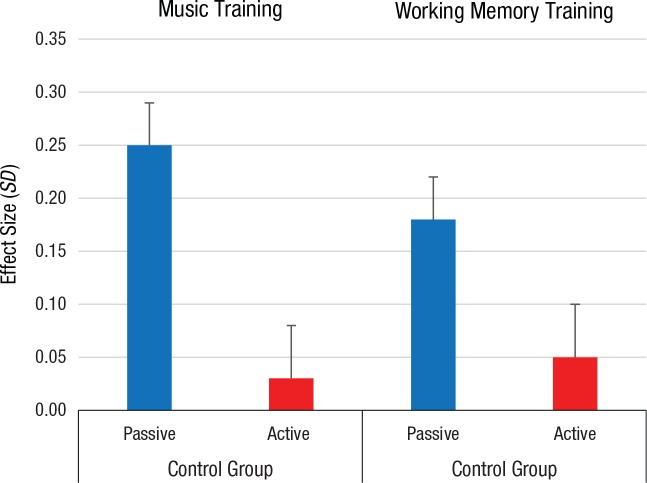
- Effects were inversely related to design quality: with active controls, music training was 0.03 SD [−0.07, 0.12], k = 54, versus 0.25 SD [0.17, 0.34], k = 64, with passive controls; working memory training was 0.05 SD [−0.05, 0.15], k = 40, versus 0.18 SD [−0.09, 0.26], k = 34. Chess had only one active-control study, with a minimal 0.10 SD effect.
- The only exception was robust near-transfer from working memory training to other memory tasks: 0.44 and 0.46 SD when compared with active and passive control groups, respectively.
Methods
- Meta-analyses of experimental studies in typically developing children and young adolescents tested chess and music instruction effects on academic attainment (literacy and mathematics) and cognitive skills, and working memory training effects on academic achievement, fluid intelligence, and cognitive control.
- The article also reviews meta-analytic correlational evidence on chess and music expertise and cognitive ability.
- Effects were pooled as standardized mean differences between treatment and control groups with 95% confidence intervals, comparing passive versus active control groups.
Limitations
- The paper states its conclusions apply at least with typically developing children and young adolescents; chess active-control evidence was limited to one study, and future interventions should include pretests and at least two control groups.
- Evident from the text: meta-analytic estimates depend on the available studies and their design quality, and the correlational evidence cannot establish causation, as the authors themselves note.
Model-written summary. Check it against the paper before relying on it.
Integrity signals
Registry
Cites
Statistics
Figures
Verification
Claims the paper makes
28 Not checked yet · 15 Own interpretation · 3 Own result
In the paper
“when the experimental groups were compared with active control groups—other filler activities to rule out possible placebo effects such as positive expectations about the training (Boot, Simons, Stothart, & Stutts, 2013) and the excitement induced by a novel activity—the overall effect sizes were minimal or null.”
§ Does Far Transfer Exist? Negative Evidence From Chess, Music, and Working Memory Training > Does Far Transfer Occur? Insights From Chess, Music, and WM Training > Experimental studies
What the sources say
- Not checked yetcites Boot et al., 2013
plain- Asserted: passes — The authors put it forward as true.
- Checkable: passes — It can be checked against evidence.
- Load-bearing: passes — The paper’s conclusions depend on it.
- Based: passes — The paper gives a reason why it holds.
In the paper
“the overall effect sizes were 0.25 SD, 95% CI = [0.17, 0.34], k = 64,3 and 0.03 SD, 95% CI = [−0.07, 0.12], k = 54, for the comparisons with passive and active control groups, respectively.”
§ Does Far Transfer Exist? Negative Evidence From Chess, Music, and Working Memory Training > Does Far Transfer Occur? Insights From Chess, Music, and WM Training > Experimental studies
What the sources say
- Not checked yetcites Sala & Gobet, 2017b
plain- Asserted: passes — The authors put it forward as true.
- Checkable: passes — It can be checked against evidence.
- Load-bearing: passes — The paper’s conclusions depend on it.
- Based: passes — The paper gives a reason why it holds.
In the paper
“the overall effect sizes were 0.18 SD, 95% CI = [−0.09, 0.26], k = 34, and 0.05 SD, 95% CI = [−0.05, 0.15], k = 40, for the comparisons with passive and active control groups, respectively”
§ Does Far Transfer Exist? Negative Evidence From Chess, Music, and Working Memory Training > Does Far Transfer Occur? Insights From Chess, Music, and WM Training > Experimental studies
What the sources say
- Not checked yetcites Sala & Gobet, 2017c
plain- Asserted: passes — The authors put it forward as true.
- Checkable: passes — It can be checked against evidence.
- Load-bearing: passes — The paper’s conclusions depend on it.
- Based: passes — The paper gives a reason why it holds.
In the paper
“Chess | 0.34 [0.24, 0.44]”
§ Does Far Transfer Exist? Negative Evidence From Chess, Music, and Working Memory Training > Does Far Transfer Occur? Insights From Chess, Music, and WM Training > Experimental studies
What the sources say
- Not checked yetcites Sala & Gobet, 2016, 2017b
plaindirect- Asserted: passes — The authors put it forward as true.
- Checkable: passes — It can be checked against evidence.
- Load-bearing: passes — The paper’s conclusions depend on it.
- Based: passes — The paper gives a reason why it holds.
A result the paper reports from its own data — it cites no other source for it, so there is none to check. The quote shows it is in the paper.
In the paper
“The size of the effects was inversely related to the quality of the experimental design.”
§ Does Far Transfer Exist? Negative Evidence From Chess, Music, and Working Memory Training > Does Far Transfer Occur? Insights From Chess, Music, and WM Training > Experimental studies
plaincorrelational- Asserted: passes — The authors put it forward as true.
- Checkable: passes — It can be checked against evidence.
- Load-bearing: passes — The paper’s conclusions depend on it.
- Based: passes — The paper gives a reason why it holds.
In the paper
“the overall effect sizes were 0.25 SD, 95% CI = [0.17, 0.34], k = 64,3 and 0.03 SD, 95% CI = [−0.07, 0.12], k = 54, for the comparisons with passive and active control groups, respectively.”
§ Does Far Transfer Exist? Negative Evidence From Chess, Music, and Working Memory Training > Does Far Transfer Occur? Insights From Chess, Music, and WM Training > Experimental studies
What the sources say
- Not checked yetcites Sala & Gobet, 2017b
plain- Asserted: passes — The authors put it forward as true.
- Checkable: passes — It can be checked against evidence.
- Load-bearing: passes — The paper’s conclusions depend on it.
- Based: passes — The paper gives a reason why it holds.
None of the sources cited for this claim have been checked yet.
In the paper
“The results showed small to moderate overall effect sizes—that is, the overall quantitative measure of the effectiveness of the training—in all three meta-analyses (Table 1).”
- Also stated in: § Abstract · plain
“The results show small to moderate effects.”
§ Does Far Transfer Exist? Negative Evidence From Chess, Music, and Working Memory Training > Does Far Transfer Occur? Insights From Chess, Music, and WM Training > Experimental studies
What the sources say
- Not checked yetcites Sala & Gobet, 2016, 2017b
- Not checked yetcites Sala & Gobet, 2017c
plain- Asserted: passes — The authors put it forward as true.
- Checkable: passes — It can be checked against evidence.
- Load-bearing: passes — The paper’s conclusions depend on it.
- Based: passes — The paper gives a reason why it holds.
- Also stated in: § Abstract · plain
In the paper
“Working memory | 0.12 [0.06, 0.18]”
§ Does Far Transfer Exist? Negative Evidence From Chess, Music, and Working Memory Training > Does Far Transfer Occur? Insights From Chess, Music, and WM Training > Experimental studies
What the sources say
- Not checked yetcites Sala & Gobet, 2017c
plain- Asserted: passes — The authors put it forward as true.
- Checkable: passes — It can be checked against evidence.
- Load-bearing: passes — The paper’s conclusions depend on it.
- Based: passes — The paper gives a reason why it holds.
In the paper
“the overall effect sizes were 0.18 SD, 95% CI = [−0.09, 0.26], k = 34, and 0.05 SD, 95% CI = [−0.05, 0.15], k = 40, for the comparisons with passive and active control groups, respectively”
§ Does Far Transfer Exist? Negative Evidence From Chess, Music, and Working Memory Training > Does Far Transfer Occur? Insights From Chess, Music, and WM Training > Experimental studies
What the sources say
- Not checked yetcites Sala & Gobet, 2017c
plain- Asserted: passes — The authors put it forward as true.
- Checkable: passes — It can be checked against evidence.
- Load-bearing: passes — The paper’s conclusions depend on it.
- Based: passes — The paper gives a reason why it holds.
A result the paper reports from its own data — it cites no other source for it, so there is none to check. The quote shows it is in the paper.
In the paper
“The only exception to this pattern was the robust near-transfer effect that WM training exerted on other memory tasks (0.44 and 0.46 SD when the treated groups were compared with active and passive control groups, respectively).”
§ Does Far Transfer Exist? Negative Evidence From Chess, Music, and Working Memory Training > Does Far Transfer Occur? Insights From Chess, Music, and WM Training > Experimental studies
boosteddirect- Asserted: passes — The authors put it forward as true.
- Checkable: passes — It can be checked against evidence.
- Load-bearing: passes — The paper’s conclusions depend on it.
- Based: passes — The paper gives a reason why it holds.
- It may state two separate claims as one. 10
- Probably not a substantial claim. 6
A result the paper reports from its own data — it cites no other source for it, so there is none to check. The quote shows it is in the paper.
In the paper
“the chess interventions included only one study with an active control group (with minimal effects: 0.10 SD).”
§ Does Far Transfer Exist? Negative Evidence From Chess, Music, and Working Memory Training > Does Far Transfer Occur? Insights From Chess, Music, and WM Training > Experimental studies
plainSingle case- Asserted: passes — The authors put it forward as true.
- Checkable: passes — It can be checked against evidence.
- Load-bearing: passes — The paper’s conclusions depend on it.
- Based: passes — The paper gives a reason why it holds.
It may state two separate claims as one.
In the paper
“we found that chess players’ overall cognitive ability was superior to that of non-chess players by half a standard deviation, a moderately large effect.”
§ Does Far Transfer Exist? Negative Evidence From Chess, Music, and Working Memory Training > Does Far Transfer Occur? Insights From Chess, Music, and WM Training > Comparison and correlational studies
What the sources say
- Not checked yetcites Sala et al., 2017
plaincorrelational- Asserted: passes — The authors put it forward as true.
- Checkable: passes — It can be checked against evidence.
- Load-bearing: unclear — It is unclear whether the paper’s conclusions depend on it.
- Based: passes — The paper gives a reason why it holds.
It may state two separate claims as one.
In the paper
“This outcome is in line with Thorndike and Woodworth’s (1901) common-elements theory.”
§ Does Far Transfer Exist? Negative Evidence From Chess, Music, and Working Memory Training > Does Far Transfer Occur? Insights From Chess, Music, and WM Training > Research in other domains
What the sources say
- Not checked yetcites Thorndike and Woodworth (1901)
plaincorrelational- Asserted: passes — The authors put it forward as true.
- Checkable: passes — It can be checked against evidence.
- Load-bearing: fails — The paper’s conclusions may not depend on it.
- Based: passes — The paper gives a reason why it holds.
Probably not a substantial claim. The paper’s conclusions may not depend on it.
In the paper
“Jaeggi, Buschkuehl, Jonides, and Perrig (2008), which presented an experiment in which participants who received training on a WM task showed an improvement on a fluid intelligence test (Raven’s Matrices).”
§ Does Far Transfer Exist? Negative Evidence From Chess, Music, and Working Memory Training > Does Far Transfer Occur? Insights From Chess, Music, and WM Training > The hypothesis underlying the potential occurrence of far transfer
What the sources say
- Not checked yetcites Jaeggi et al., 2008
plaindirect- Asserted: passes — The authors put it forward as true.
- Checkable: passes — It can be checked against evidence.
- Load-bearing: passes — The paper’s conclusions depend on it.
- Based: passes — The paper gives a reason why it holds.
Probably not a substantial claim.
None of the sources cited for this claim have been checked yet.
In the paper
“Lee, Lu, and Ko (2007) and Schellenberg (2006) found positive correlations between music skill, WM, and IQ.”
§ Does Far Transfer Exist? Negative Evidence From Chess, Music, and Working Memory Training > Does Far Transfer Occur? Insights From Chess, Music, and WM Training > Comparison and correlational studies
What the sources say
- Not checked yetcites Lee et al., 2007
- Not checked yetcites Schellenberg, 2006
plaincorrelational- Asserted: passes — The authors put it forward as true.
- Checkable: passes — It can be checked against evidence.
- Load-bearing: unclear — It is unclear whether the paper’s conclusions depend on it.
- Based: passes — The paper gives a reason why it holds.
It may state two separate claims as one.
A conclusion the paper draws from its own results — it cites no other source for it, so there is none to check. The quote shows it is in the paper.
In the paper
“cognitive ability (e.g., WM or general intelligence) is a predictor of chess skill and music skill, among many others”
§ Does Far Transfer Exist? Negative Evidence From Chess, Music, and Working Memory Training > Theoretical and Practical Implications
plaincorrelational- Asserted: passes — The authors put it forward as true.
- Checkable: passes — It can be checked against evidence.
- Load-bearing: passes — The paper’s conclusions depend on it.
- Based: passes — The paper gives a reason why it holds.
It may state two separate claims as one.
In the paper
“Like WM training, such programs have been proven to enhance participants’ performance on the task they train and, at best, some other similar tasks.”
§ Does Far Transfer Exist? Negative Evidence From Chess, Music, and Working Memory Training > Does Far Transfer Occur? Insights From Chess, Music, and WM Training > Research in other domains
What the sources say
- Not checked yetcites Simons et al., 2016
boosteddirect- Asserted: passes — The authors put it forward as true.
- Checkable: passes — It can be checked against evidence.
- Load-bearing: passes — The paper’s conclusions depend on it.
- Based: passes — The paper gives a reason why it holds.
It may state two separate claims as one.
In the paper
“Considering that spatial ability predicts attainment in mathematics (Wai, Lubinski, & Benbow, 2009)”
§ Does Far Transfer Exist? Negative Evidence From Chess, Music, and Working Memory Training > Does Far Transfer Occur? Insights From Chess, Music, and WM Training > Research in other domains
What the sources say
- Not checked yetcites Wai et al., 2009
plaincorrelational- Asserted: passes — The authors put it forward as true.
- Checkable: passes — It can be checked against evidence.
- Load-bearing: passes — The paper’s conclusions depend on it.
- Based: passes — The paper gives a reason why it holds.
Probably not a substantial claim.
A conclusion the paper draws from its own results — it cites no other source for it, so there is none to check. The quote shows it is in the paper.
In the paper
“An alternative explanation is that people with superior cognitive ability are more likely to engage and excel in chess and music.”
- Also stated in: § Conclusions and Future Directions · hedged
“Rather, smarter individuals are more likely to engage and excel in these fields.”
§ Does Far Transfer Exist? Negative Evidence From Chess, Music, and Working Memory Training > Does Far Transfer Occur? Insights From Chess, Music, and WM Training > The hypothesis underlying the potential occurrence of far transfer
hedgedcorrelational- Asserted: passes — The authors put it forward as true.
- Checkable: passes — It can be checked against evidence.
- Load-bearing: passes — The paper’s conclusions depend on it.
- Based: passes — The paper gives a reason why it holds.
It may state two separate claims as one.
- Also stated in: § Conclusions and Future Directions · hedged
In the paper
“In their systematic review, Simons et al. (2016) observe that no convincing evidence has been provided so far about the alleged generalized benefits of brain-training programs.”
§ Does Far Transfer Exist? Negative Evidence From Chess, Music, and Working Memory Training > Does Far Transfer Occur? Insights From Chess, Music, and WM Training > Research in other domains
What the sources say
- Not checked yetcites Simons et al., 2016
plain- Asserted: passes — The authors put it forward as true.
- Checkable: passes — It can be checked against evidence.
- Load-bearing: fails — The paper’s conclusions may not depend on it.
- Based: passes — The paper gives a reason why it holds.
Probably not a substantial claim. The paper’s conclusions may not depend on it.
In the paper
“Spatial ability has been found to be malleable by spatial training (Uttal et al., 2013).”
§ Does Far Transfer Exist? Negative Evidence From Chess, Music, and Working Memory Training > Does Far Transfer Occur? Insights From Chess, Music, and WM Training > Research in other domains
What the sources say
- Not checked yetcites Uttal et al., 2013
plaindirect- Asserted: passes — The authors put it forward as true.
- Checkable: passes — It can be checked against evidence.
- Load-bearing: fails — The paper’s conclusions may not depend on it.
- Based: passes — The paper gives a reason why it holds.
Probably not a substantial claim. The paper’s conclusions may not depend on it.
In the paper
“The second meta-analysis (Burgoyne et al., 2016) reported statistically significant correlations between chess skill and four broad measures of cognitive ability”
§ Does Far Transfer Exist? Negative Evidence From Chess, Music, and Working Memory Training > Does Far Transfer Occur? Insights From Chess, Music, and WM Training > Comparison and correlational studies
What the sources say
- Not checked yetcites Burgoyne et al., 2016
plaincorrelational- Asserted: passes — The authors put it forward as true.
- Checkable: passes — It can be checked against evidence.
- Load-bearing: unclear — It is unclear whether the paper’s conclusions depend on it.
- Based: passes — The paper gives a reason why it holds.
It may state two separate claims as one.
A conclusion the paper draws from its own results — it cites no other source for it, so there is none to check. The quote shows it is in the paper.
In the paper
“Although cognitive ability correlates with domain-specific skills—for example, smarter people are more likely to be stronger chess players and better musicians—there is little evidence that chess or music instruction makes people smarter.”
§ Does Far Transfer Exist? Negative Evidence From Chess, Music, and Working Memory Training > Conclusions and Future Directions
plain- Asserted: passes — The authors put it forward as true.
- Checkable: passes — It can be checked against evidence.
- Load-bearing: passes — The paper’s conclusions depend on it.
- Based: passes — The paper gives a reason why it holds.
It may state two separate claims as one.
A conclusion the paper draws from its own results — it cites no other source for it, so there is none to check. The quote shows it is in the paper.
In the paper
“If skills rarely generalize across different domains, then the most effective way to acquire a skill is to train that particular skill.”
§ Does Far Transfer Exist? Negative Evidence From Chess, Music, and Working Memory Training > Theoretical and Practical Implications
plaindirect- Asserted: passes — The authors put it forward as true.
- Checkable: fails — It may be too vague to check against evidence.
- Load-bearing: passes — The paper’s conclusions depend on it.
- Based: passes — The paper gives a reason why it holds.
Probably not a substantial claim. It may be too vague to check against evidence. It may state two separate claims as one.
None of the sources cited for this claim have been checked yet.
In the paper
“The occurrence of specific neural patterns (anatomical and functional) and absence of far-transfer effects on cognitive tests have been reported in domains such as music (e.g., Tierney, Krizman, & Kraus, 2015), chess (e.g., Hänggi, Brütsch, Siegel, & Jäncke, 2014), and video game training (e.g., Colom et al., 2012).”
§ Does Far Transfer Exist? Negative Evidence From Chess, Music, and Working Memory Training > Theoretical and Practical Implications
What the sources say
- Not checked yetcites Tierney, Krizman, & Kraus, 2015
- Not checked yetcites Hänggi, Brütsch, Siegel, & Jäncke, 2014
- Not checked yetcites Colom et al., 2012
plain- Asserted: passes — The authors put it forward as true.
- Checkable: passes — It can be checked against evidence.
- Load-bearing: passes — The paper’s conclusions depend on it.
- Based: passes — The paper gives a reason why it holds.
It may state two separate claims as one.
Claims other papers make about this one
Each is checked against this paper’s own text: does it say what the citing paper says it does?
The source backs part of the claim, not all of it — or backs it for a different population, condition or comparison.
In the citing paper
“Nevertheless, there is an increasing recognition that while domain-specific skills are eminently teachable, purely generic-cognitive skills are not teachable and attempts to teach them lead to dead-ends (Sala and Gobet 2017).”
From Cognitive Architecture and Instructional Design: 20 Years Later (2019) · cites this paper as Sala and Gobet 2017
Experimental — accuracy not yet measuredThe cited source says what the claim attributes to it.
In the citing paper
“The data summarised by Sala and Gobet (2017) provide a major justification for the post 1998 inclusion of evolutionary psychology into cognitive load theory.”
From Cognitive Architecture and Instructional Design: 20 Years Later (2019) · cites this paper as Sala and Gobet (2017)
The cited source says what the claim attributes to it.
In the citing paper
“Such findings are essential for this area to remain viable but there is little evidence of such results from any area (Sala and Gobet 2017).”
From Cognitive Architecture and Instructional Design: 20 Years Later (2019) · cites this paper as Sala and Gobet 2017
Self-check
Percentages, sums and reported differences re-computed from the paper’s own numbers.
Rated minor: it would not touch a result — a value no result rests on, a p-value that stays on the same side of the significance level, or a conflict that is clerical, resolved elsewhere in the paper, or outside its own findings.
In the paper
“the overall effect sizes were 0.18 SD, 95% CI = [−0.09, 0.26], k = 34”
§ Does Far Transfer Exist? Negative Evidence From Chess, Music, and Working Memory Training > Does Far Transfer Occur? Insights From Chess, Music, and WM Training > Experimental studies
Reported 0.18 · recomputed 0.085
Citations
Cites
Statistical Power Analysis for the Behavioral Sciences
Muller, K. E., & Cohen, J. (1989) · Technometrics · doi:10.2307/1270020 · Cited by 99,603
Statistical power analysis for the behavioral sciences
Cohen, J. (1990) · Computers Environment and Urban Systems · doi:10.1016/0198-9715(90)90050-4 · Cited by 65,417
Chase, W. G., & Simon, H. A. (1973) · Cognitive Psychology · doi:10.1016/0010-0285(73)90004-2 · Cited by 4,479
The malleability of spatial skills: A meta-analysis of training studies.
Uttal, D. H., Meadow, N. G., Tipton, E., Hand, L. L., Alden, A. R., Warren, C. M., & Newcombe, N. S. (2012) · Psychological Bulletin · doi:10.1037/a0028446 · Cited by 2,188 · cited 1×
“Spatial ability has been found to be malleable by spatial training (Uttal et al., 2013).”
BackgroundImproving fluid intelligence with training on working memory
Jaeggi, S. M., Buschkuehl, M., Jonides, J., & Perrig, W. J. (2008) · Proceedings of the National Academy of Sciences · doi:10.1073/pnas.0801268105 · Cited by 2,187
Validity and utility of alternative predictors of job performance.
Hunter, J. E., & Hunter, R. F. (1984) · Psychological Bulletin · doi:10.1037/0033-2909.96.1.72 · Cited by 2,107 · cited 1×
“Importantly, domain-general cognitive abilities (e.g., intelligence, processing speed, and working memory [WM]) are reliable predictors of success for outcomes such as academic achievement (Deary, Strand, Smith, & Fernandes, 2007) and job proficiency (Hunter & Hunter, 1984).”
BackgroundWai, J., Lubinski, D., & Benbow, C. P. (2009) · Journal of Educational Psychology · doi:10.1037/a0016127 · Cited by 2,004
Intelligence and educational achievement
Deary, I. J., Strand, S., Smith, P., & Fernandes, C. (2007) · Intelligence · doi:10.1016/j.intell.2006.02.001 · Cited by 1,723 · cited 2×
“Because of its high specificity, such information is hardly transferable to other fields, as predicted by chunking theory (Chase & Simon, 1973) and template theory (i.e., an extension of chunking theory; Gobet, 2016; Gobet & Simon, 1996).”
BackgroundThe influence of improvement in one mental function upon the efficiency of other functions. (I).
Woodworth, R. S., & Thorndike, E. L. (1901) · Psychological Review · doi:10.1037/h0074898 · Cited by 1,223 · cited 2×
“In a seminal article, Thorndike and Woodworth (1901) proposed their common-elements theory according to which transfer is a function of the extent to which two domains share common features.”
BackgroundDo “brain-training” programs work?
Simons, D. J., Boot, W. R., Charness, N., Gathercole, S. E., Chabris, C. F., Hambrick, D. Z., & Stine-Morrow, E. A. L. (2016) · Psychological Science in the Public Interest · doi:10.1177/1529100616661983 · Cited by 1,183
Research works printed but not linked: 1
- 10.1037/a0027473 · DOI · Paper page
Cited by
Sorted by citations
Cognitive Architecture and Instructional Design: 20 Years Later
Sweller, J., van Merriënboer, J. J. G., & Paas, F. (2019) · Educational Psychology Review · doi:10.1007/s10648-019-09465-5 · Cited by 2,337
Education and cognitive functioning across the life span
Lövdén, M., Fratiglioni, L., Glymour, M. M., Lindenberger, U., & Tucker-Drob, E. M. (2020) · Psychological Science in the Public Interest · doi:10.1177/1529100620920576 · Cited by 1,224
“…music, and chess) result in limited generalization of benefits to outcome measures of cognitive performance that are not directly tapping into skills, strategies, and knowledge acquired through those activities (Melby-Lervag, Redick, & Hulme, 2016; Sala & Gobet, 2017; Simons et al., 2016).”
BackgroundThe impact of shared book reading on children's language skills: A meta-analysis
Noble, C. H., Sala, G., Peter, M., Lingwood, J., Rowland, C. F., Gobet, F. R., & Pine, J. M. (2019) · Educational Research Review · doi:10.1016/j.edurev.2019.100290 · Cited by 326
Self-citationAnnual Research Review: Educational neuroscience: progress and prospects
Thomas, M. S. C., Ansari, D., & Knowland, V. C. P. (2018) · Journal of Child Psychology and Psychiatry · doi:10.1111/jcpp.12973 · Cited by 349
“The pursuit of techniques to produce general benefits for cognition As we have seen, cognitive training tends to produce only ‘near transfer’, that is, performance improvements to the task trained on or similar tasks, rather than more broadly across cognition (Sala & Gobet, 2017).”
BackgroundDomain-specific prior knowledge and learning: A meta-analysis
Simonsmeier, B. A., Flaig, M., Deiglmayr, A., Schalk, L., & Schneider, M. (2021) · Educational Psychologist · doi:10.1080/00461520.2021.1939700 · Cited by 314
The cognitive benefits of learning computer programming: A meta-analysis of transfer effects.
Scherer, R., Siddiq, F., & Sánchez Viveros, B. (2019) · Journal of Educational Psychology · doi:10.1037/edu0000314 · Cited by 205
“Sala and Gobet (2017b) obtained a similar result while studying effects of music education on literacy ( d (cid:2) (cid:4) 0.07).”
BackgroundResultInfluentialA Framework for the Testing and Validation of Simulated Environments in Experimentation and Training
Harris, D., Bird, J. M., Smart, P. A., Wilson, M., & Vine, S. J. (2020) · Frontiers in Psychology · doi:10.3389/fpsyg.2020.00605 · Cited by 229
“Achieving far transfer of learning that is generalized across domains which are only loosely related to each other is, however, notoriously difficult to achieve (Sala and Gobet, 2017).”
BackgroundLifting cognition: a meta-analysis of effects of resistance exercise on cognition
Landrigan, J.-F., Bell, T. R., Crowe, M. G., Clay, O. J., & Mirman, D. (2019) · Psychological Research · doi:10.1007/s00426-019-01145-x · Cited by 166
Cognitive Training: A Field in Search of a Phenomenon
Gobet, F. R., & Sala, G. (2022) · Perspectives on Psychological Science · doi:10.1177/17456916221091830 · Cited by 166
Self-citationCognitive Theory of Multimedia Learning
Mayer, R. E. (2021) · Cambridge University Press eBooks · doi:10.1017/9781108894333.008 · Cited by 203
The cognitive and academic benefits of Cogmed: A meta-analysis
Aksayli, N. D., Sala, G., & Gobet, F. (2019) · Educational Research Review · doi:10.1016/j.edurev.2019.04.003 · Cited by 123
“However, it is worth mentioning that the number of CWMT interventions included in these latter meta-analyses is quite limited (19 in Melby-Lervåg et al., 2016; four in Sala & Gobet, 2017a) and no conclusive response about CWMT effectiveness can be drawn from these syntheses.”
BackgroundSelf-citationRomán-Caballero, R., Vadillo, M. A., Trainor, L. J., & Lupiáñez, J. (2022) · Educational Research Review · doi:10.1016/j.edurev.2022.100436 · Cited by 118
“…to explain ” (Sala & Gobet, 2020, p. 9) or “ researchers and policymakers should seriously consider stopping spending resources for this type of research ” (Sala & Gobet, 2017b) seem overpessimistic in light of our results, and upcoming investigation will be essential to clarify this debate.”
ResultCorrelation = causation? Music training, psychology, and neuroscience
Schellenberg, E. G. (2020) · Psychology of Aesthetics, Creativity, and the Arts · doi:10.1037/aca0000263 · Cited by 113
Renshaw, I., Davids, K., Araújo, D., Lucas, A., Roberts, W., Newcombe, D. J., & Franks, B. (2019) · Frontiers in Psychology · doi:10.3389/fpsyg.2018.02468 · Cited by 117
“The result is that production models seek to explain how far transfer may occur by suggesting that the declarative knowledge base acts as the main source of transfer (Taatgen, 2013), suggesting the efficacy of domain-general cognitive abilities (Sala and Gobet, 2017).”
BackgroundExecutive function: association with multiple reading skills
Cirino, P. T., Miciak, J., Ahmed, Y., Barnes, M. A., Taylor, W. P., & Gerst, E. H. (2018) · Reading and Writing · doi:10.1007/s11145-018-9923-9 · Cited by 119
Frontoparietal theta-gamma interactions track working memory enhancement with training and tDCS
Jones, K. T., Johnson, E. L., & Berryhill, M. E. (2020) · NeuroImage · doi:10.1016/j.neuroimage.2020.116615 · Cited by 108
“Studies of cognitive training are plagued with mixed results and report little to no transfer of training gains (Morrison and Chein, 2011; Sala and Gobet, 2017; Nguyen et al., 2019; Schwaighofer et al., 2015).”
Passion, grit and mindset in young adults: Exploring the relationship and gender differences
Sigmundsson, H., Haga, M., & Hermundsdottir, F. (2020) · New Ideas in Psychology · doi:10.1016/j.newideapsych.2020.100795 · Cited by 117
Near and far transfer: Is music special?
Bigand, E., & Tillmann, B. (2022) · Memory & Cognition · doi:10.3758/s13421-021-01226-6 · Cited by 103
“All of these points might contribute to underestimating the potential effect size of music training in S&G2020, and when revisiting their data file, we inherited this tendency.”
BackgroundMethodResultInfluentialThe motivational potency of nostalgia: The future is called yesterday
Sedikides, C., & Wildschut, T. (2019) · Advances in motivation science · doi:10.1016/bs.adms.2019.05.001 · Cited by 104
Musical training, bilingualism, and executive function: working memory and inhibitory control
LaPlume, A. A., Moradzadeh, L., & Wiseheart, M. (2018) · Cognitive Research Principles and Implications · doi:10.1186/s41235-018-0095-6 · Cited by 114
“Reviews of bilingual evidence indicate that 80% of the literature yields null effects, with a greater percentage of null results for sample sizes larger than 40 (Paap, Johnson, & Sawi, 2015), in contrast with music where the evidence indicates a small to medium effect size (Sala & Gobet, 2017).”
BackgroundResultMusic Training and Nonmusical Abilities
Schellenberg, E. G., & Lima, C. F. (2023) · Annual Review of Psychology · doi:10.1146/annurev-psych-032323-051354 · Cited by 107
Investigating the Impact of a Musical Intervention on Preschool Children’s Executive Function
Bowmer, A., Mason, K., Knight, J., & Welch, G. F. (2018) · Frontiers in Psychology · doi:10.3389/fpsyg.2018.02389 · Cited by 106
“Additionally, the credibility of findings has been called into question through a meta-analysis assessing the effect of chess, music and working memory training, where an inverse relationship was found between the size of effect and quality of study design (Sala and Gobet, 2017a).”
BackgroundThe passion scale: Aspects of reliability and validity of a new 8-item scale assessing passion.
Sigmundsson, H., Haga, M., & Hermundsdottir, F. (2019) · New Ideas in Psychology · doi:10.1016/j.newideapsych.2019.06.001 · Cited by 89
Sustained Effect of Music Training on the Enhancement of Executive Function in Preschool Children
Shen, Y., Lin, Y., Liu, S., Fang, L., & Liu, G. (2019) · Frontiers in Psychology · doi:10.3389/fpsyg.2019.01910 · Cited by 102
“It is not clear which mechanisms of musical training affect cognitive ability, but many researchers believe that the transfer effect of musical training involves EF (Hannon and Trainor, 2007; Schellenberg et al., 2008; Jäncke, 2009; Moreno et al., 2014; Moreno and Farzan, 2015; Saarikivi et al., 2016; Sala and Gobet,…”
BackgroundEffects of action video game play on cognitive skills: A meta-analysis.
Bediou, B., Rodgers, M. A., Tipton, E., Mayer, R. E., Green, C. S., & Bavelier, D. (2023) · Technology Mind and Behavior · doi:10.1037/tmb0000102 · Cited by 112
Neves, L., Correia, A. I., Castro, S. L., Martins, D., & Lima, C. F. (2022) · Neuroscience & Biobehavioral Reviews · doi:10.1016/j.neubiorev.2022.104777 · Cited by 86
Training Executive Functions to Improve Academic Achievement: Tackling Avenues to Far Transfer
Gunzenhauser, C., & Nückles, M. (2021) · Frontiers in Psychology · doi:10.3389/fpsyg.2021.624008 · Cited by 91
Music lessons enhance executive functions in 6- to 7-year-old children
Frischen, U., Schwarzer, G., & Degé, F. (2021) · Learning and Instruction · doi:10.1016/j.learninstruc.2021.101442 · Cited by 76
Nostalgia promotes intrinsic motivation and effort in the presence of low interactional justice
van Dijke, M., Leunissen, J. M., Wildschut, T., & Sedikides, C. (2019) · Organizational Behavior and Human Decision Processes · doi:10.1016/j.obhdp.2018.12.003 · Cited by 73
Zanesco, A. P., Denkova, E., Rogers, S. L., MacNulty, W. K., & Jha, A. P. (2018) · Progress in brain research · doi:10.1016/bs.pbr.2018.10.001 · Cited by 70
Passion, grit and mindset: Exploring gender differences
Sigmundsson, H., Guðnason, S., & Jóhannsdóttir, S. (2021) · New Ideas in Psychology · doi:10.1016/j.newideapsych.2021.100878 · Cited by 63
Ludyga, S., Pühse, U., Gerber, M., & Herrmann, C. (2018) · European Journal of Sport Science · doi:10.1080/17461391.2018.1529826 · Cited by 60
“In general, the idea that enhanced cognitive abilities following practice transfer to other domains has been questioned as for example, there is no sound evidence for a far transfer of learning following chess practice and working memory training (Sala & Gobet, 2017).”
BackgroundHallam, S., & Himonides, E. (2022) · Open Book Publishers · doi:10.11647/obp.0292 · Cited by 88
How Artificial Intelligence Can Help Us Understand Human Creativity
Gobet, F. R., & Sala, G. (2019) · Frontiers in Psychology · doi:10.3389/fpsyg.2019.01401 · Cited by 69
“There is now very strong experimental evidence that skills acquired in a domain do not generalize to new domains sharing few commonalities with the original one (Gobet, 2016b; Sala and Gobet, 2017a), and this conclusion almost certainly also applies to creativity.”
BackgroundSelf-citationThe Extraordinary Ordinary: Re‐engineering Multilingualism as a Natural Category
Berthelé, R. (2020) · Language Learning · doi:10.1111/lang.12407 · Cited by 59
Stephens, J. M., Watson, P. W. S. J., Alansari, M., Lee, G., & Turnbull, S. M. (2021) · Frontiers in Psychology · doi:10.3389/fpsyg.2021.569133 · Cited by 61
“This longrunning disagreement over far transfer has been sustained for over a century because the empirical evidence for it has also been divided, particularly for knowledge and skills associated with critical thinking and problem-solving (cf. Brown, 1989; Sala and Gobet, 2017).”
BackgroundFerrero, M., Vadillo, M. A., & León, S. P. (2021) · Intelligence · doi:10.1016/j.intell.2021.101566 · Cited by 98
Strategy mediation in working memory training in younger and older adults
Forsberg, A., Fellman, D., Laine, M., Johnson, W., & Logie, R. H. (2020) · Quarterly Journal of Experimental Psychology · doi:10.1177/1747021820915107 · Cited by 62
Loui, P., Raine, L. B., Chaddock‐Heyman, L., Kramer, A. F., & Hillman, C. H. (2019) · Frontiers in Psychology · doi:10.3389/fpsyg.2019.01198 · Cited by 65
“A meta-analysis of the effects of music training on children’s cognitive and academic skills showed small effect sizes in transfer to intelligence, memory, mathematics, phonological processing, and spatial processing, with effect sizes being affected by methodological considerations: smaller effect sizes were generall…”
I am the chosen one: Narcissism in the backdrop of self‐determination theory
Sedikides, C., Ntoumanis, N., & Sheldon, K. M. (2018) · Journal of Personality · doi:10.1111/jopy.12402 · Cited by 59
Sala, G., & Gobet, F. R. (2017) · Learning & Behavior · doi:10.3758/s13420-017-0280-3 · Cited by 54
Self-citationPergher, V., Au, J., Shalchy, M. A., Santarnecchi, E., Seitz, A. R., Jaeggi, S. M., & Battelli, L. (2022) · Brain stimulation · doi:10.1016/j.brs.2022.11.008 · Cited by 51
“Given the controversy surrounding “far” transfer effects to broad cognitive domains or skills relevant to daily living [7,9,47], tDCS may be a useful tool moving forward to increase the signal to noise ratio in this literature.”
MethodCognitive training as a component of treatment of alcohol use disorder: A review.
Nixon, S. J., & Lewis, B. (2019) · Neuropsychology · doi:10.1037/neu0000575 · Cited by 50
“Although there are conflicting views regarding the degree to which transfer of training is possible (Owen et al., 2010; Sala & Gobet, 2017; Salminen, Strobach, & Schubert, 2012; Westerberg et al., 2007), it is clear that transfer is facilitated if training and transfer tasks engage common…”
BackgroundEnhanced recognition of vocal emotions in individuals with naturally good musical abilities.
Correia, A. I., Castro, S. L., MacGregor, C., Müllensiefen, D., Schellenberg, E. G., & Lima, C. F. (2020) · Emotion · doi:10.1037/emo0000770 · Cited by 58
The relationship between bilingual language use and executive functions
Lehtonen, M., Fyndanis, V., & Jylkkä, J. (2023) · Nature Reviews Psychology · doi:10.1038/s44159-023-00178-9 · Cited by 59
Hartanto, A., Chua, Y. J., Quek, F. Y. X., Wong, J., Ooi, W. M., & Majeed, N. M. (2023) · Attention Perception & Psychophysics · doi:10.3758/s13414-023-02707-3 · Cited by 57
“…recent findings that failed to find a far-transfer effect in computerized working memory training programs and various other experiential factors (e.g., chess, music, video game) (Melby-Lervåg et al., 2016; Redick et al., 2013; Sala & Gobet, 2017; Unsworth et al., 2015; Wiradhany et al., 2020).”
BackgroundMainert, J., Niepel, C., Murphy, K. R., & Greiff, S. (2018) · Journal of Business and Psychology · doi:10.1007/s10869-018-9561-x · Cited by 54
Berggren, R., Nilsson, J., Brehmer, Y., Schmiedek, F., & Lövdén, M. (2020) · Psychology and Aging · doi:10.1037/pag0000439 · Cited by 50
How malleable are cognitive abilities? A critical perspective on popular brief interventions.
Moreau, D. (2021) · American Psychologist · doi:10.1037/amp0000872 · Cited by 48
Replacing tDCS with theta tACS provides selective, but not general WM benefits
Jones, K. T., Arciniega, H., & Berryhill, M. E. (2019) · Brain Research · doi:10.1016/j.brainres.2019.146324 · Cited by 50
Durable memories and efficient neural coding through mnemonic training using the method of loci
Wagner, I. C., Konrad, B. N., Schuster, P., Weisig, S., Repantis, D., Ohla, K., Kühn, S., Fernández, G., Steiger, A., Lamm, C., et al. (2021) · Science Advances · doi:10.1126/sciadv.abc7606 · Cited by 46
“, effects that generalize to untrained tasks dissimilar from the training; (40, 41)].”
BackgroundBombonato, C., Lucchese, B. D., Ruffini, C., Lieto, M., Brovedani, P., Sgandurra, G., Cioni, G., & Pecini, C. (2023) · Neuropsychology Review · doi:10.1007/s11065-022-09574-z · Cited by 57
“…different processes correlated with practiced skills (Melby-Lervåg & Hulme, 2013; Sala & Gobet, 2016, 2017), as opposed to near transfers, i.e. post-treatment improvements in tasks that require directly trained processes (Kassai et al., 2019; Melby-Lervåg & Hulme, 2013; Sala & Gobet, 2016, 2017).”
BackgroundMethodThe domain-specific approach of working memory training
Peng, P., & Swanson, H. L. (2022) · Developmental Review · doi:10.1016/j.dr.2022.101035 · Cited by 45
Motivational Factors Are Varying across Age Groups and Gender
Sigmundsson, H., Haga, M., Elnes, M., Dybendal, B. H., & Hermundsdottir, F. (2022) · International Journal of Environmental Research and Public Health · doi:10.3390/ijerph19095207 · Cited by 46
Estrada‐Plana, V., Esquerda, M., Mangues, R., March‐Llanes, J., & Moya-Higueras, J. (2019) · Games for Health Journal · doi:10.1089/g4h.2018.0051 · Cited by 46
“47 Furthermore, the board games used in this research were focused in WM and STM processes and, in a weaker way, in the other EFs.”
Oldrati, V., Corti, C., Poggi, G., Borgatti, R., Urgesi, C., & Bardoni, A. (2020) · Neuropsychology Review · doi:10.1007/s11065-020-09429-5 · Cited by 41
“…conducted, but either they focused on game-like CCTP involving only/also adult samples (Bediou et al., 2017) or they addressed children but included also non-computerized training or CCTP with no game elements (Cortese et al., 2015; Karch, Albers, Renner, & Lichtenauer, 2013; Sala & Gobet, 2017a).”
MethodResultAssessing the learning and transfer of gaze behaviours in immersive virtual reality
Harris, D., Hardcastle, K. J., Wilson, M., & Vine, S. J. (2021) · Virtual Reality · doi:10.1007/s10055-021-00501-w · Cited by 39
Nostalgia, reflection, brooding: Psychological benefits and autobiographical memory functions
Jiang, T., Cheung, W., Wildschut, T., & Sedikides, C. (2021) · Consciousness and Cognition · doi:10.1016/j.concog.2021.103107 · Cited by 39
Some Evidence on the Cognitive Benefits of Learning to Code
Scherer, R., Siddiq, F., & Sánchez-Scherer, B. (2021) · Frontiers in Psychology · doi:10.3389/fpsyg.2021.559424 · Cited by 40
Nie, P., Wang, C., Rong, G., Du, B., Lü, J., Li, S., Putkinen, V., Tao, S., & Tervaniemi, M. H. (2022) · Frontiers in Psychology · doi:10.3389/fpsyg.2021.770425 · Cited by 37
A Review of the Effects of Abacus Training on Cognitive Functions and Neural Systems in Humans
Wang, C. (2020) · Frontiers in Neuroscience · doi:10.3389/fnins.2020.00913 · Cited by 46
“, 2016; Sala and Gobet, 2019), music learning (Benz et al., 2016; Sala and Gobet, 2017) and chess playing (Sala and Gobet, 2016, 2017).”
BackgroundLi, Z., & Oon, P. (2024) · International Journal of STEM Education · doi:10.1186/s40594-024-00498-z · Cited by 57
“Existing meta-analyses have found that effect sizes vary considerably across various types of learning outcomes (Sala & Gobet, 2017; Scherer et al., 2019).”
BackgroundDoes embedding learning supports enhance transfer during game-based learning?
Bainbridge, K., Shute, V. J., Rahimi, S., Liu, Z., Slater, S., Baker, R. S., & D’Mello, S. K. (2021) · Learning and Instruction · doi:10.1016/j.learninstruc.2021.101547 · Cited by 41
“General transfer is largely agreed to be a myth, as previous attempts to demonstrate it have been unsuccessful or debunked (Thorndike & Woodworth, 1901; Sala & Gobet, 2017).”
ResultOverestimation of Action-Game Training Effects: Publication Bias and Salami Slicing
Hilgard, J., Sala, G., Boot, W. R., & Simons, D. J. (2019) · Collabra: Psychology · doi:10.1525/collabra.231 · Cited by 34
Self-citationMusic Lessons and Cognitive Abilities in Children: How Far Transfer Could Be Possible
Degé, F. (2021) · Frontiers in Psychology · doi:10.3389/fpsyg.2020.557807 · Cited by 34
“While Benz et al. (2015) reported small enhancing effects on Frontiers in Psychology | www.frontiersin.org 2 January 2021 | Volume 11 | Article 557807 various cognitive abilities, Sala and Gobet (2017) found no influence ofmusic lessons on cognitive abilities at all.”
BackgroundCognitive Training in Addiction: Does It Have Clinical Potential?
Wiers, R. W. H. J. (2018) · Biological Psychiatry Cognitive Neuroscience and Neuroimaging · doi:10.1016/j.bpsc.2017.12.008 · Cited by 33
Does Music Training Improve Emotion Recognition Abilities? A Critical Review
Martins, M., Pinheiro, A. P., & Lima, C. F. (2021) · Emotion Review · doi:10.1177/17540739211022035 · Cited by 42
Leveraging artificial intelligence to improve people’s planning strategies
Callaway, F., Jain, Y., van Opheusden, B., Das, P., Iwama, G., Gul, S., Krueger, P. M., Becker, F., Griffiths, T. L., & Lieder, F. (2022) · Proceedings of the National Academy of Sciences · doi:10.1073/pnas.2117432119 · Cited by 37
“The benefits of cognitive training are often limited to tasks that are very similar to the exercises that people practiced on (43, 44).”
BackgroundChamberlain, R., Kozbelt, A., Drake, J. E., & Wagemans, J. P. (2019) · Psychology of Aesthetics Creativity and the Arts · doi:10.1037/aca0000243 · Cited by 31
Socio-affective and cognitive predictors of social adaptation in vulnerable contexts
Neely‐Prado, A., Navarrete, G., & Huepe, D. (2019) · PLoS ONE · doi:10.1371/journal.pone.0218236 · Cited by 35
Brooks, S. J., Mackenzie-Phelan, R., Tully, J. L., & Schiöth, H. B. (2020) · Frontiers in Psychiatry · doi:10.3389/fpsyt.2020.512761 · Cited by 32
“org 3 improvements, which critics argue do not elicit significant far transfer effects (27, 47, 48).”
BackgroundScerif, G., Blakey, E., Gattas, S., Hawes, Z. C. K., Howard, S. J., Merkley, R., O'Connor, R., & Simms, V. (2023) · Educational Psychology Review · doi:10.1007/s10648-023-09824-3 · Cited by 37
“In contrast, when looking at computerised EF training interventions, number of sessions is not a significant moderator for improvements (Kassai et al., 2019; Sala & Gobet, 2017).”
BackgroundTorkildsen, J. V. K., Bratlie, S. S., Kristensen, J. K., Gustafsson, J., Lyster, S. H., Snow, C. E., Hulme, C., Mononen, R., Næss, K.-A. B., López-Pedersen, A., et al. (2021) · Journal of Educational Psychology · doi:10.1037/edu0000688 · Cited by 30
Panesi, S., Bandettini, A., Traverso, L., & Morra, S. (2022) · Journal of Intelligence · doi:10.3390/jintelligence10010005 · Cited by 35
“2 Two other meta-analytic studies (Kassai et al. 2019; Sala and Gobet 2017) are potentially relevant here.”
BackgroundTimescales of learning in prefrontal cortex
Miller, J. A., & Constantinidis, C. (2024) · Nature reviews. Neuroscience · doi:10.1038/s41583-024-00836-8 · Cited by 30
“Learning is not an endless boost to WM abilities, either: the effect of training and learning is often specific and far cognitive transfer between WM and other cognitive paradigms is doubtful 73 .”
Boosting Human Decision-making with AI-Generated Decision Aids
Becker, F., Skirzyński, J., van Opheusden, B., & Lieder, F. (2022) · Computational Brain & Behavior · doi:10.1007/s42113-022-00149-y · Cited by 34
“The benefits of training on a simple task rarely transfer to the more complex problems people face in the real world (Sala and Gobet, 2017; Sala et al., 2019; Becker et al., 2021).”
BackgroundPersistent gender differences in spatial ability, even in STEM experts
Сергеевна, Ц. Э., Likhanov, M. V., Budakova, A. V., Akmalov, A. F., Сабитов, И. А., Alenina, E. A., Bartseva, K. V., & Kovas, Y. V. (2023) · Heliyon · doi:10.1016/j.heliyon.2023.e15247 · Cited by 29
“However, other studies did not find such effects [18,19].”
BackgroundMusic and Attention, Executive Function, and Creativity
Loui, P., & Guetta, R. E. (2018) · Oxford University Press eBooks · doi:10.1093/oxfordhb/9780198804123.013.12 · Cited by 28
Components of Active Music Interventions in Therapeutic Settings—Present and Future Applications
Schneider, L., Gossé, L. K., Montgomery, M. A., Wehmeier, M., Villringer, A., & Fritz, T. H. (2022) · Brain Sciences · doi:10.3390/brainsci12050622 · Cited by 27
“For example, the authors of this meta-analysis [26] performed a comparison analysis of effect sizes of musical intervention studies that either utilized an active control group or a passive group.”
BackgroundMethodInfluentialScience Education and Visuospatial Processing
Castro-Alonso, J. C., & Uttal, D. H. (2019) · Springer eBooks · doi:10.1007/978-3-030-20969-8_3 · Cited by 28
Training-induced cognitive and neural changes in musicians: implications for healthy aging
Hanna‐Pladdy, B., & Menken, M. S. (2020) · Elsevier eBooks · doi:10.1016/b978-0-12-817422-7.00008-0 · Cited by 25
Domhoff, G. W., & Schneider, A. (2018) · Dreaming · doi:10.1037/drm0000080 · Cited by 24
“…seems to be limited in its scope according to most researchers, with little or no evidence for improvement on other types of tasks that are outside of tightly related, overlapping domains (Sala & Gobet, 2017; Sala, Tatlidil, & Gobet, 2017, for meta-analyses and overviews of large literatures).”
BackgroundGajewski, P. D., Thönes, S., Falkenstein, M., Wascher, E., & Getzmann, S. (2020) · Frontiers in Human Neuroscience · doi:10.3389/fnhum.2020.586963 · Cited by 28
“…2008; Karbach and Kray, 2009; Karbach and Verhaeghen, 2014; Strobach and Huestegge, 2017), while some studies and meta-analyses questioned the existence of far transfer on nontrained functions (Shipstead et al., 2012; Melby-Lervåg and Hulme, 2013; Melby-Lervåg et al., 2016; Sala and Gobet, 2017).”
BackgroundBrain activations associated with scientific reasoning: a literature review
Nenciovici, L., Allaire‐Duquette, G., & Masson, S. (2018) · Cognitive Processing · doi:10.1007/s10339-018-0896-z · Cited by 25
Davies, C. E., McGillion, M. L., Rowland, C. F., & Matthews, D. E. (2019) · Journal of Child Language · doi:10.1017/s0305000919000801 · Cited by 28
Driver performance under simulated and actual driving conditions: Validity and orthogonality
Groeger, J. A., & Murphy, G. (2020) · Accident Analysis & Prevention · doi:10.1016/j.aap.2020.105593 · Cited by 23
Blair, M., Goveas, D., Safi, A., Marshall, C., Rosehart, H., Orenczuk, S., & Morrow, S. A. (2021) · Multiple Sclerosis and Related Disorders · doi:10.1016/j.msard.2021.102770 · Cited by 25
Cognitive and hippocampal changes weeks and years after memory training
Bråthen, A. C. S., Sørensen, Ø., de Lange, A. G., Mowinckel, A. M., Fjell, A. M., & Walhovd, K. B. (2022) · Scientific Reports · doi:10.1038/s41598-022-11636-4 · Cited by 23
Worschech, F., James, C. E., Jünemann, K., Sinke, C., Krüger, T. H. C., Scholz, D. S., Kliegel, M., Marié, D., & ALTENMÜLLER, E. O. (2023) · European Journal of Neuroscience · doi:10.1111/ejn.16031 · Cited by 29
“But in general, research in this area has yielded conflicting results (e.g., Seinfeld et al., 2013; Steele, 2005), including metaanalyses examining music-related far transfer effects on non-musical cognitive functions with unconvincing results (Sala & Gobet, 2017, 2020).”
ResultMasurovsky, A. (2020) · JMIR Serious Games · doi:10.2196/14030 · Cited by 21
“Studies, such as that by Grönholm-Nyman et al [11], and meta-analyses, such as that by Sala and Gobet [36], have provided evidence against the existence of far transfer from cognitive training studies, but enough positive results exist [5,10] that the debate continues.”
ResultLippolis, M., Müllensiefen, D., Frieler, K., Matarrelli, B., Vuust, P., Cassibba, R., & Brattico, E. (2022) · Frontiers in Psychology · doi:10.3389/fpsyg.2022.982704 · Cited by 31
Framing Executive Function as a Construct and its Relation to Academic Achievement
Cirino, P. T. (2023) · Mind Brain and Education · doi:10.1111/mbe.12360 · Cited by 24
Karbach, J., & Kray, J. (2020) · Springer eBooks · doi:10.1007/978-3-030-39292-5_14 · Cited by 20
Vita‐Barrull, N., Guzmán, N., Estrada‐Plana, V., March‐Llanes, J., Mayoral, M., & Moya-Higueras, J. (2021) · Games for Health Journal · doi:10.1089/g4h.2021.0034 · Cited by 26
Testing the Effects of 3D Multiple Object Tracking Training on Near, Mid and Far Transfer
Harris, D., Wilson, M., Smith, S. J. R., Meder, N., & Vine, S. J. (2020) · Frontiers in Psychology · doi:10.3389/fpsyg.2020.00196 · Cited by 19
“As some researchers suggest that far transfer effects may be unlikely in any form of learning (Sala and Gobet, 2017), this more targeted approach may hold the greatest potential for applied use of CT.”
BackgroundDoolittle, P. E., & Byrnes, M. K. (2023) · Wiley eBooks · doi:10.1002/9781119852865.ch3 · Cited by 20
Wong, S. S. H. (2023) · Educational Psychology Review · doi:10.1007/s10648-023-09739-z · Cited by 20
“Yet, far transfer is notoriously difficult to attain and has been argued to occur only rarely, whereas near transfer occurs more often (Detterman, 1993; Sala and Gobet, 2017).”
BackgroundThe effectiveness of computerized cognitive training on working memory in a school setting
Wiest, D. J., Wong, E. H., Bacon, J. M., Rosales, K. P., & Wiest, G. M. (2020) · Applied Cognitive Psychology · doi:10.1002/acp.3634 · Cited by 19
Promoting learning transfer in science through a complexity approach and computational modeling
Saba, J., Hel-Or, H. Z., & Levy, S. T. (2023) · Instructional Science · doi:10.1007/s11251-023-09624-w · Cited by 20
“Several studies have claimed the difficulty of achieving far transfer (Barnett & Ceci, 2002; Denning, 2017) and others have argued that only a very limited degree of far transfer can occur (Chi & VanLehn, 2012; Sala & Gobet, 2017).”
BackgroundHoward, J., Bowden, V. K., & Visser, T. A. W. (2023) · Transportation Research Part F Traffic Psychology and Behaviour · doi:10.1016/j.trf.2023.07.006 · Cited by 16
“…such a finding remains unusual in the training literature where near transfer of skills (between highly similar tasks) is typically the norm (Sala & Gobet, 2017; Woodworth & Thorndike, 1901) and far transfer of skills (between highly dissimilar tasks like video games and driving) is the…”
Background
Metadata
- Authors
- Sala, G., & Gobet, F.
- Affiliations
- University of Liverpool (GB)
- Corresponding author
- Gobet, Fernand
- Venue
- Current Directions in Psychological Science
- Publisher
- SAGE Publications
- Published
- 2017-10-25
- Volume
- 26
- Issue
- 6
- Pages
- 515-520
- ISSN
- 0963-7214 (ISSN-L)
- 1467-8721
- PMC
- PMC5724589
- OpenAlex
- W2766093218
- Cited by
- 309
- References
- 35
- Citations by year
- 2026: 20 · 2025: 39 · 2024: 27 · 2023: 42 · 2022: 57 · 2021: 41 · 2020: 34 · 2019: 29 · 2018: 18 · 2017: 1
- FWCI
- 29.20
- Type
- journal article
- Language
- en
- Open access
- hybrid
- doi.org
- Locations
- Current Directions in Psychological Science (publishedVersion, cc-by)
- Europe PMC (PubMed Central) (publishedVersion, cc-by)
- PubMed Central (publishedVersion, cc-by)
- PubMed (publishedVersion)
- London School of Economics and Political Science Research Online (London School of Economics and Political Science) (acceptedVersion)
- London School of Economics and Political Science Theses Online (London School of Economics and Political Science) (submittedVersion)
- Topics
- Social Sciences › Psychology › Experimental and Cognitive Psychology › Cognitive Abilities and Testing
- Social Sciences › Psychology › Developmental and Educational Psychology › Cognitive and developmental aspects of mathematical skills
- Social Sciences › Arts and Humanities › Music › Diverse Music Education Insights
- Keywords
- far transfer, chess instruction, music instruction, working memory training, cognitive ability, academic performance, expert musicians, brain training, video games, spatial training, active control groups
About these checks
Registry, retraction, Cites and statistics results are computed, not judged, with one exception: a printed reference that no index lists is read once by a model before it counts as a citation error. Claims are extracted by a model and kept only when their quote appears verbatim in the text; each cited source is then checked, with a model’s help, for whether it says what the claim relies on. Those verdicts can be wrong — read the claim’s quote and the cited source before relying on one.
A language model drew the claims from the paper on 2026-10-10, under version 3 of the claim definition (model deepseek-v4.1-flash, prompt extract-v3).
A second model labelled each claim on 2026-10-10 (model jev-1.13-20260917, definition revision gold-guideline-v0.2).
Statistics and arithmetic are recomputed, not judged.
Confidence bands are shown only for fields calibrated on our annotated test set. None is calibrated yet, so no band is shown.
What counts as a claim ›How we measure confidence ›How we check this ›
Are you an author, or do you see a problem with this page? Request a review
