

The DOI matches its Crossref record; 35 of the 35 references it cites were found in a registry or an index; none of the 35 sources its claims cite is checked for support yet.
Does Far Transfer Exist? Negative Evidence From Chess, Music, and Working Memory Training
Open accessAbstract
Chess masters and expert musicians appear to be, on average, more intelligent than the general population. Some researchers have thus claimed that playing chess or learning music enhances children’s cognitive abilities and academic attainment. We here present two meta-analyses assessing the effect of chess and music instruction on children’s cognitive and academic skills. A third meta-analysis evaluated the effects of working memory training—a cognitive skill correlated with music and chess expertise—on the same variables. The results show small to moderate effects. However, the effect sizes are inversely related to the quality of the experimental design (e.g., presence of active control groups). This pattern of results casts serious doubts on the effectiveness of chess, music, and working memory training. We discuss the theoretical and practical implications of these findings; extend the debate to other types of training such as spatial training, brain training, and video games; and conclude that far transfer of learning rarely occurs.
Overview
AI snapshot
Written from the paper’s full text.
TL;DR
Across meta-analyses of chess, music, and working memory training, training produced small to moderate effects, but effects shrank to minimal or null when compared with active control groups. The authors conclude that far transfer of learning rarely occurs, and that cognitive ability correlates with chess/music expertise mainly because smarter individuals select into and excel in those domains.
Key findings
- Chess players’ overall cognitive ability was superior to non-chess players by half a standard deviation; chess skill correlated with fluid intelligence, processing speed, short-term/working memory, and comprehension knowledge.
- Overall training effects were small to moderate: chess 0.34 SD [0.24, 0.44], music 0.16 SD [0.09, 0.22], and working memory training 0.12 SD [0.06, 0.18].
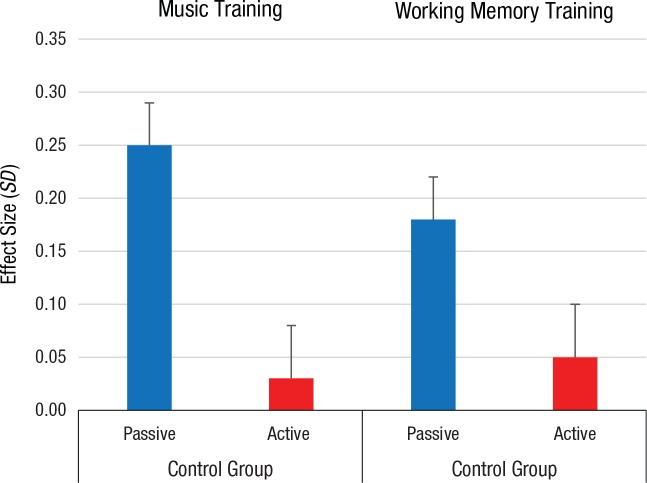
- Effects were inversely related to design quality: with active controls, music training was 0.03 SD [−0.07, 0.12], k = 54, versus 0.25 SD [0.17, 0.34], k = 64, with passive controls; working memory training was 0.05 SD [−0.05, 0.15], k = 40, versus 0.18 SD [−0.09, 0.26], k = 34. Chess had only one active-control study, with a minimal 0.10 SD effect.
- The only exception was robust near-transfer from working memory training to other memory tasks: 0.44 and 0.46 SD when compared with active and passive control groups, respectively.
Methods
- Meta-analyses of experimental studies in typically developing children and young adolescents tested chess and music instruction effects on academic attainment (literacy and mathematics) and cognitive skills, and working memory training effects on academic achievement, fluid intelligence, and cognitive control.
- The article also reviews meta-analytic correlational evidence on chess and music expertise and cognitive ability.
- Effects were pooled as standardized mean differences between treatment and control groups with 95% confidence intervals, comparing passive versus active control groups.
Limitations
- The paper states its conclusions apply at least with typically developing children and young adolescents; chess active-control evidence was limited to one study, and future interventions should include pretests and at least two control groups.
- Evident from the text: meta-analytic estimates depend on the available studies and their design quality, and the correlational evidence cannot establish causation, as the authors themselves note.
Model-written summary. Check it against the paper before relying on it.
Integrity signals
Registry
Cites
Statistics
Figures
Verification
Claims the paper makes
28 Not checked yet · 15 Own interpretation · 3 Own result
In the paper
“when the experimental groups were compared with active control groups—other filler activities to rule out possible placebo effects such as positive expectations about the training (Boot, Simons, Stothart, & Stutts, 2013) and the excitement induced by a novel activity—the overall effect sizes were minimal or null.”
§ Does Far Transfer Exist? Negative Evidence From Chess, Music, and Working Memory Training > Does Far Transfer Occur? Insights From Chess, Music, and WM Training > Experimental studies
What the sources say
- Not checked yetcites Boot et al., 2013
plain- Asserted: passes — The authors put it forward as true.
- Checkable: passes — It can be checked against evidence.
- Load-bearing: passes — The paper’s conclusions depend on it.
- Based: passes — The paper gives a reason why it holds.
In the paper
“the overall effect sizes were 0.25 SD, 95% CI = [0.17, 0.34], k = 64,3 and 0.03 SD, 95% CI = [−0.07, 0.12], k = 54, for the comparisons with passive and active control groups, respectively.”
§ Does Far Transfer Exist? Negative Evidence From Chess, Music, and Working Memory Training > Does Far Transfer Occur? Insights From Chess, Music, and WM Training > Experimental studies
What the sources say
- Not checked yetcites Sala & Gobet, 2017b
plain- Asserted: passes — The authors put it forward as true.
- Checkable: passes — It can be checked against evidence.
- Load-bearing: passes — The paper’s conclusions depend on it.
- Based: passes — The paper gives a reason why it holds.
In the paper
“the overall effect sizes were 0.18 SD, 95% CI = [−0.09, 0.26], k = 34, and 0.05 SD, 95% CI = [−0.05, 0.15], k = 40, for the comparisons with passive and active control groups, respectively”
§ Does Far Transfer Exist? Negative Evidence From Chess, Music, and Working Memory Training > Does Far Transfer Occur? Insights From Chess, Music, and WM Training > Experimental studies
What the sources say
- Not checked yetcites Sala & Gobet, 2017c
plain- Asserted: passes — The authors put it forward as true.
- Checkable: passes — It can be checked against evidence.
- Load-bearing: passes — The paper’s conclusions depend on it.
- Based: passes — The paper gives a reason why it holds.
In the paper
“Chess | 0.34 [0.24, 0.44]”
§ Does Far Transfer Exist? Negative Evidence From Chess, Music, and Working Memory Training > Does Far Transfer Occur? Insights From Chess, Music, and WM Training > Experimental studies
What the sources say
- Not checked yetcites Sala & Gobet, 2016, 2017b
plaindirect- Asserted: passes — The authors put it forward as true.
- Checkable: passes — It can be checked against evidence.
- Load-bearing: passes — The paper’s conclusions depend on it.
- Based: passes — The paper gives a reason why it holds.
A result the paper reports from its own data — it cites no other source for it, so there is none to check. The quote shows it is in the paper.
In the paper
“The size of the effects was inversely related to the quality of the experimental design.”
§ Does Far Transfer Exist? Negative Evidence From Chess, Music, and Working Memory Training > Does Far Transfer Occur? Insights From Chess, Music, and WM Training > Experimental studies
plaincorrelational- Asserted: passes — The authors put it forward as true.
- Checkable: passes — It can be checked against evidence.
- Load-bearing: passes — The paper’s conclusions depend on it.
- Based: passes — The paper gives a reason why it holds.
In the paper
“the overall effect sizes were 0.25 SD, 95% CI = [0.17, 0.34], k = 64,3 and 0.03 SD, 95% CI = [−0.07, 0.12], k = 54, for the comparisons with passive and active control groups, respectively.”
§ Does Far Transfer Exist? Negative Evidence From Chess, Music, and Working Memory Training > Does Far Transfer Occur? Insights From Chess, Music, and WM Training > Experimental studies
What the sources say
- Not checked yetcites Sala & Gobet, 2017b
plain- Asserted: passes — The authors put it forward as true.
- Checkable: passes — It can be checked against evidence.
- Load-bearing: passes — The paper’s conclusions depend on it.
- Based: passes — The paper gives a reason why it holds.
None of the sources cited for this claim have been checked yet.
In the paper
“The results showed small to moderate overall effect sizes—that is, the overall quantitative measure of the effectiveness of the training—in all three meta-analyses (Table 1).”
- Also stated in: § Abstract · plain
“The results show small to moderate effects.”
§ Does Far Transfer Exist? Negative Evidence From Chess, Music, and Working Memory Training > Does Far Transfer Occur? Insights From Chess, Music, and WM Training > Experimental studies
What the sources say
- Not checked yetcites Sala & Gobet, 2016, 2017b
- Not checked yetcites Sala & Gobet, 2017c
plain- Asserted: passes — The authors put it forward as true.
- Checkable: passes — It can be checked against evidence.
- Load-bearing: passes — The paper’s conclusions depend on it.
- Based: passes — The paper gives a reason why it holds.
- Also stated in: § Abstract · plain
In the paper
“Working memory | 0.12 [0.06, 0.18]”
§ Does Far Transfer Exist? Negative Evidence From Chess, Music, and Working Memory Training > Does Far Transfer Occur? Insights From Chess, Music, and WM Training > Experimental studies
What the sources say
- Not checked yetcites Sala & Gobet, 2017c
plain- Asserted: passes — The authors put it forward as true.
- Checkable: passes — It can be checked against evidence.
- Load-bearing: passes — The paper’s conclusions depend on it.
- Based: passes — The paper gives a reason why it holds.
In the paper
“the overall effect sizes were 0.18 SD, 95% CI = [−0.09, 0.26], k = 34, and 0.05 SD, 95% CI = [−0.05, 0.15], k = 40, for the comparisons with passive and active control groups, respectively”
§ Does Far Transfer Exist? Negative Evidence From Chess, Music, and Working Memory Training > Does Far Transfer Occur? Insights From Chess, Music, and WM Training > Experimental studies
What the sources say
- Not checked yetcites Sala & Gobet, 2017c
plain- Asserted: passes — The authors put it forward as true.
- Checkable: passes — It can be checked against evidence.
- Load-bearing: passes — The paper’s conclusions depend on it.
- Based: passes — The paper gives a reason why it holds.
A result the paper reports from its own data — it cites no other source for it, so there is none to check. The quote shows it is in the paper.
In the paper
“The only exception to this pattern was the robust near-transfer effect that WM training exerted on other memory tasks (0.44 and 0.46 SD when the treated groups were compared with active and passive control groups, respectively).”
§ Does Far Transfer Exist? Negative Evidence From Chess, Music, and Working Memory Training > Does Far Transfer Occur? Insights From Chess, Music, and WM Training > Experimental studies
boosteddirect- Asserted: passes — The authors put it forward as true.
- Checkable: passes — It can be checked against evidence.
- Load-bearing: passes — The paper’s conclusions depend on it.
- Based: passes — The paper gives a reason why it holds.
- It may state two separate claims as one. 10
- Probably not a substantial claim. 6
A result the paper reports from its own data — it cites no other source for it, so there is none to check. The quote shows it is in the paper.
In the paper
“the chess interventions included only one study with an active control group (with minimal effects: 0.10 SD).”
§ Does Far Transfer Exist? Negative Evidence From Chess, Music, and Working Memory Training > Does Far Transfer Occur? Insights From Chess, Music, and WM Training > Experimental studies
plainSingle case- Asserted: passes — The authors put it forward as true.
- Checkable: passes — It can be checked against evidence.
- Load-bearing: passes — The paper’s conclusions depend on it.
- Based: passes — The paper gives a reason why it holds.
It may state two separate claims as one.
In the paper
“we found that chess players’ overall cognitive ability was superior to that of non-chess players by half a standard deviation, a moderately large effect.”
§ Does Far Transfer Exist? Negative Evidence From Chess, Music, and Working Memory Training > Does Far Transfer Occur? Insights From Chess, Music, and WM Training > Comparison and correlational studies
What the sources say
- Not checked yetcites Sala et al., 2017
plaincorrelational- Asserted: passes — The authors put it forward as true.
- Checkable: passes — It can be checked against evidence.
- Load-bearing: unclear — It is unclear whether the paper’s conclusions depend on it.
- Based: passes — The paper gives a reason why it holds.
It may state two separate claims as one.
In the paper
“This outcome is in line with Thorndike and Woodworth’s (1901) common-elements theory.”
§ Does Far Transfer Exist? Negative Evidence From Chess, Music, and Working Memory Training > Does Far Transfer Occur? Insights From Chess, Music, and WM Training > Research in other domains
What the sources say
- Not checked yetcites Thorndike and Woodworth (1901)
plaincorrelational- Asserted: passes — The authors put it forward as true.
- Checkable: passes — It can be checked against evidence.
- Load-bearing: fails — The paper’s conclusions may not depend on it.
- Based: passes — The paper gives a reason why it holds.
Probably not a substantial claim. The paper’s conclusions may not depend on it.
In the paper
“Jaeggi, Buschkuehl, Jonides, and Perrig (2008), which presented an experiment in which participants who received training on a WM task showed an improvement on a fluid intelligence test (Raven’s Matrices).”
§ Does Far Transfer Exist? Negative Evidence From Chess, Music, and Working Memory Training > Does Far Transfer Occur? Insights From Chess, Music, and WM Training > The hypothesis underlying the potential occurrence of far transfer
What the sources say
- Not checked yetcites Jaeggi et al., 2008
plaindirect- Asserted: passes — The authors put it forward as true.
- Checkable: passes — It can be checked against evidence.
- Load-bearing: passes — The paper’s conclusions depend on it.
- Based: passes — The paper gives a reason why it holds.
Probably not a substantial claim.
None of the sources cited for this claim have been checked yet.
In the paper
“Lee, Lu, and Ko (2007) and Schellenberg (2006) found positive correlations between music skill, WM, and IQ.”
§ Does Far Transfer Exist? Negative Evidence From Chess, Music, and Working Memory Training > Does Far Transfer Occur? Insights From Chess, Music, and WM Training > Comparison and correlational studies
What the sources say
- Not checked yetcites Lee et al., 2007
- Not checked yetcites Schellenberg, 2006
plaincorrelational- Asserted: passes — The authors put it forward as true.
- Checkable: passes — It can be checked against evidence.
- Load-bearing: unclear — It is unclear whether the paper’s conclusions depend on it.
- Based: passes — The paper gives a reason why it holds.
It may state two separate claims as one.
A conclusion the paper draws from its own results — it cites no other source for it, so there is none to check. The quote shows it is in the paper.
In the paper
“cognitive ability (e.g., WM or general intelligence) is a predictor of chess skill and music skill, among many others”
§ Does Far Transfer Exist? Negative Evidence From Chess, Music, and Working Memory Training > Theoretical and Practical Implications
plaincorrelational- Asserted: passes — The authors put it forward as true.
- Checkable: passes — It can be checked against evidence.
- Load-bearing: passes — The paper’s conclusions depend on it.
- Based: passes — The paper gives a reason why it holds.
It may state two separate claims as one.
In the paper
“Like WM training, such programs have been proven to enhance participants’ performance on the task they train and, at best, some other similar tasks.”
§ Does Far Transfer Exist? Negative Evidence From Chess, Music, and Working Memory Training > Does Far Transfer Occur? Insights From Chess, Music, and WM Training > Research in other domains
What the sources say
- Not checked yetcites Simons et al., 2016
boosteddirect- Asserted: passes — The authors put it forward as true.
- Checkable: passes — It can be checked against evidence.
- Load-bearing: passes — The paper’s conclusions depend on it.
- Based: passes — The paper gives a reason why it holds.
It may state two separate claims as one.
In the paper
“Considering that spatial ability predicts attainment in mathematics (Wai, Lubinski, & Benbow, 2009)”
§ Does Far Transfer Exist? Negative Evidence From Chess, Music, and Working Memory Training > Does Far Transfer Occur? Insights From Chess, Music, and WM Training > Research in other domains
What the sources say
- Not checked yetcites Wai et al., 2009
plaincorrelational- Asserted: passes — The authors put it forward as true.
- Checkable: passes — It can be checked against evidence.
- Load-bearing: passes — The paper’s conclusions depend on it.
- Based: passes — The paper gives a reason why it holds.
Probably not a substantial claim.
A conclusion the paper draws from its own results — it cites no other source for it, so there is none to check. The quote shows it is in the paper.
In the paper
“An alternative explanation is that people with superior cognitive ability are more likely to engage and excel in chess and music.”
- Also stated in: § Conclusions and Future Directions · hedged
“Rather, smarter individuals are more likely to engage and excel in these fields.”
§ Does Far Transfer Exist? Negative Evidence From Chess, Music, and Working Memory Training > Does Far Transfer Occur? Insights From Chess, Music, and WM Training > The hypothesis underlying the potential occurrence of far transfer
hedgedcorrelational- Asserted: passes — The authors put it forward as true.
- Checkable: passes — It can be checked against evidence.
- Load-bearing: passes — The paper’s conclusions depend on it.
- Based: passes — The paper gives a reason why it holds.
It may state two separate claims as one.
- Also stated in: § Conclusions and Future Directions · hedged
In the paper
“In their systematic review, Simons et al. (2016) observe that no convincing evidence has been provided so far about the alleged generalized benefits of brain-training programs.”
§ Does Far Transfer Exist? Negative Evidence From Chess, Music, and Working Memory Training > Does Far Transfer Occur? Insights From Chess, Music, and WM Training > Research in other domains
What the sources say
- Not checked yetcites Simons et al., 2016
plain- Asserted: passes — The authors put it forward as true.
- Checkable: passes — It can be checked against evidence.
- Load-bearing: fails — The paper’s conclusions may not depend on it.
- Based: passes — The paper gives a reason why it holds.
Probably not a substantial claim. The paper’s conclusions may not depend on it.
In the paper
“Spatial ability has been found to be malleable by spatial training (Uttal et al., 2013).”
§ Does Far Transfer Exist? Negative Evidence From Chess, Music, and Working Memory Training > Does Far Transfer Occur? Insights From Chess, Music, and WM Training > Research in other domains
What the sources say
- Not checked yetcites Uttal et al., 2013
plaindirect- Asserted: passes — The authors put it forward as true.
- Checkable: passes — It can be checked against evidence.
- Load-bearing: fails — The paper’s conclusions may not depend on it.
- Based: passes — The paper gives a reason why it holds.
Probably not a substantial claim. The paper’s conclusions may not depend on it.
In the paper
“The second meta-analysis (Burgoyne et al., 2016) reported statistically significant correlations between chess skill and four broad measures of cognitive ability”
§ Does Far Transfer Exist? Negative Evidence From Chess, Music, and Working Memory Training > Does Far Transfer Occur? Insights From Chess, Music, and WM Training > Comparison and correlational studies
What the sources say
- Not checked yetcites Burgoyne et al., 2016
plaincorrelational- Asserted: passes — The authors put it forward as true.
- Checkable: passes — It can be checked against evidence.
- Load-bearing: unclear — It is unclear whether the paper’s conclusions depend on it.
- Based: passes — The paper gives a reason why it holds.
It may state two separate claims as one.
A conclusion the paper draws from its own results — it cites no other source for it, so there is none to check. The quote shows it is in the paper.
In the paper
“Although cognitive ability correlates with domain-specific skills—for example, smarter people are more likely to be stronger chess players and better musicians—there is little evidence that chess or music instruction makes people smarter.”
§ Does Far Transfer Exist? Negative Evidence From Chess, Music, and Working Memory Training > Conclusions and Future Directions
plain- Asserted: passes — The authors put it forward as true.
- Checkable: passes — It can be checked against evidence.
- Load-bearing: passes — The paper’s conclusions depend on it.
- Based: passes — The paper gives a reason why it holds.
It may state two separate claims as one.
A conclusion the paper draws from its own results — it cites no other source for it, so there is none to check. The quote shows it is in the paper.
In the paper
“If skills rarely generalize across different domains, then the most effective way to acquire a skill is to train that particular skill.”
§ Does Far Transfer Exist? Negative Evidence From Chess, Music, and Working Memory Training > Theoretical and Practical Implications
plaindirect- Asserted: passes — The authors put it forward as true.
- Checkable: fails — It may be too vague to check against evidence.
- Load-bearing: passes — The paper’s conclusions depend on it.
- Based: passes — The paper gives a reason why it holds.
Probably not a substantial claim. It may be too vague to check against evidence. It may state two separate claims as one.
None of the sources cited for this claim have been checked yet.
In the paper
“The occurrence of specific neural patterns (anatomical and functional) and absence of far-transfer effects on cognitive tests have been reported in domains such as music (e.g., Tierney, Krizman, & Kraus, 2015), chess (e.g., Hänggi, Brütsch, Siegel, & Jäncke, 2014), and video game training (e.g., Colom et al., 2012).”
§ Does Far Transfer Exist? Negative Evidence From Chess, Music, and Working Memory Training > Theoretical and Practical Implications
What the sources say
- Not checked yetcites Tierney, Krizman, & Kraus, 2015
- Not checked yetcites Hänggi, Brütsch, Siegel, & Jäncke, 2014
- Not checked yetcites Colom et al., 2012
plain- Asserted: passes — The authors put it forward as true.
- Checkable: passes — It can be checked against evidence.
- Load-bearing: passes — The paper’s conclusions depend on it.
- Based: passes — The paper gives a reason why it holds.
It may state two separate claims as one.
Claims other papers make about this one
Each is checked against this paper’s own text: does it say what the citing paper says it does?
The source backs part of the claim, not all of it — or backs it for a different population, condition or comparison.
In the citing paper
“Nevertheless, there is an increasing recognition that while domain-specific skills are eminently teachable, purely generic-cognitive skills are not teachable and attempts to teach them lead to dead-ends (Sala and Gobet 2017).”
From Cognitive Architecture and Instructional Design: 20 Years Later (2019) · cites this paper as Sala and Gobet 2017
Experimental — accuracy not yet measuredThe cited source says what the claim attributes to it.
In the citing paper
“The data summarised by Sala and Gobet (2017) provide a major justification for the post 1998 inclusion of evolutionary psychology into cognitive load theory.”
From Cognitive Architecture and Instructional Design: 20 Years Later (2019) · cites this paper as Sala and Gobet (2017)
The cited source says what the claim attributes to it.
In the citing paper
“Such findings are essential for this area to remain viable but there is little evidence of such results from any area (Sala and Gobet 2017).”
From Cognitive Architecture and Instructional Design: 20 Years Later (2019) · cites this paper as Sala and Gobet 2017
Self-check
Percentages, sums and reported differences re-computed from the paper’s own numbers.
Rated minor: it would not touch a result — a value no result rests on, a p-value that stays on the same side of the significance level, or a conflict that is clerical, resolved elsewhere in the paper, or outside its own findings.
In the paper
“the overall effect sizes were 0.18 SD, 95% CI = [−0.09, 0.26], k = 34”
§ Does Far Transfer Exist? Negative Evidence From Chess, Music, and Working Memory Training > Does Far Transfer Occur? Insights From Chess, Music, and WM Training > Experimental studies
Reported 0.18 · recomputed 0.085
Citations
Cites
Statistical Power Analysis for the Behavioral Sciences
Muller, K. E., & Cohen, J. (1989) · Technometrics · doi:10.2307/1270020 · Cited by 99,603
Statistical power analysis for the behavioral sciences
Cohen, J. (1990) · Computers Environment and Urban Systems · doi:10.1016/0198-9715(90)90050-4 · Cited by 65,417
Chase, W. G., & Simon, H. A. (1973) · Cognitive Psychology · doi:10.1016/0010-0285(73)90004-2 · Cited by 4,479
The malleability of spatial skills: A meta-analysis of training studies.
Uttal, D. H., Meadow, N. G., Tipton, E., Hand, L. L., Alden, A. R., Warren, C. M., & Newcombe, N. S. (2012) · Psychological Bulletin · doi:10.1037/a0028446 · Cited by 2,188 · cited 1×
“Spatial ability has been found to be malleable by spatial training (Uttal et al., 2013).”
BackgroundImproving fluid intelligence with training on working memory
Jaeggi, S. M., Buschkuehl, M., Jonides, J., & Perrig, W. J. (2008) · Proceedings of the National Academy of Sciences · doi:10.1073/pnas.0801268105 · Cited by 2,187
Validity and utility of alternative predictors of job performance.
Hunter, J. E., & Hunter, R. F. (1984) · Psychological Bulletin · doi:10.1037/0033-2909.96.1.72 · Cited by 2,107 · cited 1×
“Importantly, domain-general cognitive abilities (e.g., intelligence, processing speed, and working memory [WM]) are reliable predictors of success for outcomes such as academic achievement (Deary, Strand, Smith, & Fernandes, 2007) and job proficiency (Hunter & Hunter, 1984).”
BackgroundWai, J., Lubinski, D., & Benbow, C. P. (2009) · Journal of Educational Psychology · doi:10.1037/a0016127 · Cited by 2,004
Intelligence and educational achievement
Deary, I. J., Strand, S., Smith, P., & Fernandes, C. (2007) · Intelligence · doi:10.1016/j.intell.2006.02.001 · Cited by 1,723 · cited 2×
“Because of its high specificity, such information is hardly transferable to other fields, as predicted by chunking theory (Chase & Simon, 1973) and template theory (i.e., an extension of chunking theory; Gobet, 2016; Gobet & Simon, 1996).”
BackgroundThe influence of improvement in one mental function upon the efficiency of other functions. (I).
Woodworth, R. S., & Thorndike, E. L. (1901) · Psychological Review · doi:10.1037/h0074898 · Cited by 1,223 · cited 2×
“In a seminal article, Thorndike and Woodworth (1901) proposed their common-elements theory according to which transfer is a function of the extent to which two domains share common features.”
BackgroundDo “brain-training” programs work?
Simons, D. J., Boot, W. R., Charness, N., Gathercole, S. E., Chabris, C. F., Hambrick, D. Z., & Stine-Morrow, E. A. L. (2016) · Psychological Science in the Public Interest · doi:10.1177/1529100616661983 · Cited by 1,183
Research works printed but not linked: 1
- 10.1037/a0027473 · DOI · Paper page
Cited by
Sorted by citations
Items 201–300 of 309
Molhoek, B. (2021) · HTS Teologiese Studies / Theological Studies · doi:10.4102/hts.v77i3.6728 · Cited by 2
Training flexible spatial-cognitive estimation strategies using augmented reality
Matalenas, L. A., & McLaughlin, A. C. (2024) · Ergonomics · doi:10.1080/00140139.2024.2332768 · Cited by 2
“Further, there can be differences in near transfer, or generalisability of the skill to situations with high overlap of cues, and far transfer, when the concept remains the same, but the cues and domains are dissimilar (sala and Gobet 2017).”
Lavenex, P. B., Blandin, M.-L., Gaborieau, C., & Lavenex, P. (2024) · Frontiers in Rehabilitation Sciences · doi:10.3389/fresc.2024.1377133 · Cited by 4
Neurobiological Aging and Memory
Nyberg, L. H., Walhovd, K. B., & Fjell, A. M. (2024) · Oxford University Press eBooks · doi:10.1093/oxfordhb/9780190917982.013.56 · Cited by 3
Speech Perception in Noise and Cognitive Skills in Children With Varying Degrees of Music Training
Castleberry, K., Amato, A., & Benítez-Barrera, C. R. (2025) · Journal of Speech Language and Hearing Research · doi:10.1044/2024_jslhr-24-00370 · Cited by 3
Intervention Targeting Reading and Working Memory among Struggling Readers in Primary School
Fälth, L., & Brković, I. (2021) · Medical Research Archives · doi:10.18103/mra.v9i11.2610 · Cited by 6
“Also, as transfer effects between WM training and increased reading ability [56] as well as other cognitive abilities are difficult to study, future studies will need more explicit clarifications of the specific mechanisms that generate training gains.”
Background7. Executive Functioning and Self-Regulation
Hallam, S., & Himonides, E. (2022) · Open Book Publishers · doi:10.11647/obp.0292.07 · Cited by 2
Mutual interference in working memory updating: A hierarchical Bayesian model
Chen, Y., Peruggia, M., & Zandt, T. V. (2022) · Journal of Mathematical Psychology · doi:10.1016/j.jmp.2022.102706 · Cited by 2
Investigating object orientation effects across 18 languages
Chen, S.-C., Buchanan, E. M., Kekecs, Z., Miller, J. K., Szabelska, A., Aczél, B., Bernabeu, P., Forscher, P. S., Szuts, A., Vally, Z., et al. (2025) · Current Psychology · doi:10.1007/s12144-025-08304-x · Cited by 2
Editorial: The effects of music on cognition and action, volume II
Delogu, F., Brunetti, R., Jang, C., & Belardinelli, M. O. (2025) · Frontiers in Human Neuroscience · doi:10.3389/fnhum.2025.1557542 · Cited by 2
“…matter of debate whether the “transfer effects” of music on non-musical domains can be far reaching, with generalization of music skills to significantly different domains (Bigand and Tillmann, 2022) or just near-reaching cognitive functions closely related to music processing (Sala and Gobet, 2017).”
4. Literacy and Related Language Skills
Hallam, S., & Himonides, E. (2022) · Open Book Publishers · doi:10.11647/obp.0292.04 · Cited by 1
12. Re-Engagement and Motivation
Hallam, S., & Himonides, E. (2022) · Open Book Publishers · doi:10.11647/obp.0292.12 · Cited by 1
Seville, J. G., & Jr. Guhao Eugenio, S. (2023) · International Journal of Research Studies in Education · doi:10.5861/ijrse.2023.50 · Cited by 1
Validación de un modelo de enseñanza musical para la educación en general
Porflitt, F., Jeldres, R., & Saavedra, A. K. B. (2024) · European Public & Social Innovation Review · doi:10.31637/epsir-2024-1050 · Cited by 1
Updates on Working Memory Training in Deaf Children with Cochlear Implants
Kronenberger, W. G., & Pisoni, D. B. (2024) · Springer eBooks · doi:10.1007/978-3-031-67188-3_23 · Cited by 1
Akın, A., Alkan, S., Sezgin, H. S., & Güzeller, C. O. (2025) · Behaviour and Information Technology · doi:10.1080/0144929x.2025.2545315 · Cited by 1
“The findings also expanded the transfer of training research by showing evidence of far transfer from gaming settings to spatial cognitive skills (Sala and Gobet 2017).”
Cognitive reappraisal of food craving: Generalization and best implementation strategies
Saad, M., & Weinbach, N. (2025) · Appetite · doi:10.1016/j.appet.2025.108374 · Cited by 1
Gardiner, G., & van der Laan, L. (2025) · Improving Schools · doi:10.1177/13654802251362988 · Cited by 1
“Apart from a few notable studies, this research is criticised for lacking methodological rigour and definitional clarity (Jerrim et al., 2016; Sala & Gobet, 2017a).”
Gao, Y., Fang, P., Xing, W., Zeng, L., Wang, H., Zhu, X., & Wang, X. (2025) · Brain Research Bulletin · doi:10.1016/j.brainresbull.2025.111646 · Cited by 2
Music and Cognitive Development
Degé, F., Frischen, U., & Schwarzer, G. (2025) · Neurocultural health and wellbeing · doi:10.1007/978-3-662-72175-9_25 · Cited by 1
Trujillo-Trujillo, C. C., Ruíz, N. C., & Sanabria‐Mazo, J. P. (2026) · Child Neuropsychology · doi:10.1080/09297049.2025.2595075 · Cited by 3
“Narrative reviews, systematic reviews, and meta-analyses (Sala & Gobet, 2017; Scionti et al., 2020; Takacs & Kassai, 2019), as well as gray literature identified via Google Scholar, were also cross-referenced to ensure the inclusion of all relevant studies.”
Heath, K. L. (2026) · Frontiers in Cognition · doi:10.3389/fcogn.2025.1689600 · Cited by 1
“…and Hitch, 1974; George and Coch, 2011; Schulze and Koelsch, 2012 of different brain areas simultaneously (Lee et al., 2007; Olivers and Eimer, 2010; Sala and Gobet, 2017; Schulze and Koelsch, 2012; Silverman, 2010; Ye¸sil and Nal, 2017; Yurgil et al., 2020), research suggests that performing…”
How is musical expertise related to executive functions? A systematic review and meta-analysis
Aryanto, C. B., Aisyah, A. R. K., Timmers, R., Blakey, E., & von Bastian, C. C. (2026) · Psychonomic Bulletin & Review · doi:10.3758/s13423-025-02769-4 · Cited by 2
“However, like many interventions aimed at boosting cognition (see von Bastian et al., 2022), the effectiveness of musical training interventions is highly contentious (Sala & Gobet, 2017b, 2020; for a review, see Schellenberg & Lima, 2024).”
Lizcano-Cortés, F., Ripollés, P., Barrios, F. A., & Assaneo, M. F. (2026) · Communications Psychology · doi:10.1038/s44271-026-00444-5 · Cited by 4
Gonçalves, A. D. O., Marques, C. L. B., Destro, G., & de Morais, E. A. (2021) · Research Society and Development · doi:10.33448/rsd-v10i1.11965 · Cited by 1
Divergent Perspectives on Musical Knowledge, Expertise, and Science
Trehub, S. E. (2020) · Evolutionary Studies in Imaginative Culture · doi:10.26613/esic.4.2.194 · Cited by 3
Yeganeh, N. M., King, R., Boyd, L. A., Rose, G. M., & Weber, R. C. (2021) · Applied Neuropsychology Child · doi:10.1080/21622965.2021.1967154 · Cited by 2
“…such as enhanced language skills and a reduction in achievement gaps (Wang et al., 2019), others have concluded that training in EF generally does not appear to transfer to other skills and lead to other improvements in cognitive or academic functioning (Diamond & Ling, 2016; Sala & Gobet, 2017).”
BackgroundStambaugh, L. A., & Bryan, C. J. (2021) · Update Applications of Research in Music Education · doi:10.1177/87551233211049427 · Cited by 1
“Researchers from a variety of fields are interested in how working memory capacity may affect the ability to do tasks requiring attention (Sala & Gobet, 2017; Seidler et al., 2012).”
Background5. Music, Spatial Reasoning and Mathematical Performance
Hallam, S., & Himonides, E. (2022) · Open Book Publishers · doi:10.11647/obp.0292.05 · Cited by 1
16. Music, Inclusion and Social Cohesion
Hallam, S., & Himonides, E. (2022) · Open Book Publishers · doi:10.11647/obp.0292.16 · Cited by 1
Bingjie, Z. H. A. O., ZHANG, Q., Yixin, C. H. E. N., ZHANG, P., & Xuejun, B. A. I. (2022) · Advances in Psychological Science · doi:10.3724/sp.j.1042.2022.01993 · Cited by 1
The development of concept and theoretical models of “chunking” in working memory
Chen, Y., Rui, C. H. E. N., & Li, P. (2022) · Advances in Psychological Science · doi:10.3724/sp.j.1042.2022.02708 · Cited by 2
“00 16 5v 1 原因在于专家可以运用更加丰富的经验形成更多的棋子组合(Sala & Gobet, 2017)。这表明对 信息进行组块存储可以提高个体加工的效率。另外,在认知心理学研究中,组块程度成为衡 量个体加工复杂任务时的工作记忆能力标准之一(Sala et al., 2017)。 2 组块定义及其演化 James…”
Music Training, Dance Training, and Multitasking
Wiseheart, M. (2022) · Springer eBooks · doi:10.1007/978-3-031-04760-2_12 · Cited by 1
Investigating acoustic numerosity illusions in professional musicians
Pecunioso, A., Spoto, A., & Agrillo, C. (2024) · Psychonomic Bulletin & Review · doi:10.3758/s13423-024-02496-2 · Cited by 1
Sigmundsson, H., & Elnes, M. (2024) · SpringerBriefs in psychology · doi:10.1007/978-3-031-66910-1_4 · Cited by 1
Melegrito, C. K. L., Baclig, K. G., Balantac, K. M., Guzman, D. A., Vidal, K. K., Peña, L. V. C. D., & Dapiawen, K. J. (2025) · Psychology and Education A Multidisciplinary Journal · doi:10.70838/pemj.350604 · Cited by 2
Wolf, D., Schneider, S., & Schütz, A. (2020) · Otto-Friedrich-Universität eBooks · doi:10.20378/irb-48863 · Cited by 2
Strobach, T., & Karbach, J. (2020) · Springer eBooks · doi:10.1007/978-3-030-39292-5_1 · Cited by 2
The development of visual search behaviours in immersive virtual realityPreprint
Harris, D., Hardcastle, K. J., Wilson, M., & Vine, S. J. (2020) · doi:10.31234/osf.io/zue2q · Cited by 1
Mayer, R. E., & Fiorella, L. (2021) · Cambridge University Press eBooks · doi:10.1017/9781108894333.007 · Cited by 3
The Generality of Educational Effects on Cognitive Ability: A ReplicationPreprint
Lasker, J., & Kirkegaard, E. O. W. (2022) · doi:10.31234/osf.io/8s2vx · Cited by 1
Working memory training does not improve executive functioning or fluid intelligencePreprint
Rodas, J. A., & Greene, C. M. (2020) · PsyArXiv (OSF Preprints) · doi:10.31234/osf.io/8nh35 · Cited by 1
Art Knowledge Training Shapes Understanding, Inspires Creativity and Stimulates ThinkingPreprint
Bara, I., Ramsey, R., & Cross, E. S. (2024) · SSRN Electronic Journal · doi:10.2139/ssrn.4693410 · Cited by 1
Zheng, L. J., Boogaart, Z., McAvan, A. S., Garren, J. D., Doner, S., Wilkes, B. J., Groves, W., Yuksel, E., Cherep, L. A., Ekstrom, A. D., et al. (2025) · eLife · doi:10.7554/elife.106873.1 · Cited by 1
A Board Game Designing of Serious Mini Game in Complementary Colors
Yu, Y.-L., & Wu, T. (2018) · Lecture notes in computer science · doi:10.1007/978-3-319-99737-7_51
Houdeib, R. (2018) · Spectrum Research Repository (Concordia University)
Compensatory and Rehabilitative Cognitive Training Improves Executive Functions and Metacognition
Husseini, Z., Nejati, V., & Habibi, M. (2019) · Iranian Journal of Educational Sociology · doi:10.29252/ijes.2.3.175
Rindlisbacher, B. (2021) · Waxmann Verlag GmbH eBooks · doi:10.31244/9783830994244
Bilyk, V., Гіренко, С. П., Dzhahupov, H. V., Мілорадова, Н., & Dotsenko, V. V. (2022) · BRAIN BROAD RESEARCH IN ARTIFICIAL INTELLIGENCE AND NEUROSCIENCE · doi:10.18662/brain/13.1/271
Advances in Cognitive Enhancement Techniques to Improve Fluid Intelligence
林, 逸. (2022) · Advances in Social Sciences · doi:10.12677/ass.2022.113117
Gobet, F. R. (2020) · The Encyclopedia of Child and Adolescent Development · doi:10.1002/9781119171492.wecad297
Self-citationHallam, S., & Himonides, E. (2022) · Open Book Publishers · doi:10.11647/obp.0292.17
15. Music and Physical and Mental Health
Hallam, S., & Himonides, E. (2022) · Open Book Publishers · doi:10.11647/obp.0292.15
13. Personal, Social and Physical Development
Hallam, S., & Himonides, E. (2022) · Open Book Publishers · doi:10.11647/obp.0292.13
6. The Impact of Musical Engagement on Memory
Hallam, S., & Himonides, E. (2022) · Open Book Publishers · doi:10.11647/obp.0292.06
Hallam, S., & Himonides, E. (2022) · Open Book Publishers · doi:10.11647/obp.0292.09
Hallam, S., & Himonides, E. (2022) · Open Book Publishers · doi:10.11647/obp.0292.11
Hallam, S., & Himonides, E. (2022) · Open Book Publishers · doi:10.11647/obp.0292.10
Hallam, S., & Himonides, E. (2022) · Open Book Publishers · doi:10.11647/obp.0292.02
Reflections on an Exploration of the Evidence for the Power of Music
Hallam, S., & Himonides, E. (2022) · Open Book Publishers · doi:10.11647/obp.0292.18 · Cited by 1
3. Aural Perception and Language Skills
Hallam, S., & Himonides, E. (2022) · Open Book Publishers · doi:10.11647/obp.0292.03
Hallam, S., & Himonides, E. (2022) · Open Book Publishers · doi:10.11647/obp.0292.01
Gupta, S., Sengupta, S., & Dey, S. (2022) · SSRN Electronic Journal · doi:10.2139/ssrn.4143029
The 35th Cognitive Psychology Section Annual Conference
Gobet, F. R. (2019) · The Cognitive Psychology Bulletin · doi:10.53841/bpscog.2019.1.4.4
Self-citationL’acquisition de l’expertise ou l’abandon progressif du renforcement des processus génériques
Froger, G., Blättler, C., & Bonnardel, N. (2023) · Psychologie Française · doi:10.1016/j.psfr.2023.02.002
Intervenção em compreensão de leitura e funções executivas
Corso, H. V., de Assis, É. F., Lopes-Silva, J. B., & Piccolo, L. D. R. (2023) · ETD - Educação Temática Digital · doi:10.20396/etd.v25i00.8667022
Art Knowledge Training Shapes Understanding, Inspires Creativity and Stimulates ThinkingPreprint
Bara, I., Ramsey, R., & Cross, E. S. (2024) · doi:10.31234/osf.io/sxqgc
Victims of Outcomes: Towards an Enactivist Model of Technological Literacy
Cheville, A., & Heywood, J. S. (2024) · ASEE Annual Conference & Exposition · doi:10.18260/1-2--41624
Xiaoqiang, T. (2024) · Journal of Humanities and Social Sciences Studies · doi:10.32996/jhsss.2024.6.5.13
“"Passion" is typically defined as a strong desire or enthusiasm(Sala & Gobet, 2017).”
BackgroundMusikunterricht und kognitive Entwicklung
Degé, F., Frischen, U., & Schwarzer, G. (2024) · Springer eBooks · doi:10.1007/978-3-662-67506-9_27
Sigmundsson, H. (2024) · SpringerBriefs in psychology · doi:10.1007/978-3-031-61645-7_2
Acción docente para educadores físico-deportivos. Manual teórico basado en la evidencia
Abós, Á., Diloy-Peña, S., García-Cazorla, J., Mayo-Rota, C., & García‐González, L. (2024) · Universidad de Zaragoza eBooks · doi:10.26754/uz.978-84-10169-25-8 · Cited by 3
To Play or Not to Play: An Investigation Into The Effect of Video Game Use on Executive Functions
Hipkiss, S. R. D. (2024) · Cronfa (Swansea University) · doi:10.23889/suthesis.66918
The effects of Jetpul mind game on attention deficit and hyperactivity
Bi̇çer, M., & Çeti̇n, B. (2024) · Current Psychology · doi:10.1007/s12144-024-06808-6
“Chess is recognised as a sport that strengthens mental processes such as attention, memory, creativity, and reasoning, beyond being an entertaining activity (Sala & Gobet, 2017 ).”
Commentary: The Popcorn Effect
Ross, W. (2025) · Journal of Trial and Error · doi:10.36850/8ca0-4ae4
The relationship between visuospatial and analogical reasoning
Corral, D., & Burte, H. (2025) · Quarterly Journal of Experimental Psychology · doi:10.1177/17470218251327076
“…on the transfer of skills, which shows that skill transfer (as in Experiments 2 and 4b) is fairly challenging (Gobet, 2016; Gobet & Sala, 2023; Sala & Gobet, 2017, 2019; Simon & Chase, 1973) and such effects often require strong manipulations to emerge, which often occur over an extended…”
Music learning and skill development: a replication study of Hille and Schupp (2015)
Feldhaus, M., Koehler, F., Schurig, E., Saarikallio, S. H., & Kreutz, G. (2025) · Educational Psychology · doi:10.1080/01443410.2025.2477181
“The complex nature of the relationship between ML and cognitive skills, academic achievement and personality may have contributed to previous inconsistent findings (e.g., Bigand & Tillmann, 2022; Sala & Gobet, 2017, 2020).”
Musicians are faster to process hierarchical Navon letters
Pomini, E., Pecunioso, A., & Agrillo, C. (2025) · Psychology of Music · doi:10.1177/03057356251320975
“Recent meta-analyses have also argued against any potential association between music training and enhanced or different perceptual/cognitive skills, which may add some complexity to the interpretation of our findings (Sala & Gobet, 2017a, 2017b, 2020).”
Fard, M. H., Petrova, K., Kasabov, N. K., & Wang, G. (2025) · Big Data and Cognitive Computing · doi:10.3390/bdcc9070173
A Case-Controlled Study of the Mental Health of Chess Playing Indians
Gupta, S., & Sengupta, S. (2022) · Health and population. Perspectives and issues · doi:10.5005/hppi-11041-45305
Nikouee, M., & Oba, T. (2025) · TESL Canada Journal · doi:10.18806/tesl.v42i1/1427
Integration of Cognitive Training and tDCS in Neuropsychiatric Disorders - A Scoping Review
Pathak, H., Shah, V., Sreeraj, V. S., & Venkatasubramanian, G. (2025) · Current Behavioral Neuroscience Reports · doi:10.1007/s40473-025-00312-2
“It can result in near transfer, where skills acquired are generalized across two (or more) closely related domains, or far transfer, where skills are general - ized to distantly related domains [ 21 ].”
Kakaziani, T. E., de Rooij, A., & van Bakel, H. J. A. (2025) · Music & Science · doi:10.1177/20592043251364627 · Cited by 2
“…often described as “ cognitive transfer ” or “ far transfer, ” or “ far transfer effects ” or “ transfer ” primarily in academic achievement and school performance contexts like literacy, mathematics, and foreign languages (Mosing et al., 2015; Sala & Gobet, 2017, 2020; Schellenberg et al., 2023).”
What do teachers need to know about neuroscience?
Thomas, M. S. C. (2025) · Medunab · doi:10.29375/01237047.5392
“The second principle is that because the brain uses circuits that are specific to particular content, such training must take place embedded in the content domain in which it is to be used (14,2).”
Impact of Abacus Training on Auditory Function in Children
Khosravi, A., Rezapour, Z., Rashidi, F., & Dastgerdi, Z. H. (2025) · Indian Journal of Otolaryngology and Head & Neck Surgery · doi:10.1007/s12070-025-06057-4
Music Training and Auditory-Visual Detection
O'Donohue, M. P., Lacherez, P. F., & Yamamoto, N. (2025) · Music Perception An Interdisciplinary Journal · doi:10.1525/mp.2025.2464530
Williams, A. (2025) · Springer eBooks · doi:10.1007/978-3-032-02665-1_2
Zheng, L. J., Boogaart, Z., McAvan, A. S., Garren, J. D., Doner, S., Wilkes, B. J., Groves, W., Yuksel, E., Cherep, L. A., Ekstrom, A. D., et al. (2025) · eLife · doi:10.7554/elife.106873.2
Michalsky, T., & Klein, S. S. (2025) · Computers in Human Behavior Reports · doi:10.1016/j.chbr.2025.100849
Longaretti, Y., Cheron, G. A., & Zarka, D. (2025) · The Journal of Psychology · doi:10.1080/00223980.2025.2575309
Repas, A., & Marič, M. (2025) · doi:10.18690/um.fov.8.2025.1
Josseron, L., Clerc, J., & Jolly, C. (2025) · Children · doi:10.3390/children12121674
Esfandiari, F., Honarmand, M. M., & Nemati, H. (2026) · Applied Neuropsychology Child · doi:10.1080/21622965.2026.2623927
Perceiving whistled speech : a study of musicians' capacity for language processing
Ngoc, A. T. (2023) · theses.fr (ABES) · doi:10.70675/405062e3z6f59z458fz817fz36f5b48c0619
Chess in Mental Health: Therapeutic Potential and Neurocognitive Mechanisms—A Systematic Review
Rodrigo-Yanguas, M., Gobet, F. R., Bella-Fernández, M., Martín-Moratinos, M., & Blasco-Fontecilla, H. (2026) · Medicine Bulletin · doi:10.1002/mdb2.70034
Self-citationPurkart, R., Leblond‐Baccichet, G., Mellah, S., Jägersberg, A., & Belleville, S. (2026) · Memory · doi:10.1080/09658211.2026.2672008
“Our study design and findings also support the common-element theory (Barnett & Ceci, 2002; Noack et al., 2009; Sala & Gobet, 2017b, 2017a, 2019, 2020; Thorn-dike, 2013; Woodworth & Thorndike, 1901) as a model for identifying and interpreting content transfer.”
Compensating Children’s Transfer Decrease by Specific Training on the Tower of Hanoi Problem
Mombo, W. T., Josseron, L., Hubert, M., Leclercq, M., & Clerc, J. (2026) · Journal of Cognitive Enhancement · doi:10.1007/s41465-026-00360-w
“…of motivational or arousal biases on the benefits of specific training, our experimental design included two control groups, one whose participants received no training and one whose participants received training on tasks unrelated to the transfer task (Green et al., 2014 ; Sala & Gobet, 2017 ).”
Josseron, L., Clerc, J., & Jolly, C. (2026) · Human Movement Science · doi:10.1016/j.humov.2026.103505
León, S. P., Lipnevich, A. A., & Garrido, M. G. (2026) · Review of Educational Research · doi:10.3102/00346543261458396
Metadata
- Authors
- Sala, G., & Gobet, F.
- Affiliations
- University of Liverpool (GB)
- Corresponding author
- Gobet, Fernand
- Venue
- Current Directions in Psychological Science
- Publisher
- SAGE Publications
- Published
- 2017-10-25
- Volume
- 26
- Issue
- 6
- Pages
- 515-520
- ISSN
- 0963-7214 (ISSN-L)
- 1467-8721
- PMC
- PMC5724589
- OpenAlex
- W2766093218
- Cited by
- 309
- References
- 35
- Citations by year
- 2026: 20 · 2025: 39 · 2024: 27 · 2023: 42 · 2022: 57 · 2021: 41 · 2020: 34 · 2019: 29 · 2018: 18 · 2017: 1
- FWCI
- 29.20
- Type
- journal article
- Language
- en
- Open access
- hybrid
- doi.org
- Locations
- Current Directions in Psychological Science (publishedVersion, cc-by)
- Europe PMC (PubMed Central) (publishedVersion, cc-by)
- PubMed Central (publishedVersion, cc-by)
- PubMed (publishedVersion)
- London School of Economics and Political Science Research Online (London School of Economics and Political Science) (acceptedVersion)
- London School of Economics and Political Science Theses Online (London School of Economics and Political Science) (submittedVersion)
- Topics
- Social Sciences › Psychology › Experimental and Cognitive Psychology › Cognitive Abilities and Testing
- Social Sciences › Psychology › Developmental and Educational Psychology › Cognitive and developmental aspects of mathematical skills
- Social Sciences › Arts and Humanities › Music › Diverse Music Education Insights
- Keywords
- far transfer, chess instruction, music instruction, working memory training, cognitive ability, academic performance, expert musicians, brain training, video games, spatial training, active control groups
About these checks
Registry, retraction, Cites and statistics results are computed, not judged, with one exception: a printed reference that no index lists is read once by a model before it counts as a citation error. Claims are extracted by a model and kept only when their quote appears verbatim in the text; each cited source is then checked, with a model’s help, for whether it says what the claim relies on. Those verdicts can be wrong — read the claim’s quote and the cited source before relying on one.
A language model drew the claims from the paper on 2026-10-10, under version 3 of the claim definition (model deepseek-v4.1-flash, prompt extract-v3).
A second model labelled each claim on 2026-10-10 (model jev-1.13-20260917, definition revision gold-guideline-v0.2).
Statistics and arithmetic are recomputed, not judged.
Confidence bands are shown only for fields calibrated on our annotated test set. None is calibrated yet, so no band is shown.
What counts as a claim ›How we measure confidence ›How we check this ›
Are you an author, or do you see a problem with this page? Request a review
