

Acceptance and commitment therapy for autistic adults: A randomized controlled pilot study in a psychiatric outpatient setting.
Open accessThe DOI matches its Crossref record; 105 of the 111 references it cites were found in a registry or an index, and 1 are not checked yet; 12 of the 36 sources its claims cite were checked for support.
Abstract
Autistic adults are at risk of stress-related psychiatric disorders and reduced life quality due to social, cognitive, and perceptual challenges. Mental health interventions adapted to autistic adults are scarce. Acceptance and commitment therapy has preliminarily indicated health benefits in autistic adults, although it has not been robustly evaluated. Overall, 39 adults (21 males; 21–72 years) with autism spectrum disorder and normal intellectual ability (IQ M = 108.5; SD = 13.5) were randomized to 14 weeks of adapted acceptance and commitment therapy group treatment (NeuroACT) or treatment as usual. The intervention was feasible. Perceived stress and quality of life (primary outcomes), alongside psychological inflexibility, cognitive fusion, cognitive and behavioral avoidance, and autistic mannerism were statistically significantly improved in NeuroACT compared with treatment as usual (d = 0.70–0.90). Clinically significant changes in perceived stress and quality of life were in favor of NeuroACT. Between-group altered depression, anxiety, sleep problems, one quality of life measure, functional impairment, social aspects of autism, and executive difficulties were statistically non-significant. Dropout was slightly higher in NeuroACT. NeuroACT may be a promising treatment for autistic adults with co-existing stress and reduced quality of life. More extensive studies are warranted to evaluate NeuroACT further. Autistic adults are often stressed and feel depressed or anxious. However, mental health programs that are suited for autistic adults are few. Acceptance and commitment therapy is a psychotherapy method that seems to help people feel better, although not thoroughly evaluated in autistic individuals. In this study, 20 autistic adults had 14 weeks of acceptance and commitment therapy group treatment suited for autism (NeuroACT), while 19 autistic adults had ordinary care. The acceptance and commitment therapy group treatment program seemed logical and reasonable to the participants. Also, when comparing the participants in the NeuroACT group with those in the ordinary care group, the NeuroACT participants reported less stress and higher quality of life. Compared to the ordinary care group, they could also manage distressing thoughts better, perceived themselves as more flexible, and did not avoid stressful situations as much as before. However, there was no significant difference between the groups in depression, anxiety, sleep problems, social aspects of autism, everyday functioning, or executive challenges. Slightly more NeuroACT participants did not finish the treatment than ordinary care participants. In conclusion, the NeuroACT program may be a treatment for autistic adults who feel stressed and have reduced quality of life. More studies are needed to see how helpful the NeuroACT program is for autistic adults.
Verified 2026-11-19 · 1 reference not checked yet
Overview
CoChat Summary
## TL;DR
This randomized controlled pilot trial found that a 14-week autism-adapted ACT group program (NeuroACT) was feasible in a psychiatric outpatient setting and showed better outcomes than treatment as usual for perceived stress and quality of life. It also improved several ACT-related processes, but not depression, anxiety, sleep problems, functional impairment, social aspects of autism, or executive difficulties.
## Key findings
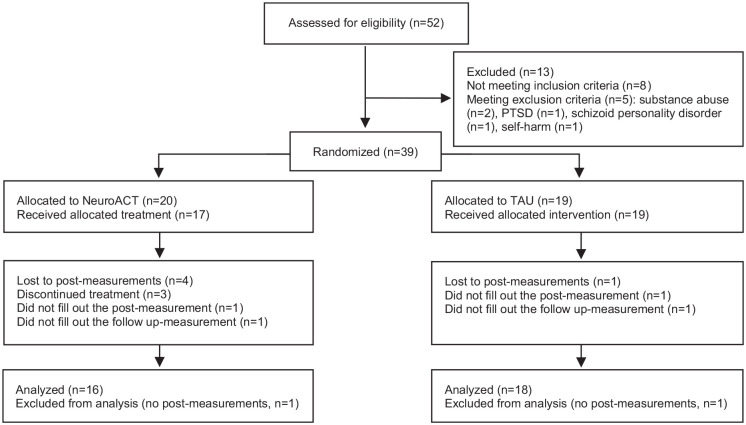
- Sample and feasibility: 39 autistic adults were randomized (20 NeuroACT, 19 TAU); 75% of 52 screened were invited, 100% of invited participants joined, 85% of NeuroACT participants completed treatment, and 87% completed all assessments at T1, T2, and T3.
- Primary outcomes: The rmANOVA showed a statistically significant group-by-time interaction favoring NeuroACT on perceived stress (PSS) with a moderate effect size; stress decreased from T1 to T2 but not from T2 to T3. NeuroACT also outperformed TAU on one quality-of-life measure (SWLS) with a moderate effect size, but not on QOLI.
- Secondary outcomes: NeuroACT showed significant group-by-time effects with moderate to large effect sizes on psychological inflexibility (AAQ), cognitive fusion (CFQ), and cognitive/behavioral avoidance (CBAS), and on autistic mannerism (SRS-AM).
- Null findings: No statistically significant between-group effects were found for depression (BDI-II), anxiety (BAI), sleep problems (KSQ indices), functional impairment (SDS), overall autistic core challenges/SRS total, social motivation/awareness/cognition/communication, or executive difficulties (DEX).
## Methods
- Design: Randomized, two-group controlled pilot trial with repeated measures at pre-treatment (T1), post-treatment (T2), and 6-month follow-up (T3); block randomization 1:1 to NeuroACT vs TAU.
- Sample/data: 39 adults with ASD from a psychiatric outpatient clinic in Stockholm; participants were 21 men and 18 women, aged 21–72 years (mean age 39, SD 12), with mean IQ 108.5 (SD 13.5).
- Main analysis: Outcome data were analyzed with mixed-design repeated-measures ANOVA (group × time), with Kruskal–Wallis/Wilcoxon tests for non-normal variables and effect sizes reported as Cohen’s d; analyses were performed on treatment completers.
- Intervention: NeuroACT was a 14-week, manualized group ACT program adapted for autism, delivered in 14 weekly 150-minute sessions with homework and mindfulness/acceptance अभ्यास; TAU participants received ordinary care and were offered NeuroACT with a 1-year delay.
## Limitations
- The paper explicitly states: small sample size reducing power and increasing risk of type 2 error; risk of type 1 error due to many outcome measures; reliance on self-report without objective/independent criteria; setting-specific limits to generalizability; lack of control for group effects; and restricted generalizability because participants had average or above-average intellectual capacity.
- Evident from the text: the trial was prematurely aborted before the planned sample size of 60 was reached, so estimates are based on a small pilot sample.
- Evident from the text: the authors report that outcome analyses were done on treatment completers, which may limit inference if dropout differed between groups.
Model-written summary. Check it against the paper before relying on it.
Integrity signals
Registry
Cites
Statistics
Figures
Verification
Claims the paper makes
11 Valid · 0 Not valid · 13 Not checked · 82 Own results and interpretations
Every source the paper cites for this claim was checked and supports it.
In the paper
“research on feasible and effective psychological interventions that address health outcomes in autistic adults is limited (Benevides et al., 2020).”
§ Acceptance and commitment therapy for autistic adults: A randomized controlled pilot study in a psychiatric outpatient setting > Introduction
What the sources say
- Supportedcites Benevides et al., 2020 matched to “Interventions to address health outcomes among autistic adults: A systematic review” (2020) source
The Introduction says few studies have evaluated the efficacy of interventions for health outcomes in autistic adults. The Discussion reports few available approaches and only emerging evidence for cognitive behavioral and mindfulness interventions; the community council section also calls for research on ease of use. Together, these support the claim that research on feasible and effective psychological interventions is limited. (LLM, conf=0.88)
plain- Asserted: passes — The authors put it forward as true.
- Checkable: passes — It can be checked against evidence.
- Load-bearing: passes — The paper’s conclusions depend on it.
- Based: passes — The paper gives a reason why it holds.
- Supported
The cited sources support only part of this claim — read each source’s verdict below.
In the paper
“ACT has been proven to reduce psychological distress in complex and persistent conditions, such as chronic pain, epilepsy, and psychosis (Hayes, 2019; Hughes et al., 2017; Shawyer et al., 2017).”
§ Acceptance and commitment therapy for autistic adults: A randomized controlled pilot study in a psychiatric outpatient setting > Introduction
What the sources say
- Partly supportedcites Hayes, 2019 matched to “Acceptance and commitment therapy: towards a unified model of behavior change” (2019) sourceExperimental — accuracy not yet measured
In the main text (page not provided), Hayes describes ACT outcomes as comparable to or better than other evidence-based approaches for conditions including chronic pain, and reports positive mental-health outcomes more broadly. The paper does not specifically address epilepsy or psychosis, or establish reduced psychological distress in those two conditions. Its qualified assessment also does not warrant the unqualified phrase “has been proven.” (LLM, conf=0.87)
- Not checked — no full text of the sourcecites Hughes et al., 2017 matched to “Acceptance and Commitment Therapy (ACT) for Chronic Pain: A Systematic Review and Meta-Analyses” (2017) source
- Partly supportedcites Shawyer et al., 2017 matched to “Acceptance and commitment therapy for psychosis: Randomised controlled trial” (2017) sourceExperimental — accuracy not yet measured
The Secondary outcomes section reports that, among participants with persistent psychotic symptoms, ACT reduced voice-related distress more than befriending at follow-up. That supports the psychosis portion of the cited sentence, but not a general reduction in psychological distress: the befriending group improved more on delusion-related distress. This paper does not address chronic pain or epilepsy, which have separate citations in the sentence. (LLM, conf=0.88)
boostedstates a cause- Asserted: passes — The authors put it forward as true.
- Checkable: passes — It can be checked against evidence.
- Load-bearing: passes — The paper’s conclusions depend on it.
- Based: passes — The paper gives a reason why it holds.
- Partly supported
The cited sources support only part of this claim — read each source’s verdict below.
In the paper
“The finding is in line with research on modified CBT for autistic individuals, which has observed changes in the SRS subscales of social motivation and AM but not overall social functioning (Bemmer et al., 2021).”
§ Acceptance and commitment therapy for autistic adults: A randomized controlled pilot study in a psychiatric outpatient setting > Discussion The current randomized controlled pilot study evaluated the feasibility and preliminary effectiveness of an adapted NeuroACT for autistic adults in a psychiatric outpatient setting. Results indicated overall good treatment feasibility, where most participants completed the treatment alongside high treatment credibility ratings and satisfactory measurement fulfillment. Analyses of effects showed statistically significantly improved primary outcomes of perceived stress and quality of life, with moderate to large effect sizes, in the NeuroACT group compared with the TAU group. In the secondary outcomes, reduced psychological inflexibility, cognitive fusion, cognitive and behavioral avoidance, and AM were statistically significant, with moderate to large effect sizes, in the NeuroACT group compared with the TAU group. Moreover, clinically significant changes in perceived stress and quality of life were observed in favor of the NeuroACT group compared with the TAU group. However, no statistically significant differences were observed between the two groups in depressive symptoms, anxiety, sleep problems, the second quality of life measure, functional impairment, social aspects of autism, or executive difficulties. Furthermore, dropout rates were slightly higher in the NeuroACT group compared with the TAU group. Where significant changes were found, the largest effect sizes were noticed in perceived stress, cognitive and behavioral avoidance, and cognitive fusion (Cohen’s d = 1.02–1.24). Significant improvements occurred from T1 to T2, except in AM, where changes were observed from T2 to T3, and quality of life, where changes were equally distributed between T1 and T2 compared with T2 and T3. Improvements from T1 to T2 were maintained or further ameliorated to T3. The results suggest that NeuroACT is a promising treatment for autistic adults with co-existing stress and reduced quality of life and that more extensive evaluations are warranted. To our knowledge, this is the first RCT to indicate that autistic adults with high perceived stress and reduced quality of life could benefit from ACT. The improvements in several outcomes are in line with research on CBT and mindfulness practice for autistic adults, suggesting that psychological treatments could positively influence mental health and improve quality of life (K. B. Beck et al., 2020; Cachia et al., 2016; Weston et al., 2016). ACT for autistic individuals is mainly based on mindfulness training from a functional analytic perspective (i.e. using mindfulness skills to overcome obstacles and pursue personally chosen values and goals). NeuroACT uses treatment techniques and content, such as motivation, acceptance, perspective-taking on thoughts, and psychoeducation to create psychological flexibility (Hayes, 2021). Enhancing psychological flexibility may be especially important in autistic individuals since insufficient emotion regulation skills alongside problematic behavioral avoidance are common problems that affect mental health negatively (Mazefsky, 2015). ACT skills help motivate participants to overcome obstructive thoughts, difficult emotions, and a lack of values clarity. In this study, the reduced obstacles of perceived stress and behavioral avoidance, alongside the improved quality of life, may thus indicate a broadening of the participants’ behavior repertoire, enhancing a sense of meaning in everyday life. The overall significant interaction effect of the SWLS but not the QOLI, both measuring quality of life, may be associated with the more durable sub-areas of the QOLI, such as economic status, neighborhood well-being, and family-related concerns. The SWLS measures subjective quality of life and overall well-being, potentially reflecting a more general sense of meaning and purpose than the QOLI. Replication studies and prolonged follow-up might further evaluate the eventual effects of using these instruments in autistic adults. While no statistically significant changes were observed in social aspects of autism, such as social cognition, social awareness, or communication, significant improvements were found in AM, related to cognitive and behavioral inflexibility. The finding is in line with research on modified CBT for autistic individuals, which has observed changes in the SRS subscales of social motivation and AM but not overall social functioning (Bemmer et al., 2021). Also, this result may align with the NeuroACT program’s overarching treatment goal of making social difficulties less of an obstacle to being active in social relationships without training the social skills themselves. For example, better handling obstructive thoughts, such as “I’m odd” or “I can’t have social relations,” indicated by increased cognitive defusion in this study, social situations might be perceived as less stressful. Also, research suggests that some autistic core challenges, such as social motivation, are not independent of emotional distress, indicating that reducing stress and anxiety in autistic individuals may facilitate social interaction (South et al., 2017). Social skills training is crucial in developing specific social behaviors (Choque Olsson et al., 2017). However, this study’s data suggest that training skills to handle obstructive thoughts and fears of social situations may complement social skills training, helping autistic individuals manage some difficulties due to stress and high anxiety levels. Moreover, in ACT for autistic individuals, the goal is not to “treat autism,” but to alleviate some core challenges that are thought to be exacerbated by mental health problems. ACT aims to change how the individual perceives his or her autistic functioning. By doing this, the individual may be able to act more flexibly in the presence of autism. Consequently, the observed changes in one subscale of the self-rated version of the SRS, as a result of the intervention, may reflect an altered perception but not necessarily an actual change in autistic core difficulties. Future studies may further evaluate these two treatment approaches in autistic individuals; social skills training, developing skills to handle thoughts and emotions, or a combination of both. Although promising, the current study has limitations. First, a small sample size reduces statistical power and increases the risk of type 2 error. Second, there might be a risk of type 1 error regarding the statistically significant efficacy measures due to the vast number of measures included, increasing the risk of a multiple testing effect. However, several outcome measures’ changes align with previous research, suggesting that the results do not depend just on chance. Third, the outcome measures relied on participant’s self-report, and no objective or independent criteria were used, increasing the risk of over- or underestimating individual progress. Fourth, the study was conducted within a psychiatric outpatient clinic, so the generalizability outside this setting may be limited. Fifth, the study design did not control for group effects. Therefore, changes observed may not be entirely due to ACT but an effect of the intervention’s group setting. Sixth, the participants included in the study all had average or above-average intellectual capacity, so generalization of the results to autistic adults with lower intellectual capacity cannot be made.
What the sources say
- Partly supportedcites Bemmer et al., 2021 matched to “Modified CBT for social anxiety and social functioning in young adults with autism spectrum disorder” (2021) sourceExperimental — accuracy not yet measured
The Results (Primary outcomes; page unavailable) report a significant change in SRS-2 social motivation, no significant change in the total score, and a significant change in restricted interests and repetitive behaviours (RRB). The paper does not report an SRS subscale called “AM”; its Measures section names RRB as the subscale, so the claim’s specific subscale label is not supported. (LLM, conf=0.86)
plainstates an association- Asserted: passes — The authors put it forward as true.
- Checkable: passes — It can be checked against evidence.
- Load-bearing: unclear — It is unclear whether the paper’s conclusions depend on it.
- Based: passes — The paper gives a reason why it holds.
- Partly supported
A result the paper reports from its own data — it cites no other source for it, so there is none to check. The quote shows it is in the paper.
In the paper
“Between-group altered depression, anxiety, sleep problems, one quality of life measure, functional impairment, social aspects of autism, and executive difficulties were statistically non-significant.”
§ Acceptance and commitment therapy for autistic adults: A randomized controlled pilot study in a psychiatric outpatient setting > Abstract
plainn = 39- Asserted: passes — The authors put it forward as true.
- Checkable: passes — It can be checked against evidence.
- Load-bearing: unclear — It is unclear whether the paper’s conclusions depend on it.
- Based: passes — The paper gives a reason why it holds.
A result the paper reports from its own data — it cites no other source for it, so there is none to check. The quote shows it is in the paper.
In the paper
“Perceived stress and quality of life (primary outcomes), alongside psychological inflexibility, cognitive fusion, cognitive and behavioral avoidance, and autistic mannerism were statistically significantly improved in NeuroACT compared with treatment as usual (d = 0.70–0.90).”
§ Acceptance and commitment therapy for autistic adults: A randomized controlled pilot study in a psychiatric outpatient setting > Abstract
plainstates a causen = 39 ·- Asserted: passes — The authors put it forward as true.
- Checkable: passes — It can be checked against evidence.
- Load-bearing: passes — The paper’s conclusions depend on it.
- Based: passes — The paper gives a reason why it holds.
59 more claims
Create a free account to see all 106 claims and to verify the 2 references still open.
- It may state two separate claims as one. 28
- Probably not a substantial claim. 21
- The quote only partly states this claim. 1
Citations
Cites
Diagnostic and Statistical Manual of Mental Disorders
American Psychiatric Association (2013) · doi:10.1176/appi.books.9780890425596 · Cited by 116,369
Statistical Power Analysis for the Behavioral Sciences
Muller, K. (1989) · Technometrics · doi:10.1080/00401706.1989.10488618 · Cited by 99,167
An inventory for measuring depression
BECK, A. T. (1961) · Archives of General Psychiatry · doi:10.1001/archpsyc.1961.01710120031004 · Cited by 38,032 · cited 1×
“Perceived depressive symptoms were assessed using the Beck Depression Inventory–II (BDI-II) (A. T. Beck et al., 1961), a 21-item self-report four-point Likert-type scale, with higher scores indicating more depressive symptoms.”
A Global Measure of Perceived Stress
Cohen, S., Kamarck, T., & Mermelstein, R. (1983) · Journal of Health and Social Behavior · doi:10.2307/2136404 · Cited by 32,807 · cited 2×
“…and (d) scoring more than one standard deviation under the population mean on the Quality of Life Inventory (QOLI) (Frisch, 1994), that is, QOLI < 1.84 or more than one standard deviation over the population mean on the Perceived Stress Scale (PSS) (S. Cohen et al., 1983), that is, PSS > 24.”
InfluentialThe satisfaction with life scale
Diener, E., Emmons, R. A., Larsen, R. J., & Griffin, S. (1985) · Journal of Personality Assessment · doi:10.1207/s15327752jpa4901_13 · Cited by 31,768 · cited 13×
“The SWLS consists of five items rated on a Likert-type scale 1–7, with a higher score indicating higher quality of life.”
InfluentialAn inventory for measuring clinical anxiety: Psychometric properties.
Beck, A. T., Epstein, N., Brown, G., & Steer, R. A. (1988) · Journal of Consulting and Clinical Psychology · doi:10.1037/0022-006x.56.6.893 · Cited by 14,407 · cited 1×
“Perceived anxiety symptoms were assessed using the Beck Anxiety Inventory (BAI) (A. T. Beck et al., 1988), a 21-item self-report four-point Likert-type scale, with a higher score indicating more anxiety symptoms.”
MethodJournal of Clinical Psychiatry
(2018) · Journal of Clinical Psychiatry · doi:10.5505/kpd · Cited by 13,651
The Use of Cronbach’s Alpha When Developing and Reporting Research Instruments in Science Education
Taber, K. S. (2018) · Research in Science Education · doi:10.1007/s11165-016-9602-2 · Cited by 10,679 · cited 1×
“The interpretations of Cronbach’s alpha were α ⩾ 0.70 = satisfactory , α ⩾ 0.80 = good , and α ⩾ 0.90 = satisfactory , where a too low or high alpha value may indicate insufficient reliability (Taber, 2018).”
Influential(1998) · PubMed · Cited by 10,216
Jacobson, N. S., & Truax, P. (1991) · Journal of Consulting and Clinical Psychology · doi:10.1037/0022-006x.59.1.12 · Cited by 7,770 · cited 1×
“Clinically significant changes (Evans et al., 1998; Jacobson & Truax, 1991) in the primary outcome measures were calculated using normal population data of the PSS ( M = 24.8, SD = 11.1) (Eklund et al., 2014) and the SWLS ( M = 24.1, SD = 6.9) (Pavot & Diener, 2008) along with clinical data from…”
InfluentialAcceptance and commitment therapy: model, processes and outcomes
Hayes, S. C., Luoma, J. B., Bond, F. W., Masuda, A., & Lillis, J. (2006) · Behaviour Research and Therapy · doi:10.1016/j.brat.2005.06.006 · Cited by 6,587 · cited 1×
“In ACT, psychological flexibility is the ability to do what is essential to oneself while handling mental obstacles that would otherwise be in the way (Hayes et al., 2006).”
Baron-Cohen, S., Wheelwright, S., Skinner, R., Martin, J., & Clubley, E. (2001) · Journal of Autism and Developmental Disorders · doi:10.1023/a:1005653411471 · Cited by 6,450 · cited 1×
“Second, assessing autistic and ADHD symptoms included standardized self-rating questionnaires (e.g. Adult Autism Spectrum Quotient (AQ); Wender Utah Rating Scale (WURS); Baron-Cohen et al., 2001; Ward et al., 1993).”
MethodBond, F. W., Hayes, S. C., Baer, R. A., Carpenter, K. M., Guenole, N., Orcutt, H. K., Waltz, T., & Zettle, R. D. (2011) · Behavior Therapy · doi:10.1016/j.beth.2011.03.007 · Cited by 3,950 · cited 1×
“Perceived psychological inflex-ibility was assessed using the Acceptance and Action Questionnaire (AAQ-7) (Bond et al., 2011), a seven-item Likert-type scale (1–7), with a higher score indicating more psychological inflexibility.”
Lord, C., Elsabbagh, M., Baird, G., & Veenstra-Vanderweele, J. (2018) · The Lancet · doi:10.1016/s0140-6736(18)31129-2 · Cited by 2,819
Delis-Kaplan Executive Function System
Delis, D. C., Kaplan, E., & Kramer, J. H. (2012) · PsycTESTS Dataset · doi:10.1037/t15082-000 · Cited by 2,683
(2014) · Journal of the Korean Medical Association · doi:10.5124/jkma.2014.57.11.899 · Cited by 2,566
The satisfaction with life scale and the emerging construct of life satisfaction
Pavot, W., & Diener, E. (2008) · The Journal of Positive Psychology · doi:10.1080/17439760701756946 · Cited by 2,396 · cited 1×
“…changes (Evans et al., 1998; Jacobson & Truax, 1991) in the primary outcome measures were calculated using normal population data of the PSS ( M = 24.8, SD = 11.1) (Eklund et al., 2014) and the SWLS ( M = 24.1, SD = 6.9) (Pavot & Diener, 2008) along with clinical data from the present sample.”
InfluentialCredibility of analogue therapy rationales
Borkovec, T. D., & Nau, S. D. (1972) · Journal of Behavior Therapy and Experimental Psychiatry · doi:10.1016/0005-7916(72)90045-6 · Cited by 1,553 · cited 6×
“The mean score of the TCS was 7.6 ( SD = 2.5) on Item 1 (how apprehensible the treatment seemed to the participants); 6.3 ( SD = 3.2) on Item 2 (how confident they felt that the group would reduce their ASD-related problems; 7.9 ( SD = 3.2) on Item 3 (how confident they would be in recommending this kind of group to a…”
InfluentialBoutron, I., Altman, D. G., Moher, D., Schulz, K. F., Ravaud, P., & for the CONSORT NPT Group* (2017) · Annals of Internal Medicine · doi:10.7326/m17-0046 · Cited by 1,538 · cited 2×
“…(3) dropout rates between the NeuroACT group and the TAU group post randomization; (4) treatment credibility; and (5) any adverse events as reported in participants’ medical records, according to the CONSORT statement for randomized trials of nonpharmacological treatments (Boutron et al., 2017).”
MethodSheehan, D. V., Harnett-Sheehan, K., & Raj, B. A. (1996) · International Clinical Psychopharmacology · doi:10.1097/00004850-199606003-00015 · Cited by 1,440 · cited 4×
“The SDS has shown satisfactory AUC statistics (0.81) (Luciano et al., 2010) and good internal consistency (Cronbach’s α = 0.89) (Leon et al., 1997).”
MethodInfluential(1993) · American Journal of Psychiatry · doi:10.1176/ajp.150.6.885 · Cited by 1,421 · cited 1×
“Second, assessing autistic and ADHD symptoms included standardized self-rating questionnaires (e.g. Adult Autism Spectrum Quotient (AQ); Wender Utah Rating Scale (WURS); Baron-Cohen et al., 2001; Ward et al., 1993).”
MethodBehavioural Assessment of the Dysexecutive Syndrome
(2004) · Methodology Of Frontal And Executive Function · doi:10.4324/9780203344187-15 · Cited by 1,149 · cited 1×
“Perceived executive difficulties were assessed using the Dysexecutive Questionnaire (DEX-S), a 20-item 5-point Likert-type scale, with a higher score indicating more executive problems (Wilson et al., 1996).”
The health status of adults on the autism spectrum
Croen, L. A., Zerbo, O., Qian, Y., Massolo, M. L., Rich, S., Sidney, S., & Kripke, C. (2015) · Autism · doi:10.1177/1362361315577517 · Cited by 1,110 · cited 2×
“…higher rates of perceived stress (Bishop-Fitzpatrick et al., 2017) and reduced quality of life (Park et al., 2019), alongside psychiatric symptoms (e.g. depression and anxiety) (Croen et al., 2015), problems with sleep (Morgan et al., 2020), and even premature mortality (Smith DaWalt et al., 2019).”
Frisch, M. B., Cornell, J., Villanueva, M., & Retzlaff, P. J. (1992) · Psychological Assessment · doi:10.1037/1040-3590.4.1.92 · Cited by 1,075 · cited 10×
“; DSM-5; APA, 2013) as the primary neurodevelopmental diagnosis; (b) 18 years of age or older; (c) if on any psychoactive drug treatment (for attention deficit hyperactivity disorder (ADHD) or other diagnoses), treatment should have been stable (at least for 3 months); and (d) scoring more than one standard deviation…”
InfluentialLudwig, D. S. (2008) · JAMA · doi:10.1001/jama.300.11.1350 · Cited by 957
The development and initial validation of the cognitive fusion questionnaire
Gillanders, D. T., Bolderston, H., Bond, F. W., Dempster, M., Flaxman, P. E., Campbell, L., Kerr, S., Tansey, L., Noel, P., Ferenbach, C., et al. (2014) · Behavior Therapy · doi:10.1016/j.beth.2013.09.001 · Cited by 837 · cited 2×
“Perceived cognitive fusion was assessed using the Cognitive Fusion Questionnaire (CFQ-7) (Gillanders et al., 2013), a 7-item Likert-type scale (1– 7), with a higher score reflecting more cognitive fusion.”
Hayes, S. C., Villatte, M., Levin, M., & Hildebrandt, M. (2011) · Annual Review of Clinical Psychology · doi:10.1146/annurev-clinpsy-032210-104449 · Cited by 800 · cited 1×
“Acceptance is the active and aware embracement of thoughts, emotions, and body sensations without attempts to avoid or counteract them, especially when doing so would cause psychological harm (Hayes et al., 2011).”
BackgroundIdentifying the lost generation of adults with autism spectrum conditions
Lai, M.-C., & Baron-Cohen, S. (2015) · The Lancet Psychiatry · doi:10.1016/s2215-0366(15)00277-1 · Cited by 756
Acceptance and Commitment Therapy (ACT) for Chronic Pain: A Systematic Review and Meta-Analyses
Hughes, L. S., Clark, J., Colclough, J. A., Dale, E., & McMillan, D. (2017) · The Clinical Journal of Pain · doi:10.1097/ajp.0000000000000425 · Cited by 611 · cited 1×
“ACT has been proven to reduce psychological distress in complex and persistent conditions, such as chronic pain, epilepsy, and psychosis (Hayes, 2019; Hughes et al., 2017; Shawyer et al., 2017).”
BackgroundGuendelman, S., Medeiros, S., & Rampes, H. (2017) · Frontiers in Psychology · doi:10.3389/fpsyg.2017.00220 · Cited by 577 · cited 1×
“Mindfulness is an emotion regulation technique defined as non-judgmental and non-reactive attention to momentarily experiences, including thoughts, emotions, and body sensations (Dryden & Still, 2006; Guendelman et al., 2017; Ludwig & Kabat-Zinn, 2008).”
BackgroundGlaesmer, H., Grande, G., Braehler, E., & Roth, M. (2011) · European Journal of Psychological Assessment · doi:10.1027/1015-5759/a000058 · Cited by 485 · cited 2×
“39) (Glaesmer et al., 2011) and good internal consistency (Cronbach’s α = 0.”
InfluentialPsychiatric comorbidity in young adults with a clinical diagnosis of Asperger syndrome
Lugnegård, T., Hallerbäck, M. U., & Gillberg, C. (2011) · Research in Developmental Disabilities · doi:10.1016/j.ridd.2011.03.025 · Cited by 483 · cited 1×
“As many as 70% of autistic adults experience at least one life-time depressive episode and 50% meet the criteria for a lifetime anxiety disorder (Lugnegård et al., 2011; Nah et al., 2018).”
Evans, C., Margison, F., & Barkham, M. (1998) · Evidence Based Mental Health · doi:10.1136/ebmh.1.3.70 · Cited by 470 · cited 1×
“Clinically significant changes (Evans et al., 1998; Jacobson & Truax, 1991) in the primary outcome measures were calculated using normal population data of the PSS ( M = 24.8, SD = 11.1) (Eklund et al., 2014) and the SWLS ( M = 24.1, SD = 6.9) (Pavot & Diener, 2008) along with clinical data from…”
InfluentialAvoidance and depression: the construction of the Cognitive–Behavioral Avoidance Scale
Ottenbreit, N. D., & Dobson, K. S. (2004) · Behaviour Research and Therapy · doi:10.1016/s0005-7967(03)00140-2 · Cited by 457 · cited 4×
“4, statistically significant group-by-time interaction effects were found in measures of psychological inflexibility (AAQ), CFQ, and CBAS, with moderate to large effect sizes in the Neu-roACT group compared with the TAU group.”
InfluentialConstantino, J. N., Davis, S. A., Todd, R. D., Schindler, M. K., Gross, M. M., Brophy, S. L., Metzger, L. M., Shoushtari, C. S., Splinter, R., & Reich, W. (2021) · PsycTESTS Dataset · doi:10.1037/t17260-000 · Cited by 427
Selective serotonin reuptake inhibitors (SSRIs) for autism spectrum disorders (ASD)
Williams, K., Brignell, A., Randall, M., Silove, N., & Hazell, P. (2013) · Cochrane Database of Systematic Reviews · doi:10.1002/14651858.cd004677.pub3 · Cited by 415
Acceptance and commitment therapy: altering the verbal support for experiential avoidance
Hayes, S. C., & Wilson, K. G. (1994) · The Behavior Analyst · doi:10.1007/bf03392677 · Cited by 354 · cited 1×
“In ACT, psychological inflexibility means that an individual avoids situations that are perceived as stressful or unpleasant, including thoughts, emotions, and body sensations related to those situations (Hayes & Wilson, 1994).”
BackgroundEpidemiology of autism in adults across age groups and ability levels
Brugha, T. S., Spiers, N., Bankart, J., Cooper, S.-A., McManus, S., Scott, F. J., Smith, J., & Tyrer, F. (2016) · British Journal of Psychiatry · doi:10.1192/bjp.bp.115.174649 · Cited by 299 · cited 2×
“…impair the ability to cope with daily hassles and reach long-term goals (Bednarz et al., 2020; Uddin, 2021; Wallace et al., 2016) and affect essential life areas, such as social relationships, work, and independent living (Bishop-Fitzpatrick et al., 2017; Brugha et al., 2016; Lai et al., 2020).”
Idring, S., Lundberg, M., Sturm, H., Dalman, C., Gumpert, C., Rai, D., Lee, B. K., & Magnusson, C. (2015) · Journal of Autism and Developmental Disorders · doi:10.1007/s10803-014-2336-y · Cited by 296 · cited 1×
“ASD is present in 1%–2% of the adult population (Idring et al., 2015).”
Mindfulness-based therapy in adults with an autism spectrum disorder: a randomized controlled trial
Spek, A. A., van Ham, N. C., & Nyklíček, I. (2013) · Research in Developmental Disabilities · doi:10.1016/j.ridd.2012.08.009 · Cited by 274 · cited 1×
“MBSR adapted for ASD has shown health benefits in a range of areas, such as depression, anxiety, rumination, sleeping problems, and interpersonal sensitivity, and the effects seem to last at least 9 weeks after treatment completion (Kiep et al., 2015; Spek et al., 2013).”
The psychometric tradition: Developing the wechsler adult intelligence scale
Wechsler, D. (1981) · Contemporary Educational Psychology · doi:10.1016/0361-476x(81)90035-7 · Cited by 274
Frazier, T. W., Ratliff, K. R., Gruber, C., Zhang, Y., Law, P. A., & Constantino, J. N. (2014) · Autism · doi:10.1177/1362361313500382 · Cited by 264
Wallace, G. L., Kenworthy, L., Pugliese, C. E., Popal, H. S., White, E. I., Brodsky, E., & Martin, A. (2016) · Journal of Autism and Developmental Disorders · doi:10.1007/s10803-015-2655-7 · Cited by 261 · cited 1×
“…memory, inhibition, or planning) often impair the ability to cope with daily hassles and reach long-term goals (Bednarz et al., 2020; Uddin, 2021; Wallace et al., 2016) and affect essential life areas, such as social relationships, work, and independent living (Bishop-Fitzpatrick et al., 2017;…”
Nordin, M., & Nordin, S. (2013) · Scandinavian Journal of Psychology · doi:10.1111/sjop.12071 · Cited by 252 · cited 2×
“The instrument has shown good criterion validity, internal consistency, and satisfactory construct validity in Swedish samples (Nordin & Nordin, 2013; Westerlund et al., 2014).”
InfluentialLai, M.-C., Anagnostou, E., Wiznitzer, M., Allison, C., & Baron-Cohen, S. (2020) · The Lancet Neurology · doi:10.1016/s1474-4422(20)30034-x · Cited by 250 · cited 1×
“…impair the ability to cope with daily hassles and reach long-term goals (Bednarz et al., 2020; Uddin, 2021; Wallace et al., 2016) and affect essential life areas, such as social relationships, work, and independent living (Bishop-Fitzpatrick et al., 2017; Brugha et al., 2016; Lai et al., 2020).”
Weston, L., Hodgekins, J., & Langdon, P. E. (2016) · Clinical Psychology Review · doi:10.1016/j.cpr.2016.08.001 · Cited by 215 · cited 1×
“The improvements in several outcomes are in line with research on CBT and mindfulness practice for autistic adults, suggesting that psychological treatments could positively influence mental health and improve quality of life (K. B. Beck et al., 2020; Cachia et al., 2016; Weston et al., 2016).”
ResultSpain, D., Sin, J., Chalder, T., Murphy, D., & Happé, F. (2015) · Research in Autism Spectrum Disorders · doi:10.1016/j.rasd.2014.10.019 · Cited by 167 · cited 7×
“Psychological treatments based on CBT and mindfulness principles thus appear to have the potential to benefit mental health in autistic adults.”
InfluentialBishop-Fitzpatrick, L., Minshew, N. J., Mazefsky, C. A., & Eack, S. M. (2017) · Journal of Autism and Developmental Disorders · doi:10.1007/s10803-016-2910-6 · Cited by 160 · cited 1×
“Moreover, autistic adults have higher rates of perceived stress (Bishop-Fitzpatrick et al., 2017) and reduced quality of life (Park et al.”
BackgroundAcceptance and commitment therapy: towards a unified model of behavior change
Hayes, S. C. (2019) · World Psychiatry · doi:10.1002/wps.20626 · Cited by 154 · cited 1×
“ACT has been proven to reduce psychological distress in complex and persistent conditions, such as chronic pain, epilepsy, and psychosis (Hayes, 2019; Hughes et al., 2017; Shawyer et al., 2017).”
Hultell, D., & Petter Gustavsson, J. (2008) · Personality and Individual Differences · doi:10.1016/j.paid.2007.10.030 · Cited by 153
Pharmacological therapies for autism spectrum disorder: a review.
(2015) · PubMed Central · Cited by 150
Acceptance and Commitment Therapy modules: Differential impact on treatment processes and outcomes
Villatte, J. L., Vilardaga, R., Villatte, M., Plumb Vilardaga, J. C., Atkins, D. C., & Hayes, S. C. (2016) · Behaviour Research and Therapy · doi:10.1016/j.brat.2015.12.001 · Cited by 136 · cited 1×
“Acceptance and commitment therapy (ACT) is a psychotherapy method within the CBT umbrella that combines mindfulness procedures and behavioral change techniques (Villatte et al., 2016).”
MethodHirvikoski, T., & Blomqvist, M. (2015) · Autism · doi:10.1177/1362361314543530 · Cited by 128 · cited 1×
“Also, research indicates that autistic core difficulties, such as social motivation, are not independent of emotional distress, suggesting that reducing stress in autistic individuals may affect how the individual perceives his or her difficulties (Hirvikoski & Blomqvist, 2015; South et al., 2017).”
Hirvikoski, T., Lindholm, T., Nordenström, A., Nordström, A.-L., & Lajic, S. (2009) · Hormones and Behavior · doi:10.1016/j.yhbeh.2008.12.004 · Cited by 123 · cited 1×
“Fourth, demographic and clinical data were obtained from medical records and a self-report questionnaire covering different clinical aspects (Hirvikoski et al., 2009).”
Choque Olsson, N., Flygare, O., Coco, C., Görling, A., Råde, A., Chen, Q., Lindstedt, K., Berggren, S., Serlachius, E., Jonsson, U., et al. (2017) · Journal of the American Academy of Child & Adolescent Psychiatry · doi:10.1016/j.jaac.2017.05.001 · Cited by 120 · cited 1×
“Social skills training is crucial in developing specific social behaviors (Choque Olsson et al., 2017).”
Alfonsson, S., Olsson, E., & Hursti, T. (2016) · Journal of Medical Internet Research · doi:10.2196/jmir.5352 · Cited by 118 · cited 1×
“The TCS has demonstrated good internal consistency in a Swedish sample consisting of stress and anxiety patients (Cronbach’s α = 0.83) (Alfonsson et al., 2016) and satisfactory internal consistency in the current sample (Cronbach’s α = 0.92).”
InfluentialUddin, L. Q. (2021) · Biological Psychiatry · doi:10.1016/j.biopsych.2020.05.010 · Cited by 116 · cited 1×
“…(e.g. working memory, inhibition, or planning) often impair the ability to cope with daily hassles and reach long-term goals (Bednarz et al., 2020; Uddin, 2021; Wallace et al., 2016) and affect essential life areas, such as social relationships, work, and independent living (Bishop-Fitzpatrick et…”
Kjærgaard, M., Arfwedson Wang, C. E., Waterloo, K., & Jorde, R. (2014) · Scandinavian Journal of Psychology · doi:10.1111/sjop.12090 · Cited by 114
Mindfulness-Based Therapy in Adults with an Autism Spectrum Disorder: Do Treatment Effects Last?
Kiep, M., Spek, A. A., & Hoeben, L. (2015) · Mindfulness · doi:10.1007/s12671-014-0299-x · Cited by 113 · cited 1×
“MBSR adapted for ASD has shown health benefits in a range of areas, such as depression, anxiety, rumination, sleeping problems, and interpersonal sensitivity, and the effects seem to last at least 9 weeks after treatment completion (Kiep et al., 2015; Spek et al., 2013).”
Hesselmark, E., Plenty, S., & Bejerot, S. (2014) · Autism · doi:10.1177/1362361313493681 · Cited by 111 · cited 1×
“The results are promising; CBT has indicated improved anxiety, depression, and quality of life, and group-delivered interventions seem to be well-suited, supportive, and cost-efficient for an ASD population (Hesselmark et al., 2014; Spain et al., 2015; Weiss & Lunsky, 2010).”
BackgroundHISTORICAL ASPECTS OF MINDFULNESS AND SELF-ACCEPTANCE IN PSYCHOTHERAPY
Dryden, W., & Still, A. (2006) · Journal of Rational-Emotive & Cognitive-Behavior Therapy · doi:10.1007/s10942-006-0026-1 · Cited by 110 · cited 1×
“Mindfulness is an emotion regulation technique defined as non-judgmental and non-reactive attention to momentarily experiences, including thoughts, emotions, and body sensations (Dryden & Still, 2006; Guendelman et al., 2017; Ludwig & Kabat-Zinn, 2008).”
BackgroundBENNETT, P. C., ONG, B., & PONSFORD, J. (2005) · Journal of the International Neuropsychological Society · doi:10.1017/s1355617705050423 · Cited by 105 · cited 2×
“91) for neurologically impaired patients (Bennett et al., 2005; Shaw et al., 2015) and good internal consistency in the current sample (Cronbach’s α = 0.”
BackgroundInfluentialMazefsky, C. A. (2015) · Journal of Autism and Developmental Disorders · doi:10.1007/s10803-015-2602-7 · Cited by 103 · cited 1×
“Enhancing psychological flexibility may be especially important in autistic individuals since insufficient emotion regulation skills alongside problematic behavioral avoidance are common problems that affect mental health negatively (Mazefsky, 2015).”
BackgroundMortality in individuals with autism spectrum disorder: Predictors over a 20-year period
Smith DaWalt, L., Hong, J., Greenberg, J. S., & Mailick, M. R. (2019) · Autism · doi:10.1177/1362361319827412 · Cited by 103 · cited 1×
“…higher rates of perceived stress (Bishop-Fitzpatrick et al., 2017) and reduced quality of life (Park et al., 2019), alongside psychiatric symptoms (e.g. depression and anxiety) (Croen et al., 2015), problems with sleep (Morgan et al., 2020), and even premature mortality (Smith DaWalt et al., 2019).”
BackgroundValidating the social responsiveness scale for adults with autism
Chan, W., Smith, L. E., Hong, J., Greenberg, J. S., & Mailick, M. R. (2017) · Autism Research · doi:10.1002/aur.1813 · Cited by 101 · cited 1×
“The SRS showed good concurrent, predictive, convergent, and discriminative validity with a sensitivity of 0.85 and a specificity of 0.83 for ASD and a Cronbach’s alpha of 0.89 in different ASD populations (Bolte, 2012; Chan Smith et al., 2017; Fra-zier et al., 2014).”
InfluentialThe role of emotion regulation and core autism symptoms in the experience of anxiety in autism
Conner, C. M., White, S. W., Scahill, L., & Mazefsky, C. A. (2020) · Autism · doi:10.1177/1362361320904217 · Cited by 99 · cited 1×
“Therefore, they tend to run a higher risk of developing avoidant behaviors and maladaptive coping strategies, which might cause long-term mental health problems (Conner et al., 2020; Pagni et al., 2020; Pfaff & Barbas, 2019).”
BackgroundHahs, A. D., Dixon, M. R., & Paliliunas, D. (2019) · Journal of Contextual Behavioral Science · doi:10.1016/j.jcbs.2018.03.002 · Cited by 93 · cited 1×
“Interventions based on ACT have been evaluated for parents of autistic children (Hahs et al., 2019; Prevedini et al., 2020; Whittingham et al., 2020), autistic adolescents (Pahnke et al., 2014), and autistic adults in a non-clinical setting (Hutchinson et al., 2019).”
Morgan, B., Nageye, F., Masi, G., & Cortese, S. (2020) · Sleep Medicine · doi:10.1016/j.sleep.2019.07.019 · Cited by 92
Acceptance and commitment therapy for psychosis: Randomised controlled trial
Shawyer, F., Farhall, J., Thomas, N., Hayes, S. C., Gallop, R., Copolov, D., & Castle, D. J. (2017) · British Journal of Psychiatry · doi:10.1192/bjp.bp.116.182865 · Cited by 89 · cited 1×
“ACT has been proven to reduce psychological distress in complex and persistent conditions, such as chronic pain, epilepsy, and psychosis (Hayes, 2019; Hughes et al., 2017; Shawyer et al., 2017).”
BackgroundPahnke, J., Lundgren, T., Hursti, T., & Hirvikoski, T. (2014) · Autism · doi:10.1177/1362361313501091 · Cited by 88 · cited 1×
“Interventions based on ACT have been evaluated for parents of autistic children (Hahs et al., 2019; Prevedini et al., 2020; Whittingham et al., 2020), autistic adolescents (Pahnke et al., 2014), and autistic adults in a non-clinical setting (Hutchinson et al., 2019).”
Self-citationPsychometric properties and factor structure of the Swedish version of the Perceived Stress Scale
Eklund, M., Bäckström, M., & Tuvesson, H. (2014) · Nordic Journal of Psychiatry · doi:10.3109/08039488.2013.877072 · Cited by 85 · cited 2×
“…changes (Evans et al., 1998; Jacobson & Truax, 1991) in the primary outcome measures were calculated using normal population data of the PSS ( M = 24.8, SD = 11.1) (Eklund et al., 2014) and the SWLS ( M = 24.1, SD = 6.9) (Pavot & Diener, 2008) along with clinical data from the present sample.”
InfluentialMindfulness in Individuals with Autism Spectrum Disorder: a Systematic Review and Narrative Analysis
Cachia, R. L., Anderson, A., & Moore, D. W. (2016) · Review Journal of Autism and Developmental Disorders · doi:10.1007/s40489-016-0074-0 · Cited by 85 · cited 4×
“The improvements in several outcomes are in line with research on CBT and mindfulness practice for autistic adults, suggesting that psychological treatments could positively influence mental health and improve quality of life (K. B. Beck et al., 2020; Cachia et al., 2016; Weston et al., 2016).”
InfluentialBrief Report: The Social Responsiveness Scale for Adults (SRS-A): Initial Results in a German Cohort
Bölte, S. (2012) · Journal of Autism and Developmental Disorders · doi:10.1007/s10803-011-1424-5 · Cited by 84 · cited 2×
“The SRS showed good concurrent, predictive, convergent, and discriminative validity with a sensitivity of 0.85 and a specificity of 0.83 for ASD and a Cronbach’s alpha of 0.89 in different ASD populations (Bolte, 2012; Chan Smith et al., 2017; Fra-zier et al., 2014).”
InfluentialInterventions to address health outcomes among autistic adults: A systematic review
Benevides, T. W., Shore, S. M., Andresen, M.-L., Caplan, R., Cook, B., Gassner, D. L., Erves, J. M., Hazlewood, T. M., King, M. C., Morgan, L., et al. (2020) · Autism · doi:10.1177/1362361320913664 · Cited by 83 · cited 1×
“Moreover, research on feasible and effective psychological interventions that address health outcomes in autistic adults is limited (Benevides et al., 2020).”
BackgroundConner, C. M., & White, S. W. (2018) · Journal of Autism and Developmental Disorders · doi:10.1007/s10803-017-3312-0 · Cited by 78 · cited 1×
“Furthermore, Conner and White (2018) have observed increased emotion regulation and impulse control in autistic adults as a result of mindfulness practice.”
McCracken, L. M., DaSilva, P., Skillicorn, B., & Doherty, R. (2014) · The Clinical Journal of Pain · doi:10.1097/ajp.0000000000000047 · Cited by 75 · cited 1×
“Discriminative validity of the CFQ against psychological acceptance has been observed as satisfactory ( r = −0.78) in a clinical sample (McCracken et al., 2014).”
InfluentialPark, S. H., Song, Y. J. C., Demetriou, E. A., Pepper, K. L., Norton, A., Thomas, E. E., Hickie, I. B., Hermens, D. F., Glozier, N., & Guastella, A. J. (2019) · Autism · doi:10.1177/1362361318823925 · Cited by 75 · cited 1×
“Moreover, autistic adults have higher rates of perceived stress (Bishop-Fitzpatrick et al., 2017) and reduced quality of life (Park et al., 2019), alongside psychiatric symptoms (e.g. depression and anxiety) (Croen et al., 2015), problems with sleep (Morgan et al., 2020), and even premature…”
Luciano, J. V., Bertsch, J., Salvador‐Carulla, L., Tomás, J. M., Fernández, A., Pinto‐Meza, A., Haro, J. M., Palao, D. J., & Serrano‐Blanco, A. (2010) · Journal of Evaluation in Clinical Practice · doi:10.1111/j.1365-2753.2009.01211.x · Cited by 74 · cited 1×
“The SDS has shown satisfactory AUC statistics (0.81) (Luciano et al., 2010) and good internal consistency (Cronbach’s α = 0.89) (Leon et al., 1997).”
InfluentialSymptom overlap on the srs‐2 adult self‐report between adults with asd and adults with high anxiety
South, M., Carr, A. W., Stephenson, K. G., Maisel, M. E., & Cox, J. C. (2017) · Autism Research · doi:10.1002/aur.1764 · Cited by 71 · cited 2×
“Also, research indicates that autistic core difficulties, such as social motivation, are not independent of emotional distress, suggesting that reducing stress in autistic individuals may affect how the individual perceives his or her difficulties (Hirvikoski & Blomqvist, 2015; South et al., 2017).”
Psychometric properties of the Cognitive Fusion Questionnaire in Colombia
Ruiz, F. J., Suárez-Falcón, J. C., Riaño-Hernández, D., & Gillanders, D. (2017) · Revista Latinoamericana de Psicología · doi:10.1016/j.rlp.2016.09.006 · Cited by 68 · cited 1×
“In addition, the CFQ demonstrated satisfactory internal consistency in a clinical sample (Cronbach’s α = 0.93) (Ruiz et al., 2017) and in the current sample (Cronbach’s α = 0.93).”
BackgroundInfluentialWeiss, J. A., & Lunsky, Y. (2010) · Clinical Psychology & Psychotherapy · doi:10.1002/cpp.694 · Cited by 67 · cited 1×
“The results are promising; CBT has indicated improved anxiety, depression, and quality of life, and group-delivered interventions seem to be well-suited, supportive, and cost-efficient for an ASD population (Hesselmark et al., 2014; Spain et al., 2015; Weiss & Lunsky, 2010).”
Modified CBT for social anxiety and social functioning in young adults with autism spectrum disorder
Bemmer, E. R., Boulton, K. A., Thomas, E. E., Larke, B., Lah, S., Hickie, I. B., & Guastella, A. J. (2021) · Molecular Autism · doi:10.1186/s13229-021-00418-w · Cited by 59 · cited 1×
“The finding is in line with research on modified CBT for autistic individuals, which has observed changes in the SRS subscales of social motivation and AM but not overall social functioning (Bemmer et al., 2021).”
The pattern of slow wave activity in spontaneously occurring long sleep
KECKLUND, G., & ÅKERSTEDT, T. (1992) · Journal of Sleep Research · doi:10.1111/j.1365-2869.1992.tb00005.x · Cited by 56 · cited 6×
“In addition, the KSQ demonstrated satisfactory internal consistency in the present sample (Cronbach’s α = 0.91).”
InfluentialBrief Report: Screening Adults with Autism Spectrum Disorder for Anxiety and Depression
Nah, Y., Brewer, N., Young, R. L., & Flower, R. L. (2017) · Journal of Autism and Developmental Disorders · doi:10.1007/s10803-017-3427-3 · Cited by 53
Psychometric validation of the Dysexecutive Questionnaire (DEX)
Shaw, S., Oei, T. P. S., & Sawang, S. (2015) · Psychological Assessment · doi:10.1037/a0038195 · Cited by 50 · cited 1×
“The DEX-S showed satisfactory internal consistency (Cronbach’s α = 0.91) for neurologically impaired patients (Bennett et al., 2005; Shaw et al., 2015) and good internal consistency in the current sample (Cronbach’s α = 0.84).”
InfluentialPahnke, J., Hirvikoski, T., Bjureberg, J., Bölte, S., Jokinen, J., Bohman, B., & Lundgren, T. (2019) · Journal of Contextual Behavioral Science · doi:10.1016/j.jcbs.2019.04.002 · Cited by 48 · cited 4×
“Power calculation was based on an open-trial pilot study on ACT for autistic adults (Pahnke et al., 2019) using the results of the Satisfaction with Life Scale (SWLS) (Diener et al., 1985) ( M = 13.2, SD = 5.1 for pre-treatment and M = 17.0, SD = 4.8 for post-treatment, 0.05 significance level, and…”
InfluentialSelf-citationFalse positive results: a challenge for psychiatric screening in primary care
Leon, A. C., Portera, L., Olfson, M., Weissman, M. M., Kathol, R. G., Farber, L. H., Sheehan, D. V., & Pleil, A. M. (1997) · American Journal of Psychiatry · doi:10.1176/ajp.154.10.1462 · Cited by 40 · cited 1×
“The SDS has shown satisfactory AUC statistics (0.81) (Luciano et al., 2010) and good internal consistency (Cronbach’s α = 0.89) (Leon et al., 1997).”
BackgroundInfluentialSwedish Acceptance and Action Questionnaire (SAAQ): a psychometric evaluation
Lundgren, T., & Parling, T. (2017) · Cognitive Behaviour Therapy · doi:10.1080/16506073.2016.1250228 · Cited by 40 · cited 1×
“AAQ was evaluated in a Swedish sample showing good concurrent and convergent validity, and good internal consistency (Cronbach’s α = 0.85) and test–retest reliability ( r = 0.80) (Lundgren & Parling, 2017).”
InfluentialSelf-citationBeck, K. B., Greco, C. M., Terhorst, L. A., Skidmore, E. R., Kulzer, J. L., & McCue, M. P. (2020) · Mindfulness · doi:10.1007/s12671-020-01345-2 · Cited by 40 · cited 1×
“The improvements in several outcomes are in line with research on CBT and mindfulness practice for autistic adults, suggesting that psychological treatments could positively influence mental health and improve quality of life (K. B. Beck et al., 2020; Cachia et al., 2016; Weston et al., 2016).”
Lahlou‐Laforêt, K., Ledru, F., Niarra, R., & Consoli, S. M. (2015) · Journal of Affective Disorders · doi:10.1016/j.jad.2015.05.056 · Cited by 38 · cited 2×
“72) (Lahlou-Laforêt et al., 2015) and internal consistency (Cronbach’s α = 0.”
InfluentialBednarz, H. M., Trapani, J. A., & Kana, R. K. (2020) · Child Neuropsychology · doi:10.1080/09297049.2020.1745166 · Cited by 36 · cited 1×
“Executive difficulties (e.g. working memory, inhibition, or planning) often impair the ability to cope with daily hassles and reach long-term goals (Bednarz et al., 2020; Uddin, 2021; Wallace et al., 2016) and affect essential life areas, such as social relationships, work, and independent living…”
Morejón, A. J. V., Vázquez-Morejón, R., & Bellido‐Zanin, G. (2014) · The Spanish Journal of Psychology · doi:10.1017/sjp.2014.76 · Cited by 35 · cited 2×
“MINI has shown moderate concurrent validity with mood and anxiety disorders (Verhoeven et al., 2017) with AUC (i.e. area under the receiver operating characteristic curve) ranging between 0.55 and 0.81 (median 0.73) for mood disorders and between 0.78 and 0.88 (median 0.83) for anxiety disorders…”
BackgroundInfluentialMechanisms for the Approach/Avoidance Decision Applied to Autism
Pfaff, D., & Barbas, H. (2019) · Trends in Neurosciences · doi:10.1016/j.tins.2019.05.002 · Cited by 26 · cited 1×
“Therefore, they tend to run a higher risk of developing avoidant behaviors and maladaptive coping strategies, which might cause long-term mental health problems (Conner et al., 2020; Pagni et al., 2020; Pfaff & Barbas, 2019).”
BackgroundPagni, B. A., Walsh, M. J. M., Foldes, E., Sebren, A., Dixon, M. V., Guerithault, N., & Braden, B. B. (2020) · Journal of Neuroscience Research · doi:10.1002/jnr.24600 · Cited by 25 · cited 1×
“Therefore, they tend to run a higher risk of developing avoidant behaviors and maladaptive coping strategies, which might cause long-term mental health problems (Conner et al., 2020; Pagni et al., 2020; Pfaff & Barbas, 2019).”
BackgroundDesign-based ratio estimators and central limit theorems for clustered, blocked RCTs
Schochet, P. Z., Pashley, N. E., Miratrix, L. W., & Kautz, T. (2022) · Journal of the American Statistical Association · doi:10.1080/01621459.2021.1906685 · Cited by 22 · cited 1×
“Randomization was conducted block-wise (Schochet et al., 2021) and performed 1:1 using folded pieces of paper reading either “treatment” or “control” placed in a container, mixed, and drawn.”
MethodCognitive defusion for reducing distressing thoughts in adults with autism
Maisel, M. E., Stephenson, K. G., Cox, J. C., & South, M. (2019) · Research in Autism Spectrum Disorders · doi:10.1016/j.rasd.2018.12.005 · Cited by 21 · cited 1×
“Moreover, Maisel et al. (2019) showed reduced psychological distress in autistic adults using a cognitive defusion intervention.”
BackgroundDesign-Based Ratio Estimators and Central Limit Theorems for Clustered, Blocked RCTs
Schochet, P. Z., Pashley, N. E., Miratrix, L. W., et al. (2021) · Figshare · doi:10.6084/m9.figshare.14308884.v1 · Cited by 21
Prevedini, A., Hirvikoski, T., Holmberg Bergman, T., Berg, B., Miselli, G., Pergolizzi, F., & Moderato, P. (2020) · European Journal of Behavior Analysis · doi:10.1080/15021149.2020.1729023 · Cited by 20 · cited 1×
“Interventions based on ACT have been evaluated for parents of autistic children (Hahs et al., 2019; Prevedini et al., 2020; Whittingham et al., 2020), autistic adolescents (Pahnke et al., 2014), and autistic adults in a non-clinical setting (Hutchinson et al., 2019).”
BackgroundWesterlund, A., Brandt, L., Harlid, R., Åkerstedt, T., & Lagerros, Y. T. (2014) · The Clinical Respiratory Journal · doi:10.1111/crj.12095 · Cited by 19 · cited 1×
“The instrument has shown good criterion validity, internal consistency, and satisfactory construct validity in Swedish samples (Nordin & Nordin, 2013; Westerlund et al., 2014).”
Agreement between clinical and MINI diagnoses in outpatients with mood and anxiety disorders
Verhoeven, F. E. A., Swaab, L. S. M. A., Carlier, I. V. E., van Hemert, A. M., Zitman, F. G., Ruhé, H. G., Schoevers, R. A., & Giltay, E. J. (2017) · Journal of Affective Disorders · doi:10.1016/j.jad.2017.06.041 · Cited by 19 · cited 1×
“Acceptance and commitment therapy (ACT) is a psychotherapy method within the CBT umbrella that combines mindfulness procedures and behavioral change techniques (Villatte et al., 2016).”
Method*Test Review: Social Responsiveness Scale by J. N. Constantino and C. P. Gruber
Booker, K. W., & Starling, L. (2011) · Assessment for Effective Intervention · doi:10.1177/1534508410380134 · Cited by 17 · cited 1×
“Finally, AM refers to cognitive and behavioral inflex-ibility (Booker & Starling, 2011).”
Whittingham, K., McGlade, A., Kulasinghe, K., Mitchell, A. E., Heussler, H., & Boyd, R. N. (2020) · BMJ Open · doi:10.1136/bmjopen-2019-034315 · Cited by 16 · cited 2×
“Interventions based on ACT have been evaluated for parents of autistic children (Hahs et al., 2019; Prevedini et al., 2020; Whittingham et al., 2020), autistic adolescents (Pahnke et al.”
BackgroundHutchinson, V. D., Rehfeldt, R. A., Hertel, I., & Root, W. B. (2019) · Advances in Neurodevelopmental Disorders · doi:10.1007/s41252-019-00136-8 · Cited by 13 · cited 1×
“Interventions based on ACT have been evaluated for parents of autistic children (Hahs et al., 2019; Prevedini et al., 2020; Whittingham et al., 2020), autistic adolescents (Pahnke et al., 2014), and autistic adults in a non-clinical setting (Hutchinson et al., 2019).”
Barajas, S., Palud, L. G., & Ros, L. (2017) · The Spanish Journal of Psychology · doi:10.1017/sjp.2017.16 · Cited by 12 · cited 1×
“The CBAS has demonstrated satisfactory internal consistency (Cronbach’s α = 0.95), good convergent and discriminative validity, and good 4-month test–retest reliability in psychiatric samples (Barajas et al., 2017; Ottenbreit & Dobson, 2004).”
InfluentialContextual Behavioral Science as a Distinct Form of Behavioral Research and Practice
Hayes, S. C. (2021) · Springer eBooks · doi:10.1007/978-3-030-77395-3_16 · Cited by 11 · cited 1×
“NeuroACT uses treatment techniques and content, such as motivation, acceptance, perspective-taking on thoughts, and psychoeducation to create psychological flexibility (Hayes, 2021).”
Research works printed but not linked: 3
- Conners C. K. (2000). Conners’ continuous performance test II: Technical guide. Multi-Health Systems.
- Frisch M. B. (1994). Quality of Life Inventory: Manual and treatment guide. National Computer Systems.
- Wechsler D. (1997). WAIS-III: Wechsler Adult Intelligence Scale (3rd ed.). Psychological Corporation.
Cited by
McQuaid, G. A., Sadowski, L. Y., Lee, N., & Wallace, G. L. (2024) · Autism in Adulthood · doi:10.1089/aut.2022.0121 · Cited by 25
Stroud, J., Rice, C., Orsini, A., Schlosser, M., Lee, J., Mandy, W., & Kamboj, S. K. (2024) · Psychopharmacology · doi:10.1007/s00213-024-06685-8 · Cited by 14
“Indeed, both psychological flexibility (Maisel et al. 2019; Pahnke et al. 2019, 2022) and social connectedness (Hodges et al. 2022; Tomfohrde et al. 2022; Stice and Lavner 2019) have been targeted as therapeutic mechanisms in psychological intervention studies with autistic people.”
Anxiety Disorders in Autistic People
Schiltz, H. K., McVey, A. J., & Lord, C. (2024) · Psychiatric Clinics of North America · doi:10.1016/j.psc.2024.04.016 · Cited by 5
Timmerman, A., Totsika, V., Lye, V., Crane, L., Linden, A. H., & Pellicano, E. (2024) · Autism · doi:10.1177/13623613241287586 · Cited by 7
“Upon contact, however, they recounted that two autistic graduate students contributed to the implementation of these studies and one community autism centre leader was Hesselmark et al. (2014) and Pahnke et al. (2022).”
Management of sleep problems in people with autism: an updated review
Bellato, A., Parlatini, V., & Cortese, S. (2024) · Rare Disease and Orphan Drugs Journal · doi:10.20517/rdodj.2023.36 · Cited by 5
Metadata
- Authors
- Pahnke, J., Jansson-Fröjmark, M., Andersson, G., Bjureberg, J., Jokinen, J., Bohman, B., & Lundgren, T.
- Affiliations
- Region Stockholm (SE)
- Karolinska Institutet and Region Stockholm, Sweden
- Linköping University (SE)
- Umeå University (SE)
- Corresponding author
- Pahnke, Johan
- ORCID
- Pahnke, Johan
- Venue
- Autism
- Publisher
- SAGE Publications
- Published
- 2022-12-13
- Volume
- 27
- Issue
- 5
- Pages
- 1461-1476
- ISSN
- 1362-3613 (ISSN-L)
- 1461-7005
- PMC
- PMC10291362
- OpenAlex
- W4311284441
- Cited by
- 19
- References
- 111
- Citations by year
- 2026: 12 · 2025: 1 · 2024: 6 · 2023: 1
- FWCI
- 0.85
- Type
- journal article
- Language
- en
- Open access
- hybrid
- doi.org
- Locations
- Autism (publishedVersion, cc-by)
- PubMed (publishedVersion)
- KTH Publication Database DiVA (KTH Royal Institute of Technology) (submittedVersion, other-oa)
- PubMed Central (submittedVersion, cc-by)
- Funders
- L. J. Boëthius Foundation
- Söderström-Königska Foundation
- Psykiatrifonden
- Stiftelsen Professor Bror Gadelius Minnesfond
- Topics
- Life Sciences › Neuroscience › Cognitive Neuroscience › Autism Spectrum Disorder Research
- Social Sciences › Psychology › Clinical Psychology › Family and Disability Support Research
- Social Sciences › Psychology › Clinical Psychology › Mindfulness and Compassion Interventions
- Keywords
- acceptance and commitment therapy, autism spectrum disorder, autistic adults, perceived stress, quality of life, psychological inflexibility, cognitive fusion, avoidance
- MeSH terms
- Autism Spectrum Disorder, Adult, Autistic Disorder, Humans, Outpatients, Pilot Projects, Quality of Life, Acceptance and Commitment Therapy
About these checks
Registry, retraction, Cites and statistics results are computed, not judged, with one exception: a printed reference that no index lists is read once by a model before it counts as a citation error. Claims are extracted by a model and kept only when their quote appears verbatim in the text; each cited source is then checked, with a model’s help, for whether it says what the claim relies on. Those verdicts can be wrong — read the claim’s quote and the cited source before relying on one.
The claim verdicts this report counts are experimental: their accuracy is not yet measured.
A language model drew the claims from the paper on 2026-10-11, under version 3 of the claim definition (model deepseek-v4.1-flash, prompt extract-v3).
A second model labelled each claim on 2026-10-11 (model jev-1.13-20260917, definition revision gold-guideline-v0.2).
Cited sources are checked with a language model’s help (gpt-6-sol).
Statistics and arithmetic are recomputed, not judged.
Confidence bands are shown only for fields calibrated on our annotated test set. None is calibrated yet, so no band is shown.
What counts as a claim ›How we measure confidence ›How we check this ›
Are you an author, or do you see a problem with this page? Request a review
Data sources
Bibliographic data: Semantic Scholar, OpenAlex, Crossref.
Contains information from the Semantic Scholar Academic Graph Datasets, made available under the ODC Attribution License (ODC-BY 1.0).
Semantic Scholar’s data is described in: Kinney, R., et al. (2023). The Semantic Scholar Open Data Platform. arXiv:2301.10140.
