

Stories in Action.
Open accessThe DOI matches its Crossref record; 322 of the 338 references it cites were found in a registry or an index, and 13 are not checked yet; 39 of the 223 sources its claims cite were checked for support.
Abstract
Stories have played a central role in human social and political life for thousands of years. Despite their ubiquity in culture and custom, however, they feature only peripherally in formal government policymaking. Government policy has tended to rely on tools with more predictable responses-incentives, transfers, and prohibitions. We argue that stories can and should feature more centrally in government policymaking. We lay out how stories can make policy more effective, specifying how they complement established policy tools. We provide a working definition of stories' key characteristics, contrasting them with other forms of communication. We trace the evolution of stories from their ancient origins to their role in mediating the impact of modern technologies on society. We then provide an account of the mechanisms underlying stories' impacts on their audiences. We conclude by describing three functions of stories-learning, persuasion, and collective action.
Verified 2026-11-25 · 13 references not checked yet
Overview
CoChat Summary
## TL;DR
This paper argues that stories should be treated as a central policy tool, not just entertainment or persuasion, because they shape learning, attitudes, and collective action. It synthesizes psychological and social-science evidence to show how stories work through transportation, identification, and meaning making, and how they can improve incentives, information provision, and coordination.
## Key findings
- Stories can make standard policy instruments more effective: they can improve incentives by communicating their meaning and reifying costs, and improve information provision by making complex information easier to digest and more scalable.
- The paper defines stories by three core features: they depict temporal events, include goal-directed agents, and organize events into causal sequences.
- It identifies three mechanisms of narrative impact: transportation/engagement, identification, and meaning making; these are said to update beliefs, attitudes, and behaviors in story-consistent ways.
- It highlights multiple reported effects from prior studies, including: a narrative video that made low-income African American women 2x as likely to get a mammography exam after 6 months; a Nigerian soap-opera intervention in which participants were 2x as likely to get tested for HIV and women’s chlamydia positivity fell by 55%; and Brazilian telenovela exposure associated with a fertility drop of approximately 7%.
## Methods
- This is a conceptual review, not a single empirical study.
- It synthesizes findings from psychology, behavioral economics, communication, and policy research, drawing on prior experiments, randomized trials, meta-analyses, natural experiments, and computational analyses cited throughout the paper.
- The main analysis is argumentative and integrative: the authors organize the literature into sections on policy design, story structure, narrative mechanisms, and social functions.
## Limitations
- The paper itself states that many claims about the role of stories in society remain underexplored or only partially understood by government policymakers, and that the evidence base for some applications is still “in the early stages” or “in need of empirical grounding.”
- It notes that several effects discussed are hard to pin down causally even when there is precise covariation; this is a limitation of the broader evidence base, not a limitation of one specific study.
- Evident from the text: this is a narrative review, so it does not present a new unified dataset or a single new empirical estimate of its own.
Model-written summary. Check it against the paper before relying on it.
Integrity signals
Registry
Cites
Statistics
Figures
Verification
Claims the paper makes
37 Valid · 6 Not valid · 141 Not checked · 101 Own results and interpretations
The cited sources support only part of this claim — read each source’s verdict below.
In the paper
“When information is presented to people in the form of a story, they are less likely to feel that they are being manipulated and to counterargue (Kreuter et al., 2010).”
§ Stories in Action > Stories and Public Policy > Information provision
What the sources say
- Partly supportedcites Kreuter et al., 2010 matched to “Comparing narrative and informational videos to increase mammography in low-income African American women” (2010) sourceExperimental — accuracy not yet measured
The Introduction says audiences absorbed in a narrative are less likely to counterargue, and the Results report less counterarguing after the narrative video. The Measures section does not assess whether viewers felt manipulated, and the cited passages do not establish that part of the claim. (LLM, conf=0.86)
hedgedstates a cause- Asserted: passes — The authors put it forward as true.
- Checkable: passes — It can be checked against evidence.
- Load-bearing: passes — The paper’s conclusions depend on it.
- Based: passes — The paper gives a reason why it holds.
- Partly supported
Every source the paper cites for this claim was checked and supports it.
In the paper
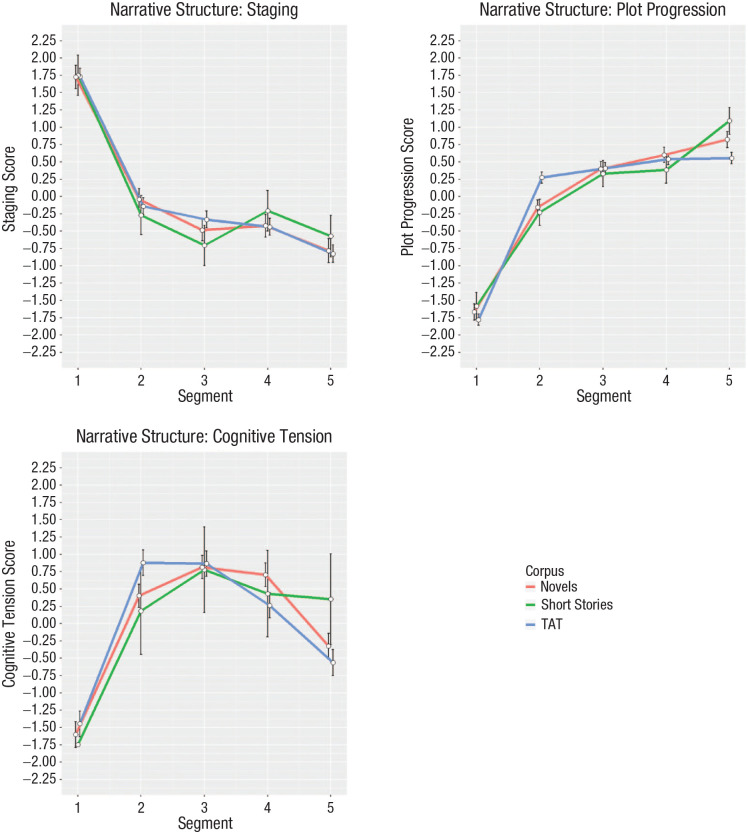
“The analysis shows that stories generally establish concreteness early on in the text as they stage events and scenes—laying out the backdrop and establishing locations, characters, and their relationships to one another.”
§ Stories in Action > The Definition and Structure of Stories > The structure of stories
What the sources say
- Supportedcites R. L. Boyd et al., 2020 matched to “The narrative arc: Revealing core narrative structures through text analysis” (2020) source
The Introduction describes staging as establishing names, locations, and relationships among characters and places at the beginning of a story. Results and Discussion (RQ1) reports that staging-related words are highest at the beginning and decline as stories unfold. The Summary and Conclusions explains that those words mark the labeling and connecting of people, objects, and events in time and space. Page numbers are unavailable in our copy. (LLM, conf=0.93)
plainstates a cause- Asserted: passes — The authors put it forward as true.
- Checkable: passes — It can be checked against evidence.
- Load-bearing: passes — The paper’s conclusions depend on it.
- Based: passes — The paper gives a reason why it holds.
- Supported
The cited sources support only part of this claim — read each source’s verdict below.
In the paper
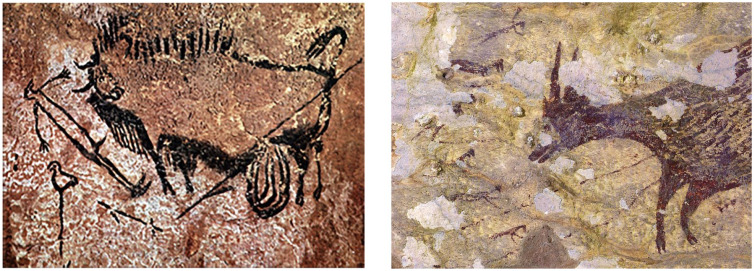
“Humans have had the ability to control fire for 1 to 2 million years (Berna et al., 2012)”
§ Stories in Action > The Evolution of Stories > Origins of storytelling
What the sources say
- Partly supportedcites Berna et al., 2012 matched to “Microstratigraphic evidence of in situ fire in the Acheulean strata of Wonderwerk Cave, Northern Cape province, South Africa” (2012) sourceExperimental — accuracy not yet measured
The paper’s opening section reports secure evidence of burning in an archaeological context at Wonderwerk Cave approximately 1.0 million years ago. It also says there is no consensus on when hominins first controlled fire and describes evidence associated with Homo erectus around 1.9 million years ago as scant and inconclusive. The claim therefore overstates what the paper establishes, particularly at the older end of the range. (LLM, conf=0.88)
plain- Asserted: passes — The authors put it forward as true.
- Checkable: passes — It can be checked against evidence.
- Load-bearing: unclear — It is unclear whether the paper’s conclusions depend on it.
- Based: passes — The paper gives a reason why it holds.
- Partly supported
Every source the paper cites for this claim was checked and supports it.
In the paper
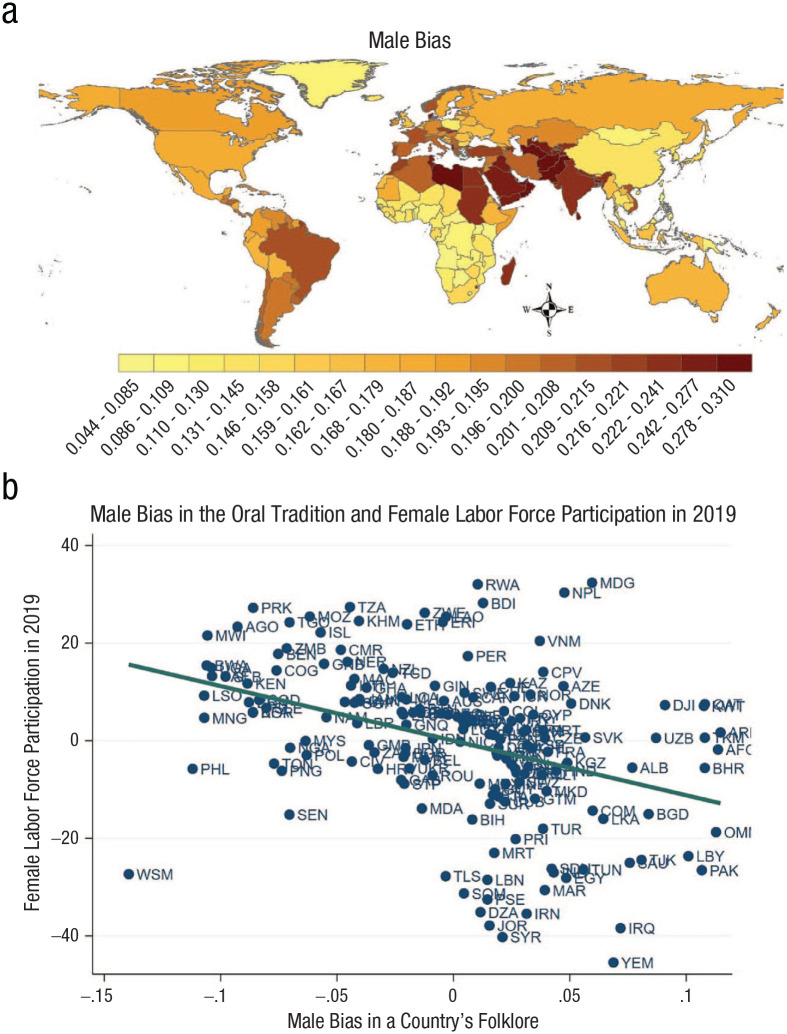
“They found that women are systematically less integrated into the labor market in societies with more gender bias in their folklore (i.e., they feature more images of dominant and physical men and domestic women).”
§ Stories in Action > The Evolution of Stories
What the sources say
- Supportedcites Michalopoulos & Xue, 2021 matched to “Folklore” (2021) source
The discussion of Table VII (p. 24) states that women are systematically less integrated into the labor market in societies whose oral traditions feature more dominant, physically active men and dependent, home-bound women. It also reports a negative association between male dominance bias and female labor-force participation. (LLM, conf=0.95)
plainstates an association- Asserted: passes — The authors put it forward as true.
- Checkable: passes — It can be checked against evidence.
- Load-bearing: passes — The paper’s conclusions depend on it.
- Based: passes — The paper gives a reason why it holds.
- Supported
Every source the paper cites for this claim was checked and supports it.
In the paper
“Michalopoulos and Xue (2021) examined a catalog of folklore developed by the Russian folklorist Yuri Berezkin that contains more than 2,500 motifs from 958 groups around the world.”
§ Stories in Action > The Evolution of Stories
What the sources say
- Supportedcites Michalopoulos & Xue, 2021 matched to “Folklore” (2021) source
Section 2, “Berezkin’s Folklore and Mythology Catalogue” (p. 3), says the authors use Berezkin’s catalogue and reports 2,564 motifs from 958 groups worldwide. This supports the attributed counts and scope. (LLM, conf=0.95)
plain- Asserted: passes — The authors put it forward as true.
- Checkable: passes — It can be checked against evidence.
- Load-bearing: passes — The paper’s conclusions depend on it.
- Based: passes — The paper gives a reason why it holds.
- Supported
141 more claims · 15 with their cited sources checked
Create a free account to see all 285 claims and to verify the 21 references still open.
- It may state two separate claims as one. 89
- Probably not a substantial claim. 64
- The quote only partly states this claim. 2
Citations
Cites
(1975) · PhilPapers (PhilPapers Foundation) · Cited by 36,737
Hardin, G. (1968) · Science · doi:10.1126/science.162.3859.1243 · Cited by 25,167
Governing the Commons: The Evolution of Institutions for Collective Action
Ostrom, E. (1990) · doi:10.1017/cbo9780511807763 · Cited by 20,653
Axelrod, R., & Hamilton, W. D. (1981) · Science · doi:10.1126/science.7466396 · Cited by 20,065
The Interpretation of Cultures
Fenn, R., & Geertz, C. (1974) · Journal for the Scientific Study of Religion · doi:10.2307/1384392 · Cited by 19,154 · cited 1×
“Second, they signal to people their role in that context (e.g., the characters are dining), helping them identify which script or performance to act out (Bicchieri, 2005; Geertz, 1973).”
BackgroundFilders, R. (1992) · International Journal of Forecasting · doi:10.1016/0169-2070(92)90130-2 · Cited by 16,165
Social Cognitive Theory: An Agentic Perspective
Bandura, A. (2001) · Annual Review of Psychology · doi:10.1146/annurev.psych.52.1.1 · Cited by 15,510
(2013) · American Economic Review · doi:10.1257/aer.103.5.i · Cited by 15,100
Crime and Punishment: An Economic Approach
Becker, G. S. (1968) · Journal of Political Economy · doi:10.1086/259394 · Cited by 13,999
The structural transformation of the public sphere: an inquiry into a category of bourgeois society
(1990) · Choice Reviews Online · doi:10.5860/choice.27-4175 · Cited by 12,693
Research works printed but not linked: 26
- Aristotle. (2013). Poetics (Kenny A. Trans.). Oxford University Press. (Original work published ca. 335 B.C.E.)
- Bandura A. (1986). Social cognitive theory: Social foundations of thought and action. Prentice Hall.
- Bandura A. (2006). Going global with social cognitive theory: From prospect to paydirt. In Donaldson S. I. Berger D. E. Pezdek K. (Eds.), Applied psychology: New frontiers and rewarding careers (pp. 53– 79). Erlbaum.
- Bönisch P. Hyll W. (2023). Television and fertility: Evidence from a natural experiment. Empirical Economics, 64, 1025– 1066.
- Brewer W. F. (2014). To assert that essentially all human knowledge and memory is represented in terms of stories is certainly wrong. In Wyer, Jr. R. S. (Ed.), Advances in social cognition: Vol. VII. Knowledge and memory: The real story (pp. 109– 119). Psychology Press.
- Brown D. E. (2017). Human universals. Temple University Press.
- Byrne D. (1971). The attraction paradigm. Academic Press.
- Chater N. (2018). The mind is flat: The illusion of mental depth and the improvised mind. Penguin.
- Dennett D. C. (1987). The intentional stance. MIT Press.
- Dissanayake E. (1988). What is art for? University of Washington Press.
- Dunbar R. (2022). How religion evolved: And why it endures. Oxford University Press.
- Eagly A. H. Chaiken S. (1993). The psychology of attitudes. Harcourt Brace Jovanovich.
- Epic of Gilgamesh. (George A. Trans.). (1999). Penguin Books.
- Graesser A. C. Olde B. Klettke B. (2002). How does the mind construct and represent stories? In Green M. C. Strange J. J. Brock T. C. (Eds.), Narrative impact: Social and cognitive foundations (pp. 229– 262). Erlbaum.
- Green M. C. Strange J. J. Brock T. C. (2002). Narrative impact: Social and cognitive foundations. Erlbaum.
- Harmon W. (2010). A handbook to literature (12th ed.). Pearson Education.
- Henrich J. (2020). The WEIRDest people in the world: How the West became psychologically peculiar and particularly prosperous. Farrar, Straus and Giroux.
- Heyes C. (2018). Cognitive gadgets. Harvard University Press.
- Hobbes T. (1991). Leviathan (Tuck R., Ed.). Cambridge University Press. (Original work published 1651)
- Hoppitt W. Laland K. N. (2013). Social learning. Princeton University Press.
- McAdams D. P. (1993). The stories we live by: Personal myths and the making of the self. Guilford Press.
- Nyhof M. Barrett J. (2001). Spreading non-natural concepts: The role of intuitive conceptual structures in memory and transmission of cultural materials. Journal of Cognition and Culture, 1(1), 69– 100. · DOI · Paper page
- Plato. (2000). The Republic (Ferrari G. R. F., Ed.; Griffith T., Trans.). Cambridge University Press. (Original work published ca. 375 B.C.E.)
- Puchner M. (2018). The written world: The power of stories to shape people, history, and civilization. Random House.
- Richerson P. J. Boyd R. (2005). Not by genes alone. University of Chicago Press.
- Zillmann D. (1996). The psychology of suspense in dramatic exposition. In Vorderer P. Wulff H. J. Friedrichsen M. (Eds.), Suspense: Conceptualizations, theoretical analyses, and empirical explorations (p. 199– 231). Erlbaum.
Cited by
The Psychology of Framing: How Everyday Language Shapes the Way We Think, Feel, and Act
Flusberg, S. J., Holmes, K. J., Thibodeau, P. H., Nabi, R. L., & Matlock, T. (2024) · Gothic.net · doi:10.1177/15291006241246966 · Cited by 154
Stigma Toward Substance Dependence: Causes, Consequences, and Potential Interventions
Krendl, A. C., & Perry, B. L. (2023) · Gothic.net · doi:10.1177/15291006231198193 · Cited by 110
“Campaigns or narratives that emphasize recovery and/or leverage social connections to change behavior or perceptions may be best suited to reducing SUD stigma (e.g., Walsh et al., 2023).”
BackgroundCultural Defaults in the Time of COVID: Lessons for the Future
Markus, H. R., Tsai, J. L., Uchida, Y., Yang, A. M., & Maitreyi, A. (2024) · Psychological Science in the Public Interest · doi:10.1177/15291006241277810 · Cited by 21
Listening to bridge societal divides
Santoro, E., & Markus, H. R. (2023) · Current Opinion in Psychology · doi:10.1016/j.copsyc.2023.101696 · Cited by 12
Economic ideology: Versions of the concept’s acceptations and application
Tambovtsev, V. (2024) · Voprosy Ekonomiki · doi:10.32609/0042-8736-2024-10-5-27 · Cited by 19
Creating demand for unmet needs: Agile Storytelling
Mehta, J., Long, E., Bynagari, V., Shojaei, F., Shojaei, F., O’Brien, A. R., & Boustani, M. A. (2024) · Frontiers in Health Services · doi:10.3389/frhs.2024.1376695 · Cited by 6
“By de fi nition, storytelling is a narrative that uses plot and characters to create new insights for the teller and listener of the story (49, 50).”
Exploring the relationship between fiction reading and emotion recognition
Castano, E., Ducceschi, L., Tiuleneva, M., Gaggero, G., Zanella, J., Saedi, F., Luminet, O., Samur, D., & Batini, F. (2025) · Motivation and Emotion · doi:10.1007/s11031-025-10170-w · Cited by 9
Conklin, H. G., & Andolina, M. W. (2025) · Theory & Research in Social Education · doi:10.1080/00933104.2025.2497232 · Cited by 5
“Stories that teachers introduce into the classroom—such as our case studies or Daryl Waters’ narrative —should be thoughtfully developed, vetted, and grounded in available knowledge and relevant facts (Walsh et al., 2022).”
InfluentialCan fictional stories beat the congeniality bias? Selective exposure to fiction and non-fiction
Appel, M., Gabel, J. J., Wimmer, L., Klöppel, M., & Richter, T. (2025) · Human Communication Research · doi:10.1093/hcr/hqaf027 · Cited by 3
Winkler, J. R., & Appel, M. (2025) · Media Psychology · doi:10.1080/15213269.2025.2545334 · Cited by 2
“Previous research has shown that fictional and non-fictional narratives do not systematically differ with regard to how they are experienced and how they shape beliefs, attitudes, and behaviors (Braddock & Dillard, 2016; Green & Appel, 2024; Green & Brock, 2000; Walsh et al., 2022).”
Mengelkamp, C., Golke, S., & Appel, M. (2025) · Applied Cognitive Psychology · doi:10.1002/acp.70036 · Cited by 3
Navarro-Díaz, L. R., Márceles, D. L. B., Madriz-Rodríguez, D. A., Albarracín, J. D. H., & Bravo, A. (2026) · Wellbeing Space and Society · doi:10.1016/j.wss.2026.100436
From knowledge to collective action: a peer-led model for climate and health leadership
Bjorgaard, J., & Barrera, G. E. (2026) · Frontiers in Public Health · doi:10.3389/fpubh.2026.1805050 · Cited by 1
The Place of Stories and Informal Conversations in the Social Sciences During Pandemics in Africa
Nyabundi, A. A. (2026) · International Journal of Qualitative Methods · doi:10.1177/16094069261431983
Rahiem, M. D. H. (2026) · AIP conference proceedings · doi:10.1063/5.0338135
Methods and techniques for data collection in automatic scene script composition
Kaur, G., Kaur, A., Khurana, M., & Damaševičius, R. (2025) · Digital Creativity · doi:10.1080/14626268.2025.2529436
“Other techniques such as topic modelling, pragmatic analysis and sentiment analysis can also be used to extract relevant information from text data and represent it in a structured format (Walsh et al. 2022).”
Rahayu, N. L. P. D. P., & Hasanah, R. (2025) · INJECT (Interdisciplinary Journal of Communication) · doi:10.18326/inject.v10i1.4504
Hunter, P. V., Wickson‐Griffiths, A., Tupper, S., Cammer, A. L., McCleary, L., Kaasalainen, S., Sussman, T., & Thompson, G. N. (2025) · Health & Social Care in the Community · doi:10.1155/hsc/3998877
Ein konzeptioneller Rahmen für Mentoring in Graduiertenprogrammen
Reyes, A. D. L. (2025) · Springer eBooks · doi:10.1007/978-3-031-83945-0_4
Nachwuchsforscher müssen Geschichten über ihre Arbeit erzählen
Reyes, A. D. L. (2025) · Springer eBooks · doi:10.1007/978-3-031-83945-0_1
Pol, S. M., Link, V., Toivonen, H. K., Scheepers, F. E., & Drossaert, C. H. C. (2025) · International Journal of Clinical Practice · doi:10.1155/ijcp/5023850 · Cited by 1
“In fourteen studies, the intervention group (IG) was more efective than the control group (CG) 1,3,4,6,10,11,14,21,22,26-28,33,34 , in four studies 9,13,16,30 , the outcomes were equal, and in two initial studies 2,12 and fve pre–post design studies 23,24,25,35,36 , no CG was used.”
The power of books: regular reading for pleasure and its impact on youth deviancy
Lassi, N. (2024) · Educational Research for Policy and Practice · doi:10.1007/s10671-024-09380-9
“According to Walsh et al. (2022), stories may be useful in influencing individuals’ understanding of the consequences of punishment.”
Early Career Researchers Must Tell Stories About Their Work
Reyes, A. D. L. (2024) · Springer eBooks · doi:10.1007/978-3-031-54284-8_1
A Conceptual Framework for Mentoring in Graduate Programs
Reyes, A. D. L. (2024) · Springer eBooks · doi:10.1007/978-3-031-54284-8_4
Page, L., Ruebeck, H., & Walsh, J. S. (2024) · SSRN Electronic Journal · doi:10.2139/ssrn.4799878 · Cited by 2
“First, we add to the large literature on the effect of narratives on social and economic outcomes (Jensen and Oster, 2009; Paluck, 2009; La Ferrara et al., 2012; Kearney and Levine, 2015; Shiller, 2017; Banerjee et al., 2019b,a; Kearney and Levine, 2019; Hoff et al., 2021; Riley, 2022; Walsh et al., 2022).”
BackgroundSelf-citation
Metadata
- Authors
- Walsh, J., Vaida, N., Coman, A., & Fiske, S. T.
- Affiliations
- Harvard University (US)
- Princeton University (US)
- Corresponding author
- Walsh, James
- Venue
- Psychological Science in the Public Interest
- Publisher
- SAGE Publications
- Published
- 2022-12
- Volume
- 23
- Issue
- 3
- Pages
- 99-141
- ISSN
- 1539-6053 (ISSN-L)
- 1529-1006
- PMC
- PMC10173355
- OpenAlex
- W4376131996
- Semantic Scholar
- 68325aa69720513255e57bad1d6d8f6b930d5452
- Cited by
- 26
- References
- 327
- Citations by year
- 2026: 5 · 2025: 11 · 2024: 8 · 2023: 2
- FWCI
- 17.14
- Type
- journal article
- Language
- en
- Open access
- hybrid
- doi.org
- Locations
- Gothic.net (publishedVersion, cc-by)
- PubMed Central (publishedVersion, cc-by)
- PubMed (publishedVersion)
- Funders
- oxford martin school, university of oxford
- economic and social research council (ES/R00787X/1 and RM02)
- Topics
- Social Sciences › Political Science and International Relations › Policy Transfer and Learning
- Social Sciences › Public Administration › Public Policy and Administration Research
- Social Sciences › Communication › Rhetoric and Communication Studies
- Keywords
- storytelling, public policy, policy communication, persuasion, collective action, learning, history of storytelling, technology and society, policy instruments
- MeSH terms
- Communication, Culture, Government, Humans, Learning, Persuasive Communication
About these checks
Registry, retraction, Cites and statistics results are computed, not judged, with one exception: a printed reference that no index lists is read once by a model before it counts as a citation error. Claims are extracted by a model and kept only when their quote appears verbatim in the text; each cited source is then checked, with a model’s help, for whether it says what the claim relies on. Those verdicts can be wrong — read the claim’s quote and the cited source before relying on one.
The claim verdicts this report counts are experimental: their accuracy is not yet measured.
A language model drew the claims from the paper on 2026-10-06, under version 3 of the claim definition (model deepseek-v4.1-flash, prompt extract-v3).
A second model labelled each claim on 2026-10-06 (model jev-1.13-20260917, definition revision gold-guideline-v0.2).
Cited sources are checked with a language model’s help (gpt-6-sol).
Statistics and arithmetic are recomputed, not judged.
Confidence bands are shown only for fields calibrated on our annotated test set. None is calibrated yet, so no band is shown.
What counts as a claim ›How we measure confidence ›How we check this ›
Are you an author, or do you see a problem with this page? Request a review
Data sources
Bibliographic data: Semantic Scholar, OpenAlex, Crossref.
Contains information from the Semantic Scholar Academic Graph Datasets, made available under the ODC Attribution License (ODC-BY 1.0).
Semantic Scholar’s data is described in: Kinney, R., et al. (2023). The Semantic Scholar Open Data Platform. arXiv:2301.10140.
