

Stories in Action.
Open accessThe DOI matches its Crossref record; 322 of the 338 references it cites were found in a registry or an index, and 13 are not checked yet; 39 of the 223 sources its claims cite were checked for support.
Abstract
Stories have played a central role in human social and political life for thousands of years. Despite their ubiquity in culture and custom, however, they feature only peripherally in formal government policymaking. Government policy has tended to rely on tools with more predictable responses-incentives, transfers, and prohibitions. We argue that stories can and should feature more centrally in government policymaking. We lay out how stories can make policy more effective, specifying how they complement established policy tools. We provide a working definition of stories' key characteristics, contrasting them with other forms of communication. We trace the evolution of stories from their ancient origins to their role in mediating the impact of modern technologies on society. We then provide an account of the mechanisms underlying stories' impacts on their audiences. We conclude by describing three functions of stories-learning, persuasion, and collective action.
Verified 2026-11-22 · 13 references not checked yet
Overview
CoChat Summary
## TL;DR
This paper argues that stories should be treated as a central policy tool, not just entertainment or persuasion, because they shape learning, attitudes, and collective action. It synthesizes psychological and social-science evidence to show how stories work through transportation, identification, and meaning making, and how they can improve incentives, information provision, and coordination.
## Key findings
- Stories can make standard policy instruments more effective: they can improve incentives by communicating their meaning and reifying costs, and improve information provision by making complex information easier to digest and more scalable.
- The paper defines stories by three core features: they depict temporal events, include goal-directed agents, and organize events into causal sequences.
- It identifies three mechanisms of narrative impact: transportation/engagement, identification, and meaning making; these are said to update beliefs, attitudes, and behaviors in story-consistent ways.
- It highlights multiple reported effects from prior studies, including: a narrative video that made low-income African American women 2x as likely to get a mammography exam after 6 months; a Nigerian soap-opera intervention in which participants were 2x as likely to get tested for HIV and women’s chlamydia positivity fell by 55%; and Brazilian telenovela exposure associated with a fertility drop of approximately 7%.
## Methods
- This is a conceptual review, not a single empirical study.
- It synthesizes findings from psychology, behavioral economics, communication, and policy research, drawing on prior experiments, randomized trials, meta-analyses, natural experiments, and computational analyses cited throughout the paper.
- The main analysis is argumentative and integrative: the authors organize the literature into sections on policy design, story structure, narrative mechanisms, and social functions.
## Limitations
- The paper itself states that many claims about the role of stories in society remain underexplored or only partially understood by government policymakers, and that the evidence base for some applications is still “in the early stages” or “in need of empirical grounding.”
- It notes that several effects discussed are hard to pin down causally even when there is precise covariation; this is a limitation of the broader evidence base, not a limitation of one specific study.
- Evident from the text: this is a narrative review, so it does not present a new unified dataset or a single new empirical estimate of its own.
Model-written summary. Check it against the paper before relying on it.
Integrity signals
Registry
Cites
Statistics
Figures
Verification
Claims the paper makes
37 Valid · 6 Not valid · 141 Not checked · 101 Own results and interpretations
The cited sources support only part of this claim — read each source’s verdict below.
In the paper
“When information is presented to people in the form of a story, they are less likely to feel that they are being manipulated and to counterargue (Kreuter et al., 2010).”
§ Stories in Action > Stories and Public Policy > Information provision
What the sources say
- Partly supportedcites Kreuter et al., 2010 matched to “Comparing narrative and informational videos to increase mammography in low-income African American women” (2010) sourceExperimental — accuracy not yet measured
The Introduction says audiences absorbed in a narrative are less likely to counterargue, and the Results report less counterarguing after the narrative video. The Measures section does not assess whether viewers felt manipulated, and the cited passages do not establish that part of the claim. (LLM, conf=0.86)
hedgedstates a cause- Asserted: passes — The authors put it forward as true.
- Checkable: passes — It can be checked against evidence.
- Load-bearing: passes — The paper’s conclusions depend on it.
- Based: passes — The paper gives a reason why it holds.
- Partly supported
Every source the paper cites for this claim was checked and supports it.
In the paper
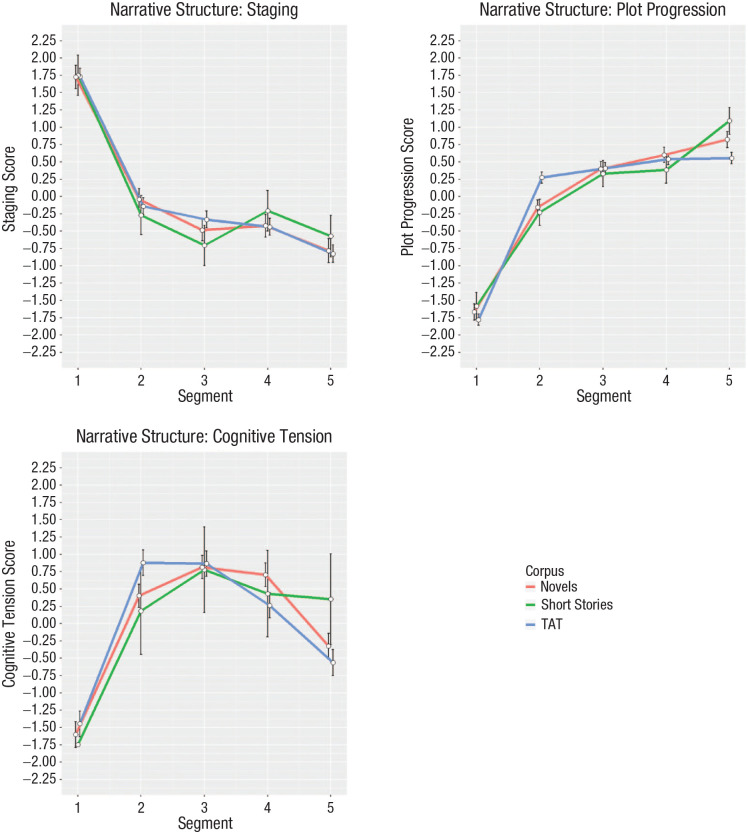
“The analysis shows that stories generally establish concreteness early on in the text as they stage events and scenes—laying out the backdrop and establishing locations, characters, and their relationships to one another.”
§ Stories in Action > The Definition and Structure of Stories > The structure of stories
What the sources say
- Supportedcites R. L. Boyd et al., 2020 matched to “The narrative arc: Revealing core narrative structures through text analysis” (2020) source
The Introduction describes staging as establishing names, locations, and relationships among characters and places at the beginning of a story. Results and Discussion (RQ1) reports that staging-related words are highest at the beginning and decline as stories unfold. The Summary and Conclusions explains that those words mark the labeling and connecting of people, objects, and events in time and space. Page numbers are unavailable in our copy. (LLM, conf=0.93)
plainstates a cause- Asserted: passes — The authors put it forward as true.
- Checkable: passes — It can be checked against evidence.
- Load-bearing: passes — The paper’s conclusions depend on it.
- Based: passes — The paper gives a reason why it holds.
- Supported
The cited sources support only part of this claim — read each source’s verdict below.
In the paper
“Humans have had the ability to control fire for 1 to 2 million years (Berna et al., 2012)”
§ Stories in Action > The Evolution of Stories > Origins of storytelling
What the sources say
- Partly supportedcites Berna et al., 2012 matched to “Microstratigraphic evidence of in situ fire in the Acheulean strata of Wonderwerk Cave, Northern Cape province, South Africa” (2012) sourceExperimental — accuracy not yet measured
The paper’s opening section reports secure evidence of burning in an archaeological context at Wonderwerk Cave approximately 1.0 million years ago. It also says there is no consensus on when hominins first controlled fire and describes evidence associated with Homo erectus around 1.9 million years ago as scant and inconclusive. The claim therefore overstates what the paper establishes, particularly at the older end of the range. (LLM, conf=0.88)
plain- Asserted: passes — The authors put it forward as true.
- Checkable: passes — It can be checked against evidence.
- Load-bearing: unclear — It is unclear whether the paper’s conclusions depend on it.
- Based: passes — The paper gives a reason why it holds.
- Partly supported
Every source the paper cites for this claim was checked and supports it.
In the paper
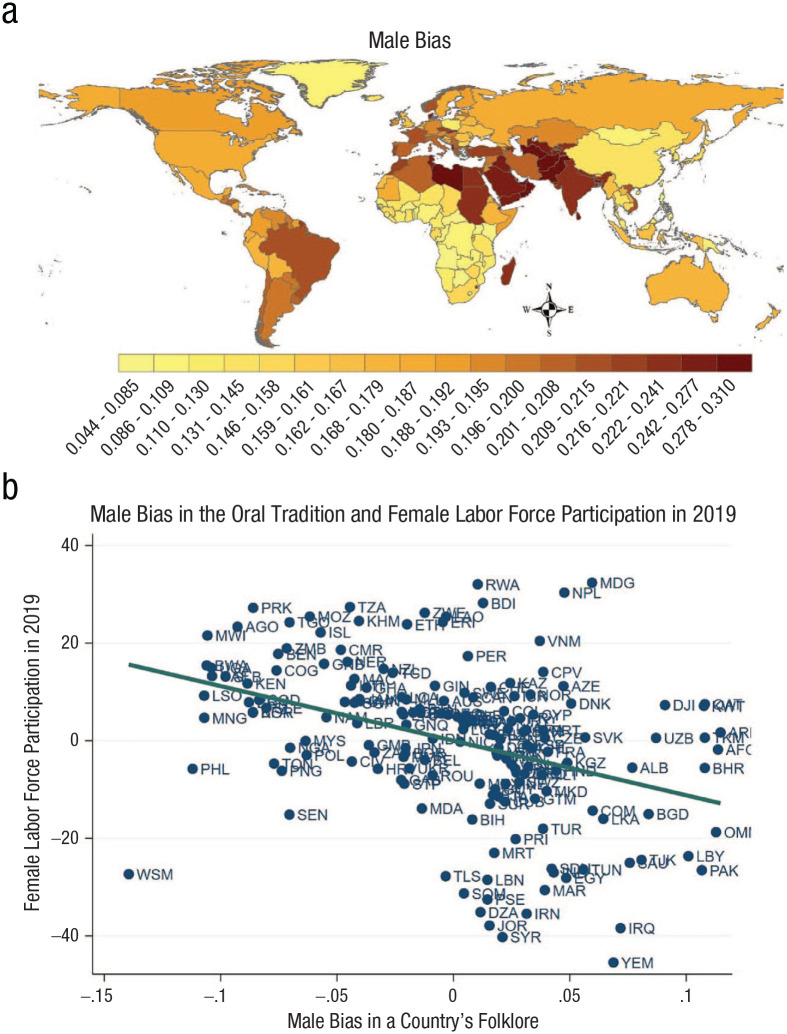
“They found that women are systematically less integrated into the labor market in societies with more gender bias in their folklore (i.e., they feature more images of dominant and physical men and domestic women).”
§ Stories in Action > The Evolution of Stories
What the sources say
- Supportedcites Michalopoulos & Xue, 2021 matched to “Folklore” (2021) source
The discussion of Table VII (p. 24) states that women are systematically less integrated into the labor market in societies whose oral traditions feature more dominant, physically active men and dependent, home-bound women. It also reports a negative association between male dominance bias and female labor-force participation. (LLM, conf=0.95)
plainstates an association- Asserted: passes — The authors put it forward as true.
- Checkable: passes — It can be checked against evidence.
- Load-bearing: passes — The paper’s conclusions depend on it.
- Based: passes — The paper gives a reason why it holds.
- Supported
Every source the paper cites for this claim was checked and supports it.
In the paper
“Michalopoulos and Xue (2021) examined a catalog of folklore developed by the Russian folklorist Yuri Berezkin that contains more than 2,500 motifs from 958 groups around the world.”
§ Stories in Action > The Evolution of Stories
What the sources say
- Supportedcites Michalopoulos & Xue, 2021 matched to “Folklore” (2021) source
Section 2, “Berezkin’s Folklore and Mythology Catalogue” (p. 3), says the authors use Berezkin’s catalogue and reports 2,564 motifs from 958 groups worldwide. This supports the attributed counts and scope. (LLM, conf=0.95)
plain- Asserted: passes — The authors put it forward as true.
- Checkable: passes — It can be checked against evidence.
- Load-bearing: passes — The paper’s conclusions depend on it.
- Based: passes — The paper gives a reason why it holds.
- Supported
141 more claims · 15 with their cited sources checked
Create a free account to see all 285 claims and to verify the 15 references still open.
- It may state two separate claims as one. 89
- Probably not a substantial claim. 64
- The quote only partly states this claim. 2
Citations
Cites
(1975) · PhilPapers (PhilPapers Foundation) · Cited by 36,737
Hardin, G. (1968) · Science · doi:10.1126/science.162.3859.1243 · Cited by 25,167
Governing the Commons: The Evolution of Institutions for Collective Action
Ostrom, E. (1990) · doi:10.1017/cbo9780511807763 · Cited by 20,653
Axelrod, R., & Hamilton, W. D. (1981) · Science · doi:10.1126/science.7466396 · Cited by 20,065
The Interpretation of Cultures
Fenn, R., & Geertz, C. (1974) · Journal for the Scientific Study of Religion · doi:10.2307/1384392 · Cited by 19,154 · cited 1×
“Second, they signal to people their role in that context (e.g., the characters are dining), helping them identify which script or performance to act out (Bicchieri, 2005; Geertz, 1973).”
BackgroundFilders, R. (1992) · International Journal of Forecasting · doi:10.1016/0169-2070(92)90130-2 · Cited by 16,165
Social Cognitive Theory: An Agentic Perspective
Bandura, A. (2001) · Annual Review of Psychology · doi:10.1146/annurev.psych.52.1.1 · Cited by 15,510
(2013) · American Economic Review · doi:10.1257/aer.103.5.i · Cited by 15,100
Crime and Punishment: An Economic Approach
Becker, G. S. (1968) · Journal of Political Economy · doi:10.1086/259394 · Cited by 13,999
The structural transformation of the public sphere: an inquiry into a category of bourgeois society
(1990) · Choice Reviews Online · doi:10.5860/choice.27-4175 · Cited by 12,693
Imagined Communities: Reflections on the Origin and Spread of Nationalism
Sears, L. J., & Anderson, B. (1994) · Journal of the American Oriental Society · doi:10.2307/604991 · Cited by 12,559
The Evolution of Reciprocal Altruism
Trivers, R. L. (1971) · The Quarterly Review of Biology · doi:10.1086/406755 · Cited by 11,010 · cited 1×
“Another common strategy for managing social dilemmas is to cooperate with others as long as they cooperate with you (Fehr et al., 2002; Fischbacher et al., 2001; Trivers, 1971).”
BackgroundPierce, W. D., & Bandura, A. (1977) · Canadian Journal of Sociology / Cahiers canadiens de sociologie · doi:10.2307/3340496 · Cited by 9,650
Culture in Action: Symbols and Strategies
Swidler, A. (1986) · American Sociological Review · doi:10.2307/2095521 · Cited by 8,661 · cited 1×
“People also learn how to interact through the stories they hear as children from their parents, through the gossip heard about how others behave, and through the stories in mass media (Baumeister et al., 2004; Swidler, 1986; Zerubavel, 2009).”
BackgroundBruner, J. (1986) · doi:10.4159/9780674029019 · Cited by 8,657
REMEMBERING: A STUDY IN EXPERIMENTAL AND SOCIAL PSYCHOLOGY
Bartlett, F. C., & Burt, C. (1933) · British Journal of Educational Psychology · doi:10.1111/j.2044-8279.1933.tb02913.x · Cited by 7,475 · cited 1×
“Through these culturally grounded cognitive schemas, a person can impose meaning on ambiguous information (Bartlett, 1932).”
BackgroundThe Cultural Origins of Human Cognition
Tomasello, M. (2009) · doi:10.2307/j.ctvjsf4jc · Cited by 6,368
Nielsen, R. P., & Axelrod, R. (1985) · The Academy of Management Review · doi:10.2307/257983 · Cited by 6,321
Family resemblances: Studies in the internal structure of categories
Rosch, E., & Mervis, C. B. (1975) · Cognitive Psychology · doi:10.1016/0010-0285(75)90024-9 · Cited by 5,933 · cited 1×
“For this reason, narrativity may be best thought of as a continuum based on family resemblances (Stein, 1982; see also Rosch & Mervis, 1975).”
BackgroundThe Narrative Construction of Reality
Bruner, J. (1991) · Critical Inquiry · doi:10.1086/448619 · Cited by 5,728 · cited 1×
“Stories are central to the explanations humans formulate of social behavior (Bruner, 1991; Dennett, 1987, 1988; Sarbin, 1986, 1990).”
BackgroundAltruistic punishment in humans
Fehr, E., & Gächter, S. (2002) · Nature · doi:10.1038/415137a · Cited by 5,616 · cited 2×
“Another common strategy for managing social dilemmas is to cooperate with others as long as they cooperate with you (Fehr et al., 2002; Fischbacher et al., 2001; Trivers, 1971).”
BackgroundAkerlof, G. A., & Kranton, R. E. (2000) · Quarterly Journal of Economics · doi:10.1162/003355300554881 · Cited by 5,585 · cited 1×
“Identity also affects groups’ capacity for collective action (Akerlof & Kranton, 2000, 2005).”
BackgroundPetty, R. E., & Cacioppo, J. T. (1986) · doi:10.1007/978-1-4612-4964-1 · Cited by 5,219
The Social Self: On Being the Same and Different at the Same Time
Brewer, M. B. (1991) · Personality and Social Psychology Bulletin · doi:10.1177/0146167291175001 · Cited by 5,107 · cited 1×
“Social identity determines the boundaries of community membership (M. B. Brewer, 1991) and establishes people’s role within their group (Biddle, 2013).”
Background(1998) · Cited by 4,875
The role of transportation in the persuasiveness of public narratives.
Green, M. C., & Brock, T. C. (2000) · Journal of Personality and Social Psychology · doi:10.1037/0022-3514.79.5.701 · Cited by 4,861
The Psychology of Prejudice: Ingroup Love and Outgroup Hate?
Brewer, M. B. (1999) · Journal of Social Issues · doi:10.1111/0022-4537.00126 · Cited by 3,494 · cited 1×
“Group membership makes collective action easier because shared identity fosters prosociality and trust (M. B. Brewer, 1999; Y. Chen & Li, 2009; Wit & Wilke, 1992).”
BackgroundAn Experimental Study of Apparent Behavior
Heider, F., & Simmel, M. (1944) · The American Journal of Psychology · doi:10.2307/1416950 · Cited by 3,340 · cited 1×
“In a famous experiment, Heider and Simmel (1944) showed people a short video depicting three shapes (a large triangle, a small triangle, and a small circle) moving around a screen, in and out of an opening and closing rectangular box.”
BackgroundDifferences Between Tight and Loose Cultures: A 33-Nation Study
Gelfand, M. J., Raver, J. L., Nishii, L., Leslie, L. M., Lun, J., Lim, B. C., Duan, L., Almaliach, A., Ang, S., Arnadottir, J., et al. (2011) · Science · doi:10.1126/science.1197754 · Cited by 3,252 · cited 1×
“One proposal is that they emerge because of cultural heterogeneity in early socialization practices and exposure to different environmental conditions that involve routine engagement in tasks that strengthen these preferences (Gelfand et al., 2011).”
BackgroundDiMaggio, P. (1997) · Annual Review of Sociology · doi:10.1146/annurev.soc.23.1.263 · Cited by 3,161 · cited 1×
“These schemas are defined as widely shared knowledge structures that provide default assumptions about an event’s characteristics and relations to other events (DiMaggio, 1997; Fiske & Linville, 1980).”
BackgroundConvention: A Philosophical Study.
Llewelyn, J. E., & Lewis, D. K. (1970) · The Philosophical Quarterly · doi:10.2307/2218418 · Cited by 3,121
Scripts, Plans, Goals, and Understanding: An Inquiry into Human Knowledge Structures
Kronenfeld, D. B., Schank, R. C., & Abelson, R. P. (1978) · Language · doi:10.2307/412850 · Cited by 3,054 · cited 3×
“They contain procedural knowledge about how events unfold: what happens and in what order (Schank & Abelson, 1977).”
Background(1981) · Cited by 3,038
The Psychology of Life Stories
McAdams, D. P. (2001) · Review of General Psychology · doi:10.1037/1089-2680.5.2.100 · Cited by 2,808 · cited 1×
“A large body of psychology has explored how people use narratives to construct the self (McAdams, 1993, 2001).”
BackgroundPredicting and Changing Behavior
Fishbein, M., & Ajzen, I. (2011) · doi:10.4324/9780203838020 · Cited by 2,807
Not By Genes Alone: How Culture Transformed Human Evolution
Richerson, P. J., & Boyd, R. (2004) · doi:10.7208/chicago/9780226712130.001.0001 · Cited by 2,793
Are people conditionally cooperative? Evidence from a public goods experiment
Fischbacher, U., Gächter, S., & Fehr, E. (2001) · Economics Letters · doi:10.1016/s0165-1765(01)00394-9 · Cited by 2,780 · cited 1×
“Another common strategy for managing social dilemmas is to cooperate with others as long as they cooperate with you (Fehr et al., 2002; Fischbacher et al., 2001; Trivers, 1971).”
BackgroundCoevolution of neocortical size, group size and language in humans
Dunbar, R. I. M. (1993) · Behavioral and Brain Sciences · doi:10.1017/s0140525x00032325 · Cited by 2,365 · cited 1×
“Animals with large, complex brains have long developmental periods and have more developed capacities for socialization (Dunbar, 1993, 1998; Herculano-Houzel, 2019).”
BackgroundA question of belonging: Race, social fit, and achievement.
Walton, G. M., & Cohen, G. L. (2007) · Journal of Personality and Social Psychology · doi:10.1037/0022-3514.92.1.82 · Cited by 2,163 · cited 1×
“22 Whether it is within nations or smaller organizational units, one concern that people often have is whether people such them belong in particular spaces and groups (Walton & Cohen, 2007).”
BackgroundRemembrance of things parsed: Story structure and recall
Mandler, J. M., & Johnson, N. S. (1977) · Cognitive Psychology · doi:10.1016/0010-0285(77)90006-8 · Cited by 2,085 · cited 5×
“The importance of schemas for encoding is evident when stories violate expectations (Mandler & Johnson, 1977): Just the right amount of violation can heighten encoding because the audience tries to make sense of an unexpected event.”
BackgroundInfluentialBus, A. G., van IJzendoorn, M. H., & Pellegrini, A. D. (1995) · Review of Educational Research · doi:10.3102/00346543065001001 · Cited by 2,063 · cited 1×
“A large literature shows that children whose parents read to them when they are babies and preschoolers are better able to read later (Bus et al., 1995).”
BackgroundDawes, R. M. (1980) · Annual Review of Psychology · doi:10.1146/annurev.ps.31.020180.001125 · Cited by 2,022
A Brief Social-Belonging Intervention Improves Academic and Health Outcomes of Minority Students
Walton, G. M., & Cohen, G. L. (2011) · Science · doi:10.1126/science.1198364 · Cited by 1,992 · cited 1×
“One study (Walton & Cohen, 2011) shared stories with students that framed social adversity in school as common and temporary and encouraged them not to see difficulties as unique to them or people such as them.”
BackgroundThe Grammar of Society: The Nature and Dynamics of Social Norms
Bicchieri, C. (2005) · doi:10.1017/cbo9780511616037 · Cited by 1,991 · cited 3×
“Second, they signal to people their role in that context (e.g., the characters are dining), helping them identify which script or performance to act out (Bicchieri, 2005; Geertz, 1973).”
BackgroundDefining Identification: A Theoretical Look at the Identification of Audiences With Media Characters
Cohen, J. (2001) · Mass Communication and Society · doi:10.1207/s15327825mcs0403_01 · Cited by 1,928 · cited 3×
“Good stories connect audiences to their characters (Cohen, 2001).”
BackgroundThaler, R. H., & Sunstein, C. R. (2003) · American Economic Review · doi:10.1257/000282803321947001 · Cited by 1,874
Stasser, G., & Titus, W. (1985) · Journal of Personality and Social Psychology · doi:10.1037/0022-3514.48.6.1467 · Cited by 1,850 · cited 1×
“This bias could be due to people’s preference to discuss shared information, relative to unshared information (Stasser & Titus, 1985).”
Background(1991) · Virginia Woolf: To the Lighthouse · doi:10.5040/9781350387997.0012 · Cited by 1,830
Gneezy, U., & Rustichini, A. (2000) · The Journal of Legal Studies · doi:10.1086/468061 · Cited by 1,816 · cited 1×
“Parents did not feel comfortable taking advantage of teachers’ patience, but once the fine was introduced, they felt more comfortable paying to arrive late (Gneezy & Rustichini, 2000).”
BackgroundSocial Cognition: From Brains to Culture
Fiske, S. T., & Taylor, S. E. (2013) · SAGE Publications Ltd eBooks · doi:10.4135/9781529681451 · Cited by 1,741
Self-citationCelebrity Endorsement: A Literature Review
Erdogan, B. Z. (1999) · Journal of Marketing Management · doi:10.1362/026725799784870379 · Cited by 1,734 · cited 1×
“5 The influence of celebrities on attitudes, beliefs, and behavior is so strong that their endorsements are a key part of businesses’ marketing strategies (Erdogan, 1999; Knoll & Matthes, 2017).”
BackgroundIdentity and the Economics of Organizations
Akerlof, G. A., & Kranton, R. E. (2005) · Journal of Economic Perspectives · doi:10.1257/0895330053147930 · Cited by 1,676 · cited 1×
“Identity also affects groups’ capacity for collective action (Akerlof & Kranton, 2000, 2005).”
BackgroundRumelhart, D. E. (1975) · Representation and Understanding · doi:10.1016/b978-0-12-108550-6.50013-6 · Cited by 1,671 · cited 1×
“Cognitive psychologists have studied how stories are represented in the mind since the 1970s and 1980s (Black & Wilensky, 1979; Mandler, 1982; Mandler & Johnson, 1977; Rumelhart, 1975; Stein, 1982; Stein & Trabasso, 1981; Trabasso & van den Broek, 1985).”
BackgroundReading literary fiction improves theory of mind
Kidd, D. C., & Castano, E. (2013) · Science · doi:10.1126/science.1239918 · Cited by 1,642 · cited 1×
“Some studies have found that reading fiction improves sociocognitive abilities (Kidd & Castano, 2013; Pino & Mazza, 2016).”
BackgroundThe origins of political order: from prehuman times to the French Revolution
(2011) · Choice Reviews Online · doi:10.5860/choice.49-1735 · Cited by 1,605
The Fox News Effect: Media Bias and Voting
DellaVigna, S., & Kaplan, E. (2007) · The Quarterly Journal of Economics · doi:10.1162/qjec.122.3.1187 · Cited by 1,602 · cited 1×
“Moreover, the rise of Fox News is estimated to have led between 5% and 30% of non-Republican voters to switch their support to George W. Bush in the 2000 election (DellaVigna & Kaplan, 2007).”
BackgroundIntergroup Threat and Outgroup Attitudes: A Meta-Analytic Review
Riek, B. M., Mania, E. W., & Gaertner, S. L. (2006) · Personality and Social Psychology Review · doi:10.1207/s15327957pspr1004_4 · Cited by 1,588 · cited 1×
“Antagonistic relations between different communities (Posner, 2004), the motivation to compete for scarce resources (Riek et al., 2006), and the motivation to assert group differences (Ybarra & Ramón, 2004) are factors that are likely to lead to divergence in the construction of these narratives.”
BackgroundHumans Have Evolved Specialized Skills of Social Cognition: The Cultural Intelligence Hypothesis
Herrmann, E., Call, J., Hernàndez-Lloreda, M. V., Hare, B., & Tomasello, M. (2007) · Science · doi:10.1126/science.1146282 · Cited by 1,582
Morphology of the Folktale: Second Edition
(1968) · University of Texas Press eBooks · doi:10.7560/783911 · Cited by 1,554 · cited 1×
“But only in the past two centuries have scholars developed the tools to analyze stories systematically (Lévi-Strauss, 1978; Propp, 1968).”
BackgroundLaland, K. N. (2004) · Learning & Behavior · doi:10.3758/bf03196002 · Cited by 1,551 · cited 1×
“People are strategic social learners— they are highly selective in deciding whom to learn from (Hoppitt & Laland, 2013; Laland, 2004; Rendell et al., 2011).”
BackgroundGroup Identity and Social Preferences
Chen, Y., & Li, S. X. (2009) · American Economic Review · doi:10.1257/aer.99.1.431 · Cited by 1,536 · cited 1×
“Group membership makes collective action easier because shared identity fosters prosociality and trust (M. B. Brewer, 1999; Y. Chen & Li, 2009; Wit & Wilke, 1992).”
BackgroundThe Stag Hunt and the Evolution of Social Structure
Skyrms, B. (2003) · Cambridge University Press eBooks · doi:10.1017/cbo9781139165228 · Cited by 1,524
McAdams, D. P., & McLean, K. C. (2013) · Current Directions in Psychological Science · doi:10.1177/0963721413475622 · Cited by 1,497
A taxonomy of external and internal attention.
Chun, M. M., Golomb, J. D., & Turk-Browne, N. B. (2011) · Annual Review of Psychology · doi:10.1146/annurev.psych.093008.100427 · Cited by 1,472 · cited 1×
“Attention refers to the focus of consciousness, either attending to external stimuli for the purpose of encoding information or retrieving the information from memory (Chun et al., 2011).”
BackgroundSlater, M. D., & Rouner, D. (2002) · Communication Theory · doi:10.1111/j.1468-2885.2002.tb00265.x · Cited by 1,458 · cited 2×
“Transportation refers to the state of being so immersed in a story that the audience can forget where they are (Green & Brock, 2000; Slater & Rouner, 2002).”
BackgroundSoap Operas and Fertility: Evidence from Brazil
Ferrara, E. L., Chong, A., & Duryea, S. (2012) · American Economic Journal: Applied Economics · doi:10.1257/app.4.4.1 · Cited by 1,453 · cited 2×
“Among other female characters, three quarters had only one child (La Ferrara et al., 2012).”
BackgroundMasuda, T., & Nisbett, R. E. (2001) · Journal of Personality and Social Psychology · doi:10.1037/0022-3514.81.5.922 · Cited by 1,424
Reputation and Coalitions in Medieval Trade: Evidence on the Maghribi Traders
Greif, A. (1989) · The Journal of Economic History · doi:10.1017/s0022050700009475 · Cited by 1,420 · cited 1×
“One of the main ways that groups hold people accountable for their track record is by disseminating reputational information about them (Greif, 1989, 1993).”
BackgroundManski, C. F. (2004) · Econometrica · doi:10.1111/j.1468-0262.2004.00537.x · Cited by 1,404 · cited 1×
“Beliefs, on the other hand, are expectations about the likelihood of different states of the world (Fishbein & Ajzen, 1975; Manski, 2004; Ramsey, 1931/2016).”
BackgroundStrong reciprocity, human cooperation, and the enforcement of social norms
Fehr, E., Fischbacher, U., & Gächter, S. (2002) · Human Nature · doi:10.1007/s12110-002-1012-7 · Cited by 1,372 · cited 2×
“Another common strategy for managing social dilemmas is to cooperate with others as long as they cooperate with you (Fehr et al., 2002; Fischbacher et al., 2001; Trivers, 1971).”
BackgroundMoyer-Gusé, E. (2008) · Communication Theory · doi:10.1111/j.1468-2885.2008.00328.x · Cited by 1,365 · cited 4×
“…on narrative per-suasion not just in social psychology but also in fields related to policy: communication (Braddock & Dillard, 2016; de Graaf et al., 2016; Moyer-Gusé, 2008; Moyer-Gusé & Nabi, 2010) and public health (Hinyard & Kreuter, 2007; Orozco-Olvera et al., 2019; Shen et al., 2015).”
BackgroundInfluentialThe Function of Fiction is the Abstraction and Simulation of Social Experience
Mar, R. A., & Oatley, K. (2008) · Perspectives on Psychological Science · doi:10.1111/j.1745-6924.2008.00073.x · Cited by 1,345 · cited 5×
“First, people project the self onto the represented characters, a process termed mentalizing (Mar & Oatley, 2008).”
BackgroundInfluentialRamsey, F. P. (2016) · Readings in Formal Epistemology · doi:10.1007/978-3-319-20451-2_3 · Cited by 1,301 · cited 1×
“Beliefs, on the other hand, are expectations about the likelihood of different states of the world (Fishbein & Ajzen, 1975; Manski, 2004; Ramsey, 1931/2016).”
BackgroundUnderstanding Media Enjoyment: The Role of Transportation Into Narrative Worlds
Green, M. C., Brock, T. C., & Kaufman, G. F. (2004) · Communication Theory · doi:10.1093/ct/14.4.311 · Cited by 1,267 · cited 1×
“Emotions can immerse the audience in the plot to such an extent that they lose touch with their surroundings (Green et al., 2004).”
BackgroundParasocial Interaction: A Review of the Literature and a Model for Future Research
Giles, D. C. (2002) · Media Psychology · doi:10.1207/s1532785xmep0403_04 · Cited by 1,245 · cited 1×
“Parasocial interaction operates as though it were a real-world social relationship; the audience develops lasting attachments that influence real-world aspirations (Giles, 2002).”
BackgroundHardin, R. (1982) · doi:10.56021/9780801828188 · Cited by 1,230
(2016) · Choice Reviews Online · doi:10.5860/choice.195747 · Cited by 1,181 · cited 2×
“People develop a vast array of their capabilities through the process of social learning (Henrich, 2017; Herrmann et al., 2007; Heyes, 2018; Tomasello, 1999).”
BackgroundUsing narratives and storytelling to communicate science with nonexpert audiences
Dahlstrom, M. F. (2014) · Proceedings of the National Academy of Sciences · doi:10.1073/pnas.1320645111 · Cited by 1,159 · cited 2×
“17 People use stories to teach children how to read (Price & Kalil, 2019), as scaffolding to impart lessons on norms and morality (Baumeister et al., 2004; Walker & Lombrozo, 2017), and to explain how the natural world works (Dahlstrom, 2014).”
BackgroundNudge: Improving Decisions About Health, Wealth, and Happiness
Hoyt, G. M. (2009) · International Review of Economics Education · doi:10.1016/s1477-3880(15)30073-6 · Cited by 1,142
Hinyard, L. J., & Kreuter, M. W. (2007) · Health Education & Behavior · doi:10.1177/1090198106291963 · Cited by 1,136
The seven sins of memory: Insights from psychology and cognitive neuroscience.
Schacter, D. L. (1999) · American Psychologist · doi:10.1037/0003-066x.54.3.182 · Cited by 1,133 · cited 2×
“Why does this happen? First, people’s memories and beliefs are highly malleable (Chater, 2018; Schacter, 1999).”
Backgroundvan Laer, T., de Ruyter, K., Visconti, L. M., & Wetzels, M. (2014) · Journal of Consumer Research · doi:10.1086/673383 · Cited by 1,129 · cited 1×
“We do not address the use of persuasion by companies and other private interests (see van Laer et al., 2014, for a discussion).”
(2002) · National Academies Press eBooks · doi:10.17226/10287 · Cited by 1,125
The Theory of the Leisure Class: An Economic Study in the Evolution of Institutions
Veblen, T. B. (2000) · Medical Entomology and Zoology · Cited by 1,089
Measuring Narrative Engagement
Busselle, R., & Bilandzic, H. (2009) · Media Psychology · doi:10.1080/15213260903287259 · Cited by 1,088 · cited 1×
“Busselle and Bilandzic (2009) also add two features in their definition of engagement: narrative understanding (i.e., comprehension) and narrative presence (i.e., “being there”).”
Background(1984) · Medical Entomology and Zoology · Cited by 1,076
Haley, K. J., & Fessler, D. M. T. (2005) · Evolution and Human Behavior · doi:10.1016/j.evolhumbehav.2005.01.002 · Cited by 1,073 · cited 1×
“People, as it turns out, are highly sensitive to the reputational consequences of their actions (Barclay, 2010; Haley & Fessler, 2005).”
BackgroundCausal thinking and the representation of narrative events
Trabasso, T., & van den Broek, P. (1985) · Journal of Memory and Language · doi:10.1016/0749-596x(85)90049-x · Cited by 1,069 · cited 2×
“The persuasive feature of the story in this pathway is not the information contained within the story but the mental model that offers a new way to organize existing information (Schwartzstein & Sunderam, 2021; Trabasso & van den Broek, 1985).”
BackgroundGossip in Evolutionary Perspective
Dunbar, R. I. M. (2004) · Review of General Psychology · doi:10.1037/1089-2680.8.2.100 · Cited by 1,068 · cited 1×
“Reputations mean that people’s track record can be used even when their prior behavior is not directly observable to their counterparts (Dunbar, 2004).”
BackgroundJudd, C. M., James-Hawkins, L., Yzerbyt, V., & Kashima, Y. (2005) · Journal of Personality and Social Psychology · doi:10.1037/0022-3514.89.6.899 · Cited by 1,061 · cited 1×
“People pay more attention to and later remember stereotypical information about real or artificially created groups (Bratanova & Kashima, 2014; Judd et al., 2005).”
BackgroundShiller, R. J. (2017) · American Economic Review · doi:10.1257/aer.107.4.967 · Cited by 1,004
Henrich, J. (2016) · doi:10.1515/9781400873296 · Cited by 1,002
Song, S. (2015) · International Politics Reviews · doi:10.1057/ipr.2015.33 · Cited by 997 · cited 2×
“One indicator of this is that when prisoners and finance professionals are primed with their identity, they behave more dishonestly (Cohn et al., 2010, 2014).”
BackgroundCurrie, G. (1990) · doi:10.1017/cbo9780511897498 · Cited by 975
Discovering Event Structure in Continuous Narrative Perception and Memory
Baldassano, C., Chen, J., Zadbood, A., Pillow, J. W., Hasson, U., & Norman, K. A. (2017) · Neuron · doi:10.1016/j.neuron.2017.06.041 · Cited by 952
The Neural Bases of Social Cognition and Story Comprehension
Mar, R. A. (2011) · Annual Review of Psychology · doi:10.1146/annurev-psych-120709-145406 · Cited by 950 · cited 1×
“Stories are particularly helpful in learning how to navigate the social world (Dodell-Feder & Tamir, 2018; Mar, 2011; Mar & Oatley, 2008; Mar et al., 2006, 2009; Oatley, 1999; Tamir et al., 2015).”
BackgroundBlack, A. (2023) · History of European Ideas · doi:10.1080/01916599.2022.2062900 · Cited by 949 · cited 3×
“This is a key determinant of historical evolution and persistence (Henrich, 2020; Laland, 2018; Mesoudi, 2011; Nunn, 2020; Richerson & Boyd, 2005).”
BackgroundPOSNER, D. N. (2004) · American Political Science Review · doi:10.1017/s0003055404041334 · Cited by 940 · cited 1×
“Antagonistic relations between different communities (Posner, 2004), the motivation to compete for scarce resources (Riek et al., 2006), and the motivation to assert group differences (Ybarra & Ramón, 2004) are factors that are likely to lead to divergence in the construction of these narratives.”
BackgroundReducing intergroup prejudice and conflict using the media: A field experiment in Rwanda.
Paluck, E. L. (2009) · Journal of Personality and Social Psychology · doi:10.1037/a0011989 · Cited by 902
Hastorf, A. H., & Cantril, H. (1954) · The Journal of Abnormal and Social Psychology · doi:10.1037/h0057880 · Cited by 882 · cited 1×
“In a classic study (Hastorf & Cantril, 1954), Princeton and Dartmouth students who saw a football game remembered it in drastically different ways, consistent with their group allegiance.”
BackgroundIs actual similarity necessary for attraction? A meta-analysis of actual and perceived similarity
Montoya, R. M., Horton, R. S., & Kirchner, J. (2008) · Journal of Social and Personal Relationships · doi:10.1177/0265407508096700 · Cited by 855 · cited 1×
“A long-standing body of work posits that people are attracted to others who have similar identities and espouse similar attitudes (i.e., “birds of a feather flock together”; Byrne, 1971; Montoya et al., 2008).”
BackgroundGentzkow, M. (2006) · Quarterly Journal of Economics · doi:10.1162/qjec.121.3.931 · Cited by 842 · cited 2×
“For example, it is estimated that the growth of television caused somewhere between 25% and 50% of the total decline in voter turnout from the 1950s through the 1970s (Gentzkow, 2006).”
BackgroundThe Power of TV: Cable Television and Women's Status in India *
Jensen, R., & Oster, E. (2009) · Quarterly Journal of Economics · doi:10.1162/qjec.2009.124.3.1057 · Cited by 792 · cited 4×
“Closer to a narrative instantiation of these differences, American participants segmented visual scenes of routine activities in more fine-grained ways, compared with Indian counterparts, providing evidence of Americans’ preference for analytic processing (Swallow & Wang, 2020).”
ResultInfluentialCrano, W. D., & Prislin, R. (2006) · Annual Review of Psychology · doi:10.1146/annurev.psych.57.102904.190034 · Cited by 785 · cited 1×
“Persuasion is first and foremost about changing people’s attitudes (Crano & Prislin, 2006) and beliefs (Kamenica, 2019).”
Stories of Peoplehood: The Politics and Morals of Political Membership
Smith, R. M. (2003) · Cambridge University Press eBooks · doi:10.1017/cbo9780511490347 · Cited by 777 · cited 4×
“One force that may mitigate this, however, is that political actors often have incentives to use stories to form broad coalitions that can attain power (R. M. Smith, 2003).”
BackgroundInfluentialThe behavioralist as tax collector: Using natural field experiments to enhance tax compliance
Hallsworth, M., List, J. A., Metcalfe, R. D., & Vlaev, I. (2017) · Journal of Public Economics · doi:10.1016/j.jpubeco.2017.02.003 · Cited by 764 · cited 1×
“For example, governments nudge people to pay their taxes as a compliment to traditional (more expensive) law-enforcement methods (Hallsworth et al., 2017).”
BackgroundExplaining the evidence: Tests of the Story Model for juror decision making.
Pennington, N., & Hastie, R. (1992) · Journal of Personality and Social Psychology · doi:10.1037/0022-3514.62.2.189 · Cited by 761 · cited 2×
“Pennington and Hastie (1992) proposed the story model of judicial decision-making to describe how this process of narrative construction and adoption could impact people’s decisions.”
BackgroundNarrative Identity and Meaning Making Across the Adult Lifespan: An Introduction
Singer, J. A. (2004) · Journal of Personality · doi:10.1111/j.0022-3506.2004.00268.x · Cited by 748 · cited 1×
“The practice of narrativizing identity enables people to organize their past, to imagine possible futures, and to give meaning, purpose, and unity to life (McAdams & McLean, 2013; Singer, 2004).”
BackgroundRadio's Impact on Public Spending
Stromberg, D. (2004) · The Quarterly Journal of Economics · doi:10.1162/003355304772839560 · Cited by 729 · cited 1×
“This affected politics: Counties with better access to radio were more likely to vote and received more generous relief funds during the New Deal (Strömberg, 2004).”
BackgroundCriminal Deterrence: A Review of the Literature
Chalfin, A., & McCrary, J. (2017) · Journal of Economic Literature · doi:10.1257/jel.20141147 · Cited by 727 · cited 1×
“Empirical evidence for this prediction is weak, however (Chalfin & McCrary, 2017).”
BackgroundPropaganda and Conflict: Evidence from the Rwandan Genocide *
Yanagizawa-Drott, D. (2014) · The Quarterly Journal of Economics · doi:10.1093/qje/qju020 · Cited by 726 · cited 2×
“The role of radio in promoting conflict has been explored in a number of settings (DellaVigna et al., 2014; Gagliarducci et al., 2020; Straus, 2007; Wang, 2021; Yanagizawa-Drott, 2014).”
BackgroundSocial Mindscapes: An Invitation to Cognitive Sociology
Franks, D. D., & Zerubavel, E. (1999) · Contemporary Sociology · doi:10.2307/2655014 · Cited by 711
Mesoudi, A. (2011) · doi:10.7208/chicago/9780226520452.001.0001 · Cited by 711
Moyer-Gusé, E., & Nabi, R. L. (2010) · Human Communication Research · doi:10.1111/j.1468-2958.2009.01367.x · Cited by 709 · cited 1×
“…on narrative per-suasion not just in social psychology but also in fields related to policy: communication (Braddock & Dillard, 2016; de Graaf et al., 2016; Moyer-Gusé, 2008; Moyer-Gusé & Nabi, 2010) and public health (Hinyard & Kreuter, 2007; Orozco-Olvera et al., 2019; Shen et al., 2015).”
Background(1986) · Cited by 688
Business culture and dishonesty in the banking industry
Cohn, A., Fehr, E., & Maréchal, M. A. (2014) · Nature · doi:10.1038/nature13977 · Cited by 687 · cited 1×
“One indicator of this is that when prisoners and finance professionals are primed with their identity, they behave more dishonestly (Cohn et al., 2010, 2014).”
BackgroundShared Reality: Experiencing Commonality with others' Inner States about the World
Echterhoff, G., Higgins, E. T., & Levine, J. M. (2009) · Perspectives on Psychological Science · doi:10.1111/j.1745-6924.2009.01161.x · Cited by 677 · cited 1×
“As an example, the motivation to relate to one another in social interactions meaningfully influences how much people alter their memories and beliefs (Echterhoff et al., 2009).”
BackgroundCausal Models: How People Think about the World and Its Alternatives
Sloman, S. (2005) · doi:10.1093/acprof:oso/9780195183115.001.0001 · Cited by 677 · cited 1×
“Another way that causal junctures drive meaning making is by indicating which information is relevant (Sloman, 2005).”
BackgroundLiberman, V., Samuels, S. M., & Ross, L. (2004) · Personality and Social Psychology Bulletin · doi:10.1177/0146167204264004 · Cited by 671 · cited 1×
“Among this group, roughly 70% of participants chose to cooperate (Liberman et al., 2004).”
BackgroundResearch on Gossip: Taxonomy, Methods, and Future Directions
Foster, E. K. (2004) · Review of General Psychology · doi:10.1037/1089-2680.8.2.78 · Cited by 671 · cited 2×
“Reputational information is most commonly spread through gossip, namely positive or negative evaluations of other people not present (Foster, 2004; Haviland, 1977).”
BackgroundHoffner, C., & Buchanan, M. (2005) · Media Psychology · doi:10.1207/s1532785xmep0704_2 · Cited by 671 · cited 2×
“Other research supports this idea, finding that identification does correlate with self-reported perceived similarity (e.g., Hoffner & Buchanan, 2005).”
BackgroundResultCausal relatedness and importance of story events
Trabasso, T., & Sperry, L. L. (1985) · Journal of Memory and Language · doi:10.1016/0749-596x(85)90048-8 · Cited by 664
Stories, identities, and political change
(2003) · Choice Reviews Online · doi:10.5860/choice.40-6123 · Cited by 661 · cited 3×
“…scientists and psychologists have long emphasized the role that stories play in collective action—driving the formation and dynamics of nations (Tilly, 2002), religions (Dunbar, 2022), hunter-gatherer communities (D. Smith et al., 2017; Sugiyama, 2001), organizations (Boje, 2008), cultural…”
BackgroundDemocracy’s Fourth Wave?: Digital Media and the Arab Spring
Howard, P. N., & Hussain, M. M. (2013) · Oxford University Press eBooks · doi:10.1093/acprof:oso/9780199936953.001.0001 · Cited by 640 · cited 1×
“Observers first heralded this new technology as a major democratic innovation when social media was used by activists during the Arab Spring (Howard & Hussain, 2013).”
BackgroundSocial Media, News Consumption, and Polarization: Evidence from a Field Experiment
Levy, R. (2021) · American Economic Review · doi:10.1257/aer.20191777 · Cited by 624
Berna, F., Goldberg, P., Horwitz, L. K., Brink, J., Holt, S., Bamford, M., & Chazan, M. (2012) · Proceedings of the National Academy of Sciences · doi:10.1073/pnas.1117620109 · Cited by 616 · cited 1×
“Humans have had the ability to control fire for 1 to 2 million years (Berna et al., 2012), whereas the capacity for language is estimated to be only about 100,000 years old (Berwick et al., 2013).”
BackgroundMar, R. A., Oatley, K., Hirsh, J., dela Paz, J., & Peterson, J. B. (2006) · Journal of Research in Personality · doi:10.1016/j.jrp.2005.08.002 · Cited by 614
Is There Teaching in Nonhuman Animals?
Caro, T. M., & Hauser, M. D. (1992) · The Quarterly Review of Biology · doi:10.1086/417553 · Cited by 606 · cited 1×
“See Caro and Hauser (1992) for a more precise definition.”
BackgroundThe effectiveness of celebrity endorsements: a meta-analysis
Knoll, J., & Matthes, J. (2017) · Journal of the Academy of Marketing Science · doi:10.1007/s11747-016-0503-8 · Cited by 601 · cited 1×
“5 The influence of celebrities on attitudes, beliefs, and behavior is so strong that their endorsements are a key part of businesses’ marketing strategies (Erdogan, 1999; Knoll & Matthes, 2017).”
BackgroundMisperceived Social Norms: Women Working Outside the Home in Saudi Arabia
Bursztyn, L., González, A. L., & Yanagizawa-Drott, D. (2020) · American Economic Review · doi:10.1257/aer.20180975 · Cited by 596 · cited 1×
“Rather, people act in anticipation of what others will think (Bicchieri, 2005; Bursztyn et al., 2020).”
BackgroundWhy Fiction May be Twice as True as Fact: Fiction as Cognitive and Emotional Simulation
Oatley, K. (1999) · Review of General Psychology · doi:10.1037/1089-2680.3.2.101 · Cited by 585
Evolution, brain, and the nature of language
Berwick, R. C., Friederici, A. D., Chomsky, N., & Bolhuis, J. J. (2013) · Trends in Cognitive Sciences · doi:10.1016/j.tics.2012.12.002 · Cited by 583 · cited 1×
“Humans have had the ability to control fire for 1 to 2 million years (Berna et al., 2012), whereas the capacity for language is estimated to be only about 100,000 years old (Berwick et al., 2013).”
BackgroundConditional Cooperation and Costly Monitoring Explain Success in Forest Commons Management
Rustagi, D., Engel, S., & Kosfeld, M. (2010) · Science · doi:10.1126/science.1193649 · Cited by 575 · cited 1×
“Groups that expend more effort and cost to monitor and cooperate conditionally more effectively manage their common pool of resources (Rustagi et al., 2010).”
BackgroundImpact of narratives on persuasion in health communication: a meta-analysis
Shen, F., Sheer, V. C., & Li, R. (2015) · Journal of Advertising · doi:10.1080/00913367.2015.1018467 · Cited by 574 · cited 1×
“…on narrative per-suasion not just in social psychology but also in fields related to policy: communication (Braddock & Dillard, 2016; de Graaf et al., 2016; Moyer-Gusé, 2008; Moyer-Gusé & Nabi, 2010) and public health (Hinyard & Kreuter, 2007; Orozco-Olvera et al., 2019; Shen et al., 2015).”
BackgroundBraddock, K., & Dillard, J. P. (2016) · Communication Monographs · doi:10.1080/03637751.2015.1128555 · Cited by 568 · cited 2×
“20 There is a long-standing literature on narrative per-suasion not just in social psychology but also in fields related to policy: communication (Braddock & Dillard, 2016; de Graaf et al., 2016; Moyer-Gusé, 2008; Moyer-Gusé & Nabi, 2010) and public health (Hinyard & Kreuter, 2007; Orozco-Olvera et…”
BackgroundBaumeister, R. F., Zhang, L., & Vohs, K. D. (2004) · Review of General Psychology · doi:10.1037/1089-2680.8.2.111 · Cited by 564 · cited 4×
“17 People use stories to teach children how to read (Price & Kalil, 2019), as scaffolding to impart lessons on norms and morality (Baumeister et al., 2004; Walker & Lombrozo, 2017), and to explain how the natural world works (Dahlstrom, 2014).”
BackgroundInfluentialDisclosing information about the self is intrinsically rewarding
Tamir, D. I., & Mitchell, J. P. (2012) · Proceedings of the National Academy of Sciences · doi:10.1073/pnas.1202129109 · Cited by 563 · cited 1×
“People are routinely motivated to gossip about others (Foster, 2004) and enjoy sharing their own experiences (Tamir & Mitchell, 2012).”
BackgroundWhat does the Schema Concept Buy us?
Fiske, S. T., & Linville, P. W. (1980) · Personality and Social Psychology Bulletin · doi:10.1177/014616728064006 · Cited by 554 · cited 1×
“These schemas are defined as widely shared knowledge structures that provide default assumptions about an event’s characteristics and relations to other events (DiMaggio, 1997; Fiske & Linville, 1980).”
BackgroundSelf-citationMar, R. A., Oatley, K., & Peterson, J. B. (2009) · COMM · doi:10.1515/comm.2009.025 · Cited by 552 · cited 1×
“Stories are particularly helpful in learning how to navigate the social world (Dodell-Feder & Tamir, 2018; Mar, 2011; Mar & Oatley, 2008; Mar et al., 2006, 2009; Oatley, 1999; Tamir et al., 2015).”
BackgroundCognitive culture: theoretical and empirical insights into social learning strategies
Rendell, L., Fogarty, L., Hoppitt, W. J. E., Morgan, T. J. H., Webster, M. M., & Laland, K. N. (2011) · Trends in Cognitive Sciences · doi:10.1016/j.tics.2010.12.002 · Cited by 549 · cited 1×
“People are strategic social learners— they are highly selective in deciding whom to learn from (Hoppitt & Laland, 2013; Laland, 2004; Rendell et al., 2011).”
BackgroundRadio and the Rise of The Nazis in Prewar Germany *
Adena, M., Enikolopov, R., Petrova, M., Santarosa, V., & Zhuravskaya, E. (2015) · The Quarterly Journal of Economics · doi:10.1093/qje/qjv030 · Cited by 546 · cited 2×
“Areas with better access to radio had lower levels of support for the Nazis.”
BackgroundA Narrative Approach to Collective Identities*
Brown, A. D. (2006) · Journal of Management Studies · doi:10.1111/j.1467-6486.2006.00609.x · Cited by 543 · cited 1×
“But stories are also important for establishing shared identities (A. D. Brown, 2006; R. M. Smith, 2003).”
Background"It Was like a Fever ..." Narrative and Identity in Social Protest
Polletta, F. (1998) · Social Problems · doi:10.2307/3097241 · Cited by 528 · cited 1×
“To judge the plausibility of stories, people draw on their repertoire of cultural knowledge, which varies from group to group (Polletta, 1998).”
BackgroundThe Differential Impact of Abstract vs. Concrete Information on Decisions1
Borgida, E., & Nisbett, R. E. (1977) · Journal of Applied Social Psychology · doi:10.1111/j.1559-1816.1977.tb00750.x · Cited by 527 · cited 1×
“For example, Borgida and Nisbett (1977) found that course recommendations made on the basis of brief personal stories had much larger impacts on students’ course choices than recommendations based on courses’ average scores from evaluations.”
BackgroundBoje, D. (2008) · SAGE Publications Ltd eBooks · doi:10.4135/9781446214305 · Cited by 524 · cited 1×
“…play in collective action—driving the formation and dynamics of nations (Tilly, 2002), religions (Dunbar, 2022), hunter-gatherer communities (D. Smith et al., 2017; Sugiyama, 2001), organizations (Boje, 2008), cultural groups (Michalopoulos & Xue, 2021), and even financial markets (Shiller, 2017).”
BackgroundCognitive Gadgets: The Cultural Evolution of Thinking
Heyes, C. (2018) · doi:10.4159/9780674985155 · Cited by 518
Identification as a Mechanism of Narrative Persuasion
de Graaf, A., Hoeken, H., Sanders, J., & Beentjes, J. W. J. (2012) · Communication Research · doi:10.1177/0093650211408594 · Cited by 506 · cited 2×
“Evidence for this comes from a series of experiments (de Graaf et al., 2012) that manipulated identification by varying story point of view.”
BackgroundEntertainment-Education and Social Change
(2003) · Routledge eBooks · doi:10.4324/9781410609595 · Cited by 487
Cognitive Psychology: Connecting Mind, Research and Everyday Experience
Goldstein, E. B. (2004) · Cited by 486
Embers of society: Firelight talk among the Ju/’hoansi Bushmen
Wiessner, P. W. (2014) · Proceedings of the National Academy of Sciences · doi:10.1073/pnas.1404212111 · Cited by 485 · cited 1×
“At night, however, more than 80% of conversations focused on elaborate stories: hunting ventures, meat fights, mur-ders, marriages, bushfires, getting lost, and births (Wiessner, 2014).”
BackgroundOn the Origin of Stories: Evolution, Cognition, and Fiction
Boyd, B. (2010) · Harvard University Press eBooks · doi:10.2307/j.ctvjf9xvk · Cited by 483
Fiction: Simulation of Social Worlds
Oatley, K. (2016) · Trends in Cognitive Sciences · doi:10.1016/j.tics.2016.06.002 · Cited by 461 · cited 1×
“As people entertain fictional simulations again and again through the books they read and the shows they watch, people practice social interaction and develop more refined expectations for how social interactions play out (Oatley, 2016).”
BackgroundWhat's social about social learning?
Heyes, C. (2012) · Journal of Comparative Psychology · doi:10.1037/a0025180 · Cited by 454 · cited 1×
“Scientists working at the intersection of psychology, biology, and anthropology continue to dispute the precise mechanisms underlying social learning (Heyes, 2012).”
BackgroundConceptualization and measurement of celebrity worship
McCutcheon, L. E., Lange, R., & Houran, J. (2002) · British Journal of Psychology · doi:10.1348/000712602162454 · Cited by 454 · cited 1×
“The cultlike status of celebrities (Brooks, 2021; McCutcheon et al., 2002) may rest on virtually all of them being in the business of storytelling.”
BackgroundTal-Or, N., & Cohen, J. (2010) · Poetics · doi:10.1016/j.poetic.2010.05.004 · Cited by 441 · cited 2×
“Identification and transportation are related but distinct constructs (Tal-Or & Cohen, 2010).”
BackgroundDunbar, R. I. M., Marriott, A., & Duncan, N. D. C. (1997) · Human Nature · doi:10.1007/bf02912493 · Cited by 405 · cited 1×
“Most daily conversation consists of narratives of some form or other (Dunbar et al., 1997).”
BackgroundBayesian Persuasion and Information Design
Kamenica, E. (2019) · Annual Review of Economics · doi:10.1146/annurev-economics-080218-025739 · Cited by 404 · cited 1×
“Persuasion is first and foremost about changing people’s attitudes (Crano & Prislin, 2006) and beliefs (Kamenica, 2019).”
BackgroundGossip as an alternative for direct observation in games of indirect reciprocity
Sommerfeld, R. D., Krambeck, H.-J., Semmann, D., & Milinski, M. (2007) · Proceedings of the National Academy of Sciences · doi:10.1073/pnas.0704598104 · Cited by 381 · cited 1×
“People often rely on gossip even when direct observations of prior behavior is available (Sommerfeld et al., 2007).”
BackgroundMedia Entertainment: The Psychology of Its Appeal
(2000) · Routledge eBooks · doi:10.4324/9781410604811 · Cited by 381 · cited 1×
“This increases the audience’s investment in the plot—people fear negative outcomes and hope for positive outcomes for liked characters and experience the converse for disliked characters (Zillmann & Vorderer, 2000).”
BackgroundA Theoretical Agenda for Entertainment-Education
Singhal, A. (2002) · Communication Theory · doi:10.1093/ct/12.2.117 · Cited by 380 · cited 1×
“Stories play a role in teaching information to adults— this is sometimes called entertainment education (Singhal et al., 2003; Singhal & Rogers, 2012, 2002) or infotainment .”
BackgroundPersuasive effects of fictional narratives increase over time
Appel, M., & Richter, T. (2007) · Media Psychology · doi:10.1080/15213260701301194 · Cited by 376
The Cognitive Structure of Emotions
Ortony, A., Clore, G. L., & Collins, A. (2022) · Cambridge University Press eBooks · doi:10.1017/9781108934053 · Cited by 373
Barrett, J., & Nyhof, M. (2001) · Journal of Cognition and Culture · doi:10.1163/156853701300063589 · Cited by 357
A bias for social information in human cultural transmission
Mesoudi, A., Whiten, A., & Dunbar, R. (2006) · British Journal of Psychology · doi:10.1348/000712605x85871 · Cited by 349 · cited 2×
“Each paragraph contained the same number of propositions (defined as “a predicate plus a series of ordered arguments”; Mesoudi et al., 2006, p. 411) and was roughly the same length— thus, the informational structure was largely equivalent.”
BackgroundPALUCK, E. L., & GREEN, D. P. (2009) · American Political Science Review · doi:10.1017/s0003055409990128 · Cited by 343 · cited 1×
“In Rwanda, psychologists and social scientists designed dramas to reduce prejudice and conflict (Paluck, 2009; Paluck & Green, 2009).”
BackgroundCooperation and the evolution of hunter-gatherer storytelling
Smith, D., Schlaepfer, P., Major, K., Dyble, M., Page, A. E., Thompson, J., Chaudhary, N., Salali, G. D., Mace, R., Astete, L., et al. (2017) · Nature Communications · doi:10.1038/s41467-017-02036-8 · Cited by 333
Earliest hunting scene in prehistoric art
Aubert, M., Lebe, R., Oktaviana, A. A., Tang, M., Burhan, B., Hamrullah, Jusdi, A., Abdullah, Hakim, B., Zhao, J.-X., et al. (2019) · Nature · doi:10.1038/s41586-019-1806-y · Cited by 330 · cited 1×
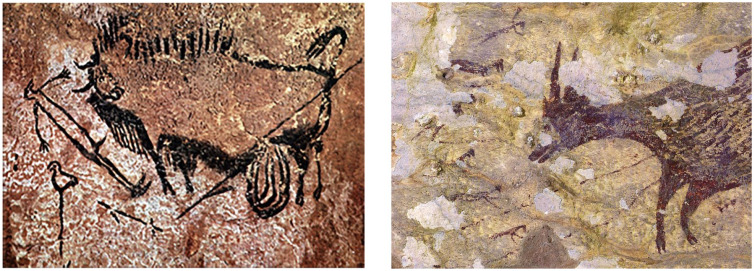
“More recently, however, evidence of much older narrative art has been found in cave art in Indonesia (Aubert et al., 2019).”
BackgroundConceptualizing media enjoyment as attitude: implications for mass media effects research.
Nabi, R. L., & Krcmar, M. (2004) · Communication Theory · doi:10.1111/j.1468-2885.2004.tb00316.x · Cited by 327 · cited 1×
“15 Nabi and Krcmar (2004) theorize that enjoyment comprises three dimensions that mutually reinforce one another to drive narrative consumption and transportation.”
BackgroundHomer and the Origin of the Greek Alphabet
Powell, B. B. (1991) · Cambridge University Press eBooks · doi:10.1017/cbo9780511552700 · Cited by 324
Emotion and Memory Research: A Grumpy Overview
Levine, L. J., & Pizarro, D. A. (2004) · Social Cognition · doi:10.1521/soco.22.5.530.50767 · Cited by 320 · cited 1×
“In this vein, Levine and Pizarro (2004) suggest that emotions arise from event appraisal relative to the status of some goal.”
BackgroundThe Role of a Narrative's Emotional Flow in Promoting Persuasive Outcomes
Nabi, R. L., & Green, M. C. (2015) · Media Psychology · doi:10.1080/15213269.2014.912585 · Cited by 318 · cited 3×
“14 Stories can act as a platform for people to suspend disbelief and vicariously pursue intense emotional journeys—they can make people burst into tears, cackle with laughter, or nervously slide back and forth in their seat, hoping for an alleviating turn of events (Nabi & Green, 2015).”
BackgroundInfluentialMedia Influences on Social Outcomes: The Impact of MTV’s 16 and Pregnant on Teen Childbearing
Kearney, M. S., & Levine, P. B. (2015) · American Economic Review · doi:10.1257/aer.20140012 · Cited by 316
Role Theory: Expectations, Identities, and Behaviors.
Turner, R. H., & Biddle, B. J. (1981) · Contemporary Sociology · doi:10.2307/2067281 · Cited by 315
Maintaining Cultural Stereotypes in the Serial Reproduction of Narratives
Kashima, Y. (2000) · Personality and Social Psychology Bulletin · doi:10.1177/0146167200267007 · Cited by 312 · cited 1×
“…example, even in contexts in which participants remember stereotype-inconsistent information better than stereo-type-consistent information in individual recall tasks, chains of connected participants recalling stories produce a reliable bias for stereotype-consistent information (Kashima, 2000).”
BackgroundThe Transportation Scale–Short Form (TS–SF)
Appel, M., Gnambs, T., Richter, T., & Green, M. C. (2015) · Media Psychology · doi:10.1080/15213269.2014.987400 · Cited by 309 · cited 1×
“Transportation affects the audience in several ways (Appel et al., 2015).”
BackgroundSanctions, Perceptions, and Crime: Implications for Criminal Deterrence
Apel, R. (2013) · Journal of Quantitative Criminology · doi:10.1007/s10940-012-9170-1 · Cited by 308 · cited 1×
“They tend to qualitatively base their estimates on actual or vicarious experiences (Apel, 2013).”
BackgroundKnowledge and memory: the real story
(1996) · Choice Reviews Online · doi:10.5860/choice.33-3602 · Cited by 307 · cited 1×
“For decades, many psychologists have argued that much if not most of human thinking takes place in narrative form (Bruner, 1986; S. G. B. Johnson et al., 2022; Mandler, 1984; Sarbin, 1986; Schank & Abelson, 1995).”
BackgroundBuringh, E., & Van Zanden, J. L. (2009) · The Journal of Economic History · doi:10.1017/s0022050709000837 · Cited by 306
Identity: Contemporary Identity Politics and the Struggle for Recognition
Fukuyama, F. (2019) · Cited by 291
Panero, M. E., Weisberg, D. S., Black, J., Goldstein, T. R., Barnes, J. L., Brownell, H., & Winner, E. (2016) · Journal of Personality and Social Psychology · doi:10.1037/pspa0000064 · Cited by 289
A Reciprocal Influence Model of Social Power: Emerging Principles and Lines of Inquiry
Keltner, D., Van Kleef, G. A., Chen, S., & Kraus, M. W. (2008) · Advances in Experimental Social Psychology · doi:10.1016/s0065-2601(07)00003-2 · Cited by 281 · cited 2×
“Roles exert a powerful influence on people’s capabilities and resources (Keltner et al., 2008).”
BackgroundKreuter, M. W., Holmes, K., Alcaraz, K., Kalesan, B., Rath, S., Richert, M., McQueen, A., Caito, N., Robinson, L., & Clark, E. M. (2010) · Patient Education and Counseling · doi:10.1016/j.pec.2010.09.008 · Cited by 279 · cited 2×
“When information is presented to people in the form of a story, they are less likely to feel that they are being manipulated and to counterargue (Kreuter et al., 2010).”
BackgroundMurphy, S. T., Frank, L. B., Moran, M. B., & Patnoe-Woodley, P. (2011) · Journal of Communication · doi:10.1111/j.1460-2466.2011.01554.x · Cited by 274 · cited 1×
“This enables people to take a character-oriented perspective, forming a bond between audience and characters (Murphy et al., 2011).”
BackgroundCross-Border Media and Nationalism: Evidence from Serbian Radio in Croatia
DellaVigna, S., Enikolopov, R., Mironova, V., Petrova, M., & Zhuravskaya, E. (2014) · American Economic Journal: Applied Economics · doi:10.1257/app.6.3.103 · Cited by 273
An Evaluation of Story Grammars*
Black, J. B., & Wilensky, R. (1979) · Cognitive Science · doi:10.1207/s15516709cog0303_2 · Cited by 273
The emotional arcs of stories are dominated by six basic shapes
Reagan, A. J., Mitchell, L., Kiley, D., Danforth, C. M., & Dodds, P. S. (2016) · EPJ Data Science · doi:10.1140/epjds/s13688-016-0093-1 · Cited by 269
László, J. (2008) · Routledge eBooks · doi:10.4324/9780203894934 · Cited by 266 · cited 1×
“Meanwhile, evidence from experimental research has now accumulated to reveal the role of stories in human psychology (Green et al., 2002; László, 2008).”
BackgroundWhat Is the Relationship between Hate Radio and Violence? Rethinking Rwanda's “Radio Machete”
Straus, S. (2007) · Politics & Society · doi:10.1177/0032329207308181 · Cited by 265 · cited 1×
“The role of radio in promoting conflict has been explored in a number of settings (DellaVigna et al., 2014; Gagliarducci et al., 2020; Straus, 2007; Wang, 2021; Yanagizawa-Drott, 2014).”
BackgroundAnderson, S. P., Strömberg, D., & Waldfogel, J. (2015) · Cited by 262
de Graaf, A., Sanders, J., & Hoeken, H. (2016) · Review of Communication Research · doi:10.12840/issn.2255-4165.2016.04.01.011 · Cited by 260 · cited 1×
“…literature on narrative per-suasion not just in social psychology but also in fields related to policy: communication (Braddock & Dillard, 2016; de Graaf et al., 2016; Moyer-Gusé, 2008; Moyer-Gusé & Nabi, 2010) and public health (Hinyard & Kreuter, 2007; Orozco-Olvera et al., 2019; Shen et al.,…”
Background"Coffee Politicians Does Create": Coffeehouses and Restoration Political Culture
Pincus, S. (1995) · The Journal of Modern History · doi:10.1086/245229 · Cited by 249 · cited 1×
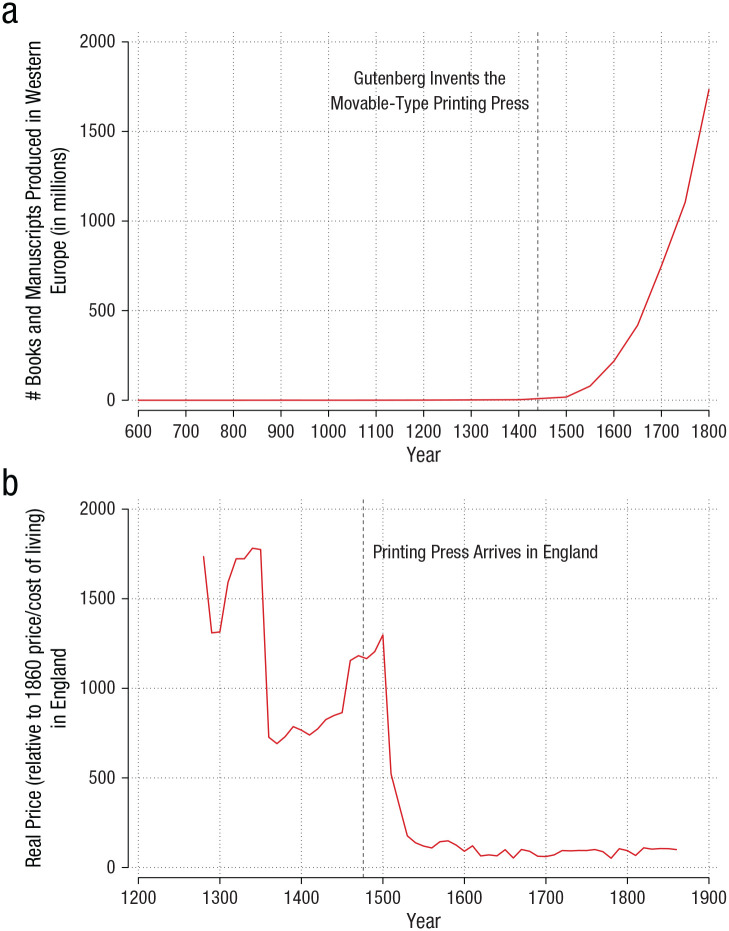
“Some social historians, influenced by the social theorist Jurgen Habermas (1991), hypothesize that these developments were key to the emergence of a public sphere in Western society (see also Pincus, 1995).”
BackgroundEffects of Sesame Street: A meta-analysis of children’s learning in 15 countries
Mares, M.-L., & Pan, Z. (2013) · Journal of Applied Developmental Psychology · doi:10.1016/j.appdev.2013.01.001 · Cited by 245 · cited 2×
“An example is the show Sesame Street (Kearney & Levine, 2019; Mares & Pan, 2013).”
BackgroundStories vs. facts: triggering emotion and action-taking on climate change
Morris, B. S., Chrysochou, P., Christensen, J. D., Orquin, J. L., Barraza, J., Zak, P. J., & Mitkidis, P. (2019) · Climatic Change · doi:10.1007/s10584-019-02425-6 · Cited by 245 · cited 1×
“…policy challenges such as intergroup conflict (Paluck, 2009; Tal-Or & Tsfati, 2016), outgroup prejudice (P. J. Johnson & Aboud, 2017; D. R. Johnson et al., 2013; Martinez et al., 2021; Moyer-Gusé et al., 2019), climate action (Morris et al., 2019), and trust in government (Trujillo & Paluck, 2012).”
BackgroundPerceived Realism: Dimensions and Roles in Narrative Persuasion
Cho, H., Shen, L., & Wilson, K. (2014) · Communication Research · doi:10.1177/0093650212450585 · Cited by 244
Incommensurability and Valuation in Law
Sunstein, C. R. (1994) · Michigan Law Review · doi:10.2307/1289693 · Cited by 236
Collective Memory and Narrative Templates
Wertsch, J. V. (2008) · Social Research: An International Quarterly · doi:10.1353/sor.2008.0051 · Cited by 230 · cited 1×
“In one analysis (Wertsch, 2008), the Russian narrative template guides their interpretation of contemporary world events.”
BackgroundFiction reading has a small positive impact on social cognition: A meta-analysis.
Dodell-Feder, D., & Tamir, D. I. (2018) · Journal of Experimental Psychology: General · doi:10.1037/xge0000395 · Cited by 223 · cited 2×
“A meta-analysis of the relationship, examining evidence from 14 studies, found that these results are significant but small (Dodell-Feder & Tamir, 2018).”
BackgroundMethodAn evaluation of story grammars
BLACK, J., & WILENSKY, R. (1979) · Cognitive Science · doi:10.1016/s0364-0213(79)80007-5 · Cited by 222
Value in Ethics and Economics.
Mackay, A. F., & Anderson, E. (1996) · Philosophy and Phenomenological Research · doi:10.2307/2108296 · Cited by 216
Skyrms, B. (2001) · Proceedings and Addresses of the American Philosophical Association · doi:10.2307/3218711 · Cited by 214
Research works printed but not linked: 26
- Aristotle. (2013). Poetics (Kenny A. Trans.). Oxford University Press. (Original work published ca. 335 B.C.E.)
- Bandura A. (1986). Social cognitive theory: Social foundations of thought and action. Prentice Hall.
- Bandura A. (2006). Going global with social cognitive theory: From prospect to paydirt. In Donaldson S. I. Berger D. E. Pezdek K. (Eds.), Applied psychology: New frontiers and rewarding careers (pp. 53– 79). Erlbaum.
- Bönisch P. Hyll W. (2023). Television and fertility: Evidence from a natural experiment. Empirical Economics, 64, 1025– 1066.
- Brewer W. F. (2014). To assert that essentially all human knowledge and memory is represented in terms of stories is certainly wrong. In Wyer, Jr. R. S. (Ed.), Advances in social cognition: Vol. VII. Knowledge and memory: The real story (pp. 109– 119). Psychology Press.
- Brown D. E. (2017). Human universals. Temple University Press.
- Byrne D. (1971). The attraction paradigm. Academic Press.
- Chater N. (2018). The mind is flat: The illusion of mental depth and the improvised mind. Penguin.
- Dennett D. C. (1987). The intentional stance. MIT Press.
- Dissanayake E. (1988). What is art for? University of Washington Press.
- Dunbar R. (2022). How religion evolved: And why it endures. Oxford University Press.
- Eagly A. H. Chaiken S. (1993). The psychology of attitudes. Harcourt Brace Jovanovich.
- Epic of Gilgamesh. (George A. Trans.). (1999). Penguin Books.
- Graesser A. C. Olde B. Klettke B. (2002). How does the mind construct and represent stories? In Green M. C. Strange J. J. Brock T. C. (Eds.), Narrative impact: Social and cognitive foundations (pp. 229– 262). Erlbaum.
- Green M. C. Strange J. J. Brock T. C. (2002). Narrative impact: Social and cognitive foundations. Erlbaum.
- Harmon W. (2010). A handbook to literature (12th ed.). Pearson Education.
- Henrich J. (2020). The WEIRDest people in the world: How the West became psychologically peculiar and particularly prosperous. Farrar, Straus and Giroux.
- Heyes C. (2018). Cognitive gadgets. Harvard University Press.
- Hobbes T. (1991). Leviathan (Tuck R., Ed.). Cambridge University Press. (Original work published 1651)
- Hoppitt W. Laland K. N. (2013). Social learning. Princeton University Press.
- McAdams D. P. (1993). The stories we live by: Personal myths and the making of the self. Guilford Press.
- Nyhof M. Barrett J. (2001). Spreading non-natural concepts: The role of intuitive conceptual structures in memory and transmission of cultural materials. Journal of Cognition and Culture, 1(1), 69– 100. · DOI · Paper page
- Plato. (2000). The Republic (Ferrari G. R. F., Ed.; Griffith T., Trans.). Cambridge University Press. (Original work published ca. 375 B.C.E.)
- Puchner M. (2018). The written world: The power of stories to shape people, history, and civilization. Random House.
- Richerson P. J. Boyd R. (2005). Not by genes alone. University of Chicago Press.
- Zillmann D. (1996). The psychology of suspense in dramatic exposition. In Vorderer P. Wulff H. J. Friedrichsen M. (Eds.), Suspense: Conceptualizations, theoretical analyses, and empirical explorations (p. 199– 231). Erlbaum.
Cited by
The Psychology of Framing: How Everyday Language Shapes the Way We Think, Feel, and Act
Flusberg, S. J., Holmes, K. J., Thibodeau, P. H., Nabi, R. L., & Matlock, T. (2024) · Gothic.net · doi:10.1177/15291006241246966 · Cited by 152
Stigma Toward Substance Dependence: Causes, Consequences, and Potential Interventions
Krendl, A. C., & Perry, B. L. (2023) · Gothic.net · doi:10.1177/15291006231198193 · Cited by 110
“Campaigns or narratives that emphasize recovery and/or leverage social connections to change behavior or perceptions may be best suited to reducing SUD stigma (e.g., Walsh et al., 2023).”
BackgroundCultural Defaults in the Time of COVID: Lessons for the Future
Markus, H. R., Tsai, J. L., Uchida, Y., Yang, A. M., & Maitreyi, A. (2024) · Psychological Science in the Public Interest · doi:10.1177/15291006241277810 · Cited by 21
Listening to bridge societal divides
Santoro, E., & Markus, H. R. (2023) · Current Opinion in Psychology · doi:10.1016/j.copsyc.2023.101696 · Cited by 12
Economic ideology: Versions of the concept’s acceptations and application
Tambovtsev, V. (2024) · Voprosy Ekonomiki · doi:10.32609/0042-8736-2024-10-5-27 · Cited by 19
Metadata
- Authors
- Walsh, J., Vaida, N., Coman, A., & Fiske, S. T.
- Affiliations
- Harvard University (US)
- Princeton University (US)
- Corresponding author
- Walsh, James
- Venue
- Psychological Science in the Public Interest
- Publisher
- SAGE Publications
- Published
- 2022-12
- Volume
- 23
- Issue
- 3
- Pages
- 99-141
- ISSN
- 1539-6053 (ISSN-L)
- 1529-1006
- PMC
- PMC10173355
- OpenAlex
- W4376131996
- Semantic Scholar
- 68325aa69720513255e57bad1d6d8f6b930d5452
- Cited by
- 26
- References
- 327
- Citations by year
- 2026: 5 · 2025: 11 · 2024: 8 · 2023: 2
- FWCI
- 17.14
- Type
- journal article
- Language
- en
- Open access
- hybrid
- doi.org
- Locations
- Gothic.net (publishedVersion, cc-by)
- PubMed Central (publishedVersion, cc-by)
- PubMed (publishedVersion)
- Funders
- oxford martin school, university of oxford
- economic and social research council (ES/R00787X/1 and RM02)
- Topics
- Social Sciences › Political Science and International Relations › Policy Transfer and Learning
- Social Sciences › Public Administration › Public Policy and Administration Research
- Social Sciences › Communication › Rhetoric and Communication Studies
- Keywords
- storytelling, public policy, policy communication, persuasion, collective action, learning, history of storytelling, technology and society, policy instruments
- MeSH terms
- Communication, Culture, Government, Humans, Learning, Persuasive Communication
About these checks
Registry, retraction, Cites and statistics results are computed, not judged, with one exception: a printed reference that no index lists is read once by a model before it counts as a citation error. Claims are extracted by a model and kept only when their quote appears verbatim in the text; each cited source is then checked, with a model’s help, for whether it says what the claim relies on. Those verdicts can be wrong — read the claim’s quote and the cited source before relying on one.
The claim verdicts this report counts are experimental: their accuracy is not yet measured.
A language model drew the claims from the paper on 2026-10-06, under version 3 of the claim definition (model deepseek-v4.1-flash, prompt extract-v3).
A second model labelled each claim on 2026-10-06 (model jev-1.13-20260917, definition revision gold-guideline-v0.2).
Cited sources are checked with a language model’s help (gpt-6-sol).
Statistics and arithmetic are recomputed, not judged.
Confidence bands are shown only for fields calibrated on our annotated test set. None is calibrated yet, so no band is shown.
What counts as a claim ›How we measure confidence ›How we check this ›
Are you an author, or do you see a problem with this page? Request a review
Data sources
Bibliographic data: Semantic Scholar, OpenAlex, Crossref.
Contains information from the Semantic Scholar Academic Graph Datasets, made available under the ODC Attribution License (ODC-BY 1.0).
Semantic Scholar’s data is described in: Kinney, R., et al. (2023). The Semantic Scholar Open Data Platform. arXiv:2301.10140.
