

The DOI matches its Crossref record; 120 of the 121 references it cites were found in a registry or an index.
A Systematic Review of Spiritually Based Interventions and Psychoneuroimmunological Outcomes in Breast Cancer Survivorship
Open accessAbstract
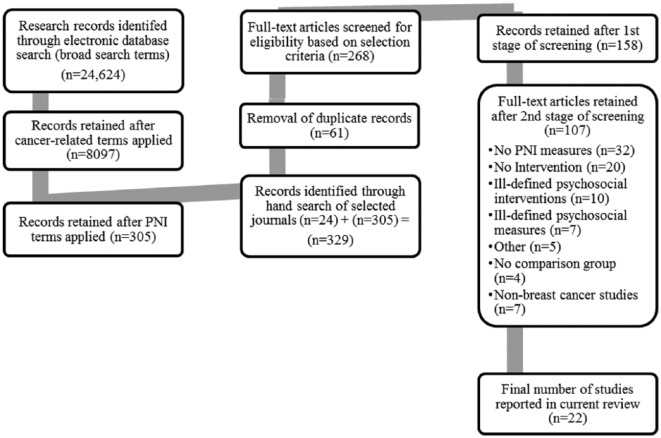
Objective This is a review of spiritually based interventions (eg, mindfulness-based stress reduction) that utilized psychoneuroimmunological (PNI) outcome measures in breast cancer survivors. Specifically, this review sought to examine the evidence regarding relationships between spiritually based interventions, psychosocial-spiritual outcomes, and biomarker outcomes in breast cancer survivors. Methods A systematic search of 9 online databases was conducted for articles of original research, peer-reviewed, randomized and nonrandomized control trials from 2005-2015. Data were extracted in order to answer selected questions regarding relationships between psychosocial-spiritual and physiological measures utilized in spiritually based interventions. Implications for future spiritually based interventions in breast cancer survivorship are discussed. Results Twenty-two articles were reviewed. Cortisol was the most common PNI biomarker outcome studied. Compared with control groups, intervention groups demonstrated positive mental health outcomes and improved or stable neuroendocrine-immune profiles, although limitations exist. Design methods have improved with regard to increased use of comparison groups compared with previous reviews. There are few spiritually based interventions that specifically measure religious or spiritual constructs. Similarly, there are few existing studies that utilize standardized religious or spiritual measures with PNI outcome measures. Findings suggest that a body of knowledge now exists in support of interventions with mindfulness-breathing-stretching components; furthermore, these interventions appear to offer potential improvement or stabilization of neuroendocrine-immune activity in breast cancer survivors compared to control groups. Conclusion From a PNI perspective, future spiritually based interventions should include standardized measures of religiousness and spirituality in order to understand relationships between and among religiousness, spirituality, and neuroendocrine-immune outcomes. Future research should now focus on determining the minimum dose and duration needed to improve or stabilize neuroendocrine-immune function, as well as diverse setting needs, including home-based practice for survivors who are too ill to travel to group sessions or lack economic resources.
Overview
The claims and statistics of this paper haven’t been checked yet.
Run the check — free, no account needed. It reads the open-access text and checks the sources it cites.
Integrity signals
Registry
Cites
Statistics
Figures
Verification
Claims the paper makes
The claims and statistics of this paper haven’t been checked yet.
Run the check — free, no account needed. It reads the open-access text and checks the sources it cites.
Claims other papers make about this one
Each is checked against this paper’s own text: does it say what the citing paper says it does?
The source backs part of the claim, not all of it — or backs it for a different population, condition or comparison.
In the citing paper
“A systematic review showed that mindfulness intervention can improve individual’s mental health and lead to positive biomarker outcomes such as decreased interleukin-6 (IL-6) and tumor necrosis factor alpha (TNF-α) (55).”
From Mindfulness-based online intervention on mental health among undergraduate nursing students during coronavirus disease 2019 pandemic in Beijing, China: A randomized controlled trial (2022) · cites this paper as [55]
Experimental — accuracy not yet measuredThe source backs part of the claim, not all of it — or backs it for a different population, condition or comparison.
In the citing paper
“In this case, the positive effect of mindfulness intervention on anxiety and stress has its biological basis.”
From Mindfulness-based online intervention on mental health among undergraduate nursing students during coronavirus disease 2019 pandemic in Beijing, China: A randomized controlled trial (2022) · cites this paper as [55]
Experimental — accuracy not yet measured
Self-check
Percentages, sums and reported differences re-computed from the paper’s own numbers.
The self-check needs the paper’s full text.
Citations
Cites
The benefits of being present: Mindfulness and its role in psychological well-being
Brown, K. W., & Ryan, R. M. (2003) · Journal of Personality and Social Psychology · doi:10.1037/0022-3514.84.4.822 · Cited by 13,448
SEER Cancer Statistics Review, 1975-2003
Ries, L. A. G., Harkins, D., Krapcho, M. F., Mariotto, A. B., Miller, B., Feuer, E. J., Clegg, L. X., Eisner, M. P., Horner, M., Howlader, N., et al. (2006) · Digital Archive @ GSU · Cited by 11,404
Sapolsky, R. M., Romero, L. M., & Munck, A. U. (2000) · Endocrine Reviews · doi:10.1210/edrv.21.1.0389 · Cited by 7,541
Protective and Damaging Effects of Stress Mediators
McEwen, B. S. (1998) · New England Journal of Medicine · doi:10.1056/nejm199801153380307 · Cited by 6,733 · cited 1×
“After prolonged HPAA vigilance, elevated cortisol activity becomes detrimental, as it becomes immunosuppressive and ultimately contributes to persistent immune dysregulation.(58,67) Mindfulness-Based Interventions and Moving Meditations as Spiritually Based Interventions Among the most commonly reported psychosocial i…”
BackgroundShapiro, S. L., Carlson, L. E., Astin, J. A., & Freedman, B. (2006) · Journal of Clinical Psychology · doi:10.1002/jclp.20237 · Cited by 4,002
Handbook of Religion and Health
Koenig, H. G., McCullough, M. E., & Larson, D. B. (2004) · American Journal of Geriatric Psychiatry · doi:10.1097/00019442-200405000-00015 · Cited by 3,262
The Concepts of Stress and Stress System Disorders: Overview of Physical and Behavioral Homeostasis
Chrousos, G. P. (1992) · JAMA · doi:10.1001/jama.1992.03480090092034 · Cited by 2,689
Hill, P. C., & Pargament, K. I. (2003) · American Psychologist · doi:10.1037/0003-066x.58.1.64 · Cited by 1,948
Salivary cortisol as a biomarker in stress research
Hellhammer, D. H., Wüst, S., & Kudielka, B. M. (2009) · Psychoneuroendocrinology · doi:10.1016/j.psyneuen.2008.10.026 · Cited by 1,925
The psychology of religion and coping : theory, research, practice
Pargament, K. (1998) · Review of Religious Research · doi:10.2307/3512468 · Cited by 1,680
Religious coping and psychological adjustment to stress: A meta-analysis
Ano, G. G., & Vasconcelles, E. B. (2005) · Journal of Clinical Psychology · doi:10.1002/jclp.20049 · Cited by 1,627 · cited 1×
“Religious coping has shown an association with spiritual growth, better mental health, and positive outcomes following stressful life events.(16,17) Studies of chronically ill populations, including breast cancer survivors, have reported that religious and spiritual factors (eg, relationship with God/higher power, pra…”
BackgroundSpirituality, religion, and health: An emerging research field.
Miller, W. R., & Thoresen, C. E. (2003) · American Psychologist · doi:10.1037/0003-066x.58.1.24 · Cited by 1,437
Piedmont, R. L. (1999) · Journal of Personality · doi:10.1111/1467-6494.00080 · Cited by 1,249
Handbook of Religion and Health
Koenig, H. G., VanderWeele, T. J., & Peteet, J. R. (2023) · doi:10.1093/oso/9780190088859.001.0001 · Cited by 1,160
Mood disorders and allostatic load
McEwen, B. S. (2003) · Biological Psychiatry · doi:10.1016/s0006-3223(03)00177-x · Cited by 1,135
Shapiro, S. L., Brown, K. W., & Biegel, G. M. (2007) · Training and Education in Professional Psychology · doi:10.1037/1931-3918.1.2.105 · Cited by 1,134 · cited 1×
“MBSR has been shown to decrease depression and anxiety,(89-91) and rumination among breast cancer survivors.(92,93) Data have shown that MBSR improved sleep quality,(54,85) reduced fatigue,(21,54) improved quality of life,(52,92) and improved perceptions of life being more meaningful.”
BackgroundSpeca, M., Carlson, L. E., Goodey, E., & Angen, M. (2000) · Psychosomatic Medicine · doi:10.1097/00006842-200009000-00004 · Cited by 1,082
Diurnal Cortisol Rhythm as a Predictor of Breast Cancer Survival
Sephton, S. E. (2000) · Journal of the National Cancer Institute · doi:10.1093/jnci/92.12.994 · Cited by 1,082
Behaviorally Conditioned Immunosuppression
Ader, R., & Cohen, N. (1975) · Psychosomatic Medicine · doi:10.1097/00006842-197507000-00007 · Cited by 1,023
Ludwig, D. S. (2008) · JAMA · doi:10.1001/jama.300.11.1350 · Cited by 957
Emmons, R. A., & Paloutzian, R. F. (2002) · Annual Review of Psychology · doi:10.1146/annurev.psych.54.101601.145024 · Cited by 868
Social networks, social support, and survival after breast cancer diagnosis
Kroenke, C. H., Kubzansky, L. D., Schernhammer, E. S., Holmes, M. D., & Kawachi, I. (2006) · Journal of Clinical Oncology · doi:10.1200/jco.2005.04.2846 · Cited by 792
Carlson, L. E., Speca, M., Patel, K. D., & Goodey, E. (2003) · Psychosomatic Medicine · doi:10.1097/01.psy.0000074003.35911.41 · Cited by 773
Carlson, L. E., Speca, M., Patel, K. D., & Goodey, E. (2003) · Psychoneuroendocrinology · doi:10.1016/s0306-4530(03)00054-4 · Cited by 756
The psychology of religion and coping: theory, research, practice
(1997) · Choice Reviews Online · doi:10.5860/choice.35-2413 · Cited by 707
Carlson, L. E., Speca, M., Faris, P., & Patel, K. D. (2007) · Brain, Behavior, and Immunity · doi:10.1016/j.bbi.2007.04.002 · Cited by 688
Carlson, L. E., & Garland, S. N. (2005) · International Journal of Behavioral Medicine · doi:10.1207/s15327558ijbm1204_9 · Cited by 556
Lengacher, C. A., Johnson‐Mallard, V., Post‐White, J., Moscoso, M. S., Jacobsen, P. B., Klein, T. W., Widen, R. H., Fitzgerald, S. G., Shelton, M. M., Barta, M., et al. (2009) · Psycho-Oncology · doi:10.1002/pon.1529 · Cited by 518 · cited 1×
“In the past 10 years, a number of CAM interventions have been conducted in breast cancer populations to examine changes in psychological and physiological outcomes in those receiving the interventions.(20,21) Although many of these CAM interventions (eg, mindfulnessbased interventions and Qigong) had a spiritual compo…”
BackgroundWitek-Janusek, L., Albuquerque, K., Chroniak, K. R., Chroniak, C., Durazo-Arvizu, R., & Mathews, H. L. (2008) · Brain, Behavior, and Immunity · doi:10.1016/j.bbi.2008.01.012 · Cited by 506
Mindfulness‐based stress reduction and cancer: a meta‐analysis
Ledesma, D., & Kumano, H. (2009) · Psycho-Oncology · doi:10.1002/pon.1400 · Cited by 491
Kiecolt‐Glaser, J. K., Bennett, J. M., Andridge, R., Peng, J., Shapiro, C. L., Malarkey, W. B., Emery, C. F., Layman, R. M., Mrózek, E., & Glaser, R. (2014) · Journal of Clinical Oncology · doi:10.1200/jco.2013.51.8860 · Cited by 409
Stress and Immune Responses After Surgical Treatment for Regional Breast Cancer
Andersen, B. L., Farrar, W. B., Golden‐Kreutz, D. M., Kutz, L. A., MacCallum, R. C., Courtney, M. E., & Glaser, R. (1998) · JNCI Journal of the National Cancer Institute · doi:10.1093/jnci/90.1.30 · Cited by 399
A randomized, controlled trial of mindfulness‐based art therapy (MBAT) for women with cancer
Monti, D. A., Peterson, C., Kunkel, E. J. S., Hauck, W. W., Pequignot, E., Rhodes, L., & Brainard, G. C. (2006) · Psycho-Oncology · doi:10.1002/pon.988 · Cited by 378
Yoga for persistent fatigue in breast cancer survivors: A randomized controlled trial
Bower, J. E., Garet, D., Sternlieb, B., Ganz, P. A., Irwin, M. R., Olmstead, R., & Greendale, G. (2012) · Cancer · doi:10.1002/cncr.26702 · Cited by 352
Social support, psychological distress, and natural killer cell activity in ovarian cancer
Lutgendorf, S. K., Sood, A. K., Anderson, B., McGinn, S., Maiseri, H., Dao, M., Sorosky, J. I., De Geest, K., Ritchie, J., & Lubaroff, D. M. (2005) · Journal of Clinical Oncology · doi:10.1200/jco.2005.10.015 · Cited by 345
Prevalence of complementary and alternative medicine use in cancer patients during treatment
Yates, J. S., Mustian, K. M., Morrow, G. R., Gillies, L. J., Padmanaban, D., Atkins, J. N., Issell, B., Kirshner, J. J., & Colman, L. K. (2005) · Supportive Care in Cancer · doi:10.1007/s00520-004-0770-7 · Cited by 309
Immune-neuroendocrine interactions
Besedovsky, H. O., del Rey, A., & Sorkin, E. (1985) · The Journal of Immunology · doi:10.4049/jimmunol.135.2.750 · Cited by 307
Bower, J. E., Meyerowitz, B. E., Desmond, K. A., Bernaards, C. A., Rowland, J. H., & Ganz, P. A. (2005) · Annals of Behavioral Medicine · doi:10.1207/s15324796abm2903_10 · Cited by 299
Raghavendra, R. M., Vadiraja, H. S., Nagarathna, R., Nagendra, H. R., Rekha, M., Vanitha, N., Gopinath, K., Srinath, B. S., Vishweshwara, M. S., Madhavi, Y. S., et al. (2009) · Integrative Cancer Therapies · doi:10.1177/1534735409331456 · Cited by 290
Bower, J. E., Greendale, G., Crosswell, A. D., Garet, D., Sternlieb, B., Ganz, P. A., Irwin, M. R., Olmstead, R., Arevalo, J., & Cole, S. W. (2014) · Psychoneuroendocrinology · doi:10.1016/j.psyneuen.2014.01.019 · Cited by 283
Carlson, L. E., Doll, R., Stephen, J., Faris, P., Tamagawa, R., Drysdale, E., & Speca, M. (2013) · Journal of Clinical Oncology · doi:10.1200/jco.2012.47.5210 · Cited by 282
Zainal, N. Z., Booth, S., & Huppert, F. A. (2013) · Psycho-Oncology · doi:10.1002/pon.3171 · Cited by 279
Garland, S. N., Carlson, L. E., Cook, S., Lansdell, L., & Speca, M. (2007) · Supportive Care in Cancer · doi:10.1007/s00520-007-0280-5 · Cited by 266
Re‐examining definitions of spirituality in nursing research
Reinert, K. G., & Koenig, H. G. (2013) · Journal of Advanced Nursing · doi:10.1111/jan.12152 · Cited by 266
Antoni, M. H., Lechner, S. C., Diaz, A., Vargas, S. E., Holley, H., Phillips, K. K., McGregor, B., Carver, C. S., & Blomberg, B. B. (2008) · Brain Behavior and Immunity · doi:10.1016/j.bbi.2008.09.005 · Cited by 262
Religion, spirituality and cancer: Current status and methodological challenges
Stefanek, M. E., Green, P. A., & Hess, S. A. (2004) · Psycho-Oncology · doi:10.1002/pon.861 · Cited by 262
Gall, T. L., & Cornblat, M. W. (2002) · Psycho-Oncology · doi:10.1002/pon.613 · Cited by 257
Oh, B., Butow, P., Mullan, B., Clarke, S., Beale, P., Pavlakis, N., Kothe, E., Lam, L., & Rosenthal, D. (2009) · Annals of Oncology · doi:10.1093/annonc/mdp479 · Cited by 252
Foster, C. L., Wright, D. N. M., HILL, H., Hopkinson, J. B., & Roffe, L. (2009) · European Journal of Cancer Care · doi:10.1111/j.1365-2354.2008.01001.x · Cited by 245
Randomized, controlled trial of yoga in women with breast cancer undergoing radiotherapy.
Chandwani, K., Perkins, G., Nagendra, H., Raghuram, N., Spelman, A., Nagarathna, R., Johnson, K., Fortier, A., Arun, B., Wei, Q., et al. (2014) · Journal of Clinical Oncology · doi:10.1200/jco.2012.48.2752 · Cited by 243
Mindfulness Meditation for Oncology Patients: A Discussion and Critical Review
Ott, M. J., Norris, R., & Bauer‐Wu, S. (2006) · Integrative Cancer Therapies · doi:10.1177/1534735406288083 · Cited by 231
Psychosocial stress and inflammation in cancer
Powell, N. D., Tarr, A. J., & Sheridan, J. F. (2012) · Brain Behavior and Immunity · doi:10.1016/j.bbi.2012.06.015 · Cited by 226
Walker, L., Walker, M. B., Ogston, K. N., Heys, S. D., Ah-See, A. K., Miller, I. D., Hutcheon, A. W., Sarkar, T. K., & Eremin, O. (1999) · British Journal of Cancer · doi:10.1038/sj.bjc.6690349 · Cited by 219
Spirituality, Religion, and Health
Yuen, E. J. (2007) · American Journal of Medical Quality · doi:10.1177/1062860606298872 · Cited by 218
Health benefits of qigong or tai chi for cancer patients: a systematic review and meta-analyses
Zeng, Y., Luo, T., Xie, H., Huang, M., & Cheng, A. S. K. (2013) · Complementary Therapies in Medicine · doi:10.1016/j.ctim.2013.11.010 · Cited by 209
Breast Cancer Survivors' Experiences of Lymphedema-Related Symptoms
Fu, M. R., & Rosedale, M. T. (2009) · Journal of Pain and Symptom Management · doi:10.1016/j.jpainsymman.2009.04.030 · Cited by 198
Carlson, L. E., Beattie, T. L., Giese‐Davis, J., Faris, P., Tamagawa, R., Fick, L. J., Degelman, E. S., & Speca, M. (2015) · Cancer · doi:10.1002/cncr.29063 · Cited by 194
Post-breast cancer lymphedema: incidence increases from 12 to 30 to 60 months.
Armer, J. A., & Stewart, B. (2010) · PubMed · Cited by 191
How the Mind Hurts and Heals the Body.
Ray, O. S. (2004) · American Psychologist · doi:10.1037/0003-066x.59.1.29 · Cited by 187
Carlson, L. E. (2012) · ISRN Psychiatry · doi:10.5402/2012/651583 · Cited by 182
McCain, N. L., Gray, D. P., Elswick, R. K., Robins, J. W., Tuck, I., Walter, J. M., Rausch, S. M., & Ketchum, J. M. (2008) · Journal of Consulting and Clinical Psychology · doi:10.1037/0022-006x.76.3.431 · Cited by 176
Campbell, T. S., Labelle, L. E., Bacon, S. L., Faris, P., & Carlson, L. E. (2012) · Journal of Behavioral Medicine · doi:10.1007/s10865-011-9357-1 · Cited by 173
Differing pathways between religiousness, spirituality, and health: A self-regulation perspective.
Aldwin, C. M., Park, C. L., Jeong, Y.-J., & Nath, R. (2014) · Psychology of Religion and Spirituality · doi:10.1037/a0034416 · Cited by 171
Lengacher, C. A., Reich, R. R., Kip, K. E., Barta, M., Ramesar, S., Paterson, C. L., Moscoso, M. S., Carranza, I., Budhrani, P. H., Kim, S. J., et al. (2014) · Biological Research For Nursing · doi:10.1177/1099800413519495 · Cited by 169
Qigong improves quality of life in women undergoing radiotherapy for breast cancer
Chen, Z., Meng, Z., Milbury, K., Bei, W., Zhang, Y., Thornton, B., Liao, Z. X., Wei, Q., Chen, J., Guo, X., et al. (2013) · Cancer · doi:10.1002/cncr.27904 · Cited by 166
Psychoneuroimmunology and health psychology: An integrative model
Lutgendorf, S. K., & Costanzo, E. S. (2003) · Brain Behavior and Immunity · doi:10.1016/s0889-1591(03)00033-3 · Cited by 166
Piedmont, R. L., Ciarrochi, J. W., Dy-Liacco, G. S., & Williams, J. E. G. (2009) · Psychology of Religion and Spirituality · doi:10.1037/a0015883 · Cited by 164
Fouladbakhsh, J. M., & Stommel, M. (2010) · Oncology Nursing Forum · doi:10.1188/10.onf.e7-e15 · Cited by 163
Lengacher, C. A., Kip, K. E., Barta, M., Post-White, J., Jacobsen, P. B., Groer, M., Lehman, B., Moscoso, M. S., Kadel, R., Le, N., et al. (2012) · Journal of Holistic Nursing · doi:10.1177/0898010111435949 · Cited by 163
Stress-Induced Immunomodulation
Glaser, R., Rabin, B. S., Chesney, M. A., Cohen, S., & Natelson, B. H. (1999) · JAMA · doi:10.1001/jama.281.24.2268 · Cited by 160
Birnie, K., Garland, S. N., & Carlson, L. E. (2010) · Psycho-Oncology · doi:10.1002/pon.1651 · Cited by 151
Religious Cognitions and Use of Prayer in Health and Illness
Bearon, L. B., & Koenig, H. G. (1990) · The Gerontologist · doi:10.1093/geront/30.2.249 · Cited by 143
Phillips, K. M., Antoni, M. H., Lechner, S. C., Blomberg, B. B., Llabre, M. M., Avisar, E., Glück, S., Derhagopian, R. P., & Carver, C. S. (2008) · Psychosomatic Medicine · doi:10.1097/psy.0b013e318186fb27 · Cited by 143
Mindfulness-based stress reduction: What processes are at work?
Dobkin, P. L. (2007) · Complementary Therapies in Clinical Practice · doi:10.1016/j.ctcp.2007.09.004 · Cited by 135
Witek‐Janusek, L., Gabram, S., & Mathews, H. L. (2006) · Psychoneuroendocrinology · doi:10.1016/j.psyneuen.2006.09.011 · Cited by 134
Frequency of Use of Complementary and Alternative Medicine in Women With Breast Cancer
Lengacher, C. A., Bennett, M. P., Kip, K. E., Keller, R., LaVance, M. S., Smith, L. S., & Cox, C. E. (2002) · Oncology nursing forum · doi:10.1188/02.onf.1445-1452 · Cited by 132
Johnstone, B., Yoon, D. P., Franklin, K. L., Schopp, L. H., & Hinkebein, J. H. (2008) · Journal of Religion and Health · doi:10.1007/s10943-008-9179-9 · Cited by 123
Johnstone, B., Bodling, A. M., Cohen, D., Christ, S. E., & Wegrzyn, A. K. (2012) · International Journal for the Psychology of Religion · doi:10.1080/10508619.2012.657524 · Cited by 122
Johnstone, B., Yoon, D. P., Cohen, D., Schopp, L. H., McCormack, G. L., Campbell, J., & Smith, M. L. (2012) · Journal of Religion and Health · doi:10.1007/s10943-012-9615-8 · Cited by 122
Mindfulness-Based Stress Reduction Among Breast Cancer Survivors: A Literature Review and Discussion
Matchim, Y., Armer, J. M., & Stewart, B. R. (2011) · Oncology Nursing Forum · doi:10.1188/11.onf.e61-e71 · Cited by 118
A Randomized Trial of the Effect of Prayer on Depression and Anxiety
Boelens, P. A., Reeves, R. R., Replogle, W. H., & Koenig, H. G. (2009) · The International Journal of Psychiatry in Medicine · doi:10.2190/pm.39.4.c · Cited by 113
Telomeres: Prognostic markers for solid tumors
Bisoffi, M., Heaphy, C. M., & Griffith, J. K. (2006) · International Journal of Cancer · doi:10.1002/ijc.22120 · Cited by 110
Bränström, R., Kvillemo, P., & Moskowitz, J. T. (2011) · International Journal of Behavioral Medicine · doi:10.1007/s12529-011-9192-3 · Cited by 107
Rossi, D., Bodoni, C. L., Genuardi, E., Monitillo, L., Drandi, D., Cerri, M., Deambrogi, C., Ricca, I., Rocci, A., Ferrero, S., et al. (2009) · Leukemia · doi:10.1038/leu.2008.399 · Cited by 100
Nagarathna, R., Rao, R. M., Nagendra, H., Vinay, C., Chandrashekara, S., Gopinath, K., & Srinath, B. S. (2008) · International Journal of Yoga · doi:10.4103/0973-6131.36789 · Cited by 100
Ader, R. (2001) · Current Directions in Psychological Science · doi:10.1111/1467-8721.00124 · Cited by 97
The Effects of Spiritual Interventions in Patients With Cancer: A Meta-Analysis
Oh, P. J., & Kim, S. H. (2014) · Oncology nursing forum · doi:10.1188/14.onf.e290-e301 · Cited by 94
Matousek, R. H., Pruessner, J. C., & Dobkin, P. L. (2011) · Complementary Therapies in Clinical Practice · doi:10.1016/j.ctcp.2010.10.005 · Cited by 93
Effects of Mindfulness-Based Stress Reduction (MBSR) on Health Among Breast Cancer Survivors
Matchim, Y., Armer, J. M., & Stewart, B. R. (2010) · Western Journal of Nursing Research · doi:10.1177/0193945910385363 · Cited by 92
Bormann, J. E., Aschbacher, K., Wetherell, J. L., Roesch, S., & Redwine, L. (2009) · Journal of Psychosomatic Research · doi:10.1016/j.jpsychores.2008.09.017 · Cited by 91
Exploratory Studies of Qigong Therapy for Cancer in China
Chen, K. M., & Yeung, R. (2002) · Integrative Cancer Therapies · doi:10.1177/1534735402238187 · Cited by 88
Hsiao, Y., Chien, L., Wu, L.-Y., Chiang, C., & Huang, S. (2010) · Journal of Advanced Nursing · doi:10.1111/j.1365-2648.2010.05328.x · Cited by 87
Is the Term 'Spirituality' a Word that Everyone Uses, But Nobody Knows What Anyone Means by it?
Rose, S. (2001) · Journal of Contemporary Religion · doi:10.1080/13537900120040663 · Cited by 82
Feinstein, M., Liu, K., Ning, H., Fitchett, G., & Lloyd-Jones, D. M. (2010) · Circulation · doi:10.1161/circulationaha.109.879973 · Cited by 79
Nunes, D. F. T., Rodriguez, A. L., Hoffmann, F. D. S., Luz, C., Filho, A. P. F. B., Müller, M. C., & Bauer, M. E. (2007) · Journal of Psychosomatic Research · doi:10.1016/j.jpsychores.2007.07.004 · Cited by 74
Eremin, O., Walker, M. B., Simpson, E., Heys, S. D., Ah-See, A. K., Hutcheon, A. W., Ogston, K. N., Sarkar, T. K., Segar, A., & Walker, L. G. (2008) · The Breast · doi:10.1016/j.breast.2008.09.002 · Cited by 71
Wyatt, G. K., Sikorskii, A. E., Wills, C. E., & Su, H. (2009) · Nursing Research · doi:10.1097/nnr.0b013e3181c3bd26 · Cited by 70
Howlader, N., Chen, V. W., Ries, L. A. G., Loch, M. M., Lee, R., Desantis, C. E., Lin, C. C., Ruhl, J., & Cronin, K. A. (2014) · Cancer · doi:10.1002/cncr.29059 · Cited by 70
Oh, B., Butow, P. N., Mullan, B. A., Hale, A. K., Lee, M. S., Guo, X., & Clarke, S. J. (2011) · Integrative Cancer Therapies · doi:10.1177/1534735411413268 · Cited by 68
Lengacher, C. A., Kip, K. E., Post‐White, J., Fitzgerald, S., Newton, C. A., Barta, M. K., Jacobsen, P. B., Shelton, M. M., Moscoso, M. S., Johnson‐Mallard, V., et al. (2011) · Biological Research For Nursing · doi:10.1177/1099800411419245 · Cited by 65
SUPPORT FOR A NEUROPSYCHOLOGICAL MODEL OF SPIRITUALITY IN PERSONS WITH TRAUMATIC BRAIN INJURY
Johnstone, B., & Glass, B. A. (2008) · Zygon® · doi:10.1111/j.1467-9744.2008.00964.x · Cited by 63
Hsiao, F.-H., Jow, G.-M., Kuo, W.-H., Chang, K.-J., Liu, Y.-F., Ho, R. T. H., Ng, S.-M., Chan, C. L. W., Lai, Y.-M., & Chen, Y.-T. (2012) · Psychotherapy and Psychosomatics · doi:10.1159/000329178 · Cited by 63
Cohen, D., Yoon, D. P., & Johnstone, B. (2009) · International Journal for the Psychology of Religion · doi:10.1080/10508610802711335 · Cited by 63
Spirituality and Spiritual Self-Care
White, M. L., Peters, R. M., & Schim, S. M. (2011) · Nursing Science Quarterly · doi:10.1177/0894318410389059 · Cited by 61
Clough‐Gorr, K. M., Ganz, P. A., & Silliman, R. A. (2009) · The Breast Journal · doi:10.1111/j.1524-4741.2009.00878.x · Cited by 60
A systematic review of the effectiveness of qigong exercise in supportive cancer care
Chan, C., Wang, C., Ho, R., Ng, S., Chan, J. S. M., Ziea, E. T. C., & Wong, V. C. W. (2012) · Supportive Care in Cancer · doi:10.1007/s00520-011-1378-3 · Cited by 57
Effects of Mindfulness Training on Levels of Cortisol in Cancer Patients
Bränström, R., Kvillemo, P., & Åkerstedt, T. (2012) · Psychosomatics · doi:10.1016/j.psym.2012.04.007 · Cited by 47
A Research-Based Use of Tai Chi/Movement Therapy as a Nursing Intervention
Chen, K., & Snyder, M. (1999) · Journal of Holistic Nursing · doi:10.1177/089801019901700304 · Cited by 47
Psychoneuroimmunology: an emerging framework for nursing research
Zeller, J. M., McCain, N. L., & Swanson, B. A. (1996) · Journal of Advanced Nursing · doi:10.1111/j.1365-2648.1996.tb00034.x · Cited by 42
Altschuler, A., Rosenbaum, E., Gordon, P., Canales, S., & Avins, A. L. (2012) · Supportive Care in Cancer · doi:10.1007/s00520-011-1216-7 · Cited by 42
Evaluation of intrapsychic factors, coping styles, and spirituality of patients affected by tumors
Vespa, A., Jacobsen, P. B., Spazzafumo, L., & Balducci, L. (2010) · Psycho-Oncology · doi:10.1002/pon.1719 · Cited by 39
Reich, R. R., Lengacher, C. A., Kip, K. E., Shivers, S. C., Schell, M. J., Shelton, M. M., Widen, R. H., Newton, C. A., Barta, M. K., Paterson, C. L., et al. (2014) · Biological Research For Nursing · doi:10.1177/1099800413519494 · Cited by 39
Psychoneuroimmunology-Based Stress Management during Adjuvant Chemotherapy for Early Breast Cancer
Robins, J., McCain, N., Elswick, R. K., Walter, J. M., Gray, D. P., & Tuck, I. (2013) · Evidence-Based Complementary and Alternative Medicine · doi:10.1155/2013/372908 · Cited by 35
Psychosocial Therapies for Patients With Cancer
Subnis, U. B., Starkweather, A. R., McCain, N. L., & Brown, R. (2013) · Integrative Cancer Therapies · doi:10.1177/1534735413503548 · Cited by 33
A Program in Contemplative Self‐Healing
Loizzo, J. J., Charlson, M. E., & Peterson, J. C. (2009) · Annals of the New York Academy of Sciences · doi:10.1111/j.1749-6632.2009.04398.x · Cited by 26
Immune Responses to Guided Imagery During Breast Cancer Treatment
Lengacher, C. A., Bennett, M. P., Gonzalez, L., Gilvary, D. L., Cox, C. E., Cantor, A. B., Jacobsen, P. B., Yang, C., & Djeu, J. Y. (2007) · Biological Research For Nursing · doi:10.1177/1099800407309374 · Cited by 26
Perspectives of the Breast Cancer Survivorship Continuum: Diagnosis through 30 Months Post-Treatment
Hulett, J. M., Armer, J. M., Stewart, B. R., & Wanchai, A. (2015) · Journal of Personalized Medicine · doi:10.3390/jpm5020174 · Cited by 24
Bodling, A. M., Heneghan, M., Walsh, J. C., Yoon, D. P., & Johnstone, B. (2013) · International Journal of Therapy and Rehabilitation · doi:10.12968/ijtr.2013.20.2.72 · Cited by 24
External Qigong Therapy for Women With Breast Cancer Prior to Surgery
Cohen, L. G., Chen, Z., Arun, B., Shao, Z., Dryden, M. J., Xu, L., Le‐Petross, C., Doğan, B. E., McKenna, B. J., Markman, M., et al. (2010) · Integrative Cancer Therapies · doi:10.1177/1534735410387424 · Cited by 12
Rehabilitation Concepts Among Aging Survivors Living With and At Risk for Lymphedema
Armer, J. M., Stewart, B. R., Wanchai, A., Lasinski, B. B., Smith, K. M., & Cormier, J. N. (2012) · Topics in Geriatric Rehabilitation · doi:10.1097/tgr.0b013e318256cf44 · Cited by 7
Research works printed but not linked: 4
- Battaglini C, 2006, Med Sportiva, 10, 49
- Armer JM, 2010, Lymphology, 43, 118
- Fetzer Institute/National Institute on Aging Working Group, 1999, Multidimensional Measurement of Religiousness/Spirituality for Use in Health Research: A Report of the Fetzer Institute/National Institute on Aging Working Group
- 10.1007/s00520-011-1216-7 · DOI · Paper page
Cited by
Sorted by citations
Handbook of Religion and Health
Koenig, H. G., VanderWeele, T. J., & Peteet, J. R. (2023) · doi:10.1093/oso/9780190088859.001.0001 · Cited by 1,160
Xiao, H., Zhang, Y., Kong, D., Li, S., & Yang, N. (2020) · Medical Science Monitor · doi:10.12659/msm.923921 · Cited by 913
Gonçalves, J. P. D. B., Lucchetti, G., Menezes, P. R., & Vallada, H. (2017) · PLoS ONE · doi:10.1371/journal.pone.0186539 · Cited by 122
Pathways to well-being: Untangling the causal relationships among biopsychosocial variables
Karunamuni, N. D., Imayama, I., & Goonetilleke, D. (2020) · Social Science & Medicine · doi:10.1016/j.socscimed.2020.112846 · Cited by 122
Stress and coping in women with breast cancer:unravelling the mechanisms to improve resilience
Borgi, M., Collacchi, B., Ortona, E., & Cirulli, F. (2020) · Neuroscience & Biobehavioral Reviews · doi:10.1016/j.neubiorev.2020.10.011 · Cited by 90
Metadata
- Authors
- Hulett, J. M., & Armer, J. M.
- Affiliations
- University of Utah (US)
- University of Missouri (US)
- Corresponding author
- Hulett, Jennifer M.
- Venue
- Integrative Cancer Therapies
- Publisher
- SAGE Publications
- Published
- 2016-07-26
- Volume
- 15
- Issue
- 4
- Pages
- 405-423
- ISSN
- 1534-7354 (ISSN-L)
- 1552-695X
- PMC
- PMC5125023
- OpenAlex
- W2346863221
- Cited by
- 105
- References
- 121
- Citations by year
- 2026: 3 · 2025: 8 · 2024: 3 · 2023: 46 · 2022: 10 · 2021: 4 · 2020: 11 · 2019: 8 · 2018: 5 · 2017: 7
- FWCI
- 1.25
- Type
- journal article
- Language
- en
- Open access
- gold
- doi.org
- Locations
- Integrative Cancer Therapies (publishedVersion, cc-by-nc)
- PubMed Central (publishedVersion, cc-by-nc)
- PubMed (publishedVersion)
- Funders
- University of Missouri
- University of Utah
- National Institutes of Health
- National Institute of Nursing Research (T32NR013456)
- Topics
- Social Sciences › Health › Religion, Spirituality, and Psychology
- Health Sciences › Medicine › Oncology › Cancer survivorship and care
- Social Sciences › Psychology › Clinical Psychology › Mindfulness and Compassion Interventions
- Keywords
- breast cancer survivorship, psychoneuroimmunology, mindfulness-based stress reduction, cortisol, home-based intervention
- MeSH terms
- Breast Neoplasms, Female, Humans, Psychoneuroimmunology, Quality of Life, Outcome Assessment, Health Care, Survivors, Mind-Body Therapies, Spirituality
About these checks
Registry, retraction, Cites and statistics results are computed, not judged, with one exception: a printed reference that no index lists is read once by a model before it counts as a citation error. Claims are extracted by a model and kept only when their quote appears verbatim in the text; each cited source is then checked, with a model’s help, for whether it says what the claim relies on. Those verdicts can be wrong — read the claim’s quote and the cited source before relying on one.
Statistics and arithmetic are recomputed, not judged.
Confidence bands are shown only for fields calibrated on our annotated test set. None is calibrated yet, so no band is shown.
What counts as a claim ›How we measure confidence ›How we check this ›
Are you an author, or do you see a problem with this page? Request a review
