

Individualized, Single Session Yoga Therapy to Reduce Physical and Emotional Symptoms in Hospitalized Hematological Cancer Patients.
Open accessThe DOI matches its Crossref record; 52 of the 52 references it cites were found in a registry or an index; 16 of the 24 sources its claims cite were checked for support.
Abstract
Objective: Inpatient treatment of hematological cancer is among the most physically and mentally arduous cancer treatments, and it is associated with a number of common physical, emotional, and social symptoms that can negatively affect quality of life (QOL) for years following treatment. While treating symptoms during hospitalization holds promise for improving long-term QOL, successful approaches likely require multidisciplinary interventions. In this article, we describe a 4-year effort in program enhancement that incorporated an adjunctive single yoga therapy session during treatment for hematological malignancies. Methods: Hospitalized patients receiving treatment for hematological cancer (N = 486) were provided a 40-minute individualized yoga therapy session. We evaluated feasibility and acceptance by quantifying the percentage of patients who discontinued the yoga session due to pain, discomfort, or another reason, and by comparing the intervention population to the demographic makeup of the unit more generally. Patient-reported symptoms were obtained before and after each session, and we evaluated acute symptom change for the entire sample and in subsamples that are less likely to use mindfulness-based interventions such as yoga. Results: The majority of sessions (87%) were completed, and the majority of unfinished sessions were interrupted by a medical procedure or because the patient fell asleep. No session was stopped early due to patients' reported pain. Significant decreases were reported in all symptoms, with the greatest decrease in fatigue and anxiety. Conclusions: Yoga therapy was a feasible and effective nondrug adjunct intervention for hospitalized patients receiving treatment for hematological cancer, including bone marrow transplantation.
Overview
CoChat Summary
## TL;DR
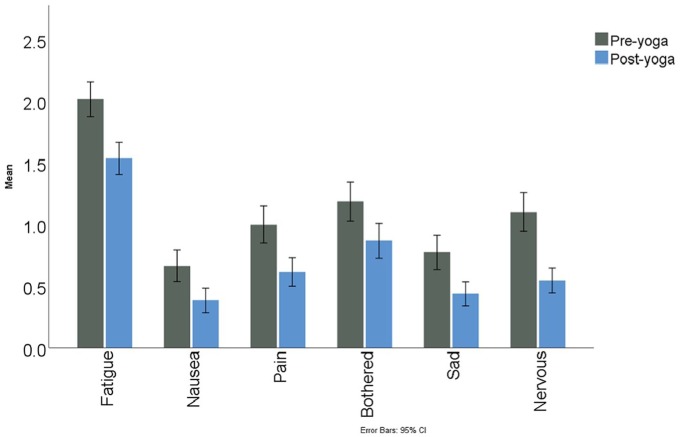
This 4-year program enhancement study found that a single 40-minute individualized yoga therapy session was feasible and acceptable for hospitalized hematological cancer patients. Across 354 sessions with pre/post data, all queried symptoms improved significantly, with the largest reductions in fatigue and nervousness.
## Key findings
- Of 558 yoga therapy sessions attempted, 486 (87%) were completed; 72 (13%) were unfinished, and no session was stopped early due to reported pain.
- For the 354 sessions with pre- and post-assessments, all 6 symptoms were significantly lower after yoga: fatigue (Z = −9.23, P < .0001, r = .50), nausea (Z = −6.57, P < .0001, r = .35), pain (Z = −6.67, P < .0001, r = .36), bothered by side effects (Z = −6.64, P < .0001, r = .36), sadness (Z = −7.11, P < .0001, r = .38), and nervousness (Z = −9.61, P < .0001, r = .52).
- In subgroup analyses, symptom reductions remained significant among African American patients (n = 131) and male patients (n = 131), with similar effect sizes reported for all 6 symptoms in each subgroup.
- Breathing awareness was used in 98% of sessions, body awareness in approximately 92%, guided relaxation in 63%, and movement in 21%; movement was less frequent due to lack of energy, illness, or pain.
## Methods
- Program enhancement study conducted between October 2013 and August 2017 on a 24-bed inpatient hematology/bone marrow transplant unit.
- Hospitalized patients with blood or lymphatic cancer were selected by nursing staff based on high morbidity/discomfort; 486 patients received a single individualized 40-minute yoga therapy session.
- Pre/post symptoms were measured with a modified FACT-BMT symptom checklist (0-4 Likert scale) for lack of energy, pain, nausea, bothered by side effects, sadness, and nervousness; feasibility and representation were analyzed with completion rates and χ² tests, and symptom change with Wilcoxon signed rank tests.
## Limitations
- The paper states it was not designed or powered to definitively test safety or efficacy, and it was not designed to make generalizable conclusions.
- Patients were not randomly selected; nursing staff identified them based on high symptom burden, and the study did not quantify patients who were not offered or who refused yoga sessions.
- Evident from the text: there was no control group, so the symptom improvements cannot be causally attributed to yoga with certainty.
Model-written summary. Check it against the paper before relying on it.
Integrity signals
Registry
Cites
Statistics
Figures
Verification
Claims the paper makes
13 Valid · 0 Not valid · 4 Not checked · 33 Own results and interpretations
The cited sources support only part of this claim — read each source’s verdict below.
In the paper
“pilot data attest to the feasibility and safety of facility-based yoga during cancer treatment for both adult36 and pediatric inpatients.37”
§ Individualized, Single Session Yoga Therapy to Reduce Physical and Emotional Symptoms in Hospitalized Hematological Cancer Patients > Background
What the sources say
- Partly supportedcites [36] Sohl SJ Danhauer SC Schnur JB Daly L Suslov K Montgomery GH Feasibility of a brief yoga intervention during chemotherapy for persistent or recurrent ovarian cancer. Explore (NY). 2012; 8: 197- 198. 22560758 PMC3348511 sourceExperimental — accuracy not yet measured
The paper’s discussion (page unavailable) says its preliminary results support the feasibility of brief yoga sessions during chemotherapy for women with ovarian cancer; participants received sessions during scheduled treatment. It does not report safety outcomes or establish that participants were inpatients. The pediatric portion of the citing sentence is attached to a different citation and is not attributed to this paper. (LLM, conf=0.88)
- Supportedcites [37] Diorio C Schechter T Lee M et al A pilot study to evaluate the feasibility of individualized yoga for inpatient children receiving intensive chemotherapy. BMC Complement Altern Med. 2015; 15: 2. 25617154 PMC4308944 source
Citation 37 is attached to the pediatric-inpatient portion of the sentence; the adult portion has a separate citation. The Results and discussion report that yoga met the feasibility threshold in 10 of 11 children receiving intensive chemotherapy and that no adverse events were attributed to it. The indexed passage has no page number. (LLM, conf=0.93)
plain- Asserted: passes — The authors put it forward as true.
- Checkable: passes — It can be checked against evidence.
- Load-bearing: passes — The paper’s conclusions depend on it.
- Based: passes — The paper gives a reason why it holds.
- Partly supported
The cited sources support only part of this claim — read each source’s verdict below.
In the paper
“the majority of studies have examined its impact for patients with breast and ovarian cancer.30”
§ Individualized, Single Session Yoga Therapy to Reduce Physical and Emotional Symptoms in Hospitalized Hematological Cancer Patients > Background
What the sources say
- Partly supportedcites [30] Danhauer SC Addington EL Sohl SJ Chaoul A Cohen L Review of yoga therapy during cancer treatment. Support Care Cancer. 2017; 25: 1357- 1372. 28064385 PMC5777241 sourceExperimental — accuracy not yet measured
The Discussion (Summary and Limitations; page unavailable) says study samples predominantly included women with breast cancer, supporting the majority claim for breast cancer. The References list a pilot study involving women with ovarian or breast cancer, but the review does not identify ovarian cancer as a major focus of the studies. (LLM, conf=0.87)
plain- Asserted: passes — The authors put it forward as true.
- Checkable: passes — It can be checked against evidence.
- Load-bearing: passes — The paper’s conclusions depend on it.
- Based: passes — The paper gives a reason why it holds.
- Partly supported
Every source the paper cites for this claim was checked and supports it.
In the paper
“Less is known about the feasibility, acceptability, or efficacy of yoga for patients with hematologic cancers.”
§ Individualized, Single Session Yoga Therapy to Reduce Physical and Emotional Symptoms in Hospitalized Hematological Cancer Patients > Background
What the sources say
- Supportedcites [35] Felbel S Meerpohl JJ Monsef I Engert A Skoetz N Yoga in addition to standard care for patients with haematological malignancies. Cochrane Database Syst Rev. 2014;(6):CD010146. PMC4869525 24919720 source
The Background (‘Why it is important to do this review’; page unavailable) says there is little information on yoga and its effects in people with haematological malignancies. The Results (‘Description of studies’; page unavailable) identify just one included trial, designed primarily to assess feasibility in people with lymphoma. Together with the review’s conclusion that efficacy remains unclear, this supports the broad statement that these aspects are less well understood. (LLM, conf=0.88)
plain- Asserted: passes — The authors put it forward as true.
- Checkable: passes — It can be checked against evidence.
- Load-bearing: passes — The paper’s conclusions depend on it.
- Based: passes — The paper gives a reason why it holds.
- Supported
A result the paper reports from its own data — it cites no other source for it, so there is none to check. The quote shows it is in the paper.
In the paper
“A total of 354 (73%) sessions were completed with pre- and post-assessments for analysis.”
§ Individualized, Single Session Yoga Therapy to Reduce Physical and Emotional Symptoms in Hospitalized Hematological Cancer Patients > Results
plain- Asserted: passes — The authors put it forward as true.
- Checkable: passes — It can be checked against evidence.
- Load-bearing: passes — The paper’s conclusions depend on it.
- Based: passes — The paper gives a reason why it holds.
A result the paper reports from its own data — it cites no other source for it, so there is none to check. The quote shows it is in the paper.
In the paper
“the majority of unfinished sessions were interrupted by a medical procedure or because the patient fell asleep.”
§ Individualized, Single Session Yoga Therapy to Reduce Physical and Emotional Symptoms in Hospitalized Hematological Cancer Patients > Abstract Objective: Inpatient treatment of hematological cancer is among the most physically and mentally arduous cancer treatments, and it is associated with a number of common physical, emotional, and social symptoms that can negatively affect quality of life (QOL) for years following treatment. While treating symptoms during hospitalization holds promise for improving long-term QOL, successful approaches likely require multidisciplinary interventions. In this article, we describe a 4-year effort in program enhancement that incorporated an adjunctive single yoga therapy session during treatment for hematological malignancies. Methods: Hospitalized patients receiving treatment for hematological cancer (N = 486) were provided a 40-minute individualized yoga therapy session. We evaluated feasibility and acceptance by quantifying the percentage of patients who discontinued the yoga session due to pain, discomfort, or another reason, and by comparing the intervention population to the demographic makeup of the unit more generally. Patient-reported symptoms were obtained before and after each session, and we evaluated acute symptom change for the entire sample and in subsamples that are less likely to use mindfulness-based interventions such as yoga. Results: The majority of sessions (87%) were completed, and the majority of unfinished sessions were interrupted by a medical procedure or because the patient fell asleep. No session was stopped early due to patients’ reported pain. Significant decreases were reported in all symptoms, with the greatest decrease in fatigue and anxiety. Conclusions: Yoga therapy was a feasible and effective nondrug adjunct intervention for hospitalized patients receiving treatment for hematological cancer, including bone marrow transplantation.
plainn = 486- Asserted: passes — The authors put it forward as true.
- Checkable: passes — It can be checked against evidence.
- Load-bearing: unclear — It is unclear whether the paper’s conclusions depend on it.
- Based: passes — The paper gives a reason why it holds.
15 more claims
Create a free account to see all 50 claims and to verify the 1 reference still open.
- Probably not a substantial claim. 23
- It may state two separate claims as one. 16
Statistics recomputed
Every reported test result, recomputed from its test statistic and degrees of freedom. A result shows as not adding up only once an independent check has confirmed it.
- Consistentχ²(2) = 36.7reported p < .001 · recomputed p < .001
“χ2(2, N = 709) = 36.7, p < .001”
- Consistentχ²(2) = 37.8reported p < .001 · recomputed p < .001
“χ2(2, N = 689) = 37.8, p < .001”
- Consistentz = -9.23reported p < .0001 · recomputed p < .001
“Z = −9.23, p < .0001”
- Consistentz = -6.57reported p < .0001 · recomputed p < .001
“Z = −6.57, p < .0001”
- Consistentz = -6.67reported p < .0001 · recomputed p < .001
“Z = −6.67, p < .0001”
15 more recomputed tests
Create a free account to see every test the Stats check recomputed.
Self-check
Percentages, sums and reported differences re-computed from the paper’s own numbers.
Each contradiction between two passages listed here was confirmed by an independent check.
Rated minor: it would not touch a result — a value no result rests on, a p-value that stays on the same side of the significance level, or a conflict that is clerical, resolved elsewhere in the paper, or outside its own findings.
In the paper
§ Individualized, Single Session Yoga Therapy to Reduce Physical and Emotional Symptoms in Hospitalized Hematological Cancer Patients > Results
“Bothered by side effects: Z = −6.64, P < .0001, r = .36;”
§ Individualized, Single Session Yoga Therapy to Reduce Physical and Emotional Symptoms in Hospitalized Hematological Cancer Patients > Results
“Bothered by symptoms: Z = −3.56, P < .001, r = .33;”
Citations
Cites
Hematopoietic Stem-Cell Transplantation
Copelan, E. A. (2006) · New England Journal of Medicine · doi:10.1056/nejmra052638 · Cited by 2,522
Trends in the Use of Complementary Health Approaches Among Adults in the United States: New Data
Jackson, C. (2015) · Holistic Nursing Practice · doi:10.1097/hnp.0000000000000088 · Cited by 1,166
Depression as a predictor of disease progression and mortality in cancer patients: A Meta‐Analysis
Satin, J. R., Linden, W., & Phillips, M. J. (2009) · Cancer · doi:10.1002/cncr.24561 · Cited by 972
Mustian, K. M., Alfano, C. M., Heckler, C., Kleckner, A. S., Kleckner, I. R., Leach, C. R., Mohr, D., Palesh, O. G., Peppone, L. J., Piper, B. F., et al. (2017) · JAMA Oncology · doi:10.1001/jamaoncol.2016.6914 · Cited by 932
(2015) · PubMed · Cited by 926
Krebber, A. M. H., Buffart, L. M., Kleijn, G., Riepma, I. C., de Bree, R., Leemans, C. R., Becker, A., Brug, J., van Straten, A., Cuijpers, P., et al. (2014) · Psycho-Oncology · doi:10.1002/pon.3409 · Cited by 908
Cancer-related fatigue: the scale of the problem
Hofman, M., Ryan, J. L., Figueroa-Moseley, C. D., Jean-Pierre, P., & Morrow, G. R. (2007) · The Oncologist · doi:10.1634/theoncologist.12-s1-4 · Cited by 895
McQuellon, R., Russell, G., Cella, D., Craven, B., Brady, M., Bonomi, A., & Hurd, D. (1997) · Bone Marrow Transplantation · doi:10.1038/sj.bmt.1700672 · Cited by 466 · cited 1×
“Prior to and immediately after each session, the yoga therapist collected patient-reported symptoms using a modified symptom checklist derived from a validated tool for patient-reported outcomes, the Functional Assessment of Cancer Therapy–BMT (FACT-BMT) version 4.(39) Patients reported symptom change on a Likert-type…”
MethodWalker, J., Hansen, C. H., Martin, P., Symeonides, S., Ramessur, R., Murray, G., & Sharpe, M. (2014) · The Lancet Psychiatry · doi:10.1016/s2215-0366(14)70313-x · Cited by 435 · cited 1×
“The rates of depression among cancer patients actively undergoing treatment is higher,(49) and an astounding 73% of cancer patients with depression do not receive any treatment for their depression.(50) Both depression and QOL during and after cancer treatment predict mortality, independent of, Table 2.”
BackgroundRecovery and Long-term Function After Hematopoietic Cell Transplantation for Leukemia or Lymphoma
Syrjala, K. L. (2004) · JAMA · doi:10.1001/jama.291.19.2335 · Cited by 349
Bower, J. E., Greendale, G., Crosswell, A. D., Garet, D., Sternlieb, B., Ganz, P. A., Irwin, M. R., Olmstead, R., Arevalo, J., & Cole, S. W. (2014) · Psychoneuroendocrinology · doi:10.1016/j.psyneuen.2014.01.019 · Cited by 283
Multicenter, Randomized Controlled Trial of Yoga for Sleep Quality Among Cancer Survivors
Mustian, K. M., Sprod, L. K., Janelsins, M., Peppone, L. J., Palesh, O. G., Chandwani, K., Reddy, P. S., Melnik, M. K., Heckler, C., & Morrow, G. R. (2013) · Journal of Clinical Oncology · doi:10.1200/jco.2012.43.7707 · Cited by 282
Syrjala, K. L., Langer, S. L., Abrams, J. R., Storer, B. E., & Martin, P. J. (2005) · Journal of Clinical Oncology · doi:10.1200/jco.2005.12.674 · Cited by 260
Randomized, Controlled Trial of Yoga in Women With Breast Cancer Undergoing Radiotherapy
Chandwani, K. D., Perkins, G., Nagendra, H. R., Raghuram, N. V., Spelman, A., Nagarathna, R., Johnson, K., Fortier, A., Arun, B., Wei, Q., et al. (2014) · Journal of Clinical Oncology · doi:10.1200/jco.2012.48.2752 · Cited by 246
Carson, J. W., Carson, K. M., Porter, L. S., Keefe, F. J., & Seewaldt, V. L. (2009) · Supportive Care in Cancer · doi:10.1007/s00520-009-0587-5 · Cited by 231
Loberiza, F. R., Rizzo, J. D., Bredeson, C. N., Antin, J. H., Horowitz, M. M., Weeks, J. C., & Lee, S. J. (2002) · Journal of Clinical Oncology · doi:10.1200/jco.2002.08.757 · Cited by 213
Impact of Cancer on Health-Related Quality of Life of Older Americans
Reeve, B. B., Potosky, A. L., Smith, A. W., Han, P. K., Hays, R. D., Davis, W. W., Arora, N. K., Haffer, S. C., & Clauser, S. B. (2009) · JNCI Journal of the National Cancer Institute · doi:10.1093/jnci/djp123 · Cited by 211
RAGHAVENDRA, R. M., NAGARATHNA, R., NAGENDRA, H. R., GOPINATH, K. S., SRINATH, B. S., RAVI, B. D., PATIL, S., RAMESH, B. S., & NALINI, R. (2007) · European Journal of Cancer Care · doi:10.1111/j.1365-2354.2006.00739.x · Cited by 210
The Safety of Yoga: A Systematic Review and Meta-Analysis of Randomized Controlled Trials
Cramer, H., Ward, L., Saper, R., Fishbein, D., Dobos, G., & Lauche, R. (2015) · American Journal of Epidemiology · doi:10.1093/aje/kwv071 · Cited by 207
Caruso, R., Nanni, M. G., Riba, M., Sabato, S., Mitchell, A. J., Croce, E., & Grassi, L. (2017) · Acta Oncologica · doi:10.1080/0284186x.2016.1266090 · Cited by 203
Richardson, J. L., Marks, G., & Levine, A. (1988) · Journal of Clinical Oncology · doi:10.1200/jco.1988.6.11.1746 · Cited by 180 · cited 1×
“In addition, cancer-related fatigue has a profound deleterious emotional, psychological, and social impact, as it interferes with daily activities and QOL(43) and can ultimately reduce compliance with treatment.(44) While pharmacologic management of fatigue during stem cell transplant appears somewhat efficacious, the…”
Backgroundvan Haren, I. E. P. M., Timmerman, H., Potting, C. M., Blijlevens, N. M. A., Staal, J. B., & Nijhuis-van der Sanden, M. W. G. (2013) · Physical Therapy · doi:10.2522/ptj.20120181 · Cited by 168
Bevans, M., El-Jawahri, A., Tierney, D. K., Wiener, L., Wood, W. A., Hoodin, F., Kent, E. E., Jacobsen, P. B., Lee, S. J., Hsieh, M. M., et al. (2017) · Biology of Blood and Marrow Transplantation · doi:10.1016/j.bbmt.2016.09.011 · Cited by 166 · cited 3×
“The most common include physical (fatigue, pain, sleep disturbance), psychological (anxiety, depression), and social (loneliness, negative self-image, loss of control, and privacy) sequelae.(2) While rates of emotional distress and physical limitations are acutely elevated in the 100 days following treatment,(3,4) the…”
BackgroundInfluentialEngagement in Mindfulness Practices by U.S. Adults: Sociodemographic Barriers
Olano, H. A., Kachan, D., Tannenbaum, S. L., Mehta, A., Annane, D., & Lee, D. J. (2015) · The Journal of Alternative and Complementary Medicine · doi:10.1089/acm.2014.0269 · Cited by 158 · cited 1×
“The former finding is consistent with National Health Interview Survey data, which found that of the nearly 70 000 participants surveyed, representing approximately 170 million adults, men were half as likely to engage in mindfulness-based practices such as yoga.(40) Similarly, men make up only about 30% of the partic…”
ResultRoutine screening for psychosocial distress following hematopoietic stem cell transplantation
Lee, S. J., Loberiza, F. R., Antin, J. H., Kirkpatrick, T., Prokop, L. J., Alyea, E. P., Cutler, C. S., Ho, V. T., Richardson, P. G. G., Schlossman, R. L., et al. (2004) · Bone Marrow Transplantation · doi:10.1038/sj.bmt.1704709 · Cited by 158
Fatigue and Physical Activity in Patients Undergoing Hematopoietic Stem Cell Transplant
Hacker, E. D., Ferrans, C., Verlen, E., Ravandi, F., van Besien, K., Gelms, J., & Dieterle, N. (2006) · Oncology Nursing Forum · doi:10.1188/06.onf.614-624 · Cited by 150
Exercise, inflammation, and fatigue in cancer survivors
LaVoy, E. C. P., Fagundes, C. P., & Dantzer, R. (2026) · PubMed · doi:10.22029/eir.2016.1710 · Cited by 138
Waldron, E. M., Hong, S., Moskowitz, J. T., & Burnett-Zeigler, I. (2018) · Mindfulness · doi:10.1007/s12671-018-0920-5 · Cited by 137
Vardar Yağlı, N., Şener, G., Arıkan, H., Sağlam, M., İnal İnce, D., Savcı, S., Çalık Kutukcu, E., Altundağ, K., Kaya, E. B., Kutluk, T., et al. (2015) · Integrative Cancer Therapies · doi:10.1177/1534735414565699 · Cited by 117
(2008) · PubMed · Cited by 115
Review of yoga therapy during cancer treatment
Danhauer, S. C., Addington, E. L., Sohl, S. J., Chaoul, A., & Cohen, L. (2017) · Supportive Care in Cancer · doi:10.1007/s00520-016-3556-9 · Cited by 114
Delivering Care to Long-Term Adult Survivors of Hematopoietic Cell Transplantation
Syrjala, K. L., Martin, P. J., & Lee, S. J. (2012) · Journal of Clinical Oncology · doi:10.1200/jco.2012.42.3038 · Cited by 112
Jacobsen, P. B., Le-Rademacher, J., Jim, H., Syrjala, K., Wingard, J. R., Logan, B., Wu, J., Majhail, N. S., Wood, W., Rizzo, J. D., et al. (2014) · Biology of Blood and Marrow Transplantation · doi:10.1016/j.bbmt.2014.05.027 · Cited by 101
Do negative or positive emotions differentially impact mortality after adult stem cell transplant?
Hoodin, F., Uberti, J. P., Lynch, T. J., Steele, P. F., & Ratanatharathorn, V. (2006) · Bone Marrow Transplantation · doi:10.1038/sj.bmt.1705419 · Cited by 92
Psychological distress in long‐term survivors of hematopoietic stem cell transplantation
Rusiewicz, A., DuHamel, K. N., Burkhalter, J., Ostroff, J., Winkel, G., Scigliano, E., Papadopoulos, E., Moskowitz, C., & Redd, W. (2008) · Psycho-Oncology · doi:10.1002/pon.1221 · Cited by 87
Correlates of Quality of Life Among African American and White Cancer Survivors
Matthews, A. K., Tejeda, S., Johnson, T. P., Berbaum, M. L., & Manfredi, C. (2012) · Cancer Nursing · doi:10.1097/ncc.0b013e31824131d9 · Cited by 86 · cited 5×
“Cancerrelated fatigue is among the most commonly described symptoms experienced by hematological cancer patients over the course of treatment, and it is associated with significant morbidity, functional impairment, and reduction in QOL.22 Caused by both the cancer itself and by aggressive treatments, cancer-related fa…”
ResultInfluentialPharmacologic Interventions for Fatigue in Cancer and Transplantation: A Meta-Analysis
Tomlinson, D., Robinson, P. D., Oberoi, S., Cataudella, D., Culos-Reed, N., Davis, H., Duong, N., Gibson, F., Götte, M., Hinds, P., et al. (2018) · Current Oncology · doi:10.3747/co.25.3883 · Cited by 68 · cited 1×
“agents used (erythropoietin and methylphenidate) carry a risk of nonserious adverse events and safety concerns.(45) For all of these reasons, the beneficial effect of yoga on cancerrelated fatigue we observed is particularly encouraging.”
BackgroundDiorio, C., Schechter, T., Lee, M., O’Sullivan, C., Hesser, T., Tomlinson, D., Piscione, J., Armstrong, C., Tomlinson, G., & Sung, L. (2015) · BMC Complementary and Alternative Medicine · doi:10.1186/s12906-015-0529-3 · Cited by 66 · cited 1×
“However, pilot data attest to the feasibility and safety of facility-based yoga during cancer treatment for both adult(36) and pediatric inpatients.(37) In advance of a more definitive clinical trial evaluating facility-based yoga for symptom management during treatment, here we describe a program enhancement study th…”
BackgroundAndorsky, D. J., Loberiza, F. R., & Lee, S. J. (2006) · Bone Marrow Transplantation · doi:10.1038/sj.bmt.1705347 · Cited by 62
Nelson, A. M., Coe, C. L., Juckett, M. B., Rumble, M. E., Rathouz, P. J., Hematti, P., & Costanzo, E. S. (2014) · Bone Marrow Transplantation · doi:10.1038/bmt.2014.179 · Cited by 61
Fung, F. Y., Li, M., Breunis, H., Timilshina, N., Minden, M. D., & Alibhai, S. M. H. (2012) · Leukemia Research · doi:10.1016/j.leukres.2012.11.013 · Cited by 60
Myers, R. M., Hill, B. T., Shaw, B. E., Kim, S., Millard, H. R., Battiwalla, M., Majhail, N. S., Buchbinder, D. K., Lazarus, H. M., Savani, B. N., et al. (2017) · Cancer · doi:10.1002/cncr.31114 · Cited by 57
Cost savings in inpatient oncology through an integrative medicine approach.
Kligler, B., Homel, P., Harrison, L. B., Levenson, H., Kenney, J., & Merrell, W. C. (2011) · PubMed · Cited by 56
Panju, A. H., Danesh, A., Minden, M. D., Kelvin, D. J., & Alibhai, S. M. H. (2008) · Supportive Care in Cancer · doi:10.1007/s00520-008-0512-3 · Cited by 41
(2008) · PubMed · Cited by 39
Sirilla, J., & Overcash, J. (2013) · Supportive Care in Cancer · doi:10.1007/s00520-012-1637-y · Cited by 31 · cited 1×
“Yoga practices are well tolerated(25,26) and have been shown to be effective for improving sleep,(27) peripheral muscular strength,(28) and QOL,(29) and for reducing fatigue,(30) pain,(31) nausea,(32) and inflammatory signaling(33) in cancer survivors, and it is recommended as adjunctive support during stem cell trans…”
BackgroundYoga in addition to standard care for patients with haematological malignancies
Felbel, S., Meerpohl, J. J., Monsef, I., Engert, A., & Skoetz, N. (2014) · Cochrane Database of Systematic Reviews · doi:10.1002/14651858.cd010146.pub2 · Cited by 31
Ardakani, M. T., Mehrpooya, M., Mehdizadeh, M., Hajifathali, A., & Abdolahi, A. (2015) · PubMed Central · Cited by 22
Sohl, S. J., Danhauer, S. C., Schnur, J. B., Daly, L., Suslov, K., & Montgomery, G. H. (2012) · EXPLORE · doi:10.1016/j.explore.2012.02.006 · Cited by 12
(1997) · doi:10.1002/(sici)1097-0142(19970501)79:9
(2008) · Europe PMC (PubMed Central)
Morita (2000) · doi:10.1002/(sici)1099-1611(200003/04)9:2
Research works printed but not linked: 1
- Feuerstein G The Yoga Tradition. Prescott, AZ: Hohm Press; 1998.
Cited by
Safety, Precautions, and Modalities in Cancer Rehabilitation: an Updated Review
Zheng, J. Y., Mixon, A., & McLarney, M. D. (2021) · Current Physical Medicine and Rehabilitation Reports · doi:10.1007/s40141-021-00312-9 · Cited by 32
Yoga Meningkatkan Kualitas Hidup Pada Pasien Kanker: Literature Review
Setiawan, H., Khaerunnisa, R. N., Ariyanto, H., Fitriani, A., Firdaus, F. A., & Nugraha, D. (2021) · Journal of Holistic Nursing Science · doi:10.31603/nursing.v8i1.3848 · Cited by 40
“Aspek psikologis dan sosial seperti harga diri, kebahagiaan, hubungan interpersonal, spiritualitas, masalah keuangan, persepsi diri terhadap kualitas hidup, perasaan positif dan kesejahteraan sosial (Mascaro et al., 2019).”
BackgroundTailored Yoga Intervention for Postlumbar Spine Surgical Pain Management: A Feasibility Study
Sharma, N. K., Li, C., Aoyagi, K., Ritchey, S., Mohr, E., Burton, D. C., Arnold, P. M., & Colgrove, Y. (2024) · Journal of Integrative and Complementary Medicine · doi:10.1089/jicm.2023.0096 · Cited by 3
“Yogic relaxation and diaphragmatic breathing lessened anxiety in hospitalized patients with traumatic brain injury, 31 spinal cord injury, COVID-19, 32 hematological cancer, 33 and children with cancer.”
Sackmann, C., Weißflog, G., Bodschwinna, D., Hönig, K., & Ernst, J. (2024) · European Journal of Cancer Care · doi:10.1155/2024/3272185 · Cited by 6
Joshi, A. M., Mehta, S. A., Dhakate, N. G., & Mehta, A. O. (2023) · Yoga Mimamsa · doi:10.4103/ym.ym_41_23 · Cited by 8
Metadata
- Authors
- Mascaro, J. S., Waller, A. V., Wright, L., Leonard, T., Haack, C., & Waller, E. K.
- Affiliations
- Emory University (US)
- Corresponding author
- Mascaro, Jennifer S.
- Venue
- Integrative Cancer Therapies
- Publisher
- SAGE Publications
- Published
- 2019-01
- Volume
- 18
- Pages
- 1534735419861692-1534735419861692
- ISSN
- 1534-7354 (ISSN-L)
- 1552-695X
- PMC
- PMC6637829
- OpenAlex
- W2957723842
- Cited by
- 17
- References
- 52
- Citations by year
- 2026: 2 · 2025: 3 · 2024: 2 · 2023: 4 · 2022: 2 · 2021: 3 · 2020: 1
- FWCI
- 0.63
- Type
- journal article
- Language
- en
- Open access
- gold
- doi.org
- Licence
- cc-by-nc
- journals.sagepub.com/page/policies/text-and-data-mining-license (tdm)
- Locations
- Integrative Cancer Therapies (publishedVersion, cc-by-nc)
- PubMed Central (publishedVersion, cc-by-nc)
- PubMed (publishedVersion)
- DOAJ (DOAJ: Directory of Open Access Journals) (submittedVersion, cc-by-sa)
- Topics
- Health Sciences › Medicine › Oncology › Cancer survivorship and care
- Health Sciences › Medicine › Complementary and alternative medicine › Complementary and Alternative Medicine Studies
- Social Sciences › Psychology › Clinical Psychology › Mindfulness and Compassion Interventions
- Keywords
- yoga therapy, hematologic cancer, hospitalized cancer patients, adjunctive therapy, fatigue, anxiety, quality of life, bone marrow transplantation, personalized interventions, feasibility, symptom relief, inpatient care
- MeSH terms
- Adult, Anxiety, Anxiety Disorders, Depression, Emotions, Fatigue, Female, Humans, Male, Middle Aged, Pain, Quality of Life, Yoga, Meditation, Hematologic Neoplasms, Mindfulness
About these checks
Registry, retraction, Cites and statistics results are computed, not judged, with one exception: a printed reference that no index lists is read once by a model before it counts as a citation error. Claims are extracted by a model and kept only when their quote appears verbatim in the text; each cited source is then checked, with a model’s help, for whether it says what the claim relies on. Those verdicts can be wrong — read the claim’s quote and the cited source before relying on one.
The claim verdicts this report counts are experimental: their accuracy is not yet measured.
A language model drew the claims from the paper on 2026-10-11, under version 3 of the claim definition (model deepseek-v4.1-flash, prompt extract-v3).
A second model labelled each claim on 2026-10-11 (model jev-1.13-20260917, definition revision gold-guideline-v0.2).
Cited sources are checked with a language model’s help (gpt-6-sol).
Statistics and arithmetic are recomputed, not judged.
Confidence bands are shown only for fields calibrated on our annotated test set. None is calibrated yet, so no band is shown.
What counts as a claim ›How we measure confidence ›How we check this ›
Are you an author, or do you see a problem with this page? Request a review
Data sources
Bibliographic data: Semantic Scholar, OpenAlex, Crossref.
Contains information from the Semantic Scholar Academic Graph Datasets, made available under the ODC Attribution License (ODC-BY 1.0).
Semantic Scholar’s data is described in: Kinney, R., et al. (2023). The Semantic Scholar Open Data Platform. arXiv:2301.10140.
