

Social Media Imaginaries and the City: How the Attention Economy Is Reshaping Urban Built Environments
Open accessThe DOI matches its Crossref record; 79 of the 82 references it cites were found in a registry or an index, and 3 are not checked yet; 4 of the 29 sources its claims cite were checked for support.
Abstract
Social media are becoming a growing presence in our cities, filtering our experience of urban place and enabling locations to “go viral.” This article examines the downstream consequences of this new reality, examining how the urban actors who shape the city consider social media in their work. Drawing on ethnographic research and interviews with elite investors in São Paulo’s gentrifying Centro neighborhood, this article finds that social media are ever-present force in the production of the city. The capacity of social media to shape imaginaries and steer flows of people—and therefore flows of capital—have emerged as a powerful economic logic, integral to the city’s economic machinery. In pursuit of online attention, investors are adapting the city to fit their understanding of what “works” on social media—changing not only superficial designs and aesthetics, but even in which buildings they invest. Restaurants and bars come to function as intermediaries for the exchange of attention capital : they purchase attention from influencers, in turn marketing it to their customers and exchanging accumulated digital clout for free beer and new kitchens from their suppliers. Attention is transforming the very built environment of the city, which in turn provides essential physical infrastructure for the attention economy. While social media platforms may be diverse in their biases and characteristics, this article argues that the imperative of data accumulation has produced an era in which everything—even our cities—is shaped by the pursuit of attention.
Verified 2026-11-25 · 3 references not checked yet
Overview
CoChat Summary
TL;DR
Drawing on ethnographic research and interviews with five elite investors in São Paulo’s gentrifying Centro, this article argues that social media—especially Instagram—has become an ever-present economic logic in city-making, with attention functioning as a form of capital. Investors adapt urban aesthetics, design, and even building choices to social media shareability, while restaurants and bars act as attention intermediaries trading digital clout with influencers and suppliers.
Key findings
- Social media is integral to investors’ work: one said “we’re all thinking about social media, every day, all day.” Instagram is by far the most important platform, Twitter/X a distant second; TripAdvisor, Yelp, and Google Maps are described as largely irrelevant, Facebook as having lost relevance, and WhatsApp as influential but less important for business.
- Establishments owned by the interviewed investors and targeting middle and upper classes had between 50,000 and 200,000 Instagram followers; even a relatively small hot dog stand had nearly 100,000 followers. The author analyzed the 100 most recent posts from establishments and the 200 most recent posts tagging/mentioning them.
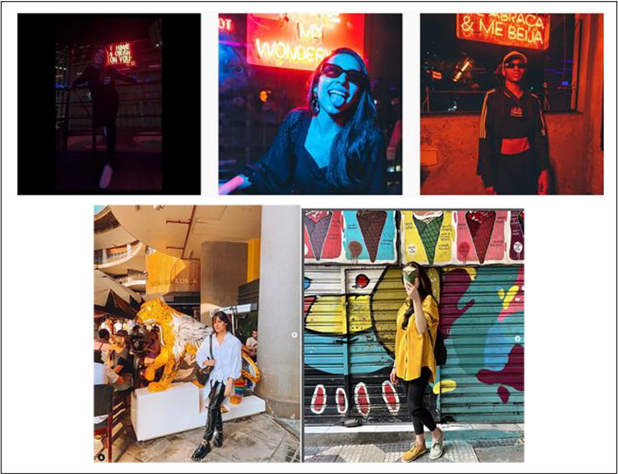
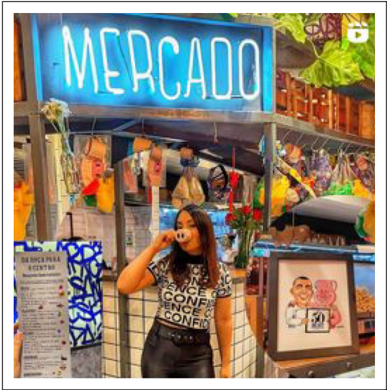
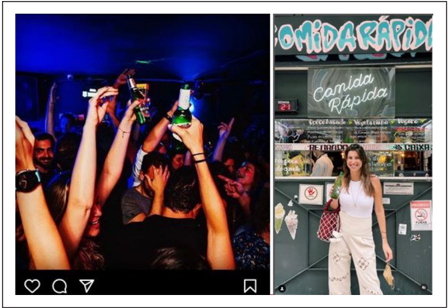
- Investors adapt the built environment to social media: they create “instagrammable places,” props, neon quotes, post-it note walls, pig-nose cocktail cups, graffiti backdrops, and redecorate or repaint as often as every few months. One investor chose a building in part for its photogenic corridor.
- Attention operates as capital: restaurants and bars function as “attention intermediaries,” hiring influencers and negotiating social media attention into supplier contracts. One owner placed a kitchen brand in an instagrammable area and received an entire restaurant kitchen for free; attention is explicitly contracted, with “a specified rate of conversation between likes and reais.”
Methods
- Qualitative case study of São Paulo’s Centro neighborhood, using ethnographic research, interviews, analysis of social media posts, and several on-the-ground visits; the author also draws on substantial experience of the city, neighborhoods, and discussed establishments.
- Interviews with five investors associated with many of the most influential, successful, and visible establishments in the neighborhood. Subjects were selected based on material influence in shaping nightlife consumption; access used a snowball approach. Interviews were conducted over Zoom in English or Portuguese, lasted around 1 hour, and covered background, establishments, social media strategy, and how digital media transformed their business.
- Instagram post analysis focused on the dominant platform in the investors’ view: the 100 most recent posts from the establishment and the 200 most recent posts in which the establishment was tagged or mentioned.
Limitations
- The paper states that access to such individuals is challenging and that the sample is five investors from a relatively small social clique; because the investors showed a remarkable level of agreement, the article does not differentiate between them.
- The paper states that it focuses on how interviewees understand and perceive social media and follows their definitions; for these investors, Instagram is by far the most important platform, so the perceptions described chiefly concern Instagram’s aesthetics and preferences.
- Evident but not framed as a dedicated limitations section: the study is a single-city, single-neighborhood case with five elite investors, limiting generalizability; it relies on interviews and Instagram posts rather than systematic comparative or longitudinal data. The paper does not include a dedicated limitations section.
Model-written summary. Check it against the paper before relying on it.
Integrity signals
Registry
Cites
Statistics
Figures


Verification
Claims the paper makes
4 Valid · 5 Not valid · 16 Not checked · 104 Own results and interpretations
The cited sources support only part of this claim — read each source’s verdict below.
In the paper
“This article has argued that the two strands cannot be treated as separate, as the logic of attention extraction defines the structure of interaction within which creativity, agency, and self-expression operate (Törnberg & Uitermark, 2025).”
What the sources say
- Partly supportedcites Törnberg & Uitermark, 2025 matched to “Seeing Like a Platform: An Inquiry into the Condition of Digital Modernity” (2025) sourceExperimental — accuracy not yet measured
Split into 2 atoms — 1 confirmed, 1 partially supported, 0 disputed, 0 misattributed, 0 unverifiable. Expand the claim to see per-atom verdicts.
plainstates a cause- Asserted: passes — The authors put it forward as true.
- Checkable: passes — It can be checked against evidence.
- Load-bearing: passes — The paper’s conclusions depend on it.
- Based: passes — The paper gives a reason why it holds.
- Partly supported
A result the paper reports from its own data — it cites no other source for it, so there is none to check. The quote shows it is in the paper.
In the paper
“However, most establishments go far beyond just providing such basics: they adapt their overall aesthetics, and provide design environments, backdrops, and elements to actively encourage sharing.”
plain- Asserted: passes — The authors put it forward as true.
- Checkable: passes — It can be checked against evidence.
- Load-bearing: passes — The paper’s conclusions depend on it.
- Based: passes — The paper gives a reason why it holds.
A result the paper states — it cites no source for it, so there is none to check. The quote shows it is in the paper.
In the paper
“As a result, even things that are ostensibly unrelated to media or advertising must be adapted.”
plainstates a cause- Asserted: passes — The authors put it forward as true.
- Checkable: passes — It can be checked against evidence.
- Load-bearing: passes — The paper’s conclusions depend on it.
- Based: passes — The paper gives a reason why it holds.
A result the paper reports from its own data — it cites no other source for it, so there is none to check. The quote shows it is in the paper.
In the paper
“this article finds that social media are ever-present force in the production of the city.”
- Also stated in: § Attention as Aesthetics · plain
“Social media is ever-present in the work of the investors.”
plainstates a causeSingle case- Asserted: passes — The authors put it forward as true.
- Checkable: passes — It can be checked against evidence.
- Load-bearing: passes — The paper’s conclusions depend on it.
- Based: passes — The paper gives a reason why it holds.
- Also stated in: § Attention as Aesthetics · plain
A result the paper reports from its own data — it cites no other source for it, so there is none to check. The quote shows it is in the paper.
In the paper
“On social media, Centro is represented as a well-off, highly aestheticized place of luxury and high-end consumption by the young, White and beautiful.”
plain- Asserted: passes — The authors put it forward as true.
- Checkable: passes — It can be checked against evidence.
- Load-bearing: passes — The paper’s conclusions depend on it.
- Based: passes — The paper gives a reason why it holds.
57 more claims
Create a free account to see all 129 claims and to verify the 2 references still open.
- Probably not a substantial claim. 43
- It may state two separate claims as one. 39
Citations
Cites
Understanding Media: The Extensions of Man
Levine, S., & McLuhan, M. (1964) · American Quarterly · doi:10.2307/2711172 · Cited by 12,311 · cited 1×
“Through this process of “mediatiza-tion” (Hjarvard, 2008), the operational logic of the dominant form of media gradually comes to define the broader cultural logic of its era (McLuhan, 1994; Postman, 1985).”
The Gutenberg Galaxy: The Making of Typographic Man
Leech, G. N., & McLuhan, M. (1963) · The Modern Language Review · doi:10.2307/3719923 · Cited by 3,339
Measuring user influence in twitter: The million follower fallacy
Cha, M., Haddadi, H., Benevenuto, F., & Gummadi, K. (2010) · Proceedings of the International AAAI Conference on Web and Social Media · doi:10.1609/icwsm.v4i1.14033 · Cited by 3,022 · cited 1×
“Social media are moreover associated with highly unequal distributions of attention (Cha et al., 2010; Törnberg, 2022a).”
The real-time city? Big data and smart urbanism
Kitchin, R. (2014) · GeoJournal · doi:10.1007/s10708-013-9516-8 · Cited by 2,794
The Real-Time City? Big Data and Smart Urbanism
Kitchin, R. (2013) · SSRN Electronic Journal · doi:10.2139/ssrn.2289141 · Cited by 2,794
Understanding Media: The Extensions of Man
McLuhan, M., & Gordon, W. T. (1964) · Saber7 UCAB · Cited by 2,325
Zukin, S. (1995) · doi:10.5860/choice.33-4653 · Cited by 2,005
Shanahan, D. (1988) · The Social Science Journal · doi:10.1016/0362-3319(88)90048-1 · Cited by 1,761
Amusing Ourselves to Death: Public Discourse in the Age of Show Business
Postman, N. (2010) · Cited by 1,698
Understanding Social Media Logic
Van Dijck, J., & Poell, T. (2013) · Media and Communication · doi:10.17645/mac.v1i1.70 · Cited by 1,258 · cited 1×
“…principle prevents us from, for instance, posting lengthy academic papers on Instagram and aestheticized photos of our lunch on ResearchGate, such messages go against the media logics of the respective platforms and are unlikely to be widely seen (Langlois & Elmer, 2013; van Dijck & Poell, 2013).”
Status update: celebrity, publicity, and branding in the social media age
(2014) · Choice Reviews Online · doi:10.5860/choice.51-5062 · Cited by 1,163
The Mediatization of Society: A Theory of the Media as Agents of Social and Cultural Change
Hjarvard, S. (2008) · Nordicom Review · doi:10.1515/nor-2017-0181 · Cited by 1,128 · cited 1×
“Through this process of “mediatiza-tion” (Hjarvard, 2008), the operational logic of the dominant form of media gradually comes to define the broader cultural logic of its era (McLuhan, 1994; Postman, 1985).”
Postman, N. (1985) · ETC: A Review of General Semantics · doi:10.66774/etc_4201_013 · Cited by 1,117 · cited 5×
“If , as Postman (1985) argued, the logic of the television was to cast everything in the language of entertainment, then social media should be understood as ushering in an era where everything—even our cities—is shaped by the pursuit of attention.”
InfluentialSrnicek, N. (2016) · Cited by 1,099
When data is capital: Datafication, accumulation, and extraction
Sadowski, J. (2019) · Big Data & Society · doi:10.1177/2053951718820549 · Cited by 1,057 · cited 1×
“As an essential precursor to the personal data whose accumulation defines contemporary digital capitalism (Sadowski, 2019), attention has become a highly valuable—and a growing literature has described how entire economies and large technological infrastructures have grown around its capture,…”
Savage, M., Bagnall, G., & Longhurst, B. (2005) · doi:10.4135/9781446216880 · Cited by 993
Platform capitalism: The intermediation and capitalisation of digital economic circulation
Langley, P., & Leyshon, A. (2017) · Finance and Society · doi:10.2218/finsoc.v3i1.1936 · Cited by 989 · cited 1×
“…are understood to operate by conditioning social life and defining the means through which individuals interact and experience the world, employing their intermediation to engage in data commodification, value extraction, and data governance within our every-day life (Langley & Leyshon, 2017).”
The mediated construction of reality
Nyre, L. (2018) · New Media & Society · doi:10.1177/1461444817742900 · Cited by 953 · cited 3×
“Politics, religion, education, and public discourse are remolded by media’s influence, as individuals and organizations adapt their practices to align with their understanding of media’s preferences (Couldry & Hepp, 2018).”
The Mediated Construction of Reality
Couldry, N., & Hepp, A. (2016) · Cited by 929
Internet Celebrity: Understanding Fame Online
Abidin, C. (2018) · doi:10.1108/9781787560765 · Cited by 788 · cited 1×
“The feedback mechanisms that are central to nearly every social media platform mean that attention tends to attract attention, meaning that some users will be elevated to the status of micro-celebrities, while the large majority will have very limited voice (Abidin, 2018; Marwick, 2013).”
Airbnb and the rent gap: Gentrification through the sharing economy
Wachsmuth, D., & Weisler, A. (2018) · Environment and Planning A: Economy and Space · doi:10.1177/0308518x18778038 · Cited by 720 · cited 1×
“…how platformization and datafication have transformed material and economic dimensions of the city—in particular short-term rental services, food delivery, and urban transportation (Wachsmuth & Weisler, 2018), as well as urban governance and citizenship (Cardullo et al., 2019; Leszczynski, 2016).”
The Gutenberg galaxy the making of typographic man
McLuhan, M. (n.d.) · Cited by 579
New Retail Capital and Neighborhood Change: Boutiques and Gentrification in New York City
Zukin, S., Trujillo, V., Frase, P., Jackson, D., Recuber, T., & Walker, A. (2009) · City & Community · doi:10.1111/j.1540-6040.2009.01269.x · Cited by 569 · cited 1×
“As Zukin et al. (2009) argue, restaurants and bars are not only products of gentrifi-cation, but also producers of social meaning and identity.”
Ethnographic Approaches to Digital Media
Coleman, E. G. (2010) · Annual Review of Anthropology · doi:10.1146/annurev.anthro.012809.104945 · Cited by 566 · cited 2×
“Such a focus requires an ethnographic approach to digital media, in which we examine not only media representations, but also seek to examine the actions and motivations of actors in the city (Coleman, 2010).”
Big Data from the South(s): Beyond Data Universalism
Milan, S., & Treré, E. (2019) · Television & New Media · doi:10.1177/1527476419837739 · Cited by 511 · cited 3×
“By focusing on a city and neighborhood outside the Global North, this article contributes to moving beyond the Euro-American centrism of the literature (Milan & Treré, 2019).”
InfluentialGraham, S. D. N. (2005) · Progress in Human Geography · doi:10.1191/0309132505ph568oa · Cited by 489 · cited 1×
“While the theoretical literature has long emphasized the mutual co-construction between the spatial and the digital (Graham, 2005), most empirical studies have tended to focus on how social media represents and co-produces space, or on how people “use digital media to become placemakers” (Halegoua,…”
CONSUMING AUTHENTICITY: From outposts of difference to means of exclusion
Zukin, S. (2008) · Cultural Studies · doi:10.1080/09502380802245985 · Cited by 459 · cited 1×
“It offers a colorful backdrop for selfies, while at the same time fits the story of Centro as a gritty and urban neighborhood (Zukin, 2008).”
Cardullo, P., & Kitchin, R. (2019) · Environment and Planning C: Politics and Space · doi:10.1177/0263774x18806508 · Cited by 438 · cited 1×
“First, the literatures on “platform urbanism” (Barns, 2019; Leszczynski, 2020; van Doorn, 2020), and “smart urbanism” (Cardullo & Kitchin, 2019; Kitchin, 2014) tend to take a critical position, viewing the mediation of urbanity as part of the workings of a mode of capitalism “centred upon…”
Code/Space: Software and Everyday Life
Zook, M. (2012) · Regional Studies · doi:10.1080/00343404.2012.696477 · Cited by 381
Understanding Social Media Logic
Dijck, J. V., & Poell, T. (2013) · doi:10.12924/mac2013.01010002 · Cited by 370
Code and the Transduction of Space
Dodge, M., & Kitchin, R. (2005) · Annals of the Association of American Geographers · doi:10.1111/j.1467-8306.2005.00454.x · Cited by 329 · cited 1×
“As we see and engage with the city through these platforms, their the code and data become intertwined with our daily lives and practices (Dodge & Kitchin, 2005).”
Glitchy vignettes of platform urbanism
Leszczynski, A. (2020) · Environment and Planning D: Society and Space · doi:10.1177/0263775819878721 · Cited by 322 · cited 2×
“Parts of this literature have highlighted the platforms as part of a new mode of capital-ism, focusing on economic and material dimensions of an emerging imperative of data extraction (Barns, 2019; Leszczynski, 2020; van Doorn, 2020).”
Net Locality: Why Location Matters in a Networked World
Gordon, E., & de Souza e Silva, A. (2011) · Wiley eBooks · doi:10.1002/9781444340679 · Cited by 302
The Media City: Media, Architecture and Urban Space
McQuire, S. (2008) · SAGE Publications Ltd eBooks · doi:10.4135/9781446269572 · Cited by 298 · cited 2×
“A small but growing academic literature has over the last few years examined how platforms like Google Maps, Facebook, Instagram, Twitter, and Airbnb have become part of the urban experience (Barns, 2019; Halegoua, 2020; Jansson, 2019; McQuire, 2008).”
Sadowski, J. (2020) · The MIT Press eBooks · doi:10.7551/mitpress/12240.001.0001 · Cited by 293 · cited 2×
“Through this lens, urban platforms are an expression of the annexation of urban infrastructures into this mode of data accumulation (Sadowski, 2020a).”
Speculative futures: Cities, data, and governance beyond smart urbanism
Leszczynski, A. (2016) · Environment and Planning A: Economy and Space · doi:10.1177/0308518x16651445 · Cited by 284 · cited 1×
“…how platformization and datafication have transformed material and economic dimensions of the city—in particular short-term rental services, food delivery, and urban transportation (Wachsmuth & Weisler, 2018), as well as urban governance and citizenship (Cardullo et al., 2019; Leszczynski, 2016).”
Platform Urbanism: Negotiating Platform Ecosystems in Connected Cities
Barns, S. (2020) · doi:10.1007/978-981-32-9725-8 · Cited by 269
Zooming into an Instagram City: Reading the local through social media
Hochman, N., & Manovich, L. (2013) · First Monday · doi:10.5210/fm.v18i7.4711 · Cited by 267 · cited 1×
“The fleeting property of “shareability,” “virality” and “instagrammability” determine their digital visibility (Hochman & Manovich, 2013).”
Mapping DigiPlace: Geocoded Internet Data and the Representation of Place
Zook, M. A., & Graham, M. (2007) · Environment and Planning B: Planning and Design · doi:10.1068/b3311 · Cited by 263 · cited 1×
“…media—checking in, posting stories, taking selfies—blur the line between the spatial and the digital (Gordon & e Silva, 2011; Kitchin & Dodge, 2014; Zook & Graham, 2007), thus coming to “alter the conditions through which society, space, and time, and thus spatiality, are produced” (Kitchin &…”
Mobile Interfaces in Public Spaces
de Souza e Silva, A., & Frith, J. (2012) · Routledge eBooks · doi:10.4324/9780203123966 · Cited by 208
How platforms govern: Social regulation in digital capitalism
Törnberg, P. (2023) · Big Data & Society · doi:10.1177/20539517231153808 · Cited by 207 · cited 1×
“The so-called “sharing economy” platforms have been a particular focus of these literatures, as Airbnb and Uber offer clear examples of how mediation can be used as a strategy to shirk regulation and taxation (Törnberg, 2023; van Doorn, 2020).”
Self-citationCyberspace and cityscapes: on the emergence of platform urbanism
Sadowski, J. (2020) · Urban Geography · doi:10.1080/02723638.2020.1721055 · Cited by 192 · cited 2×
“Through this lens, urban platforms are an expression of the annexation of urban infrastructures into this mode of data accumulation (Sadowski, 2020a).”
Franck, G. (2019) · Journal of Sociology · doi:10.1177/1440783318811778 · Cited by 191 · cited 1×
“…accumulation defines contemporary digital capitalism (Sadowski, 2019), attention has become a highly valuable—and a growing literature has described how entire economies and large technological infrastructures have grown around its capture, manipulation, and control (Franck, 2019; Hwang, 2020).”
(2019) · QUT ePrints (Queensland University of Technology) · Cited by 181
Reassembling the city through Instagram
Boy, J. D., & Uitermark, J. (2017) · Transactions of the Institute of British Geographers · doi:10.1111/tran.12185 · Cited by 176 · cited 1×
“…while Instagram likes simple, bright, colorful, with happy and positive messages, and renders the city as an “an indeterminable stream of peak moments” by the “happy, healthy and hip” (Boy & Uitermark, 2017, p. 617), Twitter/X has a flair for the clever and snarky—emphasizing conflict and outrage.”
A new institution on the block: On platform urbanism and Airbnb citizenship
van Doorn, N. (2020) · New Media & Society · doi:10.1177/1461444819884377 · Cited by 160 · cited 3×
“Parts of this literature have highlighted the platforms as part of a new mode of capital-ism, focusing on economic and material dimensions of an emerging imperative of data extraction (Barns, 2019; Leszczynski, 2020; van Doorn, 2020).”
Platform Imaginaries and Dutch Public Service Media
van Es, K. F., & Poell, T. (2020) · Social Media + Society · doi:10.1177/2056305120933289 · Cited by 159 · cited 1×
“By tracing how individuals seek to draw advantages in their pursuits by adapting to their ideas of what “works” on platforms (Van Es & Poell, 2020), this article seeks to understand how the operational logic of social media comes to spread to parts of society that are seemingly unrelated to media.”
Cardullo, P., Di Feliciantonio, C., Kitchin, R., et al. (2019) · Emerald Group Publishing Limited eBooks · doi:10.1108/9781787691391 · Cited by 140 · cited 2×
“First, the literatures on “platform urbanism” (Barns, 2019; Leszczynski, 2020; van Doorn, 2020), and “smart urbanism” (Cardullo & Kitchin, 2019; Kitchin, 2014) tend to take a critical position, viewing the mediation of urbanity as part of the workings of a mode of capitalism “centred upon…”
Cardullo, P., & Kitchin, R. (2018) · SocArXiv (OSF Preprints) · doi:10.31235/osf.io/xugb5 · Cited by 128
Lane, J. (2018) · Oxford Scholarship Online · doi:10.1093/oso/9780199381265.001.0001 · Cited by 125
THE RESEARCH POLITICS OF SOCIAL MEDIA PLATFORMS
Langlois, G., & Elmer, G. (2013) · Culture machine · Cited by 108
The Political Economy of Attention
Pedersen, M. A., Albris, K., & Seaver, N. (2021) · Annual Review of Anthropology · doi:10.1146/annurev-anthro-101819-110356 · Cited by 94 · cited 1×
“Social media platforms like Instagram, Twitter, YouTube, and TikTok extract and sell profitable user data by creating marketplaces in which individuals compete for attention (Pedersen et al., 2021).”
Subprime Attention Crisis: Advertising and the Time Bomb at the Heart of the Internet
Holmes, J. (2021) · Journal of Telecommunications and the Digital Economy · doi:10.18080/jtde.v9n1.373 · Cited by 80 · cited 1×
“…accumulation defines contemporary digital capitalism (Sadowski, 2019), attention has become a highly valuable—and a growing literature has described how entire economies and large technological infrastructures have grown around its capture, manipulation, and control (Franck, 2019; Hwang, 2020).”
Hygienisation, Gentrification, and Urban Displacement in Brazil
Garmany, J., & Richmond, M. A. (2020) · Antipode · doi:10.1111/anti.12584 · Cited by 79
Evans, L., & Saker, M. (2017) · Springer eBooks · doi:10.1007/978-3-319-49472-2 · Cited by 71 · cited 1×
“Visual platforms often emphasize consumption experiences, casting place as part of a symbolic economy of distinction, thus becoming part of the visual and discursive enlargement of gentrification (Bronsvoort & Uitermark, 2022; Evans & Saker, 2017).”
Chang, H., & Spierings, B. (2023) · Geoforum · doi:10.1016/j.geoforum.2023.103677 · Cited by 67 · cited 1×
“Part of this is of course about providing the necessary basic “infrastructure” for sharing—a fast and open Wi-Fi connection, and lightning that allows taking appealing phone photos of the photogenically presented meals (Chang & Spierings, 2023).”
Seeing the street through Instagram. Digital platforms and the amplification of gentrification
Bronsvoort, I., & Uitermark, J. L. (2022) · Urban Studies · doi:10.1177/00420980211046539 · Cited by 60
Digital Platforms and Algorithmic Subjectivities
Armano, E., Briziarelli, M., & Risi, E. (2022) · University of Westminster Press eBooks · doi:10.16997/book54 · Cited by 59
Platform affordances and data practices: The value of dispute on Wikipedia
Weltevrede, E., & Borra, E. (2016) · Big Data & Society · doi:10.1177/2053951716653418 · Cited by 55 · cited 1×
“Such logics are in part produced by the medias’ designs and affordances (Weltevrede & Borra, 2016), but they are also a question of the cultures that over time emerge through the agency of consumers and creators.”
The Digital City: Media and the Social Production of Place
Halegoua, G. R. (2020) · doi:10.18574/nyu/9781479839216.001.0001 · Cited by 52
The Digital City: Media and the Social Production of Place
Halegoua, G. R. (2020) · New York University Press eBooks · doi:10.18574/nyu/9781479864027.001.0001 · Cited by 50
Big Data from the South(s): Beyond Data UniversalismPreprint
Milan, S., & Treré, E. (2019) · SSRN Electronic Journal · doi:10.2139/ssrn.3384569 · Cited by 46
Törnberg, P., & Uitermark, J. (2022) · City and Community · doi:10.1177/15356841211068521 · Cited by 44 · cited 3×
“…years triggered rapid growth of research on what is variably called the “media city” (McQuire, 2008), “digital city” (Halegoua, 2020), “media-tized city” (Törnberg & Uitermark, 2022), or “geomedia city” (Hartmann & Jansson, 2024), focusing on the implications of mediation on our experience of the…”
Self-citationPlatform placemaking and the digital urban culture of Airbnbification
Törnberg, P. (2022) · Urban Transformations · doi:10.1186/s42854-022-00032-w · Cited by 43 · cited 2×
“Digital media and cities are understood intersecting spaces that both enable the management of impression and the expression of lifestyles and identities (Törnberg, 2022b).”
Self-citationThe mutual shaping of geomedia and gentrification: The case of alternative tourism apps
Jansson, A. (2019) · Communication and the Public · doi:10.1177/2057047319850197 · Cited by 40 · cited 1×
“A small but growing academic literature has over the last few years examined how platforms like Google Maps, Facebook, Instagram, Twitter, and Airbnb have become part of the urban experience (Barns, 2019; Halegoua, 2020; Jansson, 2019; McQuire, 2008).”
Törnberg, P., & Chiappini, L. (2020) · Environment and Planning A: Economy and Space · doi:10.1177/0308518x19886321 · Cited by 34 · cited 2×
“Platforms have thus emerged as “a powerful engine for the cultural representation of neighborhoods” (Törnberg & Chiappini, 2020): as the city is filtered by media—aspects of the city that “work well” on specific platforms are spot-lighted, while things that do not are concealed.”
Self-citationDegen, M., & Rose, G. (2022) · Bloomsbury Publishing Plc eBooks · doi:10.5040/9781350070868 · Cited by 33
Instafame: Graffiti and Street Art in the Instagram Era
MacDowall, L. (2019) · doi:10.1386/9781783209835 · Cited by 32 · cited 1×
“Graffiti art is highlighted as a core element of this inter-section between gentrification and Instagram aesthetics (MacDowall, 2019), and is frequently employed by the investors (Polson, 2022).”
Transcoding a wanghong city: Mediatized culturalization of urban places in China
Zou, S. (2025) · Media, Culture & Society · doi:10.1177/01634437241271009 · Cited by 32
Gentrification and the Right to the Geomedia City
Hartmann, M., & Jansson, A. (2022) · Space and Culture · doi:10.1177/12063312221090600 · Cited by 31
(2020) · Cited by 30
From the Tag to the #Hashtag: Street Art, Instagram, and Gentrification
Polson, E. (2024) · Space and Culture · doi:10.1177/12063312221090608 · Cited by 27 · cited 1×
“Graffiti art is highlighted as a core element of this inter-section between gentrification and Instagram aesthetics (MacDowall, 2019), and is frequently employed by the investors (Polson, 2022).”
How sharing is the “sharing economy”? Evidence from 97 Airbnb markets
Törnberg, P. (2022) · PLOS ONE · doi:10.1371/journal.pone.0266998 · Cited by 24 · cited 2×
“Digital media and cities are understood intersecting spaces that both enable the management of impression and the expression of lifestyles and identities (Törnberg, 2022b).”
Self-citationSeeing Like a Platform: An Inquiry into the Condition of Digital Modernity
Törnberg, P., & Uitermark, J. (2025) · doi:10.4324/9781003326861 · Cited by 18 · cited 1×
“This article has argued that the two strands cannot be treated as separate, as the logic of attention extraction defines the structure of interaction within which creativity, agency, and self-expression operate (Törnberg & Uitermark, 2025).”
Self-citationOn Display: Instagram, the Self, and the City
Boy, J. D., & Uitermark, J. (2024) · doi:10.1093/oso/9780197629437.001.0001 · Cited by 16
(2022) · Leiden Repository (Leiden University) · Cited by 9
Reina, M. L., & Comarú, F. D. A. (2015) · Cadernos Metrópole · doi:10.1590/2236-9996.2015-3406 · Cited by 8 · cited 1×
“Recent years have however seen an increasing number of high-end restaurants and bars emerging in Centro, starting during Brazil’s 2010 economic upswing driven by the commodity hyperboom (Reina & Comarú, 2015).”
O aquecimento imobiliário e o mercado de habitação na área central de São Paulo (2001-2010)
Shimbo, L. Z. (2013) · EURE (Santiago) · doi:10.4067/s0250-71612013000200010 · Cited by 5 · cited 1×
“Centro has seen several attempts at revitalization already since the 1970s, with “Projeto Centro” (1973–1975) and “Plano Integrado da Área Central” (1975–1979; Shimbo, 2013).”
On display Instagram, the self, and the city
Boy, J. D., & Uitermark, J. (n.d.) · Cited by 1
A new institution on the block
van Doorn, N. (2020) · Routledge eBooks · doi:10.4324/9780429319754-9 · Cited by 1
Banks, D. A. (2023) · University of California Press eBooks · doi:10.1525/9780520383470
Research works printed but not linked: 5
- Manovich, L. (2016). Exploring urban social media. In R. Kitchin & S.-Y. Perng (Eds.), Code and the city (pp. 146-160). Routledge.
- Oyeyinka, O. (2010). São Paulo: A tale of two cities (Vol. 1). UN-HABITAT.
- Reichert, R. A. (2024). Amidst the flow: Biographical narratives, social trajectories, and urban itineraries of crack cocaine users in São Paulo . Ethics International Press.
- Rui T. (2016). Fluxos de uma territorialidade: Duas décadas de “cracolândia” (1995-2014) [Flows of a territoriality: Two decades of “cracolândia” (1995-2014)]. In Kowarick L., Frugoli Jr H. (Eds.), Pluralidade Urbana Em São Paulo: Vulnerabilidade, Marginalidade, Ativismos Sociais [Urban Plurality in São Paulo: Vulnerability, Marginality, Social Activism] (Vol. 34, pp. 225–248). Editora.
- Souza, F. F. D. (2011). A batalha pelo centro de São Paulo: Santa Ifigênia, concessão urbanística e Projeto Nova Luz [The battle for the center of São Paulo: Santa Ifigênia, urban concessions and the New Light Project]. Paulo's Editora.
Cited by
Escaping the Spectacle: Anti-Check-in as an Algorithmic Culture Jamming Strategy on Social Media
Luo, X. (2026) · Social Media + Society · doi:10.1177/20563051261431221 · Cited by 1
“Social media practices, such as check-ins and selfies, blur the boundaries between the physical and the digital (Kitchin & Dodge, 2014) and profoundly reshape urban space and the flows of capital (Törnberg, 2025).”
The digital oligarchic public sphere: contesting human rights in the age of billionaires
Regilme, S. S. (2026) · Globalizations · doi:10.1080/14747731.2026.2657672 · Cited by 6
Wanghong urbanism: Platform aesthetics and urban change in Kennedy Town, Hong Kong
Liang, S. (2026) · Journal of Urban Affairs · doi:10.1080/07352166.2026.2709428 · Cited by 2
Dong, X., Tang, L., & Lian, Y. (2026) · Behaviour and Information Technology · doi:10.1080/0144929x.2026.2614044
“According to previous studies, clout is a variable that indicates the level of confidence or leadership of a person (Althuwaini, Herring, and Obeng 2025), which has been widely used to investigate human behaviours (Moore, Yen, and Powers 2021; Törnberg 2025).”
Liang, W., Shên, H., & Hou, N. (2026) · Deviant Behavior · doi:10.1080/01639625.2026.2653656 · Cited by 1
Metadata
- Authors
- Törnberg, P.
- Affiliations
- University of Amsterdam (NL)
- Corresponding author
- Törnberg, Petter
- ORCID
- Törnberg, Petter
- Venue
- Social Media + Society
- Publisher
- SAGE Publications
- Published
- 2025-01
- Volume
- 11
- Issue
- 1
- ISSN
- 2056-3051 (ISSN-L)
- OpenAlex
- W4408343713
- Cited by
- 14
- References
- 76
- Citations by year
- 2026: 14
- FWCI
- 26.76
- Type
- journal article
- Language
- en
- Open access
- gold
- doi.org
- Licence
- cc-by
- creativecommons.org/licenses/by/4.0/ (unspecified)
- journals.sagepub.com/page/policies/text-and-data-mining-license (tdm)
- Locations
- Social Media + Society (publishedVersion, cc-by)
- UvA-DARE (University of Amsterdam) (submittedVersion, cc-by)
- DOAJ (DOAJ: Directory of Open Access Journals) (submittedVersion, cc-by-sa)
- Funders
- Nederlandse Organisatie voor Wetenschappelijk Onderzoek (VI.Veni.201S.006)
- Topics
- Social Sciences › Urban Studies › Urban Planning and Governance
- Social Sciences › Urban Studies › Urban and sociocultural dynamics
- Social Sciences › Urban Studies › Cultural Industries and Urban Development
- Keywords
- social media, attention economy, urban built environment, urban imaginary, gentrification, real estate investment, influencers, bars and restaurants, data accumulation, urban environment
About these checks
Registry, retraction, Cites and statistics results are computed, not judged, with one exception: a printed reference that no index lists is read once by a model before it counts as a citation error. Claims are extracted by a model and kept only when their quote appears verbatim in the text; each cited source is then checked, with a model’s help, for whether it says what the claim relies on. Those verdicts can be wrong — read the claim’s quote and the cited source before relying on one.
The claim verdicts this report counts are experimental: their accuracy is not yet measured.
A language model drew the claims from the paper on 2026-10-10, under version 3 of the claim definition (model deepseek-v4.1-flash, prompt extract-v3).
A second model labelled each claim on 2026-10-10 (model jev-1.13-20260917, definition revision gold-guideline-v0.2).
Cited sources are checked with a language model’s help (qwen3.8-omni-flash).
Statistics and arithmetic are recomputed, not judged.
Confidence bands are shown only for fields calibrated on our annotated test set. None is calibrated yet, so no band is shown.
What counts as a claim ›How we measure confidence ›How we check this ›
Are you an author, or do you see a problem with this page? Request a review
Data sources
Bibliographic data: Semantic Scholar, OpenAlex, Crossref.
Contains information from the Semantic Scholar Academic Graph Datasets, made available under the ODC Attribution License (ODC-BY 1.0).
Semantic Scholar’s data is described in: Kinney, R., et al. (2023). The Semantic Scholar Open Data Platform. arXiv:2301.10140.
