

Fostering Employee Trust via Effective Supervisory Communication during the COVID-19 Pandemic: Through the Lens of Motivating Language Theory
Open accessThe DOI matches its Crossref record; 100 of the 104 references it cites were found in a registry or an index; 4 of the 50 sources its claims cite were checked for support.
Abstract
Investigated supervisory motivating language among 393 full-time employees, finding that direction-giving language (0.27) and empathetic language (0.60) both positively influence employee trust and satisfy needs for competence and relatedness.
Overview
CoChat Summary
TL;DR
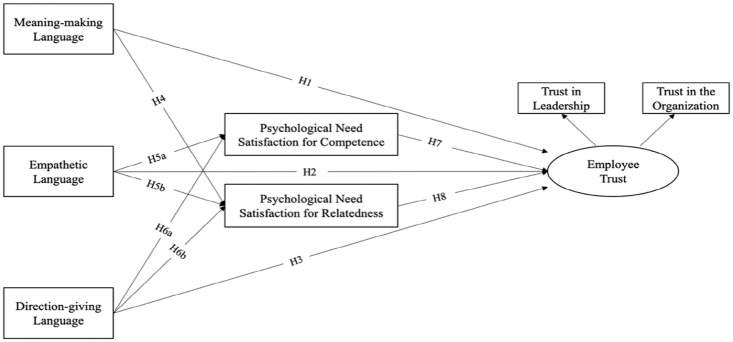
This study uses motivating language theory and self-determination theory to test how supervisory meaning-making, empathetic, and direction-giving communication during COVID-19 influenced U.S. employees’ trust in leaders and organizations. Survey results from 393 full-time employees show all three language forms had direct and indirect positive effects on trust via psychological need satisfaction for competence and relatedness, with empathetic language strongest.
Key findings
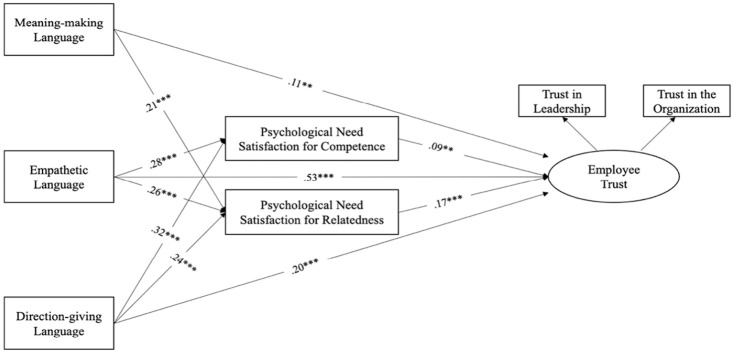
- All three supervisory motivating language forms positively predicted employee trust toward the leader and organization: total effects were meaning-making 0.15, empathetic 0.60, and direction-giving 0.27; direct effects were 0.11, 0.53, and 0.20; indirect effects were 0.04, 0.07, and 0.07.
- Motivating language predicted psychological need satisfaction: meaning-making → relatedness β = .21; empathetic → competence β = .28 and relatedness β = .26; direction-giving → competence β = .32 and relatedness β = .24 (all p < .001).
- Need satisfaction predicted trust: competence β = .09, p < .01; relatedness β = .17, p < .001. Mediation was significant for all three language forms via competence and relatedness, with indirect effects of .04, .07, and .07.
- Empathetic language showed the strongest effect among the three language types on employee trust in the leader and organization.
Methods
- Online survey conducted in May 2020 with 393 full-time employees across U.S. industries, recruited via Amazon Mechanical Turk; average age was 33.26 (SD = 9.49), 64% were male, and 81.7% were working from home during the pandemic.
- Measures used 7-point Likert scales adapted from prior literature: 20 motivating language items (direction-giving α = .88, empathetic α = .94, meaning-making α = .89), 12 psychological need satisfaction items (competence α = .89, relatedness α = .80), and trust items for leader (α = .85) and organization (α = .92).
- Two-step structural equation modeling in AMOS 26.1 with position level controlled; CFA and structural model showed good fit (e.g., structural model χ²(6) = 12.09, p = .06, CFI = .99, RMSEA = .05), and indirect effects were tested with a 5,000-sample bootstrap.
Limitations
- Stated: the cross-sectional, self-reported survey may be subject to common method variance; Harman’s single factor test and unmeasured latent method factor technique did not reveal common source bias, but future mixed-method or multi-source designs are suggested. SEM is also limited in establishing true causal relationships, so experimental and longitudinal designs are recommended.
- Stated: the quantitative design limits in-depth understanding; future qualitative interviews, case studies, or focus groups are suggested. The study also calls for future work on a single organization, industry, or employee group such as front-line workers; notes it examined only competence and relatedness, not autonomy; and notes the U.S. context may limit generalization across national cultures and socioeconomic contexts.
- Evident from the text: the sample was recruited via Amazon Mechanical Turk, a nonprobability convenience sample, and was predominantly male (64%) and mostly working from home (81.7%), which may limit generalizability beyond the sampled U.S. full-time employees.
Model-written summary. Check it against the paper before relying on it.
Integrity signals
Registry
Cites
Statistics
Figures
Verification
Claims the paper makes
3 Valid · 0 Not valid · 27 Not checked · 33 Own results and interpretations
The cited sources support only part of this claim — read each source’s verdict below.
In the paper
“Supervisors are arguably the most trustworthy source of information for employees (Legood et al., 2016; Men & Bowen, 2017; Whitener et al., 1998).”
§ Fostering Employee Trust via Effective Supervisory Communication during the COVID-19 Pandemic: Through the Lens of Motivating Language Theory > Abstract
What the sources say
- Partly supportedcites Legood et al., 2016 matched to “Leader trustworthy behavior and organizational trust: the role of the immediate manager for cultivating trust” (2016) sourceExperimental — accuracy not yet measured
The Theoretical background and hypotheses section (page unavailable) says an immediate manager provides particularly salient and diagnostic information about the organization's trustworthiness. It does not say supervisors are the most trustworthy source of information for employees; that comparative claim goes beyond the passage. (LLM, conf=0.85)
- Not matchedcites Men & Bowen, 2017
An author–year citation the paper’s reference list doesn’t settle. We don’t search these by name.
- Not checked — no full text of the sourcecites Whitener et al., 1998 matched to “Managers as Initiators of Trust: An Exchange Relationship Framework for Understanding Managerial Trustworthy Behavior” (1998) source
hedged- Asserted: passes — The authors put it forward as true.
- Checkable: passes — It can be checked against evidence.
- Load-bearing: passes — The paper’s conclusions depend on it.
- Based: passes — The paper gives a reason why it holds.
- Partly supported
The cited sources support only part of this claim — read each source’s verdict below.
In the paper
“Previous studies have shown that when employees feel their psychological needs are fulfilled in the workplace, they tend to develop positive attitudes and behavioral intentions toward the organization, such as a higher level of job satisfaction (Van den Broeck et al., 2016), organizational commitment (Dursun, 2015), and identification with the organization (Smidts et al., 2001).”
§ Fostering Employee Trust via Effective Supervisory Communication during the COVID-19 Pandemic: Through the Lens of Motivating Language Theory > Literature Review > The Mediator: Employees’ Psychological Need Satisfaction
What the sources say
- Supportedcites Van den Broeck et al., 2016 matched to “A Review of Self-Determination Theory’s Basic Psychological Needs at Work” (2016) source
Van den Broeck et al. report positive associations between satisfaction of basic psychological needs at work and job satisfaction in “Relations Between Needs and Outcome Variables” (p. 17). The citing sentence assigns organizational commitment and organizational identification to other sources, so those outcomes are not part of this verdict. (LLM, conf=0.93)
- Not matchedcites Dursun, 2015
An author–year citation the paper’s reference list doesn’t settle. We don’t search these by name.
- Supportedcites Smidts et al., 2001 matched to “THE IMPACT OF EMPLOYEE COMMUNICATION AND PERCEIVED EXTERNAL PRESTIGE ON ORGANIZATIONAL IDENTIFICATION.” (2001) source
The citation is attached specifically to the 'identification with the organization' clause. Our copy grounds identification in the fulfillment of basic psychological motives: the ABSTRACT (p. 8 of the theory framing, p. 4) derives 'the need for self-categorization' and 'the need for self-enhancement' from social identity theory, and pp. 10-11 argue that communication that makes members feel taken seriously, gives them a voice and enhances self-worth and belonging strengthens identification. The results (p. 18) confirm this empirically (communication climate beta = .52, p < .001; PEP beta = .42, p < .001 on organizational identification). The wider list of outcomes (job satisfaction, commitment) is credited to the other citations, not to this one. (LLM, conf=0.82)
boostedstates an association- Asserted: passes — The authors put it forward as true.
- Checkable: passes — It can be checked against evidence.
- Load-bearing: passes — The paper’s conclusions depend on it.
- Based: passes — The paper gives a reason why it holds.
- Supported
A result the paper reports from its own data — it cites no other source for it, so there is none to check. The quote shows it is in the paper.
In the paper
“an employee’s level of employment position in the organization showed significant positive effects on employee trust toward the leader (β = .22, t = 3.78, p < .001)”
§ Fostering Employee Trust via Effective Supervisory Communication during the COVID-19 Pandemic: Through the Lens of Motivating Language Theory > Results
plainstates a cause- Asserted: passes — The authors put it forward as true.
- Checkable: passes — It can be checked against evidence.
- Load-bearing: unclear — It is unclear whether the paper’s conclusions depend on it.
- Based: passes — The paper gives a reason why it holds.
A result the paper reports from its own data — it cites no other source for it, so there is none to check. The quote shows it is in the paper.
In the paper
“employee psychological need satisfaction for competence showed small but significant positive effect for employee trust toward the leader and the organization (β = .09, p < .01).”
§ Fostering Employee Trust via Effective Supervisory Communication during the COVID-19 Pandemic: Through the Lens of Motivating Language Theory > Results > Hypothesis Testing
plainstates a cause- Asserted: passes — The authors put it forward as true.
- Checkable: passes — It can be checked against evidence.
- Load-bearing: passes — The paper’s conclusions depend on it.
- Based: passes — The paper gives a reason why it holds.
- Rests on an assumption not shown here.
A result the paper reports from its own data — it cites no other source for it, so there is none to check. The quote shows it is in the paper.
In the paper
“and the organization (β = .15, t = 2.55, p < .01)”
§ Fostering Employee Trust via Effective Supervisory Communication during the COVID-19 Pandemic: Through the Lens of Motivating Language Theory > Results
plainstates a cause- Asserted: passes — The authors put it forward as true.
- Checkable: passes — It can be checked against evidence.
- Load-bearing: unclear — It is unclear whether the paper’s conclusions depend on it.
- Based: passes — The paper gives a reason why it holds.
32 more claims
Create a free account to see all 63 claims and to verify the 4 references still open.
- Probably not a substantial claim. 11
- It may state two separate claims as one. 19
Statistics recomputed
Every reported test result, recomputed from its test statistic and degrees of freedom. A result shows as not adding up only once an independent check has confirmed it.
- Consistentχ²(4) = 8.74reported p = .07 · recomputed p = .068
“χ2(4) = 8.74, p = .07”
- Consistentχ²(6) = 12.09reported p = .06 · recomputed p = .060
“χ2(6) = 12.09, p = .06”
Self-check
Percentages, sums and reported differences re-computed from the paper’s own numbers.
Each contradiction between two passages listed here was confirmed by an independent check.
Rated minor: it would not touch a result — a value no result rests on, a p-value that stays on the same side of the significance level, or a conflict that is clerical, resolved elsewhere in the paper, or outside its own findings.
In the paper
§ Fostering Employee Trust via Effective Supervisory Communication during the COVID-19 Pandemic: Through the Lens of Motivating Language Theory > Results > Hypothesis Testing
“Hypotheses 4 and 5 predicted the positive impacts of leaders’ use of meaning-making, empathetic, and direction-giving language on employees’ psychological need satisfaction for competence and/or relatedness.”
§ Fostering Employee Trust via Effective Supervisory Communication during the COVID-19 Pandemic: Through the Lens of Motivating Language Theory > Literature Review > The Mediator: Employees’ Psychological Need Satisfaction
“H6: Leaders’ use of direction-giving language positively influences employee psychological need satisfaction for competence (a) and relatedness (b).”
Citations
Cites
The "what" and "why" of goal pursuits: Human needs and the self-determination of behavior
Deci, E. L., & Ryan, R. M. (2000) · Psychological Inquiry · doi:10.1207/s15327965pli1104_01 · Cited by 34,210 · cited 8×
“Many empirical studies have demonstrated positive organizational outcomes of satisfying employee basic psychological needs (Deci & Ryan, 2000), such as job satisfaction (Andreassen et al., 2010; Ilardi et al., 1993), organization commitment (Lian et al., 2012; Vansteenkiste et al., 2007), work…”
BackgroundMethodInfluentialThe need to belong: Desire for interpersonal attachments as a fundamental human motivation.
Baumeister, R. F., & Leary, M. R. (1995) · Psychological Bulletin · doi:10.1037//0033-2909.117.3.497 · Cited by 23,245 · cited 1×
“The need for relatedness is defined as the desire to maintain intimate Men et al. 199 relationships and have a sense of mutual respect and care with others (Baumeister & Leary, 1995).”
BackgroundIntrinsic and Extrinsic Motivations: Classic Definitions and New Directions
Ryan, R. M., & Deci, E. L. (2000) · Contemporary Educational Psychology · doi:10.1006/ceps.1999.1020 · Cited by 18,666 · cited 1×
“Such explicit supervisory support can also satisfy the aforementioned need for relatedness (Ryan & Deci, 2000).”
BackgroundAn integrative model of organizational trust
Mayer, R. C., Davis, J. H., & Schoorman, F. D. (1995) · The Academy of Management Review · doi:10.2307/258792 · Cited by 10,736
Not So Different After All: A Cross-Discipline View Of Trust
Rousseau, D. M., Sitkin, S. B., Burt, R. S., & Camerer, C. (1998) · Academy of Management Review · doi:10.5465/amr.1998.926617 · Cited by 10,274 · cited 2×
“, 1998), and this assumption of risk is based on the individual’s previous positive expectations or beliefs about the behaviors and intentions of others (Rousseau et al., 1998).”
BackgroundAffect and Cognition Based Trust as Foundations for Interpersonal Cooperation in Organizations
McAllister, D. J. (1995) · Academy of Management Journal · doi:10.2307/256727 · Cited by 7,346 · cited 7×
“…the most frequently cited definition of trust in leadership, the current study defines this term as willingness to be vulnerable to words, actions, and decisions of his or her supervisor, regardless of the ability to control the other party (Mayer et al., 1995; McAllister, 1995; Williams, 2001).”
BackgroundMethodInfluentialMotivation reconsidered: The concept of competence.
White, R. W. (1959) · Psychological Review · doi:10.1037/h0040934 · Cited by 5,681 · cited 2×
“In the workplace setting, competence represents an employee feeling capable of accomplishing challenging tasks and obtaining desired outcomes (Deci et al., 2001; White, 1959).”
BackgroundThe general causality orientations scale: Self-determination in personality
Deci, E. L., & Ryan, R. M. (1985) · Journal of Research in Personality · doi:10.1016/0092-6566(85)90023-6 · Cited by 5,079 · cited 1×
“…leadership’s reinforcement of organizational values and purposes, understanding subordinate needs and providing support, providing clear work instruction and meaningful feedback, may all predict to what extent an employee’s psychological needs may be fulfilled at work (Deci & Ryan, 1985).”
BackgroundWhitener, E. M., Brodt, S. E., Korsgaard, M. A., & Werner, J. M. (1998) · The Academy of Management Review · doi:10.5465/amr.1998.926624 · Cited by 4,971 · cited 2×
“Supervisors are arguably the most trustworthy source of information for employees (Legood et al., 2016; Men & Bowen, 2017; Whitener et al., 1998).”
BackgroundTrust in leadership: Meta-analytic findings and implications for research and practice.
Dirks, K. T., & Ferrin, D. L. (2002) · Journal of Applied Psychology · doi:10.1037/0021-9010.87.4.611 · Cited by 3,550 · cited 1×
“As an essential psychological state in achieving leadership effectiveness, trust stems from two distinctive psychological processes: cognitive and affective trust (Dirks & Ferrin, 2002; McAllister, 1995).”
Background
Research works printed but not linked: 4
- Hon L. C. Grunig J. E. (1999). Guidelines for measuring relationships in public relations. The Institute for Public Relations, Commission on PR Measurement and Evaluation.
- Kline R. B. (2011). Methodology in the social sciences. Principles and practice of structural equation modeling (3rd ed.). Guilford Press.
- Luthra A. Dahiya R. (2015). Effective leadership is all about communicating effectively: Connecting leadership and communication. International Journal of Management & Business Studies, 5(3), 43– 48.
- Straiter K. L. (2005). The effects of supervisors’ trust of subordinates and their organization on job satisfaction and organizational commitment. International Journal of Leadership Studies, 1(1), 86– 101.
Cited by
Work and worker health in the post-pandemic world: a public health perspective
Peters, S. E., Dennerlein, J. T., Wagner, G. R., & Sorensen, G. (2022) · The Lancet Public Health · doi:10.1016/s2468-2667(21)00259-0 · Cited by 175
Tao, W., Lee, Y., Sun, R., Li, J.-Y., & He, M. (2021) · Public Relations Review · doi:10.1016/j.pubrev.2021.102133 · Cited by 185
“Leader communication has been repeatedly evidenced to impact employees’ perceptions, emotions, and behaviors (e.g., Men, Qin, and Jin, 2021).”
BackgroundJaiswal, A., Sengupta, S., Panda, M., Hati, L., Prikshat, V., Patel, P., & Mohyuddin, S. M. (2022) · International Journal of Manpower · doi:10.1108/ijm-04-2022-0149 · Cited by 89
Rabiul, M. K., Promsivapallop, P., Karim, R. A., Islam, M. A., & Patwary, A. K. (2022) · Journal of Hospitality and Tourism Management · doi:10.1016/j.jhtm.2022.09.002 · Cited by 77
Thelen, P. D., Yue, C. A., & Verghese, A. K. (2022) · Public Relations Review · doi:10.1016/j.pubrev.2022.102253 · Cited by 65
van Zoonen, W., Sivunen, A. E., & Blomqvist, K. (2023) · European Management Journal · doi:10.1016/j.emj.2023.04.006 · Cited by 67
The influence of the psychological contract on employee engagement in a South African bank
Ngobeni, D. A., Saurombe, M. D., & Joseph, R. M. (2022) · Frontiers in Psychology · doi:10.3389/fpsyg.2022.958127 · Cited by 38
Enhancing Job Performance: The Critical Roles of Well-Being, Satisfaction, and Trust in Supervisor
Yang, Y., Obrenovic, B., Kamotho, D. W., Godinić, D., & Ostic, D. (2024) · Behavioral Sciences · doi:10.3390/bs14080688 · Cited by 127
“Trust in the supervisor is fundamental in influencing individual s’ social capital through a feedback loop [57,58].”
BackgroundDong, C., Huang, Q., Ni, S., Zhang, B., & Chen, C. (2023) · Journal of Business Ethics · doi:10.1007/s10551-023-05531-9 · Cited by 35
“Many CSR studies have found that empathetic, emotion-attached, supportive, and motivational communication takes care of employees’ psychological wellbeing and improve employee engagement (Lemon & Boman, 2022; Men et al. 2022; Tao et al., 2022).”
Hajjami, O., & Crocco, O. S. (2023) · European journal of training and development · doi:10.1108/ejtd-10-2022-0103 · Cited by 57
Effect of supervisor-subordinate Guanxi on employees work behavior: An empirical dynamic framework
Khan, H. S. U. D., Guangsheng, Y., Chughtai, M. S., & Cristofaro, M. (2023) · Journal of Innovation & Knowledge · doi:10.1016/j.jik.2023.100360 · Cited by 36
“Researchers found a signi fi cant link between trust and citizenship behavior (Sokmen & Yasrebdoost, 2022), interpersonal trust (Chudzicka-Czupala et al., 2022), effective supervisory communication (Men, Qin & Jin, 2022) and performance feedback (Asad et al., 2021).”
The Impact of CSR Perceptions on Employees’ Turnover Intention during the COVID-19 Crisis in China
Cheng, Y., Wang, Y., & Pan, F. (2022) · International Journal of Environmental Research and Public Health · doi:10.3390/ijerph19148297 · Cited by 31
“This finding is critical, especially during the COVID-19 pandemic, because this global crisis has brought challenges to organizational management in terms of maintaining employees’ trust in their organization [79].”
BackgroundUlutürk, B., ALTUNTAŞ, E. Y., & Hürmeriç, P. (2024) · International Journal of Business Communication · doi:10.1177/23294884231223521 · Cited by 36
“…identification (M. Mayfield et al., 2021), perceived interpersonal and informational justice (Alikaj & Hanke, 2021), self-efficacy (J. Mayfield & Mayfield, 2012), and employee trust in leadership and organization (Men et al., 2022), which we hypothesize may lead to higher psychological empowerment.”
Kim, Y. (2023) · Asian Journal of Communication · doi:10.1080/01292986.2023.2181978 · Cited by 31
“The importance of leadership in shaping the corporate climate and influencing employees’ perceptions of the organization has been widely recognized in the existing literature (Men, 2014; Men et al., 2021).”
BackgroundYue, C. A., Qin, Y. S., & Men, L. R. (2023) · Corporate Communications An International Journal · doi:10.1108/ccij-04-2023-0050 · Cited by 35
Self-citationChen, Z. F., & Cheng, Y. (2023) · Internet Research · doi:10.1108/intr-07-2022-0571 · Cited by 29
Holmes, W. T. “., Parker, M. A., Olsen, J. J., & Khojasteh, J. (2021) · Journal of Educational Administration · doi:10.1108/jea-02-2021-0038 · Cited by 25
Kim, H., Mattson, L. D., Zhang, D., & Cho, H. J. (2022) · Journal of Applied Communication Research · doi:10.1080/00909882.2022.2141070 · Cited by 28
“In fact, a study conducted during the pandemic revealed that supervisors’ support communication made workers feel more acknowledged and motivated, leading to a higher degree of trust (Men et al., 2022).”
BackgroundWhat Does Jean-Jacques Rousseau and Chester I. Barnard Have to Do With Quiet Quitting?
Bell, R. L., & Kennebrew, D. (2023) · American Journal of Management · doi:10.33423/ajm.v23i1.5869 · Cited by 44
Sun, Y., Konar, R., & Wei, C. K. (2025) · International Journal of Hospitality Management · doi:10.1016/j.ijhm.2025.104086 · Cited by 17
Rabiul, M. K., Hasan, M. K., Miraz, M. H., & Karim, R. A. (2023) · Management Research Review · doi:10.1108/mrr-10-2022-0720 · Cited by 18
Hsu, C., & Lai, C.-F. (2023) · Asia Pacific Management Review · doi:10.1016/j.apmrv.2023.05.002 · Cited by 23
Ulutürk, B. (2023) · Management Communication Quarterly · doi:10.1177/08933189231219708 · Cited by 22
“May fi eld & May fi eld, 2021), and trust in leadership and organization (Men et al., 2022).”
Reducing Anxiety Through Workplace Communication During COVID-19: Who, What, When, and How
Kay, A., Levine, L., & Shapiro, E. (2022) · International Journal of Business Communication · doi:10.1177/23294884221105580 · Cited by 18
“…has suggested that managers play a particularly important role in employee attitudes toward and during remote work (Makarius & Larson, 2017) and in a time of ambiguity and upheaval such direct communication could be expected to be particularly important (Men et al., 2021; Skiba & Wildman, 2019).”
BackgroundMikkelson, A. C., Sloan, D., Walter, R., & Hinnenkamp, C. (2023) · Business and Professional Communication Quarterly · doi:10.1177/23294906231167176 · Cited by 31
“These findings are not surprising, as employees expect this type of communication from supervisors whether they are working in person (Cupach et al., 2010; Fuller et al., 2018) or in remote environments (Men et al., 2022).”
Kim, Y., Meganck, S. L., & Basnyat, I. (2023) · Corporate Communications An International Journal · doi:10.1108/ccij-09-2022-0110 · Cited by 31
Lee, E., Mitson, R., & Xu, H. (2024) · Journal of Communication Management · doi:10.1108/jcom-02-2024-0038 · Cited by 24
Chen, F., & Wu, Q. L. (2024) · Corporate Communications: An International Journal · doi:10.1108/ccij-03-2023-0029 · Cited by 12
Bashir, M., Naqshbandi, M. M., & Pradhan, S. (2025) · Technological Forecasting and Social Change · doi:10.1016/j.techfore.2025.123977 · Cited by 18
Singh, S. R. J., Sharma, K. K., Mittal, A., & Chand, P. K. (2022) · Global Knowledge, Memory and Communication · doi:10.1108/gkmc-07-2022-0157 · Cited by 19
The Impact of Organization-Employee Dialogic Communication on Employee Engagement in Remote Work
Qin, Y. S. (2024) · International Journal of Business Communication · doi:10.1177/23294884241261061 · Cited by 20
“…to sufficient information about their work and the organization, are encouraged to participate in decision-making, and interpret the organization’s values and objectives, they may feel a sense of belonging and connectedness to the organization (Men et al., 2021; Ruck, 2021; Smidts et al., 2001).”
Self-citationMalik, M. F., Khwaja, M. G., Hanif, H., & Mahmood, S. (2023) · Leadership & Organization Development Journal · doi:10.1108/lodj-04-2023-0199 · Cited by 19
Qin, Y. S. (2025) · International Journal of Strategic Communication · doi:10.1080/1553118x.2024.2417669 · Cited by 11
“…leadership communication plays a vital role in fostering employee trust in leadership by reducing uncertainty, helping employees understand their work, and building an emotional connection with the leader (e.g., Hoch & Kozlowski, 2014; Marlow et al., 2017; Men et al., 2021; Newman et al., 2020).”
Self-citationMaunz, L. A., Thal, S. B., & Glaser, J. (2024) · Applied Psychology · doi:10.1111/apps.12546 · Cited by 20
Kioulepoglou, P., Chazapis, S., & Blundell, J. (2024) · Research in Transportation Business & Management · doi:10.1016/j.rtbm.2024.101103 · Cited by 19
Alsharairi, A., Alazzah, M., Safori, A. O., & Adwan, M. N. A. (2025) · Frontiers in Communication · doi:10.3389/fcomm.2025.1713290 · Cited by 14
“…and transparent leader behavior has been shown to generate perceptions of justice and care that employees reciprocate through constructive attitudes and behaviors, including communication-related involvement in digital environments (Cropanzano et al., 2017; Men et al., 2022; Thelen and Men, 2022).”
InfluentialDong, C., Cheng, Y., Wang, Y., & Sazhina, O. (2024) · Journal of Public Relations Research · doi:10.1080/1062726x.2024.2390459 · Cited by 11
“Research also suggested that leadership and internal communication are important factors influencing employees’ psychological needs and well-being (Men et al., 2022; Qin & Men, 2023).”
Employee Perceptions of Supervisor Credibility: Predictive Effects for Employee Well-Being Outcomes
Mikkelson, A. C., Tietsort, C. J., & Hinnenkamp, C. (2024) · Business and Professional Communication Quarterly · doi:10.1177/23294906241241668 · Cited by 12
“…lead to greater feedback-seeking behavior (Chun et al., 2014; Kingsley Westerman et al., 2018), foster trust and organizational commitment (Men et al., 2022), minimize negative reactions to control efforts (Dull, 2009; Long, 2015), increase motivation and strategic alignment (Lees &…”
Managing crisis in the cruise industry: using internal communications to foster workforce resilience
Sharples, L., Fletcher‐Brown, J., Nieto‐García, M., Sit, J., & Viglia, G. (2023) · Tourism Review · doi:10.1108/tr-03-2023-0150 · Cited by 15
Understanding the efficacy of leadership communication styles in flex work contexts
Mitson, R., Xu, H., & Hmielowski, J. D. (2024) · Corporate Communications An International Journal · doi:10.1108/ccij-02-2024-0033 · Cited by 12
Zhao, H., & Ali, M. H. (2024) · International Journal of Business Communication · doi:10.1177/23294884241299379 · Cited by 11
“Employees are more likely to adhere to directives and acknowledge the organizational structure, thus demonstrating compliance and allegiance to the organization (Hackman, 2002; Men et al., 2022).”
Sun, J., Sarfraz, M., & Asghar, M. (2023) · Risk Management and Healthcare Policy · doi:10.2147/rmhp.s426295 · Cited by 11
“It leads to positive employee outcomes.(40) The supervisor using motivating language influences the employees’ trust by satisfying their demand for information.”
BackgroundMotivating language and relational energy to performance: workload as moderator
Rabiul, M. K., & Panha, I. (2024) · Anatolia · doi:10.1080/13032917.2024.2341318 · Cited by 7
“…of occupational outcomes has been confirmed by previous studies focusing on immediate outcomes, such as job engagement (Rabiul, 2023), trust (Men et al., 2021), employee advocacy (Yue, 2021), job satisfaction (Madlock & Clubbs, 2019), psychological needs satisfaction (Men et al., 2021),…”
InfluentialYue, C. A., Xu, S., Tao, W., & Huang, V. (2024) · Communication Research · doi:10.1177/00936502241234011 · Cited by 8
Empowering commitment: unraveling the impact of motivating language and the mediating role of trust
Talukder, M. F., & Atinc, G. M. (2024) · Corporate Communications An International Journal · doi:10.1108/ccij-12-2023-0196 · Cited by 9
Hamza, K. A., Alshaabani, A., Salameh, N., & Rudnák, I. (2022) · Problems and Perspectives in Management · doi:10.21511/ppm.20(2).2022.43 · Cited by 13
“For example, they are transparent communication (Kim & Lee, 2021), employees’ openness to change (Yue et al., 2019; Kim & Lee, 2021), constant improvement (Khattak et al., 2020), and finally, organizational commitment (Top et al., 2014; Men et al., 2022).”
BackgroundRen, Z.-M., Du, W., & Wen, X.-Z. (2022) · Sustainability · doi:10.3390/su14052609 · Cited by 8
“Employee involvement, well-being, and support to digital work could even foster digital transformation of the workplace [39].”
BackgroundDing, K., Li, R., Li, Z., & Hu, S. (2025) · Journal Of Big Data · doi:10.1186/s40537-025-01100-1 · Cited by 12
“Men et al. [56] observed that supervisory communication can significantly impact employee satisfaction and trust, mainly through three forms of motivating language: meaning-making language, empathetic language, and direction-giving language.”
Conti, S., Wang, Y., & Ravazzani, S. (2025) · International Journal of Business Communication · doi:10.1177/23294884251384721 · Cited by 5
Athamneh, M. H. A., & Jais, J. B. (2023) · Cogent Social Sciences · doi:10.1080/23311886.2023.2203989 · Cited by 20
Mitson, R., Qin, S., & Men, R. L. (2024) · International Journal of Strategic Communication · doi:10.1080/1553118x.2024.2331300 · Cited by 13
“…during times of turbulence), scholars have noted that there are other organizational factors that play a role in positive employee outcomes, such as trust in the leader (Jaiswal & Dhar, 2017; Men et al., 2022), as well as trust in the organization (Agarwal, 2013; Gustafsson et al., 2021).”
BackgroundRabiul, M. K., Gürsoy, D., Mohamed, A. E., & Patwary, A. K. (2023) · Journal of Quality Assurance in Hospitality & Tourism · doi:10.1080/1528008x.2023.2270617 · Cited by 11
“The effective use of meaning-making language reinforces employees’ motivations and past personal achievements and directs them on how to use their skills to attain future achievements (Men et al., 2021; Rabiul, 2023).”
Authentic leadership for creativity and innovation: The moderating role of motivating language
Siswanti, Y., & Muafi, M. (2025) · SA Journal of Human Resource Management · doi:10.4102/sajhrm.v23i0.2695 · Cited by 11
Kim, Y., & Meganck, S. L. (2025) · Public Relations Review · doi:10.1016/j.pubrev.2025.102615 · Cited by 6
Job-crafting amid uncertainty: South African employee experiences during the COVID-19 pandemic
Marx, K., Jacobs, M., & Jonker, C. (2025) · SA Journal of Human Resource Management · doi:10.4102/sajhrm.v23i0.2844 · Cited by 10
Through the Lens of Virtual Students: Challenges and Opportunities
Villarama, J. A., Santos, J. P. E., Adsuara, J. P., Gundran, J. F., & Castillo, M. E. G. C. (2022) · International Journal of Learning Teaching and Educational Research · doi:10.26803/ijlter.21.10.6 · Cited by 8
“Effective policy affects many types of support (Men et al., 2022).”
BackgroundYazıcı, A. M., & Mecek, M. (2023) · İş ve İnsan Dergisi · doi:10.18394/iid.1342592 · Cited by 8
Employees motivation and managerial coaching during the pandemic COVID-19 at the research institute
Stanković, T., & Radojević, T. (2022) · The European Journal of Applied Economics · doi:10.5937/ejae19-35560 · Cited by 9
This Is Bullshit: The Relationship between Organizational Bullshitting and Employee Job Satisfaction
Fallatah, M. I. (2023) · Social Sciences · doi:10.3390/socsci12110636 · Cited by 6
Osaili, T. M. I., Al‐Nabulsi, A. A., Albluwi, B. I. H., Olaimat, A. N., Obaid, R. S., Taha, S., Ayyash, M. M., & Holley, R. A. (2022) · British Food Journal · doi:10.1108/bfj-02-2022-0132 · Cited by 3
Toledano, C. A., Miquel-Segarra, S., & López, M. C. L. D. A. (2023) · Anàlisi · doi:10.5565/rev/analisi.3559 · Cited by 3
Capizzo, L. W., Nzau, T., Oduolowu, D., Duffy, M. E., & Brengarth, L. B. (2023) · Corporate Communications An International Journal · doi:10.1108/ccij-05-2023-0079 · Cited by 4
Amira Haliem Ibrahiem, A. W. A. D., ELNAGGAR, M. K., El-Halim, A. A. E.-K. G. A., AHMED, M. F. A. E.-L., & Wahba, S. (2024) · GeoJournal of Tourism and Geosites · doi:10.30892/gtg.53219-1231 · Cited by 8
Mühl, A., Schoellbauer, J., Straus, E., & Korunka, C. (2024) · The International Journal of Human Resource Management · doi:10.1080/09585192.2024.2439264 · Cited by 5
“…the present study specifies prior empirical findings that link social interactions to satisfying the need for relatedness (e.g. Jungert et al., 2018; Lee et al., 2017; Men et al., 2022) and shows that coordination, as a specific form of interaction, contributes to relatedness satisfaction.”
Castro-Martínez, A., Díaz-Morilla, P., & Torres-Martín, J. L. (2022) · Revista Internacional de Relaciones Públicas · doi:10.5783/rirp-23-2022-08-143-162 · Cited by 3
Technical nurses’ perception of work environment factors that affect their performance
Abdou, F., Mola, M. E., & Elewa, A. H. (2023) · Egyptian Nursing Journal · doi:10.4103/enj.enj_17_23 · Cited by 2
Brossoit, R. M., Hammer, L. B., Bodner, T., Mohr, C. D., Allen, S. J., Crain, T. L., Brockwood, K. J., & Adler, A. B. (2024) · Journal of Managerial Psychology · doi:10.1108/jmp-10-2023-0582 · Cited by 2
Cultural Change Strategies and Challenges in Healthcare and Technology Sectors
Willie, M. M. (2024) · Journal of Public Administration · doi:10.53973/jopa.2024.59.3.a14 · Cited by 3
Rachmani, I. D., Sarwoprasodjo, S., Muljono, P., et al. (2025) · Record and Library Journal · doi:10.20473/rlj.v11-i1.2025.145-162 · Cited by 2
Work during and after the Pandemic
Peters, S. E., & Wagner, G. R. (2024) · Oxford University Press eBooks · doi:10.1093/oso/9780197625217.003.0012 · Cited by 3
Perspective Chapter: Strategies for Successful Cultural Change during Strategy Implementation
Willie, M. M. (2025) · Business, management and economics · doi:10.5772/intechopen.114935 · Cited by 1
Men, L. R., Yue, C. A., Cho-Li, Q., & Nam, G. (2025) · International Journal of Business Communication · doi:10.1177/23294884251359239 · Cited by 6
“…is particularly impactful and constructive for FLEs, as frontline jobs often face emotional labor from customer complaints (Ozturk & Karatepe, 2019), and supervisors’ use of MLT helps satisfy employees’ psychological needs and ultimately fosters trust in leadership (L. R. Men et al., 2022).”
Self-citationDigital dialogue and creative outcomes: Unpacking AI-focused supervisory communication
Wei, F., Samad, S., & Rahman, K.-U. (2025) · Acta Psychologica · doi:10.1016/j.actpsy.2025.105534 · Cited by 6
Mohamad, B., Hamid, A. S. A., Adamu, A. A., & Wolf, K. (2025) · Corporate Communications An International Journal · doi:10.1108/ccij-05-2025-0111 · Cited by 1
Khan, U. R., Zaman, S. I., & Khan, S. (2025) · International Journal of Business Communication · doi:10.1177/23294884251377042 · Cited by 1
Zhang, Y., & Dong, C. (2025) · International Journal of Business Communication · doi:10.1177/23294884251380221 · Cited by 1
An Acceptance Analysis of Firms’ Posts on Sina Weibo to Build Credibility
Wu, C. (2025) · Journal of Business and Technical Communication · doi:10.1177/10506519251404893 · Cited by 2
“The role of credibility has been the subject of many information, organizational, and communication studies (e.g., Appelman & Sundar, 2016; Men et al., 2022; Metzger, 2007).”
Psychological Safety: The Role of Motivating Language, Energies, and Customer Incivility
Rabiul, M. K., ALMALOY, Y., Patwary, A. K., & Salman, A. (2025) · Howard Journal of Communications · doi:10.1080/10646175.2025.2597282 · Cited by 4
Guo, Y., & Ayoun, B. (2026) · Journal of Quality Assurance in Hospitality & Tourism · doi:10.1080/1528008x.2026.2619898 · Cited by 1
Zhang, C., Zhang, X., Zheng, W. T., & Zhang, D. (2026) · Journal of Hospitality and Tourism Management · doi:10.1016/j.jhtm.2026.101452 · Cited by 1
Sokolova, K., Pérez, C., & Besson, E. (2026) · Psychology and Marketing · doi:10.1002/mar.70154 · Cited by 2
Men, L. R., Mitson, R., Qin, Y. “., & Yue, C. A. (2026) · International Journal of Strategic Communication · doi:10.1080/1553118x.2026.2660777 · Cited by 2
Self-citationHe, H., Men, L. R., Liu, W., & Nam, G. (2026) · International Journal of Business Communication · doi:10.1177/23294884261464148 · Cited by 3
Self-citationChen, C.-H. (2024) · International Journal of Business Communication · doi:10.1177/23294884241264788 · Cited by 3
“Supervisory communication involves exchanging information, ideas, and feedback between supervisors and employees, facilitating collaboration, and providing valuable support (Men et al., 2021).”
InfluentialQin, Y. S., Men, L. R., Akanbi, F., & He, H. (2025) · International Journal of Business Communication · doi:10.1177/23294884251349493 · Cited by 6
“When supervisors apply motivating language that is empowering and empa-thetic with clear directions, they not only communicate organizational goals clearly but also inspire trust and cooperation among their team members (Men et al., 2022).”
InfluentialSelf-citationNotes From the Editors: 60 Years Young and a Work in Progress
Mayfield, J. R., & Mayfield, M. (2023) · International Journal of Business Communication · doi:10.1177/23294884231189909 · Cited by 2
Omar, A. T. (2021) · International Journal of Academic Research in Business and Social Sciences · doi:10.6007/ijarbss/v11-i11/11580
“…jobs, the employees perceive more connectedness and unity, demonstrating their cohesion (Bartsch et al., 2021) Furthermore, when pandemic leaders highlight the importance of team building in achieving organizational goals, it gives meaning to tasks and incorporates social values (Men et al., 2021).”
BackgroundDoes work motivation and work discipline affect employee performance during Covid-19?
Orbaningsih, D., Priyanto, E. D., Wahyono, G. B., & Handhajani, S. B. P. (2022) · Economics Business Accounting & Society Review · doi:10.55980/ebasr.v1i2.11 · Cited by 1
COMUNICAÇÃO DA LIDERANÇA: GERANDO CONFIANÇA, CONEXÕES E RESULTADOS NO CONTEXTO ORGANIZACIONAL
Forte, D. W., da Silva, K. C. N., Cunha, C. J. C. D. A., & da Silva, S. M. (2023) · Anais ... Congresso Internacional do Conhecimento e Inovação · doi:10.48090/ciki.v1i1.1345
Ambivalences of Leadership Communication in the Digital Age
Kneip, V. (2023) · Springer eBooks · doi:10.1007/978-3-031-34314-8_17
Features of Intra-Firm Communications of Industrial Enterprises in Turbulent Conditions
Kushnir, A. M. (2024) · Economic problems and legal practice · doi:10.33693/2541-8025-2024-20-1-174-181
Maya, E. I., & Rojuaniah, R. (2024) · INNOVATIVE Journal Of Social Science Research · doi:10.31004/innovative.v4i3.10468
Mapping the Challenges of COVID-19 From the Point of View of Organisational Communication
Kantanen, H., & Koskela, M. (2024) · Emerald Group Publishing Limited eBooks · doi:10.1108/s2398-391420240000007003
ROSARIO, T. T. B. D. (2024) · International Journal of Research Publications · doi:10.47119/ijrp1001491520246630
Navigating fast-moving trends: an exploration of current and preferred leadership styles in Myanmar
Aung, M. A. A., & Fukushige, A. (2024) · Asia Pacific Business Review · doi:10.1080/13602381.2024.2353777
Nzau, T., & Capizzo, L. W. (2024) · SSRN Electronic Journal · doi:10.2139/ssrn.4885493
The Resilience of Healthcare Workers in Hospital During Covid-19 Crisis
Putra, R. S., & Agustina, T. S. (2024) · Southeast Asian Business Review · doi:10.20473/sabr.v2i2.57481
“The importance of employee’s affect, of course, can be caused through the role of a good leader (Surji, 2014); the leader here plays a role to be able to foster positive emotions, mutual trust, and support for employees (Men et al., 2022).”
BackgroundResultMutsuddi, I., Dileep Kumar, M., Sharma, V., Poulose, J., & Mahajan, Y. (2025) · International journal of organizational analysis · doi:10.1108/ijoa-11-2024-4982 · Cited by 1
Exploring the experiences of department heads in promoting positive work ethics among educators
Oloba, P. B., & Govender, M. (2025) · Journal of Preschool and Elementary School Education/Multidisciplinary Journal of School Education · doi:10.35765/mjse.2025.1427.18 · Cited by 1
Metadata
- Authors
- Men, L. R., Qin, Y. S., & Jin, J.
- Affiliations
- University of Florida (US)
- Corresponding author
- Men, Linjuan Rita
- Venue
- International Journal of Business Communication
- Publisher
- SAGE Publications
- Published
- 2021-06-06
- Volume
- 59
- Issue
- 2
- Pages
- 193-218
- ISSN
- 2329-4884 (ISSN-L)
- 2329-4892
- PMC
- PMC8185562
- OpenAlex
- W3172891069
- Cited by
- 121
- References
- 104
- Citations by year
- 2026: 22 · 2025: 24 · 2024: 28 · 2023: 28 · 2022: 16 · 2021: 3
- FWCI
- 18.19
- Type
- journal article
- Language
- en
- Open access
- hybrid
- doi.org
- Locations
- International Journal of Business Communication (publishedVersion, cc-by)
- PubMed Central (publishedVersion, cc-by)
- Topics
- Social Sciences › Business, Management and Accounting › Organizational Behavior and Human Resource Management › Job Satisfaction and Organizational Behavior
- Social Sciences › Communication › Public Relations and Crisis Communication
- Social Sciences › Cultural Studies › Discourse Analysis and Cultural Communication
- Keywords
- employee trust, supervisory communication, self-determination theory, psychological need satisfaction, competence, relatedness, empathic communication, meaning-making, leadership communication, COVID-19 pandemic, trust in leadership, organizational trust
About these checks
Registry, retraction, Cites and statistics results are computed, not judged, with one exception: a printed reference that no index lists is read once by a model before it counts as a citation error. Claims are extracted by a model and kept only when their quote appears verbatim in the text; each cited source is then checked, with a model’s help, for whether it says what the claim relies on. Those verdicts can be wrong — read the claim’s quote and the cited source before relying on one.
The claim verdicts this report counts are experimental: their accuracy is not yet measured.
A language model drew the claims from the paper on 2026-10-10, under version 3 of the claim definition (model deepseek-v4.1-flash, prompt extract-v3).
A second model labelled each claim on 2026-10-10 (model jev-1.13-20260917, definition revision gold-guideline-v0.2).
Cited sources are checked with a language model’s help (gpt-6-sol and qwen3.8-omni-flash).
Statistics and arithmetic are recomputed, not judged.
Confidence bands are shown only for fields calibrated on our annotated test set. None is calibrated yet, so no band is shown.
What counts as a claim ›How we measure confidence ›How we check this ›
Are you an author, or do you see a problem with this page? Request a review
Data sources
Bibliographic data: Semantic Scholar, OpenAlex, Crossref.
Contains information from the Semantic Scholar Academic Graph Datasets, made available under the ODC Attribution License (ODC-BY 1.0).
Semantic Scholar’s data is described in: Kinney, R., et al. (2023). The Semantic Scholar Open Data Platform. arXiv:2301.10140.
