

Fostering Employee Trust via Effective Supervisory Communication during the COVID-19 Pandemic: Through the Lens of Motivating Language Theory
Open accessThe DOI matches its Crossref record; 100 of the 104 references it cites were found in a registry or an index; 4 of the 50 sources its claims cite were checked for support.
Abstract
Investigated supervisory motivating language among 393 full-time employees, finding that direction-giving language (0.27) and empathetic language (0.60) both positively influence employee trust and satisfy needs for competence and relatedness.
Overview
CoChat Summary
TL;DR
This study uses motivating language theory and self-determination theory to test how supervisory meaning-making, empathetic, and direction-giving communication during COVID-19 influenced U.S. employees’ trust in leaders and organizations. Survey results from 393 full-time employees show all three language forms had direct and indirect positive effects on trust via psychological need satisfaction for competence and relatedness, with empathetic language strongest.
Key findings
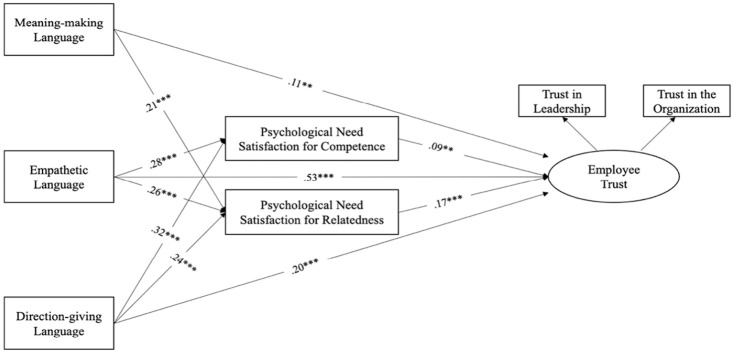
- All three supervisory motivating language forms positively predicted employee trust toward the leader and organization: total effects were meaning-making 0.15, empathetic 0.60, and direction-giving 0.27; direct effects were 0.11, 0.53, and 0.20; indirect effects were 0.04, 0.07, and 0.07.
- Motivating language predicted psychological need satisfaction: meaning-making → relatedness β = .21; empathetic → competence β = .28 and relatedness β = .26; direction-giving → competence β = .32 and relatedness β = .24 (all p < .001).
- Need satisfaction predicted trust: competence β = .09, p < .01; relatedness β = .17, p < .001. Mediation was significant for all three language forms via competence and relatedness, with indirect effects of .04, .07, and .07.
- Empathetic language showed the strongest effect among the three language types on employee trust in the leader and organization.
Methods
- Online survey conducted in May 2020 with 393 full-time employees across U.S. industries, recruited via Amazon Mechanical Turk; average age was 33.26 (SD = 9.49), 64% were male, and 81.7% were working from home during the pandemic.
- Measures used 7-point Likert scales adapted from prior literature: 20 motivating language items (direction-giving α = .88, empathetic α = .94, meaning-making α = .89), 12 psychological need satisfaction items (competence α = .89, relatedness α = .80), and trust items for leader (α = .85) and organization (α = .92).
- Two-step structural equation modeling in AMOS 26.1 with position level controlled; CFA and structural model showed good fit (e.g., structural model χ²(6) = 12.09, p = .06, CFI = .99, RMSEA = .05), and indirect effects were tested with a 5,000-sample bootstrap.
Limitations
- Stated: the cross-sectional, self-reported survey may be subject to common method variance; Harman’s single factor test and unmeasured latent method factor technique did not reveal common source bias, but future mixed-method or multi-source designs are suggested. SEM is also limited in establishing true causal relationships, so experimental and longitudinal designs are recommended.
- Stated: the quantitative design limits in-depth understanding; future qualitative interviews, case studies, or focus groups are suggested. The study also calls for future work on a single organization, industry, or employee group such as front-line workers; notes it examined only competence and relatedness, not autonomy; and notes the U.S. context may limit generalization across national cultures and socioeconomic contexts.
- Evident from the text: the sample was recruited via Amazon Mechanical Turk, a nonprobability convenience sample, and was predominantly male (64%) and mostly working from home (81.7%), which may limit generalizability beyond the sampled U.S. full-time employees.
Model-written summary. Check it against the paper before relying on it.
Integrity signals
Registry
Cites
Statistics
Figures
Verification
Claims the paper makes
3 Valid · 0 Not valid · 27 Not checked · 33 Own results and interpretations
The cited sources support only part of this claim — read each source’s verdict below.
In the paper
“Supervisors are arguably the most trustworthy source of information for employees (Legood et al., 2016; Men & Bowen, 2017; Whitener et al., 1998).”
§ Fostering Employee Trust via Effective Supervisory Communication during the COVID-19 Pandemic: Through the Lens of Motivating Language Theory > Abstract
What the sources say
- Partly supportedcites Legood et al., 2016 matched to “Leader trustworthy behavior and organizational trust: the role of the immediate manager for cultivating trust” (2016) sourceExperimental — accuracy not yet measured
The Theoretical background and hypotheses section (page unavailable) says an immediate manager provides particularly salient and diagnostic information about the organization's trustworthiness. It does not say supervisors are the most trustworthy source of information for employees; that comparative claim goes beyond the passage. (LLM, conf=0.85)
- Not matchedcites Men & Bowen, 2017
An author–year citation the paper’s reference list doesn’t settle. We don’t search these by name.
- Not checked — no full text of the sourcecites Whitener et al., 1998 matched to “Managers as Initiators of Trust: An Exchange Relationship Framework for Understanding Managerial Trustworthy Behavior” (1998) source
hedged- Asserted: passes — The authors put it forward as true.
- Checkable: passes — It can be checked against evidence.
- Load-bearing: passes — The paper’s conclusions depend on it.
- Based: passes — The paper gives a reason why it holds.
- Partly supported
The cited sources support only part of this claim — read each source’s verdict below.
In the paper
“Previous studies have shown that when employees feel their psychological needs are fulfilled in the workplace, they tend to develop positive attitudes and behavioral intentions toward the organization, such as a higher level of job satisfaction (Van den Broeck et al., 2016), organizational commitment (Dursun, 2015), and identification with the organization (Smidts et al., 2001).”
§ Fostering Employee Trust via Effective Supervisory Communication during the COVID-19 Pandemic: Through the Lens of Motivating Language Theory > Literature Review > The Mediator: Employees’ Psychological Need Satisfaction
What the sources say
- Supportedcites Van den Broeck et al., 2016 matched to “A Review of Self-Determination Theory’s Basic Psychological Needs at Work” (2016) source
Van den Broeck et al. report positive associations between satisfaction of basic psychological needs at work and job satisfaction in “Relations Between Needs and Outcome Variables” (p. 17). The citing sentence assigns organizational commitment and organizational identification to other sources, so those outcomes are not part of this verdict. (LLM, conf=0.93)
- Not matchedcites Dursun, 2015
An author–year citation the paper’s reference list doesn’t settle. We don’t search these by name.
- Supportedcites Smidts et al., 2001 matched to “THE IMPACT OF EMPLOYEE COMMUNICATION AND PERCEIVED EXTERNAL PRESTIGE ON ORGANIZATIONAL IDENTIFICATION.” (2001) source
The citation is attached specifically to the 'identification with the organization' clause. Our copy grounds identification in the fulfillment of basic psychological motives: the ABSTRACT (p. 8 of the theory framing, p. 4) derives 'the need for self-categorization' and 'the need for self-enhancement' from social identity theory, and pp. 10-11 argue that communication that makes members feel taken seriously, gives them a voice and enhances self-worth and belonging strengthens identification. The results (p. 18) confirm this empirically (communication climate beta = .52, p < .001; PEP beta = .42, p < .001 on organizational identification). The wider list of outcomes (job satisfaction, commitment) is credited to the other citations, not to this one. (LLM, conf=0.82)
boostedstates an association- Asserted: passes — The authors put it forward as true.
- Checkable: passes — It can be checked against evidence.
- Load-bearing: passes — The paper’s conclusions depend on it.
- Based: passes — The paper gives a reason why it holds.
- Supported
A result the paper reports from its own data — it cites no other source for it, so there is none to check. The quote shows it is in the paper.
In the paper
“an employee’s level of employment position in the organization showed significant positive effects on employee trust toward the leader (β = .22, t = 3.78, p < .001)”
§ Fostering Employee Trust via Effective Supervisory Communication during the COVID-19 Pandemic: Through the Lens of Motivating Language Theory > Results
plainstates a cause- Asserted: passes — The authors put it forward as true.
- Checkable: passes — It can be checked against evidence.
- Load-bearing: unclear — It is unclear whether the paper’s conclusions depend on it.
- Based: passes — The paper gives a reason why it holds.
A result the paper reports from its own data — it cites no other source for it, so there is none to check. The quote shows it is in the paper.
In the paper
“employee psychological need satisfaction for competence showed small but significant positive effect for employee trust toward the leader and the organization (β = .09, p < .01).”
§ Fostering Employee Trust via Effective Supervisory Communication during the COVID-19 Pandemic: Through the Lens of Motivating Language Theory > Results > Hypothesis Testing
plainstates a cause- Asserted: passes — The authors put it forward as true.
- Checkable: passes — It can be checked against evidence.
- Load-bearing: passes — The paper’s conclusions depend on it.
- Based: passes — The paper gives a reason why it holds.
- Rests on an assumption not shown here.
A result the paper reports from its own data — it cites no other source for it, so there is none to check. The quote shows it is in the paper.
In the paper
“and the organization (β = .15, t = 2.55, p < .01)”
§ Fostering Employee Trust via Effective Supervisory Communication during the COVID-19 Pandemic: Through the Lens of Motivating Language Theory > Results
plainstates a cause- Asserted: passes — The authors put it forward as true.
- Checkable: passes — It can be checked against evidence.
- Load-bearing: unclear — It is unclear whether the paper’s conclusions depend on it.
- Based: passes — The paper gives a reason why it holds.
32 more claims
Create a free account to see all 63 claims and to verify the 4 references still open.
- Probably not a substantial claim. 11
- It may state two separate claims as one. 19
Statistics recomputed
Every reported test result, recomputed from its test statistic and degrees of freedom. A result shows as not adding up only once an independent check has confirmed it.
- Consistentχ²(4) = 8.74reported p = .07 · recomputed p = .068
“χ2(4) = 8.74, p = .07”
- Consistentχ²(6) = 12.09reported p = .06 · recomputed p = .060
“χ2(6) = 12.09, p = .06”
Self-check
Percentages, sums and reported differences re-computed from the paper’s own numbers.
Each contradiction between two passages listed here was confirmed by an independent check.
Rated minor: it would not touch a result — a value no result rests on, a p-value that stays on the same side of the significance level, or a conflict that is clerical, resolved elsewhere in the paper, or outside its own findings.
In the paper
§ Fostering Employee Trust via Effective Supervisory Communication during the COVID-19 Pandemic: Through the Lens of Motivating Language Theory > Results > Hypothesis Testing
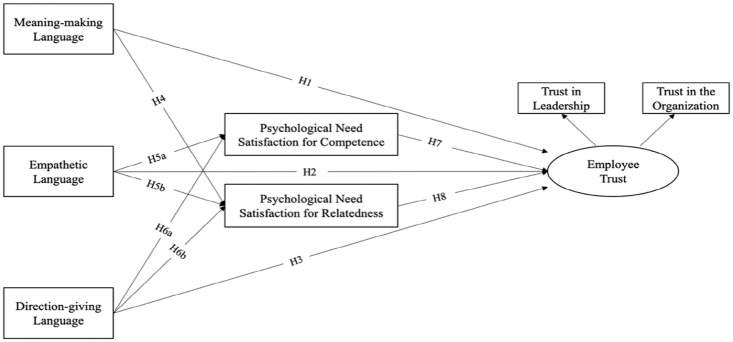
“Hypotheses 4 and 5 predicted the positive impacts of leaders’ use of meaning-making, empathetic, and direction-giving language on employees’ psychological need satisfaction for competence and/or relatedness.”
§ Fostering Employee Trust via Effective Supervisory Communication during the COVID-19 Pandemic: Through the Lens of Motivating Language Theory > Literature Review > The Mediator: Employees’ Psychological Need Satisfaction
“H6: Leaders’ use of direction-giving language positively influences employee psychological need satisfaction for competence (a) and relatedness (b).”
Citations
Cites
The "what" and "why" of goal pursuits: Human needs and the self-determination of behavior
Deci, E. L., & Ryan, R. M. (2000) · Psychological Inquiry · doi:10.1207/s15327965pli1104_01 · Cited by 34,210 · cited 8×
“Many empirical studies have demonstrated positive organizational outcomes of satisfying employee basic psychological needs (Deci & Ryan, 2000), such as job satisfaction (Andreassen et al., 2010; Ilardi et al., 1993), organization commitment (Lian et al., 2012; Vansteenkiste et al., 2007), work…”
BackgroundMethodInfluentialThe need to belong: Desire for interpersonal attachments as a fundamental human motivation.
Baumeister, R. F., & Leary, M. R. (1995) · Psychological Bulletin · doi:10.1037//0033-2909.117.3.497 · Cited by 23,245 · cited 1×
“The need for relatedness is defined as the desire to maintain intimate Men et al. 199 relationships and have a sense of mutual respect and care with others (Baumeister & Leary, 1995).”
BackgroundIntrinsic and Extrinsic Motivations: Classic Definitions and New Directions
Ryan, R. M., & Deci, E. L. (2000) · Contemporary Educational Psychology · doi:10.1006/ceps.1999.1020 · Cited by 18,666 · cited 1×
“Such explicit supervisory support can also satisfy the aforementioned need for relatedness (Ryan & Deci, 2000).”
BackgroundAn integrative model of organizational trust
Mayer, R. C., Davis, J. H., & Schoorman, F. D. (1995) · The Academy of Management Review · doi:10.2307/258792 · Cited by 10,736
Not So Different After All: A Cross-Discipline View Of Trust
Rousseau, D. M., Sitkin, S. B., Burt, R. S., & Camerer, C. (1998) · Academy of Management Review · doi:10.5465/amr.1998.926617 · Cited by 10,274 · cited 2×
“, 1998), and this assumption of risk is based on the individual’s previous positive expectations or beliefs about the behaviors and intentions of others (Rousseau et al., 1998).”
BackgroundAffect and Cognition Based Trust as Foundations for Interpersonal Cooperation in Organizations
McAllister, D. J. (1995) · Academy of Management Journal · doi:10.2307/256727 · Cited by 7,346 · cited 7×
“…the most frequently cited definition of trust in leadership, the current study defines this term as willingness to be vulnerable to words, actions, and decisions of his or her supervisor, regardless of the ability to control the other party (Mayer et al., 1995; McAllister, 1995; Williams, 2001).”
BackgroundMethodInfluentialMotivation reconsidered: The concept of competence.
White, R. W. (1959) · Psychological Review · doi:10.1037/h0040934 · Cited by 5,681 · cited 2×
“In the workplace setting, competence represents an employee feeling capable of accomplishing challenging tasks and obtaining desired outcomes (Deci et al., 2001; White, 1959).”
BackgroundThe general causality orientations scale: Self-determination in personality
Deci, E. L., & Ryan, R. M. (1985) · Journal of Research in Personality · doi:10.1016/0092-6566(85)90023-6 · Cited by 5,079 · cited 1×
“…leadership’s reinforcement of organizational values and purposes, understanding subordinate needs and providing support, providing clear work instruction and meaningful feedback, may all predict to what extent an employee’s psychological needs may be fulfilled at work (Deci & Ryan, 1985).”
BackgroundWhitener, E. M., Brodt, S. E., Korsgaard, M. A., & Werner, J. M. (1998) · The Academy of Management Review · doi:10.5465/amr.1998.926624 · Cited by 4,971 · cited 2×
“Supervisors are arguably the most trustworthy source of information for employees (Legood et al., 2016; Men & Bowen, 2017; Whitener et al., 1998).”
BackgroundTrust in leadership: Meta-analytic findings and implications for research and practice.
Dirks, K. T., & Ferrin, D. L. (2002) · Journal of Applied Psychology · doi:10.1037/0021-9010.87.4.611 · Cited by 3,550 · cited 1×
“As an essential psychological state in achieving leadership effectiveness, trust stems from two distinctive psychological processes: cognitive and affective trust (Dirks & Ferrin, 2002; McAllister, 1995).”
BackgroundCommon methods variance detection in business research
Fuller, C. M., Simmering, M. J., Atinc, G., Atinc, Y., & Babin, B. J. (2016) · Journal of Business Research · doi:10.1016/j.jbusres.2015.12.008 · Cited by 3,519 · cited 2×
“Although the use of Harman’s single factor test and the unmeasured latent method factor technique (Fuller et al., 2016; Richardson et al., 2009) did not reveal common source bias in our data, we suggest future research adopt a mixed-method approach or include two or more information sources to rule…”
MethodSelf-Determination Theory in Work Organizations: The State of a Science
Deci, E. L., Olafsen, A. H., & Ryan, R. M. (2017) · Annual Review of Organizational Psychology and Organizational Behavior · doi:10.1146/annurev-orgpsych-032516-113108 · Cited by 3,199 · cited 2×
“Moreover, several empirical studies in management have demonstrated that employees who report stronger levels of relatedness with the organization develop greater trusting attitudes toward the organization as well as the corporate management (e.g., Deci et al., 2017; Neves & Eisenberger, 2014).”
BackgroundDeci, E. L., Ryan, R. M., Gagné, M., Leone, D. R., Usunov, J., & Kornazheva, B. P. (2001) · Personality and Social Psychology Bulletin · doi:10.1177/0146167201278002 · Cited by 1,890 · cited 6×
“…show authentic care and take employee input into consideration, it can reduce anxiety and cultivate a stronger sense of belongingness to the organization among employees during the pandemic, thus satisfying their psychological need for relatedness (Deci et al., 2001; Weinstein & Ryan, 2010).”
BackgroundInfluentialBaard, P. P., Deci, E. L., & Ryan, R. M. (2004) · Journal of Applied Social Psychology · doi:10.1111/j.1559-1816.2004.tb02690.x · Cited by 1,886 · cited 4×
“, 2002), work performance (Baard et al., 2004), and mental health (Lynch et al.”
BackgroundInfluentialRichardson, H. A., Simmering, M. J., & Sturman, M. C. (2009) · Organizational Research Methods · doi:10.1177/1094428109332834 · Cited by 1,721
COVID-19 and the workplace: Implications, issues, and insights for future research and action.
Kniffin, K. M., Narayanan, J., Anseel, F., Antonakis, J., Ashford, S. P., Bakker, A. B., Bamberger, P., Bapuji, H., Bhave, D. P., Choi, V. K., et al. (2021) · American Psychologist · doi:10.1037/amp0000716 · Cited by 1,712
The value of value congruence.
Edwards, J. R., & Cable, D. M. (2009) · Journal of Applied Psychology · doi:10.1037/a0014891 · Cited by 1,582 · cited 1×
“According to Edwards and Cable (2009), regardless of the target of the trust, value congruence with the organization could be essential for employee trust to occur.”
BackgroundWeinstein, N., & Ryan, R. M. (2010) · Journal of Personality and Social Psychology · doi:10.1037/a0016984 · Cited by 1,484 · cited 2×
“When employees feel their input is respected and recognized by leadership, they may be more motivated and feel a stronger sense of competence at work (Neves & Eisenberger, 2014; Weinstein & Ryan, 2010).”
BackgroundA Review of Self-Determination Theory’s Basic Psychological Needs at Work
Van den Broeck, A., Ferris, D. L., Chang, C.-H., & Rosen, C. C. (2016) · Journal of Management · doi:10.1177/0149206316632058 · Cited by 1,465 · cited 3×
“…fulfilled in the workplace, they tend to develop positive attitudes and behavioral intentions toward the organization, such as a higher level of job satisfaction (Van den Broeck et al., 2016), organizational commitment (Dursun, 2015), and identification with the organization (Smidts et al., 2001).”
BackgroundSmidts, A., Pruyn, A. T. H., & Van Riel, C. B. M. (2001) · Academy of Management Journal · doi:10.2307/3069448 · Cited by 1,352 · cited 1×
“, 2016), organizational commitment (Dursun, 2015), and identification with the organization (Smidts et al., 2001).”
BackgroundVan den Broeck, A., Vansteenkiste, M., De Witte, H., Soenens, B., & Lens, W. (2010) · Journal of Occupational and Organizational Psychology · doi:10.1348/096317909x481382 · Cited by 1,305 · cited 3×
“(6) I feel cared for by others in my organization during the pandemic (Source: Van den Broeck et al., 2010)”
BackgroundMethodInfluentialLeading teams: setting the stage for great performances
(2002) · The Journal of Academic Librarianship · doi:10.1016/s0099-1333(02)00355-5 · Cited by 1,172 · cited 2×
“In particular, when leaders use direction-giving language to clarify employee job roles, changes, and task expectations during the pandemic, employees may trust leadership competence in responding to the crisis (Hackman, 2002).”
BackgroundVan den Broeck, A., Vansteenkiste, M., De Witte, H., & Lens, W. (2008) · Work & Stress · doi:10.1080/02678370802393672 · Cited by 914 · cited 2×
“The need for autonomy refers to the desire to obtain a sense of ownership and make personal decisions without being affected by external forces (Deci & Ryan, 2000; Van den Broeck et al., 2008).”
BackgroundJung, D. I., & Avolio, B. J. (2000) · Journal of Organizational Behavior · doi:10.1002/1099-1379(200012)21:8<949::aid-job64>3.0.co;2-f · Cited by 892
Trust in leadership: A multi-level review and integration
Burke, C. S., Sims, D. E., Lazzara, E. H., & Salas, E. (2007) · The Leadership Quarterly · doi:10.1016/j.leaqua.2007.09.006 · Cited by 870 · cited 5×
“Generally, scholars have examined trust from three perspectives: as a trait, a process, or an emergent state (Burke et al., 2007).”
BackgroundInfluentialBraun, S., Peus, C., Weisweiler, S., & Frey, D. (2013) · The Leadership Quarterly · doi:10.1016/j.leaqua.2012.11.006 · Cited by 839 · cited 2×
“Previous studies have demonstrated that various leadership attributes can influence employee trust at work, such as transformational (Braun et al., 2013), authentic (Wang & Hsieh, 2013), and servant leadership (Thelen, 2020), as well as leaders’ communication styles and channels (e.g., Men, 2014,…”
Background(2020) · American Business Review · doi:10.37625/abr · Cited by 797
Vansteenkiste, M., Neyrinck, B., Niemiec, C. P., Soenens, B., De Witte, H., & Van den Broeck, A. (2007) · Journal of Occupational and Organizational Psychology · doi:10.1348/096317906x111024 · Cited by 750 · cited 1×
“…needs (Deci & Ryan, 2000), such as job satisfaction (Andreassen et al., 2010; Ilardi et al., 1993), organization commitment (Lian et al., 2012; Vansteenkiste et al., 2007), work motivation (Richer et al., 2002), work performance (Baard et al., 2004), and mental health (Lynch et al., 2005).”
BackgroundIn Whom we Trust: Group Membership as an Affective Context for Trust Development
Williams, M. (2001) · The Academy of Management Review · doi:10.5465/amr.2001.4845794 · Cited by 720 · cited 1×
“…the most frequently cited definition of trust in leadership, the current study defines this term as willingness to be vulnerable to words, actions, and decisions of his or her supervisor, regardless of the ability to control the other party (Mayer et al., 1995; McAllister, 1995; Williams, 2001).”
BackgroundDirani, K. M., Abadi, M., Alizadeh, A., Barhate, B., Garza, R. C., Gunasekara, N., Ibrahim, G., & Majzun, Z. (2020) · Human Resource Development International · doi:10.1080/13678868.2020.1780078 · Cited by 709 · cited 2×
“The long-lasting pandemic has caused widespread emotional distress, anxiety, and boredom, so leaders need to be equipped with emotional intelligence, recognize employees’ emotional needs and communicate timely and sufficient emotional support (Dirani et al., 2020).”
BackgroundIlardi, B. C., Leone, D., Kasser, T., & Ryan, R. M. (1993) · Journal of Applied Social Psychology · doi:10.1111/j.1559-1816.1993.tb01066.x · Cited by 653 · cited 2×
“Many empirical studies have demonstrated positive organizational outcomes of satisfying employee basic psychological needs (Deci & Ryan, 2000), such as job satisfaction (Andreassen et al., 2010; Ilardi et al., 1993), organization commitment (Lian et al.”
BackgroundEisenberger, R., Karagonlar, G., Stinglhamber, F., Neves, P., Becker, T. E., Gonzalez-Morales, M. G., & Steiger-Mueller, M. (2010) · Journal of Applied Psychology · doi:10.1037/a0020858 · Cited by 652 · cited 1×
“Specifically, previous research has found that when psychological need for relatedness is fulfilled, employees are more willing to cultivate a positive and long-lasting relationship with the organization (Eisenberger et al., 2010; Tao et al., 2018).”
BackgroundSpence Laschinger, H. K., Finegan, J., & Shamian, J. (2001) · Health Care Management Review · doi:10.1097/00004010-200107000-00002 · Cited by 610
Toward the differentiation of trust in supervisor and trust in organization.
Tan, H. H., & Tan, C. S. (2000) · PubMed · Cited by 567
Leadership and stress: A meta-analytic review
Harms, P. D., Credé, M., Tynan, M., Leon, M., & Jeung, W. (2017) · The Leadership Quarterly · doi:10.1016/j.leaqua.2016.10.006 · Cited by 558 · cited 1×
“Supervisors who demonstrate concerns for subordinate well-being can become a source of relief from employee emotional exhaustion (Harms et al., 2017), thereby fostering trust in leaders and organizations.”
BackgroundA correlation of servant leadership, leader trust, and organizational trust
Joseph, E. E., & Winston, B. E. (2005) · Leadership & Organization Development Journal · doi:10.1108/01437730510575552 · Cited by 552 · cited 1×
“…is more associated with ability, benevolence, and integrity, trust in the organization is associated with proper structures (e.g., policies and contracts), organizational justice, support, communication, and culture (DeConinck, 2010; Joseph & Winston, 2005; Men & Bowen, 2017; Tan & Tan, 2000).”
BackgroundDeConinck, J. B. (2010) · Journal of Business Research · doi:10.1016/j.jbusres.2010.01.003 · Cited by 544 · cited 4×
“Prior research has found organizational support (Dursun, 2015), perceived organizational justice (DeConinck, 2010), leadership styles (Jung & Avolio, 2000), and leadership communication (Porumbescu et al.”
BackgroundInfluentialTransylvanian Review of Administrative Sciences
(2017) · Transylvanian Review of Administrative Sciences · doi:10.24193/tras · Cited by 506
Loss and Resilience in the Time of COVID‐19: Meaning Making, Hope, and Transcendence
Walsh, F. (2020) · Family Process · doi:10.1111/famp.12588 · Cited by 501 · cited 1×
“In times of pandemic-related loss and life threats, the meaning-making process is important because it helps people make sense of loss, rebuild shared beliefs, reduce selfblame and guilt, and maintain hope for a positive outlook (Walsh, 2020).”
BackgroundTaking control amidst the chaos: emotion regulation during the COVID-19 pandemic.
Restubog, S. L. D., Ocampo, A. C. G., & Wang, L. (2020) · Journal of Vocational Behavior · doi:10.1016/j.jvb.2020.103440 · Cited by 419 · cited 1×
“Indeed, the pandemic not only disrupts the broad workforce physically and financially, but emotionally as well (Restubog et al., 2020).”
BackgroundCrowdsourcing research: Data collection with Amazon’s Mechanical Turk
Sheehan, K. B. (2018) · Communication Monographs · doi:10.1080/03637751.2017.1342043 · Cited by 408 · cited 2×
“Respondents were recruited via Amazon Mechanical Turk (MTurk), which has been utilized for many social science studies for sample recruitment, and data quality confirmed in previous studies (e.g., Buhrmester et al., 2011; Sheehan, 2018).”
Methodde Vries, R. E., Bakker-Pieper, A., & Oostenveld, W. (2010) · Journal of Business and Psychology · doi:10.1007/s10869-009-9140-2 · Cited by 405 · cited 2×
“…research suggest that supervisory communication styles, channels, skills, and effectiveness can influence employee attitudes, behaviors, emotional capital, and organizational performance (Cardon et al., 2019; De Vries et al., 2010; Men, 2014)), including employee trust (Burke et al., 2007).”
BackgroundA Motivational Model of Work Turnover
Richer, S. F., Blanchard, C., & Vallerand, R. J. (2002) · Journal of Applied Social Psychology · doi:10.1111/j.1559-1816.2002.tb02065.x · Cited by 399 · cited 2×
“, 2007), work motivation (Richer et al., 2002), work performance (Baard et al.”
BackgroundAn Examination of Organizational Trust Antecedents
Gilbert, J. A., & Tang, T. L.-P. (1998) · Public Personnel Management · doi:10.1177/009102609802700303 · Cited by 383 · cited 2×
“Consistent with prior studies (Gilbert & Tang, 1998; Seppänen et al., 2014), the present study revealed that supervisor use of meaning-making language is necessary for establishing and reinforcing employee trust toward the leader and the organization.”
BackgroundResultLeadership: A communicative perspective
Fairhurst, G. T., & Connaughton, S. L. (2014) · Leadership · doi:10.1177/1742715013509396 · Cited by 353 · cited 1×
“Although communication is recognized as a key component of leadership (Fairhurst & Connaughton, 2014; Luthra & Dahiya, 2015), only a handful of scholars have examined how leadership communication influences employee trust (Men, 2015, Thelen, 2020).”
BackgroundServant leadership as antecedent of trust in organizations
Sendjaya, S., & Pekerti, A. (2010) · Leadership & Organization Development Journal · doi:10.1108/01437731011079673 · Cited by 338 · cited 2×
“Maintaining a trusting relationship with employees is regarded as one of the core tasks for leaders and communication managers (Men, 2014; Sendjaya & Pekerti, 2010).”
BackgroundLian, H., Lance Ferris, D., & Brown, D. J. (2012) · Organizational Behavior and Human Decision Processes · doi:10.1016/j.obhdp.2011.10.003 · Cited by 321 · cited 1×
“…basic psychological needs (Deci & Ryan, 2000), such as job satisfaction (Andreassen et al., 2010; Ilardi et al., 1993), organization commitment (Lian et al., 2012; Vansteenkiste et al., 2007), work motivation (Richer et al., 2002), work performance (Baard et al., 2004), and mental health…”
BackgroundLee, C.-K., Song, H.-J., Lee, H.-M., Lee, S., & Bernhard, B. J. (2013) · International Journal of Hospitality Management · doi:10.1016/j.ijhm.2012.10.011 · Cited by 319 · cited 1×
“Employee organizational trust has been associated with various beneficial outcomes for the organization, such as employee job satisfaction (Lee et al., 2013), employee openness to change (Neill et al., 2019), reduced turnover intention (Kath et al., 2010), organizational commitment (Laschinger et…”
BackgroundExamining the effects of trust in leaders: A bases-and-foci approach
Yang, J., & Mossholder, K. W. (2010) · The Leadership Quarterly · doi:10.1016/j.leaqua.2009.10.004 · Cited by 308 · cited 1×
“Given the inherent power structure within the organization, it is likely that employees will be subjective to influence and control from organizational authorities, which makes trust in leadership a necessary approach to enhance positive employee outcomes (Yang & Mossholder, 2010).”
BackgroundMen, L. R. (2014) · Journal of Public Relations Research · doi:10.1080/1062726x.2014.908719 · Cited by 299 · cited 4×
“Maintaining a trusting relationship with employees is regarded as one of the core tasks for leaders and communication managers (Men, 2014; Sendjaya & Pekerti, 2010).”
BackgroundInfluentialSelf-citationThe effect of authentic leadership on employee trust and employee engagement
Wang, D.-S., & Hsieh, C.-C. (2013) · Social Behavior and Personality: an international journal · doi:10.2224/sbp.2013.41.4.613 · Cited by 269 · cited 1×
“…studies have demonstrated that various leadership attributes can influence employee trust at work, such as transformational (Braun et al., 2013), authentic (Wang & Hsieh, 2013), and servant leadership (Thelen, 2020), as well as leaders’ communication styles and channels (e.g., Men, 2014, 2015).”
BackgroundThree Roles of Language in Motivation Theory
Sullivan, J. J. (1988) · The Academy of Management Review · doi:10.5465/amr.1988.4306798 · Cited by 267 · cited 6×
“In particular, a versatile strategic communication model that includes the use of meaning-making, empathetic, and direction-giving language should guide leadership communication practice which in turn will generate positive employee outcomes (Sullivan, 1988).”
BackgroundInfluentialImplicit self-esteem: Nature, measurement, and a new way forward.
Buhrmester, M. D., Blanton, H., & Swann, W. B. (2011) · Journal of Personality and Social Psychology · doi:10.1037/a0021341 · Cited by 259 · cited 1×
“…with an organization across different industries in the U.S. Respondents were recruited via Amazon Mechanical Turk (MTurk), which has been utilized for many social science studies for sample recruitment, and data quality confirmed in previous studies (e.g., Buhrmester et al., 2011; Sheehan, 2018).”
MethodLongstaff, P. H., & Yang, S.-U. (2008) · Ecology and Society · doi:10.5751/es-02232-130103 · Cited by 257 · cited 1×
“Such knowledge is critical because employee trust serves as the key factor in building resilience during a widespread disaster (Longstaff & Yang, 2008).”
BackgroundRespectful Inquiry: A Motivational Account of Leading Through Asking Questions and Listening
Van Quaquebeke, N., & Felps, W. (2018) · Academy of Management Review · doi:10.5465/amr.2014.0537 · Cited by 240 · cited 1×
“In internal communication literature, leadership communication has been widely recognized as an important factor that affects employee attitude and behavior given supervisory day-to-day interactions and communications with employees (Van Quaquebeke & Felps, 2018).”
BackgroundTrust in managerial relationships
Atkinson, S., & Butcher, D. (2003) · Journal of Managerial Psychology · doi:10.1108/02683940310473064 · Cited by 222 · cited 1×
“However, as a socially constructed phenomenon, there seems to be no unified definition of trust (Atkinson & Butcher, 2003).”
BackgroundMen, L. R. (2015) · Public Relations Review · doi:10.1016/j.pubrev.2015.06.021 · Cited by 212 · cited 2×
“…studies have demonstrated that various leadership attributes can influence employee trust at work, such as transformational (Braun et al., 2013), authentic (Wang & Hsieh, 2013), and servant leadership (Thelen, 2020), as well as leaders’ communication styles and channels (e.g., Men, 2014, 2015).”
BackgroundSelf-citationPerceived organizational support and risk taking
Neves, P., & Eisenberger, R. (2014) · Journal of Managerial Psychology · doi:10.1108/jmp-07-2011-0021 · Cited by 203 · cited 2×
“When employees feel their input is respected and recognized by leadership, they may be more motivated and feel a stronger sense of competence at work (Neves & Eisenberger, 2014; Weinstein & Ryan, 2010).”
BackgroundThe relationship between ‘workaholism’, basic needs satisfaction at work and personality
Andreassen, C. S., Hetland, J., & Pallesen, S. (2010) · European Journal of Personality · doi:10.1002/per.737 · Cited by 194 · cited 2×
“…have demonstrated positive organizational outcomes of satisfying employee basic psychological needs (Deci & Ryan, 2000), such as job satisfaction (Andreassen et al., 2010; Ilardi et al., 1993), organization commitment (Lian et al., 2012; Vansteenkiste et al., 2007), work motivation (Richer et…”
BackgroundLynch, M. F., Plant, R. W., & Ryan, R. M. (2005) · Professional Psychology: Research and Practice · doi:10.1037/0735-7028.36.4.415 · Cited by 194 · cited 2×
“According to the self-determination theory, satisfying the psychological needs of employees can enhance self-growth and mental well-being at work (Deci & Ryan, 2000; Lynch et al., 2005), both of which are beneficial to developing a trusting relationship with the leader and organization.”
BackgroundMethodStrategic Vision and Values in Top Leaders’ Communications: Motivating Language at a Higher Level
Mayfield, J. R., Mayfield, M., & Sharbrough, W. C. (2014) · International Journal of Business Communication · doi:10.1177/2329488414560282 · Cited by 191 · cited 5×
“Either through formal talk or casual conversations, meaning-making messages from leaders can assist employees in achieving value congruence with the organization (Mayfield et al., 2015).”
BackgroundInfluentialCharoensukmongkol, P., & Phungsoonthorn, T. (2021) · The Journal of General Psychology · doi:10.1080/00221309.2020.1795613 · Cited by 182 · cited 2×
“…context of a pandemic and demonstrated that feelings of connection can significantly enhance employee trust towards leadership and the organization, especially considering that employee need for relatedness is more evident than ever during turbulent times (Charoensukmongkol & Phungsoonthorn, 2020).”
BackgroundAuthentic Leadership, Trust And Work Engagement
Hassan, A., & Ahmed, F. (2011) · Zenodo (CERN European Organization for Nuclear Research) · doi:10.5281/zenodo.1075159 · Cited by 173
Six, F., & Sorge, A. (2008) · Journal of Management Studies · doi:10.1111/j.1467-6486.2007.00763.x · Cited by 170 · cited 1×
“The role of trust has been widely examined within management, organizational, and communication literature (Sendjaya & Pekerti, 2010; Six & Sorge, 2008).”
BackgroundThe many benefits of employee well‐being in organizational research
Wright, T. A., & Huang, C. (2012) · Journal of Organizational Behavior · doi:10.1002/job.1828 · Cited by 168 · cited 1×
“Employees are more likely to develop a trusting relationship with their leader and organization when they perceive competence by the organization in dealing with the challenges (Pfeffer, 2018; Wright & Huang, 2012).”
BackgroundThe role of organizational trust in safety climate's influence on organizational outcomes
Kath, L. M., Magley, V. J., & Marmet, M. D. (2010) · Accident Analysis & Prevention · doi:10.1016/j.aap.2009.11.010 · Cited by 158 · cited 2×
“…outcomes for the organization, such as employee job satisfaction (Lee et al., 2013), employee openness to change (Neill et al., 2019), reduced turnover intention (Kath et al., 2010), organizational commitment (Laschinger et al., 2001), and organizational performance (Paliszkiewicz & Koohang, 2013).”
Background(2018) · Cited by 154
Excellence in Internal Communication Management
Men, R. L., & Bowen, S. A. (2016) · Cited by 151
Motivating Language: Exploring Theory with Scale Development
Mayfield, J., Mayfield, M., & Kopf, J. (1995) · Journal of Business Communication · doi:10.1177/002194369503200402 · Cited by 149 · cited 5×
“Motivating language theory (MLT) provides a sound framework for understanding how leadership’s daily communication with followers works to motivate employees (Mayfield et al., 1995; Sullivan, 1988).”
BackgroundInfluentialSharbrough, W. C. (2006) · Journal of Business Communication · doi:10.1177/0021943606291712 · Cited by 131
How communication climate and organizational identification impact change
Neill, M. S., Men, L. R., & Yue, C. A. (2019) · Corporate Communications An International Journal · doi:10.1108/ccij-06-2019-0063 · Cited by 130 · cited 2×
“…associated with various beneficial outcomes for the organization, such as employee job satisfaction (Lee et al., 2013), employee openness to change (Neill et al., 2019), reduced turnover intention (Kath et al., 2010), organizational commitment (Laschinger et al., 2001), and organizational…”
BackgroundSelf-citationMayfield, J., & Mayfield, M. (2012) · Journal of Business Communication · doi:10.1177/0021943612456036 · Cited by 127 · cited 3×
“Third, leaders’s use of direction-giving language can help reduce role ambiguity and clarify work expectations and directions (Mayfield & Mayfield, 2012; 2017; Mayfield et al., 2015).”
BackgroundMayfield, J. R., & Mayfield, M. (2017) · Springer eBooks · doi:10.1007/978-3-319-66930-4 · Cited by 125
Skiba, T. S., & Wildman, J. L. (2018) · Journal of Business and Psychology · doi:10.1007/s10869-018-9537-x · Cited by 122 · cited 1×
“…pandemic, the role of supervisory communication is perceived to be even more crucial as employees expect to hear from their direct managers information that can ease concerns about uncertainties (Skiba & Wildman, 2019) and receive clear guidance to help them to navigate disrupted work routines.”
BackgroundReflections on leadership in the time of COVID-19
Stoller, J. K. (2020) · BMJ Leader · doi:10.1136/leader-2020-000244 · Cited by 116 · cited 2×
“While a crisis like COVID-19 is a self-evident threat, it provides an opportunity for leaders to reflect on what communication practices can help retain employee trust through a crisis (Stoller, 2020).”
Background(2002) · Cited by 112
Online Journal of Applied Knowledge Management
(2019) · Online Journal of Applied Knowledge Management · doi:10.36965/ojakm · Cited by 112
Chathoth, P. K., Mak, B. L., Jauhari, V., & Manaktola, K. (2007) · Journal of Hospitality & Tourism Research · doi:10.1177/1096348007299922 · Cited by 108 · cited 1×
“Chathoth et al. (2007) indicated that trust results when competence, integrity, and openness exist within organizational relationships and actions.”
BackgroundLanguage in International Business
Piekkari, R., Welch, D. E., & Welch, L. S. (2014) · Edward Elgar Publishing eBooks · doi:10.4337/9781784710996 · Cited by 96
Internal communicators’ understanding of the definition and importance of employee advocacy
Thelen, P. D. (2020) · Public Relations Review · doi:10.1016/j.pubrev.2020.101946 · Cited by 95 · cited 3×
“…studies have demonstrated that various leadership attributes can influence employee trust at work, such as transformational (Braun et al., 2013), authentic (Wang & Hsieh, 2013), and servant leadership (Thelen, 2020), as well as leaders’ communication styles and channels (e.g., Men, 2014, 2015).”
BackgroundMayfield, M., & Mayfield, J. R. (2017) · International Journal of Business Communication · doi:10.1177/2329488416687057 · Cited by 92 · cited 6×
“(Source: Mayfield & Mayfield, 2017)”
BackgroundMethodInfluentialEmployees’ prosocial behavioral intentions through empowerment in CSR decision-making
Tao, W., Song, B., Ferguson, M. A., & Kochhar, S. (2018) · Public Relations Review · doi:10.1016/j.pubrev.2018.07.002 · Cited by 89 · cited 6×
“As a result of recognizing the organization’s efforts in satisfying employee needs, a trusting relationship between the organization and the employee can be further strengthened (Hon & Grunig, 1999; Tao et al., 2018).”
BackgroundResultInfluentialHofmeyer, A., Taylor, R., & Kennedy, K. (2020) · Nurse Education Today · doi:10.1016/j.nedt.2020.104502 · Cited by 87 · cited 1×
“Such leadership support, care, and encouragement are much needed especially during a challenging pandemic situation (Hofmeyer et al., 2020).”
BackgroundLeaders's language and employee proactivity: Enhancing psychological meaningfulness and vitality
Binyamin, G., & Brender-Ilan, Y. (2018) · European Management Journal · doi:10.1016/j.emj.2017.09.004 · Cited by 80 · cited 2×
“Third, leader use of direction-giving language provides a clear sense of direction and helps employees reduce their uncertainty and enhance their feeling of self-efficacy (Binyamin & Brender-Ilan, 2018; Mayfield & Mayfield, 2018).”
BackgroundCardon, P. W., Huang, Y., & Power, G. (2019) · International Journal of Business Communication · doi:10.1177/2329488419828808 · Cited by 79 · cited 2×
“…research suggest that supervisory communication styles, channels, skills, and effectiveness can influence employee attitudes, behaviors, emotional capital, and organizational performance (Cardon et al., 2019; De Vries et al., 2010; Men, 2014)), including employee trust (Burke et al., 2007).”
BackgroundBrown, L. A., & Roloff, M. E. (2015) · Communication Quarterly · doi:10.1080/01463373.2015.1058287 · Cited by 77 · cited 1×
“…the context of a pandemic, satisfying the psychological needs of employees, especially the need for competence and relatedness, can be instrumental for employees to cope with psychological and emotional challenges at work and enhance their sense of well-being (Bersin, 2020; Brown & Roloff, 2015).”
BackgroundMotivating language as a mediator between servant leadership and employee outcomes
Gutierrez-Wirsching, S., Mayfield, J., Mayfield, M., & Wang, W. (2015) · Management Research Review · doi:10.1108/mrr-01-2014-0009 · Cited by 76 · cited 3×
“…forms) has positive effects on critical organizational outcomes such as employee job satisfaction (Sharbrough et al., 2006), self-efficacy (Mayfield & Mayfield, 2012), organizational citizenship behavior (Gutierrez-Wirsching et al., 2015), and organizational performance (Mayfield et al., 2015).”
BackgroundPaliszkiewicz, J. O., & Koohang, A. A. (2013) · Cited by 65
The relation between organizational trust, organizational support and organizational commitment
Eğriboyun, D. (2015) · AFRICAN JOURNAL OF BUSINESS MANAGEMENT · doi:10.5897/ajbm2014.7623 · Cited by 56 · cited 4×
“Prior research has found organizational support (Dursun, 2015), perceived organizational justice (DeConinck, 2010), leadership styles (Jung & Avolio, 2000), and leadership communication (Porumbescu et al.”
BackgroundInfluentialThe linkages among leadership, trust, and business ethics
Tuấn, L. T. (2012) · Social Responsibility Journal · doi:10.1108/17471111211196629 · Cited by 55 · cited 1×
“However, while prior research has confirmed the crucial role of leadership in developing and sustaining employee trust (Jung & Avolio, 2000; Tuan, 2012), previous studies predominantly focus on leadership style or behaviors.”
ResultLeaders and their use of motivating language
C. Sarros, J., Luca, E., Densten, I., & C. Santora, J. (2014) · Leadership & Organization Development Journal · doi:10.1108/lodj-06-2012-0073 · Cited by 54 · cited 1×
“Additionally, a sense of trust in leaders can be developed when leaders use empathetic language to encourage and praise workers and care for their well-being (Sarros et al., 2014).”
BackgroundMayfield, M., & Mayfield, J. R. (2009) · The Journal of Business Inquiry · Cited by 50
Saruhan, N. (2013) · Pressacademia · Cited by 46
Legood, A., Thomas, G., & Sacramento, C. (2016) · Journal of Applied Social Psychology · doi:10.1111/jasp.12394 · Cited by 38 · cited 1×
“Supervisors are arguably the most trustworthy source of information for employees (Legood et al., 2016; Men & Bowen, 2017; Whitener et al., 1998).”
BackgroundFawkes, J. (2014) · Public Relations Review · doi:10.1016/j.pubrev.2014.02.011 · Cited by 37 · cited 1×
“A reduced sense of uncertainty and an enhanced sense of control can increase employee self-efficacy at work and satisfy their psychological need for competence (Fawkes, 2015).”
BackgroundLing, B., & Guo, Y. (2025) · International Journal of Business Communication · doi:10.1177/2329488420915503 · Cited by 32 · cited 1×
“When employees obtain adequate information and clear feedback from leaders, a belief that their leader is reliable, competent, and honest arises (Ling & Guo, 2020).”
BackgroundBuilding Trust: Communication and Subordinate Trust in Public Organizations
Porumbescu, G., Park, J. H., & Oomsels, P. (2013) · Transylvanian Review of Administrative Sciences · Cited by 31
Why and How Does Shared Language Affect Subsidiary Knowledge Inflows? A Social Identity Perspective
Reiche, B. S., Harzing, A.-W. K., & Pudelko, M. (2016) · JIBS special collections · doi:10.1007/978-3-319-42745-4_9 · Cited by 18
A Study on Population Growth and Economic Development with Special Reference to India
Bedia, D. D., & Gupta, R. K. P. (2013) · Cited by 7
Building intra-organisational trust with managerial communications
Seppänen, R., Kosonen, M., Vanhala, M., & Ellonen, H. K. (2014) · International Journal of Management Practice · doi:10.1504/ijmp.2014.061473 · Cited by 4 · cited 2×
“Consistent with prior studies (Gilbert & Tang, 1998; Seppänen et al., 2014), the present study revealed that supervisor use of meaning-making language is necessary for establishing and reinforcing employee trust toward the leader and the organization.”
BackgroundResult
Research works printed but not linked: 4
- Hon L. C. Grunig J. E. (1999). Guidelines for measuring relationships in public relations. The Institute for Public Relations, Commission on PR Measurement and Evaluation.
- Kline R. B. (2011). Methodology in the social sciences. Principles and practice of structural equation modeling (3rd ed.). Guilford Press.
- Luthra A. Dahiya R. (2015). Effective leadership is all about communicating effectively: Connecting leadership and communication. International Journal of Management & Business Studies, 5(3), 43– 48.
- Straiter K. L. (2005). The effects of supervisors’ trust of subordinates and their organization on job satisfaction and organizational commitment. International Journal of Leadership Studies, 1(1), 86– 101.
Cited by
Work and worker health in the post-pandemic world: a public health perspective
Peters, S. E., Dennerlein, J. T., Wagner, G. R., & Sorensen, G. (2022) · The Lancet Public Health · doi:10.1016/s2468-2667(21)00259-0 · Cited by 175
Tao, W., Lee, Y., Sun, R., Li, J.-Y., & He, M. (2021) · Public Relations Review · doi:10.1016/j.pubrev.2021.102133 · Cited by 185
“Leader communication has been repeatedly evidenced to impact employees’ perceptions, emotions, and behaviors (e.g., Men, Qin, and Jin, 2021).”
BackgroundJaiswal, A., Sengupta, S., Panda, M., Hati, L., Prikshat, V., Patel, P., & Mohyuddin, S. M. (2022) · International Journal of Manpower · doi:10.1108/ijm-04-2022-0149 · Cited by 89
Rabiul, M. K., Promsivapallop, P., Karim, R. A., Islam, M. A., & Patwary, A. K. (2022) · Journal of Hospitality and Tourism Management · doi:10.1016/j.jhtm.2022.09.002 · Cited by 77
Thelen, P. D., Yue, C. A., & Verghese, A. K. (2022) · Public Relations Review · doi:10.1016/j.pubrev.2022.102253 · Cited by 65
Metadata
- Authors
- Men, L. R., Qin, Y. S., & Jin, J.
- Affiliations
- University of Florida (US)
- Corresponding author
- Men, Linjuan Rita
- Venue
- International Journal of Business Communication
- Publisher
- SAGE Publications
- Published
- 2021-06-06
- Volume
- 59
- Issue
- 2
- Pages
- 193-218
- ISSN
- 2329-4884 (ISSN-L)
- 2329-4892
- PMC
- PMC8185562
- OpenAlex
- W3172891069
- Cited by
- 121
- References
- 104
- Citations by year
- 2026: 22 · 2025: 24 · 2024: 28 · 2023: 28 · 2022: 16 · 2021: 3
- FWCI
- 18.19
- Type
- journal article
- Language
- en
- Open access
- hybrid
- doi.org
- Locations
- International Journal of Business Communication (publishedVersion, cc-by)
- PubMed Central (publishedVersion, cc-by)
- Topics
- Social Sciences › Business, Management and Accounting › Organizational Behavior and Human Resource Management › Job Satisfaction and Organizational Behavior
- Social Sciences › Communication › Public Relations and Crisis Communication
- Social Sciences › Cultural Studies › Discourse Analysis and Cultural Communication
- Keywords
- employee trust, supervisory communication, self-determination theory, psychological need satisfaction, competence, relatedness, empathic communication, meaning-making, leadership communication, COVID-19 pandemic, trust in leadership, organizational trust
About these checks
Registry, retraction, Cites and statistics results are computed, not judged, with one exception: a printed reference that no index lists is read once by a model before it counts as a citation error. Claims are extracted by a model and kept only when their quote appears verbatim in the text; each cited source is then checked, with a model’s help, for whether it says what the claim relies on. Those verdicts can be wrong — read the claim’s quote and the cited source before relying on one.
The claim verdicts this report counts are experimental: their accuracy is not yet measured.
A language model drew the claims from the paper on 2026-10-10, under version 3 of the claim definition (model deepseek-v4.1-flash, prompt extract-v3).
A second model labelled each claim on 2026-10-10 (model jev-1.13-20260917, definition revision gold-guideline-v0.2).
Cited sources are checked with a language model’s help (gpt-6-sol and qwen3.8-omni-flash).
Statistics and arithmetic are recomputed, not judged.
Confidence bands are shown only for fields calibrated on our annotated test set. None is calibrated yet, so no band is shown.
What counts as a claim ›How we measure confidence ›How we check this ›
Are you an author, or do you see a problem with this page? Request a review
Data sources
Bibliographic data: Semantic Scholar, OpenAlex, Crossref.
Contains information from the Semantic Scholar Academic Graph Datasets, made available under the ODC Attribution License (ODC-BY 1.0).
Semantic Scholar’s data is described in: Kinney, R., et al. (2023). The Semantic Scholar Open Data Platform. arXiv:2301.10140.
