

The Pupil Dilation Response to Auditory Stimuli: Current State of Knowledge
Open accessThe DOI matches its Crossref record; 176 of the 178 references it cites were found in a registry or an index, and 2 are not checked yet.
Abstract
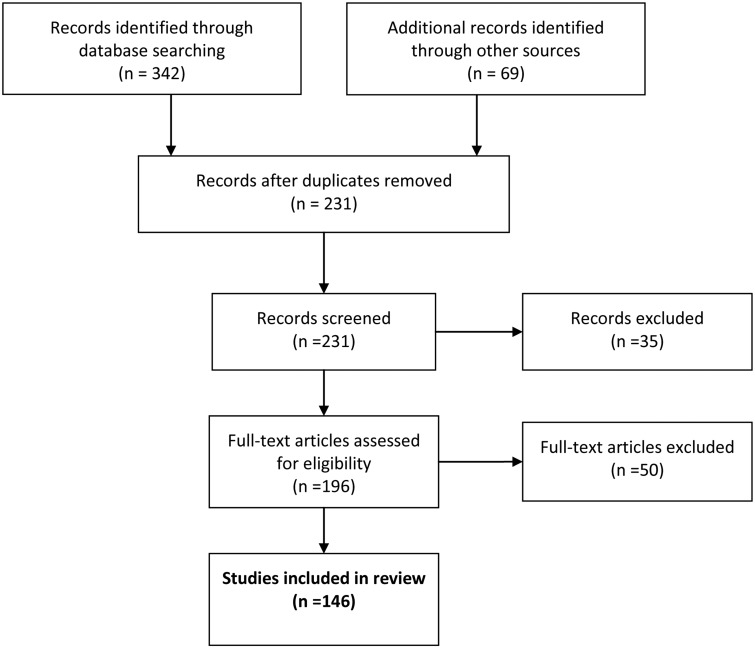
The measurement of cognitive resource allocation during listening, or listening effort, provides valuable insight in the factors influencing auditory processing. In recent years, many studies inside and outside the field of hearing science have measured the pupil response evoked by auditory stimuli. The aim of the current review was to provide an exhaustive overview of these studies. The 146 studies included in this review originated from multiple domains, including hearing science and linguistics, but the review also covers research into motivation, memory, and emotion. The present review provides a unique overview of these studies and is organized according to the components of the Framework for Understanding Effortful Listening. A summary table presents the sample characteristics, an outline of the study design, stimuli, the pupil parameters analyzed, and the main findings of each study. The results indicate that the pupil response is sensitive to various task manipulations as well as interindividual differences. Many of the findings have been replicated. Frequent interactions between the independent factors affecting the pupil response have been reported, which indicates complex processes underlying cognitive resource allocation. This complexity should be taken into account in future studies that should focus more on interindividual differences, also including older participants. This review facilitates the careful design of new studies by indicating the factors that should be controlled for. In conclusion, measuring the pupil dilation response to auditory stimuli has been demonstrated to be sensitive method applicable to numerous research questions. The sensitivity of the measure calls for carefully designed stimuli.
Overview
The claims and statistics of this paper haven’t been checked yet.
Free: it reads the open-access text and checks the first 5 claims that cite a source we can check. Create a free account to check every claim.
Integrity signals
Registry
Cites
Statistics
Figures
Verification
Claims the paper makes
The claims and statistics of this paper haven’t been checked yet.
Free: it reads the open-access text and checks the first 5 claims that cite a source we can check. Create a free account to check every claim.
Claims other papers make about this one
Each is checked against this paper’s own text: does it say what the citing paper says it does?
The source backs part of the claim, not all of it — or backs it for a different population, condition or comparison.
In the citing paper
“Generally speaking, listening effort increases with the magnitude of the obstacle such that more background noise (Van Engen & McLaughlin, 2018;Zekveld, Koelewijn, & Kramer, 2018) or poorer knowledge of the target language (Borghini & Hazan, 2018;Schmidtke et al., 2014) leads to greater listening effort”
From Listening effort and fatigue in native and non-native primary school children (2021) · cites this paper as Zekveld et al., 2018
Experimental — accuracy not yet measuredThe source backs part of the claim, not all of it — or backs it for a different population, condition or comparison.
In the citing paper
“They have shown that in more difficult acoustic scenarios, larger PPD and MPD are measures of increased listening effort [25].”
From An exploratory Study of EEG Alpha Oscillation and Pupil Dilation in Hearing-Aid Users During Effortful listening to Continuous Speech (2020) · cites this paper as [25]
Experimental — accuracy not yet measuredThe cited source says what the claim attributes to it.
In the citing paper
“In the context of hearing research, the taskevoked pupil response (TEPR) has widely been shown to be sensitive to the increased demands of listening in suboptimal acoustic conditions (see Zekveld et al., 2018 for a review), and is therefore, thought to reflect the effort required to achieve speech recognition under degraded listening conditions.”
From Effortful listening under the microscope: Examining relations between pupillometric and subjective markers of effort and tiredness from listening (2021) · cites this paper as Zekveld et al., 2018
The cited source says what the claim attributes to it.
In the citing paper
“Recently, pupillometry has been deemed as a valid tool to study language processing load and listening effort”
From Effects of acoustic and semantic cues on listening effort during native and non-native speech perception (2020) · cites this paper as Zekveld et al. (2018)
The check wasn’t confident either way, so it gives no verdict — never disputed.
In the citing paper
“However, studies to date report no association between TEPR and perceived effort.”
From Effortful listening under the microscope: Examining relations between pupillometric and subjective markers of effort and tiredness from listening (2021) · cites this paper as Zekveld et al., 2018
Experimental — accuracy not yet measured
7 more claims about this paper
Create a free account to see every claim other papers make about this one.
Self-check
Percentages, sums and reported differences re-computed from the paper’s own numbers.
The self-check needs the paper’s full text.
Citations
Cites
(2001) · doi:10.1017/cbo9780511546396 · Cited by 4,482
Aston-Jones, G., & Cohen, J. D. (2005) · Annual Review of Neuroscience · doi:10.1146/annurev.neuro.28.061604.135709 · Cited by 4,472 · cited 1×
“We refer to the task-evoked pupil response as the phasic change in pupil diameter (Aston-Jones & Cohen, 2005) in response to a momentary event such as an auditory stimulus presented in a listening task.”
MethodPupil Diameter and Load on Memory
Kahneman, D., & Beatty, J. (1966) · Science · doi:10.1126/science.154.3756.1583 · Cited by 1,617 · cited 7×
“The current review identified numerous studies that applied an auditory memory task, which may be partly based on the seminal work of Kahneman and Beatty (1966).”
BackgroundMethodInfluentialHearing Impairment and Cognitive Energy: The Framework for Understanding Effortful Listening (FUEL)
Pichora-Fuller, M. K., Kramer, S. E., Eckert, M. A., Edwards, B., Hornsby, B. W. Y., Humes, L. E., Lemke, U., Lunner, T., Matthen, M., Mackersie, C. L., et al. (2016) · Ear & Hearing · doi:10.1097/aud.0000000000000312 · Cited by 1,318 · cited 24×
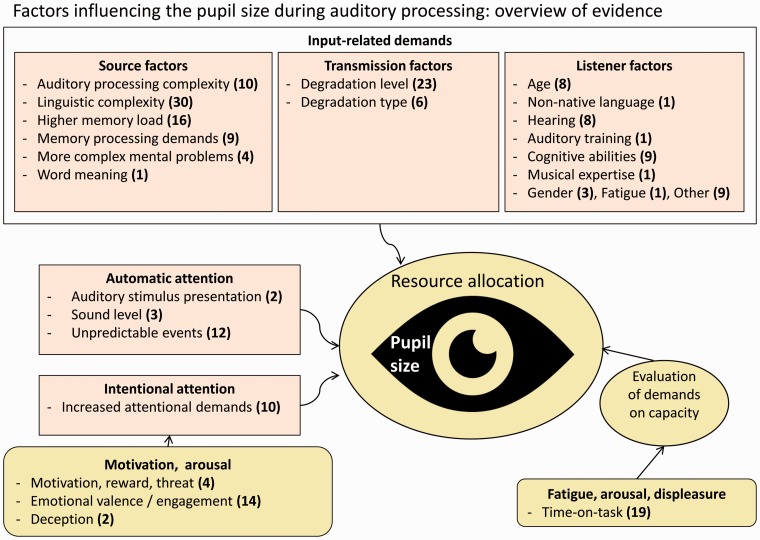
“We grouped the results according to whether these were based on external (see Table 1) versus internal (individual) factors (Table 2) and furthermore used the FUEL categories to structure the results (Pichora-Fuller et al., 2016).”
BackgroundMethodResultInfluentialSelf-citationHandbook of Approach and Avoidance Motivation
(2013) · Psychology Press eBooks · doi:10.4324/9780203888148 · Cited by 1,302
Pupil Size in Relation to Mental Activity during Simple Problem-Solving
Hess, E. H., & Polt, J. M. (1964) · Science · doi:10.1126/science.143.3611.1190 · Cited by 1,169 · cited 1×
“Please note that some of the excluded articles included early studies that were rejected because of the lack of formal statistical tests (e.g., Berrien & Huntington, 1943; Bradshaw, 1969, 1970; Hess & Polt, 1964; Schaefer, Ferguson, Klein, & Rawson, 1968).”
BackgroundPupillometry: A Window to the Preconscious?
Laeng, B., Sirois, S., & Gredebäck, G. (2012) · Perspectives on Psychological Science · doi:10.1177/1745691611427305 · Cited by 921
Pupil size variation as an indication of affective processing
Partala, T., & Surakka, V. (2003) · International Journal of Human-Computer Studies · doi:10.1016/s1071-5819(03)00017-x · Cited by 836 · cited 3×
“Peavler (1974) was the first to demonstrate this effect when showing that the pupil size was smaller for a recall condition with 13-digit when compared with 9-digit strings.”
BackgroundPupil diameter covaries with BOLD activity in human locus coeruleus
Murphy, P. R., O'Connell, R. G., O'Sullivan, M., Robertson, I. H., & Balsters, J. H. (2014) · Human Brain Mapping · doi:10.1002/hbm.22466 · Cited by 819
Gilzenrat, M. S., Nieuwenhuis, S., Jepma, M., & Cohen, J. D. (2010) · Cognitive, Affective, & Behavioral Neuroscience · doi:10.3758/cabn.10.2.252 · Cited by 798
Research works printed but not linked: 3
- Bradley M. T. Janisse M. P. (1979) Pupil size and lie detection: The effect of certainty on detection. Psychology: A Journal of Human Behavior 16: 33– 39.
- Hopstaken J. F. van der Linden D. Bakker A. B. Kompier M. A. (2015) The window of my eyes: Task disengagement and mental fatigue covary with pupil dynamics. Biological Psychology 110: 100– 106. 26196899
- Kahneman D. (1973) Attention and effort vol. 1063, Englewood Cliffs, NJ: Prentice-Hall.
Cited by
Items 301–381 of 381
Hearing Loss Is Reflected in Conversational Pupil Responses
Masters, B., Shiell, M. M., Wendt, D., & MacDonald, E. (2026) · Trends in Hearing · doi:10.1177/23312165261485567
Shen, J., & DeDe, G. (2026) · Frontiers in Psychology · doi:10.3389/fpsyg.2026.1926700
Teubner-Rhodes, S. E., Pusser, A., & Dunterman, R. A. (2026) · Attention Perception & Psychophysics · doi:10.3758/s13414-026-03271-2
Qi, S., & Thibodeau, L. M. (2026) · Sensors · doi:10.3390/s26206613
Shen, J., & Murray, E. S. H. (2024) · Ear and Hearing · doi:10.1097/aud.0000000000001599
Do Audiovisual Correspondences Affect Pupil Size?
Niimi, R. (2026) · Japanese Psychological Research · doi:10.1111/jpr.70032
Dissociable pupil-linked arousal during overt and inner speech
Kuwamizu, R., Watanabe, R., Yamamoto, N., Otani, K., & Moriguchi, Y. (2026) · iScience · doi:10.1016/j.isci.2026.117825
Fabio, C., & Kayser, C. (2025) · eLife · doi:10.7554/elife.105734.1
Fabio, C., & Kayser, C. (2025) · eLife · doi:10.7554/elife.105734.2
The Cardiovascular Response During Speech Reception
Samra, B. J. (2024) · doi:10.5463/thesis.894
Becker, J., Korn, C. W., & Blank, H. (2024) · Scientific Reports · doi:10.1038/s41598-024-59302-1
Blank, H., Korn, C., & Becker, J. (2026) · OSF Preprints (OSF Preprints)
Seta, D. D., Oliva, E., di Villahermosa, S. M., Luca, P. D., Mancini, P., D’Alessandro, H. D., Libonati, F. A., Turchetta, R., & Russo, F. (2026) · Audiology Research · doi:10.3390/audiolres16050129
Temporal contrast enhancement in auditory and nociceptive processing
Poehlmann, J., Szikszay, T. M., Luebke, L., Adamczyk, W. M., Luedtke, K., & Wöstmann, M. (2026) · Pain · doi:10.1097/j.pain.0000000000004080
The role of visual cues on word recognition in noise in monolingual and bilingual toddlers
Ayala, M. R., Blair, M., & Morini, G. (2026) · International Journal of Bilingualism · doi:10.1177/13670069251410425
Pupillary Responses Reflect Image Memorability
Niimi, R. (2025) · Psychophysiology · doi:10.1111/psyp.70007
Silcox, J. W., & Payne, B. R. (2024) · OSF Preprints (OSF Preprints) · doi:10.31219/osf.io/6qxdh_v1
On the relationship of arousal and attentional distraction by emotional novel soundsPreprint
Bonmassar, C., Scharf, F., Widmann, A., & Wetzel, N. (2021) · PsyArXiv (OSF Preprints) · doi:10.31234/osf.io/vyqw8
On the Relationship of Arousal and Attentional Distraction by Emotional Novel SoundsPreprint
Bonmassar, C., Scharf, F., Widmann, A., & Wetzel, N. (2022) · SSRN Electronic Journal · doi:10.2139/ssrn.4170482
Wardak, C., & Aguillon-Hernandez, N. (2024) · Elsevier eBooks · doi:10.1016/b978-0-12-820480-1.00166-2
Contreras-Altamirano, Debener, S., & Witt, K. (2026) · Research Square · doi:10.21203/rs.3.rs-10514460/v1
Interaction of involuntary and executive attention during developmentPreprint
Schöllkopf, U., Widmann, A., Bidet‐Caulet, A., & Wetzel, N. (2026) · bioRxiv (Cold Spring Harbor Laboratory) · doi:10.64898/2026.07.19.739397
Trends in Digital Hearing Health and Computational Audiology
(2024) · Frontiers research topics · doi:10.3389/978-2-8325-5771-6
Emotional Cue Effects on Choice Impulsivity
Knauth, K. (2024) · Kölner Universitäts PublikationsServer (Universität zu Köln)
Mepham, A. (2025) · White Rose eTheses Online (University of Leeds, The University of Sheffield, University of York)
On target selection indicated by pupil dilation
Strauch, C. (2021) · OPen Access Repositorium der Universität Ulm (OPARU) (Ulm University) · doi:10.18725/oparu-37988
Inferring trust in recommendation systems from brain, behavioural, and physiological dataPreprint
Cheung, V. K. M., Shih, P.-C., Hirano, M., Goto, M., & Furuya, S. (2025) · arXiv (Cornell University) · doi:10.48550/arxiv.2510.27272
Giuliani, N. P., & Panoncillo, S. G. (2026) · Trends in Hearing · doi:10.1177/23312165261504059
Render, A. (2020) · University of Regensburg Publication Server (University of Regensburg)
Perceptual learning and neural processing of noise-vocoded speech under divided attention
Wang, H. (2024) · UCL Discovery (University College London)
Boyer, J., Beraud, N., Béranger, B., Hardy, T., Türker, B., Gouyette, H., Lopez‐Persem, A., & Sergent, C. (2026) · bioRxiv (Cold Spring Harbor Laboratory) · doi:10.64898/2026.06.17.732590
Musical object processing in dementia
Core, L. B. S. (2025) · UCL Discovery (University College London)
The Effects of Attention and Prior Knowledge on Perception and Misperception of Speech
Kuimova, A. (2023) · YorkSpace (York University)
Behavioral and Neurophysiological Correlates of Auditory Attention in Monolinguals and Bilinguals
Bao, W. (2025) · TSpace (University of Toronto)
Sound-evoked facial motion in ferrets: evidence for species differences in sensorimotor couplingPreprint
Martin, M., & Boubenec, Y. (2026) · bioRxiv (Cold Spring Harbor Laboratory) · doi:10.64898/2026.03.09.710529
Kanari, K., & Tsutsumi, T. (2026) · Scientific Reports · doi:10.1038/s41598-026-73294-0
Scherger, A.-L., Urbanczik, G., Ludwigs, T., & Kizilirmak, J. M. (2021) · Frontiers in Psychology · doi:10.3389/fpsyg.2021.790449
Effects of Sound and Illumination on Pupil Size and Accommodation
Kim, M., & Chu, B. S. (2024) · The Korean Journal of Vision Science · doi:10.17337/jmbi.2024.26.4.249
Schneeberger, M., Peer, A., Aumayr, G., Pszeida, M., Weiss, W., Mosbacher, J. A., Haid, F., Luley, P., Weber, A., Ladstätter, S., et al. (2026) · AHFE international · doi:10.54941/ahfe1007377
Effort allocation during speech perception: Insights from pupillometry
Lebiecka-Johansen, P. A. (2023) · doi:10.5463/thesis.332
Neuromodulator recruitment during listening and learning in mice and humans.
Robert, B. (2023) · Digital Access to Scholarship at Harvard (DASH) (Harvard University)
Jakobsen, Y. (2025) · University of Southern Denmark Research Portal (University of Southern Denmark) · doi:10.21996/e8453ad5-dc35-4b7a-9398-d93603901002
Clinical applications of pupillometry – Audiological research and future prospects
Haipus, F.-M. (2025) · Aaltodoc (Aalto University)
The effects of music on responsiveness in people with dementia using pupillometry
Dolenc, J. (2023) · Repository of the University of Primorsk (University of Primorska)
Spatial aspects of auditory salience
Podwińska, Z. (2020) · University of Salford Institutional Repository (University of Salford)
Prosody and attention orienting
Lialiou, M. (2025) · OAPEN (The OAPEN Foundation) · doi:10.5281/zenodo.15396922
Prosody and attention orienting
Lialiou, M. (2025) · doi:10.17169/refubium-49667
Speech Perception and Auditory Attention in Noisy and Multi-Talker Environments
Haro, S. (2023) · Digital Access to Scholarship at Harvard (DASH) (Harvard University)
Investigating Humor Perception in Music
Imre, N. S. (2023) · Pécsi Egyetemi Archívum (University of Pécs)
Effect of Spatial Release from Masking on Listening Effort in Different Semantic ContextsPreprint
Borjigin, A., Dantanarayana, N. D., Litovsky, R. Y., & Litovsky, R. Y. (2026) · bioRxiv (Cold Spring Harbor Laboratory) · doi:10.64898/2026.07.13.738303
Advanced vision tests for optimising aircrew performance
Sadler, J. R. E. (2021) · City Research Online (City University London)
Physiology-Informed Audio Quality and Listening Effort EstimationPreprint
McGuire, N., & Emmanouilidou, D. (2026) · arXiv (Cornell University) · doi:10.48550/arxiv.2610.36865
Decruy, L. P. (2019) · Lirias (KU Leuven)
Sánchez, J. S. (2026) · Gredos (University of Salamanca) · doi:10.14201/gredos.170624
The Listening Effort Profile of Eye Movements: Easy, Difficult, and Impossible Speech ComprehensionPreprint
Herrmann, B., Fink, L., Pandey, P. R., Johnsrude, I. S., & Ryan, J. D. (2026) · bioRxiv (Cold Spring Harbor Laboratory) · doi:10.64898/2026.06.30.735702
Messung der Höranstrengung beim Satzverstehen im Störgeräusch
Zimmer, A. (2025) · heiDOK (Heidelberg University) · doi:10.11588/heidok.00036971
Rhythmic Abilities and Cognitive Load in Perception of Accented Second Language SpeechPreprint
Wong, B. W. L., Samuel, A. G., Kapnoula, E. C., & McLaughlin, D. J. (2025) · PsyArXiv (OSF Preprints) · doi:10.31234/osf.io/8xywk_v1
Baboukani, P. S., Graversen, C., Alickovic, E., & Østergaard, J. (2022) · doi:10.3389/fnins.2022.932959.s001
Chancen und Grenzen einer technologiebasierten Risikodiagnostik
Röbstek, L., Neitzel, I., & Scherger, A.-L. (2024) · Technische Universität Dortmund Eldorado (Technische Universität Dortmund) · doi:10.17877/de290r-24365
Yağmur, S. (2023) · OpenMETU (Middle East Technical University)
McLaughlin, D. J., Zink, M. E., Gaunt, L., Spehar, B., Engen, K. J. V., Sommers, M. S., & Peelle, J. E. (2021) · PsyArXiv (OSF Preprints) · doi:10.31234/osf.io/6pa3g_v1
Cross-modal mechanisms: perceptual multistability in audition and vision
Grenzebach, J. (2021) · Qucosa (Saxon State and University Library Dresden)
Languages guide dynamic attending in different ways: The case of the cocktail party effectPreprint
Kovács, P., Winkler, I., & Tóth, B. (2024) · PsyArXiv (OSF Preprints) · doi:10.31234/osf.io/3tx8c
Kovács, P., Tóth, B., Kohári, A., Baumgartner, R., & Winkler, I. (2025) · OSF Preprints (OSF Preprints) · doi:10.31219/osf.io/dgtkp_v1
Zhang, Y., Callejón-Leblic, M. A., Picazo-Reina, A. M., Blanco-Trejo, S., Patou, F., & Sánchez-Gómez, S. (2023) · doi:10.3389/fnins.2023.1307777.s003
Acoustic Salience Drives Pupillary Dynamics in an Interrupted, Reverberant TaskPreprint
Figarola, V., Liang, W., Luthra, S., Parker, E., Winn, M. B., Brown, C., & Shinn‐Cunningham, B. G. (2026) · bioRxiv (Cold Spring Harbor Laboratory) · doi:10.64898/2026.03.31.715639
The Role of Perceptual Rhythmic Ability in the Perception of Accented Second Language Speech
Wong, B. W. L., Samuel, A. G., Kapnoula, E. C., & McLaughlin, D. J. (2026) · Journal of Speech Language and Hearing Research · doi:10.1044/2026_jslhr-26-00042
Shen, J., Fitzgerald, L. P., & Kulick, E. R. (2022) · doi:10.3389/fpsyg.2022.959638.s001
Martohardjono, G., Johns, M. A., Franciotti, P., Castillo, D., Porru, I., & Lowry, C. (2023) · doi:10.3389/fpsyg.2023.1180989.s002
Zheng, Y., Knight, S., McGarrigle, R., Maher, G., & Mattys, S. (2026) · Trends in Hearing · doi:10.1177/23312165261492832
Beoordeling van de luisterinspanning bij slechthorende kinderen: een nieuw meetparadigma
Hsu, C.-L. (2019) · Lirias
Characterizing Perception of Impulse Sounds Through Subjective Ratings and Pupillometric Responses
Wiederschein, L., Schließ, A., Denk, F., & Husstedt, H. (2026) · Trends in Hearing · doi:10.1177/23312165261446374
Fantozzi, M. P. T., Crivello, A., Rosa, D. L., Milazzo, M., Fiacchini, G., Bruschini, L., & Manzoni, D. (2026) · Scientific Reports · doi:10.1038/s41598-026-64019-4
Alben, N., & Arthur, C. (2023) · Attention Perception & Psychophysics · doi:10.3758/s13414-023-02765-7
Ershaid, H., McLaughlin, D. J., & Lallier, M. (2025) · OSF Preprints (OSF Preprints) · doi:10.31219/osf.io/9jhd4
Analyse von Bedrohungen für die Privatsphäre durch VR/AR Geräte
Lengert, A. (2024) · MOnAMi (Hochschule Mittweida Hochschulbibliothek)
Accommodation in Anisometropic Amblyopia
Geraghty, H. L. (2025) · White Rose eTheses Online (University of Leeds, The University of Sheffield, University of York)
Kumar, P., Malik, S., Zheng, G., Zhao, G., & Li, X. (2026) · arXiv (Cornell University) · doi:10.48550/arxiv.2610.24898
Metadata
- Authors
- Zekveld, A. A., Koelewijn, T., & Kramer, S. E.
- Venue
- Trends in Hearing
- Publisher
- SAGE Publications
- Published
- 2018-01
- Volume
- 22
- Pages
- 2331216518777174-2331216518777174
- ISSN
- 2331-2165 (ISSN-L)
- PMC
- PMC6156203
- OpenAlex
- W2894332003
- Cited by
- 306
- References
- 176
- FWCI
- 14.25
- Type
- journal article
- Language
- en
- Open access
- gold
- Licence
- journals.sagepub.com/page/policies/text-and-data-mining-license (tdm)
- Funders
- FP7 People: Marie-Curie Actions (607373)
- Amsterdam Public Health research institute (IPB Revanche programme PupILL)
About these checks
Registry, retraction, Cites and statistics results are computed, not judged, with one exception: a printed reference that no index lists is read once by a model before it counts as a citation error. Claims are extracted by a model and kept only when their quote appears verbatim in the text; each cited source is then checked, with a model’s help, for whether it says what the claim relies on. Those verdicts can be wrong — read the claim’s quote and the cited source before relying on one.
Statistics and arithmetic are recomputed, not judged.
Confidence bands are shown only for fields calibrated on our annotated test set. None is calibrated yet, so no band is shown.
What counts as a claim ›How we measure confidence ›How we check this ›
Are you an author, or do you see a problem with this page? Request a review
Data sources
Bibliographic data: Semantic Scholar, OpenAlex, Crossref.
Contains information from the Semantic Scholar Academic Graph Datasets, made available under the ODC Attribution License (ODC-BY 1.0).
Semantic Scholar’s data is described in: Kinney, R., et al. (2023). The Semantic Scholar Open Data Platform. arXiv:2301.10140.
