

Overview and Feasibility of a Novel Transdisciplinary Integrative Approach to High Impact Chronic Pain in Vermont
Open accessThe DOI matches its Crossref record; 29 of the 29 references it cites were found in a registry or an index; 23 of the 43 sources its claims cite were checked for support.
Abstract
Background/Objective: Pain is one of the most common chronic conditions in the US, estimated to affect 20.9% of the population (51.6 million people). We evaluated the Partners Aligned in Transformative Healing (PATH) program at University Medical Center’s Comprehensive Pain Program clinic. Feasibility, initial clinical and financial results were assessed to inform payers’ support for PATH, an integrative transdisciplinary program within a bundled payment format. Methods: Participants completed a multi-week program including integrative therapies, with empirically validated assessment surveys administered at the beginning and end of the program. Insurance claims data were analyzed 12 months pre- and post-program. Statistical significance of pre-post differences was assessed by paired T-tests with P < 0.05. Results: Between June 2019 and August 2022, 170 individuals enrolled in PATH, 151 (88.8%) completed the program, and 121 participants completed outcome surveys. Participants were predominately White, non-Hispanic (98%), female (76%), with an average age of 49.8. All participant-reported clinical outcomes (PROs) showed statistically significant improvement from baseline to final assessment, and some but not all were clinically significant. PEG subscale of average pain interference, enjoyment of life, and interference with general activity each decreased. The T-scores for the following domains of PROMIS-29 decreased: Pain interference; fatigue; sleep disturbance; anxiety, and depression. The PROMIS-29 domains of overall physical function and social roles and activities mean T-scores increased. Per Member Per Month (PMPM) total cost of care decreased by $462 (18%). Emergency room utilization for all diagnoses decreased by 457 visits/1000 patients (65%), and for pain-related diagnoses by 194 visits/1000 patients (67%) during the observation period. Conclusions: Results suggest that the PATH Program is a feasible and acceptable model that shows initial effectiveness relative to short-term patient-reported clinical outcomes and shows signs of durability in both utilization and financial outcomes at 1 year. The results support continued study including a multi-site RCT. © The Author(s) 2024.
Overview
CoChat Summary
## TL;DR
This pilot evaluation of the PATH transdisciplinary integrative pain program found high completion and short-term improvements in patient-reported outcomes, with signals of lower 1-year costs and emergency room use. The authors conclude it is feasible and acceptable, but the single-arm design means causality cannot be established.
## Key findings
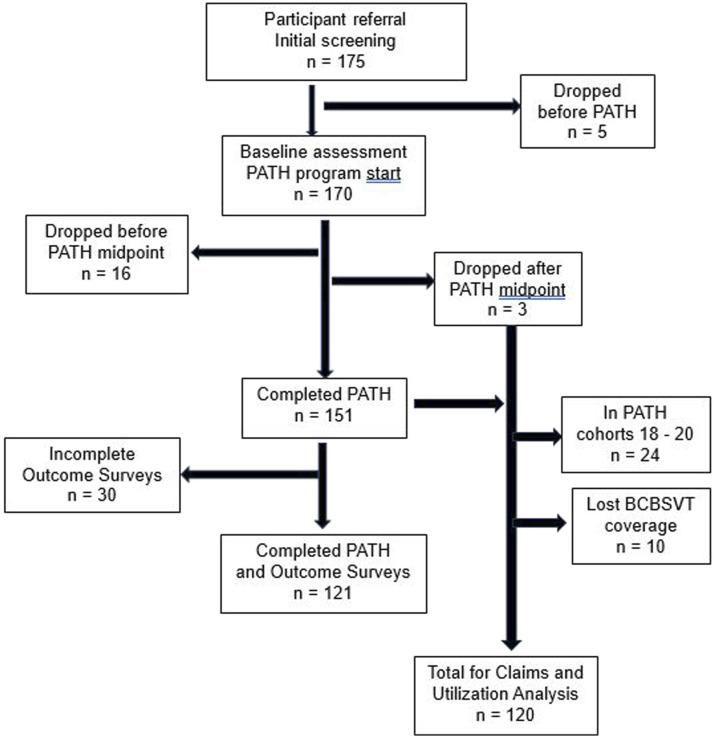
- From June 18, 2019 to August 18, 2022, 170 people enrolled; 151 completed the program, a completion rate of 88.8%. Of 175 referred and screened, 170 (97.7%) chose to begin PATH.
- Among 121 participants with outcome surveys, all patient-reported outcomes improved significantly from baseline to final assessment; some but not all were clinically significant.
- Total cost of care decreased by $462 per member per month, from $2529.92 PMPM to $2068.32 PMPM, an 18% decrease; medical costs fell 17%, prescription costs 23%, and musculoskeletal-coded costs 30%.
- Emergency room visits decreased by 457 visits/1000 patients (65%) for all diagnoses and by 194 visits/1000 patients (67%) for pain-related diagnoses during the observation period.
## Methods
- Pilot, single-arm feasibility evaluation of the PATH program at University Medical Center’s Comprehensive Pain Program clinic in Vermont, covering cohorts started on or after June 2019 and completed by August 2022.
- Participant-reported outcomes were measured with validated pre/post surveys, including PEG, PROMIS-29, Brief Resilience Scale, Self-Compassion Scale, Chronic Pain Acceptance Questionnaire-8, and Health Confidence Scale.
- Insurance claims data from BCBSVT were analyzed for the 12 months pre- and post-program among participants who completed at least half of PATH and had continuous BCBSVT coverage for at least 6 months before and after the program; paired t-tests with P < 0.05 assessed pre-post differences.
## Limitations
- The paper states this was a single-arm study, so it cannot make definitive statements about causality and findings should be replicated in a controlled study.
- The paper states long-term follow-up was limited: the intended 6-month post-intervention reassessment could not be done because resources were unavailable.
- Evident from the text: the sample was predominantly White, non-Hispanic (98%) and female (76%), which the authors say limits generalizability to the more diverse U.S. population.
Model-written summary. Check it against the paper before relying on it.
Integrity signals
Registry
Cites
Statistics
Figures
Verification
Claims the paper makes
20 Valid · 1 Not valid · 15 Not checked · 69 Own results and interpretations
At least one cited source doesn’t support this claim or points to a different paper, and none confirmed it — see the verdicts below.
In the paper
“It is established that non-Hispanic Black adults and Hispanic adults are more likely to experience chronic pain than non-Hispanic white adults, 31”
§ Overview and Feasibility of a Novel Transdisciplinary Integrative Approach to High Impact Chronic Pain in Vermont > Discussion > Limitations
What the sources say
- Disputedcites [31] Mullins P Yong R Bhattacharyya N. Impact of demographic factors on chronic pain among adults in the United States. Pain Rep. 2022; 7(4): e1009. doi: 10.1097/PR9.0000000000001009 38304396 PMC10833639 sourceExperimental — accuracy not yet measured
The Results and Discussion report the opposite for chronic pain overall: non-Hispanic White adults had the highest reported rate, and Hispanic and non-Hispanic Black adults had lower adjusted odds. The Introduction refers to earlier data about *severe* chronic pain, which does not support the unqualified claim about chronic pain. (LLM, conf=0.95)
Checked by a reasoning model — may be wrong.
boostedstates an association- Asserted: passes — The authors put it forward as true.
- Checkable: passes — It can be checked against evidence.
- Load-bearing: passes — The paper’s conclusions depend on it.
- Based: passes — The paper gives a reason why it holds.
- Disputed
Every source the paper cites for this claim was checked and supports it.
In the paper
“Studies indicate that those who are more resilient to pain adopt more adaptive coping strategies to pain. 23”
§ Overview and Feasibility of a Novel Transdisciplinary Integrative Approach to High Impact Chronic Pain in Vermont > Methodology > Patient Reported Outcomes
What the sources say
- Supportedcites [23] Sturgeon JA Zautra AJ. Resilience: a new paradigm for adaptation to chronic pain. Curr Pain Headache Rep. 2010; 14(2): 105- 112. doi: 10.1007/s11916-010-0095-9 20425199 PMC4899321 source
The Conclusions (page not supplied) state that people considered resilient to pain adopt more adaptive coping strategies. The Cognitive-Behavioral Aspects of Resilience to Pain section also reports better functioning in pain-coping strategies among a resilient group than a non-resilient group. (LLM, conf=0.94)
hedgedstates an association- Asserted: passes — The authors put it forward as true.
- Checkable: passes — It can be checked against evidence.
- Load-bearing: unclear — It is unclear whether the paper’s conclusions depend on it.
- Based: passes — The paper gives a reason why it holds.
- Supported
The cited sources support only part of this claim — read each source’s verdict below.
In the paper
“It has been validated for use in assessing impacts of health care interventions. 18”
§ Overview and Feasibility of a Novel Transdisciplinary Integrative Approach to High Impact Chronic Pain in Vermont > Methodology > Patient Reported Outcomes
What the sources say
- Partly supportedcites [18] Hays RD Spritzer KL Schalet BD Cella D. PROMIS®-29 v2.0 profile physical and mental health summary scores. Qual Life Res. 2018; 27(7): 1885- 1891. doi: 10.1007/s11136-018-1842-3 29569016 PMC5999556 sourceExperimental — accuracy not yet measured
The Abstract Conclusions provide preliminary evidence of the reliability and validity of the PROMIS-29 v2.0 physical and mental health summary scores and say they can be used in future studies to assess intervention impacts. They also recommend further evaluation; the paper does not establish that the PROMIS-29 has been validated specifically for measuring the impacts of health care interventions. (LLM, conf=0.86)
plain- Asserted: passes — The authors put it forward as true.
- Checkable: passes — It can be checked against evidence.
- Load-bearing: passes — The paper’s conclusions depend on it.
- Based: passes — The paper gives a reason why it holds.
- Partly supported
Every source the paper cites for this claim was checked and supports it.
In the paper
“The employment status, however, is not typical. In the US, 30.1% of those with HICP are employed 2 while 50% of the PATH participants are employed full-time, and 17% are employed part-time.”
§ Overview and Feasibility of a Novel Transdisciplinary Integrative Approach to High Impact Chronic Pain in Vermont > Discussion > Participant Demographics
What the sources say
- Supportedcites [2] Rikard SM Strahan AE Schmit KM Guy GP Jr. Chronic pain among adults — United States, 2019–2021. MMWR Morb Mortal Wkly Rep. 2023; 72: 379- 385. doi: 10.15585/mmwr.mm7215a1 37053114 PMC10121254 source
The employment-status table reports 5,088,000 employed adults with high-impact chronic pain out of 16,883,000 across its three employment categories—30.1%. The paper does not report PATH participants’ employment; the comparison with PATH is the citing authors’ own. (LLM, conf=0.92)
plain- Asserted: passes — The authors put it forward as true.
- Checkable: passes — It can be checked against evidence.
- Load-bearing: unclear — It is unclear whether the paper’s conclusions depend on it.
- Based: passes — The paper gives a reason why it holds.
- Supported
The cited sources support only part of this claim — read each source’s verdict below.
In the paper
“The PATH gender mix (76.4% female) is typical of an HICP population that uses integrative health.27,28”
§ Overview and Feasibility of a Novel Transdisciplinary Integrative Approach to High Impact Chronic Pain in Vermont > Discussion > Participant Demographics
What the sources say
- Not checked — no full text of the sourcecites [27] Zelaya CE Dahlhamer JM Lucas JW Connor EM. Chronic pain and high-impact chronic pain among U.S. adults, 2019. NCHS data brief. 2020; 390: 1- 8. 33151145
- Partly supportedcites [28] Zhang Y Leach MJ Hall H, et al. Differences between male and female consumers of complementary and alternative medicine in a national US population: a secondary analysis of 2012 NIHS data. Evid Based Complement Alternat Med. 2015; 2015: 413173. doi: 10.1155/2015/413173 25861360 PMC4377351 sourceExperimental — accuracy not yet measured
The Results and Discussion §4.1 report that women were the majority of CAM users in the 2012 US survey, supporting the general point that integrative-health users are more often female. But the paper reports nearly 60% female, not 76.4%, and does not establish that this proportion is typical of an HICP population. Page numbers were not available in our copy. (LLM, conf=0.86)
plainstates an association- Asserted: passes — The authors put it forward as true.
- Checkable: passes — It can be checked against evidence.
- Load-bearing: unclear — It is unclear whether the paper’s conclusions depend on it.
- Based: passes — The paper gives a reason why it holds.
44 more claims · 2 with their cited sources checked
Create a free account to see all 105 claims and to verify the 7 references still open.
- Probably not a substantial claim. 37
- It may state two separate claims as one. 31
Citations
Cites
The brief resilience scale: Assessing the ability to bounce back
Smith, B. W., Dalen, J., Wiggins, K., Tooley, E., Christopher, P., & Bernard, J. (2008) · International Journal of Behavioral Medicine · doi:10.1080/10705500802222972 · Cited by 6,439 · cited 1×
“19 Resilience is an important skill to develop for those living with high impact chronic pain.”
Bush, K. (1998) · Archives of Internal Medicine · doi:10.1001/archinte.158.16.1789 · Cited by 6,196
Qaseem, A., Wilt, T. J., McLean, R. M., Forciea, M. A., & for the Clinical Guidelines Committee of the American College of Physicians* (2017) · Annals of Internal Medicine · doi:10.7326/m16-2367 · Cited by 3,234
Construction and factorial validation of a short form of the Self-Compassion Scale
Raes, F., Pommier, E., Neff, K. D., & Van Gucht, D. (2011) · Clinical Psychology & Psychotherapy · doi:10.1002/cpp.702 · Cited by 2,997 · cited 1×
“20 Self-compassion is positively associated with pain acceptance, and use of pain coping strategies, and may be effective in reducing pain interference.”
CDC Guideline for Prescribing Opioids for Chronic Pain — United States, 2016
Dowell, D., Haegerich, T. M., & Chou, R. (2016) · MMWR. Recommendations and Reports · doi:10.15585/mmwr.rr6501e1 · Cited by 2,697
Prevalence of Chronic Pain and High-Impact Chronic Pain Among Adults — United States, 2016
Dahlhamer, J., Lucas, J., Zelaya, Nahin, R., Mackey, S., DeBar, L., Kerns, R., Von Korff, M., Porter, L., & Helmick, C. (2018) · MMWR. Morbidity and Mortality Weekly Report · doi:10.15585/mmwr.mm6736a2 · Cited by 2,598
Psychometric properties of the TSK-11: A shortened version of the Tampa Scale for Kinesiophobia
Woby, S. R., Roach, N. K., Urmston, M., & Watson, P. J. (2005) · Pain · doi:10.1016/j.pain.2005.05.029 · Cited by 923
Prevalence of chronic pain among adults in the United States
Yong, R. J., Mullins, P. M., & Bhattacharyya, N. (2022) · Pain · doi:10.1097/j.pain.0000000000002291 · Cited by 839
Krebs, E. E., Lorenz, K. A., Bair, M. J., Damush, T. M., Wu, J., Sutherland, J. M., Asch, S. M., & Kroenke, K. (2009) · Journal of General Internal Medicine · doi:10.1007/s11606-009-0981-1 · Cited by 782
PROMIS®-29 v2.0 profile physical and mental health summary scores
Hays, R. D., Spritzer, K. L., Schalet, B. D., & Cella, D. (2018) · Quality of Life Research · doi:10.1007/s11136-018-1842-3 · Cited by 684
Chronic Pain Among Adults — United States, 2019–2021
Rikard, S. M., Strahan, A. E., Schmit, K. M., & Guy, G. P. (2023) · MMWR. Morbidity and Mortality Weekly Report · doi:10.15585/mmwr.mm7215a1 · Cited by 588
Positive Affect as a Source of Resilience for Women in Chronic Pain.
Zautra, A. J., Johnson, L. M., & Davis, M. C. (2005) · Journal of Consulting and Clinical Psychology · doi:10.1037/0022-006x.73.2.212 · Cited by 567 · cited 1×
“24 The Self Compassion Scale - Short form, validated in general populations, measures self-compassion as well as the 6 second-order factors of self-kindness, self-judgment, common hu-manity, isolation, mindfulness and over-identi fi cation, and has been shown to be positively correlated with…”
Prevalence and Profile of High-Impact Chronic Pain in the United States
Pitcher, M. H., Von Korff, M., Bushnell, M. C., & Porter, L. (2019) · The Journal of Pain · doi:10.1016/j.jpain.2018.07.006 · Cited by 470
Resilience: A New Paradigm for Adaptation to Chronic Pain
Sturgeon, J. A., & Zautra, A. J. (2010) · Current Pain and Headache Reports · doi:10.1007/s11916-010-0095-9 · Cited by 417 · cited 1×
“23 and that failure of resilience may contribute to the development of chronic pain.”
No Shortcuts to Safer Opioid Prescribing
Dowell, D., Haegerich, T., & Chou, R. (2019) · New England Journal of Medicine · doi:10.1056/nejmp1904190 · Cited by 408
(2020) · PubMed · Cited by 332
Fish, R. A., McGuire, B., Hogan, M., Morrison, T. G., & Stewart, I. (2010) · Pain · doi:10.1016/j.pain.2009.12.016 · Cited by 306 · cited 1×
“25 The Chronic Pain Acceptance Questionnaire-8 (CPAQ-8), a validated 8 item measure of chronic pain acceptance 21 is a signi fi cant predictor of reliable change in depression, anxiety and disability in populations of patients with chronic pain, above that of pain intensity alone.”
Noninvasive Nonpharmacological Treatment for Chronic Pain: A Systematic Review Update
Skelly, A. C., Chou, R., Dettori, J. R., Turner, J. A., Friedly, J. L., Rundell, S. D., Fu, R., Brodt, E. D., Wasson, N., Kantner, S., et al. (2020) · doi:10.23970/ahrqepccer227 · Cited by 256
Bovin, M. J., Kimerling, R., Weathers, F. W., Prins, A., Marx, B. P., Post, E. P., & Schnurr, P. P. (2021) · JAMA Network Open · doi:10.1001/jamanetworkopen.2020.36733 · Cited by 144
Integration of complementary and alternative medicine in primary care: What do patients want?
Jong, M., van de Vijver, L., Busch, M., Fritsma, J., & Seldenrijk, R. (2012) · Patient Education and Counseling · doi:10.1016/j.pec.2012.08.013 · Cited by 115 · cited 2×
“The PROMIS-29 assesses multiple functional domains including physical function; fatigue; pain interference; depressive symptoms; anxiety; ability to participate in social roles and activities; and sleep disturbance.”
Medical Student Attitudes toward Complementary, Alternative and Integrative Medicine
Abbott, R. B., Hui, K.-K. P., Hays, R. D., Mandel, J., Goldstein, M., Winegarden, B., Glaser, D. N., & Brunton, L. L. (2011) · Evidence-based Complementary and Alternative Medicine · doi:10.1093/ecam/nep195 · Cited by 92 · cited 1×
“While we found studies that investigated preferences for users of integrative health care, 29 and some for medical students and doctors, 30 we did not fi nd any high-quality studies of non-users that explored factors that might be involved in not using integrative care.”
Zhang, Y., Leach, M. J., Hall, H., Sundberg, T., Ward, L., Sibbritt, D., & Adams, J. (2015) · Evidence-Based Complementary and Alternative Medicine · doi:10.1155/2015/413173 · Cited by 83 · cited 2×
“28 The higher prevalence of using integrative health by females relative to males suggests that there may be attitude and belief differences affecting the use of integrative health care by men.”
Kroenke, K., Krebs, E. E., Turk, D., Von Korff, M., Bair, M. J., Allen, K. D., Sandbrink, F., Cheville, A. L., DeBar, L., Lorenz, K. A., et al. (2019) · Pain Medicine · doi:10.1093/pm/pny279 · Cited by 60
The relation of self‐compassion to functioning among adults with chronic pain
Edwards, K. A., Pielech, M., Hickman, J., Ashworth, J., Sowden, G., & Vowles, K. E. (2019) · European Journal of Pain · doi:10.1002/ejp.1429 · Cited by 56 · cited 1×
“25 The Chronic Pain Acceptance Questionnaire-8 (CPAQ-8), a validated 8 item measure of chronic pain acceptance 21 is a signi fi cant predictor of reliable change in depression, anxiety and disability in populations of patients with chronic pain, above that of pain intensity alone.”
Kim, S., Lee, J., & Boone, D. (2022) · Journal of Pain Research · doi:10.2147/jpr.s340382 · Cited by 26
Dyer, N. L., Surdam, J., & Dusek, J. A. (2022) · Pain Medicine · doi:10.1093/pm/pnab151 · Cited by 23 · cited 1×
“9,10 In response to this need, the University of Vermont Medical Center established the Comprehensive Pain Program (CPP) to improve treatment options for people struggling with chronic pain.”
Impact of demographic factors on chronic pain among adults in the United States
Mullins, P. M., Yong, R. J., & Bhattacharyya, N. (2022) · PAIN Reports · doi:10.1097/pr9.0000000000001009 · Cited by 20 · cited 2×
“31 We (cid:1) 8.40 0.001 PEG life enjoyment 103 (cid:1) 9.45 0.001 PEG general activity interference 103 did not evaluate these relationships as part of this pilot feasibility study, and should be included in future evaluations.”
InfluentialBaranoff, J., Hanrahan, S. J., Kapur, D., & Connor, J. P. (2014) · Journal of Behavioral Medicine · doi:10.1007/s10865-013-9502-0 · Cited by 13 · cited 1×
“26 The Health Con fi dence Scale is a simple and validated tool used often in primary care settings.”
(2014) · PubMed
Cited by
Talbot, J. A., Jewell, C., Holston, B., Plavin, J., Rose, G. L., & Ziller, E. C. (2025) · The Journal of Rural Health · doi:10.1111/jrh.70058 · Cited by 6
Self-citationRural-Urban Differences in the Prevalence of Chronic Pain Among Adult Cancer Survivors
Choi, H., Hallgren, E., Reblin, M., et al. (2025) · JAMA Network Open · doi:10.1001/jamanetworkopen.2025.49972 · Cited by 2
Self-citationImplementation of Evidence-Based Integrative Health Approaches—A Call to Action
Plavin, J., Quanbeck, A., Cherkin, D. C., & Grover, K. W. (2025) · Journal of Integrative and Complementary Medicine · doi:10.1089/jicm.2025.0074
Self-citationHealth and Wellness Coaching in Clinical Care: A Call to Action
Whitman, S. T. K., Westervelt, K., Weinand, R., Sibold, J., Thompson, T. L., O’Farrell, K. D., & Wolever, R. Q. (2025) · Journal of Integrative and Complementary Medicine · doi:10.1177/27683605251392361
Metadata
- Authors
- Plavin, J., Landau, J., Rose, G. L., Ziller, E., Nowak, S., Finley, H., Audy, L., & Porter, J.
- Affiliations
- University of Vermont Medical Center (US)
- University of Vermont (US)
- Corresponding author
- Plavin, Joshua
- Venue
- Global Advances in Integrative Medicine and Health
- Publisher
- SAGE Publications
- Published
- 2024-01
- Volume
- 13
- Pages
- 27536130241271643-27536130241271643
- ISSN
- 2753-6130 (ISSN-L)
- PMC
- PMC11363026
- OpenAlex
- W4402020199
- Semantic Scholar
- baa71d1f6997203658e49446c9061d3f1805946f
- Cited by
- 4
- References
- 29
- Citations by year
- 2025: 4
- FWCI
- 1.13
- Type
- journal article
- Language
- en
- Open access
- hybrid
- doi.org
- Licence
- Locations
- Global Advances in Integrative Medicine and Health (publishedVersion, cc-by-nc)
- PubMed Central (publishedVersion, cc-by-nc)
- PubMed (publishedVersion)
- Funders
- UVM
- University of Vermont Health Network
- Larner College of Medicine
- Topics
- Health Sciences › Health Professions › Physical Therapy, Sports Therapy and Rehabilitation › Musculoskeletal pain and rehabilitation
- Health Sciences › Medicine › Epidemiology › Chronic Disease Management Strategies
- Health Sciences › Medicine › Anesthesiology and Pain Medicine › Pain Management and Treatment
- Keywords
- chronic pain, integrative medicine, transdisciplinary care, PATH program, bundled payment, patient-reported outcomes, PROMIS-29, pain interference, cost of care, emergency department utilization, feasibility, Vermont
About these checks
Registry, retraction, Cites and statistics results are computed, not judged, with one exception: a printed reference that no index lists is read once by a model before it counts as a citation error. Claims are extracted by a model and kept only when their quote appears verbatim in the text; each cited source is then checked, with a model’s help, for whether it says what the claim relies on. Those verdicts can be wrong — read the claim’s quote and the cited source before relying on one.
The claim verdicts this report counts are experimental: their accuracy is not yet measured.
A language model drew the claims from the paper on 2026-10-11, under version 3 of the claim definition (model deepseek-v4.1-flash, prompt extract-v3).
A second model labelled each claim on 2026-10-11 (model jev-1.13-20260917, definition revision gold-guideline-v0.2).
Cited sources are checked with a language model’s help (gpt-6-sol).
Statistics and arithmetic are recomputed, not judged.
Confidence bands are shown only for fields calibrated on our annotated test set. None is calibrated yet, so no band is shown.
What counts as a claim ›How we measure confidence ›How we check this ›
Are you an author, or do you see a problem with this page? Request a review
Data sources
Bibliographic data: Semantic Scholar, OpenAlex, Crossref.
Contains information from the Semantic Scholar Academic Graph Datasets, made available under the ODC Attribution License (ODC-BY 1.0).
Semantic Scholar’s data is described in: Kinney, R., et al. (2023). The Semantic Scholar Open Data Platform. arXiv:2301.10140.
