

Mode of action of nintedanib in the treatment of idiopathic pulmonary fibrosis
Open accessThe DOI matches its Crossref record; 90 of the 90 references it cites were found in a registry or an index.
Abstract
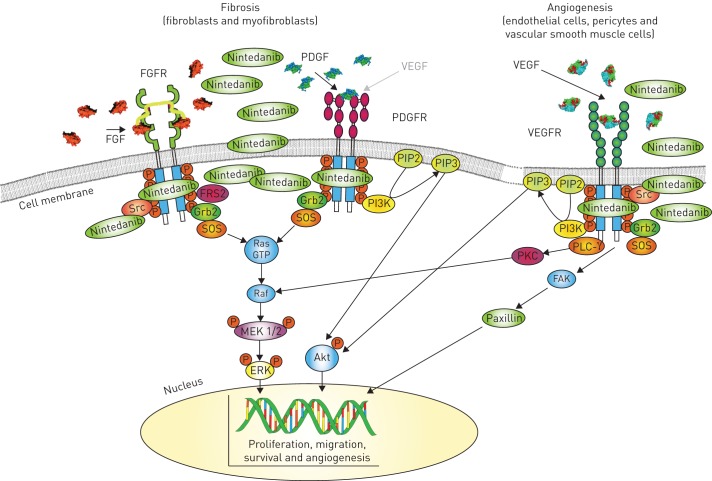
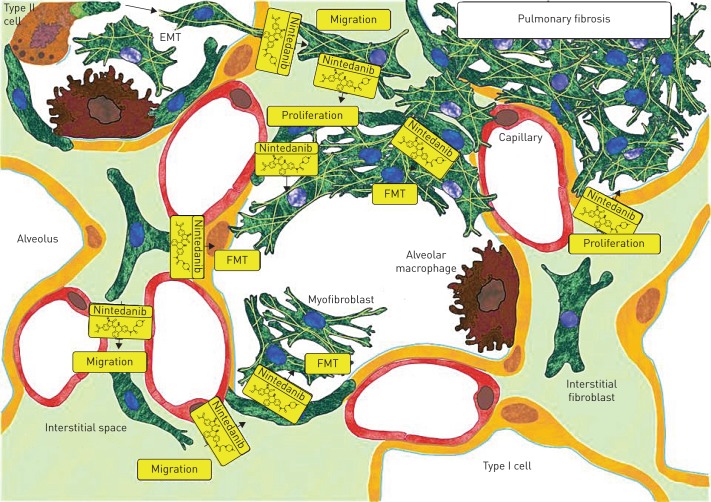
Idiopathic pulmonary fibrosis (IPF) is a progressive and ultimately fatal disease characterised by fibrosis of the lung parenchyma and loss of lung function. Although the pathogenic pathways involved in IPF have not been fully elucidated, IPF is believed to be caused by repetitive alveolar epithelial cell injury and dysregulated repair, in which there is uncontrolled proliferation of lung fibroblasts and differentiation of fibroblasts into myofibroblasts, which excessively deposit extracellular matrix (ECM) proteins in the interstitial space. A number of profibrotic mediators including platelet-derived growth factor (PDGF), fibroblast growth factor (FGF) and transforming growth factor-β are believed to play important roles in the pathogenesis of IPF. Nintedanib is a potent small molecule inhibitor of the receptor tyrosine kinases PDGF receptor, FGF receptor and vascular endothelial growth factor receptor. Data from in vitro studies have shown that nintedanib interferes with processes active in fibrosis such as fibroblast proliferation, migration and differentiation, and the secretion of ECM. In addition, nintedanib has shown consistent anti-fibrotic and anti-inflammatory activity in animal models of lung fibrosis. These data provide a strong rationale for the clinical efficacy of nintedanib in patients with IPF, which has recently been demonstrated in phase III clinical trials.
Overview
The claims and statistics of this paper haven’t been checked yet.
Free: it reads the open-access text and checks the first 5 claims that cite a source we can check. Create a free account to check every claim.
Integrity signals
Registry
Cites
Statistics
Figures
Verification
Claims the paper makes
The claims and statistics of this paper haven’t been checked yet.
Free: it reads the open-access text and checks the first 5 claims that cite a source we can check. Create a free account to check every claim.
Claims other papers make about this one
Each is checked against this paper’s own text: does it say what the citing paper says it does?
The source backs part of the claim, not all of it — or backs it for a different population, condition or comparison.
In the citing paper
“Nintedanib has inhibitory effects on platelet-derived growth factor receptors α/β (PDGFα/β), vascular endothelial growth factor (VEGF) receptors 1, 2 and 3, and fibroblast growth factor (FGF) receptor 1, 2, and 3, as well as potentiation of Src homology region 2 domain containing phosphatase 1 (SHP-1) [19,20].”
From Emerging pharmacological options in the treatment of idiopathic pulmonary fibrosis (IPF) (2024) · cites this paper as [19]
Experimental — accuracy not yet measuredThe source backs part of the claim, not all of it — or backs it for a different population, condition or comparison.
In the citing paper
“These observations indicate that the Pdgf pathway is crucial to disease pathogenesis.”
From Reference-based analysis of lung single-cell sequencing reveals a transitional profibrotic macrophage (2019) · cites this paper as [41]
Experimental — accuracy not yet measuredThe cited source says what the claim attributes to it.
In the citing paper
“In two phase 3 trials with patients suffering from interstitial lung disease, nintedanib profoundly lowered the decline in forced vital capacity (195, 198).”
From Unraveling SSc Pathophysiology; The Myofibroblast (2018) · cites this paper as [195]
The cited source says what the claim attributes to it.
In the citing paper
“The current standard-of-care (SOC) therapy regimen to treat IPF includes either nintedanib, a broadly acting inhibitor of receptor tyrosine kinases31, or pirfenidone, an inhibitor of TGFβ-mediated fibroblast-to-myofibroblast transition32.”
From A generative AI-discovered TNIK inhibitor for idiopathic pulmonary fibrosis: a randomized phase 2a trial (2025) · cites this paper as [31]
In the citing paper
“In vivo, nintedanib protects mice and rats against bleomycin-induced lung fibrosis (195, 196), and lowers the amount of lymphocytes and neutrophils but not macrophages in bronchoalveolar lavage liquid in this model.”
From Unraveling SSc Pathophysiology; The Myofibroblast (2018) · cites this paper as [195]
1 more claim about this paper
Create a free account to see every claim other papers make about this one.
Self-check
Percentages, sums and reported differences re-computed from the paper’s own numbers.
The self-check needs the paper’s full text.
Citations
Cites
The biology of VEGF and its receptors
Ferrara, N., Gerber, H.-P., & LeCouter, J. (2003) · Nature Medicine · doi:10.1038/nm0603-669 · Cited by 9,591
Raghu, G., Collard, H. R., Egan, J. J., Martinez, F. J., Behr, J., Brown, K. K., Colby, T. V., Cordier, J.-F., Flaherty, K. R., Lasky, J. A., et al. (2011) · American Journal of Respiratory and Critical Care Medicine · doi:10.1164/rccm.2009-040gl · Cited by 7,186
Efficacy and Safety of Nintedanib in Idiopathic Pulmonary Fibrosis
Richeldi, L., du Bois, R. M., Raghu, G., Azuma, A., Brown, K. K., Costabel, U., Cottin, V., Flaherty, K. R., Hansell, D. M., Inoue, Y., et al. (2014) · New England Journal of Medicine · doi:10.1056/nejmoa1402584 · Cited by 4,654
Self-citation(2002) · American Journal of Respiratory and Critical Care Medicine · doi:10.1164/ajrccm.165.2.ats01 · Cited by 4,196
A phase 3 trial of pirfenidone in patients with idiopathic pulmonary fibrosis.
King, T. E., Bradford, W. Z., Castro-Bernardini, S., Fagan, E. A., Glaspole, I., Glassberg, M. K., Gorina, E., Hopkins, P. M., Kardatzke, D., Lancaster, L., et al. (2014) · New England Journal of Medicine · doi:10.1056/nejmoa1402582 · Cited by 3,975
King, T. E., Pardo, A., & Selman, M. (2011) · The Lancet · doi:10.1016/s0140-6736(11)60052-4 · Cited by 2,194
Pirfenidone in patients with idiopathic pulmonary fibrosis (CAPACITY): two randomised trials
Noble, P. W., Albera, C., Bradford, W. Z., Costabel, U., Glassberg, M. K., Kardatzke, D., King, T. E., Lancaster, L., Sahn, S. A., Szwarcberg, J., et al. (2011) · The Lancet · doi:10.1016/s0140-6736(11)60405-4 · Cited by 2,154
Selman, M., King, T. E., & Pardo, A. (2001) · Annals of Internal Medicine · doi:10.7326/0003-4819-134-2-200101160-00015 · Cited by 1,786
Signal transduction by vascular endothelial growth factor receptors
Koch, S., Tugues, S., Li, X., Gualandi, L., & Claesson-Welsh, L. (2011) · Biochemical Journal · doi:10.1042/bj20110301 · Cited by 1,635
Idiopathic Pulmonary Fibrosis: Clinical Relevance of Pathologic Classification
KATZENSTEIN, A.-L. A., & MYERS, J. L. (1998) · American Journal of Respiratory and Critical Care Medicine · doi:10.1164/ajrccm.157.4.9707039 · Cited by 1,261
Cited by
Items 101–200 of 1,001
Rivera‐Ortega, P., Hayton, C., Blaikley, J., Leonard, C. T., & Chaudhuri, N. (2018) · Therapeutic Advances in Respiratory Disease · doi:10.1177/1753466618800618 · Cited by 90
Lung Fibrosis and Fibrosis in the Lungs: Is It All about Myofibroblasts?
Zapater, E. O., Signes‐Costa, J., Montero, P., & Roger, I. (2022) · Biomedicines · doi:10.3390/biomedicines10061423 · Cited by 95
Regulatory Immune Cells in Idiopathic Pulmonary Fibrosis: Friends or Foes?
van Geffen, C., Deißler, A., Quante, M., Renz, H. E., Hartl, D., & Kolahian, S. (2021) · Frontiers in Immunology · doi:10.3389/fimmu.2021.663203 · Cited by 88
Emerging drug delivery strategies for idiopathic pulmonary fibrosis treatment
Ghumman, M., Dhamecha, D., Gonsalves, A., Fortier, L., Sorkhdini, P., Zhou, Y., & Menon, J. U. (2021) · European Journal of Pharmaceutics and Biopharmaceutics · doi:10.1016/j.ejpb.2021.03.017 · Cited by 79
Efficacy and safety of nintedanib in advanced idiopathic pulmonary fibrosis
Yoon, H.-Y., Park, S., Kim, D. S., & Song, J. W. (2018) · Respiratory Research · doi:10.1186/s12931-018-0907-8 · Cited by 78
Gad, E. S., Salama, A., Elshafie, M. F., Arafa, H. M. M., Abdelsalam, R. M., & Khattab, M. M. (2019) · Inflammation · doi:10.1007/s10753-019-01101-2 · Cited by 80
IL-13 and idiopathic pulmonary fibrosis: Possible links and new therapeutic strategies
Passalacqua, G., Mincarini, M., Colombo, D., Troisi, G., Ferrari, M., Bagnasco, D., Balbi, F., Riccio, A., & Canonica, G. W. (2017) · Pulmonary Pharmacology & Therapeutics · doi:10.1016/j.pupt.2017.05.007 · Cited by 88
Audousset, C., McGovern, T. K., & Martin, J. G. (2021) · Frontiers in Physiology · doi:10.3389/fphys.2021.727806 · Cited by 87
“, 2002) in the expansion of pulmonary fibrosis and the pre-clinical development of nintedanib (Wollin et al., 2015).”
BackgroundGiacomelli, C., Piccarducci, R., Marchetti, L., Romei, C., & Martini, C. (2021) · Biochemical Pharmacology · doi:10.1016/j.bcp.2021.114812 · Cited by 85
“trials, explaining why the research has begun to explore a multi-target therapeutic strategy [114].”
Parker, A. L., Bowman, E. D., Zingone, A., Ryan, B. M., Cooper, W. A., Kohonen‐Corish, M. R. J., Harris, C. C., & Cox, T. R. (2022) · Genome Medicine · doi:10.1186/s13073-022-01127-6 · Cited by 81
“fibrosis Fibrogenic signaling through these tyrosine kinase receptors is known to play a role in the progression of idiopathic pulmonary fibrosis [119], a chronic, degenerative lung condition characterized by extensive ECM remodeling that typically presents at older age and is associated with increased risk of develop…”
Nintedanib in the treatment of idiopathic pulmonary fibrosis
Mazzei, M. E., Richeldi, L., & Collard, H. R. (2015) · Therapeutic Advances in Respiratory Disease · doi:10.1177/1753465815579365 · Cited by 74
“By so doing, nintedanib interferes with processes active in fibrosis such as fibroblast proliferation, migration and differentiation and the secretion of extracellular matrix [Hostettler et al. 2014; Wollin et al. 2015].”
BackgroundDiscovery of a new class of integrin antibodies for fibrosis
Zhang, J., Wang, T., Saigal, A., Johnson, J., Morrisson, J., Tabrizifard, S., Hollingsworth, S. A., Eddins, M. J., Mao, W., O’Neill, K., et al. (2021) · Scientific Reports · doi:10.1038/s41598-021-81253-0 · Cited by 78
“49 Wollin, L. et al. Mode of action of nintedanib in the treatment of idiopathic pulmonary fibrosis. Eur Respir J 45, 1434-1445, doi:10.1183/09031936.00174914 (2015). 50 Henderson, N.”
InfluentialAnti-fibrotic Effects of CXCR4-Targeting i-body AD-114 in Preclinical Models of Pulmonary Fibrosis
Griffiths, K. R., Habiel, D. M., Jaffar, J., Binder, U., Darby, W. G., Hosking, C. G., Skerra, A., Westall, G. P., Hogaboam, C. M., & Foley, M. (2018) · Scientific Reports · doi:10.1038/s41598-018-20811-5 · Cited by 78
The Management of Patients With Idiopathic Pulmonary Fibrosis
Spagnolo, P., Tzouvelekis, A., & Bonella, F. (2018) · Frontiers in Medicine · doi:10.3389/fmed.2018.00148 · Cited by 72
“By inhibiting VEGFR, FGFR, and PDGFR, nintedanib interferes with a number of processes that have been implicated in the pathogenesis of IPF, namely proliferation and migration of primary human lung fibroblasts, fibroblast to myofibroblast transformation, and TGFβ-stimulated secretion and deposition of collagen by prim…”
BackgroundKato, R., Haratani, K., Hayashi, H., Sakai, K., Sakai, H., Kawakami, H., Tanaka, K., Takeda, M., Yonesaka, K., Nishio, K., et al. (2020) · British Journal of Cancer · doi:10.1038/s41416-020-01201-z · Cited by 75
Alteration of human macrophage phenotypes by the anti-fibrotic drug nintedanib
Bellamri, N., Morzadec, C., Joannes, A., Lecureur, V., Wollin, L., Jouneau, S., & Vernhet, L. (2019) · International Immunopharmacology · doi:10.1016/j.intimp.2019.03.061 · Cited by 74
Self-citationCellular Senescence in Idiopathic Pulmonary Fibrosis
Kellogg, D. L., Kellogg, D. L., Musi, N., & Nambiar, A. M. (2021) · Current Molecular Biology Reports · doi:10.1007/s40610-021-00145-4 · Cited by 67
Role of fibroblast growth factor 23 and klotho cross talk in idiopathic pulmonary fibrosis
Barnes, J. W., Duncan, D., Helton, S., Hutcheson, S. B., Kurundkar, D., Logsdon, N. J., Locy, M. L., Garth, J. M., Denson, R. S., Farver, C. F., et al. (2019) · American Journal of Physiology-Lung Cellular and Molecular Physiology · doi:10.1152/ajplung.00246.2018 · Cited by 72
Campochiaro, C., & Allanore, Y. (2021) · Arthritis Research & Therapy · doi:10.1186/s13075-021-02536-5 · Cited by 76
“Nintedanib is a multi-tyrosine kinase inhibitor which blocks FGF receptor-1, VEGF receptor-2 and PDGF receptor-α and β [52].”
BackgroundDelanote, I., Wuyts, W. A., Yserbyt, J., Verbeken, E. K., Verleden, G. M., & Vos, R. (2016) · BMC Pulmonary Medicine · doi:10.1186/s12890-016-0308-z · Cited by 65
“Nintedanib is a tyrosine kinase inhibitor, which blocks receptors for platelet-derived growth factor (PDGF), fibroblast growth factor (FGF), and vascular endothelial growth factor (VEGF), thus inhibiting downstream signaling in (myo-)fibroblasts [10].”
BackgroundFibrotic Idiopathic Interstitial Lung Disease: The Molecular and Cellular Key Players
Samarelli, A. V., Tonelli, R., Marchioni, A., Bruzzi, G., Gozzi, F., Andrisani, D., Castaniere, I., Manicardi, L., Moretti, A., Tabbì, L., et al. (2021) · International Journal of Molecular Sciences · doi:10.3390/ijms22168952 · Cited by 72
“Nintedanib is a synthetic compound acting as an inhibitor of tyrosine kinase receptors VEGFR1-3, FRGFR1-3 and PDGFRa-b involved in the proliferation and migration of lung fibroblasts as well as the differentiation of the key mechanisms of fibroblasts and myofibroblasts in IPF pathogenesis [90].”
BackgroundManagement of Idiopathic Pulmonary Fibrosis
Pleasants, R., & Tighe, R. M. (2019) · Annals of Pharmacotherapy · doi:10.1177/1060028019862497 · Cited by 63
“Nintedanib interferes with fibroblast proliferation, migration, and differentiation and the secretion of extracellular matrix components in the lung and has demonstrated antifibrotic and anti-inflammatory properties in animal models of lung fibrosis.(35) The mechanism of action of pirfenidone in IPF is not fully under…”
BackgroundTargeting GPCR Signaling for Idiopathic Pulmonary Fibrosis Therapies
Haak, A. J., Ducharme, M. T., Diaz Espinosa, A. M., & Tschumperlin, D. J. (2020) · Trends in Pharmacological Sciences · doi:10.1016/j.tips.2019.12.008 · Cited by 65
“Nintedanib acts as an ATP-competitive inhibitor of fibroblast growth factor receptor (FGFR)-1, vascular endothelial growth factor receptor (VEGFR)-2, platelet-derived growth factor receptors (PDGFRs), Flt-3 and members of the Src-family, such as Src, Lyn and Lck [83],[84].”
BackgroundTargeting Histone Deacetylases in Idiopathic Pulmonary Fibrosis: A Future Therapeutic Option
Korfei, M., Mahavadi, P., & Guenther, A. (2022) · Cells · doi:10.3390/cells11101626 · Cited by 72
“Nintedanib can block activation of platelet-derived growth factor receptor (PDGFR), fibroblast growth factor receptor (FGFR), vascular endothelial growth factor receptor (VEGFR) and Src family kinases involved in fibroblast proliferation, migration, and transformation [93].”
BackgroundInterstitial Lung Disease in Rheumatoid Arthritis: A Practical Review
Laria, A., Lurati, A. M., Zizzo, G., Zaccara, E., Mazzocchi, D., Re, K. A., Marrazza, M., Faggioli, P. M., & Mazzone, A. (2022) · Frontiers in Medicine · doi:10.3389/fmed.2022.837133 · Cited by 78
“Nintedanib is a small-molecule inhibitor of the tyrosine kinase receptors of platelet-derived growth factor (PDGFR) α and ß, fibroblast growth factor (FGFR) 1-3, and VEGFR 1-3; it also inhibits lymphocyte-specific protein tyrosine kinase, Lyn protein tyrosine kinase, proto-oncogenic protein tyrosine kinase Src, and co…”
BackgroundKhanna, D., Tashkin, D. P., Denton, C. P., Lubell, M., Vazquez‐Mateo, C., & Wax, S. D. (2018) · Rheumatology · doi:10.1093/rheumatology/key151 · Cited by 67
Behr, J., Kolb, M. R. J., Song, J. W., Luppi, F., Schinzel, B., Stowasser, S., Quaresma, M., & Martínez, F. J. (2019) · American Journal of Respiratory and Critical Care Medicine · doi:10.1164/rccm.201903-0488oc · Cited by 64
“Nintedanib, an intracellular inhibitor of tyrosine kinases (7), is an approved treatment for IPF.”
BackgroundSelf-citationCottin, V., Crestani, B., Cadranel, J. L., Cordier, J. F., Marchand-Adam, S., Prévot, G., Wallaert, B., Bergot, E., Camus, P., Dalphin, J., et al. (2017) · Revue des Maladies Respiratoires · doi:10.1016/j.rmr.2017.07.017 · Cited by 69
The multifaceted roles of perlecan in fibrosis
Lord, M. S., Tang, F., Rnjak‐Kovacina, J., Smith, J. G. W., Melrose, J., & Whitelock, J. M. (2018) · Matrix Biology · doi:10.1016/j.matbio.2018.02.013 · Cited by 69
Li, L., Kao, K., Liu, Y.-Y., Lin, C., Chen, N., Lee, C.-S., Wang, C., & Yang, C. (2017) · Journal of Cellular and Molecular Medicine · doi:10.1111/jcmm.13206 · Cited by 71
“It also inhibits TGF-b1-induced fibroblast to myofibroblast differentiation and hinders non-receptor tyrosine kinases of the Src family in bleomycin murine lung fibrosis models [15, 22, 40].”
BackgroundGabasa, M., Ikemori, R., Hilberg, F., Reguart, N., & Alcaraz, J. (2017) · British Journal of Cancer · doi:10.1038/bjc.2017.270 · Cited by 65
“In contrast, it is currently unclear whether nintedanib induces vacuolar structures or autophagy in lung cancer cells (Wollin et al, 2015; Shochet et al, 2016), although autophagy has been reported in different cancer types in response to other tyrosine kinase inhibitors (Han et al, 2011; Rikiishi,…”
BackgroundInfluentialJiang, Q., Liu, C., Liu, S., Lu, W., Li, Y., Luo, X., Ma, R., Zhang, C., Chen, H., Chen, Y., et al. (2020) · British Journal of Pharmacology · doi:10.1111/bph.15285 · Cited by 62
“Bleomycin is a very commonly used stimulator to induce PF in rodents (Wollin et al., 2015).”
BackgroundPamrevlumab for the treatment of idiopathic pulmonary fibrosis
Sgalla, G., Franciosa, C., Simonetti, J., & Richeldi, L. (2020) · Expert Opinion on Investigational Drugs · doi:10.1080/13543784.2020.1773790 · Cited by 59
Korfei, M., Stelmaszek, D., MacKenzie, B., Skwarna, S., Chillappagari, S., Bach, A., Ruppert, C., Saito, S., Mahavadi, P., Klepetko, W., et al. (2018) · PLoS ONE · doi:10.1371/journal.pone.0207915 · Cited by 64
Outcome of lung transplantation in idiopathic pulmonary fibrosis with previous anti-fibrotic therapy
Leuschner, G., Stocker, F., Veit, T., Kneidinger, N., Winter, H., Schramm, R., Weig, T., Matthes, S., Ceelen, F., Arnold, P., et al. (2018) · The Journal of Heart and Lung Transplantation · doi:10.1016/j.healun.2017.07.002 · Cited by 59
Fibrotic phenotype of IgG4-related disease
Lanzillotta, M., Culver, E. L., Sharma, A., Zen, Y., Zhang, W., Stone, J. H., & Della‐Torre, E. (2024) · The Lancet Rheumatology · doi:10.1016/s2665-9913(23)00299-0 · Cited by 69
Pulmonary toxicants and fibrosis: innate and adaptive immune mechanisms
Malaviya, R., Kipen, H. M., Businaro, R., Laskin, J. D., & Laskin, D. L. (2020) · Toxicology and Applied Pharmacology · doi:10.1016/j.taap.2020.115272 · Cited by 59
The Role of Immune Cells in the Pathogenesis of Idiopathic Pulmonary Fibrosis
Xu, Y., Lan, P., & Wang, T. (2023) · Medicina · doi:10.3390/medicina59111984 · Cited by 68
“It has been shown that TGF-β is a major contributor to tissue repair through the promotion of ECM deposition, fibroblast to myofibroblast differentiation and the epithelial–mesenchymal transition (EMT) [29].”
BackgroundHoffmann-Vold, A.-M., Weigt, S. S., Saggar, R., Palchevskiy, V., Volkmann, E. R., Liang, L. L., Ross, D., Ardehali, A., Lynch, J. P., & Belperio, J. A. (2019) · EBioMedicine · doi:10.1016/j.ebiom.2019.10.050 · Cited by 58
“In vitro and in vivo tudies have suggested that all of these pathways are involved in LD pathobiology via inflammation/cell activation, fibroplasia and ascular remodelling [15 , 16] .”
BackgroundNintedanib induces senolytic effect via STAT3 inhibition
Cho, H.-J., Hwang, J.-A., Yang, E. J., Kim, E.-C., Kim, J., Kim, S. Y., Kim, Y. Z., Park, S. C., & Lee, Y. (2022) · Cell Death and Disease · doi:10.1038/s41419-022-05207-8 · Cited by 65
“In particular, previous studies have shown that nintedanib modulates STAT3 activity, resulting in the apoptosis of triple-negative breast cancer cells [19] as well as ameliorates IPF by inhibiting the JAK2/STAT3 pathway [44].”
BackgroundInfluentialHermansky–Pudlak syndrome pulmonary fibrosis: a rare inherited interstitial lung disease
Yokoyama, T., & Gochuico, B. R. (2021) · European Respiratory Review · doi:10.1183/16000617.0193-2020 · Cited by 60
The role of autophagy in idiopathic pulmonary fibrosis: from mechanisms to therapies
Yue, Y.-L., Zhang, M., Liu, J., Fang, L., & Qu, Y.-Q. (2022) · Therapeutic Advances in Respiratory Disease · doi:10.1177/17534666221140972 · Cited by 67
Magdy, G., El‐Deen, A. K., Radwan, A. S., Belal, F. F., & Elmansi, H. (2025) · Talanta Open · doi:10.1016/j.talo.2025.100423 · Cited by 55
Idiopathic pulmonary fibrosis: current treatment options and critical appraisal of nintedanib
Wollin, S. L., Bonella, F., & Stowasser, S. (2015) · Drug Design Development and Therapy · doi:10.2147/dddt.s76648 · Cited by 72
“However, the exact contribution of inhibition of specific kinases to the activity of nintedanib in IPF has not been established.(52) D ru g D es ig n, D ev el op m en t a nd T he ra py d ow nl oa de d fr om h ttp s: //w w w .”
Self-citationJo, H. E., Troy, L. K., Keir, G. J., Chambers, D. C., Holland, A. E., Goh, N. S. L., WILSHER, M. L., de Boer, S., Moodley, Y. P., Grainge, C., et al. (2017) · Respirology · doi:10.1111/resp.13146 · Cited by 61
Statin Therapy and Outcomes in Trials of Nintedanib in Idiopathic Pulmonary Fibrosis
Kreuter, M., Costabel, U., Richeldi, L., Cottin, V., Wijsenbeek, M. S., Bonella, F., Bendstrup, E. M., Maher, T. M., Wachtlin, D., Stowasser, S., et al. (2018) · Respiration · doi:10.1159/000486286 · Cited by 61
Self-citationProgressive fibrosing interstitial lung disease associated with systemic autoimmune diseases
Fischer, A., & Distler, J. H. W. (2019) · Clinical Rheumatology · doi:10.1007/s10067-019-04720-0 · Cited by 63
Idiopathic Pulmonary Fibrosis and Post-COVID-19 Lung Fibrosis: Links and Risks
Patrucco, F., Solidoro, P., Gavelli, F., Apostolo, D., & Bellan, M. (2023) · Microorganisms · doi:10.3390/microorganisms11040895 · Cited by 64
“This activity reduces the proliferation, migration, and differentiation of myofibroblasts and then the deposition of extracellular matrix [77].”
What have we learned from basic science studies on idiopathic pulmonary fibrosis?
Yanagihara, T., Sato, S., Upagupta, C., & Kolb, M. (2019) · European Respiratory Review · doi:10.1183/16000617.0029-2019 · Cited by 53
Self-citationCottin, V., Martinez, F. J., Jenkins, R. G., Belperio, J. A., Kitamura, H., Molina-Molina, M., Tschoepe, I., Coeck, C., Lievens, D., & Costabel, U. (2022) · Respiratory Research · doi:10.1186/s12931-022-01974-2 · Cited by 53
“Based on the mechanism of action of nintedanib [5] and its known adverse event profile in patients with IPF [7], we present data on diarrhea, liver enzyme and bilirubin elevations, bleeding, and cardiovascular adverse events.”
BackgroundLung-kidney interactions and their role in chronic kidney disease-associated pulmonary diseases
Bollenbecker, S., Czaya, B. A., Gutiérrez, O. M., & Krick, S. (2022) · American Journal of Physiology-Lung Cellular and Molecular Physiology · doi:10.1152/ajplung.00152.2021 · Cited by 67
Targeting Macrophages as a Therapeutic Option in Coronavirus Disease 2019
Gracia-Hernandez, M., Sotomayor, E. M., & Villagra, A. (2020) · Frontiers in Pharmacology · doi:10.3389/fphar.2020.577571 · Cited by 56
“These compounds impair fibroblast proliferation and migration, myofibroblast differentiation, collagen fibril assembly, and signaling through PDGFR, FGFR, and VEGFR (Wollin et al., 2015; Knüppel et al., 2017; Kurita et al., 2017).”
BackgroundMolecular Dissection of Pro-Fibrotic IL11 Signaling in Cardiac and Pulmonary Fibroblasts
Widjaja, A. A., Viswanathan, S., Jinrui, D., Singh, B. K., Tan, J., Wei Ting, J. G., Lamb, D., Shekeran, S. G., George, B. L., Schafer, S., et al. (2021) · Frontiers in Molecular Biosciences · doi:10.3389/fmolb.2021.740650 · Cited by 53
“Nintedanib, a tyrosine kinase inhibitor, is not known to cause ER stress and while the concentration we used (2 μM) is similar to that commonly applied (Wollin et al., 2015), we probed matters further using a dose-response (nintedanib: 16 μM-7.”
MethodNambiar, S., Tan, D. B. A., Clynick, B., Bong, S.-H., Rawlinson, C., Gummer, J. P. A., Corte, T. J., Glaspole, I., Moodley, Y. P., & Trengove, R. D. (2021) · PROTEOMICS - CLINICAL APPLICATIONS · doi:10.1002/prca.202000039 · Cited by 52
“Nintedanib is known to target profibrotic mediators such as PDGFR [52], which subsequently inhibit PPARγ resulting in the build-up of APOC3 protein [51].”
BackgroundDelivery of anti-microRNA-21 by lung-targeted liposomes for pulmonary fibrosis treatment
Yan, L., Su, Y., Hsia, I., Xu, Y. D., Vincent–Chong, V. K., Mojica, W. D., Seshadri, M., Zhao, R., & Wu, Y. (2023) · Molecular Therapy — Nucleic Acids · doi:10.1016/j.omtn.2023.02.031 · Cited by 56
Regulation of alveolar macrophage death in pulmonary fibrosis: a review
Yang, G., Yang, Y., Liu, Y., & Liu, X. (2023) · APOPTOSIS · doi:10.1007/s10495-023-01888-4 · Cited by 57
“Nintedanib, an intracellular inhibitor of tyrosine kinase receptor, has been demonstrated to hinder fibrosis by targeting PDGF, VEGF and FGF (fibroblast growth factor) and is considered as a novel pharmacological treatment [28, 29].”
BackgroundThe current landscape of antifibrotic therapy across different organs: A systematic approach
Fuster‐Martínez, I., & Calatayud, S. (2024) · Pharmacological Research · doi:10.1016/j.phrs.2024.107245 · Cited by 64
Early clinical experiences with nintedanib in three UK tertiary interstitial lung disease centres
Toellner, H., Hughes, G., Beswick, W., Crooks, M. G., Donaldson, C., Forrest, I., Hart, S. P., Leonard, C. T., Major, M., Simpson, A. J., et al. (2017) · Clinical and Translational Medicine · doi:10.1186/s40169-017-0172-3 · Cited by 54
Tsutsumi, T., Nagaoka, T., Yoshida, T., Wang, L., Kuriyama, S., Suzuki, Y., Nagata, Y., Harada, N., Kodama, Y., Takahashi, F., et al. (2019) · PLoS ONE · doi:10.1371/journal.pone.0214697 · Cited by 55
Inhibition of EP300 and DDR1 synergistically alleviates pulmonary fibrosis in vitro and in vivo
Jia, T., Zhang, M., Wen, Z., Wang, B., Zhang, L., Ou, Y., Tang, X., Yu, X., & Jiang, Q. (2018) · Biomedicine & Pharmacotherapy · doi:10.1016/j.biopha.2018.07.132 · Cited by 57
Targeted Therapy for Idiopathic Pulmonary Fibrosis: Where To Now?
Rangarajan, S., Locy, M. L., Luckhardt, T., & Thannickal, V. J. (2016) · Drugs · doi:10.1007/s40265-015-0523-6 · Cited by 56
The Role of Cytokines in the Fibrotic Responses in Crohn’s Disease
Curciarello, R., Docena, G. H., & MacDonald, T. T. (2017) · Frontiers in Medicine · doi:10.3389/fmed.2017.00126 · Cited by 53
“For example, nintedanib is a receptor tyrosine kinase inhibitor used in the United States for idiopathic pulmonary fibrosis, which mainly interferes with fibroblast growth factor receptor, platelet-derived growth factor receptor, and vascular endothelial growth factor receptor; these targets were identified in the ble…”
BackgroundZhou, B., Wang, W., Wu, X., Zhang, W., Zhou, G., Gao, Z., & Liu, W. (2020) · Acta Pharmacologica Sinica · doi:10.1038/s41401-020-0381-y · Cited by 55
Roles of the fibroblast growth factor signal transduction system in tissue injury repair
Chen, K., Rao, Z., Dong, S., Chen, Y., Wang, X., Luo, Y., Gong, F., & Li, X. (2022) · Burns & Trauma · doi:10.1093/burnst/tkac005 · Cited by 53
“FGF signaling was shown to elicit cardioprotective effects on the heart [24, 25] and to be important for epithelial repair in the lung [26, 27] and wound healing on skin [28].”
BackgroundJee, A. S., & Corte, T. J. (2019) · Drugs · doi:10.1007/s40265-019-01178-x · Cited by 52
Circadian clock molecule REV-ERBα regulates lung fibrotic progression through collagen stabilization
Wang, Q., Sundar, I. K., Lucas, J. H., Park, J., Nogales, A., Martínez‐Sobrido, L., & Rahman, I. (2023) · Nature Communications · doi:10.1038/s41467-023-36896-0 · Cited by 57
Human microvasculature-on-a chip: anti-neovasculogenic effect of nintedanib in vitro
Zeinali, S., Bichsel, C. A., Hobi, N., Funke, M., Marti, T. M., Schmid, R. A., Guenat, O. T., & Geiser, T. (2018) · Angiogenesis · doi:10.1007/s10456-018-9631-8 · Cited by 52
Effects of Nintedanib on Quantitative Lung Fibrosis Score in Idiopathic Pulmonary Fibrosis
Lancaster, L., Goldin, J., Trampisch, M., Kim, G. H., Ilowite, J., Homik, L., Hotchkin, D. L., Kaye, M., Ryerson, C. J., Mogulkoc, N., et al. (2020) · The Open Respiratory Medicine Journal · doi:10.2174/1874306402014010022 · Cited by 48
Yamani, A., Zdżalik-Bielecka, D., Lipner, J., Stanczak, A. M., Piórkowska, N., Stańczak, P. S., Olejkowska, P., Hucz‐Kalitowska, J., Magdycz, M., Dzwonek, K., et al. (2020) · European Journal of Medicinal Chemistry · doi:10.1016/j.ejmech.2020.112990 · Cited by 50
Yu, W.-K., Chen, W., Su, V. Y., Shen, H., Wu, H.-H., Chen, H., & Yang, K. (2022) · International Journal of Molecular Sciences · doi:10.3390/ijms23158193 · Cited by 54
“are controversial for their heterogenous phenotypes [9,10].”
Biomarkers in the Pathogenesis, Diagnosis, and Treatment of Systemic Sclerosis
Muruganandam, M., Ariza‐Hutchinson, A., Patel, R. A., & Sibbitt, W. L. (2023) · Journal of Inflammation Research · doi:10.2147/jir.s379815 · Cited by 52
Taniguchi, H., Xu, Z., Azuma, A., Inoue, Y., Li, H., Fujimoto, T., Bailes, Z., Schlenker‐Herceg, R., & Dong Soo, K. I. M. (2016) · Respirology · doi:10.1111/resp.12852 · Cited by 49
Azuma, A., Taniguchi, H., Inoue, Y., Kondoh, Y., Ogura, T., Homma, S., Fujimoto, T., Sakamoto, W., Sugiyama, Y., & Nukiwa, T. (2017) · Respirology · doi:10.1111/resp.12960 · Cited by 46
Application of nintedanib and other potential anti-fibrotic agents in fibrotic diseases
Liu, F., Bayliss, G. P., & Zhuang, S. (2019) · Clinical Science · doi:10.1042/cs20190249 · Cited by 52
“Nintedanib also inhibited TGF-β-induced fibroblast to myofibroblast transformation in primary human lung fibroblasts from IPF patients [13], while somewhat controversial results demonstrated that nintedanib at concentrations of ⩾300 nmol·L−1 did not change the morphology of primary alveolar type II epithelial cells de…”
ResultChronic respiratory diseases: An introduction and need for novel drug delivery approaches
Shukla, S. D., Vanka, K. S., Chavelier, A., Shastri, M. D., Tambuwala, M. M., Bakshi, H. A., Pabreja, K., Mahmood, M. Q., & O’Toole, R. (2020) · Elsevier eBooks · doi:10.1016/b978-0-12-820658-4.00001-7 · Cited by 81
Spagnolo, P., Tonelli, R., Samarelli, A. V., Castelli, G., Cocconcelli, E., Petrarulo, S., Cerri, S., Bernardinello, N., Clini, E. M., Saetta, M. P., et al. (2022) · Expert Opinion on Therapeutic Targets · doi:10.1080/14728222.2022.2114897 · Cited by 45
“liferation or number of Th1, Th2, and Treg cells [165].”
BackgroundRuysscher, D. D., Granton, P. V., Lieuwes, N. G., van Hoof, S. J., Wollin, L., Weynand, B., Dingemans, A. C., Verhaegen, F., & Dubois, L. J. (2017) · Radiotherapy and Oncology · doi:10.1016/j.radonc.2017.07.014 · Cited by 49
Self-citationFlaherty, K. R., Kolb, M., Vancheri, C., Tang, W., Conoscenti, C. S., & Richeldi, L. (2018) · European Respiratory Journal · doi:10.1183/13993003.02593-2017 · Cited by 43
Self-citationWollin, L., Distler, J. H. W., Denton, C. P., & Gahlemann, M. (2019) · Journal of Scleroderma and Related Disorders · doi:10.1177/2397198319841842 · Cited by 48
Self-citationMacrophage-derived GPNMB trapped by fibrotic extracellular matrix promotes pulmonary fibrosis
Wang, J., Zhang, X., Min, L., Yuan, M., Yin, J., Luo, W. F., Wang, S., Cai, Y., Jiang, W., & Chao, J. (2023) · Communications Biology · doi:10.1038/s42003-022-04333-5 · Cited by 51
Kreuter, M., Kögler, H., Trampisch, M., Geier, S., & Richeldi, L. (2019) · Respiratory Research · doi:10.1186/s12931-019-1037-7 · Cited by 49
Rol, N., de Raaf, M. A., Sun, X., Kuiper, V. P., Bós, D. D. S. G., Happé, C. M., Kurakula, K., Dickhoff, C., Thuillet, R., Tu, L., et al. (2018) · Cardiovascular Research · doi:10.1093/cvr/cvy186 · Cited by 52
Self-citationInhibition of Aurora Kinase B attenuates fibroblast activation and pulmonary fibrosis
Kasam, R. K., Ghandikota, S. K., Soundararajan, D., Reddy, G. B., Huang, S. K., Jegga, A. G., & Madala, S. K. (2020) · EMBO Molecular Medicine · doi:10.15252/emmm.202012131 · Cited by 50
“Pirfenidone and nintedanib both cause gastrointestinal events, while pirfenidone also causes skin disorders including rash and photosensitivity (Costabel et al, 2014; Wollin et al, 2015; Lancaster et al, 2017; Kasam et al, 2019).”
BackgroundKropski, J. A., Richmond, B. W., Gaskill, C. F., Foronjy, R., & Majka, S. M. (2017) · Pulmonary Circulation · doi:10.1177/2045893217739807 · Cited by 44
Indole-Based Small Molecules as Potential Therapeutic Agents for the Treatment of Fibrosis
Qin, R., Zhao, Q., Han, B., Zhu, H.-P., Peng, C. Y., Zhan, G., & Huang, W. (2022) · Frontiers in Pharmacology · doi:10.3389/fphar.2022.845892 · Cited by 46
Duch, P., Díaz‐Valdivia, N., Ikemori, R., Gabasa, M., Radisky, E. S., Arshakyan, M., Gea‐Sorlí, S., Mateu-Bosch, A., Bragado, P., Carrasco, J. L., et al. (2022) · Matrix Biology · doi:10.1016/j.matbio.2022.06.009 · Cited by 52
“In support of this possibility, the antifibrotic drug nintedanib [23], which was clinically approved in lung ADC owing to the LUME-1 clinical trial reporting therapeutic benefits selectively in ADC but not SCC [42], was shown to reduce TIMP-1 expression in a mouse model of pulmonary fibrosis [43].”
BackgroundFibroblasts—Warriors at the Intersection of Wound Healing and Disrepair
Roman, J. (2023) · Biomolecules · doi:10.3390/biom13060945 · Cited by 55
Kaur, R., Shaikh, T. B., Sripadi, H. P., Kuncha, M., Sarathi, U. V. R. V., Kulhari, H., Andugulapati, S. B., & Sistla, R. (2023) · International Journal of Pharmaceutics · doi:10.1016/j.ijpharm.2023.123644 · Cited by 45
Lung function outcomes in the INPULSIS® trials of nintedanib in idiopathic pulmonary fibrosis
Brown, K. K., Flaherty, K. R., Cottin, V., Raghu, G., Inoue, Y., Azuma, A., Huggins, J. T., Richeldi, L., Stowasser, S., Stansen, W., et al. (2019) · Respiratory Medicine · doi:10.1016/j.rmed.2018.11.012 · Cited by 44
Self-citationManagement of Fibrosing Interstitial Lung Diseases
Maher, T. M., & Wuyts, W. A. (2019) · Advances in Therapy · doi:10.1007/s12325-019-00992-9 · Cited by 48
“Nintedanib is an intracellular inhibitor of tyrosine kinases, which blocks processes fundamental to the pathogenesis of fibrosis, including the proliferation, migration and differentiation of fibroblasts, the deposition of extracellular matrix and the release of pro-fibrotic mediators [73, 74].”
BackgroundRozenberg, D., Sitzer, N., Porter, S., Weiss, A. J., Colman, R., Reid, W. D., Shapera, S., Fisher, J. H., & Wentlandt, K. (2019) · Journal of Pain and Symptom Management · doi:10.1016/j.jpainsymman.2019.12.364 · Cited by 43
Safety of Nintedanib in Patients with Idiopathic Pulmonary Fibrosis: Global Pharmacovigilance Data
Lasky, J. A., Criner, G. J., Lazarus, H. M., KOHLBRENNER, V. M., Bender, S. D., & Richeldi, L. (2020) · Advances in Therapy · doi:10.1007/s12325-020-01452-5 · Cited by 45
“Nintedanib is an intracellular inhibitor of tyrosine kinases that inhibits processes fundamental to the pathogenesis of pulmonary fibrosis [9, 10, 25, 26].”
BackgroundGrześk, G., Woźniak-Wiśniewska, A., Błażejewski, J., Górny, B., Wołowiec, Ł., Rogowicz, D., & Nowaczyk, A. (2020) · International Journal of Molecular Sciences · doi:10.3390/ijms22010282 · Cited by 46
“Such molecular activation of the receptor leads to its autophosphorylation and intracellular downstream signaling via Ras, phospholipase C gamma, P38 and PI3K [22].”
BackgroundInfluentialTherapeutic targeting of argininosuccinate synthase 1 (ASS1)-deficient pulmonary fibrosis
Li, J.-M., Yang, D. C. H., Oldham, J. M., Linderholm, A., Zhang, J., Liu, J., Kenyon, N. J., & Chen, C. (2021) · Molecular Therapy · doi:10.1016/j.ymthe.2021.01.028 · Cited by 46
Nintedanib: A Review of Its Use in Patients with Idiopathic Pulmonary Fibrosis
Keating, G. M. (2015) · Drugs · doi:10.1007/s40265-015-0418-6 · Cited by 49
“intracellular signalling needed for the proliferation, migration and transformation of fibroblasts [6, 10, 12].”
BackgroundPractical considerations in the pharmacologic treatment of idiopathic pulmonary fibrosis
King, C. S., & Nathan, S. D. (2015) · Current Opinion in Pulmonary Medicine · doi:10.1097/mcp.0000000000000190 · Cited by 44
“Nintedanib is a small molecule tyrosine kinase inhibitor originally designed as an antiangiogenic cancer drug [12].”
BackgroundSurber, M. W., Beck, S., Pham, S., Marsden, A. T., Gandi, S. K., Baily, J. E., & McElroy, M. (2020) · Pulmonary Pharmacology & Therapeutics · doi:10.1016/j.pupt.2020.101938 · Cited by 45
Kewalramani, N., Machahua, C., Poletti, V. E., Cadranel, J. L., Wells, A. U., & Funke-Chambour, M. (2022) · ERJ Open Research · doi:10.1183/23120541.00115-2022 · Cited by 45
“Of note, nintedanib, used to reduce IPF progression, is a well-known inhibitor of the receptor tyrosine kinase VEGFR [82].”
BackgroundKinase-targeting small-molecule inhibitors and emerging bifunctional molecules
Goebel, G. L., Qiu, X., & Wu, P. (2022) · Trends in Pharmacological Sciences · doi:10.1016/j.tips.2022.04.006 · Cited by 43
Guo, H., Sun, J., Zhang, S., Nie, Y., Zhou, S., & Zeng, Y. (2023) · Frontiers in Pharmacology · doi:10.3389/fphar.2023.1205948 · Cited by 41
“It suppresses the release of pro-inflammatory and pro-fibrotic mediators, inhibits fibroblast migration and differentiation, and contributes to the blockade of extracellular matrix deposition (Wollin et al., 2015).”
Background
Metadata
- Authors
- Wollin, L., Wex, E., Pautsch, A., Schnapp, G., Hostettler, K. E., Stowasser, S., & Kolb, M.
- Affiliations
- Boehringer Ingelheim (Germany) (DE)
- University Hospital of Basel (CH)
- McMaster University (CA)
- Corresponding author
- Wollin, Lutz
- ORCID
- Venue
- European Respiratory Journal
- Publisher
- European Respiratory Society (ERS)
- Published
- 2015-03-05
- Volume
- 45
- Issue
- 5
- Pages
- 1434-1445
- ISSN
- 0903-1936 (ISSN-L)
- 1399-3003
- PMC
- PMC4416110
- OpenAlex
- W2120791222
- Cited by
- 1,005
- References
- 88
- Citations by year
- 2026: 90 · 2025: 118 · 2024: 103 · 2023: 133 · 2022: 123 · 2021: 111 · 2020: 82 · 2019: 78 · 2018: 60 · 2017: 56 · 2016: 37 · 2015: 14
- FWCI
- 9.87
- Type
- journal article
- Language
- en
- Open access
- hybrid
- doi.org
- Licence
- cc-by-nc
- Locations
- European Respiratory Journal (publishedVersion, cc-by-nc)
- Europe PMC (PubMed Central) (publishedVersion, cc-by-nc)
- PubMed Central (publishedVersion, cc-by-nc)
- PubMed (publishedVersion)
- Funders
- Boehringer Ingelheim
- Topics
- Health Sciences › Medicine › Pulmonary and Respiratory Medicine › Interstitial Lung Diseases and Idiopathic Pulmonary Fibrosis
- Health Sciences › Medicine › Pulmonary and Respiratory Medicine › Pulmonary Hypertension Research and Treatments
- Health Sciences › Medicine › Surgery › Transplantation: Methods and Outcomes
- Keywords
- nintedanib, idiopathic pulmonary fibrosis, mechanism of action, PDGF receptor inhibition, VEGF receptor inhibition, receptor tyrosine kinase inhibitors, fibroblast proliferation, myofibroblast differentiation, extracellular matrix deposition, alveolar epithelial cell injury, antifibrotic therapy, anti-inflammatory activity
- MeSH terms
- Animals, Bleomycin, Cell Differentiation, Clinical Trials as Topic, Enzyme Inhibitors, Extracellular Matrix, Fibroblast Growth Factors, Fibroblasts, Fibrosis, Humans, Indoles, Lung, Lung Diseases, Platelet-Derived Growth Factor, Silicon Dioxide, Transforming Growth Factor beta, Apoptosis, Cell Proliferation, Idiopathic Pulmonary Fibrosis
About these checks
Registry, retraction, Cites and statistics results are computed, not judged, with one exception: a printed reference that no index lists is read once by a model before it counts as a citation error. Claims are extracted by a model and kept only when their quote appears verbatim in the text; each cited source is then checked, with a model’s help, for whether it says what the claim relies on. Those verdicts can be wrong — read the claim’s quote and the cited source before relying on one.
Statistics and arithmetic are recomputed, not judged.
Confidence bands are shown only for fields calibrated on our annotated test set. None is calibrated yet, so no band is shown.
What counts as a claim ›How we measure confidence ›How we check this ›
Are you an author, or do you see a problem with this page? Request a review
Data sources
Bibliographic data: Semantic Scholar, OpenAlex, Crossref.
Contains information from the Semantic Scholar Academic Graph Datasets, made available under the ODC Attribution License (ODC-BY 1.0).
Semantic Scholar’s data is described in: Kinney, R., et al. (2023). The Semantic Scholar Open Data Platform. arXiv:2301.10140.
