

Mode of action of nintedanib in the treatment of idiopathic pulmonary fibrosis
Open accessThe DOI matches its Crossref record; 90 of the 90 references it cites were found in a registry or an index.
Abstract
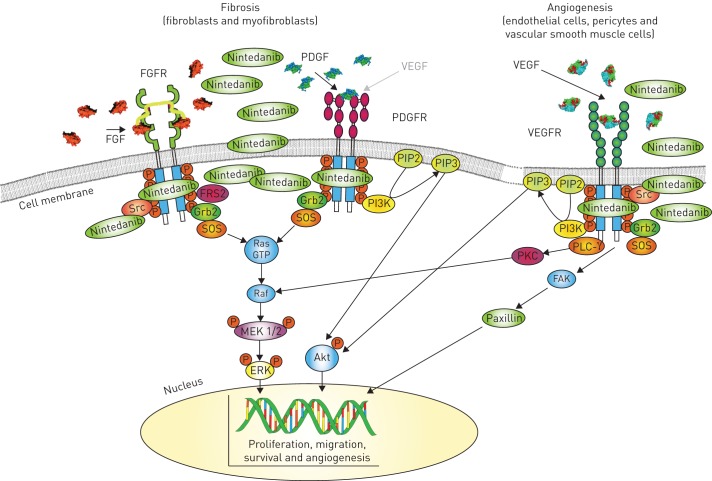
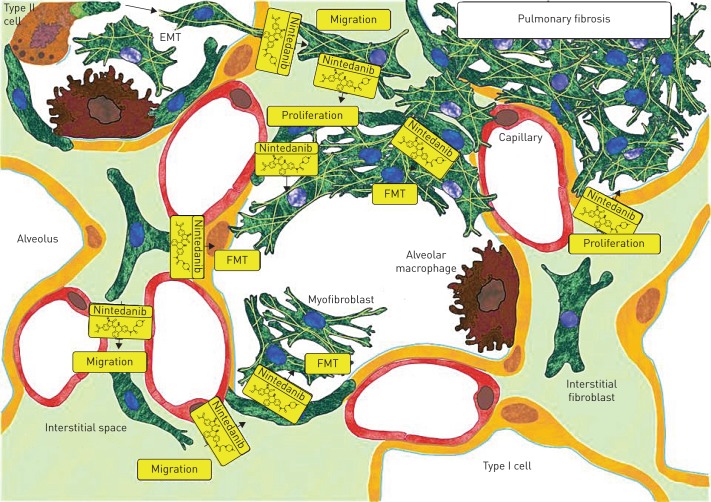
Idiopathic pulmonary fibrosis (IPF) is a progressive and ultimately fatal disease characterised by fibrosis of the lung parenchyma and loss of lung function. Although the pathogenic pathways involved in IPF have not been fully elucidated, IPF is believed to be caused by repetitive alveolar epithelial cell injury and dysregulated repair, in which there is uncontrolled proliferation of lung fibroblasts and differentiation of fibroblasts into myofibroblasts, which excessively deposit extracellular matrix (ECM) proteins in the interstitial space. A number of profibrotic mediators including platelet-derived growth factor (PDGF), fibroblast growth factor (FGF) and transforming growth factor-β are believed to play important roles in the pathogenesis of IPF. Nintedanib is a potent small molecule inhibitor of the receptor tyrosine kinases PDGF receptor, FGF receptor and vascular endothelial growth factor receptor. Data from in vitro studies have shown that nintedanib interferes with processes active in fibrosis such as fibroblast proliferation, migration and differentiation, and the secretion of ECM. In addition, nintedanib has shown consistent anti-fibrotic and anti-inflammatory activity in animal models of lung fibrosis. These data provide a strong rationale for the clinical efficacy of nintedanib in patients with IPF, which has recently been demonstrated in phase III clinical trials.
Overview
The claims and statistics of this paper haven’t been checked yet.
Free: it reads the open-access text and checks the first 5 claims that cite a source we can check. Create a free account to check every claim.
Integrity signals
Registry
Cites
Statistics
Figures
Verification
Claims the paper makes
The claims and statistics of this paper haven’t been checked yet.
Free: it reads the open-access text and checks the first 5 claims that cite a source we can check. Create a free account to check every claim.
Claims other papers make about this one
Each is checked against this paper’s own text: does it say what the citing paper says it does?
The source backs part of the claim, not all of it — or backs it for a different population, condition or comparison.
In the citing paper
“Nintedanib has inhibitory effects on platelet-derived growth factor receptors α/β (PDGFα/β), vascular endothelial growth factor (VEGF) receptors 1, 2 and 3, and fibroblast growth factor (FGF) receptor 1, 2, and 3, as well as potentiation of Src homology region 2 domain containing phosphatase 1 (SHP-1) [19,20].”
From Emerging pharmacological options in the treatment of idiopathic pulmonary fibrosis (IPF) (2024) · cites this paper as [19]
Experimental — accuracy not yet measuredThe source backs part of the claim, not all of it — or backs it for a different population, condition or comparison.
In the citing paper
“These observations indicate that the Pdgf pathway is crucial to disease pathogenesis.”
From Reference-based analysis of lung single-cell sequencing reveals a transitional profibrotic macrophage (2019) · cites this paper as [41]
Experimental — accuracy not yet measuredThe cited source says what the claim attributes to it.
In the citing paper
“In two phase 3 trials with patients suffering from interstitial lung disease, nintedanib profoundly lowered the decline in forced vital capacity (195, 198).”
From Unraveling SSc Pathophysiology; The Myofibroblast (2018) · cites this paper as [195]
The cited source says what the claim attributes to it.
In the citing paper
“The current standard-of-care (SOC) therapy regimen to treat IPF includes either nintedanib, a broadly acting inhibitor of receptor tyrosine kinases31, or pirfenidone, an inhibitor of TGFβ-mediated fibroblast-to-myofibroblast transition32.”
From A generative AI-discovered TNIK inhibitor for idiopathic pulmonary fibrosis: a randomized phase 2a trial (2025) · cites this paper as [31]
In the citing paper
“In vivo, nintedanib protects mice and rats against bleomycin-induced lung fibrosis (195, 196), and lowers the amount of lymphocytes and neutrophils but not macrophages in bronchoalveolar lavage liquid in this model.”
From Unraveling SSc Pathophysiology; The Myofibroblast (2018) · cites this paper as [195]
1 more claim about this paper
Create a free account to see every claim other papers make about this one.
Self-check
Percentages, sums and reported differences re-computed from the paper’s own numbers.
The self-check needs the paper’s full text.
Citations
Cites
The biology of VEGF and its receptors
Ferrara, N., Gerber, H.-P., & LeCouter, J. (2003) · Nature Medicine · doi:10.1038/nm0603-669 · Cited by 9,591
Raghu, G., Collard, H. R., Egan, J. J., Martinez, F. J., Behr, J., Brown, K. K., Colby, T. V., Cordier, J.-F., Flaherty, K. R., Lasky, J. A., et al. (2011) · American Journal of Respiratory and Critical Care Medicine · doi:10.1164/rccm.2009-040gl · Cited by 7,186
Efficacy and Safety of Nintedanib in Idiopathic Pulmonary Fibrosis
Richeldi, L., du Bois, R. M., Raghu, G., Azuma, A., Brown, K. K., Costabel, U., Cottin, V., Flaherty, K. R., Hansell, D. M., Inoue, Y., et al. (2014) · New England Journal of Medicine · doi:10.1056/nejmoa1402584 · Cited by 4,654
Self-citation(2002) · American Journal of Respiratory and Critical Care Medicine · doi:10.1164/ajrccm.165.2.ats01 · Cited by 4,196
A phase 3 trial of pirfenidone in patients with idiopathic pulmonary fibrosis.
King, T. E., Bradford, W. Z., Castro-Bernardini, S., Fagan, E. A., Glaspole, I., Glassberg, M. K., Gorina, E., Hopkins, P. M., Kardatzke, D., Lancaster, L., et al. (2014) · New England Journal of Medicine · doi:10.1056/nejmoa1402582 · Cited by 3,975
King, T. E., Pardo, A., & Selman, M. (2011) · The Lancet · doi:10.1016/s0140-6736(11)60052-4 · Cited by 2,194
Pirfenidone in patients with idiopathic pulmonary fibrosis (CAPACITY): two randomised trials
Noble, P. W., Albera, C., Bradford, W. Z., Costabel, U., Glassberg, M. K., Kardatzke, D., King, T. E., Lancaster, L., Sahn, S. A., Szwarcberg, J., et al. (2011) · The Lancet · doi:10.1016/s0140-6736(11)60405-4 · Cited by 2,154
Selman, M., King, T. E., & Pardo, A. (2001) · Annals of Internal Medicine · doi:10.7326/0003-4819-134-2-200101160-00015 · Cited by 1,786
Signal transduction by vascular endothelial growth factor receptors
Koch, S., Tugues, S., Li, X., Gualandi, L., & Claesson-Welsh, L. (2011) · Biochemical Journal · doi:10.1042/bj20110301 · Cited by 1,635
Idiopathic Pulmonary Fibrosis: Clinical Relevance of Pathologic Classification
KATZENSTEIN, A.-L. A., & MYERS, J. L. (1998) · American Journal of Respiratory and Critical Care Medicine · doi:10.1164/ajrccm.157.4.9707039 · Cited by 1,261
Cited by
Aran, D., Looney, A. P., Liu, L., Wu, E., Fong, V., Hsu, A., Chak, S., Naikawadi, R. P., Wolters, P. J., Abate, A. R., et al. (2019) · Nature Immunology · doi:10.1038/s41590-018-0276-y · Cited by 4,984
Nintedanib in Progressive Fibrosing Interstitial Lung Diseases
Flaherty, K. R., Wells, A. U., Cottin, V., Devaraj, A., Walsh, S. L. F., Inoue, Y., Richeldi, L., Kolb, M., Tetzlaff, K., Stowasser, S., et al. (2019) · New England Journal of Medicine · doi:10.1056/nejmoa1908681 · Cited by 2,403
Self-citationNintedanib for systemic sclerosis–associated interstitial lung disease
Distler, O., Highland, K. B., Gahlemann, M., Azuma, A., Fischer, A., Mayes, M. D., Raghu, G., Sauter, W., Girard, M., Alves, M., et al. (2019) · New England Journal of Medicine · doi:10.1056/nejmoa1903076 · Cited by 1,647
Self-citationLong COVID or post-COVID-19 syndrome: putative pathophysiology, risk factors, and treatments
Yong, S. J. (2021) · Infectious Diseases · doi:10.1080/23744235.2021.1924397 · Cited by 1,339
Volkmann, E. R., Andréasson, K., & Smith, V. (2023) · The Lancet · doi:10.1016/s0140-6736(22)01692-0 · Cited by 616
Idiopathic pulmonary fibrosis: Disease mechanisms and drug development
Spagnolo, P., Kropski, J. A., Jones, M. G., Lee, J. S., Rossi, G., Karampitsakos, T., Maher, T. M., Tzouvelekis, A., & Ryerson, C. J. (2021) · Pharmacology & Therapeutics · doi:10.1016/j.pharmthera.2020.107798 · Cited by 636
Wells, A. U., Flaherty, K. R., Brown, K. K., Inoue, Y., Devaraj, A., Richeldi, L., Moua, T., Crestani, B., Wuyts, W. A., Stowasser, S., et al. (2020) · The Lancet Respiratory Medicine · doi:10.1016/s2213-2600(20)30036-9 · Cited by 569
Self-citationTargeting fibrosis: mechanisms and clinical trials
Zhao, M., Wang, L., Wang, M., Zhou, S., Lu, Y., Cui, H., Racanelli, A. C., Zhang, L., Ye, T., Ding, B., et al. (2022) · Signal Transduction and Targeted Therapy · doi:10.1038/s41392-022-01070-3 · Cited by 547
Inflammation and immunity in IPF pathogenesis and treatment
Heukels, P., Moor, C. C., von der Thüsen, J. H., Wijsenbeek, M. S., & Kool, M. (2019) · Respiratory Medicine · doi:10.1016/j.rmed.2018.12.015 · Cited by 517
Developmental pathways in the pathogenesis of lung fibrosis
Chanda, D., Otoupalova, E., Smith, S. R., Volckaert, T., De Langhe, S. P., & Thannickal, V. J. (2019) · Molecular Aspects of Medicine · doi:10.1016/j.mam.2018.08.004 · Cited by 514
“, 2016), as well as on PDGF receptor signaling (Wollin et al., 2015).”
BackgroundRicheldi, L., Cottin, V., du Bois, R. M., Selman, M., Kimura, T., Bailes, Z., Schlenker-Herceg, R., Stowasser, S., & Brown, K. K. (2016) · Respiratory Medicine · doi:10.1016/j.rmed.2016.02.001 · Cited by 463
“This is an open access article under the CC BY-NC-ND license (http://creativecommons.org/licenses/by-nc-nd/4.0/). growth factor receptor; FVC, pulmonary fibrosis; MedDRA, latelet-derived growth factor ; VEGFR, vascular endothelial mpton, Mailpoint 810, South 6YD, UK. ldi), vincent.cottin@chu-lyon.”
BackgroundInfluentialSelf-citationJenkins, R. G., Moore, B. B., Chambers, R. C., Eickelberg, O., Königshoff, M., Kolb, M., Laurent, G. J., Nanthakumar, C. B., Olman, M. A., Pardo, A., et al. (2017) · American Journal of Respiratory Cell and Molecular Biology · doi:10.1165/rcmb.2017-0096st · Cited by 435
Self-citationZhong, Q., Xiao, X., Qiu, Y., Xu, Z., Chen, C., Chong, B., Zhao, X., Hai, S., Li, S., An, Z., et al. (2023) · MedComm · doi:10.1002/mco2.261 · Cited by 442
Idiopathic Pulmonary Fibrosis (IPF): An Overview
Barratt, S., Creamer, A., Hayton, C., & Chaudhuri, N. (2018) · Journal of Clinical Medicine · doi:10.3390/jcm7080201 · Cited by 382
“Nintedanib, a tyrosine kinase inhibitor initially developed as an anti-tumour agent [123], was noted to have activity against fibroblasts through inhibition of vascular endothelial growth factor (VEGF) and other profibrotic mediators such as platelet-derived growth factor (PDGF), fibroblast growth factor (FGF), and tr…”
BackgroundThe Bleomycin Model of Pulmonary Fibrosis
Liu, T., De Los Santos, F. G., & Phan, S. H. (2017) · Methods in Molecular Biology · doi:10.1007/978-1-4939-7113-8_2 · Cited by 357
Dual EGFR-VEGF Pathway Inhibition: A Promising Strategy for Patients With EGFR-Mutant NSCLC
Le, X., Nilsson, M., Goldman, J., Reck, M., Nakagawa, K., Kato, T., Ares, L. P., Frimodt-Moller, B., Wolff, K., Visseren-Grul, C., et al. (2021) · Journal of Thoracic Oncology · doi:10.1016/j.jtho.2020.10.006 · Cited by 339
A small-molecule TNIK inhibitor targets fibrosis in preclinical and clinical models
Ren, F., Aliper, A., Chen, J., Zhao, H., Rao, S., Kuppe, C., Ozerov, I. V., Zhang, M., Witte, K., Kruse, C., et al. (2025) · Nature Biotechnology · doi:10.1038/s41587-024-02143-0 · Cited by 348
“…its efficacy in IPF by inhibiting fibroblast growth factor receptor (FGFR), platelet-derived growth factor receptor (PDGFR) and vascular endothelial growth factor (VEGFR) 32 , that is, growth factor receptors in the fibrotic pathway of tyrosine kinase structure, with FGFR being most relevant 33 .”
Fibrosing interstitial lung diseases: knowns and unknowns
Cottin, V., Wollin, L., Fischer, A., Quaresma, M., Stowasser, S., & Harari, S. (2019) · European Respiratory Review · doi:10.1183/16000617.0100-2018 · Cited by 336
Self-citationMehta, M., Dhanjal, D. S., Paudel, K. R., Singh, B., Gupta, G., Rajeshkumar, S., Thangavelu, L., Tambuwala, M. M., Bakshi, H. A., Chellappan, D. K., et al. (2020) · Inflammopharmacology · doi:10.1007/s10787-020-00698-3 · Cited by 330
Idiopathic pulmonary fibrosis: Epithelial-mesenchymal interactions and emerging therapeutic targets
Hewlett, J. C., Kropski, J. A., & Blackwell, T. S. (2018) · Matrix Biology · doi:10.1016/j.matbio.2018.03.021 · Cited by 321
Idiopathic pulmonary fibrosis: Current and future treatment
Glass, D. S., Grossfeld, D., Renna, H. A., Agarwala, P., Spiegler, P., DeLeon, J., & Reiss, A. B. (2022) · The Clinical Respiratory Journal · doi:10.1111/crj.13466 · Cited by 314
“These effects on receptor tyrosine kinases lead to decreased fibroblast activity.(5,64,65) INPULSIS phase 3 trials I and II showed a significant decrease in the rate of FVC deterioration in IPF patients although the death rate remained the same.”
BackgroundNintedanib with Add-on Pirfenidone in Idiopathic Pulmonary Fibrosis. Results of the INJOURNEY Trial
Vancheri, C., Kreuter, M., Richeldi, L., Ryerson, C. J., Valeyre, D., Grutters, J. C., Wiebe, S., Stansen, W., Quaresma, M., Stowasser, S., et al. (2018) · American Journal of Respiratory and Critical Care Medicine · doi:10.1164/rccm.201706-1301oc · Cited by 305
“Nintedanib and pirfenidone have pleiotropic effects and are thought to target different aspects of the fibrotic cascade (9, 10), suggesting that therapy with both drugs”
BackgroundSelf-citationThe Role of Macrophages in the Development of Acute and Chronic Inflammatory Lung Diseases
Lee, J.-W., Chun, W., Lee, H. J., Min, J.-H., Kim, S.-M., Seo, J.-Y., Ahn, K.-S., & Oh, S.-R. (2021) · Cells · doi:10.3390/cells10040897 · Cited by 291
“Furthermore, growth factors, including MIP-2, vascular endothelial growth factor (VEGF), angiopoietin, and platelet-derived growth factor (PDGF), have been shown to promote collagen deposition [14].”
BackgroundPotential of nintedanib in treatment of progressive fibrosing interstitial lung diseases
Wollin, L., Distler, J. H. W., Redente, E. F., Riches, D. W. H., Stowasser, S., Schlenker-Herceg, R., Maher, T. M., & Kolb, M. (2019) · European Respiratory Journal · doi:10.1183/13993003.00161-2019 · Cited by 296
Self-citationThe natural history of progressive fibrosing interstitial lung diseases
Brown, K. K., Martinez, F. J., Walsh, S. L. F., Thannickal, V. J., Prasse, A., Schlenker-Herceg, R., Goeldner, R.-G., Clerisme-Beaty, E., Tetzlaff, K., Cottin, V., et al. (2020) · European Respiratory Journal · doi:10.1183/13993003.00085-2020 · Cited by 293
“Nintedanib is an intracellular inhibitor of tyrosine kinases [10, 25].”
BackgroundEfficacy of Nintedanib in Idiopathic Pulmonary Fibrosis across Prespecified Subgroups in INPULSIS
Costabel, U., Inoue, Y., Richeldi, L., Collard, H. R., Tschoepe, I., Stowasser, S., & Azuma, A. (2016) · American Journal of Respiratory and Critical Care Medicine · doi:10.1164/rccm.201503-0562oc · Cited by 280
Self-citationAntifibrotic therapy for idiopathic pulmonary fibrosis: time to treat
Maher, T. M., & Strek, M. E. (2019) · Respiratory Research · doi:10.1186/s12931-019-1161-4 · Cited by 265
“In vitro studies have shown that by inhibiting signaling mediated via tyrosine kinases, nintedanib inhibits fundamental processes of fibrosis, such as the recruitment, proliferation and differentiation of fibroblasts and fibrocytes and the deposition of extracellular matrix [15].”
BackgroundNintedanib plus Sildenafil in Patients with Idiopathic Pulmonary Fibrosis
Kolb, M., Raghu, G., Wells, A. U., Behr, J., Richeldi, L., Schinzel, B., Quaresma, M., Stowasser, S., & Martinez, F. J. (2018) · New England Journal of Medicine · doi:10.1056/nejmoa1811737 · Cited by 264
Self-citationJolly, M. K., Ward, C., Eapen, M. S., Myers, S., Hallgren, O., Levine, H., & Sohal, S. S. (2018) · Developmental Dynamics · doi:10.1002/dvdy.24541 · Cited by 253
Therapeutic targets in lung tissue remodelling and fibrosis
Liu, G., Philp, A. M., Corte, T., Travis, M. A., Schilter, H., Hansbro, N. G., Burns, C. J., Eapen, M. S., Sohal, S. S., Burgess, J. K., et al. (2021) · Pharmacology & Therapeutics · doi:10.1016/j.pharmthera.2021.107839 · Cited by 249
Nintedanib in patients with idiopathic pulmonary fibrosis and preserved lung volume
Kolb, M., Richeldi, L., Behr, J., Maher, T. M., Tang, W., Stowasser, S., Hallmann, C., & du Bois, R. M. (2017) · Thorax · doi:10.1136/thoraxjnl-2016-208710 · Cited by 235
Self-citationThe Processes and Mechanisms of Cardiac and Pulmonary Fibrosis
Murtha, L. A., Schuliga, M. J., Mabotuwana, N. S., Hardy, S. A., Waters, D. W., Burgess, J. K., Knight, D. A., & Boyle, A. J. (2017) · Frontiers in Physiology · doi:10.3389/fphys.2017.00777 · Cited by 229
“Furthermore, polymorphisms in the gene encoding ACE are associated with IPF and ARDS susceptibility or outcome (Marshall et al., 2002; Uh et al., 2013).”
BackgroundInfluentialHighland, K. B., Distler, O., Kuwana, M., Allanore, Y., Assassi, S., Azuma, A., Bourdin, A., Denton, C. P., Distler, J. H. W., Hoffmann-Vold, A. M., et al. (2021) · The Lancet Respiratory Medicine · doi:10.1016/s2213-2600(20)30330-1 · Cited by 217
Self-citationClinical Pharmacokinetics and Pharmacodynamics of Nintedanib
Wind, S., Schmid, U., Freiwald, M., Marzin, K., Lotz, R., Ebner, T., Stopfer, P., & Dallinger, C. (2019) · Clinical Pharmacokinetics · doi:10.1007/s40262-019-00766-0 · Cited by 212
Lung Fibrosis after COVID-19: Treatment Prospects
Bazdyrev, E., Rusina, P., Panova, M., Novikov, F., Grishagin, I., & Nebolsin, V. (2021) · Pharmaceuticals · doi:10.3390/ph14080807 · Cited by 192
“Nintedanib binds to the intracellular ATP pockets of the corresponding receptors, which leads to the inhibition of pro-fibrotic signaling and the attenuation of the proliferation, migration, and differentiation of fibroblasts as well as extracellular matrix component secretion [51].”
BackgroundVEGF and FGF-2: Promising targets for the treatment of respiratory disorders
Laddha, A. P., & Kulkarni, Y. A. (2019) · Respiratory Medicine · doi:10.1016/j.rmed.2019.08.003 · Cited by 187
Current and Future Treatment Landscape for Idiopathic Pulmonary Fibrosis
Bonella, F., Spagnolo, P., & Ryerson, C. (2023) · Drugs · doi:10.1007/s40265-023-01950-0 · Cited by 182
“Nintedanib is an intracellular tyrosine kinase inhibitor (TKI) with multiple targets involved in lung fibrosis [67].”
BackgroundProgression of fibrosing interstitial lung disease
Wong, A. W., Ryerson, C. J., & Guler, S. A. (2020) · Respiratory Research · doi:10.1186/s12931-020-1296-3 · Cited by 185
Flaherty, K. R., Brown, K. K., Wells, A. U., Clerisme-Beaty, E., Collard, H. R., Cottin, V., Devaraj, A., Inoue, Y., Le Maulf, F., Richeldi, L., et al. (2017) · BMJ Open Respiratory Research · doi:10.1136/bmjresp-2017-000212 · Cited by 184
“10 This manuscript describes the design of the PF-ILD study, a phase III clinical trial evaluating the efficacy and safety of nintedanib compared with placebo in adult patients with progressive fibrosing lung disease.”
MethodA Novel Antifibrotic Mechanism of Nintedanib and Pirfenidone. Inhibition of Collagen Fibril Assembly
Knüppel, L., Ishikawa, Y., Aichler, M., Heinzelmann, K., Hatz, R., Behr, J., Walch, A., Bächinger, H. P., Eickelberg, O., & Staab-Weijnitz, C. A. (2017) · American Journal of Respiratory Cell and Molecular Biology · doi:10.1165/rcmb.2016-0217oc · Cited by 183
The Role of the Mammalian Target of Rapamycin (mTOR) in Pulmonary Fibrosis
Lawrence, J., & Nho, R. (2018) · International Journal of Molecular Sciences · doi:10.3390/ijms19030778 · Cited by 183
Xu, Z., Ren, F., Wang, P., Cao, J., Tan, C., Ma, D., Zhao, L., Dai, J., Ding, Y., Fang, H., et al. (2025) · Nature Medicine · doi:10.1038/s41591-025-03743-2 · Cited by 180
“The current standard-of-care (SOC) therapy regimen to treat IPF includes either nintedanib, a broadly acting inhibitor of receptor tyrosine kinases 31 , or pirfenidone, an inhibitor of TGFβ-mediated fibroblast-to-myofibroblast transition 32 .”
Effect of nintedanib in subgroups of idiopathic pulmonary fibrosis by diagnostic criteria
Raghu, G., Wells, A. U., Nicholson, A. G., Richeldi, L., Flaherty, K. R., Le Maulf, F., Stowasser, S., Schlenker-Herceg, R., & Hansell, D. M. (2017) · American Journal of Respiratory and Critical Care Medicine · doi:10.1164/rccm.201602-0402oc · Cited by 180
“Nintedanib is an intracellular inhibitor of tyrosine kinases (8) that has been approved for the treatment of IPF in several countries and regions, including the US (9), Europe (10), and Japan and that received a conditional recommendation for use in the latest international clinical practice guideline for the treatmen…”
Self-citationInui, N., Sakai, S., & Kitagawa, M. (2021) · International Journal of Molecular Sciences · doi:10.3390/ijms22116107 · Cited by 169
“No model can completely reproduce all the physiological and histopathological features of human pulmonary fibrosis (Figure 1) [23,46,49], although the mouse models can help to elucidate the mechanism of this complex disease.”
BackgroundMethodInfluentialNintedanib: A Review in Fibrotic Interstitial Lung Diseases
Lamb, Y. N. (2021) · Drugs · doi:10.1007/s40265-021-01487-0 · Cited by 161
Unraveling SSc Pathophysiology; The Myofibroblast
van Caam, A., Vonk, M., van den Hoogen, F., van Lent, P., & van der Kraan, P. (2018) · Frontiers in Immunology · doi:10.3389/fimmu.2018.02452 · Cited by 153
Zhao, X.-K., Cheng, Y., Liang Cheng, M., Yu, L., Mu, M., Li, H., Liu, Y., Zhang, B., Yao, Y., Guo, H., et al. (2016) · Scientific Reports · doi:10.1038/srep19276 · Cited by 152
Traditional Chinese medicine for pulmonary fibrosis therapy: Progress and future prospects
Li, L., & Kan, L. (2016) · Journal of Ethnopharmacology · doi:10.1016/j.jep.2016.12.042 · Cited by 160
“In vitro by employing a murine fibroblast cell line 3T6, GCA could lead to the down-regulated expression of ECM degradation proteins (MMP3, MMP-7, MMP-8 and MMP-9), anti-apoptotic protein Bcl-2 and cell cycle regulatory proteins (Cyclin B1, Cyclin D1 and Cyclin E) along with up-regulated pro-apoptotic protein Bax and…”
InfluentialPharmacotherapy and adjunctive treatment for idiopathic pulmonary fibrosis (IPF)
Saito, S., Alkhatib, A., Kolls, J. K., Kondoh, Y., & Lasky, J. A. (2019) · Journal of Thoracic Disease · doi:10.21037/jtd.2019.04.62 · Cited by 148
Blood Biomarkers in Idiopathic Pulmonary Fibrosis
Guiot, J., Moermans, C., Henket, M., Corhay, J.-L., & Louis, R. (2017) · Lung · doi:10.1007/s00408-017-9993-5 · Cited by 147
“Of interest, VEGF is targeted by nintedanib used as a specific IPF therapy [57].”
BackgroundIdiopathic pulmonary fibrosis: lessons from clinical trials over the past 25 years
Raghu, G. (2017) · European Respiratory Journal · doi:10.1183/13993003.01209-2017 · Cited by 146
Acute exacerbations in the INPULSIS trials of nintedanib in idiopathic pulmonary fibrosis
Collard, H. R., Richeldi, L., Kim, D. S., Taniguchi, H., Tschoepe, I., Luisetti, M., Roman, J., Tino, G., Schlenker-Herceg, R., Hallmann, C., et al. (2017) · European Respiratory Journal · doi:10.1183/13993003.01339-2016 · Cited by 138
Fibrotic microtissue array to predict anti-fibrosis drug efficacy
Asmani, M., Velumani, S., Li, Y., Wawrzyniak, N., Hsia, I., Chen, Z., Hinz, B., & Zhao, R. (2018) · Nature Communications · doi:10.1038/s41467-018-04336-z · Cited by 137
Lehmann, M., Buhl, L., Alsafadi, H. N., Klee, S., Hermann, S., Mutze, K., Ota, C., Lindner, M., Behr, J., Hilgendorff, A., et al. (2018) · Respiratory Research · doi:10.1186/s12931-018-0876-y · Cited by 138
“However, it has been previously acknowledged that non-receptor kinases or targets not yet identified and/or effects on cells other than fibroblasts could contribute to the anti-fibrotic properties of Nintedanib [16, 20, 21].”
Dinnon, K. H., Leist, S. R., Okuda, K., Dang, H., Fritch, E. J., Gully, K. L., la Cruz, G. D., Evangelista, M. D., Asakura, T., Gilmore, R. C., et al. (2022) · Science Translational Medicine · doi:10.1126/scitranslmed.abo5070 · Cited by 149
“Based on preclinical studies of anti-fibrotic agents in reducing the severity of PF responses to chemical agents, we tested the concept that early intervention with an anti-fibrotic agent may reduce the severity of PF following SARS-CoV-2 infection ( 59 ).”
Effects of nintedanib on the microvascular architecture in a lung fibrosis model
Ackermann, M., Kim, Y. O., Wagner, W. L., Schuppan, D., Valenzuela, C. D., Mentzer, S. J., Kreuz, S., Stiller, D., Wollin, L., & Konerding, M. A. (2017) · Angiogenesis · doi:10.1007/s10456-017-9543-z · Cited by 133
“The in vivo efficacy of nintedanib was explored in silica-induced lung fibrosis in mice and bleomycin-induced lung fibrosis in mice and rats [9].”
Self-citationTherapeutic targets in idiopathic pulmonary fibrosis
Kolb, M. R. J., Bonella, F., & Wollin, L. (2017) · Respiratory Medicine · doi:10.1016/j.rmed.2017.07.062 · Cited by 142
Self-citationAntifibrotic therapy for fibrotic lung disease beyond idiopathic pulmonary fibrosis
Collins, B. F., & Raghu, G. (2019) · European Respiratory Review · doi:10.1183/16000617.0022-2019 · Cited by 134
Matteson, E. L., Kelly, C. A., Distler, J. H. W., Hoffmann‐Vold, A., Seibold, J. R., Mittoo, S., Dellaripa, P. F., Aringer, M., Pope, J. E., Distler, O., et al. (2022) · Arthritis & Rheumatology · doi:10.1002/art.42075 · Cited by 148
Self-citationThe controversial role of mast cells in fibrosis
Bradding, P., & Pejler, G. (2018) · Immunological Reviews · doi:10.1111/imr.12626 · Cited by 129
Regulation of cellular senescence by extracellular matrix during chronic fibrotic diseases
Blokland, K. E. C., Pouwels, S. D., Schuliga, M., Knight, D. A., & Burgess, J. K. (2020) · Clinical Science · doi:10.1042/cs20190893 · Cited by 128
TGF-β and BMPR2 Signaling in PAH: Two Black Sheep in One Family
Rol, N., Kurakula, K., Happé, C. M., Bogaard, H. J., & Goumans, M. (2018) · International Journal of Molecular Sciences · doi:10.3390/ijms19092585 · Cited by 141
“Furthermore, nintedanib, a tyrosine kinase inhibitor known to inhibit TGF-β-mediated fibrosis, attenuated cardiac fibrosis in experimental pulmonary hypertension [130,131] Hemnes et al.”
BackgroundProtein kinases: drug targets for immunological disorders
Castelo‐Soccio, L. A., Kim, H., Gadina, M., Schwartzberg, P. L., Laurence, A. D. J., & O’Shea, J. J. (2023) · Nature reviews. Immunology · doi:10.1038/s41577-023-00877-7 · Cited by 136
“Nintedanib appears to decrease uncontrolled proliferation of lung fibroblasts and differentiation of fibroblasts into myofibroblasts, which deposit extracellular matrix into the interstitial spaces in these diseases 33 .”
BackgroundIdiopathic pulmonary fibrosis: Molecular mechanisms and potential treatment approaches
Glass, D. S., Grossfeld, D. J., Renna, H. A., Agarwala, P., Spiegler, P. A., Kasselman, L. J., Glass, A. D., DeLeon, J. R., & Reiss, A. B. (2020) · Respiratory Investigation · doi:10.1016/j.resinv.2020.04.002 · Cited by 140
Advances in the management of idiopathic pulmonary fibrosis and progressive pulmonary fibrosis
Liu, G. Y., Budinger, G. R. S., & Dematte, J. E. (2022) · BMJ · doi:10.1136/bmj-2021-066354 · Cited by 145
Immune Mechanisms of Pulmonary Fibrosis with Bleomycin
Ishida, Y., Kuninaka, Y., Mukaida, N., & Kondo, T. (2023) · International Journal of Molecular Sciences · doi:10.3390/ijms24043149 · Cited by 136
Angiopoietin inhibitors: A review on targeting tumor angiogenesis
Digna, P., & Apte, M. (2021) · European Journal of Pharmacology · doi:10.1016/j.ejphar.2021.174021 · Cited by 135
Betensley, A., Sharif, R., & Karamichos, D. (2016) · Journal of Clinical Medicine · doi:10.3390/jcm6010002 · Cited by 119
“VEGF, FGF, and PDGF connect a number of processes including angiogenesis and fibrogenesis and have been implicated in the pathogenesis of IPF [66].”
BackgroundZhang, Y., Lu, W., Zhang, X., Lü, J., Xu, S., Chen, S., Zhong, Z., Zhou, T., Wang, Q., Chen, J., et al. (2019) · Pharmacological Research · doi:10.1016/j.phrs.2019.104307 · Cited by 129
Khanna, D., Lescoat, A., Roofeh, D., Bernstein, E. J., Kazerooni, E. A., Roth, M. D., Martínez, F. J., Flaherty, K. R., & Denton, C. P. (2021) · Arthritis & Rheumatology · doi:10.1002/art.41933 · Cited by 124
“This combination may be especially relevant considering the antiinflammatory properties of tocilizumab and the potential more specific antifibrotic effects of nintedanib through PDGF and FGF receptor inhibition, as well as its potential impact on vasculopathy through VEGF receptor inhibition (28).”
Wuyts, W. A., Kolb, M., Stowasser, S., Stansen, W., Huggins, J. T., & Raghu, G. (2016) · Lung · doi:10.1007/s00408-016-9912-1 · Cited by 119
Self-citationSavary, G., Dewaeles, E., Diazzi, S., Buscot, M., Nottet, N., Fassy, J., Courcot, E., Henaoui, I.-S., Lemaire, J., Martis, N., et al. (2019) · American Journal of Respiratory and Critical Care Medicine · doi:10.1164/rccm.201807-1237oc · Cited by 113
Fibrosis: cross-organ biology and pathways to development of innovative drugs
Rieder, F., Nagy, L. E., Maher, T. M., Distler, J. H. W., Kramann, R., Hinz, B., & Prunotto, M. (2025) · Nature Reviews Drug Discovery · doi:10.1038/s41573-025-01158-9 · Cited by 154
“These human clinical observations were supported by both pirfenidone 222 and nintedanib 223 functionally inhibiting an activated mesenchymal phenotype, a common mechanism of fibrosis across organs (Box 2).”
A novel computational approach for drug repurposing using systems biology
Peyvandipour, A., Saberian, N., Shafi, A., Donato, M., & Drăghici, S. (2018) · Bioinformatics · doi:10.1093/bioinformatics/bty133 · Cited by 125
FOXM1 is a critical driver of lung fibroblast activation and fibrogenesis
Penke, L. R. K., Speth, J. M., Dommeti, V. L., White, E. S., Bergin, I. L., & Peters-Golden, M. L. (2018) · Journal of Clinical Investigation · doi:10.1172/jci87631 · Cited by 126
Targeting CSF-1R represents an effective strategy in modulating inflammatory diseases
Xiang, C., Li, H., & Tang, W. (2022) · Pharmacological Research · doi:10.1016/j.phrs.2022.106566 · Cited by 118
Use of animal models in IPF research
Carrington, R., Jordan, S., Pitchford, S. C., & Page, C. P. (2018) · Pulmonary Pharmacology & Therapeutics · doi:10.1016/j.pupt.2018.07.002 · Cited by 116
Hydrogel-based delivery of Il-10 improves treatment of bleomycin-induced lung fibrosis in mice
Shamskhou, E. A., Kratochvil, M. J., Orcholski, M. E., Nagy, N., Kaber, G., Steen, E. H., Balaji, S., Yuan, K., Keswani, S. G., Danielson, B. T., et al. (2019) · Biomaterials · doi:10.1016/j.biomaterials.2019.02.017 · Cited by 116
Maher, T. M., Stowasser, S., Nishioka, Y., White, E. S., Cottin, V., Noth, I., Selman, M., Rohr, K. B., Michael, A., Ittrich, C., et al. (2019) · The Lancet Respiratory Medicine · doi:10.1016/s2213-2600(19)30255-3 · Cited by 106
Self-citationHsp90 regulation of fibroblast activation in pulmonary fibrosis
Sontake, V., Wang, Y., Kasam, R. K., Sinner, D., Reddy, G. B., Naren, A. P., McCormack, F. X., White, E. S., Jegga, A. G., & Madala, S. K. (2017) · JCI Insight · doi:10.1172/jci.insight.91454 · Cited by 100
“Fibroblast proliferation is an important cellular process involved in pulmonary fibrogenesis, and IPF-directed therapies such as nintedanib act to attenuate the proliferation of lung fibroblasts and inhibit differentiation of fibroblasts into myofibroblasts (20).”
BackgroundKato, M., Sasaki, S., Nakamura, T., Kurokawa, K., Yamada, T., Ochi, Y., Ihara, H., Takahashi, F., & Takahashi, K. (2019) · Scientific Reports · doi:10.1038/s41598-019-48593-4 · Cited by 106
Richeldi, L., Varone, F., Bergna, M., de Andrade, J., Falk, J., Hallowell, R., Jouneau, S., Kondoh, Y., Morrow, L., Randerath, W., et al. (2018) · European Respiratory Review · doi:10.1183/16000617.0074-2018 · Cited by 95
Vascular permeability in the fibrotic lung
Probst, C. K., Montesi, S. B., Medoff, B. D., Shea, B. S., & Knipe, R. S. (2020) · European Respiratory Journal · doi:10.1183/13993003.00100-2019 · Cited by 94
The clinical manifestations and molecular pathogenesis of radiation fibrosis
Fijardo, M., Kwan, J. Y. Y., Bissey, P.-A., Citrin, D. E., Yip, K. W., & Liu, F. (2024) · EBioMedicine · doi:10.1016/j.ebiom.2024.105089 · Cited by 104
Liu, S.-S., Lv, X.-X., Liu, C., Qi, J., Li, Y.-X., Wei, X.-P., Li, K., Hua, F., Cui, B., Zhang, X., et al. (2019) · Immunity · doi:10.1016/j.immuni.2019.06.014 · Cited by 95
Molecular Mechanisms and Cellular Contribution from Lung Fibrosis to Lung Cancer Development
Samarelli, A. V., Masciale, V., Aramini, B., Coló, G. P., Tonelli, R., Marchioni, A., Bruzzi, G., Gozzi, F., Andrisani, D., Castaniere, I., et al. (2021) · International Journal of Molecular Sciences · doi:10.3390/ijms222212179 · Cited by 99
A four-part guide to lung immunology: Invasion, inflammation, immunity, and intervention
Gopallawa, I., Dehinwal, R., Bhatia, V., Gujar, V., & Chirmule, N. B. (2023) · Frontiers in Immunology · doi:10.3389/fimmu.2023.1119564 · Cited by 115
Clinical Treatment Options in Scleroderma: Recommendations and Comprehensive Review
Zhao, M. F., Wu, J., Wu, H., Sawalha, A. H., & Lu, Q. (2021) · Clinical Reviews in Allergy & Immunology · doi:10.1007/s12016-020-08831-4 · Cited by 97
“Nintedanib, an inhibitor of vascular endothelial growth factor receptor (VEGFR), is the only drug approved for the treatment of SSc-ILD so far [64].”
BackgroundShah, R. R. (2016) · Drug Safety · doi:10.1007/s40264-016-0450-9 · Cited by 93
“A key mediator in the pathogenesis of PF is TGF-b1 [139, 140].”
BackgroundNintedanib for the treatment of idiopathic pulmonary fibrosis
Varone, F., Sgalla, G., Iovene, B., Bruni, T., & Richeldi, L. (2018) · Expert Opinion on Pharmacotherapy · doi:10.1080/14656566.2018.1425681 · Cited by 98
“Due to potentially similar pathobiologic features between IPF and a recognized role of the same tyrosinekinase receptors in the pathogenesis of progressive fibrosis [35,36], nintedanib was tested in several in vitro essays and in murine models of bleomycin-induced and silica-induced lung fibrosis, where it demonstrate…”
BackgroundUmemura, Y., Mitsuyama, Y., Minami, K., Nishida, T., Watanabe, A., Okada, N., Yamakawa, K., Nochioka, K., & Fujimi, S. (2021) · International Journal of Infectious Diseases · doi:10.1016/j.ijid.2021.05.055 · Cited by 103
Lang, N. J., Gote-Schniering, J., Porras-Gonzalez, D., Yang, L., Sadeleer, L. D., Jentzsch, R. C., Shitov, V. A., Zhou, S., Ansari, M., Agami, A., et al. (2023) · Science Translational Medicine · doi:10.1126/scitranslmed.adh0908 · Cited by 104
“KRT17 + /KRT5 − basaloid cells were most perturbed in response to both treatments, although both drugs are thought to primarily target myofibroblasts ( 24 , 63 ), possibly because of modulation of the cell-cell communication routes between myofibroblasts and basaloid cells by nintedanib and CMP4.”
BackgroundResultGu, H., Fisher, A. J., Mickler, E. A., Duerson, F., Cummings, O. W., Peters-Golden, M. L., Twigg, H. L., Woodruff, T. M., Wilkes, D. S., & Vittal, R. (2016) · The FASEB Journal · doi:10.1096/fj.201500044 · Cited by 91
“Food and Drug Administration–approved drug for IPF, nintedanib (59).”
BackgroundRedente, E. F., Aguilar, M., Black, B. P., Edelman, B., Bahadur, A. N., Humphries, S. M., Lynch, D. A., Wollin, L., & Riches, D. W. H. (2018) · American Journal of Physiology-Lung Cellular and Molecular Physiology · doi:10.1152/ajplung.00304.2017 · Cited by 95
Self-citationNintedanib in children and adolescents with fibrosing interstitial lung diseases
Deterding, R. R., Young, L. R., DeBoer, E. M., Warburton, D., Cunningham, S., Schwerk, N., Flaherty, K. R., Brown, K. K., Dumistracel, M., Erhardt, E. M., et al. (2022) · European Respiratory Journal · doi:10.1183/13993003.01512-2022 · Cited by 92
“Nintedanib is an intracellular inhibitor of tyrosine kinases that inhibits processes fundamental to the progression of pulmonary fibrosis [9,10].”
Self-citationPulmonary inflammation and fibroblast immunoregulation: from bench to bedside
Ghonim, M. A., Boyd, D. F., Flerlage, T., & Thomas, P. G. (2023) · Journal of Clinical Investigation · doi:10.1172/jci170499 · Cited by 95
“…may enable incorporation of these treatment strategies to target deleterious fibroblast responses in inflammatory lung diseases. with activity against VEGFR, PDGFR, and FGF receptors, shown to slow lung fibrosis via reducing the production of collagen and profibrotic mediators (151, 153, 154).”
BackgroundWhat can target kidney fibrosis?
Leaf, I. A., & Duffield, J. S. (2016) · Nephrology Dialysis Transplantation · doi:10.1093/ndt/gfw388 · Cited by 94
Post-intubation subglottic stenosis: aetiology at the cellular and molecular level
Dorris, E., Russell, J., & Murphy, M. (2021) · European Respiratory Review · doi:10.1183/16000617.0218-2020 · Cited by 104
Seibold, J. R., Maher, T. M., Highland, K. B., Assassi, S., Azuma, A., Hummers, L. K., Costabel, U., von Wangenheim, U., KOHLBRENNER, V. M., Gahlemann, M., et al. (2020) · Annals of the Rheumatic Diseases · doi:10.1136/annrheumdis-2020-217331 · Cited by 87
Gamad, N., Malik, S., Suchal, K., Vasisht, S., Tomar, A., Arava, S. K., Arya, D. S., & Bhatia, J. (2017) · Biomedicine & Pharmacotherapy · doi:10.1016/j.biopha.2017.11.101 · Cited by 89
Metadata
- Authors
- Wollin, L., Wex, E., Pautsch, A., Schnapp, G., Hostettler, K. E., Stowasser, S., & Kolb, M.
- Affiliations
- Boehringer Ingelheim (Germany) (DE)
- University Hospital of Basel (CH)
- McMaster University (CA)
- Corresponding author
- Wollin, Lutz
- ORCID
- Venue
- European Respiratory Journal
- Publisher
- European Respiratory Society (ERS)
- Published
- 2015-03-05
- Volume
- 45
- Issue
- 5
- Pages
- 1434-1445
- ISSN
- 0903-1936 (ISSN-L)
- 1399-3003
- PMC
- PMC4416110
- OpenAlex
- W2120791222
- Cited by
- 1,005
- References
- 88
- Citations by year
- 2026: 90 · 2025: 118 · 2024: 103 · 2023: 133 · 2022: 123 · 2021: 111 · 2020: 82 · 2019: 78 · 2018: 60 · 2017: 56 · 2016: 37 · 2015: 14
- FWCI
- 9.87
- Type
- journal article
- Language
- en
- Open access
- hybrid
- doi.org
- Licence
- cc-by-nc
- Locations
- European Respiratory Journal (publishedVersion, cc-by-nc)
- Europe PMC (PubMed Central) (publishedVersion, cc-by-nc)
- PubMed Central (publishedVersion, cc-by-nc)
- PubMed (publishedVersion)
- Funders
- Boehringer Ingelheim
- Topics
- Health Sciences › Medicine › Pulmonary and Respiratory Medicine › Interstitial Lung Diseases and Idiopathic Pulmonary Fibrosis
- Health Sciences › Medicine › Pulmonary and Respiratory Medicine › Pulmonary Hypertension Research and Treatments
- Health Sciences › Medicine › Surgery › Transplantation: Methods and Outcomes
- Keywords
- nintedanib, idiopathic pulmonary fibrosis, mechanism of action, PDGF receptor inhibition, VEGF receptor inhibition, receptor tyrosine kinase inhibitors, fibroblast proliferation, myofibroblast differentiation, extracellular matrix deposition, alveolar epithelial cell injury, antifibrotic therapy, anti-inflammatory activity
- MeSH terms
- Animals, Bleomycin, Cell Differentiation, Clinical Trials as Topic, Enzyme Inhibitors, Extracellular Matrix, Fibroblast Growth Factors, Fibroblasts, Fibrosis, Humans, Indoles, Lung, Lung Diseases, Platelet-Derived Growth Factor, Silicon Dioxide, Transforming Growth Factor beta, Apoptosis, Cell Proliferation, Idiopathic Pulmonary Fibrosis
About these checks
Registry, retraction, Cites and statistics results are computed, not judged, with one exception: a printed reference that no index lists is read once by a model before it counts as a citation error. Claims are extracted by a model and kept only when their quote appears verbatim in the text; each cited source is then checked, with a model’s help, for whether it says what the claim relies on. Those verdicts can be wrong — read the claim’s quote and the cited source before relying on one.
Statistics and arithmetic are recomputed, not judged.
Confidence bands are shown only for fields calibrated on our annotated test set. None is calibrated yet, so no band is shown.
What counts as a claim ›How we measure confidence ›How we check this ›
Are you an author, or do you see a problem with this page? Request a review
Data sources
Bibliographic data: Semantic Scholar, OpenAlex, Crossref.
Contains information from the Semantic Scholar Academic Graph Datasets, made available under the ODC Attribution License (ODC-BY 1.0).
Semantic Scholar’s data is described in: Kinney, R., et al. (2023). The Semantic Scholar Open Data Platform. arXiv:2301.10140.
