

Mode of action of nintedanib in the treatment of idiopathic pulmonary fibrosis
Open accessThe DOI matches its Crossref record; 90 of the 90 references it cites were found in a registry or an index.
Abstract
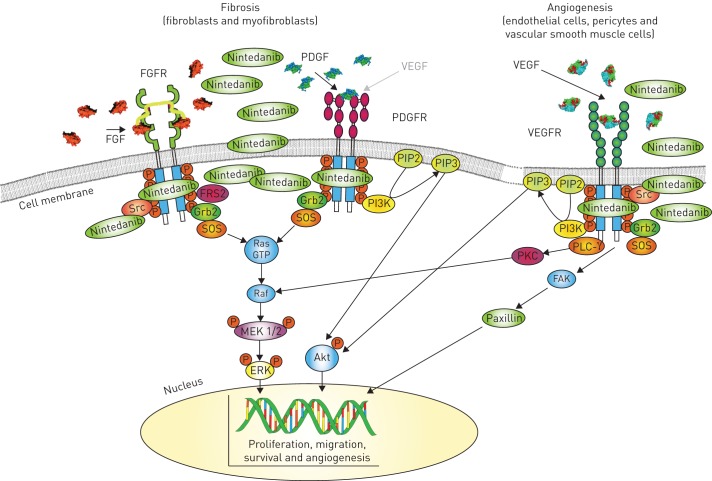
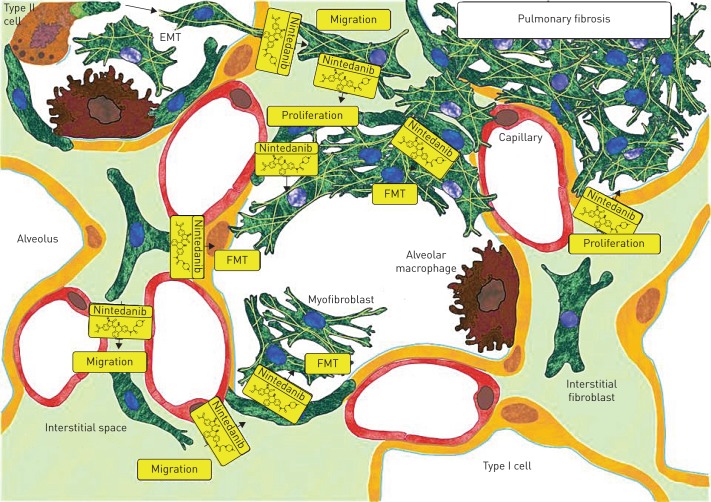
Idiopathic pulmonary fibrosis (IPF) is a progressive and ultimately fatal disease characterised by fibrosis of the lung parenchyma and loss of lung function. Although the pathogenic pathways involved in IPF have not been fully elucidated, IPF is believed to be caused by repetitive alveolar epithelial cell injury and dysregulated repair, in which there is uncontrolled proliferation of lung fibroblasts and differentiation of fibroblasts into myofibroblasts, which excessively deposit extracellular matrix (ECM) proteins in the interstitial space. A number of profibrotic mediators including platelet-derived growth factor (PDGF), fibroblast growth factor (FGF) and transforming growth factor-β are believed to play important roles in the pathogenesis of IPF. Nintedanib is a potent small molecule inhibitor of the receptor tyrosine kinases PDGF receptor, FGF receptor and vascular endothelial growth factor receptor. Data from in vitro studies have shown that nintedanib interferes with processes active in fibrosis such as fibroblast proliferation, migration and differentiation, and the secretion of ECM. In addition, nintedanib has shown consistent anti-fibrotic and anti-inflammatory activity in animal models of lung fibrosis. These data provide a strong rationale for the clinical efficacy of nintedanib in patients with IPF, which has recently been demonstrated in phase III clinical trials.
Overview
The claims and statistics of this paper haven’t been checked yet.
Free: it reads the open-access text and checks the first 5 claims that cite a source we can check. Create a free account to check every claim.
Integrity signals
Registry
Cites
Statistics
Figures
Verification
Claims the paper makes
The claims and statistics of this paper haven’t been checked yet.
Free: it reads the open-access text and checks the first 5 claims that cite a source we can check. Create a free account to check every claim.
Claims other papers make about this one
Each is checked against this paper’s own text: does it say what the citing paper says it does?
The source backs part of the claim, not all of it — or backs it for a different population, condition or comparison.
In the citing paper
“Nintedanib has inhibitory effects on platelet-derived growth factor receptors α/β (PDGFα/β), vascular endothelial growth factor (VEGF) receptors 1, 2 and 3, and fibroblast growth factor (FGF) receptor 1, 2, and 3, as well as potentiation of Src homology region 2 domain containing phosphatase 1 (SHP-1) [19,20].”
From Emerging pharmacological options in the treatment of idiopathic pulmonary fibrosis (IPF) (2024) · cites this paper as [19]
Experimental — accuracy not yet measuredThe source backs part of the claim, not all of it — or backs it for a different population, condition or comparison.
In the citing paper
“These observations indicate that the Pdgf pathway is crucial to disease pathogenesis.”
From Reference-based analysis of lung single-cell sequencing reveals a transitional profibrotic macrophage (2019) · cites this paper as [41]
Experimental — accuracy not yet measuredThe cited source says what the claim attributes to it.
In the citing paper
“In two phase 3 trials with patients suffering from interstitial lung disease, nintedanib profoundly lowered the decline in forced vital capacity (195, 198).”
From Unraveling SSc Pathophysiology; The Myofibroblast (2018) · cites this paper as [195]
The cited source says what the claim attributes to it.
In the citing paper
“The current standard-of-care (SOC) therapy regimen to treat IPF includes either nintedanib, a broadly acting inhibitor of receptor tyrosine kinases31, or pirfenidone, an inhibitor of TGFβ-mediated fibroblast-to-myofibroblast transition32.”
From A generative AI-discovered TNIK inhibitor for idiopathic pulmonary fibrosis: a randomized phase 2a trial (2025) · cites this paper as [31]
In the citing paper
“In vivo, nintedanib protects mice and rats against bleomycin-induced lung fibrosis (195, 196), and lowers the amount of lymphocytes and neutrophils but not macrophages in bronchoalveolar lavage liquid in this model.”
From Unraveling SSc Pathophysiology; The Myofibroblast (2018) · cites this paper as [195]
1 more claim about this paper
Create a free account to see every claim other papers make about this one.
Self-check
Percentages, sums and reported differences re-computed from the paper’s own numbers.
The self-check needs the paper’s full text.
Citations
Cites
The biology of VEGF and its receptors
Ferrara, N., Gerber, H.-P., & LeCouter, J. (2003) · Nature Medicine · doi:10.1038/nm0603-669 · Cited by 9,591
Raghu, G., Collard, H. R., Egan, J. J., Martinez, F. J., Behr, J., Brown, K. K., Colby, T. V., Cordier, J.-F., Flaherty, K. R., Lasky, J. A., et al. (2011) · American Journal of Respiratory and Critical Care Medicine · doi:10.1164/rccm.2009-040gl · Cited by 7,186
Efficacy and Safety of Nintedanib in Idiopathic Pulmonary Fibrosis
Richeldi, L., du Bois, R. M., Raghu, G., Azuma, A., Brown, K. K., Costabel, U., Cottin, V., Flaherty, K. R., Hansell, D. M., Inoue, Y., et al. (2014) · New England Journal of Medicine · doi:10.1056/nejmoa1402584 · Cited by 4,654
Self-citation(2002) · American Journal of Respiratory and Critical Care Medicine · doi:10.1164/ajrccm.165.2.ats01 · Cited by 4,196
A phase 3 trial of pirfenidone in patients with idiopathic pulmonary fibrosis.
King, T. E., Bradford, W. Z., Castro-Bernardini, S., Fagan, E. A., Glaspole, I., Glassberg, M. K., Gorina, E., Hopkins, P. M., Kardatzke, D., Lancaster, L., et al. (2014) · New England Journal of Medicine · doi:10.1056/nejmoa1402582 · Cited by 3,975
King, T. E., Pardo, A., & Selman, M. (2011) · The Lancet · doi:10.1016/s0140-6736(11)60052-4 · Cited by 2,194
Pirfenidone in patients with idiopathic pulmonary fibrosis (CAPACITY): two randomised trials
Noble, P. W., Albera, C., Bradford, W. Z., Costabel, U., Glassberg, M. K., Kardatzke, D., King, T. E., Lancaster, L., Sahn, S. A., Szwarcberg, J., et al. (2011) · The Lancet · doi:10.1016/s0140-6736(11)60405-4 · Cited by 2,154
Selman, M., King, T. E., & Pardo, A. (2001) · Annals of Internal Medicine · doi:10.7326/0003-4819-134-2-200101160-00015 · Cited by 1,786
Signal transduction by vascular endothelial growth factor receptors
Koch, S., Tugues, S., Li, X., Gualandi, L., & Claesson-Welsh, L. (2011) · Biochemical Journal · doi:10.1042/bj20110301 · Cited by 1,635
Idiopathic Pulmonary Fibrosis: Clinical Relevance of Pathologic Classification
KATZENSTEIN, A.-L. A., & MYERS, J. L. (1998) · American Journal of Respiratory and Critical Care Medicine · doi:10.1164/ajrccm.157.4.9707039 · Cited by 1,261
Cited by
Items 301–400 of 1,001
Karamalakova, Y. D., Stefanov, I., Georgieva, E., & Nikolova, G. (2022) · Antioxidants · doi:10.3390/antiox11030523 · Cited by 30
“[79] for nintedanib, these positive effects include effects on VEGF receptors, fibroblasts and platelet GF, tyrosine kinases (Src, Flt3, Lyn and Lck) [80] and suggest that effects on MCs function may be mediated by additional tyrosine kinases [81].”
BackgroundInhibition of MRTF activation as a clinically achievable anti-fibrotic mechanism for pirfenidone
Ma, H., Heiden, J. A. V., Uttarwar, S., Xi, Y., N’Diaye, E.-N., LaCanna, R., Caplazi, P., Gierke, S., Moffat, J. G., Wolters, P. J., et al. (2022) · European Respiratory Journal · doi:10.1183/13993003.00604-2022 · Cited by 30
Inhibition of Oncogenic Src Ameliorates Silica-Induced Pulmonary Fibrosis via PI3K/AKT Pathway
Hao, X., Jin, Y., Zhang, Y., Li, S., Cui, J., He, H., Guo, L., Fang, Y., & Liu, H. (2023) · International Journal of Molecular Sciences · doi:10.3390/ijms24010774 · Cited by 28
“(D) p-c-Src, TGF-β1, PDGF-BB, and VEGFR3 in the lungs of mice from the various groups.”
BackgroundInfluentialEffect of Antifibrotic Therapy on Survival in Patients With Idiopathic Pulmonary Fibrosis
de Andrade, J. A., Neely, M. L., Hellkamp, A. S., Culver, D. A., Kim, H. J., Liesching, T. N., Lobo, L. J., Ramaswamy, M., Safdar, Z., Bender, S. D., et al. (2022) · Clinical Therapeutics · doi:10.1016/j.clinthera.2023.03.003 · Cited by 29
Zhang, R., Dong, Y., Sun, M., Wang, Y., Cai, C., Zeng, Y., Wu, Y., & Zhao, Q. (2019) · Journal of Cancer · doi:10.7150/jca.26277 · Cited by 27
“In addition, nintedanib has been approved to treat patients with idiopathic pulmonary fibrosis (IPF) in clinical trials which is an effective inhibitor of fibrosis and its associated tumor-promoting effects in NSCLC [10,11].”
BackgroundChen, C., Lin, H.-C., Wang, Y., Wang, C., Lin, Y. S., & Lai, C. (2021) · PLoS ONE · doi:10.1371/journal.pone.0251636 · Cited by 31
“It can inhibit processes involved in fibrosis progression [5].”
BackgroundAberrant B Cell Receptor Signaling in Naïve B Cells from Patients with Idiopathic Pulmonary Fibrosis
Neys, S. F. H., Heukels, P., van Hulst, J. A. C., Rip, J., Wijsenbeek, M. S., Hendriks, R. W., & Corneth, O. B. J. (2021) · Cells · doi:10.3390/cells10061321 · Cited by 29
“Nintedanib is a receptor tyrosine kinase inhibitor which suppresses downstream signaling of FGFR and VEGFR, thereby dampening pro-fibrotic processes in IPF patients [35].”
BackgroundPlasticity towards Rigidity: A Macrophage Conundrum in Pulmonary Fibrosis
Sari, E., He, C., & Margaroli, C. (2022) · International Journal of Molecular Sciences · doi:10.3390/ijms231911443 · Cited by 29
“It targets multiple growth factor signaling pathways such as fibroblast growth factor receptor-1 (FGF-1), vascular endothelial growth factor receptor-2 (VEGFR-2), and platelet-derived growth factor receptor (PDGF-R) α and β [26].”
BackgroundSheu, C., Chang, W., Tsai, M., Liao, S., Chong, I., & Kuo, P. (2019) · Journal of Clinical Medicine · doi:10.3390/jcm8030308 · Cited by 27
“By competitively and reversibly blocking the receptor tyrosine kinases FGFR, VEGFR, and PDGFR, nintedanib inhibits fibroblasts proliferation, migration and transformation to myofibroblasts [12,13].”
BackgroundTherapeutic and diagnostic targeting of fibrosis in metabolic, proliferative and viral disorders
Sofias, A. M., Lorenzi, F. D., Peña, Q., Shalmani, A. A., Vucur, M., Wang, J., Kiessling, F. M., Shi, Y., Consolino, L., Storm, G., et al. (2021) · Advanced Drug Delivery Reviews · doi:10.1016/j.addr.2021.113831 · Cited by 28
“While their molecular mechanisms have not yet been completely elucidated, the evidence available suggests that pirfenidone inhibits TGF-β activity [11], while nintedanib acts as a multi-tyrosine kinase inhibitor targeting the vascular endothelial growth factor 1-3 (VEGFR1-3), fibroblast growth factor receptors 1-3 (FG…”
BackgroundTGFβ1-RCN3-TGFBR1 loop facilitates pulmonary fibrosis by orchestrating fibroblast activation
Wu, M., Wang, Z., Shi, X., Zan, D., Chen, H., Yang, S., Ding, F., Liu, Y., Tan, P., Ma, R. Z., et al. (2023) · Respiratory Research · doi:10.1186/s12931-023-02533-z · Cited by 28
“Pirfenidone and nintedanib are recently approved anti-profibrotic drugs for IPF and fibrotic ILD treatments [5, 6, 29, 44].”
BackgroundSultana, Z., Khatri, R., Yousefi, B., Shaikh, N., Jauch-Speer, S.-L., Schaub, D. P., Engeßer, J., Hellmig, M., Piegsa, V., Hube, A. L., et al. (2025) · Nature Immunology · doi:10.1038/s41590-025-02291-8 · Cited by 32
“We identified nintedanib 34,35 with the highest score for blocking PDGF signaling in PECs.”
Integrative analyses of genes associated with idiopathic pulmonary fibrosis
Wang, H., Xie, Q., Ou‐Yang, W., & Zhang, M. (2018) · Journal of Cellular Biochemistry · doi:10.1002/jcb.28153 · Cited by 29
Deterding, R. R., Griese, M., Deutsch, G. H., Warburton, D., DeBoer, E. M., Cunningham, S., Clément, A., Schwerk, N., Flaherty, K. R., Brown, K. K., et al. (2021) · ERJ Open Research · doi:10.1183/23120541.00805-2020 · Cited by 30
“Nintedanib treatment also decreased lung inflammation, granuloma formation and fibrosis in an animal model of silica-induced lung fibrosis [20] and reduced airway inflammation and remodelling following chronic allergic stimulation in ovalbumin-sensitised mice [21].”
BackgroundSelf-citationKamp, J. C., Neubert, L., Stark, H., Hinrichs, J. B., Boekhoff, C., Seidel, A. D., Ius, F., Haverich, A., Gottlieb, J., Welte, T., et al. (2022) · Cells · doi:10.3390/cells11040664 · Cited by 27
“RTK targeted by Nintendanib are platelet-derived growth factor receptor (PDGFR), fibroblast growth factor receptor (FGR) and vascular endothelial growth factor receptor (VEGFR) [31].”
BackgroundTargeting Chitinase 1 and Chitinase 3-Like 1 as Novel Therapeutic Strategy of Pulmonary Fibrosis
Lee, S., Lee, C.-M., Ma, B., Kamle, S., Elias, J. A., Zhou, Y., & Lee, C. G. (2022) · Frontiers in Pharmacology · doi:10.3389/fphar.2022.826471 · Cited by 32
The oncogenic landscape of the idiopathic pulmonary fibrosis: a narrative review
Stella, G. M., D’Agnano, V., Piloni, D., Saracino, L., Lettieri, S., Mariani, F., Lancia, A., Bortolotto, C., Rinaldi, P., Falanga, F., et al. (2022) · Translational Lung Cancer Research · doi:10.21037/tlcr-21-880 · Cited by 32
“Nintedanib is a multikinase inhibitor which also down-regulates protein and mRNA expression of extracellular matrix (ECM) proteins, fibronectin, and collagen 1a1 and inhibits (TGF)-β1-induced myofibroblast differentiate (34).”
BackgroundMagnini, D., Montemurro, G., Iovene, B., Tagliaboschi, L., Gerardi, R. E., Greco, E. L., Bruni, T., Fabbrizzi, A., Lombardi, F., & Richeldi, L. (2017) · Respiration · doi:10.1159/000475780 · Cited by 26
Pharmacological management of Idiopathic Pulmonary Fibrosis: current and emerging options
Trachalaki, A., Irfan, M., & Wells, A. U. (2020) · Expert Opinion on Pharmacotherapy · doi:10.1080/14656566.2020.1822326 · Cited by 26
Khedoe, P. P. S. J., Marges, E. R., Hiemstra, P. S., Ninaber, M. K., & Geelhoed, M. (2020) · Frontiers in Immunology · doi:10.3389/fimmu.2020.01990 · Cited by 26
“As nintedanib was recently approved for IPF treatment (90), its effectivity was also examined in SSc-ILD patients (91).”
BackgroundStrobel, B., Klein, H., Leparc, G., Stierstorfer, B., Gantner, F., & Kreuz, S. (2022) · Scientific Reports · doi:10.1038/s41598-022-16344-7 · Cited by 29
Assassi, S., Distler, O., Allanore, Y., Ogura, T., Varga, J., Vettori, S., Crestani, B., Voß, F., Alves, M., Stowasser, S., et al. (2022) · ACR Open Rheumatology · doi:10.1002/acr2.11483 · Cited by 24
“cesses fundamental to the progression of lung fibrosis (11,12).”
BackgroundSelf-citationUtility of nintedanib for severe idiopathic pulmonary fibrosis: a single-center retrospective study
Abe, M., Tsushima, K., Sakayori, M., Suzuki, K., Ikari, J., Terada, J., & Tatsumi, K. (2018) · Drug Design Development and Therapy · doi:10.2147/dddt.s179427 · Cited by 25
“Nintedanib is a tyrosine-kinase inhibitor and targets vascular endothelial growth factor receptors, fibroblast growth factor receptors, and platelet-derived growth factor receptors.(8,9) In the most recent international clinical practice guidelines, nintedanib received a conditional recommendation for the treatment of…”
Age-Related Dynamics of Lung-Resident Memory CD8+ T Cells in the Age of COVID-19
Goplen, N. P., Cheon, I. S., & Sun, J. (2021) · Frontiers in Immunology · doi:10.3389/fimmu.2021.636118 · Cited by 24
“Further, one of the frontline treatments (Nintedanib) that slows development of IPF by presumably targeting the kinase activities of PDGF, FGF, and VEGF receptors, inhibits src family tyrosine kinases, including the crucial T cell activating kinase Lck, with similar IC50 values (120, 121).”
BackgroundXu, Z., Li, H., Wen, F., Bai, C., Chen, P., Fan, F., Hu, N., Stowasser, S., & Kang, J. (2019) · Advances in Therapy · doi:10.1007/s12325-019-0887-1 · Cited by 23
Self-citationLin, D. C.-C., Qiao, L., Zhang, Y.-N., Liu, Y., & Liu, X. (2015) · Journal of Pharmaceutical and Biomedical Analysis · doi:10.1016/j.jpba.2015.08.024 · Cited by 24
Safety of nintedanib before lung transplant: an Italian case series
Balestro, E., Solidoro, P., Parigi, P., Boffini, M., Lucianetti, A., & Rea, F. (2018) · Respirology Case Reports · doi:10.1002/rcr2.312 · Cited by 25
Aschner, Y., & Downey, G. P. (2018) · American Journal of Respiratory Cell and Molecular Biology · doi:10.1165/rcmb.2018-0049tr · Cited by 25
“Nintedanib, for example, inhibits at least seven receptor and nonreceptor tyrosine kinases (PDGFR, FGFR, VEGFR, Flt-3, Src, Lck, and Lyn) with half-maximal inhibitory concentration values ranging from 13 to 610 nmol$/L2 (VEFGR-3 and FGFR-4, respectively) (174).”
BackgroundComeglio, P., Filippi, S., Sarchielli, E., Morelli, A., Cellai, I., Corno, C., Pini, A., Adorini, L., Vannelli, G. B., Maggi, M., et al. (2018) · Journal of Endocrinological Investigation · doi:10.1007/s40618-018-0913-1 · Cited by 23
Sköld, C. M., Arnheim‐Dahlström, L., Bartley, K., Janson, C., Kirchgaessler, K.-U., LEVINE, A. M., & Ferrara, G. (2019) · Respiratory Medicine · doi:10.1016/j.rmed.2019.06.001 · Cited by 26
Miura, Y., Ohkubo, H., Niimi, A., & Kanazawa, S. (2021) · ERJ Open Research · doi:10.1183/23120541.00345-2021 · Cited by 28
Cottin, V., Bonniaud, P., Cadranel, J. L., Crestani, B., Jouneau, S., Marchand-Adam, S., Nunès, H., Wémeau-Stervinou, L., Bergot, E., Blanchard, É., et al. (2022) · Revue des Maladies Respiratoires · doi:10.1016/j.rmr.2022.01.005 · Cited by 27
Huang, T., Kuo, C., Chen, C., Tseng, Y., Wu, C., & Lin, S. (2021) · BMC Pulmonary Medicine · doi:10.1186/s12890-021-01530-6 · Cited by 25
“Considering that pharmacodynamically nintedanib can only slow down and not reverse the fibrogenesis [3, 9], it is plausible that patients with higher levels of KL-6 and SPA (indicating more severe fibrotic destruction) would be less likely to exhibit a strong therapeutic response and more likely”
BackgroundSehgal, M., Jakhete, S. M., Manekar, A. G., & Sasikumar, S. (2022) · Heliyon · doi:10.1016/j.heliyon.2022.e09773 · Cited by 24
“The other drug, Nintedanib, acts as a potent inhibitor of the proangiogenic receptor tyrosine kinases, namely platelet-derived growth factor receptor, fibroblast growth factor receptor and vascular endothelial growth factor receptor, all of which are upregulated in specific cell types in the lung of IPF patients [110,…”
Highlights on Future Treatments of IPF: Clues and Pitfalls
Libra, A., Sciacca, E., Muscato, G., Sambataro, G., Spicuzza, L., & Vancheri, C. (2024) · International Journal of Molecular Sciences · doi:10.3390/ijms25158392 · Cited by 25
“Nintedanib, a tyrosine kinase inhibitor, targets receptors involved in fibrosis such as vascular endothelial growth factor receptor (VEGFR), fibroblast growth factor receptor (FGFR), and platelet-derived growth factor receptor (PDGFR) [51,52]. activation and collagen synthesis [49].”
BackgroundCottin, V., Crestani, B., Cadranel, J. L., Cordier, J. F., Marchand-Adam, S., Prévot, G., Wallaert, B., Bergot, E., Camus, P., Dalphin, J., et al. (2017) · Revue des Maladies Respiratoires · doi:10.1016/j.rmr.2017.07.018 · Cited by 25
“[101] Wollin L, Wex E, Pautsch A, et al.”
BackgroundRed-COLA1: a human fibroblast reporter cell line for type I collagen transcription
Wong, H. H., Seet, S. H., Bascom, C. C., Isfort, R. J., & Bard, F. (2020) · Scientific Reports · doi:10.1038/s41598-020-75683-5 · Cited by 26
Butel-Simoes, L. E., Haw, T. J., Williams, T. D., Sritharan, S., Gadre, P., Herrmann, S. M., Herrmann, J., Ngo, D. T. M., & Sverdlov, A. L. (2023) · Hypertension · doi:10.1161/hypertensionaha.122.17947 · Cited by 24
The Role of SOX9 in IGF-II-Mediated Pulmonary Fibrosis
Waldrep, K. M., Rodgers, J. I., Garrett, S. M., Wolf, B. J., & Feghali‐Bostwick, C. A. (2023) · International Journal of Molecular Sciences · doi:10.3390/ijms241411234 · Cited by 22
“Current drugs target receptor tyrosine kinases (nintedanib), interleukin-6 (tocilizumab), and TGFβ signaling (pirfenidone) [7,39,40].”
BackgroundOckham’s razor for the MET-driven invasive growth linking idiopathic pulmonary fibrosis and cancer
Stella, G. M., Gentile, A., Balderacchi, A. M., Meloni, F., Milan, M., & Benvenuti, S. (2016) · Journal of Translational Medicine · doi:10.1186/s12967-016-1008-4 · Cited by 23
Schmid, U., Liesenfeld, K., Fleury, A., Dallinger, C., & Freiwald, M. (2017) · Cancer Chemotherapy and Pharmacology · doi:10.1007/s00280-017-3452-0 · Cited by 22
Treatment of idiopathic pulmonary fibrosis with Nintedanib: an update
Wongkarnjana, A., Yanagihara, T., & Kolb, M. R. J. (2019) · Expert Review of Respiratory Medicine · doi:10.1080/17476348.2019.1673733 · Cited by 25
Self-citationTackling MARCKS‐PIP3 circuit attenuates fibroblast activation and fibrosis progression
Yang, D. C. H., Li, J., Xu, J., Oldham, J. M., Phan, S. H., Last, J. A., Wu, R., & Chen, C. (2019) · The FASEB Journal · doi:10.1096/fj.201901705r · Cited by 28
Hu, X., Zou, M., Ni, L., Zhang, M., Zheng, W., Liu, B., & Cheng, Z. (2022) · Frontiers in Pharmacology · doi:10.3389/fphar.2022.829673 · Cited by 21
“A single intratracheal dose of BLM in mice has been the most popular and best characterized animal model to investigate PF, which has provided valuable insight into the treatment of human IPF (Wollin et al., 2015; Glassberg et al., 2017).”
BackgroundAdvances in idiopathic pulmonary fibrosis diagnosis and treatment
Liu, H., Shen, J., & He, C. (2025) · Chinese Medical Journal - Pulmonary and Critical Care Medicine · doi:10.1016/j.pccm.2025.02.001 · Cited by 23
“64-66 Nintedanib, a tyrosine kinase inhibitor, targets multiple growth factor signaling pathways.”
Hagmeyer, L., Treml, M., Priegnitz, C., & Randerath, W. J. (2016) · Respiration · doi:10.1159/000444690 · Cited by 22
Wilfong, E. M., & Aggarwal, R. (2021) · Therapeutic Advances in Musculoskeletal Disease · doi:10.1177/1759720x211060907 · Cited by 22
Time-Dependent Molecular Motifs of Pulmonary Fibrogenesis in COVID-19
Kamp, J. C., Neubert, L., Ackermann, M., Stark, H., Werlein, C., Fuge, J., Haverich, A., Tzankov, A., Steinestel, K., Friemann, J., et al. (2022) · International Journal of Molecular Sciences · doi:10.3390/ijms23031583 · Cited by 25
Meta-Analysis of Effect of Nintedanib on Reducing FVC Decline Across Interstitial Lung Diseases
Bonella, F., Cottin, V., Valenzuela, C., Wijsenbeek, M. S., Voß, F., Rohr, K. B., Stowasser, S., & Maher, T. M. (2022) · Advances in Therapy · doi:10.1007/s12325-022-02145-x · Cited by 21
Self-citationThe Effect of Nintedanib in Post-COVID-19 Lung Fibrosis: An Observational Study
Saiphoklang, N., Patanayindee, P., & Ruchiwit, P. (2022) · Critical Care Research and Practice · doi:10.1155/2022/9972846 · Cited by 30
Idiopathic pulmonary fibrosis: Diagnosis, biomarkers and newer treatment protocols
Patel, H., Shah, J. R., Patel, D., Avanthika, C., Jhaveri, S., & Gor, K. (2022) · Disease-a-Month · doi:10.1016/j.disamonth.2022.101484 · Cited by 25
Yin, Y., Liu, S., Li, P., Luo, J., Liu, H., & Wu, W. (2023) · Biomedicine & Pharmacotherapy · doi:10.1016/j.biopha.2023.114543 · Cited by 26
He, X., Ji, J., Pei, Z., Luo, Z., Fang, S., Liu, X., Yan, L., Yan, H., & Guo, L. (2024) · Annals of Medicine · doi:10.1080/07853890.2024.2323097 · Cited by 26
Calverley, B. C., Kadler, K. E., & Pickard, A. (2020) · Cells · doi:10.3390/cells9092070 · Cited by 22
Tu, M., Lu, C., Jia, H., Chen, S., Wang, Y., Li, J., Cheng, J., Yang, M., & Zhang, G. (2024) · Journal of Translational Medicine · doi:10.1186/s12967-024-05698-3 · Cited by 24
“Furthermore, sustained myofibroblast phenotypes contribute to impaired lung repair, tissue scarring, distortion of alveolar structures, and irreversible decline in lung function [16, 17].”
BackgroundVascular involvement in idiopathic pulmonary fibrosis
Mondoni, M., Rinaldo, R. F., Ryerson, C. J., Albrici, C., Baccelli, A., Tirelli, C., Marchetti, F., Cefalo, J., Nalesso, G., Ferranti, G., et al. (2024) · ERJ Open Research · doi:10.1183/23120541.00550-2024 · Cited by 22
“It competitively blocks the kinase activity of several receptors, including VEGFR 1 – 3; PDGFR-α and - β ; and FGFR 1 – 3 [91], thus inhibiting proliferation, migration and transformation of lung fibroblasts [92, 93].”
Lemieszek, M. K., Rzeski, W., Golec, M., Maćkiewicz, B., Zwoliński, J., Dutkiewicz, J. K., & Milanowski, J. (2020) · Ecotoxicology and Environmental Safety · doi:10.1016/j.ecoenv.2020.110416 · Cited by 20
Diagnosis and Management of Fibrotic Interstitial Lung Diseases
Collins, B. F., & Luppi, F. (2021) · Clinics in Chest Medicine · doi:10.1016/j.ccm.2021.03.008 · Cited by 22
Nakamura, Y., & Shimizu, Y. (2023) · Cells · doi:10.3390/cells12040548 · Cited by 22
Pharmacological approaches to pulmonary fibrosis following COVID-19
Laššán, Š., Tesař, T., Tisonova, J., & Laššánová, M. (2023) · Frontiers in Pharmacology · doi:10.3389/fphar.2023.1143158 · Cited by 24
“Nintedanib is an orally active small molecule tyrosine kinase inhibitor that targets the platelet-derived growth factor (PDGF) receptor, vascular endothelial growth factor (VEGF) receptors and fibroblast growth factor (FGF) receptors (Wollin et al. 2015).”
BackgroundRecent Advances in Treatment of Systemic Sclerosis and Morphea
Teske, N. M., & Fett, N. M. (2023) · American Journal of Clinical Dermatology · doi:10.1007/s40257-023-00831-2 · Cited by 25
Antibody-mediated depletion of CCR10+EphA3+ cells ameliorates fibrosis in IPF
Hohmann, M. S., Habiel, D. M., Espíndola, M. S., Huang, G., Jones, I. C., Narayanan, R., Coelho, A. L., Oldham, J. M., Noth, I., Ma, S., et al. (2021) · JCI Insight · doi:10.1172/jci.insight.141061 · Cited by 23
BAL Transcriptomes Characterize Idiopathic Pulmonary Fibrosis Endotypes With Prognostic Impact
Sadeleer, L. D., Verleden, S. E., Schupp, J. C., McDonough, J. E., Goos, T., Yserbyt, J., Bargagli, E., Rottoli, P., Kaminski, N., Prasse, A., et al. (2022) · CHEST Journal · doi:10.1016/j.chest.2021.12.668 · Cited by 27
Paulín, F., Babini, A. M., Mamani, M. N., Mercado, J. F., & Caro, F. M. (2017) · Revista de investigaci�n Cl�nica · doi:10.24875/ric.17002162 · Cited by 22
Research Progress of Fibroblasts in Human Diseases
Li, X., Li, N., Wang, Y., Han, Q., & Sun, B. (2024) · Biomolecules · doi:10.3390/biom14111478 · Cited by 21
“Nintedanib, an intracellular tyrosine kinase inhibitor, targets multiple targets involved in pulmonary fibrosis [181].”
Li, Z., Geng, J., Xie, B., He, J., Wang, J., Peng, L., Hu, Y., Dai, H., & Wang, C. (2022) · Frontiers in Pharmacology · doi:10.3389/fphar.2022.834604 · Cited by 20
“In addition to differentiation, the abnormally elevated migration and proliferation of myofibroblasts are also considered important in the progression of pulmonary fibrosis (Wollin et al., 2015).”
BackgroundEvaluation of Proteasome Inhibitors in the Treatment of Idiopathic Pulmonary Fibrosis
Chen, I., Liu, Y., Wu, Y.-H., Lo, S., Dai, Z., Hsu, J., & Tseng, Y. (2022) · Cells · doi:10.3390/cells11091543 · Cited by 22
“Nintedanib is a small-molecule inhibitor of receptor tyrosine kinases, including FGF receptor, PDGF receptor, and VEGF receptor [94].”
BackgroundGinsenoside Rg3 attenuates pulmonary fibrosis by inhibiting endothelial to mesenchymal transition
Yun, E., Kwon, B. S., Kim, J., & Lee, A. (2023) · Animal Cells and Systems · doi:10.1080/19768354.2023.2244549 · Cited by 19
“They are known to have anti-fi brotic e ff ects, delay progression, and improve the survival rate by inhibiting fi broblast proliferation, ECM production, and myo fi broblast di ff erentiation (Wollin et al. 2015; Shah et al. 2021).”
BackgroundAnimal models of silicosis: fishing for new therapeutic targets and treatments
Martínez‐López, A., Candel, S., & Tyrkalska, S. D. (2023) · European Respiratory Review · doi:10.1183/16000617.0078-2023 · Cited by 25
Inflammatory Network of Liver Fibrosis and How It Can Be Targeted Therapeutically
Lowe, K., Tanase, C. E., Maghami, S., Fisher, L. E., & Ghaemmaghami, A. M. (2023) · Immuno · doi:10.3390/immuno3040023 · Cited by 22
Zhao, P., Cai, Z., Tian, Y., Li, J., Li, K., Li, M., Bai, Y., & Li, J. (2021) · International Immunopharmacology · doi:10.1016/j.intimp.2021.108360 · Cited by 21
3D printed drug-eluting stents: Toward personalized therapy for airway stenosis
Krivitsky, A., Paunović, N., Klein, K., Coulter, F. B., Schleich, S., Karol, A. A., Bauer, A., Krivitsky, V., Lohmann, V., Carril, P. C., et al. (2024) · Journal of Controlled Release · doi:10.1016/j.jconrel.2024.11.031 · Cited by 18
Leonard‐Duke, J., Agro, S. M. J., Csordas, D. J., Bruce, A. C., Eggertsen, T. G., Tavakol, T. N., Comlekoglu, T., Barker, T. H., Bonham, C. A., Saucerman, J. J., et al. (2024) · PNAS Nexus · doi:10.1093/pnasnexus/pgae551 · Cited by 20
“Nintedanib also inhibits fibroblast growth factor receptor (FGFR), which is known to regulate angiogenesis and pericyte recruitment (42, 43).”
Cordeiro, C. R., Campos, P., Carvalho, L., Borba, A., Clemente, S., Freitas, S., Furtado, S. T., Jesus, J. M., Leal, C., Marqués, J., et al. (2017) · Revista Portuguesa de Pneumologia · doi:10.1016/j.rppnen.2017.05.005 · Cited by 23
Mou, Y., Liu, J., Pan, T. S., Wang, Q., Miao, K., Xu, Y., Xiong, W., & Yu, J. (2021) · Biomedicine & Pharmacotherapy · doi:10.1016/j.biopha.2021.111500 · Cited by 20
Nintedanib ameliorates imiquimod-induced psoriasis in mice by inhibiting NF-κB and VEGFR2 signaling
Li, X., Xi, B., Miao, Y., Ma, X., Zhang, J., Gao, J., Wei, W., Zhou, H., & Yang, C. (2021) · International Immunopharmacology · doi:10.1016/j.intimp.2021.108129 · Cited by 20
Hao, M., Fu, R., Tai, J., Tian, Z., Yuan, X., Chen, Y., Wang, M., Jiang, H., Ji, M., Lai, F., et al. (2022) · Acta Pharmaceutica Sinica B · doi:10.1016/j.apsb.2022.10.006 · Cited by 19
“Fibrous tissue density Z IOD/blue area (2)”
Ma, J., Li, H., Jia, J., Wang, W., Liu, W., Yao, X., Li, T., & Ren, B. (2022) · Journal of Molecular Liquids · doi:10.1016/j.molliq.2022.121064 · Cited by 18
The usual Interstitial pneumonia pattern in autoimmune rheumatic diseases
Luppi, F., Manfredi, A., Faverio, P., Andersen, M. B., Bono, F., Pagni, F., Salvarani, C., Bendstrup, E. M., & Sebastiani, M. (2023) · BMC Pulmonary Medicine · doi:10.1186/s12890-023-02783-z · Cited by 19
“Nintedanib acts as a triple tyrosine kinase inhibitor, simultaneously inhibiting signaling pathways activated by platelet-derived growth factor (PDGF), fibroblast growth factor (FGF), as well as vascular endothelial growth factor (VEGF) [73].”
BackgroundWang, X., Goyal, M., Gadhave, D. G., & Gupta, V. (2024) · Journal of Drug Delivery Science and Technology · doi:10.1016/j.jddst.2024.105615 · Cited by 19
Pathological mechanisms and novel drug targets in fibrotic interstitial lung disease
Nishioka, Y., Araya, J., Tanaka, Y., & Kumanogoh, A. (2024) · Inflammation and Regeneration · doi:10.1186/s41232-024-00345-2 · Cited by 20
“These agents act predominantly by inhibiting fibroblast migration, activation, and differentiation [1, 5, 6].”
BackgroundInfluentialHuang, X., Wang, W., Yuan, H., Sun, J., Li, L., Wu, X., Luo, J., & Gu, Y. (2016) · The Tohoku Journal of Experimental Medicine · doi:10.1620/tjem.239.251 · Cited by 19
The safety of new drug treatments for idiopathic pulmonary fibrosis
Fletcher, S., Jones, M. G., Spinks, K., Sgalla, G., Marshall, B. G., Limbrey, R., & Richeldi, L. (2016) · Expert Opinion on Drug Safety · doi:10.1080/14740338.2016.1218470 · Cited by 20
Spagnolo, P. (2017) · Milestones in drug therapy · doi:10.1007/978-3-0348-0977-1_11 · Cited by 18
Reversion of in vivo fibrogenesis by novel chromone scaffolds
Kim, H.-S., Yoon, Y.-M., Meang, M. K., Park, Y. E., Lee, J. Y., Lee, T. H., Lee, J. E., Kim, I. H., & Youn, B. (2019) · EBioMedicine · doi:10.1016/j.ebiom.2018.12.017 · Cited by 18
“Nintedanib is known to be an angiokinase inhibitor that antagonizes TGF-βR, FGFR, and PDGFR, whereas the mode of action (MOA) of pirfenidone remains elusive [32].”
BackgroundMitochondrial antiviral signaling protein is crucial for the development of pulmonary fibrosis
Kim, S., Lee, J. Y., Yoon, C. M., Shin, H. J., Lee, S. W., Rosas, I. O., Herzog, E. L., Cruz, C. S. D., Kaminski, N., & Kang, M. (2020) · European Respiratory Journal · doi:10.1183/13993003.00652-2020 · Cited by 19
Rahaghi, F., Belperio, J. A., Fitzgerald, J., Gulati, M., Hallowell, R. W., Highland, K. B., Huie, T. J., Kim, G. H. J., Kolb, M. R. J., Lasky, J. A., et al. (2021) · Clinical Medicine Insights Circulatory Respiratory and Pulmonary Medicine · doi:10.1177/11795484211006050 · Cited by 21
Self-citationPrincipi, L., Ferrini, E., Ciccimarra, R., Pagani, L., Chinello, C., Previtali, P., Smith, A. J., Villetti, G., Zoboli, M., Ravanetti, F., et al. (2023) · International Journal of Molecular Sciences · doi:10.3390/ijms24054410 · Cited by 19
“The drug is a triple tyrosine kinase inhibitor (TKI) that targets the vascular endothelial growth factor receptor (VEGFR), the platelet-derived growth factor receptor (PDGFR), and the fibroblast growth factor receptor (FGFR) [5].”
BackgroundSegurança e tolerabilidade de Nintedanibe em pacientes com fibrose pulmonar idiopática no Brasil
Pereira, C. A. D. C., Martínez, J. A. B., Baldi, B. G., Jezler, S. F. D. O., Rubin, A. S., Rufino, R., Zonzin, G., Quaresma, M., Trampisch, M., & Rabahi, M. F. (2019) · Jornal Brasileiro de Pneumologia · doi:10.1590/1806-3713/e20180414 · Cited by 25
Emerging pharmacological options in the treatment of idiopathic pulmonary fibrosis (IPF)
Aribindi, K., Liu, G. Y., & Albertson, T. E. (2024) · Expert Review of Clinical Pharmacology · doi:10.1080/17512433.2024.2396121 · Cited by 17
“…inhibitory effects on platelet-derived growth factor receptors α/β (PDGFα/ β), vascular endothelial growth factor (VEGF) receptors 1, 2 and 3, and fibroblast growth factor (FGF) receptor 1, 2, and 3, as well as potentiation of Src homology region 2 domain containing phosphatase 1 (SHP-1) [19,20].”
Idiopathic Pulmonary Fibrosis: Where do We Stand and How Far to Go?
Singh, V., Ulasov, I., Gupta, S., Singh, A., Roy, V. K., & Kharwar, R. K. (2024) · Discovery Medicine · doi:10.24976/discov.med.202436180.3 · Cited by 17
Maher, T. M., Stowasser, S., Nishioka, Y., White, E. S., Cottin, V., Noth, I., Selman, M., Blahova, Z., Wachtlin, D., Diefenbach, C., et al. (2018) · BMJ Open Respiratory Research · doi:10.1136/bmjresp-2018-000325 · Cited by 18
“In lung fibroblasts from patients with IPF, nintedanib reduces fibroblast/ myofibroblast proliferation and differentiation, induces secretion of MMP-2 and reduces ECM secretion.(27) In clinical trials, nintedanib slowed disease progression by reducing the annual rate of decline in FVC compared with placebo,(29) 30 res…”
BackgroundSelf-citationChen, C., Tung, H.-Y., Tseng, Y., Huang, J., Shi, L.-S., & Ye, Y. (2022) · Life Sciences · doi:10.1016/j.lfs.2022.120950 · Cited by 19
Mechanistic studies of MALAT1 in respiratory diseases
Wu, W., Wang, S., Zhang, L., Mao, B., Wang, B., Wang, X., Zhao, D., Zhao, P., Mou, Y., & Yan, P. (2022) · Frontiers in Molecular Biosciences · doi:10.3389/fmolb.2022.1031861 · Cited by 19
“Simultaneous targeting these proangiogenic receptors may enhance their effectiveness as antitumor agents and overcome resistance to VEGF- and VEGFR-2-targeting drugs (Liu et al., 2014; Wollin et al., 2015).”
BackgroundPan, L., Meng, F., Wang, W., Wang, X.-H., Shen, H., Bao, P., Kang, J., & Kong, D. (2023) · Frontiers in Immunology · doi:10.3389/fimmu.2022.1072612 · Cited by 17
The Treatment of Lung Involvement in Systemic Sclerosis
Ruaro, B., Confalonieri, M., Matucci‐Cerinic, M., Salton, F., Confalonieri, P., Santagiuliana, M., Citton, G. M., Baratella, E., & Bruni, C. (2021) · Pharmaceuticals · doi:10.3390/ph14020154 · Cited by 19
“Nintedanib is an intracellular tyrosine kinase inhibitor approved for the first time for the treatment of idiopathic pulmonary fibrosis (IPF) [82,83].”
BackgroundInfluentialAntifibrotic drugs in lung transplantation and chronic lung allograft dysfunction: a review
Bos, S., Sadeleer, L. D., Vanstapel, A., Beeckmans, H., Sacreas, A., Yserbyt, J., Wuyts, W. A., & Vos, R. (2021) · European Respiratory Review · doi:10.1183/16000617.0050-2021 · Cited by 26
Cottin, V., Bonniaud, P., Cadranel, J. L., Crestani, B., Jouneau, S., Marchand-Adam, S., Nunès, H., Wémeau-Stervinou, L., Bergot, E., Blanchard, É., et al. (2022) · Respiratory Medicine and Research · doi:10.1016/j.resmer.2022.100948 · Cited by 25
Transforming growth factor β1 alters the 3′-UTR of mRNA to promote lung fibrosis
Ko, J., Mills, T., Huang, J., Chen, N., Mertens, T. C. J., Collum, S. D., Lee, G., Xiang, Y., Han, L., Zhou, Y., et al. (2019) · Journal of Biological Chemistry · doi:10.1074/jbc.ra119.009148 · Cited by 18
“The only drugs that slow down the progression of IPF are pirfenidone and nintedanib, and they indeed target multiple signaling molecules (51, 52).”
BackgroundCyclic Stretching of Fibrotic Microtissue Array for Evaluation of Anti-Fibrosis Drugs
Asmani, M., Kotei, C., Hsia, I., Marecki, L., Wang, T., Zhou, C., & Zhao, R. (2019) · Cellular and Molecular Bioengineering · doi:10.1007/s12195-019-00590-3 · Cited by 16
Metadata
- Authors
- Wollin, L., Wex, E., Pautsch, A., Schnapp, G., Hostettler, K. E., Stowasser, S., & Kolb, M.
- Affiliations
- Boehringer Ingelheim (Germany) (DE)
- University Hospital of Basel (CH)
- McMaster University (CA)
- Corresponding author
- Wollin, Lutz
- ORCID
- Venue
- European Respiratory Journal
- Publisher
- European Respiratory Society (ERS)
- Published
- 2015-03-05
- Volume
- 45
- Issue
- 5
- Pages
- 1434-1445
- ISSN
- 0903-1936 (ISSN-L)
- 1399-3003
- PMC
- PMC4416110
- OpenAlex
- W2120791222
- Cited by
- 1,005
- References
- 88
- Citations by year
- 2026: 90 · 2025: 118 · 2024: 103 · 2023: 133 · 2022: 123 · 2021: 111 · 2020: 82 · 2019: 78 · 2018: 60 · 2017: 56 · 2016: 37 · 2015: 14
- FWCI
- 9.87
- Type
- journal article
- Language
- en
- Open access
- hybrid
- doi.org
- Licence
- cc-by-nc
- Locations
- European Respiratory Journal (publishedVersion, cc-by-nc)
- Europe PMC (PubMed Central) (publishedVersion, cc-by-nc)
- PubMed Central (publishedVersion, cc-by-nc)
- PubMed (publishedVersion)
- Funders
- Boehringer Ingelheim
- Topics
- Health Sciences › Medicine › Pulmonary and Respiratory Medicine › Interstitial Lung Diseases and Idiopathic Pulmonary Fibrosis
- Health Sciences › Medicine › Pulmonary and Respiratory Medicine › Pulmonary Hypertension Research and Treatments
- Health Sciences › Medicine › Surgery › Transplantation: Methods and Outcomes
- Keywords
- nintedanib, idiopathic pulmonary fibrosis, mechanism of action, PDGF receptor inhibition, VEGF receptor inhibition, receptor tyrosine kinase inhibitors, fibroblast proliferation, myofibroblast differentiation, extracellular matrix deposition, alveolar epithelial cell injury, antifibrotic therapy, anti-inflammatory activity
- MeSH terms
- Animals, Bleomycin, Cell Differentiation, Clinical Trials as Topic, Enzyme Inhibitors, Extracellular Matrix, Fibroblast Growth Factors, Fibroblasts, Fibrosis, Humans, Indoles, Lung, Lung Diseases, Platelet-Derived Growth Factor, Silicon Dioxide, Transforming Growth Factor beta, Apoptosis, Cell Proliferation, Idiopathic Pulmonary Fibrosis
About these checks
Registry, retraction, Cites and statistics results are computed, not judged, with one exception: a printed reference that no index lists is read once by a model before it counts as a citation error. Claims are extracted by a model and kept only when their quote appears verbatim in the text; each cited source is then checked, with a model’s help, for whether it says what the claim relies on. Those verdicts can be wrong — read the claim’s quote and the cited source before relying on one.
Statistics and arithmetic are recomputed, not judged.
Confidence bands are shown only for fields calibrated on our annotated test set. None is calibrated yet, so no band is shown.
What counts as a claim ›How we measure confidence ›How we check this ›
Are you an author, or do you see a problem with this page? Request a review
Data sources
Bibliographic data: Semantic Scholar, OpenAlex, Crossref.
Contains information from the Semantic Scholar Academic Graph Datasets, made available under the ODC Attribution License (ODC-BY 1.0).
Semantic Scholar’s data is described in: Kinney, R., et al. (2023). The Semantic Scholar Open Data Platform. arXiv:2301.10140.
