

Mode of action of nintedanib in the treatment of idiopathic pulmonary fibrosis
Open accessThe DOI matches its Crossref record; 90 of the 90 references it cites were found in a registry or an index.
Abstract
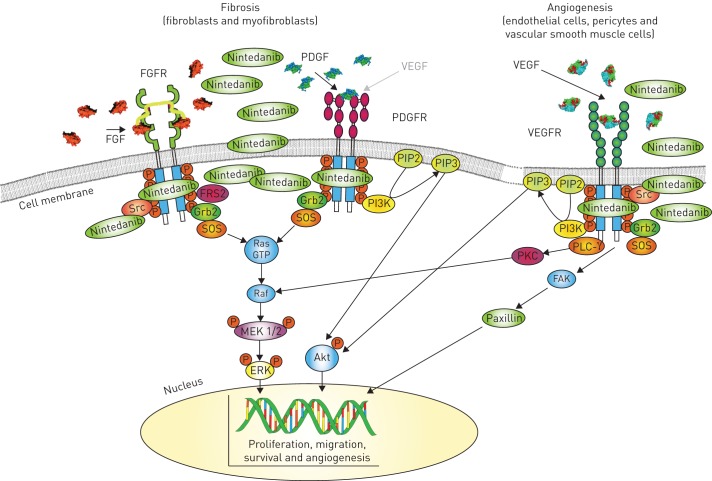
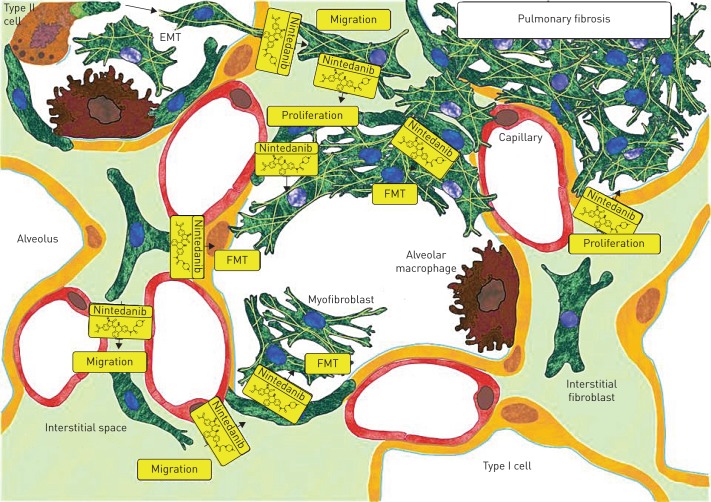
Idiopathic pulmonary fibrosis (IPF) is a progressive and ultimately fatal disease characterised by fibrosis of the lung parenchyma and loss of lung function. Although the pathogenic pathways involved in IPF have not been fully elucidated, IPF is believed to be caused by repetitive alveolar epithelial cell injury and dysregulated repair, in which there is uncontrolled proliferation of lung fibroblasts and differentiation of fibroblasts into myofibroblasts, which excessively deposit extracellular matrix (ECM) proteins in the interstitial space. A number of profibrotic mediators including platelet-derived growth factor (PDGF), fibroblast growth factor (FGF) and transforming growth factor-β are believed to play important roles in the pathogenesis of IPF. Nintedanib is a potent small molecule inhibitor of the receptor tyrosine kinases PDGF receptor, FGF receptor and vascular endothelial growth factor receptor. Data from in vitro studies have shown that nintedanib interferes with processes active in fibrosis such as fibroblast proliferation, migration and differentiation, and the secretion of ECM. In addition, nintedanib has shown consistent anti-fibrotic and anti-inflammatory activity in animal models of lung fibrosis. These data provide a strong rationale for the clinical efficacy of nintedanib in patients with IPF, which has recently been demonstrated in phase III clinical trials.
Overview
The claims and statistics of this paper haven’t been checked yet.
Free: it reads the open-access text and checks the first 5 claims that cite a source we can check. Create a free account to check every claim.
Integrity signals
Registry
Cites
Statistics
Figures
Verification
Claims the paper makes
The claims and statistics of this paper haven’t been checked yet.
Free: it reads the open-access text and checks the first 5 claims that cite a source we can check. Create a free account to check every claim.
Claims other papers make about this one
Each is checked against this paper’s own text: does it say what the citing paper says it does?
The source backs part of the claim, not all of it — or backs it for a different population, condition or comparison.
In the citing paper
“Nintedanib has inhibitory effects on platelet-derived growth factor receptors α/β (PDGFα/β), vascular endothelial growth factor (VEGF) receptors 1, 2 and 3, and fibroblast growth factor (FGF) receptor 1, 2, and 3, as well as potentiation of Src homology region 2 domain containing phosphatase 1 (SHP-1) [19,20].”
From Emerging pharmacological options in the treatment of idiopathic pulmonary fibrosis (IPF) (2024) · cites this paper as [19]
Experimental — accuracy not yet measuredThe source backs part of the claim, not all of it — or backs it for a different population, condition or comparison.
In the citing paper
“These observations indicate that the Pdgf pathway is crucial to disease pathogenesis.”
From Reference-based analysis of lung single-cell sequencing reveals a transitional profibrotic macrophage (2019) · cites this paper as [41]
Experimental — accuracy not yet measuredThe cited source says what the claim attributes to it.
In the citing paper
“In two phase 3 trials with patients suffering from interstitial lung disease, nintedanib profoundly lowered the decline in forced vital capacity (195, 198).”
From Unraveling SSc Pathophysiology; The Myofibroblast (2018) · cites this paper as [195]
The cited source says what the claim attributes to it.
In the citing paper
“The current standard-of-care (SOC) therapy regimen to treat IPF includes either nintedanib, a broadly acting inhibitor of receptor tyrosine kinases31, or pirfenidone, an inhibitor of TGFβ-mediated fibroblast-to-myofibroblast transition32.”
From A generative AI-discovered TNIK inhibitor for idiopathic pulmonary fibrosis: a randomized phase 2a trial (2025) · cites this paper as [31]
In the citing paper
“In vivo, nintedanib protects mice and rats against bleomycin-induced lung fibrosis (195, 196), and lowers the amount of lymphocytes and neutrophils but not macrophages in bronchoalveolar lavage liquid in this model.”
From Unraveling SSc Pathophysiology; The Myofibroblast (2018) · cites this paper as [195]
1 more claim about this paper
Create a free account to see every claim other papers make about this one.
Self-check
Percentages, sums and reported differences re-computed from the paper’s own numbers.
The self-check needs the paper’s full text.
Citations
Cites
The biology of VEGF and its receptors
Ferrara, N., Gerber, H.-P., & LeCouter, J. (2003) · Nature Medicine · doi:10.1038/nm0603-669 · Cited by 9,591
Raghu, G., Collard, H. R., Egan, J. J., Martinez, F. J., Behr, J., Brown, K. K., Colby, T. V., Cordier, J.-F., Flaherty, K. R., Lasky, J. A., et al. (2011) · American Journal of Respiratory and Critical Care Medicine · doi:10.1164/rccm.2009-040gl · Cited by 7,186
Efficacy and Safety of Nintedanib in Idiopathic Pulmonary Fibrosis
Richeldi, L., du Bois, R. M., Raghu, G., Azuma, A., Brown, K. K., Costabel, U., Cottin, V., Flaherty, K. R., Hansell, D. M., Inoue, Y., et al. (2014) · New England Journal of Medicine · doi:10.1056/nejmoa1402584 · Cited by 4,654
Self-citation(2002) · American Journal of Respiratory and Critical Care Medicine · doi:10.1164/ajrccm.165.2.ats01 · Cited by 4,196
A phase 3 trial of pirfenidone in patients with idiopathic pulmonary fibrosis.
King, T. E., Bradford, W. Z., Castro-Bernardini, S., Fagan, E. A., Glaspole, I., Glassberg, M. K., Gorina, E., Hopkins, P. M., Kardatzke, D., Lancaster, L., et al. (2014) · New England Journal of Medicine · doi:10.1056/nejmoa1402582 · Cited by 3,975
King, T. E., Pardo, A., & Selman, M. (2011) · The Lancet · doi:10.1016/s0140-6736(11)60052-4 · Cited by 2,194
Pirfenidone in patients with idiopathic pulmonary fibrosis (CAPACITY): two randomised trials
Noble, P. W., Albera, C., Bradford, W. Z., Costabel, U., Glassberg, M. K., Kardatzke, D., King, T. E., Lancaster, L., Sahn, S. A., Szwarcberg, J., et al. (2011) · The Lancet · doi:10.1016/s0140-6736(11)60405-4 · Cited by 2,154
Selman, M., King, T. E., & Pardo, A. (2001) · Annals of Internal Medicine · doi:10.7326/0003-4819-134-2-200101160-00015 · Cited by 1,786
Signal transduction by vascular endothelial growth factor receptors
Koch, S., Tugues, S., Li, X., Gualandi, L., & Claesson-Welsh, L. (2011) · Biochemical Journal · doi:10.1042/bj20110301 · Cited by 1,635
Idiopathic Pulmonary Fibrosis: Clinical Relevance of Pathologic Classification
KATZENSTEIN, A.-L. A., & MYERS, J. L. (1998) · American Journal of Respiratory and Critical Care Medicine · doi:10.1164/ajrccm.157.4.9707039 · Cited by 1,261
Cited by
Items 401–500 of 1,001
Dowdall, N., & Hoare, T. R. (2025) · Advanced Healthcare Materials · doi:10.1002/adhm.202501006 · Cited by 18
Zhang, Y., Qi, C., Wei, Q., Li, Y., & Tian, P. (2025) · Respiratory Research · doi:10.1186/s12931-025-03294-7 · Cited by 17
“Although nintedanib was originally developed as an anticancer agent, it is also a novel therapeutic agent for the treat-ment of IPF because of its potent antifibrotic and anti-inflammatory activities, which can slow the progression of pulmonary fibrosis [156].”
Kreuder, L., Bissey, P.-A., Yip, K. W., & Liu, F. (2025) · International Journal of Radiation Biology · doi:10.1080/09553002.2025.2540353 · Cited by 18
Advances and challenges in nintedanib drug delivery
Velagacherla, V., Suresh, A., Mehta, C. H., & Nayak, U. Y. (2021) · Expert Opinion on Drug Delivery · doi:10.1080/17425247.2021.1985460 · Cited by 16
SHP2 : The protein tyrosine phosphatase involved in chronic pulmonary inflammation and fibrosis
Chang, C., Lin, C., Chen, B.-C., Lin, P., & Chen, C. (2021) · IUBMB Life · doi:10.1002/iub.2559 · Cited by 21
“Tyrosine phosphorylation-related signaling pathways are tightly modulated by protein-tyrosine kinases (PTKs) and PTPs, which participate in regulating cellular responses to numerous growth factors.6,7 Emerging studies have confirmed that receptor tyrosine kinases (RTKs), such as PDGF receptors (PDGFRs), vascular endot…”
BackgroundDiagnosis of Fibrotic Hypersensitivity Pneumonitis: Is There a Role for Biomarkers?
Pereira, J. O., Fernandes, V., Alfaro, T. M., Freitas, S., & Cordeiro, C. R. (2023) · Life · doi:10.3390/life13020565 · Cited by 16
Štefániková, M., Doubková, M., Ovesná, P., Šterclová, M., Lacina, L., Žůrková, M., Plačková, M., Bartoš, V., Janíčková, I., Bittenglová, R., et al. (2023) · BMC Pulmonary Medicine · doi:10.1186/s12890-023-02450-3 · Cited by 19
“Studies showed that nintedanib inhibited the proliferation and activation of human fibroblasts and showed antifibrotic and antiinflammatory activity [9].”
BackgroundInhibition of tyrosine kinase Fgr prevents radiation-induced pulmonary fibrosis (RIPF)
Mukherjee, A., Epperly, M. W., Fisher, R., Hou, W., Shields, D. S., Huq, M. S., Pifer, P. M., Mulherkar, R., Wilhite, T. J., Wang, H., et al. (2023) · Cell Death Discovery · doi:10.1038/s41420-023-01538-3 · Cited by 17
“CXCL5 has been associated with several inflammatory and fibrotic diseases including IPF (elevated levels were detected in the BAL fluid of IPF patients) [26, 34].”
BackgroundChong, D. L. W., Mikolasch, T., Sahota, J., Rebeyrol, C., Garthwaite, H. S., Booth, H., Heightman, M., Denneny, E., José, R. J. P., Khawaja, A. A., et al. (2023) · American Journal of Physiology-Lung Cellular and Molecular Physiology · doi:10.1152/ajplung.00227.2022 · Cited by 20
“Studies focused on the pro fi brotic role of PGDF in IPF have shown that inhibiting PDGF-BB signaling with Imatinib (a tyrosine kinase inhibitor of PDGFR) or APB5 (a PDGFR-b blocking antibody) attenuates bleomycin-induced PF (50, 51).”
Joannes, A., Voisin, T., Morzadec, C., Letellier, A., Llamas‐Gutierrez, F., Chiforeanu, D. C., Naourès, C. L., Guillot, S., Latour, B. R. D., Rouzé, S., et al. (2023) · Pulmonary Pharmacology & Therapeutics · doi:10.1016/j.pupt.2023.102267 · Cited by 22
Self-citationEvidence from recent clinical trials in fibrotic interstitial lung diseases
Cottin, V., & Valenzuela, C. (2024) · Current Opinion in Pulmonary Medicine · doi:10.1097/mcp.0000000000001089 · Cited by 18
LRG1-Targeted Nintedanib Delivery for Enhanced Renal Fibrosis Mitigation
Zhang, Y., Wang, L., Yang, X. J., Fan, L., Li, Y., Zhu, F., Zhu, A., Du, S., Min, H., & Qi, Y. (2024) · Nano Letters · doi:10.1021/acs.nanolett.4c03315 · Cited by 20
Venetsanopoulou, A. I., Ntinopoulou, M., Papagianni, E., Koletsos, N., Voulgari, P. V., & Chrysanthopoulou, A. (2024) · Frontiers in Immunology · doi:10.3389/fimmu.2024.1480594 · Cited by 19
Nintedanib: a new treatment for idiopathic pulmonary fibrosis
Cottin, V. (2015) · Clinical Investigation · doi:10.4155/cli.15.27 · Cited by 18
Tyrosine kinase inhibitor BIBF1000 does not hamper right ventricular pressure adaptation in rats
de Raaf, M. A., Herrmann, F. E., Schalij, I., de Man, F. S., Noordegraaf, A. V., Guignabert, C., Wollin, L., & Bogaard, H. J. (2016) · American Journal of Physiology-Heart and Circulatory Physiology · doi:10.1152/ajpheart.00656.2015 · Cited by 17
Self-citationTolerability of nintedanib-related diarrhea in patients with idiopathic pulmonary fibrosis
Hirasawa, Y., Abe, M., Terada, J., Sakayori, M., Suzuki, K., Yoshioka, K., Kawasaki, T., Tsushima, K., & Tatsumi, K. (2020) · Pulmonary Pharmacology & Therapeutics · doi:10.1016/j.pupt.2020.101917 · Cited by 16
Conca, W., Weheba, I., Abouzied, M., Abdelsayed, A., Aleyouni, Y., Mutairy, E. A., Bakshi, N., & Khalid, M. (2020) · Frontiers in Pharmacology · doi:10.3389/fphar.2020.585761 · Cited by 16
“With regard to the fibrotic component of RPILD, pirfenidone delays the progression of lung fibrosis (Li et al., 2016), and nintedanib, an anti-fibrotic tyrosine kinase inhibitor, decreases the rate of decline in forced vital capacity (FVC) in various ILDs (Richeldi et al., 2014; Wollin et al., 2015; Distler et al., 20…”
BackgroundErre, G. L., Sebastiani, M., Manfredi, A., Gerratana, E., Atzeni, F., Passiu, G., & Mangoni, A. A. (2021) · Drugs in Context · doi:10.7573/dic.2020-8-6 · Cited by 20
Treatment of Idiopathic Pulmonary Fibrosis
Abuserewa, S. T. H., Duff, R., & Becker, G. (2021) · Cureus · doi:10.7759/cureus.15360 · Cited by 18
“Mechanism of action Tyrosine kinase receptor blocker preventing the release of fibrogenic growth factors and thus slows down fibrosis [15,16].”
BackgroundAlonso‐Pérez, J., Carrasco‐Rozas, A., Borrell-Pagés, M., Fernández‐Simón, E., Piñol‐Jurado, P., Badimón, L., Wollin, L., Lleixà, C., Gallardo, E., Olivé, M., et al. (2022) · Biomedicines · doi:10.3390/biomedicines10102629 · Cited by 19
Self-citationNasonov, E. L., Ananyeva, L. P., & Avdeev, S. N. (2022) · Rheumatology Science and Practice · doi:10.47360/1995-4484-2022-1 · Cited by 17
Darwish, H. W., Attwa, M. W., & Kadi, A. A. (2016) · Tropical Journal of Pharmaceutical Research · doi:10.4314/tjpr.v15i11.23 · Cited by 16
“NTB was approved by the FDA (2014) [2] and European Commission (2015) for the management of idiopathic pulmonary fibrosis (IPF) [3-5].”
BackgroundBigaeva, E., Stribos, E. G. D., Mutsaers, H. A. M., Piersma, B., Leliveld, A. M., de Jong, I. J., Bank, R. A., Seelen, M. A., van Goor, H., Wollin, L., et al. (2019) · American Journal of Physiology-Renal Physiology · doi:10.1152/ajprenal.00108.2019 · Cited by 18
Self-citationPark, M. Y., Bae, S., Heo, J. A., Park, M., Kim, Y., Han, J., Jang, I., Yu, K., & Oh, J. (2023) · Clinical and Translational Science · doi:10.1111/cts.13518 · Cited by 15
Farooq, H., Luehmann, H. P., Koenitzer, J. R., Heo, G. S., Sultan, D. H., Kulkarni, D. H., Gunsten, S. P., Sashti, R. M., Huang, T., Keller, A. R., et al. (2024) · EBioMedicine · doi:10.1016/j.ebiom.2024.105431 · Cited by 16
Breaking the cycle: should we target inflammation, fibrosis, or both?
Baxter, S. K., Irizarry-Caro, R. A., Heiden, J. A. V., & Arron, J. R. (2025) · Frontiers in Immunology · doi:10.3389/fimmu.2025.1569501 · Cited by 15
Fava, V. M., Bourgey, M., Nawarathna, P. M., Orlova, M., Cassart, P., Vinh, D. C., Cheng, M. P., Bourque, G., Schurr, E., & Langlais, D. (2022) · Science Advances · doi:10.1126/sciadv.abm2510 · Cited by 17
“When evaluating the Reactome interferon signaling pathway, we detected nintedanib, a triple angiokinase inhibitor used in the treatment of pulmonary fibrosis, as a candidate drug interacting with multiple genes and hubs of these pathways (37).”
MethodAdenosine receptor signalling as a driver of pulmonary fibrosis
Cash, E., Goodwin, A. T., & Tatler, A. L. (2023) · Pharmacology & Therapeutics · doi:10.1016/j.pharmthera.2023.108504 · Cited by 16
Yin, Y., Liu, S., Liu, H., & Wu, W. (2023) · Biomedicine & Pharmacotherapy · doi:10.1016/j.biopha.2023.115403 · Cited by 17
Advanced Delivery Strategies of Nintedanib for Lung Disorders and Beyond: A Comprehensive Review
Thakkar, D., Singh, S., & Wairkar, S. (2024) · AAPS PharmSciTech · doi:10.1208/s12249-024-02869-9 · Cited by 18
“The primary mechanism of action of nintedanib is the inhibition of multiple signalling receptors, including tyrosine kinase receptors such as vascular endothelial growth factor receptor (VEGFR), platelet-derived growth factor receptor (PDGFR), and fibroblast growth factor receptor (FGFR) [ 4].”
Mısırcı, S., Ekin, A., Yağız, B., Coşkun, B. N., Başıbüyük, F., Birlik, A. M., Sarı, İ., Karaca, A. D., Koca, S. S., Çetin, G. Y., et al. (2025) · Clinical Rheumatology · doi:10.1007/s10067-025-07323-0 · Cited by 20
Cardiovascular implications of idiopathic pulmonary fibrosis: A way forward together?
Mosher, C. L., & Mentz, R. J. (2020) · American Heart Journal · doi:10.1016/j.ahj.2020.04.027 · Cited by 16
Mansour, H. S., El-wahab, H. A. A. A., Ali, A. M., & Aboul‐Fadl, T. (2021) · RSC Advances · doi:10.1039/d0ra10672k · Cited by 15
Challenges in the Management of Post-COVID-19 Pulmonary Fibrosis for the Latin American Population
Chérrez-Ojeda, I., Cortés-Telles, A., Gochicoa‐Rangel, L., Camacho-Leon, G., Mautong, H., Robles‐Velasco, K., & Faytong‐Haro, M. (2022) · Journal of Personalized Medicine · doi:10.3390/jpm12091393 · Cited by 16
“Nintedanib An ATP-competitive inhibitor of FGFR-1, VEGFR-2, and PDGFR-α and -β [60] NCT04338802 • Changes in FVC (Time frame: 8 weeks)”
BackgroundOverview on the Link Between the Complement System and Auto-Immune Articular and Pulmonary Disease
Triggianese, P., Conigliaro, P., Martino, E. D., Monosi, B., & Chimenti, M. S. (2023) · Open Access Rheumatology Research and Reviews · doi:10.2147/oarrr.s318826 · Cited by 18
“In addition, nintedanib inhibits profibrotic mechanisms also acting on VEGFR subtypes.(148,167) The interaction between the CS and VEGF is suggested by its role in neovascular age-related macular”
BackgroundHeinzelmann, K., Noskovičová, N., Merl‐Pham, J., Preißler, G., Winter, H., Lindner, M., Hatz, R. A., Hauck, S. M., Behr, J., & Eickelberg, O. (2016) · The International Journal of Biochemistry & Cell Biology · doi:10.1016/j.biocel.2016.02.013 · Cited by 20
Negative impact of hyperglycaemia on mouse alveolar development
He, M.-Y., Wang, G., Han, S., Li, K., Jin, Y., Liu, M., Si, Z.-P., Ju, W., Liu, G., & Yang, X. (2017) · Cell Cycle · doi:10.1080/15384101.2017.1403683 · Cited by 15
“Profibrotic mediators, including PDGFR, Fgf and TGF-b, are known to associated with fibroplasia and extracellular matrix deposition [57,58], which is a finding similar to our observation in this study (Figure 3F).”
ResultAn updated safety review of the drug treatments for idiopathic pulmonary fibrosis
Sgalla, G., Comes, A., & Richeldi, L. (2021) · Expert Opinion on Drug Safety · doi:10.1080/14740338.2021.1921143 · Cited by 18
“fibrosis, it was selected as a potential treatment for IPF [10].”
BackgroundXie, X., Deng, H., Lin, X., Wu, J., Liu, M., Xie, Z., Qin, Y.-Y., & Zhou, C. (2021) · Frontiers in Oncology · doi:10.3389/fonc.2021.673877 · Cited by 16
“Besides VEGFR family, nintedanib targets pro-angiogenic and pro-fibrotic pathways mediated by PDGFR, FGFR and as well as Src and Flt-3 kinases, which are related to the pathogenesis of pulmonary fibrosis.”
BackgroundMartínez, J. A. B., Ferreira, J. C., Tanni, S. É., Alves, L. R., Cabral, B. F., de Carvalho, C. R. R., Cezare, T. J., da Costa, C. H., Gazzana, M. B., Jezler, S. F. D. O., et al. (2020) · Jornal Brasileiro de Pneumologia · doi:10.36416/1806-3756/e20190423 · Cited by 18
“Nintedanib was initially developed as an inhibitor of VEGF and FGF receptors, being intended for use in the treatment of cancer.(43) However, since nintedanib inhibits PDGF receptors, it has also been investigated as a therapy for IPF.”
BackgroundMethodLi, R. M., Tan, D. B. A., Tedja, C., Cooper, W. A., Jo, H. E., Grainge, C., Glaspole, I., Goh, N. S. L., Ellis, S. J., Hopkins, P. M.-A., et al. (2025) · Respirology · doi:10.1111/resp.14894 · Cited by 16
“As a tyrosine kinase inhibitor, nintedanib competitively binds FGF, PDGF and VEGF receptors thereby inhibiting pathways leading to MMP7 production [22] and fibroblast proliferation [23].”
Ma, M., Chu, Z., Quan, H., Li, H., Zhou, Y., Han, Y., Li, K., Pan, W., Wang, D., Yan, Y., et al. (2025) · Frontiers in Pharmacology · doi:10.3389/fphar.2025.1524654 · Cited by 22
Molecular Basis of Chronic Intestinal Wall Fibrosis in Inflammatory Bowel Diseases
Sputa-Grzegrzółka, P., Socha‐Banasiak, A., Dzięgiel, P., & Kempisty, B. (2025) · International Journal of Molecular Sciences · doi:10.3390/ijms26125754 · Cited by 16
“Broad-spectrum antifibrotic agents such as pirfenidone and nintedanib, approved for idiopathic pulmonary fibrosis, are being investigated for their anti-inflammatory and antifibrotic potential in intestinal fibrosis [106].”
Qiu, Y., & Ye, W. (2025) · Annals of Thoracic Medicine · doi:10.4103/atm.atm_132_25 · Cited by 16
“[5] .”
Lee, J. H., Jang, J. H., Lee, S., & Her, M. (2025) · International Journal of Molecular Sciences · doi:10.3390/ijms262412126 · Cited by 17
“The clinical efficacy of nintedanib, a tyrosine kinase inhibitor targeting PDGFR, FGFR, and VEGRF [190], across IPF [191], systemic sclerosis-ILD [192], and progressive fibrosing CTD-ILD [193] underscores the centrality of these interconnected growth-factor pathways in autoimmune-driven lung…”
Ongoing Clinical Trials in Aging-Related Tissue Fibrosis and New Findings Related to AhR Pathways
Yu, H., Feng, Z., Lin, W., Yang, K., Liu, R., Li, J., Liu, X., Pei, M., & Yang, H. (2022) · Aging and Disease · doi:10.14336/ad.2021.1105 · Cited by 17
“Pirfenidone and nintedanib are thought to mediate different aspects of fibrotic cascades, the combination of which might provide additive effects on IPF outcomes compared with either monotherapy [149, 150].”
BackgroundBell, T. J., Nagel, D. J., Woeller, C. F., & Kottmann, R. M. (2022) · PLoS ONE · doi:10.1371/journal.pone.0271608 · Cited by 16
Fibronectin-targeted FUD and PEGylated FUD peptides for fibrotic diseases
Lee, H. J., Tomasini-Johansson, B. R., Gupta, N., & Kwon, G. S. (2023) · Journal of Controlled Release · doi:10.1016/j.jconrel.2023.06.008 · Cited by 15
Crosstalk with lung fibroblasts shapes the growth and therapeutic response of mesothelioma cells
Chrisochoidou, Y., Roy, R., Farahmand, P., Gonzalez, G., Doig, J., Krásný, L., Rimmer, E. F., Willis, A. E., MacFarlane, M., Huang, P. H., et al. (2023) · Cell Death and Disease · doi:10.1038/s41419-023-06240-x · Cited by 14
Hadi, D. D., Marsool, M. D. M., Marsool, A. D. M., Vora, N., Al‐Badri, S. G., Al‐Fatlawi, N., Wssawi, A. F. A. A., Al‐Ibraheem, A. M. T., Hamza, K. A., Prajjwal, P., et al. (2023) · Immunity Inflammation and Disease · doi:10.1002/iid3.1079 · Cited by 16
“3,56 NDB also has anti ‐ inflammatory activities, although it still needs full comprehension.”
Shakeel, I., Afzal, M., Islam, A., Sohal, S. S., & Hassan, M. I. (2023) · Medicine in Drug Discovery · doi:10.1016/j.medidd.2023.100167 · Cited by 16
Liao, K., & Chen, C. (2024) · Frontiers in Pharmacology · doi:10.3389/fphar.2024.1309712 · Cited by 18
Kadam, A. H., & Schnitzer, J. E. (2024) · Cells · doi:10.3390/cells13060515 · Cited by 16
“The bleomycin model is well characterized, extensively used, provides invaluable insights into the pathophysiology of pulmonary fibrosis, and allows testing of novel therapeutics [4,6].”
BackgroundSingh, S., & Wairkar, S. (2024) · AAPS PharmSciTech · doi:10.1208/s12249-024-02793-y · Cited by 14
“PGDF leads to expansion of myofibroblast involved in tissue remodelling by stimulating fibroblast proliferation [33].”
Chaudhuri, N., Azuma, A., Sroka, K., Erhardt, E. M., Ritter, I., & Harari, S. A. (2024) · Advances in Therapy · doi:10.1007/s12325-024-03023-4 · Cited by 20
Vacchi, C., Manfredi, A., Cassone, G., Salvarani, C., Cerri, S., & Sebastiani, M. (2020) · Case Reports in Medicine · doi:10.1155/2020/6390749 · Cited by 16
Dobashi, M., Tanaka, H., Taima, K., Itoga, M., Ishioka, Y., Shiratori, T., Okumura, F., Tabe, C., Tanaka, Y., Morimoto, T., et al. (2021) · SAGE Open Medicine · doi:10.1177/20503121211023357 · Cited by 14
Chen, D., Tang, H., Jiang, H., Sun, L., Zhao, W., & Qian, F. (2022) · Frontiers in Pharmacology · doi:10.3389/fphar.2022.835979 · Cited by 19
Wu, X., Xiao, X., Chen, X., Yang, M., Hu, Z., Shuai, S., Fu, Q., Yang, H., & Du, Q. (2022) · Frontiers in Pharmacology · doi:10.3389/fphar.2022.948101 · Cited by 16
“However, current studies show that these two drugs do not cure or reverse PF (Wollin et al., 2015); they can only prevent the development or further progression of PF.”
BackgroundRole of ferroptosis in fibrosis diseases
Sun, Z., Zou, X., Bao, M., Huang, Z., Lou, Y., Zhang, Y., & Huang, P. C. (2023) · The American Journal of the Medical Sciences · doi:10.1016/j.amjms.2023.04.024 · Cited by 16
Young, O. N., Bourke, J. E., & Widdop, R. E. (2023) · Biochemical Pharmacology · doi:10.1016/j.bcp.2023.115839 · Cited by 17
Shukla, S. K., Kadry, H., Bhatt, J. A., Elbatanony, R. S., Ahsan, F., & Gupta, V. (2020) · Bioanalysis · doi:10.4155/bio-2019-0284 · Cited by 14
Boxhammer, E., Lehle, K., Schmid, Ç., & von Suesskind-Schwendi, M. (2020) · Experimental Lung Research · doi:10.1080/01902148.2020.1738594 · Cited by 17
“In future studies, the anti-inflammatory and anti-fibrotic potential of nintedanib could be outlined in different experimental designs of fibrotic lung diseases.(23,24,53) In addition to previous effects of nintedanib, our study also demonstrated an antioxidative effect of nintedanib.”
BackgroundMethodCCL24 and Fibrosis: A Narrative Review of Existing Evidence and Mechanisms
Greenman, R., & Weston, C. J. (2025) · Cells · doi:10.3390/cells14020105 · Cited by 16
“Indeed, pulmonary fibrosis can be treated with Nintedanib, an inhibitor of the downstream signaling of VEGF, PDGF, and FGF, which interferes with angiogenesis, and Sorafenib, a multikinase inhibitor that blocks VEGF signaling, has been used to target angiogenesis in hepatocellular carcinoma [64–66].”
Park, S., Park, J. Y., Nahm, J. H., Kim, G., Cho, Y. L., Kang, W. J., & Key, J. (2022) · Materials Today Chemistry · doi:10.1016/j.mtchem.2022.101181 · Cited by 13
Treatable Traits in Systemic Sclerosis
Amati, F., Bongiovanni, G., Tonutti, A., Motta, F., Stainer, A., Mangiameli, G., Aliberti, S., Selmi, C. F., & Santis, M. D. (2023) · Clinical Reviews in Allergy & Immunology · doi:10.1007/s12016-023-08969-x · Cited by 13
“A “treatable trait” approach might be able to identify the early pathological manifestations and prevent CV deterioration, by focusing on the biologic mechanisms of SSc [111, 112].”
BackgroundLi, H., Xin, G., Zhou, Q., Yu, X., Wan, C., Wang, Y., Wen, A., Zhang, K., Zhang, B., Cao, Y. Q., et al. (2024) · Bioorganic Chemistry · doi:10.1016/j.bioorg.2024.107286 · Cited by 13
Roger, I., Montero, P., Milara, J., & Cortijo, J. (2024) · European Journal of Pharmacology · doi:10.1016/j.ejphar.2024.176547 · Cited by 18
Lee, C. T., Hao, W., Burg, C., Best, J. H., Kolenic, G. E., & Strek, M. E. (2024) · Respiratory Research · doi:10.1186/s12931-024-02883-2 · Cited by 17
Provenzani, A., Vinci, D. L., Alaimo, M., Maria, S. D., Tuzzolino, F., Floridia, G., Stefano, R. D., Carollo, A., Callari, A., Polidori, P., et al. (2025) · Therapeutic Advances in Drug Safety · doi:10.1177/20420986251341645 · Cited by 17
“16,17 Pirfenidone is an orally bioavailable synthetic molecule that modulates TGF-β and TNF-α activity in vitro, inhibits fibroblast proliferation, reduces collagen synthesis, and attenuates fibrosis markers in animal models of lung fibrosis.”
Kotecha, J., Shulgina, L., Sexton, D. W., Atkins, C., & Wilson, A. M. (2016) · Journal of Clinical Medicine · doi:10.3390/jcm5090080 · Cited by 13
“Nintedanib, which inhibits the VEGF receptor-2 (VEGFR-2), was shown to specifically reverse VEGF-induced proliferation in human primary lung fibroblasts from IPF patients [23,24].”
BackgroundTargeted Therapy in Systemic Sclerosis
Baron, M. G. (2016) · Rambam Maimonides Medical Journal · doi:10.5041/rmmj.10257 · Cited by 13
Existing and emerging treatments for idiopathic pulmonary fibrosis
Kolilekas, L., Papiris, S. A., & Bouros, D. E. (2019) · Expert Review of Respiratory Medicine · doi:10.1080/17476348.2019.1568244 · Cited by 15
“of tissue fibrosis [41], and exerts anti-inflammatory effects in animal models of pulmonary fibrosis [39].”
BackgroundCirculating fibrocytes are not disease-specific prognosticators in idiopathic pulmonary fibrosis
Stewart, I. D., Nanji, H., Figueredo, G. P., Fahy, W. A., Maher, T. M., Ask, A., Maharaj, S. S., Ask, K., Kolb, M. R. J., & Jenkins, G. R. (2021) · European Respiratory Journal · doi:10.1183/13993003.00172-2021 · Cited by 14
“[1], the timing of recruitment meant that PROFILE participants were naïve to antifibrotics during the study and we could not evaluate circulating fibrocytes as a biomarker for clinical response to antifibrotic therapy, which may attenuate fibrocyte migration and fibroblast differentiation [10 – 12].”
Self-citationMicroRNAs in organ fibrosis: From molecular mechanisms to potential therapeutic targets
Zhao, H., Feng, Y., Liu, T., Wang, J., & Yu, J. (2021) · Pathology - Research and Practice · doi:10.1016/j.prp.2021.153588 · Cited by 13
Siswanto, S., Yamamoto, H., Furuta, H., Kobayashi, M., Nagashima, T., Kayanuma, G., Nagayasu, K., Imai, Y., & Kaneko, S. (2021) · Frontiers in Pharmacology · doi:10.3389/fphar.2021.635293 · Cited by 15
“2011) and nintedanib (Wollin et al., 2015), both having indefinite antifibrotic mechanisms, have been approved for clinical use.”
BackgroundSSC-ILD mouse model induced by osmotic minipump delivered bleomycin: effect of Nintedanib
Ravanetti, F., Ferrini, E., Ragionieri, L., Khalajzeyqami, Z., Nicastro, M., Ridwan, Y. R., KleinJan, A., Villetti, G., Grandi, A., & Stellari, F. F. (2021) · Scientific Reports · doi:10.1038/s41598-021-97728-z · Cited by 15
Case Report: Nintedaninb May Accelerate Lung Recovery in Critical Coronavirus Disease 2019
Bussolari, C., Palumbo, D., Fominskiy, E. V., Nardelli, P., LORENZO, R. D., Vitali, G., COBELLI, F. D., Rovere, P. Q., & Scandroglio, A. M. (2021) · Frontiers in Medicine · doi:10.3389/fmed.2021.766486 · Cited by 13
“It has anti-fibrotic and anti-inflammatory properties and mainly targets VEGF-R, FGF-R, and PDGF-R (8, 9).”
BackgroundInfluentialHe, X., Sun, Y., Lu, J., Naz, F., Ma, S., & Liu, J. (2023) · Frontiers in Immunology · doi:10.3389/fimmu.2023.1117760 · Cited by 16
Sanglifehrin A mitigates multiorgan fibrosis by targeting the collagen chaperone cyclophilin B
Flaxman, H. A., Chrysovergi, M.-A., Han, H., Kabir, F., Lister, R. T., Chang, C., Yvon, R., Black, K. E., Weigert, A., Savai, R., et al. (2024) · JCI Insight · doi:10.1172/jci.insight.171162 · Cited by 14
“Despite being approved for clinical use, the mechanisms of action of pirfenidone and nintedanib remain incompletely understood.”
Shah, R. R. (2016) · Drug Safety · doi:10.1007/s40264-016-0485-y · Cited by 13
Unravelling fibrosis using single-cell transcriptomics
Dobie, R., & Henderson, N. C. (2019) · Current Opinion in Pharmacology · doi:10.1016/j.coph.2019.09.004 · Cited by 15
Bergantini, L., d’Alessandro, M., Cameli, P., Carleo, A., Landi, C., Vietri, L., Lanzarone, N., Pieroni, M., Sestini, P., & Bargagli, E. (2021) · Internal Medicine Journal · doi:10.1111/imj.14768 · Cited by 14
Pan-transcriptome-based candidate therapeutic discovery for idiopathic pulmonary fibrosis
Wang, Y., Yella, J., Ghandikota, S. K., Cherukuri, T. C., Ediga, H. H., Madala, S. K., & Jegga, A. G. (2020) · Therapeutic Advances in Respiratory Disease · doi:10.1177/1753466620971143 · Cited by 16
“Notably, nintedanib was also among the 14 additional small molecules, and the enriched pathways that contributed to the connection to IPF were related to fibroblast proliferation, ECM production and cell migration, which is in consistent with implicated MoA of nintedanib against IPF in vitro (33).”
ResultSpeca, S., Dubuquoy, C., Rousseaux, C., Chavatte, P., Desreumaux, P., & Spagnolo, P. (2021) · PLoS ONE · doi:10.1371/journal.pone.0257281 · Cited by 13
Joannes, A., Morzadec, C., Duclos, M., Llamas‐Gutierrez, F., Chiforeanu, D. C., Naourès, C. L., Latour, B. R. D., Rouzé, S., Wollin, L., Jouneau, S., et al. (2022) · Toxicology and Applied Pharmacology · doi:10.1016/j.taap.2022.115972 · Cited by 13
Self-citationA Trans-Agency Workshop on the Pathophysiology of Radiation-Induced Lung Injury
Cassatt, D. R., Gorovets, A., Karimi-Shah, B. A., Roberts, R., Price, P. W., Satyamitra, M. M., Todd, N. F., Wang, S., & Marzella, L. (2021) · Radiation Research · doi:10.1667/rade-21-00127.1 · Cited by 14
“Nintedanib is an inhibitor of the receptors for fibroblast growth factor, platelet-derived growth factor receptor, and vascular endothelial factor, thereby preventing fibroblast proliferation, migration and differentiation (90).”
BackgroundYüksel, R., Yüksel, N., Yazır, Y., Öztürk, A., Rençber, S. F., & KÜÇÜK, K. D. (2023) · Experimental Eye Research · doi:10.1016/j.exer.2023.109431 · Cited by 12
Sevilla, J. P. H., Memon, A., & Hinchcliff, M. (2023) · Arthritis Research & Therapy · doi:10.1186/s13075-023-03090-y · Cited by 13
“Nintedanib (a tyrosine kinase inhibitor) blocks the activation of multiple downstream profibrotic pathways [39].”
BackgroundAboud, H. M., Menshawe, S. F. E., Mohammed, N. H., Tulbah, A. S., & Ali, A. A. (2024) · Pharmaceuticals · doi:10.3390/ph17101275 · Cited by 12
“NTD selectively engages to the ATP-binding sites of platelet-derived growth factor receptors, vascular endothelial growth factor receptors, and fibroblast growth factor receptors [9].”
BackgroundPharmacogenetics and interstitial lung disease
Oldham, J. M., Noth, I., & Martínez, F. J. (2016) · Current Opinion in Pulmonary Medicine · doi:10.1097/mcp.0000000000000289 · Cited by 12
Leveraging ageing models of pulmonary fibrosis: the efficacy of nintedanib in ageing
Kato, K., Shin, Y.-J., Palumbo, S., Papageorgiou, I., Hahn, S., Irish, J. D., Rounseville, S. P., Krafty, R. T., Wollin, L., Sauler, M., et al. (2021) · European Respiratory Journal · doi:10.1183/13993003.00759-2021 · Cited by 12
Self-citationChen, Q., Chu, L., Li, X., Li, H., Zhang, Y., Cao, Q., & Zhuang, Q. (2022) · Frontiers in Cell and Developmental Biology · doi:10.3389/fcell.2021.801715 · Cited by 13
Post–Coronavirus Disease 2019 Pulmonary Fibrosis: Wait or Needs Intervention
Yoon, H., & Uh, S. (2022) · Tuberculosis & respiratory diseases · doi:10.4046/trd.2022.0053 · Cited by 15
To Investigate Growth Factor Receptor Targets and Generate Cancer Targeting Inhibitors
Basu, D., Pal, R., Sarkar, M., Barma, S., Halder, S., Roy, H., Nandi, S., & Samadder, A. (2023) · Current Topics in Medicinal Chemistry · doi:10.2174/0115680266261150231110053650 · Cited by 13
Ruggiero, V., Aquino, G., Gaudio, P. D., Mencherini, T., Tedesco, C., & Russo, P. (2024) · Journal of Drug Delivery Science and Technology · doi:10.1016/j.jddst.2024.105340 · Cited by 14
Jain, N., Bhushan, B. L. S., Natarajan, M., Mehta, R., Saini, D. K., & Chatterjee, K. (2024) · ACS Biomaterials Science & Engineering · doi:10.1021/acsbiomaterials.3c01499 · Cited by 13
Lung Cancer in Patients with Severe Idiopathic Pulmonary Fibrosis: Critical Aspects
Bargagli, E., Bonti, V., Ferrari, K., Rosi, E., Bindi, A., Bartolucci, M., Moroni, C., & Voltolini, L. (2017) · In Vivo · doi:10.21873/invivo.11130 · Cited by 13
The Role of Immunity and Inflammation in IPF Pathogenesis
Butler, M. W., & Keane, M. P. (2018) · Respiratory medicine · doi:10.1007/978-3-319-99975-3_6 · Cited by 14
Effect of nintedanib on airway inflammation in a mouse model of acute asthma
Lee, J. M., Rhee, C. K., Lee, J. H., Yoon, H. J., Kim, I. K., Hur, J., Kang, J. Y., Yoon, H. K., Lee, S. Y., & Kim, Y. K. (2019) · Journal of Asthma · doi:10.1080/02770903.2018.1544641 · Cited by 13
“Previous studies have shown that nintedanib inhibits PDGFR phosphorylation and subsequent protein kinase B and ERK 1/2 phosphorylation in lung tissue from mice [44,45].”
BackgroundResult
Metadata
- Authors
- Wollin, L., Wex, E., Pautsch, A., Schnapp, G., Hostettler, K. E., Stowasser, S., & Kolb, M.
- Affiliations
- Boehringer Ingelheim (Germany) (DE)
- University Hospital of Basel (CH)
- McMaster University (CA)
- Corresponding author
- Wollin, Lutz
- ORCID
- Venue
- European Respiratory Journal
- Publisher
- European Respiratory Society (ERS)
- Published
- 2015-03-05
- Volume
- 45
- Issue
- 5
- Pages
- 1434-1445
- ISSN
- 0903-1936 (ISSN-L)
- 1399-3003
- PMC
- PMC4416110
- OpenAlex
- W2120791222
- Cited by
- 1,005
- References
- 88
- Citations by year
- 2026: 90 · 2025: 118 · 2024: 103 · 2023: 133 · 2022: 123 · 2021: 111 · 2020: 82 · 2019: 78 · 2018: 60 · 2017: 56 · 2016: 37 · 2015: 14
- FWCI
- 9.87
- Type
- journal article
- Language
- en
- Open access
- hybrid
- doi.org
- Licence
- cc-by-nc
- Locations
- European Respiratory Journal (publishedVersion, cc-by-nc)
- Europe PMC (PubMed Central) (publishedVersion, cc-by-nc)
- PubMed Central (publishedVersion, cc-by-nc)
- PubMed (publishedVersion)
- Funders
- Boehringer Ingelheim
- Topics
- Health Sciences › Medicine › Pulmonary and Respiratory Medicine › Interstitial Lung Diseases and Idiopathic Pulmonary Fibrosis
- Health Sciences › Medicine › Pulmonary and Respiratory Medicine › Pulmonary Hypertension Research and Treatments
- Health Sciences › Medicine › Surgery › Transplantation: Methods and Outcomes
- Keywords
- nintedanib, idiopathic pulmonary fibrosis, mechanism of action, PDGF receptor inhibition, VEGF receptor inhibition, receptor tyrosine kinase inhibitors, fibroblast proliferation, myofibroblast differentiation, extracellular matrix deposition, alveolar epithelial cell injury, antifibrotic therapy, anti-inflammatory activity
- MeSH terms
- Animals, Bleomycin, Cell Differentiation, Clinical Trials as Topic, Enzyme Inhibitors, Extracellular Matrix, Fibroblast Growth Factors, Fibroblasts, Fibrosis, Humans, Indoles, Lung, Lung Diseases, Platelet-Derived Growth Factor, Silicon Dioxide, Transforming Growth Factor beta, Apoptosis, Cell Proliferation, Idiopathic Pulmonary Fibrosis
About these checks
Registry, retraction, Cites and statistics results are computed, not judged, with one exception: a printed reference that no index lists is read once by a model before it counts as a citation error. Claims are extracted by a model and kept only when their quote appears verbatim in the text; each cited source is then checked, with a model’s help, for whether it says what the claim relies on. Those verdicts can be wrong — read the claim’s quote and the cited source before relying on one.
Statistics and arithmetic are recomputed, not judged.
Confidence bands are shown only for fields calibrated on our annotated test set. None is calibrated yet, so no band is shown.
What counts as a claim ›How we measure confidence ›How we check this ›
Are you an author, or do you see a problem with this page? Request a review
Data sources
Bibliographic data: Semantic Scholar, OpenAlex, Crossref.
Contains information from the Semantic Scholar Academic Graph Datasets, made available under the ODC Attribution License (ODC-BY 1.0).
Semantic Scholar’s data is described in: Kinney, R., et al. (2023). The Semantic Scholar Open Data Platform. arXiv:2301.10140.
