

Mode of action of nintedanib in the treatment of idiopathic pulmonary fibrosis
Open accessThe DOI matches its Crossref record; 90 of the 90 references it cites were found in a registry or an index.
Abstract
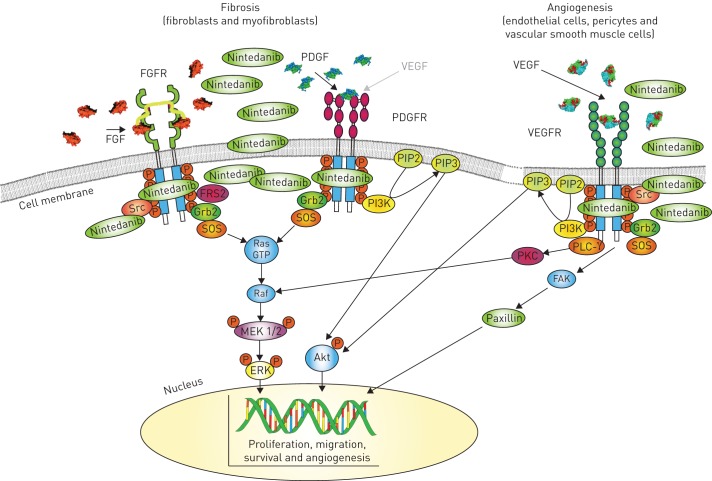
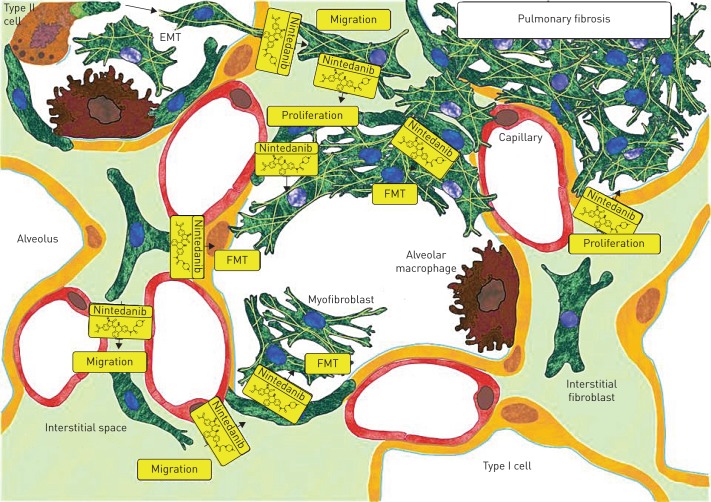
Idiopathic pulmonary fibrosis (IPF) is a progressive and ultimately fatal disease characterised by fibrosis of the lung parenchyma and loss of lung function. Although the pathogenic pathways involved in IPF have not been fully elucidated, IPF is believed to be caused by repetitive alveolar epithelial cell injury and dysregulated repair, in which there is uncontrolled proliferation of lung fibroblasts and differentiation of fibroblasts into myofibroblasts, which excessively deposit extracellular matrix (ECM) proteins in the interstitial space. A number of profibrotic mediators including platelet-derived growth factor (PDGF), fibroblast growth factor (FGF) and transforming growth factor-β are believed to play important roles in the pathogenesis of IPF. Nintedanib is a potent small molecule inhibitor of the receptor tyrosine kinases PDGF receptor, FGF receptor and vascular endothelial growth factor receptor. Data from in vitro studies have shown that nintedanib interferes with processes active in fibrosis such as fibroblast proliferation, migration and differentiation, and the secretion of ECM. In addition, nintedanib has shown consistent anti-fibrotic and anti-inflammatory activity in animal models of lung fibrosis. These data provide a strong rationale for the clinical efficacy of nintedanib in patients with IPF, which has recently been demonstrated in phase III clinical trials.
Overview
The claims and statistics of this paper haven’t been checked yet.
Free: it reads the open-access text and checks the first 5 claims that cite a source we can check. Create a free account to check every claim.
Integrity signals
Registry
Cites
Statistics
Figures
Verification
Claims the paper makes
The claims and statistics of this paper haven’t been checked yet.
Free: it reads the open-access text and checks the first 5 claims that cite a source we can check. Create a free account to check every claim.
Claims other papers make about this one
Each is checked against this paper’s own text: does it say what the citing paper says it does?
The source backs part of the claim, not all of it — or backs it for a different population, condition or comparison.
In the citing paper
“Nintedanib has inhibitory effects on platelet-derived growth factor receptors α/β (PDGFα/β), vascular endothelial growth factor (VEGF) receptors 1, 2 and 3, and fibroblast growth factor (FGF) receptor 1, 2, and 3, as well as potentiation of Src homology region 2 domain containing phosphatase 1 (SHP-1) [19,20].”
From Emerging pharmacological options in the treatment of idiopathic pulmonary fibrosis (IPF) (2024) · cites this paper as [19]
Experimental — accuracy not yet measuredThe source backs part of the claim, not all of it — or backs it for a different population, condition or comparison.
In the citing paper
“These observations indicate that the Pdgf pathway is crucial to disease pathogenesis.”
From Reference-based analysis of lung single-cell sequencing reveals a transitional profibrotic macrophage (2019) · cites this paper as [41]
Experimental — accuracy not yet measuredThe cited source says what the claim attributes to it.
In the citing paper
“In two phase 3 trials with patients suffering from interstitial lung disease, nintedanib profoundly lowered the decline in forced vital capacity (195, 198).”
From Unraveling SSc Pathophysiology; The Myofibroblast (2018) · cites this paper as [195]
The cited source says what the claim attributes to it.
In the citing paper
“The current standard-of-care (SOC) therapy regimen to treat IPF includes either nintedanib, a broadly acting inhibitor of receptor tyrosine kinases31, or pirfenidone, an inhibitor of TGFβ-mediated fibroblast-to-myofibroblast transition32.”
From A generative AI-discovered TNIK inhibitor for idiopathic pulmonary fibrosis: a randomized phase 2a trial (2025) · cites this paper as [31]
In the citing paper
“In vivo, nintedanib protects mice and rats against bleomycin-induced lung fibrosis (195, 196), and lowers the amount of lymphocytes and neutrophils but not macrophages in bronchoalveolar lavage liquid in this model.”
From Unraveling SSc Pathophysiology; The Myofibroblast (2018) · cites this paper as [195]
1 more claim about this paper
Create a free account to see every claim other papers make about this one.
Self-check
Percentages, sums and reported differences re-computed from the paper’s own numbers.
The self-check needs the paper’s full text.
Citations
Cites
The biology of VEGF and its receptors
Ferrara, N., Gerber, H.-P., & LeCouter, J. (2003) · Nature Medicine · doi:10.1038/nm0603-669 · Cited by 9,591
Raghu, G., Collard, H. R., Egan, J. J., Martinez, F. J., Behr, J., Brown, K. K., Colby, T. V., Cordier, J.-F., Flaherty, K. R., Lasky, J. A., et al. (2011) · American Journal of Respiratory and Critical Care Medicine · doi:10.1164/rccm.2009-040gl · Cited by 7,186
Efficacy and Safety of Nintedanib in Idiopathic Pulmonary Fibrosis
Richeldi, L., du Bois, R. M., Raghu, G., Azuma, A., Brown, K. K., Costabel, U., Cottin, V., Flaherty, K. R., Hansell, D. M., Inoue, Y., et al. (2014) · New England Journal of Medicine · doi:10.1056/nejmoa1402584 · Cited by 4,654
Self-citation(2002) · American Journal of Respiratory and Critical Care Medicine · doi:10.1164/ajrccm.165.2.ats01 · Cited by 4,196
A phase 3 trial of pirfenidone in patients with idiopathic pulmonary fibrosis.
King, T. E., Bradford, W. Z., Castro-Bernardini, S., Fagan, E. A., Glaspole, I., Glassberg, M. K., Gorina, E., Hopkins, P. M., Kardatzke, D., Lancaster, L., et al. (2014) · New England Journal of Medicine · doi:10.1056/nejmoa1402582 · Cited by 3,975
King, T. E., Pardo, A., & Selman, M. (2011) · The Lancet · doi:10.1016/s0140-6736(11)60052-4 · Cited by 2,194
Pirfenidone in patients with idiopathic pulmonary fibrosis (CAPACITY): two randomised trials
Noble, P. W., Albera, C., Bradford, W. Z., Costabel, U., Glassberg, M. K., Kardatzke, D., King, T. E., Lancaster, L., Sahn, S. A., Szwarcberg, J., et al. (2011) · The Lancet · doi:10.1016/s0140-6736(11)60405-4 · Cited by 2,154
Selman, M., King, T. E., & Pardo, A. (2001) · Annals of Internal Medicine · doi:10.7326/0003-4819-134-2-200101160-00015 · Cited by 1,786
Signal transduction by vascular endothelial growth factor receptors
Koch, S., Tugues, S., Li, X., Gualandi, L., & Claesson-Welsh, L. (2011) · Biochemical Journal · doi:10.1042/bj20110301 · Cited by 1,635
Idiopathic Pulmonary Fibrosis: Clinical Relevance of Pathologic Classification
KATZENSTEIN, A.-L. A., & MYERS, J. L. (1998) · American Journal of Respiratory and Critical Care Medicine · doi:10.1164/ajrccm.157.4.9707039 · Cited by 1,261
Cited by
Items 201–300 of 1,001
A novel phosphodiesterase 4 inhibitor, AA6216, reduces macrophage activity and fibrosis in the lung
Matsuhira, T., Nishiyama, O., Tabata, Y., Kaji, C., Kubota-Ishida, N., Chiba, Y., Sano, H., Iwanaga, T., & Tohda, Y. (2020) · European Journal of Pharmacology · doi:10.1016/j.ejphar.2020.173508 · Cited by 41
Loss of ANT1 Increases Fibrosis and Epithelial Cell Senescence in Idiopathic Pulmonary Fibrosis
Sui, J., Boatz, J. C., Shi, J., Hu, Q., Li, X., Zhang, Y., Königshoff, M., & Kliment, C. R. (2023) · American Journal of Respiratory Cell and Molecular Biology · doi:10.1165/rcmb.2022-0315oc · Cited by 45
The Role of Airway Myofibroblasts in Asthma
Jendzjowsky, N. G., & Kelly, M. M. (2019) · CHEST Journal · doi:10.1016/j.chest.2019.08.1917 · Cited by 46
Therapeutic Approaches to Systemic Sclerosis: Recent Approvals and Future Candidate Therapies
Lescoat, A., Roofeh, D., Kuwana, M., Lafyatis, R., Allanore, Y., & Khanna, D. (2021) · Clinical Reviews in Allergy & Immunology · doi:10.1007/s12016-021-08891-0 · Cited by 41
New Era in Systemic Sclerosis Treatment: Recently Approved Therapeutics
Ebata, S., Yoshizaki‐Ogawa, A., Sato, S., & Yoshizaki, A. (2022) · Journal of Clinical Medicine · doi:10.3390/jcm11154631 · Cited by 43
“It suppresses fibroblast proliferation by blocking mitogen-activated protein kinase and Akt signaling pathways in three types of cells involved in angiogenesis: endothelial cells, pericytes, and smooth muscle cells [41].”
BackgroundLiu, C.-Y., Huang, T.-T., Chu, P.-Y., Huang, C.-T., Lee, C.-H., Wang, W.-L., Lau, K.-Y., Tsai, W.-C., Chao, T.-I., Su, J.-C., et al. (2017) · Experimental & Molecular Medicine · doi:10.1038/emm.2017.114 · Cited by 40
Raman, L., Stewart, I. D., Barratt, S. L., Chua, F., Chaudhuri, N., Crawshaw, A., Gibbons, M., Hogben, C., Hoyles, R. K., Kouranos, V., et al. (2022) · ERJ Open Research · doi:10.1183/23120541.00423-2022 · Cited by 43
Further insight into systemic sclerosis from the vasculopathy perspective
Ren, H., Liu, L., Xiao, Y., Shi, Y., Zeng, Z., Ding, Y. P., Zou, P., & Xiao, R. (2023) · Biomedicine & Pharmacotherapy · doi:10.1016/j.biopha.2023.115282 · Cited by 49
The role of inflammation in silicosis
Liu, T., Sun, H.-F., Han, Y., Zhan, Y., & Jiang, J. (2024) · Frontiers in Pharmacology · doi:10.3389/fphar.2024.1362509 · Cited by 58
Airway Complications After Lung Transplantation
Frye, L., & Machuzak, M. S. (2017) · Clinics in Chest Medicine · doi:10.1016/j.ccm.2017.07.010 · Cited by 43
Nintedanib Reduces Neutrophil Chemotaxis via Activating GRK2 in Bleomycin-Induced Pulmonary Fibrosis
Chen, W., Chen, N., Chen, H., Yu, W.-K., Su, V. Y., Chen, H., Wu, H.-H., & Yang, K. (2020) · International Journal of Molecular Sciences · doi:10.3390/ijms21134735 · Cited by 48
“In fibrosing lung diseases, especially IPF, nintedanib exerts both anti-inflammatory and antifibrotic activity [39].”
BackgroundInjured Endothelial Cell: A Risk Factor for Pulmonary Fibrosis
Zhao, W., Wang, L., Wang, Y., Yuan, H., Zhao, M., Lian, H., Ma, S., Xu, K., Li, Z., & Yu, G. (2023) · International Journal of Molecular Sciences · doi:10.3390/ijms24108749 · Cited by 47
“In vitro studies have indicated that nintedanib interferes with the proliferation, migration and differentiation, and secretion of ECM of fibroblasts [106].”
BackgroundEvaluation of Pirfenidone and Nintedanib in a Human Lung Model of Fibrogenesis
Roach, K., Castells, E., Dixon, K., Mason, S., Elliott, G., Marshall, H., Poblocka, M., Macip, S., Richardson, M., Khalfaoui, L., et al. (2021) · Frontiers in Pharmacology · doi:10.3389/fphar.2021.679388 · Cited by 39
“Nintedanib is an inhibitor of PDGF, VEGF and FGF receptor tyrosine kinases, and similar to pirfenidone, inhibits lung fibrosis in animal models and inhibits profibrotic human lung fibroblast activity (Hostettler et al., 2014; Wollin et al., 2015; Lehtonen et al., 2016; Knüppel et al., 2017; Epstein Shochet et al., 201…”
BackgroundSong, J. W., Ogura, T., Inoue, Y., Xu, Z., Quaresma, M., Stowasser, S., Stansen, W., & Crestani, B. (2020) · Respirology · doi:10.1111/resp.13647 · Cited by 39
Self-citationRecent advances in studies of 15-PGDH as a key enzyme for the degradation of prostaglandins
Sun, C., Zhou, Z., Yang, D. K., Chen, Z., Zhou, Y., Wen, W., Chen, F., Zheng, L., Peng, X., & Tang, C. (2021) · International Immunopharmacology · doi:10.1016/j.intimp.2021.108176 · Cited by 48
Lee, W. T., Lee, H., Kim, J., Jung, Y.-J., Choi, E., Jeong, J. H., Jeong, J., Lee, J. H., & Youn, Y. S. (2023) · Bioactive Materials · doi:10.1016/j.bioactmat.2023.11.005 · Cited by 67
Clinical use of nintedanib in patients with idiopathic pulmonary fibrosis
Case, A. H., & Johnson, P. (2017) · BMJ Open Respiratory Research · doi:10.1136/bmjresp-2017-000192 · Cited by 46
“14 15 Inhibition of these processes reduces the loss of parenchymal architecture and stiffening of the lungs and so reduces the decline in lung volume characteristic of the progression of IPF.(15)”
BackgroundInfluentialClinical course and management of idiopathic pulmonary fibrosis
Quinn, C., Wisse, A., & Manns, S. T. (2019) · Multidisciplinary Respiratory Medicine · doi:10.1186/s40248-019-0197-0 · Cited by 46
“animal models of lung fibrosis suggest that nintedanib and pirfenidone inhibit processes that are fundamental to the progression of fibrosis such as the proliferation, migration and differentiation of fibroblasts and the deposition of extracellular matrix components such as collagen in the lungs [22, 23].”
BackgroundChang, C., Lin, C., Lee, C., Chuang, H., Shih, F.-C., Wan, S.-W., Tai, C., & Chen, C. (2020) · Biochemical Pharmacology · doi:10.1016/j.bcp.2020.114356 · Cited by 46
Magneto-acoustic protein nanostructures for non-invasive imaging of tissue mechanics in vivo
Kim, W.-S., Min, S., Kim, S. K., Kang, S., An, S., Criado-Hidalgo, E., Davis, H. C., Bar‐Zion, A., Malounda, D., Kim, Y. H., et al. (2023) · Nature Materials · doi:10.1038/s41563-023-01688-w · Cited by 41
“Nint-edanib, well known for its antifibrotic effects on idiopathic pulmonary fibrosis, was tested, and treatment was performed starting from day 5 after fibrosis induction 29 .”
BackgroundChang, S., Lv, J., Wang, X., Su, J., Bian, C., Zheng, Z., Yu, H., Bao, J., Xin, Y., & Jiang, X. M. (2024) · Critical Reviews in Oncology/Hematology · doi:10.1016/j.critrevonc.2024.104461 · Cited by 41
Zheng, Y., Schupp, J. C., Adams, T. S., Clair, G., Justet, A., Ahangari, F., Yan, X., Hansen, P., Carlon, M. S., Cortesi, E. E., et al. (2025) · Nature Biomedical Engineering · doi:10.1038/s41551-025-01423-7 · Cited by 49
“Present therapeutic options for IPF are markedly narrow; two Food and Drug Administration (FDA)-approved drugs, pirfenidone 39 and nintedanib 40 , that slow lung function decline, but do not reverse fibrosis 41 .”
Beneficial effects of bile acid receptor agonists in pulmonary disease models
Comeglio, P., Morelli, A., Adorini, L., Maggi, M., & Vignozzi, L. (2017) · Expert Opinion on Investigational Drugs · doi:10.1080/13543784.2017.1385760 · Cited by 43
“Nintedanib displays anti-inflammatory and antifibrotic effects, inhibiting migration, proliferation, and transformation of fibroblasts to myofibroblasts in animal models of lung fibrosis [135,151].”
BackgroundSevere idiopathic pulmonary fibrosis: what can be done?
Caminati, A., Cassandro, R., Torre, O., & Harari, S. A. (2017) · European Respiratory Review · doi:10.1183/16000617.0047-2017 · Cited by 39
Population pharmacokinetics of nintedanib in patients with idiopathic pulmonary fibrosis
Schmid, U., Döge, C., Dallinger, C., & Freiwald, M. (2017) · Pulmonary Pharmacology & Therapeutics · doi:10.1016/j.pupt.2017.11.004 · Cited by 38
“Nintedanib is a potent intracellular inhibitor of tyrosine kinases, including the receptor kinases VEGF (vascular endothelial growth factor), platelet-derived growth factor (PDGF) and fibroblast growth factor (FGF) [1-4].”
BackgroundEpstein Shochet, G., Wollin, L., & Shitrit, D. (2018) · Respirology · doi:10.1111/resp.13287 · Cited by 38
Self-citationKeenan, C. R., Langenbach, S. Y., Jativa, F., Harris, T., Li, M., Chen, Q., Xia, Y., Gao, X., Schuliga, M. J., Jaffar, J., et al. (2018) · Frontiers in Pharmacology · doi:10.3389/fphar.2018.00738 · Cited by 43
“To confirm a functional effect of PF670462 in preventing TGF-β induced EMT, E-cadherin was immunostained.”
BackgroundInfluentialIkemori, R., Gabasa, M., Duch, P., Vizoso, M., Bragado, P., Arshakyan, M., Luis, I.-C., Marín, A., Morán, S., de Moura, M. C., et al. (2019) · Cancer Research · doi:10.1158/0008-5472.can-19-0637 · Cited by 41
Inhibition of mast cells: a novel mechanism by which nintedanib may elicit anti-fibrotic effects
Overed-Sayer, C. L., Miranda, E., Dunmore, R., Marin, E. L., Beloki, L., Rassl, D. M., Parfrey, H., Carruthers, A. M., Chahboub, A., Koch, S., et al. (2020) · Thorax · doi:10.1136/thoraxjnl-2019-214000 · Cited by 40
“For nintedanib, these positive effects include an impact on the receptors for VEGF, FGF and PDGF. 30 Furthermore, nintedanib can act on a number of other tyrosine kinases, including Src, Flt3, Lyn and Lck, 52 suggesting that the impact on MC function could also be mediated via other tyrosine…”
InfluentialDoryab, A., Taskin, M. B., Stahlhut, P., Gröll, J., & Schmid, O. (2022) · Advanced Materials · doi:10.1002/adma.202205083 · Cited by 48
Update on diagnosis and treatment of idiopathic pulmonary fibrosis
Martínez, J. A. B., Baldi, B. G., da Costa, C. H., Jezler, S. F. D. O., Lima, M. S., & Rufino, R. (2015) · Jornal Brasileiro de Pneumologia · doi:10.1590/s1806-37132015000000152 · Cited by 43
“In patients with IPF, the mechanisms whereby nintedanib acts involve inhibition of receptor tyrosine kinases.(32) The drug blocks the intracellular ATP-binding sites of specific tyrosine kinases.”
BackgroundDing, H., Cui, Y., Yang, J., Li, Y., Zhang, H., Ju, S., Ren, X., Ding, C., & Zhao, J. (2023) · Journal of Controlled Release · doi:10.1016/j.jconrel.2023.03.060 · Cited by 38
Therapeutic and pathological roles of fibroblast growth factors in pulmonary diseases
Agha, E. E., Seeger, W., & Bellusci, S. (2016) · Developmental Dynamics · doi:10.1002/dvdy.24468 · Cited by 41
“The use of RTK inhibitors such as ponatinib or BIBF 1120 (nintedanib) seems to be beneficial in attenuating lung fibrosis D E V E L O P M E N T A L D Y N A M IC S and suppressing TGFb1 activity (Chaudhary et al., 2007; Qu et al., 2015; Wollin et al., 2015; Woodcock and Maher, 2015).”
BackgroundCooperative signaling between integrins and growth factor receptors in fibrosis
Maldonado, H., & Hagood, J. S. (2021) · Journal of Molecular Medicine · doi:10.1007/s00109-020-02026-2 · Cited by 37
p53 Expression in Lung Fibroblasts Is Linked to Mitigation of Fibrotic Lung Remodeling
Nagaraja, M. R., Tiwari, N., Shetty, S. K., Marudamuthu, A. S., Fan, L., Ostrom, R. S., Fu, J., Gopu, V., Radhakrishnan, V., Idell, S., et al. (2018) · The American Journal of Pathology · doi:10.1016/j.ajpath.2018.07.005 · Cited by 37
Bon, H., Hales, P., Lumb, S., Holdsworth, G., Johnson, T. S., Qureshi, O. S., & Twomey, B. M. (2019) · The Nephron journals/Nephron journals · doi:10.1159/000499506 · Cited by 39
Mitchell, C. N. C., Islam, M. S., Afrin, S., Brennan, J. T., Psoter, K. J., & Segars, J. H. (2021) · Fertility and Sterility · doi:10.1016/j.fertnstert.2020.12.011 · Cited by 41
Ding, L., Tang, S., Tang, W., Mosley, D. D., Yu, A., Sil, D., Romanova, S., Bailey, K. L., Knoell, D. L., Wyatt, T. A., et al. (2022) · Advanced Science · doi:10.1002/advs.202103676 · Cited by 42
Vascular Contribution to Lung Repair and Fibrosis
Caporarello, N., & Ligresti, G. (2023) · American Journal of Respiratory Cell and Molecular Biology · doi:10.1165/rcmb.2022-0431tr · Cited by 39
Cough in Idiopathic Pulmonary Fibrosis
Mann, J., Goh, N. S. L., Holland, A. E., & Khor, Y. H. (2021) · Frontiers in Rehabilitation Sciences · doi:10.3389/fresc.2021.751798 · Cited by 40
Vazquez‐Armendariz, A. I., Barroso, M. M., Agha, E. E., & Herold, S. (2022) · Cells · doi:10.3390/cells11091526 · Cited by 40
“Nintedanib is an intracellular suppressor of tyrosine kinases that acts as an inhibitor of fibroblast recruitment, proliferation, and differentiation, therefore negatively affecting extracellular matrix (ECM) deposition [8].”
BackgroundOuyang, B., Deng, L., Yang, F., Shi, H., Wang, N., Tang, W., Huang, X. X., Zhou, Y., Yu, H., Wei, Y., et al. (2023) · Materials Today Bio · doi:10.1016/j.mtbio.2023.100643 · Cited by 43
“This is an open access ar improve the prognosis of patients and achieve little clinical success due to their overall ineffectiveness [4,5].”
BackgroundAmano, H., Mastui, Y., Ito, Y., Shibata, Y., Betto, T., Eshima, K., Ogawa, F., Satoh, Y., Shibuya, M., & Majima, M. (2019) · Biomedicine & Pharmacotherapy · doi:10.1016/j.biopha.2019.109067 · Cited by 37
No relevant pharmacokinetic drug–drug interaction between nintedanib and pirfenidone
Richeldi, L., Fletcher, S., Adamali, H., Chaudhuri, N., Wiebe, S., Wind, S., Hohl, K., Baker, A., Schlenker-Herceg, R., Stowasser, S., et al. (2019) · European Respiratory Journal · doi:10.1183/13993003.01060-2018 · Cited by 34
Self-citationPodolanczuk, A. J., & Cottin, V. (2023) · Advances in Therapy · doi:10.1007/s12325-023-02454-9 · Cited by 45
“Nintedanib is a tyrosine kinase inhibitor that inhibits processes fundamental to the progression of pulmonary fibrosis, including the proliferation and transformation of lung fibroblasts and the deposition of extracellular matrix [2, 3].”
BackgroundZulfikar, S., Mulholland, S., Adamali, H. I., & Barratt, S. L. (2020) · Clinical Pharmacology Advances and Applications · doi:10.2147/cpaa.s228362 · Cited by 41
Targeting Drugs Against Fibroblast Growth Factor(s)-Induced Cell Signaling
Agrawal, S., Maity, S., Alraawi, Z., Al-Ameer, M., & Kumar, T. K. S. (2020) · Current Drug Targets · doi:10.2174/1389450121999201012201926 · Cited by 34
Romano, E., Rosa, I., Fioretto, B. S., Matucci‐Cerinic, M., & Manetti, M. (2021) · Life · doi:10.3390/life11070610 · Cited by 40
Trials and Treatments: An Update on Pharmacotherapy for Idiopathic Pulmonary Fibrosis
Thong, L., McElduff, E. J., & Henry, M. T. (2023) · Life · doi:10.3390/life13020486 · Cited by 37
“Nintedanib binds to the ATP binding pocket of these receptors, preventing auto phosphorylation and thereby inhibiting downstream cascade signaling [50].”
BackgroundHong, Y., Lee, Y., Cheng, T., Lai, C., Hsu, C., Kuo, C., Hsu, Y.-Y., Li, J.-T., Chang, B.-I., Ma, C.-Y., et al. (2019) · Journal of Investigative Dermatology · doi:10.1016/j.jid.2019.03.1149 · Cited by 37
Oncostatin M in the Regulation of Connective Tissue Cells and Macrophages in Pulmonary Disease
Richards, C. D., & Botelho, F. M. (2019) · Biomedicines · doi:10.3390/biomedicines7040095 · Cited by 37
“In clinical trials targeting tyrosine kinase signaling of TGF-β, the drug Nintedanib showed slowing but not a stoppage of progression, and may generate severe side effects [26,27].”
BackgroundMolecular mechanisms and targets of right ventricular fibrosis in pulmonary hypertension
Bekedam, F. T., Goumans, M., Bogaard, H. J., de Man, F. S., & Valldeperas, A. L. (2023) · Pharmacology & Therapeutics · doi:10.1016/j.pharmthera.2023.108389 · Cited by 34
PARP1 stabilizes FOXN3 to suppress pulmonary fibrosis through p38-related feedback regulation
Zhu, X., Huo, Q., Jin, L., Du, J., Yu, J., Wang, H., Wu, N., Li, Y., Rui, Y., Zhao, C., et al. (2026) · Science Advances · doi:10.1126/sciadv.ady1681 · Cited by 38
“This abnormal cellular response leads to excessive deposition of extracellular matrix components, resulting in further lung tissue remodeling and impaired lung function ( 9 , 10 , 12 , 15 – 18 ).”
Treatment of idiopathic pulmonary fibrosis: a position paper from a Nordic expert group
Sköld, C. M., Bendstrup, E. M., Myllärniemi, M., Guðmundsson, G., Sjåheim, T., Hilberg, O., Altraja, A., Kaarteenaho, R. L., & Ferrara, G. (2016) · Journal of Internal Medicine · doi:10.1111/joim.12571 · Cited by 38
László, V., Valkó, Z., Kovács, I., Ozsvar, J., Hoda, M. A., Klikovits, T., Lakatos, D., Czirók, A., Garay, T., Stiglbauer, A., et al. (2018) · Clinical Cancer Research · doi:10.1158/1078-0432.ccr-17-1507 · Cited by 36
“Of note, nintedanib has also been shown to inhibit the migration of fibroblasts in idiopathic pulmonary fibrosis (39).”
BackgroundFibroblasts and their responses to chronic injury in pulmonary fibrosis
Wu, B., Tang, L. F., & Kapoor, M. (2020) · Seminars in Arthritis and Rheumatism · doi:10.1016/j.semarthrit.2020.12.003 · Cited by 37
Diazzi, S., Baeri, A., Fassy, J., Lecacheur, M., Marín-Béjar, O., Girard, C. A. J., Lefevre, L., Lacoux, C., Irondelle, M., Mounier, C. M., et al. (2022) · EMBO Molecular Medicine · doi:10.15252/emmm.202115295 · Cited by 40
“…switch toward the undifferentiated/mesenchymal-like state. on primary lung fibroblasts from patients with IPF, notably the inhibition of growth factor-induced proliferation/migration and TGF-b - induced myofibroblast activation, as well as the downregulation of ECM proteins (Wollin et al , 2015).”
BackgroundSilicosis: from pathogenesis to therapeutics
Bi-jun, Y., Liu, X., Peng, C., Meng, X., & Jia, Q. (2025) · Frontiers in Pharmacology · doi:10.3389/fphar.2025.1516200 · Cited by 56
“…which jointly participate in regulating the development of pulmonary fi brosis induced by silica dust. murine models of bleomycin-and silica-induced pulmonary fi brosis, where it was demonstrated to reduce or prevent the fi brotic process (Chaudhary et al., 2007; Wollin et al., 2015).”
Idiopathic pulmonary fibrosis: from clinical trials to real-life experiences
Harari, S. A., & Caminati, A. (2015) · European Respiratory Review · doi:10.1183/16000617.0042-2015 · Cited by 36
Idiopathic Pulmonary Fibrosis in Switzerland: Diagnosis and Treatment
Funke-Chambour, M., Azzola, A., Adler, D., Barazzone‐Argiroffo, C., Benden, C., Boehler, A., Bridevaux, P., Brutsche, M. H., Clarenbach, C. F., Hostettler, K., et al. (2017) · Respiration · doi:10.1159/000464332 · Cited by 36
Self-citationMackintosh, J. A., Munsif, M., Ranzenbacher, L., Thomson, C., Musk, M., Snell, G. I., Glanville, A. R., Chambers, D. C., & Hopkins, P. M.-A. (2019) · The Journal of Heart and Lung Transplantation · doi:10.1016/j.healun.2019.02.005 · Cited by 35
Tong, B., Fu, L., Hu, B., Zhang, Z., Tan, Z.-X., Li, S.-R., Chen, Y., Zhang, C., Wang, H., Xu, D., et al. (2021) · BMC Pulmonary Medicine · doi:10.1186/s12890-021-01514-6 · Cited by 35
“Background Idiopathic pulmonary fibrosis (IPF) is characterized by excessive deposition of collagen, leading to death due to the lack of effective therapies [1, 2].”
BackgroundKumari, J., Wagener, F. A. D. T. G., & Kouwer, P. H. J. (2022) · ACS Applied Materials & Interfaces · doi:10.1021/acsami.2c02549 · Cited by 32
“In line with previous studies showing that nintedanib and pirfenidone reduce TGF β 1-induced proliferation of human fi broblasts, 7,10 we observed that in our PIC-RGD hydrogel fi brosis model both nintedanib and pirfenidone signi fi cantly reduced myo fi broblast proliferation (Figure 6C).”
Antifibrotic Drug Nintedanib Inhibits CSF1R to Promote IL-4–associated Tissue Repair Macrophages
Watson, C. K., Schloesser, D., Fundel‐Clemens, K., Lerner, C., Gabler, S., Baskaran, P., Wohnhaas, C. T., Dichtl, S., Huber, H. J., Ask, K., et al. (2023) · American Journal of Respiratory Cell and Molecular Biology · doi:10.1165/rcmb.2022-0021oc · Cited by 38
Duan, F., Barrón, G. M., Meliton, A. Y., Mutlu, G. M., Dulin, N. O., & Schuger, L. A. (2018) · American Journal of Respiratory Cell and Molecular Biology · doi:10.1165/rcmb.2018-0028oc · Cited by 38
Kim, H.-Y., Kim, M., Kim, S., Joen, D., & Lee, K. (2018) · Molecules · doi:10.3390/molecules23081974 · Cited by 37
“(2015) reported that NDN inhibits inflammatory responses, thus reducing the development of lung fibrosis in bleomycin (BLM)- and silica-induced lung fibrosis models [26].”
BackgroundInfluentialTyrosine kinase inhibitors relax pulmonary arteries in human and murine precision-cut lung slices
Rieg, A. D., Bünting, N. A., Cranen, C., Suleiman, S., Spillner, J. W., Schnöring, H., Schröder, T., von Stillfried, S. F., Braunschweig, T. A., Manley, P. W., et al. (2019) · Respiratory Research · doi:10.1186/s12931-019-1074-2 · Cited by 32
Progressive fibrosing interstitial lung diseases: A new concept and indication of nintedanib
Makino, S. (2020) · Modern Rheumatology · doi:10.1080/14397595.2020.1826665 · Cited by 35
Toledo, M. A. S., Gatz, M., Sontag, S., Gleixner, K. V., Eisenwort, G., Feldberg, K., Hamouda, A. E. I., Kluge, F., Guareschi, R., Rossetti, G., et al. (2020) · Blood · doi:10.1182/blood.2019004509 · Cited by 36
HSP47: A Therapeutic Target in Pulmonary Fibrosis
Sakamoto, N., Okuno, D., Tokito, T., Yura, H., Kido, T., Ishimoto, H., Tanaka, Y., & Mukae, H. (2023) · Biomedicines · doi:10.3390/biomedicines11092387 · Cited by 39
Cleemput, J. V., Sonaglioni, A., Wuyts, W. A., Bengus, M., Stauffer, J. L., & Harari, S. A. (2018) · Advances in Therapy · doi:10.1007/s12325-018-0857-z · Cited by 34
Idiopathic Pulmonary Fibrosis and Progressive Pulmonary Fibrosis
Strykowski, R. K., & Adegunsoye, A. (2023) · Immunology and Allergy Clinics of North America · doi:10.1016/j.iac.2023.01.010 · Cited by 36
Wang, J., Wang, P., Shao, Y., & He, D. (2023) · Pharmaceutics · doi:10.3390/pharmaceutics15082151 · Cited by 34
Holtze, C. H., Flaherty, K. R., Kreuter, M., Luppi, F., Moua, T., Vancheri, C., & Scholand, M. B. (2018) · European Respiratory Review · doi:10.1183/16000617.0078-2018 · Cited by 33
Epithelial Mesenchymal Transition in Respiratory Disease
Knight, D. A., Grainge, C., Stick, S. M., Kicic, A., & Schuliga, M. J. (2020) · CHEST Journal · doi:10.1016/j.chest.2019.12.014 · Cited by 34
FGFR Inhibitors: Clinical Activity and Development in the Treatment of Cholangiocarcinoma
King, G. T., & Javle, M. M. (2021) · Current Oncology Reports · doi:10.1007/s11912-021-01100-3 · Cited by 31
Li, D., Zhang, J., Yuan, S., Wang, C., Chang, J., Tong, Y., Liu, R., Sang, T., Li, L., Li, J., et al. (2022) · Cell Proliferation · doi:10.1111/cpr.13299 · Cited by 35
Development of nintedanib nanosuspension for inhaled treatment of experimental silicosis
da Silva, L. H. A., Vieira, J. B., Cabral, M. R., Antunes, M. A., Lee, D., Cruz, F. F., Hanes, J. S., Rocco, P. R. M., Morales, M. M., & Suk, J. S. (2022) · Bioengineering & Translational Medicine · doi:10.1002/btm2.10401 · Cited by 34
Boehme, S. A., Franz-Bacon, K., DiTirro, D. N., Ly, T. W., & Bacon, K. B. (2016) · PLoS ONE · doi:10.1371/journal.pone.0154874 · Cited by 36
“Both compounds have anti-fibrotic properties and have been shown to reduce the functional decline and disease progression in IPF patients with mild to moderate functional impairment [16, 17].”
BackgroundPirfenidone and Nintedanib for Treatment of Idiopathic Pulmonary Fibrosis
Sathiyamoorthy, G., Sehgal, S., & Ashton, R. W. (2017) · Southern Medical Journal · doi:10.14423/smj.0000000000000655 · Cited by 30
Idiopathic Pulmonary Fibrosis: Review of Current Knowledge
Muri, J., Durcová, B., Slivka, R., Vrbenská, A., Makovická, M., Makovický, P., Škarda, J., Delongová, P., Kamarád, V., & Vecanová, J. (2024) · Physiological Research · doi:10.33549/physiolres.935322 · Cited by 38
Is personalised medicine the key to heterogeneity in idiopathic pulmonary fibrosis?
Clarke, D. L., Murray, L. A., Crestani, B., & Sleeman, M. A. (2016) · Pharmacology & Therapeutics · doi:10.1016/j.pharmthera.2016.09.010 · Cited by 33
The safety and tolerability of nintedanib in the treatment of idiopathic pulmonary fibrosis
Cottin, V. (2017) · Expert Opinion on Drug Safety · doi:10.1080/14740338.2017.1338268 · Cited by 31
“regardless of the trigger [18] and to normalize the distorted”
BackgroundKasam, R. K., Reddy, G. B., Jegga, A. G., & Madala, S. K. (2019) · Frontiers in Pharmacology · doi:10.3389/fphar.2019.00532 · Cited by 30
“Nintedanib was shown to attenuate fibroblast proliferation, migration, and transformation, but its effects on apoptotic clearance had not been explored (Wollin et al., 2015).”
BackgroundThe kidney matrisome in health, aging, and disease
Lausecker, F., Lennon, R., & Randles, M. J. (2022) · Kidney International · doi:10.1016/j.kint.2022.06.029 · Cited by 30
3D pulmonary fibrosis model for anti-fibrotic drug discovery by inkjet-bioprinting
Kang, D., Lee, Y., Kim, W., Lee, H., & Jung, S. (2022) · Biomedical Materials · doi:10.1088/1748-605x/aca8e3 · Cited by 34
“…the pathogenic pathways underlying PF are not fully elucidated yet, it is considered to be driven by repetitive epithelial injury and dysfunction in repair, which res-ults in uncontrolled proliferation and differentiation of lung fibroblasts into myofibroblasts that deposit ECM excessively [3].”
PGF2α signaling drives fibrotic remodeling and fibroblast population dynamics in mice
Rodríguez, L. R., Tang, S. Y., Barboza, W. R., Murthy, A., Tomer, Y., Cai, T., Iyer, S., Chavez, K., Das, U. S., Ghosh, S., et al. (2023) · JCI Insight · doi:10.1172/jci.insight.172977 · Cited by 30
“Similarly, in both preclinical models and clinical practice, either Pirfenidone or Nintedanib do not completely attenuate either fibrotic endpoints or loss of lung function suggesting additional pathways to fibrogenesis are contributors (8, 9, 29, 30).”
BackgroundLu, Y., Zhao, X., Yu, L., Qi, F., Zhai, B., Gao, C., & Ding, Q. (2017) · Scientific Reports · doi:10.1038/srep46357 · Cited by 31
Idiopathic pulmonary fibrosis: a holistic approach to disease management in the antifibrotic age
Shaw, J., Marshall, T., Morris, H. G., Hayton, C., & Chaudhuri, N. (2017) · Journal of Thoracic Disease · doi:10.21037/jtd.2017.10.111 · Cited by 34
“This pathway is thought to be involved in the development of fibrosis and its inhibition leads to a reduction in profibrotic mediators (15).”
BackgroundNintedanib inhibits TGF-β-induced myofibroblast transdifferentiation in human Tenon's fibroblasts.
Lin, X., Wen, J., Liu, R., Gao, W., Qu, B., & Yu, M. (2018) · PubMed Central · Cited by 47
Rackow, A. R., Nagel, D. J., McCarthy, C., Judge, J., Lacy, S. H., Freeberg, M. A. T., Thatcher, T. H., Kottmann, R. M., & Sime, P. J. (2020) · European Respiratory Journal · doi:10.1183/13993003.00075-2020 · Cited by 31
“Increased mitochondrial ROS activates TGF-β1 and PDGF receptor (PDGFR) [33]; PDGFR expression is increased in IPF [34] and is one target of nintedanib [35].”
BackgroundKindlin-2 Acts as a Key Mediator of Lung Fibroblast Activation and Pulmonary Fibrosis Progression
Zhang, P., Wang, J., Luo, W., Yuan, J., Cui, C., Guo, L., & Wu, C. (2021) · American Journal of Respiratory Cell and Molecular Biology · doi:10.1165/rcmb.2020-0320oc · Cited by 29
Pharmacokinetics of Nintedanib in Subjects With Hepatic Impairment
Marzin, K., Kretschmar, G., Luedtke, D., Kraemer, S., Kuelzer, R., Schlenker‐Herceg, R., Schmid, U., Schnell, D., & Dallinger, C. (2017) · The Journal of Clinical Pharmacology · doi:10.1002/jcph.1025 · Cited by 28
Low‐dose administration of bleomycin leads to early alterations in lung mechanics
Headley, L., Bi, W., Wilson, C., Collum, S. D., Chavez, M., Darwiche, T., Mertens, T. C. J., Hernandez, A. M., Siddiqui, S. R., Rosenbaum, S., et al. (2018) · Experimental Physiology · doi:10.1113/ep087322 · Cited by 31
“pirfenidone (Liu, Lu, Kang, Wang, & Wang, 2017; Oku et al., 2008; Wollin et al., 2015), there are several imperfections in this model that could affect future approaches to IPF drug development (Carrington et al.”
BackgroundGlassberg, M. K., Nathan, S. D., Lin, C., Morgenthien, E. A., Stauffer, J. L., Chou, W., & Noble, P. W. (2019) · Advances in Therapy · doi:10.1007/s12325-019-01052-y · Cited by 28
Systemic Sclerosis Associated Interstitial Lung Disease: New Directions in Disease Management
Mirsaeidi, M. S., Barletta, P., & Glassberg, M. K. (2019) · Frontiers in Medicine · doi:10.3389/fmed.2019.00248 · Cited by 33
“Nintedanib, is a tyrosine kinase inhibitor (77) for vascular endothelial growth factor (VEGF), fibroblast growth factor (FGF), and platelet-derived growth factor (PDGF), and colony stimulating factor 1 receptor (CSF1R) (78), slows disease progression and improves survival in patients with IPF.”
BackgroundShochet, G. E., Pham, S., Beck, S., Naiel, S., Mekhael, O., Revill, S. D., Hayat, A. I., Vierhout, M., Bardenstein-Wald, B., Shitrit, D., et al. (2020) · Pulmonary Pharmacology & Therapeutics · doi:10.1016/j.pupt.2020.101933 · Cited by 28
Self-citationThe Effect of Nintedanib on T-Cell Activation, Subsets and Functions
Ubieta, K., Thomas, M. J., & Wollin, L. (2021) · Drug Design Development and Therapy · doi:10.2147/dddt.s288369 · Cited by 31
Self-citationGlomSpheres as a 3D co-culture spheroid model of the kidney glomerulus for rapid drug-screening
Tuffin, J. P., Chesor, M., Kuzmuk, V., Johnson, T. S., Satchell, S. C., Welsh, G. I., & Saleem, M. A. (2021) · Communications Biology · doi:10.1038/s42003-021-02868-7 · Cited by 30
Inhibition of CHIT1 as a novel therapeutic approach in idiopathic pulmonary fibrosis
Sklepkiewicz, P. L., Dymek, B., Mlącki, M., Koralewski, R., Mazur, M., Nejman‐Gryz, P., Korur, S., Zagożdżon, A., Rymaszewska, A., von der Thüsen, J. H., et al. (2022) · European Journal of Pharmacology · doi:10.1016/j.ejphar.2022.174792 · Cited by 28
Metadata
- Authors
- Wollin, L., Wex, E., Pautsch, A., Schnapp, G., Hostettler, K. E., Stowasser, S., & Kolb, M.
- Affiliations
- Boehringer Ingelheim (Germany) (DE)
- University Hospital of Basel (CH)
- McMaster University (CA)
- Corresponding author
- Wollin, Lutz
- ORCID
- Venue
- European Respiratory Journal
- Publisher
- European Respiratory Society (ERS)
- Published
- 2015-03-05
- Volume
- 45
- Issue
- 5
- Pages
- 1434-1445
- ISSN
- 0903-1936 (ISSN-L)
- 1399-3003
- PMC
- PMC4416110
- OpenAlex
- W2120791222
- Cited by
- 1,005
- References
- 88
- Citations by year
- 2026: 90 · 2025: 118 · 2024: 103 · 2023: 133 · 2022: 123 · 2021: 111 · 2020: 82 · 2019: 78 · 2018: 60 · 2017: 56 · 2016: 37 · 2015: 14
- FWCI
- 9.87
- Type
- journal article
- Language
- en
- Open access
- hybrid
- doi.org
- Licence
- cc-by-nc
- Locations
- European Respiratory Journal (publishedVersion, cc-by-nc)
- Europe PMC (PubMed Central) (publishedVersion, cc-by-nc)
- PubMed Central (publishedVersion, cc-by-nc)
- PubMed (publishedVersion)
- Funders
- Boehringer Ingelheim
- Topics
- Health Sciences › Medicine › Pulmonary and Respiratory Medicine › Interstitial Lung Diseases and Idiopathic Pulmonary Fibrosis
- Health Sciences › Medicine › Pulmonary and Respiratory Medicine › Pulmonary Hypertension Research and Treatments
- Health Sciences › Medicine › Surgery › Transplantation: Methods and Outcomes
- Keywords
- nintedanib, idiopathic pulmonary fibrosis, mechanism of action, PDGF receptor inhibition, VEGF receptor inhibition, receptor tyrosine kinase inhibitors, fibroblast proliferation, myofibroblast differentiation, extracellular matrix deposition, alveolar epithelial cell injury, antifibrotic therapy, anti-inflammatory activity
- MeSH terms
- Animals, Bleomycin, Cell Differentiation, Clinical Trials as Topic, Enzyme Inhibitors, Extracellular Matrix, Fibroblast Growth Factors, Fibroblasts, Fibrosis, Humans, Indoles, Lung, Lung Diseases, Platelet-Derived Growth Factor, Silicon Dioxide, Transforming Growth Factor beta, Apoptosis, Cell Proliferation, Idiopathic Pulmonary Fibrosis
About these checks
Registry, retraction, Cites and statistics results are computed, not judged, with one exception: a printed reference that no index lists is read once by a model before it counts as a citation error. Claims are extracted by a model and kept only when their quote appears verbatim in the text; each cited source is then checked, with a model’s help, for whether it says what the claim relies on. Those verdicts can be wrong — read the claim’s quote and the cited source before relying on one.
Statistics and arithmetic are recomputed, not judged.
Confidence bands are shown only for fields calibrated on our annotated test set. None is calibrated yet, so no band is shown.
What counts as a claim ›How we measure confidence ›How we check this ›
Are you an author, or do you see a problem with this page? Request a review
Data sources
Bibliographic data: Semantic Scholar, OpenAlex, Crossref.
Contains information from the Semantic Scholar Academic Graph Datasets, made available under the ODC Attribution License (ODC-BY 1.0).
Semantic Scholar’s data is described in: Kinney, R., et al. (2023). The Semantic Scholar Open Data Platform. arXiv:2301.10140.
