

The DOI matches its Crossref record; 22 of the 22 references it cites were found in a registry or an index.
The Nijmegen Questionnaire and dysfunctional breathing
Open accessAbstract
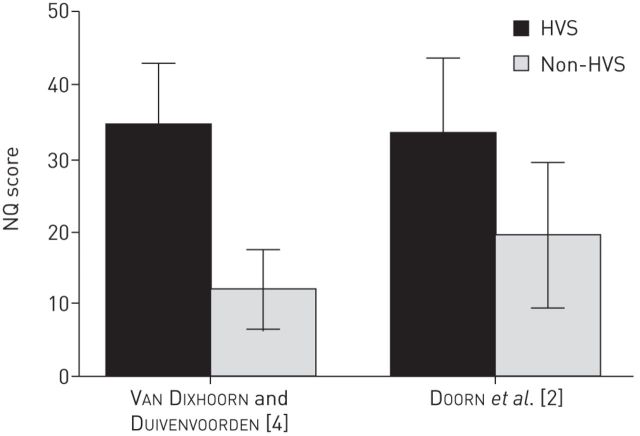
The Nijmegen Questionnaire was introduced over 30 years ago as a screening tool to detect patients with hyperventilation complaints that could benefit from breathing regulation through capnographic feedback [1]. It was validated against the Hyperventilation Provocation Test [2], on the assumption at the time that hypocapnia was causally related to complaints. In later studies, the correlation between Nijmegen Questionnaire scores and carbon dioxide tensions appeared highly variable. The diagnosis of hyperventilation syndrome (HVS) was questioned and slowly disappeared. Nevertheless, the Nijmegen Questionnaire has remained in use and we have noticed even a recent increase in studies in clinical medicine as well as requests for permission to use the Nijmegen Questionnaire in new studies. We would like to formally declare here that the Nijmegen Questionnaire is not copyrighted and is free to use. It has been or will be translated, as far as we know, into Greek, Farsi, Finnish, Norwegian, Swedish, Spanish, Filipino and Chinese. However, the validity of the Nijmegen Questionnaire is often a point of discussion and we would like to make a few comments on that issue [3]. The Nijmegen Questionnaire is useful to quantify and assess the normality of subjective sensations <http://ow.ly/MBJj1>
Overview
The claims and statistics of this paper haven’t been checked yet.
Run the check — free, no account needed. It reads the open-access text and checks the sources it cites.
Integrity signals
Registry
Cites
Statistics
Figures
Verification
Claims the paper makes
The claims and statistics of this paper haven’t been checked yet.
Run the check — free, no account needed. It reads the open-access text and checks the sources it cites.
Claims other papers make about this one
Each is checked against this paper’s own text: does it say what the citing paper says it does?
The source backs part of the claim, not all of it — or backs it for a different population, condition or comparison.
In the citing paper
“Assuming an expected average Nijmegen score of 34 among patients with HVS,43 and aiming to reduce the score of these same patients to the normal range (i.e., score of 23), the expected difference was set at 11 points.”
From Physiotherapy Education and Breathing Retraining for Patients With Hyperventilation Syndrome: An Observational Study (2026) · cites this paper as [43]
Experimental — accuracy not yet measured
Self-check
Percentages, sums and reported differences re-computed from the paper’s own numbers.
The self-check needs the paper’s full text.
Citations
Cites
Efficacy of Nijmegen questionnaire in recognition of the hyperventilation syndrome
van Dixhoorn, J., & Duivenvoorden, H. J. (1985) · Journal of Psychosomatic Research · doi:10.1016/0022-3999(85)90042-x · Cited by 445
The Unpleasantness of Perceived Dyspnea Is Processed in the Anterior Insula and Amygdala
von Leupoldt, A., Sommer, T., Kegat, S., Baumann, H. J., Klose, H., Dahme, B., & Büchel, C. (2008) · American Journal of Respiratory and Critical Care Medicine · doi:10.1164/rccm.200712-1821oc · Cited by 302
Thomas, M., McKinley, R. K., Freeman, E., & Foy, C. (2001) · BMJ · doi:10.1136/bmj.322.7294.1098 · Cited by 294
Holloway, E. A., & West, R. J. (2007) · Thorax · doi:10.1136/thx.2006.076430 · Cited by 170
The prevalence of dysfunctional breathing in adults in the community with and without asthma
Thomas, M., McKinley, R. K., Freeman, E., Foy, C., & Price, D. (2005) · Primary Care Respiratory Journal · doi:10.1016/j.pcrj.2004.10.007 · Cited by 166
Getting to grips with ‘dysfunctional breathing’
Barker, N., & Everard, M. L. (2015) · Paediatric Respiratory Reviews · doi:10.1016/j.prrv.2014.10.001 · Cited by 131
Han, J. N., Stegen, K., De Valck, C., Clément, J., & Van de Woestijne, K. P. (1996) · Journal of Psychosomatic Research · doi:10.1016/s0022-3999(96)00220-6 · Cited by 106
Hyperventilation in asthma: A validation study of the Nijmegen Questionnaire – NQ
Grammatopoulou, E. P., Skordilis, E. K., Georgoudis, G., Haniotou, A., Evangelodimou, A., Fildissis, G., Katsoulas, T., & Kalagiakos, P. (2014) · Journal of Asthma · doi:10.3109/02770903.2014.922190 · Cited by 104
Affective neural circuitry and mind–body influences in asthma
Rosenkranz, M. A., & Davidson, R. J. (2009) · NeuroImage · doi:10.1016/j.neuroimage.2009.05.042 · Cited by 99
Courtney, R., Greenwood, K. M., & Cohen, M. (2011) · Journal of Bodywork and Movement Therapies · doi:10.1016/j.jbmt.2010.06.004 · Cited by 96
Research works printed but not linked: 4
- Doorn, 1982, Control of the end-tidal P CO2, Bull Eur Physiopathol Respir, 18, 829
- Doorn, 1983, Een vragenlijst voor hyperventilatieklachten, De Psycholoog, 18, 573
- Van Dixhoorn, 1985, Hyperventilatieklachten in de fysiotherapiepraktijk, Ned T Fysiotherapie, 95–7/8, 167
- Van Dixhoorn, 1997, Hyperventilation and dysfunctional breathing, Biol Psychol, 46, 90
Cited by
Sorted by citations
Montani, D., Savale, L., Noël, N., Meyrignac, O., Colle, R., Gasnier, M., Corruble, E., Beurnier, A., Jutant, E., Pham, T. O., et al. (2022) · European Respiratory Review · doi:10.1183/16000617.0185-2021 · Cited by 277
Breathing exercises for adults with asthma
Santino, T. A., Chaves, G. S., Freitas, D. A., Fregonezi, G. A., & Mendonça, K. M. (2020) · Cochrane Database of Systematic Reviews · doi:10.1002/14651858.cd001277.pub4 · Cited by 185
Dysfunctional breathing: what do we know?
Vidotto, L. S., Carvalho, C. R. F. D., Harvey, A., & Jones, M. (2019) · Jornal Brasileiro de Pneumologia · doi:10.1590/1806-3713/e20170347 · Cited by 116
Novel assessment tool to detect breathing pattern disorder in patients with refractory asthma
Todd, S., Walsted, E. S., Grillo, L., Livingston, R., Menzies‐Gow, A., & Hull, J. H. (2018) · Respirology · doi:10.1111/resp.13173 · Cited by 96
Depiazzi, J., & Everard, M. L. (2016) · Breathe · doi:10.1183/20734735.007216 · Cited by 88
Metadata
- Authors
- van Dixhoorn, J., & Folgering, H.
- Venue
- ERJ Open Research
- Publisher
- European Respiratory Society (ERS)
- Published
- 2015-05
- Volume
- 1
- Issue
- 1
- Pages
- 00001-2015
- ISSN
- 2312-0541 (ISSN-L)
- PMC
- PMC5005127
- OpenAlex
- W2152691399
- Cited by
- 161
- References
- 22
- Citations by year
- 2026: 13 · 2025: 25 · 2024: 22 · 2023: 21 · 2022: 18 · 2021: 17 · 2020: 15 · 2019: 10 · 2018: 7 · 2017: 7 · 2016: 4 · 2015: 2
- FWCI
- 5.42
- Type
- journal article
- Language
- en
- Open access
- gold
- doi.org
- Licence
- cc-by-nc
- Locations
- ERJ Open Research (publishedVersion, cc-by-nc)
- PubMed Central (publishedVersion, cc-by-nc)
- PubMed (publishedVersion)
- DOAJ (DOAJ: Directory of Open Access Journals) (submittedVersion, cc-by-sa)
- Topics
- Health Sciences › Medicine › Psychiatry and Mental health › Psychosomatic Disorders and Their Treatments
- Health Sciences › Medicine › Pulmonary and Respiratory Medicine › Respiratory and Cough-Related Research
- Social Sciences › Psychology › Experimental and Cognitive Psychology › Anxiety, Depression, Psychometrics, Treatment, Cognitive Processes
- Keywords
- Nijmegen questionnaire, hyperventilation syndrome, dysfunctional breathing, screening tool, questionnaire validity, hypocapnia, carbon dioxide tension, respiratory control
About these checks
Registry, retraction, Cites and statistics results are computed, not judged, with one exception: a printed reference that no index lists is read once by a model before it counts as a citation error. Claims are extracted by a model and kept only when their quote appears verbatim in the text; each cited source is then checked, with a model’s help, for whether it says what the claim relies on. Those verdicts can be wrong — read the claim’s quote and the cited source before relying on one.
Statistics and arithmetic are recomputed, not judged.
Confidence bands are shown only for fields calibrated on our annotated test set. None is calibrated yet, so no band is shown.
What counts as a claim ›How we measure confidence ›How we check this ›
Are you an author, or do you see a problem with this page? Request a review
