

The DOI matches its Crossref record; 38 of the 38 references it cites were found in a registry or an index.
Transcriptional oscillation of canonical clock genes in mouse peripheral tissues
Open accessAbstract
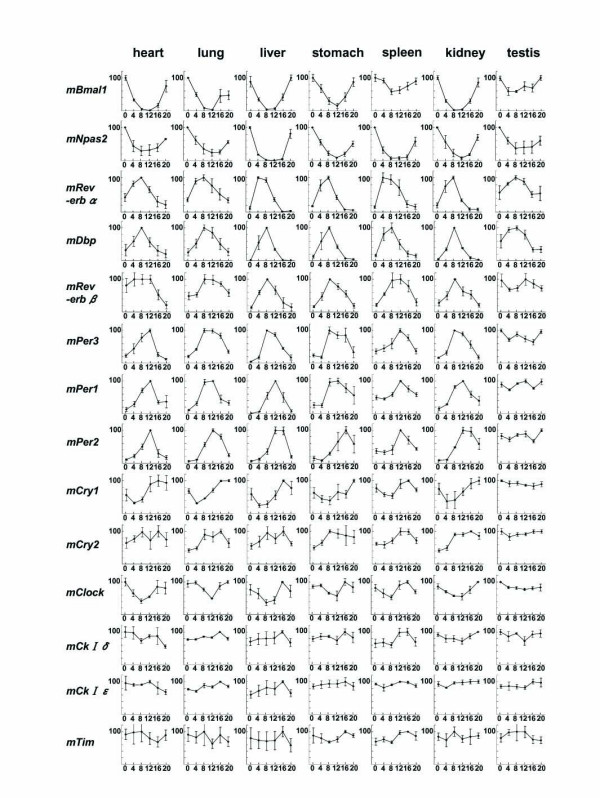
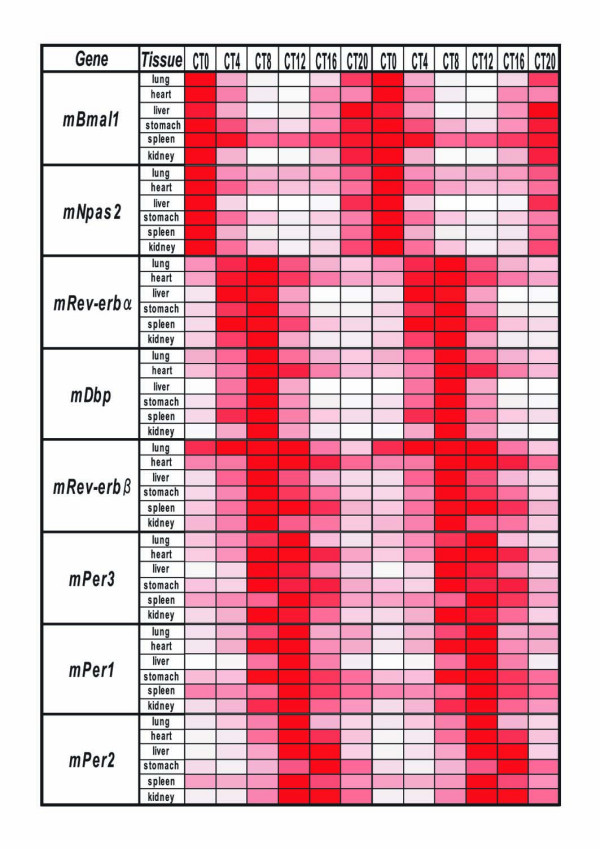
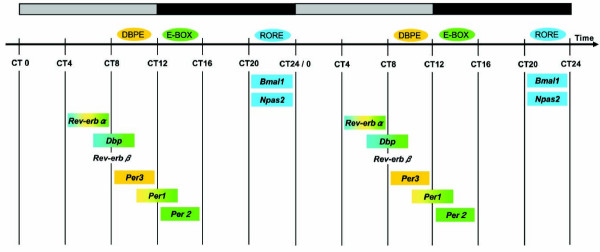
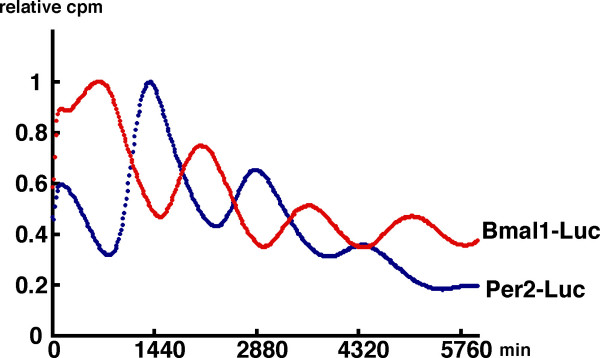
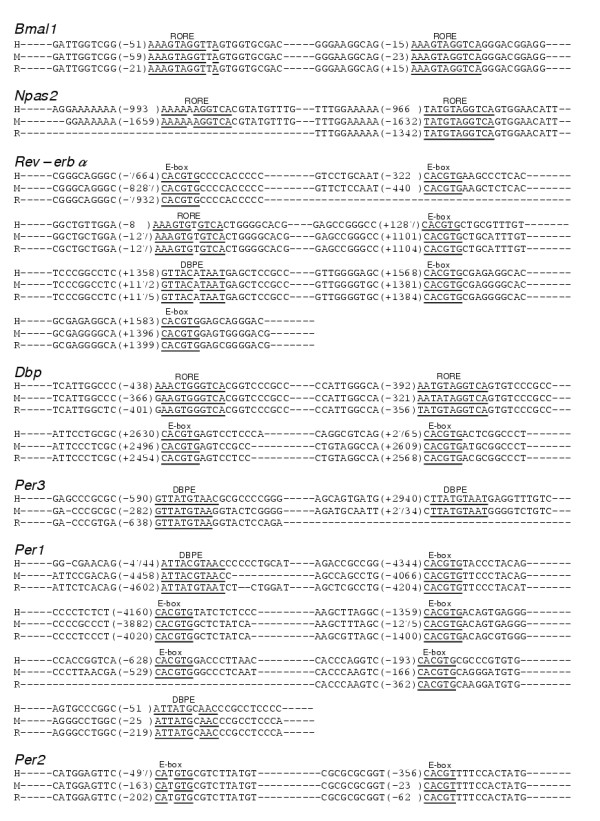
BACKGROUND: The circadian rhythm of about 24 hours is a fundamental physiological function observed in almost all organisms from prokaryotes to humans. Identification of clock genes has allowed us to study the molecular bases for circadian behaviors and temporal physiological processes such as hormonal secretion, and has prompted the idea that molecular clocks reside not only in a central pacemaker, the suprachiasmatic nuclei (SCN) of hypothalamus in mammals, but also in peripheral tissues, even in immortalized cells. Furthermore, previous molecular dissection revealed that the mechanism of circadian oscillation at a molecular level is based on transcriptional regulation of clock and clock-controlled genes. RESULTS: We systematically analyzed the mRNA expression of clock and clock-controlled genes in mouse peripheral tissues. Eight genes (mBmal1, mNpas2, mRev-erbalpha, mDbp, mRev-erbbeta, mPer3, mPer1 and mPer2; given in the temporal order of the rhythm peak) showed robust circadian expressions of mRNAs in all tissues except testis, suggesting that these genes are core molecules of the molecular biological clock. The bioinformatics analysis revealed that these genes have one or a combination of 3 transcriptional elements (RORE, DBPE, and E-box), which are conserved among human, mouse, and rat genome sequences, and indicated that these 3 elements may be responsible for the biological timing of expression of canonical clock genes. CONCLUSIONS: The observation of oscillatory profiles of canonical clock genes is not only useful for physiological and pathological examination of the circadian clock in various organs but also important for systematic understanding of transcriptional regulation on a genome-wide basis. Our finding of the oscillatory expression of canonical clock genes with a temporal order provides us an interesting hypothesis, that cyclic timing of all clock and clock-controlled genes may be dependent on several transcriptional elements including 3 known elements, E-box, RORE, and DBPE.
Overview
The claims and statistics of this paper haven’t been checked yet.
Run the check — free, no account needed. It reads the open-access text and checks the sources it cites.
Integrity signals
Registry
Cites
Statistics
Figures
Verification
Claims the paper makes
The claims and statistics of this paper haven’t been checked yet.
Run the check — free, no account needed. It reads the open-access text and checks the sources it cites.
Claims other papers make about this one
Each is checked against this paper’s own text: does it say what the citing paper says it does?
In the citing paper
“suggesting that the cardiovascular system could be influenced by the circadian timing system at the local level in addition to input from the central pacemaker”
From The impact of the circadian timing system on cardiovascular and metabolic function (2012) · cites this paper as Yamamoto et al., 2004
Self-check
Percentages, sums and reported differences re-computed from the paper’s own numbers.
The self-check needs the paper’s full text.
Citations
Cites
Coordination of circadian timing in mammals
Reppert, S. M., & Weaver, D. R. (2002) · Nature · doi:10.1038/nature00965 · Cited by 4,379
Molecular Bases for Circadian Clocks
Dunlap, J. C. (1999) · Cell · doi:10.1016/s0092-8674(00)80566-8 · Cited by 2,900
Yoo, S.-H., Yamazaki, S., Lowrey, P. L., Shimomura, K., Ko, C. H., Buhr, E. D., Siepka, S. M., Hong, H.-K., Oh, W. J., Yoo, O. J., et al. (2004) · Proceedings of the National Academy of Sciences · doi:10.1073/pnas.0308709101 · Cited by 2,329
Coordinated Transcription of Key Pathways in the Mouse by the Circadian Clock
Panda, S., Antoch, M. P., Miller, B. H., Su, A. I., Schook, A. C., Straume, M., Schultz, P. G., Kay, S. A., Takahashi, J. S., & Hogenesch, J. B. (2002) · Cell · doi:10.1016/s0092-8674(02)00722-5 · Cited by 2,310
Clock Mutants of Drosophila melanogaster
Konopka, R. J., & Benzer, S. (1971) · Proceedings of the National Academy of Sciences · doi:10.1073/pnas.68.9.2112 · Cited by 2,287
Preitner, N., Damiola, F., Luis-Lopez-Molina, Zakany, J., Duboule, D., Albrecht, U., & Schibler, U. (2002) · Cell · doi:10.1016/s0092-8674(02)00825-5 · Cited by 2,198
Role of the CLOCK Protein in the Mammalian Circadian Mechanism
Gekakis, N., Staknis, D., Nguyen, H. B., Davis, F. C., Wilsbacher, L. D., King, D. P., Takahashi, J. S., & Weitz, C. J. (1998) · Science · doi:10.1126/science.280.5369.1564 · Cited by 2,035
mCRY1 and mCRY2 are essential components of the negative limb of the circadian clock feedback loop
Kume, K., Zylka, M. J., Sriram, S., Shearman, L. P., Weaver, D. R., Jin, X., Maywood, E. S., Hastings, M. H., & Reppert, S. M. (1999) · Cell · doi:10.1016/s0092-8674(00)81014-4 · Cited by 1,617
Extensive and divergent circadian gene expression in liver and heart
Storch, K.-F., Lipan, O., Leykin, I., Viswanathan, N., Davis, F. C., Wong, W. H., & Weitz, C. J. (2002) · Nature · doi:10.1038/nature744 · Cited by 1,509
An h Per2 Phosphorylation Site Mutation in Familial Advanced Sleep Phase Syndrome
Toh, K. L., Jones, C. R., He, Y., Eide, E. J., Hinz, W. A., Virshup, D. M., Ptáček, L. J., & Fu, Y.-H. (2001) · Science · doi:10.1126/science.1057499 · Cited by 1,460
Cited by
Sorted by citations
Items 301–306 of 306
Hussein, L. E. C. (2020) · theses.fr (ABES) · doi:10.70675/9042525czdb1cz48faz8c65z9705b72ae812
Oh, E., Nah, J., Yun, N., Lee, M. N., & Pae, M. (2026) · Nutrition Research and Practice · doi:10.4162/nrp.2026.20.3.417
Advances in monitoring mammalian circadian components and their rhythms using reporter systems
Kalyanaraman, B., Rivera‐Iglesias, E. F., & Farkas, M. E. (2026) · RSC Chemical Biology · doi:10.1039/d5cb00332f
Song, W., Liu, Y., Zeng, L., Cao, D., Han, J., Wen, J., Huang, Z., Miao, L., Liao, Z., & Hu, C. (2026) · iScience · doi:10.1016/j.isci.2026.117036
da Cunha, L. S., de Morais, G. P., Machado, C. B., Oliveira, D. D. S., Nogueira, B. M. D., Machado, A. K. D. C., Farias, I. C., Pessoa, F. M. C. D. P., Ribeiro, R. M., de Albuquerque, K. M. C., et al. (2026) · Blood Research · doi:10.1007/s44313-026-00157-y
The circadian clock and the cell cycle
Cox, C. A. (2012) · UCL Discovery (University College London)
Metadata
- Authors
- Yamamoto, T., Nakahata, Y., Soma, H., Akashi, M., Mamine, T., & Takumi, T.
- Affiliations
- Osaka City University (JP)
- Life Science Institute (JP)
- Corresponding author
- Takumi, Toru
- Venue
- BMC Molecular Biology
- Published
- 2004-10-09
- Volume
- 5
- Issue
- 1
- Pages
- 18-18
- ISSN
- 1471-2199 (ISSN-L)
- PMC
- PMC535906
- OpenAlex
- W1878038567
- Cited by
- 308
- References
- 38
- Citations by year
- 2026: 7 · 2025: 9 · 2024: 6 · 2023: 5 · 2022: 10 · 2021: 13 · 2020: 9 · 2019: 6 · 2018: 13 · 2017: 11 · 2016: 12 · 2015: 12 · 2014: 14 · 2013: 20 · 2012: 23
- FWCI
- 6.74
- Type
- journal article
- Language
- en
- Open access
- hybrid
- doi.org
- Licence
- cc-by
- Locations
- BMC Molecular Biology (publishedVersion, cc-by)
- PubMed Central (publishedVersion, cc-by)
- PubMed (publishedVersion)
- DOAJ (DOAJ: Directory of Open Access Journals) (submittedVersion)
- Funders
- Ministry of Education, Culture, Sports, Science and Technology
- Japan Society for the Promotion of Science
- Topics
- Life Sciences › Neuroscience › Endocrine and Autonomic Systems › Circadian rhythm and melatonin
- Life Sciences › Agricultural and Biological Sciences › Plant Science › Plant Molecular Biology Research
- Social Sciences › Psychology › Experimental and Cognitive Psychology › Sleep and Work-Related Fatigue
- Keywords
- circadian clock, clock genes, transcriptional oscillations, peripheral circadian rhythms, clock-controlled genes, Bmal1, NPAS2, NR1D1, DBP, REV-ERBβ, Per1, Per2, E-box, mRNA expression, mouse tissues
- MeSH terms
- Animals, Base Sequence, Cell Line, Circadian Rhythm, DNA-Binding Proteins, Enhancer Elements, Genetic, Gene Expression Regulation, Male, Mice, Inbred BALB C, Molecular Sequence Data, Nerve Tissue Proteins, Nuclear Proteins, Organ Specificity, Transcription Factors, Transcription, Genetic, Receptors, Cytoplasmic and Nuclear, Cell Cycle Proteins, Computational Biology, NIH 3T3 Cells, Mice, Basic Helix-Loop-Helix Transcription Factors, Basic Helix-Loop-Helix Proteins, ARNTL Transcription Factors, Period Circadian Proteins, Nuclear Receptor Subfamily 1, Group D, Member 1
About these checks
Registry, retraction, Cites and statistics results are computed, not judged, with one exception: a printed reference that no index lists is read once by a model before it counts as a citation error. Claims are extracted by a model and kept only when their quote appears verbatim in the text; each cited source is then checked, with a model’s help, for whether it says what the claim relies on. Those verdicts can be wrong — read the claim’s quote and the cited source before relying on one.
Statistics and arithmetic are recomputed, not judged.
Confidence bands are shown only for fields calibrated on our annotated test set. None is calibrated yet, so no band is shown.
What counts as a claim ›How we measure confidence ›How we check this ›
Are you an author, or do you see a problem with this page? Request a review
