

External validation of multivariable prediction models: a systematic review of methodological conduct and reporting
Open accessThe DOI matches its Crossref record; 70 of the 70 references it cites were found in a registry or an index.
Abstract
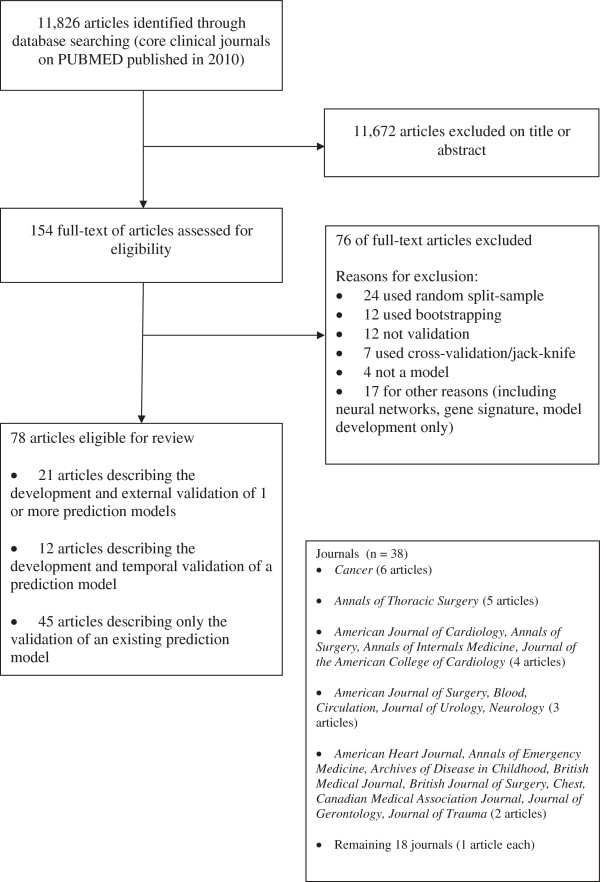
BACKGROUND: Before considering whether to use a multivariable (diagnostic or prognostic) prediction model, it is essential that its performance be evaluated in data that were not used to develop the model (referred to as external validation). We critically appraised the methodological conduct and reporting of external validation studies of multivariable prediction models. METHODS: We conducted a systematic review of articles describing some form of external validation of one or more multivariable prediction models indexed in PubMed core clinical journals published in 2010. Study data were extracted in duplicate on design, sample size, handling of missing data, reference to the original study developing the prediction models and predictive performance measures. RESULTS: 11,826 articles were identified and 78 were included for full review, which described the evaluation of 120 prediction models. in participant data that were not used to develop the model. Thirty-three articles described both the development of a prediction model and an evaluation of its performance on a separate dataset, and 45 articles described only the evaluation of an existing published prediction model on another dataset. Fifty-seven percent of the prediction models were presented and evaluated as simplified scoring systems. Sixteen percent of articles failed to report the number of outcome events in the validation datasets. Fifty-four percent of studies made no explicit mention of missing data. Sixty-seven percent did not report evaluating model calibration whilst most studies evaluated model discrimination. It was often unclear whether the reported performance measures were for the full regression model or for the simplified models. CONCLUSIONS: The vast majority of studies describing some form of external validation of a multivariable prediction model were poorly reported with key details frequently not presented. The validation studies were characterised by poor design, inappropriate handling and acknowledgement of missing data and one of the most key performance measures of prediction models i.e. calibration often omitted from the publication. It may therefore not be surprising that an overwhelming majority of developed prediction models are not used in practice, when there is a dearth of well-conducted and clearly reported (external validation) studies describing their performance on independent participant data.
Overview
The claims and statistics of this paper haven’t been checked yet.
Free: it reads the open-access text and checks the first 5 claims that cite a source we can check. Create a free account to check every claim.
Integrity signals
Registry
Cites
Statistics
Figures
Verification
Claims the paper makes
The claims and statistics of this paper haven’t been checked yet.
Free: it reads the open-access text and checks the first 5 claims that cite a source we can check. Create a free account to check every claim.
Claims other papers make about this one
Each is checked against this paper’s own text: does it say what the citing paper says it does?
The source backs part of the claim, not all of it — or backs it for a different population, condition or comparison.
In the citing paper
“For instance, validation studies rarely present information on the calibration intercept and slope, or different studies report estimates for different risk strata or time horizons.”
From A framework for meta-analysis of prediction model studies with binary and time-to-event outcomes (2019) · cites this paper as [11]
Experimental — accuracy not yet measuredThe cited source says what the claim attributes to it.
In the citing paper
“Furthermore, because validation studies are often conducted using small and local data sets,11 they rarely provide evidence about a model’s potential generalizability across different settings and populations.”
From A framework for meta-analysis of prediction model studies with binary and time-to-event outcomes (2019) · cites this paper as [11]
The cited source says what the claim attributes to it.
In the citing paper
“Unfortunately, extraction of calibration measures is often hampered by poor assessment and reporting.11,16”
From A framework for meta-analysis of prediction model studies with binary and time-to-event outcomes (2019) · cites this paper as [11]
The cited source says what the claim attributes to it.
In the citing paper
“Despite the significant potential demonstrated by extant studies in the application of machine learning for multidimensional data processing and risk prediction, the lack of external validation using completely independent datasets remains a major methodological issue in risk prediction model research (64, 65).”
From Machine learning-based risk predictive models for diabetic kidney disease in type 2 diabetes mellitus patients: a systematic review and meta-analysis (2025) · cites this paper as [64]
In the citing paper
“In a meta-analysis without access to individual participant data (IPD), we are reliant on extracting these performance measures from study publications. However, they are often poorly reported.”
From A framework for meta-analysis of prediction model studies with binary and time-to-event outcomes (2019) · cites this paper as [11]
Self-check
Percentages, sums and reported differences re-computed from the paper’s own numbers.
The self-check needs the paper’s full text.
Citations
Cites
Multiple imputation using chained equations: Issues and guidance for practice
White, I. R., Royston, P., & Wood, A. M. (2011) · Statistics in Medicine · doi:10.1002/sim.4067 · Cited by 9,792 · cited 1×
“If those with missing values were retained in the analyses, then it is important for the reader to know how they were handled in the analysis, including whether methods such as multiple imputation were used [31].”
MethodEuropean Guidelines on cardiovascular disease prevention in clinical practice (version 2012)
Authors/Task Force Members:, Perk, J., De Backer, G., Gohlke, H., Graham, I., Reiner, Ž., Verschuren, M., Albus, C., Benlian, P., Boysen, G., et al. (2012) · European Heart Journal · doi:10.1093/eurheartj/ehs092 · Cited by 8,490
Sterne, J. A. C., White, I. R., Carlin, J. B., Spratt, M., Royston, P., Kenward, M. G., Wood, A. M., & Carpenter, J. R. (2009) · BMJ · doi:10.1136/bmj.b2393 · Cited by 7,299 · cited 1×
“The majority (64%) of studies were assumed to have conducted complete-case analyses to handle missing values, despite methodological guidance to do the contrary [40-44].”
BackgroundDecision curve analysis: a novel method for evaluating prediction models
Vickers, A. J., & Elkin, E. B. (2006) · Medical Decision Making · doi:10.1177/0272989x06295361 · Cited by 6,341 · cited 2×
“New methods based on decision curve analysis (net benefit) [50] and relative utility [51] have recently been introduced.”
MethodAssessing the Performance of Prediction Models: A Framework for Traditional and Novel Measures
Steyerberg, E. W., Vickers, A. J., Cook, N. R., Gerds, T., Gonen, M., Obuchowski, N., Pencina, M. J., & Kattan, M. W. (2010) · Epidemiology · doi:10.1097/ede.0b013e3181c30fb2 · Cited by 5,170 · cited 3×
“Performance is typically characterised by evaluating a model’s calibration and discrimination [15].”
BackgroundClinician’s Guide to Prevention and Treatment of Osteoporosis
Cosman, F., de Beur, S. J., LeBoff, M. S., Lewiecki, E. M., Tanner, B., Randall, S., & Lindsay, R. (2014) · Osteoporosis International · doi:10.1007/s00198-014-2794-2 · Cited by 4,149
Authors/Task Force Members, Graham, I., Atar, D., Borch-Johnsen, K., Boysen, G., Burell, G., Cifkova, R., Dallongeville, J., De Backer, G., Ebrahim, S., et al. (2007) · European Heart Journal · doi:10.1093/eurheartj/ehm316 · Cited by 3,753
Clinical Prediction Models: A Practical Approach to Development, Validation, and Updating
Steyerberg, E. W. (2019) · Statistics for Biology and Health · doi:10.1007/978-3-030-16399-0 · Cited by 3,281
Internal validation of predictive models
Steyerberg, E. W., Harrell, F. E., Borsboom, G. J. J. M., Eijkemans, M. J. C., Vergouwe, Y., & Habbema, J. D. F. (2001) · Journal of Clinical Epidemiology · doi:10.1016/s0895-4356(01)00341-9 · Cited by 2,746
Avoidable waste in the production and reporting of research evidence
Chalmers, I., & Glasziou, P. (2009) · The Lancet · doi:10.1016/s0140-6736(09)60329-9 · Cited by 2,208
Cited by
Items 301–400 of 735
van Doorn, W. P. T. M., Helmich, F., van Dam, P. M. E. L., Jacobs, L. H. J., Stassen, P. M., Bekers, O., & Meex, S. J. R. (2023) · The Journal of Applied Laboratory Medicine · doi:10.1093/jalm/jfad094 · Cited by 19
Meng, L., & Ho, P. (2024) · The Journal of Vascular Access · doi:10.1177/11297298241237830 · Cited by 19
“Bosanquet et al. 20 only validated their model using a subset of the original database with no missing data, which is not considered a proper validation methodology 35 (not in Table 1).”
Katechis, S., Nikolopoulos, D., Flouda, S., Adamichou, C., Chavatza, K., Kapsala, N., Katsimbri, P., Bertsias, G. K., Boumpas, D. T., & Fanouriakis, A. (2024) · Rheumatology · doi:10.1093/rheumatology/keae278 · Cited by 14
Rejali, M., Mansourian, M., Babaei, Z., & Eshrati, B. (2017) · International Journal of Preventive Medicine · doi:10.4103/ijpvm.ijpvm_146_16 · Cited by 14
“New method based on decision curve analysis (DCA) has recently been introduce.[8]”
Hunter, S., Fernando, H., & Baker, J. F. (2021) · Global Spine Journal · doi:10.1177/2192568221989296 · Cited by 14
“The trend for algorithm development and predictive scoring should be balanced by robust external validation to demonstrate generalizability of scoring systems.(7) Despite the high AUC values in the original paper and internal validation sample (0.”
MethodChalkou, K., Steyerberg, E. W., Bossuyt, P. M., Subramaniam, S., Benkert, P., Kühle, J., Disanto, G., Kappos, L., Zecca, C., Egger, M., et al. (2021) · Diagnostic and Prognostic Research · doi:10.1186/s41512-021-00106-6 · Cited by 17
Dukka, H., Dietrich, T., Saleh, M. H. A., Troiano, G., Yonel, Z., Ravidà, A., Wang, H., Greenwell, H., & Chapple, I. (2021) · Journal of Periodontology · doi:10.1002/jper.21-0296 · Cited by 21
López-Jiménez, N., Sánchez, F. G., Pailos, R. H., Rodrigo-Álvaro, V., Pascual-Pedreño, A. I., Moreno‐Cid, M., Delgado‐Rodríguez, M., & Hernández‐Martínez, A. (2021) · BJOG An International Journal of Obstetrics & Gynaecology · doi:10.1111/1471-0528.16947 · Cited by 17
Analysis: Flawed Datasets of Monkeypox Skin Images
Vega, C., Schneider, R., & Satagopam, V. (2023) · Journal of Medical Systems · doi:10.1007/s10916-023-01928-1 · Cited by 16
“on medical prediction models, states that “the majority of published prediction models are opportunistic and are rarely being used or even mentioned in clinical guidelines” [59].”
BackgroundParsons, R., Blythe, R. D., Cramb, S. M., & McPhail, S. (2023) · Journal of the American Medical Informatics Association · doi:10.1093/jamia/ocad042 · Cited by 16
“However, many published clinical prediction models are not well calibrated or do not report on calibration.(24) In this equation, the threshold (t) is calculated by the relative costs (C) of possible classifications (TP: true positive; FP: false positive; TN: true negative; FP: false negative):”
BackgroundRisk Prediction Models in Perioperative Medicine: Methodological Considerations
Collins, G. S., Ma, J., Gerry, S., Ohuma, E. O., Odondi, L., Trivella, M., de Beyer, J. A., & Vazquez-Montes, M. (2016) · Current anesthesiology reports · doi:10.1007/s40140-016-0171-8 · Cited by 15
Jeffery, A. D. (2015) · CIN Computers Informatics Nursing · doi:10.1097/cin.0000000000000154 · Cited by 14
Williams, R. D., Reps, J., Kors, J. A., Ryan, P. B., Steyerberg, E. W., Verhamme, K. M. C., & Rijnbeek, P. R. (2022) · Drug Safety · doi:10.1007/s40264-022-01161-8 · Cited by 16
“Currently, the majority of prediction models are not externally validated; where they are, they are poorly reported [2].”
BackgroundGujjuri, R. R., Clarke, J., Elliott, J. A., Rahman, S., Reynolds, J. V., Hanna, G. B., Markar, S. R., & ENSURE Study Group (2022) · Annals of Surgery · doi:10.1097/sla.0000000000005538 · Cited by 14
External validation of the QLifetime cardiovascular risk prediction tool: population cohort study
Livingstone, S. J., Morales, D. R., Fleuriot, J., Donnan, P. T., & Guthrie, B. (2023) · BMC Cardiovascular Disorders · doi:10.1186/s12872-023-03209-8 · Cited by 13
“Important strengths of the study are the use of population data and study design, conduct and reporting consistent with methodology recommendations [13, 24], publishing all codesets used [6], accounting for competing mortality risks, and examining performance in key subgroups.”
MethodFitzhugh, N., Rasmussen, L. R., Simoni, A. H., & Valentin, J. B. (2023) · European Journal of Neuroscience · doi:10.1111/ejn.16084 · Cited by 15
“Previous reviews investigating the methodological conduct of prognosis studies conclude that the research quality within some medical fields is generally poor (Collins et al., 2011, 2014; Mallett et al., 2010).”
BackgroundResultBayesian Decision Curve Analysis With Bayesdca
Cruz, G. N. F., & Korthauer, K. D. (2024) · Statistics in Medicine · doi:10.1002/sim.10277 · Cited by 19
Kirchgesner, J., Verstockt, B., Adamina, M., Allin, K. H., Allocca, M., Bourgonje, A. R., Burisch, J. M., Doherty, G. A., Dulai, P. S., El‐Hussuna, A., et al. (2025) · Journal of Crohn s and Colitis · doi:10.1093/ecco-jcc/jjaf073 · Cited by 15
Meid, A. D., Ruff, C., Wirbka, L., Stoll, F., Seidling, H. M., Groll, A., & Haefeli, W. E. (2020) · Clinical Epidemiology · doi:10.2147/clep.s274466 · Cited by 15
Leveraging Decision Curve Analysis to Improve Clinical Application of Surgical Risk Calculators
Dadashzadeh, E. R., Bou‐Samra, P., Huckaby, L. V., Nebbia, G., Handzel, R. M., Varley, P. R., Wu, S., & Tsung, A. (2021) · Journal of Surgical Research · doi:10.1016/j.jss.2020.11.059 · Cited by 13
Pienaar, M. A., Sempa, J. B., Luwes, N. J., & Solomon, L. J. (2022) · Frontiers in Pediatrics · doi:10.3389/fped.2022.797080 · Cited by 15
“Calibration is a frequently neglected performance metric (30–33).”
BackgroundLee, S. Y., Ha, S., Jeon, M. G., Li, H., Choi, H., Kim, H. P., Choi, Y. R., Hoseok, I., Jeong, Y. J., Park, Y. H., et al. (2022) · npj Digital Medicine · doi:10.1038/s41746-022-00658-x · Cited by 16
“Last, few studies on CAD evaluations provide evidence for calibration (i.e., agreement between observed proportions and predicted probabilities) 46 , despite the recommendation by relevant reporting guidelines 47 – 49 .”
BackgroundVilliger, R., Julliard, P., Farhoumand, P. D., Choffat, D., Tritschler, T., Stalder, O., Rossel, J., Aujesky, D., Méan, M., & Baumgartner, C. (2023) · Thrombosis Research · doi:10.1016/j.thromres.2023.08.003 · Cited by 19
Lopes, A. J., Ferreira, A. D. S., Walchan, E. M., Soares, M., Bunn, P. D. S., & Guimarães, F. S. (2016) · Human Movement Science · doi:10.1016/j.humov.2016.07.005 · Cited by 13
Faisal, M., Howes, R., Steyerberg, E. W., Richardson, D., & Mohammed, M. A. (2016) · QJM · doi:10.1093/qjmed/hcw110 · Cited by 13
Garriga, C., Sanchez-Santos, M. T., Judge, A., Perneger, T., Hannouche, D., Lübbeke, A., & Arden, N. (2018) · Scientific Reports · doi:10.1038/s41598-018-21713-2 · Cited by 13
Brustia, R., Langella, S., Kawai, T., Fonseca, G. M., Schielke, A., Colli, F., Resende, V., Fleres, F., Roulin, D., Leyman, P., et al. (2019) · European Journal of Surgical Oncology · doi:10.1016/j.ejso.2019.10.041 · Cited by 15
Alves, J. R., Muglia, V. F., Lucchesi, F. R., Faria, R. A. O. G., Alcántara-Quispe, C., Vazquez, V. D. L., dos Reis, R. B., & Faria, E. F. (2020) · European Radiology · doi:10.1007/s00330-020-06839-0 · Cited by 14
Evaluation of Predictive Models for Complications following Spinal Surgery
Dietz, N. E., Sharma, M., Alhourani, A., Ugiliweneza, B., Wang, D., Drazin, D. G., & Boakye, M. (2020) · Journal of Neurological Surgery Part A Central European Neurosurgery · doi:10.1055/s-0040-1709709 · Cited by 13
Ong, W. J. D., How, C. H., Chong, W. H. K., Khan, F. A., Ngiam, K. Y., & Kansal, A. (2024) · Intelligence-Based Medicine · doi:10.1016/j.ibmed.2024.100165 · Cited by 13
Ban, J.-W., Stevens, R., & Perera, R. (2018) · Diagnostic and Prognostic Research · doi:10.1186/s41512-018-0025-6 · Cited by 13
“Although the number of studies reporting CPR research has been rapidly increasing [8, 9, 30], too much focus is still on creating new CPRs rather than externally validating and assessing the impacts of existing CPRs [6, 8, 13].”
BackgroundMethodResultInfluentialWong, C. K., Munster, B. C. V., Hatseras, A., Veld, E. H. I. '., van Leeuwen, B. L., de Rooij, S. E., & Pleijhuis, R. G. (2022) · BMJ Open · doi:10.1136/bmjopen-2021-054023 · Cited by 13
Modern Learning from Big Data in Critical Care: Primum Non Nocere
Gravesteijn, B. Y., Steyerberg, E. W., & Lingsma, H. F. (2022) · Neurocritical Care · doi:10.1007/s12028-022-01510-6 · Cited by 14
“The risk of overfitting is too large [62], resulting in potentially harmful prediction tools [69, 70].”
BackgroundExternal Validation of a Breath-Based Prediction Model for Malignant Pleural Mesothelioma
Janssens, E., Schillebeeckx, E., Zwijsen, K., Raskin, J., Cleemput, J. V., Surmont, V. F. M., Nackaerts, K., Marcq, E., van Meerbeeck, J. P., & Lamote, K. (2022) · Cancers · doi:10.3390/cancers14133182 · Cited by 12
“Most of the studies mainly focus on highlighting the great potential of VOCs as non-invasive biomarkers but often fail to evaluate the performance of the model using independent data, which is key to verifying the model’s applicability to the general patient population [17].”
BackgroundNowinka, Z., Alagha, M. A., Mahmoud, K., & Jones, G. G. (2022) · JMIR Formative Research · doi:10.2196/36130 · Cited by 14
“ML predictive models have an important role in augmenting clinical judgment, and when compared with standard predictions, they produce more accurate and less variable risk estimates [53].”
BackgroundLivingstone, S. J., Morales, D. R., McMinn, M., Eke, C. S., Donnan, P. T., & Guthrie, B. (2022) · BMJ Medicine · doi:10.1136/bmjmed-2022-000316 · Cited by 14
Preoperative risk modelling for oesophagectomy: A systematic review
Grantham, J. P., Hii, A., & Shenfine, J. (2023) · World Journal of Gastrointestinal Surgery · doi:10.4240/wjgs.v15.i3.450 · Cited by 13
Whiting, D., Mallett, S., Lennox, B., & Fazel, S. (2023) · BMJ Mental Health · doi:10.1136/bmjment-2022-300634 · Cited by 15
Benndorf, M., Wu, Y., & Burnside, E. S. (2015) · Clinical Imaging · doi:10.1016/j.clinimag.2015.10.011 · Cited by 12
“Validation of a clinical prediction rule in populations that are independent from the population the prediction rule was developed with is regarded mandatory (25, 26).”
BackgroundOjha, R. P., Asdahl, P. H., Steyerberg, E. W., & Schrøeder, H. (2017) · Pediatric Blood & Cancer · doi:10.1002/pbc.26935 · Cited by 13
Thomsen, M. K., Pedersen, L. H., Erichsen, R., Lash, T. L., Sørensen, H. T., & Mikkelsen, E. M. (2022) · British Journal of Cancer · doi:10.1038/s41416-022-01709-6 · Cited by 14
“We also performed temporal validation, which is intermediate between internal and external validation [24, 29].”
MethodPredictive Algorithms in the Diagnosis and Management of Pediatric Hip and Periarticular Infection
Hunter, S., Kioa, G., & Baker, J. F. (2022) · Journal of Bone and Joint Surgery · doi:10.2106/jbjs.21.01040 · Cited by 12
Reporting Standards and Critical Appraisal of Prediction Models
Wee, L., van Kuijk, S. M. J., Dankers, F. J. W. M., Traverso, A., Welch, M. L., & Dekker, A. L. A. J. (2018) · Springer eBooks · doi:10.1007/978-3-319-99713-1_10 · Cited by 17
Prediction models in gynaecology: Transparent reporting needed for clinical application
Gelderblom, M. E., Stevens, K. Y. R., Houterman, S., Weyers, S., & Schoot, B. C. (2021) · European Journal of Obstetrics & Gynecology and Reproductive Biology · doi:10.1016/j.ejogrb.2021.08.013 · Cited by 11
Aly, F., Hansen, C. R., Mouiee, D. A., Sundaresan, P., Haidar, A., Vinod, S. K., & Holloway, L. C. (2023) · Radiotherapy and Oncology · doi:10.1016/j.radonc.2023.109629 · Cited by 11
Zeng, Q., Li, Z., Gui, S., Wu, J., Liu, C., Wang, T., Peng, D., & Zeng, G. (2024) · Journal of orthopaedic surgery · doi:10.1177/10225536241249591 · Cited by 11
“21 This diversity of model choices creates challenges and inconveniences for clinical staff.”
AlKetbi, L. B., Nagelkerke, N. J. D., Humaid, A., AlAlawi, N., AlKetbi, R. M., Aleissaee, H., AlShamsi, N., Abdulbaqi, H., Fahmawee, T., AlHashaikeh, B., et al. (2024) · Journal of the American Heart Association · doi:10.1161/jaha.124.035930 · Cited by 14
“45 There was no general explanation or justification for such differences, which probably depended on areas of study, study methodology, population, and diseases studied.”
Antonelli, A., Veccia, A., Sandri, M. F., Furlan, M. C., Recenti, S., Sodano, M., Palumbo, C., Cozzoli, A., & Simeone, C. (2017) · Clinical Genitourinary Cancer · doi:10.1016/j.clgc.2017.10.018 · Cited by 11
Khan, O. Z., Badhiwala, J. H., & Fehlings, M. G. (2020) · Spinal Cord · doi:10.1038/s41393-020-00551-y · Cited by 12
Li, R., Yuizono, T., & Li, X. (2022) · PLoS ONE · doi:10.1371/journal.pone.0269176 · Cited by 19
Li, Y., Sijtsema, N. M., de Vette, S. P. M., Steenbakkers, R. J. H. M., Zhang, F., Noordzij, W., den Bosch, L. V., Langendijk, J. A., & van Dijk, L. V. (2023) · Radiotherapy and Oncology · doi:10.1016/j.radonc.2022.109458 · Cited by 11
Risk Prediction Models: Applications in Cancer Prevention
Colditz, G. A., & Wei, E. K. (2015) · Current Epidemiology Reports · doi:10.1007/s40471-015-0057-1 · Cited by 12
External Validation of Early Weight Loss Nomograms for Exclusively Breastfed Newborns
Schaefer, É., Flaherman, V. J., Kuzniewicz, M. W., Li, S. X., Walsh, E. M., & Paul, I. M. (2015) · Breastfeeding Medicine · doi:10.1089/bfm.2015.0126 · Cited by 13
“19”
Harris, W. B., Zhang, C., Liu, Y., Robertson, D. K., Akbashev, M. Y., Lingerfelt, B. M., Küçük, Ö., Carthon, B. C., Gillespie, T. W., Osunkoya, A. O., et al. (2017) · Tumor Biology · doi:10.1177/1010428317705514 · Cited by 11
External Validation and Recalculation of the CODEX Index in COPD Patients. A 3CIAplus Cohort Study
Almagro, P., Martínez‐Camblor, P., Miravitlles, M., Rodríguez‐Carballeira, M., Navarro, A., Lamprecht, B., Luna, A. S. R. G., Kaiser, B., Alfageme, I., Casanova, C., et al. (2019) · COPD Journal of Chronic Obstructive Pulmonary Disease · doi:10.1080/15412555.2018.1484440 · Cited by 11
“External validation is essential to determine the reproducibility of prediction models and to explore whether predictions obtained by the model are valid in other populations (43,44).”
BackgroundEissa, A., Elsherbiny, A., Zoeir, A., Sandri, M. F., Pirola, G. M., Puliatti, S., Prete, C. D., Sighinolfi, M. C., Micali, S., Rocco, B., et al. (2019) · Minerva Urologica e Nefrologica · doi:10.23736/s0393-2249.19.03427-1 · Cited by 12
Cheng, Q., Zhao, G., Wang, X., Wang, L., Lu, M. M., Li, Q., Wu, Y., Huang, Y., Jia, Q., & Xie, L. (2020) · Scientific Reports · doi:10.1038/s41598-020-70748-x · Cited by 11
Simon-Pimmel, J., Foucher, Y., Léger, M., Feuillet, F., Bodet-Contentin, L., Cinotti, R., Frasca, D., & Dantan, É. (2021) · BMJ Open · doi:10.1136/bmjopen-2020-047279 · Cited by 13
Vratsistas‐Curto, A., Tiedemann, A., Treacy, D., Lord, S. R., & Sherrington, C. (2017) · Journal of Rehabilitation Medicine · doi:10.2340/16501977-2290 · Cited by 14
“Guidelines recommend that independent investigators should externally validate prediction models (23).”
BackgroundLemel, H., Shin, D., Meade, S. M., Lapin, B. R., Mroz, T. E., Steinmetz, M. P., & Habboub, G. (2025) · Artificial Intelligence Surgery · doi:10.20517/ais.2024.42 · Cited by 10
Pantelidis, P., Ruipérez-Campillo, S., Vogt, J. E., Antonopoulos, A. S., Gialamas, I., Zakynthinos, G. Ε., Spartalis, Μ., Dilaveris, P., Millet, J., Papaioannou, T. G., et al. (2025) · Frontiers in Cardiovascular Medicine · doi:10.3389/fcvm.2025.1659971 · Cited by 14
Nguyen, H. H. K., Le, H. M., Thang, L. Q., Ngan, D. T. Q., Thoi, N. T., Phuong, N., Hoang, D. M., & Huynh, C. D. (2025) · iScience · doi:10.1016/j.isci.2025.114375 · Cited by 14
Ou, Y., Jiang, D., Li, P., Zhang, W., Zhou, Y., Chen, Y., & Yin, X. (2026) · Frontiers in Public Health · doi:10.3389/fpubh.2025.1667792 · Cited by 14
van den Boorn, H. G., Dijksterhuis, W. P. M., van der Geest, L. G., de Vos‐Geelen, J., Besselink, M. G., Wilmink, J. W., van Oijen, M. G. H., & van Laarhoven, H. W. M. (2021) · Journal of the National Comprehensive Cancer Network · doi:10.6004/jnccn.2020.7669 · Cited by 11
Tuson, M., Turlach, B. A., Murray, K., Kok, M. R., Vickery, A. W., & Whyatt, D. (2021) · International Journal of Environmental Research and Public Health · doi:10.3390/ijerph181910253 · Cited by 11
Akpinar, E. O., Ghaferi, A. A., Liem, R. S. L., Bonham, A. J., Nienhuijs, S. W., Greve, J. W. M., & de Mheen, P. J. M. (2022) · Surgery for Obesity and Related Diseases · doi:10.1016/j.soard.2022.09.008 · Cited by 11
Evaluating Prognostic Markers Using Relative Utility Curves and Test Tradeoffs
Baker, S. G., & Kramer, B. S. (2015) · Journal of Clinical Oncology · doi:10.1200/jco.2014.58.0092 · Cited by 10
“Ideally, investigators should evaluate the performances of the models in an independent test sample from a different population than that associated with the training sample.(10,11) For comparing the performances of models 1 and 2, three popular statistical measures are: (1) the coefficient for the marker in a regress…”
BackgroundChen, C., Tsai, M. K., Wen, C., & Wen, C. P. (2021) · ESMO Open · doi:10.1016/j.esmoop.2021.100288 · Cited by 11
“It requires external validation done by independent database and investigators before the widespread use of our prediction model.(43) Moreover, the predicted probability provided by our models or the figures of our NNS nomogram may vary with local incidence of CRC and the different FIT laboratories.”
MethodQuality of logistic regression reporting in studies of tooth survival after periodontal treatment
Faggion, C. M., Chambrone, L., & Tu, Y. (2014) · Journal Of Clinical Periodontology · doi:10.1111/jcpe.12318 · Cited by 10
Yoneoka, D., Henmi, M., Sawada, N., & Inoue, M. (2015) · BMC Medical Research Methodology · doi:10.1186/s12874-015-0087-x · Cited by 13
“In addition, the model’s calibration was examined by the Hosmer-Lemeshow chi-squared statistic [32].”
MethodGehringer, C. K., Martin, G. P., Hyrich, K. L., Verstappen, S. M. M., Sexton, J., Kristianslund, E. K., Provan, S. A., Kvien, T. K., & Sergeant, J. C. (2023) · Journal of Clinical Epidemiology · doi:10.1016/j.jclinepi.2023.111239 · Cited by 11
de Mattos, B. P., Mattjie, C., Ravazio, R., Barros, R. C., & Grassi‐Oliveira, R. (2024) · International Journal of Mental Health and Addiction · doi:10.1007/s11469-024-01403-z · Cited by 14
“…findings are in accordance with the broader evidence identified in recent literature, which delineates the emerging integration of ML within various health domains (Andaur Navarro et al., 2023; Andaur Navarro et al., 2023, 2022; Dhiman et al., 2022, 2023; Collins et al., 2014; Farimani et al., 2024).”
Haalboom, M., Kort, S., & van der Palen, J. A. M. (2021) · Journal of Clinical Epidemiology · doi:10.1016/j.jclinepi.2021.06.008 · Cited by 10
Lin, V. A., Gögenur, D. S., Pachler, F. R., Fransgaard, T., & Gögenür, I. (2022) · Journal of Crohn s and Colitis · doi:10.1093/ecco-jcc/jjac114 · Cited by 11
To Trach or Not To Trach: Long-term Tracheostomy Outcomes in Infants with BPD
Kielt, M. J., Levin, J. C., & MBI (2023) · NeoReviews · doi:10.1542/neo.24-11-e704 · Cited by 10
Xu, X., Hou, Z., Xu, Y., Gu, H., Liang, G., & Huang, Y. (2020) · Clinics and Research in Hepatology and Gastroenterology · doi:10.1016/j.clinre.2020.06.008 · Cited by 10
Opportunities in cancer imaging: a review of oesophageal, gastric and colorectal malignancies
Foley, K., Pearson, B., Riddell, Z. C., & Taylor, S. A. (2021) · Clinical Radiology · doi:10.1016/j.crad.2021.01.001 · Cited by 9
Callcut, R. A., Xu, Y. X., Moorman, J. R., Tsai, C., Villaroman, A., Robles, A. J., Lake, D. E., Hu, X., & Clark, M. (2021) · Physiological Measurement · doi:10.1088/1361-6579/ac2264 · Cited by 10
Kalafat, E., Morales‐Roselló, J., Scarinci, E., Thilaganathan, B., & Khalil, A. A. (2018) · The Journal of Maternal-Fetal & Neonatal Medicine · doi:10.1080/14767058.2018.1560412 · Cited by 9
“We reported both the accuracy and goodness-of-fit measures as recommended by experts in study methodology [31].”
MethodLeo, M. C., McMullen, C. K., O'Keeffe-Rosetti, M. C., Weinmann, S. A., Garg, T. K., & Nielsen, M. E. (2019) · Urologic Oncology Seminars and Original Investigations · doi:10.1016/j.urolonc.2019.10.003 · Cited by 11
van der Ploeg, T., & Gobbens, R. J. J. (2022) · JMIR Medical Informatics · doi:10.2196/31480 · Cited by 9
“While the interest in the development, validation, and clinical application of prediction models is increasing, a recent systematic review showed that only a quarter of the studies reported prediction models with internal as well as external validation [45,46].”
BackgroundLifestyle predictors of colorectal cancer in European populations: a systematic review
Mertens, E., Keuchkarian, M., Vasquez, M. S., Vandevijvere, S., & Peñalvo, J. L. (2024) · BMJ Nutrition Prevention & Health · doi:10.1136/bmjnph-2022-000554 · Cited by 10
“While a vast majority of external validation studies were poorly reported/performed, 48 49 current research recognises a potentially inferior performance of prediction models in external validation studies.”
BackgroundMoons, K. G. M., Altman, D. G., Reitsma, J. B., loannidis, J. P. A., Macaskill, P., Steyerberg, E. W., Vickers, A. J., Ransohoff, D. F., & Collins, G. S. (2022) · Digital Diagnostics · doi:10.17816/dd110794 · Cited by 12
Self-citationAlbaigés, G., Papastefanou, I., Rodríguez, I., Prats, P., Echevarría, M., Rodríguez, M. Á. P., & Melcon, A. R. (2023) · Ultrasound in Obstetrics and Gynecology · doi:10.1002/uog.26210 · Cited by 10
Buick, J. E., Austin, P. C., Cheskes, S., Ko, D. T., & Atzema, C. L. (2023) · Academic Emergency Medicine · doi:10.1111/acem.14756 · Cited by 10
Transportability of bacterial infection prediction models for critically ill patients
Eickelberg, G., Sanchez-Pinto, L. N., Kline, A. S., & Luo, Y. (2023) · Journal of the American Medical Informatics Association · doi:10.1093/jamia/ocad174 · Cited by 9
Hameed, M., Yeung, J., Boone, D. J., Mallett, S., & Halligan, S. (2023) · European Radiology · doi:10.1007/s00330-023-10168-3 · Cited by 9
“Via systematic review, Collins found that most external evaluations were poorly designed and reported themselves [85].”
BackgroundGuthrie, B., Rogers, G., Livingstone, S. J., Morales, D. R., Donnan, P. T., Davis, S., Youn, J.-H., Hainsworth, R., Thompson, A., & Payne, K. (2024) · Health and Social Care Delivery Research · doi:10.3310/kltr7714 · Cited by 11
Yu, J. Y., Kim, D., Yoon, S., Kim, T., Heo, S., Chang, H., Han, G. S., Jeong, K. W., Park, R. W., Gwon, J. M., et al. (2024) · Scientific Reports · doi:10.1038/s41598-024-54364-7 · Cited by 14
Development and external validation of a head and neck cancer risk prediction model
Smith, C. D. L., McMahon, A. D., Lyall, D. M., Goulart, M. D. A., Inman, G. J., Ross, A. J., Gormley, M., Dudding, T., Macfarlane, G. J., Robinson, M., et al. (2024) · Head & Neck · doi:10.1002/hed.27834 · Cited by 8
“20 21 – 23 The growing number of large population-cohort studies offers new opportunities for developing and validating clinically applicable risk models.”
Ehresman, J., Lubelski, D., Pennington, Z. A., Hung, B., Ahmed, A. K., Azad, T. D., Lehner, K., Feghali, J., Buser, Z., Harrop, J. S., et al. (2021) · Journal of Neurosurgery Spine · doi:10.3171/2020.8.spine20963 · Cited by 8
Application of ED-XRF spectra for determination of macroelements in edible seaweeds
Milinović, J., Figueiredo, F. M. J., Noronha, J. P., & Sardinha, J. P. (2022) · Journal of Food Composition and Analysis · doi:10.1016/j.jfca.2022.104559 · Cited by 9
Systematic Reviews of Prognostic Factor Studies
Riley, R. D., Moons, K. G. M., Altman, D. G., Collins, G. S., & Debray, T. P. A. (2022) · Wiley eBooks · doi:10.1002/9781119099369.ch17 · Cited by 9
Self-citationIntegrating Machine Learning for Football Injury Prediction: A Concept for an Intelligent System
Prys, M., Rosiński, Ł., Buryta, R., Radzimiński, Ł., Różewski, P., & Rejer, I. (2023) · Procedia Computer Science · doi:10.1016/j.procs.2023.10.410 · Cited by 8
dos Santos, A. L., Pinhati, C. C., Perdigão, J., Galante, S. C., Silva, L., Veloso, I. Y., Silva, A. C. S. E., & OLIVEIRA, E. A. (2024) · Artificial Intelligence in Medicine · doi:10.1016/j.artmed.2024.102824 · Cited by 9
The asthma prediction rule to decrease hospitalizations for children with asthma
Arnold, D. H., Sills, M. R., & Walsh, C. G. (2016) · Current Opinion in Allergy and Clinical Immunology · doi:10.1097/aci.0000000000000259 · Cited by 8
Lin, J., Zhao, Y., Zhou, Y., Hao, H., He, Q., Tian, Y., Zou, B., Zhao, G., Qiu, X., Jiang, L., et al. (2020) · Neuroendocrinology · doi:10.1159/000505924 · Cited by 8
External Validation of a Bayesian Network for Error Detection in Radiotherapy Plans
Kalendralis, P., Eyssen, D., Canters, R. A. M., Luk, S. M. H., Kalet, A. M., van Elmpt, W., Fijten, R., Dekker, A. L. A. J., Zegers, C. M. L., & Bermejo, I. (2021) · IEEE Transactions on Radiation and Plasma Medical Sciences · doi:10.1109/trpms.2021.3070656 · Cited by 8
Ramos, R. D. A., Guimarães, F. S., Dionyssiotis, Y., Tsekoura, D., Papathanasiou, J. V., & Ferreira, A. D. S. (2018) · Journal of Bodywork and Movement Therapies · doi:10.1016/j.jbmt.2018.01.010 · Cited by 9
Polypharmacology and Natural Products
Wang, Z., & Yang, B. (2022) · Springer eBooks · doi:10.1007/978-3-031-04998-9_15 · Cited by 7
Metadata
- Authors
- Collins, G. S., de Groot, J. A., Dutton, S., Omar, O., Shanyinde, M., Tajar, A., Voysey, M., Wharton, R., Yu, L.-M., Moons, K. G., & Altman, D. G.
- Affiliations
- University of Oxford (GB)
- University Medical Center Utrecht (NL)
- ORCID
- Venue
- BMC Medical Research Methodology
- Published
- 2014-03-19
- Volume
- 14
- Issue
- 1
- Pages
- 40-40
- ISSN
- 1471-2288 (ISSN-L)
- PMC
- PMC3999945
- OpenAlex
- W2084164487
- Cited by
- 729
- References
- 70
- Citations by year
- 2026: 61 · 2025: 61 · 2024: 75 · 2023: 86 · 2022: 88 · 2021: 80 · 2020: 68 · 2019: 40 · 2018: 41 · 2017: 47 · 2016: 34 · 2015: 41 · 2014: 7
- FWCI
- 5.44
- Type
- journal article
- Language
- en
- Open access
- gold
- doi.org
- Licence
- Locations
- BMC Medical Research Methodology (publishedVersion, cc-by)
- Europe PMC (PubMed Central) (publishedVersion, cc-by)
- PubMed Central (publishedVersion, cc-by)
- PubMed (publishedVersion)
- University of Birmingham Research Portal (University of Birmingham) (submittedVersion)
- Funders
- Cancer Research UK (16895)
- National Institute for Health and Care Research (NF-SI-0508-10259)
- Nederlandse Organisatie voor Wetenschappelijk Onderzoek (91208004, 918.10.615, project 9120.8004)
- Medical Research Council (MR/K006584/1, G1100513)
- Topics
- Physical Sciences › Mathematics › Statistics and Probability › Statistical Methods in Epidemiology
- Social Sciences › Decision Sciences › Statistics, Probability and Uncertainty › Meta-analysis and systematic reviews
- Health Sciences › Health Professions › Health Information Management › Artificial Intelligence in Healthcare
- Keywords
- external validation, multivariable prediction models, reporting quality, model calibration, model discrimination, missing data, simplified scoring system, prognostic model, diagnostic model
- MeSH terms
- Data Interpretation, Statistical, Humans, Prognosis, Reproducibility of Results, Outcome Assessment, Health Care, Validation Studies as Topic
About these checks
Registry, retraction, Cites and statistics results are computed, not judged, with one exception: a printed reference that no index lists is read once by a model before it counts as a citation error. Claims are extracted by a model and kept only when their quote appears verbatim in the text; each cited source is then checked, with a model’s help, for whether it says what the claim relies on. Those verdicts can be wrong — read the claim’s quote and the cited source before relying on one.
Statistics and arithmetic are recomputed, not judged.
Confidence bands are shown only for fields calibrated on our annotated test set. None is calibrated yet, so no band is shown.
What counts as a claim ›How we measure confidence ›How we check this ›
Are you an author, or do you see a problem with this page? Request a review
Data sources
Bibliographic data: Semantic Scholar, OpenAlex, Crossref.
Contains information from the Semantic Scholar Academic Graph Datasets, made available under the ODC Attribution License (ODC-BY 1.0).
Semantic Scholar’s data is described in: Kinney, R., et al. (2023). The Semantic Scholar Open Data Platform. arXiv:2301.10140.
