

External validation of multivariable prediction models: a systematic review of methodological conduct and reporting
Open accessThe DOI matches its Crossref record; 70 of the 70 references it cites were found in a registry or an index.
Abstract
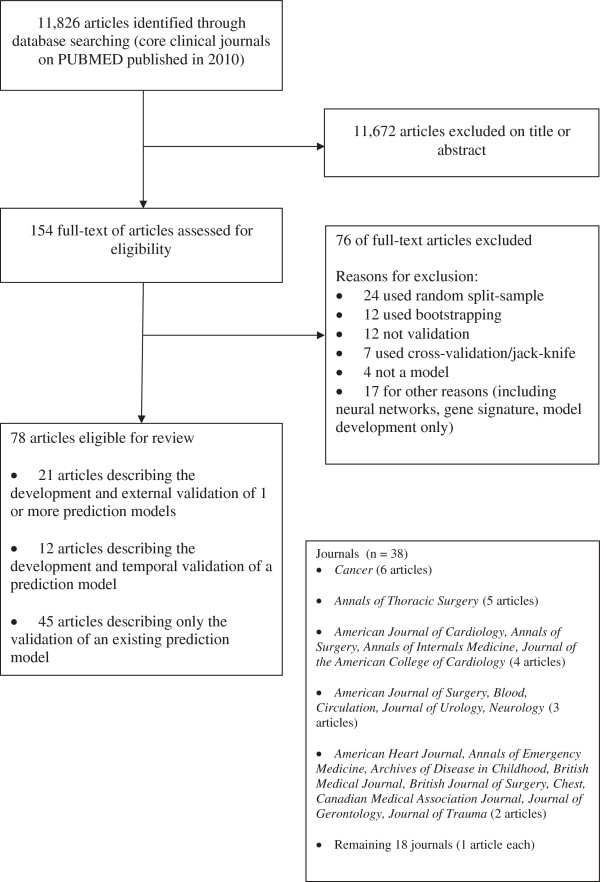
BACKGROUND: Before considering whether to use a multivariable (diagnostic or prognostic) prediction model, it is essential that its performance be evaluated in data that were not used to develop the model (referred to as external validation). We critically appraised the methodological conduct and reporting of external validation studies of multivariable prediction models. METHODS: We conducted a systematic review of articles describing some form of external validation of one or more multivariable prediction models indexed in PubMed core clinical journals published in 2010. Study data were extracted in duplicate on design, sample size, handling of missing data, reference to the original study developing the prediction models and predictive performance measures. RESULTS: 11,826 articles were identified and 78 were included for full review, which described the evaluation of 120 prediction models. in participant data that were not used to develop the model. Thirty-three articles described both the development of a prediction model and an evaluation of its performance on a separate dataset, and 45 articles described only the evaluation of an existing published prediction model on another dataset. Fifty-seven percent of the prediction models were presented and evaluated as simplified scoring systems. Sixteen percent of articles failed to report the number of outcome events in the validation datasets. Fifty-four percent of studies made no explicit mention of missing data. Sixty-seven percent did not report evaluating model calibration whilst most studies evaluated model discrimination. It was often unclear whether the reported performance measures were for the full regression model or for the simplified models. CONCLUSIONS: The vast majority of studies describing some form of external validation of a multivariable prediction model were poorly reported with key details frequently not presented. The validation studies were characterised by poor design, inappropriate handling and acknowledgement of missing data and one of the most key performance measures of prediction models i.e. calibration often omitted from the publication. It may therefore not be surprising that an overwhelming majority of developed prediction models are not used in practice, when there is a dearth of well-conducted and clearly reported (external validation) studies describing their performance on independent participant data.
Overview
The claims and statistics of this paper haven’t been checked yet.
Free: it reads the open-access text and checks the first 5 claims that cite a source we can check. Create a free account to check every claim.
Integrity signals
Registry
Cites
Statistics
Figures
Verification
Claims the paper makes
The claims and statistics of this paper haven’t been checked yet.
Free: it reads the open-access text and checks the first 5 claims that cite a source we can check. Create a free account to check every claim.
Claims other papers make about this one
Each is checked against this paper’s own text: does it say what the citing paper says it does?
The source backs part of the claim, not all of it — or backs it for a different population, condition or comparison.
In the citing paper
“For instance, validation studies rarely present information on the calibration intercept and slope, or different studies report estimates for different risk strata or time horizons.”
From A framework for meta-analysis of prediction model studies with binary and time-to-event outcomes (2019) · cites this paper as [11]
Experimental — accuracy not yet measuredThe cited source says what the claim attributes to it.
In the citing paper
“Furthermore, because validation studies are often conducted using small and local data sets,11 they rarely provide evidence about a model’s potential generalizability across different settings and populations.”
From A framework for meta-analysis of prediction model studies with binary and time-to-event outcomes (2019) · cites this paper as [11]
The cited source says what the claim attributes to it.
In the citing paper
“Unfortunately, extraction of calibration measures is often hampered by poor assessment and reporting.11,16”
From A framework for meta-analysis of prediction model studies with binary and time-to-event outcomes (2019) · cites this paper as [11]
The cited source says what the claim attributes to it.
In the citing paper
“Despite the significant potential demonstrated by extant studies in the application of machine learning for multidimensional data processing and risk prediction, the lack of external validation using completely independent datasets remains a major methodological issue in risk prediction model research (64, 65).”
From Machine learning-based risk predictive models for diabetic kidney disease in type 2 diabetes mellitus patients: a systematic review and meta-analysis (2025) · cites this paper as [64]
In the citing paper
“In a meta-analysis without access to individual participant data (IPD), we are reliant on extracting these performance measures from study publications. However, they are often poorly reported.”
From A framework for meta-analysis of prediction model studies with binary and time-to-event outcomes (2019) · cites this paper as [11]
Self-check
Percentages, sums and reported differences re-computed from the paper’s own numbers.
The self-check needs the paper’s full text.
Citations
Cites
Multiple imputation using chained equations: Issues and guidance for practice
White, I. R., Royston, P., & Wood, A. M. (2011) · Statistics in Medicine · doi:10.1002/sim.4067 · Cited by 9,792 · cited 1×
“If those with missing values were retained in the analyses, then it is important for the reader to know how they were handled in the analysis, including whether methods such as multiple imputation were used [31].”
MethodEuropean Guidelines on cardiovascular disease prevention in clinical practice (version 2012)
Authors/Task Force Members:, Perk, J., De Backer, G., Gohlke, H., Graham, I., Reiner, Ž., Verschuren, M., Albus, C., Benlian, P., Boysen, G., et al. (2012) · European Heart Journal · doi:10.1093/eurheartj/ehs092 · Cited by 8,490
Sterne, J. A. C., White, I. R., Carlin, J. B., Spratt, M., Royston, P., Kenward, M. G., Wood, A. M., & Carpenter, J. R. (2009) · BMJ · doi:10.1136/bmj.b2393 · Cited by 7,299 · cited 1×
“The majority (64%) of studies were assumed to have conducted complete-case analyses to handle missing values, despite methodological guidance to do the contrary [40-44].”
BackgroundDecision curve analysis: a novel method for evaluating prediction models
Vickers, A. J., & Elkin, E. B. (2006) · Medical Decision Making · doi:10.1177/0272989x06295361 · Cited by 6,341 · cited 2×
“New methods based on decision curve analysis (net benefit) [50] and relative utility [51] have recently been introduced.”
MethodAssessing the Performance of Prediction Models: A Framework for Traditional and Novel Measures
Steyerberg, E. W., Vickers, A. J., Cook, N. R., Gerds, T., Gonen, M., Obuchowski, N., Pencina, M. J., & Kattan, M. W. (2010) · Epidemiology · doi:10.1097/ede.0b013e3181c30fb2 · Cited by 5,170 · cited 3×
“Performance is typically characterised by evaluating a model’s calibration and discrimination [15].”
BackgroundClinician’s Guide to Prevention and Treatment of Osteoporosis
Cosman, F., de Beur, S. J., LeBoff, M. S., Lewiecki, E. M., Tanner, B., Randall, S., & Lindsay, R. (2014) · Osteoporosis International · doi:10.1007/s00198-014-2794-2 · Cited by 4,149
Authors/Task Force Members, Graham, I., Atar, D., Borch-Johnsen, K., Boysen, G., Burell, G., Cifkova, R., Dallongeville, J., De Backer, G., Ebrahim, S., et al. (2007) · European Heart Journal · doi:10.1093/eurheartj/ehm316 · Cited by 3,753
Clinical Prediction Models: A Practical Approach to Development, Validation, and Updating
Steyerberg, E. W. (2019) · Statistics for Biology and Health · doi:10.1007/978-3-030-16399-0 · Cited by 3,281
Internal validation of predictive models
Steyerberg, E. W., Harrell, F. E., Borsboom, G. J. J. M., Eijkemans, M. J. C., Vergouwe, Y., & Habbema, J. D. F. (2001) · Journal of Clinical Epidemiology · doi:10.1016/s0895-4356(01)00341-9 · Cited by 2,746
Avoidable waste in the production and reporting of research evidence
Chalmers, I., & Glasziou, P. (2009) · The Lancet · doi:10.1016/s0140-6736(09)60329-9 · Cited by 2,208
Cited by
Items 501–600 of 735
Tutorial: dos and don’ts in clinical prediction research for venous thromboembolism
Nemeth, B., Smeets, M. J. R., Cannegieter, S. C., & van Smeden, M. (2024) · Research and Practice in Thrombosis and Haemostasis · doi:10.1016/j.rpth.2024.102480 · Cited by 3
“Whilepredictionresearchhasbecomeincreasinglypopularinrecent years, several papers have shown methodological shortcomings and a lackofuniformandadequatereportingformanyofthesemodels[10,11].”
BackgroundBai, D., Leu, C., Mantell, J. E., Exner, T. M., Cooper, D. D., Hoffman, S., Kelvin, E. A., Myer, L., Constant, D., & Moodley, J. (2016) · AIDS and Behavior · doi:10.1007/s10461-016-1441-7 · Cited by 3
“External validation is essential as it quantifies optimism from model overfitting or deficiencies during the development of a prediction model and evaluates the validity of the model in different locations with a similar population [61].”
BackgroundNikolakopoulos, I., Nourabadi, S., Eldredge, J. B., Anand, L., Zhang, M., Qiu, M., Rosenberg, D., & Spyropoulos, A. C. (2020) · Journal of Thrombosis and Thrombolysis · doi:10.1007/s11239-020-02191-8 · Cited by 3
Uddin, M. S. G., Islam, M. S., & Methun, M. I. H. (2022) · Bangladesh Medical Research Council Bulletin · doi:10.3329/bmrcb.v47i1.55798 · Cited by 3
Polypharmacology in Drug Design and Discovery—Basis for Rational Design of Multitarget Drugs
Wang, Z., & Yang, B. (2022) · Springer eBooks · doi:10.1007/978-3-031-04998-9_12 · Cited by 3
Nasr, N. M. G., Soltész, B., Sándor, J., Ádány, R., & Fiatal, S. (2022) · Journal of Cardiovascular Development and Disease · doi:10.3390/jcdd9090295 · Cited by 4
“Accurate risk identification allows medical professionals to intervene early before the developments of the diseases, thus improving the quality of life of the patient [12,13].”
BackgroundZhang, X., Zhou, K., You, L., Zhang, J., Chen, Y., Dai, H., Wan, S., Guan, Z., Hu, M., Kang, J., et al. (2023) · PLoS ONE · doi:10.1371/journal.pone.0283307 · Cited by 5
Development and external validation of clinical prediction models for pituitary surgery
Zanier, O., Zoli, M., Staartjes, V. E., Alalfi, M. O., Guaraldi, F., Asioli, S., Rustici, A., Pasquini, E., Faustini‐Fustini, M., Erlic, Z., et al. (2023) · Brain and Spine · doi:10.1016/j.bas.2023.102668 · Cited by 3
“…validation is a critical step in evaluating the applicability of any model before introduction into clinical practice as internal validation and resampling techniques only allow for a very limited conclusion of the ultimate performance on new patients (generalization) (Collins et al., 2014).”
BackgroundKhalid, S. I., Massaad, E., Roy, J. M., Thomson, K. B., Mirpuri, P., Kiapour, A., & Shin, J. H. (2024) · Neurosurgery · doi:10.1227/neu.0000000000003074 · Cited by 3
The future of plastic surgery data collection, analysis and presentation
Freshwater, M. F. (2016) · Journal of Plastic Reconstructive & Aesthetic Surgery · doi:10.1016/j.bjps.2016.03.020 · Cited by 3
Calibration of Prognostic Risk Scores
CALSTER, B. V., & Steyerberg, E. W. (2018) · Wiley eBooks · doi:10.1002/9781118445112.stat08078 · Cited by 3
Improving Clinical Prognostic Model Methodology: Letter to the Editor
Bullock, G. S., & Collins, P. G. S. (2021) · The American Journal of Sports Medicine · doi:10.1177/03635465211005721 · Cited by 3
“Briefly, these include the lack of full reporting of missing data and the missing data mechanism (eg, any assumptions and what was included in the imputation model), lack of a reported intercept to enable other researchers to implement or validate the model, weak assessment of calibration (eg, the Hosmer-Lemeshow test…”
BackgroundKlemp, M., & Rein, R. (2025) · Sports Medicine · doi:10.1007/s40279-025-02211-8 · Cited by 3
“…the TRIPOD (Transparent Reporting of a multivariable prediction model for Individual Prognosis Or Diagnosis) guidelines recommending the reporting of calibration in prediction modeling studies [4], calibration is far less commonly assessed than discrimination, as found in systematic reviews [5–7].”
Alqurashi, W., Shaker, M. S., Wells, G. A., Collins, G. S., Greenhawt, M., Curran, J., Zemek, R. L., Schuh, S., Ellis, A. K., Gerdts, J. D., et al. (2022) · BMJ Open · doi:10.1136/bmjopen-2022-061976 · Cited by 2
Yan, D., Wang, Y., Hu, J., Lu, R., Ye, C., Liu, N., Chen, D., Liang, W., Zheng, L., Liu, W., et al. (2024) · Frontiers in Nutrition · doi:10.3389/fnut.2024.1351503 · Cited by 3
Khalifa, M., Magrabi, F., & Gallego, B. (2024) · Computer Methods and Programs in Biomedicine Update · doi:10.1016/j.cmpbup.2024.100161 · Cited by 2
A New Evaluation Model for Traumatic Severe Pneumothorax Based on Interpretable Machine Learning
Lv, Y., Weng, J., Li, J., Chen, W., Huang, H., & Zhao, Y. (2025) · International Journal of Computers Communications & Control · doi:10.15837/ijccc.2025.1.6830 · Cited by 2
Diomatari, C., Martin, G. P., Jenkins, D. A., & Jani, M. (2025) · Seminars in Arthritis and Rheumatism · doi:10.1016/j.semarthrit.2025.152728 · Cited by 2
Honda, T., Furuta, Y., Maezono, A., Chen, S., Ishida, Y., Furuhashi, H., Kumamoto, M., Oishi, E., Kimura, Y., Yoshida, D., et al. (2025) · Journal of the American Heart Association · doi:10.1161/jaha.124.040386 · Cited by 3
Zhang, Y., Sun, X., Cheng, C., Hou, N., Han, S., & Tang, X. (2025) · Frontiers in Endocrinology · doi:10.3389/fendo.2025.1610884 · Cited by 2
Cao, Q., Meng, H., Bai, S., Dong, H., Zhang, S., & Fan, C. (2025) · International Journal of Nursing Practice · doi:10.1111/ijn.70041 · Cited by 2
Risk assessment tools for women with breast atypia: A systematic review
Nierenberg, T. C., Dalton, J. C., Howell, R., Kaplan, S. J., Chiba, A., Wang, T., & Plichta, J. K. (2025) · The American Journal of Surgery · doi:10.1016/j.amjsurg.2025.116598 · Cited by 2
A systematic review of CRISPR applications in demyelinating peripheral nervous system disorders
Mariki, A., Kohlmeier, K. A., Mousavi, S. M., & Shabani, M. (2025) · Regenerative Medicine · doi:10.1080/17460751.2025.2574198 · Cited by 2
Byrne, P., Lin, T., Jones, M., Demasi, M., Saif-Ur-Rahman, K., & DuBroff, R. J. (2026) · Journal of clinical lipidology · doi:10.1016/j.jacl.2026.03.026 · Cited by 2
Qualified prediction system for allograft failure in real world settings: extended validation study
Raynaud, M., Truchot, A., Naser, S., Aubert, O., Divard, G., Thalamas, T., Lombardi, Y., Legendre, C. M., Bailly, É., Büchler, M., et al. (2026) · BMJ Medicine · doi:10.1136/bmjmed-2025-002088 · Cited by 2
Prognostic prediction models for psoriatic arthritis in psoriasis: A systematic review
Khoda, F., Khan, Y., Haw, W., Nahar, S., Hodkinson, C., Chinoy, H., Warren, R., Martin, G. P., & Yiu, Z. (2026) · Journal of the European Academy of Dermatology and Venereology · doi:10.1111/jdv.70561 · Cited by 2
Agbo, C. E., Nwankwo, C. K., Onyehalu, J. C., Agu, M. C., Opah, C., & Nworu, C. S. (2026) · Journal of Pharmacology and Experimental Therapeutics · doi:10.1016/j.jpet.2026.104986 · Cited by 2
Talakey, A. A., Hughes, F. J., & Bernabé, E. (2020) · The Journal of Contemporary Dental Practice · doi:10.5005/jp-journals-10024-2952 · Cited by 3
Ban, J.-W., Abel, L., Stevens, R., & Perera, R. (2024) · PLoS ONE · doi:10.1371/journal.pone.0310321 · Cited by 2
Impact of pectoral muscle removal on deep-learning-based breast cancer risk prediction
Klaneček, Ž., Wang, Y., Wagner, T., Cockmartin, L., Marshall, N., Schott, B., Deatsch, A. E., Studen, A., Jarm, K., Krajc, M., et al. (2025) · Physics in Medicine and Biology · doi:10.1088/1361-6560/adb367 · Cited by 3
“As found by many systematic reviews (Bouwmeester et al 2012, Collins et al 2014, Kleinrouweler et al 2016, Wessler et al 2017, Christodoulou et al 2019), calibration of risk prediction models, which adjusts the predicted probabilities to more accurately reflect the true likelihood of cancer…”
Zhang, Y., Zhu, W., Wu, M., Gao, T., Hu, H.-X., & Xu, Z. (2025) · World Journal of Gastrointestinal Oncology · doi:10.4251/wjgo.v17.i4.103113 · Cited by 3
“A C-index greater than 0.65 indicates a reasonable estimate[28].”
InfluentialLing, S., Sun, P., Zaccardi, F., Khosla, S., Cooper, A., Fenici, P., & Khunti, K. (2020) · Diabetes Obesity and Metabolism · doi:10.1111/dom.13966 · Cited by 2
“Notably, if development data cover large or multiple settings, an appropriate internal validation (eg, bootstrapping, examining heterogeneity via meta-analysis) is considered to be just as good as external model validation.(38,39) Fifth, we excluded patients without three HbA1c measures during the follow-up, which may…”
Evani, T. (2023) · International Journal of Humanities Social Sciences and Education · doi:10.20431/2349-0381.1004001 · Cited by 2
“Some AI scholars including [1] define the field as the study of intelligent agents : any system that perceives its environment and takes actions that maximize its chance of achieving its goals.”
BackgroundKornas, K., Tait, C. A., Negatu, E., & Rosella, L. C. (2024) · BMJ Open Diabetes Research & Care · doi:10.1136/bmjdrc-2023-003905 · Cited by 2
Vakitbilir, N., Bergmann, T. J. G., Froese, L., Gomez, A., Sainbhi, A. S., Stein, K. Y., Islam, A., & Zeiler, F. A. (2024) · Computers in Biology and Medicine · doi:10.1016/j.compbiomed.2024.108766 · Cited by 2
Prediction Tools in Spine Surgery: A Narrative Review
Jadresic, M. C., & Baker, J. F. (2024) · Spine Surgery and Related Research · doi:10.22603/ssrr.2024-0189 · Cited by 3
Current State of Artificial Intelligence and Trauma Video Review: Insights for Trauma Resuscitation
Villarreal, J. A., Suh, E., Forrester, J. D., Jopling, J. K., & Dumas, R. P. (2025) · Current Trauma Reports · doi:10.1007/s40719-025-00293-3 · Cited by 3
“Annotation studies for random forest medical imaging for intensive care unit clinical event detection reported inter-annotator disagreement rates of up to 33%, driven by differences in expert interpretation during model training and even institutional-by-institution protocol[67, 68].”
Multimodal modeling for personalized psychiatry
Clark, S. R., Cearns, M., Schubert, K. O., & Baune, B. T. (2019) · Elsevier eBooks · doi:10.1016/b978-0-12-813176-3.00043-2 · Cited by 2
Prospective Validation of the Iowa Rectal Surgery Risk Calculator
Sherman, S. K., Hrabe, J. E., Huang, E. S., Cromwell, J. W., & Byrn, J. C. (2018) · Journal of Gastrointestinal Surgery · doi:10.1007/s11605-018-3770-5 · Cited by 2
“Despite the known tendency of clinical risk models to perform better when tested against the same data used to develop them, systematic reviews of published risk calculators conclude that for most, external validation is reported inappropriately or not at all.(6,15,16) Serious limitations in the development and testin…”
Integral Model of Management Support: Review of Quantitative Management Techniques
Arsić, S., & Mihic, M. M. (2019) · Lecture notes in networks and systems · doi:10.1007/978-3-030-30853-7_14 · Cited by 2
The epidemiology of cardiovascular disease
Backer, G. D., Graham, I. D., Lira, M. T., Hayman, L. L., & Uchmanowicz, I. (2021) · Oxford University Press eBooks · doi:10.1093/med/9780198849315.003.0001 · Cited by 2
Comparison of Some Prediction Models and their Relevance in the Clinical Research
Panda, N. R., MAHANTA, K. L., Pati, J. K., Varanasi, P. R., & Bhuyan, R. (2023) · International Journal of Statistics in Medical Research · doi:10.6000/1929-6029.2023.12.02 · Cited by 2
Development and application of statistical methods for prognosis research
Snell, K. I. (2015) · University of Birmingham Institutional Research Archive (University of Birmingham) · Cited by 3
Statistical modelling: essentially, all models are wrong, but some are useful
Welsing, P. M. J. (2015) · Rheumatology · doi:10.1093/rheumatology/kev116 · Cited by 2
Black, J. E., Terry, A. L., & Lizotte, D. J. (2017) · arXiv (Cornell University) · doi:10.48550/arxiv.1705.09563 · Cited by 2
“External validation assesses the performance of a model on a similar but different group of patients that were not used when developing the model [44]; external validation requires the use of an external dataset.”
MethodSchenker-Ahmed, N. M., Bulsara, N., Yang, L., Huang, L., Iranmehr, A., Wu, J., Graff, A. M., Dadakova, T., Chung, H.-K., Tkach, D., et al. (2019) · bioRxiv (Cold Spring Harbor Laboratory) · doi:10.1101/731661 · Cited by 2
Improving prediction model systematic review methodology: Letter to the Editor
Bullock, G. S., Hughes, T., Sergeant, J. C., Callaghan, M. J., Collins, P. G. S., & Riley, R. D. (2021) · Translational Sports Medicine · doi:10.1002/tsm2.240 · Cited by 2
Alcorn, S. R., Fiksel, J., Wright, J. L., Elledge, C. R., Smith, T. J., Perng, P., Saleemi, S., McNutt, T., DeWeese, T. L., & Zeger, S. L. (2021) · International Journal of Radiation Oncology*Biology*Physics · doi:10.1016/j.ijrobp.2020.12.057 · Cited by 2
External validation of the CACE-HF risk score for mortality in patients with heart failure
López, R. Q., Manzano, L., Bilbao, A., Montero-Pérez-Barquero, M., Cepeda-Rodrigo, J. M., & Escobar-Martínez, A. (2019) · European Journal of Internal Medicine · doi:10.1016/j.ejim.2019.05.010 · Cited by 1
Ahmad, F. (2023) · Bulletin of Business and Economics (BBE) · doi:10.61506/01.00347 · Cited by 1
“External validation is necessary to assess a model's generalizability by testing it on various datasets (Collins et al., 2014).”
BackgroundHåkansson, K., Muse, D. H., Bäck, A., Rasmussen, J. H., Lindegaard, A. M., Specht, L., Friborg, J., Cange, H. H., & Vogelius, I. R. (2025) · Head & Neck · doi:10.1002/hed.28085 · Cited by 1
The state of prediction models in hematologic disease: a worrisome assessment
Wang, X., Zhang, K., Wang, L., Xu, J., Wang, Y., Chen, S., & Tang, Z. (2025) · Current Opinion in Hematology · doi:10.1097/moh.0000000000000865 · Cited by 1
Validation of the prognostic model “oncologiq palliative” for head and neck cancer patients
van den Besselaar, B. N., Klaveren, D. V., Berzenji, D., Hoesseini, A., Jansen, J. C., Hardillo, J. A., de Jong, R. J. B., Offerman, M. P. J., & Sewnaik, A. (2025) · European Archives of Oto-Rhino-Laryngology · doi:10.1007/s00405-025-09462-1 · Cited by 2
“Therefore, it is important to perform external validation before using a prognostic model in clinical practice [22, 25].”
InfluentialVirtanen, S., Stavseth, M. R., Bukten, A., Tesli, M., Fazel, S., & Chang, Z. (2025) · Psychology Crime and Law · doi:10.1080/1068316x.2025.2581796 · Cited by 1
Li, L. X., Hopkins, A. M., Woodman, R. J., Abuhelwa, A. Y., Gao, Y., Parent, N., Rowland, A., & Sorich, M. J. (2025) · Journal of Clinical Epidemiology · doi:10.1016/j.jclinepi.2025.112082 · Cited by 1
Bello, F. D., on Behalf of EAU - YAU Kidney transplant working group, Gallioli, A., Pecoraro, A., Prudhomme, T., Piana, A., Marco, B. B., Haberal, H. B., Dönmez, M. İ., López‐Abad, A., et al. (2026) · Minerva Urology and Nephrology · doi:10.23736/s2724-6051.25.06559-0 · Cited by 1
Mokhtar, S., & Abbass, J. (2025) · International Conference on Decision Aid Sciences and Applications (DASA) · doi:10.1109/dasa68193.2025.11498954 · Cited by 1
“Their performance also declines across external populations due to demographic and epidemiological heterogeneity [9].”
Biziaev, T., Aktary, M. L., Wang, Q., Chekouo, T., Bhatti, P., Shack, L., Robson, P. J., & Kopciuk, K. A. (2023) · Cancers · doi:10.3390/cancers15143545 · Cited by 1
“Evaluating predictive performance using an external dataset enhances the generalizability of model predictions and is a crucial step prior to its application and use in clinical practice [46].”
MethodVentura, V. D. G. J., Delfino-Pereira, P., Pires, M. C., Asevedo, A. A., Jorge, A. D. O., dos Santos, A. C. P., Costa, A. S. D. M., Gomes, A. G. D. R., Lima, B. F., Pessoa, B. P., et al. (2023) · BMC Nephrology · doi:10.1186/s12882-023-03341-9 · Cited by 1
“Many validation studies of predictive scores present performance only with discrimination, especially AUROC, omitting calibration data [36].”
BackgroundMachine Learning Models for Predicting Nurse Turnover and Turnover Intention: A Systematic Review
Hudays, A., Schiltz, N. K., Alrashidi, M., Arishi, A., Khormi, J., Darraj, A., Alkhadrah, A., Flimban, A., Aljohani, R., Sailah, M. A., et al. (2025) · Saudi Journal of Nursing and Health Care · doi:10.36348/sjnhc.2025.v08i06.003 · Cited by 1
Cassão, B. C., Foresto, R. D., Hazin, M. A. A., de Morais, A. P., de Andrade, L. G. M., Medina-Pestana, J. O., Requião‐Moura, L., & Junior, H. T. S. (2025) · Kidney360 · doi:10.34067/kid.0000000946 · Cited by 1
“30,31 Brazil ranks fourth globally in the absolute number of kidney transplants, operating under the world's largest public health care transplantation system.”
Variable-based probabilistic calibration with binary outcome
Seto, H., Kitora, S., Oyama, A., Toki, H., Yamamoto, R., & Yamamoto, M. (2024) · Biostatistics · doi:10.1093/biostatistics/kxaf026 · Cited by 1
Otokiti, A. U., Shih, H.-J., Ozoude, M. M., Siguachi, I., Warsame, L., Williams, K. S., & Akinloye, S. J. (2025) · Medical Research Archives · doi:10.18103/mra.v13i12.7083 · Cited by 1
Diagnostic performance and heterogeneity of validated flow cytometry scores: a systematic review
Sorigué, M. (2026) · Critical Reviews in Clinical Laboratory Sciences · doi:10.1080/10408363.2026.2651313 · Cited by 1
Wildes, D. M., Corley, L., O’Sullivan, D., Selewski, D. T., Costigan, C., Awan, A., Quinlan, C., & Boyle, M. A. (2026) · Journal of Paediatrics and Child Health · doi:10.1111/jpc.70429 · Cited by 2
Performance of Risk Scores in Predicting Intracranial Aneurysm Instability
Tarkiainen, J., Pyysalo, L., & Frösén, J. (2026) · Neurosurgery · doi:10.1227/neu.0000000000004144 · Cited by 1
Yang, J., Jiang, J., Peng, J., Li, J., Mi, P., & Chen, G. (2026) · Journal of International Medical Research · doi:10.1177/03000605261460311 · Cited by 1
“30,31 Therefore, independent external validation should not be considered an optional enhancement but rather a fundamental requirement for assessing the clinical readiness of predictive models.”
Beyond Regulatory Approval: Lifecycle Assurance for Clinical Artificial Intelligence
Shujaat, S. (2026) · Journal of Medical Systems · doi:10.1007/s10916-026-02466-2 · Cited by 1
“Validation evalu - ates performance during development and external testing [ 23].”
Kundu, S. (2017) · Biostatistics and Biometrics Open Access Journal · doi:10.19080/bboaj.2017.01.555552 · Cited by 1
“Biostat Biometrics Open Acc J 1(1): BBOAJ.”
Moons, K. G. M., Altman, D. G., Reitsma, J. B., loannidis, J. P. A., Macaskill, P., Steyerberg, E. W., Vickers, A. J., Ransohoff, D. F., & Collins, G. S. (2023) · Вопросы современной педиатрии · doi:10.15690/vsp.v22i2.2557 · Cited by 1
Self-citationGroot, O. Q. (2023) · Clinical Orthopaedics and Related Research · doi:10.1097/corr.0000000000002828 · Cited by 1
Prognostic Tools for Older Women with Breast Cancer: A Systematic Review
Record, S. M., Chanenchuk, T., Parrish, K. J. M., Kaplan, S. J., Kimmick, G. G., & Plichta, J. K. (2023) · Medicina · doi:10.3390/medicina59091576 · Cited by 3
“In addition, outcomes may have been worse than the investigators in these studies predicted since patients with missing data in large registries, such as SEER, have been shown to have worse outcomes [36].”
InfluentialIloanusi, S., Yunusa, I. U., Mgbere, O. O., Abughosh, S., Chen, H., & Essien, E. J. (2023) · Annals of Epidemiology · doi:10.1016/j.annepidem.2023.09.007 · Cited by 1
Surendran, A. K., Reddy, V. N., & Vijayakumar, C. (2024) · Annals of Surgical Oncology · doi:10.1245/s10434-024-15128-9 · Cited by 1
“8 In conclusion, Choi et al. innovative approach on the development of a multidimensional nomogram is a promising advancement in the realm of MIPD as it helps in tailoring patient management strategies and enhancing clinical decision making.”
Liao, K., van der Veer, S. N., Gomes, F., Finn, C. F., Yorke, J., & Sperrin, M. (2024) · JCO Clinical Cancer Informatics · doi:10.1200/cci.24.00035 · Cited by 4
“58 A study with larger sample size may be of interest to develop a prognostic model using separate ePROM questions as candidate prognostic predictors rather than a summary score.”
Grolleau, F., Tibshirani, R. J., & Chen, J. H. (2025) · Europe PMC (PubMed Central) · doi:10.48550/arxiv.2501.03155 · Cited by 8
“External validation is crucial for demonstrating this generalizability; however, many validation studies are underpowered, yielding unreliable results and potentially misleading conclusions [5, 6].”
Bligard, K. H., Papastefanou, I., & Odibo, A. O. (2025) · Ultrasound in Obstetrics and Gynecology · doi:10.1002/uog.29284 · Cited by 1
“Testing the predictive value of the FMF competing-risks model in independent populations is of paramount importance to determine its generalizability 22,23 .”
Lee, H., & Krischer, J. P. (2017) · Model Assisted Statistics and Applications · doi:10.3233/mas-170397 · Cited by 1
“In epidemiological studies, prediction and variable selection are often criticized for lacking proper validation (Collins et al., 2014; Bleeker et al., 2003).”
Conca, A., Koch, D., Regez, K., Kutz, A., Baechli, C., Haubitz, S., Schüetz, P., Müeller, B., Spirig, R., & Petry, H. (2020) · JMIR Research Protocols · doi:10.2196/21447 · Cited by 1
“We will test for agreement between predicted and observed probabilities using the Hosmer-Lemeshow goodness-of-fit test [30,38].”
Mateen, B. A., Boakye, N. T., Sonabend, R., Russell, N., & Saverino, A. (2020) · Journal of Neuropsychology · doi:10.1111/jnp.12239 · Cited by 2
Koczwara, B., Kaambwa, B., Knowles, R., & Miller, M. (2021) · Supportive Care in Cancer · doi:10.1007/s00520-021-06107-x · Cited by 1
“A lack of external validation is an important reason that only a small proportion of the large number of models developed are applied in a clinical setting [27].”
BackgroundD’Haene, A., Bauters, A., Heyse, B., & Wyffels, P. (2023) · Acta Anaesthesiologica Belgica · doi:10.56126/74.2.08 · Cited by 1
Gupta, P., & Chhangte, R. (2024) · Indian Journal of Neurotrauma · doi:10.1055/s-0044-1791972 · Cited by 1
Haroon, S. M., Adab, P., Riley, R. D., Fitzmaurice, D. A., Jordan, R., & Dickens, A. (2016) · European Respiratory Journal · doi:10.1183/13993003.congress-2016.pa3930 · Cited by 1
Survival modelling in mathematical and medical statistics
Hua, H. (2015) · University of Birmingham Institutional Research Archive (University of Birmingham) · Cited by 1
Khalifa, M., Magrabi, F., & Gallego, B. (2020) · Research Square · doi:10.21203/rs.3.rs-15929/v1 · Cited by 1
“These include Debray framework [77, 85], Steyerberg framework [50, 51, 55, 84], Collins approach [56], the TRIPOD statement [86, 87] and the CHARMS checklist [88], Wallace framework [89, 90], Harris framework [91], Toll approach [78], and the GRADE guidelines [72-74, 92, 93].”
BackgroundMethodMethods for individual participant data meta-analysis in prediction research
de Jong, V. M. T. (2020) · Utrecht University Repository (Utrecht University) · doi:10.33540/469 · Cited by 1
Artificial intelligence applications in radiotherapy: The role of the FAIR data principles
Kalendralis, P. (2022) · doi:10.26481/dis.20221010pk · Cited by 2
Big data and interpretable models for outcome prediction in radiation oncology
Osong, B. (2023) · Research Publications (Maastricht University) · doi:10.26481/dis.20230307ao · Cited by 1
Galbusera, F., Cina, A., & Samartzis, D. (2023) · Neurospine · doi:10.14245/ns.2346296.148 · Cited by 1
Khalifa, M., Magrabi, F., & Gallego, B. (2024) · SSRN Electronic Journal · doi:10.2139/ssrn.4788792 · Cited by 1
Reproducibility and Robustness of Localized Mortality PredictionPreprint
Nitch-Griffin, E., Peterson, A., Skaf, Y., & Brunson, J. C. (2024) · medRxiv · doi:10.1101/2024.06.04.24308417 · Cited by 1
“We sought to gain high-level insights into the dependency of both the performance and the calibration of localized models on cohort sizes (Collins et al. 2014).”
BackgroundPurkayastha, D. S. (2025) · medRxiv · doi:10.64898/2025.12.28.25343118 · Cited by 1
Ensor, J., CALSTER, B. V., Barreñada, L., Wynants, L., & Perry, B. I. (2026) · Research Square · doi:10.21203/rs.3.rs-10767123/v1 · Cited by 1
Kwong, K. (2016) · uO Research (University of Ottawa) · doi:10.20381/ruor-5825
Singleton, K. (2016) · eScholarship (California Digital Library) · Cited by 1
Soave, D. M. (2016) · TSpace (University of Toronto) · Cited by 1
Clinical judgement in the era of evidence based medicine
Sepulveda, F., & José, L. P. (2017) · Research Portal (King's College London)
Building Reality Checks into the Translational Pathway for Diagnostic and Prognostic ModelsPreprint
Lendrem, D. W., Lendrem, C., Pratt, A. G., Tarn, J. R., Skelton, A. J., James, K., McMeekin, P. J., Linsley, M., Gillespie, C., Cordell, H. J., et al. (2018) · arXiv (Cornell University) · doi:10.48550/arxiv.1810.10936
Accurate prediction of the irrelevant remains irrelevant
Torrance, H. L., Broekmans, F. J., & Mol, B. W. (2018) · Human Reproduction · doi:10.1093/humrep/dey379
Metadata
- Authors
- Collins, G. S., de Groot, J. A., Dutton, S., Omar, O., Shanyinde, M., Tajar, A., Voysey, M., Wharton, R., Yu, L.-M., Moons, K. G., & Altman, D. G.
- Affiliations
- University of Oxford (GB)
- University Medical Center Utrecht (NL)
- ORCID
- Venue
- BMC Medical Research Methodology
- Published
- 2014-03-19
- Volume
- 14
- Issue
- 1
- Pages
- 40-40
- ISSN
- 1471-2288 (ISSN-L)
- PMC
- PMC3999945
- OpenAlex
- W2084164487
- Cited by
- 729
- References
- 70
- Citations by year
- 2026: 61 · 2025: 61 · 2024: 75 · 2023: 86 · 2022: 88 · 2021: 80 · 2020: 68 · 2019: 40 · 2018: 41 · 2017: 47 · 2016: 34 · 2015: 41 · 2014: 7
- FWCI
- 5.44
- Type
- journal article
- Language
- en
- Open access
- gold
- doi.org
- Licence
- Locations
- BMC Medical Research Methodology (publishedVersion, cc-by)
- Europe PMC (PubMed Central) (publishedVersion, cc-by)
- PubMed Central (publishedVersion, cc-by)
- PubMed (publishedVersion)
- University of Birmingham Research Portal (University of Birmingham) (submittedVersion)
- Funders
- Cancer Research UK (16895)
- National Institute for Health and Care Research (NF-SI-0508-10259)
- Nederlandse Organisatie voor Wetenschappelijk Onderzoek (91208004, 918.10.615, project 9120.8004)
- Medical Research Council (MR/K006584/1, G1100513)
- Topics
- Physical Sciences › Mathematics › Statistics and Probability › Statistical Methods in Epidemiology
- Social Sciences › Decision Sciences › Statistics, Probability and Uncertainty › Meta-analysis and systematic reviews
- Health Sciences › Health Professions › Health Information Management › Artificial Intelligence in Healthcare
- Keywords
- external validation, multivariable prediction models, reporting quality, model calibration, model discrimination, missing data, simplified scoring system, prognostic model, diagnostic model
- MeSH terms
- Data Interpretation, Statistical, Humans, Prognosis, Reproducibility of Results, Outcome Assessment, Health Care, Validation Studies as Topic
About these checks
Registry, retraction, Cites and statistics results are computed, not judged, with one exception: a printed reference that no index lists is read once by a model before it counts as a citation error. Claims are extracted by a model and kept only when their quote appears verbatim in the text; each cited source is then checked, with a model’s help, for whether it says what the claim relies on. Those verdicts can be wrong — read the claim’s quote and the cited source before relying on one.
Statistics and arithmetic are recomputed, not judged.
Confidence bands are shown only for fields calibrated on our annotated test set. None is calibrated yet, so no band is shown.
What counts as a claim ›How we measure confidence ›How we check this ›
Are you an author, or do you see a problem with this page? Request a review
Data sources
Bibliographic data: Semantic Scholar, OpenAlex, Crossref.
Contains information from the Semantic Scholar Academic Graph Datasets, made available under the ODC Attribution License (ODC-BY 1.0).
Semantic Scholar’s data is described in: Kinney, R., et al. (2023). The Semantic Scholar Open Data Platform. arXiv:2301.10140.
