

External validation of multivariable prediction models: a systematic review of methodological conduct and reporting
Open accessThe DOI matches its Crossref record; 70 of the 70 references it cites were found in a registry or an index.
Abstract
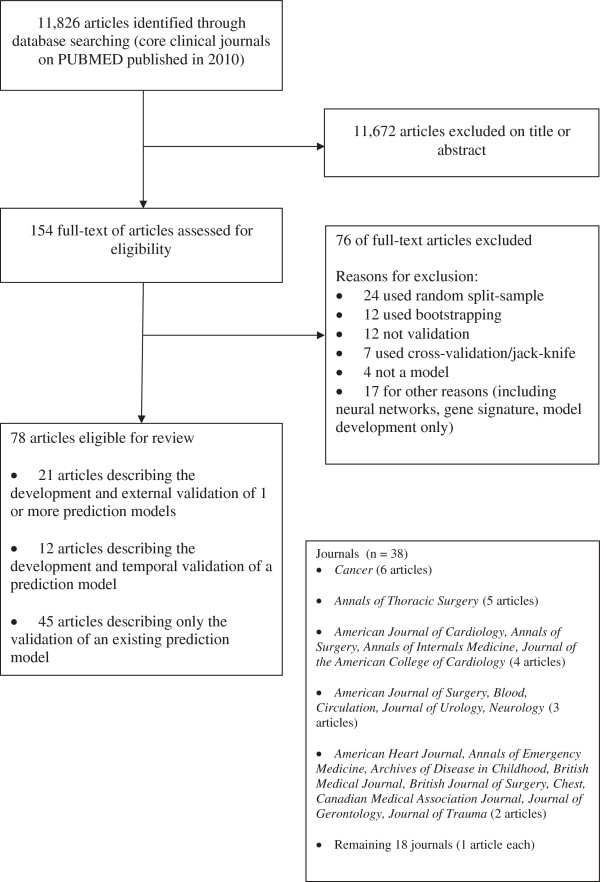
BACKGROUND: Before considering whether to use a multivariable (diagnostic or prognostic) prediction model, it is essential that its performance be evaluated in data that were not used to develop the model (referred to as external validation). We critically appraised the methodological conduct and reporting of external validation studies of multivariable prediction models. METHODS: We conducted a systematic review of articles describing some form of external validation of one or more multivariable prediction models indexed in PubMed core clinical journals published in 2010. Study data were extracted in duplicate on design, sample size, handling of missing data, reference to the original study developing the prediction models and predictive performance measures. RESULTS: 11,826 articles were identified and 78 were included for full review, which described the evaluation of 120 prediction models. in participant data that were not used to develop the model. Thirty-three articles described both the development of a prediction model and an evaluation of its performance on a separate dataset, and 45 articles described only the evaluation of an existing published prediction model on another dataset. Fifty-seven percent of the prediction models were presented and evaluated as simplified scoring systems. Sixteen percent of articles failed to report the number of outcome events in the validation datasets. Fifty-four percent of studies made no explicit mention of missing data. Sixty-seven percent did not report evaluating model calibration whilst most studies evaluated model discrimination. It was often unclear whether the reported performance measures were for the full regression model or for the simplified models. CONCLUSIONS: The vast majority of studies describing some form of external validation of a multivariable prediction model were poorly reported with key details frequently not presented. The validation studies were characterised by poor design, inappropriate handling and acknowledgement of missing data and one of the most key performance measures of prediction models i.e. calibration often omitted from the publication. It may therefore not be surprising that an overwhelming majority of developed prediction models are not used in practice, when there is a dearth of well-conducted and clearly reported (external validation) studies describing their performance on independent participant data.
Overview
The claims and statistics of this paper haven’t been checked yet.
Free: it reads the open-access text and checks the first 5 claims that cite a source we can check. Create a free account to check every claim.
Integrity signals
Registry
Cites
Statistics
Figures
Verification
Claims the paper makes
The claims and statistics of this paper haven’t been checked yet.
Free: it reads the open-access text and checks the first 5 claims that cite a source we can check. Create a free account to check every claim.
Claims other papers make about this one
Each is checked against this paper’s own text: does it say what the citing paper says it does?
The source backs part of the claim, not all of it — or backs it for a different population, condition or comparison.
In the citing paper
“For instance, validation studies rarely present information on the calibration intercept and slope, or different studies report estimates for different risk strata or time horizons.”
From A framework for meta-analysis of prediction model studies with binary and time-to-event outcomes (2019) · cites this paper as [11]
Experimental — accuracy not yet measuredThe cited source says what the claim attributes to it.
In the citing paper
“Furthermore, because validation studies are often conducted using small and local data sets,11 they rarely provide evidence about a model’s potential generalizability across different settings and populations.”
From A framework for meta-analysis of prediction model studies with binary and time-to-event outcomes (2019) · cites this paper as [11]
The cited source says what the claim attributes to it.
In the citing paper
“Unfortunately, extraction of calibration measures is often hampered by poor assessment and reporting.11,16”
From A framework for meta-analysis of prediction model studies with binary and time-to-event outcomes (2019) · cites this paper as [11]
The cited source says what the claim attributes to it.
In the citing paper
“Despite the significant potential demonstrated by extant studies in the application of machine learning for multidimensional data processing and risk prediction, the lack of external validation using completely independent datasets remains a major methodological issue in risk prediction model research (64, 65).”
From Machine learning-based risk predictive models for diabetic kidney disease in type 2 diabetes mellitus patients: a systematic review and meta-analysis (2025) · cites this paper as [64]
In the citing paper
“In a meta-analysis without access to individual participant data (IPD), we are reliant on extracting these performance measures from study publications. However, they are often poorly reported.”
From A framework for meta-analysis of prediction model studies with binary and time-to-event outcomes (2019) · cites this paper as [11]
Self-check
Percentages, sums and reported differences re-computed from the paper’s own numbers.
The self-check needs the paper’s full text.
Citations
Cites
Multiple imputation using chained equations: Issues and guidance for practice
White, I. R., Royston, P., & Wood, A. M. (2011) · Statistics in Medicine · doi:10.1002/sim.4067 · Cited by 9,792 · cited 1×
“If those with missing values were retained in the analyses, then it is important for the reader to know how they were handled in the analysis, including whether methods such as multiple imputation were used [31].”
MethodEuropean Guidelines on cardiovascular disease prevention in clinical practice (version 2012)
Authors/Task Force Members:, Perk, J., De Backer, G., Gohlke, H., Graham, I., Reiner, Ž., Verschuren, M., Albus, C., Benlian, P., Boysen, G., et al. (2012) · European Heart Journal · doi:10.1093/eurheartj/ehs092 · Cited by 8,490
Sterne, J. A. C., White, I. R., Carlin, J. B., Spratt, M., Royston, P., Kenward, M. G., Wood, A. M., & Carpenter, J. R. (2009) · BMJ · doi:10.1136/bmj.b2393 · Cited by 7,299 · cited 1×
“The majority (64%) of studies were assumed to have conducted complete-case analyses to handle missing values, despite methodological guidance to do the contrary [40-44].”
BackgroundDecision curve analysis: a novel method for evaluating prediction models
Vickers, A. J., & Elkin, E. B. (2006) · Medical Decision Making · doi:10.1177/0272989x06295361 · Cited by 6,341 · cited 2×
“New methods based on decision curve analysis (net benefit) [50] and relative utility [51] have recently been introduced.”
MethodAssessing the Performance of Prediction Models: A Framework for Traditional and Novel Measures
Steyerberg, E. W., Vickers, A. J., Cook, N. R., Gerds, T., Gonen, M., Obuchowski, N., Pencina, M. J., & Kattan, M. W. (2010) · Epidemiology · doi:10.1097/ede.0b013e3181c30fb2 · Cited by 5,170 · cited 3×
“Performance is typically characterised by evaluating a model’s calibration and discrimination [15].”
BackgroundClinician’s Guide to Prevention and Treatment of Osteoporosis
Cosman, F., de Beur, S. J., LeBoff, M. S., Lewiecki, E. M., Tanner, B., Randall, S., & Lindsay, R. (2014) · Osteoporosis International · doi:10.1007/s00198-014-2794-2 · Cited by 4,149
Authors/Task Force Members, Graham, I., Atar, D., Borch-Johnsen, K., Boysen, G., Burell, G., Cifkova, R., Dallongeville, J., De Backer, G., Ebrahim, S., et al. (2007) · European Heart Journal · doi:10.1093/eurheartj/ehm316 · Cited by 3,753
Clinical Prediction Models: A Practical Approach to Development, Validation, and Updating
Steyerberg, E. W. (2019) · Statistics for Biology and Health · doi:10.1007/978-3-030-16399-0 · Cited by 3,281
Internal validation of predictive models
Steyerberg, E. W., Harrell, F. E., Borsboom, G. J. J. M., Eijkemans, M. J. C., Vergouwe, Y., & Habbema, J. D. F. (2001) · Journal of Clinical Epidemiology · doi:10.1016/s0895-4356(01)00341-9 · Cited by 2,746
Avoidable waste in the production and reporting of research evidence
Chalmers, I., & Glasziou, P. (2009) · The Lancet · doi:10.1016/s0140-6736(09)60329-9 · Cited by 2,208
Cited by
Items 601–700 of 735
Black, J. E. (2018) · Scholarship@Western (Western University) · Cited by 1
Toland, A. E. (2019) · British Journal of Dermatology · doi:10.1111/bjd.18531
Mallya, S., Overhage, J. M., Bodapati, S., Srivastava, N., & Genç, Ş. (2019) · arXiv (Cornell University) · doi:10.48550/arxiv.1911.05370 · Cited by 3
“Several studies show that characterizing performance on a single population can be insufficient [[25], [26], [27], [28]].”
BackgroundJiang, D., & Shen, Y. (2019) · Expert Review of Molecular Diagnostics · doi:10.1080/14737159.2019.1692656
Quait, A. A. (2018) · White Rose eTheses Online (University of Leeds, The University of Sheffield, University of York) · Cited by 2
Maximizing research value: adequate reporting and effective (de-)implementation strategies
Heus, P. (2020) · Utrecht University Repository (Utrecht University) · doi:10.33540/8 · Cited by 1
Zeng, J., Cao, W., & Wang, L. (2021) · Journal of Shanghai Jiaotong University (Science) · doi:10.1007/s12204-021-2255-y
Prediction Models for Tuberculosis Treatment Outcomes
Peetluk, L. S. (2021)
Gram-negative infections – Burden, Antibiotic Resistance and Empiric Treatment
Deelen, J. W. T. (2021) · Utrecht University Repository (Utrecht University) · doi:10.33540/484
Gundle, K. R. (2021) · Clinical Orthopaedics and Related Research · doi:10.1097/corr.0000000000002078
The Impact of Managerial Approach to Untreated Type -2 Diabetes using AI Techniques
Sahu, P., & Mantri, J. K. (2021) · International Conference on Computational Intelligence and Computing Applications (ICCICA) · doi:10.1109/iccica52458.2021.9697120
Kubat, M., & Şahin, S. (2022) · Acta Medica Alanya · doi:10.30565/medalanya.995148
Khalifa, M., Magrabi, F., & Gallego, B. (2020) · Research Square · doi:10.21203/rs.3.rs-15929/v2
Computational Intelligence Methods for Cancer Survival Prediction
Isa, A. (2022) · Studies in computational intelligence · doi:10.1007/978-981-16-9221-5_7
Defining “Better Prediction” by Machine-Learning Models Toward Clinical Application
Hamaya, R., Sahashi, Y., & Kagiyama, N. (2022) · JACC. Cardiovascular imaging · doi:10.1016/j.jcmg.2021.03.033
Cheng, Q., Zhao, G., Wang, L., Lu, M., Li, Q., Wu, Y., Huang, Y., Jia, Q., & Xie, L. (2020) · doi:10.21203/rs.3.rs-21161/v1
“Besides the novel identified predictors of incident MDR-TB, what the predominant finding in the present study was that we first integrated these existing predictors into an excellent risk prediction tool called nomogram [33].”
BackgroundDeveloping, validating, and evaluating clinical prediction models in breast and prostate cancer
Hueting, T. A. (2022) · doi:10.3990/1.9789036553940 · Cited by 1
Validação do modelo PREDICT em uma coorte de casos de câncer de mama no Brasil
Magario, M. B. (2022) · Digital Library of Theses and Dissertations (Universidade de São Paulo) · doi:10.11606/t.17.2022.tde-21062022-144552
Yu, J. Y., Chang, H. S., Lin, X., Xie, F., Yoon, S. Y., Ong, M. E. H., Ng, Y. Y., Chong, M. C. Y., & Cha, W. C. (2022) · Research Square · doi:10.21203/rs.3.rs-2311067/v1
Rylance, R. T., Wagner, P., Olesen, K. K. W., Carlson, J., Alfredsson, J., Jernberg, T., Leósdóttir, M., Johansson, P., Vasko, P., Mæng, M., et al. (2022) · Open Heart · doi:10.1136/openhrt-2022-002143
Improving Clinical Utility of Real-World Prediction Models: Updating Through Recalibration
Bullock, G. S., Shanley, E., Thigpen, C. A., Arden, N., Noonan, T. K., Kissenberth, M. J., Wyland, D. J., & Collins, G. S. (2022) · The Journal of Strength and Conditioning Research · doi:10.1519/jsc.0000000000004369 · Cited by 2
“same from the originally developed predictionmodel (10).”
BackgroundCommon challenges in the development of prediction models
Houle, T. T., Smith, M. R., & Turner, D. P. (2023) · Headache The Journal of Head and Face Pain · doi:10.1111/head.14504
Akpinar, E. O. (2023) · Research Publications (Maastricht University) · doi:10.26481/dis.20230704ea
Roepke, R. M. L. (2023) · Digital Library of Theses and Dissertations (Universidade de São Paulo) · doi:10.11606/t.5.2023.tde-23062023-163039
Yip, S., Sunderland, K., Ledet, E. M., Beigi, A., Angeles, A., Khalaf, D. J., Sabol, R. A., Warner, E. W., Schrader, K. A., Sun, S., et al. (2023) · Research Square · doi:10.21203/rs.3.rs-3211140/v1
Ingwersen, T., Olma, M. C., Schlemm, E., Mayer, C., Cheng, B., Tütüncü, S., Kirchhof, P. F., Veltkamp, R. C., Röther, J., Laufs, U., et al. (2023) · Neurological Research and Practice · doi:10.1186/s42466-023-00279-z
“Previous proposals for a minimum sample size in external validation studies have suggested at least 100 events; however, these were based on a single simulation study [1, 28].”
BackgroundMethod¿Una bola de cristal en la consulta? Interpretación de una regla de predicción clínica
Muelas, A. L., CASTELLANOS, H. M. C., & Arias, M. M. (2024) · Actualización en Medicina de Familia · doi:10.55783/amf.s200201
Murmann, M., Manuel, D. G., Tanuseputro, P., Bennett, C. L., Pugliese, M., Li, W., Roberts, R. L., & Hsu, A. T. (2024) · F1000Research · doi:10.12688/f1000research.144888.1
Labib, M. A., Catapano, J. S., Inoue, M., Kupanoff, K. M., Singh, R., Abramov, I. T., Scherschinski, L., Srinivasan, V. M., Youn, T. S., Spetzler, R. F., et al. (2024) · Neurosurgery · doi:10.1227/neu.0000000000002959
Goya-Lirio, S., Hernando-Llorens, M., de Garayo-Díaz, S. G., & Cobos, J. R. D. L. (2024) · Revista Clínica Española · doi:10.1016/j.rce.2024.04.008
Kingsley, V., Fox, L., Simm, D., Martin, G. P., Thompson, W., & Faisal, M. (2024) · International Journal of Medical Informatics · doi:10.1016/j.ijmedinf.2024.105497
Goya-Lirio, S., Hernando-Llorens, M., de Garayo-Díaz, S. G., & Cobos, J. R. D. L. (2024) · Revista Clínica Española (English Edition) · doi:10.1016/j.rceng.2024.05.004
Clinical Prediction Models to Improve Patient Safety and Value of Care
Parsons, R. (2024) · Queensland University of Technology · doi:10.5204/thesis.eprints.251808
External validation of web‐based calculator to predict cesarean delivery after induction of labor
Sukayogula, M., Ahmed, M., Donga, P., & Ghimire, A. (2025) · International Journal of Gynecology & Obstetrics · doi:10.1002/ijgo.70069
Said, S. A., IntHout, J., Koffijberg, H., de Hullu, J. A., Hyde, S. E., van der Aa, M. A., & van Altena, A. M. (2025) · Cancer Epidemiology · doi:10.1016/j.canep.2025.102824 · Cited by 1
Liu, S., Huang, A., Huang, Y., Hu, L., Cai, L., He, S., Lyu, G., & Lian, X. (2025) · Diagnostics · doi:10.3390/diagnostics15131630
“Minor discrepancies in AUC between training and validation sets are commonly observed in predictive modeling and may be attributed to slight overfitting or random variability between datasets [27,28].”
Wale, A., Ayres, T., Khatoon, S., Fox-McNally, A., Morgan, C. L., Morgan, H., Shaw, H., Davies, J. R., Edwards, R. T., Dunstan, C., et al. (2025) · medRxiv · doi:10.1101/2025.06.27.25330118
Light Tree-Based Models for Mortality Prediction of ICU Patients
Tran, M. P., & Nguyen, Q. T. (2025) · International Conference on Smart Computing, IoT and Machine Learning (SIML) · doi:10.1109/siml65326.2025.11080868
“…machine learning models for clinical predictions typically focus on assessing discriminative performance through the area under the receiver operating characteristic (AUROC) curve, while the evaluation of prediction reliability, specifically calibration, is seldom addressed [14], [15], [16], [17].”
Otokiti, A. U., Shih, H.-J., Ozoude, M. M., Siguachi, I., Warsame, L., Williams, K. S., & Akinloye, S. J. (2025) · Studies in health technology and informatics · doi:10.3233/shti250952
Spillinger, A., Ellefson, J. L., Yang, Q., Yin, L. X., Stokken, J. K., Pasic, T. R., Koszewski, I. J., & Lin, S. Y. (2025) · International Forum of Allergy & Rhinology · doi:10.1002/alr.70024
Mariki, A., Kohlmeier, K. A., Mousavi, S. M., & Shabani, M. (2025) · Regenerative Medicine · doi:10.1080/17460751.2025.2561451
Kiratipaisarl, W., Surawattanasakul, V., Sirikul, W., & Phinyo, P. (2025) · Journal of Clinical Medicine · doi:10.3390/jcm14217617
“Thereby, the threat to the internal validity of this study, including measurement error and selection bias from excluding incomplete cases, is minimized [41].”
Katkuri, S. N., Vadhithala, V., Kumar, A. N., Verma, S., & Dedeepya, D. (2025) · The Pediatric Infectious Disease Journal · doi:10.1097/inf.0000000000005094
Snell, K. I. E., Allotey, J., Smuk, M., Hooper, R., Chan, C., Ahmed, A. S., Chappell, L. C., Von Dadelszen, P., Green, M., Kenny, L. C., et al. (2020) · Figshare · doi:10.6084/m9.figshare.13175531
Self-citationAbdulaziz, K. E., Perry, J. J., Yadav, K., Dowlatshahi, D., Stiell, I. G., Wells, G. A., & Taljaard, M. (2022) · Figshare · doi:10.6084/m9.figshare.19793204
Havsed, K., Petersson, G. H., Isberg, P.-E., Pigg, M., Svensäter, G., & Rohlin, M. (2024) · Figshare · doi:10.6084/m9.figshare.26633814
Vazquez-Montes, M. D. L. A., Debray, T. P. A., Taylor, K., Speich, B., Jones, N. R., Collins, G., Hobbs, F. D. R. R., Magriplis, E., Maruri-Aguilar, H., Moons, K. G. M., et al. (2020) · Figshare · doi:10.6084/m9.figshare.12864836
Self-citationHavsed, K., Petersson, G. H., Isberg, P.-E., Pigg, M., Svensäter, G., & Rohlin, M. (2024) · Figshare · doi:10.6084/m9.figshare.26633826
das Graças José Ventura, V., Pereira, P. D., Pires, M. C., Asevedo, A. A., de Oliveira Jorge, A., dos Santos, A. C. P., de Moura Costa, A. S., dos Reis Gomes, A. G., Lima, B. F., Pessoa, B. P., et al. (2024) · Figshare · doi:10.6084/m9.figshare.26622904
Huber, M., Schober, P. R., Petersen, S., & Luedi, M. M. (2023) · Figshare · doi:10.6084/m9.figshare.22622953
das Graças José Ventura, V., Pereira, P. D., Pires, M. C., Asevedo, A. A., de Oliveira Jorge, A., dos Santos, A. C. P., de Moura Costa, A. S., dos Reis Gomes, A. G., Lima, B. F., Pessoa, B. P., et al. (2024) · Figshare · doi:10.6084/m9.figshare.26622901
Havsed, K., Petersson, G. H., Isberg, P.-E., Pigg, M., Svensäter, G., & Rohlin, M. (2024) · Figshare · doi:10.6084/m9.figshare.26633820
Afshar, M., Sharma, B., Bhalla, S., Thompson, H. M., Dligach, D., Boley, R. A., Kishen, E., Simmons, A., Perticone, K., & Karnik, N. S. (2021) · Figshare · doi:10.6084/m9.figshare.14235064
Havsed, K., Petersson, G. H., Isberg, P.-E., Pigg, M., Svensäter, G., & Rohlin, M. (2024) · Figshare · doi:10.6084/m9.figshare.26633808
Zhou, L., Wang, L., Liu, G., & Cai, E. (2024) · Figshare · doi:10.6084/m9.figshare.26724125
das Graças José Ventura, V., Pereira, P. D., Pires, M. C., Asevedo, A. A., de Oliveira Jorge, A., dos Santos, A. C. P., de Moura Costa, A. S., dos Reis Gomes, A. G., Lima, B. F., Pessoa, B. P., et al. (2023) · Figshare · doi:10.6084/m9.figshare.24248058
Han, K. S., Kim, S. J., Lee, E. J., Shin, J. H., Lee, J. S., & Lee, S. W. (2021) · Figshare · doi:10.6084/m9.figshare.13605569
Havsed, K., Petersson, G. H., Isberg, P.-E., Pigg, M., Svensäter, G., & Rohlin, M. (2024) · Figshare · doi:10.6084/m9.figshare.26633811
Sexton, J. K., Coory, M. D., Kumar, S., Smith, G., Gordon, A., Chambers, G., Pereira, G. F., Raynes‐Greenow, C. H., Hilder, L., Middleton, P., et al. (2020) · Figshare · doi:10.6084/m9.figshare.13467221
Vazquez-Montes, M. D. L. A., Debray, T. P. A., Taylor, K., Speich, B., Jones, N. R., Collins, G., Hobbs, F. D. R. R., Magriplis, E., Maruri-Aguilar, H., Moons, K. G. M., et al. (2020) · Figshare · doi:10.6084/m9.figshare.12864839
Self-citationAbdulaziz, K. E., Perry, J. J., Yadav, K., Dowlatshahi, D., Stiell, I. G., Wells, G. A., & Taljaard, M. (2022) · Figshare · doi:10.6084/m9.figshare.19793198
Helmrich, I. R., Mikolić, A., Kent, D. M., Lingsma, H. F., Wynants, L., Steyerberg, E. W., & van Klaveren, D. (2022) · Figshare · doi:10.6084/m9.figshare.19711396
Livingstone, S. J., Morales, D. R., Fleuriot, J., Donnan, P. T., & Guthrie, B. (2024) · Figshare · doi:10.6084/m9.figshare.26582516
das Graças José Ventura, V., Pereira, P. D., Pires, M. C., Asevedo, A. A., de Oliveira Jorge, A., dos Santos, A. C. P., de Moura Costa, A. S., dos Reis Gomes, A. G., Lima, B. F., Pessoa, B. P., et al. (2024) · Figshare · doi:10.6084/m9.figshare.24248176
Navarro, C. L. A., Damen, J. A., Takada, T., Nijman, S. W. J., Dhiman, P., Ma, J., Collins, G. S., Bajpai, R., Riley, R. D., Moons, K. G. M., et al. (2022) · Figshare · doi:10.6084/m9.figshare.18393578
Self-citationHavsed, K., Petersson, G. H., Isberg, P.-E., Pigg, M., Svensäter, G., & Rohlin, M. (2024) · Figshare · doi:10.6084/m9.figshare.26633817
Reis, Z. S. N., Pires, M. C., Ramos, L. E. F., Sales, T. L. S., Delfino-Pereira, P., Martins, K. P. M. P., Garbini, A. F., Gomes, A. G. D. R., Pessoa, B. P., Matos, C. C., et al. (2024) · Figshare · doi:10.6084/m9.figshare.26560460
Abdulaziz, K. E., Perry, J. J., Yadav, K., Dowlatshahi, D., Stiell, I. G., Wells, G. A., & Taljaard, M. (2022) · Figshare · doi:10.6084/m9.figshare.19793201
Sexton, J. K., Coory, M. D., Kumar, S., Smith, G., Gordon, A., Chambers, G., Pereira, G. F., Raynes‐Greenow, C. H., Hilder, L., Middleton, P., et al. (2020) · Figshare · doi:10.6084/m9.figshare.13467219
Abdulaziz, K. E., Perry, J. J., Yadav, K., Dowlatshahi, D., Stiell, I. G., Wells, G. A., & Taljaard, M. (2022) · Figshare · doi:10.6084/m9.figshare.19793207
das Graças José Ventura, V., Pereira, P. D., Pires, M. C., Asevedo, A. A., de Oliveira Jorge, A., dos Santos, A. C. P., de Moura Costa, A. S., dos Reis Gomes, A. G., Lima, B. F., Pessoa, B. P., et al. (2024) · Figshare · doi:10.6084/m9.figshare.26622907
Bruce, J., Hossain, A., Ji, C., Lall, R., Arnold, S., Padfield, E., Underwood, M. R., & Lamb, S. E. (2023) · Figshare · doi:10.6084/m9.figshare.22600855
Huber, M., Schober, P. R., Petersen, S., & Luedi, M. M. (2023) · Figshare · doi:10.6084/m9.figshare.22622956
Havsed, K., Petersson, G. H., Isberg, P.-E., Pigg, M., Svensäter, G., & Rohlin, M. (2024) · Figshare · doi:10.6084/m9.figshare.26633823
Livingstone, S. J., Guthrie, B., Donnan, P. T., Thompson, A., & Morales, D. R. (2022) · Figshare · doi:10.6084/m9.figshare.19703880
Reis, Z. S. N., Pires, M. C., Ramos, L. E. F., Sales, T. L. S., Delfino-Pereira, P., Martins, K. P. M. P., Garbini, A. F., Gomes, A. G. D. R., Pessoa, B. P., Matos, C. C., et al. (2024) · Figshare · doi:10.6084/m9.figshare.26560457
Zhou, L., Wang, L., Liu, G., & Cai, E. (2024) · Figshare · doi:10.6084/m9.figshare.25885113
Zhou, L., Wang, L., Liu, G., & Cai, E. (2024) · Figshare · doi:10.6084/m9.figshare.25884980
Kaur, P., Kannapiran, P., Ng, S. H. X., Chu, J., Low, Z. J., Ding, Y. Y., Tan, W. S., & Hum, A. (2023) · Figshare · doi:10.6084/m9.figshare.22721531
Livingstone, S. J., Guthrie, B., Donnan, P. T., Thompson, A., & Morales, D. R. (2022) · Figshare · doi:10.6084/m9.figshare.19703883
Xu, W., Cheng, S., Wu, C., Li, C., Ni, T., Ni, P., Zhang, G., Diao, M., & Hu, W. (2026) · Frontiers in Medicine · doi:10.3389/fmed.2025.1717973
“The integration of machine learning (ML) with electronic health records has advanced predictive capabilities across various medical fields (11–13).”
Akinwumi, P. O., Qian, M., Babatope, O. A., Olorunsogbon, T. A., & Ogunleye, R. O. (2026) · Research Square · doi:10.21203/rs.3.rs-8627838/v1
Cai, J., Tong, N., Hang, C., Qi, X., Su, L., & Guo, S. (2026) · Diagnostics · doi:10.3390/diagnostics16040598 · Cited by 2
“Although cross-validation and independent test set validation were employed, model generalizability still requires confirmation through external validation [32].”
Predicting Surgical Outcomes in Breast Reconstruction With Machine Learning: A Systematic Review
Rosenbloom, A., Gasbeck, T., Mamoun, L., Shah, N. D., Nanda, A., & Lee, G. (2026) · Annals of Plastic Surgery · doi:10.1097/sap.0000000000004667
Machine learning studies of drug-induced nephrotoxicity: a scoping review
Ihsan, M., Chang, S.-T., Chan, W.-K., & Chen, H.-Y. (2026) · Therapeutic Advances in Drug Safety · doi:10.1177/20420986261430234
“Limited sample sizes, 13 a lack of external validation, 14 overfitting, improper missing data management, 15 and a restrained explanation may reduce the utility of such models.”
Garcia-Lopez, A. E., Cuervo-Rojas, J., García-López, J., & Girón-Luque, F. (2026) · Clinical Kidney Journal · doi:10.1093/ckj/sfag089 · Cited by 1
“Calibration, a key aspect of model performance, has been infrequently reported in previous studies [ 40 , 41 ].”
Visual analytics framework for survival analysis and biomarker discovery from gene expression data
Kokošar, J., Turkay, Ç., Ausec, L., Štajdohar, M. R., & Zupan, B. (2026) · PLoS ONE · doi:10.1371/journal.pone.0325399 · Cited by 1
Black, J. E., Campbell, D. J. T., Ronksley, P. E., McBrien, K. A., & Williamson, T. S. (2026) · International Journal of Medical Informatics · doi:10.1016/j.ijmedinf.2026.106407
Wilson, J. P., Chowdhury, F. U. H., Hassan, S., Harriss, E., Alves, F. P., Musa, A. M., Dahal, P., Stepniewska, K., & Guerin, P. J. (2026) · BMJ Public Health · doi:10.1136/bmjph-2024-001196
“21 A glossary of key terms relating to model development and evaluation is presented in table 1.”
Xiao, Y., Liu, Q., Zhao, W., Yang, M., Wu, Q., Fei, X., Qiu, C., Huang, B., Wang, A., Li, F., et al. (2026) · Research Square · doi:10.21203/rs.3.rs-8380234/v1
Li, Y., Chen, Z., Fan, Y., Meng, Y., & Chen, L. (2026) · Frontiers in Oncology · doi:10.3389/fonc.2026.1770406
Tosun, B. G., Gacemer, H. A., Helvacıoğlu, D., Turan, S., Bereket, A., & Güran, T. (2026) · Journal of Clinical Research in Pediatric Endocrinology · doi:10.4274/jcrpe.galenos.2026.2026-1-17
“In addition, variability in test timing, pre-test steroid withdrawal, and execution under everyday care represents the real-world context in which the test is applied, reiterating the importance of validating diagnostic thresholds under pragmatic conditions (35,36,45).”
Risk prediction models for imported infectious diseases: A systematic review
Xu, S., Xie, J., Xie, L., Zhang, L., Xie, C., Zhang, Y., Hong, S., Qu, L., Yuan, G., Chen, R., et al. (2026) · International Journal of Infectious Diseases · doi:10.1016/j.ijid.2026.108737
Salleh, M. M. M., Kassim, S. S., Razak, T. R., Azahar, N., Ismail, N., Yusoff, M. Z. M., Khebir, M. H. A., Teruna, M. M. S., Rameli, N. A. C., Sallehhudin, M. I. M., et al. (2026) · doi:10.2196/preprints.99492
Nakayashiki, A., Umezawa, K., Nishijima, Y., Suzuki, R., Yokosawa, M., & Endo, H. (2026) · medRxiv · doi:10.64898/2026.04.28.26352003
Tian, X., Shi, M., Zhou, G., Sun, Y., Shi, Y., Xiong, H., Wang, M., Dong, J., & Ren, J. (2026) · Frontiers in Neurology · doi:10.3389/fneur.2026.1772331
“Currently, a comprehensive synthesis, comparative assessment of performance, and consolidation of evidence for these models remain absent, which hinders the selection of the most robust tool and its translation into routine clinical practice (18, 19).”
Metadata
- Authors
- Collins, G. S., de Groot, J. A., Dutton, S., Omar, O., Shanyinde, M., Tajar, A., Voysey, M., Wharton, R., Yu, L.-M., Moons, K. G., & Altman, D. G.
- Affiliations
- University of Oxford (GB)
- University Medical Center Utrecht (NL)
- ORCID
- Venue
- BMC Medical Research Methodology
- Published
- 2014-03-19
- Volume
- 14
- Issue
- 1
- Pages
- 40-40
- ISSN
- 1471-2288 (ISSN-L)
- PMC
- PMC3999945
- OpenAlex
- W2084164487
- Cited by
- 729
- References
- 70
- Citations by year
- 2026: 61 · 2025: 61 · 2024: 75 · 2023: 86 · 2022: 88 · 2021: 80 · 2020: 68 · 2019: 40 · 2018: 41 · 2017: 47 · 2016: 34 · 2015: 41 · 2014: 7
- FWCI
- 5.44
- Type
- journal article
- Language
- en
- Open access
- gold
- doi.org
- Licence
- Locations
- BMC Medical Research Methodology (publishedVersion, cc-by)
- Europe PMC (PubMed Central) (publishedVersion, cc-by)
- PubMed Central (publishedVersion, cc-by)
- PubMed (publishedVersion)
- University of Birmingham Research Portal (University of Birmingham) (submittedVersion)
- Funders
- Cancer Research UK (16895)
- National Institute for Health and Care Research (NF-SI-0508-10259)
- Nederlandse Organisatie voor Wetenschappelijk Onderzoek (91208004, 918.10.615, project 9120.8004)
- Medical Research Council (MR/K006584/1, G1100513)
- Topics
- Physical Sciences › Mathematics › Statistics and Probability › Statistical Methods in Epidemiology
- Social Sciences › Decision Sciences › Statistics, Probability and Uncertainty › Meta-analysis and systematic reviews
- Health Sciences › Health Professions › Health Information Management › Artificial Intelligence in Healthcare
- Keywords
- external validation, multivariable prediction models, reporting quality, model calibration, model discrimination, missing data, simplified scoring system, prognostic model, diagnostic model
- MeSH terms
- Data Interpretation, Statistical, Humans, Prognosis, Reproducibility of Results, Outcome Assessment, Health Care, Validation Studies as Topic
About these checks
Registry, retraction, Cites and statistics results are computed, not judged, with one exception: a printed reference that no index lists is read once by a model before it counts as a citation error. Claims are extracted by a model and kept only when their quote appears verbatim in the text; each cited source is then checked, with a model’s help, for whether it says what the claim relies on. Those verdicts can be wrong — read the claim’s quote and the cited source before relying on one.
Statistics and arithmetic are recomputed, not judged.
Confidence bands are shown only for fields calibrated on our annotated test set. None is calibrated yet, so no band is shown.
What counts as a claim ›How we measure confidence ›How we check this ›
Are you an author, or do you see a problem with this page? Request a review
Data sources
Bibliographic data: Semantic Scholar, OpenAlex, Crossref.
Contains information from the Semantic Scholar Academic Graph Datasets, made available under the ODC Attribution License (ODC-BY 1.0).
Semantic Scholar’s data is described in: Kinney, R., et al. (2023). The Semantic Scholar Open Data Platform. arXiv:2301.10140.
