

External validation of multivariable prediction models: a systematic review of methodological conduct and reporting
Open accessThe DOI matches its Crossref record; 70 of the 70 references it cites were found in a registry or an index.
Abstract
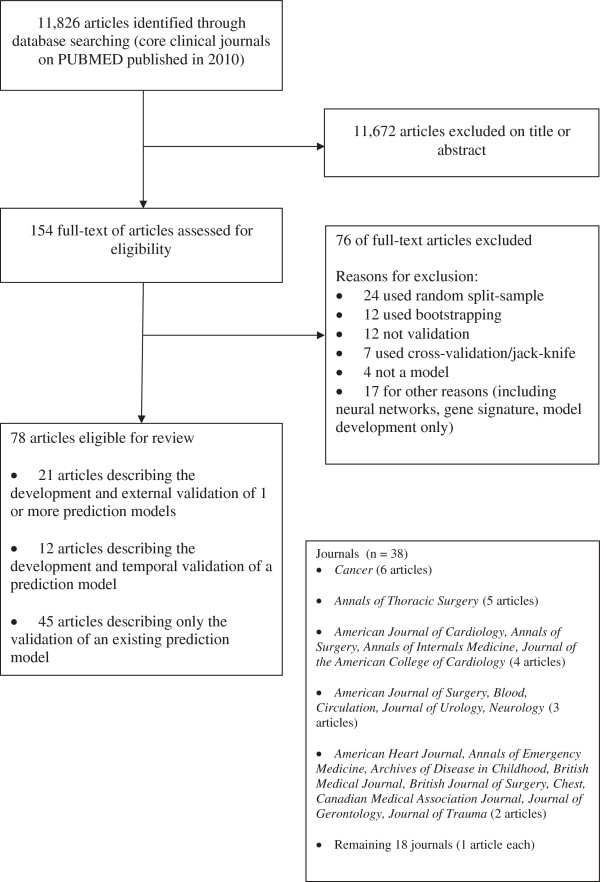
BACKGROUND: Before considering whether to use a multivariable (diagnostic or prognostic) prediction model, it is essential that its performance be evaluated in data that were not used to develop the model (referred to as external validation). We critically appraised the methodological conduct and reporting of external validation studies of multivariable prediction models. METHODS: We conducted a systematic review of articles describing some form of external validation of one or more multivariable prediction models indexed in PubMed core clinical journals published in 2010. Study data were extracted in duplicate on design, sample size, handling of missing data, reference to the original study developing the prediction models and predictive performance measures. RESULTS: 11,826 articles were identified and 78 were included for full review, which described the evaluation of 120 prediction models. in participant data that were not used to develop the model. Thirty-three articles described both the development of a prediction model and an evaluation of its performance on a separate dataset, and 45 articles described only the evaluation of an existing published prediction model on another dataset. Fifty-seven percent of the prediction models were presented and evaluated as simplified scoring systems. Sixteen percent of articles failed to report the number of outcome events in the validation datasets. Fifty-four percent of studies made no explicit mention of missing data. Sixty-seven percent did not report evaluating model calibration whilst most studies evaluated model discrimination. It was often unclear whether the reported performance measures were for the full regression model or for the simplified models. CONCLUSIONS: The vast majority of studies describing some form of external validation of a multivariable prediction model were poorly reported with key details frequently not presented. The validation studies were characterised by poor design, inappropriate handling and acknowledgement of missing data and one of the most key performance measures of prediction models i.e. calibration often omitted from the publication. It may therefore not be surprising that an overwhelming majority of developed prediction models are not used in practice, when there is a dearth of well-conducted and clearly reported (external validation) studies describing their performance on independent participant data.
Overview
The claims and statistics of this paper haven’t been checked yet.
Free: it reads the open-access text and checks the first 5 claims that cite a source we can check. Create a free account to check every claim.
Integrity signals
Registry
Cites
Statistics
Figures
Verification
Claims the paper makes
The claims and statistics of this paper haven’t been checked yet.
Free: it reads the open-access text and checks the first 5 claims that cite a source we can check. Create a free account to check every claim.
Claims other papers make about this one
Each is checked against this paper’s own text: does it say what the citing paper says it does?
The source backs part of the claim, not all of it — or backs it for a different population, condition or comparison.
In the citing paper
“For instance, validation studies rarely present information on the calibration intercept and slope, or different studies report estimates for different risk strata or time horizons.”
From A framework for meta-analysis of prediction model studies with binary and time-to-event outcomes (2019) · cites this paper as [11]
Experimental — accuracy not yet measuredThe cited source says what the claim attributes to it.
In the citing paper
“Furthermore, because validation studies are often conducted using small and local data sets,11 they rarely provide evidence about a model’s potential generalizability across different settings and populations.”
From A framework for meta-analysis of prediction model studies with binary and time-to-event outcomes (2019) · cites this paper as [11]
The cited source says what the claim attributes to it.
In the citing paper
“Unfortunately, extraction of calibration measures is often hampered by poor assessment and reporting.11,16”
From A framework for meta-analysis of prediction model studies with binary and time-to-event outcomes (2019) · cites this paper as [11]
The cited source says what the claim attributes to it.
In the citing paper
“Despite the significant potential demonstrated by extant studies in the application of machine learning for multidimensional data processing and risk prediction, the lack of external validation using completely independent datasets remains a major methodological issue in risk prediction model research (64, 65).”
From Machine learning-based risk predictive models for diabetic kidney disease in type 2 diabetes mellitus patients: a systematic review and meta-analysis (2025) · cites this paper as [64]
In the citing paper
“In a meta-analysis without access to individual participant data (IPD), we are reliant on extracting these performance measures from study publications. However, they are often poorly reported.”
From A framework for meta-analysis of prediction model studies with binary and time-to-event outcomes (2019) · cites this paper as [11]
Self-check
Percentages, sums and reported differences re-computed from the paper’s own numbers.
The self-check needs the paper’s full text.
Citations
Cites
Multiple imputation using chained equations: Issues and guidance for practice
White, I. R., Royston, P., & Wood, A. M. (2011) · Statistics in Medicine · doi:10.1002/sim.4067 · Cited by 9,792 · cited 1×
“If those with missing values were retained in the analyses, then it is important for the reader to know how they were handled in the analysis, including whether methods such as multiple imputation were used [31].”
MethodEuropean Guidelines on cardiovascular disease prevention in clinical practice (version 2012)
Authors/Task Force Members:, Perk, J., De Backer, G., Gohlke, H., Graham, I., Reiner, Ž., Verschuren, M., Albus, C., Benlian, P., Boysen, G., et al. (2012) · European Heart Journal · doi:10.1093/eurheartj/ehs092 · Cited by 8,490
Sterne, J. A. C., White, I. R., Carlin, J. B., Spratt, M., Royston, P., Kenward, M. G., Wood, A. M., & Carpenter, J. R. (2009) · BMJ · doi:10.1136/bmj.b2393 · Cited by 7,299 · cited 1×
“The majority (64%) of studies were assumed to have conducted complete-case analyses to handle missing values, despite methodological guidance to do the contrary [40-44].”
BackgroundDecision curve analysis: a novel method for evaluating prediction models
Vickers, A. J., & Elkin, E. B. (2006) · Medical Decision Making · doi:10.1177/0272989x06295361 · Cited by 6,341 · cited 2×
“New methods based on decision curve analysis (net benefit) [50] and relative utility [51] have recently been introduced.”
MethodAssessing the Performance of Prediction Models: A Framework for Traditional and Novel Measures
Steyerberg, E. W., Vickers, A. J., Cook, N. R., Gerds, T., Gonen, M., Obuchowski, N., Pencina, M. J., & Kattan, M. W. (2010) · Epidemiology · doi:10.1097/ede.0b013e3181c30fb2 · Cited by 5,170 · cited 3×
“Performance is typically characterised by evaluating a model’s calibration and discrimination [15].”
BackgroundClinician’s Guide to Prevention and Treatment of Osteoporosis
Cosman, F., de Beur, S. J., LeBoff, M. S., Lewiecki, E. M., Tanner, B., Randall, S., & Lindsay, R. (2014) · Osteoporosis International · doi:10.1007/s00198-014-2794-2 · Cited by 4,149
Authors/Task Force Members, Graham, I., Atar, D., Borch-Johnsen, K., Boysen, G., Burell, G., Cifkova, R., Dallongeville, J., De Backer, G., Ebrahim, S., et al. (2007) · European Heart Journal · doi:10.1093/eurheartj/ehm316 · Cited by 3,753
Clinical Prediction Models: A Practical Approach to Development, Validation, and Updating
Steyerberg, E. W. (2019) · Statistics for Biology and Health · doi:10.1007/978-3-030-16399-0 · Cited by 3,281
Internal validation of predictive models
Steyerberg, E. W., Harrell, F. E., Borsboom, G. J. J. M., Eijkemans, M. J. C., Vergouwe, Y., & Habbema, J. D. F. (2001) · Journal of Clinical Epidemiology · doi:10.1016/s0895-4356(01)00341-9 · Cited by 2,746
Avoidable waste in the production and reporting of research evidence
Chalmers, I., & Glasziou, P. (2009) · The Lancet · doi:10.1016/s0140-6736(09)60329-9 · Cited by 2,208
Cited by
Items 101–200 of 735
Machine learning-based clinical decision support systems for pregnancy care: A systematic review
Du, Y., McNestry, C., Wei, L., Antoniadi, A. M., McAuliffe, F. M., & Mooney, C. (2023) · International Journal of Medical Informatics · doi:10.1016/j.ijmedinf.2023.105040 · Cited by 73
Metabolomics and Biomarker Discovery in Traumatic Brain Injury
Banoei, M. M., Casault, C. A., Metwaly, S., & Winston, B. W. (2018) · Journal of Neurotrauma · doi:10.1089/neu.2017.5326 · Cited by 75
Claude, L.-A., Houenou, J., Duchesnay, É., & Favre, P. (2020) · Bipolar Disorders · doi:10.1111/bdi.12895 · Cited by 69
Validation of a prognostic index for Huntington's disease
Long, J. D., Langbehn, D. R., Tabrizi, S. J., Landwehrmeyer, G. B., Paulsen, J. S., Warner, J., & Sampaio, C. (2016) · Movement Disorders · doi:10.1002/mds.26838 · Cited by 67
“A guideline for the evaluation of the magnitude of C is provided by a survey of values found in external validation studies in oncology and cardiovascular disease.(23) The survey showed mean C50:78, and we consider this value to be the benchmark for typical and acceptable predictive performance.”
Long, J. D., & Mills, J. A. (2018) · BMC Medical Research Methodology · doi:10.1186/s12874-018-0592-9 · Cited by 80
COVID Mortality Prediction with Machine Learning Methods: A Systematic Review and Critical Appraisal
Bottino, F., Tagliente, E., Pasquini, L., Napoli, A. D., Lucignani, M., Figà-Talamanca, L., & Napolitano, A. (2021) · Journal of Personalized Medicine · doi:10.3390/jpm11090893 · Cited by 74
“The interest in the development and validation of prediction models in clinical setting is growing [68,69], but 14/24 studies of our review reported prediction performance with internal validation only [20,21,25,26,28–32,34,36,38,39,42].”
BackgroundLoymans, R. J. B., Debray, T. P. A., Honkoop, P., Termeer, E. H., Snoeck-Stroband, J. B., Schermer, T. R., Assendelft, W. J., Timp, M. L., Chung, K. F., Sousa, A. R., et al. (2018) · The Journal of Allergy and Clinical Immunology In Practice · doi:10.1016/j.jaip.2018.02.004 · Cited by 69
Collins, G. S., Reitsma, J. B., Altman, D. G., & Moons, K. G. M. (2015) · European Journal of Clinical Investigation · doi:10.1111/eci.12376 · Cited by 58
Self-citationVernooij, J. E. M., Koning, N. J., Geurts, J. W., Holewijn, S., Preckel, B., Kalkman, C. J., & Vernooij, L. M. (2023) · Anaesthesia · doi:10.1111/anae.15988 · Cited by 65
“External validation on heterogeneous noncardiac cohorts [17, 28] Yes = 2points; No = 0 points”
Backgroundvan der Ploeg, T., Nieboer, D., & Steyerberg, E. W. (2016) · Journal of Clinical Epidemiology · doi:10.1016/j.jclinepi.2016.03.002 · Cited by 68
“17 While the interest in the development, validation, and clinical application of clinical prediction models is increasing, a recent systematic review showed that only a quarter of the studies reported prediction models with internal as well as external validation [27] [28].”
BackgroundMethodEstimation of required sample size for external validation of risk models for binary outcomes
Pavlou, M., Qu, C., Omar, R. Z., Seaman, S. R., Steyerberg, E. W., White, I. R., & Ambler, G. (2021) · Statistical Methods in Medical Research · doi:10.1177/09622802211007522 · Cited by 56
“K x ð Þ 1⁄4 P g x ð j Y 1⁄4 0Þ 1⁄4 P g 0 ð Þ x 1⁄4 R x 1 1 p g ð Þ dF g ð Þ R1 1 1 p g ð Þ dF g ð Þ : (6)”
MethodJelicic, J., Juul‐Jensen, K., Bukumirić, Z., Clausen, M. R., Al‐Mashhadi, A. L., Pedersen, R. S., Poulsen, C. B., Brown, P. D. N., El‐Galaly, T. C., & Larsen, T. S. (2023) · Blood Cancer Journal · doi:10.1038/s41408-023-00930-7 · Cited by 66
“Moreover, calibration, the agreement between observed outcomes and predictions, has gained more attention recently and is recommended when externally validating prediction models [18].”
BackgroundAlewijn, M., van der Voet, H., & van Ruth, S. M. (2016) · Journal of Food Composition and Analysis · doi:10.1016/j.jfca.2016.06.003 · Cited by 62
Desideri, I., Loi, M., Francolini, G., Becherini, C., Livi, L., & Bonomo, P. (2020) · Frontiers in Oncology · doi:10.3389/fonc.2020.01708 · Cited by 62
“In addition, an overarching issue is represented by the paucity of external validation studies (7, 8) for most NTCP models.”
BackgroundIn Silico Oncology Drug Repositioning and Polypharmacology
Cheng, F. (2018) · Methods in molecular biology · doi:10.1007/978-1-4939-8868-6_15 · Cited by 62
Bullock, G. S., Hughes, T., Arundale, A. J. H., Ward, P., Collins, G. S., & Kluzek, S. (2022) · Sports Medicine · doi:10.1007/s40279-022-01655-6 · Cited by 65
“The absence of reporting transparency associated with black box models is problematic because it inhibits the understanding of how they have been internally or externally validated, which are essential processes to understand model performance and generalisability [18, 35].”
BackgroundInfluentialTufts PACE Clinical Predictive Model Registry: update 1990 through 2015
Wessler, B. S., Paulus, J., Lundquist, C. M., Ajlan, M., Natto, Z., Janes, W. A., Jethmalani, N., Raman, G., Lutz, J. S., & Kent, D. M. (2017) · Diagnostic and Prognostic Research · doi:10.1186/s41512-017-0021-2 · Cited by 55
“These important efforts arise from welldocumented gaps in reporting [19, 20].”
BackgroundGudiol, C., Albasanz‐Puig, A., Laporte-Amargós, J., Pallarés, N., Mussetti, A., Ruíz-Camps, I., Puerta‐Alcalde, P., Abdala, E., Oltolini, C., Akova, M., et al. (2020) · Antimicrobial Agents and Chemotherapy · doi:10.1128/aac.02494-19 · Cited by 57
“All validation analyses performed with the derived sample were also repeated with the reserved sample for validation (36).”
MethodParsons, R. E., Liu, X., Collister, J. A., Clifton, D. A., Cairns, B. J., & Clifton, L. (2023) · Heart · doi:10.1136/heartjnl-2022-321231 · Cited by 69
Afshar, M., Sharma, B., Dligach, D., Oguss, M., Brown, R., Chhabra, N., Thompson, H. M., Markossian, T., Joyce, C., Churpek, M. M., et al. (2022) · The Lancet Digital Health · doi:10.1016/s2589-7500(22)00041-3 · Cited by 55
“22 Thus, model updating or recalibration is an efficient alternative and recommended by the TRIPOD guidelines.”
A systematic review of breath analysis and detection of volatile organic compounds in COPD
Christiansen, A. B., Davidsen, J. R., Titlestad, I. L., Vestbo, J., & Baumbach, J. (2016) · Journal of Breath Research · doi:10.1088/1752-7155/10/3/034002 · Cited by 68
Ramspek, C. L., Voskamp, P. W. M., van Ittersum, F. J., Krediet, R. T., Dekker, F. W., & van Diepen, M. (2017) · Clinical Epidemiology · doi:10.2147/clep.s139748 · Cited by 64
“Though the importance of combining evidence is recognized, many more models have been developed in the medical research field than are used in clinical practice or even tested on different populations.(17,21,22) To combat this research waste, the realization of more external validation studies is imperative and increa…”
Livingstone, S. J., Morales, D. R., Donnan, P. T., Payne, K., Thompson, A., Youn, J.-H., & Guthrie, B. (2021) · The Lancet Healthy Longevity · doi:10.1016/s2666-7568(21)00088-x · Cited by 69
Systematic review on the predictive ability of frailty assessment measures in cardiac surgery
Abdullahi, Y. S., Athanasopoulos, L. V., Casula, R., Moscarelli, M., Bagnall, N. M., Ashrafian, H., & Athanasiou, T. (2017) · Interactive Cardiovascular and Thoracic Surgery · doi:10.1093/icvts/ivw374 · Cited by 62
Prediction models for the incidence and progression of periodontitis: A systematic review
Du, M., Bo, T., Kapellas, K., & Peres, M. A. (2018) · Journal Of Clinical Periodontology · doi:10.1111/jcpe.13037 · Cited by 59
Khalifa, M., Magrabi, F., & Gallego, B. (2019) · BMC Medical Informatics and Decision Making · doi:10.1186/s12911-019-0940-7 · Cited by 52
Prediction modelling in the early detection of neonatal sepsis
Sahu, P., Stanly, E. A. R., Lewis, L., Prabhu, K., Rao, M., & Kunhikatta, V. (2022) · World Journal of Pediatrics · doi:10.1007/s12519-021-00505-1 · Cited by 62
External validation of machine learning models—registered models and adaptive sample splitting
Gallitto, G., Englert, R., Kincses, B., Kotikalapudi, R., Li, J., Hoffschlag, K., Bingel, U., & Spisák, T. (2025) · GigaScience · doi:10.1093/gigascience/giaf036 · Cited by 67
Management – spinal metastases
Nater, A., Sahgal, A., & Fehlings, M. G. (2018) · Handbook of clinical neurology · doi:10.1016/b978-0-12-811161-1.00016-5 · Cited by 59
Predictive Analytics for Glaucoma Using Data From the All of Us Research Program
Baxter, S. L., Saseendrakumar, B. R., Paul, P., Kim, J., Bonomi, L., Kuo, T.-T., Loperena, R., Ratsimbazafy, F., Boerwinkle, E., Cicek, M. S., et al. (2021) · American Journal of Ophthalmology · doi:10.1016/j.ajo.2021.01.008 · Cited by 59
Nater, A., Tetreault, L. A., Kopjar, B., Arnold, P. M., Dekutoski, M. B., Finkelstein, J. A., Fisher, C. G., France, J. C., Gokaslan, Z. L., Rhines, L. D., et al. (2018) · Cancer · doi:10.1002/cncr.31585 · Cited by 53
“55 (26; 15-44) Time interval between diagnosis of primary cancer and MESCC, mean 6 SD (median; range), d 102 581.”
BackgroundCharidimou, A., Frosch, M. P., Salman, R. A., Baron, J., Cordonnier, C., Hernández‐Guillamón, M., Linn, J., Raposo, N., Rodrigues, M. A., Romero, J. R., et al. (2019) · International Journal of Stroke · doi:10.1177/1747493019855888 · Cited by 60
Methods for Handling Missing Variables in Risk Prediction Models
Held, U., Kessels, A. G. H., García‐Aymerich, J., Basagaña, X., ter Riet, G., Moons, K. G. M., & Puhan, M. A. (2016) · American Journal of Epidemiology · doi:10.1093/aje/kwv346 · Cited by 64
“(3), the authors addressed the conduct in and reporting of external validation studies and found that the vast majority of studies were lacking with respect to reporting, design, and handling of missing data.”
BackgroundSelf-citationWeng, S. F., Kai, J., Akyea, R. K., & Qureshi, N. (2019) · The Lancet Public Health · doi:10.1016/s2468-2667(19)30061-1 · Cited by 59
Su, N., Lagerweij, M. D., & van der Heijden, G. J. M. G. (2021) · Journal of Dentistry · doi:10.1016/j.jdent.2021.103664 · Cited by 60
Kouli, O., Murray, V., Bhatia, S., Cambridge, W. A., Kawka, M., Shafi, S., Knight, S., Kamarajah, S. K., McLean, K. A., Glasbey, J. C., et al. (2022) · The Lancet Digital Health · doi:10.1016/s2589-7500(22)00069-3 · Cited by 56
Archer, K. R., Bydon, M., Khan, I., Nian, H., Pennings, J. S., Harrell, F. E., Sivaganesan, A., Chotai, S., McGirt, M. J., Foley, K. T., et al. (2020) · Spine · doi:10.1097/brs.0000000000003610 · Cited by 48
“Spine of outcomes.(70) Thus, the providers taking care of higher-risk patients (i.”
BackgroundMedina‐Lara, A., Grigore, B., Lewis, R. A., Peters, J., Price, S., Landa, P., Robinson, S., Neal, R. D., Hamilton, W. T., & Spencer, A. E. (2020) · Health Technology Assessment · doi:10.3310/hta24660 · Cited by 56
Participatory design of probability-based decision support tools for in-hospital nurses
Jeffery, A. D., Novak, L. L., Kennedy, B., Dietrich, M. S., & Mion, L. C. (2017) · Journal of the American Medical Informatics Association · doi:10.1093/jamia/ocx060 · Cited by 46
Predicting risk of undiagnosed COPD: development and validation of the TargetCOPD score
Haroon, S. M., Adab, P., Riley, R. D., Fitzmaurice, D. A., & Jordan, R. (2017) · European Respiratory Journal · doi:10.1183/13993003.02191-2016 · Cited by 46
“This non-random splitting of the data ensured the developed risk score could be validated in new data from a different part of the intended population.[20] 7.”
BackgroundChi, S., Tian, Y., Wang, F., Zhou, T., Jin, S., & Li, J. (2022) · Artificial Intelligence in Medicine · doi:10.1016/j.artmed.2022.102256 · Cited by 54
Hino, M., Mihara, T., Miyazaki, S., Hijikata, T., Miwa, T., Goto, T., & Ka, K. (2017) · Anesthesia & Analgesia · doi:10.1213/ane.0000000000002126 · Cited by 57
Azad, T. D., Ehresman, J., Ahmed, A. K., Staartjes, V. E., Lubelski, D., Stienen, M. N., Veeravagu, A., & Ratliff, J. K. (2021) · The Spine Journal · doi:10.1016/j.spinee.2020.10.006 · Cited by 45
Yun, H., Choi, J., & Park, J. H. (2021) · JMIR Medical Informatics · doi:10.2196/30770 · Cited by 53
“Despite the importance of calibration in the prediction model to support clinician decision, systematic reviews have found that calibration is assessed far less than discrimination [24,25,27], which is problematic since poor calibration can make predictions misleading [24,26-28].”
Deimazar, G., & Sheikhtaheri, A. (2023) · International Journal of Medical Informatics · doi:10.1016/j.ijmedinf.2023.105246 · Cited by 58
Li, K., O'Brien, R., Lutz, M., Luo, S., & Initiative, T. A. D. N. (2018) · Alzheimer's & Dementia · doi:10.1016/j.jalz.2017.11.004 · Cited by 44
“78 to be an acceptable predictive performance as suggested in the previous study [22].”
ResultKarnuta, J. M., Murphy, M. P., Luu, B. C., Ryan, M. J., Haeberle, H. S., Brown, N. M., Iorio, R. R., Chen, A. F., & Ramkumar, P. N. (2022) · The Journal of Arthroplasty · doi:10.1016/j.arth.2022.03.002 · Cited by 48
Diagnosing malignant melanoma in ambulatory care: a systematic review of clinical prediction rules
Harrington, E., Clyne, B., Wesseling, N., Sandhu, H., Armstrong, L., Bennett, H., & Fahey, T. P. (2017) · BMJ Open · doi:10.1136/bmjopen-2016-014096 · Cited by 83
“Arguably, the dearth of well conducted and clearly reported external validation and impact analysis studies undermines trust in the use of such rules in practice.(77) Current NICE guidelines for melanoma detection and management recommend dermoscopy of any suspicious lesion, advising against using computer-assisted di…”
Influentialthe Sentinel Practice Network of the Basque Country, Piniés, J. A., González-Carril, F., Arteagoitia, J. M., Irigoien, I., Altzibar, J. M., Rodriguez-Murua, J. L., & Echevarriarteun, L. (2014) · Diabetologia · doi:10.1007/s00125-014-3370-1 · Cited by 48
“Thus, external validation of the developed model is required with an appropriated methodological conduct, as reported in a recent review [28].”
MethodBarreñada, L., Ledger, A., Dhiman, P., Collins, G., Wynants, L., Verbakel, J. Y., Timmerman, D., Valentin, L., & Van Calster, B. (2024) · BMJ Medicine · doi:10.1136/bmjmed-2023-000817 · Cited by 42
Machine learning models in predicting graft survival in kidney transplantation: meta-analysis
Ravindhran, B., Chandak, P., Schafer, N., Kundalia, K., Hwang, W., Antoniadis, S., Haroon, U., & Zakri, R. H. (2023) · BJS Open · doi:10.1093/bjsopen/zrad011 · Cited by 54
Khan, S. S., Greenland, P., Hayman, L. L., Khera, R., Návar, A. M., Pencina, M. J., Reza, N., Shah, S. H., Shanbhag, S. M., Weber, B., et al. (2026) · Circulation · doi:10.1161/cir.0000000000001401 · Cited by 61
When and how to use data from randomised trials to develop or validate prognostic models
Pajouheshnia, R., Groenwold, R. H. H., Peelen, L. M., Reitsma, J. B., & Moons, K. G. M. (2019) · BMJ · doi:10.1136/bmj.l2154 · Cited by 50
Self-citationDemocratizing Artificial Intelligence Imaging Analysis With Automated Machine Learning: Tutorial
Thirunavukarasu, A. J., Elangovan, K., Gutierrez, L., Li, Y., Tan, I., Keane, P. A., Korot, E., & Ting, D. S. W. (2023) · Journal of Medical Internet Research · doi:10.2196/49949 · Cited by 37
“While external validation is preferably undertaken by a separate research team to avoid a potential source of bias, initial validation may be done by the same team to improve the veracity of their performance claims [35,36].”
Brussee, J. M., Vet, N. J., Krekels, E. H. J., Valkenburg, A. J., Jacqz-Aigrain, É., van Gerven, J., Swart, E. L., van den Anker, J. N., Tibboel, D., de Hoog, M., et al. (2017) · British Journal of Clinical Pharmacology · doi:10.1111/bcp.13459 · Cited by 43
“When a model is applied to predict pharmacokinetics in individuals with characteristics outside the range of the population used in model development, this not an external validation, but a form of extrapolation and this may affect the model’s predictions in the new population (12).”
MethodMachine learning models for decision support in epilepsy management: A critical review
Smolyansky, E. D., Hakeem, H., Ge, Z., Chen, Z. Z., & Kwan, P. (2021) · Epilepsy & Behavior · doi:10.1016/j.yebeh.2021.108273 · Cited by 49
The AI revolution in glaucoma: Bridging challenges with opportunities
Li, F., Wang, D., Yang, Z., Zhang, Y., Jiang, J., Liu, X., Kong, K., Zhou, F., Tham, C. C. Y., Medeiros, F. A., et al. (2024) · Progress in Retinal and Eye Research · doi:10.1016/j.preteyeres.2024.101291 · Cited by 49
The Value of Prognostic Screening for Patients With Low Back Pain in Secondary Care
Karran, E. L., Traeger, A. C., McAuley, J. H., Hillier, S., Yau, Y.-H., & Moseley, G. L. (2017) · Journal of Pain · doi:10.1016/j.jpain.2016.12.020 · Cited by 44
Examining Bias and Reporting in Oral Health Prediction Modeling Studies
Du, M., Haag, D. G., Song, Y., Lynch, J. W., & Mittinty, M. (2020) · Journal of Dental Research · doi:10.1177/0022034520903725 · Cited by 41
“In health research, prediction modeling studies (PMSs) are used to identify a population at high risk of a particular health condition and determine the benefit from a care management plan (Collins et al. 2014).”
BackgroundWilshaw, J., Rosenthal, S. L., Wess, G., Dickson, D., Bevilacqua, L., Dutton, E., Deinert, M., Abrantes, R., Schneider, I., Oyama, M. A., et al. (2021) · Journal of Veterinary Internal Medicine · doi:10.1111/jvim.16083 · Cited by 31
“An important next step is to assess the model's accuracy in the exact set of circumstances in which it is intended for use; primary-care practice.(38) If satisfactory, this model could be used to support clinical decision making in preclinical DMVD.”
MethodTrudell, A., Tuuli, M. G., Colditz, G. A., Macones, G. A., & Odibo, A. O. (2017) · PLoS ONE · doi:10.1371/journal.pone.0173461 · Cited by 43
Semi-supervised learning to improve generalizability of risk prediction models
Chi, S., Li, X., Tian, Y., Li, J., Kong, X., Ding, K., Weng, C., & Li, J. (2019) · Journal of Biomedical Informatics · doi:10.1016/j.jbi.2019.103117 · Cited by 38
Aim for Clinical Utility, Not Just Predictive Accuracy
Sachs, M. C., Sjölander, A., & Gabriel, E. E. (2020) · Epidemiology · doi:10.1097/ede.0000000000001173 · Cited by 49
“Despite the ubiquity of such predictions, the vast majority of the predictions and tools go unused in clinical practice [1].”
Accounting for treatment use when validating a prognostic model: a simulation study
Pajouheshnia, R., Peelen, L. M., Moons, K. G. M., Reitsma, J. B., & Groenwold, R. H. H. (2017) · BMC Medical Research Methodology · doi:10.1186/s12874-017-0375-8 · Cited by 45
“In studies that use independent data to validate a previously developed prognostic model, performance is often considerably worse than in the development set [4].”
BackgroundSelf-citationBridge, J., Blakey, J., & Bonnett, L. J. (2020) · BMC Medical Research Methodology · doi:10.1186/s12874-020-0913-7 · Cited by 40
Prediction of gasoline research octane number using multiple feature machine learning models
Sun, X., Zhang, F., Liu, J., & Duan, X. (2022) · Fuel · doi:10.1016/j.fuel.2022.126510 · Cited by 40
Cuenca-Gómez, D., Matallana, C. D. P., Rollé, V., Valino, N., Revello, R., Adiego, B., Mendoza, M., Molina, F. S., Carrillo, M. P., Delgado⋈, J. L., et al. (2023) · Ultrasound in Obstetrics and Gynecology · doi:10.1002/uog.26233 · Cited by 40
Archer, R. J., Everson-Hock, E., Hamilton, J., Stevens, J., Essat, M., Poku, E. N., Clowes, M., Pandor, A., & Stevenson, M. (2018) · Health Technology Assessment · doi:10.3310/hta22660 · Cited by 40
He, Y., Ong, A. Y., Li, X., Din, F. V., Brown, E. R., Timofeeva, M. N., Wang, Z., Farrington, S. M., Campbell, H., Dunlop, M. G., et al. (2019) · Surgical Oncology · doi:10.1016/j.suronc.2019.05.014 · Cited by 40
“It is ideally performed by independent investigators to avoid over-interpretation [34], but of note, only 13% of the new models in our review have been externally validated by independent investigators.”
BackgroundResultPrediction models for prostate cancer to be used in the primary care setting: a systematic review
Aladwani, M., Lophatananon, A., Ollier, W., & Muir, K. R. (2020) · BMJ Open · doi:10.1136/bmjopen-2019-034661 · Cited by 40
Wang, Q.-L., Ness‐Jensen, E., Santoni, G., Xie, S.-H., & Lagergren, J. (2020) · The American Journal of Gastroenterology · doi:10.14309/ajg.0000000000001094 · Cited by 42
Prognostic models for predicting relapse or recurrence of major depressive disorder in adults
Moriarty, A. S., Meader, N., Snell, K. I., Riley, R. D., Paton, L. W., Chew-Graham, C. A., Gilbody, S., Churchill, R., Phillips, R. S., Ali, S., et al. (2021) · Cochrane Database of Systematic Reviews · doi:10.1002/14651858.cd013491.pub2 · Cited by 36
Lee, J. W., Philteos, J., Levin, M., Namavarian, A., Propst, E. J., & Wolter, N. E. (2021) · JAMA Otolaryngology–Head & Neck Surgery · doi:10.1001/jamaoto.2021.1548 · Cited by 42
Composite Outcomes in Clinical Prediction Modeling: Are We Trying to Predict Apples and Oranges?
Dash, K., Goodacre, S. W., & Sutton, L. (2022) · Annals of Emergency Medicine · doi:10.1016/j.annemergmed.2022.01.046 · Cited by 41
Chin, S., Fatimilehin, A., Walshaw, R. C., Argarwal, A., Mistry, H. B., Elliott, T., Logue, J. P., Wylie, J. P., & Choudhury, A. (2020) · International Journal of Radiation Oncology*Biology*Physics · doi:10.1016/j.ijrobp.2020.01.008 · Cited by 34
Polce, E. M., Kunze, K. N., Dooley, M. S., Piuzzi, N. S., Boettner, F., & Sculco, P. K. (2022) · Journal of Bone and Joint Surgery · doi:10.2106/jbjs.21.00717 · Cited by 37
“Previous literature has demonstrated that research investigating prediction models often solely focuses on evaluating discrimination while failing to consider calibration 79-82 .”
BackgroundHodgson, L. E., Dimitrov, B. D., Roderick, P. J., Venn, R. M., & Forni, L. G. (2017) · BMJ Open · doi:10.1136/bmjopen-2016-013511 · Cited by 37
Implementation and Updating of Clinical Prediction Models: A Systematic Review
Saelmans, A., Seinen, T. M., Pera, V., Markus, A. F., Fridgeirsson, E. A., John, L. H., Schiphof‐Godart, L., Rijnbeek, P. R., Reps, J., & Williams, R. D. (2025) · Mayo Clinic Proceedings Digital Health · doi:10.1016/j.mcpdig.2025.100228 · Cited by 53
“62,64,65 External validation is vital because it provides insights into the impact of missing predictors and the accuracy of the model across different patient characteristics.”
Validation of a first-trimester screening model for pre-eclampsia in an unselected population
Scazzocchio, E., Crovetto, F., Triunfo, S., Gratacós, E., & Figueras, F. (2017) · Ultrasound in Obstetrics and Gynecology · doi:10.1002/uog.15982 · Cited by 40
Rizzo, S., Raimondi, S., de Jong, E. E. C., van Elmpt, W., Piano, F. D., Petrella, F., Bagnardi, V., Jochems, A., Bellomi, M., Dingemans, A. C., et al. (2018) · European Journal of Radiology · doi:10.1016/j.ejrad.2018.11.032 · Cited by 40
“Finally, external validation will determine the transportability of the model in different locations consisting of plausibly similar individuals (different case-mix) [13].”
BackgroundHan, K. S., Kim, S. J., Lee, E. J., Shin, J. H., Lee, J. S., & Lee, S. W. (2021) · Critical Care · doi:10.1186/s13054-020-03408-1 · Cited by 38
Nazarian, S., Gkouzionis, I., Kawka, M., Jamroziak, M., Lloyd, J., Darzi, A. W., Patel, N., Elson, D. S., & Peters, C. J. (2022) · JAMA Surgery · doi:10.1001/jamasurg.2022.3899 · Cited by 37
“Of these, 22 (65%) were male, and the median (range) age was 68 (35-89) years.”
BackgroundPark, J., Kim, J., Ryu, B., Heo, E., Jung, S. Y., & Yoo, S. (2019) · Journal of Medical Internet Research · doi:10.2196/11757 · Cited by 34
“Furthermore, to ensure the generalizability of our models [10-12], we conducted an external validation using another national sample cohort dataset, comprised of different patients, published by National Health Insurance Service (NHIS).”
Faisal, M., Scally, A., Howes, R., Beatson, K., Richardson, D., & Mohammed, M. A. (2018) · Health Informatics Journal · doi:10.1177/1460458218813600 · Cited by 42
“This approach to model testing is infrequent [27,28] but methodologically more rigorous than simply considering internal validation [26].”
BackgroundMethodExternal validation of an opioid misuse machine learning classifier in hospitalized adult patients
Afshar, M., Sharma, B., Bhalla, S., Thompson, H. M., Dligach, D., Boley, R. A., Kishen, E., Simmons, A., Perticone, K., & Karnik, N. S. (2021) · Addiction Science & Clinical Practice · doi:10.1186/s13722-021-00229-7 · Cited by 35
Mascitelli, J. R., Cole, T. S., Yoon, S., Nakaji, P., Albuquerque, F. C., McDougall, C. G., Zabramski, J. M., Lawton, M. T., & Spetzler, R. F. (2018) · Neurosurgery · doi:10.1093/neuros/nyy600 · Cited by 32
Ramakrishnaiah, Y., Maćešić, N., Webb, G. I., Peleg, A. Y., & Tyagi, S. (2025) · International Journal of Medical Informatics · doi:10.1016/j.ijmedinf.2025.105816 · Cited by 39
Con: Most clinical risk scores are useless
Dekker, F. W., Ramspek, C. L., & van Diepen, M. (2017) · Nephrology Dialysis Transplantation · doi:10.1093/ndt/gfx073 · Cited by 37
“Unfortunately, this seems to be a major pitfall within renal prediction research, in which validation is almost always incomplete and often poorly conducted [26].”
BackgroundWilliams, B. A., Chagin, K. M., Bash, L. D., Boden, W. E., Duval, S., Fowkes, F. G. R., Mahaffey, K. W., Patel, M. D., D’Agostino, R. B., Peterson, E. D., et al. (2018) · Atherosclerosis · doi:10.1016/j.atherosclerosis.2018.03.026 · Cited by 34
Ogero, M. O., Sarguta, R. J., Malla, L., Aluvaala, J., Agweyu, A., English, M., Onyango, N. O., & Akech, S. (2020) · BMJ Open · doi:10.1136/bmjopen-2019-035045 · Cited by 37
Fortin, Y., Crispo, J. A. G., Cohen, D., McNair, D., Mattison, D. R., & Krewski, D. R. (2017) · PLoS ONE · doi:10.1371/journal.pone.0174379 · Cited by 33
Liou, L., Scott, E. R., Parchure, P., Ouyang, Y., Egorova, N., Freeman, R., Hofer, I. S., Nadkarni, G. N., Timsina, P., Kia, A., et al. (2024) · npj Digital Medicine · doi:10.1038/s41746-024-01141-5 · Cited by 41
“Inthepayortypeanalysis Inthepayortypeanalysis,wefoundthatmalnutrition predictedriskwasmoremiscalibratedinpatientswithcommercialinsur-ancewithmoreextremecalibrationintercepts,Emax,andEavgsuggesting overestimationofrisk(SupplementaryTables5and6,SupplementaryFig.”
Huang, Y., Bazzazzadehgan, S., Li, J., Arabshomali, A., Li, M., Bhattacharya, K., & Bentley, J. P. (2025) · BMC Medical Research Methodology · doi:10.1186/s12874-025-02694-z · Cited by 37
“In three ML-specific systematic reviews, the lack of external validation across many studies using ML models was also noted [80–82].”
Innes, H. A., Jepsen, P., McDonald, S., Dillon, J. F., Hamill, V., Yeung, A., Benselin, J., Went, A., Fraser, A., Bathgate, A. J., et al. (2021) · JHEP Reports · doi:10.1016/j.jhepr.2021.100384 · Cited by 39
van Zanten, S. E. M. V., Lane, A., Heymans, M. W., Baugh, J., Chaney, B., Hoffman, L. M., Doughman, R., Jansen, M. H. A., Sánchez, E., Vandertop, W. P., et al. (2017) · Journal of Neuro-Oncology · doi:10.1007/s11060-017-2514-9 · Cited by 35
Predictors of time to initiation of symptomatic therapy in early Parkinson's disease
Simuni, T., Long, J. D., Caspell‐Garcia, C., Coffey, C. S., Lasch, S., Tanner, C. M., Jennings, D. L., Kieburtz, K. D., MAREK, K. L., & the PPMI Investigators (2016) · Annals of Clinical and Translational Neurology · doi:10.1002/acn3.317 · Cited by 31
“78 to represent average effect size and the quartiles to represent “small” and “large” effects.(17)”
BackgroundEvidence synthesis in prognosis research
Debray, T. P. A., de Jong, V. M. T., Moons, K. G. M., & Riley, R. D. (2019) · Diagnostic and Prognostic Research · doi:10.1186/s41512-019-0059-4 · Cited by 35
“Summary points Many prognostic model studies are based on relatively small samples, leading to overfitting, poor generalizability, and over-optimism [58, 85].”
BackgroundSelf-citationCORR Synthesis: When Should We Be Skeptical of Clinical Prediction Models?
Karhade, A. V., & Schwab, J. H. (2020) · Clinical Orthopaedics and Related Research · doi:10.1097/corr.0000000000001367 · Cited by 30
“Unfortunately, only a few studies have reported model calibration [4, 9, 44].”
BackgroundLuu, J. H., Борисенко, Е. А., Przekop, V., Patil, A., Forrester, J. D., & Choi, J. (2024) · Trauma Surgery & Acute Care Open · doi:10.1136/tsaco-2023-001222 · Cited by 34
Severity of oEsophageal Anastomotic Leak in patients after oesophagectomy: the SEAL score
Ubels, S., Verstegen, M. H. P., Klarenbeek, B. R., Bouwense, S. A. W., Henegouwen, M. I. V. B., Daams, F. D., van Det, M. J., Griffiths, E. A., Haveman, J. W., Heisterkamp, J., et al. (2022) · British journal of surgery · doi:10.1093/bjs/znac226 · Cited by 28
Metadata
- Authors
- Collins, G. S., de Groot, J. A., Dutton, S., Omar, O., Shanyinde, M., Tajar, A., Voysey, M., Wharton, R., Yu, L.-M., Moons, K. G., & Altman, D. G.
- Affiliations
- University of Oxford (GB)
- University Medical Center Utrecht (NL)
- ORCID
- Venue
- BMC Medical Research Methodology
- Published
- 2014-03-19
- Volume
- 14
- Issue
- 1
- Pages
- 40-40
- ISSN
- 1471-2288 (ISSN-L)
- PMC
- PMC3999945
- OpenAlex
- W2084164487
- Cited by
- 729
- References
- 70
- Citations by year
- 2026: 61 · 2025: 61 · 2024: 75 · 2023: 86 · 2022: 88 · 2021: 80 · 2020: 68 · 2019: 40 · 2018: 41 · 2017: 47 · 2016: 34 · 2015: 41 · 2014: 7
- FWCI
- 5.44
- Type
- journal article
- Language
- en
- Open access
- gold
- doi.org
- Licence
- Locations
- BMC Medical Research Methodology (publishedVersion, cc-by)
- Europe PMC (PubMed Central) (publishedVersion, cc-by)
- PubMed Central (publishedVersion, cc-by)
- PubMed (publishedVersion)
- University of Birmingham Research Portal (University of Birmingham) (submittedVersion)
- Funders
- Cancer Research UK (16895)
- National Institute for Health and Care Research (NF-SI-0508-10259)
- Nederlandse Organisatie voor Wetenschappelijk Onderzoek (91208004, 918.10.615, project 9120.8004)
- Medical Research Council (MR/K006584/1, G1100513)
- Topics
- Physical Sciences › Mathematics › Statistics and Probability › Statistical Methods in Epidemiology
- Social Sciences › Decision Sciences › Statistics, Probability and Uncertainty › Meta-analysis and systematic reviews
- Health Sciences › Health Professions › Health Information Management › Artificial Intelligence in Healthcare
- Keywords
- external validation, multivariable prediction models, reporting quality, model calibration, model discrimination, missing data, simplified scoring system, prognostic model, diagnostic model
- MeSH terms
- Data Interpretation, Statistical, Humans, Prognosis, Reproducibility of Results, Outcome Assessment, Health Care, Validation Studies as Topic
About these checks
Registry, retraction, Cites and statistics results are computed, not judged, with one exception: a printed reference that no index lists is read once by a model before it counts as a citation error. Claims are extracted by a model and kept only when their quote appears verbatim in the text; each cited source is then checked, with a model’s help, for whether it says what the claim relies on. Those verdicts can be wrong — read the claim’s quote and the cited source before relying on one.
Statistics and arithmetic are recomputed, not judged.
Confidence bands are shown only for fields calibrated on our annotated test set. None is calibrated yet, so no band is shown.
What counts as a claim ›How we measure confidence ›How we check this ›
Are you an author, or do you see a problem with this page? Request a review
Data sources
Bibliographic data: Semantic Scholar, OpenAlex, Crossref.
Contains information from the Semantic Scholar Academic Graph Datasets, made available under the ODC Attribution License (ODC-BY 1.0).
Semantic Scholar’s data is described in: Kinney, R., et al. (2023). The Semantic Scholar Open Data Platform. arXiv:2301.10140.
