

The DOI matches its Crossref record; 55 of the 55 references it cites were found in a registry or an index; 1 of the 46 sources its claims cite were checked for support.
Comparative effectiveness of cognitive behavioral therapy for insomnia: a systematic review
Open accessAbstract
BACKGROUND: Insomnia is common in primary care, can persist after co-morbid conditions are treated, and may require long-term medication treatment. A potential alternative to medications is cognitive behavioral therapy for insomnia (CBT-I). METHODS: In accordance with PRISMA guidelines, we systematically reviewed MEDLINE, EMBASE, the Cochrane Central Register, and PsycINFO for randomized controlled trials (RCTs) comparing CBT-I to any prescription or non-prescription medication in patients with primary or comorbid insomnia. Trials had to report quantitative sleep outcomes (e.g. sleep latency) in order to be included in the analysis. Extracted results included quantitative sleep outcomes, as well as psychological outcomes and adverse effects when available. Evidence base quality was assessed using GRADE. RESULTS: Five studies met criteria for analysis. Low to moderate grade evidence suggests CBT-I has superior effectiveness to benzodiazepine and non-benzodiazepine drugs in the long term, while very low grade evidence suggests benzodiazepines are more effective in the short term. Very low grade evidence supports use of CBT-I to improve psychological outcomes. CONCLUSIONS: CBT-I is effective for treating insomnia when compared with medications, and its effects may be more durable than medications. Primary care providers should consider CBT-I as a first-line treatment option for insomnia.
Overview
AI snapshot
Written from the paper’s full text.
TL;DR
This systematic review found that CBT-I is at least as effective as sleep medications for chronic insomnia and may produce more durable long-term benefits. The evidence base was limited to five RCTs, all in primary insomnia, and was too small and heterogeneous for meta-analysis.
Key findings
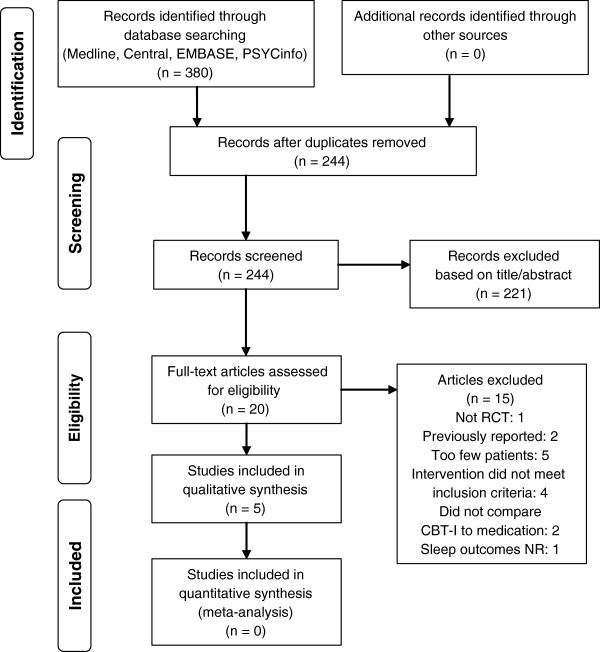
- Five RCTs met inclusion criteria, all in patients with primary insomnia; comparators were zopiclone, zolpidem, temazepam, and triazolam. One trial in comorbid insomnia was excluded because it used nefazodone, now withdrawn.
- Low- to moderate-grade evidence suggested CBT-I was superior to benzodiazepine and non-benzodiazepine drugs in the long term, while very low-grade evidence suggested benzodiazepines were more effective in the short term. Moderate-grade evidence favored CBT-I over non-benzodiazepines in the short term.
- Long-term CBT-I generally improved sleep latency by 30–45 minutes, total sleep time by 30–60 minutes, and sleep efficiency by 8–16%; drug effects declined over time. In Morin 1999 at 24 months, CBT-I increased total sleep time by 65.2 minutes and sleep efficiency by 16.4%, versus 11.5 minutes and 2.9% for temazepam, with all temazepam measurements significantly worsening from end of treatment to follow-up.
- Psychological outcomes favored CBT-I in one trial: at 6 months, State-Trait Anxiety Index scores improved for CBT-I versus zopiclone (state: –5.11 vs. +1.61, p < 0.05; trait: –4.47 vs. +1.97, p < 0.01). Sleep Impairment Index declined 10 points with CBT-I versus 4 with temazepam at 24 months (p = 0.01), and PSQI improved 1.2 points with CBT-I versus worsened 0.8 points with temazepam at 8 months (p < 0.01).
Methods
- PRISMA-guided systematic review of MEDLINE, EMBASE, Cochrane Central Register, and PsycINFO through September 2011, plus review of published systematic reviews for missed RCTs.
- Included published RCTs of adults aged 18+ with chronic insomnia per DSM-IV, comparing individual or group CBT-I delivered by a professional to FDA-approved prescription or non-prescription insomnia medications; studies had to report at least one quantitative sleep outcome. Studies with fewer than 10 patients per group, self-help programs, and comparisons of CBT-I components were excluded.
- Five RCTs were included; evidence was too small and heterogeneous for meta-analysis. Quality was assessed with a nine-point Jadad/Chalmers-based scale, and overall evidence strength was rated using GRADE. Sleep diary and automated measures (polysomnography/actigraphy) were analyzed separately.
Limitations
- Stated: all included trials focused on primary insomnia and may not represent the majority of patients with comorbid medical or psychiatric disorders; only one comorbid-insomnia trial was found and was excluded because the drug was withdrawn. No trials compared CBT-I with antihistamines or antidepressants, adverse-event reporting was limited, long-term data versus non-benzodiazepines were sparse, short-term CBT-I versus benzodiazepine data were inconsistent, and double-blinding was not possible.
- Stated: the evidence base was too small and heterogeneous for meta-analysis, and three of five included studies were in older adults.
- Evident from the text: only five RCTs were available, outcome measures and demographic composition were diverse, and the review could not draw conclusions about relative safety.
Model-written summary. Check it against the paper before relying on it.
Integrity signals
Registry
Cites
Statistics
Figures
Verification
Claims the paper makes
26 Own result · 25 Not checked yet · 14 Own interpretation · 10 No basis given · 4 Own method · 1 Supported
Every source the paper cites for this claim was checked and supports it.
In the paper
“RCTs of CBT-I only, with no medication comparator condition, generally find that treatment is as efficacious in those with comorbid disorders compared to those with primary insomnia (for example see [38]).”
§ Comparative effectiveness of cognitive behavioral therapy for insomnia: a systematic review > Discussion
What the sources say
- Supportedcites [38] Jungquist CR, O'Brien C, Matteson-Rusby S, Smith MT, Pigeon WR, Xia Y, Lu N, Perlis ML: The efficacy of cognitive-behavioral therapy for insomnia in patients with chronic pain. Sleep Med. 2010, 11: 302-309. 10.1016/j.sleep.2009.05.018. source
The Methods (Design) describe a randomized CBT-I trial in patients with insomnia comorbid with chronic pain, using a contact/measurement control rather than a medication comparator. The Discussion reports that its treatment effect sizes, considered alongside other chronic-pain trials, equal or exceed meta-analytic benchmarks for primary insomnia. The paper therefore supports the claim as an example, though it does not directly randomize patients with comorbid insomnia against patients with primary insomnia. (LLM, conf=0.88)
plain- Asserted: passes — The authors put it forward as true.
- Checkable: passes — It can be checked against evidence.
- Load-bearing: passes — The paper’s conclusions depend on it.
- Based: passes — The paper gives a reason why it holds.
- Supported
In the paper
“Only one trial compared CBT-I to drug therapy in patients with comorbid insomnia [34]: the drug used was nefazodone (now withdrawn from the market), so the study was excluded from further analysis.”
§ Comparative effectiveness of cognitive behavioral therapy for insomnia: a systematic review > Results
What the sources say
- Not checked yetcites [34] Thase ME, Rush AJ, Manber R, Kornstein SG, Klein DN, Markowitz JC, Ninan PT, Friedman ES, Dunner DL, Schatzberg AF, Borian FE, Trivedi MH, Keller MB: Differential effects of nefazodone and cognitive behavioral analysis system of psychotherapy on insomnia associated with chronic forms of major depression. J Clin Psychiatry. 2002, 63: 493-500. 10.4088/JCP.v63n0605. source
plain- Asserted: passes — The authors put it forward as true.
- Checkable: passes — It can be checked against evidence.
- Load-bearing: unclear — It is unclear whether the paper’s conclusions depend on it.
- Based: passes — The paper gives a reason why it holds.
A result the paper reports from its own data — it cites no other source for it, so there is none to check. The quote shows it is in the paper.
In the paper
“Very low grade evidence supports use of CBT-I to improve psychological outcomes.”
§ Comparative effectiveness of cognitive behavioral therapy for insomnia: a systematic review > Abstract > Results
hedgeddirect- Asserted: passes — The authors put it forward as true.
- Checkable: passes — It can be checked against evidence.
- Load-bearing: passes — The paper’s conclusions depend on it.
- Based: passes — The paper gives a reason why it holds.
A result the paper reports from its own data — it cites no other source for it, so there is none to check. The quote shows it is in the paper.
In the paper
“very low grade evidence suggests benzodiazepines are more effective in the short term”
§ Comparative effectiveness of cognitive behavioral therapy for insomnia: a systematic review > Abstract > Results
hedgeddirect- Asserted: passes — The authors put it forward as true.
- Checkable: passes — It can be checked against evidence.
- Load-bearing: passes — The paper’s conclusions depend on it.
- Based: passes — The paper gives a reason why it holds.
A result the paper reports from its own data — it cites no other source for it, so there is none to check. The quote shows it is in the paper.
In the paper
“Low to moderate grade evidence suggests CBT-I has superior effectiveness to benzodiazepine and non-benzodiazepine drugs in the long term”
§ Comparative effectiveness of cognitive behavioral therapy for insomnia: a systematic review > Abstract > Results
hedgeddirect- Asserted: passes — The authors put it forward as true.
- Checkable: passes — It can be checked against evidence.
- Load-bearing: passes — The paper’s conclusions depend on it.
- Based: passes — The paper gives a reason why it holds.
A result the paper reports from its own data — it cites no other source for it, so there is none to check. The quote shows it is in the paper.
In the paper
“Five studies met criteria for analysis.”
- Also stated in: § Results · plain
“Our search found a total of five RCTs that met the inclusion criteria and compared CBT-I to medications.”
§ Comparative effectiveness of cognitive behavioral therapy for insomnia: a systematic review > Abstract > Results
plainn = 5- Asserted: passes — The authors put it forward as true.
- Checkable: passes — It can be checked against evidence.
- Load-bearing: passes — The paper’s conclusions depend on it.
- Based: passes — The paper gives a reason why it holds.
- Also stated in: § Results · plain
None of the sources cited for this claim have been checked yet.
In the paper
“The trials compared CBT-I to zopiclone [29], zolpidem [30], temazepam [31,32], and triazolam [33].”
§ Comparative effectiveness of cognitive behavioral therapy for insomnia: a systematic review > Results
What the sources say
- Not checked yetcites [29] Sivertsen B, Omvik S, Pallesen S, Bjorvatn B, Havik OE, Kvale G, Nielsen GH, Nordhus IH: Cognitive behavioral therapy vs zopiclone for treatment of chronic primary insomnia in older adults: a randomized controlled trial. JAMA. 2006, 295: 2851-2858. 10.1001/jama.295.24.2851. source
- Not checked yetcites [30] Jacobs GD, Pace-Schott EF, Stickgold R, Otto MW: Cognitive behavior therapy and pharmacotherapy for insomnia: a randomized controlled trial and direct comparison. Arch Intern Med. 2004, 164: 1888-1896. 10.1001/archinte.164.17.1888. source
- Not checked yetcites [31] Morin CM, Colecchi C, Stone J, Sood R, Brink D: Behavioral and pharmacological therapies for late-life insomnia: a randomized controlled trial. JAMA. 1999, 281: 991-999. 10.1001/jama.281.11.991. source
- Not checked yetcites [32] Wu R, Bao J, Zhang C, Deng J, Long C: Comparison of sleep condition and sleep-related psychological activity after cognitive-behavior and pharmacological therapy for chronic insomnia. Psychother Psychosom. 2006, 75: 220-228. 10.1159/000092892. source
plain- Asserted: passes — The authors put it forward as true.
- Checkable: passes — It can be checked against evidence.
- Load-bearing: unclear — It is unclear whether the paper’s conclusions depend on it.
- Based: passes — The paper gives a reason why it holds.
A result the paper reports from its own data — it cites no other source for it, so there is none to check. The quote shows it is in the paper.
In the paper
“Our search found a total of five RCTs that met the inclusion criteria and compared CBT-I to medications.”
§ Comparative effectiveness of cognitive behavioral therapy for insomnia: a systematic review > Results
plainn = 5- Asserted: passes — The authors put it forward as true.
- Checkable: passes — It can be checked against evidence.
- Load-bearing: passes — The paper’s conclusions depend on it.
- Based: passes — The paper gives a reason why it holds.
The paper states this without a source or data behind it here, so there is nothing to check it against. The quote shows it is in the paper.
In the paper
“The five trials all involved patients with primary insomnia.”
§ Comparative effectiveness of cognitive behavioral therapy for insomnia: a systematic review > Results
plainn = 5- Asserted: passes — The authors put it forward as true.
- Checkable: passes — It can be checked against evidence.
- Load-bearing: unclear — It is unclear whether the paper’s conclusions depend on it.
- Based: passes — The paper gives a reason why it holds.
The paper states this without a source or data behind it here, so there is nothing to check it against. The quote shows it is in the paper.
In the paper
“There have only been a handful of studies that have included both cognitive behavioral and pharmacotherapy treatment arms for inclusion in this systematic review.”
§ Comparative effectiveness of cognitive behavioral therapy for insomnia: a systematic review > Discussion
plain- Asserted: passes — The authors put it forward as true.
- Checkable: passes — It can be checked against evidence.
- Load-bearing: passes — The paper’s conclusions depend on it.
- Based: passes — The paper gives a reason why it holds.
- It may state two separate claims as one. 12
- Probably not a substantial claim. 14
- The quote only partly states this claim. 2
In the paper
“Wu et al [32] surveyed patients using the Pittsburgh Sleep Quality Index: after 8 months this measure improved an average of 1.2 points in patients treated with CBT-I, while it worsened 0.8 points in patients given tamezepam (p < 0.01).”
§ Comparative effectiveness of cognitive behavioral therapy for insomnia: a systematic review > Results > Patients’ subjective evaluation of sleep
What the sources say
- Not checked yetcites [32] Wu R, Bao J, Zhang C, Deng J, Long C: Comparison of sleep condition and sleep-related psychological activity after cognitive-behavior and pharmacological therapy for chronic insomnia. Psychother Psychosom. 2006, 75: 220-228. 10.1159/000092892. source
plaindirect- Asserted: passes — The authors put it forward as true.
- Checkable: passes — It can be checked against evidence.
- Load-bearing: passes — The paper’s conclusions depend on it.
- Based: passes — The paper gives a reason why it holds.
It may state two separate claims as one.
A result the paper reports from its own data — it cites no other source for it, so there is none to check. The quote shows it is in the paper.
In the paper
“Some studies reported intermediate time points as well, which were consistent with the initial and final results.”
§ Comparative effectiveness of cognitive behavioral therapy for insomnia: a systematic review > Results > Quantitative sleep outcomes
plaincorrelational- Asserted: passes — The authors put it forward as true.
- Checkable: passes — It can be checked against evidence.
- Load-bearing: fails — The paper’s conclusions may not depend on it.
- Based: passes — The paper gives a reason why it holds.
Probably not a substantial claim. The paper’s conclusions may not depend on it.
A result the paper reports from its own data — it cites no other source for it, so there is none to check. The quote shows it is in the paper.
In the paper
“In terms of demographic composition, three of the five studies we included were in older adults.”
§ Comparative effectiveness of cognitive behavioral therapy for insomnia: a systematic review > Discussion
plain- Asserted: passes — The authors put it forward as true.
- Checkable: passes — It can be checked against evidence.
- Load-bearing: fails — The paper’s conclusions may not depend on it.
- Based: passes — The paper gives a reason why it holds.
Probably not a substantial claim. The paper’s conclusions may not depend on it.
The paper states this without a source or data behind it here, so there is nothing to check it against. The quote shows it is in the paper.
In the paper
“The studies also were diverse in terms of sleep-related outcome measures (subjective versus objective) and demographic composition.”
§ Comparative effectiveness of cognitive behavioral therapy for insomnia: a systematic review > Discussion
plain- Asserted: passes — The authors put it forward as true.
- Checkable: passes — It can be checked against evidence.
- Load-bearing: fails — The paper’s conclusions may not depend on it.
- Based: passes — The paper gives a reason why it holds.
Probably not a substantial claim. The paper’s conclusions may not depend on it. It may state two separate claims as one.
A result the paper reports from its own data — it cites no other source for it, so there is none to check. The quote shows it is in the paper.
In the paper
“All trials asked patients to complete sleep diaries.”
§ Comparative effectiveness of cognitive behavioral therapy for insomnia: a systematic review > Results > Quantitative sleep outcomes
plain- Asserted: passes — The authors put it forward as true.
- Checkable: passes — It can be checked against evidence.
- Load-bearing: fails — The paper’s conclusions may not depend on it.
- Based: passes — The paper gives a reason why it holds.
Probably not a substantial claim. The paper’s conclusions may not depend on it.
None of the sources cited for this claim have been checked yet.
In the paper
“CBT-I vs. non-benzodiazepines | Short term | Improved more with CBT-I”
§ Comparative effectiveness of cognitive behavioral therapy for insomnia: a systematic review > Results > Quantitative sleep outcomes
What the sources say
- Not checked yetcites [26] Atkins D, Best D, Briss PA, Eccles M, Falck-Ytter Y, Flottorp S, Guyatt GH, Harbour RT, Haugh MC, Henry D, Hill S, Jaeschke R, Leng G, Liberati A, Magrini N, Mason J, Middleton P, Mrukowicz J, O'Connell D, Oxman AD, Phillips B, Schunemann HJ, Edejer TT, Varonen H, Vist GE, Williams JW, Zaza S, GRADE Working Group: Grading quality of evidence and strength of recommendations. BMJ. 2004, 328: 1490-1497. source
- Not checked yetcites [27] Guyatt GH, Oxman AD, Kunz R, Falck-Ytter Y, Vist GE, Liberati A, Schunemann HJ, GRADE Working Group: Going from evidence to recommendations. BMJ. 2008, 336: 1049-1051. 10.1136/bmj.39493.646875.AE. source
- Not checked yetcites [28] Guyatt GH, Oxman AD, Kunz R, Vist GE, Falck-Ytter Y, Schunemann HJ, GRADE Working Group: What is “quality of evidence” and why is it important to clinicians?. BMJ. 2008, 336: 995-998. 10.1136/bmj.39490.551019.BE. source
plaindirect- Asserted: passes — The authors put it forward as true.
- Checkable: passes — It can be checked against evidence.
- Load-bearing: passes — The paper’s conclusions depend on it.
- Based: passes — The paper gives a reason why it holds.
It may state two separate claims as one. The quote only partly states this claim.
A result the paper reports from its own data — it cites no other source for it, so there is none to check. The quote shows it is in the paper.
In the paper
“Reported sleep measures included sleep latency, TST, and total time spent awake during the night.”
§ Comparative effectiveness of cognitive behavioral therapy for insomnia: a systematic review > Results > Quantitative sleep outcomes
plain- Asserted: passes — The authors put it forward as true.
- Checkable: passes — It can be checked against evidence.
- Load-bearing: fails — The paper’s conclusions may not depend on it.
- Based: passes — The paper gives a reason why it holds.
Probably not a substantial claim. The paper’s conclusions may not depend on it.
In the paper
“Trends towards improved results with CBT-I were observed in the Penn State Worry Questionnaire and the Worry Domains Questionnaire, but the differences between groups were not statistically significant.”
§ Comparative effectiveness of cognitive behavioral therapy for insomnia: a systematic review > Results > Quality of life and daytime outcomes
What the sources say
- Not checked yetcites [35] Omvik S, Sivertsen B, Pallesen S, Bjorvatn B, Havik OE, Nordhus IH: Daytime functioning in older patients suffering from chronic insomnia: treatment outcome in a randomized controlled trial comparing CBT with zopiclone. Behav Res Ther. 2008, 46: 623-641. 10.1016/j.brat.2008.02.013. source
plain- Asserted: passes — The authors put it forward as true.
- Checkable: passes — It can be checked against evidence.
- Load-bearing: unclear — It is unclear whether the paper’s conclusions depend on it.
- Based: passes — The paper gives a reason why it holds.
It may state two separate claims as one.
None of the sources cited for this claim have been checked yet.
In the paper
“CBT-I vs. benzodiazepines | Short term | Improved less with CBT-I”
§ Comparative effectiveness of cognitive behavioral therapy for insomnia: a systematic review > Results > Quantitative sleep outcomes
What the sources say
- Not checked yetcites [26] Atkins D, Best D, Briss PA, Eccles M, Falck-Ytter Y, Flottorp S, Guyatt GH, Harbour RT, Haugh MC, Henry D, Hill S, Jaeschke R, Leng G, Liberati A, Magrini N, Mason J, Middleton P, Mrukowicz J, O'Connell D, Oxman AD, Phillips B, Schunemann HJ, Edejer TT, Varonen H, Vist GE, Williams JW, Zaza S, GRADE Working Group: Grading quality of evidence and strength of recommendations. BMJ. 2004, 328: 1490-1497. source
- Not checked yetcites [27] Guyatt GH, Oxman AD, Kunz R, Falck-Ytter Y, Vist GE, Liberati A, Schunemann HJ, GRADE Working Group: Going from evidence to recommendations. BMJ. 2008, 336: 1049-1051. 10.1136/bmj.39493.646875.AE. source
- Not checked yetcites [28] Guyatt GH, Oxman AD, Kunz R, Vist GE, Falck-Ytter Y, Schunemann HJ, GRADE Working Group: What is “quality of evidence” and why is it important to clinicians?. BMJ. 2008, 336: 995-998. 10.1136/bmj.39490.551019.BE. source
plaindirect- Asserted: passes — The authors put it forward as true.
- Checkable: passes — It can be checked against evidence.
- Load-bearing: passes — The paper’s conclusions depend on it.
- Based: passes — The paper gives a reason why it holds.
It may state two separate claims as one. The quote only partly states this claim.
None of the sources cited for this claim have been checked yet.
In the paper
“The overall quality of the evidence base for each comparison was rated using the GRADE approach [26-28].”
§ Comparative effectiveness of cognitive behavioral therapy for insomnia: a systematic review > Methods > Data abstraction and analysis
What the sources say
- Not checked yetcites [26] Atkins D, Best D, Briss PA, Eccles M, Falck-Ytter Y, Flottorp S, Guyatt GH, Harbour RT, Haugh MC, Henry D, Hill S, Jaeschke R, Leng G, Liberati A, Magrini N, Mason J, Middleton P, Mrukowicz J, O'Connell D, Oxman AD, Phillips B, Schunemann HJ, Edejer TT, Varonen H, Vist GE, Williams JW, Zaza S, GRADE Working Group: Grading quality of evidence and strength of recommendations. BMJ. 2004, 328: 1490-1497. source
- Not checked yetcites [27] Guyatt GH, Oxman AD, Kunz R, Falck-Ytter Y, Vist GE, Liberati A, Schunemann HJ, GRADE Working Group: Going from evidence to recommendations. BMJ. 2008, 336: 1049-1051. 10.1136/bmj.39493.646875.AE. source
- Not checked yetcites [28] Guyatt GH, Oxman AD, Kunz R, Vist GE, Falck-Ytter Y, Schunemann HJ, GRADE Working Group: What is “quality of evidence” and why is it important to clinicians?. BMJ. 2008, 336: 995-998. 10.1136/bmj.39490.551019.BE. source
plain- Asserted: passes — The authors put it forward as true.
- Checkable: passes — It can be checked against evidence.
- Load-bearing: passes — The paper’s conclusions depend on it.
- Based: passes — The paper gives a reason why it holds.
Probably not a substantial claim.
What the paper did — it cites no source for this, so there is none to check. The quote shows it is in the paper.
In the paper
“Measures from patients’ sleep diaries and measures from automated means (polysomnography and actigraphy) were analyzed separately because of known unreliability in patients’ perceptions of sleep.”
§ Comparative effectiveness of cognitive behavioral therapy for insomnia: a systematic review > Methods > Inclusion criteria
boosteddirect- Asserted: passes — The authors put it forward as true.
- Checkable: passes — It can be checked against evidence.
- Load-bearing: passes — The paper’s conclusions depend on it.
- Based: passes — The paper gives a reason why it holds.
Probably not a substantial claim.
- Rests on an assumption: There can be substantial differences between automated measures of sleep time and patients' self-reports on sleep diaries.
None of the sources cited for this claim have been checked yet.
In the paper
“Assessment of RCT quality was done using a nine-point scale (Additional file 1: Table S6) based on scales by Jadad [24] and Chalmers [25].”
§ Comparative effectiveness of cognitive behavioral therapy for insomnia: a systematic review > Methods > Data abstraction and analysis
What the sources say
- Not checked yetcites [24] Jadad AR, Moore RA, Carroll D, Jenkinson C, Reynolds DJ, Gavaghan DJ, McQuay HJ: Assessing the quality of reports of randomized clinical trials: is blinding necessary?. Control Clin Trials. 1996, 17: 1-12. 10.1016/0197-2456(95)00134-4. source
- Not checked yetcites [25] Chalmers TC, Smith H, Blackburn B, Silverman B, Schroeder B, Reitman D, Ambroz A: A method for assessing the quality of a randomized control trial. Control Clin Trials. 1981, 2: 31-49. 10.1016/0197-2456(81)90056-8. source
plain- Asserted: passes — The authors put it forward as true.
- Checkable: passes — It can be checked against evidence.
- Load-bearing: fails — The paper’s conclusions may not depend on it.
- Based: passes — The paper gives a reason why it holds.
Probably not a substantial claim. The paper’s conclusions may not depend on it.
In the paper
“But this review does not tell us whether CBT-I is as effective as sleep medications.”
§ Comparative effectiveness of cognitive behavioral therapy for insomnia: a systematic review > Background
What the sources say
- Not checked yetcites [21] Okajima I, Komada Y, Inoue Y: A meta-analysis on the treatment effectiveness of cognitive behavioral therapy for primary insomnia. Sleep Biol Rhythms. 2011, 9: 24-34. source
plain- Asserted: passes — The authors put it forward as true.
- Checkable: passes — It can be checked against evidence.
- Load-bearing: passes — The paper’s conclusions depend on it.
- Based: passes — The paper gives a reason why it holds.
Probably not a substantial claim.
In the paper
“Inclusion criteria were defined in advance of data abstraction using the PICO framework below [22].”
§ Comparative effectiveness of cognitive behavioral therapy for insomnia: a systematic review > Methods > Inclusion criteria
What the sources say
- Not checked yetcites [22] Richardson WS, Wilson MC, Nishikawa J, Hayward RS: The well-built clinical question: A key to evidence-based decisions. ACP J Club. 1995, 3: A12-A13. source
plain- Asserted: passes — The authors put it forward as true.
- Checkable: passes — It can be checked against evidence.
- Load-bearing: fails — The paper’s conclusions may not depend on it.
- Based: passes — The paper gives a reason why it holds.
Probably not a substantial claim. The paper’s conclusions may not depend on it.
In the paper
“A new systematic review [21] meta-analyzes evidence from 14 randomized trials comparing groups of patients given CBT-I to control groups.”
- Also stated in: § Background · plain
“The meta-analysis found that CBT-I had a medium to large effect in reducing insomnia, and that the effects were maintained even after conclusion of the treatment period.”
§ Comparative effectiveness of cognitive behavioral therapy for insomnia: a systematic review > Background
What the sources say
- Not checked yetcites [21] Okajima I, Komada Y, Inoue Y: A meta-analysis on the treatment effectiveness of cognitive behavioral therapy for primary insomnia. Sleep Biol Rhythms. 2011, 9: 24-34. source
plaindirect- Asserted: passes — The authors put it forward as true.
- Checkable: passes — It can be checked against evidence.
- Load-bearing: passes — The paper’s conclusions depend on it.
- Based: passes — The paper gives a reason why it holds.
It may state two separate claims as one.
- Also stated in: § Background · plain
What the paper did — it cites no source for this, so there is none to check. The quote shows it is in the paper.
In the paper
“Data synthesis methods followed the practice of the Cochrane Collaboration.”
§ Comparative effectiveness of cognitive behavioral therapy for insomnia: a systematic review > Methods > Data abstraction and analysis
plain- Asserted: passes — The authors put it forward as true.
- Checkable: passes — It can be checked against evidence.
- Load-bearing: fails — The paper’s conclusions may not depend on it.
- Based: passes — The paper gives a reason why it holds.
Probably not a substantial claim. The paper’s conclusions may not depend on it.
In the paper
“The AHRQ Evidence-based Practice review [20] addressed that question, but it was published in 2005 and lacks evidence published since September 2004.”
§ Comparative effectiveness of cognitive behavioral therapy for insomnia: a systematic review > Background
What the sources say
- Not checked yetcites [20] Buscemi N, Vandermeer B, Friesen C, Bialy L, Tubman M, Ospina M, Klassen TP, Witmans M: Manifestations and Management of Chronic Insomnia in Adults. Evidence Report/ Technology Assessment No. 125. AHRQ Publication No. 05-E021-2. 2005, Rockville: Agency for Healthcare Research and Quality
plain- Asserted: passes — The authors put it forward as true.
- Checkable: passes — It can be checked against evidence.
- Load-bearing: passes — The paper’s conclusions depend on it.
- Based: passes — The paper gives a reason why it holds.
It may state two separate claims as one.
In the paper
“There is now evidence to suggest that insomnia often persists following resolution of these ‘primary’ conditions, and that it generally does not spontaneously resolve over time if left untreated [5].”
§ Comparative effectiveness of cognitive behavioral therapy for insomnia: a systematic review > Background
What the sources say
- Not checked yetcites [5] Morin CM, Belanger L, LeBlanc M, Ivers H, Savard J, Espie CA, Merette C, Baillargeon L, Gregoire JP: The natural history of insomnia: a population-based 3-year longitudinal study. Arch Intern Med. 2009, 169: 447-453. 10.1001/archinternmed.2008.610. source
hedged- Asserted: passes — The authors put it forward as true.
- Checkable: passes — It can be checked against evidence.
- Load-bearing: passes — The paper’s conclusions depend on it.
- Based: passes — The paper gives a reason why it holds.
It may state two separate claims as one.
What the paper did — it cites no source for this, so there is none to check. The quote shows it is in the paper.
In the paper
“Two research analysts (MDM, BL) reviewed full text of each retrieved article to determine whether it met the stated inclusion criteria. Disagreements were resolved by a third reviewer (PG).”
§ Comparative effectiveness of cognitive behavioral therapy for insomnia: a systematic review > Methods > Literature searches and study inclusion/exclusion
plain- Asserted: passes — The authors put it forward as true.
- Checkable: passes — It can be checked against evidence.
- Load-bearing: fails — The paper’s conclusions may not depend on it.
- Based: passes — The paper gives a reason why it holds.
Probably not a substantial claim. The paper’s conclusions may not depend on it. It may state two separate claims as one.
What the paper did — it cites no source for this, so there is none to check. The quote shows it is in the paper.
In the paper
“Lastly, all studies in this field suffer an unavoidable risk of bias because double-blinding is not possible.”
§ Comparative effectiveness of cognitive behavioral therapy for insomnia: a systematic review > Discussion
plaindirect- Asserted: passes — The authors put it forward as true.
- Checkable: passes — It can be checked against evidence.
- Load-bearing: fails — The paper’s conclusions may not depend on it.
- Based: passes — The paper gives a reason why it holds.
Probably not a substantial claim. The paper’s conclusions may not depend on it.
A conclusion the paper draws from its own results — it cites no other source for it, so there is none to check. The quote shows it is in the paper.
In the paper
“Second, CBT-I may have advantages when compared to medications, most notably more durable treatment gains that reduce or eliminate the need for long-term pharmacologic treatment.”
§ Comparative effectiveness of cognitive behavioral therapy for insomnia: a systematic review > Discussion
hedgedconditional- Asserted: passes — The authors put it forward as true.
- Checkable: passes — It can be checked against evidence.
- Load-bearing: passes — The paper’s conclusions depend on it.
- Based: passes — The paper gives a reason why it holds.
It may state two separate claims as one.
In the paper
“Despite the evidence supporting the effectiveness of CBT-I, many providers may not be aware of its existence or know how to refer patients for treatment [39].”
§ Comparative effectiveness of cognitive behavioral therapy for insomnia: a systematic review > Discussion
What the sources say
- Not checked yetcites [39] Wetzler RG, Winslow DH: New solutions for treating chronic insomnia: an introduction to behavioral sleep medicine. J Ky Med Assoc. 2006, 104: 502-512.
hedged- Asserted: passes — The authors put it forward as true.
- Checkable: passes — It can be checked against evidence.
- Load-bearing: unclear — It is unclear whether the paper’s conclusions depend on it.
- Based: passes — The paper gives a reason why it holds.
It may state two separate claims as one.
A conclusion the paper draws from its own results — it cites no other source for it, so there is none to check. The quote shows it is in the paper.
In the paper
“CBT-I is an effective treatment for insomnia that can produce durable results in a relatively brief number of visits.”
§ Comparative effectiveness of cognitive behavioral therapy for insomnia: a systematic review > Conclusion
plaindirect- Asserted: passes — The authors put it forward as true.
- Checkable: passes — It can be checked against evidence.
- Load-bearing: passes — The paper’s conclusions depend on it.
- Based: passes — The paper gives a reason why it holds.
It may state two separate claims as one.
A conclusion the paper draws from its own results — it cites no other source for it, so there is none to check. The quote shows it is in the paper.
In the paper
“Data on long-term outcomes of CBT-I compared to non-benzodiazepines is still sparse, and inconsistencies in the data comparing CBT-I to benzodiazepines in the short term need to be resolved.”
§ Comparative effectiveness of cognitive behavioral therapy for insomnia: a systematic review > Discussion
plain- Asserted: passes — The authors put it forward as true.
- Checkable: passes — It can be checked against evidence.
- Load-bearing: passes — The paper’s conclusions depend on it.
- Based: passes — The paper gives a reason why it holds.
Probably not a substantial claim.
The paper relies on this without support.
Medications are usually not curative, leading to long-term treatment over many years despite a lack of safety and efficacy data for their long-term use beyond 1–2 years.
“Perhaps the most important disadvantage is that medications are usually not curative, leading to long-term treatment over many years despite a lack of safety and efficacy data for their long-term use beyond 1–2 years.”
The paper relies on this without support.
CBT-I has fewer known side effects than medication.
“Treating insomnia with CBT-I, as opposed to medication, has a number of potential advantages, including fewer known side effects”
The paper relies on this without support.
There can be substantial differences between automated measures of sleep time and patients' self-reports on sleep diaries.
“There can also be substantial differences between automated measures of sleep time and patients’ self-reports on sleep diaries.”
The paper relies on this without support.
Insomnia RCTs generally find larger effects of treatment on subjective measures such as questionnaires than on objective measures of actigraphy and polysomnography.
“In terms of outcome measures, insomnia RCTs generally find larger effects of treatment on subjective measures such as questionnaires than on objective measures of actigraphy and polysomnography.”
The paper relies on this without support.
The diagnosis of insomnia relies on patient report and not on a diagnostic laboratory test.
“the diagnosis of insomnia relies on patient report and not on a diagnostic laboratory test.”
The paper relies on this without support.
Many patients presenting with insomnia to primary care practices will have secondary or co-morbid insomnia.
“many patients presenting with insomnia to primary care practices will have secondary or co-morbid insomnia”
Claims other papers make about this one
Each is checked against this paper’s own text: does it say what the citing paper says it does?
In the citing paper
“The recommended first-line treatment, Cognitive Behavioral Therapy for Insomnia (CBTI) does not carry these risks and is therefore preferable for reasons beyond demonstrated efficacy(244-248), efficacy relative to medications(249-253), and effectiveness(254).”
From Sleep: important considerations for the prevention of cardiovascular disease (2016) · cites this paper as [248]
Self-check
Percentages, sums and reported differences re-computed from the paper’s own numbers.
Each contradiction between two passages listed here was confirmed by an independent check.
Rated minor: it would not touch a result — a value no result rests on, a p-value that stays on the same side of the significance level, or a conflict that is clerical, resolved elsewhere in the paper, or outside its own findings.
In the paper
§ Comparative effectiveness of cognitive behavioral therapy for insomnia: a systematic review > Results
“| Wu 2006 [31] | CBT-I: 19 | –32.8 min | +30.3 min | Not reported | +10.2% | | p values based on post-intervention differences |”
§ Comparative effectiveness of cognitive behavioral therapy for insomnia: a systematic review > Results
“| Wu 2006 [32] | RCT | 77 patients | Individual CBT-I 2 per week, 8 weeks | Temazepam, see comment | Sleep diaries, polysomnography | Dose 7.5 mg→30 mg→15 mg over 8 week period |”
Rated minor: it would not touch a result — a value no result rests on, a p-value that stays on the same side of the significance level, or a conflict that is clerical, resolved elsewhere in the paper, or outside its own findings.
In the paper
§ Comparative effectiveness of cognitive behavioral therapy for insomnia: a systematic review > Results > Patients’ subjective evaluation of sleep
“Both reported that patients were significantly more satisfied with CBT-I than with zopiclone, but they did so using different measures.”
§ Comparative effectiveness of cognitive behavioral therapy for insomnia: a systematic review > Results > Patients’ subjective evaluation of sleep
“In Morin’s study [31] the Sleep Impairment Index declined 10 points after 24 months for patients treated with CBT-I, but only 4 points for patients given tamezepam (p = 0.01).”
Citations
Cites
Assessing the quality of reports of randomized clinical trials: Is blinding necessary?
Jadad, A. R., Moore, R. A., Carroll, D., Jenkinson, C., Reynolds, D. J. M., Gavaghan, D. J., & McQuay, H. J. (1996) · Controlled Clinical Trials · doi:10.1016/0197-2456(95)00134-4 · Cited by 17,582 · cited 2×
“Assessment of RCT quality was done using a nine-point scale (Additional file 1: Table S6) based on scales by Jadad [24] and Chalmers [25].”
MethodGrading quality of evidence and strength of recommendations
(2004) · BMJ · doi:10.1136/bmj.328.7454.1490 · Cited by 8,477 · cited 6×
“The overall quality of the evidence base for each comparison was rated using the GRADE approach [26-28].”
MethodInfluentialEpidemiology of insomnia: what we know and what we still need to learn
Ohayon, M. M. (2002) · Sleep Medicine Reviews · doi:10.1053/smrv.2002.0186 · Cited by 3,743 · cited 1×
“The prevalence of insomnia in primary care patients is as high as 69% [1,2] compared to 33% in the general population [3].”
BackgroundWhat is ‘quality of evidence’ and why is it important to clinicians?
Guyatt, G. H., Oxman, A. D., Kunz, R., Vist, G. E., Falck-Ytter, Y., & Schünemann, H. J. (2008) · BMJ · doi:10.1136/bmj.39490.551019.be · Cited by 3,250 · cited 6×
“The overall quality of the evidence base for each comparison was rated using the GRADE approach [26-28].”
MethodInfluentialThe well-built clinical question: A key to evidence-based decisions
(1995) · ACP Journal Club · doi:10.7326/acpjc-1995-123-3-a12 · Cited by 2,931 · cited 1×
“Inclusion criteria were defined in advance of data abstraction using the PICO framework below [22].”
MethodBaglioni, C., Battagliese, G., Feige, B., Spiegelhalder, K., Nissen, C., Voderholzer, U., Lombardo, C., & Riemann, D. (2011) · Journal of Affective Disorders · doi:10.1016/j.jad.2011.01.011 · Cited by 2,779
Epidemiologic study of sleep disturbances and psychiatric disorders. An opportunity for prevention?
Ford, D. E. (1989) · JAMA · doi:10.1001/jama.262.11.1479 · Cited by 2,440
Epidemiologic Study of Sleep Disturbances and Psychiatric Disorders: An Opportunity for Prevention?
Ford, D. E. (1989) · JAMA · doi:10.1001/jama.1989.03430110069030 · Cited by 2,252
Clinical Guideline for the Evaluation and Management of Chronic Insomnia in Adults
Schutte-Rodin, S., Broch, L., Buysse, D., Dorsey, C., & Sateia, M. (2008) · Journal of Clinical Sleep Medicine · doi:10.5664/jcsm.27286 · Cited by 1,943 · cited 3×
“Some patients also prefer non-medication treatments [12,16,17].”
BackgroundGoing from evidence to recommendations
Guyatt, G. H., Oxman, A. D., Kunz, R., Falck-Ytter, Y., Vist, G. E., Liberati, A., & Schünemann, H. J. (2008) · BMJ · doi:10.1136/bmj.39493.646875.ae · Cited by 1,810
Research works printed but not linked: 1
- NIH state-of-the-science conference statement on manifestations and management of chronic insomnia in adults. NIH Consens Sci Statements. 2005, 22: 1-30.
Cited by
Sorted by citations
European guideline for the diagnosis and treatment of insomnia
Riemann, D., Baglioni, C., Bassetti, C., Bjorvatn, B., Dolenc Groselj, L., Ellis, J. G., Espie, C. A., Garcia‐Borreguero, D., Gjerstad, M., Gonçalves, M., et al. (2017) · Journal of Sleep Research · doi:10.1111/jsr.12594 · Cited by 2,049
“Mitchell et al. (2012) analysed studies that directly compared CBT-I with pharmacotherapy; only five studies fulfilled the inclusion criteria.”
Update on treatments for nonmotor symptoms of Parkinson's disease—an evidence‐based medicine review
Seppi, K., Chaudhuri, К. R., Coelho, M. M., Fox, S. H., Katzenschlager, R., Perez‐Lloret, S., Weintraub, D. A., & Sampaio, C. (2019) · Movement Disorders · doi:10.1002/mds.27602 · Cited by 1,013
“” In general, reporting of adverse events (AEs) in CBT trials is limited (Table 2).(85,86) Therefore, there is “insufficient evidence” to conclude on the safety of CBT in PD patients with depression.”
BackgroundZachariae, R., Lyby, M. S., Ritterband, L. M., & O'Toole, M. S. (2016) · Sleep Medicine Reviews · doi:10.1016/j.smrv.2015.10.004 · Cited by 704
“They are usually not curative, leading to long-term treatment over many years despite lack of safety and efficacy data beyond 1-2 years [9,10].”
BackgroundCognitive and behavioral therapies in the treatment of insomnia: A meta-analysis
van Straten, A., van der Zweerde, T., Kleiboer, A., Cuijpers, P., Morin, C. M., & Lancee, J. (2018) · Sleep Medicine Reviews · doi:10.1016/j.smrv.2017.02.001 · Cited by 676
Wu, J. Q., Appleman, E. R., Salazar, R. D., & Ong, J. C. (2015) · JAMA Internal Medicine · doi:10.1001/jamainternmed.2015.3006 · Cited by 527
Metadata
- Authors
- Mitchell, M. D., Gehrman, P., Perlis, M., & Umscheid, C. A.
- Affiliations
- University of Pennsylvania Health System (US)
- University of Pennsylvania (US)
- Corresponding author
- Mitchell, Matthew D
- Venue
- BMC Family Practice
- Published
- 2012-05-25
- Volume
- 13
- Issue
- 1
- Pages
- 40-40
- ISSN
- 1471-2296 (ISSN-L)
- PMC
- PMC3481424
- OpenAlex
- W2026032799
- Semantic Scholar
- 21aa68d115e33399322c96f824a3fa2bf6eeab3e
- Cited by
- 617
- References
- 55
- Citations by year
- 2026: 33 · 2025: 59 · 2024: 43 · 2023: 55 · 2022: 59 · 2021: 101 · 2020: 45 · 2019: 43 · 2018: 38 · 2017: 32 · 2016: 33 · 2015: 30 · 2014: 32 · 2013: 9 · 2012: 5
- FWCI
- 3.56
- Type
- journal article
- Language
- en
- Open access
- gold
- doi.org
- Licence
- Locations
- BMC Family Practice (publishedVersion, cc-by)
- PubMed Central (publishedVersion, cc-by)
- PubMed (publishedVersion)
- DOAJ (DOAJ: Directory of Open Access Journals) (submittedVersion, cc-by-sa)
- Funders
- University of Pennsylvania
- Perelman School of Medicine, University of Pennsylvania
- Topics
- Social Sciences › Psychology › Experimental and Cognitive Psychology › Sleep and related disorders
- Social Sciences › Psychology › Experimental and Cognitive Psychology › Anxiety, Depression, Psychometrics, Treatment, Cognitive Processes
- Health Sciences › Medicine › Physiology (medical) › Obstructive Sleep Apnea Research
- Keywords
- cognitive behavioral therapy for insomnia, insomnia, benzodiazepines, non-benzodiazepine hypnotics, sleep medication, sleep latency, psychological outcomes, adverse effects, comorbid insomnia, primary care, long-term treatment effectiveness
- MeSH terms
- Humans, Sleep Initiation and Maintenance Disorders, Quality of Life, Cognitive Behavioral Therapy, Outcome Assessment, Health Care, Evidence-Based Medicine, Comparative Effectiveness Research
About these checks
Registry, retraction, Cites and statistics results are computed, not judged, with one exception: a printed reference that no index lists is read once by a model before it counts as a citation error. Claims are extracted by a model and kept only when their quote appears verbatim in the text; each cited source is then checked, with a model’s help, for whether it says what the claim relies on. Those verdicts can be wrong — read the claim’s quote and the cited source before relying on one.
A language model drew the claims from the paper on 2026-10-10, under version 3 of the claim definition (model deepseek-v4.1-flash, prompt extract-v3).
A second model labelled each claim on 2026-10-10 (model jev-1.13-20260917, definition revision gold-guideline-v0.2).
Cited sources are checked with a language model’s help (gpt-6-sol).
Statistics and arithmetic are recomputed, not judged.
Confidence bands are shown only for fields calibrated on our annotated test set. None is calibrated yet, so no band is shown.
What counts as a claim ›How we measure confidence ›How we check this ›
Are you an author, or do you see a problem with this page? Request a review
