

Validation of brief screening tools for depressive and alcohol use disorders among TB and HIV patients in primary care in Zambia
Open accessThe DOI matches its Crossref record; 38 of the 39 references it cites were found in a registry or an index.
Abstract
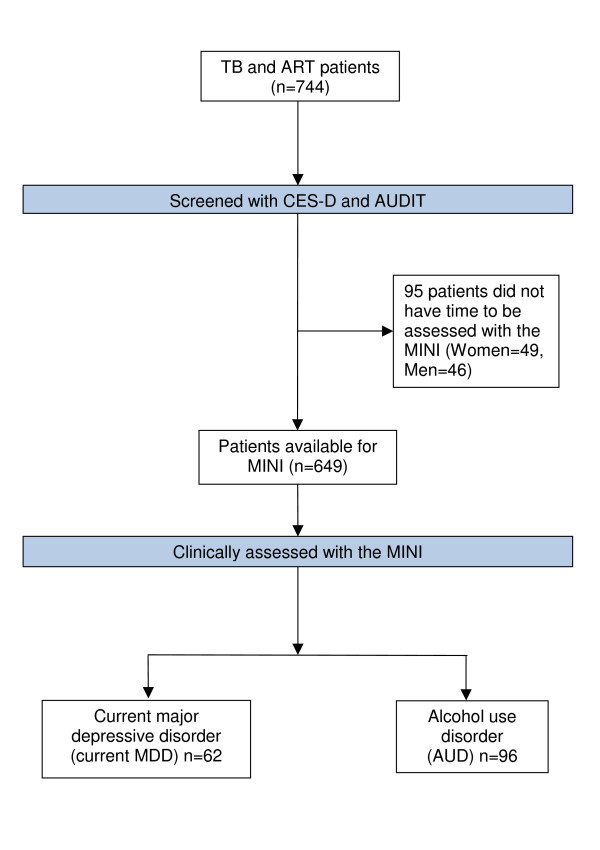
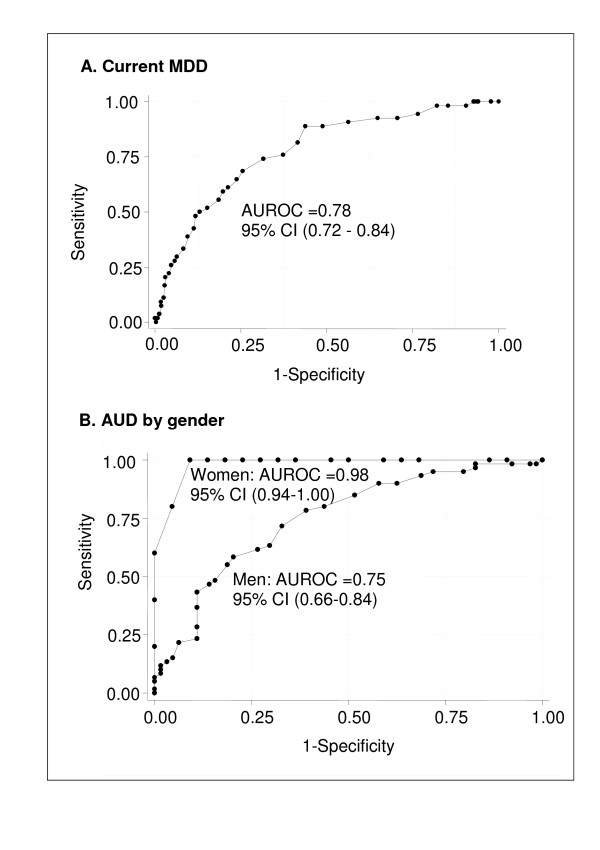
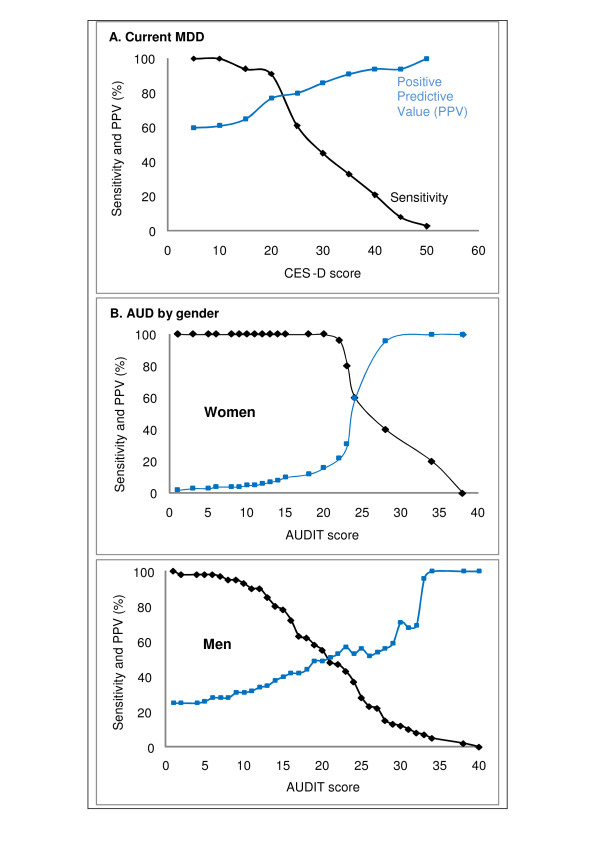
BACKGROUND: This study was conducted to evaluate the diagnostic accuracy and determine the optimum cut-off scores for clinical use of the Center for Epidemiological Studies Depression scale (CES-D) and Alcohol Use Disorders Identification Test (AUDIT) against a reference psychiatric diagnostic interview, in TB and anti-retroviral therapy (ART) patients in primary care in Zambia. METHODS: This was a cross-sectional study in 16 primary level care clinics. Consecutive sampling was used to select 649 participants who started TB treatment or ART in the preceding month. Participants were first interviewed using the CES-D and AUDIT, and subsequently with a psychiatric diagnostic interview for current major depressive disorder (MDD) and alcohol use disorders (AUDs) using the Mini-International Neuropsychiatric Interview (MINI). The diagnostic accuracy was calculated using the Area Under the Receiver Operating Characteristic curve (AUROC). The optimum cut-off scores for clinical use were calculated using sensitivity and positive predictive value (PPV). RESULTS: The CES-D and AUDIT had high internal consistency (Cronbach's alpha = 0.84; 0.98 respectively). Confirmatory factor analysis showed that the four-factor CES-D model was not a good fit for the data (Tucker-Lewis Fit Index (TLI) = 0.86; standardized root-mean square residual (SRMR) = 0.06) while the two-factor AUDIT model fitted the data well (TFI = 0.99; SRMR = 0.04). Both the CES-D and AUDIT demonstrated good discriminatory ability in detecting MINI-defined current MDDs and AUDs (AUROC for CES-D = 0.78; AUDIT = 0.98 for women and 0.75 for men). The optimum CES-D cut-off score in screening for current MDD was 22 (sensitivity 73%, PPV 76%) while that of the AUDIT in screening for AUD was 24 for women (sensitivity 60%, PPV 60%), and 20 for men (sensitivity 55%, PPV 50%). CONCLUSIONS: The CES-D and AUDIT showed high discriminatory ability in measuring MINI-defined current MDD and AUD respectively. They are suitable mental health screening tools for use among TB and ART patients in primary care in Zambia.
Overview
The claims and statistics of this paper haven’t been checked yet.
Free: it reads the open-access text and checks the first 5 claims that cite a source we can check. Create a free account to check every claim.
Integrity signals
Registry
Cites
Statistics
Figures
Verification
Claims the paper makes
The claims and statistics of this paper haven’t been checked yet.
Free: it reads the open-access text and checks the first 5 claims that cite a source we can check. Create a free account to check every claim.
Claims other papers make about this one
Each is checked against this paper’s own text: does it say what the citing paper says it does?
The source backs part of the claim, not all of it — or backs it for a different population, condition or comparison.
In the citing paper
“Although not validated in the Ethiopian setting, AUDIT has been used in neighbouring countries [37,38].”
From Burden of mental disorders and unmet needs among street homeless people in Addis Ababa, Ethiopia (2014) · cites this paper as [37]
Experimental — accuracy not yet measured
Self-check
Percentages, sums and reported differences re-computed from the paper’s own numbers.
The self-check needs the paper’s full text.
Citations
Cites
Hu, L., & Bentler, P. M. (1999) · Structural Equation Modeling A Multidisciplinary Journal · doi:10.1080/10705519909540118 · Cited by 108,788 · cited 1×
“08 as our rule of thumb for goodness of fit of the models [36].”
BackgroundThe CES-D Scale: A Self-Report Depression Scale for Research in the General Population
Radloff, L. S. (1977) · Applied Psychological Measurement · doi:10.1177/014662167700100306 · Cited by 53,267
The meaning and use of the area under a receiver operating characteristic (ROC) curve.
Hanley, J. A., & McNeil, B. J. (1982) · Radiology · doi:10.1148/radiology.143.1.7063747 · Cited by 21,856 · cited 1×
“Non-parametric area under the receiver operating characteristic curve (AUROC) analyses were performed to estimate the diagnostic accuracy of the screening tools [ 37 ].”
MethodSAUNDERS, J. B., AASLAND, O. G., BABOR, T. F., DE LA FUENTE, J. R., & GRANT, M. (1993) · Addiction · doi:10.1111/j.1360-0443.1993.tb02093.x · Cited by 13,597 · cited 3×
“The AUDIT was developed by the World Health Organisation (WHO) as a simple method of screening for excessive alcohol consumption in the past 12 months [28,34].”
BackgroundMethodThe mini international neuropsychiatric interview
Lecrubier, Y., Sheehan, D., Hergueta, T., & Weiller, E. (1998) · European Psychiatry · doi:10.1016/s0924-9338(99)80239-9 · Cited by 5,872
The WHO World Mental Health Surveys: Global Perspectives on the Epidemiology of Mental Disorders
Kessler, R. C., & Üstün, T. B. (2008) · Cited by 872
Mini International Neuropsychiatric Interview
Lecrubier, Y., Sheehan, D. V., Weiller, E., Amorim, P., Bonora, I., Sheehan, K. H., Janavs, J., & Dunbar, G. C. (2013) · PsycTESTS Dataset · doi:10.1037/t18597-000 · Cited by 720
Role of depression, stress, and trauma in HIV disease progression
Leserman, J. (2008) · Psychosomatic Medicine · doi:10.1097/psy.0b013e3181777a5f · Cited by 662 · cited 1×
“MDDs have also been found to be associated with HIV disease progression [16,17].”
BackgroundAlcohol Use and Antiretroviral Adherence: Review and Meta-Analysis
Hendershot, C. S., Stoner, S. A., Pantalone, D. W., & Simoni, J. M. (2009) · JAIDS Journal of Acquired Immune Deficiency Syndromes · doi:10.1097/qai.0b013e3181b18b6e · Cited by 492 · cited 1×
“MDD [9] and hazardous alcohol consumption [10,11] are associated with high risk of HIV acquisition and transmission, and with poorer adherence to anti-retroviral therapy (ART) [12] and TB treatment [13].”
BackgroundSAUNDERS, J. B., AASLAND, O. G., AMUNDSEN, A., & GRANT, M. (1993) · Addiction · doi:10.1111/j.1360-0443.1993.tb00822.x · Cited by 480 · cited 4×
“Chersich MF, Luchters SM, Malonza IM, Mwarogo P, King’ola N, Temmerman M: Heavy episodic drinking among Kenyan female sex workers is associated with unsafe sex, sexual violence and sexually transmitted infections.”
MethodInfluentialThe Global Distribution of Average Volume of Alcohol Consumption and Patterns of Drinking
Rehm, J., Rehn, N., Room, R., Monteiro, M., Gmel, G., Jernigan, D., & Frick, U. (2003) · European Addiction Research · doi:10.1159/000072221 · Cited by 471
Myer, L., Smit, J., Roux, L. L., Parker, S., Stein, D. J., & Seedat, S. (2008) · AIDS Patient Care and STDs · doi:10.1089/apc.2007.0102 · Cited by 450 · cited 10×
“6Medical Research Council Anxiety and Stress Disorders Unit, Department of Psychiatry, University of Stellenbosch, Cape Town, South Africa.”
MethodInfluentialSelf-citationPatel, V., Araya, R., Chowdhary, N., King, M., Kirkwood, B., Nayak, S., Simon, G., & Weiss, H. A. (2008) · Psychological Medicine · doi:10.1017/s0033291707002334 · Cited by 364 · cited 2×
“have high PPV) so that the expense and morbidity of further evaluation of false positive results are reduced in settings that already have limited resources [38].”
BackgroundSelf-citationFisher, J. C., Bang, H., & Kapiga, S. H. (2007) · Sexually Transmitted Diseases · doi:10.1097/olq.0b013e318067b4fd · Cited by 350 · cited 1×
“MDD [9] and hazardous alcohol consumption [10,11] are associated with high risk of HIV acquisition and transmission, and with poorer adherence to anti-retroviral therapy (ART) [12] and TB treatment [13].”
BackgroundHIV risk behavior among adults with severe mental illness: A systematic review
Meade, C. S., & Sikkema, K. J. (2005) · Clinical Psychology Review · doi:10.1016/j.cpr.2005.02.001 · Cited by 319 · cited 1×
“MDD [9] and hazardous alcohol consumption [10,11] are associated with high risk of HIV acquisition and transmission, and with poorer adherence to anti-retroviral therapy (ART) [12] and TB treatment [13].”
BackgroundCollins, P. Y., Holman, A. R., Freeman, M. C., & Patel, V. (2006) · AIDS · doi:10.1097/01.aids.0000238402.70379.d4 · Cited by 318
Self-citationHIV disease progression: depression, stress, and possible mechanisms
Leserman, J. (2003) · Biological Psychiatry · doi:10.1016/s0006-3223(03)00323-8 · Cited by 307
Causal Considerations on Alcohol and HIV/AIDS -- A Systematic Review
Shuper, P. A., Neuman, M., Kanteres, F., Baliunas, D., Joharchi, N., & Rehm, J. (2010) · Alcohol and Alcoholism · doi:10.1093/alcalc/agp091 · Cited by 306 · cited 1×
“AUDs [15] and * Correspondence: Nathaniel.”
Interim policy on collaborative TB / HIV activities.
Getahun, H., van Gorkom, J., Harries, A. D., Harrington, M., & Nunn, P. (2004) · Cited by 227
Depression and CD4 Cell Count Among Persons with HIV Infection in Uganda
Kaharuza, F. M., Bunnell, R., Moss, S., Purcell, D. W., Bikaako-Kajura, W., Wamai, N., Downing, R., Solberg, P., Coutinho, A., & Mermin, J. (2006) · AIDS and Behavior · doi:10.1007/s10461-006-9142-2 · Cited by 210 · cited 6×
“For example, the prevalence of MDDs among HIV positive individuals has been estimated as 43.7% in South Africa [6], 71.3% in Zimbabwe [7] and 47% in Uganda [8].”
BackgroundMethodInfluentialChersich, M. F., Luchters, S. M. F., Malonza, I. M., Mwarogo, P., King'ola, N., & Temmerman, M. (2007) · International Journal of STD & AIDS · doi:10.1258/095646207782212342 · Cited by 183 · cited 1×
“MDD [9] and hazardous alcohol consumption [10,11] are associated with high risk of HIV acquisition and transmission, and with poorer adherence to anti-retroviral therapy (ART) [12] and TB treatment [13].”
BackgroundUtility of the AUDIT for identification of hazardous or harmful drinking in drug-dependent patients
Skipsey, K., Burleson, J. A., & Kranzler, H. R. (1997) · Drug and Alcohol Dependence · doi:10.1016/s0376-8716(97)01353-7 · Cited by 146 · cited 1×
“These high estimates are similar to previous studies performed on the CES-D [27] and the AUDIT [41].”
ResultIntegrating mental health in global initiatives for HIV/AIDS
Freeman, M. C., Patel, V., Collins, P. Y., & Bertolote, J. M. (2005) · British Journal of Psychiatry · doi:10.1192/bjp.187.1.1 · Cited by 130 · cited 2×
“HIV-infected patients in PHC facilities is essential for improving population health [ 24 ].”
BackgroundSelf-citationFactors associated with prevalence of mental disorder in people living with HIV/AIDS in South Africa
Freeman, M., Nkomo, N., Kafaar, Z., & Kelly, K. (2007) · AIDS Care · doi:10.1080/09540120701426482 · Cited by 123 · cited 1×
“For example, the prevalence of MDDs among HIV positive individuals has been estimated as 43.7% in South Africa [ 6 ], 71.3% in Zimbabwe [7] and 47% in Uganda [8].”
BackgroundInfluentialKruse, G. R., Chapula, B. T., Ikeda, S., Nkhoma, M., Quiterio, N., Pankratz, D., Mataka, K., Chi, B. H., Bond, V., & Reid, S. E. (2009) · Human Resources for Health · doi:10.1186/1478-4491-7-55 · Cited by 90 · cited 1×
“However, like many low income countries, Zambia has a high attrition of health workers [25], and few are skilled in detecting MDDs and AUDs.”
BackgroundShevlin, M., & Smith, G. W. (2007) · Alcohol and Alcoholism · doi:10.1093/alcalc/agm045 · Cited by 82 · cited 1×
“We used confirmatory factor analysis to examine how a four-factor model of ‘depressive symptoms’, ‘somatic symptoms’, ‘positive experiences’ and ‘interpersonal difficulties’ for the CESD [27], and a two-factor model of ‘alcohol consumption’ and ‘alcohol related problems’ for the AUDIT [35] fit the observed data.”
MethodKaarne, T., Aalto, M., Kuokkanen, M., & Seppä, K. (2010) · Drug and Alcohol Review · doi:10.1111/j.1465-3362.2010.00172.x · Cited by 81
Ayles, H., Sismanidis, C., Beyers, N., Hayes, R., & Godfrey‐Faussett, P. (2008) · Trials · doi:10.1186/1745-6215-9-63 · Cited by 81
Self-citationSurveys of Drinking Patterns and Problems in Seven Developing Countries
Demers, A., Room, R., & Bourgault, C. (2000) · Cited by 78
Pretorius, T. B. (1991) · Psychological Reports · doi:10.2466/pr0.1991.69.3f.1179 · Cited by 72 · cited 1×
“Reliability, validity, and factor structure have been found to be similar across a wide variety of demographic characteristics in general population samples that have been tested [ 32 ,33].”
BackgroundAmuha, M. G., Kutyabami, P., Kitutu, F. E., Odoi‐Adome, R., & Kalyango, J. N. (2009) · PubMed Central · Cited by 72
Mental distress in the general population in Zambia: Impact of HIV and social factors
Chipimo, P. J., & Fýlkesnes, K. (2009) · BMC Public Health · doi:10.1186/1471-2458-9-298 · Cited by 54
Sebit, M., Tombe, M., Siziya, S., Balus, S., Nkomo, S., & Maramba, P. (2004) · East African Medical Journal · doi:10.4314/eamj.v80i10.8752 · Cited by 53
Comparative Validity of Screening Instruments for Mental Distress in Zambia
Chipimo, P. J., & Fylkesnes, K. (2010) · Clinical Practice & Epidemiology in Mental Health · doi:10.2174/1745017901006010004 · Cited by 48 · cited 2×
“6% (diagnosed by DSM-IV criteria) [22].”
MethodBoschloo, L., Vogelzangs, N., Smit, J. H., van den Brink, W., Veltman, D. J., Beekman, A. T. F., & Penninx, B. W. J. H. (2010) · Journal of Affective Disorders · doi:10.1016/j.jad.2010.04.019 · Cited by 46 · cited 2×
“The data for the AUDIT was stratified by gender as previous research had shown that cut-off for the AUDIT was gender specific [39,40].”
MethodResultHealth workforce responses to global health initiatives funding: a comparison of Malawi and Zambia
Brugha, R., Kadzandira, J., Simbaya, J., Dicker, P., Mwapasa, V., & Walsh, A. (2010) · Human Resources for Health · doi:10.1186/1478-4491-8-19 · Cited by 45 · cited 1×
“In the effort to mitigate the health worker crisis in Africa, TB and HIV programs are task shifting care to lower cadre staff [26].”
BackgroundMyer, L., Stein, D. J., Grimsrud, A., HERMAN, A. A. B., Seedat, S., Moomal, H., & Williams, D. R. (2009) · PubMed · Cited by 25
Self-citationPRETORIUS, T. B. (1991) · Psychological Reports · doi:10.2466/pr0.69.8.1179-1185 · Cited by 12
Research works printed but not linked: 5
- World Health Organization HIV/AIDS and mental health report by the Secretariat 2008 Geneva: WHO
- Central Statistics Office (Zambia), Ministry of Health (Zambia), ORC Macro Zambia Demographic and Health Survey 2007-2008 2008
- World Health Organization Global tuberculosis control: epidemiology, strategy, financing: WHO report 2009 2009 Geneva: World Health Organization
- World Health Organisation Frequetly asked questins about TB and HIV 2008
- WHO mhGAP intervention guide for mental, neurological and substance use disorders in non-specialized health settings 2010 Geneva, Switzerland: WHO Press 23741783
Cited by
Depression in HIV Infected Patients: a Review
Nanni, M. G., Caruso, R., Mitchell, A. J., Meggiolaro, E., & Grassi, L. (2015) · Current Psychiatry Reports · doi:10.1007/s11920-014-0530-4 · Cited by 511
Baron, E. C., Davies, T., & Lund, C. (2017) · BMC Psychiatry · doi:10.1186/s12888-016-1178-x · Cited by 332
“It has been validated in a variety of settings, such as Zambia [8] and South Africa [9].”
BackgroundPatel, P., Rose, C. E., Collins, P. Y., Nuche-Berenguer, B., Sahasrabuddhe, V. V., Peprah, E., Vorkoper, S., Pastakia, S. D., Rausch, D., & Levitt, N. S. (2018) · AIDS · doi:10.1097/qad.0000000000001888 · Cited by 270
“and 10), the Hopkins Symptom Checklist (HSCL), PHQ9 [155–157], the Center for Epidemiological Studies Depression Scale (CES-D) [158,159], and the Edinburgh Post-Natal Depression Scale (EPDS) [160].”
Cholera, R., Gaynes, B. N., Pence, B. W., Bassett, J., Qangule, N., Macphail, C., Bernhardt, S., Pettifor, A., & Miller, W. C. (2014) · Journal of Affective Disorders · doi:10.1016/j.jad.2014.06.003 · Cited by 221
Pachi, A., Bratis, D., Moussas, G., & Tselebis, A. (2013) · Tuberculosis Research and Treatment · doi:10.1155/2013/489865 · Cited by 185
“[7 4, 87 ].”
Metadata
- Authors
- Chishinga, N., Kinyanda, E., Weiss, H. A., Patel, V., Ayles, H., & Seedat, S.
- Affiliations
- MRC/UVRI & LSHTM Uganda Research Unit (UG)
- London School of Hygiene & Tropical Medicine (GB)
- Stellenbosch University (ZA)
- Corresponding author
- Chishinga, Nathaniel
- Venue
- BMC Psychiatry
- Published
- 2011-05-04
- Volume
- 11
- Issue
- 1
- Pages
- 75-75
- ISSN
- 1471-244X (ISSN-L)
- PMC
- PMC3112078
- OpenAlex
- W2152994124
- Cited by
- 146
- References
- 39
- Citations by year
- 2026: 5 · 2025: 4 · 2024: 2 · 2023: 7 · 2022: 10 · 2021: 9 · 2020: 16 · 2019: 12 · 2018: 11 · 2017: 16 · 2016: 12 · 2015: 5 · 2014: 14 · 2013: 11 · 2012: 11
- FWCI
- 16.15
- Type
- journal article
- Language
- en
- Open access
- gold
- doi.org
- Licence
- Locations
- BMC Psychiatry (publishedVersion, cc-by)
- PubMed Central (publishedVersion, cc-by)
- PubMed (publishedVersion)
- LSHTM Research Online (London School of Hygiene and Tropical Medicine) (acceptedVersion)
- DOAJ (DOAJ: Directory of Open Access Journals) (submittedVersion, cc-by-sa)
- SUNScholar (Stellenbosch University) (submittedVersion)
- Funders
- Wellcome Trust (091834)
- Department for International Development
- Topics
- Health Sciences › Medicine › Psychiatry and Mental health › Mental Health Treatment and Access
- Social Sciences › Psychology › Experimental and Cognitive Psychology › Anxiety, Depression, Psychometrics, Treatment, Cognitive Processes
- Health Sciences › Nursing › Research and Theory › Health Education and Validation
- Keywords
- depression screening, alcoholism, tuberculosis, antiretroviral therapy, HIV, CES-D, auditing, diagnostic accuracy, cut-off values, primary care, mental health screening, Zambia
- MeSH terms
- Adult, Depressive Disorder, Female, Humans, Male, Predictive Value of Tests, Primary Health Care, Psychiatric Status Rating Scales, Tuberculosis, Zambia, HIV Infections, Alcohol-Related Disorders
About these checks
Registry, retraction, Cites and statistics results are computed, not judged, with one exception: a printed reference that no index lists is read once by a model before it counts as a citation error. Claims are extracted by a model and kept only when their quote appears verbatim in the text; each cited source is then checked, with a model’s help, for whether it says what the claim relies on. Those verdicts can be wrong — read the claim’s quote and the cited source before relying on one.
Statistics and arithmetic are recomputed, not judged.
Confidence bands are shown only for fields calibrated on our annotated test set. None is calibrated yet, so no band is shown.
What counts as a claim ›How we measure confidence ›How we check this ›
Are you an author, or do you see a problem with this page? Request a review
Data sources
Bibliographic data: Semantic Scholar, OpenAlex, Crossref.
Contains information from the Semantic Scholar Academic Graph Datasets, made available under the ODC Attribution License (ODC-BY 1.0).
Semantic Scholar’s data is described in: Kinney, R., et al. (2023). The Semantic Scholar Open Data Platform. arXiv:2301.10140.
