

Reliability and validity of the Thai version of the PHQ-9
Open accessThe DOI matches its Crossref record; 40 of the 40 references it cites were found in a registry or an index.
Abstract
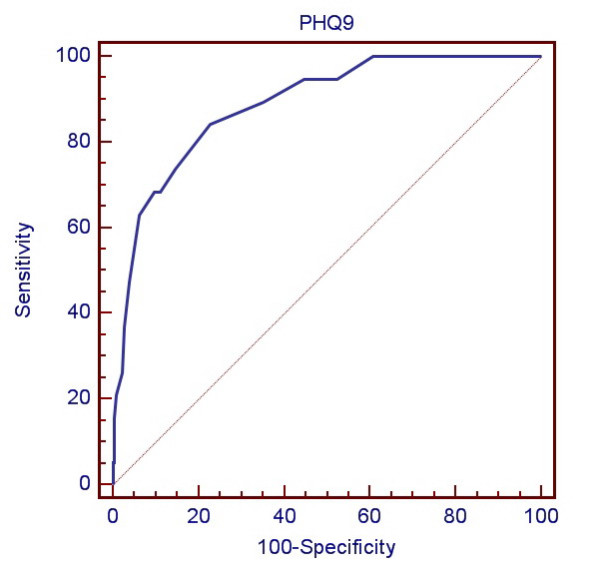
BACKGROUND: Most depression screening tools in Thailand are lengthy. The long process makes them impractical for routine use in primary care. This study aims to examine the reliability and validity of a Thai version Patient Health Questionnaire (PHQ-9) as a screening tool for major depression in primary care patients. METHODS: The English language PHQ-9 was translated into Thai. The process involved back-translation, cross-cultural adaptation, field testing of the pre-final version, as well as final adjustments. The PHQ-9 was then administered among 1,000 patients in family practice clinic. Of these 1,000 patients, 300 were further assessed by the Thai version of the Mini International Neuropsychiatric Interview (MINI) and the Thai version of the Hamilton Rating Scale for Depression (HAM-D). These tools served as gold-standards for diagnosing depression and for assessing symptom severity, respectively. In the assessment, reliability and validity analyses, and receiver operating characteristic curve analysis were performed. RESULTS: Complete data were obtained from 924 participants and 279 interviewed respondents. The mean age of the participants was 45.0 years (SD = 14.3) and 73.7% of them were females. The mean PHQ-9 score was 4.93 (SD = 3.75). The Thai version of the PHQ-9 had satisfactory internal consistency (Cronbach's alpha = 0.79) and showed moderate convergent validity with the HAM-D (r = 0.56; P < 0.001). The categorical algorithm of the PHQ-9 had low sensitivity (0.53) but very high specificity (0.98) and positive likelihood ratio (27.37). Used as a continuous measure, the optimal cut-off score of PHQ-9 >/= 9 revealed a sensitivity of 0.84, specificity of 0.77, positive predictive value (PPV) of 0.21, negative predictive value (NPV) of 0.99, and positive likelihood ratio of 3.71. The area under the curve (AUC) in this study was 0.89 (SD = 0.05, 95% CI 0.85 to 0.92). CONCLUSION: The Thai version of the PHQ-9 has acceptable psychometric properties for screening for major depression in general practice with a recommended cut-off score of nine or greater.
Overview
The claims and statistics of this paper haven’t been checked yet.
Free: it reads the open-access text and checks the first 5 claims that cite a source we can check. Create a free account to check every claim.
Integrity signals
Registry
Cites
Statistics
Figures
Verification
Claims the paper makes
The claims and statistics of this paper haven’t been checked yet.
Free: it reads the open-access text and checks the first 5 claims that cite a source we can check. Create a free account to check every claim.
Self-check
Percentages, sums and reported differences re-computed from the paper’s own numbers.
The self-check needs the paper’s full text.
Citations
Cites
The PHQ-9: Validity of a brief depression severity measure
Kroenke, K., Spitzer, R. L., & Williams, J. B. W. (2001) · Journal of General Internal Medicine · doi:10.1046/j.1525-1497.2001.016009606.x · Cited by 44,910
(1998) · The Journal of Clinical Psychiatry · Cited by 19,139
Guidelines for the process of cross-cultural adaptation of self-report measures
Beaton, D. E., Bombardier, C., Guillemin, F., & Ferraz, M. B. (2000) · Spine · doi:10.1097/00007632-200012150-00014 · Cited by 14,542
Journal of Clinical Psychiatry
(2018) · Journal of Clinical Psychiatry · doi:10.5505/kpd · Cited by 13,651
(1998) · PubMed · Cited by 10,216
Development of a Rating Scale for Primary Depressive Illness
HAMILTON, M. (1967) · British Journal of Social and Clinical Psychology · doi:10.1111/j.2044-8260.1967.tb00530.x · Cited by 8,410
The mini international neuropsychiatric interview
Lecrubier, Y., Sheehan, D., Hergueta, T., & Weiller, E. (1998) · European Psychiatry · doi:10.1016/s0924-9338(99)80239-9 · Cited by 5,872
Kushner (2021) · doi:10.12788/jfp · Cited by 3,799
Robins, L. N. (1988) · Archives of General Psychiatry · doi:10.1001/archpsyc.1988.01800360017003 · Cited by 2,909 · cited 1×
“86 [27].”
Global burden of depressive disorders in the year 2000
Üstün, T. B., Ayuso-Mateos, J. L., Chatterji, S., Mathers, C., & Murray, C. J. L. (2004) · British Journal of Psychiatry · doi:10.1192/bjp.184.5.386 · Cited by 1,735
Löwe, B., Kroenke, K., Herzog, W., & Gräfe, K. (2004) · Journal of Affective Disorders · doi:10.1016/s0165-0327(03)00198-8 · Cited by 1,558 · cited 1×
“Recently, the PHQ-9 was also demonstrated to be sensitive to change and responsive to treatment outcomes over time and thus is a useful tool for monitoring treatment progress [14,30,31].”
MethodJournal of the Medical Association of Thailand
(2020) · Journal of the Medical Association of Thailand · doi:10.35755/jmedassocthai · Cited by 963
J OURNAL OF THE MEDICAL ASSOCIATION OF THAILAND
Kapol, N. (2008) · Cited by 817
(2001) · PubMed · Cited by 713
Huang, F. Y., Chung, H., Kroenke, K., Delucchi, K. L., & Spitzer, R. L. (2006) · Journal of General Internal Medicine · doi:10.1111/j.1525-1497.2006.00409.x · Cited by 687
What's under the ROC? An Introduction to Receiver Operating Characteristics Curves
Streiner, D. L., & Cairney, J. (2007) · The Canadian Journal of Psychiatry · doi:10.1177/070674370705200210 · Cited by 527
Adewuya, A. O., Ola, B. A., & Afolabi, O. O. (2006) · Journal of Affective Disorders · doi:10.1016/j.jad.2006.05.021 · Cited by 474 · cited 1×
“This was also the case in the study of Adewuya et al [32].”
ResultStigma in response to mental disorders: a comparison of Australia and Japan
Griffiths, K. M., Nakane, Y., Christensen, H., Yoshioka, K., Jorm, A. F., & Nakane, H. (2006) · BMC Psychiatry · doi:10.1186/1471-244x-6-21 · Cited by 428
Stafford, L., Berk, M., & Jackson, H. J. (2007) · General Hospital Psychiatry · doi:10.1016/j.genhosppsych.2007.06.005 · Cited by 266
Depression screening: a practical strategy.
Nease, D. E., & Maloin, J. M. (2003) · PubMed · Cited by 209
Screening and case finding instruments for depression
Gilbody, S., House, A., & Sheldon, T. (2005) · Cochrane Database of Systematic Reviews · doi:10.1002/14651858.cd002792.pub2 · Cited by 205
(2022) · doi:10.54615/2231-7805 · Cited by 195
Doctors’ attitude towards people with mental illness in Western Nigeria
Adewuya, A. O., & Oguntade, A. A. (2007) · Social Psychiatry and Psychiatric Epidemiology · doi:10.1007/s00127-007-0246-4 · Cited by 163
World Mental Health Casebook: Social and Mental Health Programs in Low-Income Countries
Cohen, A., Kleinman, A., & Saraceno, B. (2002) · Springer eBooks · doi:10.1007/b112400 · Cited by 163
Responsiveness of the PHQ-9 to Psychopharmacological Depression Treatment
Löwe, B., Karapanagiotou‐Schenkel, I., Carney, C. P., & Göbel, C. (2005) · Psychosomatics · doi:10.1176/appi.psy.47.1.62 · Cited by 147
The Validity of the Mini International Neuropsychiatric Interview (M.I.N.I)-Thai version
Kittirattanapaiboon, P., & Khamwongpin, M. (2005) · Journal of Mental Health of Thailand - วารสารสุขภาพจิต แห่งประเทศไทย · doi:10.14456/dmhjournal.2005.15 · Cited by 144
Omoro, S. A. O., Fann, J. R., Weymuller, E. A., MacHaria, I. M., & Yueh, B. (2006) · The International Journal of Psychiatry in Medicine · doi:10.2190/8w7y-0tpm-jvgv-qw6m · Cited by 133
Validity of the Hamilton Rating Scale for Depression
Knesevich, J. W., Biggs, J. T., Clayton, P. J., & Ziegler, V. E. (1977) · British Journal of Psychiatry · doi:10.1192/bjp.131.1.49 · Cited by 118
Concordance between the PHQ-9 and the HSCL-20 in depressed primary care patients
Lee, P. W., Schulberg, H. C., Raue, P. J., & Kroenke, K. K. (2006) · Journal of Affective Disorders · doi:10.1016/j.jad.2006.09.002 · Cited by 111
Chen, T. M., Huang, F. Y., Chang, C., & Chung, H. (2006) · Psychiatric Services · doi:10.1176/ps.2006.57.7.976 · Cited by 81 · cited 1×
“Recently, the PHQ-9 was also demonstrated to be sensitive to change and responsive to treatment outcomes over time and thus is a useful tool for monitoring treatment progress [14,30,31].”
MethodLearning from low income countries: mental health
McKenzie, K., Patel, V., & Araya, R. (2004) · BMJ · doi:10.1136/bmj.329.7475.1138 · Cited by 78
Editorial: Treating depression in the developing world
Patel, V., Araya, R., & Bolton, P. (2004) · Tropical Medicine & International Health · doi:10.1111/j.1365-3156.2004.01243.x · Cited by 76
Weiss, M. G., Raguram, R., & Channabasavanna, S. M. (1995) · British Journal of Psychiatry · doi:10.1192/bjp.166.3.353 · Cited by 72
Development of the Thai Depression Inventory.
Lotrakul, M., & Sukanich, P. (1999) · PubMed · Cited by 65
Self-citationBech, P. (1993) · PubMed · Cited by 50
Hickie AM, I. B., Davenport, T. A., Luscombe, G. M., Rong, Y., Hickie, M. L., & Bell, M. I. (2007) · BMC Psychiatry · doi:10.1186/1471-244x-7-48 · Cited by 47
Psychiatric services in primary care settings: a survey of general practitioners in Thailand
Lotrakul, M., & Saipanish, R. (2006) · BMC Family Practice · doi:10.1186/1471-2296-7-48 · Cited by 39
Self-citationKuptniratsaikul, V., Chulakadabba, S., & Ratanavijitrasil, S. (2002) · PubMed · Cited by 28
Kasantikul, D., Karnjanathanalers, N., Limsuwan, N., Thongtang, O., Vuthiganond, S., Khuangsirikul, Tantipiwatanakul, P., & Theeramoke (1997) · PubMed · Cited by 22
Köksalan, K. (2005) · Journal of Clinical Microbiology · doi:10.1128/jcm.43.6.3031-3032.2005 · Cited by 2
Research works printed but not linked: 1
- Streiner DL, Norman GR: Scaling responses. In: Health Measuremant Scales: a practical guide to their development and use . 1995, Oxford , Oxford University Press, 20-53. 2nd ed.
Cited by
Manea, L., Gilbody, S., & McMillan, D. (2012) · Canadian Medical Association Journal · doi:10.1503/cmaj.110829 · Cited by 1,966
Wang, W., Bian, Q., Zhao, Y., Li, X., Wang, W., Du, J., Zhang, G., Zhou, Q., & Zhao, M. (2014) · General Hospital Psychiatry · doi:10.1016/j.genhosppsych.2014.05.021 · Cited by 1,480
Manea, L., Gilbody, S., & McMillan, D. (2015) · General Hospital Psychiatry · doi:10.1016/j.genhosppsych.2014.09.009 · Cited by 795
Costantini, L., Pasquarella, C., Odone, A., Colucci, M. E., Costanza, A., Serafini, G., Aguglia, A., Belvederi Murri, M., Brakoulias, V., Amore, M., et al. (2021) · Journal of Affective Disorders · doi:10.1016/j.jad.2020.09.131 · Cited by 733
Validity of the patient health questionnaire-9 for depression screening and diagnosis in East Africa
Gelaye, B., Williams, M. A., Lemma, S., Deyessa, N., Bahretibeb, Y., Shibre, T., Wondimagegn, D., Lemenhe, A., Fann, J. R., Vander Stoep, A., et al. (2013) · Psychiatry Research · doi:10.1016/j.psychres.2013.07.015 · Cited by 543
Metadata
- Authors
- Lotrakul, M., Sumrithe, S., & Saipanish, R.
- Affiliations
- Mahidol University (TH)
- Corresponding author
- Lotrakul, Manote
- Venue
- BMC Psychiatry
- Published
- 2008-06-20
- Volume
- 8
- Issue
- 1
- Pages
- 46-46
- ISSN
- 1471-244X (ISSN-L)
- PMC
- PMC2443128
- OpenAlex
- W2010298035
- Semantic Scholar
- 0af4196929af85a5dad1f9e4d3d4086d16f27e9a
- Cited by
- 606
- References
- 40
- Citations by year
- 2026: 59 · 2025: 84 · 2024: 48 · 2023: 63 · 2022: 67 · 2021: 59 · 2020: 41 · 2019: 40 · 2018: 43 · 2017: 30 · 2016: 12 · 2015: 12 · 2014: 10 · 2013: 13 · 2012: 7
- FWCI
- 4.12
- Type
- journal article
- Language
- en
- Open access
- gold
- doi.org
- Licence
- cc-by
- creativecommons.org/licenses/by/2.0 (tdm)
- Locations
- BMC Psychiatry (publishedVersion, cc-by)
- PubMed Central (publishedVersion, cc-by)
- PubMed (publishedVersion)
- DOAJ (DOAJ: Directory of Open Access Journals) (submittedVersion)
- Greater South Information System
- Funders
- Mahidol University
- Topics
- Social Sciences › Psychology › Experimental and Cognitive Psychology › Anxiety, Depression, Psychometrics, Treatment, Cognitive Processes
- Social Sciences › Decision Sciences › Management Science and Operations Research › Psychometric Methodologies and Testing
- Health Sciences › Nursing › Research and Theory › Health Education and Validation
- Keywords
- PHQ-9, Thai translation, depression screening, major depressive disorder, cross-cultural adaptation, primary care, psychometric properties, cut-off values, sensitivity and specificity, family medicine patients
- MeSH terms
- Adult, Algorithms, Cross-Sectional Studies, Cross-Cultural Comparison, Major Depressive Disorder, Female, Humans, Language, Male, Mass Screening, Middle Aged, Personality Inventory, Primary Health Care, Psychometrics, Surveys and Questionnaires, Thailand, Reproducibility of Results
About these checks
Registry, retraction, Cites and statistics results are computed, not judged, with one exception: a printed reference that no index lists is read once by a model before it counts as a citation error. Claims are extracted by a model and kept only when their quote appears verbatim in the text; each cited source is then checked, with a model’s help, for whether it says what the claim relies on. Those verdicts can be wrong — read the claim’s quote and the cited source before relying on one.
Statistics and arithmetic are recomputed, not judged.
Confidence bands are shown only for fields calibrated on our annotated test set. None is calibrated yet, so no band is shown.
What counts as a claim ›How we measure confidence ›How we check this ›
Are you an author, or do you see a problem with this page? Request a review
Data sources
Bibliographic data: Semantic Scholar, OpenAlex, Crossref.
Contains information from the Semantic Scholar Academic Graph Datasets, made available under the ODC Attribution License (ODC-BY 1.0).
Semantic Scholar’s data is described in: Kinney, R., et al. (2023). The Semantic Scholar Open Data Platform. arXiv:2301.10140.
