

Warwick-Edinburgh Mental Well-being Scale (WEMWBS): Validated for teenage school students in England and Scotland. A mixed methods assessment
Open accessThe DOI matches its Crossref record; 39 of the 41 references it cites were found in a registry or an index.
Abstract
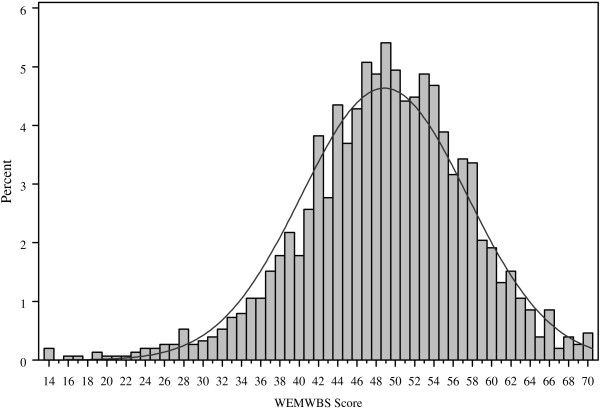
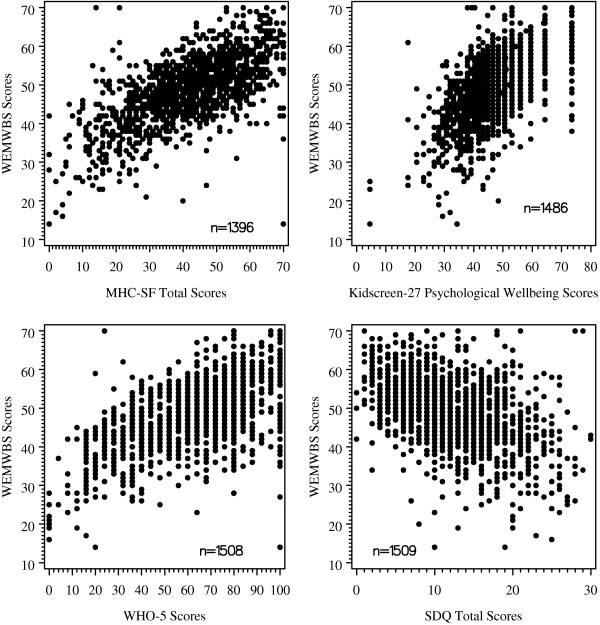
BACKGROUND: Understanding and measuring mental health and wellbeing amongst teenagers has recently become a priority. The Warwick-Edinburgh Mental Well-being Scale (WEMWBS) is validated for measuring mental wellbeing in populations aged 16 years and over in the UK. We report here a study designed to establish the validity and reliability of WEMWBS in teenagers in the UK. METHODS: WEMWBS and comparator scales, together with socio-demographic information and self-reported health, were incorporated into a self-administered questionnaire given to pupils aged 13 to 16 years in six schools in Scotland and England. Psychometric properties including internal consistency, correlations with comparator scales, test-retest stability and unidimensionality were investigated for WEMWBS. Twelve focus groups were undertaken to assess acceptability and comprehensibility of WEMWBS and were taped, transcribed and analysed thematically. RESULTS: A total of 1,650 teenagers completed the questionnaire (response rate 80.8%). Mean WEMWBS score was 48.8 (SD 6.8; median 49). Response scores covered the full range (from 14 to 70). WEMWBS demonstrated strong internal consistency and a high Cronbach's alpha of 0.87 (95% CI (0.85-0.88), n = 1517). Measures of construct validity gave values as predicted. The correlation coefficient for WEMWBS total score and psychological wellbeing domain of the Kidscreen-27 was 0.59 (95% CI [0.55; 0.62]); for the Mental Health Continuum Short Form (MHC-SF) was 0.65, 95% CI [0.62; 0.69]; and for the WHO (WHO-5) Well-being Index 0.57 (95% CI [0.53; 0.61]). The correlation coefficient for the Strengths and Difficulties Questionnaire (SDQ) was -0.44 (95% CI [-0.49; -0.40]) and for the 12-item General Health Questionnaire (GHQ12) -0.45 (95% CI [-0.49; -0.40]). Test-retest reliability was acceptable (Intraclass correlation coefficient (ICC) 0.66 (95% CI [0.59; 0.72] n = 212)). Confirmatory factor analysis demonstrated one underlying factor. WEMWBS was significantly associated with the Family Affluence Score (WEMWBS increased with increasing household socio-economic status) and had a positive association with the physical health dimension of the Kidscreen-27, but was unrelated to age, gender or location/school. Eighty students took part in focus groups. In general, although some students considered some items open to misunderstanding or misinterpretation, WEMWBS was received positively and was considered comprehensible, and acceptable. CONCLUSIONS: WEMWBS is a psychometrically strong population measure of mental wellbeing, and can be used for this purpose in teenagers aged 13 and over.
Overview
The claims and statistics of this paper haven’t been checked yet.
Free: it reads the open-access text and checks the first 5 claims that cite a source we can check. Create a free account to check every claim.
Integrity signals
Registry
Cites
Statistics
Figures
Verification
Claims the paper makes
The claims and statistics of this paper haven’t been checked yet.
Free: it reads the open-access text and checks the first 5 claims that cite a source we can check. Create a free account to check every claim.
Claims other papers make about this one
Each is checked against this paper’s own text: does it say what the citing paper says it does?
The source backs part of the claim, not all of it — or backs it for a different population, condition or comparison.
In the citing paper
“Psychometric data of the measure on the original WEMWBS for adolescents has indicated satisfactory to high internal consistency (r=.87) and the short version has acceptable test-retest reliability (r=.66, 95% CI 0.59-0.72) [44,45].”
From Feasibility and effectiveness of a web-based positive psychology program for youth mental health: Randomized controlled trial (2014) · cites this paper as [45]
Experimental — accuracy not yet measuredThe source backs part of the claim, not all of it — or backs it for a different population, condition or comparison.
In the citing paper
“to high internal consistency (r=.87) and the short version has acceptable test-retest reliability (r=.66, 95% CI 0.59-0.72) [44,45].”
From Feasibility and effectiveness of a web-based positive psychology program for youth mental health: Randomized controlled trial (2014) · cites this paper as [45]
Experimental — accuracy not yet measuredThe cited source says what the claim attributes to it.
In the citing paper
“Participants provided demographic information (age, gender, ethnicity and postcode) and completed the Warwick–Edinburgh Mental Wellbeing scale (WEMWBS), validated for use with young people [22,23].”
Self-check
Percentages, sums and reported differences re-computed from the paper’s own numbers.
The self-check needs the paper’s full text.
Citations
Cites
Coefficient Alpha and the Internal Structure of Tests
Cronbach, L. J. (1951) · Psychometrika · doi:10.1007/bf02310555 · Cited by 43,931 · cited 2×
“7, demonstrating satisfactory to high internal consistency [32].”
BackgroundMethodOn Happiness and Human Potentials: A Review of Research on Hedonic and Eudaimonic Well-Being
Ryan, R. M., & Deci, E. L. (2001) · Annual Review of Psychology · doi:10.1146/annurev.psych.52.1.141 · Cited by 11,567 · cited 1×
“In adults, mental wellbeing is regarded as covering both hedonic (happiness, subjective wellbeing) and eudaimonic (positive functioning) wellbeing [14].”
BackgroundPharmacological interventions for somatoform disorders in adults
Kleinstäuber, M., Witthöft, M., Steffanowski, A., van Marwijk, H., Hiller, W., & Lambert, M. J. (2014) · Cochrane Database of Systematic Reviews · doi:10.1002/14651858.cd010628.pub2 · Cited by 11,335
Bootstrap Methods and their Application
Davison, A. C., & Hinkley, D. V. (1997) · doi:10.1017/cbo9780511802843 · Cited by 7,350
Psychometric properties of the strengths and difficulties questionnaire
GOODMAN, R. (2001) · Journal of the American Academy of Child & Adolescent Psychiatry · doi:10.1097/00004583-200111000-00015 · Cited by 6,813 · cited 10×
“We found very little difference between age groups when correlations between WEMWBS and GHQ12, WHO-5, SDQ, MHC-SF and Kidscreen-27 were repeated for those aged 14 years and younger versus those aged 15 years and older.”
BackgroundInfluentialThe cochrane database of systematic reviews
Geddes, J. (1996) · Journal of Psychosomatic Research · doi:10.1016/s0022-3999(96)90063-x · Cited by 5,989
Bootstrap Methods and Their Application
Loughin, T. M., Davison, A. C., & Hinkley, D. V. (1999) · Journal of the American Statistical Association · doi:10.2307/2669707 · Cited by 5,418
The Warwick-Edinburgh Mental Well-being Scale (WEMWBS): development and UK validation
Tennant, R., Hiller, L., Fishwick, R., Platt, S., Joseph, S., Weich, S., Parkinson, J., Secker, J., & Stewart-Brown, S. (2007) · Health and Quality of Life Outcomes · doi:10.1186/1477-7525-5-63 · Cited by 5,031 · cited 4×
“Discussion WEMWBS is a population measure of mental wellbeing, validated for use in adults aged 16 years and over in the UK [20,21].”
BackgroundMethodInfluentialSelf-citationQualitative data analysis for applied policy research
(2002) · Analyzing Qualitative Data · doi:10.4324/9780203413081-14 · Cited by 4,964 · cited 1×
“Analysis was undertaken using an adapted Framework Approach [37] suitable where a framework for analysis already exists.”
MethodCochrane Database of Systematic Reviews
(2008) · Encyclopedia of Public Health · doi:10.1007/978-1-4020-5614-7_436 · Cited by 4,527
Research works printed but not linked: 7
- Currie C Roberts C Morgan A Smith R Settertobulte W Samdal O Barnekow Rasmussen V Young People's Health in Context: international report from the HBSC 2001/02 survey, (Health Policy for Children and Adolescents, No.4) 2004 WHO Regional Office for Europe, Copenhagen
- Department for Children, Schools and Families Every Child Matters Green Paper 2003 CM5860. Crown Copyright
- National Institute for Health and Clinical Excellence Public Health Guidance No 12 Promoting Children's Social and Emotional Wellbeing in Primary Education 2008
- Ofsted Indicators of a school's contribution to well-being 2008 HMI 080195
- Scottish Government Towards a Mentally Flourishing Scotland: Policy and Action Plan 2009-2011 2009 Edinburgh, Scottish Government
- Tennant R Fishwick R Platt S Joseph S Stewart-Brown S Monitoring positive mental health in Scotland: validating the Affectometer 2 scale and developing the Warwick-Edinburgh Mental Well-being scale for the UK 2006 Glasgow, NHS Health Scotland
- Clarke A Putz R Friede T Ashdown J Adi Y Martin S Flynn P Blake A Stewart-Brown S Platt S Warwick-Edinburgh Mental Well-being Scale (WEMWBS) acceptability and validation in English and Scottish secondary school students (The WAVES Project) 2010 Glasgow, NHS Health Scotland
Cited by
Items 301–400 of 492
Jónsdóttir, U. S., Thordardottir, E. B., Aspelund, T., Jónmundsson, Þ., & Einarsdóttir, K. (2019) · European Journal of Public Health · doi:10.1093/eurpub/ckz192 · Cited by 7
McGovern, R., Stamp, E., Javanbakht, M., McColl, E., Hickman, M., & Kaner, E. (2018) · Pilot and Feasibility Studies · doi:10.1186/s40814-018-0305-5 · Cited by 7
“with adults [66] Health-related quality of life (HRQoL) will be assessed”
BackgroundWilson, C., Secker, J., & Kent, L. (2014) · Journal of Applied Arts and Health · doi:10.1386/jaah.5.3.341_1 · Cited by 8
“This scale has demonstrated high internal consistency, construct validity, discriminant validity and test–retest reliability (e.g. Bartram et al. 2011; Clarke et al. 2011; Tennant et al. 2007).”
BackgroundDavison, B., Liddle, R., Fitz, J., & Singh, G. R. (2020) · SAGE Open Medicine · doi:10.1177/2050312120906042 · Cited by 5
Hews‐Girard, J., Dimitropoulos, G., Duffy, A. C., Velmovitsky, P. E., Keown‐Stoneman, C. D. G., King, N., Thannhauser, J. E., Szeto, A. C. H., & Patten, S. B. (2025) · Journal of College Student Mental Health · doi:10.1080/28367138.2025.2510683 · Cited by 6
“In a study of teenagers in England and Scotland, the WEMWBS-7 demonstrated strong internal consistency (α = 0.87 Clarke et al., 2011).”
InfluentialHinze, V., Blakemore, S., Dalgleish, T., Ford, T. J., Mansfield, K. L., Ukoumunne, O. C., Kuyken, W., & Montero‐Marín, J. (2025) · JAACAP Open · doi:10.1016/j.jaacop.2025.07.003 · Cited by 9
“22 Informed assent/consent was obtained from schools, parents (opt-out), and adolescents.”
Srinivasan, S. P., Arumugam, C., Anandan, A., & Ramachandran, P. (2023) · Indian Journal of Psychiatry · doi:10.4103/indianjpsychiatry.indianjpsychiatry_153_23 · Cited by 5
“25-27] To ensure uniformity of administration and remove any barriers to the child’s reading ability, all the scales were read out to the children by the research assistants while they answered the questions on their forms.”
Chen, Z. F., Sun, R., & Tao, W. (2024) · Asian Journal of Communication · doi:10.1080/01292986.2024.2315587 · Cited by 7
“As both perspectives capture di ff erent and important aspects of mental well-being, we combine these two perspectives and adopted the Warwick-Edinburgh Mental Well-Being Scale (WEMWBS) to measure mental well-being (Clarke et al., 2011; Stewart-Brown et al., 2009; Tennant et al., 2007).”
MethodPalmer, A., O'Connor, D. B., Janardhana, N., Khandeparkar, P., Bhola, P., Prabhu, S., A. L., K., Arelingaiah, M., K. P., J., Nag, R., et al. (2025) · Mental Health Science · doi:10.1002/mhs2.70019 · Cited by 5
“The WEMWBS has been validated for use in adolescents (e.g., Clarke et al. 2011) and Indian adolescents (Singh and Raina 2020: M age: 15.27).”
InfluentialSABANCI, A. Ş. R. G. A. (2019) · Journal of Turkish Studies · doi:10.29228/turkishstudies.22098 · Cited by 7
Bear, H. A., Moon, Z., Wasil, A. R., Ahuvia, I. L., Edbrooke-Childs, J. H., & Wolpert, M. (2023) · Counselling Psychology Quarterly · doi:10.1080/09515070.2023.2232320 · Cited by 5
“The WEMWBS is established as reliable and valid for use with young people in the United Kingdom, demonstrating strong internal consistency and a high Cronbach’s alpha of .87 (95% CI (0.85–0.88), n = 1,517) (Clarke et al., 2011).”
MethodInfluentialAdaptation of the Mental Health Inventory (MHI-38) for Adolescents - Indonesian Version
Parombean, A. C., Abidin, F. A., Qodariah, L., & Novita, S. (2023) · Psychology Research and Behavior Management · doi:10.2147/prbm.s412460 · Cited by 21
Danielsen, K. K., Cabral, D., & Sveaas, S. H. (2023) · International Journal of Environmental Research and Public Health · doi:10.3390/ijerph20176639 · Cited by 10
Tuckey, N., van Agteren, J. E., Chur‐Hansen, A., Ali, K., Fassnacht, D. B., Beatty, L., Bareham, M., Wardill, H. R., & Iasiello, M. P. (2024) · Asia-Pacific Journal of Clinical Oncology · doi:10.1111/ajco.14060 · Cited by 6
Gardner, L. A., O’Dean, S., Rowe, A., Hawkins, A., Egan, L., Stockings, E., Teesson, M., Hides, L. M., Catakovic, A., Ellem, R., et al. (2024) · Australian & New Zealand Journal of Psychiatry · doi:10.1177/00048674241267908 · Cited by 5
“Wellbeing was assessed using the seven-item Short Warwick–Edinburgh Mental Well-being Scale (Clarke et al., 2011).”
Poziom i korelaty prężności psychicznej studentów wczesnej edukacji w wybranych uczelniach w Polsce
Kulawska, E. (2020) · Forum Pedagogiczne · doi:10.21697/fp.2020.1.09 · Cited by 6
Murphy, J. M., McGrane, B., & Sweeney, M. R. (2021) · Physical Activity and Health · doi:10.5334/paah.127 · Cited by 15
Ohr, S. O., Holm, D., Ball, J., & Foureur, M. J. (2021) · Australian journal of advanced nursing · doi:10.37464/2020.384.172 · Cited by 9
Jong, A., Riddleston, L., Mathur, M., Duncan, K. B., Lalioti, K., Fuhrmann, D., & Lau, J. Y. F. (2023) · Current Research in Behavioral Sciences · doi:10.1016/j.crbeha.2023.100133 · Cited by 6
Positive Education and Teaching for Productive Disposition in Mathematics
Woodward, A., Beswick, K., & Oates, G. (2018) · Springer eBooks · doi:10.1007/978-3-030-01273-1_15 · Cited by 9
Family functioning and its relationship to adolescent mental health
Butler, C. W. (2015) · Cited by 11
Történeti tabló a pozitív pszichológiai jóllét és mentális egészség elméletekről és előzményeikről
Zábó, V., Oláh, A., & Vargha, A. (2023) · Magyar Pszichológiai Szemle · doi:10.1556/0016.2023.00041 · Cited by 9
Zhang, L., Zhang, Y., Zhou, J., Zhang, X., & Gao, L. (2024) · Psychology Research and Behavior Management · doi:10.2147/prbm.s470027 · Cited by 9
Social media challenges: fatigue, misinformation and user disengagement
Santiago, J. K., Tiago, M. T. B., & Tiago, F. (2025) · Management Decision · doi:10.1108/md-04-2024-0868 · Cited by 7
Ebrahimi, A. M., Pordanjani, T. R., & Tad, H. (2019) · Health Research Journal · doi:10.29252/hrjbaq.4.4.189 · Cited by 5
Dodd-Reynolds, C. J., Nevens, L., Oliver, E. J., Finch, T. L., Lake, A. A., & Hanson, C. L. (2019) · BMJ Open · doi:10.1136/bmjopen-2019-029718 · Cited by 4
Nair, M., Chacko, D., Rajaraman, V., George, B., Samraj, L., & Russell, P. S. S. (2014) · Indian Journal of Psychological Medicine · doi:10.4103/0253-7176.130991 · Cited by 4
“the hedonic and eudemonic wellbeing of a teenager as does the Warwick-Edinburgh Mental Well-being Scale validated for teenagers.[10] Conversely, TSQ-M can be compared in it conceptualization like other generic measures for mental ill health namely Strength and Difficulties Questionnaire, Indian Adolescent Health Quest…”
The influence of university students' stress mindsets on health and performance outcomesPreprint
Keech, J. J., Hagger, M. S., O’Callaghan, F., & Hamilton, K. (2018) · PsyArXiv (OSF Preprints) · doi:10.31234/osf.io/skpbw · Cited by 4
Maximising impactful and locally relevant mental health research: ethical considerations
Calia, C., Chakrabarti, A., Sarabwe, E., & Chiumento, A. (2022) · Wellcome Open Research · doi:10.12688/wellcomeopenres.18269.1 · Cited by 12
Moshashai, S. K., Yārahmadi, Y., & Sharifi, H. P. (2023) · Journal of Clinical Research in Paramedical Sciences · doi:10.5812/jcrps-133581 · Cited by 5
A workplace wellness program protects against COVID-19 effects on mental wellbeing
Toma, G., Rubie-Davies, C. M., & Fevre, D. M. L. (2023) · Journal of Workplace Behavioral Health · doi:10.1080/15555240.2023.2237674 · Cited by 5
“Following a period of disagreement on its definition, the concept was accepted to cover two main aspects of wellbeing: eudaimonic, meaning positive functioning, and hedonic, meaning subjective wellbeing and happiness (Clarke et al., 2011; Hunter et al., 2015; Tennant et al., 2007).”
BackgroundHe, M., Lam, A. I. F., & Wong, P. W. C. (2023) · Asian Social Work and Policy Review · doi:10.1111/aswp.12303 · Cited by 3
Psychometric Evaluation of the Warwick-Edinburgh Mental Well-Being Scale on Indonesian Students
Ramadhana, M. R. (2023) · Journal An-Nafs Kajian Penelitian Psikologi · doi:10.33367/psi.v8i2.3817 · Cited by 8
“The level of internal consistency value of the WEMWBS scale is good and has a similar value to reports in other studies (Clarke et al., 2011; Taggart et al., 2013; Tennant et al., 2007; Waqas et al., 2015).”
BackgroundResultİme, Y. (2024) · Polish Psychological Bulletin · doi:10.24425/ppb.2023.148052 · Cited by 6
“Similarly, Clarke et al. (2011) examined the psychometric properties of the scale in a sample of English and Scottish adolescents.”
BackgroundDiplock, B. D., Selchen, S., Rawana, J. S., Craig, S. G., & Pepler, D. J. (2024) · Advances in Mental Health · doi:10.1080/18387357.2024.2367408 · Cited by 4
“…has good to excellent internal consistency (Cronbach α = .89 – .95), acceptable to excellent test-retest reliability ( r = 0.66– 0.83), has been found to be unsusceptible to bias, and has good criterion, content and construct validity (Bass et al., 2016; Clarke et al., 2011; Tennant et al., 2007).”
InfluentialGross‐Manos, D., Tepper, S., & Kosher, H. (2025) · Children and Youth Services Review · doi:10.1016/j.childyouth.2025.108215 · Cited by 4
Development of wellness scale for emerging adults: Validity and reliability study
Siyez, D. M., Esen, E., Seymenler, S., & Öztürk, B. (2020) · Current Psychology · doi:10.1007/s12144-020-00672-w · Cited by 6
Sunflowers on the road to NASA
Moss, J. (2010) · Bereavement Care · doi:10.1080/02682621.2010.484934 · Cited by 3
Shastan, N. J., Tamini, B. K., & Harafteh, F. S. K. (2021) · Iranian Journal of Educational Sociology · doi:10.52547/ijes.4.1.86 · Cited by 3
Coulton, S., Giles, E. L., McGeechan, G., Deluca, P., Drummond, C., Howel, D., Kaner, E., McColl, E., McGovern, R., Scott, S., et al. (2022) · Alcohol and Alcoholism · doi:10.1093/alcalc/agab087 · Cited by 2
“General psychological health was assessed using the Warwick–Edinburgh Mental Wellbeing Scale (WEMWBS; Clarke et al., 2011).”
Citerne, A., Roda, C., Rancière, F., & Momas, I. (2023) · Child and Adolescent Psychiatry and Mental Health · doi:10.1186/s13034-023-00609-8 · Cited by 4
Murphy, J. M., McGrane, B., & Sweeney, M. R. (2021) · Preprints.org · doi:10.20944/preprints202107.0580.v1 · Cited by 3
Gardner, L. A., Rowe, A., Stockings, E., Champion, K. E., Hides, L. M., MCBRIDE, N. T., ALLSOP, S. J., O’Dean, S., Sunderland, M., Lee, Y. Y., et al. (2023) · Research Square · doi:10.21203/rs.3.rs-2579595/v1 · Cited by 3
Ball, W., Anderson, C., Black, C., Gordon, S., Lackenby, M., Murchie, M., Ostrovska, B., O’Sullivan, K., Rowlands, H., Rzewuska, M., et al. (2024) · Social Science & Medicine · doi:10.1016/j.socscimed.2024.117057 · Cited by 2
School experiences and self‐harm in the OxWell study
Nawaz, R. F., Ford, T. J., Fazel, M. S., Geulayov, G., The OxWell Study Team, & White, S. R. (2025) · JCPP Advances · doi:10.1002/jcv2.70025 · Cited by 2
Lu, S. (2025) · The Journals of Gerontology Series B · doi:10.1093/geronb/gbaf214 · Cited by 3
Bone, J. K., Bu, F., Fancourt, D. E., & Hayes, D. (2026) · BMJ Mental Health · doi:10.1136/bmjment-2025-302442 · Cited by 3
“Well-being was measured with the SWEMWBS, which has been validated for this population 27 and used in many evaluations of SP. 3 18 However, 43% of CYP successfully discharged from SP had missing well-being data.”
Social tenants’ health: evaluating the effectiveness of landlord interventions
Cheshire, P. C., Gibbons, S., & Mouland, J. (2018) · Journal of Epidemiology & Community Health · doi:10.1136/jech-2017-209888 · Cited by 2
Cochrane, A., Booth, A., Walker, I., Morgan, S. A., Mitchell, A. S., Barlow-Pay, M., Hewitt, C. E., Taylor, B., Chapman, C., Raftery, J. P., et al. (2021) · Trials · doi:10.1186/s13063-021-05905-2 · Cited by 4
Self-Determination and Social & Emotional Learning for Students with Special Educational Needs
Kong, L. C. (2023) · Springer eBooks · doi:10.1007/978-981-99-7897-7_9 · Cited by 5
Abualbasal, A., Issa, R., Alfayoumi, D., Azzouqa, S., & Tawabini, N. (2024) · Journal of Ecohumanism · doi:10.62754/joe.v3i5.3885 · Cited by 4
Paranoia, Functioning, and the Moderating Effect of Well‐Being in a Community Sample of Adolescents
Thompson, E., Kingston, J. L., Ellett, L., Krkovic, K., Velotta, S. K., Rabasco, A., & Gaudiano, B. A. (2025) · Journal of Adolescence · doi:10.1002/jad.12460 · Cited by 4
Iacob, C. I., Dumitru, C., Yıldız, M., & Folostina, R. M. (2025) · Current Psychology · doi:10.1007/s12144-025-07530-7 · Cited by 2
“Given the close interrelatedness between mental well-being, general well-being, and life satisfaction, these variables were used to investigate the convergent validity of the WEMWBS (Clarke et al., 2011 ; Konaszewski et al., 2021).”
Webb, L., Castillo, I. E., Holingue, C., Testa, A. M., Wallace, D. M., & Jackson, D. B. (2025) · Journal of Adolescent Health · doi:10.1016/j.jadohealth.2025.05.022 · Cited by 2
Natural Choices for Health and Wellbeing
Barton, J. (2013) · Cited by 2
Jyothi, L., Nuthalapati, R. K., & Peddy, S. R. (2018) · Journal of Indian College of Cardiology · doi:10.1016/j.jicc.2018.07.002 · Cited by 2
Rombouts, M., Duinhof, E. L., Kleinjan, M., Kraiss, J. T., Shields‐Zeeman, L., & Monshouwer, K. (2022) · BMC Public Health · doi:10.1186/s12889-021-12321-3 · Cited by 4
“Studies from the United Kingdom found that it is appropriate to use the 14-item WEMWBS to measure well-being among adolescents aged 13 to 16 [39].”
MethodSalary, S., Roshan, R., Poursharifi, H., Farahani, H., & Hosseini, M. S. (2022) · Journal of North Khorasan University of Medical Sciences · doi:10.32592/nkums.14.3.59 · Cited by 1
Health and wellbeing in refugee families from Syria resettled in Denmark
Nielsen, N. O., Benedikz, E., Dahl, M., Præstegaard, J., & Lindahl, M. (2023) · Journal of Migration and Health · doi:10.1016/j.jmh.2023.100200 · Cited by 2
“89 in school students aged 13–16 years (Clarke et al., 2011)).”
BackgroundMultiple substance use among adolescents in Scotland: profile and trends
Black, C., & Martin, C. (2015) · Digital Education Resource Archive (University College London) · Cited by 2
Reiss, V. L. (2013) · UA Campus Repository (The University of Arizona) · Cited by 5
Coulton, S., Nizalova, O. Y., Pellatt‐Higgins, T., Stevens, A., Hendrie, N., Marchand, C., Vass, R., Deluca, P., Drummond, C., Ferguson, J., et al. (2023) · Public Health Research · doi:10.3310/fkpy6814 · Cited by 3
Öz Kontrolün Yeşil Satın Alma Davranışına Etkisinde Mental İyi Oluşun Rolü
İŞLEK, M. S., & AŞIK, E. (2023) · Alanya Akademik Bakış · doi:10.29023/alanyaakademik.1273900 · Cited by 2
Đinh, M. H. Đ., & Nguyễn, H. T. V. (2024) · European Journal of Psychology and Educational Research · doi:10.12973/ejper.7.3.129 · Cited by 3
Screti, C., Atkinson, L., Shaw, R. L., Muhammed, R., & Heath, G. (2024) · BMJ Open · doi:10.1136/bmjopen-2024-085576 · Cited by 1
Karanfil, S. M. (2025) · Aircraft Engineering and Aerospace Technology · doi:10.1108/aeat-09-2024-0254 · Cited by 1
The role of uncertainty in earthquake fear and well-being among seafarers
Toygar, A. (2025) · Work · doi:10.1177/10519815251346460 · Cited by 2
“39 Thus, MWB is correlated with positive mental health is identi fi ed with mental health.”
Lam, J. R., & Gatt, J. M. (2025) · Frontiers in Psychiatry · doi:10.3389/fpsyt.2025.1611208 · Cited by 1
Sarasjärvi, K. K., Elovainio, M. J., Appelqvist‐Schmidlechner, K., Solin, P., Tamminen, N., & Therman, S. (2025) · BMC Psychology · doi:10.1186/s40359-025-03571-6 · Cited by 2
Madkour, M. E., Schwientek, A.-K., Yasenok, V., Frei, A. L., Kaufmann, M., Петрашенко, В. О., Burriel, M. S., Piven, S. M., Kolyada, N., Seifritz, E., et al. (2026) · Frontiers in Public Health · doi:10.3389/fpubh.2026.1740963 · Cited by 1
Dargue-Fox, E. J., Mallinson‐Howard, S. H., Healy, L. C., Johnston, J., & Sarkar, M. (2026) · Psychology of sport and exercise · doi:10.1016/j.psychsport.2026.103131 · Cited by 2
Policy Development for Student Wellbeing
Noble, T., & McGrath, H. (2015) · SpringerBriefs in well-being and quality of life research · doi:10.1007/978-3-319-21795-6_3 · Cited by 1
Diaco, S. B. (2020) · Learning Research and Practice · doi:10.1080/23735082.2020.1792536 · Cited by 1
McLellan, R., Faucher, C., & Winter, L. (2022) · Transdisciplinary perspectives in educational research · doi:10.1007/978-3-030-95205-1_9 · Cited by 1
A preliminary evaluation of Kids Matter: A community‐based parenting intervention
Serna, C. E., Eisenstadt, M., Gardner, E., & Liverpool, S. (2022) · Journal of Community Psychology · doi:10.1002/jcop.22917 · Cited by 4
Research protocol for a preliminary evaluation of a gamified tool for adult wellbeing
Gavin, J., & Barnes, S. (2023) · Mental Health and Social Inclusion · doi:10.1108/mhsi-01-2023-0001 · Cited by 1
Sujan, M. S. H., Haghighathoseini, A., Tasnim, R., Ripon, R. K., Akter, M., Ripon, S. A., Hasan, M. M., Uddin, M. R., & Ferdous, M. Z. (2023) · Asian Journal of Health Sciences · doi:10.15419/ajhs.v9i1.521 · Cited by 4
Youth Perspectives of Neglect Signs and Help-Seeking
Cohen, A., Marey‐Sarwan, I., & Gross‐Manos, D. (2024) · Behavioral Sciences · doi:10.3390/bs14080704 · Cited by 1
“Generally, theoretical discourse indicates that children are knowledgeable regarding their worldviews and the contexts in which they live, thus their views must be heard [45,55,56] (Clarke et al., 2011; Mayall, 2015; Marey-Sarwan, 2019).”
BackgroundAdolescents in the Dunkelfeld: A Study of Help Seeking Minors Who Use Child Sexual Abuse Materials
Westfal, V. (2025) · Sexual Abuse · doi:10.1177/10790632251351254 · Cited by 2
“The Warwick-Edinburgh Mental Wellbeing Scale (WEMWBS) by Tennant and colleagues (2007) is an instrument that has been validated in different languages and age groups, including teenagers, to measure mental wellbeing (Clarke et al., 2011; Hunter et al., 2015; Tennant et al., 2007).”
Woo, H. Y. (2018) · Biomedical Research - India · doi:10.4066/biomedicalresearch.29-18-1168 · Cited by 1
The Impact of a Felon's Overall Well-Being on Education, Employment, and Recidivism
McNair-Williams, S. S. (2019) · Digital Commons (Liberty University) · Cited by 1
Leisure Satisfaction and Mental Well-Being: A Study on the Families of Disabled Athletes
Arı, Ç., & Akgül, B. M. (2022) · Akdeniz Spor Bilimleri Dergisi · doi:10.38021/asbid.1127440 · Cited by 1
Rocliffe, P., Sherwin, I., McNamara, P., MacDonncha, C., & O’Keeffe, B. T. (2023) · Open Research Europe · doi:10.12688/openreseurope.16535.1 · Cited by 1
Caraterização da Saúde Mental numa população jovem dos Açores: da psicopatologia ao bem-estar
Monte, K. (2014) · Portuguese National Funding Agency for Science, Research and Technology (RCAAP Project by FCT) · Cited by 1
Söderqvist, F., & Larm, P. (2020) · Research Square · doi:10.21203/rs.3.rs-110171/v1 · Cited by 1
Áttekintés a lelki jóllét és a mentális egészség modelljeiről és mérőeszközeirőlPreprint
Zábó, V., Oláh, A., & Vargha, A. (2022) · OSF Preprints (OSF Preprints) · doi:10.31219/osf.io/6k2uj · Cited by 3
Carp, T.-N. (2025) · Preprints.org · doi:10.20944/preprints202504.0238.v4
Carp, T.-N. (2025) · Preprints.org · doi:10.20944/preprints202504.0238.v5
Carp, T.-N. (2025) · Preprints.org · doi:10.20944/preprints202504.0238.v6
Ferreira, C. (2015) · Portuguese National Funding Agency for Science, Research and Technology (RCAAP Project by FCT)
Baker, C. M., Elizabeth, L., Crone, D., Tutton, A., & Aitken, P. (2016) · Wiley eBooks · doi:10.1002/9781394259625.ch23 · Cited by 2
Positive mental health and wellbeing in adolescents with cystic fibrosis
Cronly, J., & Savage, E. (2018) · Journal of Psychosomatic Research · doi:10.1016/j.jpsychores.2018.11.017
Sajadian, M. (2018) · Paramedical Sciences and Military Health
Kangmennaang, J. (2019) · UWSpace (University of Waterloo) · Cited by 1
The conceptualisation and assessment of child and adolescent well- and ill-being
Bracey, S. (2019) · University of Birmingham Institutional Research Archive (University of Birmingham) · Cited by 1
Factor Invariance of Anxiety and Depression Measures in Autism
McKernan, E. P. (2020) · Syracuse University Libraries (Syracuse University)
The Influence of Emotion Regulation on the Emotional Well-Being among Diverse College Students
Gardiner, S. R. (2021) · Digital Commons (Liberty University) · Cited by 3
Metadata
- Authors
- Clarke, A., Friede, T., Putz, R., Ashdown, J., Martin, S., Blake, A., Adi, Y., Parkinson, J., Flynn, P., Platt, S., & Stewart-Brown, S.
- Affiliations
- University of Warwick (GB)
- Universitätsmedizin Göttingen (DE)
- National Health Service (GB)
- Coventry and Warwickshire Partnership NHS Trust (GB)
- King Saud University (SA)
- Public Health Scotland (GB)
- University of Stirling (GB)
- University of Edinburgh (GB)
- Corresponding author
- Clarke, Aileen
- ORCID
- Venue
- BMC Public Health
- Published
- 2011-06-21
- Volume
- 11
- Issue
- 1
- Pages
- 487-487
- ISSN
- 1471-2458 (ISSN-L)
- PMC
- PMC3141456
- OpenAlex
- W2043602673
- Cited by
- 493
- References
- 41
- Citations by year
- 2026: 33 · 2025: 40 · 2024: 51 · 2023: 69 · 2022: 51 · 2021: 45 · 2020: 35 · 2019: 38 · 2018: 27 · 2017: 29 · 2016: 16 · 2015: 32 · 2014: 12 · 2013: 7 · 2012: 6
- FWCI
- 11.73
- Type
- journal article
- Language
- en
- Open access
- gold
- doi.org
- Licence
- Locations
- BMC Public Health (publishedVersion, cc-by)
- PubMed Central (publishedVersion, cc-by)
- PubMed (publishedVersion)
- Warwick Research Archive Portal (University of Warwick) (acceptedVersion)
- GoeScholar The Publication Server of the Georg-August-Universität Göttingen (Georg-August-Universität Göttingen) (acceptedVersion, other-oa)
- DOAJ (DOAJ: Directory of Open Access Journals) (submittedVersion, cc-by-sa)
- GRO (submittedVersion, cc-by)
- University of Birmingham Research Portal (University of Birmingham) (submittedVersion)
- Edinburgh Research Explorer (University of Edinburgh) (submittedVersion, cc-by)
- Funders
- NHS Health Scotland
- Topics
- Social Sciences › Decision Sciences › Management Science and Operations Research › Psychometric Methodologies and Testing
- Social Sciences › Psychology › Social Psychology › Psychological Well-being and Life Satisfaction
- Health Sciences › Nursing › Research and Theory › Health Education and Validation
- Keywords
- Warwick-Edinburgh Mental Well-being Scale, adolescent psychological well-being, psychometric validation, school pupils, test-retest reliability, internal consistency, construct validity, unidimensionality, questionnaire acceptability, Strengths and Difficulties Questionnaire, Mental Health Continuum-Short Form, KIDSCREEN-27, WHO-5 Well-Being Index, General Health Questionnaire, self-reported health, mental health
- MeSH terms
- Adolescent, England, Female, Humans, Male, Mental Health, Personal Satisfaction, Psychometrics, Surveys and Questionnaires, Scotland, Focus Groups
About these checks
Registry, retraction, Cites and statistics results are computed, not judged, with one exception: a printed reference that no index lists is read once by a model before it counts as a citation error. Claims are extracted by a model and kept only when their quote appears verbatim in the text; each cited source is then checked, with a model’s help, for whether it says what the claim relies on. Those verdicts can be wrong — read the claim’s quote and the cited source before relying on one.
Statistics and arithmetic are recomputed, not judged.
Confidence bands are shown only for fields calibrated on our annotated test set. None is calibrated yet, so no band is shown.
What counts as a claim ›How we measure confidence ›How we check this ›
Are you an author, or do you see a problem with this page? Request a review
Data sources
Bibliographic data: Semantic Scholar, OpenAlex, Crossref.
Contains information from the Semantic Scholar Academic Graph Datasets, made available under the ODC Attribution License (ODC-BY 1.0).
Semantic Scholar’s data is described in: Kinney, R., et al. (2023). The Semantic Scholar Open Data Platform. arXiv:2301.10140.
