

Warwick-Edinburgh Mental Well-being Scale (WEMWBS): Validated for teenage school students in England and Scotland. A mixed methods assessment
Open accessThe DOI matches its Crossref record; 39 of the 41 references it cites were found in a registry or an index.
Abstract
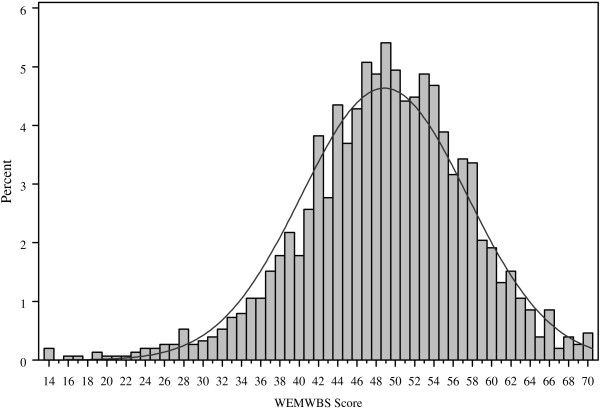
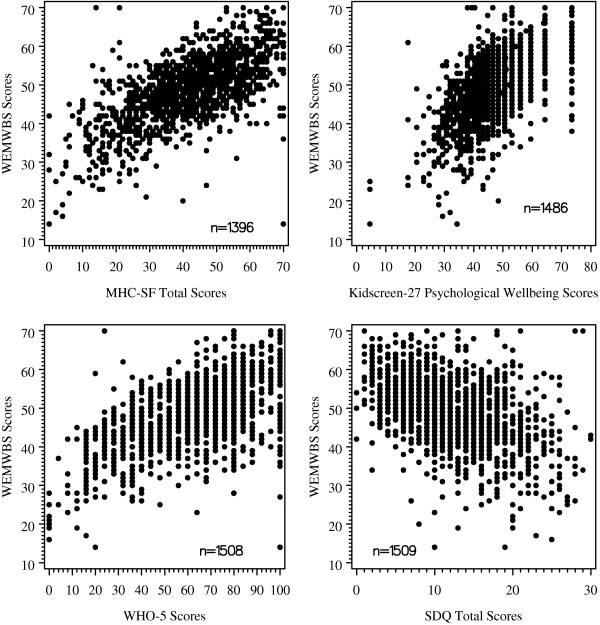
BACKGROUND: Understanding and measuring mental health and wellbeing amongst teenagers has recently become a priority. The Warwick-Edinburgh Mental Well-being Scale (WEMWBS) is validated for measuring mental wellbeing in populations aged 16 years and over in the UK. We report here a study designed to establish the validity and reliability of WEMWBS in teenagers in the UK. METHODS: WEMWBS and comparator scales, together with socio-demographic information and self-reported health, were incorporated into a self-administered questionnaire given to pupils aged 13 to 16 years in six schools in Scotland and England. Psychometric properties including internal consistency, correlations with comparator scales, test-retest stability and unidimensionality were investigated for WEMWBS. Twelve focus groups were undertaken to assess acceptability and comprehensibility of WEMWBS and were taped, transcribed and analysed thematically. RESULTS: A total of 1,650 teenagers completed the questionnaire (response rate 80.8%). Mean WEMWBS score was 48.8 (SD 6.8; median 49). Response scores covered the full range (from 14 to 70). WEMWBS demonstrated strong internal consistency and a high Cronbach's alpha of 0.87 (95% CI (0.85-0.88), n = 1517). Measures of construct validity gave values as predicted. The correlation coefficient for WEMWBS total score and psychological wellbeing domain of the Kidscreen-27 was 0.59 (95% CI [0.55; 0.62]); for the Mental Health Continuum Short Form (MHC-SF) was 0.65, 95% CI [0.62; 0.69]; and for the WHO (WHO-5) Well-being Index 0.57 (95% CI [0.53; 0.61]). The correlation coefficient for the Strengths and Difficulties Questionnaire (SDQ) was -0.44 (95% CI [-0.49; -0.40]) and for the 12-item General Health Questionnaire (GHQ12) -0.45 (95% CI [-0.49; -0.40]). Test-retest reliability was acceptable (Intraclass correlation coefficient (ICC) 0.66 (95% CI [0.59; 0.72] n = 212)). Confirmatory factor analysis demonstrated one underlying factor. WEMWBS was significantly associated with the Family Affluence Score (WEMWBS increased with increasing household socio-economic status) and had a positive association with the physical health dimension of the Kidscreen-27, but was unrelated to age, gender or location/school. Eighty students took part in focus groups. In general, although some students considered some items open to misunderstanding or misinterpretation, WEMWBS was received positively and was considered comprehensible, and acceptable. CONCLUSIONS: WEMWBS is a psychometrically strong population measure of mental wellbeing, and can be used for this purpose in teenagers aged 13 and over.
Overview
The claims and statistics of this paper haven’t been checked yet.
Free: it reads the open-access text and checks the first 5 claims that cite a source we can check. Create a free account to check every claim.
Integrity signals
Registry
Cites
Statistics
Figures
Verification
Claims the paper makes
The claims and statistics of this paper haven’t been checked yet.
Free: it reads the open-access text and checks the first 5 claims that cite a source we can check. Create a free account to check every claim.
Claims other papers make about this one
Each is checked against this paper’s own text: does it say what the citing paper says it does?
The source backs part of the claim, not all of it — or backs it for a different population, condition or comparison.
In the citing paper
“Psychometric data of the measure on the original WEMWBS for adolescents has indicated satisfactory to high internal consistency (r=.87) and the short version has acceptable test-retest reliability (r=.66, 95% CI 0.59-0.72) [44,45].”
From Feasibility and effectiveness of a web-based positive psychology program for youth mental health: Randomized controlled trial (2014) · cites this paper as [45]
Experimental — accuracy not yet measuredThe source backs part of the claim, not all of it — or backs it for a different population, condition or comparison.
In the citing paper
“to high internal consistency (r=.87) and the short version has acceptable test-retest reliability (r=.66, 95% CI 0.59-0.72) [44,45].”
From Feasibility and effectiveness of a web-based positive psychology program for youth mental health: Randomized controlled trial (2014) · cites this paper as [45]
Experimental — accuracy not yet measuredThe cited source says what the claim attributes to it.
In the citing paper
“Participants provided demographic information (age, gender, ethnicity and postcode) and completed the Warwick–Edinburgh Mental Wellbeing scale (WEMWBS), validated for use with young people [22,23].”
Self-check
Percentages, sums and reported differences re-computed from the paper’s own numbers.
The self-check needs the paper’s full text.
Citations
Cites
Coefficient Alpha and the Internal Structure of Tests
Cronbach, L. J. (1951) · Psychometrika · doi:10.1007/bf02310555 · Cited by 43,931 · cited 2×
“7, demonstrating satisfactory to high internal consistency [32].”
BackgroundMethodOn Happiness and Human Potentials: A Review of Research on Hedonic and Eudaimonic Well-Being
Ryan, R. M., & Deci, E. L. (2001) · Annual Review of Psychology · doi:10.1146/annurev.psych.52.1.141 · Cited by 11,567 · cited 1×
“In adults, mental wellbeing is regarded as covering both hedonic (happiness, subjective wellbeing) and eudaimonic (positive functioning) wellbeing [14].”
BackgroundPharmacological interventions for somatoform disorders in adults
Kleinstäuber, M., Witthöft, M., Steffanowski, A., van Marwijk, H., Hiller, W., & Lambert, M. J. (2014) · Cochrane Database of Systematic Reviews · doi:10.1002/14651858.cd010628.pub2 · Cited by 11,335
Bootstrap Methods and their Application
Davison, A. C., & Hinkley, D. V. (1997) · doi:10.1017/cbo9780511802843 · Cited by 7,350
Psychometric properties of the strengths and difficulties questionnaire
GOODMAN, R. (2001) · Journal of the American Academy of Child & Adolescent Psychiatry · doi:10.1097/00004583-200111000-00015 · Cited by 6,813 · cited 10×
“We found very little difference between age groups when correlations between WEMWBS and GHQ12, WHO-5, SDQ, MHC-SF and Kidscreen-27 were repeated for those aged 14 years and younger versus those aged 15 years and older.”
BackgroundInfluentialThe cochrane database of systematic reviews
Geddes, J. (1996) · Journal of Psychosomatic Research · doi:10.1016/s0022-3999(96)90063-x · Cited by 5,989
Bootstrap Methods and Their Application
Loughin, T. M., Davison, A. C., & Hinkley, D. V. (1999) · Journal of the American Statistical Association · doi:10.2307/2669707 · Cited by 5,418
The Warwick-Edinburgh Mental Well-being Scale (WEMWBS): development and UK validation
Tennant, R., Hiller, L., Fishwick, R., Platt, S., Joseph, S., Weich, S., Parkinson, J., Secker, J., & Stewart-Brown, S. (2007) · Health and Quality of Life Outcomes · doi:10.1186/1477-7525-5-63 · Cited by 5,031 · cited 4×
“Discussion WEMWBS is a population measure of mental wellbeing, validated for use in adults aged 16 years and over in the UK [20,21].”
BackgroundMethodInfluentialSelf-citationQualitative data analysis for applied policy research
(2002) · Analyzing Qualitative Data · doi:10.4324/9780203413081-14 · Cited by 4,964 · cited 1×
“Analysis was undertaken using an adapted Framework Approach [37] suitable where a framework for analysis already exists.”
MethodCochrane Database of Systematic Reviews
(2008) · Encyclopedia of Public Health · doi:10.1007/978-1-4020-5614-7_436 · Cited by 4,527
Research works printed but not linked: 7
- Currie C Roberts C Morgan A Smith R Settertobulte W Samdal O Barnekow Rasmussen V Young People's Health in Context: international report from the HBSC 2001/02 survey, (Health Policy for Children and Adolescents, No.4) 2004 WHO Regional Office for Europe, Copenhagen
- Department for Children, Schools and Families Every Child Matters Green Paper 2003 CM5860. Crown Copyright
- National Institute for Health and Clinical Excellence Public Health Guidance No 12 Promoting Children's Social and Emotional Wellbeing in Primary Education 2008
- Ofsted Indicators of a school's contribution to well-being 2008 HMI 080195
- Scottish Government Towards a Mentally Flourishing Scotland: Policy and Action Plan 2009-2011 2009 Edinburgh, Scottish Government
- Tennant R Fishwick R Platt S Joseph S Stewart-Brown S Monitoring positive mental health in Scotland: validating the Affectometer 2 scale and developing the Warwick-Edinburgh Mental Well-being scale for the UK 2006 Glasgow, NHS Health Scotland
- Clarke A Putz R Friede T Ashdown J Adi Y Martin S Flynn P Blake A Stewart-Brown S Platt S Warwick-Edinburgh Mental Well-being Scale (WEMWBS) acceptability and validation in English and Scottish secondary school students (The WAVES Project) 2010 Glasgow, NHS Health Scotland
Cited by
Items 401–492 of 492
The GoActive Feasibility Study
Corder, K. L. (2014) · doi:10.1186/isrctn31583496
Online Multicomponent Program for Mental Health Promotion of Medical Students: An Intervention Study
AboZayed, A., Elsalamony, O. K., Elkholy, M., Enaba, D. A., & Yousof, H. Z. (2022) · Open Access Macedonian Journal of Medical Sciences · doi:10.3889/oamjms.2022.9174
Imkome, E. (2022) · IntechOpen eBooks · doi:10.5772/intechopen.108542
Larson, E. E., Salomon-Ballada, S., Pullen, N., Gajjar, J., Callender, L., Tregebov, S., & Wright, J. G. (2023) · doi:10.2196/preprints.46772
Alrasheadi, B. A. (2023) · International Journal of ADVANCED AND APPLIED SCIENCES · doi:10.21833/ijaas.2023.02.022 · Cited by 1
AUTORREALIZAÇÃO E SAÚDE MENTAL
Leite, E. V., da Fonseca, L. S., Medrado, J. D. S., & de Carvalho, G. S. (2023) · Teoria e Prática da Educação · doi:10.4025/tpe.v26i1.64248
Visual arts teachers’ mental well-being nurturing gifted students
YAVUZ, S., POLAT, M., POLAT, İ., & Arı, C. (2023) · Journal for the Education of Gifted Young Scientists · doi:10.17478/jegys.1287793
Gunpal, S. (2023) · International Journal of Advanced Academic Studies · doi:10.33545/27068919.2023.v5.i7a.1009
Research Protocol for a Preliminary Evaluation of a Gamified Tool for Adult Wellbeing
Gavin, J., & Barnes, S. (2023) · Lecture notes in networks and systems · doi:10.1007/978-3-031-37164-6_50
New Technologies and Interventions to Improve the Mental Health of People with Diabetes
Adeel, A., Kannangara, C. S., Bharaj, H., Basu, A., & Green, B. (2023) · Lecture notes in networks and systems · doi:10.1007/978-3-031-37164-6_53
Serious mental health diagnoses in children on the Child Protection Register: a record linkage studyPreprint
Ball, W., Anderson, C., Black, C., Gordon, S., Lackenby, M., Murchie, M., Ostrovska, B., O’Sullivan, K., Rowlands, H., Rzewuska, M., et al. (2023) · medRxiv · doi:10.1101/2023.10.13.23296488
“Future research should calculate the incidence and prevalence of poor mental health in this population using self-reported measures such as the Strengths and Difficulties Questionnaire (SDQ) [36] or the Warwick-Edinburgh Mental Well-being Scale (WEMWBS) [37] to compare with patterns in mental health prescribing and sp…”
MethodKonstantopoulou, S., Sakellari, Ε., Triantafyllou, K., Leino‐Kilpi, H., Sourander, A., & Kolaitis, G. A. (2023) · Children and Youth Services Review · doi:10.1016/j.childyouth.2023.107233
McGovern, R., Smart, D., Alderson, H., Fouweather, T., & Kaner, E. (2023) · Alcohol and Alcoholism · doi:10.1093/alcalc/agad076
Loyen, E., Bogaert, L., Hallford, D. J., D’Argembeau, A., & Raes, F. (2023) · Frontiers in Public Health · doi:10.3389/fpubh.2023.1216988
Youth Well-being: Exploring Models and Instruments
Zanini, D. S., & Fernandes, I. A. (2023) · Medical Research Archives · doi:10.18103/mra.v11i12.4985 · Cited by 2
Coulton, S., Hendrie, N., Vass, R., Gannon, T. A., Wooton, A., Rushworh-Claeys, J., & Sinetos, J. (2024) · Journal of Public Health · doi:10.1093/pubmed/fdae017 · Cited by 2
“Frequency of substance use was assessed using the Time Line Follow Back 28 day (TLFB28 29 ), mental health and wellbeing using the Warwick–Edinburgh Mental Well-being Scale (WEMWBS 30 ) and attitudes and behaviour using the Strengths and Difficulties Questionnaire (SDQ 31 ).”
MethodMazlan, S. N. A., & Mohamed, A. M. D. (2024) · International Journal of Academic Research in Business and Social Sciences · doi:10.6007/ijarbss/v14-i2/20722
“This WEMWBS was appropriate for use at the population level for those aged 13 and above (Clarke et al., 2011).”
MethodThe Survey on Flourishing: Measuring Subjective Well-Being in an Adolescent SamplePreprint
Salazar, G. C., & Warren, J. S. (2024) · Research Square · doi:10.21203/rs.3.rs-3937716/v1
Gennings, E., Batten, J., & Brown, H. J. (2024) · International Journal of Adolescence and Youth · doi:10.1080/02673843.2024.2331569
“…I . . . ’ was developed and a 5-point Likert scale was selected as research suggests it is easily understood by young people (Coaley, 2010), and often used within existing literature in this field (The Children’s Society, 2006; Clarke et al., 2011; Liddle & Carter, 2015; McLellan & Steward, 2015).”
Jansen, S., Niyonsenga, J., Nsabimana, E., Mihigo, B., Rutembesa, E., Slegh, H., & Mutabaruka, J. (2024) · SAGE Open · doi:10.1177/21582440241255440
“Data were collected using the 20-item Domestic Violence Questionnaire(Indu et al., 2011), the 15-item Hopkin Symptoms Checklist-depression subscale (Derogatis et al., 1974) and the 14-item Warwick-Edinburg Mental Wellbeing Scale (Clarke et al., 2011).”
Milne‐Ives, M., Ananthakrishnan, A., Homer, S. R., Andrade, J., & Meinert, E. (2024) · Research Square · doi:10.21203/rs.3.rs-4510115/v1
Liu, X., & Liu, X. (2024) · Religions · doi:10.3390/rel15091061 · Cited by 3
Booth, A., Morgan, S. A., Walker, I., Mitchell, A. S., Barlow-Pay, M., Chapman, C., Cochrane, A., Filby, E., Fleming, J., Hewitt, C. E., et al. (2024) · Public Health Research · doi:10.3310/ntfw7364
Youth club volleyball and well-being: the influence of team and coaches
DeBoer, K. E. (2025) · doi:10.46569/vq27zx74p · Cited by 2
Blake, D. M., Brooks, K., Israelsson, J., Cordiner, R., Rajamani, A., Kovats, S. R., & Coleman, P. (2025) · JMIR Research Protocols · doi:10.2196/73827
“It has been validated on different populations, including university students [33], secondary mental health care users aged ≥ 18 years [34], the general population [32], and the UK farming population [35].”
Milne‐Ives, M., Ananthakrishnan, A., Homer, S. R., Andrade, J., & Meinert, E. (2025) · JMIR Research Protocols · doi:10.2196/71551
“The Warwick-Edinburgh Mental Wellbeing Scale [53] has been validated in many populations, including children and teenagers aged >11 years, so it is a good measure to capture parents’ perspectives and children’s and young people’s perspectives [63,64].”
Alcohol use among school-going deaf adolescents: a cross-sectional study
Quarshie, E. N., Fobi, D., Mapaling, C., Bokpin, I. N., & Asante, K. O. (2025) · Vulnerable Children and Youth Studies · doi:10.1080/17450128.2025.2568992
“In this study, the Cronbach’s alpha for the WEMWBS was 0.83.”
InfluentialKuberka, P., Chilton, M., Pike, K. C., Shafran, R., & Yardley, L. (2025) · doi:10.2196/preprints.84384
John, D., Mottahedin-Fardo, L., & Jones, C. (2025) · The Child & Family Clinical Psychology Review · doi:10.53841/bpscypf.2025.10.1.56
Wills, J., Oha, J. T., Bridge, G., Callaghan, P., Flood, C., Jenkins, C. L., Reavey, P., & Sykes, S. (2025) · European Journal of Public Health · doi:10.1093/eurpub/ckaf200
“The Warwick Edinburgh Mental Wellbeing Scale (WEMWBS) was also used in this study to assess wellbeing: however, it was not originally designed for use with young people, although some studies do report that it is validated for this age group [18].”
Policy Pressures and Inequality: The Challenges Facing Adolescent Health in Times of Crisis
Fortes-Muñoz, P., Espelt, A., Bosque‐Prous, M., Folch, C., Robles-Muñoz, M., Drou-Roget, G., Teixidó‐Compañó, E., Pons‐Vigués, M., Llosada‐Gistau, J., & Muntaner, C. (2025) · International Journal of Social Determinants of Health and Health Services · doi:10.1177/27551938251390147 · Cited by 1
“36 The scale had 14 items and for each item, 5 response options were offered, ranging from 1 (never) to 5 (always).”
Gómez-Juncal, M. R., Angulo, A. F., Rivas-Diez, R., & Rosell, M. S. (2025) · Acta Psychologica · doi:10.1016/j.actpsy.2025.105926 · Cited by 4
Saha, P., Biswas, A., & Kumari, N. (2025) · International Journal of Event and Festival Management · doi:10.1108/ijefm-06-2025-0074
Barth Vedøy, I., Skulberg, K. R., Anderssen, S. A., Fagerland, M. W., Tjomsland, H. E., & Thurston, M. N. (2021) · Figshare · doi:10.6084/m9.figshare.17031049
Barth Vedøy, I., Skulberg, K. R., Anderssen, S. A., Fagerland, M. W., Tjomsland, H. E., & Thurston, M. N. (2021) · Figshare · doi:10.6084/m9.figshare.17031046
Jones, R. M., Andrews, J., Dalton, A. F., Dixon, B. E., Dzomba, B. J., Fernando, S. I., Pogreba-Brown, K., Ortiz, M. R., Sharma, V., Simmons, N., et al. (2024) · Figshare · doi:10.6084/m9.figshare.26943999
Oyebode, O. O., Torres-Sahli, M., Kapinga, D., Bruno-McClung, E., Willans, R., Shah, N., Wilbard, L., Banham, L., & Stewart-Brown, S. (2024) · Figshare · doi:10.6084/m9.figshare.26588649
Self-citationBarth Vedøy, I., Skulberg, K. R., Anderssen, S. A., Fagerland, M. W., Tjomsland, H. E., & Thurston, M. N. (2021) · Figshare · doi:10.6084/m9.figshare.17031037
Jones, R. M., Andrews, J. G., Dalton, A. F., Dixon, B. E., Dzomba, B. J., Fernando, S. I., Pogreba-Brown, K., Ortiz, M. R., Sharma, V., Simmons, N., et al. (2024) · Figshare · doi:10.6084/m9.figshare.26944002
King, N., Linden, B., Cunningham, S., Rivera, D., Rose, J., Wagner, N., Mulder, J., Adams, M., Baxter, R., & Duffy, A. (2022) · Figshare · doi:10.6084/m9.figshare.20408535
Froud, R., Grant, M., Burton, K., Foss, J. G. K., Ellard, D. R., Seers, K., Smith, D., Barillec, M., Patel, S., Haywood, K. L., et al. (2020) · Figshare · doi:10.6084/m9.figshare.12177984
Citerne, A., Roda, C., Rancière, F., & Momas, I. (2024) · Figshare · doi:10.6084/m9.figshare.26588910
Gardner, L. A., Rowe, A.-L., Stockings, E., Champion, K. E., Hides, L. M., MCBRIDE, N. T., Allsop, S., O’Dean, S., Sunderland, M., Lee, Y. Y., et al. (2023) · Figshare · doi:10.6084/m9.figshare.22623727
Barth Vedøy, I., Skulberg, K. R., Anderssen, S. A., Fagerland, M. W., Tjomsland, H. E., & Thurston, M. N. (2021) · Figshare · doi:10.6084/m9.figshare.17031043
Jones, R. M., Andrews, J., Dalton, A. F., Dixon, B. E., Dzomba, B. J., Fernando, S. I., Pogreba-Brown, K., Ortiz, M. R., Sharma, V., Simmons, N., et al. (2024) · Figshare · doi:10.6084/m9.figshare.26944005
Oyebode, O. O., Torres-Sahli, M., Kapinga, D., Bruno-McClung, E., Willans, R., Shah, N., Wilbard, L., Banham, L., & Stewart-Brown, S. (2024) · Figshare · doi:10.6084/m9.figshare.26588652
Self-citationBarth Vedøy, I., Skulberg, K. R., Anderssen, S., Fagerland, M. W., Tjomsland, H. E., & Thurston, M. N. (2021) · Figshare · doi:10.6084/m9.figshare.17031040
Haney, M. Ö., & Yoğurtcu, H. (2025) · Turkish Journal of Family Medicine & Primary Care · doi:10.21763/tjfmpc.1600120 · Cited by 1
White, J., & Logan, P. (2025) · The Cognitive Behaviour Therapist · doi:10.1017/s1754470x25100391 · Cited by 1
“However, WEMWBS scores decrease with decreased household socio-economic status (Clarke et al ., 2011; Scottish Government, 2017) and it may be that the current sample ’ s lower wellbeing and higher anxiety and depression scores may be reflective of being in one of the most deprived catchment areas…”
Leisure Management and Mental Well-Being: A Study of Recreational Athletes
Akyürek, Z., Ayhan, C., Soyer, F., & ÇAKAR, A. (2025) · KOSALB International Journal of Human Movements Science · doi:10.70736/2958.8332.kosalb.60
“On the other hand, some studies report no significant gender difference in mental well-being [47, 48], while Tennant et al. [40] and Tekkurşun et al. [49] found that men have higher levels of mental well-being than women.”
Ren, M., Han, X., Xia, Y., & Ding, D. (2026) · Applied Research in Quality of Life · doi:10.1007/s11482-025-10544-9 · Cited by 2
A Mental Well-Being Screening Process in an Elite Youth Football Academy
Harvey, S. A., Ong, C. W., Hardy, J., Callow, N., Wood, C., O’Malley, L., McGregor, P., Killilea, J., & Daley, C. (2026) · The Sport Psychologist · doi:10.1123/tsp.2024-0128 · Cited by 1
Chatwin, S., Pearson, R. M., Goswami, H., & Appleton, P. R. (2026) · PLOS mental health. · doi:10.1371/journal.pmen.0000551
“For example, regarding the WEMWBS [5] the comprehensibility of items was poor with young participants, as items caused confusion, were misinterpreted, or participants were hesitant to answer [4].”
Jaganathan, K., Serlachius, A. S., Prestidge, C., Doss, F. S., & Marshall, M. R. (2026) · PLoS ONE · doi:10.1371/journal.pone.0340006
“The former will be assessed from the Short Warwick Short Warwick Edinburgh Mental Well-being Scale (SWEMWBS) [16–21], which evaluates general well-being through a series of statements about feelings and behaviors experienced over the past week.”
Age differences in the role of self compassion dimensions in mental well being in Malaysia
Ameruddin, N. F. L., Berezina, E. B., & Aruta, J. J. B. R. (2026) · Discover Public Health · doi:10.1186/s12982-026-01591-0
Parsonage-Harrison, J., Esslemont, T., Hodges, O., Dawes, H., & Collett, J. (2026) · British Journal of Occupational Therapy · doi:10.1177/03080226261423429
Mahedy, L., McDonald, B., Greene, G., van de Venter, E., Davies, A., & John, A. M. (2026) · Journal of Adolescent Health · doi:10.1016/j.jadohealth.2026.02.007 · Cited by 2
Grosriez, S. L. D. (2023) · theses.fr (ABES) · doi:10.70675/7b76165az2eb6z4223zb761z5c362a6102de
A mixed-methods evaluation of the “State of Mind” school-based wellbeing programme in South Wales
Carey, D., Greville, W. J., Davies, N., Price, K., & Bowers, D. (2026) · Journal of Behavioral and Cognitive Therapy · doi:10.1016/j.jbct.2026.100594
Asikainen, H., Lampinen, V. S., & Katajavuori, N. (2026) · JMIR Research Protocols · doi:10.2196/84729
Kelkar, P., Chaudhury, S., Chaudhari, B., & Agarwal, S. (2026) · Medical Journal of Dr D Y Patil Vidyapeeth · doi:10.4103/mjdrdypu.mjdrdypu_442_25
Nadda, A., Malhotra, N., Bhardwaj, A., Virk, A., Gupta, M., & Goel, K. (2026) · BMC Public Health · doi:10.1186/s12889-026-26502-5
“(4) Students life satisfaction scale (SLSS Hueb-nar et al. 1991) [19].”
Testing the Act Belong Commit® Mental Wellbeing Quiz With University Students
Burns, S. K., Batta, T., Henry, K., Kindness, M., & Uy, C. (2026) · doi:10.30688/janzssa.2026-2-04
“However, some adolescent participants reported confusion and difficulty understanding some questions (Clarke et al., 2011) and culturally determined differences in mental wellbeing and the translation of some concepts have been noted (Taggart et al., 2013).”
Wong, J., Xu, T., Perez, K. G., Khadduri, A., Scott, Y., Watkins, F., Oswiecimski, J., Wang, A., Antonaki, E., Slachevsky, D. E., et al. (2026) · Pilot and Feasibility Studies · doi:10.1186/s40814-026-01840-8
“Both of these scales have been validated for reliability, sensitivity, and specificity across different adolescent populations [50–54], and they are used in other EASE efficacy trials globally [21–23].”
Lu, S., Pan, Z., & Kim, S. (2026) · The Journals of Gerontology Series B · doi:10.1093/geronb/gbag103 · Cited by 1
“Subjective well-being (SWB) was assessed by the validated Chinese version of the 7-item short Warwick-Edinburgh Mental Well-being Scale (Clarke et al., 2011; Sun et al., 2019).”
Cahill, S., Thornton, E., & Humphrey, N. (2026) · SSM - Mental Health · doi:10.1016/j.ssmmh.2026.100667
Lituri, J., Houghton, S. J., & Zhao, J. (2026) · Children · doi:10.3390/children13070941 · Cited by 1
“A single underlying PMW construct was found by [59], while other research [35] has revealed model fit, which, while acceptable, was not totally supportive of a single underlying PMW construct.”
Kuberka, P., Chilton, M., Pike, K. C., Shafran, R., & Yardley, L. (2026) · JMIR Pediatrics and Parenting · doi:10.2196/84384
Zhou, B., Wang, N., Xiaobing, L., & Jing, Z. (2026) · Behavioral Sciences · doi:10.3390/bs16081331
“The Warwick–Edinburgh Mental Well-being Scale may capture positive mental functioning, including validation work with teenage school students (Clarke et al., 2011; Tennant et al., 2007).”
Wellbeing and Adolescents: Measurement, Development and Inclusion
Zhou, W. (2026) · Emerald Group Publishing Limited eBooks · doi:10.1108/s1479-363620260000025007
Andrianto, A., Pribadi, B. P., Darajat, M. N., & Zahra, J. (2026) · Journal of Economics Business and Accountancy Ventura · doi:10.14414/jebav.v29i2.5488
“All of these reliability values exceeded the 0.70 threshold recommended by Clarke et al. (2011), which indicates that all constructs in this study have very good reliability and are suitable for further analysis (see Table 2).”
InfluentialLipinska, G., Roden, L. C., Davy, J., Scheuermaier, K. D., Gómez-Olivé, F. X., Lewis, R., Wells, S., da Silva, K. M., Milton, Y. M., Abric, E., et al. (2026) · Wellcome Open Research · doi:10.12688/wellcomeopenres.25508.1
Olstad, D. L., Campbell, D. J., Sajobi, T. T., O'Hara, H., Leblanc, P., McCormack, G. R., Pereira, L. R., Lee, Y. Y., Aktary, M. L., Minaker, L. M., et al. (2026) · Nutrition and Health · doi:10.1177/02601060261473062
Khanna, D., Black, L., Panaiyotou, M., Humphrey, N., & Demkowicz, O. (2026) · Journal of School Psychology · doi:10.1016/j.jsp.2026.101595
Maratos, F. A., Parente, F., Hurst, J., & Harvey, C. (2026) · Frontiers in Psychology · doi:10.3389/fpsyg.2026.1861788
“Clarke et al. (2011) reported that the WEMWBS has strong internal consistency ( α = 0.87) and acceptable test–retest reliability (0.66).”
InfluentialForty, L., Newbold, A., Byrom, N., Chamberlain, S. R., Dooley, J., Dorey, L., Duffy, A., Matlock, K. A., Morse, K. F., Rees, S., et al. (2026) · Research Square · doi:10.21203/rs.3.rs-11000076/v1
คุณสมบัติทางจิตมิติของแบบประเมินความผาสุกทางจิตใจวอริก-เอดินบะระ ฉบับภาษาไทย ในนักศึกษามหาวิทยาลัย
Sriwichai, N., ศรีบูรพา, น., & เตชะรัตนะคุณ, ข. (2026) · Journal of Mental Health of Thailand - วารสารสุขภาพจิต แห่งประเทศไทย · doi:10.64838/jmht.2026.288245
Dooley, J., Morse, K. F., Byrom, N., Chamberlain, S. R., Davie, E., Snell, G. D., Duffy, A. C., Dorey, L., Forty, L., Matlock, K. A., et al. (2026) · The British Journal of Psychiatry · doi:10.1192/bjp.2026.10777
Clayton, P., Kent, R. G., Stanworth, K., Vu, M., Happe, F. G. E., & Hollocks, M. J. (2026) · Clinical Child Psychology and Psychiatry · doi:10.1177/13591045261494878
Church-Duplessis, V., Baguio, M. J., McQuiggan, J., Rae, J., Daniel, B.-J. M., Paragg, J., Twum, P. W., & Dantzer, B. (2026) · Youth · doi:10.3390/youth6040151
Pan, Z., Lu, S., Liu, J., Ho, H. C., & Liu, Y. (2026) · Wellbeing Space and Society · doi:10.1016/j.wss.2026.100497
The Role of Implementation: Happy Class in The Hague
Verhagen, A. M. (2015) · Utrecht University Repository (Utrecht University)
Metadata
- Authors
- Clarke, A., Friede, T., Putz, R., Ashdown, J., Martin, S., Blake, A., Adi, Y., Parkinson, J., Flynn, P., Platt, S., & Stewart-Brown, S.
- Affiliations
- University of Warwick (GB)
- Universitätsmedizin Göttingen (DE)
- National Health Service (GB)
- Coventry and Warwickshire Partnership NHS Trust (GB)
- King Saud University (SA)
- Public Health Scotland (GB)
- University of Stirling (GB)
- University of Edinburgh (GB)
- Corresponding author
- Clarke, Aileen
- ORCID
- Venue
- BMC Public Health
- Published
- 2011-06-21
- Volume
- 11
- Issue
- 1
- Pages
- 487-487
- ISSN
- 1471-2458 (ISSN-L)
- PMC
- PMC3141456
- OpenAlex
- W2043602673
- Cited by
- 493
- References
- 41
- Citations by year
- 2026: 33 · 2025: 40 · 2024: 51 · 2023: 69 · 2022: 51 · 2021: 45 · 2020: 35 · 2019: 38 · 2018: 27 · 2017: 29 · 2016: 16 · 2015: 32 · 2014: 12 · 2013: 7 · 2012: 6
- FWCI
- 11.73
- Type
- journal article
- Language
- en
- Open access
- gold
- doi.org
- Licence
- Locations
- BMC Public Health (publishedVersion, cc-by)
- PubMed Central (publishedVersion, cc-by)
- PubMed (publishedVersion)
- Warwick Research Archive Portal (University of Warwick) (acceptedVersion)
- GoeScholar The Publication Server of the Georg-August-Universität Göttingen (Georg-August-Universität Göttingen) (acceptedVersion, other-oa)
- DOAJ (DOAJ: Directory of Open Access Journals) (submittedVersion, cc-by-sa)
- GRO (submittedVersion, cc-by)
- University of Birmingham Research Portal (University of Birmingham) (submittedVersion)
- Edinburgh Research Explorer (University of Edinburgh) (submittedVersion, cc-by)
- Funders
- NHS Health Scotland
- Topics
- Social Sciences › Decision Sciences › Management Science and Operations Research › Psychometric Methodologies and Testing
- Social Sciences › Psychology › Social Psychology › Psychological Well-being and Life Satisfaction
- Health Sciences › Nursing › Research and Theory › Health Education and Validation
- Keywords
- Warwick-Edinburgh Mental Well-being Scale, adolescent psychological well-being, psychometric validation, school pupils, test-retest reliability, internal consistency, construct validity, unidimensionality, questionnaire acceptability, Strengths and Difficulties Questionnaire, Mental Health Continuum-Short Form, KIDSCREEN-27, WHO-5 Well-Being Index, General Health Questionnaire, self-reported health, mental health
- MeSH terms
- Adolescent, England, Female, Humans, Male, Mental Health, Personal Satisfaction, Psychometrics, Surveys and Questionnaires, Scotland, Focus Groups
About these checks
Registry, retraction, Cites and statistics results are computed, not judged, with one exception: a printed reference that no index lists is read once by a model before it counts as a citation error. Claims are extracted by a model and kept only when their quote appears verbatim in the text; each cited source is then checked, with a model’s help, for whether it says what the claim relies on. Those verdicts can be wrong — read the claim’s quote and the cited source before relying on one.
Statistics and arithmetic are recomputed, not judged.
Confidence bands are shown only for fields calibrated on our annotated test set. None is calibrated yet, so no band is shown.
What counts as a claim ›How we measure confidence ›How we check this ›
Are you an author, or do you see a problem with this page? Request a review
Data sources
Bibliographic data: Semantic Scholar, OpenAlex, Crossref.
Contains information from the Semantic Scholar Academic Graph Datasets, made available under the ODC Attribution License (ODC-BY 1.0).
Semantic Scholar’s data is described in: Kinney, R., et al. (2023). The Semantic Scholar Open Data Platform. arXiv:2301.10140.
