

Efficacy and cost-effectiveness of minimal guided and unguided internet-based mobile supported stress-management in employees with occupational stress: a three-armed randomised controlled trial
Open accessThe DOI matches its Crossref record; 76 of the 77 references it cites were found in a registry or an index; 6 of the 56 sources its claims cite were checked for support.
Abstract
BACKGROUND: Internet- and mobile based stress-management interventions (iSMI) may be an effective means to address the negative consequences of occupational stress. However, available results from randomised controlled trials are conflicting. Moreover, it is yet not clear whether guided or unguided self-help iSMI provide better value for money. Internet-based mental health interventions without guidance are often much less effective than interventions including at least some guidance from a professional. However, direct comparisons in randomised controlled trials are scarce and, to the best of our knowledge, the comparative (cost)-effectiveness of guided vs. unguided iSMI has not yet been studied. Hence, this study investigates the acceptability and (cost-) effectiveness of minimal guided and unguided iSMI in employees with heightened levels of perceived stress. METHODS: A three-armed randomised controlled trial (RCT) will be conducted to compare a minimal guided and unguided iSMI with a waiting list control condition (WLC). Both active conditions are based on the same iSMI, i.e. GET.ON Stress, and differ only with regard to the guidance format. Employees with heightened levels of perceived stress (PSS ≥ 22) will be randomised to one of three conditions. Primary outcome will be comparative changes in perceived stress (PSS). Secondary outcomes include changes in self-reported depression, work-engagement, presenteeism and absenteeism. Moreover, a cost-effectiveness analysis will be conducted from a societal perspective, including both direct medical costs and costs related to productivity losses. In addition, a cost-benefit analysis will be conducted from the employer's perspective. Incremental net-benefit regression analyses will address the question if there are any baseline factors (i.e. subgroups of employees) associated with particularly favorable cost-effectiveness when the experimental intervention is offered. Assessments take place at baseline, 7 weeks post-treatment and 6 months after randomisation. DISCUSSION: Online-based (guided) self-help interventions could be an acceptable, effective and economically sustainable approach to offer evidence-based intervention alternatives to reduce the negative consequences associated with work-related stress. This study evaluates the (cost-) effectiveness of two versions of an iSMI, minimal guided and unguided iSMI. Thus, the present study will further enhance the evidence-base for iSMI and provide valuable information about the optimal balance between outcome and economic costs. TRIAL REGISTRATION: German Clinical Trial Registration (DRKS): DRKS00005687.
Overview
CoChat Summary
## TL;DR
This paper is a three-armed randomized controlled trial protocol testing whether a minimal-guided and an unguided internet/mobile stress-management program (GET.ON Stress) are more effective and cost-effective than waiting list control in employees with heightened perceived stress. It also aims to compare the two support formats on efficacy, acceptability, and economic outcomes.
## Key findings
- Not stated in the paper.
- The planned primary outcome is perceived stress (PSS) at post-treatment, with assessments at baseline, 7 weeks post-treatment, and 6 months after randomisation.
- The study plans to recruit and randomize 408 participants with PSS ≥ 22; the sample size was chosen to detect a between-group effect size of d = 0.30 with 80% power at alpha = .05 (one-tailed).
- The authors hypothesize that both active conditions will be more effective and cost-effective than waiting list control, and that minimal guided iSMI will outperform unguided iSMI in effectiveness, cost-effectiveness, and acceptability; no results are reported in the paper text provided.
## Methods
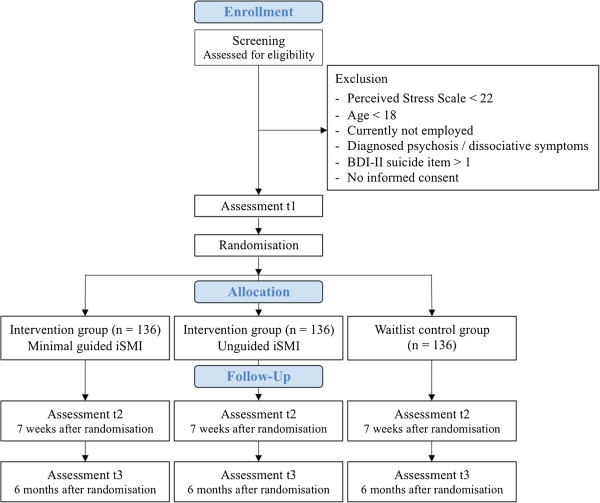
- Three-armed randomised controlled trial comparing minimal guided iSMI, unguided iSMI, and waiting list control; all intervention arms also had access to treatment as usual.
- Participants are currently employed adults aged >18 with Perceived Stress Scale (PSS-10) scores ≥ 22, internet access, sufficient German, and informed consent; exclusions include prior psychosis/dissociative symptoms and notable suicidal risk.
- Main analyses planned as intention-to-treat plus per-protocol analyses, using ANOVA, multiple imputation for missing data, effect sizes (Cohen’s d), NNT, and economic analyses including cost-effectiveness, cost-utility, cost-benefit, and incremental net-benefit regression.
## Limitations
- The paper explicitly states it includes no objective stress measurement (e.g., cortisol) and relies only on self-report measures.
- The sample is restricted to employees with PSS ≥ 22, so results are said to generalize only to that subgroup, not to the broader working population.
- The study is powered to detect differences in perceived stress reduction, so the authors state the sample will be too small to draw reliable conclusions about moderating effects between guided and unguided groups; this is a limitation stated in the paper.
- Evident from the text: this is a protocol/background-methods paper, so the paper itself provides no outcome results.
Model-written summary. Check it against the paper before relying on it.
Integrity signals
Registry
Cites
Statistics
Figures
Verification
Claims the paper makes
4 Valid · 1 Not valid · 19 Not checked · 11 Own results and interpretations
The cited sources support only part of this claim — read each source’s verdict below.
In the paper
“(2) anonymity is assured when employees want to avoid stigmatisation or self-disclosure in group settings”
§ Efficacy and cost-effectiveness of minimal guided and unguided internet-based mobile supported stress-management in employees with occupational stress: a three-armed randomised controlled trial > Background
What the sources say
- Partly supportedcites [9] Cuijpers P van Straten A Warmerdam L van Rooy MJ Recruiting participants for interventions to prevent the onset of depressive disorders: possible ways to increase participation rates BMC Health Serv Res 2010 10 181 10.1186/1472-6963-10-181 20579332 PMC2907376 sourceExperimental — accuracy not yet measured
Our copy supports the stigma and group-self-disclosure elements: 'Solutions aimed at potential participants' says offering the CWD courses through the Internet 'may also help to reduce stigma' and that internet-based interventions 'avoid the stigma of going to a therapist' and 'may reach people who are not willing to participate in face-to-face interventions', while 'Organizational solutions' notes the possibility of an individual format 'for people who are not willing to participate in group interventions' (linked to 'Unwillingness to participate', where the group format 'assumes that participants are willing to share their problems with others'). Two parts of the claim are not supported: the paper nowhere asserts that anonymity is 'assured' — it only hedges that Internet delivery 'may' reduce stigma — and its population is the general Dutch adult population with subthreshold depression using regional ambulatory mental-health prevention services, not employees/workplace settings. The employee framing is the citing authors' extension. (LLM, conf=0.80)
- Not checked yetcites [10] Buntrock C Ebert DD Lehr D Cuijpers P Riper H Smit F Berking M Evaluating the efficacy and cost-effectiveness of web-based indicated prevention of major depression: design of a randomised controlled trial BMC Psychiatry 2014 14 1 25 10.1186/1471-244X-14-25 24485283 PMC3914724 source
- Could not verifycites [11] Andersson G Titov N Advantages and limitations of Internet-based interventions for common mental disorders World Psychiatry 2014 13 1 4 11 10.1002/wps.20083 24497236 PMC3918007 sourceExperimental — accuracy not yet measured
Across our full copy of Andersson & Titov (2014) no passage states that Internet-based interventions assure anonymity, and none addresses employees or avoidance of self-disclosure in group settings; searches for 'anonymity/anonymous/privacy/confidentiality', 'stigma/stigmatization/group treatment' and 'employees/workplace' returned only the closest neighbours. The nearest content is the RECRUITMENT OF PATIENTS section (p. 1-2), which credits online self-referral with reaching people who 'never reach specialist clinics and sometimes hesitate to even mention their problems when consulting general practitioners', and the advantages list in INTERNET-BASED TREATMENTS FOR MOOD AND ANXIETY DISORDERS (p. 4), which is about access, cost-effectiveness and convenience rather than anonymity. If anything, the paper frames confidentiality as secure logins to a website and lists security issues as a 'con' (INTERNET-BASED ASSESSMENTS AND DIAGNOSIS, p. 2), but it never makes the claim attributed to it here, so the point is simply not addressed by our copy. (LLM, conf=0.65)
- Not checked yetcites [12] Ruwaard J Lange A Bouwman M Broeksteeg J Schrieken B E-mailed standardized cognitive behavioural treatment of work-related stress: a randomized controlled trial Cogn Behav Ther 2007 36 3 179 192 10.1080/16506070701381863 17852171 source
- Not checked yetcites [13] Ebert DD, Lehr D, Boß L, Riper H, Cuijpers P, Andersson G, Thiart H, Heber E, Berking M: Efficacy of an Internet-based problem-solving training for teachers: Results of a randomized controlled trial.Scand J Work Environ Health 25121986
plainstates a cause- Asserted: passes — The authors put it forward as true.
- Checkable: passes — It can be checked against evidence.
- Load-bearing: passes — The paper’s conclusions depend on it.
- Based: passes — The paper gives a reason why it holds.
- Partly supported
The cited sources support only part of this claim — read each source’s verdict below.
In the paper
“Internet-based mental health interventions without guidance are often much less effective than interventions including at least some guidance from a professional [15, 16].”
§ Efficacy and cost-effectiveness of minimal guided and unguided internet-based mobile supported stress-management in employees with occupational stress: a three-armed randomised controlled trial > Background
What the sources say
- Partly supportedcites [15] Richards D Richardson T Computer-based psychological treatments for depression: a systematic review and meta-analysis Clin Psychol Rev 2012 32 4 329 342 10.1016/j.cpr.2012.02.004 22466510 sourceExperimental — accuracy not yet measured
The Discussion (p. ~14) and Subgroup analysis (Section 3.3) of Richards & Richardson (2012) support the direction and size of the guidance effect, but only for depression: pooled post-treatment effects were d = .78 for therapist-supported, d = .58 for administratively-supported and d = .36 for unsupported studies, and the difference reached significance only for no support vs therapist support (χ² = 7.86, p < .05). Two parts of the claim are therefore not carried by this source: (a) it generalises to 'internet-based mental health interventions' whereas the review/meta-analysis is confined to computer-based treatments for depression; and (b) the phrase 'at least some guidance from a professional' over-reaches the source, which explicitly states that administrative-type support 'not delivered by a mental health professional' 'works equally well as therapist-supported studies' and was not significantly different from no support. The source also cautions that it is unclear whether differences arose solely from support level. (LLM, conf=0.72)
- Supportedcites [16] Johansson R Andersson G Internet-based psychological treatments for depression Expert Rev Neurother 2012 12 7 861 869 10.1586/ern.12.63 22853793 source
The section 'How important is guidance in guided ICBT?' concludes that 'there is now a strong support for the claim that guided internet-based psychological treatments are more effective than unguided treatments,' and quantifies the gradient: average effect sizes by degree of human support were d = 0.21 (no contact), 0.44 (contact before only), 0.58 (mainly during) and 0.76 (before, during and after), with Spearman rho = 0.64 (p < 0.01), i.e. any contact already doubles the unguided estimate. 'The overall effect of ICBT for depression' additionally reports a previous meta-analysis in which the effect was significantly moderated by guidance (guided d = 0.61 vs unguided d = 0.25). The one caveat is that this review's own dataset is depression-focused (25 trials, 33 comparisons) and it notes the debate plus cases where unguided programs with pretreatment contact showed medium-to-large effects, which the claim's 'often' accommodates. (LLM, conf=0.85)
plainstates a cause- Asserted: passes — The authors put it forward as true.
- Checkable: passes — It can be checked against evidence.
- Load-bearing: passes — The paper’s conclusions depend on it.
- Based: passes — The paper gives a reason why it holds.
- Partly supported
In the paper
“Our group recently conducted a randomised controlled trial testing the efficacy and cost-effectiveness of an internet-based SMI in employees with heightened levels of perceived stress [25]. Results are still pending.”
§ Efficacy and cost-effectiveness of minimal guided and unguided internet-based mobile supported stress-management in employees with occupational stress: a three-armed randomised controlled trial > Background
What the sources say
- Not checked yetcites [25] Heber E Ebert DD Lehr D Nobis S Berking M Riper H Efficacy and cost-effectiveness of a web-based and mobile stress-management intervention for employees: design of a randomized controlled trial BMC Public Health 2013 13 655 10.1186/1471-2458-13-655 23855376 PMC3717042 source
plain- Asserted: passes — The authors put it forward as true.
- Checkable: passes — It can be checked against evidence.
- Load-bearing: passes — The paper’s conclusions depend on it.
- Based: passes — The paper gives a reason why it holds.
In the paper
“However, direct comparisons in randomised controlled trials are scarce.”
§ Efficacy and cost-effectiveness of minimal guided and unguided internet-based mobile supported stress-management in employees with occupational stress: a three-armed randomised controlled trial > Background
What the sources say
- Not checked yetcites Reichler et al. in prep
plain- Asserted: passes — The authors put it forward as true.
- Checkable: passes — It can be checked against evidence.
- Load-bearing: passes — The paper’s conclusions depend on it.
- Based: passes — The paper gives a reason why it holds.
In the paper
“However, the majority of affected individuals remains untreated [8].”
§ Efficacy and cost-effectiveness of minimal guided and unguided internet-based mobile supported stress-management in employees with occupational stress: a three-armed randomised controlled trial > Background
What the sources say
- Not checked yetcites [8] American Psychological Association: Stress in America™: Missing the Health Care Connection. [ https://www.apa.org/news/press/releases/stress/2012/full-report.pdf]
plain- Asserted: passes — The authors put it forward as true.
- Checkable: passes — It can be checked against evidence.
- Load-bearing: passes — The paper’s conclusions depend on it.
- Based: passes — The paper gives a reason why it holds.
9 more claims
Create a free account to see all 35 claims and to verify the 50 references still open.
- Probably not a substantial claim. 14
- It may state two separate claims as one. 10
Claims other papers make about this one
Each is checked against this paper’s own text: does it say what the citing paper says it does?
The check wasn’t confident either way, so it gives no verdict — never disputed.
In the citing paper
“Moderate-to-large improvements versus controls were also found for mental health, sleep, perseverance cognitions, and recovery experience outcomes”
From Web-based interventions for the management of stress in the workplace: Focus, form, and efficacy (2017) · cites this paper as [32]
Experimental — accuracy not yet measuredThe check wasn’t confident either way, so it gives no verdict — never disputed.
In the citing paper
“These improvements remained stable at 6-month follow-up”
From Web-based interventions for the management of stress in the workplace: Focus, form, and efficacy (2017) · cites this paper as [32]
Experimental — accuracy not yet measuredThe check wasn’t confident either way, so it gives no verdict — never disputed.
In the citing paper
“A significant large reduction in insomnia severity was again reported for intervention group participants postintervention (d = 1.37) versus waitlist controls”
From Web-based interventions for the management of stress in the workplace: Focus, form, and efficacy (2017) · cites this paper as [32]
Experimental — accuracy not yet measured
Citations
Cites
Statistical Power Analysis for the Behavioral Sciences
Muller, K. (1989) · Technometrics · doi:10.1080/00401706.1989.10488618 · Cited by 99,167
Statistical power analysis for the behavioral sciences
(1990) · Computers, Environment and Urban Systems · doi:10.1016/0198-9715(90)90050-4 · Cited by 65,269
The CES-D Scale: A Self-Report Depression Scale for Research in the General Population
Radloff, L. S. (1977) · Applied Psychological Measurement · doi:10.1177/014662167700100306 · Cited by 53,267
A Global Measure of Perceived Stress
Cohen, S., Kamarck, T., & Mermelstein, R. (1983) · Journal of Health and Social Behavior · doi:10.2307/2136404 · Cited by 32,807 · cited 4×
“We will include a) currently employed workers b) above the age of 18 c) with scores ≥ 22 on the Perceived Stress Scale (PSS-10 [26]), d) who have internet access, e) sufficient German skills in reading and writing (self-report) and f) who are willing to give informed consent.”
MethodInfluentialWARE, J. E., KOSINSKI, M., & KELLER, S. D. (1996) · Medical Care · doi:10.1097/00005650-199603000-00003 · Cited by 17,392 · cited 2×
“We will use the Short Form 12 (SF-12) [44] and the (EuroQol EQ-5D) [45] to assess quality of life.”
BackgroundMethodMissing data: our view of the state of the art
Schafer, J. L., & Graham, J. W. (2002) · Psychological Methods · doi:10.1037/1082-989x.7.2.147 · Cited by 11,638
The measurement of engagement and burnout: a two sample confirmatory factor analytic approach.
Schaufeli, W. B., Salanova, M., González-romá, V., & Bakker, A. B. (2002) · Journal of Happiness Studies · doi:10.1023/a:1015630930326 · Cited by 10,014 · cited 1×
“The Utrecht Work Engagement Scale (UWES) [42] assesses work engagement defined as a “positive, fulfilling, work-related state of mind that is characterised by vigor, dedication, and absorption” [43].”
Background(1996) · Consulting Psychologists Press eBooks · Cited by 7,863
Jacobson, N. S., & Truax, P. (1991) · Journal of Consulting and Clinical Psychology · doi:10.1037/0022-006x.59.1.12 · Cited by 7,770
High self-control predicts good adjustment, less pathology, better grades, and interpersonal success
Tangney, J. P., Baumeister, R. F., & Boone, A. L. (2004) · Journal of Personality · doi:10.1111/j.0022-3506.2004.00263.x · Cited by 6,557
Rammstedt, B., & John, O. P. (2007) · Journal of Research in Personality · doi:10.1016/j.jrp.2006.02.001 · Cited by 4,244
The Revised CONSORT Statement for Reporting Randomized Trials: Explanation and Elaboration
Altman, D. G., Schulz, K. F., Moher, D., Egger, M., Davidoff, F., Elbourne, D., Gøtzsche, P. C., Lang, T., & for the CONSORT Group (2001) · Annals of Internal Medicine · doi:10.7326/0003-4819-134-8-200104170-00012 · Cited by 3,835
Campbell‐Sills, L., & Stein, M. B. (2007) · Journal of Traumatic Stress · doi:10.1002/jts.20271 · Cited by 3,575
Hammen, C. (2005) · Annual Review of Clinical Psychology · doi:10.1146/annurev.clinpsy.1.102803.143938 · Cited by 2,979 · cited 1×
“Occupational stress has shown to be a major risk factor for a range of health outcomes, such as depression [1], coronary disease ([2] and related mortality [3].”
BackgroundPsychological Perspectives on Legitimacy and Legitimation
Tyler, T. R. (2006) · Annual Review of Psychology · doi:10.1146/annurev.psych.57.102904.190038 · Cited by 2,381 · cited 1×
“Instead it aims at creating perceived legitimacy of the coach and a sense that the coach has the participant’s best interest at heart [32].”
BackgroundPapacharissi, Z., & Rubin, A. M. (2000) · Journal of Broadcasting & Electronic Media · doi:10.1207/s15506878jobem4402_2 · Cited by 1,826 · cited 2×
“Form [61,62], Health Action Process Approach Questionnaire (HAPA-Questionnaire) (according to the guidelines by [63]), Internet Affinity Questionnaire [64] and the Connor-Davidson Resilience Scale (CD-RISC) [65].”
MethodConsolidated Health Economic Evaluation Reporting Standards (CHEERS) statement
Husereau, D., Drummond, M., Petrou, S., Carswell, C., Moher, D., Greenberg, D., Augustovski, F., Briggs, A. H., Mauskopf, J., Loder, E., et al. (2013) · BMJ · doi:10.1136/bmj.f1049 · Cited by 1,776
The client satisfaction questionnaire
Attkisson, C. C., & Zwick, R. (1982) · Evaluation and Program Planning · doi:10.1016/0149-7189(82)90074-x · Cited by 1,743 · cited 2×
“In absence of a standardised measure for evaluating course satisfaction in internet-based treatments, user satisfaction will be measured with a self-designed questionnaire based on the Client Satisfaction Questionnaire (CSQ-8 [47], German Version [48]).”
MethodComputer-based psychological treatments for depression: A systematic review and meta-analysis
Richards, D., & Richardson, T. (2012) · Clinical Psychology Review · doi:10.1016/j.cpr.2012.02.004 · Cited by 1,442
Effects of occupational stress management intervention programs: A meta-analysis.
Richardson, K. M., & Rothstein, H. R. (2008) · Journal of Occupational Health Psychology · doi:10.1037/1076-8998.13.1.69 · Cited by 1,374 · cited 1×
“, relaxation, organisational interventions) [5-7].”
Stress and cardiovascular disease
Steptoe, A., & Kivimäki, M. (2012) · Nature Reviews Cardiology · doi:10.1038/nrcardio.2012.45 · Cited by 1,321
Measures in Health Psychology: A User's Portfolio
Johnston, M., Wright, S., & Weinman, J. A. (1995) · Cited by 1,300
COHEN, S., & JANICKI‐DEVERTS, D. (2012) · Journal of Applied Social Psychology · doi:10.1111/j.1559-1816.2012.00900.x · Cited by 1,187
Advantages and limitations of Internet-based interventions for common mental disorders
Andersson, G., & Titov, N. (2014) · World Psychiatry · doi:10.1002/wps.20083 · Cited by 1,160 · cited 1×
“Finally (5), internet-based interventions are easily scalable, implying that only a small increase of therapeutic resources is required for reaching a greater proportion of the eligible population using these interventions [9-13].”
BackgroundMohr, D. C., Cuijpers, P., & Lehman, K. (2011) · Journal of Medical Internet Research · doi:10.2196/jmir.1602 · Cited by 1,097 · cited 2×
“It is assumed that people respond more positively to adherence demands from a coach who is perceived as legitimate [29,33].”
BackgroundMethodSelf-citationThe benefits of interventions for work-related stress
(2001) · American Journal of Public Health · doi:10.2105/ajph.91.2.270 · Cited by 999
The Work Limitations Questionnaire
Lerner, D., Amick, B. C., Rogers, W. H., Malspeis, S., Bungay, K., & Cynn, D. (2001) · Medical Care · doi:10.1097/00005650-200101000-00009 · Cited by 971
Maslach burnout inventory-general survey
김, 영. (2009) · Cited by 907
The Psychology of Legitimacy: A Relational Perspective on Voluntary Deference to Authorities
Tyler, T. R. (1997) · Personality and Social Psychology Review · doi:10.1207/s15327957pspr0104_4 · Cited by 755 · cited 1×
“It is assumed that people respond more positively to adherence demands from a coach who is perceived as legitimate [29,33].”
BackgroundHedman, E., Ljótsson, B., & Lindefors, N. (2012) · Expert Review of Pharmacoeconomics & Outcomes Research · doi:10.1586/erp.12.67 · Cited by 672 · cited 1×
“Internet-based interventions have shown to be effective in community and clinical settings, including the treatment of depression [14-16], anxiety [17,18] and sleep disorders [19].”
BackgroundAhlstrom, L., Grimby-Ekman, A., Hagberg, M., & Dellve, L. (2010) · Scandinavian Journal of Work, Environment & Health · doi:10.5271/sjweh.2917 · Cited by 622 · cited 1×
“To assess presenteeism, we used the Work Limitations Questionnaire (WLQ-8) [66], the Single-Item Presenteeism Question [67] and a single item question on work ability [68].”
MethodEuroQol-5D (EQ-5D): an instrument for measuring quality of life
Balestroni, G., & Bertolotti, G. (2015) · Monaldi Archives for Chest Disease · doi:10.4081/monaldi.2012.121 · Cited by 572
Hoch, J. S., Briggs, A. H., & Willan, A. R. (2002) · Health Economics · doi:10.1002/hec.678 · Cited by 535
Internet-based psychological treatments for depression
Johansson, R., & Andersson, G. (2012) · Expert Review of Neurotherapeutics · doi:10.1586/ern.12.63 · Cited by 509 · cited 2×
“Internet-based interventions have shown to be effective in community and clinical settings, including the treatment of depression [14-16], anxiety [17,18] and sleep disorders [19].”
BackgroundMomentary work recovery: The role of within-day work breaks
Trougakos, J. P., & Hideg, I. (2009) · Research in Occupational Stress and Well-being · doi:10.1108/s1479-3555(2009)0000007005 · Cited by 465
Fry, J. P., & Neff, R. A. (2009) · Journal of Medical Internet Research · doi:10.2196/jmir.1138 · Cited by 447 · cited 1×
“Both, personal and automatic reminders have shown to improve adherence to self-guided health promotion and behaviour change interventions [30,31], but in the model of supportive accountability, it is assumed that personal reminders from a coach are perceived as benevolent and are more effective than automatic reminder…”
BackgroundComputer‐Aided Psychotherapy for Anxiety Disorders: A Meta‐Analytic Review
Cuijpers, P., Marks, I. M., van Straten, A., Cavanagh, K., Gega, L., & Andersson, G. (2009) · Cognitive Behaviour Therapy · doi:10.1080/16506070802694776 · Cited by 429 · cited 1×
“Internet-based interventions have shown to be effective in community and clinical settings, including the treatment of depression [14-16], anxiety [17,18] and sleep disorders [19].”
BackgroundSelf-citationA guide to cost-effectiveness acceptability curves
Fenwick, E., & Byford, S. (2005) · British Journal of Psychiatry · doi:10.1192/bjp.187.2.106 · Cited by 420
(1993) · Beltz eBooks · Cited by 409
Bouwmans, C., De Jong, K., Timman, R., Zijlstra-Vlasveld, M., Van der Feltz-Cornelis, C., Tan, S. S., & Hakkaart-van Roijen, L. (2013) · BMC Health Services Research · doi:10.1186/1472-6963-13-217 · Cited by 401 · cited 2×
“Information on the participants’ use of health services will be o tained with the German Version of the Trimbos and institute of Medical Technology Assessm nt Cost Questionnaire for Psychiatry (TiC–P-G; [46]).”
MethodConsensus statement on defining and measuring negative effects of internet interventions
Rozental, A., Andersson, G., Boettcher, J., Ebert, D. D., Cuijpers, P., Knaevelsrud, C., Ljótsson, B., Kaldo, V., Titov, N., & Carlbring, P. (2014) · Internet Interventions · doi:10.1016/j.invent.2014.02.001 · Cited by 371 · cited 1×
“To determine potential negative effects of the intervention on course of symptom [50] we will also report number of participants with reliable symptom deteriorations according to the RCI [51].”
MethodSelf-citationTitov, N., Dear, B. F., Johnston, L., Lorian, C., Zou, J., Wootton, B., Spence, J., McEvoy, P. M., & Rapee, R. M. (2013) · PLoS ONE · doi:10.1371/journal.pone.0062873 · Cited by 364
Meta-Analysis of Perceived Stress and Its Association With Incident Coronary Heart Disease
Richardson, S., Shaffer, J. A., Falzon, L., Krupka, D., Davidson, K. W., & Edmondson, D. (2012) · The American Journal of Cardiology · doi:10.1016/j.amjcard.2012.08.004 · Cited by 349 · cited 1×
“Occupational stress has shown to be a major risk factor for a range of health outcomes, such as depression [1], coronary disease ([2] and related mortality [3].”
BackgroundPsychometric properties of the French versions of the Perceived Stress Scale
Lesage, F.-X., Berjot, S., & Deschamps, F. (2012) · International Journal of Occupational Medicine and Environmental Health · doi:10.2478/s13382-012-0024-8 · Cited by 341
(1989) · PubMed · Cited by 298
Bhui, K. S., Dinos, S., Stansfeld, S. A., & White, P. D. (2012) · Journal of Environmental and Public Health · doi:10.1155/2012/515874 · Cited by 287 · cited 1×
“, rela xation, organisational interventions) [5-7].”
Bertrams, A., & Dickhäuser, O. (2009) · Diagnostica · doi:10.1026/0012-1924.55.1.2 · Cited by 266
Assessing the economic impact of stress[mdash ]The modern day hidden epidemic
Kalia, M. (2002) · Metabolism · doi:10.1053/meta.2002.33193 · Cited by 243 · cited 1×
“Moreover, stress is also associated with substantial economic costs due to absenteeism, staff turnover and reduced work performance [4].”
BackgroundComputerised Cognitive Behavioural Therapy for Insomnia: A Systematic Review and Meta-Analysis
Cheng, S. K., & Dizon, J. (2012) · Psychotherapy and Psychosomatics · doi:10.1159/000335379 · Cited by 241 · cited 1×
“Internet-based interventions have shown to be effective in community and clinical settings, including the treatment of depression [14-16], anxiety [17,18] and sleep disorders [19].”
BackgroundBerking, M., & Znoj, H. (2008) · Zeitschrift für Psychiatrie, Psychologie und Psychotherapie · doi:10.1024/1661-4747.56.2.141 · Cited by 227
Self-citationCook, R. F., Billings, D. W., Hersch, R. K., Back, A. S., & Hendrickson, A. (2007) · Journal of Medical Internet Research · doi:10.2196/jmir.9.2.e17 · Cited by 170 · cited 1×
“So far, RCTs on Internet-based SMI show conflicting results, with some studies reporting significant results with moderate effects sizes on perceived stress [12,20] and others not finding significant results [21,22].”
ResultThiart, H., Lehr, D., Ebert, D. D., Berking, M., & Riper, H. (2015) · Scandinavian Journal of Work, Environment & Health · doi:10.5271/sjweh.3478 · Cited by 168
Self-citationRandomized Controlled Trial of Internet-Based Stress Management
Zetterqvist, K., Maanmies, J., Ström, L., & Andersson, G. (2003) · Cognitive Behaviour Therapy · doi:10.1080/16506070302316 · Cited by 160 · cited 1×
“So far, RCTs on Internet-based SMI show conflicting results, with some studies reporting significant results with moderate effects sizes on perceived stress [12,20] and others not finding significant results [21,22].”
ResultSemmer, N. K., Grebner, S., & Elfering, A. (2004) · Research in Occupational Stress and Well-being · doi:10.1016/s1479-3555(03)03006-3 · Cited by 151
Schwarzer, R., Sniehotta, F. F., Lippke, S., Łuszczyńska, A., Scholz, U., Schüz, B., Wegner, M., & Ziegelmann, J. P. (2003) · Zurich Open Repository and Archive (University of Zurich) · doi:10.5167/uzh-102499 · Cited by 138
Ebert, D. D., Lehr, D., Boß, L., Riper, H., Cuijpers, P., Andersson, G., Thiart, H., Heber, E., & Berking, M. (2014) · Scandinavian Journal of Work, Environment & Health · doi:10.5271/sjweh.3449 · Cited by 115 · cited 1×
“Finally (5), internet-based interventions are easily scalable, implying that only a small increase of therapeutic resources is required for reaching a greater proportion of the eligible population using these interventions [9-13].”
BackgroundSelf-citationMayo-Wilson, E., & Montgomery, P. (2013) · Cochrane Database of Systematic Reviews · doi:10.1002/14651858.cd005330.pub4 · Cited by 112
Lehr, D., Hillert, A., Schmitz, E., & Sosnowsky, N. (2008) · Diagnostica · doi:10.1026/0012-1924.54.2.61 · Cited by 107
Self-citationCuijpers, P., van Straten, A., Warmerdam, L., & van Rooy, M. J. (2010) · BMC Health Services Research · doi:10.1186/1472-6963-10-181 · Cited by 106
Self-citationRuwaard, J., Lange, A., Bouwman, M., Broeksteeg, J., & Schrieken, B. (2007) · Cognitive Behaviour Therapy · doi:10.1080/16506070701381863 · Cited by 99
Schwarzer, R., Diehl, M., & Schmitz, G. S. (1999) · PsycTESTS Dataset · doi:10.1037/t01606-000 · Cited by 95
Heber, E., Ebert, D. D., Lehr, D., Nobis, S., Berking, M., & Riper, H. (2013) · BMC Public Health · doi:10.1186/1471-2458-13-655 · Cited by 91
Self-citationIyengar Yoga for Distressed Women: A 3-Armed Randomized Controlled Trial
Michalsen, A., Jeitler, M., Brunnhuber, S., Lüdtke, R., Büssing, A., Musial, F., Dobos, G., & Kessler, C. (2012) · Evidence-Based Complementary and Alternative Medicine · doi:10.1155/2012/408727 · Cited by 70
Buntrock, C., Ebert, D. D., Lehr, D., Cuijpers, P., Riper, H., Smit, F., & Berking, M. (2014) · BMC Psychiatry · doi:10.1186/1471-244x-14-25 · Cited by 57
Self-citationShimazu, A., Kawakami, N., Irimajiri, H., Sakamoto, M., & Amano, S. (2005) · Journal of Occupational Health · doi:10.1539/joh.47.405 · Cited by 56 · cited 1×
“So far, RCTs on Internet-based SMI show conflicting results, with some studies reporting significant results with moderate effects sizes on perceived stress [12,20] and others not finding significant results [21,22].”
ResultEbert, D. D., Christ, O., & Berking, M. (2013) · Diagnostica · doi:10.1026/0012-1924/a000079 · Cited by 52
Self-citationLi, J., Loerbroks, A., Jarczok, M. N., Schöllgen, I., Bosch, J. A., Mauss, D., Siegrist, J., & Fischer, J. E. (2012) · American Journal of Industrial Medicine · doi:10.1002/ajim.22018 · Cited by 48
Forstmeier, S., & Rüddel, H. (2008) · The Open Psychology Journal · doi:10.2174/1874350100801010066 · Cited by 36
Entwicklung einer Kurzform eines Fragebogens zur Psychotherapiemotivation
Schulz, H., Nübling, R., & Rüddel, H. (1995) · Verhaltenstherapie · doi:10.1159/000258901 · Cited by 36
Ebert, D. D., Lehr, D., Baumeister, H., Boß, L., Riper, H., Cuijpers, P., Reins, J. A., Buntrock, C., & Berking, M. (2014) · Trials · doi:10.1186/1745-6215-15-39 · Cited by 36
Self-citationPsychometrische Überprüfung einer Kurzform des Fragebogens zur Psychotherapiemotivation - FPTM-23
Schulz, H., Lang, K., Nübling, R., & Koch, U. (2003) · Diagnostica · doi:10.1026//0012-1924.49.2.83 · Cited by 34
Thiart, H., Lehr, D., Ebert, D., Sieland, B., Berking, M., & Riper, H. (2013) · Trials · doi:10.1186/1745-6215-14-169 · Cited by 32
Self-citationKigozi, J., Lewis, M., Jowett, S. M., Barton, P. M., & Coast, J. (2013) · Spine · doi:10.1097/brs.0000000000000162 · Cited by 28
Neubach, B., & Schmidt, K. (2000) · Zeitschrift für Arbeits- und Organisationspsychologie A&O · doi:10.1026//0932-4089.44.3.140 · Cited by 26
Geraedts, A. S., Kleiboer, A. M., Wiezer, N. M., van Mechelen, W., & Cuijpers, P. (2013) · BMC Psychiatry · doi:10.1186/1471-244x-13-61 · Cited by 15
Self-citation
Research works printed but not linked: 4
- American Psychological Association: Stress in America™: Missing the Health Care Connection. [ https://www.apa.org/news/press/releases/stress/2012/full-report.pdf]
- Beck AT Steer A Brown GK BDI-II: Beck Depression Inventory Manual. 2nd ed. San Antonio, TX: Psychological Corporation; 1996 1996 2 San Antonio Psychological Corporation
- Lehr D Hillert A Schmitz E Cut-off-werten EE Von Screening depressiver Störungen mittels Allgemeiner Depressions- Skala (ADS-K) und State-Trait Depressions Scales (STDS-T) 2008 1 10
- Schaufeli W Bakker A Utrecht Work Engagement Scale: Test Manual 2003 Utrecht The Netherlands Departmant of Psychology, Utrecht University
Cited by
Ebert, D. D., Van Daele, T., Nordgreen, T., Karekla, M., Compare, A., Zarbo, C., Brugnera, A., Øverland, S., Trebbi, G., Jensen, K. L., et al. (2018) · European Psychologist · doi:10.1027/1016-9040/a000318 · Cited by 437
“Fostering adherence to the content of the intervention is often one major aim of human support in stand-alone IMIs, rather than the delivery of new therapeutic techniques that go beyond the content of the current lesson (Ebert et al., 2014; Schueller, Tomasino, & Mohr, 2016; Zarski et al., 2016).”
BackgroundSelf-citationHeber, E., Ebert, D. D., Lehr, D., Cuijpers, P., Berking, M., Nobis, S., & Riper, H. (2017) · Journal of Medical Internet Research · doi:10.2196/jmir.5774 · Cited by 408
“More research on the relative level and type of human involvement needed in these interventions would be useful [64].”
Self-citationInterventions to improve return to work in depressed people
Nieuwenhuijsen, K., Faber, B., Verbeek, J. H., Neumeyer-Gromen, A., Hees, H. L., Verhoeven, A. C., van der Feltz-Cornelis, C. M., & Bültmann, U. (2014) · Cochrane Database of Systematic Reviews · doi:10.1002/14651858.cd006237.pub3 · Cited by 299
Hennemann, S., Beutel, M. E., & Zwerenz, R. (2017) · Journal of Health Communication · doi:10.1080/10810730.2017.1284286 · Cited by 274
Ebert, D. D., Cuijpers, P., Muñoz, R. F., & Baumeister, H. (2017) · Frontiers in Psychiatry · doi:10.3389/fpsyt.2017.00116 · Cited by 244
“However, unguided IMIs might still produce larger effects at population level with regard to the reduction of disease burden, as more individuals could be reached at a given budget (85).”
BackgroundSelf-citation
Metadata
- Authors
- Ebert, D. D., Lehr, D., Smit, F., Zarski, A.-C., Riper, H., Heber, E., Cuijpers, P., & Berking, M.
- Affiliations
- Leuphana University of Lüneburg (DE)
- Trimbos Institute (NL)
- Corresponding author
- Ebert, David Daniel
- ORCID
- Venue
- BMC Public Health
- Published
- 2014-08-07
- Volume
- 14
- Issue
- 1
- Pages
- 807-807
- ISSN
- 1471-2458 (ISSN-L)
- PMC
- PMC4153891
- OpenAlex
- W2088366764
- Cited by
- 82
- References
- 77
- Citations by year
- 2026: 1 · 2025: 3 · 2024: 3 · 2023: 4 · 2022: 9 · 2021: 8 · 2020: 6 · 2019: 7 · 2018: 11 · 2017: 11 · 2016: 9 · 2015: 5 · 2014: 5
- FWCI
- 15.55
- Type
- journal article
- Language
- en
- Open access
- gold
- doi.org
- Licence
- Locations
- BMC Public Health (publishedVersion, cc-by)
- Europe PMC (PubMed Central) (publishedVersion, cc-by)
- PubMed Central (publishedVersion, cc-by)
- PubMed (publishedVersion)
- Pure Amsterdam UMC (publishedVersion, other-oa)
- Amsterdam UMC (VU Amsterdam) - Institutional Repository (publishedVersion, other-oa)
- Multilingual Matters (Channel View Publications) (publishedVersion, cc-by)
- OPUS FAU (Kooperativer Bibliotheksverbund Berlin-Brandenburg (KOBV), on behalf of the Universitätsbibliothek Erlangen-Nürnberg) (submittedVersion)
- Data Archiving and Networked Services (DANS) (submittedVersion, other-oa)
- Digital Academic REpository of VU University Amsterdam (Vrije Universiteit Amsterdam) (submittedVersion)
- VU Research Portal (submittedVersion, other-oa)
- Funders
- European Commission (2007DE161PR001, ZW6‐80119999, CCI 2007DE161PR001, EFRE: ZW6-80119999, CCI 2007DE161PR001)
- European Regional Development Fund (ZW6-80119999, CCI 2007DE161PR001, 2007DE161PR001)
- Topics
- Social Sciences › Psychology › Applied Psychology › Digital Mental Health Interventions
- Health Sciences › Medicine › Public Health, Environmental and Occupational Health › Workplace Health and Well-being
- Social Sciences › Psychology › Clinical Psychology › Mindfulness and Compassion Interventions
- Keywords
- occupational stress, cost-effectiveness, perceived stress, workers, work engagement, presenteeism, absenteeism, depression, productivity loss, employer perceptions
- MeSH terms
- Absenteeism, Adult, Cost-Benefit Analysis, Depressive Disorder, Female, Follow-Up Studies, Humans, Occupational Diseases, Occupational Health Services, Psychotherapy, Stress, Psychological, Comorbidity, Treatment Outcome, Health Care Costs, Telemedicine, Efficiency, Organizational, Internet, Evidence-Based Practice, Self Report
About these checks
Registry, retraction, Cites and statistics results are computed, not judged, with one exception: a printed reference that no index lists is read once by a model before it counts as a citation error. Claims are extracted by a model and kept only when their quote appears verbatim in the text; each cited source is then checked, with a model’s help, for whether it says what the claim relies on. Those verdicts can be wrong — read the claim’s quote and the cited source before relying on one.
The claim verdicts this report counts are experimental: their accuracy is not yet measured.
A language model drew the claims from the paper on 2026-10-11, under version 3 of the claim definition (model deepseek-v4.1-flash, prompt extract-v3).
A second model labelled each claim on 2026-10-11 (model jev-1.13-20260917, definition revision gold-guideline-v0.2).
Cited sources are checked with a language model’s help (qwen3.8-omni-flash).
Statistics and arithmetic are recomputed, not judged.
Confidence bands are shown only for fields calibrated on our annotated test set. None is calibrated yet, so no band is shown.
What counts as a claim ›How we measure confidence ›How we check this ›
Are you an author, or do you see a problem with this page? Request a review
Data sources
Bibliographic data: Semantic Scholar, OpenAlex, Crossref.
Contains information from the Semantic Scholar Academic Graph Datasets, made available under the ODC Attribution License (ODC-BY 1.0).
Semantic Scholar’s data is described in: Kinney, R., et al. (2023). The Semantic Scholar Open Data Platform. arXiv:2301.10140.
