

Mindfulness-and body-psychotherapy-based group treatment of chronic tinnitus: a randomized controlled pilot study
Open accessThe DOI matches its Crossref record; 40 of the 40 references it cites were found in a registry or an index.
Abstract
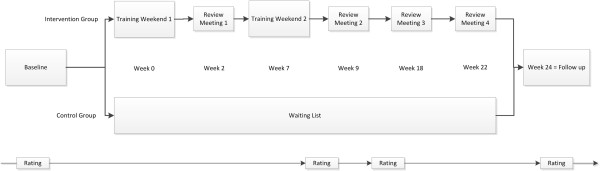
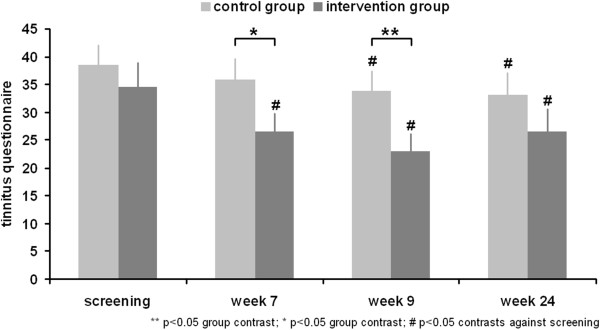
BACKGROUND: Tinnitus, the perception of sound in absence of an external acoustic source, impairs the quality of life in 2% of the population. Since in most cases causal treatment is not possible, the majority of therapeutic attempts aim at developing and strengthening individual coping and habituation strategies. Therapeutic interventions that incorporate training in mindfulness meditation have become increasingly popular in the treatment of stress-related disorders. Here we conducted a randomized, controlled clinical study to investigate the efficacy of a specific mindfulness- and body-psychotherapy based program in patients suffering from chronic tinnitus. METHODS: Thirty-six patients were enrolled in this pilot study. The treatment was specifically developed for tinnitus patients and is based on mindfulness and body psychotherapy. Treatment was performed as group therapy at two training weekends that were separated by an interval of 7 weeks (eleven hours/weekend) and in four further two-hour sessions (week 2, 9, 18 and 22). Patients were randomized to receive treatment either immediately or after waiting time, which served as a control condition. The primary study outcome was the change in tinnitus complaints as measured by the German Version of the Tinnitus Questionnaire (TQ). RESULTS: ANOVA testing for the primary outcome showed a significant interaction effect time by group (F = 7.4; df = 1,33; p = 0.010). Post hoc t-tests indicated an amelioration of TQ scores from baseline to week 9 in both groups (intervention group: t = 6.2; df = 17; p < 0.001; control group: t = 2.5; df = 16; p = 0.023), but the intervention group improved more than the control group. Groups differed at week 7 and 9, but not at week 24 as far as the TQ score was concerned. CONCLUSIONS: Our results suggest that this mindfulness- and body-psychotherapy-based approach is feasible in the treatment of tinnitus and merits further evaluation in clinical studies with larger sample sizes.The study is registered with clinicaltrials.gov (NCT01540357).
Overview
The claims and statistics of this paper haven’t been checked yet.
Free: it reads the open-access text and checks the first 5 claims that cite a source we can check. Create a free account to check every claim.
Integrity signals
Registry
Cites
Statistics
Figures
Verification
Claims the paper makes
The claims and statistics of this paper haven’t been checked yet.
Free: it reads the open-access text and checks the first 5 claims that cite a source we can check. Create a free account to check every claim.
Self-check
Percentages, sums and reported differences re-computed from the paper’s own numbers.
The self-check needs the paper’s full text.
Citations
Cites
Kabat-Zinn, J. (1982) · General Hospital Psychiatry · doi:10.1016/0163-8343(82)90026-3 · Cited by 4,255
The effect of mindfulness based therapy on anxiety and depression: A meta analytic review
Hofmann, S. G., Sawyer, A. T., Witt, A. A., & Oh, D. (2010) · Journal of Consulting and Clinical Psychology · doi:10.1037/a0018555 · Cited by 3,846 · cited 2×
“They have demonstrated efficacy in the treatment of a variety of stress-related disorders [10,11] such as anxiety and mood disorders [12] or chronic pain [13,14].”
BackgroundAnalysing controlled trials with baseline and follow up measurements
Vickers, A. J., & Altman, D. G. (2001) · BMJ · doi:10.1136/bmj.323.7321.1123 · Cited by 2,116 · cited 1×
“[24-26].”
Chiesa, A., & Serretti, A. (2009) · The Journal of Alternative and Complementary Medicine · doi:10.1089/acm.2008.0495 · Cited by 1,681 · cited 1×
“They have demonstrated efficacy in the treatment of a variety of stress-related disorders [10,11] such as anxiety and mood disorders [12] or chronic pain [13,14].”
BackgroundInternal consistencies of the original and revised beck depression inventory
Beck, A. T., & Steer, R. A. (1984) · Journal of Clinical Psychology · doi:10.1002/1097-4679(198411)40:6<1365::aid-jclp2270400615>3.0.co;2-d · Cited by 1,146
Bohlmeijer, E., Prenger, R., Taal, E., & Cuijpers, P. (2010) · Journal of Psychosomatic Research · doi:10.1016/j.jpsychores.2009.10.005 · Cited by 822
Veehof, M. M., Oskam, M.-J., Schreurs, K. M. G., & Bohlmeijer, E. T. (2011) · PAIN · doi:10.1016/j.pain.2010.11.002 · Cited by 792 · cited 1×
“Mindfulness-based therapeutic approaches have demonstrated beneficial effects in other stress-related disorders such as chronic pain [13,29] or anxiety [12].”
BackgroundVan Breukelen, G. J. P. (2006) · Journal of Clinical Epidemiology · doi:10.1016/j.jclinepi.2006.02.007 · Cited by 765
Chiesa, A., & Serretti, A. (2011) · Psychiatry Research · doi:10.1016/j.psychres.2010.08.011 · Cited by 650 · cited 1×
“A significant increase in alpha power through meditation has been revealed by electroencephalographic [30] and magnetencephalographic [31] studies.”
BackgroundMorone, N. E., Greco, C. M., & Weiner, D. K. (2008) · Pain · doi:10.1016/j.pain.2007.04.038 · Cited by 546 · cited 2×
“They have demonstrated efficacy in the treatment of a variety of stress-related disorders [10,11] such as anxiety and mood disorders [12] or chronic pain [13,14].”
Background
Research works printed but not linked: 1
- Holl M: Die Tinnitus-Atemtherapie: So gehen Sie aktiv gegen Ihr Ohrgeräusch vor. Hannover: Schluetersche; 2011.
Cited by
A multidisciplinary European guideline for tinnitus: diagnostics, assessment, and treatment
Cima, R. F. F., Mazurek, B., Haider, H., Kikidis, D., Lapira, A., Noreña, A., & Hoare, D. J. (2019) · HNO · doi:10.1007/s00106-019-0633-7 · Cited by 442
Cognitive behavioural therapy for tinnitus
Fuller, T., Cima, R., Langguth, B., Mazurek, B., Vlaeyen, J. W., & Hoare, D. J. (2020) · Cochrane Database of Systematic Reviews · doi:10.1002/14651858.cd012614.pub2 · Cited by 212
Self-citationHeeren, A., Maurage, P., Perrot, H., Volder, A. D., Renier, L. A., Araneda, R., Lacroix, É., Decat, M., Deggouj, N., & Philippot, P. (2014) · Behavioural Brain Research · doi:10.1016/j.bbr.2014.04.043 · Cited by 129
Kreuzer, P. M., Landgrebe, M., Resch, M., Hüsser, O., Schecklmann, M., Geisreiter, F., Poeppl, T. B., Prasser, S. J., Hajak, G., Rupprecht, R., et al. (2014) · Brain stimulation · doi:10.1016/j.brs.2014.05.003 · Cited by 112
Self-citationMcKenna, L., Marks, E. M., Hallsworth, C. A., & Schaette, R. (2017) · Psychotherapy and Psychosomatics · doi:10.1159/000478267 · Cited by 93
Levine, R. A., & Oron, Y. (2015) · Handbook of clinical neurology · doi:10.1016/b978-0-444-62630-1.00023-8 · Cited by 124
Cognitive Mechanisms in Chronic Tinnitus: Psychological Markers of a Failure to Switch Attention
Trevis, K. J., McLachlan, N. M., & Wilson, S. J. (2016) · Frontiers in Psychology · doi:10.3389/fpsyg.2016.01262 · Cited by 96
“Both CBT and mindfulness have been shown to be effective in lessening the impact of CT and improving psychosocial wellbeing (Philippot et al., 2011; Cima et al., 2012, 2014; Kreuzer et al., 2012).”
BackgroundLandry, E. C., Sandoval, X. C. R., Simeone, C. N., Tidball, G., Lea, J., & Westerberg, B. D. (2020) · Otology & Neurotology · doi:10.1097/mao.0000000000002472 · Cited by 82
Roland, L. T., Lenze, E. J., Hardin, F. M., Kallogjeri, D., Nicklaus, J., Wineland, A. M., Fendell, G., Peelle, J. E., & Piccirillo, J. F. (2015) · Otolaryngology–Head and Neck Surgery · doi:10.1177/0194599815571556 · Cited by 77
“Previous behavioral studies done at other institutions have reported preliminary evidence for the efficacy of MBSR in reducing bother associated with chronic tinnitus.(13,31) Our current findings expand on previous studies through the use of a larger sample size and the incorporation of advanced neuroimaging to study…”
ResultPsychological Therapy for People with Tinnitus: A Scoping Review of Treatment Components.
Thompson, D. M., Hall, D. A., Walker, D.-M., & Hoare, D. J. (2017) · Ear & Hearing · doi:10.1097/aud.0000000000000363 · Cited by 59
“…1992), behavior therapy (Lindberg 1988; Lindberg et al. 1988); ACT (Westin et al. 2011); internetdelivered ACT (Hesser et al. 2012); mindfulness (Kreuzer et al. 2012); tinnitus education (Mason et al. 1996; Kröner-Herwig et al. 2003; Henry et al. 2007; Tucker 2013; Argstatter et al. 2015),…”
BackgroundTinnitus and sound intolerance: evidence and experience of a Brazilian group
Onishi, E. T., Coelho, C. C. D. B., Oiticica, J., Figueiredo, R. R., Guimarães, R. D. C. C., Sanchez, T. G., Gürtler, A. L., Venosa, A. R., Sampaio, A. L. L., Azevedo, A. A., et al. (2018) · Brazilian Journal of Otorhinolaryngology · doi:10.1016/j.bjorl.2017.12.002 · Cited by 24
Arif, M., Sadlier, M., Rajenderkumar, D., James, J., & Tahir, T. (2017) · The Journal of Laryngology & Otology · doi:10.1017/s002221511700069x · Cited by 49
McKenna, L., Marks, E. M., & Vogt, F. (2018) · Ear & Hearing · doi:10.1097/aud.0000000000000491 · Cited by 41
The Effect of Mindfulness-Based Interventions on Tinnitus Distress. A Systematic Review
Rademaker, M. M., Stegeman, I., Ho-Kang-You, K. E., Stokroos, R. J., & Smit, A. L. (2019) · Frontiers in Neurology · doi:10.3389/fneur.2019.01135 · Cited by 39
“The third RCT by Kreuzer et al., comparing MBI to a waiting list, did not find a statistically significant difference between both groups after treatment for the TQ and THI (38) (Table 7).”
BackgroundMethodInfluentialPhillips, J. S., McFerran, D. J., Hall, D. A., & Hoare, D. J. (2018) · The Laryngoscope · doi:10.1002/lary.26607 · Cited by 35
The Comorbidity of Depression and Anxiety Symptoms in Tinnitus Sufferers: A Network Analysis
Chen, X., Ren, L., Xue, X., Yu, N., Liu, P., Shen, W., Zhou, H., Wang, B., Zhou, J., Yang, S., et al. (2023) · Brain Sciences · doi:10.3390/brainsci13040583 · Cited by 34
Zimmerman, B., Finnegan, M. K., Paul, S., Schmidt, S. A., Tai, Y., Roth, K., Chen, Y., & Husain, F. T. (2019) · Frontiers in Neuroscience · doi:10.3389/fnins.2019.00747 · Cited by 37
“Although the research on these treatments are still in their early days, mindfulnessbased therapies have shown initial promise in modulating the severity of tinnitus (Kreuzer et al., 2012; Philippot et al., 2012; Gans et al., 2014; Roland et al., 2015; McKenna et al., 2017).”
BackgroundHusain, F. T., Zimmerman, B., Tai, Y., Finnegan, M. K., Kay, E., Khan, F., Menard, C., & Gobin, R. L. (2019) · International Journal of Audiology · doi:10.1080/14992027.2019.1629655 · Cited by 21
“Such interventions have also been used to treat psychological symptoms associated with tinnitus (Gans, O’Sullivan, and Bircheff 2014; Kreuzer et al. 2012; McKenna et al. 2017; Philippot et al. 2012; Roland et al. 2015).”
BackgroundAazh, H., & Moore, B. C. J. (2018) · International Journal of Audiology · doi:10.1080/14992027.2018.1431405 · Cited by 19
“The forms of therapy include desensitisation, education, mindfulness and cognitive behavioural therapy (CBT) (Aazh, Moore, and Glasberg 2008; Kreuzer et al. 2012; Aazh and Moore 2016; Aazh et al. 2016).”
MethodPlein, C. T., Harounian, J. A., Floyd, E. M., Irizarry, R., FERZLI, G. S., Kidwai, S. M., & Rosenfeld, R. M. (2015) · Otolaryngology · doi:10.1177/0194599815608160 · Cited by 22
“This yielded 147 studies (Figure 1) for inclusion in data abstraction and analysis.(5-151)”
BackgroundKikidis, D., Vassou, E., Schlee, W., Iliadou, E., Markatos, N., Triantafyllou, A., & Langguth, B. (2021) · Journal of Clinical Medicine · doi:10.3390/jcm10081737 · Cited by 18
Self-citationKreuzer, P. M., Poeppl, T. B., Bulla, J., Schlee, W., Lehner, A., Langguth, B., & Schecklmann, M. (2016) · Journal of Neural Transmission · doi:10.1007/s00702-016-1588-4 · Cited by 19
“Clinical studies applying relaxation techniques in chronic tinnitus have shown very encouraging clinical results (Biesinger et al. 2010; Kreuzer et al. 2012; Philippot et al. 2011).”
BackgroundSelf-citationGüntensperger, D., Kleinjung, T., Neff, P. K. A., Thüring, C., & Meyer, M. E. (2020) · Restorative Neurology and Neuroscience · doi:10.3233/rnn-200992 · Cited by 32
Walter, U., Pennig, S., Bleckmann, L., Röschmann-Doose, K., Wittig, T., Thomsen, J., & Schlee, W. (2025) · Journal of Medical Internet Research · doi:10.2196/59575 · Cited by 17
“In patients in the waiting list group during a 24-week trial, improvement in the TQ sum score corresponded to an estimated effect size below 0.4 [38].”
InfluentialMareš, T., Albrecht, J., Buday, J., Podgorná, G., Le, T. H., Magyarová, E., Poshor, K., Halik, J., Buna, J., Čapek, V., et al. (2022) · Frontiers in Psychiatry · doi:10.3389/fpsyt.2022.969800 · Cited by 15
“Apart from a few specialized centers dedicated to tinnitus research, the care is usually dispersed between various neurological, otorhinolaryngological, psychiatric, rehabilitation, and general practitioner departments using different treatment approaches from the fields of psychotherapy (5), physical therapy (6), pha…”
BackgroundRademaker, M. M., Stegeman, I., Lieftink, A. F., Somers, M., Stokroos, R. J., & Smit, A. L. (2020) · BMJ Open · doi:10.1136/bmjopen-2019-033210 · Cited by 10
A case series report of cancer patients undergoing group body psychotherapy
Grossert, A., Meinlschmidt, G., & Schaefert, R. (2017) · F1000Research · doi:10.12688/f1000research.12262.1 · Cited by 8
Bardon, C., Guillemette, A., Rioux, M.-E., & Rivard, M. (2023) · Disability and Rehabilitation · doi:10.1080/09638288.2022.2104943 · Cited by 8
Sensory neurologic disorders: Tinnitus
Chemali, Z. N., Nehme, R., & Fricchione, G. L. (2019) · Handbook of clinical neurology · doi:10.1016/b978-0-444-64012-3.00022-8 · Cited by 9
Hallucinations in Hearing Impairment: How Informed Are Clinicians?
Marschall, T. M., van Dijk, P., Kluk, K., Koops, S., Linszen, M. M. J., Griffiths, T. D., Toh, W. L., Malicka, A. N., Kovačić, D., Mulert, C., et al. (2022) · Schizophrenia Bulletin · doi:10.1093/schbul/sbac034 · Cited by 7
Grossert, A., Meffert, C., Hess, V., Rochlitz, C., Pless, M., Hunziker, S., Wössmer, B., Geuter, U., Meinlschmidt, G., & Schaefert, R. (2019) · BMC Psychology · doi:10.1186/s40359-019-0357-1 · Cited by 6
Patel, N., Malicka, A. N., McGinnity, S., Anderson, R. B., Paolini, A. G., & Crosland, P. (2021) · Ear and Hearing · doi:10.1097/aud.0000000000001112 · Cited by 7
Preliminary Examination of the Incidence of and Factors Related to Hearing Tinnitus in Dreams
Aazh, H., Stevens, J., & Moore, B. C. J. (2020) · Journal of the American Academy of Audiology · doi:10.1055/s-0040-1718929 · Cited by 5
Influência de fatores e hábitos pessoais na percepção do zumbido
Teixeira, A. R., Lessa, A. H., Rosito, L. P. S., Neves, C. Z., Bueno, C. D., Picinini, T. D. A., & Dall’Igna, C. (2016) · Revista CEFAC · doi:10.1590/1982-021620161867716 · Cited by 7
At-home meditation for tinnitus management
Fitzgerald, B. P., Stocking, C., Ralli, M., & Sheppard, A. (2021) · Hearing Balance and Communication · doi:10.1080/21695717.2020.1870825 · Cited by 6
Eimontas, J., Gegieckaitė, G., Asačiova, I., Stičinskaitė, N., Arcimavičiūtė, L., Savickaitė, D., Vaitiekūnaitė-Zubriakovienė, D., Polianskis, M., Gans, J. J., Beukes, E. W., et al. (2023) · Trials · doi:10.1186/s13063-023-07299-9 · Cited by 5
“Previous studies were either testing mindfulness combined with cognitive therapy [29–31], interventions incorporating mindfulness as a core or additional element [32, 33], or MBSR program [25, 34].”
MethodKothari, D. S., Nieri, C. A., Tanenbaum, Z. G., Linker, L. A., & Rangarajan, S. V. (2023) · Otolaryngology · doi:10.1002/ohn.523 · Cited by 3
Usefulness of Yoga in the management of tinnitus during COVID-19: A narrative review
Apoorva, H. M., Jayaram, M., & Patil, N. J. (2023) · Journal of Ayurveda and Integrative Medicine · doi:10.1016/j.jaim.2023.100822 · Cited by 3
“Kreuzer et al. [53], in a randomized controlled trial on 36 persons with chronic tinnitus, investigated the efficacy of two techniques - mindfulness and body-psychotherapy-based program.”
BackgroundAmbulante Gruppenmusiktherapie zur Tinnitusbehandlung
Körber, A., Wilfer, T., & Spitzer, C. (2023) · Die Psychotherapie · doi:10.1007/s00278-023-00668-4 · Cited by 2
“Bisherige Gruppentherapien für Tinnitus-Betroffene basieren entweder überwiegend auf kognitiv-behavioraler Psychotherapie (KVT; Fuller et al. 2020; Moschen et al. 2015), einer Kombination aus KVT und Tinnitus-Retraining-Therapie (Holdefer et al. 2010) oder alternativen multimodalen Ansätzen, z. B. Achtsamkeit und Körp…”
BackgroundMcKenna, L., & Vogt, F. (2024) · Springer eBooks · doi:10.1007/978-3-031-35647-6_45 · Cited by 2
The Effectiveness of Mindfulness-Based Cognitive Therapy in the Management of Tinnitus
Jariengprasert, C., Watanapornmongkol, K., Kiatthanabumrung, S., & Wisupagan, T. (2022) · The International Tinnitus Journal · doi:10.5935/0946-5448.20220001 · Cited by 5
Influence of Spirituality on Severity, Quality of Life, and Mental Health of Tinnitus Patients
Ouverney, L. D. O. C., Lucchetti, G., da Silva, C. H., Albuquerque, J. B., Ezequiel, O. D. S., & Lucchetti, A. L. G. (2025) · Annals of Otology Rhinology & Laryngology · doi:10.1177/00034894251349411 · Cited by 1
Wolever, R. Q., Kane, R. J., Hazelton, A. G., Bechard, E. M., & Tucci, D. L. (2019) · Advances in Integrative Medicine · doi:10.1016/j.aimed.2019.04.005 · Cited by 1
Evaluating the Effectiveness of Values Based Training to Impact Physical Activity in Adults
Sykes, J. (2015) · Digital Commons - University of South Florida (University of South Florida)
Emotional Processing and Non-Auditory Based Interventions in Tinnitus
Husain, F. T., Tai, Y., & Finnegan, M. K. (2016) · Perspectives of the ASHA Special Interest Groups · doi:10.1044/persp1.sig7.13
Mauch, A., & Argstatter, H. (2018) · Musiktherapeutische Umschau · doi:10.13109/muum.2018.39.1.40
Mindfulness-Based Therapy in the Management of Tinnitus
Prashanth Prabhu, P. (2021) · Advances in psychology, mental health, and behavioral studies (APMHBS) book series · doi:10.4018/978-1-7998-8682-2.ch011
Utilização do treinamento auditivo como intervenção para indivíduos com zumbido
Ferreira, M. C. (2020) · Digital Library of Theses and Dissertations (Universidade de São Paulo) · doi:10.11606/d.25.2020.tde-01102021-161101 · Cited by 2
(2022) · Thieme Publishers New York eBooks · doi:10.1055/b-0042-189041
Tinnitus Treatment for Adult: A Meta Analytic Study
Ali, M. A. M., & Seleim, A. M. (2023) · Al-Azhar International Medical Journal /Al-Azhar International Medical Journal · doi:10.58675/2682-339x.2156
Mindfulness-based therapy for chronic tinnitus: a narrative review
Zhang, Z.-C., Xu, Q., Wang, J., Luo, Y., Shao, Q., Li, Y., Lu, H., & Lu, J. (2026) · Frontiers in Psychology · doi:10.3389/fpsyg.2026.1738053
“For example, Kreuzer et al. (2012) described a combined intervention incorporating mindfulness training and somatic-psychological therapy and reported improvement in some patient-reported outcomes.”
Influential
Metadata
- Authors
- Kreuzer, P. M., Goetz, M., Holl, M., Schecklmann, M., Landgrebe, M., Staudinger, S., & Langguth, B.
- Affiliations
- University of Regensburg (DE)
- Corresponding author
- Kreuzer, Peter M
- Venue
- BMC Complementary and Alternative Medicine
- Published
- 2012-11-28
- Volume
- 12
- Issue
- 1
- Pages
- 235-235
- ISSN
- 1472-6882 (ISSN-L)
- PMC
- PMC3517771
- OpenAlex
- W2130056252
- Cited by
- 51
- References
- 40
- Citations by year
- 2026: 1 · 2025: 1 · 2024: 2 · 2023: 6 · 2022: 5 · 2021: 4 · 2020: 5 · 2019: 8 · 2018: 2 · 2017: 6 · 2016: 5 · 2015: 4 · 2014: 2
- FWCI
- 1.07
- Type
- journal article
- Language
- en
- Open access
- gold
- doi.org
- Licence
- cc-by
- creativecommons.org/licenses/by/2.0 (tdm)
- Locations
- BMC Complementary and Alternative Medicine (publishedVersion, cc-by)
- Europe PMC (PubMed Central) (publishedVersion, cc-by)
- PubMed Central (publishedVersion, cc-by)
- PubMed (publishedVersion)
- University of Regensburg Publication Server (University of Regensburg) (acceptedVersion)
- DOAJ (DOAJ: Directory of Open Access Journals) (submittedVersion, cc-by-sa)
- University of Regensburg Publication Server (University of Regensburg)
- Topics
- Life Sciences › Neuroscience › Sensory Systems › Hearing, Cochlea, Tinnitus, Genetics
- Physical Sciences › Physics and Astronomy › Acoustics and Ultrasonics › Noise Effects and Management
- Health Sciences › Health Professions › Speech and Hearing › Hearing Loss and Rehabilitation
- Keywords
- chronic tinnitus, mindfulness meditation, body psychotherapy, group therapy, tinnitus treatment, Tinnitus Questionnaire, coping strategies, habituation, treatment feasibility
- MeSH terms
- Adaptation, Psychological, Adult, Aged, Analysis of Variance, Chronic Disease, Female, Habituation, Psychophysiologic, Humans, Male, Middle Aged, Pilot Projects, Psychotherapy, Psychotherapy, Group, Surveys and Questionnaires, Stress, Psychological, Tinnitus, Treatment Outcome, Meditation
About these checks
Registry, retraction, Cites and statistics results are computed, not judged, with one exception: a printed reference that no index lists is read once by a model before it counts as a citation error. Claims are extracted by a model and kept only when their quote appears verbatim in the text; each cited source is then checked, with a model’s help, for whether it says what the claim relies on. Those verdicts can be wrong — read the claim’s quote and the cited source before relying on one.
Statistics and arithmetic are recomputed, not judged.
Confidence bands are shown only for fields calibrated on our annotated test set. None is calibrated yet, so no band is shown.
What counts as a claim ›How we measure confidence ›How we check this ›
Are you an author, or do you see a problem with this page? Request a review
Data sources
Bibliographic data: Semantic Scholar, OpenAlex, Crossref.
Contains information from the Semantic Scholar Academic Graph Datasets, made available under the ODC Attribution License (ODC-BY 1.0).
Semantic Scholar’s data is described in: Kinney, R., et al. (2023). The Semantic Scholar Open Data Platform. arXiv:2301.10140.
