

The DOI matches its Crossref record; 61 of the 62 references it cites were found in a registry or an index, and 1 are not checked yet.
The social gradient in doctor-patient communication
Open accessAbstract
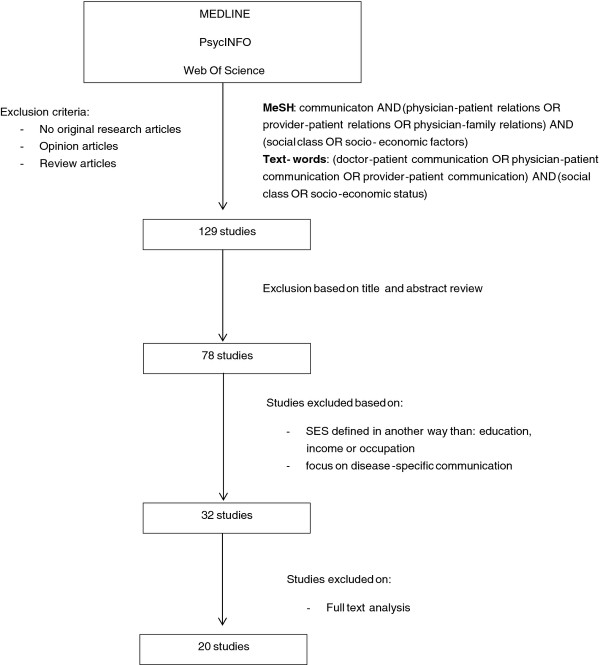
OBJECTIVE: In recent years, the importance of social differences in the physician-patient relationship has frequently been the subject of research. A 2002 review synthesised the evidence on this topic. Considering the increasing importance of social inequalities in health care, an actualization of this review seemed appropriate. METHODS: A systematic search of literature published between 1965 and 2011 on the social gradient in doctor-patient communication. In this review social class was determined by patient's income, education or occupation. RESULTS: Twenty original research papers and meta-analyses were included. Social differences in doctor-patient communication were described according to the following classification: verbal behaviour including instrumental and affective behaviour, non-verbal behaviour and patient-centred behaviour. CONCLUSION: This review indicates that the literature on the social gradient in doctor-patient communication that was published in the last decade, addresses new issues and themes. Firstly, most of the found studies emphasize the importance of the reciprocity of communication.Secondly, there seems to be a growing interest in patient's perception of doctor-patient communication. PRACTICE IMPLICATIONS: By increasing the doctors' awareness of the communicative differences and by empowering patients to express concerns and preferences, a more effective communication could be established.
Overview
The claims and statistics of this paper haven’t been checked yet.
Run the check — free, no account needed. It reads the open-access text and checks the sources it cites.
Integrity signals
Registry
Cites
Statistics
Figures
Verification
Claims the paper makes
The claims and statistics of this paper haven’t been checked yet.
Run the check — free, no account needed. It reads the open-access text and checks the sources it cites.
Claims other papers make about this one
Each is checked against this paper’s own text: does it say what the citing paper says it does?
The cited source says what the claim attributes to it.
In the citing paper
“However studies have found that doctor-patient communication differs depending upon the patient's SES (10).”
From High levels of socioeconomic deprivation do not inhibit patients’ communication of concerns in head and neck cancer review clinics (2018) · cites this paper as [10]
Self-check
Percentages, sums and reported differences re-computed from the paper’s own numbers.
The self-check needs the paper’s full text.
Citations
Cites
Socioeconomic Inequalities in Health in 22 European Countries
Mackenbach, J. P., Stirbu, I., Roskam, A.-J. R., Schaap, M. M., Menvielle, G., Leinsalu, M., & Kunst, A. E. (2008) · New England Journal of Medicine · doi:10.1056/nejmsa0707519 · Cited by 3,289
Patient-centredness: a conceptual framework and review of the empirical literature
Mead, N., & Bower, P. (2000) · Social Science & Medicine · doi:10.1016/s0277-9536(00)00098-8 · Cited by 2,993
Doctor-patient communication: a review of the literature
Ong, L. M. L., de Haes, J. C. J. M., Hoos, A. M., & Lammes, F. B. (1995) · Social Science & Medicine · doi:10.1016/0277-9536(94)00155-m · Cited by 2,430
Assessing the Effects of Physician-Patient Interactions on the Outcomes of Chronic Disease
Kaplan, S. H., Greenfield, S., & Ware, J. E. (1989) · Medical Care · doi:10.1097/00005650-198903001-00010 · Cited by 2,043
Mackenbach, J. P., & Kunst, A. E. (1997) · Social Science & Medicine · doi:10.1016/s0277-9536(96)00073-1 · Cited by 1,343
Meta-analysis of correlates of provider behavior in medical encounters
Hall, J. A., Roter, D. L., & Katz, N. R. (1988) · Medical Care · doi:10.1097/00005650-198807000-00002 · Cited by 1,069 · cited 3×
“Patients of a higher social class received not only more overall communication but also more information [32].”
BackgroundInfluentialSocial class, sense of control, and social explanation.
Kraus, M. W., Piff, P. K., & Keltner, D. (2009) · Journal of Personality and Social Psychology · doi:10.1037/a0016357 · Cited by 956
Communication Patterns of Primary Care Physicians
Roter, D. L. (1997) · JAMA: The Journal of the American Medical Association · doi:10.1001/jama.1997.03540280088045 · Cited by 939
Doctor-patient communication: the Toronto consensus statement.
Simpson, M., Buckman, R. A., Stewart, M., Maguire, P., Lipkin, M., Novack, D. H., & Till, J. E. (1991) · BMJ · doi:10.1136/bmj.303.6814.1385 · Cited by 877
Physician-patient communication in the primary care office: a systematic review.
Beck, R., Daughtridge, R., & Sloane, P. D. (2002) · PubMed · Cited by 868
Alter, D. A., Naylor, C. D., Austin, P. C., & Tu, J. V. (1999) · New England Journal of Medicine · doi:10.1056/nejm199910283411806 · Cited by 678
Street, R. L., Gordon, H. S., & Haidet, P. (2007) · Social Science & Medicine · doi:10.1016/j.socscimed.2007.03.036 · Cited by 600
Inequalities in health. Report of a research working group.
Black, D. A. K. (1980) · PubMed · Cited by 590
Socio-economic status of the patient and doctor–patient communication: does it make a difference?
Willems, S., De Maesschalck, S., Deveugele, M., Derese, A., & De Maeseneer, J. (2005) · Patient Education and Counseling · doi:10.1016/j.pec.2004.02.011 · Cited by 582 · cited 2×
“Does the doctor-patient communication varies according to the socio-economic status of the patient? If so, which aspects of the consultation are affected? Are the findings of studies published after 2002 different than those of the publication of the first (and the latest) review on this topic [25].”
BackgroundSelf-citationKaplan, S. H., Gandek, B., Greenfield, S., Rogers, W., & Ware, J. E. (1995) · Medical Care · doi:10.1097/00005650-199512000-00002 · Cited by 580
Patient Participation in Medical Consultations
Street, R. L., Gordon, H. S., Ward, M. M., Krupat, E., & Kravitz, R. L. (2005) · Medical Care · doi:10.1097/01.mlr.0000178172.40344.70 · Cited by 574
Information giving in medical care
Waitzkin, H. (1985) · Journal of Health and Social Behavior · doi:10.2307/2136599 · Cited by 466
Income inequality, the psychosocial environment, and health: comparisons of wealthy nations
Lynch, J., Smith, G. D., Hillemeier, M., Shaw, M., Raghunathan, T., & Kaplan, G. (2001) · The Lancet · doi:10.1016/s0140-6736(01)05407-1 · Cited by 450
Doctor–patient communication and the quality of care
Bensing, J. (1991) · Social Science & Medicine · doi:10.1016/0277-9536(91)90047-g · Cited by 407
Street, R. L. (1991) · Social Science & Medicine · doi:10.1016/0277-9536(91)90288-n · Cited by 389
ROTER, D. L., Hall, J. A., & Katz, N. R. (1987) · Medical Care · doi:10.1097/00005650-198705000-00007 · Cited by 380
Communicating with Medical Patients
(1990) · Annals of Internal Medicine · doi:10.7326/0003-4819-113-3-259_4 · Cited by 355
Siminoff, L. A., Graham, G. C., & Gordon, N. H. (2006) · Patient Education and Counseling · doi:10.1016/j.pec.2006.06.011 · Cited by 354
Origins of health inequalities in a national population sample
Power, C., & Matthews, S. (1997) · The Lancet · doi:10.1016/s0140-6736(97)07474-6 · Cited by 353
McKinstry, B. (2000) · BMJ · doi:10.1136/bmj.321.7265.867 · Cited by 344
Why do providers contribute to disparities and what can be done about it?
Burgess, D. J., Fu, S. S., & Ryn, M. (2004) · Journal of General Internal Medicine · doi:10.1111/j.1525-1497.2004.30227.x · Cited by 310
The impact of childhood living conditions on illness and mortality in adulthood
Lundberg, O. (1993) · Social Science & Medicine · doi:10.1016/0277-9536(93)90122-k · Cited by 304
Mead, N., Bower, P., & Hann, M. (2002) · Social Science & Medicine · doi:10.1016/s0277-9536(01)00171-x · Cited by 275
Analyzing Patient Participation in Medical Encounters
Street, R. L., & Millay, B. (2001) · Health Communication · doi:10.1207/s15327027hc1301_06 · Cited by 257
Piette, J. D., Schillinger, D., Potter, M. B., & Heisler, M. (2003) · Journal of General Internal Medicine · doi:10.1046/j.1525-1497.2003.31968.x · Cited by 234
Sturm, R., & Gresenz, C. R. (2002) · BMJ · doi:10.1136/bmj.324.7328.20 · Cited by 231
Clinical decision-making: Patients’ preferences and experiences
Murray, E., Pollack, L. M., White, M. S., & Lo, B. (2006) · Patient Education and Counseling · doi:10.1016/j.pec.2006.07.007 · Cited by 223
Socio-economic and locational determinants of accessibility and utilization of primary health-care
Field, K. S., & Briggs, D. J. (2001) · Health & Social Care in the Community · doi:10.1046/j.0966-0410.2001.00303.x · Cited by 223
Beach, M. C., ROTER, D. L., Wang, N., Duggan, P. S., & Cooper, L. A. (2006) · Patient Education and Counseling · doi:10.1016/j.pec.2006.06.004 · Cited by 217
Does childhood socioeconomic status influence adult health through behavioural factors?
van de Mheen, H. (1998) · International Journal of Epidemiology · doi:10.1093/ije/27.3.431 · Cited by 196
Communicative styles and adaptations in physician–parent consultations
Street, R. L. (1992) · Social Science & Medicine · doi:10.1016/0277-9536(92)90289-3 · Cited by 196
Mackenbach, J. P., van de Mheen, H., & Stronks, K. (1994) · Social Science & Medicine · doi:10.1016/0277-9536(94)90399-9 · Cited by 195 · cited 1×
“Health differences between social groups due to underlying social mechanisms such as differential access to care, social exclusion or poverty are a matter of major concern in today’s public health research but in spite of marked health improvements of the overall population and efforts to overcome health inequalities,…”
BackgroundHealth for all in the 21st century.
Antezana, F. S., Chollat-Traquet, C., & Yach, D. (1998) · PubMed · Cited by 158
Bensing, J., Kerssens, J., & van der Pasch, M. (1995) · Journal of Nonverbal Behavior · doi:10.1007/bf02173082 · Cited by 152
Influences on patients’ ratings of physicians: Physicians demographics and personality
Duberstein, P. R., Meldrum, S. C., Fiscella, K. A., Shields, C. G., & Epstein, R. M. (2006) · Patient Education and Counseling · doi:10.1016/j.pec.2006.09.007 · Cited by 143
Pendleton, D. A., & Bochner, S. (1980) · Social Science & Medicine Part A Medical Sociology · doi:10.1016/s0271-7123(80)80077-0 · Cited by 134
DeVoe, J. E., Wallace, L. S., & Fryer, G. E. (2009) · Health Expectations · doi:10.1111/j.1369-7625.2008.00516.x · Cited by 133
Schouten, B. C., Meeuwesen, L., Tromp, F., & Harmsen, H. A. M. (2007) · Patient Education and Counseling · doi:10.1016/j.pec.2007.03.018 · Cited by 127
Health care discrimination, processes of care, and diabetes patients’ health status
Piette, J. D., Bibbins-Domingo, K. B., & Schillinger, D. (2005) · Patient Education and Counseling · doi:10.1016/j.pec.2004.12.001 · Cited by 114
Tackling Inequalities in Health
Whitehead, M. (1995) · Health Education Journal · doi:10.1177/001789699505400201 · Cited by 108
Zandbelt, L. C., Smets, E. M. A., Oort, F. J., Godfried, M. H., & de Haes, J. C. J. M. (2006) · Patient Education and Counseling · doi:10.1016/j.pec.2006.09.011 · Cited by 103
Patients characteristics affecting physician–patient nonverbal communication
STREET, R. L., & BULLER, D. B. (1988) · Human Communication Research · doi:10.1111/j.1468-2958.1988.tb00171.x · Cited by 100
Cheraghi‐Sohi, S., Bower, P., Mead, N., McDonald, R., Whalley, D., & Roland, M. O. (2006) · Health Expectations · doi:10.1111/j.1369-7625.2006.00395.x · Cited by 90
Communication in general practice: differences between European countries
van den Brink-Muinen, A., Verhaak, P., Bensing, J. M., Bahrs, O., Deveugele, M. I., Gask, L. L., Mead, N., Leiva-Fernández, F., Perez, A. R., Messerli, V., et al. (2003) · Family Practice · doi:10.1093/fampra/cmg426 · Cited by 89
Self-citationPatient Characteristics Which are Related to the Doctor-Patient Interaction
Stewart, M. (1984) · Family Practice · doi:10.1093/fampra/1.1.30 · Cited by 84
Does patient educational level affect office visits to family physicians?
(2002) · PubMed Central · Cited by 84
Bao, Y., Fox, S. A., & Escarce, J. J. (2006) · Health Services Research · doi:10.1111/j.1475-6773.2006.00638.x · Cited by 82
Do lower socioeconomic groups use more health services, because they suffer from more illnesses?
Droomers, M. (2004) · European Journal of Public Health · doi:10.1093/eurpub/14.3.311 · Cited by 80
Epstein, A. M., Taylor, W. C., & Seage, G. R. (1985) · The American Journal of Medicine · doi:10.1016/0002-9343(85)90469-3 · Cited by 80
Health Literacy: Essential for Health Communication
Parker, R. M., & Gazmararian, J. A. (2003) · Journal of Health Communication · doi:10.1080/10810730305700 · Cited by 69
Jensen, J. D., King, A. J., Guntzviller, L. M., & Davis, L. A. (2009) · Patient Education and Counseling · doi:10.1016/j.pec.2009.09.041 · Cited by 66
Buetow, S. A. (1995) · Social Science & Medicine · doi:10.1016/0277-9536(94)e0074-3 · Cited by 63
Why patients consult and what happens when they do
Martin, E., Russell, D., Goodwin, S., Chapman, R., North, M., & Sheridan, P. (1991) · BMJ · doi:10.1136/bmj.303.6797.289 · Cited by 59
Breast reconstructive surgery in medically underserved women with breast cancer
Maly, R. C., Liu, Y., Kwong, E., Thind, A., & Diamant, A. L. (2009) · Cancer · doi:10.1002/cncr.24510 · Cited by 41
Socioeconomic and Racial/Ethnic Differences in the Discussion of Cancer Screening
Bao, Y., Fox, S., & Escarce, J. J. (2007) · Cited by 32
Wyke, S., Hunt, K., Walker, J., & Wilson, P. (2003) · European Journal of General Practice · doi:10.3109/13814780309160402 · Cited by 28
Turrell, G., & Mathers, C. (2001) · International Journal of Epidemiology · doi:10.1093/ije/30.2.231 · Cited by 10
Research works printed but not linked: 4
- 10.1111/j.1369-7625.2008.00516.x · DOI
- 10.1016/j.pec.2009.09.041 · DOI
- 10.1016/j.pec.2006.06.011 · DOI · Paper page
- 10.1097/01.mlr.0000178172.40344.70 · DOI
Cited by
Sorted by citations
Patient engagement in the inpatient setting: a systematic review
Prey, J. E., Woollen, J., Wilcox, L. G., Sackeim, A., Hripcsak, G. M., Henry, S. B., Restaino, S. W., Feiner, S., & Vawdrey, D. K. (2013) · Journal of the American Medical Informatics Association · doi:10.1136/amiajnl-2013-002141 · Cited by 265
Socioeconomic inequalities in primary-care and specialist physician visits: a systematic review
Lückmann, S. L., Hoebel, J., Roick, J., Markert, J., Spallek, J., Knesebeck, O. V. D., & Richter, M. (2021) · International Journal for Equity in Health · doi:10.1186/s12939-020-01375-1 · Cited by 168
Mercer, S. W., Higgins, M., Bikker, A. M., Fitzpatrick, B., McConnachie, A., Lloyd, S. M., Little, P. S., & Watt, G. C. M. (2016) · The Annals of Family Medicine · doi:10.1370/afm.1910 · Cited by 156
Peimani, M., Nasli-Esfahani, E., & Sadeghi, R. (2018) · Chronic Illness · doi:10.1177/1742395318782378 · Cited by 115
Peretti‐Watel, P., Ward, J. K., Vergélys, C., Bocquier, A., Raude, J., & Verger, P. (2019) · Sociology of Health & Illness · doi:10.1111/1467-9566.12902 · Cited by 117
Metadata
- Authors
- Verlinde, E., De Laender, N., De Maesschalck, S., Deveugele, M., & Willems, S.
- Affiliations
- Ghent University (BE)
- Corresponding author
- Verlinde, Evelyn
- Venue
- International Journal for Equity in Health
- Published
- 2012
- Volume
- 11
- Issue
- 1
- Pages
- 12
- ISSN
- 1475-9276 (ISSN-L)
- PMC
- PMC3317830
- OpenAlex
- W2008405683
- Cited by
- 307
- References
- 62
- Citations by year
- 2026: 13 · 2025: 21 · 2024: 32 · 2023: 24 · 2022: 28 · 2021: 31 · 2020: 34 · 2019: 27 · 2018: 27 · 2017: 13 · 2016: 15 · 2015: 13 · 2014: 15 · 2013: 12
- FWCI
- 2.00
- Type
- journal article
- Language
- en
- Open access
- gold
- doi.org
- Licence
- cc-by
- Locations
- International Journal for Equity in Health (publishedVersion, cc-by)
- Europe PMC (PubMed Central) (publishedVersion, cc-by)
- PubMed Central (publishedVersion, cc-by)
- PubMed (publishedVersion)
- Ghent University Academic Bibliography (Ghent University) (submittedVersion, other-oa)
- DOAJ (DOAJ: Directory of Open Access Journals) (submittedVersion, cc-by-sa)
- Topics
- Health Sciences › Health Professions › General Health Professions › Patient-Provider Communication in Healthcare
- Social Sciences › Health › Health disparities and outcomes
- Health Sciences › Health Professions › General Health Professions › Interpreting and Communication in Healthcare
- Keywords
- social gradient, physician-patient communication, social class, income, occupation, verbal behavior, nonverbal behavior, patient perspectives, patient empowerment
- MeSH terms
- Acculturation, Affective Symptoms, Communication, Humans, Physician-Patient Relations, Social Behavior, Social Class, Verbal Behavior, Models, Statistical, Patient-Centered Care, Cultural Diversity, Health Status Disparities, Social Participation
About these checks
Registry, retraction, Cites and statistics results are computed, not judged, with one exception: a printed reference that no index lists is read once by a model before it counts as a citation error. Claims are extracted by a model and kept only when their quote appears verbatim in the text; each cited source is then checked, with a model’s help, for whether it says what the claim relies on. Those verdicts can be wrong — read the claim’s quote and the cited source before relying on one.
Statistics and arithmetic are recomputed, not judged.
Confidence bands are shown only for fields calibrated on our annotated test set. None is calibrated yet, so no band is shown.
What counts as a claim ›How we measure confidence ›How we check this ›
Are you an author, or do you see a problem with this page? Request a review
