

Systematic review of the health benefits of physical activity and fitness in school-aged children and youth
Open accessThe DOI matches its Crossref record; 114 of the 116 references it cites were found in a registry or an index; none of the 128 sources its claims cite is checked for support yet.
Abstract
BACKGROUND: The purpose was to: 1) perform a systematic review of studies examining the relation between physical activity, fitness, and health in school-aged children and youth, and 2) make recommendations based on the findings. METHODS: The systematic review was limited to 7 health indicators: high blood cholesterol, high blood pressure, the metabolic syndrome, obesity, low bone density, depression, and injuries. Literature searches were conducted using predefined keywords in 6 key databases. A total of 11,088 potential papers were identified. The abstracts and full-text articles of potentially relevant papers were screened to determine eligibility. Data was abstracted for 113 outcomes from the 86 eligible papers. The evidence was graded for each health outcome using established criteria based on the quantity and quality of studies and strength of effect. The volume, intensity, and type of physical activity were considered. RESULTS: Physical activity was associated with numerous health benefits. The dose-response relations observed in observational studies indicate that the more physical activity, the greater the health benefit. Results from experimental studies indicate that even modest amounts of physical activity can have health benefits in high-risk youngsters (e.g., obese). To achieve substantive health benefits, the physical activity should be of at least a moderate intensity. Vigorous intensity activities may provide even greater benefit. Aerobic-based activities had the greatest health benefit, other than for bone health, in which case high-impact weight bearing activities were required. CONCLUSION: The following recommendations were made: 1) Children and youth 5-17 years of age should accumulate an average of at least 60 minutes per day and up to several hours of at least moderate intensity physical activity. Some of the health benefits can be achieved through an average of 30 minutes per day. [Level 2, Grade A]. 2) More vigorous intensity activities should be incorporated or added when possible, including activities that strengthen muscle and bone [Level 3, Grade B]. 3) Aerobic activities should make up the majority of the physical activity. Muscle and bone strengthening activities should be incorporated on at least 3 days of the week [Level 2, Grade A].
Overview
CoChat Summary
TL;DR
This systematic review found physical activity is associated with numerous health benefits in school-aged children and youth, with observational dose-response evidence suggesting more activity yields greater benefit. It recommends an average of at least 60 minutes per day of at least moderate activity, with some benefits achievable at 30 minutes per day, plus added vigorous and muscle/bone-strengthening activities.
Key findings
- From 11,088 unique citations, 86 eligible papers yielded 113 outcomes across 7 health indicators. Physical activity was associated with benefits; observational studies showed dose-response relations, and experimental studies indicated even modest activity can benefit high-risk youngsters (e.g., obese).
- Metabolic syndrome: summary odds ratio for least active vs most active was 1.68 (95% CI 1.22–2.31) in 3 self-report studies; least fit vs most fit was 6.79 (95% CI 5.11–9.03) in 4 fitness studies. Obesity: median odds ratio was 1.33 for self-reported activity and 3.79 for objective measures. Cholesterol: unfit girls were 1.89 (1.12–3.17) times and unfit boys 3.68 (2.55–5.31) times more likely to have hypercholesterolemia than moderately/high fit peers.
- Recommendations: children and youth 5–17 years should accumulate an average of at least 60 minutes per day and up to several hours of at least moderate intensity activity; some health benefits can be achieved through an average of 30 minutes per day [Level 2, Grade A]. More vigorous activities should be incorporated when possible, including muscle- and bone-strengthening activities [Level 3, Grade B]; aerobic activities should make up the majority, with muscle and bone strengthening on at least 3 days per week [Level 2, Grade A].
- Bone: as little as 10 minutes of moderate-to-high impact activities on as little as 2 or 3 days per week can have a modest effect on bone mineral density when combined with general weight-bearing aerobic activities. Injuries: all 3 included studies reported higher injury rates in active children/youth and clear dose-response relations; vigorous sports risk estimates were high.
Methods
- Systematic review limited to 7 health indicators: high blood cholesterol, high blood pressure, metabolic syndrome, obesity, low bone density, depression, and injuries. Searches used predefined keywords in 6 databases (MEDLINE, EMBASE, CINAHL, PsycINFO, Evidence-Based Medicine Reviews, SPORTDiscus) to January 2008, limited to human participants, English language, and ages 5–17 years.
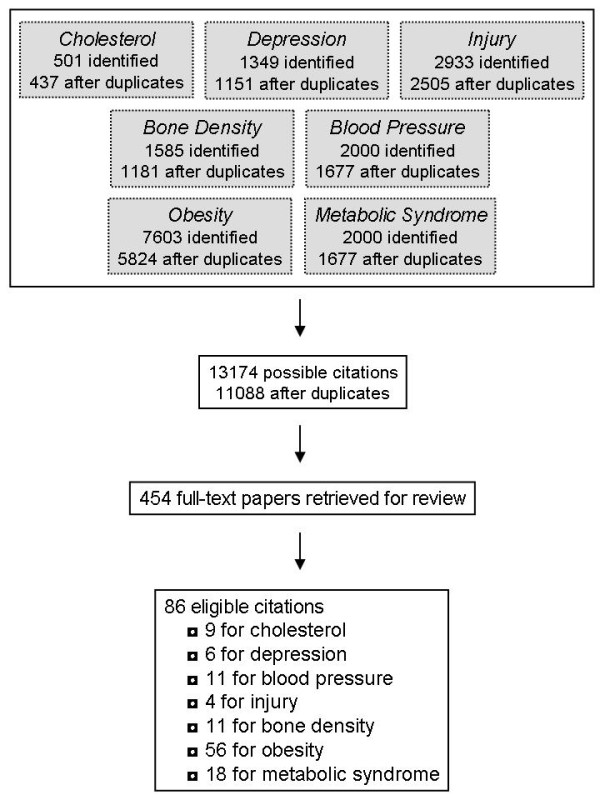
- After duplicates, 11,088 unique citations were screened; 454 full-text articles were reviewed; 86 unique citations met eligibility and 113 outcomes were abstracted. Observational studies had to report dichotomous outcomes; intervention studies were excluded if they included dietary or other behavioral components that could independently affect outcomes.
- Evidence was graded using pre-specified criteria based on quantity/quality of studies and strength of effect; meta-analyses were performed when at least 4 studies were available. RCT quality was assessed with the Downs and Black checklist, and effect sizes used Cohen’s d and ratio-score criteria.
Limitations
- Stated: unpublished and non-English studies were excluded, no extensive cross-referencing of reference lists was performed, the review was limited to 7 health outcomes, and many observational studies were excluded because they did not report dichotomous outcomes; these may have biased results and recommendations.
- Stated RCT limitations: samples were small and non-representative, statistical power was often lacking, adverse events were rarely reported, dropout details were limited, and intent-to-treat analyses were not performed; therefore Level 2 was the highest level assignable to any recommendation.
- Evident from the text: the nature of dose-response relations (linear vs curvilinear) often remained unclear, and the moderating effects of age and sex were not systematically addressed across outcomes.
Model-written summary. Check it against the paper before relying on it.
Integrity signals
Registry
Cites
Statistics
Figures
Verification
Claims the paper makes
0 Valid · 0 Not valid · 42 Not checked · 127 Own results and interpretations
A result the paper reports from its own data — it cites no other source for it, so there is none to check. The quote shows it is in the paper.
In the paper
“Results from experimental studies indicate that even modest amounts of physical activity can have health benefits in high-risk youngsters (e.g., obese).”
§ Systematic review of the health benefits of physical activity and fitness in school-aged children and youth > Abstract > Results
hedgedstates a cause- Asserted: passes — The authors put it forward as true.
- Checkable: passes — It can be checked against evidence.
- Load-bearing: passes — The paper’s conclusions depend on it.
- Based: passes — The paper gives a reason why it holds.
A result the paper reports from its own data — it cites no other source for it, so there is none to check. The quote shows it is in the paper.
In the paper
“Physical activity was associated with numerous health benefits.”
§ Systematic review of the health benefits of physical activity and fitness in school-aged children and youth > Abstract > Results
plainstates an association- Asserted: passes — The authors put it forward as true.
- Checkable: passes — It can be checked against evidence.
- Load-bearing: passes — The paper’s conclusions depend on it.
- Based: passes — The paper gives a reason why it holds.
A result the paper states — it cites no source for it, so there is none to check. The quote shows it is in the paper.
In the paper
“Aerobic-based activities had the greatest health benefit, other than for bone health, in which case high-impact weight bearing activities were required.”
§ Systematic review of the health benefits of physical activity and fitness in school-aged children and youth > Abstract > Results
plainstates an association- Asserted: passes — The authors put it forward as true.
- Checkable: passes — It can be checked against evidence.
- Load-bearing: passes — The paper’s conclusions depend on it.
- Based: passes — The paper gives a reason why it holds.
A result the paper reports from its own data — it cites no other source for it, so there is none to check. The quote shows it is in the paper.
In the paper
“The dose-response relations observed in observational studies indicate that the more physical activity, the greater the health benefit.”
§ Systematic review of the health benefits of physical activity and fitness in school-aged children and youth > Abstract > Results
hedgedstates an association- Asserted: passes — The authors put it forward as true.
- Checkable: passes — It can be checked against evidence.
- Load-bearing: passes — The paper’s conclusions depend on it.
- Based: passes — The paper gives a reason why it holds.
None of the sources cited for this claim have been checked yet.
In the paper
“The results indicated that unfit girls, defined as the lowest 20% fit, were 1.89 (95% confidence interval: 1.12-3.17) times more likely to have hypercholesterolemia and 1.03 (0.74-1.43) times more likely to have a low HDL-cholesterol by comparison to moderately and high fit girls.”
§ Systematic review of the health benefits of physical activity and fitness in school-aged children and youth > Results > Cholesterol and blood lipids
hedgedstates an associationn = 3,110- Asserted: passes — The authors put it forward as true.
- Checkable: passes — It can be checked against evidence.
- Load-bearing: passes — The paper’s conclusions depend on it.
- Based: passes — The paper gives a reason why it holds.
103 more claims
Create a free account to see all 169 claims and every source verdict.
- Probably not a substantial claim. 26
- The quote only partly states this claim. 2
- It may state two separate claims as one. 37
Claims other papers make about this one
Each is checked against this paper’s own text: does it say what the citing paper says it does?
The source backs part of the claim, not all of it — or backs it for a different population, condition or comparison.
In the citing paper
“Research indicates that those who are physically active show or report better overall physical and mental health, a higher level of fitness and a lower level of obesity than their sedentary or physically inactive counterparts1–4”
From Physical activity and health in Chinese children and adolescents: expert consensus statement (2020) (2020) · cites this paper as [2]
Experimental — accuracy not yet measuredThe cited source says what the claim attributes to it.
In the citing paper
“The association with overweight/obesity tends to be stronger when moderate to vigorous-intensity physical activities are performed.2”
From Physical activity and health in Chinese children and adolescents: expert consensus statement (2020) (2020) · cites this paper as [2]
The cited source says what the claim attributes to it.
In the citing paper
“Among physical activity interventions, the effects of physical activity independent of dietary changes on measures indicative of weight reduction (eg, BMI, total fat, abdominal fat) tend to be in the small range.2”
From Physical activity and health in Chinese children and adolescents: expert consensus statement (2020) (2020) · cites this paper as [2]
The cited source says what the claim attributes to it.
In the citing paper
“In general, as the level of physical activity increases, the likelihood of injury increases.2”
From Physical activity and health in Chinese children and adolescents: expert consensus statement (2020) (2020) · cites this paper as [2]
The cited source says what the claim attributes to it.
In the citing paper
“Systematic reviews have shown that physical activity (PA) is associated with greater mental health, 6 and a reduced risk of mental ill-health, specifically depression and anxiety.7,8”
From Domain-Specific Physical Activity and Mental Health: A Meta-analysis (2017) · cites this paper as [8]
2 more claims about this paper
Create a free account to see every claim other papers make about this one.
Self-check
Percentages, sums and reported differences re-computed from the paper’s own numbers.
Each contradiction between two passages listed here was confirmed by an independent check.
Rated major: it would touch a result — a value a result rests on, reported and recomputed p-values on opposite sides of the significance level, two passages that conflict with no sign which is right, or a cited work retracted before this paper was published.
In the paper
§ Systematic review of the health benefits of physical activity and fitness in school-aged children and youth > Discussion > Recommendations based on systematic review
“More vigorous intensity activities should be incorporated or added when possible, including activities that strengthen muscle and bone. [Level 3, Grade B].”
§ Systematic review of the health benefits of physical activity and fitness in school-aged children and youth > Discussion > Recommendations based on systematic review
“This recommendation was given a lower grade (Grade C) because of the potential increase in injury risk associated with more vigorous intensity activities and sports.”
Rated minor: it would not touch a result — a value no result rests on, a p-value that stays on the same side of the significance level, or a conflict that is clerical, resolved elsewhere in the paper, or outside its own findings.
In the paper
§ Systematic review of the health benefits of physical activity and fitness in school-aged children and youth > Results > Metabolic syndrome
“Sixteen articles examining the metabolic syndrome met the inclusion criteria.”
§ Systematic review of the health benefits of physical activity and fitness in school-aged children and youth > Results > Metabolic syndrome
“Eight of the 17 identified studies were observational in nature”
Rated minor: it would not touch a result — a value no result rests on, a p-value that stays on the same side of the significance level, or a conflict that is clerical, resolved elsewhere in the paper, or outside its own findings.
In the paper
“A total of 31 observational studies (24 cross-sectional, 3 prospective cohort, 2 case-control, 1 mixed) were retrieved”
§ Systematic review of the health benefits of physical activity and fitness in school-aged children and youth > Results > Overweight and obesity
Reported 31 · recomputed 30
Rated minor: it would not touch a result — a value no result rests on, a p-value that stays on the same side of the significance level, or a conflict that is clerical, resolved elsewhere in the paper, or outside its own findings.
In the paper
“437 citations were identified for cholesterol, 1151 for depression, 2505 for injury, 1181 for bone density, 1677 for blood pressure, 5824 for obesity, and 1677 for the metabolic syndrome. Thus, the grand total was 13174.”
§ Systematic review of the health benefits of physical activity and fitness in school-aged children and youth > Results > Literature review
Reported 13174 · recomputed 14452
Citations
Cites
Downs, S. H., & Black, N. (1998) · Journal of Epidemiology and Community Health · doi:10.1136/jech.52.6.377 · Cited by 8,252
Evidence Based Physical Activity for School-age Youth
Strong, W. B., Malina, R. M., Blimkie, C. J. R., Daniels, S. R., Dishman, R. K., Gutin, B., Hergenroeder, A. C., Must, A., Nixon, P. A., Pivarnik, J. M., et al. (2005) · The Journal of Pediatrics · doi:10.1016/j.jpeds.2005.01.055 · Cited by 4,222
Systematic Reviews: Synthesis of Best Evidence for Clinical Decisions
Cook, D. J., Mulrow, C. D., & Haynes, R. B. (1997) · Annals of Internal Medicine · doi:10.7326/0003-4819-126-5-199703010-00006 · Cited by 2,184
Andersen, L. B., Harro, M., Sardinha, L. B., Froberg, K., Ekelund, U., Brage, S., & Anderssen, S. A. (2006) · The Lancet · doi:10.1016/s0140-6736(06)69075-2 · Cited by 1,473
Lau, D. C. W., Douketis, J. D., Morrison, K. M., Hramiak, I. M., Sharma, A. M., Ur, E., & Panel, F. M. O. T. O. C. C. P. G. E. (2007) · Canadian Medical Association Journal · doi:10.1503/cmaj.061409 · Cited by 1,154
Paterson, D. H., & Warburton, D. E. (2010) · International Journal of Behavioral Nutrition and Physical Activity · doi:10.1186/1479-5868-7-38 · Cited by 953
A systematic review of the evidence for Canada's Physical Activity Guidelines for Adults
Warburton, D. E., Charlesworth, S., Ivey, A., Nettlefold, L., & Bredin, S. S. (2010) · International Journal of Behavioral Nutrition and Physical Activity · doi:10.1186/1479-5868-7-39 · Cited by 902 · cited 1×
“This report was part of a much larger project around Canada's physical activity guidelines, and comparable systematic reviews for adults [ 10 ] and older adults [11] have also been published in the journal.”
A meta-regression to examine the relationship between aerobic fitness and cognitive performance
Etnier, J. L., Nowell, P. M., Landers, D. M., & Sibley, B. A. (2006) · Brain Research Reviews · doi:10.1016/j.brainresrev.2006.01.002 · Cited by 749
Is the Canadian childhood obesity epidemic related to physical inactivity?
Tremblay, M. S., & Willms, J. D. (2003) · International Journal of Obesity · doi:10.1038/sj.ijo.0802376 · Cited by 517
Nassis, G. P., Papantakou, K., Skenderi, K., Triandafillopoulou, M., Kavouras, S. A., Yannakoulia, M., Chrousos, G. P., & Sidossis, L. S. (2005) · Metabolism · doi:10.1016/j.metabol.2005.05.013 · Cited by 469
Research works printed but not linked: 1
- Petitti DB Meta-Analysis, Decision Analysis, and Cost-Effective Analysis 1994 New York, NY: Oxford University Press
Cited by
Items 901–1,000 of 4,834
Ha, A. S. C., Lonsdale, C., Lubans, D. R., & Ng, J. Y. Y. (2019) · Medicine & Science in Sports & Exercise · doi:10.1249/mss.0000000000002172 · Cited by 54
Jones, M. A., Skidmore, P. M. L., Stoner, L. R., Harrex, H. A. L., Saeedi, P., Black, K. E., & Gibbs, B. B. (2019) · Journal of Sports Sciences · doi:10.1080/02640414.2019.1685842 · Cited by 43
Healy, S., Foley, J. T., & Haegele, J. A. (2020) · American Journal of Health Promotion · doi:10.1177/0890117120915687 · Cited by 41
Renko, E., Knittle, K. P., Palsola, M., Lintunen, T., & Hankonen, N. E. (2020) · BMC Public Health · doi:10.1186/s12889-020-09653-x · Cited by 57
D’Haese, S., Dyck, D. V., Bourdeaudhuij, I. D., Deforche, B. I., & Cardon, G. (2015) · BMC Public Health · doi:10.1186/s12889-015-1937-5 · Cited by 51
Huppertz, C., Bartels, M., de Geus, E. J. C., van Beijsterveldt, C. E. M., Rose, R. J., Kaprio, J. A., & Silventoinen, K. (2016) · Scandinavian Journal of Medicine and Science in Sports · doi:10.1111/sms.12727 · Cited by 44
Wang, J., Zhao, X., Bi, Y., Jiang, S., Sun, Y., Lang, J., & Han, C. (2022) · Cognitive Neurodynamics · doi:10.1007/s11571-022-09905-z · Cited by 52
“Physical activity (PA) is widely agreed to be associated with numerous benefits (Janssen and LeBlanc 2010).”
BackgroundMotivation for physical activity in children: A moving matter in need for study
Pannekoek, L., Piek, J. P., & Hagger, M. S. (2013) · Human Movement Science · doi:10.1016/j.humov.2013.08.004 · Cited by 57
Hernández, P., Bradford, J. C., Brahmachary, P. P., Ulman, S. M., Robinson, J. L., June, R. K., & Cucchiarini, M. (2024) · Osteoarthritis and Cartilage · doi:10.1016/j.joca.2024.04.015 · Cited by 46
Pirrie, A. M., & Lodewyk, K. R. (2012) · Mental Health and Physical Activity · doi:10.1016/j.mhpa.2012.04.001 · Cited by 38
Wong, L. S., Gibson, A., Farooq, A., & Reilly, J. J. (2021) · Journal of School Health · doi:10.1111/josh.13070 · Cited by 58
Robust Compositional Analysis of Physical Activity and Sedentary Behaviour Data
Štefelová, N., Dygrýn, J., Hron, K., Gába, A., Rubín, L., & Palarea‐Albaladejo, J. (2018) · International Journal of Environmental Research and Public Health · doi:10.3390/ijerph15102248 · Cited by 40
Factors Predicting Physical Activity and Sports Participation in Adolescence
Rullestad, A., Meland, E., & Mildestvedt, T. (2021) · Journal of Environmental and Public Health · doi:10.1155/2021/9105953 · Cited by 64
Hamilton, K. L., Kaczynski, A. T., Fair, M., & Lévesque, L. (2017) · Journal of Environmental and Public Health · doi:10.1155/2017/7582402 · Cited by 49
Armbrust, W., Bos, J. J. F. J., Cappon, J., van Rossum, M. A. J. J., Sauer, P. J. J., Wulffraat, N., van Wijnen, V. K., & Lelieveld, O. T. H. M. (2015) · Pediatric Rheumatology · doi:10.1186/s12969-015-0029-5 · Cited by 38
Campbell, N., Gaston, A., Gray, C., Rush, E., Maddison, R., & Prapavessis, H. (2016) · Journal of Physical Activity and Health · doi:10.1123/jpah.2015-0031 · Cited by 38
Sport participation, screen time, and personality trait development during childhood
Allen, M. S., Vella, S. A., & Laborde, S. (2015) · British Journal of Developmental Psychology · doi:10.1111/bjdp.12102 · Cited by 44
Graham, D. J., Lucas-Thompson, R. G., & O’Donnell, M. B. (2014) · Frontiers in Public Health · doi:10.3389/fpubh.2014.00058 · Cited by 38
Crowe, M., Sampasa‐Kanyinga, H., Saunders, T. J., Hamilton, H. A., Benchimol, E. I., & Chaput, J. (2020) · Canadian Journal of Public Health · doi:10.17269/s41997-020-00313-6 · Cited by 47
Physical activity guidelines for preschoolers: a call for research to inform public health policy
Skouteris, H., DellˈAquila, D., Baur, L. A., Dwyer, G. M., McCabe, M. P., Ricciardelli, L. A., & Fuller‐Tyszkiewicz, M. (2012) · Medical Journal of Australia · doi:10.5694/mja11.11015 · Cited by 38
Blanchard, J., Wyk, N. V., Ertel, E., Alpous, A., & Longmuir, P. E. (2019) · Journal of Sports Sciences · doi:10.1080/02640414.2019.1689076 · Cited by 45
Exercise-induced dyspnea is a problem among the general adolescent population
Johansson, H. E., Norlander, K., Hedenström, H., Janson, C., Nordang, L., Nordvall, L., & Emtner, M. (2014) · Respiratory Medicine · doi:10.1016/j.rmed.2014.03.010 · Cited by 46
O’Dea, J., & Amy, N. K. (2011) · International Journal of Behavioral Nutrition and Physical Activity · doi:10.1186/1479-5868-8-68 · Cited by 49
Results from the Philippines' 2022 report card on physical activity for children and adolescents
Cagas, J. Y., Mallari, M. F. T., Torre, B. A., Kang, M.-G. D. P., Palad, Y. Y., Guisihan, R. M., Aurellado, M. I., Pituk, C. S., Realin, J. G. P., Sabado, M. L. C., et al. (2022) · Journal of Exercise Science & Fitness · doi:10.1016/j.jesf.2022.10.001 · Cited by 79
Rech, J. P., Irwin, J. M., Rosen, A. B., Baldwin, J. L., & Schenkelberg, M. A. (2022) · Adapted Physical Activity Quarterly · doi:10.1123/apaq.2021-0152 · Cited by 53
Manyanga, T., Barnes, J. D., Abdeta, C., Adeniyi, A. F., Bhawra, J., Draper, C. E., Katapally, T. R., Khan, A., Lambert, E., Makaza, D., et al. (2018) · Journal of Physical Activity and Health · doi:10.1123/jpah.2018-0370 · Cited by 38
Janssen, I. (2016) · Journal of Adolescent Health · doi:10.1016/j.jadohealth.2016.07.007 · Cited by 38
Self-citation“Green exercise, health and well-being,”
Loureiro, A., & Veloso, S. (2017) · International Handbooks of Quality-of-Life · doi:10.1007/978-3-319-31416-7_8 · Cited by 38
Zhang, Z., Li, H. J., Slapšinskaitė, A., Zhang, T., Zhang, L., & Gui, C. Y. (2020) · Public Health · doi:10.1016/j.puhe.2020.07.001 · Cited by 46
Ha, A. S. C., Lonsdale, C., Lubans, D. R., & Ng, J. Y. Y. (2017) · BMC Public Health · doi:10.1186/s12889-017-4553-8 · Cited by 49
Determinants of Diet and Physical Activity in Malaysian Adolescents: A Systematic Review
Mohammadi, S., Jalaludin, M. Y., Su, T. T., Dahlui, M., Mohamed, M. N. A., & Majid, H. A. (2019) · International Journal of Environmental Research and Public Health · doi:10.3390/ijerph16040603 · Cited by 47
Fraysse, F., Grobler, A. C., Muller, J., Wake, M. A., & Olds, T. (2019) · BMJ Open · doi:10.1136/bmjopen-2018-023194 · Cited by 48
Intellectual maturity and physical fitness in preschool children
Román, P. Á. L., Mora‐López, D., & García‐Pinillos, F. (2016) · Pediatrics International · doi:10.1111/ped.12898 · Cited by 44
Indigenous Participation in Australian Sport: The Perils of the ‘Panacea’ Proposition
Evans, J. R., Wilson, R., Dalton, B., & Georgakis, S. (2015) · Cosmopolitan Civil Societies An Interdisciplinary Journal · doi:10.5130/ccs.v7i1.4232 · Cited by 47
Pate, R. R., Saunders, R. P., Ross, S. E. T., & Dowda, M. C. (2022) · Preventive Medicine Reports · doi:10.1016/j.pmedr.2022.101712 · Cited by 50
McGarty, A. M., Penpraze, V., & Melville, C. A. (2016) · PLoS ONE · doi:10.1371/journal.pone.0164928 · Cited by 40
Sebire, S. J., Jago, R., Wood, L., Thompson, J. L., Zahra, J., & Lawlor, D. A. (2015) · Social Science & Medicine · doi:10.1016/j.socscimed.2015.11.022 · Cited by 42
TEST-RETEST RELIABILITY OF A FIELD-BASED PHYSICAL FITNESS ASSESSMENT FOR CHILDREN AGED 3-6 YEARS.
Román, P. Á. L., López, D. M., Sánchez, M. F., Sánchez, J. S., Coronas, F. M., & García‐Pinillos, F. (2015) · PubMed · doi:10.3305/nh.2015.32.4.9486 · Cited by 43
Physical Activity of Polish and Turkish University Students as Assessed by IPAQ
Bednarek, J., Pomykała, S., Bigosińska, M., & Szyguła, Z. (2016) · Central European Journal of Sport Sciences and Medicine · doi:10.18276/cej.2016.4-02 · Cited by 41
Dallolio, L., Ceciliani, A., Sanna, T., Garulli, A., & Leoni, E. (2016) · Journal of Physical Activity and Health · doi:10.1123/jpah.2015-0694 · Cited by 47
Manz, K., Krug, S., Schienkiewitz, A., & Finger, J. D. (2016) · BMC Public Health · doi:10.1186/s12889-016-3615-7 · Cited by 49
“Background Regular physical activity (PA) during childhood and adolescence is associated with numerous short- and long-term health benefits [1, 2].”
BackgroundLander, N., Mergen, J., Morgan, P. J., Salmon, J., & Barnett, L. M. (2018) · Journal of Sports Sciences · doi:10.1080/02640414.2018.1504397 · Cited by 41
Rhodes, R. E., Zhang, R., & Zhang, C. (2020) · Annals of Behavioral Medicine · doi:10.1093/abm/kaz068 · Cited by 46
Reduced physical exercise and health‐related quality of life after Fontan palliation
Hedlund, E. R., Lundell, B. P. W., Villard, L., & Sjöberg, G. (2016) · Acta Paediatrica · doi:10.1111/apa.13544 · Cited by 41
McGarty, A. M., Penpraze, V., & Melville, C. A. (2014) · Research in Developmental Disabilities · doi:10.1016/j.ridd.2014.02.009 · Cited by 46
Novotny, R., Nigg, C. R., Li, F., & Wilkens, L. R. (2015) · Childhood Obesity · doi:10.1089/chi.2014.0141 · Cited by 43
“PA is also generally thought to improve BP by maintaining or decreasing weight.(28) Although a slowing of the increase in DBP with age in children is likely beneficial for health, there is a paucity of evidence about healthy BP levels for children, and there has been some question in the literature about the accuracy…”
Nordbø, E. C. A., Raanaas, R. K., Nordh, H., & Aamodt, G. (2020) · Health & Place · doi:10.1016/j.healthplace.2020.102360 · Cited by 44
Urban and suburban children's experiences with school travel – A case study
Race, D. L., Sims‐Gould, J., Lee, N. C., Frazer, A. D., Voss, C., Naylor, P., & McKay, H. A. (2017) · Journal of Transport & Health · doi:10.1016/j.jth.2017.01.011 · Cited by 42
Rhodes, R. E., Spence, J. C., Berry, T. R., Deshpande, S., Faulkner, G., Latimer‐Cheung, A. E., O’Reilly, N., & Tremblay, M. S. (2015) · Annals of Behavioral Medicine · doi:10.1007/s12160-015-9721-4 · Cited by 48
Flow in youth sport, physical activity, and physical education: A systematic review
Jackman, P. C., Dargue-Fox, E. J., Johnston, J., & Hawkins, R. M. (2020) · Psychology of sport and exercise · doi:10.1016/j.psychsport.2020.101852 · Cited by 62
“…optimal experience; peak performance; athlete; child; enjoyment22 23 24 3 Flow states in youth sport, physical activity, and physical education: A systematic review 1 Physical activity (PA) can have wide-ranging health benefits for youth1 populations 2 (Eime et al., 2013; Janssen & LeBlanc, 2010).”
BackgroundBermejo‐Cantarero, A., Sánchez‐López, M., Álvarez‐Bueno, C., Redondo‐Tébar, A., García‐Hermoso, A., & Martínez‐Vizcaíno, V. (2023) · Sports Health A Multidisciplinary Approach · doi:10.1177/19417381231190885 · Cited by 47
“11,21 Thus, several systematic reviews suggest a direct association between PA and HRQoL in children and adolescents, but these reviews included participants with chronic conditions 26 , or the results came exclusively from observational studies and did not allow cause-effect relationships between…”
Avilés-Santa, L. M., Colón‐Ramos, U., Lindberg, N. M., Mattei, J., Pasquel, F. J., & Pérez, C. M. (2017) · Frontiers in Endocrinology · doi:10.3389/fendo.2017.00298 · Cited by 44
The Effect of an Active Transport to School Intervention at a Suburban Elementary School
Bungum, T. J., Clark, S., & Aguilar, B. L. C. (2014) · American Journal of Health Education · doi:10.1080/19325037.2014.916635 · Cited by 41
Manley, D., Cowan, P. A., Graff, J. C., Perlow, M., RICE, P. S., Richey, P. A., & Sánchez, Z. V. (2013) · Journal of Pediatric Nursing · doi:10.1016/j.pedn.2013.10.011 · Cited by 46
Watson, A., Timperio, A. F., Brown, H. L., & Hesketh, K. D. (2019) · BMC Public Health · doi:10.1186/s12889-019-6982-z · Cited by 43
D’Haese, S., Meester, F. D., Cardon, G., Bourdeaudhuij, I. D., Deforche, B. I., & Dyck, D. V. (2015) · Health & Place · doi:10.1016/j.healthplace.2015.03.004 · Cited by 45
Moradi, H., Sohrabi, M., Taheri, H., Khodashenas, E., & Movahedi, A. (2018) · International Journal of Developmental Disabilities · doi:10.1080/20473869.2018.1502068 · Cited by 38
Lishchynsky, J. T., Rutschmann, T. D., Toomey, C., Palacios-Derflingher, L. M., Yeates, K. O., Emery, C. A., & Schneider, K. (2019) · Frontiers in Neurology · doi:10.3389/fneur.2019.00588 · Cited by 39
“Participation in physical activity has been reported to have positive benefits for youth health (13).”
BackgroundInfluentialA Framework for Physical Activity Programs Within School–Community Partnerships
Acker, R. V., Bourdeaudhuij, I. D., Martelaer, K. D., Seghers, J., Kirk, D., Haerens, L. L., Cocker, K. A. D., & Cardon, G. (2011) · Quest · doi:10.1080/00336297.2011.10483683 · Cited by 61
Magistro, D., Cooper, S. B., Carlevaro, F., Marchetti, I., Magno, F., Bardaglio, G., & Musella, G. (2022) · Psychology of sport and exercise · doi:10.1016/j.psychsport.2022.102254 · Cited by 66
Cardiorespiratory and muscular fitness associations with older adolescent cognitive control
Shigeta, T. T., Leahy, A. A., Smith, J. J., Eather, N., Lubans, D. R., & Hillman, C. H. (2020) · Journal of sport and health science/Journal of Sport and Health Science · doi:10.1016/j.jshs.2020.05.004 · Cited by 44
Khan, Y., Taghdisi, M. H., & Nourijelyani, K. (2015) · PubMed Central · Cited by 70
Li, D., Wang, D., Zou, J., Li, C., Qian, H., Yan, J. H., & He, Y. (2023) · European Journal of Pediatrics · doi:10.1007/s00431-023-05009-w · Cited by 68
“Given the relatively rapid development of children and the wide variation in the physiological characteristics of children at different stages of growth and development [5], there should be a targeted approach to physical activity.”
BackgroundMarques, A., & de Matos, M. G. (2014) · BMJ Open · doi:10.1136/bmjopen-2014-006012 · Cited by 50
Aerobic Fitness, Micronutrient Status, and Academic Achievement in Indian School-Aged Children
Desai, I. K., Kurpad, A. V., Chomitz, V. R., & Thomas, T. S. (2015) · PLoS ONE · doi:10.1371/journal.pone.0122487 · Cited by 50
Morris, J. L., Daly-Smith, A., Defeyter, M. A., McKenna, J., Zwolinsky, S., Lloyd, S., Fothergill, M. A., & Graham, P. (2019) · Pediatric Exercise Science · doi:10.1123/pes.2018-0128 · Cited by 41
Lampard, A. M., Nishi, A., Baskin, M. L., Carson, T. L., & Davison, K. K. (2014) · Behavioral Medicine · doi:10.1080/08964289.2014.979757 · Cited by 39
Latorre‐Román, P. A., Mora‐López, D., & García‐Pinillos, F. (2018) · Child Care Health and Development · doi:10.1111/cch.12550 · Cited by 44
Before-school running/walking club: Effects on student on-task behavior
Stylianou, M., Kulinna, P. H., van der Mars, H., Mahar, M. T., Adams, M. A., & Amazeen, E. L. (2016) · Preventive Medicine Reports · doi:10.1016/j.pmedr.2016.01.010 · Cited by 48
Koch, E. D., Tost, H., Braun, U., Gan, G., Giurgiu, M., Reinhard, I., Zipf, A., Meyer‐Lindenberg, A., Ebner‐Priemer, U., & Reichert, M. (2020) · Scandinavian Journal of Medicine and Science in Sports · doi:10.1111/sms.13774 · Cited by 56
Sackett, S. C., & Edwards, E. S. (2019) · Human Movement Science · doi:10.1016/j.humov.2019.04.015 · Cited by 41
Bianchi-Hayes, J. M., Schoenfeld, E. R., Cataldo, R., Hou, W., Messina, C. R., & Pati, S. (2018) · JMIR Pediatrics and Parenting · doi:10.2196/pediatrics.8878 · Cited by 38
Holt, N. L., Neely, K. C., Spence, J. C., Carson, V., Pynn, S. R., Boyd, K. A., Ingstrup, M. S., & Robinson, Z. (2016) · BMC Public Health · doi:10.1186/s12889-016-3490-2 · Cited by 46
Childhood Sports Participation and Adolescent Sport Profile
Gallant, F., O’Loughlin, J. L., Brunet, J., Sabiston, C. M., & Bélanger, M. F. (2017) · PEDIATRICS · doi:10.1542/peds.2017-1449 · Cited by 48
Cortínez-O’Ryan, A., Albagli, A., Sadarangani, K. P., & Aguilar-Farías, N. (2017) · PLoS ONE · doi:10.1371/journal.pone.0180172 · Cited by 39
Cameron, J. D., Maras, D., Sigal, R. J., Kenny, G. P., Borghese, M. M., Chaput, J., Alberga, A. S., & Goldfield, G. S. (2016) · Appetite · doi:10.1016/j.appet.2016.08.101 · Cited by 49
The tracking of active travel and its relationship with body composition in UK adolescents
Falconer, C., Leary, S. D., Page, A. S., & Cooper, A. R. (2015) · Journal of Transport & Health · doi:10.1016/j.jth.2015.09.005 · Cited by 37
“Young people who are physically active are less likely to be overweight, have an improved body composition and more favourable cardiovascular risk profile than their less active peers (Janssen and LeBlanc, 2010; Ness et al., 2007).”
BackgroundPolet, J., Lintunen, T., Schneider, J., & Hagger, M. S. (2020) · Journal of Applied Social Psychology · doi:10.1111/jasp.12691 · Cited by 40
Marques, A., Bordado, J., Tesler, R., Demetriou, Y., Sturm, D. J., & de Matos, M. G. (2020) · American Journal of Human Biology · doi:10.1002/ajhb.23419 · Cited by 42
Gerber, M., Endes, K., Brand, S., Herrmann, C., Colledge, F., Donath, L., Faude, O., Hanssen, H., Pühse, U., & Zahner, L. (2016) · Quality of Life Research · doi:10.1007/s11136-016-1472-6 · Cited by 44
Virtanen, J. I., Muikku, T., Similä, T., Cinar, A. B., & Pohjola, V. (2018) · European Journal of Public Health · doi:10.1093/eurpub/cky193 · Cited by 40
Barnes, J. D., Colley, R. C., & Tremblay, M. S. (2012) · Applied Physiology, Nutrition, and Metabolism · doi:10.1139/h2012-033 · Cited by 33
“This warrants concern because many risk factors for adverse health outcomes such as cardiovascular diseases and mental health conditions are known to develop early in life (Ball and McCargar 2003; Janssen and LeBlanc 2010; Tremblay et al. 2011a).”
Park, S., Zachary, W. W., Gittelsohn, J., Quinn, C. C., & Surkan, P. J. (2020) · The Science of Diabetes Self-Management and Care · doi:10.1177/0145721720906082 · Cited by 38
Heale, L. D., Dover, S., Goh, Y. I., Maksymiuk, V. A., Wells, G. D., & Feldman, B. M. (2018) · Pediatric Rheumatology · doi:10.1186/s12969-018-0282-5 · Cited by 34
Ezzat, A. M., BRUSSONI, M. J., Mâsse, L. C., & Emery, C. A. (2021) · The American Journal of Sports Medicine · doi:10.1177/03635465211002530 · Cited by 38
The health and educational impact of removing financial constraints for school sport
Sulz, L., Gleddie, D., Kinsella, C., & Humbert, M. L. (2022) · European Physical Education Review · doi:10.1177/1356336x221104909 · Cited by 51
Bürgi, R., Tomatis, L., Murer, K., & de Bruin, E. D. (2016) · BMC Public Health · doi:10.1186/s12889-016-2954-8 · Cited by 42
Stone, M. R., Faulkner, G., Zeglen-Hunt, L., et al. (2012) · PubMed · doi:10.17269/cjph.103.3108 · Cited by 35
Wang, D. (2017) · Journal of Sport and Health Science · doi:10.1016/j.jshs.2017.10.001 · Cited by 35
Leis, R., Jurado‐Castro, J. M., Llorente‐Cantarero, F. J., Anguita‐Ruiz, A., Rupérez, A. I., Bedoya-Carpente, J. J., Vázquez‐Cobela, R., Aguilera, C. M., Bueno, G., & Gil‐Campos, M. (2020) · Nutrients · doi:10.3390/nu12051288 · Cited by 47
Harder-Lauridsen, N. M., Birk, N. M., Ried‐Larsen, M., Juul, A., Andersen, L. B., Pedersen, B. K., & Krogh‐Madsen, R. (2014) · BMC Pediatrics · doi:10.1186/1471-2431-14-273 · Cited by 44
“The hypothesis of the present study was that the explorative measurements would support the beneficial effects of weight loss and increased physical activity as previously found in adults and children [36,50-52].”
Actual and perceived motor competence: Are children accurate in their perceptions?
Morano, M., Bortoli, L., Ruiz, M. C., Campanozzi, A., & Robazza, C. (2020) · PLoS ONE · doi:10.1371/journal.pone.0233190 · Cited by 48
Precision medicine and healthy living: The importance of the built environment
Hills, A. P., Farpour‐Lambert, N. J., & Byrne, N. M. (2019) · Progress in Cardiovascular Diseases · doi:10.1016/j.pcad.2018.12.013 · Cited by 40
Wunsch, K., Eckert, T., Fiedler, J., Cleven, L., Niermann, C. Y. N., Reiterer, H., Renner, B., & Wöll, A. (2020) · JMIR Research Protocols · doi:10.2196/20534 · Cited by 40
“In this regard, a dose-response relationship was detected, with even slight increases in physical activity leading to physiological and psychological health benefits in adults [9-11] as well as in children and adolescents [12].”
Dzielska, A., Mazur, J., Nałęcz, H., Oblacińska, A., & Fijałkowska, A. (2020) · Nutrients · doi:10.3390/nu12072128 · Cited by 43
de Faria, F. R., Miranda, V. P. N., Howe, C. A., Sasaki, J. E., & Amorim, P. R. D. S. (2020) · PLoS ONE · doi:10.1371/journal.pone.0234374 · Cited by 40
Garcia, M. B. (2025) · Journal of Teaching in Physical Education · doi:10.1123/jtpe.2024-0084 · Cited by 35
A cluster analysis of patterns of objectively measured physical activity in Hong Kong
Lee, P. H., Yu, Y., McDowell, I., Leung, G. M., & Lam, T. (2012) · Public Health Nutrition · doi:10.1017/s1368980012003631 · Cited by 37
An evaluation of outdoor school environments to promote physical activity in Delhi, India
Tarun, S., Arora, M., Rawal, T., & Benjamin‐Neelon, S. E. (2017) · BMC Public Health · doi:10.1186/s12889-016-3987-8 · Cited by 36
Cañada, F. C., Torres‐Luque, G., Fernández, I. L., Santos‐Lozano, A., Garatachea, N., & Carnero, E. Á. (2014) · PubMed · doi:10.3305/nh.2015.31.1.7450 · Cited by 40
Metadata
- Authors
- Janssen, I., & LeBlanc, A. G.
- Affiliations
- Queen's University (CA)
- Corresponding author
- Janssen, Ian
- Venue
- International Journal of Behavioral Nutrition and Physical Activity
- Published
- 2010
- Volume
- 7
- Issue
- 1
- Pages
- 40
- ISSN
- 1479-5868 (ISSN-L)
- PMC
- PMC2885312
- OpenAlex
- W2145702257
- Semantic Scholar
- ef8d55efd11b9d5e4a4814b6a38ff3d60d820d37
- Cited by
- 4,829
- References
- 116
- Citations by year
- 2026: 185 · 2025: 257 · 2024: 310 · 2023: 304 · 2022: 371 · 2021: 451 · 2020: 459 · 2019: 401 · 2018: 387 · 2017: 490 · 2016: 302 · 2015: 280 · 2014: 250 · 2013: 191 · 2012: 109
- FWCI
- 12.18
- Type
- journal article
- Language
- en
- Open access
- gold
- doi.org
- Licence
- cc-by
- Locations
- International Journal of Behavioral Nutrition and Physical Activity (publishedVersion, cc-by)
- PubMed Central (publishedVersion, cc-by)
- PubMed (publishedVersion)
- DOAJ (DOAJ: Directory of Open Access Journals) (submittedVersion, cc-by-sa)
- Funders
- Public Health Agency of Canada
- Public Health Agency
- Topics
- Health Sciences › Medicine › Public Health, Environmental and Occupational Health › Physical Activity and Health
- Health Sciences › Medicine › Public Health, Environmental and Occupational Health › Obesity, Physical Activity, Diet
- Social Sciences › Life-span and Life-course Studies › Recreational Sport and Physical Activity
- Keywords
- physical activity, physical fitness, school-aged children, youth, health benefits, serum cholesterol, blood pressure, metabolic syndrome, childhood obesity, bone mineral density, depression, injuries, dose-response relationship, aerobic exercise, physical activity guidelines
About these checks
Registry, retraction, Cites and statistics results are computed, not judged, with one exception: a printed reference that no index lists is read once by a model before it counts as a citation error. Claims are extracted by a model and kept only when their quote appears verbatim in the text; each cited source is then checked, with a model’s help, for whether it says what the claim relies on. Those verdicts can be wrong — read the claim’s quote and the cited source before relying on one.
A language model drew the claims from the paper on 2026-10-10, under version 3 of the claim definition (model deepseek-v4.1-flash, prompt extract-v3).
A second model labelled each claim on 2026-10-10 (model jev-1.13-20260917, definition revision gold-guideline-v0.2).
Statistics and arithmetic are recomputed, not judged.
Confidence bands are shown only for fields calibrated on our annotated test set. None is calibrated yet, so no band is shown.
What counts as a claim ›How we measure confidence ›How we check this ›
Are you an author, or do you see a problem with this page? Request a review
Data sources
Bibliographic data: Semantic Scholar, OpenAlex, Crossref.
Contains information from the Semantic Scholar Academic Graph Datasets, made available under the ODC Attribution License (ODC-BY 1.0).
Semantic Scholar’s data is described in: Kinney, R., et al. (2023). The Semantic Scholar Open Data Platform. arXiv:2301.10140.
