

Systematic review of the health benefits of physical activity and fitness in school-aged children and youth
Open accessThe DOI matches its Crossref record; 114 of the 116 references it cites were found in a registry or an index; none of the 128 sources its claims cite is checked for support yet.
Abstract
BACKGROUND: The purpose was to: 1) perform a systematic review of studies examining the relation between physical activity, fitness, and health in school-aged children and youth, and 2) make recommendations based on the findings. METHODS: The systematic review was limited to 7 health indicators: high blood cholesterol, high blood pressure, the metabolic syndrome, obesity, low bone density, depression, and injuries. Literature searches were conducted using predefined keywords in 6 key databases. A total of 11,088 potential papers were identified. The abstracts and full-text articles of potentially relevant papers were screened to determine eligibility. Data was abstracted for 113 outcomes from the 86 eligible papers. The evidence was graded for each health outcome using established criteria based on the quantity and quality of studies and strength of effect. The volume, intensity, and type of physical activity were considered. RESULTS: Physical activity was associated with numerous health benefits. The dose-response relations observed in observational studies indicate that the more physical activity, the greater the health benefit. Results from experimental studies indicate that even modest amounts of physical activity can have health benefits in high-risk youngsters (e.g., obese). To achieve substantive health benefits, the physical activity should be of at least a moderate intensity. Vigorous intensity activities may provide even greater benefit. Aerobic-based activities had the greatest health benefit, other than for bone health, in which case high-impact weight bearing activities were required. CONCLUSION: The following recommendations were made: 1) Children and youth 5-17 years of age should accumulate an average of at least 60 minutes per day and up to several hours of at least moderate intensity physical activity. Some of the health benefits can be achieved through an average of 30 minutes per day. [Level 2, Grade A]. 2) More vigorous intensity activities should be incorporated or added when possible, including activities that strengthen muscle and bone [Level 3, Grade B]. 3) Aerobic activities should make up the majority of the physical activity. Muscle and bone strengthening activities should be incorporated on at least 3 days of the week [Level 2, Grade A].
Overview
CoChat Summary
TL;DR
This systematic review found physical activity is associated with numerous health benefits in school-aged children and youth, with observational dose-response evidence suggesting more activity yields greater benefit. It recommends an average of at least 60 minutes per day of at least moderate activity, with some benefits achievable at 30 minutes per day, plus added vigorous and muscle/bone-strengthening activities.
Key findings
- From 11,088 unique citations, 86 eligible papers yielded 113 outcomes across 7 health indicators. Physical activity was associated with benefits; observational studies showed dose-response relations, and experimental studies indicated even modest activity can benefit high-risk youngsters (e.g., obese).
- Metabolic syndrome: summary odds ratio for least active vs most active was 1.68 (95% CI 1.22–2.31) in 3 self-report studies; least fit vs most fit was 6.79 (95% CI 5.11–9.03) in 4 fitness studies. Obesity: median odds ratio was 1.33 for self-reported activity and 3.79 for objective measures. Cholesterol: unfit girls were 1.89 (1.12–3.17) times and unfit boys 3.68 (2.55–5.31) times more likely to have hypercholesterolemia than moderately/high fit peers.
- Recommendations: children and youth 5–17 years should accumulate an average of at least 60 minutes per day and up to several hours of at least moderate intensity activity; some health benefits can be achieved through an average of 30 minutes per day [Level 2, Grade A]. More vigorous activities should be incorporated when possible, including muscle- and bone-strengthening activities [Level 3, Grade B]; aerobic activities should make up the majority, with muscle and bone strengthening on at least 3 days per week [Level 2, Grade A].
- Bone: as little as 10 minutes of moderate-to-high impact activities on as little as 2 or 3 days per week can have a modest effect on bone mineral density when combined with general weight-bearing aerobic activities. Injuries: all 3 included studies reported higher injury rates in active children/youth and clear dose-response relations; vigorous sports risk estimates were high.
Methods
- Systematic review limited to 7 health indicators: high blood cholesterol, high blood pressure, metabolic syndrome, obesity, low bone density, depression, and injuries. Searches used predefined keywords in 6 databases (MEDLINE, EMBASE, CINAHL, PsycINFO, Evidence-Based Medicine Reviews, SPORTDiscus) to January 2008, limited to human participants, English language, and ages 5–17 years.
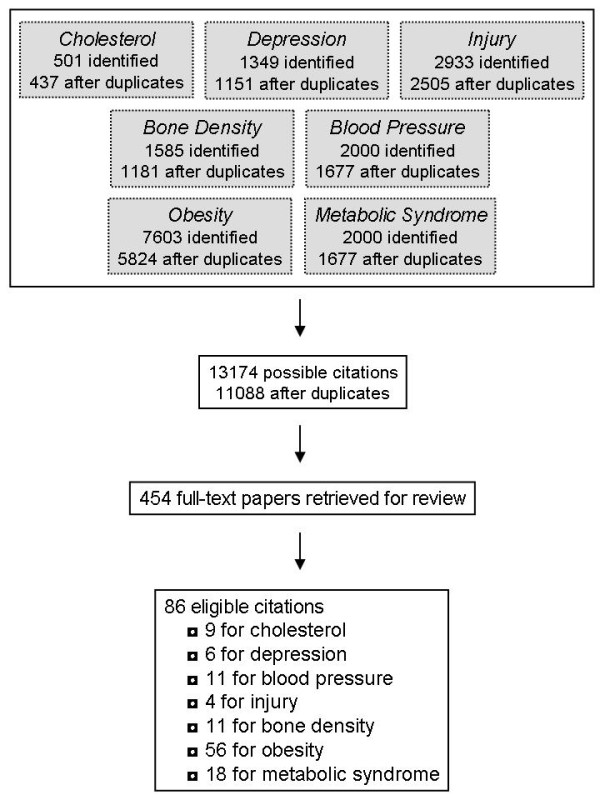
- After duplicates, 11,088 unique citations were screened; 454 full-text articles were reviewed; 86 unique citations met eligibility and 113 outcomes were abstracted. Observational studies had to report dichotomous outcomes; intervention studies were excluded if they included dietary or other behavioral components that could independently affect outcomes.
- Evidence was graded using pre-specified criteria based on quantity/quality of studies and strength of effect; meta-analyses were performed when at least 4 studies were available. RCT quality was assessed with the Downs and Black checklist, and effect sizes used Cohen’s d and ratio-score criteria.
Limitations
- Stated: unpublished and non-English studies were excluded, no extensive cross-referencing of reference lists was performed, the review was limited to 7 health outcomes, and many observational studies were excluded because they did not report dichotomous outcomes; these may have biased results and recommendations.
- Stated RCT limitations: samples were small and non-representative, statistical power was often lacking, adverse events were rarely reported, dropout details were limited, and intent-to-treat analyses were not performed; therefore Level 2 was the highest level assignable to any recommendation.
- Evident from the text: the nature of dose-response relations (linear vs curvilinear) often remained unclear, and the moderating effects of age and sex were not systematically addressed across outcomes.
Model-written summary. Check it against the paper before relying on it.
Integrity signals
Registry
Cites
Statistics
Figures
Verification
Claims the paper makes
0 Valid · 0 Not valid · 42 Not checked · 127 Own results and interpretations
A result the paper reports from its own data — it cites no other source for it, so there is none to check. The quote shows it is in the paper.
In the paper
“Results from experimental studies indicate that even modest amounts of physical activity can have health benefits in high-risk youngsters (e.g., obese).”
§ Systematic review of the health benefits of physical activity and fitness in school-aged children and youth > Abstract > Results
hedgedstates a cause- Asserted: passes — The authors put it forward as true.
- Checkable: passes — It can be checked against evidence.
- Load-bearing: passes — The paper’s conclusions depend on it.
- Based: passes — The paper gives a reason why it holds.
A result the paper reports from its own data — it cites no other source for it, so there is none to check. The quote shows it is in the paper.
In the paper
“Physical activity was associated with numerous health benefits.”
§ Systematic review of the health benefits of physical activity and fitness in school-aged children and youth > Abstract > Results
plainstates an association- Asserted: passes — The authors put it forward as true.
- Checkable: passes — It can be checked against evidence.
- Load-bearing: passes — The paper’s conclusions depend on it.
- Based: passes — The paper gives a reason why it holds.
A result the paper states — it cites no source for it, so there is none to check. The quote shows it is in the paper.
In the paper
“Aerobic-based activities had the greatest health benefit, other than for bone health, in which case high-impact weight bearing activities were required.”
§ Systematic review of the health benefits of physical activity and fitness in school-aged children and youth > Abstract > Results
plainstates an association- Asserted: passes — The authors put it forward as true.
- Checkable: passes — It can be checked against evidence.
- Load-bearing: passes — The paper’s conclusions depend on it.
- Based: passes — The paper gives a reason why it holds.
A result the paper reports from its own data — it cites no other source for it, so there is none to check. The quote shows it is in the paper.
In the paper
“The dose-response relations observed in observational studies indicate that the more physical activity, the greater the health benefit.”
§ Systematic review of the health benefits of physical activity and fitness in school-aged children and youth > Abstract > Results
hedgedstates an association- Asserted: passes — The authors put it forward as true.
- Checkable: passes — It can be checked against evidence.
- Load-bearing: passes — The paper’s conclusions depend on it.
- Based: passes — The paper gives a reason why it holds.
None of the sources cited for this claim have been checked yet.
In the paper
“The results indicated that unfit girls, defined as the lowest 20% fit, were 1.89 (95% confidence interval: 1.12-3.17) times more likely to have hypercholesterolemia and 1.03 (0.74-1.43) times more likely to have a low HDL-cholesterol by comparison to moderately and high fit girls.”
§ Systematic review of the health benefits of physical activity and fitness in school-aged children and youth > Results > Cholesterol and blood lipids
hedgedstates an associationn = 3,110- Asserted: passes — The authors put it forward as true.
- Checkable: passes — It can be checked against evidence.
- Load-bearing: passes — The paper’s conclusions depend on it.
- Based: passes — The paper gives a reason why it holds.
103 more claims
Create a free account to see all 169 claims and every source verdict.
- Probably not a substantial claim. 26
- The quote only partly states this claim. 2
- It may state two separate claims as one. 37
Claims other papers make about this one
Each is checked against this paper’s own text: does it say what the citing paper says it does?
The source backs part of the claim, not all of it — or backs it for a different population, condition or comparison.
In the citing paper
“Research indicates that those who are physically active show or report better overall physical and mental health, a higher level of fitness and a lower level of obesity than their sedentary or physically inactive counterparts1–4”
From Physical activity and health in Chinese children and adolescents: expert consensus statement (2020) (2020) · cites this paper as [2]
Experimental — accuracy not yet measuredThe cited source says what the claim attributes to it.
In the citing paper
“The association with overweight/obesity tends to be stronger when moderate to vigorous-intensity physical activities are performed.2”
From Physical activity and health in Chinese children and adolescents: expert consensus statement (2020) (2020) · cites this paper as [2]
The cited source says what the claim attributes to it.
In the citing paper
“Among physical activity interventions, the effects of physical activity independent of dietary changes on measures indicative of weight reduction (eg, BMI, total fat, abdominal fat) tend to be in the small range.2”
From Physical activity and health in Chinese children and adolescents: expert consensus statement (2020) (2020) · cites this paper as [2]
The cited source says what the claim attributes to it.
In the citing paper
“In general, as the level of physical activity increases, the likelihood of injury increases.2”
From Physical activity and health in Chinese children and adolescents: expert consensus statement (2020) (2020) · cites this paper as [2]
The cited source says what the claim attributes to it.
In the citing paper
“Systematic reviews have shown that physical activity (PA) is associated with greater mental health, 6 and a reduced risk of mental ill-health, specifically depression and anxiety.7,8”
From Domain-Specific Physical Activity and Mental Health: A Meta-analysis (2017) · cites this paper as [8]
2 more claims about this paper
Create a free account to see every claim other papers make about this one.
Self-check
Percentages, sums and reported differences re-computed from the paper’s own numbers.
Each contradiction between two passages listed here was confirmed by an independent check.
Rated major: it would touch a result — a value a result rests on, reported and recomputed p-values on opposite sides of the significance level, two passages that conflict with no sign which is right, or a cited work retracted before this paper was published.
In the paper
§ Systematic review of the health benefits of physical activity and fitness in school-aged children and youth > Discussion > Recommendations based on systematic review
“More vigorous intensity activities should be incorporated or added when possible, including activities that strengthen muscle and bone. [Level 3, Grade B].”
§ Systematic review of the health benefits of physical activity and fitness in school-aged children and youth > Discussion > Recommendations based on systematic review
“This recommendation was given a lower grade (Grade C) because of the potential increase in injury risk associated with more vigorous intensity activities and sports.”
Rated minor: it would not touch a result — a value no result rests on, a p-value that stays on the same side of the significance level, or a conflict that is clerical, resolved elsewhere in the paper, or outside its own findings.
In the paper
§ Systematic review of the health benefits of physical activity and fitness in school-aged children and youth > Results > Metabolic syndrome
“Sixteen articles examining the metabolic syndrome met the inclusion criteria.”
§ Systematic review of the health benefits of physical activity and fitness in school-aged children and youth > Results > Metabolic syndrome
“Eight of the 17 identified studies were observational in nature”
Rated minor: it would not touch a result — a value no result rests on, a p-value that stays on the same side of the significance level, or a conflict that is clerical, resolved elsewhere in the paper, or outside its own findings.
In the paper
“A total of 31 observational studies (24 cross-sectional, 3 prospective cohort, 2 case-control, 1 mixed) were retrieved”
§ Systematic review of the health benefits of physical activity and fitness in school-aged children and youth > Results > Overweight and obesity
Reported 31 · recomputed 30
Rated minor: it would not touch a result — a value no result rests on, a p-value that stays on the same side of the significance level, or a conflict that is clerical, resolved elsewhere in the paper, or outside its own findings.
In the paper
“437 citations were identified for cholesterol, 1151 for depression, 2505 for injury, 1181 for bone density, 1677 for blood pressure, 5824 for obesity, and 1677 for the metabolic syndrome. Thus, the grand total was 13174.”
§ Systematic review of the health benefits of physical activity and fitness in school-aged children and youth > Results > Literature review
Reported 13174 · recomputed 14452
Citations
Cites
Downs, S. H., & Black, N. (1998) · Journal of Epidemiology and Community Health · doi:10.1136/jech.52.6.377 · Cited by 8,252
Evidence Based Physical Activity for School-age Youth
Strong, W. B., Malina, R. M., Blimkie, C. J. R., Daniels, S. R., Dishman, R. K., Gutin, B., Hergenroeder, A. C., Must, A., Nixon, P. A., Pivarnik, J. M., et al. (2005) · The Journal of Pediatrics · doi:10.1016/j.jpeds.2005.01.055 · Cited by 4,222
Systematic Reviews: Synthesis of Best Evidence for Clinical Decisions
Cook, D. J., Mulrow, C. D., & Haynes, R. B. (1997) · Annals of Internal Medicine · doi:10.7326/0003-4819-126-5-199703010-00006 · Cited by 2,184
Andersen, L. B., Harro, M., Sardinha, L. B., Froberg, K., Ekelund, U., Brage, S., & Anderssen, S. A. (2006) · The Lancet · doi:10.1016/s0140-6736(06)69075-2 · Cited by 1,473
Lau, D. C. W., Douketis, J. D., Morrison, K. M., Hramiak, I. M., Sharma, A. M., Ur, E., & Panel, F. M. O. T. O. C. C. P. G. E. (2007) · Canadian Medical Association Journal · doi:10.1503/cmaj.061409 · Cited by 1,154
Paterson, D. H., & Warburton, D. E. (2010) · International Journal of Behavioral Nutrition and Physical Activity · doi:10.1186/1479-5868-7-38 · Cited by 953
A systematic review of the evidence for Canada's Physical Activity Guidelines for Adults
Warburton, D. E., Charlesworth, S., Ivey, A., Nettlefold, L., & Bredin, S. S. (2010) · International Journal of Behavioral Nutrition and Physical Activity · doi:10.1186/1479-5868-7-39 · Cited by 902 · cited 1×
“This report was part of a much larger project around Canada's physical activity guidelines, and comparable systematic reviews for adults [ 10 ] and older adults [11] have also been published in the journal.”
A meta-regression to examine the relationship between aerobic fitness and cognitive performance
Etnier, J. L., Nowell, P. M., Landers, D. M., & Sibley, B. A. (2006) · Brain Research Reviews · doi:10.1016/j.brainresrev.2006.01.002 · Cited by 749
Is the Canadian childhood obesity epidemic related to physical inactivity?
Tremblay, M. S., & Willms, J. D. (2003) · International Journal of Obesity · doi:10.1038/sj.ijo.0802376 · Cited by 517
Nassis, G. P., Papantakou, K., Skenderi, K., Triandafillopoulou, M., Kavouras, S. A., Yannakoulia, M., Chrousos, G. P., & Sidossis, L. S. (2005) · Metabolism · doi:10.1016/j.metabol.2005.05.013 · Cited by 469
Research works printed but not linked: 1
- Petitti DB Meta-Analysis, Decision Analysis, and Cost-Effective Analysis 1994 New York, NY: Oxford University Press
Cited by
Items 501–600 of 4,834
Ruivo, R., Carita, A. I., & Pezarat‐Correia, P. (2015) · Manual Therapy · doi:10.1016/j.math.2015.05.001 · Cited by 104
Leptokaridou, E. T., Vlachopoulos, S. P., & Papaioannou, A. G. (2016) · Educational Psychology · doi:10.1080/01443410.2014.950195 · Cited by 67
Mackintosh, K. A., Chappel, S. E., Salmon, J., Timperio, A. F., Ball, K., Brown, H. L., Macfarlane, S., & Ridgers, N. D. (2019) · JMIR mhealth and uhealth · doi:10.2196/13858 · Cited by 78
“Physical activity during childhood plays a critical role in reducing cardiometabolic risk factors, which are associated with long-term health [2].”
BackgroundErfle, S. E., & Gamble, A. (2014) · Journal of School Health · doi:10.1111/josh.12217 · Cited by 85
Rößler, R., Verhagen, E. A. L. M., Rommers, N., Dvořák, J., Junge, A., Lichtenstein, E., Donath, L., & Faude, O. (2018) · British Journal of Sports Medicine · doi:10.1136/bjsports-2018-099395 · Cited by 82
Wang, Y., & Wang, X. (2024) · Frontiers in Public Health · doi:10.3389/fpubh.2024.1484848 · Cited by 151
Peterson, J. L., Puhl, R. M., & Luedicke, J. (2012) · Journal of School Health · doi:10.1111/j.1746-1561.2012.00719.x · Cited by 67
Physical fitness in preschool children: association with sex, age and weight status
Román, P. Á. L., del Castillo, R. M., Zurita, M. L., Sánchez, J. S., García‐Pinillos, F., & López, D. M. (2016) · Child Care Health and Development · doi:10.1111/cch.12404 · Cited by 79
Too hot to move? Objectively assessed seasonal changes in Australian children’s physical activity
Ridgers, N. D., Salmon, J., & Timperio, A. F. (2015) · International Journal of Behavioral Nutrition and Physical Activity · doi:10.1186/s12966-015-0245-x · Cited by 75
Garriguet, D., & Colley, R. C. (2014) · PubMed · Cited by 84
The Case for Vigorous Physical Activity in Youth
Owens, S., Galloway, R., & Gutin, B. (2016) · American Journal of Lifestyle Medicine · doi:10.1177/1559827615594585 · Cited by 85
Contextualizing physical literacy in the school environment: The challenges
Castelli, D. M., Barcelona, J., & Bryant, L. J. (2015) · Journal of sport and health science/Journal of Sport and Health Science · doi:10.1016/j.jshs.2015.04.003 · Cited by 104
Sigmundová, D., Sigmund, E., Hamřík, Z., & Kalman, M. (2013) · European Journal of Public Health · doi:10.1093/eurpub/ckt085 · Cited by 77
Children’s independent mobility in the City of Toronto, Canada
Buliung, R. N., Larsen, K., Faulkner, G., & Ross, T. (2017) · Travel Behaviour and Society · doi:10.1016/j.tbs.2017.06.001 · Cited by 72
Solomon-Moore, E., Toumpakari, Z., Sebire, S. J., Thompson, J. L., Lawlor, D. A., & Jago, R. (2018) · BMJ Open · doi:10.1136/bmjopen-2017-019732 · Cited by 85
Peralta, L. R., Mihrshahi, S., Bellew, B., Reece, L. J., & Hardy, L. L. (2019) · Journal of School Health · doi:10.1111/josh.12761 · Cited by 85
Active Video Games in Schools and Effects on Physical Activity and Health: A Systematic Review
Norris, E., Hamer, M., & Stamatakis, E. (2016) · The Journal of Pediatrics · doi:10.1016/j.jpeds.2016.02.001 · Cited by 66
D’Haese, S., Dyck, D. V., Bourdeaudhuij, I. D., Deforche, B. I., & Cardon, G. (2015) · International Journal of Behavioral Nutrition and Physical Activity · doi:10.1186/s12966-015-0171-y · Cited by 86
“Physical activity is associated with numerous health benefits in children [1].”
BackgroundOliveira, R. S., BARKER, A. R., Wilkinson, K., Abbott, R. A., & Williams, C. A. (2017) · International Journal of Cardiology · doi:10.1016/j.ijcard.2017.02.022 · Cited by 73
A Bit of Fit: Minimalist Intervention in Adolescents Based on a Physical Activity Tracker
Gaudet, J., Gallant, F., & Bélanger, M. (2017) · JMIR mHealth and uHealth · doi:10.2196/mhealth.7647 · Cited by 66
Buttery, S. C., Zysman, M., Vikjord, S. A. A., Hopkinson, N. S., Jenkins, C. R., & Vanfleteren, L. E. G. W. (2021) · Respirology · doi:10.1111/resp.14032 · Cited by 88
Omorou, A. Y., Langlois, J., Lecomte, E., Briançon, S., & Vuillemin, A. (2015) · Quality of Life Research · doi:10.1007/s11136-015-1172-7 · Cited by 77
the SOPHYA Study Group, Bringolf‐Isler, B., Schindler, C., Kayser, B., Suggs, L. S., & Probst-Hensch, N. M. (2018) · BMC Public Health · doi:10.1186/s12889-018-5949-9 · Cited by 78
Dickinson, K., & Place, M. (2014) · Autism Research and Treatment · doi:10.1155/2014/419653 · Cited by 88
Shull, E. R., Dowda, M. C., Saunders, R. P., McIver, K. L., & Pate, R. R. (2019) · Journal of science and medicine in sport · doi:10.1016/j.jsams.2019.10.017 · Cited by 74
Mnich, C., Weyland, S., Jekauc, D., & Schipperijn, J. (2019) · International Journal of Environmental Research and Public Health · doi:10.3390/ijerph16214266 · Cited by 65
Exercise addiction and its related factors in amateur runners
Lukács, A., Sasvári, P., Varga, B., & Mayer, K. (2019) · Journal of Behavioral Addictions · doi:10.1556/2006.8.2019.28 · Cited by 82
Martin, R., & Murtagh, E. (2015) · Teaching and Teacher Education · doi:10.1016/j.tate.2015.09.007 · Cited by 100
Hincapié, C. A., & Cassidy, J. D. (2010) · Archives of Physical Medicine and Rehabilitation · doi:10.1016/j.apmr.2010.07.230 · Cited by 79
Martínez-Vizcaíno, V., Sánchez-López, M., Notario-Pacheco, B., Salcedo-Aguilar, F., Solera-Martínez, M., Franquelo-Morales, P., López-Martínez, S., García-Prieto, J. C., Arias-Palencia, N., Torrijos-Niño, C., et al. (2014) · International Journal of Behavioral Nutrition and Physical Activity · doi:10.1186/s12966-014-0154-4 · Cited by 64
Children With ADHD Engage in Less Physical Activity
Mercurio, L. Y., Amanullah, S., Gill, N., & Gjelsvik, A. (2019) · Journal of Attention Disorders · doi:10.1177/1087054719887789 · Cited by 84
Hyper-parenting is negatively associated with physical activity among 7–12 year olds
Janssen, I. (2015) · Preventive Medicine · doi:10.1016/j.ypmed.2015.01.015 · Cited by 76
Self-citationDoes playing a sports active video game improve young children's ball skill competence?
Johnson, T. M., Ridgers, N. D., Hulteen, R. M., Mellecker, R. R., & Barnett, L. M. (2015) · Journal of science and medicine in sport · doi:10.1016/j.jsams.2015.05.002 · Cited by 85
Marques, A., Minderico, C., Martins, S., Palmeira, A., Ekelund, U., & Sardinha, L. B. (2016) · International Journal of Obesity · doi:10.1038/ijo.2015.168 · Cited by 64
Smith, J. J., Morgan, P. J., Plotnikoff, R. C., Dally, K. A., Salmon, J., Okely, A. D., Finn, T. L., Babic, M. J., Skinner, G., & Lubans, D. R. (2014) · Contemporary Clinical Trials · doi:10.1016/j.cct.2013.11.008 · Cited by 64
Bogataj, Š., Trajković, N., Cadenas‐Sánchez, C., & Sember, V. (2021) · Nutrients · doi:10.3390/nu13010238 · Cited by 94
Predictors of stationary cycling exergame use among inactive children in the family home
Rhodes, R. E., Beauchamp, M. R., Blanchard, C. M., Bredin, S. S. D., Warburton, D. E. R., & Maddison, R. (2018) · Psychology of sport and exercise · doi:10.1016/j.psychsport.2018.03.009 · Cited by 67
BMI and recommended levels of physical activity in school children
Schwarzfischer, P., Weber, M., Gruszfeld, D., Socha, P., Luque, V., Escribano, J., Xhonneux, A., Verduci, E., Mariani, B., Koletzko, B. V., et al. (2017) · BMC Public Health · doi:10.1186/s12889-017-4492-4 · Cited by 82
Miller, N. C., Kumar, S., Pearce, K. L., & Baldock, K. L. (2021) · Environmental Education Research · doi:10.1080/13504622.2021.1921117 · Cited by 105
Cohen, K. E., Morgan, P. J., Plotnikoff, R. C., Barnett, L. M., & Lubans, D. R. (2015) · Journal of Sports Sciences · doi:10.1080/02640414.2015.1017734 · Cited by 83
Linear/Nonlinear Relations of Activity and Fitness with Children’s Academic Achievement
HANSEN, D. M., HERRMANN, S. D., LAMBOURNE, K., LEE, J., & DONNELLY, J. E. (2014) · Medicine & Science in Sports & Exercise · doi:10.1249/mss.0000000000000362 · Cited by 63
The physical activity of children and adolescents in Germany 2003-2017: The MoMo-study
Schmidt, S., Anedda, B., Burchartz, A., Oriwol, D., Kolb, S., Wäsche, H., Niessner, C., & Wöll, A. (2020) · PLoS ONE · doi:10.1371/journal.pone.0236117 · Cited by 81
Laxer, R. E., & Janssen, I. (2013) · International Journal of Health Geographics · doi:10.1186/1476-072x-12-31 · Cited by 74
Self-citationHolman, R. M., Carson, V., & Janssen, I. (2011) · PLoS ONE · doi:10.1371/journal.pone.0025733 · Cited by 94
“Nonetheless, we are confident that the MVPA variables proceeded the CRS outcome in our study because previous prospective cohort and randomized controlled trails have reported similar relationships [1,29],_ENREF_29 and because the associations observed in our study were strong, followed clear dose-response patterns, a…”
BackgroundResultSelf-citationA Comparison Study of Classifier Algorithms for Cross-Person Physical Activity Recognition
Sáez, Y., Baldominos, A., & Isasi, P. (2016) · Sensors · doi:10.3390/s17010066 · Cited by 77
Lee, Y. H., Richards, K. A. R., & Washburn, N. S. (2021) · European Review of Applied Psychology · doi:10.1016/j.erap.2021.100625 · Cited by 82
Miller, A. A., Christensen, E., Eather, N., Sproule, J., Annis-Brown, L., & Lubans, D. R. (2015) · Preventive Medicine · doi:10.1016/j.ypmed.2015.02.002 · Cited by 73
Castillo, I., Molina‐García, J., Estevan, I., Queralt, A., & Álvarez, O. (2020) · International Journal of Environmental Research and Public Health · doi:10.3390/ijerph17134844 · Cited by 99
Meta-Analysis of Physical Activity Levels in Youth With and Without Disabilities
Jung, J., Leung, W. C. W., Schram, B. M., & Yun, J. (2018) · Adapted Physical Activity Quarterly · doi:10.1123/apaq.2017-0123 · Cited by 82
Development and validation of the short-form adolescent health promotion scale
Chen, M., Lai, L.-J., Chen, H.-C., & Gaete, J. (2014) · BMC Public Health · doi:10.1186/1471-2458-14-1106 · Cited by 77
Lin, H. T., Chen, H., Liu, Q., Xu, J., & Li, S. (2024) · Frontiers in Psychology · doi:10.3389/fpsyg.2023.1305425 · Cited by 115
Stewart, T. I., Duncan, S., & Schipperijn, J. (2016) · Health & Place · doi:10.1016/j.healthplace.2016.11.009 · Cited by 71
Fernández-Espínola, C., Almagro, B. J., Tamayo-Fajardo, J. A., & Buñuel, P. S.-L. (2020) · Frontiers in Psychology · doi:10.3389/fpsyg.2020.01535 · Cited by 108
van Woudenberg, T. J., Bevelander, K. E., Burk, W. J., Smit, C. R., Buijs, L., & Buijzen, M. (2018) · BMC Public Health · doi:10.1186/s12889-018-5451-4 · Cited by 64
Urban greenery, active school transport, and body weight among Hong Kong children
Yang, Y., Lü, Y., Yang, L., Gou, Z., & Zhang, X. (2020) · Travel Behaviour and Society · doi:10.1016/j.tbs.2020.03.001 · Cited by 73
Effects of home‐based exergaming on child social cognition and subsequent prediction of behavior
Rhodes, R. E., Kaos, M., Beauchamp, M. R., Bursick, S. K., Latimer‐Cheung, A. E., Hernández, H. A., Warburton, D. E. R., Ye, Z., & Graham, T. C. N. (2018) · Scandinavian Journal of Medicine and Science in Sports · doi:10.1111/sms.13225 · Cited by 63
Perceptual Responses to High- and Moderate-Intensity Interval Exercise in Adolescents
Malik, A., Williams, C. A., Weston, K. L., & BARKER, A. R. (2017) · Medicine & Science in Sports & Exercise · doi:10.1249/mss.0000000000001508 · Cited by 68
“interval) manner (15), and there is strong evidence showing time spent performing moderate and vigorous physical activity is related to health benefits in this population (16).”
BackgroundBell, C., Finch, M., Wolfenden, L., Fitzgerald, M., Morgan, P. J., Jones, J. Z., Freund, M., & Wiggers, J. (2015) · Australian and New Zealand Journal of Public Health · doi:10.1111/1753-6405.12314 · Cited by 66
Schneller, M. B., Duncan, S., Schipperijn, J., Nielsen, G., Mygind, E., & Bentsen, P. (2017) · BMC Public Health · doi:10.1186/s12889-017-4430-5 · Cited by 79
Summer Weight Gain and Fitness Loss: Causes and Potential Solutions
Weaver, R. G., Beets, M. W., Brazendale, K., & Brusseau, T. A. (2018) · American Journal of Lifestyle Medicine · doi:10.1177/1559827617750576 · Cited by 71
Heradstveit, O., Haugland, S., Hysing, M., Stormark, K. M., Sivertsen, B., & Bøe, T. (2020) · BMC Public Health · doi:10.1186/s12889-020-09141-2 · Cited by 79
Kessaram, T., McKenzie, J., Girin, N., Merilles, O. E. A., Pullar, J., Roth, A., White, P., & Hoy, D. (2015) · BMC Obesity · doi:10.1186/s40608-015-0062-4 · Cited by 61
Wang, L., Tang, Y., & Luo, J. (2017) · Journal of Sport and Health Science · doi:10.1016/j.jshs.2017.09.001 · Cited by 61
Gräf, C., Beneke, R., Bloch, W., Bucksch, J., Dordel, S., Eiser, S., Ferrari, N., Koch, B., Krug, S., Lawrenz, W., et al. (2014) · Obesity Facts · doi:10.1159/000362485 · Cited by 86
Hamer, M., Aggio, D., Knock, G., Kipps, C., Shankar, A., & Smith, L. (2017) · BMC Public Health · doi:10.1186/s12889-017-4483-5 · Cited by 81
Yu, S., Wang, T., Zhong, T., Qian, Y., & Qi, J. (2022) · Healthcare · doi:10.3390/healthcare10020233 · Cited by 94
Physical activity and sport participation: A systematic review of the impact of fatherhood
Pot, N., & Keizer, R. (2016) · Preventive Medicine Reports · doi:10.1016/j.pmedr.2016.05.018 · Cited by 64
“Physical activity, including sport participation, is an important component of a healthy lifestyle (Bauman, 2004; Janssen and LeBlanc, 2010; WHO, 2010).”
BackgroundJanssen, I. (2014) · Preventive Medicine · doi:10.1016/j.ypmed.2014.06.016 · Cited by 73
Self-citationDeterminants of eating patterns and nutrient intake among adolescent athletes: a systematic review
Noll, M., de Mendonça, C. R., de Souza Rosa, L. P., & Silveira, E. A. (2017) · Nutrition Journal · doi:10.1186/s12937-017-0267-0 · Cited by 60
Marques, A., Calmeiro, L., Loureiro, N., Frasquilho, D., & de Matos, M. G. (2015) · Journal of Adolescence · doi:10.1016/j.adolescence.2015.07.018 · Cited by 82
Marques, A., Demetriou, Y., Tesler, R., Gouveia, É. R., Peralta, M., & de Matos, M. G. (2019) · International Journal of Environmental Research and Public Health · doi:10.3390/ijerph16183292 · Cited by 69
“ Girls should cook, rather than kick! ” – Female soccer players under stereotype threat
Hermann, J. M., & Vollmeyer, R. (2016) · Psychology of sport and exercise · doi:10.1016/j.psychsport.2016.06.010 · Cited by 68
The Forest School impact on children: reviewing two decades of research
Dabaja, Z. F. (2021) · Education 3-13 · doi:10.1080/03004279.2021.1889013 · Cited by 85
Huppertz, C., Bartels, M., de Zeeuw, E. L., van Beijsterveldt, C. E. M., Hudziak, J. J., Willemsen, G. A. H. M., Boomsma, D. I., & de Geus, E. J. C. (2016) · Behavior Genetics · doi:10.1007/s10519-016-9799-x · Cited by 67
Social climate profiles in adolescent sports: Associations with enjoyment and intention to continue
Gardner, L. A., Magee, C., & Vella, S. A. (2016) · Journal of Adolescence · doi:10.1016/j.adolescence.2016.08.003 · Cited by 86
Denton, S. J., Trenell, M. I., Plötz, T., Savory, L. A., Bailey, D. P., & Kerr, C. J. (2013) · PLoS ONE · doi:10.1371/journal.pone.0061073 · Cited by 83
“Pursuing a physically active lifestyle is positively associated with many physiological and psychological health benefits [6] but engagement in this behaviour is low in children, with a large percentage of both boys and girls (67% and 79%, respectively) aged 4–15 years not achieving the recommended…”
BackgroundObesity estimates for children based on parent-reported versus direct measures.
Shields, M. E., Gorber, S. C., Janssen, I., & Tremblay, M. S. (2011) · PubMed · Cited by 81
Self-citationCollaborators, I. C. A. D. (., Goodman, A., Page, A. S., & Cooper, A. R. (2014) · International Journal of Behavioral Nutrition and Physical Activity · doi:10.1186/1479-5868-11-84 · Cited by 66
Addressing mental health through sport: a review of sporting organizations' websites
Liddle, S. K., Deane, F. P., & Vella, S. A. (2017) · Early Intervention in Psychiatry · doi:10.1111/eip.12337 · Cited by 59
Dog walking is associated with more outdoor play and independent mobility for children
Christian, H. E., Trapp, G., Villanueva, K., Zubrick, S. R., Koekemoer, R., & Giles‐Corti, B. (2014) · Preventive Medicine · doi:10.1016/j.ypmed.2014.08.002 · Cited by 66
Parental physical activity, safety perceptions and children’s independent mobility
Santos, M. P., Pizarro, A. I. N., Mota, J. A. P. S., & Marques, E. A. (2013) · BMC Public Health · doi:10.1186/1471-2458-13-584 · Cited by 77
Adherence to the obesity-related lifestyle intervention targets in the IDEFICS study
on behalf of the IDEFICS consortium, Kovács, E., Siani, A., Konstabel, K., Hadjigeorgiou, C., de Bourdeaudhuij, I., Eiben, G., Lissner, L., Gwozdz, W., Reisch, L., et al. (2014) · International Journal of Obesity · doi:10.1038/ijo.2014.145 · Cited by 59
Lohman, T. G., Hingle, M. D., & Going, S. B. (2013) · Pediatric Exercise Science · doi:10.1123/pes.25.4.573 · Cited by 76
Family Structure as a Correlate of Organized Sport Participation among Youth
McMillan, R., McIsaac, M., & Janssen, I. (2016) · PLOS ONE · doi:10.1371/journal.pone.0147403 · Cited by 58
Self-citationAsh, T., Bowling, A., Davison, K., & Garcia, J. (2017) · Journal of Developmental & Behavioral Pediatrics · doi:10.1097/dbp.0000000000000452 · Cited by 59
Morton, K., Corder, K. L., Suhrcke, M., Harrison, F., Jones, A., van Sluijs, E. M. F., & Atkin, A. J. (2016) · International Journal of Behavioral Nutrition and Physical Activity · doi:10.1186/s12966-016-0378-6 · Cited by 67
Effects of Child Care Intervention on Physical Activity and Body Composition
Goldfield, G. S., Dingwall‐Harvey, A. L. J., Grattan, K. P., Temple, V. A., Naylor, P., Alberga, A. S., Ferraro, Z. M., Wilson, S., Cameron, J. D., Barrowman, N. J., et al. (2016) · American Journal of Preventive Medicine · doi:10.1016/j.amepre.2016.03.024 · Cited by 66
Levels of physical activity during physical education lessons in Sweden
Fröberg, A., Raustorp, A., Pagels, P., Larsson, C. L., & Boldemann, C. (2016) · Acta Paediatrica · doi:10.1111/apa.13551 · Cited by 67
Media Use Among Children and Adolescents with Autism Spectrum Disorder: a Systematic Review
Stiller, A., & Mößle, T. (2018) · Review Journal of Autism and Developmental Disorders · doi:10.1007/s40489-018-0135-7 · Cited by 73
Haapala, E. (2012) · Baltic Journal of Health and Physical Activity · doi:10.2478/v10131-012-0007-y · Cited by 58
García-Hermoso, A., Saavedra, J. M., Escalante, Y., Sánchez-López, M., & Martínez-Vizcaíno, V. (2014) · European Journal of Endocrinology · doi:10.1530/eje-14-0291 · Cited by 58
Vella, S. A., Schranz, N. K., Davern, M. T., Hardy, L. L., Hills, A. P., Morgan, P. J., Plotnikoff, R. C., & Tomkinson, G. R. (2015) · Journal of science and medicine in sport · doi:10.1016/j.jsams.2015.04.011 · Cited by 76
School-Based Health Promotion and Physical Activity During and After School Hours
Vander Ploeg, K. A., McGavock, J., Maximova, K., & Veugelers, P. J. (2014) · Pediatrics · doi:10.1542/peds.2013-2383 · Cited by 58
Chung, J. O. K., Li, W. H. C., Chiu, S. Y., Ho, K. Y., & López, V. (2013) · Cancer Nursing · doi:10.1097/ncc.0b013e3182980255 · Cited by 64
Parental Perceptions of Physical Activity Benefits for Youth With Developmental Disabilities
Pitchford, E. A., Siebert, E. A., Hamm, J. L., & Yun, J. (2015) · American Journal on Intellectual and Developmental Disabilities · doi:10.1352/1944-7558-121.1.25 · Cited by 69
“Some health benefits of physical activity may also be possible with an average of 30 min of physical activity per day (Janssen & LeBlanc, 2010).”
BackgroundChildren, Young people and Mobility as a Service: Opportunities and barriers for future mobility
Gairal‐Casadó, R., Golightly, D., Laing, K., Palacín, R., & Todd, L. (2020) · Transportation Research Interdisciplinary Perspectives · doi:10.1016/j.trip.2020.100107 · Cited by 85
Holt, A.-D., Smedegaard, S., Pawlowski, C. S., Skovgaard, T., & Christiansen, L. B. (2018) · European Physical Education Review · doi:10.1177/1356336x18758353 · Cited by 80
Moving outdoors: further explorations of ‘child-initiated’ learning in the outdoor environment
Maynard, T., Waters, J., & Clement, J. A. (2011) · Education 3-13 · doi:10.1080/03004279.2011.578750 · Cited by 91
Murtagh, E., Mulvihill, M., & Markey, O. (2013) · Pediatric Exercise Science · doi:10.1123/pes.25.2.300 · Cited by 58
Helbich, M. (2016) · International Journal of Sustainable Transportation · doi:10.1080/15568318.2016.1275892 · Cited by 64
Metadata
- Authors
- Janssen, I., & LeBlanc, A. G.
- Affiliations
- Queen's University (CA)
- Corresponding author
- Janssen, Ian
- Venue
- International Journal of Behavioral Nutrition and Physical Activity
- Published
- 2010
- Volume
- 7
- Issue
- 1
- Pages
- 40
- ISSN
- 1479-5868 (ISSN-L)
- PMC
- PMC2885312
- OpenAlex
- W2145702257
- Semantic Scholar
- ef8d55efd11b9d5e4a4814b6a38ff3d60d820d37
- Cited by
- 4,829
- References
- 116
- Citations by year
- 2026: 185 · 2025: 257 · 2024: 310 · 2023: 304 · 2022: 371 · 2021: 451 · 2020: 459 · 2019: 401 · 2018: 387 · 2017: 490 · 2016: 302 · 2015: 280 · 2014: 250 · 2013: 191 · 2012: 109
- FWCI
- 12.18
- Type
- journal article
- Language
- en
- Open access
- gold
- doi.org
- Licence
- cc-by
- Locations
- International Journal of Behavioral Nutrition and Physical Activity (publishedVersion, cc-by)
- PubMed Central (publishedVersion, cc-by)
- PubMed (publishedVersion)
- DOAJ (DOAJ: Directory of Open Access Journals) (submittedVersion, cc-by-sa)
- Funders
- Public Health Agency of Canada
- Public Health Agency
- Topics
- Health Sciences › Medicine › Public Health, Environmental and Occupational Health › Physical Activity and Health
- Health Sciences › Medicine › Public Health, Environmental and Occupational Health › Obesity, Physical Activity, Diet
- Social Sciences › Life-span and Life-course Studies › Recreational Sport and Physical Activity
- Keywords
- physical activity, physical fitness, school-aged children, youth, health benefits, serum cholesterol, blood pressure, metabolic syndrome, childhood obesity, bone mineral density, depression, injuries, dose-response relationship, aerobic exercise, physical activity guidelines
About these checks
Registry, retraction, Cites and statistics results are computed, not judged, with one exception: a printed reference that no index lists is read once by a model before it counts as a citation error. Claims are extracted by a model and kept only when their quote appears verbatim in the text; each cited source is then checked, with a model’s help, for whether it says what the claim relies on. Those verdicts can be wrong — read the claim’s quote and the cited source before relying on one.
A language model drew the claims from the paper on 2026-10-10, under version 3 of the claim definition (model deepseek-v4.1-flash, prompt extract-v3).
A second model labelled each claim on 2026-10-10 (model jev-1.13-20260917, definition revision gold-guideline-v0.2).
Statistics and arithmetic are recomputed, not judged.
Confidence bands are shown only for fields calibrated on our annotated test set. None is calibrated yet, so no band is shown.
What counts as a claim ›How we measure confidence ›How we check this ›
Are you an author, or do you see a problem with this page? Request a review
Data sources
Bibliographic data: Semantic Scholar, OpenAlex, Crossref.
Contains information from the Semantic Scholar Academic Graph Datasets, made available under the ODC Attribution License (ODC-BY 1.0).
Semantic Scholar’s data is described in: Kinney, R., et al. (2023). The Semantic Scholar Open Data Platform. arXiv:2301.10140.
