

Systematic review of the health benefits of physical activity and fitness in school-aged children and youth
Open accessThe DOI matches its Crossref record; 114 of the 116 references it cites were found in a registry or an index; none of the 128 sources its claims cite is checked for support yet.
Abstract
BACKGROUND: The purpose was to: 1) perform a systematic review of studies examining the relation between physical activity, fitness, and health in school-aged children and youth, and 2) make recommendations based on the findings. METHODS: The systematic review was limited to 7 health indicators: high blood cholesterol, high blood pressure, the metabolic syndrome, obesity, low bone density, depression, and injuries. Literature searches were conducted using predefined keywords in 6 key databases. A total of 11,088 potential papers were identified. The abstracts and full-text articles of potentially relevant papers were screened to determine eligibility. Data was abstracted for 113 outcomes from the 86 eligible papers. The evidence was graded for each health outcome using established criteria based on the quantity and quality of studies and strength of effect. The volume, intensity, and type of physical activity were considered. RESULTS: Physical activity was associated with numerous health benefits. The dose-response relations observed in observational studies indicate that the more physical activity, the greater the health benefit. Results from experimental studies indicate that even modest amounts of physical activity can have health benefits in high-risk youngsters (e.g., obese). To achieve substantive health benefits, the physical activity should be of at least a moderate intensity. Vigorous intensity activities may provide even greater benefit. Aerobic-based activities had the greatest health benefit, other than for bone health, in which case high-impact weight bearing activities were required. CONCLUSION: The following recommendations were made: 1) Children and youth 5-17 years of age should accumulate an average of at least 60 minutes per day and up to several hours of at least moderate intensity physical activity. Some of the health benefits can be achieved through an average of 30 minutes per day. [Level 2, Grade A]. 2) More vigorous intensity activities should be incorporated or added when possible, including activities that strengthen muscle and bone [Level 3, Grade B]. 3) Aerobic activities should make up the majority of the physical activity. Muscle and bone strengthening activities should be incorporated on at least 3 days of the week [Level 2, Grade A].
Overview
CoChat Summary
TL;DR
This systematic review found physical activity is associated with numerous health benefits in school-aged children and youth, with observational dose-response evidence suggesting more activity yields greater benefit. It recommends an average of at least 60 minutes per day of at least moderate activity, with some benefits achievable at 30 minutes per day, plus added vigorous and muscle/bone-strengthening activities.
Key findings
- From 11,088 unique citations, 86 eligible papers yielded 113 outcomes across 7 health indicators. Physical activity was associated with benefits; observational studies showed dose-response relations, and experimental studies indicated even modest activity can benefit high-risk youngsters (e.g., obese).
- Metabolic syndrome: summary odds ratio for least active vs most active was 1.68 (95% CI 1.22–2.31) in 3 self-report studies; least fit vs most fit was 6.79 (95% CI 5.11–9.03) in 4 fitness studies. Obesity: median odds ratio was 1.33 for self-reported activity and 3.79 for objective measures. Cholesterol: unfit girls were 1.89 (1.12–3.17) times and unfit boys 3.68 (2.55–5.31) times more likely to have hypercholesterolemia than moderately/high fit peers.
- Recommendations: children and youth 5–17 years should accumulate an average of at least 60 minutes per day and up to several hours of at least moderate intensity activity; some health benefits can be achieved through an average of 30 minutes per day [Level 2, Grade A]. More vigorous activities should be incorporated when possible, including muscle- and bone-strengthening activities [Level 3, Grade B]; aerobic activities should make up the majority, with muscle and bone strengthening on at least 3 days per week [Level 2, Grade A].
- Bone: as little as 10 minutes of moderate-to-high impact activities on as little as 2 or 3 days per week can have a modest effect on bone mineral density when combined with general weight-bearing aerobic activities. Injuries: all 3 included studies reported higher injury rates in active children/youth and clear dose-response relations; vigorous sports risk estimates were high.
Methods
- Systematic review limited to 7 health indicators: high blood cholesterol, high blood pressure, metabolic syndrome, obesity, low bone density, depression, and injuries. Searches used predefined keywords in 6 databases (MEDLINE, EMBASE, CINAHL, PsycINFO, Evidence-Based Medicine Reviews, SPORTDiscus) to January 2008, limited to human participants, English language, and ages 5–17 years.
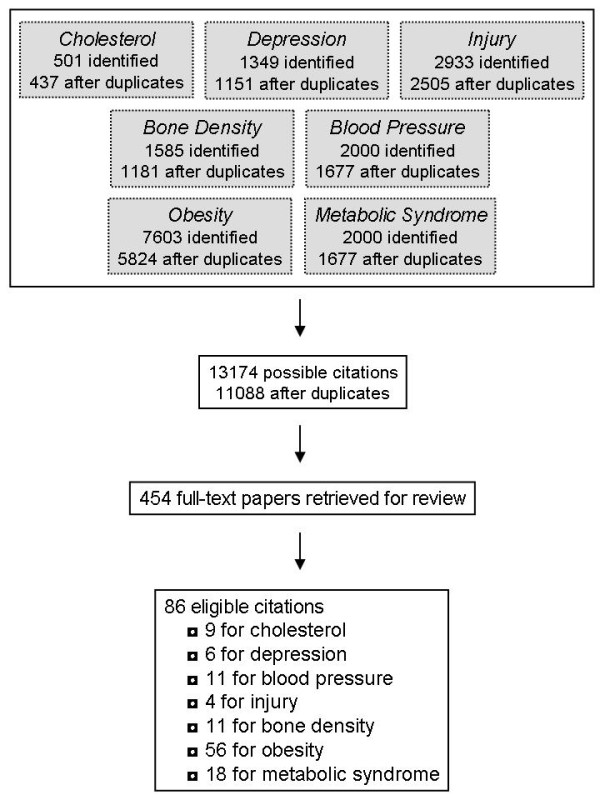
- After duplicates, 11,088 unique citations were screened; 454 full-text articles were reviewed; 86 unique citations met eligibility and 113 outcomes were abstracted. Observational studies had to report dichotomous outcomes; intervention studies were excluded if they included dietary or other behavioral components that could independently affect outcomes.
- Evidence was graded using pre-specified criteria based on quantity/quality of studies and strength of effect; meta-analyses were performed when at least 4 studies were available. RCT quality was assessed with the Downs and Black checklist, and effect sizes used Cohen’s d and ratio-score criteria.
Limitations
- Stated: unpublished and non-English studies were excluded, no extensive cross-referencing of reference lists was performed, the review was limited to 7 health outcomes, and many observational studies were excluded because they did not report dichotomous outcomes; these may have biased results and recommendations.
- Stated RCT limitations: samples were small and non-representative, statistical power was often lacking, adverse events were rarely reported, dropout details were limited, and intent-to-treat analyses were not performed; therefore Level 2 was the highest level assignable to any recommendation.
- Evident from the text: the nature of dose-response relations (linear vs curvilinear) often remained unclear, and the moderating effects of age and sex were not systematically addressed across outcomes.
Model-written summary. Check it against the paper before relying on it.
Integrity signals
Registry
Cites
Statistics
Figures
Verification
Claims the paper makes
0 Valid · 0 Not valid · 42 Not checked · 127 Own results and interpretations
A result the paper reports from its own data — it cites no other source for it, so there is none to check. The quote shows it is in the paper.
In the paper
“Results from experimental studies indicate that even modest amounts of physical activity can have health benefits in high-risk youngsters (e.g., obese).”
§ Systematic review of the health benefits of physical activity and fitness in school-aged children and youth > Abstract > Results
hedgedstates a cause- Asserted: passes — The authors put it forward as true.
- Checkable: passes — It can be checked against evidence.
- Load-bearing: passes — The paper’s conclusions depend on it.
- Based: passes — The paper gives a reason why it holds.
A result the paper reports from its own data — it cites no other source for it, so there is none to check. The quote shows it is in the paper.
In the paper
“Physical activity was associated with numerous health benefits.”
§ Systematic review of the health benefits of physical activity and fitness in school-aged children and youth > Abstract > Results
plainstates an association- Asserted: passes — The authors put it forward as true.
- Checkable: passes — It can be checked against evidence.
- Load-bearing: passes — The paper’s conclusions depend on it.
- Based: passes — The paper gives a reason why it holds.
A result the paper states — it cites no source for it, so there is none to check. The quote shows it is in the paper.
In the paper
“Aerobic-based activities had the greatest health benefit, other than for bone health, in which case high-impact weight bearing activities were required.”
§ Systematic review of the health benefits of physical activity and fitness in school-aged children and youth > Abstract > Results
plainstates an association- Asserted: passes — The authors put it forward as true.
- Checkable: passes — It can be checked against evidence.
- Load-bearing: passes — The paper’s conclusions depend on it.
- Based: passes — The paper gives a reason why it holds.
A result the paper reports from its own data — it cites no other source for it, so there is none to check. The quote shows it is in the paper.
In the paper
“The dose-response relations observed in observational studies indicate that the more physical activity, the greater the health benefit.”
§ Systematic review of the health benefits of physical activity and fitness in school-aged children and youth > Abstract > Results
hedgedstates an association- Asserted: passes — The authors put it forward as true.
- Checkable: passes — It can be checked against evidence.
- Load-bearing: passes — The paper’s conclusions depend on it.
- Based: passes — The paper gives a reason why it holds.
None of the sources cited for this claim have been checked yet.
In the paper
“The results indicated that unfit girls, defined as the lowest 20% fit, were 1.89 (95% confidence interval: 1.12-3.17) times more likely to have hypercholesterolemia and 1.03 (0.74-1.43) times more likely to have a low HDL-cholesterol by comparison to moderately and high fit girls.”
§ Systematic review of the health benefits of physical activity and fitness in school-aged children and youth > Results > Cholesterol and blood lipids
hedgedstates an associationn = 3,110- Asserted: passes — The authors put it forward as true.
- Checkable: passes — It can be checked against evidence.
- Load-bearing: passes — The paper’s conclusions depend on it.
- Based: passes — The paper gives a reason why it holds.
103 more claims
Create a free account to see all 169 claims and every source verdict.
- Probably not a substantial claim. 26
- The quote only partly states this claim. 2
- It may state two separate claims as one. 37
Claims other papers make about this one
Each is checked against this paper’s own text: does it say what the citing paper says it does?
The source backs part of the claim, not all of it — or backs it for a different population, condition or comparison.
In the citing paper
“Research indicates that those who are physically active show or report better overall physical and mental health, a higher level of fitness and a lower level of obesity than their sedentary or physically inactive counterparts1–4”
From Physical activity and health in Chinese children and adolescents: expert consensus statement (2020) (2020) · cites this paper as [2]
Experimental — accuracy not yet measuredThe cited source says what the claim attributes to it.
In the citing paper
“The association with overweight/obesity tends to be stronger when moderate to vigorous-intensity physical activities are performed.2”
From Physical activity and health in Chinese children and adolescents: expert consensus statement (2020) (2020) · cites this paper as [2]
The cited source says what the claim attributes to it.
In the citing paper
“Among physical activity interventions, the effects of physical activity independent of dietary changes on measures indicative of weight reduction (eg, BMI, total fat, abdominal fat) tend to be in the small range.2”
From Physical activity and health in Chinese children and adolescents: expert consensus statement (2020) (2020) · cites this paper as [2]
The cited source says what the claim attributes to it.
In the citing paper
“In general, as the level of physical activity increases, the likelihood of injury increases.2”
From Physical activity and health in Chinese children and adolescents: expert consensus statement (2020) (2020) · cites this paper as [2]
The cited source says what the claim attributes to it.
In the citing paper
“Systematic reviews have shown that physical activity (PA) is associated with greater mental health, 6 and a reduced risk of mental ill-health, specifically depression and anxiety.7,8”
From Domain-Specific Physical Activity and Mental Health: A Meta-analysis (2017) · cites this paper as [8]
2 more claims about this paper
Create a free account to see every claim other papers make about this one.
Self-check
Percentages, sums and reported differences re-computed from the paper’s own numbers.
Each contradiction between two passages listed here was confirmed by an independent check.
Rated major: it would touch a result — a value a result rests on, reported and recomputed p-values on opposite sides of the significance level, two passages that conflict with no sign which is right, or a cited work retracted before this paper was published.
In the paper
§ Systematic review of the health benefits of physical activity and fitness in school-aged children and youth > Discussion > Recommendations based on systematic review
“More vigorous intensity activities should be incorporated or added when possible, including activities that strengthen muscle and bone. [Level 3, Grade B].”
§ Systematic review of the health benefits of physical activity and fitness in school-aged children and youth > Discussion > Recommendations based on systematic review
“This recommendation was given a lower grade (Grade C) because of the potential increase in injury risk associated with more vigorous intensity activities and sports.”
Rated minor: it would not touch a result — a value no result rests on, a p-value that stays on the same side of the significance level, or a conflict that is clerical, resolved elsewhere in the paper, or outside its own findings.
In the paper
§ Systematic review of the health benefits of physical activity and fitness in school-aged children and youth > Results > Metabolic syndrome
“Sixteen articles examining the metabolic syndrome met the inclusion criteria.”
§ Systematic review of the health benefits of physical activity and fitness in school-aged children and youth > Results > Metabolic syndrome
“Eight of the 17 identified studies were observational in nature”
Rated minor: it would not touch a result — a value no result rests on, a p-value that stays on the same side of the significance level, or a conflict that is clerical, resolved elsewhere in the paper, or outside its own findings.
In the paper
“A total of 31 observational studies (24 cross-sectional, 3 prospective cohort, 2 case-control, 1 mixed) were retrieved”
§ Systematic review of the health benefits of physical activity and fitness in school-aged children and youth > Results > Overweight and obesity
Reported 31 · recomputed 30
Rated minor: it would not touch a result — a value no result rests on, a p-value that stays on the same side of the significance level, or a conflict that is clerical, resolved elsewhere in the paper, or outside its own findings.
In the paper
“437 citations were identified for cholesterol, 1151 for depression, 2505 for injury, 1181 for bone density, 1677 for blood pressure, 5824 for obesity, and 1677 for the metabolic syndrome. Thus, the grand total was 13174.”
§ Systematic review of the health benefits of physical activity and fitness in school-aged children and youth > Results > Literature review
Reported 13174 · recomputed 14452
Citations
Cites
Downs, S. H., & Black, N. (1998) · Journal of Epidemiology and Community Health · doi:10.1136/jech.52.6.377 · Cited by 8,252
Evidence Based Physical Activity for School-age Youth
Strong, W. B., Malina, R. M., Blimkie, C. J. R., Daniels, S. R., Dishman, R. K., Gutin, B., Hergenroeder, A. C., Must, A., Nixon, P. A., Pivarnik, J. M., et al. (2005) · The Journal of Pediatrics · doi:10.1016/j.jpeds.2005.01.055 · Cited by 4,222
Systematic Reviews: Synthesis of Best Evidence for Clinical Decisions
Cook, D. J., Mulrow, C. D., & Haynes, R. B. (1997) · Annals of Internal Medicine · doi:10.7326/0003-4819-126-5-199703010-00006 · Cited by 2,184
Andersen, L. B., Harro, M., Sardinha, L. B., Froberg, K., Ekelund, U., Brage, S., & Anderssen, S. A. (2006) · The Lancet · doi:10.1016/s0140-6736(06)69075-2 · Cited by 1,473
Lau, D. C. W., Douketis, J. D., Morrison, K. M., Hramiak, I. M., Sharma, A. M., Ur, E., & Panel, F. M. O. T. O. C. C. P. G. E. (2007) · Canadian Medical Association Journal · doi:10.1503/cmaj.061409 · Cited by 1,154
Paterson, D. H., & Warburton, D. E. (2010) · International Journal of Behavioral Nutrition and Physical Activity · doi:10.1186/1479-5868-7-38 · Cited by 953
A systematic review of the evidence for Canada's Physical Activity Guidelines for Adults
Warburton, D. E., Charlesworth, S., Ivey, A., Nettlefold, L., & Bredin, S. S. (2010) · International Journal of Behavioral Nutrition and Physical Activity · doi:10.1186/1479-5868-7-39 · Cited by 902 · cited 1×
“This report was part of a much larger project around Canada's physical activity guidelines, and comparable systematic reviews for adults [ 10 ] and older adults [11] have also been published in the journal.”
A meta-regression to examine the relationship between aerobic fitness and cognitive performance
Etnier, J. L., Nowell, P. M., Landers, D. M., & Sibley, B. A. (2006) · Brain Research Reviews · doi:10.1016/j.brainresrev.2006.01.002 · Cited by 749
Is the Canadian childhood obesity epidemic related to physical inactivity?
Tremblay, M. S., & Willms, J. D. (2003) · International Journal of Obesity · doi:10.1038/sj.ijo.0802376 · Cited by 517
Nassis, G. P., Papantakou, K., Skenderi, K., Triandafillopoulou, M., Kavouras, S. A., Yannakoulia, M., Chrousos, G. P., & Sidossis, L. S. (2005) · Metabolism · doi:10.1016/j.metabol.2005.05.013 · Cited by 469
Research works printed but not linked: 1
- Petitti DB Meta-Analysis, Decision Analysis, and Cost-Effective Analysis 1994 New York, NY: Oxford University Press
Cited by
Items 601–700 of 4,834
Polet, J., Hassandra, M., Lintunen, T., Laukkanen, A., Hankonen, N. E., Hirvensalo, M. H., Tammelin, T., & Hagger, M. S. (2019) · BMC Public Health · doi:10.1186/s12889-019-6478-x · Cited by 87
Children’s perceptions of factors that influence PE enjoyment: a qualitative investigation
Domville, M. S., Watson, P. M., Richardson, D., & Graves, L. (2019) · Physical Education and Sport Pedagogy · doi:10.1080/17408989.2018.1561836 · Cited by 100
Motor Performance as Predictor of Physical Activity in Children: The CHAMPS Study-DK
Larsen, L. R., Kristensen, P. L., Junge, T., Rexen, C. T., & Wedderkopp, N. (2014) · Medicine & Science in Sports & Exercise · doi:10.1249/mss.0000000000000604 · Cited by 84
Remote and web 2.0 interventions for promoting physical activity
Foster, C. E., Richards, J. A., Thorogood, M., Hillsdon, M. M., Kaur, A., Wickramasinghe, K. K., & Wedatilake, T. (2013) · Cochrane Database of Systematic Reviews · doi:10.1002/14651858.cd010395 · Cited by 101
LeBlanc, A. G., Berry, T. R., Deshpande, S., Duggan, M., Faulkner, G., Latimer‐Cheung, A. E., O’Reilly, N., Rhodes, R. E., Spence, J. C., & Tremblay, M. S. (2015) · Applied Physiology, Nutrition, and Metabolism · doi:10.1139/apnm-2014-0464 · Cited by 67
Self-citationMorelli, C., Avolio, E., Galluccio, A., Caparello, G., Manes, E., Ferraro, S., Rose, D. D., Santoro, M., Barone, I., Catalano, S., et al. (2020) · Nutrients · doi:10.3390/nu12030742 · Cited by 67
Joronen, K., Aikasalo, A., & Suvitie, A. (2016) · Scandinavian Journal of Caring Sciences · doi:10.1111/scs.12393 · Cited by 74
Tran, G. T., Smith, T. O., Grice, A., Kingsbury, S. R., McCrory, P. R., & Conaghan, P. G. (2016) · British Journal of Sports Medicine · doi:10.1136/bjsports-2016-096142 · Cited by 78
A systematic review of game technologies for pediatric patients
Jurdi, S., Montaner-Marco, J., García-Sanjuán, F., Javier, J., & Nacher, V. (2018) · Computers in Biology and Medicine · doi:10.1016/j.compbiomed.2018.04.019 · Cited by 70
Interpersonal autonomy support style and its consequences in physical education classes
Fin, G., Murcia, J. A. M., León, J., Baretta, E., & Júnior, R. J. N. (2019) · PLoS ONE · doi:10.1371/journal.pone.0216609 · Cited by 82
Influence of a Physical Exercise Program in the Anxiety and Depression in Children with Obesity
Romero-Pérez, E. M., Gonzalez-Bernal, J. J., Cámara, R. S., González‐Santos, J., Tánori-Tapia, J. M., Rodríguez-Fernández, P., Barrios, M. J., Márquez, S., & Fernández, J. A. D. P. (2020) · International Journal of Environmental Research and Public Health · doi:10.3390/ijerph17134655 · Cited by 66
Smith, L., Gardner, B., Aggio, D., & Hamer, M. (2015) · Preventive Medicine · doi:10.1016/j.ypmed.2015.02.004 · Cited by 67
“Throughout the life course physical activity aids in the prevention against non-communicable disease risk factors (e.g., hypertension, high cholesterol, obesity; Warburton et al., 2006; Janssen and LeBlanc, 2010).”
BackgroundIto, T., Sugiura, H., Ito, Y., Noritake, K., & Ochi, N. (2021) · PLoS ONE · doi:10.1371/journal.pone.0251025 · Cited by 65
Hong, J.-T., Chen, S., Tang, Y., Cao, Z., Zhuang, J., Zhu, Z., Chen, P., & Liu, Y. (2020) · BMC Public Health · doi:10.1186/s12889-020-09254-8 · Cited by 72
Children, parents and pets exercising together (CPET): exploratory randomised controlled trial
Morrison, R., Reilly, J. J., Penpraze, V., Westgarth, C., Ward, D. S., Mutrie, N., Hutchison, P., Young, D., McNicol, L., Calvert, M., et al. (2013) · BMC Public Health · doi:10.1186/1471-2458-13-1096 · Cited by 55
“; licensee BioMed Centr Commons Attribution License (http://creativec reproduction in any medium, provided the or from the UK suggests that objectively measured PA declines and sedentary behaviour increases before adolescence [4-7].”
BackgroundMotor Competence, Physical Activity, and Fitness across Early Childhood
King‐Dowling, S., Proudfoot, N. A., Cairney, J., & Timmons, B. W. (2020) · Medicine & Science in Sports & Exercise · doi:10.1249/mss.0000000000002388 · Cited by 79
Fitness, physical activity and academic achievement in overweight/obese children
Cadenas‐Sánchez, C., Migueles, J. H., Esteban‐Cornejo, I., Mora-González, J., Henriksson, P., Rodríguez‐Ayllón, M., Molina‐García, P., Löf, M., Labayen, I., Hillman, C. H., et al. (2020) · Journal of Sports Sciences · doi:10.1080/02640414.2020.1729516 · Cited by 82
Ridgers, N. D., Timperio, A., Brown, H., Ball, K., Macfarlane, S., Lai, S. K., Richards, K., Ngan, W., & Salmon, J. (2017) · BMC Public Health · doi:10.1186/s12889-016-3945-5 · Cited by 56
Preventive Interventions for Internet Addiction in Young Children: Systematic Review
Theopilus, Y., Mahmud, A. A., Davis, H., & Octavia, J. R. (2024) · JMIR Mental Health · doi:10.2196/56896 · Cited by 94
“The critical information of each included study was collected, such as authors, year, country, study design (including measurement scale and timeframe), participants, intervention design, control condition, and key outcomes (Multimedia Appendix 1 [52-66]).”
Parental Perception of Neighborhood Safety and Children’s Physical Activity
Galaviz, K. I., Zytnick, D., Kegler, M. C., & Cunningham, S. A. (2016) · Journal of Physical Activity and Health · doi:10.1123/jpah.2015-0557 · Cited by 61
Boddy, L. M., MURPHY, M. H., Cunningham, C., Breslin, G., Foweather, L., Gobbi, R., Graves, L., Hopkins, N. D., Auth, M. K. H., & Stratton, G. (2014) · American Journal of Human Biology · doi:10.1002/ajhb.22537 · Cited by 67
Edelson, L. R., Mathias, K. C., Fulgoni, V. L., & Karagounis, L. G. (2015) · BMC Public Health · doi:10.1186/s12889-016-2791-9 · Cited by 56
Kim, Y., Barreira, T. V., & Kang, M. (2015) · Journal of Epidemiology · doi:10.2188/jea.je20150068 · Cited by 65
Autism spectrum disorder: family quality of life while waiting for intervention services
Jones, S., Bremer, E., & Lloyd, M. (2016) · Quality of Life Research · doi:10.1007/s11136-016-1382-7 · Cited by 70
“It is well established that regular engagement in physical activity can provide numerous benefits to one’s physical, psychological, and emotional well-being in the general population [28, 29].”
Chu, C., Chen, F., Pontifex, M. B., Sun, Y., & Chang, Y. (2016) · International Journal of Sport and Exercise Psychology · doi:10.1080/1612197x.2016.1223420 · Cited by 82
A dose–response effect between built environment characteristics and transport walking for youths
Lü, Y., Sun, G., Gou, Z., Liu, Y., & Zhang, X. (2019) · Journal of Transport & Health · doi:10.1016/j.jth.2019.100616 · Cited by 59
Matin, N., Kelishadi, R., Heshmat, R., Motamed-Gorji, N., Djalalinia, S., Motlagh, M. E., Ardalan, G., Arefirad, T., Mohammadi, R., Safiri, S., et al. (2017) · International Health · doi:10.1093/inthealth/ihw044 · Cited by 55
Dessing, D., de Vries, S. I., Graham, J. M., & Pierik, F. H. (2014) · BMC Public Health · doi:10.1186/1471-2458-14-227 · Cited by 70
“For example, being physically active is related to improved cardiovascular risk factors, enhanced bone mineral density and improved psychological well-being [1,2].”
Exercise Improves Academic Performance
Cappelen, A. W., Charness, G., Ekström, M., Gneezy, U., & Tungodden, B. (2025) · Journal of Political Economy · doi:10.1086/738251 · Cited by 66
Mazur, A., Zachurzok, A., Baran, J., Dereń, K., Łuszczki, E., Weres, A., Wyszyńska, J., Dylczyk, J., Szczudlik, E., Drożdż, D., et al. (2022) · Nutrients · doi:10.3390/nu14183806 · Cited by 77
Andretta, J. R., & McKay, M. T. (2020) · Children and Youth Services Review · doi:10.1016/j.childyouth.2020.105374 · Cited by 71
Lovell, R., Husk, K., Cooper, C., Stahl-Timmins, W., & Garside, R. (2015) · BMC Public Health · doi:10.1186/s12889-015-2214-3 · Cited by 82
Active Transportation and Adolescents’ Health
Larouche, R., Faulkner, G., Fortier, M., & Tremblay, M. S. (2014) · American Journal of Preventive Medicine · doi:10.1016/j.amepre.2013.12.009 · Cited by 73
Face-to-face versus remote and web 2.0 interventions for promoting physical activity
Richards, J., Thorogood, M., Hillsdon, M., & Foster, C. (2013) · Cochrane Database of Systematic Reviews · doi:10.1002/14651858.cd010393.pub2 · Cited by 55
Lemos, L., Clark, C. C. T., Brand, C., Pessoa, M. L. F., Gaya, A. R., Mota, J. A. P. S., Duncan, M. J., & Martins, C. (2021) · Scandinavian Journal of Medicine and Science in Sports · doi:10.1111/sms.13938 · Cited by 60
“Furthermore, it is physical activities at high intensities that appears to be associated with positive health outcomes, including health-related fitness, with emerging evidence that vigorous activities provide additional benefits 39,40 .”
BackgroundRivera, E., Timperio, A. F., Loh, V. H. Y., Deforche, B. I., & Veitch, J. (2021) · Health & Place · doi:10.1016/j.healthplace.2021.102617 · Cited by 66
Wilk, P., Clark, A. F., Maltby, A. M., Smith, C., Tucker, P., & Gilliland, J. (2017) · SSM - Population Health · doi:10.1016/j.ssmph.2017.11.004 · Cited by 80
Motivation for Physical Activity among U.S. Adolescents: A Self-Determination Theory Perspective
Nogg, K. A., Vaughn, A. A., Levy, S. S., & Blashill, A. J. (2020) · Annals of Behavioral Medicine · doi:10.1093/abm/kaaa037 · Cited by 80
Savahl, S., Adams, S., Florence, M. A., Casas, F., Mpilo, M., Isobell, D., & Manuel, D. (2019) · Child Indicators Research · doi:10.1007/s12187-019-09699-3 · Cited by 64
Group-based physical activity trajectories in children transitioning from elementary to high school
Pate, R. R., Schenkelberg, M. A., Dowda, M. C., & McIver, K. L. (2019) · BMC Public Health · doi:10.1186/s12889-019-6630-7 · Cited by 67
Fairclough, S. J., Dumuid, D., Mackintosh, K. A., Stone, G., Dagger, R. M., Stratton, G., Davies, I. G., & Boddy, L. M. (2018) · Preventive Medicine Reports · doi:10.1016/j.pmedr.2018.07.011 · Cited by 63
Review of Physical Activity Prevalence of Asian School-Age Children and Adolescents
Müller, A. M., Khoo, S., & Lambert, R. (2013) · Asia Pacific Journal of Public Health · doi:10.1177/1010539513481494 · Cited by 60
Interventions to prevent obesity in children aged 12 to 18 years old
Spiga, F., Tomlinson, E., Davies, A. L., Moore, T. H., Dawson, S., Breheny, K., Savović, J., Hodder, R. K., Wolfenden, L., Higgins, J. P. T., et al. (2024) · Cochrane Database of Systematic Reviews · doi:10.1002/14651858.cd015330.pub2 · Cited by 91
Dumuid, D., Olds, T. S., Lewis, L. K., & Maher, C. (2016) · BMC Public Health · doi:10.1186/s12889-016-3419-9 · Cited by 54
de Moraes, A. C. F., Carvalho, H. B., Rey-López, J. P., Gracia‐Marco, L., Béghin, L., Kafatos, A., Jiménez‐Pavón, D., Molnár, D., Henauw, S. D., Μanios, Y., et al. (2013) · PLoS ONE · doi:10.1371/journal.pone.0062006 · Cited by 60
Collins, P., Al‐Nakeeb, Y., Nevill, A. M., & Lyons, M. (2012) · International Journal of Environmental Research and Public Health · doi:10.3390/ijerph9093030 · Cited by 73
“The advantages of physical activity (PA) to people of all ages are widely publicised and present psychological, sociological and physiological benefits to those who regularly engage in PA [1–3].”
Ruiz-Hermosa, A., Álvarez-Bueno, C., Cavero-Redondo, I., Martínez-Vizcaíno, V., Redondo-Tébar, A., & Sánchez-López, M. (2019) · International Journal of Environmental Research and Public Health · doi:10.3390/ijerph16101839 · Cited by 54
Physical activity and creativity of children and youths
Piya-amornphan, N., Santiworakul, A., Cetthakrikul, S., & Srirug, P. (2020) · BMC Pediatrics · doi:10.1186/s12887-020-2017-2 · Cited by 56
Promoting Exercise Adherence Through Groups: A Self-Categorization Theory Perspective
Beauchamp, M. R. (2018) · Exercise and Sport Sciences Reviews · doi:10.1249/jes.0000000000000177 · Cited by 64
KUKASWADIA, A. A., Pickett, W., & Janssen, I. (2014) · PLoS ONE · doi:10.1371/journal.pone.0089509 · Cited by 72
Self-citationEvans, E. W., Abrantes, A. M., Chen, E., & Jelalian, E. (2017) · BioMed Research International · doi:10.1155/2017/4271483 · Cited by 61
Childhood obesity and walking: guidelines and challenges
Shultz, S. P., Browning, R. C., Schütz, Y., Maffeis, C., & Hills, A. P. (2011) · International Journal of Pediatric Obesity · doi:10.3109/17477166.2011.590202 · Cited by 65
Youth sport dropout according to the Process-Person-Context-Time model: a systematic review
Moulds, K., Galloway, S., Abbott, S., & Cobley, S. P. (2022) · International Review of Sport and Exercise Psychology · doi:10.1080/1750984x.2021.2012817 · Cited by 77
“Positive bene fi ts include a reduced risk of obesity, improved motor skills (Reilly & McDowell, 2003), increased competence, emotional well-being, and a reduced risk of depression (Bailey, 2006; Janssen & LeBlanc, 2010).”
BackgroundZheng, C., Feng, J., Huang, Y., & Wong, S. H. (2021) · Health & Place · doi:10.1016/j.healthplace.2021.102546 · Cited by 67
Siegrist, M., Lammel, C., Haller, B., Christle, J., & Halle, M. (2013) · Scandinavian Journal of Medicine & Science in Sports · doi:10.1111/j.1600-0838.2011.01387.x · Cited by 53
Korcz, A., & Monyeki, M. A. (2018) · International Journal of Environmental Research and Public Health · doi:10.3390/ijerph15122793 · Cited by 76
Bao, Y., Gao, M., Luo, D., & Zhou, X. (2023) · Forests · doi:10.3390/f14020423 · Cited by 72
Kerner, C., Burrows, A., & McGrane, B. (2019) · International Journal of Health Promotion and Education · doi:10.1080/14635240.2019.1581641 · Cited by 60
Owen, M. B., Kerner, C., Taylor, S. L., Noonan, R. J., Newson, L., Kosteli, M., Curry, W. B., & Fairclough, S. J. (2018) · Children · doi:10.3390/children5060067 · Cited by 63
“Regular physical activity (PA) is associated with numerous health benefits for children and young people aged 5–18 years [1,2].”
BackgroundMartínez-Andrés, M., Gutiérrez, R. B., Rodríguez‐Martin, B., Pardo‐Guijarro, M. J., & Martínez‐Vizcaíno, V. (2017) · International Journal of Qualitative Studies on Health and Well-Being · doi:10.1080/17482631.2017.1379338 · Cited by 73
Neto, A. S., de Campos, W., dos Santos, G. C., & Mazzardo, O. (2014) · BMC Pediatrics · doi:10.1186/1471-2431-14-42 · Cited by 68
Wray, A. J. D., Martin, G., Ostermeier, E., Medeiros, A., Little, M., Reilly, K. C., & Gilliland, J. (2020) · Health Promotion and Chronic Disease Prevention in Canada · doi:10.24095/hpcdp.40.4.02 · Cited by 86
Murphy, J. M., Sweeney, M. R., & McGrane, B. (2020) · Physical Activity and Health · doi:10.5334/paah.58 · Cited by 78
Rittsteiger, L., Hinz, T., Oriwol, D., Wäsche, H., Hövener, C., & Wöll, A. (2021) · BMC Public Health · doi:10.1186/s12889-021-11284-9 · Cited by 75
Gall, S., Adams, L., Joubert, N., Ludyga, S., Müller, I., Nqweniso, S., Pühse, U., du Randt, R., Seelig, H., Smith, D., et al. (2018) · PLOS ONE · doi:10.1371/journal.pone.0206908 · Cited by 52
Mendoza, J. A., Watson, K., Baranowski, T., Nicklas, T. A., Uscanga, D. K., Nguyen, N., & Hanfling, M. J. (2010) · Journal of Applied Research on Children Informing Policy for Children at Risk · doi:10.58464/2155-5834.1009 · Cited by 58
“Physical activity is an important contributor to energy balance and weight status(8) and independently associated with a reduced risk of several chronic diseases.(9-12) Young children in the U.”
BackgroundA Critical Examination of Child Protection Initiatives in Sport Contexts
Kerr, G. A., Stirling, A. E., & MacPherson, E. (2014) · Social Sciences · doi:10.3390/socsci3040742 · Cited by 66
“A substantial body of literature supports such benefits as the development of physical strength and coordination, self-esteem, perseverance, teamwork and leadership, as a result of participation in organized sport [2,3].”
BackgroundType-Specific Screen Time Associations with Cardiovascular Risk Markers in Children
Stamatakis, E., Coombs, N. A., Jago, R., Gama, A., Mourão, I., Nogueira, H. G. D. S. M., Rosado‐Marques, V., & Padez, C. M. P. (2013) · American Journal of Preventive Medicine · doi:10.1016/j.amepre.2013.01.020 · Cited by 67
Children’s Technology Time in Two US Cohorts
Goode, J. A., Fomby, P., Mollborn, S., & Limburg, A. (2019) · Child Indicators Research · doi:10.1007/s12187-019-09675-x · Cited by 70
Oliver, M., McPhee, J., Carroll, P., Ikeda, E., Mavoa, S., Mackay, L., Kearns, R. A., Kyttä, M., Asiasiga, L., Garrett, N., et al. (2016) · BMJ Open · doi:10.1136/bmjopen-2016-013377 · Cited by 52
“2 Even modest amounts of activity can have marked health benefits in high-risk children (eg, who are obese or have high blood pressure).(3) Active travel (eg, walking or cycling to destinations) and independent mobility (ie, unsupervised travel and neighbourhood play) offer important opportunities for children to accu…”
BackgroundThe physical activity profile of active children in England
Payne, S., Townsend, N., & Foster, C. (2013) · International Journal of Behavioral Nutrition and Physical Activity · doi:10.1186/1479-5868-10-136 · Cited by 52
Children's activities and time use: Variations between and within 16 countries
Rees, G. (2017) · Children and Youth Services Review · doi:10.1016/j.childyouth.2017.06.057 · Cited by 62
Joschtel, B., Gomersall, S. R., Tweedy, S. M., Petsky, H., Chang, A. B., & Trost, S. G. (2018) · BMJ Open Sport & Exercise Medicine · doi:10.1136/bmjsem-2018-000409 · Cited by 65
“Among healthy children, there is consistent evidence that exercise confers numerous health benefits such as improved cardiovascular fitness, musculoskeletal health, mental health and elements of cardiometabolic risk factors such as reduced adiposity, blood lipids, blood sugar levels and blood pressure.(14) 15 Among ch…”
BackgroundAn in-school exercise intervention to enhance bone and reduce fat in girls: The CAPO Kids trial
Nogueira, R. C., Weeks, B. K., & Beck, B. R. (2014) · Bone · doi:10.1016/j.bone.2014.08.006 · Cited by 58
“Exercise programs that incorporate brief but high rate of loading activities such as jumping (for weight bearing bones) or tennis (upper extremity bones) induce the greatest gains in bone [6, 16], while longer duration aerobic activities have historically been utilised to minimise the accumulation…”
Tymms, P. B., Curtis, S. E., Routen, A. C., Thomson, K. H., Bolden, D. S., Bock, S., Dunn, C. E., Cooper, A. R., Elliott, J. G., Moore, H. J., et al. (2016) · BMJ Open · doi:10.1136/bmjopen-2015-009318 · Cited by 51
Improving Physical Fitness in Adolescents Through a School-Based Intervention: the EDUFIT Study
Ardoy, D. N., Fernández-Rodríguez, J. M., Ruiz, J. R., Chillón, P., España‐Romero, V., Castillo, M. J., & Ortega, F. B. (2011) · Revista Española de Cardiología (English Edition) · doi:10.1016/j.rec.2011.02.010 · Cited by 75
Olstad, D. L., Campbell, E. J., Raine, K. D., & Nykiforuk, C. I. J. (2015) · BMC Public Health · doi:10.1186/s12889-015-1669-6 · Cited by 67
Family Physical Activity Planning and Child Physical Activity Outcomes: A Randomized Trial
Rhodes, R. E., Blanchard, C. M., Quinlan, A., Naylor, P., & Warburton, D. E. R. (2019) · American Journal of Preventive Medicine · doi:10.1016/j.amepre.2019.03.007 · Cited by 56
Dong, X., Ding, L., Zhang, R., Ding, M., Wang, B., & Yi, X. (2021) · Frontiers in Pediatrics · doi:10.3389/fped.2021.722079 · Cited by 69
Poulsen, P. H., Biering, K., & Andersen, J. H. (2015) · BMC Public Health · doi:10.1186/s12889-015-2658-5 · Cited by 62
Farren, G. L., Zhang, T., Gu, X., & Thomas, K. T. (2017) · Journal of sport and health science/Journal of Sport and Health Science · doi:10.1016/j.jshs.2017.03.008 · Cited by 58
Cox, A., Fairclough, S. J., Kosteli, M., & Noonan, R. J. (2019) · Sports Medicine · doi:10.1007/s40279-019-01215-5 · Cited by 72
Zheng, W., Shen, H., Belhaidas, M. B., Zhao, Y., Wang, L., & Yan, J. H. (2023) · Children · doi:10.3390/children10010111 · Cited by 77
Objectively measured versus self-reported physical activity in children and adolescents with cancer
Götte, M., Seidel, C. C., Kesting, S. V., Rosenbaum, D., & Boos, J. (2017) · PLOS ONE · doi:10.1371/journal.pone.0172216 · Cited by 51
Shen, H., Yan, J. H., Hong, J.-T., Clark, C. C. T., Yang, X.-N., Liu, Y., & Chen, S. (2020) · International Journal of Environmental Research and Public Health · doi:10.3390/ijerph17093066 · Cited by 56
Results from Australia’s 2014 Report Card on Physical Activity for Children and Youth
Schranz, N. K., Olds, T., Cliff, D. P., Davern, M. T., Engelen, L., Giles‐Corti, B., Gomersall, S. R., Hardy, L. L., Hesketh, K. D., Hills, A. P., et al. (2014) · Journal of Physical Activity and Health · doi:10.1123/jpah.2014-0164 · Cited by 62
Kennedy, S. G., Leahy, A. A., Smith, J. J., Eather, N., Hillman, C. H., Morgan, P. J., Plotnikoff, R. C., Boyer, J., & Lubans, D. R. (2020) · Children · doi:10.3390/children7120299 · Cited by 56
Akpınar, A. (2019) · International Journal of Environmental Research and Public Health · doi:10.3390/ijerph16214281 · Cited by 60
A Study of Preservice Physical Education Teachers’ Content Knowledge of Health-Related Fitness
Santiago, J. A., & Morrow, J. R. (2020) · Journal of Teaching in Physical Education · doi:10.1123/jtpe.2019-0138 · Cited by 56
Reimers, A. K., Jekauc, D., Mess, F., Mewes, N., & Wöll, A. (2012) · BMC Public Health · doi:10.1186/1471-2458-12-705 · Cited by 63
Corder, K., Craggs, C., Jones, A. P., Ekelund, U., Griffin, S. J., & van Sluijs, E. M. (2013) · International Journal of Behavioral Nutrition and Physical Activity · doi:10.1186/1479-5868-10-69 · Cited by 50
Nilsen, A. K. O., Anderssen, S. A., Resaland, G. K., Johannessen, K., Ylvisåker, E., & Aadland, E. (2019) · Preventive Medicine Reports · doi:10.1016/j.pmedr.2019.100837 · Cited by 64
Sebire, S. J., Kesten, J. M., Edwards, M. J., May, T., Banfield, K., Tomkinson, K., Blair, P. S., Bird, E. L., Powell, J. E., & Jago, R. (2016) · Psychology of sport and exercise · doi:10.1016/j.psychsport.2016.01.009 · Cited by 68
Brunet, J., Gunnell, K. E., Teixeira, P., Sabiston, C. M., & Bélanger, M. (2016) · Journal of Sport and Exercise Psychology · doi:10.1123/jsep.2016-0256 · Cited by 50
“…several health conditions (e.g., hypertension, Type 2 diabetes, heart diseases, stroke, obesity, depression, certain cancers) and enhance quality of life and well-being in adolescents (Andersen, Riddoch, Kriemler, & Hills, 2011; Eime, Young, Harvey, Charity, & Payne, 2013; Janssen & LeBlanc, 2010).”
Agans, J. P., Säfvenbom, R., Davis, J. L., Bowers, E. P., & Lerner, R. M. (2013) · Advances in child development and behavior · doi:10.1016/b978-0-12-397946-9.00010-5 · Cited by 61
van Woudenberg, T. J., Bevelander, K. E., Burk, W. J., Smit, C. R., Buijs, L., & Buijzen, M. (2020) · Frontiers in Psychology · doi:10.3389/fpsyg.2019.02913 · Cited by 52
Chen, Z., Chi, G., Wang, L., Chen, S., Yan, J. H., & Li, S. (2022) · International Journal of Environmental Research and Public Health · doi:10.3390/ijerph19105783 · Cited by 91
Fuglkjær, S., Dissing, K. B., & Hestbæk, L. (2017) · BMC Musculoskeletal Disorders · doi:10.1186/s12891-017-1771-2 · Cited by 64
Hoeboer, J., Krijger, M., Savelsbergh, G. J. P., & de Vries, S. I. (2017) · Journal of Sports Sciences · doi:10.1080/02640414.2017.1406296 · Cited by 60
Loucaides, C. A., Jago, R., & Theophanous, M. (2011) · International Journal of Behavioral Nutrition and Physical Activity · doi:10.1186/1479-5868-8-90 · Cited by 63
Metadata
- Authors
- Janssen, I., & LeBlanc, A. G.
- Affiliations
- Queen's University (CA)
- Corresponding author
- Janssen, Ian
- Venue
- International Journal of Behavioral Nutrition and Physical Activity
- Published
- 2010
- Volume
- 7
- Issue
- 1
- Pages
- 40
- ISSN
- 1479-5868 (ISSN-L)
- PMC
- PMC2885312
- OpenAlex
- W2145702257
- Semantic Scholar
- ef8d55efd11b9d5e4a4814b6a38ff3d60d820d37
- Cited by
- 4,829
- References
- 116
- Citations by year
- 2026: 185 · 2025: 257 · 2024: 310 · 2023: 304 · 2022: 371 · 2021: 451 · 2020: 459 · 2019: 401 · 2018: 387 · 2017: 490 · 2016: 302 · 2015: 280 · 2014: 250 · 2013: 191 · 2012: 109
- FWCI
- 12.18
- Type
- journal article
- Language
- en
- Open access
- gold
- doi.org
- Licence
- cc-by
- Locations
- International Journal of Behavioral Nutrition and Physical Activity (publishedVersion, cc-by)
- PubMed Central (publishedVersion, cc-by)
- PubMed (publishedVersion)
- DOAJ (DOAJ: Directory of Open Access Journals) (submittedVersion, cc-by-sa)
- Funders
- Public Health Agency of Canada
- Public Health Agency
- Topics
- Health Sciences › Medicine › Public Health, Environmental and Occupational Health › Physical Activity and Health
- Health Sciences › Medicine › Public Health, Environmental and Occupational Health › Obesity, Physical Activity, Diet
- Social Sciences › Life-span and Life-course Studies › Recreational Sport and Physical Activity
- Keywords
- physical activity, physical fitness, school-aged children, youth, health benefits, serum cholesterol, blood pressure, metabolic syndrome, childhood obesity, bone mineral density, depression, injuries, dose-response relationship, aerobic exercise, physical activity guidelines
About these checks
Registry, retraction, Cites and statistics results are computed, not judged, with one exception: a printed reference that no index lists is read once by a model before it counts as a citation error. Claims are extracted by a model and kept only when their quote appears verbatim in the text; each cited source is then checked, with a model’s help, for whether it says what the claim relies on. Those verdicts can be wrong — read the claim’s quote and the cited source before relying on one.
A language model drew the claims from the paper on 2026-10-10, under version 3 of the claim definition (model deepseek-v4.1-flash, prompt extract-v3).
A second model labelled each claim on 2026-10-10 (model jev-1.13-20260917, definition revision gold-guideline-v0.2).
Statistics and arithmetic are recomputed, not judged.
Confidence bands are shown only for fields calibrated on our annotated test set. None is calibrated yet, so no band is shown.
What counts as a claim ›How we measure confidence ›How we check this ›
Are you an author, or do you see a problem with this page? Request a review
Data sources
Bibliographic data: Semantic Scholar, OpenAlex, Crossref.
Contains information from the Semantic Scholar Academic Graph Datasets, made available under the ODC Attribution License (ODC-BY 1.0).
Semantic Scholar’s data is described in: Kinney, R., et al. (2023). The Semantic Scholar Open Data Platform. arXiv:2301.10140.
