

Systematic review of the health benefits of physical activity and fitness in school-aged children and youth
Open accessThe DOI matches its Crossref record; 114 of the 116 references it cites were found in a registry or an index; none of the 128 sources its claims cite is checked for support yet.
Abstract
BACKGROUND: The purpose was to: 1) perform a systematic review of studies examining the relation between physical activity, fitness, and health in school-aged children and youth, and 2) make recommendations based on the findings. METHODS: The systematic review was limited to 7 health indicators: high blood cholesterol, high blood pressure, the metabolic syndrome, obesity, low bone density, depression, and injuries. Literature searches were conducted using predefined keywords in 6 key databases. A total of 11,088 potential papers were identified. The abstracts and full-text articles of potentially relevant papers were screened to determine eligibility. Data was abstracted for 113 outcomes from the 86 eligible papers. The evidence was graded for each health outcome using established criteria based on the quantity and quality of studies and strength of effect. The volume, intensity, and type of physical activity were considered. RESULTS: Physical activity was associated with numerous health benefits. The dose-response relations observed in observational studies indicate that the more physical activity, the greater the health benefit. Results from experimental studies indicate that even modest amounts of physical activity can have health benefits in high-risk youngsters (e.g., obese). To achieve substantive health benefits, the physical activity should be of at least a moderate intensity. Vigorous intensity activities may provide even greater benefit. Aerobic-based activities had the greatest health benefit, other than for bone health, in which case high-impact weight bearing activities were required. CONCLUSION: The following recommendations were made: 1) Children and youth 5-17 years of age should accumulate an average of at least 60 minutes per day and up to several hours of at least moderate intensity physical activity. Some of the health benefits can be achieved through an average of 30 minutes per day. [Level 2, Grade A]. 2) More vigorous intensity activities should be incorporated or added when possible, including activities that strengthen muscle and bone [Level 3, Grade B]. 3) Aerobic activities should make up the majority of the physical activity. Muscle and bone strengthening activities should be incorporated on at least 3 days of the week [Level 2, Grade A].
Overview
CoChat Summary
TL;DR
This systematic review found physical activity is associated with numerous health benefits in school-aged children and youth, with observational dose-response evidence suggesting more activity yields greater benefit. It recommends an average of at least 60 minutes per day of at least moderate activity, with some benefits achievable at 30 minutes per day, plus added vigorous and muscle/bone-strengthening activities.
Key findings
- From 11,088 unique citations, 86 eligible papers yielded 113 outcomes across 7 health indicators. Physical activity was associated with benefits; observational studies showed dose-response relations, and experimental studies indicated even modest activity can benefit high-risk youngsters (e.g., obese).
- Metabolic syndrome: summary odds ratio for least active vs most active was 1.68 (95% CI 1.22–2.31) in 3 self-report studies; least fit vs most fit was 6.79 (95% CI 5.11–9.03) in 4 fitness studies. Obesity: median odds ratio was 1.33 for self-reported activity and 3.79 for objective measures. Cholesterol: unfit girls were 1.89 (1.12–3.17) times and unfit boys 3.68 (2.55–5.31) times more likely to have hypercholesterolemia than moderately/high fit peers.
- Recommendations: children and youth 5–17 years should accumulate an average of at least 60 minutes per day and up to several hours of at least moderate intensity activity; some health benefits can be achieved through an average of 30 minutes per day [Level 2, Grade A]. More vigorous activities should be incorporated when possible, including muscle- and bone-strengthening activities [Level 3, Grade B]; aerobic activities should make up the majority, with muscle and bone strengthening on at least 3 days per week [Level 2, Grade A].
- Bone: as little as 10 minutes of moderate-to-high impact activities on as little as 2 or 3 days per week can have a modest effect on bone mineral density when combined with general weight-bearing aerobic activities. Injuries: all 3 included studies reported higher injury rates in active children/youth and clear dose-response relations; vigorous sports risk estimates were high.
Methods
- Systematic review limited to 7 health indicators: high blood cholesterol, high blood pressure, metabolic syndrome, obesity, low bone density, depression, and injuries. Searches used predefined keywords in 6 databases (MEDLINE, EMBASE, CINAHL, PsycINFO, Evidence-Based Medicine Reviews, SPORTDiscus) to January 2008, limited to human participants, English language, and ages 5–17 years.
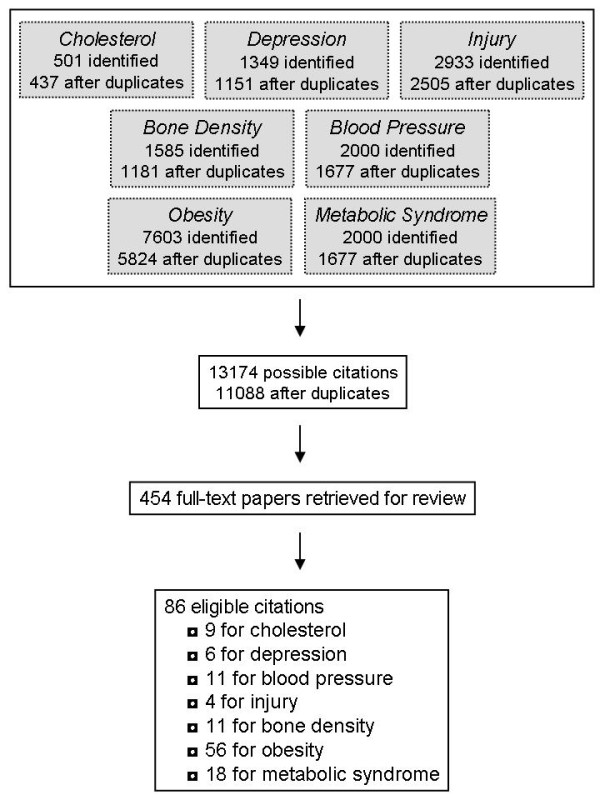
- After duplicates, 11,088 unique citations were screened; 454 full-text articles were reviewed; 86 unique citations met eligibility and 113 outcomes were abstracted. Observational studies had to report dichotomous outcomes; intervention studies were excluded if they included dietary or other behavioral components that could independently affect outcomes.
- Evidence was graded using pre-specified criteria based on quantity/quality of studies and strength of effect; meta-analyses were performed when at least 4 studies were available. RCT quality was assessed with the Downs and Black checklist, and effect sizes used Cohen’s d and ratio-score criteria.
Limitations
- Stated: unpublished and non-English studies were excluded, no extensive cross-referencing of reference lists was performed, the review was limited to 7 health outcomes, and many observational studies were excluded because they did not report dichotomous outcomes; these may have biased results and recommendations.
- Stated RCT limitations: samples were small and non-representative, statistical power was often lacking, adverse events were rarely reported, dropout details were limited, and intent-to-treat analyses were not performed; therefore Level 2 was the highest level assignable to any recommendation.
- Evident from the text: the nature of dose-response relations (linear vs curvilinear) often remained unclear, and the moderating effects of age and sex were not systematically addressed across outcomes.
Model-written summary. Check it against the paper before relying on it.
Integrity signals
Registry
Cites
Statistics
Figures
Verification
Claims the paper makes
0 Valid · 0 Not valid · 42 Not checked · 127 Own results and interpretations
A result the paper reports from its own data — it cites no other source for it, so there is none to check. The quote shows it is in the paper.
In the paper
“Results from experimental studies indicate that even modest amounts of physical activity can have health benefits in high-risk youngsters (e.g., obese).”
§ Systematic review of the health benefits of physical activity and fitness in school-aged children and youth > Abstract > Results
hedgedstates a cause- Asserted: passes — The authors put it forward as true.
- Checkable: passes — It can be checked against evidence.
- Load-bearing: passes — The paper’s conclusions depend on it.
- Based: passes — The paper gives a reason why it holds.
A result the paper reports from its own data — it cites no other source for it, so there is none to check. The quote shows it is in the paper.
In the paper
“Physical activity was associated with numerous health benefits.”
§ Systematic review of the health benefits of physical activity and fitness in school-aged children and youth > Abstract > Results
plainstates an association- Asserted: passes — The authors put it forward as true.
- Checkable: passes — It can be checked against evidence.
- Load-bearing: passes — The paper’s conclusions depend on it.
- Based: passes — The paper gives a reason why it holds.
A result the paper states — it cites no source for it, so there is none to check. The quote shows it is in the paper.
In the paper
“Aerobic-based activities had the greatest health benefit, other than for bone health, in which case high-impact weight bearing activities were required.”
§ Systematic review of the health benefits of physical activity and fitness in school-aged children and youth > Abstract > Results
plainstates an association- Asserted: passes — The authors put it forward as true.
- Checkable: passes — It can be checked against evidence.
- Load-bearing: passes — The paper’s conclusions depend on it.
- Based: passes — The paper gives a reason why it holds.
A result the paper reports from its own data — it cites no other source for it, so there is none to check. The quote shows it is in the paper.
In the paper
“The dose-response relations observed in observational studies indicate that the more physical activity, the greater the health benefit.”
§ Systematic review of the health benefits of physical activity and fitness in school-aged children and youth > Abstract > Results
hedgedstates an association- Asserted: passes — The authors put it forward as true.
- Checkable: passes — It can be checked against evidence.
- Load-bearing: passes — The paper’s conclusions depend on it.
- Based: passes — The paper gives a reason why it holds.
None of the sources cited for this claim have been checked yet.
In the paper
“The results indicated that unfit girls, defined as the lowest 20% fit, were 1.89 (95% confidence interval: 1.12-3.17) times more likely to have hypercholesterolemia and 1.03 (0.74-1.43) times more likely to have a low HDL-cholesterol by comparison to moderately and high fit girls.”
§ Systematic review of the health benefits of physical activity and fitness in school-aged children and youth > Results > Cholesterol and blood lipids
hedgedstates an associationn = 3,110- Asserted: passes — The authors put it forward as true.
- Checkable: passes — It can be checked against evidence.
- Load-bearing: passes — The paper’s conclusions depend on it.
- Based: passes — The paper gives a reason why it holds.
103 more claims
Create a free account to see all 169 claims and every source verdict.
- Probably not a substantial claim. 26
- The quote only partly states this claim. 2
- It may state two separate claims as one. 37
Claims other papers make about this one
Each is checked against this paper’s own text: does it say what the citing paper says it does?
The source backs part of the claim, not all of it — or backs it for a different population, condition or comparison.
In the citing paper
“Research indicates that those who are physically active show or report better overall physical and mental health, a higher level of fitness and a lower level of obesity than their sedentary or physically inactive counterparts1–4”
From Physical activity and health in Chinese children and adolescents: expert consensus statement (2020) (2020) · cites this paper as [2]
Experimental — accuracy not yet measuredThe cited source says what the claim attributes to it.
In the citing paper
“The association with overweight/obesity tends to be stronger when moderate to vigorous-intensity physical activities are performed.2”
From Physical activity and health in Chinese children and adolescents: expert consensus statement (2020) (2020) · cites this paper as [2]
The cited source says what the claim attributes to it.
In the citing paper
“Among physical activity interventions, the effects of physical activity independent of dietary changes on measures indicative of weight reduction (eg, BMI, total fat, abdominal fat) tend to be in the small range.2”
From Physical activity and health in Chinese children and adolescents: expert consensus statement (2020) (2020) · cites this paper as [2]
The cited source says what the claim attributes to it.
In the citing paper
“In general, as the level of physical activity increases, the likelihood of injury increases.2”
From Physical activity and health in Chinese children and adolescents: expert consensus statement (2020) (2020) · cites this paper as [2]
The cited source says what the claim attributes to it.
In the citing paper
“Systematic reviews have shown that physical activity (PA) is associated with greater mental health, 6 and a reduced risk of mental ill-health, specifically depression and anxiety.7,8”
From Domain-Specific Physical Activity and Mental Health: A Meta-analysis (2017) · cites this paper as [8]
2 more claims about this paper
Create a free account to see every claim other papers make about this one.
Self-check
Percentages, sums and reported differences re-computed from the paper’s own numbers.
Each contradiction between two passages listed here was confirmed by an independent check.
Rated major: it would touch a result — a value a result rests on, reported and recomputed p-values on opposite sides of the significance level, two passages that conflict with no sign which is right, or a cited work retracted before this paper was published.
In the paper
§ Systematic review of the health benefits of physical activity and fitness in school-aged children and youth > Discussion > Recommendations based on systematic review
“More vigorous intensity activities should be incorporated or added when possible, including activities that strengthen muscle and bone. [Level 3, Grade B].”
§ Systematic review of the health benefits of physical activity and fitness in school-aged children and youth > Discussion > Recommendations based on systematic review
“This recommendation was given a lower grade (Grade C) because of the potential increase in injury risk associated with more vigorous intensity activities and sports.”
Rated minor: it would not touch a result — a value no result rests on, a p-value that stays on the same side of the significance level, or a conflict that is clerical, resolved elsewhere in the paper, or outside its own findings.
In the paper
§ Systematic review of the health benefits of physical activity and fitness in school-aged children and youth > Results > Metabolic syndrome
“Sixteen articles examining the metabolic syndrome met the inclusion criteria.”
§ Systematic review of the health benefits of physical activity and fitness in school-aged children and youth > Results > Metabolic syndrome
“Eight of the 17 identified studies were observational in nature”
Rated minor: it would not touch a result — a value no result rests on, a p-value that stays on the same side of the significance level, or a conflict that is clerical, resolved elsewhere in the paper, or outside its own findings.
In the paper
“A total of 31 observational studies (24 cross-sectional, 3 prospective cohort, 2 case-control, 1 mixed) were retrieved”
§ Systematic review of the health benefits of physical activity and fitness in school-aged children and youth > Results > Overweight and obesity
Reported 31 · recomputed 30
Rated minor: it would not touch a result — a value no result rests on, a p-value that stays on the same side of the significance level, or a conflict that is clerical, resolved elsewhere in the paper, or outside its own findings.
In the paper
“437 citations were identified for cholesterol, 1151 for depression, 2505 for injury, 1181 for bone density, 1677 for blood pressure, 5824 for obesity, and 1677 for the metabolic syndrome. Thus, the grand total was 13174.”
§ Systematic review of the health benefits of physical activity and fitness in school-aged children and youth > Results > Literature review
Reported 13174 · recomputed 14452
Citations
Cites
Downs, S. H., & Black, N. (1998) · Journal of Epidemiology and Community Health · doi:10.1136/jech.52.6.377 · Cited by 8,252
Evidence Based Physical Activity for School-age Youth
Strong, W. B., Malina, R. M., Blimkie, C. J. R., Daniels, S. R., Dishman, R. K., Gutin, B., Hergenroeder, A. C., Must, A., Nixon, P. A., Pivarnik, J. M., et al. (2005) · The Journal of Pediatrics · doi:10.1016/j.jpeds.2005.01.055 · Cited by 4,222
Systematic Reviews: Synthesis of Best Evidence for Clinical Decisions
Cook, D. J., Mulrow, C. D., & Haynes, R. B. (1997) · Annals of Internal Medicine · doi:10.7326/0003-4819-126-5-199703010-00006 · Cited by 2,184
Andersen, L. B., Harro, M., Sardinha, L. B., Froberg, K., Ekelund, U., Brage, S., & Anderssen, S. A. (2006) · The Lancet · doi:10.1016/s0140-6736(06)69075-2 · Cited by 1,473
Lau, D. C. W., Douketis, J. D., Morrison, K. M., Hramiak, I. M., Sharma, A. M., Ur, E., & Panel, F. M. O. T. O. C. C. P. G. E. (2007) · Canadian Medical Association Journal · doi:10.1503/cmaj.061409 · Cited by 1,154
Paterson, D. H., & Warburton, D. E. (2010) · International Journal of Behavioral Nutrition and Physical Activity · doi:10.1186/1479-5868-7-38 · Cited by 953
A systematic review of the evidence for Canada's Physical Activity Guidelines for Adults
Warburton, D. E., Charlesworth, S., Ivey, A., Nettlefold, L., & Bredin, S. S. (2010) · International Journal of Behavioral Nutrition and Physical Activity · doi:10.1186/1479-5868-7-39 · Cited by 902 · cited 1×
“This report was part of a much larger project around Canada's physical activity guidelines, and comparable systematic reviews for adults [ 10 ] and older adults [11] have also been published in the journal.”
A meta-regression to examine the relationship between aerobic fitness and cognitive performance
Etnier, J. L., Nowell, P. M., Landers, D. M., & Sibley, B. A. (2006) · Brain Research Reviews · doi:10.1016/j.brainresrev.2006.01.002 · Cited by 749
Is the Canadian childhood obesity epidemic related to physical inactivity?
Tremblay, M. S., & Willms, J. D. (2003) · International Journal of Obesity · doi:10.1038/sj.ijo.0802376 · Cited by 517
Nassis, G. P., Papantakou, K., Skenderi, K., Triandafillopoulou, M., Kavouras, S. A., Yannakoulia, M., Chrousos, G. P., & Sidossis, L. S. (2005) · Metabolism · doi:10.1016/j.metabol.2005.05.013 · Cited by 469
Research works printed but not linked: 1
- Petitti DB Meta-Analysis, Decision Analysis, and Cost-Effective Analysis 1994 New York, NY: Oxford University Press
Cited by
Items 4,201–4,300 of 4,834
Population coverage for a core set of services, 2015 (or nearest year)
(2017) · Health at a glance · doi:10.1787/health_glance-2017-graph52-en
Kovács, É. (2015) · Pesci Egyetemi Archivum (University of Pécs)
Validity Test of the Locomotor Learning Model in Children Aged 6-8 Years
Sari, E. F. N., Siregar, N. M., & Mitsalina, D. (2023) · JPUD - Jurnal Pendidikan Usia Dini · doi:10.21009/jpud.172.07
“Through science and technology, physical education teachers can design creative and innovative learning, making it easier to deliver physical education material to all students and adapting it to the characteristics of each student (Handayani, 2020; Janssen & LeBlanc, 2010; Marheni et al., 2021).”
Background(2020) · ARC Journal of Public Health and Community Medicine · doi:10.20431/2456-0596.0502003
Shigeta, T. T. (2022) · Digital Repository Service (Northeastern University) · doi:10.17760/d20455937
Li, T., Wang, L., & Yu, S. (2025) · Quality in Sport · doi:10.12775/qs.2025.37.57482 · Cited by 1
“Numerous health concerns, including obesity, coronary heart disease, and musculoskeletal health, have been shown to be positively influenced by the promotion of PA among children and adolescents (Brown et al., 2009; Janssen et al., 2010; Wu et al., 2017).”
Efecto de los juegos en la creatividad infantil en función del nivel de actividad física realizada
Rodríguez‐Negro, J., Guijarro, E., & Sierra-Ríos, J. V. (2024) · European Journal of Child Development Education and Psychopathology · doi:10.32457/ejpad.v12i1.2395
Gagnon, M., Bouqartacha, S., Bédard, É., et al. (2026) · Children · doi:10.3390/children13070931
Le travail rémunéré et non rémunéré des élèves
OECD (2018) · Programme international pour le suivi des acquis des élèves · doi:10.1787/9789264288850-16-fr
Donnelly, S., Carlin, A., Reilly, J. J., Mackintosh, K. A., Basterfield, L., & O'Kane, M. (2026) · BMJ Public Health · doi:10.1136/bmjph-2026-005513
AI-Enabled Physical Activity Intervention Strategies for Children and Adolescents: A Scoping Review
Zhao, J., Huang, J., Shang, Z., & He, Z. (2026) · Children · doi:10.3390/children13081114
“Regular physical activity (PA) is essential for the healthy physical, cognitive, and psychosocial development of children and adolescents, and its benefits extend into adult life [1,2].”
Influence of high-intensity interval training in adolescents with asthma
Winn, C. O. N. (2018) · Cronfa (Swansea University) · doi:10.23889/suthesis.46062
Popa, P. Ș., Popa, G. V., Earar, K., & Matei, M. N. (2024) · Romanian Journal of Oral Rehabilitation · doi:10.62610/rjor.2024.1.16.46
“In hot environments, athletes are prone to dehydration, which affects salivary flow and increases the risk of dental caries and oral infections [12].”
أثر برنامج بدني – صحي علي بعض عناصر اللياقة الصحية لدي الطلاب المستجدين بجامعة سوهاج
عبد, م. ر. ع. ا. (2022) · مجلة أسيوط لعلوم وفنون التربية الرياضية · doi:10.21608/jprr.2022.304789
Bewegungstagebücher zur Messung der Bewegungsaktivität für Kinder und Jugendliche
Teufl, L. (2024) · Prävention und Gesundheitsförderung · doi:10.1007/s11553-024-01184-2
Physical Activity Level among School Going Children in Surat City, Gujarat: A Cross Sectional Survey
Shah, S. (2020) · Indian Journal of Public Health Research & Development · doi:10.37506/ijphrd.v11i7.10175
Hip replacement surgery trends, 2000 to 2015 (or nearest year)
(2017) · Health at a glance · doi:10.1787/health_glance-2017-graph167-en
Physical Activity of Young Children in Hong Kong Preschools
Chow, B. C., Louie, L. H.-T., & Cheung, P. P. (2013) · Asian Journal of Physical Education & Recreation · doi:10.24112/ajper.191836
Yehuda, A. Z., & Baron‐Epel, O. (2026) · Health Education Journal · doi:10.1177/00178969261428580
“Regular PA has been widely recognised for its significant benefits, such as improving physical fitness, mental health, cognitive performance and social well-being (Bailey et al., 2013; Janssen and LeBlanc, 2010).”
Validity and reliability of the Turkish version of the parent perceptions of physical activity scale
Akkaya, K. U., İncekar, M. Ç., & Elbasan, B. (2023) · TURKISH JOURNAL OF MEDICAL SCIENCES · doi:10.55730/1300-0144.5646 · Cited by 2
“Physical activity is fundamental to general health and motor development from birth and has many benefits for children in terms of physical, psychosocial, cognitive, and emotional aspects [2].”
BackgroundParamashiva, P. S., Sukumar, S., Shettigar, D., Vaishali, K., Chandrasekaran, B., Palaniswamy, H. P., Dkhar, W., Pradhan, A., Panakkal, N. C., David, L. R., et al. (2026) · Public Health in Practice · doi:10.1016/j.puhip.2026.100811
Rodríguez-Solana, A., Gracia‐Marco, L., Migueles, J. H., Mármol-Pérez, A., Cadenas‐Sánchez, C., Gil-Cosano, J. J., Llorente‐Cantarero, F. J., & Ubago‐Guisado, E. (2026) · Heliyon · doi:10.1016/j.heliyon.2026.e44602
Children’s Well-Being During the Pandemic
Maureen, I. Y., Saroinsong, W. P., Dewi, D. K., Wiyono, B. D., & Trihantoyo, S. (2021) · Advances in Social Science, Education and Humanities Research/Advances in social science, education and humanities research · doi:10.2991/assehr.k.211223.215
“[15] In the medium category, there are indicators of children doing non-online creative activities at home.”
Evolution of the main determinants of life expectancy: OECD 1990 to 2010
(2017) · Health at a glance · doi:10.1787/health_glance-2017-graph4-en
Seggern, M. J. V., Schenkelberg, M. A., Essay, A. M., Kellstedt, D. K., High, R., Welk, G. J., Rosenkranz, R. R., & Dzewaltowski, D. A. (2022) · Research Square · doi:10.21203/rs.3.rs-2140204/v1 · Cited by 1
Sportverletzungen im Kindes- und Jugendalter
Berrsché, G., König, T. T., Schaub, F., & Nührenbörger, C. (2026) · Monatsschrift Kinderheilkunde · doi:10.1007/s00112-026-02341-x · Cited by 2
Casellas‐Vidal, D., Font‐Lladó, R., Osiniri, I., Camós-Carreras, M., Ruiz‐Eizmendi, A., Serrano-Ferrer, J., Casellas, J., López‐Bermejo, A., & Prats‐Puig, A. (2026) · Health Science Reports · doi:10.1002/hsr2.72653
Tessier, D. P. (2025) · La Revue de Santé Scolaire et Universitaire · doi:10.1016/j.revssu.2025.01.007 · Cited by 1
Byman, A., Ulmanen, S., Pyhältö, K., Syväoja, H. J., Kulmala, J., & Tammelin, T. (2026) · PLoS ONE · doi:10.1371/journal.pone.0351971
Correlates of physical activity in Interlake youth
Erickson, T. (2014) · Mspace (University of Manitoba) · Cited by 1
Prevalence and Risk Factors of Physical Fitness Disorders in Adolescents: A Literature Review
Zaimsyah, F. R., Hastuti, P., & Zein, R. H. (2026) · COMPETITOR Jurnal Pendidikan Kepelatihan Olahraga · doi:10.26858/cpjok.v18i1.518
Julian, V., Bergsten, P., Ennequin, G., Forslund, A. H., Ahlström, H. K., Ciba, I., Dahlbom, M., Furthner, D., Gomahr, J., Kullberg, J., et al. (2022) · Research Square · doi:10.21203/rs.3.rs-1365849/v1
Page, M. (2020) · Scholarship@Western (Western University)
Phillipson, L., & Hall, D. V. (2014) · Research Online (University of Wollongong)
Parental perspectives on children’s right to participation in an urban slum settlement of Dhaka
Fatema, K., Moniruzzaman, S., Khan, M. M. H., Anjum, A., Mousum, S., Towhid, M. I. I., Salwa, M., & Haque, M. A. (2026) · Children and Youth Services Review · doi:10.1016/j.childyouth.2026.109125 · Cited by 2
Yang, Y., Wu, J., He, J., Li, J., & Yu, J. J. (2026) · Journal of Exercise Science & Fitness · doi:10.1016/j.jesf.2026.200461
Bayduza, A. L. (2012) · ERA: Education and Research Archive (University of Alberta) · doi:10.7939/r3zs9w
The Effect of Physical Activity on Quality of Life in Refugee Children
Çamiçi, F., & Cerit, E. (2024) · International Journal on Studies in Education · doi:10.46328/ijonse.252
“A review of the literature shows that studies examining physical activity and quality of life in children show that children with high levels of physical activity have better physical and mental health (Janssen & Leblanc, 2010; Leung et al. 2012).”
BackgroundPhysical Pain and Participation in Organized Activities Among U.S. Adolescents
Gregory, K. A., King, K. A., Vidourek, R. A., et al. (2022) · Health Behavior Research · doi:10.4148/2572-1836.1145
Ramírez-Cardona, L., Trejo-Varón, R., & Barengo, N. C. (2013)
The Study of Relationship between Physical Activity and Obesity Rates among Children
Titarmare, V., & Kumar, P. (2025) · Integrated Journal for Research in Arts and Humanities · doi:10.55544/ijrah.5.3.35
Description of physical activity and screen time among U.S. middle school students
Zhou, M., Zhao, Z., Li, X., Jin, Y., Hong, X., He, H., Zhao, M., & Song, X. (2025) · PLoS ONE · doi:10.1371/journal.pone.0311103 · Cited by 1
Health on two wheels: cycling’s net benefits and equity implications for children
NAYEEM, M. N. R., Qian, X., Mariscal, N., Huang, Y., & Zhou, S. (2026) · Transportation Research Part D Transport and Environment · doi:10.1016/j.trd.2026.105440
Pahmeier, I., & Tiemann, M. (2022) · Springer eBooks · doi:10.1007/978-3-662-64695-3_22 · Cited by 1
EFFECTS OF PHYSICAL EDUCATION CLASSES ON STUDENTS' FUNCTIONAL ABILITIES
Mekić, R., Mavrić, A., Čaprić, I., Zećirović, A., & Mekić, M. (2021) · SPORT I ZDRAVLJE · doi:10.7251/sizen2101073m
Martin, A. K., Egan, C. A., & Paul, D. R. (2026) · Journal of Teaching in Physical Education · doi:10.1123/jtpe.2025-0242
Čule, M. (2021) · Odgojno-obrazovne teme · doi:10.53577/oot.4.2.2
Humeral Retroversion, Range of Motion, and Strength Adaptations in Tennis Players
Hannah, D. C. (2019) · Cited by 2
Community pharmacies, 2015 (or nearest year)
(2017) · Health at a glance · doi:10.1787/health_glance-2017-graph177-en
Knibbe, T. J. (2015) · TSpace (University of Toronto)
Hullings, C. (2015) · doi:10.7282/t3rr210p · Cited by 1
Population exposed to PM2.5 levels exceeding 10 microgrammes/m3, 2015
(2017) · Health at a glance · doi:10.1787/health_glance-2017-graph50-en
The relationship between adolescent physical activity, brain health, and academic achievement
Papasideris, M. (2020) · UWSpace (University of Waterloo)
Correlations of Physical Activity and Psychosomatic Complaints of 10–15-Year-Old Schoolchildren
Grinienė, E., & Jankauskaitė, G. (2018) · Baltic Journal of Sport and Health Sciences · doi:10.33607/bjshs.v1i92.107
Ganjeh, P. (2023) · eDiss (Georg-August-Universität Göttingen) · doi:10.53846/goediss-10106
Brown, D. M. Y., Pfledderer, C. D., Stoepker, P., Chong, K. H., Kracht, C. L., & Fairclough, S. J. (2025) · Journal of Sports Sciences · doi:10.1080/02640414.2025.2540663
“However, some individuals may find higher intensities of PA unpleasant (Rhodes & Kates, 2015), deterring them from further engagement, and ultimately causing them to miss out on a range of health benefits (Janssen & LeBlanc, 2010).”
Biçer, B. (2021) · Akdeniz Spor Bilimleri Dergisi · doi:10.38021/asbid.975967
Stioui, M., Lefèvre, L., Trio, C., & Schnitzler, C. (2025) · Movement & Sport Sciences - Science & Motricité · doi:10.1051/sm/2025004 · Cited by 1
Jorgenson, C. (2019) · Carleton University's Institutional Repository (MacOdrum Library, Carleton University) · doi:10.22215/etd/2019-13808
Alsina, D. A. (2014) · Dialnet (Universidad de la Rioja)
Diseño de una propuesta educativa en educación física para fomentar andar al colegio en adolescentes
Saucedo‐Araujo, R. G., Huertas‐Delgado, F. J., Molina‐García, J., Lara-Sánchez, A. J., Chillón, P., Mitáš, J., & Herrador‐Colmenero, M. (2025) · Retos · doi:10.47197/retos.v63.109625 · Cited by 8
Cancer mortality by gender, 2015 (or nearest year)
(2017) · Health at a glance · doi:10.1787/health_glance-2017-graph16-en
Ma, J. K. (2014) · QSpace (Queen's University Library)
Carson, J. R., Greenstadt, E., Olivera, B., DUNSIGER, S. I., Zive, M., Higgins, M., Godino, J., Marcus, B. H., Meyer, D. M., & Larsen, B. A. (2025) · doi:10.2196/preprints.71623
Associação entre prática de atividade física e aptidão cardiorrespiratória em adolescentes
Peixoto, M. B., Borges, T. T., & Reichert, F. F. (2024) · Revista Brasileira de Atividade Física & Saúde · doi:10.12820/rbafs.29e0336
Morphological characteristics and functional abilities of students of third grade of primary school
Zrnzević, N. (2019) · Zbornik radova Uciteljskog fakulteta Prizren-Leposavic · doi:10.5937/zrufpl1913227z
A OBESIDADE INFANTIL E A IMPORTÂNCIA DO PROFISSIONAL DE EDUCAÇÃO FISÍCA NO COMBATE A OBESIDADE
LOURENÇO, A. V. D. S., & de Sousa, G. R. (2022) · doi:10.48209/978-65-89949-10-8
THE ROLE OF DHAKA'S COMMUNITY-BASED PARKS IN IMPROVING CHILDREN’S MENTAL AND PHYSICAL HEALTH
Mim, A. T., & Saika, U. (2024) · Journal of Event Tourism and Hospitality Studies · doi:10.32890/jeth2024.4.5
“According to UNICEF, there is evidence that the physical and mental health advantages commonly associated with exercise are more readily accessed when green areas are readily available to children of all ages (Janssen & Leblanc, 2010; Chawla, 2015 Boone-Heinonen et al., 2010).”
BackgroundRozenštoka, S., Atava-Cudare, E., Bondins, J., et al. (2026) · Translational Exercise Biomedicine · doi:10.1515/teb-2026-0012
Lang, R. B., Liu, T., & Ledbetter‐Cho, K. (2021) · Springer eBooks · doi:10.1007/978-3-319-91280-6_102189
Wang, Q., Lam, L. T.-M., Lin, H., Yang, W., Ying, F., & Li, Y. (2024) · Research Square · doi:10.21203/rs.3.rs-4435553/v1
A STUDY ON THE ACTIVITIES IN LEISURE TIME OF 13-14 YEAR OLD STUDENTS
Dikova, P. (2020) · Trakia Journal of Sciences · doi:10.15547/tjs.2020.s.01.144
Powell, E. A., Woodfield, L., Powell, A. J., Myers, T., & Barker, M. (2024) · International Journal of Qualitative Studies on Health and Well-Being · doi:10.1080/17482631.2024.2419165
“The benefits of engaging in PA for all children have been well documented (Chaput et al., 2020; Janssen & LeBlanc, 2010), including cardiorespiratory fitness, muscle fitness, bone health, and cardiometabolic health.”
BackgroundKlein, T., Worth, A., Niessner, C., Merk, S., & Hanssen‐Doose, A. (2026) · Scientific Reports · doi:10.1038/s41598-026-40270-7
Clark, N., Loverin, A., Ramos, C. H., Brusseau, T. A., Burns, R. D., Christensen, J. T., Estabrooks, P. A., & Metos, J. (2025) · Journal of Physical Activity and Health · doi:10.1123/jpah.2025-0022
(2014) · CRC Press eBooks · doi:10.1201/b17025-3
Stabil andel barn med overvekt og fedme
Bøhler, L. (2016) · Norsk tidsskrift for ernæring · doi:10.18261/ntfe.14.2.4
Introduction: Transport and land use in childhood
Buliung, R. N., & Mitra, R. (2023) · doi:10.32920/23843856.v1
Teacher Implementation Profiles: A Response to Top-Down Mandate of Movement Integration
Beddoes, Z., Barcelona, J., & Castelli, D. M. (2024) · International Journal of Physical Activity and Health · doi:10.18122/ijpah.3.2.7.boisestate
“Evidence suggests that physical inactivity, obesity, and type II diabetes may be inversely related to academic success (Janssen & LeBlanc, 2010).”
BackgroundSedentary Behaviour and Health among Young People
Carson, V. (2012) · QSpace (Queen's University Library)
Influence of dietary and activity patterns on weight status of Ukrainian school aged children
Pavlyshyn, H., Kozak, K., Furdela, V., Kovalchuk, T., Luchyshyn, N., & Haliyash, N. (2020) · International Journal of Adolescent Medicine and Health · doi:10.1515/ijamh-2020-0184
Marconi, V. D. S., & Silva‐Santana, G. (2026) · International Journal of Ayurveda Research · doi:10.4103/ijar.ijar_48_26
Genetics of physical activity and physical fitness
Zi, Y., Bartels, M., & de Geus, E. J. C. (2023) · Oxford University Press eBooks · doi:10.1093/med/9780192843968.003.0017 · Cited by 4
Anebaracy, V., & Shrivastava, A. (2019) · Journal of Evolution of Medical and Dental Sciences · doi:10.14260/jemds/2019/680
Akay, B., & Orhan, R. (2026) · Pamukkale University Journal of Education · doi:10.9779/pauefd.1495827
Moderate-to-vigorous daily physical activity among 15-year-olds, 2013-14
(2017) · Health at a glance · doi:10.1787/health_glance-2017-graph43-en
Consultations skipped due to cost, 2016 (or nearest year)
(2017) · Health at a glance · doi:10.1787/health_glance-2017-graph55-en
Physical activity during recreational youth sport: does coach training have an influence?
Schlechter, C. R. (2015) · K-State Research Exchange (Kansas State University) · Cited by 1
Chen, Y., Pan, S., Lin, Y., Cao, R., & Zhang, Y. (2024) · BMC Public Health · doi:10.1186/s12889-024-20709-0 · Cited by 1
OECD (2017) · Health at a glance · doi:10.1787/health_glance-2017-58-en · Cited by 1
A Survey On Physical Activity Monitoring (PAM) Among Malaysian Young Adults
Vasanthi, R. K., Murugayah, K., Surendran, P. J., Nadzalan, A. M., Purushothaman, V. K., Muniandy, Y., & Sadasivam, S. (2024) · National Journal of Community Medicine · doi:10.55489/njcm.150220243512 · Cited by 1
Hofmann, J. C. (2016) · ERA: Education and Research Archive (University of Alberta) · doi:10.7939/r3x34n31g · Cited by 1
ТЕРАРОБІКА ЯК ЗАСІБ ПІДВИЩЕННЯ ПРОЦЕСУ ФІЗИЧНОГО ВИХОВАННЯ ШКОЛЯРІВ
Товстопятко, Ф. Ф., Грачова, В. О., & Субботіна, О. О. (2022) · Visnyk of Zaporizhzhya National University Physical education and Sports · doi:10.26661/2663-5925-2022-1-06
Metadata
- Authors
- Janssen, I., & LeBlanc, A. G.
- Affiliations
- Queen's University (CA)
- Corresponding author
- Janssen, Ian
- Venue
- International Journal of Behavioral Nutrition and Physical Activity
- Published
- 2010
- Volume
- 7
- Issue
- 1
- Pages
- 40
- ISSN
- 1479-5868 (ISSN-L)
- PMC
- PMC2885312
- OpenAlex
- W2145702257
- Semantic Scholar
- ef8d55efd11b9d5e4a4814b6a38ff3d60d820d37
- Cited by
- 4,829
- References
- 116
- Citations by year
- 2026: 185 · 2025: 257 · 2024: 310 · 2023: 304 · 2022: 371 · 2021: 451 · 2020: 459 · 2019: 401 · 2018: 387 · 2017: 490 · 2016: 302 · 2015: 280 · 2014: 250 · 2013: 191 · 2012: 109
- FWCI
- 12.18
- Type
- journal article
- Language
- en
- Open access
- gold
- doi.org
- Licence
- cc-by
- Locations
- International Journal of Behavioral Nutrition and Physical Activity (publishedVersion, cc-by)
- PubMed Central (publishedVersion, cc-by)
- PubMed (publishedVersion)
- DOAJ (DOAJ: Directory of Open Access Journals) (submittedVersion, cc-by-sa)
- Funders
- Public Health Agency of Canada
- Public Health Agency
- Topics
- Health Sciences › Medicine › Public Health, Environmental and Occupational Health › Physical Activity and Health
- Health Sciences › Medicine › Public Health, Environmental and Occupational Health › Obesity, Physical Activity, Diet
- Social Sciences › Life-span and Life-course Studies › Recreational Sport and Physical Activity
- Keywords
- physical activity, physical fitness, school-aged children, youth, health benefits, serum cholesterol, blood pressure, metabolic syndrome, childhood obesity, bone mineral density, depression, injuries, dose-response relationship, aerobic exercise, physical activity guidelines
About these checks
Registry, retraction, Cites and statistics results are computed, not judged, with one exception: a printed reference that no index lists is read once by a model before it counts as a citation error. Claims are extracted by a model and kept only when their quote appears verbatim in the text; each cited source is then checked, with a model’s help, for whether it says what the claim relies on. Those verdicts can be wrong — read the claim’s quote and the cited source before relying on one.
A language model drew the claims from the paper on 2026-10-10, under version 3 of the claim definition (model deepseek-v4.1-flash, prompt extract-v3).
A second model labelled each claim on 2026-10-10 (model jev-1.13-20260917, definition revision gold-guideline-v0.2).
Statistics and arithmetic are recomputed, not judged.
Confidence bands are shown only for fields calibrated on our annotated test set. None is calibrated yet, so no band is shown.
What counts as a claim ›How we measure confidence ›How we check this ›
Are you an author, or do you see a problem with this page? Request a review
Data sources
Bibliographic data: Semantic Scholar, OpenAlex, Crossref.
Contains information from the Semantic Scholar Academic Graph Datasets, made available under the ODC Attribution License (ODC-BY 1.0).
Semantic Scholar’s data is described in: Kinney, R., et al. (2023). The Semantic Scholar Open Data Platform. arXiv:2301.10140.
