

Systematic review of the health benefits of physical activity and fitness in school-aged children and youth
Open accessThe DOI matches its Crossref record; 114 of the 116 references it cites were found in a registry or an index; none of the 128 sources its claims cite is checked for support yet.
Abstract
BACKGROUND: The purpose was to: 1) perform a systematic review of studies examining the relation between physical activity, fitness, and health in school-aged children and youth, and 2) make recommendations based on the findings. METHODS: The systematic review was limited to 7 health indicators: high blood cholesterol, high blood pressure, the metabolic syndrome, obesity, low bone density, depression, and injuries. Literature searches were conducted using predefined keywords in 6 key databases. A total of 11,088 potential papers were identified. The abstracts and full-text articles of potentially relevant papers were screened to determine eligibility. Data was abstracted for 113 outcomes from the 86 eligible papers. The evidence was graded for each health outcome using established criteria based on the quantity and quality of studies and strength of effect. The volume, intensity, and type of physical activity were considered. RESULTS: Physical activity was associated with numerous health benefits. The dose-response relations observed in observational studies indicate that the more physical activity, the greater the health benefit. Results from experimental studies indicate that even modest amounts of physical activity can have health benefits in high-risk youngsters (e.g., obese). To achieve substantive health benefits, the physical activity should be of at least a moderate intensity. Vigorous intensity activities may provide even greater benefit. Aerobic-based activities had the greatest health benefit, other than for bone health, in which case high-impact weight bearing activities were required. CONCLUSION: The following recommendations were made: 1) Children and youth 5-17 years of age should accumulate an average of at least 60 minutes per day and up to several hours of at least moderate intensity physical activity. Some of the health benefits can be achieved through an average of 30 minutes per day. [Level 2, Grade A]. 2) More vigorous intensity activities should be incorporated or added when possible, including activities that strengthen muscle and bone [Level 3, Grade B]. 3) Aerobic activities should make up the majority of the physical activity. Muscle and bone strengthening activities should be incorporated on at least 3 days of the week [Level 2, Grade A].
Overview
CoChat Summary
TL;DR
This systematic review found physical activity is associated with numerous health benefits in school-aged children and youth, with observational dose-response evidence suggesting more activity yields greater benefit. It recommends an average of at least 60 minutes per day of at least moderate activity, with some benefits achievable at 30 minutes per day, plus added vigorous and muscle/bone-strengthening activities.
Key findings
- From 11,088 unique citations, 86 eligible papers yielded 113 outcomes across 7 health indicators. Physical activity was associated with benefits; observational studies showed dose-response relations, and experimental studies indicated even modest activity can benefit high-risk youngsters (e.g., obese).
- Metabolic syndrome: summary odds ratio for least active vs most active was 1.68 (95% CI 1.22–2.31) in 3 self-report studies; least fit vs most fit was 6.79 (95% CI 5.11–9.03) in 4 fitness studies. Obesity: median odds ratio was 1.33 for self-reported activity and 3.79 for objective measures. Cholesterol: unfit girls were 1.89 (1.12–3.17) times and unfit boys 3.68 (2.55–5.31) times more likely to have hypercholesterolemia than moderately/high fit peers.
- Recommendations: children and youth 5–17 years should accumulate an average of at least 60 minutes per day and up to several hours of at least moderate intensity activity; some health benefits can be achieved through an average of 30 minutes per day [Level 2, Grade A]. More vigorous activities should be incorporated when possible, including muscle- and bone-strengthening activities [Level 3, Grade B]; aerobic activities should make up the majority, with muscle and bone strengthening on at least 3 days per week [Level 2, Grade A].
- Bone: as little as 10 minutes of moderate-to-high impact activities on as little as 2 or 3 days per week can have a modest effect on bone mineral density when combined with general weight-bearing aerobic activities. Injuries: all 3 included studies reported higher injury rates in active children/youth and clear dose-response relations; vigorous sports risk estimates were high.
Methods
- Systematic review limited to 7 health indicators: high blood cholesterol, high blood pressure, metabolic syndrome, obesity, low bone density, depression, and injuries. Searches used predefined keywords in 6 databases (MEDLINE, EMBASE, CINAHL, PsycINFO, Evidence-Based Medicine Reviews, SPORTDiscus) to January 2008, limited to human participants, English language, and ages 5–17 years.
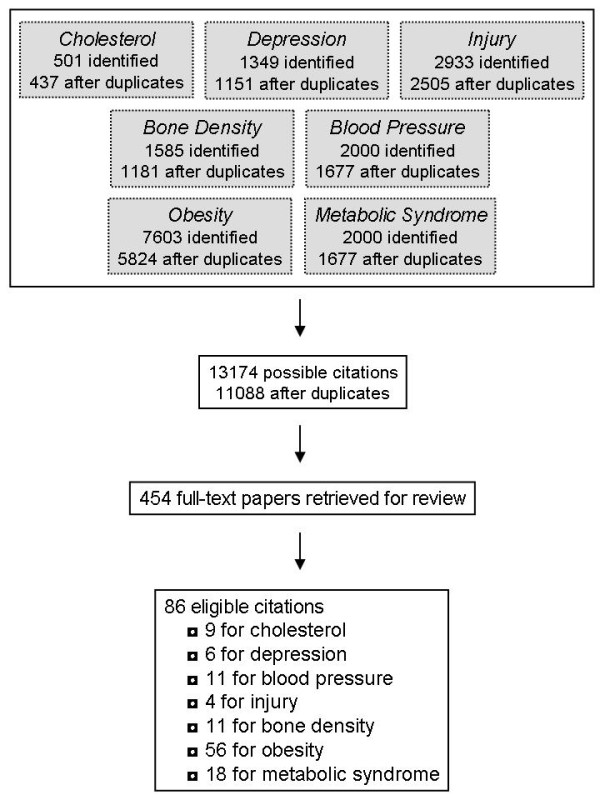
- After duplicates, 11,088 unique citations were screened; 454 full-text articles were reviewed; 86 unique citations met eligibility and 113 outcomes were abstracted. Observational studies had to report dichotomous outcomes; intervention studies were excluded if they included dietary or other behavioral components that could independently affect outcomes.
- Evidence was graded using pre-specified criteria based on quantity/quality of studies and strength of effect; meta-analyses were performed when at least 4 studies were available. RCT quality was assessed with the Downs and Black checklist, and effect sizes used Cohen’s d and ratio-score criteria.
Limitations
- Stated: unpublished and non-English studies were excluded, no extensive cross-referencing of reference lists was performed, the review was limited to 7 health outcomes, and many observational studies were excluded because they did not report dichotomous outcomes; these may have biased results and recommendations.
- Stated RCT limitations: samples were small and non-representative, statistical power was often lacking, adverse events were rarely reported, dropout details were limited, and intent-to-treat analyses were not performed; therefore Level 2 was the highest level assignable to any recommendation.
- Evident from the text: the nature of dose-response relations (linear vs curvilinear) often remained unclear, and the moderating effects of age and sex were not systematically addressed across outcomes.
Model-written summary. Check it against the paper before relying on it.
Integrity signals
Registry
Cites
Statistics
Figures
Verification
Claims the paper makes
0 Valid · 0 Not valid · 42 Not checked · 127 Own results and interpretations
A result the paper reports from its own data — it cites no other source for it, so there is none to check. The quote shows it is in the paper.
In the paper
“Results from experimental studies indicate that even modest amounts of physical activity can have health benefits in high-risk youngsters (e.g., obese).”
§ Systematic review of the health benefits of physical activity and fitness in school-aged children and youth > Abstract > Results
hedgedstates a cause- Asserted: passes — The authors put it forward as true.
- Checkable: passes — It can be checked against evidence.
- Load-bearing: passes — The paper’s conclusions depend on it.
- Based: passes — The paper gives a reason why it holds.
A result the paper reports from its own data — it cites no other source for it, so there is none to check. The quote shows it is in the paper.
In the paper
“Physical activity was associated with numerous health benefits.”
§ Systematic review of the health benefits of physical activity and fitness in school-aged children and youth > Abstract > Results
plainstates an association- Asserted: passes — The authors put it forward as true.
- Checkable: passes — It can be checked against evidence.
- Load-bearing: passes — The paper’s conclusions depend on it.
- Based: passes — The paper gives a reason why it holds.
A result the paper states — it cites no source for it, so there is none to check. The quote shows it is in the paper.
In the paper
“Aerobic-based activities had the greatest health benefit, other than for bone health, in which case high-impact weight bearing activities were required.”
§ Systematic review of the health benefits of physical activity and fitness in school-aged children and youth > Abstract > Results
plainstates an association- Asserted: passes — The authors put it forward as true.
- Checkable: passes — It can be checked against evidence.
- Load-bearing: passes — The paper’s conclusions depend on it.
- Based: passes — The paper gives a reason why it holds.
A result the paper reports from its own data — it cites no other source for it, so there is none to check. The quote shows it is in the paper.
In the paper
“The dose-response relations observed in observational studies indicate that the more physical activity, the greater the health benefit.”
§ Systematic review of the health benefits of physical activity and fitness in school-aged children and youth > Abstract > Results
hedgedstates an association- Asserted: passes — The authors put it forward as true.
- Checkable: passes — It can be checked against evidence.
- Load-bearing: passes — The paper’s conclusions depend on it.
- Based: passes — The paper gives a reason why it holds.
None of the sources cited for this claim have been checked yet.
In the paper
“The results indicated that unfit girls, defined as the lowest 20% fit, were 1.89 (95% confidence interval: 1.12-3.17) times more likely to have hypercholesterolemia and 1.03 (0.74-1.43) times more likely to have a low HDL-cholesterol by comparison to moderately and high fit girls.”
§ Systematic review of the health benefits of physical activity and fitness in school-aged children and youth > Results > Cholesterol and blood lipids
hedgedstates an associationn = 3,110- Asserted: passes — The authors put it forward as true.
- Checkable: passes — It can be checked against evidence.
- Load-bearing: passes — The paper’s conclusions depend on it.
- Based: passes — The paper gives a reason why it holds.
103 more claims
Create a free account to see all 169 claims and every source verdict.
- Probably not a substantial claim. 26
- The quote only partly states this claim. 2
- It may state two separate claims as one. 37
Claims other papers make about this one
Each is checked against this paper’s own text: does it say what the citing paper says it does?
The source backs part of the claim, not all of it — or backs it for a different population, condition or comparison.
In the citing paper
“Research indicates that those who are physically active show or report better overall physical and mental health, a higher level of fitness and a lower level of obesity than their sedentary or physically inactive counterparts1–4”
From Physical activity and health in Chinese children and adolescents: expert consensus statement (2020) (2020) · cites this paper as [2]
Experimental — accuracy not yet measuredThe cited source says what the claim attributes to it.
In the citing paper
“The association with overweight/obesity tends to be stronger when moderate to vigorous-intensity physical activities are performed.2”
From Physical activity and health in Chinese children and adolescents: expert consensus statement (2020) (2020) · cites this paper as [2]
The cited source says what the claim attributes to it.
In the citing paper
“Among physical activity interventions, the effects of physical activity independent of dietary changes on measures indicative of weight reduction (eg, BMI, total fat, abdominal fat) tend to be in the small range.2”
From Physical activity and health in Chinese children and adolescents: expert consensus statement (2020) (2020) · cites this paper as [2]
The cited source says what the claim attributes to it.
In the citing paper
“In general, as the level of physical activity increases, the likelihood of injury increases.2”
From Physical activity and health in Chinese children and adolescents: expert consensus statement (2020) (2020) · cites this paper as [2]
The cited source says what the claim attributes to it.
In the citing paper
“Systematic reviews have shown that physical activity (PA) is associated with greater mental health, 6 and a reduced risk of mental ill-health, specifically depression and anxiety.7,8”
From Domain-Specific Physical Activity and Mental Health: A Meta-analysis (2017) · cites this paper as [8]
2 more claims about this paper
Create a free account to see every claim other papers make about this one.
Self-check
Percentages, sums and reported differences re-computed from the paper’s own numbers.
Each contradiction between two passages listed here was confirmed by an independent check.
Rated major: it would touch a result — a value a result rests on, reported and recomputed p-values on opposite sides of the significance level, two passages that conflict with no sign which is right, or a cited work retracted before this paper was published.
In the paper
§ Systematic review of the health benefits of physical activity and fitness in school-aged children and youth > Discussion > Recommendations based on systematic review
“More vigorous intensity activities should be incorporated or added when possible, including activities that strengthen muscle and bone. [Level 3, Grade B].”
§ Systematic review of the health benefits of physical activity and fitness in school-aged children and youth > Discussion > Recommendations based on systematic review
“This recommendation was given a lower grade (Grade C) because of the potential increase in injury risk associated with more vigorous intensity activities and sports.”
Rated minor: it would not touch a result — a value no result rests on, a p-value that stays on the same side of the significance level, or a conflict that is clerical, resolved elsewhere in the paper, or outside its own findings.
In the paper
§ Systematic review of the health benefits of physical activity and fitness in school-aged children and youth > Results > Metabolic syndrome
“Sixteen articles examining the metabolic syndrome met the inclusion criteria.”
§ Systematic review of the health benefits of physical activity and fitness in school-aged children and youth > Results > Metabolic syndrome
“Eight of the 17 identified studies were observational in nature”
Rated minor: it would not touch a result — a value no result rests on, a p-value that stays on the same side of the significance level, or a conflict that is clerical, resolved elsewhere in the paper, or outside its own findings.
In the paper
“A total of 31 observational studies (24 cross-sectional, 3 prospective cohort, 2 case-control, 1 mixed) were retrieved”
§ Systematic review of the health benefits of physical activity and fitness in school-aged children and youth > Results > Overweight and obesity
Reported 31 · recomputed 30
Rated minor: it would not touch a result — a value no result rests on, a p-value that stays on the same side of the significance level, or a conflict that is clerical, resolved elsewhere in the paper, or outside its own findings.
In the paper
“437 citations were identified for cholesterol, 1151 for depression, 2505 for injury, 1181 for bone density, 1677 for blood pressure, 5824 for obesity, and 1677 for the metabolic syndrome. Thus, the grand total was 13174.”
§ Systematic review of the health benefits of physical activity and fitness in school-aged children and youth > Results > Literature review
Reported 13174 · recomputed 14452
Citations
Cites
Downs, S. H., & Black, N. (1998) · Journal of Epidemiology and Community Health · doi:10.1136/jech.52.6.377 · Cited by 8,252
Evidence Based Physical Activity for School-age Youth
Strong, W. B., Malina, R. M., Blimkie, C. J. R., Daniels, S. R., Dishman, R. K., Gutin, B., Hergenroeder, A. C., Must, A., Nixon, P. A., Pivarnik, J. M., et al. (2005) · The Journal of Pediatrics · doi:10.1016/j.jpeds.2005.01.055 · Cited by 4,222
Systematic Reviews: Synthesis of Best Evidence for Clinical Decisions
Cook, D. J., Mulrow, C. D., & Haynes, R. B. (1997) · Annals of Internal Medicine · doi:10.7326/0003-4819-126-5-199703010-00006 · Cited by 2,184
Andersen, L. B., Harro, M., Sardinha, L. B., Froberg, K., Ekelund, U., Brage, S., & Anderssen, S. A. (2006) · The Lancet · doi:10.1016/s0140-6736(06)69075-2 · Cited by 1,473
Lau, D. C. W., Douketis, J. D., Morrison, K. M., Hramiak, I. M., Sharma, A. M., Ur, E., & Panel, F. M. O. T. O. C. C. P. G. E. (2007) · Canadian Medical Association Journal · doi:10.1503/cmaj.061409 · Cited by 1,154
Paterson, D. H., & Warburton, D. E. (2010) · International Journal of Behavioral Nutrition and Physical Activity · doi:10.1186/1479-5868-7-38 · Cited by 953
A systematic review of the evidence for Canada's Physical Activity Guidelines for Adults
Warburton, D. E., Charlesworth, S., Ivey, A., Nettlefold, L., & Bredin, S. S. (2010) · International Journal of Behavioral Nutrition and Physical Activity · doi:10.1186/1479-5868-7-39 · Cited by 902 · cited 1×
“This report was part of a much larger project around Canada's physical activity guidelines, and comparable systematic reviews for adults [ 10 ] and older adults [11] have also been published in the journal.”
A meta-regression to examine the relationship between aerobic fitness and cognitive performance
Etnier, J. L., Nowell, P. M., Landers, D. M., & Sibley, B. A. (2006) · Brain Research Reviews · doi:10.1016/j.brainresrev.2006.01.002 · Cited by 749
Is the Canadian childhood obesity epidemic related to physical inactivity?
Tremblay, M. S., & Willms, J. D. (2003) · International Journal of Obesity · doi:10.1038/sj.ijo.0802376 · Cited by 517
Nassis, G. P., Papantakou, K., Skenderi, K., Triandafillopoulou, M., Kavouras, S. A., Yannakoulia, M., Chrousos, G. P., & Sidossis, L. S. (2005) · Metabolism · doi:10.1016/j.metabol.2005.05.013 · Cited by 469
Research works printed but not linked: 1
- Petitti DB Meta-Analysis, Decision Analysis, and Cost-Effective Analysis 1994 New York, NY: Oxford University Press
Cited by
Items 4,301–4,400 of 4,834
Leahy, N. A. (2018) · The Scholarship East Carolina University's Institutional Repository (East Carolina University)
Effect of Treadmill Training on Ventilatory Functions and Physical Performance in Obese Children
Ghafar, M. A. A., khalek, M., & Obaya, H. E. (2016) · International Journal of Therapies and Rehabilitation Research · doi:10.5455/ijtrr.000000147
Haua-Navarro, K., Moreno‐Landa, L. I., Prez-Rodrguez, M., Melndez, G., & Bertha, A. (2012) · InTech eBooks · doi:10.5772/31701 · Cited by 1
Antala, B., Іващенко, С., & Lopatenko, G. O. (2020) · Sport Science and Human Health · doi:10.28925/2664-2069.2020.2.1
INATIVIDADE FÍSICA E SURGIMENTO DE PATOLOGIAS EM ADOLESCENTES: UMA REVISÃO BIBLIOGRÁFICA
Marinho, C. L. F., & Ribeiro, L. S. (2019) · Revista Uningá · doi:10.46311/2318-0579.56.euj2319
The Role of Sport in Promoting Mental Health Among Adolescents
Liguori, F., & Pelullo, C. P. (2026) · Physical Education Theory and Methodology · doi:10.17309/tmfv.2026.3.07
Children’s Perceptions of Road Environments in Urban-Rural Fringe Areas
Ao, Y., Long, Y., & Bahmani, H. (2026) · Springer eBooks · doi:10.1007/978-981-95-8856-5_6
Ding, Y. (2019) · Illinois Digital Environment for Access to Learning and Scholarship (University of Illinois at Urbana-Champaign)
Impacts of aerobic exercise on children with asthma diagnosis: integrative review
dos Santos, B. E., de Macedo, L. C. D. S. A., Adomaitis, A. P. G., de Castro, A. M. M., de Almeida, J. T., dos Santos, M. L. D. M., & Merey, L. S. F. (2022) · REVISTA CIÊNCIAS EM SAÚDE · doi:10.21876/rcshci.v12i1.1174 · Cited by 2
The impact of physical activities on positive emotions in children and adolescents: a meta-analysis
Zhao, Z., Feng, Z., Wang, T., Deng, J., & Liu, Y. (2026) · Frontiers in Psychology · doi:10.3389/fpsyg.2026.1792960
Yeh, S.-W., Yuan, C., Wu, Y.-F., & Shen, R. (2020) · doi:10.2196/preprints.19208
Why Do Most Children Not Walk or Cycle to and from School?
Fitriani, A., & Hidayati (2025) · Jurnal PROMKES · doi:10.20473/jpk.v13.i1.2025.65-75
“…roles of physical activity in improving children’s health and well-being in their age and later life have been recognized (Gao et al., 2018; Janssen & LeBlanc, 2010), including for obesity prevention (Wyszynska et al., 2020), fitness enhancement (Ortegaa et al., 2013), cognitive…”
Yılmaz, S. H., & Uzunçayır, D. (2025) · Akdeniz Spor Bilimleri Dergisi · doi:10.38021/asbid.1678362
Soni, J. D., & Vora, D. (2025) · Cureus · doi:10.7759/cureus.96152
“Participation in sport confers multiple health benefits, including lower risks of obesity, diabetes, and hypertension, as well as improved mental, emotional, and social well-being [7,8].”
Editorial: “Effective strategies for promoting health-enhancing children's physical activity”
Matic, R. M., Milovanović, I., Valantinė, I., Alexandris, K., & Popovic, S. R. (2022) · Frontiers in Public Health · doi:10.3389/fpubh.2022.964316 · Cited by 1
Kim, M., & Hodge, S. R. (2026) · Quest · doi:10.1080/00336297.2026.2676299
Antihypertensive drugs consumption, 2000 and 2015 (or nearest year)
(2017) · Health at a glance · doi:10.1787/health_glance-2017-graph178-en
Manneville, F. (2020) · theses.fr (ABES) · doi:10.70675/d8136dd5zabd8z43c6zb80cz4a4078668ab0
Jaafar, Z., Rosli, N. A., Mohd, N., et al. (2026) · doi:10.2196/preprints.102014
A school-integrated physical exercise program improves motor performance of children and adolescentsPreprint
Homeyer, D., Memaran, N., Kück, M., Grams, L., von der Born, J., Bauer, E., Schwalba, M., Kerling, A., von Maltzahn, N., Albrecht, A. A., et al. (2022) · Research Square · doi:10.21203/rs.3.rs-1854498/v2
The Effects of an Intentionally Designed Physical Literacy Curriculum on Primary-Aged Children
Wyk, N. V. (2016) · Libraries and Cultural Resources (University of Calgary) · doi:10.11575/prism/28095 · Cited by 1
The effect of psychological collectivism on individual youth sport athletes
Donkers, J. L. (2015) · Open ULeth Scholarship (OPUS) (University of Lethbridge) · Cited by 1
de Jesus, G. M., Araujo, L. D. M. D. S., & Araújo, R. H. D. O. (2025) · Research Square · doi:10.21203/rs.3.rs-6994217/v1
Abós, Á., Sevil‐Serrano, J., Sanz-Remacha, M., & García‐González, L. (2015) · Dialnet (Universidad de la Rioja)
Sahni, P., Gibert, C., Khanna, P., Sachdeva, M., Bhatt, S., Negi, K., & Kumar, J. (2026) · Research Square · doi:10.21203/rs.3.rs-8886161/v1
Sigmund, E., Šnoblová, R., Lokvencová, P. N., Chmelík, F., Sigmundová, D., & Groffik, D. (2011) · e-Pedagogium · doi:10.5507/epd.2011.040
Perbedaan Physical Self-Concept dan Aktivitas Fisik Usia Remaja: Apakah Ada Hubungannya?
Kurniawan, R., Jajat, J., & Sutisna, N. (2019) · Jurnal Terapan Ilmu Keolahragaan · doi:10.17509/jtikor.v4i2.18873
Andersson, J. (2016) · DiVA (University of Gävle)
Rahman, S. (2023) · University of North Texas Digital Library (University of North Texas) · doi:10.12794/metadc2179317
Julien, V. (2015) · Constellation (Université du Québec à Chicoutimi) · Cited by 2
The effects of resistance exercise on insulin sensitivity in adolescents
Critch, S. (2018) · Pediatrics & Therapeutics · doi:10.4172/2161-0665-c1-049
The Importance of Providing Opportunities for Health Behaviors during the School Day
Castelli, D. M., Barcelona, J., Crim, B. N., & Burson, S. L. (2020) · Nestlé Nutrition Institute Workshop series · doi:10.1159/000511512
Childhood obesity in Ireland: recent trends and modifiable determinants
Keane, E. (2014) · Cork Open Research Archive (University College Cork, Ireland)
Alarcón-Aguilar, J., Queiroz, D. D. R., Soares, F. C., de Lima, M. M. A., Hardman, C. M., Júnior, R. D. S. W., Mota, J., Cristi‐Montero, C., de Barros, M. V. G., & dos Santos, M. A. M. (2026) · Revista Brasileira de Atividade Física & Saúde · doi:10.12820/rbafs.31e0423
Application of Machine Learning in the Measurement of Free-living Physical Activity Behaviours
Narayanan, T. L., & Narayanan, A. (2019) · Tuwhera (Auckland University of Technology) · Cited by 2
Pediatric and adolescent sports concussions
Santana, J. A., & Hergenroeder, A. C. (2020) · Elsevier eBooks · doi:10.1016/b978-0-12-818872-9.00007-8
OECD (2017) · Health at a glance · doi:10.1787/health_glance-2017-77-en · Cited by 2
Güç ve Zarafet Sporu: Kürek Araştırmaları
Ünver, D., & Güney, Ş. E. (2024) · Özgür Yayınları eBooks · doi:10.58830/ozgur.pub636.c2798
Boyano, J. M. S., & Aguayo, B. B. (2022) · MLS Sport Research · doi:10.54716/mlssr.v2i1.1349 · Cited by 1
Life expectancy at birth by sex, 2015 (or nearest year)
(2017) · Health at a glance · doi:10.1787/health_glance-2017-graph9-en
Johnson, A. M., Bocarro, J. N., Kroshus-Havril, E., & Arredondo, E. M. (2026) · Pilot and Feasibility Studies · doi:10.1186/s40814-026-01765-2
Study on the Correlation between High School Students’ Physical Fitness and 20 m Shuttle Run Test
许, 妍. (2025) · Advances in Physical Sciences · doi:10.12677/aps.2025.134069
Prävalenz der Schulwegmobilität und des Spielens im Freien bei Kindergartenkindern in der Schweiz
Kühnis, J., Eliane, S., Kathrin, B., & Ilaria, F. (2023) · Swiss Sports & Exercise Medicine · doi:10.34045/sems/2023/10
Honda, S., MATSUNAGA, M., Matsui, M., Toyama, K., & Suzuki, K. (2026) · Frontiers in Public Health · doi:10.3389/fpubh.2026.1807141
Accelerometry measurement of physical activity and sedentary behaviour in pre-school children
Hislop, J. F. (2013) · Queen Margaret University eTheses Repository · Cited by 1
Depression and Leisure-Time Physical Activity in Pubertal Girls
Hussien, N. N., & Eldin, R. M. B. (2020) · Journal of Family Medicine and Health Care · doi:10.11648/j.jfmhc.20200604.11
Injury risk increases minimally over a large range of changes in activity level in childrenPreprint
Wang, C., Stokes, T., Vargas, J. T., Steele, R. J., Wedderkopp, N., & Shrier, I. (2020) · arXiv (Cornell University) · doi:10.48550/arxiv.2010.02952 · Cited by 4
Khan, M. J., Ali, M. U., a, S. N., Ganesan, B., Abdullahi, A., Hasan, S. M. M., Khan, A. R., Hawlader, M. D. H., & Winser, S. J. (2024) · Child Care Health and Development · doi:10.1111/cch.70021 · Cited by 1
Do Children Engaged in Organized Sports Meet the Recommended Levels of Step Counts?
Demirci, N., Karaca, A., Cinemre, A., & Ünver, E. (2021) · Spor Bilimleri Dergisi · doi:10.17644/sbd.782411
Burrows, E. J. (2013) · Library and Archives Canada (Government of Canada)
Selonke, J., Hunger, I., Hackenbroich, T., Kirchner, B., & Rohleder, D. (2026) · German Journal of Exercise and Sport Research · doi:10.1007/s12662-026-01144-2
“…motor skills; strengthens children’s skeletal, tendon, and muscular systems; and has a positive effect on their cardiovascular system, lung function, and metabolism (Gallahue, Ozmun, & Goodway, 2012; Janssen & Leblanc, 2010; Kambas et al., 2012; Krus & Bahr, 2016; Scheid, 2009; Weineck, 2004).”
Factors associated with physical activity of children and adolescents : a parental point of view
Katainen, A. (2020) · Jyväskylä University Digital Archive (University of Jyväskylä)
RIBEIRO, J. M. S., & CANALONGA, V. B. (2022) · doi:10.48209/978-65-89949-18-8
O‘SMIRLARNING RUHIY SALOMATLIGINI MUSTAHKAMLASHDA JISMONIY TARBIYANING O‘RNI
SOBIROVA, S. (2024) · UzMU xabarlari · doi:10.69617/nuuz.v1i1.9.1.4297
Beregi, E., & Bognár, J. (2026) · Preventive Medicine Reports · doi:10.1016/j.pmedr.2026.103564
People with a prescription of antipsychotics, 2015 or nearest year
(2017) · Health at a glance · doi:10.1787/health_glance-2017-graph198-en
Machado, F. R. H., SOUZA, R. H. T., MASSAHUD, A. R., & SILVA, G. R. (2022) · doi:10.48209/978-65-89949-02-8
Gesundheit, die aus der Bewegung kommt: Wie körperlich aktiv sind Jugendliche in Luxemburg?
Bund, A., Eckelt, M., Steffgen, G., & Hutmacher, D. (2022) · Springer eBooks · doi:10.1007/978-3-658-35744-3_14
OECD (2017) · Health at a glance · doi:10.1787/health_glance-2017-43-en
Pacheco, Á. F. G., & Pozo, M. D. R. H. (2012)
Радзиевская, М. П., Малиновска, А., & Радзиевский, П. А. (2014) · Pedagogics psychology medical-biological problems of physical training and sports
The Relationship between Physical Fitness Factors and Academic Skills among Officer Aircrew
López, M. (2019) · Digital Commons (Liberty University)
Physical Activity as an Aspect of Students’ Social and Educational Life
Корж, Н. Л., Вікторівна, Ш. Л., & Shuba, V. V. (2022) · Bulletin of Luhansk Taras Shevchenko National University · doi:10.12958/2227-2844-2022-3(351)-201-211
Physical Activity and Health in Dutch and Chinese Children
Lu, C. (2020) · University of Groningen research database (University of Groningen / Centre for Information Technology) · doi:10.33612/diss.131752838
Zaragoza, L. M. M., & Molina‐García, J. (2020) · Actividad física y deporte: ciencia y profesión
Budzynski‐Seymour, E., Jones, M. A., & Steele, J. (2020) · doi:10.2196/preprints.21497
“Physical activity is associated with physiological, developmental, cognitive and social health benefits in young people [1-3].”
BackgroundThe Get-Up! study: adiposity and blood pressure in Australian toddlers
Sousa‐Sá, E., Zhang, Z., Pereira, J. R., et al. (2020) · Porto Biomedical Journal · doi:10.1097/j.pbj.0000000000000063
A review on the impact of physical education on the holistic development of students
Kumari, P., & Sharma, A. (2025) · International Journal of Physiology Sports and Physical Education · doi:10.33545/26647710.2025.v7.i1c.122 · Cited by 2
Daily vegetable eating among 15-year-olds, 2013-14
(2017) · Health at a glance · doi:10.1787/health_glance-2017-graph42-en
Trends on CHF hospital admission in adults, selected countries
(2017) · Health at a glance · doi:10.1787/health_glance-2017-graph74-en
McCoy, S. M. (2016) · D-Scholarship@Pitt (University of Pittsburgh) · Cited by 1
Day, S. E., Nguyen, C., Argenio, K. L., Konty, K., Dougan, S. S., D’Agostino, E. M., Neshteruk, C. D., Wagner, B. E., & Thompson, H. R. (2026) · Frontiers in Public Health · doi:10.3389/fpubh.2026.1682913 · Cited by 1
Rojas-Jiménez, Á. (2016) · Institutional Repository of the University of Granada (University of Granada) · doi:10.30827/digibug.45035
McFadden, K. (2021) · ERA: Education and Research Archive (University of Alberta) · doi:10.7939/r3-32yn-1m82
Olfactory Identification, Odor Hedonics, and Atypical Behaviors
Cary, J., LaFrance, J., Costello, S., & Bovier, E. R. (2019) · Psi Chi Journal of Psychological Research · doi:10.24839/2325-7342.jn24.3.184
OECD (2017) · Health at a glance · doi:10.1787/health_glance-2017-8-en
Ha, T., Moon, J., Yu, H., Paulson, L., & Fan, X. (2026) · Journal of Teaching in Physical Education · doi:10.1123/jtpe.2025-0304
Zhang, M., & Zhang, B. (2026) · Frontiers in Public Health · doi:10.3389/fpubh.2026.1962774
ten Velde, G. (2022) · doi:10.2196/preprints.36839 · Cited by 2
Yoo, D.-H., & Huh, Y.-S. (2019) · Exercise Science · doi:10.15857/ksep.2019.28.2.122
The Effects of Health-Related Fitness on School Attendance in New York City 6th-8th Grade Youth
D’Agostino, E. (2016) · CUNY Academic Works (City University of New York) · Cited by 1
Sport als Prävention und Therapie bei Krebs
Götte, M., & Kesting, S. (2021) · Elsevier eBooks · doi:10.1016/b978-3-437-23461-3.00032-8
Ektirici, A. (2023) · e-International Journal of Educational Research · doi:10.19160/e-ijer.1257874 · Cited by 2
The effects of rheumatoid arthritis on Cypriot recreational athletes
Nicolaou, S., & Christodoulides, E. (2019) · Testnevelés Sport Tudomány · doi:10.21846/tst.2019.3-4.3
“These findings are strongly supported by published research with regards to the positive effects of physical activity, on physiological, mental and emotional health (Fredrickson, 2003; Janssen & LeBlanc, 2010; Reiner et al., 2013; Warburton et al., 2006).”
Sport Commitment in High School Swimming
Larson, H. K. (2014) · ERA: Education and Research Archive (University of Alberta) · doi:10.7939/r3295g · Cited by 1
Éducation à la santé : représentations sociales des préoccupations des jeunes du Canada
IsaBelle, C., & Kaszap, M. (2013) · Santé Publique · doi:10.3917/spub.131.0025
“Ces indicateurs sont notamment préoc-cupants du point de vue de la santé mentale des jeunes, puisqu’il existerait un lien entre l’activité physique, l’estime de soi, l’image de soi [7] et les symptômes de dépression [8].”
Motor milestones, physical activity, overweight and cardiometabolic risk: from birth to adolescence
Brouwer, S. I. (2020) · University of Groningen research database (University of Groningen / Centre for Information Technology) · doi:10.33612/diss.132600352
Ortaokul öğrencilerinin fiziksel uygunluk risk profillerinin belirlenmesi
Irmak, M., & SARIDAŞ, G. (2026) · Education science and sports. · doi:10.70053/esas.1880236
Metadata
- Authors
- Janssen, I., & LeBlanc, A. G.
- Affiliations
- Queen's University (CA)
- Corresponding author
- Janssen, Ian
- Venue
- International Journal of Behavioral Nutrition and Physical Activity
- Published
- 2010
- Volume
- 7
- Issue
- 1
- Pages
- 40
- ISSN
- 1479-5868 (ISSN-L)
- PMC
- PMC2885312
- OpenAlex
- W2145702257
- Semantic Scholar
- ef8d55efd11b9d5e4a4814b6a38ff3d60d820d37
- Cited by
- 4,829
- References
- 116
- Citations by year
- 2026: 185 · 2025: 257 · 2024: 310 · 2023: 304 · 2022: 371 · 2021: 451 · 2020: 459 · 2019: 401 · 2018: 387 · 2017: 490 · 2016: 302 · 2015: 280 · 2014: 250 · 2013: 191 · 2012: 109
- FWCI
- 12.18
- Type
- journal article
- Language
- en
- Open access
- gold
- doi.org
- Licence
- cc-by
- Locations
- International Journal of Behavioral Nutrition and Physical Activity (publishedVersion, cc-by)
- PubMed Central (publishedVersion, cc-by)
- PubMed (publishedVersion)
- DOAJ (DOAJ: Directory of Open Access Journals) (submittedVersion, cc-by-sa)
- Funders
- Public Health Agency of Canada
- Public Health Agency
- Topics
- Health Sciences › Medicine › Public Health, Environmental and Occupational Health › Physical Activity and Health
- Health Sciences › Medicine › Public Health, Environmental and Occupational Health › Obesity, Physical Activity, Diet
- Social Sciences › Life-span and Life-course Studies › Recreational Sport and Physical Activity
- Keywords
- physical activity, physical fitness, school-aged children, youth, health benefits, serum cholesterol, blood pressure, metabolic syndrome, childhood obesity, bone mineral density, depression, injuries, dose-response relationship, aerobic exercise, physical activity guidelines
About these checks
Registry, retraction, Cites and statistics results are computed, not judged, with one exception: a printed reference that no index lists is read once by a model before it counts as a citation error. Claims are extracted by a model and kept only when their quote appears verbatim in the text; each cited source is then checked, with a model’s help, for whether it says what the claim relies on. Those verdicts can be wrong — read the claim’s quote and the cited source before relying on one.
A language model drew the claims from the paper on 2026-10-10, under version 3 of the claim definition (model deepseek-v4.1-flash, prompt extract-v3).
A second model labelled each claim on 2026-10-10 (model jev-1.13-20260917, definition revision gold-guideline-v0.2).
Statistics and arithmetic are recomputed, not judged.
Confidence bands are shown only for fields calibrated on our annotated test set. None is calibrated yet, so no band is shown.
What counts as a claim ›How we measure confidence ›How we check this ›
Are you an author, or do you see a problem with this page? Request a review
Data sources
Bibliographic data: Semantic Scholar, OpenAlex, Crossref.
Contains information from the Semantic Scholar Academic Graph Datasets, made available under the ODC Attribution License (ODC-BY 1.0).
Semantic Scholar’s data is described in: Kinney, R., et al. (2023). The Semantic Scholar Open Data Platform. arXiv:2301.10140.
