

Systematic review of the health benefits of physical activity and fitness in school-aged children and youth
Open accessThe DOI matches its Crossref record; 114 of the 116 references it cites were found in a registry or an index; none of the 128 sources its claims cite is checked for support yet.
Abstract
BACKGROUND: The purpose was to: 1) perform a systematic review of studies examining the relation between physical activity, fitness, and health in school-aged children and youth, and 2) make recommendations based on the findings. METHODS: The systematic review was limited to 7 health indicators: high blood cholesterol, high blood pressure, the metabolic syndrome, obesity, low bone density, depression, and injuries. Literature searches were conducted using predefined keywords in 6 key databases. A total of 11,088 potential papers were identified. The abstracts and full-text articles of potentially relevant papers were screened to determine eligibility. Data was abstracted for 113 outcomes from the 86 eligible papers. The evidence was graded for each health outcome using established criteria based on the quantity and quality of studies and strength of effect. The volume, intensity, and type of physical activity were considered. RESULTS: Physical activity was associated with numerous health benefits. The dose-response relations observed in observational studies indicate that the more physical activity, the greater the health benefit. Results from experimental studies indicate that even modest amounts of physical activity can have health benefits in high-risk youngsters (e.g., obese). To achieve substantive health benefits, the physical activity should be of at least a moderate intensity. Vigorous intensity activities may provide even greater benefit. Aerobic-based activities had the greatest health benefit, other than for bone health, in which case high-impact weight bearing activities were required. CONCLUSION: The following recommendations were made: 1) Children and youth 5-17 years of age should accumulate an average of at least 60 minutes per day and up to several hours of at least moderate intensity physical activity. Some of the health benefits can be achieved through an average of 30 minutes per day. [Level 2, Grade A]. 2) More vigorous intensity activities should be incorporated or added when possible, including activities that strengthen muscle and bone [Level 3, Grade B]. 3) Aerobic activities should make up the majority of the physical activity. Muscle and bone strengthening activities should be incorporated on at least 3 days of the week [Level 2, Grade A].
Overview
CoChat Summary
TL;DR
This systematic review found physical activity is associated with numerous health benefits in school-aged children and youth, with observational dose-response evidence suggesting more activity yields greater benefit. It recommends an average of at least 60 minutes per day of at least moderate activity, with some benefits achievable at 30 minutes per day, plus added vigorous and muscle/bone-strengthening activities.
Key findings
- From 11,088 unique citations, 86 eligible papers yielded 113 outcomes across 7 health indicators. Physical activity was associated with benefits; observational studies showed dose-response relations, and experimental studies indicated even modest activity can benefit high-risk youngsters (e.g., obese).
- Metabolic syndrome: summary odds ratio for least active vs most active was 1.68 (95% CI 1.22–2.31) in 3 self-report studies; least fit vs most fit was 6.79 (95% CI 5.11–9.03) in 4 fitness studies. Obesity: median odds ratio was 1.33 for self-reported activity and 3.79 for objective measures. Cholesterol: unfit girls were 1.89 (1.12–3.17) times and unfit boys 3.68 (2.55–5.31) times more likely to have hypercholesterolemia than moderately/high fit peers.
- Recommendations: children and youth 5–17 years should accumulate an average of at least 60 minutes per day and up to several hours of at least moderate intensity activity; some health benefits can be achieved through an average of 30 minutes per day [Level 2, Grade A]. More vigorous activities should be incorporated when possible, including muscle- and bone-strengthening activities [Level 3, Grade B]; aerobic activities should make up the majority, with muscle and bone strengthening on at least 3 days per week [Level 2, Grade A].
- Bone: as little as 10 minutes of moderate-to-high impact activities on as little as 2 or 3 days per week can have a modest effect on bone mineral density when combined with general weight-bearing aerobic activities. Injuries: all 3 included studies reported higher injury rates in active children/youth and clear dose-response relations; vigorous sports risk estimates were high.
Methods
- Systematic review limited to 7 health indicators: high blood cholesterol, high blood pressure, metabolic syndrome, obesity, low bone density, depression, and injuries. Searches used predefined keywords in 6 databases (MEDLINE, EMBASE, CINAHL, PsycINFO, Evidence-Based Medicine Reviews, SPORTDiscus) to January 2008, limited to human participants, English language, and ages 5–17 years.
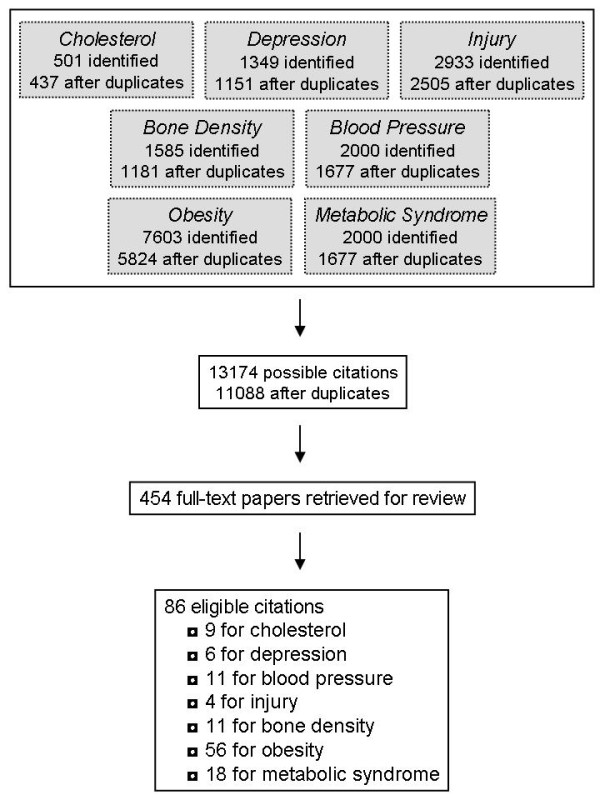
- After duplicates, 11,088 unique citations were screened; 454 full-text articles were reviewed; 86 unique citations met eligibility and 113 outcomes were abstracted. Observational studies had to report dichotomous outcomes; intervention studies were excluded if they included dietary or other behavioral components that could independently affect outcomes.
- Evidence was graded using pre-specified criteria based on quantity/quality of studies and strength of effect; meta-analyses were performed when at least 4 studies were available. RCT quality was assessed with the Downs and Black checklist, and effect sizes used Cohen’s d and ratio-score criteria.
Limitations
- Stated: unpublished and non-English studies were excluded, no extensive cross-referencing of reference lists was performed, the review was limited to 7 health outcomes, and many observational studies were excluded because they did not report dichotomous outcomes; these may have biased results and recommendations.
- Stated RCT limitations: samples were small and non-representative, statistical power was often lacking, adverse events were rarely reported, dropout details were limited, and intent-to-treat analyses were not performed; therefore Level 2 was the highest level assignable to any recommendation.
- Evident from the text: the nature of dose-response relations (linear vs curvilinear) often remained unclear, and the moderating effects of age and sex were not systematically addressed across outcomes.
Model-written summary. Check it against the paper before relying on it.
Integrity signals
Registry
Cites
Statistics
Figures
Verification
Claims the paper makes
0 Valid · 0 Not valid · 42 Not checked · 127 Own results and interpretations
A result the paper reports from its own data — it cites no other source for it, so there is none to check. The quote shows it is in the paper.
In the paper
“Results from experimental studies indicate that even modest amounts of physical activity can have health benefits in high-risk youngsters (e.g., obese).”
§ Systematic review of the health benefits of physical activity and fitness in school-aged children and youth > Abstract > Results
hedgedstates a cause- Asserted: passes — The authors put it forward as true.
- Checkable: passes — It can be checked against evidence.
- Load-bearing: passes — The paper’s conclusions depend on it.
- Based: passes — The paper gives a reason why it holds.
A result the paper reports from its own data — it cites no other source for it, so there is none to check. The quote shows it is in the paper.
In the paper
“Physical activity was associated with numerous health benefits.”
§ Systematic review of the health benefits of physical activity and fitness in school-aged children and youth > Abstract > Results
plainstates an association- Asserted: passes — The authors put it forward as true.
- Checkable: passes — It can be checked against evidence.
- Load-bearing: passes — The paper’s conclusions depend on it.
- Based: passes — The paper gives a reason why it holds.
A result the paper states — it cites no source for it, so there is none to check. The quote shows it is in the paper.
In the paper
“Aerobic-based activities had the greatest health benefit, other than for bone health, in which case high-impact weight bearing activities were required.”
§ Systematic review of the health benefits of physical activity and fitness in school-aged children and youth > Abstract > Results
plainstates an association- Asserted: passes — The authors put it forward as true.
- Checkable: passes — It can be checked against evidence.
- Load-bearing: passes — The paper’s conclusions depend on it.
- Based: passes — The paper gives a reason why it holds.
A result the paper reports from its own data — it cites no other source for it, so there is none to check. The quote shows it is in the paper.
In the paper
“The dose-response relations observed in observational studies indicate that the more physical activity, the greater the health benefit.”
§ Systematic review of the health benefits of physical activity and fitness in school-aged children and youth > Abstract > Results
hedgedstates an association- Asserted: passes — The authors put it forward as true.
- Checkable: passes — It can be checked against evidence.
- Load-bearing: passes — The paper’s conclusions depend on it.
- Based: passes — The paper gives a reason why it holds.
None of the sources cited for this claim have been checked yet.
In the paper
“The results indicated that unfit girls, defined as the lowest 20% fit, were 1.89 (95% confidence interval: 1.12-3.17) times more likely to have hypercholesterolemia and 1.03 (0.74-1.43) times more likely to have a low HDL-cholesterol by comparison to moderately and high fit girls.”
§ Systematic review of the health benefits of physical activity and fitness in school-aged children and youth > Results > Cholesterol and blood lipids
hedgedstates an associationn = 3,110- Asserted: passes — The authors put it forward as true.
- Checkable: passes — It can be checked against evidence.
- Load-bearing: passes — The paper’s conclusions depend on it.
- Based: passes — The paper gives a reason why it holds.
103 more claims
Create a free account to see all 169 claims and every source verdict.
- Probably not a substantial claim. 26
- The quote only partly states this claim. 2
- It may state two separate claims as one. 37
Claims other papers make about this one
Each is checked against this paper’s own text: does it say what the citing paper says it does?
The source backs part of the claim, not all of it — or backs it for a different population, condition or comparison.
In the citing paper
“Research indicates that those who are physically active show or report better overall physical and mental health, a higher level of fitness and a lower level of obesity than their sedentary or physically inactive counterparts1–4”
From Physical activity and health in Chinese children and adolescents: expert consensus statement (2020) (2020) · cites this paper as [2]
Experimental — accuracy not yet measuredThe cited source says what the claim attributes to it.
In the citing paper
“The association with overweight/obesity tends to be stronger when moderate to vigorous-intensity physical activities are performed.2”
From Physical activity and health in Chinese children and adolescents: expert consensus statement (2020) (2020) · cites this paper as [2]
The cited source says what the claim attributes to it.
In the citing paper
“Among physical activity interventions, the effects of physical activity independent of dietary changes on measures indicative of weight reduction (eg, BMI, total fat, abdominal fat) tend to be in the small range.2”
From Physical activity and health in Chinese children and adolescents: expert consensus statement (2020) (2020) · cites this paper as [2]
The cited source says what the claim attributes to it.
In the citing paper
“In general, as the level of physical activity increases, the likelihood of injury increases.2”
From Physical activity and health in Chinese children and adolescents: expert consensus statement (2020) (2020) · cites this paper as [2]
The cited source says what the claim attributes to it.
In the citing paper
“Systematic reviews have shown that physical activity (PA) is associated with greater mental health, 6 and a reduced risk of mental ill-health, specifically depression and anxiety.7,8”
From Domain-Specific Physical Activity and Mental Health: A Meta-analysis (2017) · cites this paper as [8]
2 more claims about this paper
Create a free account to see every claim other papers make about this one.
Self-check
Percentages, sums and reported differences re-computed from the paper’s own numbers.
Each contradiction between two passages listed here was confirmed by an independent check.
Rated major: it would touch a result — a value a result rests on, reported and recomputed p-values on opposite sides of the significance level, two passages that conflict with no sign which is right, or a cited work retracted before this paper was published.
In the paper
§ Systematic review of the health benefits of physical activity and fitness in school-aged children and youth > Discussion > Recommendations based on systematic review
“More vigorous intensity activities should be incorporated or added when possible, including activities that strengthen muscle and bone. [Level 3, Grade B].”
§ Systematic review of the health benefits of physical activity and fitness in school-aged children and youth > Discussion > Recommendations based on systematic review
“This recommendation was given a lower grade (Grade C) because of the potential increase in injury risk associated with more vigorous intensity activities and sports.”
Rated minor: it would not touch a result — a value no result rests on, a p-value that stays on the same side of the significance level, or a conflict that is clerical, resolved elsewhere in the paper, or outside its own findings.
In the paper
§ Systematic review of the health benefits of physical activity and fitness in school-aged children and youth > Results > Metabolic syndrome
“Sixteen articles examining the metabolic syndrome met the inclusion criteria.”
§ Systematic review of the health benefits of physical activity and fitness in school-aged children and youth > Results > Metabolic syndrome
“Eight of the 17 identified studies were observational in nature”
Rated minor: it would not touch a result — a value no result rests on, a p-value that stays on the same side of the significance level, or a conflict that is clerical, resolved elsewhere in the paper, or outside its own findings.
In the paper
“A total of 31 observational studies (24 cross-sectional, 3 prospective cohort, 2 case-control, 1 mixed) were retrieved”
§ Systematic review of the health benefits of physical activity and fitness in school-aged children and youth > Results > Overweight and obesity
Reported 31 · recomputed 30
Rated minor: it would not touch a result — a value no result rests on, a p-value that stays on the same side of the significance level, or a conflict that is clerical, resolved elsewhere in the paper, or outside its own findings.
In the paper
“437 citations were identified for cholesterol, 1151 for depression, 2505 for injury, 1181 for bone density, 1677 for blood pressure, 5824 for obesity, and 1677 for the metabolic syndrome. Thus, the grand total was 13174.”
§ Systematic review of the health benefits of physical activity and fitness in school-aged children and youth > Results > Literature review
Reported 13174 · recomputed 14452
Citations
Cites
Downs, S. H., & Black, N. (1998) · Journal of Epidemiology and Community Health · doi:10.1136/jech.52.6.377 · Cited by 8,252
Evidence Based Physical Activity for School-age Youth
Strong, W. B., Malina, R. M., Blimkie, C. J. R., Daniels, S. R., Dishman, R. K., Gutin, B., Hergenroeder, A. C., Must, A., Nixon, P. A., Pivarnik, J. M., et al. (2005) · The Journal of Pediatrics · doi:10.1016/j.jpeds.2005.01.055 · Cited by 4,222
Systematic Reviews: Synthesis of Best Evidence for Clinical Decisions
Cook, D. J., Mulrow, C. D., & Haynes, R. B. (1997) · Annals of Internal Medicine · doi:10.7326/0003-4819-126-5-199703010-00006 · Cited by 2,184
Andersen, L. B., Harro, M., Sardinha, L. B., Froberg, K., Ekelund, U., Brage, S., & Anderssen, S. A. (2006) · The Lancet · doi:10.1016/s0140-6736(06)69075-2 · Cited by 1,473
Lau, D. C. W., Douketis, J. D., Morrison, K. M., Hramiak, I. M., Sharma, A. M., Ur, E., & Panel, F. M. O. T. O. C. C. P. G. E. (2007) · Canadian Medical Association Journal · doi:10.1503/cmaj.061409 · Cited by 1,154
Paterson, D. H., & Warburton, D. E. (2010) · International Journal of Behavioral Nutrition and Physical Activity · doi:10.1186/1479-5868-7-38 · Cited by 953
A systematic review of the evidence for Canada's Physical Activity Guidelines for Adults
Warburton, D. E., Charlesworth, S., Ivey, A., Nettlefold, L., & Bredin, S. S. (2010) · International Journal of Behavioral Nutrition and Physical Activity · doi:10.1186/1479-5868-7-39 · Cited by 902 · cited 1×
“This report was part of a much larger project around Canada's physical activity guidelines, and comparable systematic reviews for adults [ 10 ] and older adults [11] have also been published in the journal.”
A meta-regression to examine the relationship between aerobic fitness and cognitive performance
Etnier, J. L., Nowell, P. M., Landers, D. M., & Sibley, B. A. (2006) · Brain Research Reviews · doi:10.1016/j.brainresrev.2006.01.002 · Cited by 749
Is the Canadian childhood obesity epidemic related to physical inactivity?
Tremblay, M. S., & Willms, J. D. (2003) · International Journal of Obesity · doi:10.1038/sj.ijo.0802376 · Cited by 517
Nassis, G. P., Papantakou, K., Skenderi, K., Triandafillopoulou, M., Kavouras, S. A., Yannakoulia, M., Chrousos, G. P., & Sidossis, L. S. (2005) · Metabolism · doi:10.1016/j.metabol.2005.05.013 · Cited by 469
Research works printed but not linked: 1
- Petitti DB Meta-Analysis, Decision Analysis, and Cost-Effective Analysis 1994 New York, NY: Oxford University Press
Cited by
Items 4,101–4,200 of 4,834
Bonifacio, M., & Losañes, S. P. (2025) · Psychology and Education A Multidisciplinary Journal · doi:10.70838/pemj.370909
Naito, T., Aoyagi, K., Oka, K., & Ishii, K. (2024) · medRxiv · doi:10.1101/2024.12.14.24319036
POE: Learning Settings and Practice Matter Exploratory Study - 9th Grade
Scott–Webber, L., Breithecker, D., & Sorensen, D. (2022) · Journal of Education and Learning · doi:10.5539/jel.v12n1p1 · Cited by 3
“What we know is in children and adolescents daily sitting time takes over 50% of the waking day at 7 years and 75% at 15 years (Janssen et al., 2016).”
BackgroundBARBOSA, S. R., MASSAHUD, A. R., & Barreto, S. M. G. (2022) · doi:10.48209/978-65-89949-05-8
Badiola, A., Ibañez, I., Iturricastillo, A., Yanci, J., & Arruabarrena, O. U. (2025) · Societies · doi:10.3390/soc15120326
Crossley, S. G. M., McNarry, M. A., Rosenberg, M., Knowles, Z. R., Eslambolchilar, P., & Mackintosh, K. A. (2018) · doi:10.2196/preprints.11253
Kramer, E. (2020) · University of Minnesota Digital Conservancy (University of Minnesota) · Cited by 1
Physical activity and physical fitness in children with chronic conditions
Bos, J. (2020) · University of Groningen research database (University of Groningen / Centre for Information Technology) · doi:10.33612/diss.110390749 · Cited by 1
The Effect of Sport in Online Dating: Evidence from Causal Machine Learning
Boller, D., Lechner, M., & Okasa, G. (2021) · Humanities and Social Sciences Communications · doi:10.1057/s41599-025-04566-9 · Cited by 1
“For instance, Hillman et al. (2008) demonstrated that sports activity enhances cognition and brain function (for a review, see Janssen and LeBlanc, 2010; Strong et al. 2005).”
Bai, X., Wang, Z., Li, J., Zhang, J., & Zhang, S. (2023) · Research Square · doi:10.21203/rs.3.rs-2952205/v1
Does physical activity reinforce adolescents’ body-esteem? A cross-sectional study from FinlandPreprint
Ojala, K., Huotari, P., Villberg, J., & Tynjälä, J. (2019) · doi:10.21203/rs.2.19250/v1
Daily vegetable eating among adults, 2015 (or nearest year)
(2017) · Health at a glance · doi:10.1787/health_glance-2017-graph39-en
D’Isanto, T., Domenico, F. D., Simões, V., Esposito, G., & Aliberti, S. (2026) · Children · doi:10.3390/children13091255
“Physical activity during childhood and adolescence is widely recognized as a key determinant of physical and psychological health, contributing to healthy growth and the prevention of numerous chronic conditions and functional impairments [1,2].”
Acharya, A. (2023) · International Journal of Community Medicine and Public Health · doi:10.18203/2394-6040.ijcmph20231672
Radigan, M., Wang, R., Calderwood, C., Perkins, M. B., Lanzara, C. B., & Sederer, L. I. (2016) · Psychiatric Quarterly · doi:10.1007/s11126-016-9464-9
OECD (2018) · Programme international pour le suivi des acquis des élèves · doi:10.1787/9789264288850-1-fr
Prieto-Ayuso, A., Koolwijk, P., Martínez, A. H., & de Vries, S. I. (2025) · Journal of Sports Sciences · doi:10.1080/02640414.2025.2555119
“An active lifestyle is associated with all kinds of positive health effects (Janssen & LeBlanc, 2010; Robinson et al., 2015).”
Kyan, A., & Takakura, M. (2020) · Japan Journal of Human Growth and Development Research · doi:10.5332/hatsuhatsu.2020.88_1
ПІДВИЩЕННЯ ЕФЕКТИВНОСТІ ПРОЦЕСУ ФІЗИЧНОГО ВИХОВАННЯ ШКОЛЯРІВ СУЧАСНИМИ ФІТНЕС-ТЕХНОЛОГІЯМИ
Тищенко, В. О., Омельяненко, Г. А., Крюков, Ю. М., & Яковченко, А. B. (2022) · Visnyk of Zaporizhzhya National University Physical education and Sports · doi:10.26661/2663-5925-2022-1-05 · Cited by 3
Djaafri, Z., Bencharif, M., Sersar, I., Amokrane, N., Bendjama, R. F. N., & Bentaleb, M. (2024) · Nutrition Clinique et Métabolisme · doi:10.1016/j.nupar.2024.10.002 · Cited by 1
Board Diving Regulations in Public Swimming Pools and Risk of Injury
Williams, D. D., & Odin, L. (2015) · Risk Analysis · doi:10.1111/risa.12523
Gadais, T., Dionne, S., Laurencelle, L., & Nadeau, L. (2016) · Ejournal de la recherche sur l intervention en éducation physique et sport -eJRIEPS · doi:10.4000/ejrieps.803
Domínguez, R. R. (2017) · UVaDOC UVaDOC University of Valladolid Documentary Repository (University of Valladolid) · doi:10.35376/10324/23033 · Cited by 2
체육을 통해 청소년들의 공격성을 예방할 수 있는가?: 자기결정이론의 체육현장 적용*
임, 창., 천, 승., & 김, 리. (2025) · 한국체육학회지 · doi:10.23949/kjpe.2025.9.64.5.10
Physical Activity, Sedentary Behaviour and Sleep in Adolescent Females in New Zealand
Tye, L. (2020) · Otago University Research Archive (University of Otago) · Cited by 1
Prevalence of Physical Activity and its Association with Medication Use Among Children With ADHD
Alotaibi, M. M., Alrashdi, N. Z., Alanazi, S. A., Alkhalidi, M. M., ALMUTAIRI, M. K., Alzubaidi, B. Y., & Alqahtani, M. Μ. (2026) · Current Psychology · doi:10.1007/s12144-026-09712-3
“The small increase in single-visit ER use among daily-active children may reflect sporadic, activity-related minor injuries that prompt an isolated emergency visit but do not translate into a sustained pattern of acute-care use (Hanson et al., 2019 ; Janssen & Leblanc, 2010 ).”
INFLUÊNCIA DA ATIVIDADE FÍSICA REGULAR NA QUALIDADE DE VIDA DE IDOSOS: UM ESTUDO DE REVISÃO
ABREU, C. D. S., Loureiro, W., & SOEIRO, L. B. (2022) · doi:10.48209/978-65-89949-15-8
Adolescents’ enjoyment in face-to-face physical education during the COVID-19 pandemic
Mata, C., Onofre, M., Costa, J., Monteiro, D., Teixeira, D., & Martins, J. (2023) · European Physical Education Review · doi:10.1177/1356336x231163106 · Cited by 1
Kiran, V. U., Vabbalareddi, R., Pandranki, J., & Nandan, V. B. (2024) · Indian Journal of Dental Research · doi:10.4103/ijdr.ijdr_247_23
Weather and children’s allocation of time: Evidence from India
Neog, B. J. (2026) · Review of Economics of the Household · doi:10.1007/s11150-026-09875-9
Self-evaluation of behaviours related to the health of Polish young adults
Martyn, J., & Marć, M. (2020) · Family Medicine & Primary Care Review · doi:10.5114/fmpcr.2020.95320
Gebruik van commerciële stappentellers bij 3‑ en 4‑jarigen: het effect van feedback geven aan ouders
Dogger, C. A., Mérelle, S. Y. M., & Rip, R. (2018) · JGZ Tijdschrift voor jeugdgezondheidszorg · doi:10.1007/s12452-017-0129-3
MRI units, 2015 (or nearest year)
(2017) · Health at a glance · doi:10.1787/health_glance-2017-graph152-en
Greule, C., Sudeck, G., Ziser, K., Erschens, R. S., Martus, P., Giel, K. E., Mack, I., Weiland, A., Zurstiege, G., Zipfel, S., et al. (2026) · German Journal of Exercise and Sport Research · doi:10.1007/s12662-026-01145-1
“Dateofregistration:27.11.2020 (Universal trialnumberU1111-1254-9536). mentalhealthofchildrenandadolescents (Janssen & LeBlanc, 2010; WHO, 2022; Tarp et al., 2018), global observations on physical activity levels still point towards the need for action (Kohl et al., 2012).”
InfluentialCameron, K. L., McDonald, C. E., Cheong, J. L. Y., & Spittle, A. J. (2026) · Disability and Rehabilitation · doi:10.1080/09638288.2026.2723373 · Cited by 1
Hibbs, N. (2016) · e-scholar@UOIT (University of Ontario Institute of Technology)
Dahm, S. F., & Maticevic, M. (2024) · Journal of Applied Sport and Exercise Psychology · doi:10.1026/2941-7597/a000010
Childhood Environment and Obesity
Hughes, S. O., Power, T. G., Dave, J. M., & O’Connor, T. M. (2016) · Springer eBooks · doi:10.1007/978-3-319-11251-0_15 · Cited by 1
Sport Parents’ Perspectives of Children’s Free Play and Sport and their Accompanying Messages
Watchman, T. (2017) · ERA: Education and Research Archive (University of Alberta) · doi:10.7939/r3g737g5b
Winchar, G. (2019) · Mspace (University of Manitoba)
Practising nurses per 1 000 population, 2000 and 2015 (or nearest year)
(2017) · Health at a glance · doi:10.1787/health_glance-2017-graph139-en
刘, 梦. (2019) · Advances in Education · doi:10.12677/ae.2019.95097
“1007/s40279-014-0215-5 [2] Janssen, I.”
MASSAHUD, A. R., SANDY, M. R., SANDY, P., & SIMAO, A. P. (2022) · doi:10.48209/978-65-89949-03-8
Lau, E. Y., Faulkner, G., & Qian, W. (2016) · Promotion de la santé et prévention des maladies chroniques au Canada · doi:10.24095/hpcdp.36.11.01f
C., A. R. L., Shilpa, K., Ugargol, A. R., et al. (2017) · International Journal of Community Medicine and Public Health · doi:10.18203/2394-6040.ijcmph20171758
Seemüller, S., & Reimers, A. K. (2025) · Archives of Public Health · doi:10.1186/s13690-025-01728-8 · Cited by 1
“Physical activity (PA) is associated with numerous health benefits for people with and without disabilities [1, 2].”
Moriana-Coronas, F. J. (2014) · Cited by 1
Dube, P. C. (2017) · Scholarship at UWindsor (University of Windsor) · Cited by 1
Examining the relation between children’s satisfaction with their time-use and subjective well-being
Savahl, S., Adams, S., Casas, F., Varela, J. J., Goswami, H., Baatjies, D., & van der Harst, M. (2026) · International Journal of Adolescence and Youth · doi:10.1080/02673843.2026.2659784
A Descriptive Study: Males’ and Females’ Involvement in Physical Activity and Eating Behaviors
Graves, M. L., Nabors, L., Bernard, A. L., & Vidourek, R. A. (2020) · Journal of Public Health Issues and Practices · doi:10.33790/jphip1100161
South County Food, Fitness, and Fun Program: A Comprehensive Intervention on Childhood Obesity
Tassoni, A. (2013) · Digital Commons - URI (University of Rhode Island) · doi:10.23860/thesis-tassoni-amanda-2013
“In spite of many intervention studies focusing on this topic, the rates of childhood obesity continue to rise (Berkey et al., 2000); (Janssen & LeBlanc, 2010);(Ogden & Carroll, 2010);(Warburton et al., 2006).”
BackgroundOviedo, D. R., Wilches-Mogollon, M. A., Arbelaez, M. J., Duarte, N. V., Sarmiento, O. L., Marquez, S., Dávila, J. D., de Tejada, J. R., Durán, D., Flórez, J., et al. (2026) · African Transport Studies · doi:10.1016/j.aftran.2026.100095 · Cited by 1
Risk assessment of low cognitive performance among fishermen's children in Malaysia
Meli, A. M., Zakaria, N. H., Yusof, H. M., Kamarudin, K. S., & Ali, A. (2023) · Journal of Taibah University Medical Sciences · doi:10.1016/j.jtumed.2023.05.004
Kendall, I. S., Greco, A., Cantarutti, N., Constante, A. D., Diaz‐Gil, D., D’hulst, S., Esmel-Vilomara, R., López-Guillén, J. L., Łuczak-Woźniak, K., Ragazzoni, G. L., et al. (2026) · European Journal of Pediatrics · doi:10.1007/s00431-026-06768-y
Expectation of Undergraduates on Teachers in Professional Colleges - A Survey
Kamaladevi, & Brundha, M. P. (2023) · International Journal of Advanced Research in Science Communication and Technology · doi:10.48175/ijarsct-14381
Ammar, A., Aly, M., Trabelsi, K., Mera, T. A., Masmoudi, L., El-Gyar, N., Shalaby, A. M., Jahrami, H., Husain, W., Żmijewski, P., et al. (2025) · Frontiers in Public Health · doi:10.3389/fpubh.2025.1675893 · Cited by 1
“Regular PA improves cardiorespiratory fitness, muscular strength, coordination, metabolic health, and bone development, while also supporting cognitive functions such as attention, memory, and academic performance (1–5).”
Rindler, V. (2021) · theses.fr (ABES) · doi:10.70675/c5577089z9368z4f20z8d94z7f763356eabd
Kunz, S., & Stenberg, E. (2013) · Zürcher Hochschule für Angewandte Wissenschaften digital collection (Zurich University of Applied Sciences) · doi:10.21256/zhaw-284
Ojukwu, C. P., Judith, O. C., Onyekwelu, A. I., Eleje, C. U., Ekowa, J. L., & Fatai, K. E. (2026) · medRxiv · doi:10.64898/2026.05.30.26354500
PROMOTING ADOLESCENTS' PHYSICAL ACTIVITY @ SCHOOL
Lindqvist, A.-K. (2015) · DiVA (Luleå University of Technology) · Cited by 3
Gray, C. E. (2011) · Scholarship@Western (Western University)
Back health in health education: reflections on musculoskeletal fitness
Monfort-Pañego, M., Miñana-Signes, V., & Noll, M. A. (2025) · Journal of Human Growth and Development · doi:10.36311/jhgd.v35.17301 · Cited by 2
Regular binge-drinking (at least once a month) by gender, 2014
(2017) · Health at a glance · doi:10.1787/health_glance-2017-graph34-en
Iliano, E., Angarita‐Osorio, N., Beeckman, M., Latomme, J., & Cardon, G. (2026) · Journal of Intergenerational Relationships · doi:10.1080/15350770.2026.2679981
Fredriksen, P. M., Goswami, N., & Mamen, A. (2026) · PLoS ONE · doi:10.1371/journal.pone.0351792
OECD (2018) · Programme international pour le suivi des acquis des élèves · doi:10.1787/9789264288850-18-fr
Bradt, L., de Walle, T. V., der Eecken, A. V., Moerkerke, B., & Loeys, T. (2015) · Sociologos · doi:10.21825/sociologos.86896 · Cited by 1
Remuneration of hospital nurses, USD PPP, 2015 (or nearest year)
(2017) · Health at a glance · doi:10.1787/health_glance-2017-graph144-en
Velásquez, M. A. Q., Saldarriaga-Franco, J. F., Canola, H. C., et al. (2022) · CES Medicina · doi:10.21615/cesmedicina.6578
Nutrients Intake and Hypertension
Fantin, F. (2020) · MDPI eBooks · doi:10.3390/books978-3-03928-663-8
Fyysinen aktiivisuus, ruutuaika sekä tuki- ja liikuntaelimistön kipuoireet 7.- ja 8. luokkalaisilla
Nissinen, E. (2015) · Jyväskylä University Digital Archive (University of Jyväskylä) · Cited by 1
Hansell, A. H. (2018) · The Research Repository @ WVU (West Virginia University) · doi:10.33915/etd.8209
Movement patterns of youth and their parents: cross-sectional and longitudinal associations
Hänggi, J. M., Lovison, G., Jeong, A., Dössegger, A., Taube, W., Kayser, B., Suggs, L. S., Bringolf‐Isler, B., & Probst-Hensch, N. M. (2026) · Journal of Activity Sedentary and Sleep Behaviors · doi:10.1186/s44167-025-00092-w
“Physical activity (PA) has broad health benefits in children [1–3] and adults [4–7].”
Cárcamo-Oyarzún, J., Martínez-López, N., Ferbol, C., Cumilef-Bustamante, P., Negron-Molina, M., Luna-Villouta, P. F., Pávez-Adasme, G., Pacheco-Carrillo, J., Vitoria, R. V., Ibarra-Mora, J., et al. (2026) · Journal of Physical Activity and Health · doi:10.1123/jpah.2025-0644
Effectiveness of school-based intervention in obese children
Nagrale, S., & Jiandani, M. (2026) · Journal of Family Medicine and Primary Care · doi:10.4103/jfmpc.jfmpc_1909_24
Harding, H., Wallace, L., English, M., van Gogh, M., & Caperchione, C. M. (2026) · Journal of Physical Activity and Health · doi:10.1123/jpah.2026-0167
School-based Physical Activity: Planning with student motivation in mind
Barrett, J. (2015) · Teaching and Learning · doi:10.26522/tl.v10i1.428
Trends in share of adults with diabetes, 1980-2014
(2017) · Health at a glance · doi:10.1787/health_glance-2017-graph29-en
Urban-Rural Contrasts in Attitudes, Motives and Sport Preferences in Adolescents
Kudláček, M., Sigmund, M., Kvintová, J., et al. (2017) · e-Pedagogium · doi:10.5507/epd.2017.058
O’Loughlin, E. K. (2019) · Spectrum Research Repository (Concordia University) · Cited by 4
Mutawally, S. (2019) · Lu Zone Ul (Laurentian University)
CHILDREN'S PHYSICAL SELF-EFFICACY AND FREE-TIME PHYSICAL ACTIVITY
Steward, K. (2013)
Active Video Games and Energy Balance in Male Adolescents
Gribbon, A. (2015) · uO Research (University of Ottawa) · doi:10.20381/ruor-3929
“…physical activity expenditure, from low to moderate intensities (LeBlanc, et al., 2013), and that typically moderate to vigorous intensities are required to promote the physiological adaptations that result in a marked improvement in cardio-metabolic health in adolescents (Janssen & LeBlanc, 2010).”
BackgroundSadia, F., Frank-Wilson, A. W., Patel, N. B., Bélanger, M. F., BRUSSONI, M. J., Faulkner, G., Gunnell, K. E., Tremblay, M. S., & Larouche, R. (2026) · Applied Physiology, Nutrition, and Metabolism · doi:10.1139/apnm-2025-0213
Chu, S., Lee, G., Yu, J., & Joo, W. (2026) · Frontiers in Psychology · doi:10.3389/fpsyg.2026.1868378
“Combined with their generally higher levels of physical activity (Janssen and LeBlanc, 2010), boys are more likely to assume dominant roles, experience success, and receive recognition and support from their peers in PE classes that primarily involve ball games and team-based activities (Rodrigues…”
InfluentialEngels, B., Kotte, E. M. W., Engelbert, R., Sol, M. E., van der Lugt, R., Wittink, H. M., Gorter, J. W., & Bloemen, M. A. T. (2025) · PLoS ONE · doi:10.1371/journal.pone.0319659
“In addition, insight into actual time spent in PA would undoubtedly add value to adopting more active lifestyles, as parents and children are often unaware of their actual PA levels [22].”
Metadata
- Authors
- Janssen, I., & LeBlanc, A. G.
- Affiliations
- Queen's University (CA)
- Corresponding author
- Janssen, Ian
- Venue
- International Journal of Behavioral Nutrition and Physical Activity
- Published
- 2010
- Volume
- 7
- Issue
- 1
- Pages
- 40
- ISSN
- 1479-5868 (ISSN-L)
- PMC
- PMC2885312
- OpenAlex
- W2145702257
- Semantic Scholar
- ef8d55efd11b9d5e4a4814b6a38ff3d60d820d37
- Cited by
- 4,829
- References
- 116
- Citations by year
- 2026: 185 · 2025: 257 · 2024: 310 · 2023: 304 · 2022: 371 · 2021: 451 · 2020: 459 · 2019: 401 · 2018: 387 · 2017: 490 · 2016: 302 · 2015: 280 · 2014: 250 · 2013: 191 · 2012: 109
- FWCI
- 12.18
- Type
- journal article
- Language
- en
- Open access
- gold
- doi.org
- Licence
- cc-by
- Locations
- International Journal of Behavioral Nutrition and Physical Activity (publishedVersion, cc-by)
- PubMed Central (publishedVersion, cc-by)
- PubMed (publishedVersion)
- DOAJ (DOAJ: Directory of Open Access Journals) (submittedVersion, cc-by-sa)
- Funders
- Public Health Agency of Canada
- Public Health Agency
- Topics
- Health Sciences › Medicine › Public Health, Environmental and Occupational Health › Physical Activity and Health
- Health Sciences › Medicine › Public Health, Environmental and Occupational Health › Obesity, Physical Activity, Diet
- Social Sciences › Life-span and Life-course Studies › Recreational Sport and Physical Activity
- Keywords
- physical activity, physical fitness, school-aged children, youth, health benefits, serum cholesterol, blood pressure, metabolic syndrome, childhood obesity, bone mineral density, depression, injuries, dose-response relationship, aerobic exercise, physical activity guidelines
About these checks
Registry, retraction, Cites and statistics results are computed, not judged, with one exception: a printed reference that no index lists is read once by a model before it counts as a citation error. Claims are extracted by a model and kept only when their quote appears verbatim in the text; each cited source is then checked, with a model’s help, for whether it says what the claim relies on. Those verdicts can be wrong — read the claim’s quote and the cited source before relying on one.
A language model drew the claims from the paper on 2026-10-10, under version 3 of the claim definition (model deepseek-v4.1-flash, prompt extract-v3).
A second model labelled each claim on 2026-10-10 (model jev-1.13-20260917, definition revision gold-guideline-v0.2).
Statistics and arithmetic are recomputed, not judged.
Confidence bands are shown only for fields calibrated on our annotated test set. None is calibrated yet, so no band is shown.
What counts as a claim ›How we measure confidence ›How we check this ›
Are you an author, or do you see a problem with this page? Request a review
Data sources
Bibliographic data: Semantic Scholar, OpenAlex, Crossref.
Contains information from the Semantic Scholar Academic Graph Datasets, made available under the ODC Attribution License (ODC-BY 1.0).
Semantic Scholar’s data is described in: Kinney, R., et al. (2023). The Semantic Scholar Open Data Platform. arXiv:2301.10140.
