

Systematic review of the health benefits of physical activity and fitness in school-aged children and youth
Open accessThe DOI matches its Crossref record; 114 of the 116 references it cites were found in a registry or an index; none of the 128 sources its claims cite is checked for support yet.
Abstract
BACKGROUND: The purpose was to: 1) perform a systematic review of studies examining the relation between physical activity, fitness, and health in school-aged children and youth, and 2) make recommendations based on the findings. METHODS: The systematic review was limited to 7 health indicators: high blood cholesterol, high blood pressure, the metabolic syndrome, obesity, low bone density, depression, and injuries. Literature searches were conducted using predefined keywords in 6 key databases. A total of 11,088 potential papers were identified. The abstracts and full-text articles of potentially relevant papers were screened to determine eligibility. Data was abstracted for 113 outcomes from the 86 eligible papers. The evidence was graded for each health outcome using established criteria based on the quantity and quality of studies and strength of effect. The volume, intensity, and type of physical activity were considered. RESULTS: Physical activity was associated with numerous health benefits. The dose-response relations observed in observational studies indicate that the more physical activity, the greater the health benefit. Results from experimental studies indicate that even modest amounts of physical activity can have health benefits in high-risk youngsters (e.g., obese). To achieve substantive health benefits, the physical activity should be of at least a moderate intensity. Vigorous intensity activities may provide even greater benefit. Aerobic-based activities had the greatest health benefit, other than for bone health, in which case high-impact weight bearing activities were required. CONCLUSION: The following recommendations were made: 1) Children and youth 5-17 years of age should accumulate an average of at least 60 minutes per day and up to several hours of at least moderate intensity physical activity. Some of the health benefits can be achieved through an average of 30 minutes per day. [Level 2, Grade A]. 2) More vigorous intensity activities should be incorporated or added when possible, including activities that strengthen muscle and bone [Level 3, Grade B]. 3) Aerobic activities should make up the majority of the physical activity. Muscle and bone strengthening activities should be incorporated on at least 3 days of the week [Level 2, Grade A].
Overview
CoChat Summary
TL;DR
This systematic review found physical activity is associated with numerous health benefits in school-aged children and youth, with observational dose-response evidence suggesting more activity yields greater benefit. It recommends an average of at least 60 minutes per day of at least moderate activity, with some benefits achievable at 30 minutes per day, plus added vigorous and muscle/bone-strengthening activities.
Key findings
- From 11,088 unique citations, 86 eligible papers yielded 113 outcomes across 7 health indicators. Physical activity was associated with benefits; observational studies showed dose-response relations, and experimental studies indicated even modest activity can benefit high-risk youngsters (e.g., obese).
- Metabolic syndrome: summary odds ratio for least active vs most active was 1.68 (95% CI 1.22–2.31) in 3 self-report studies; least fit vs most fit was 6.79 (95% CI 5.11–9.03) in 4 fitness studies. Obesity: median odds ratio was 1.33 for self-reported activity and 3.79 for objective measures. Cholesterol: unfit girls were 1.89 (1.12–3.17) times and unfit boys 3.68 (2.55–5.31) times more likely to have hypercholesterolemia than moderately/high fit peers.
- Recommendations: children and youth 5–17 years should accumulate an average of at least 60 minutes per day and up to several hours of at least moderate intensity activity; some health benefits can be achieved through an average of 30 minutes per day [Level 2, Grade A]. More vigorous activities should be incorporated when possible, including muscle- and bone-strengthening activities [Level 3, Grade B]; aerobic activities should make up the majority, with muscle and bone strengthening on at least 3 days per week [Level 2, Grade A].
- Bone: as little as 10 minutes of moderate-to-high impact activities on as little as 2 or 3 days per week can have a modest effect on bone mineral density when combined with general weight-bearing aerobic activities. Injuries: all 3 included studies reported higher injury rates in active children/youth and clear dose-response relations; vigorous sports risk estimates were high.
Methods
- Systematic review limited to 7 health indicators: high blood cholesterol, high blood pressure, metabolic syndrome, obesity, low bone density, depression, and injuries. Searches used predefined keywords in 6 databases (MEDLINE, EMBASE, CINAHL, PsycINFO, Evidence-Based Medicine Reviews, SPORTDiscus) to January 2008, limited to human participants, English language, and ages 5–17 years.
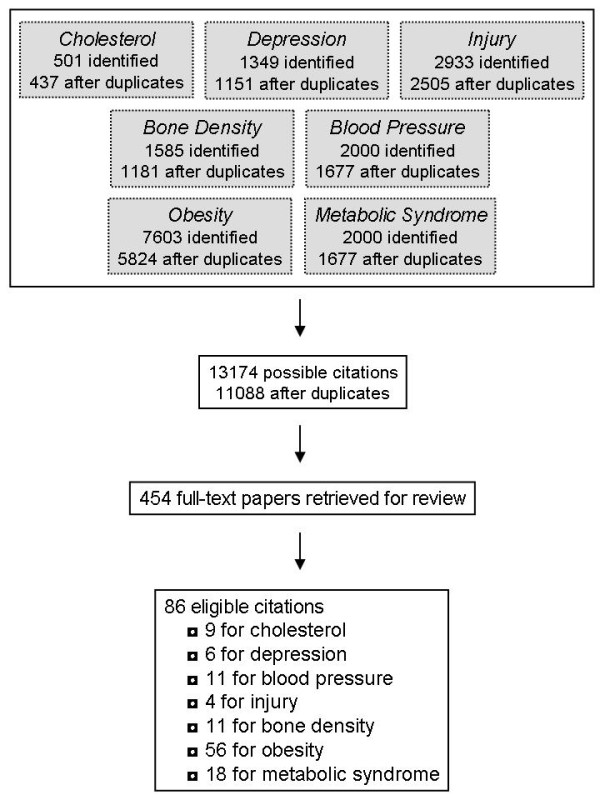
- After duplicates, 11,088 unique citations were screened; 454 full-text articles were reviewed; 86 unique citations met eligibility and 113 outcomes were abstracted. Observational studies had to report dichotomous outcomes; intervention studies were excluded if they included dietary or other behavioral components that could independently affect outcomes.
- Evidence was graded using pre-specified criteria based on quantity/quality of studies and strength of effect; meta-analyses were performed when at least 4 studies were available. RCT quality was assessed with the Downs and Black checklist, and effect sizes used Cohen’s d and ratio-score criteria.
Limitations
- Stated: unpublished and non-English studies were excluded, no extensive cross-referencing of reference lists was performed, the review was limited to 7 health outcomes, and many observational studies were excluded because they did not report dichotomous outcomes; these may have biased results and recommendations.
- Stated RCT limitations: samples were small and non-representative, statistical power was often lacking, adverse events were rarely reported, dropout details were limited, and intent-to-treat analyses were not performed; therefore Level 2 was the highest level assignable to any recommendation.
- Evident from the text: the nature of dose-response relations (linear vs curvilinear) often remained unclear, and the moderating effects of age and sex were not systematically addressed across outcomes.
Model-written summary. Check it against the paper before relying on it.
Integrity signals
Registry
Cites
Statistics
Figures
Verification
Claims the paper makes
0 Valid · 0 Not valid · 42 Not checked · 127 Own results and interpretations
A result the paper reports from its own data — it cites no other source for it, so there is none to check. The quote shows it is in the paper.
In the paper
“Results from experimental studies indicate that even modest amounts of physical activity can have health benefits in high-risk youngsters (e.g., obese).”
§ Systematic review of the health benefits of physical activity and fitness in school-aged children and youth > Abstract > Results
hedgedstates a cause- Asserted: passes — The authors put it forward as true.
- Checkable: passes — It can be checked against evidence.
- Load-bearing: passes — The paper’s conclusions depend on it.
- Based: passes — The paper gives a reason why it holds.
A result the paper reports from its own data — it cites no other source for it, so there is none to check. The quote shows it is in the paper.
In the paper
“Physical activity was associated with numerous health benefits.”
§ Systematic review of the health benefits of physical activity and fitness in school-aged children and youth > Abstract > Results
plainstates an association- Asserted: passes — The authors put it forward as true.
- Checkable: passes — It can be checked against evidence.
- Load-bearing: passes — The paper’s conclusions depend on it.
- Based: passes — The paper gives a reason why it holds.
A result the paper states — it cites no source for it, so there is none to check. The quote shows it is in the paper.
In the paper
“Aerobic-based activities had the greatest health benefit, other than for bone health, in which case high-impact weight bearing activities were required.”
§ Systematic review of the health benefits of physical activity and fitness in school-aged children and youth > Abstract > Results
plainstates an association- Asserted: passes — The authors put it forward as true.
- Checkable: passes — It can be checked against evidence.
- Load-bearing: passes — The paper’s conclusions depend on it.
- Based: passes — The paper gives a reason why it holds.
A result the paper reports from its own data — it cites no other source for it, so there is none to check. The quote shows it is in the paper.
In the paper
“The dose-response relations observed in observational studies indicate that the more physical activity, the greater the health benefit.”
§ Systematic review of the health benefits of physical activity and fitness in school-aged children and youth > Abstract > Results
hedgedstates an association- Asserted: passes — The authors put it forward as true.
- Checkable: passes — It can be checked against evidence.
- Load-bearing: passes — The paper’s conclusions depend on it.
- Based: passes — The paper gives a reason why it holds.
None of the sources cited for this claim have been checked yet.
In the paper
“The results indicated that unfit girls, defined as the lowest 20% fit, were 1.89 (95% confidence interval: 1.12-3.17) times more likely to have hypercholesterolemia and 1.03 (0.74-1.43) times more likely to have a low HDL-cholesterol by comparison to moderately and high fit girls.”
§ Systematic review of the health benefits of physical activity and fitness in school-aged children and youth > Results > Cholesterol and blood lipids
hedgedstates an associationn = 3,110- Asserted: passes — The authors put it forward as true.
- Checkable: passes — It can be checked against evidence.
- Load-bearing: passes — The paper’s conclusions depend on it.
- Based: passes — The paper gives a reason why it holds.
103 more claims
Create a free account to see all 169 claims and every source verdict.
- Probably not a substantial claim. 26
- The quote only partly states this claim. 2
- It may state two separate claims as one. 37
Claims other papers make about this one
Each is checked against this paper’s own text: does it say what the citing paper says it does?
The source backs part of the claim, not all of it — or backs it for a different population, condition or comparison.
In the citing paper
“Research indicates that those who are physically active show or report better overall physical and mental health, a higher level of fitness and a lower level of obesity than their sedentary or physically inactive counterparts1–4”
From Physical activity and health in Chinese children and adolescents: expert consensus statement (2020) (2020) · cites this paper as [2]
Experimental — accuracy not yet measuredThe cited source says what the claim attributes to it.
In the citing paper
“The association with overweight/obesity tends to be stronger when moderate to vigorous-intensity physical activities are performed.2”
From Physical activity and health in Chinese children and adolescents: expert consensus statement (2020) (2020) · cites this paper as [2]
The cited source says what the claim attributes to it.
In the citing paper
“Among physical activity interventions, the effects of physical activity independent of dietary changes on measures indicative of weight reduction (eg, BMI, total fat, abdominal fat) tend to be in the small range.2”
From Physical activity and health in Chinese children and adolescents: expert consensus statement (2020) (2020) · cites this paper as [2]
The cited source says what the claim attributes to it.
In the citing paper
“In general, as the level of physical activity increases, the likelihood of injury increases.2”
From Physical activity and health in Chinese children and adolescents: expert consensus statement (2020) (2020) · cites this paper as [2]
The cited source says what the claim attributes to it.
In the citing paper
“Systematic reviews have shown that physical activity (PA) is associated with greater mental health, 6 and a reduced risk of mental ill-health, specifically depression and anxiety.7,8”
From Domain-Specific Physical Activity and Mental Health: A Meta-analysis (2017) · cites this paper as [8]
2 more claims about this paper
Create a free account to see every claim other papers make about this one.
Self-check
Percentages, sums and reported differences re-computed from the paper’s own numbers.
Each contradiction between two passages listed here was confirmed by an independent check.
Rated major: it would touch a result — a value a result rests on, reported and recomputed p-values on opposite sides of the significance level, two passages that conflict with no sign which is right, or a cited work retracted before this paper was published.
In the paper
§ Systematic review of the health benefits of physical activity and fitness in school-aged children and youth > Discussion > Recommendations based on systematic review
“More vigorous intensity activities should be incorporated or added when possible, including activities that strengthen muscle and bone. [Level 3, Grade B].”
§ Systematic review of the health benefits of physical activity and fitness in school-aged children and youth > Discussion > Recommendations based on systematic review
“This recommendation was given a lower grade (Grade C) because of the potential increase in injury risk associated with more vigorous intensity activities and sports.”
Rated minor: it would not touch a result — a value no result rests on, a p-value that stays on the same side of the significance level, or a conflict that is clerical, resolved elsewhere in the paper, or outside its own findings.
In the paper
§ Systematic review of the health benefits of physical activity and fitness in school-aged children and youth > Results > Metabolic syndrome
“Sixteen articles examining the metabolic syndrome met the inclusion criteria.”
§ Systematic review of the health benefits of physical activity and fitness in school-aged children and youth > Results > Metabolic syndrome
“Eight of the 17 identified studies were observational in nature”
Rated minor: it would not touch a result — a value no result rests on, a p-value that stays on the same side of the significance level, or a conflict that is clerical, resolved elsewhere in the paper, or outside its own findings.
In the paper
“A total of 31 observational studies (24 cross-sectional, 3 prospective cohort, 2 case-control, 1 mixed) were retrieved”
§ Systematic review of the health benefits of physical activity and fitness in school-aged children and youth > Results > Overweight and obesity
Reported 31 · recomputed 30
Rated minor: it would not touch a result — a value no result rests on, a p-value that stays on the same side of the significance level, or a conflict that is clerical, resolved elsewhere in the paper, or outside its own findings.
In the paper
“437 citations were identified for cholesterol, 1151 for depression, 2505 for injury, 1181 for bone density, 1677 for blood pressure, 5824 for obesity, and 1677 for the metabolic syndrome. Thus, the grand total was 13174.”
§ Systematic review of the health benefits of physical activity and fitness in school-aged children and youth > Results > Literature review
Reported 13174 · recomputed 14452
Citations
Cites
Downs, S. H., & Black, N. (1998) · Journal of Epidemiology and Community Health · doi:10.1136/jech.52.6.377 · Cited by 8,252
Evidence Based Physical Activity for School-age Youth
Strong, W. B., Malina, R. M., Blimkie, C. J. R., Daniels, S. R., Dishman, R. K., Gutin, B., Hergenroeder, A. C., Must, A., Nixon, P. A., Pivarnik, J. M., et al. (2005) · The Journal of Pediatrics · doi:10.1016/j.jpeds.2005.01.055 · Cited by 4,222
Systematic Reviews: Synthesis of Best Evidence for Clinical Decisions
Cook, D. J., Mulrow, C. D., & Haynes, R. B. (1997) · Annals of Internal Medicine · doi:10.7326/0003-4819-126-5-199703010-00006 · Cited by 2,184
Andersen, L. B., Harro, M., Sardinha, L. B., Froberg, K., Ekelund, U., Brage, S., & Anderssen, S. A. (2006) · The Lancet · doi:10.1016/s0140-6736(06)69075-2 · Cited by 1,473
Lau, D. C. W., Douketis, J. D., Morrison, K. M., Hramiak, I. M., Sharma, A. M., Ur, E., & Panel, F. M. O. T. O. C. C. P. G. E. (2007) · Canadian Medical Association Journal · doi:10.1503/cmaj.061409 · Cited by 1,154
Paterson, D. H., & Warburton, D. E. (2010) · International Journal of Behavioral Nutrition and Physical Activity · doi:10.1186/1479-5868-7-38 · Cited by 953
A systematic review of the evidence for Canada's Physical Activity Guidelines for Adults
Warburton, D. E., Charlesworth, S., Ivey, A., Nettlefold, L., & Bredin, S. S. (2010) · International Journal of Behavioral Nutrition and Physical Activity · doi:10.1186/1479-5868-7-39 · Cited by 902 · cited 1×
“This report was part of a much larger project around Canada's physical activity guidelines, and comparable systematic reviews for adults [ 10 ] and older adults [11] have also been published in the journal.”
A meta-regression to examine the relationship between aerobic fitness and cognitive performance
Etnier, J. L., Nowell, P. M., Landers, D. M., & Sibley, B. A. (2006) · Brain Research Reviews · doi:10.1016/j.brainresrev.2006.01.002 · Cited by 749
Is the Canadian childhood obesity epidemic related to physical inactivity?
Tremblay, M. S., & Willms, J. D. (2003) · International Journal of Obesity · doi:10.1038/sj.ijo.0802376 · Cited by 517
Nassis, G. P., Papantakou, K., Skenderi, K., Triandafillopoulou, M., Kavouras, S. A., Yannakoulia, M., Chrousos, G. P., & Sidossis, L. S. (2005) · Metabolism · doi:10.1016/j.metabol.2005.05.013 · Cited by 469
Research works printed but not linked: 1
- Petitti DB Meta-Analysis, Decision Analysis, and Cost-Effective Analysis 1994 New York, NY: Oxford University Press
Cited by
Items 201–300 of 4,834
Reframing family-centred obesity prevention using the Family Ecological Model
Davison, K. K., Jurkowski, J. M., & Lawson, H. A. (2013) · Public Health Nutrition · doi:10.1017/s1368980012004533 · Cited by 141
Koohsari, M. J., Badland, H. M., & Giles‐Corti, B. (2013) · Cities · doi:10.1016/j.cities.2013.07.001 · Cited by 175
Vasconcellos, F. V. D. A., Seabra, A., Katzmarzyk, P. T., Kraemer‐Aguiar, L. G., Bouskela, E., & Farinatti, P. (2014) · Sports Medicine · doi:10.1007/s40279-014-0193-7 · Cited by 184
“Considered as an important strategy to increase energy expenditure [18], regular PA is associated with improvements in body composition [19], cardiorespiratory fitness [20], metabolic syndrome components [21], hemodynamic variables [22], and psycho-”
BackgroundHinckson, E. A., Cerin, E., Mavoa, S., Smith, M., Badland, H. M., Stewart, T. I., Duncan, S., & Schofield, G. (2017) · International Journal of Behavioral Nutrition and Physical Activity · doi:10.1186/s12966-017-0597-5 · Cited by 158
Gender differences in the distribution of children’s physical activity: evidence from nine countries
Kretschmer, L., Salalι, G. D., Andersen, L. B., Hallal, P. C., Northstone, K., Sardinha, L. B., Dyble, M., Bann, D., Collaborators, I. C. A. D. (., Andersen, L. B., et al. (2023) · International Journal of Behavioral Nutrition and Physical Activity · doi:10.1186/s12966-023-01496-0 · Cited by 203
“Low levels of activity in childhood have been linked to a series of unfavourable outcomes: higher incidence of infectious [2] and chronic disease [3–8], poorer mental health outcomes [3, 9], lower cognitive function and school performance [9, 10], and delayed physical development [3, 7, 8, 10–15].”
BackgroundEime, R. M., Harvey, J. T., Craike, M. J., Symons, C. M., & Payne, W. R. (2013) · International Journal of Behavioral Nutrition and Physical Activity · doi:10.1186/1479-5868-10-50 · Cited by 139
“Whilst we know that support from both family and peers/friends are strong determinants of PA behaviour, there is a growing body of literature suggesting that support from peers/friends is a stronger predictor of PA than support from parents [20,24-28].”
Chaput, J. ‐., Saunders, T. J., & Carson, V. (2017) · Obesity Reviews · doi:10.1111/obr.12508 · Cited by 139
Spittaels, H., Van Cauwenberghe, E., Verbestel, V., De Meester, F., Van Dyck, D., Verloigne, M., Haerens, L., Deforche, B., Cardon, G., & De Bourdeaudhuij, I. (2012) · International Journal of Behavioral Nutrition and Physical Activity · doi:10.1186/1479-5868-9-149 · Cited by 138
Vella, S. A., Cliff, D. P., Magee, C. A., & Okely, A. D. (2015) · Journal of Science and Medicine in Sport · doi:10.1016/j.jsams.2014.05.006 · Cited by 139
DHULI, K., Naureen, Z., Medori, M. C., Fioretti, F., Caruso, P., Perrone, M. A., Nodari, S., Manganotti, P., Xhufi, S., Bushati, M., et al. (2022) · Journal of Preventive Medicine and Hygiene · doi:10.15167/2421-4248/jpmh2022.63.2s3.2756
Diagnosis & treatment of tuberculosis in HIV co-infected patients
Swaminathan, S., Padmapriyadarsini, C., & Narendran, G. (2011) · The Indian Journal of Medical Research · doi:10.4103/0971-5916.92630 · Cited by 194
Classroom Standing Desks and Sedentary Behavior: A Systematic Review
Minges, K. E., Chao, A. M., Irwin, M. L., Owen, N., Park, C., Whittemore, R., & Salmon, J. (2016) · Pediatrics · doi:10.1542/peds.2015-3087 · Cited by 138
Helbich, M., van Emmichoven, M. J. Z., Dijst, M., Kwan, M., Pierik, F. H., & de Vries, S. I. (2016) · Health & Place · doi:10.1016/j.healthplace.2016.03.003 · Cited by 150
“For children, the World Health Organization (WHO, 2015) recommends 60 min of moderate to vigorous physical activity every day to prevent disease in later life (Faulkner et al., 2009; Janssen and Leblanc, 2010).”
BackgroundBöhm, B., Karwiese, S. D., Böhm, H., & Oberhoffer, R. (2019) · JMIR mHealth and uHealth · doi:10.2196/mhealth.8298 · Cited by 137
“Aerobic-based activities had the greatest health benefit, other than for bone health, in which case high-impact weight-bearing activities were required [15].”
BackgroundWickerson, L., Rozenberg, D., Janaudis-Ferreira, T., Deliva, R., Lo, V., Beauchamp, G., Helm, D., Gottesman, C., Mendes, P., Vieira, L., et al. (2016) · World Journal of Transplantation · doi:10.5500/wjt.v6.i3.517 · Cited by 136
Kapsal, N. J., Dicke, T., Morin, A. J. S., Vasconcellos, D., Maïano, C., Lee, J. J., & Lonsdale, C. (2019) · Journal of Physical Activity and Health · doi:10.1123/jpah.2018-0675 · Cited by 170
McGarty, A. M., & Melville, C. A. (2017) · Research in Developmental Disabilities · doi:10.1016/j.ridd.2017.12.007 · Cited by 168
Longitudinal changes in sedentary time and physical activity during adolescence
Harding, S. K., Page, A. S., Falconer, C., & Cooper, A. R. (2015) · International Journal of Behavioral Nutrition and Physical Activity · doi:10.1186/s12966-015-0204-6 · Cited by 133
Talent Research in Sport 1990–2018: A Scoping Review
Baker, J. R., Wilson, S., Johnston, K., Dehghansai, N., Koenigsberg, A., de Vegt, S., & Wattie, N. (2020) · Frontiers in Psychology · doi:10.3389/fpsyg.2020.607710 · Cited by 184
ERICA: leisure-time physical inactivity in Brazilian adolescents
Cureau, F. V., da Silva, T. L. N., Bloch, K. V., Fujimori, E., Belfort, D. R., de Carvalho, K. M. B., de Leon, E. B., de Vasconcellos, M. T. L., Ekelund, U., & Schaan, B. D. (2016) · Revista de Saúde Pública · doi:10.1590/s01518-8787.2016050006683 · Cited by 162
The Walking School Bus and Children's Physical Activity: A Pilot Cluster Randomized Controlled Trial
Mendoza, J. A., Watson, K., Baranowski, T., Nicklas, T. A., Uscanga, D. K., & Hanfling, M. J. (2011) · Pediatrics · doi:10.1542/peds.2010-3486 · Cited by 133
Playground Designs to Increase Physical Activity Levels During School Recess: A Systematic Review
Escalante, Y., García-Hermoso, A., Backx, K., & Saavedra, J. M. (2014) · Health Education & Behavior · doi:10.1177/1090198113490725 · Cited by 132
He, G., Cerin, E., Huang, W. Y., & Wong, S. H. (2014) · PLoS ONE · doi:10.1371/journal.pone.0106578 · Cited by 132
Review of High-Intensity Interval Training for Cognitive and Mental Health in Youth
LEAHY, A. A., MAVILIDI, M. F., SMITH, J. J., HILLMAN, C. H., EATHER, N., BARKER, D., & LUBANS, D. R. (2020) · Medicine & Science in Sports & Exercise · doi:10.1249/mss.0000000000002359 · Cited by 131
Bergier, J., Kapka‐Skrzypczak, L., Biliński, P., Paprzycki, P., & Wojtyła, A. (2012) · PubMed · Cited by 152
Epidemiology of Sport-Related Concussion
Pierpoint, L. A., & Collins, C. L. (2020) · Clinics in Sports Medicine · doi:10.1016/j.csm.2020.08.013 · Cited by 172
Text Neck Syndrome in Children and Adolescents
David, D., Giannini, C., Chiarelli, F., & Mohn, A. (2021) · International Journal of Environmental Research and Public Health · doi:10.3390/ijerph18041565 · Cited by 225
Ikeda, E., Hinckson, E. A., Witten, K., & Smith, M. (2018) · Health & Place · doi:10.1016/j.healthplace.2018.09.009 · Cited by 151
When children play, they feel better: organized activity participation and health in adolescents
Badura, P., Geckova, A. M., Sigmundova, D., van Dijk, J. P., & Reijneveld, S. A. (2015) · BMC Public Health · doi:10.1186/s12889-015-2427-5 · Cited by 129
Brazo‐Sayavera, J., Aubert, S., Barnes, J. D., González, S. A., & Tremblay, M. S. (2021) · PLoS ONE · doi:10.1371/journal.pone.0255353 · Cited by 166
Meester, A. D., Stodden, D. F., Brian, A., True, L. K., Cardon, G., Tallir, I., & Haerens, L. L. (2016) · PLoS ONE · doi:10.1371/journal.pone.0164600 · Cited by 168
Exercise, cognition, and the adolescent brain
Herting, M. M., & Chu, X. (2017) · Birth Defects Research · doi:10.1002/bdr2.1178 · Cited by 130
Relationship of Weight-Based Teasing and Adolescents’ Psychological Well-Being and Physical Health
Greenleaf, C., Petrie, T. A., & Martin, S. B. (2014) · Journal of School Health · doi:10.1111/josh.12118 · Cited by 130
Ruivo, R., Pezarat‐Correia, P., & Carita, A. I. (2016) · Journal of Manipulative and Physiological Therapeutics · doi:10.1016/j.jmpt.2016.10.005 · Cited by 179
Kirsch Micheletti, J., Bláfoss, R., Sundstrup, E., Bay, H., Pastre, C. M., & Andersen, L. L. (2019) · BMC Musculoskeletal Disorders · doi:10.1186/s12891-019-3002-5 · Cited by 128
Physical activity and motor skills in children: A differentiated approach
Dapp, L. C., Gashaj, V., & Roebers, C. M. (2021) · Psychology of sport and exercise · doi:10.1016/j.psychsport.2021.101916 · Cited by 223
“…role in children ’ s and adolescents ’ lives, since it positively affects many aspects of physical and mental health (Biddle & Asare, 2011; Janssen & LeBlanc, 2010), fundamentally contributing to a positive social, emotional, and cognitive development (Ahn, Sera, Cummins, & Flouri, 2018;…”
BackgroundPaleg, G., Smith, B. A., & Glickman, L. B. (2013) · Pediatric Physical Therapy · doi:10.1097/pep.0b013e318299d5e7 · Cited by 139
Pozuelo-Carrascosa, D. P., García-Hermoso, A., Álvarez-Bueno, C., Sánchez-López, M., & Martinez-Vizcaino, V. (2018) · British Journal of Sports Medicine · doi:10.1136/bjsports-2017-097600 · Cited by 128
Pawlowski, C. S., Andersen, H. B., Troelsen, J., & Schipperijn, J. (2016) · PLoS ONE · doi:10.1371/journal.pone.0148786 · Cited by 190
The Role of Physical Exercise in Inflammatory Bowel Disease
Bilski, J., Brzozowski, B., Mazur-Biały, A. I., Śliwowski, Z., & Brzozowski, T. (2014) · BioMed Research International · doi:10.1155/2014/429031 · Cited by 157
Physical inactivity is a risk factor for physical activity-related injuries in children
Bloemers, F., Collard, D., Paw, M. C. A., Van Mechelen, W., Twisk, J., & Verhagen, E. (2012) · British Journal of Sports Medicine · doi:10.1136/bjsports-2011-090546 · Cited by 127
Lee, H., Tamminen, K. A., Clark, A. M., Slater, L., Spence, J. C., & Holt, N. L. (2015) · International Journal of Behavioral Nutrition and Physical Activity · doi:10.1186/s12966-015-0165-9 · Cited by 127
Hecke, L. V., Ghekiere, A., Veitch, J., Dyck, D. V., Cauwenberg, J. V., Clarys, P., & Deforche, B. I. (2018) · Health & Place · doi:10.1016/j.healthplace.2018.03.008 · Cited by 158
Colley, R. C., Brownrigg, M., & Tremblay, M. S. (2012) · Health Promotion Practice · doi:10.1177/1524839911432929 · Cited by 119
Aittasalo, M., Vähä-Ypyä, H., Vasankari, T., Husu, P., Jussila, A.-M., & Sievänen, H. (2015) · BMC Sports Science, Medicine and Rehabilitation · doi:10.1186/s13102-015-0010-0 · Cited by 126
“The interest in assessing physical activity and sedentary behaviour in children and adolescents has received increasing attention as obesity and related health risks have become more general also at younger age [2, 3] and the evidence about the health benefits of physical activity in paediatric population has strength…”
BackgroundBhatia, M., & Sood, S. K. (2017) · Computers in Industry · doi:10.1016/j.compind.2017.06.009 · Cited by 136
Larsen, K., Gilliland, J., & Hess, P. M. (2011) · Annals of the Association of American Geographers · doi:10.1080/00045608.2011.627059 · Cited by 165
McCrorie, P. R., Fenton, C., & Ellaway, A. (2014) · International Journal of Behavioral Nutrition and Physical Activity · doi:10.1186/s12966-014-0093-0 · Cited by 126
Sember, V., Jurak, G., Kovač, M., Morrison, S. A., & Starc, G. (2020) · Frontiers in Public Health · doi:10.3389/fpubh.2020.00307 · Cited by 126
Bremer, E., & Cairney, J. (2016) · American Journal of Lifestyle Medicine · doi:10.1177/1559827616640196 · Cited by 172
Mavilidi, M. F., Drew, R., Morgan, P. J., Lubans, D. R., Schmidt, M., & Riley, N. (2020) · Acta Paediatrica · doi:10.1111/apa.14892 · Cited by 124
Compensation of Physical Activity and Sedentary Time in Primary School Children
RIDGERS, N. D., TIMPERIO, A., CERIN, E., & SALMON, J. (2014) · Medicine & Science in Sports & Exercise · doi:10.1249/mss.0000000000000275 · Cited by 118
Jaakkola, T. T., Yli-Piipari, S. R., Watt, A. P., & Jarmo, L. (2015) · Journal of science and medicine in sport · doi:10.1016/j.jsams.2015.11.003 · Cited by 191
Maher, C. A., Toohey, M., & Ferguson, M. (2016) · Disability and Rehabilitation · doi:10.3109/09638288.2015.1066450 · Cited by 123
“and social health [2], the same two domains of QOL that we found significant associations within the current study.”
BackgroundInfluentialFaude, O., Rößler, R., Petushek, E. J., Roth, R., Zahner, L., & Donath, L. (2017) · Frontiers in Physiology · doi:10.3389/fphys.2017.00791 · Cited by 157
Physical activity as the main therapeutic tool for metabolic syndrome in childhood
Brambilla, P., Pozzobon, G. C., & Pietrobelli, A. (2010) · International Journal of Obesity · doi:10.1038/ijo.2010.255 · Cited by 151
Family and home influences on children's after-school and weekend physical activity
McMinn, A. M., Griffin, S. J., Jones, A. P., & van Sluijs, E. M. F. (2013) · The European Journal of Public Health · doi:10.1093/eurpub/cks160 · Cited by 118
KiGGS Study Group, Manz, K., Schlack, R., Poethko‐Müller, C., Mensink, G., Finger, J. D., & Lampert, T. (2014) · Bundesgesundheitsblatt - Gesundheitsforschung - Gesundheitsschutz · doi:10.1007/s00103-014-1986-4 · Cited by 187
Burkhardt, J., & Brennan, C. (2012) · Arts & Health · doi:10.1080/17533015.2012.665810 · Cited by 120
Ridgers, N. D., Timperio, A., Crawford, D., & Salmon, J. (2012) · British Journal of Sports Medicine · doi:10.1136/bjsm.2011.084921 · Cited by 119
Phillips, S. M., Summerbell, C., Hobbs, M., Hesketh, K. R., Saxena, S. K., Muir, C., & Hillier-Brown, F. C. (2021) · International Journal of Behavioral Nutrition and Physical Activity · doi:10.1186/s12966-021-01132-9 · Cited by 157
de Greeff, J. W., Hartman, E., Mullender-Wijnsma, M. J., Bosker, R. J., Doolaard, S., & Visscher, C. (2016) · Health Education Research · doi:10.1093/her/cyv102 · Cited by 119
García‐Hermoso, A., Izquierdo, M., & Ramírez‐Vélez, R. (2022) · Translational Pediatrics · doi:10.21037/tp-21-507 · Cited by 158
Socioeconomic Inequities in Youth Participation in Physical Activity and Sports
Tandon, P. S., Kroshus, E., Olsen, K., Garrett, K., Qu, P., & McCleery, J. (2021) · International Journal of Environmental Research and Public Health · doi:10.3390/ijerph18136946 · Cited by 192
Parental Correlates of Outdoor Play in Boys and Girls Aged 0 to 12—A Systematic Review
Boxberger, K., & Reimers, A. K. (2019) · International Journal of Environmental Research and Public Health · doi:10.3390/ijerph16020190 · Cited by 116
Corder, K., Sharp, S. J., Atkin, A. J., Andersen, L. B., Cardon, G., Page, A., Davey, R., Grøntved, A., Hallal, P. C., Janz, K. F., et al. (2016) · Preventive Medicine Reports · doi:10.1016/j.pmedr.2016.05.006 · Cited by 116
Associations between physical activity intensity and well-being in adolescents
Costigan, S. A., Lubans, D. R., Lonsdale, C., Sanders, T., & Cruz, B. D. P. (2019) · Preventive Medicine · doi:10.1016/j.ypmed.2019.05.009 · Cited by 144
Hiking: A Low-Cost, Accessible Intervention to Promote Health Benefits
Mitten, D. S., Overholt, J. R., Haynes, F. I., D’Amore, C., & Ady, J. C. (2016) · American Journal of Lifestyle Medicine · doi:10.1177/1559827616658229 · Cited by 164
Reilly, J. J. (2016) · Journal of Exercise Science & Fitness · doi:10.1016/j.jesf.2016.05.002 · Cited by 132
“There is now a substantial amount of evidence, reviewed systematically and appraised critically, that physical activity influences health during childhood and adolescence.(1,2) Moreover, higher moderate-to-vigorous-intensity physical activity (MVPA) during childhood and adolescence has benefits beyond health.”
BackgroundUnderstanding child and parent perceptions of barriers influencing children’s active school travel
Wilson, K., Clark, A. F., & Gilliland, J. (2018) · BMC Public Health · doi:10.1186/s12889-018-5874-y · Cited by 145
Bunketorp Käll, L., Malmgren, H., Olsson, E., Lindén, T., & Nilsson, M. (2015) · Journal of School Health · doi:10.1111/josh.12303 · Cited by 114
Marzi, I., Demetriou, Y., & Reimers, A. K. (2018) · International Journal of Health Geographics · doi:10.1186/s12942-018-0145-9 · Cited by 135
Nordbø, E. C. A., Nordh, H., Raanaas, R. K., & Aamodt, G. (2019) · JBI Evidence Synthesis · doi:10.11124/jbisrir-d-19-00051 · Cited by 138
Physical activity for children with chronic disease; a narrative review and practical applications
West, S., Banks, L., Schneiderman, J. E., Caterini, J. E., Stephens, S., White, G., Dogra, S., & Wells, G. D. (2019) · BMC Pediatrics · doi:10.1186/s12887-018-1377-3 · Cited by 131
Physical activity levels of children and adolescents with moderate‐to‐severe intellectual disability
Wouters, M., Evenhuis, H. M., & Hilgenkamp, T. I. M. (2018) · Journal of Applied Research in Intellectual Disabilities · doi:10.1111/jar.12515 · Cited by 137
Invernizzi, P. L., Crotti, M., Bosio, A., Cavaggioni, L., Alberti, G., & Scurati, R. (2019) · Sustainability · doi:10.3390/su11020405 · Cited by 155
Ma, J. K., Mare, L. L., & Gurd, B. J. (2014) · Applied Physiology, Nutrition, and Metabolism · doi:10.1139/apnm-2014-0125 · Cited by 111
“Importantly, while there is evidence available that high-intensity exercise is safe, and even encouraged, in healthy children (Corbin et al. 1994; Janssen and Leblanc 2010), it should be noted that in children with chronic health conditions medical clearance should be sought before participation in high-intensity inte…”
BackgroundEime, R., Harvey, J. T., Charity, M. J., Casey, M. M., Westerbeek, H. M., & Payne, W. R. (2017) · Australian and New Zealand Journal of Public Health · doi:10.1111/1753-6405.12647 · Cited by 142
Eather, N., Morgan, P. J., & Lubans, D. R. (2013) · Preventive Medicine · doi:10.1016/j.ypmed.2012.10.019 · Cited by 110
Face-to-face interventions for promoting physical activity
Richards, J. A., Hillsdon, M. M., Thorogood, M., & Foster, C. E. (2013) · Cochrane Database of Systematic Reviews · doi:10.1002/14651858.cd010392.pub2 · Cited by 110
Edwards, J. M., Jeffrey, S., May, T., Rinehart, N., & Barnett, L. M. (2016) · Journal of sport and health science/Journal of Sport and Health Science · doi:10.1016/j.jshs.2016.09.004 · Cited by 135
“Current recommendations state that children should participate in 60 min or more of developmentally appropriate moderate-tovigorous PA on most days of the week.(2) However, only 1 in 5 typically developing (TD)Australian children reaches the recommended levels of activity,(4) and childrenwithdisabilities, including AS…”
BackgroundAllafi, A. R., Al-Haifi, A. R., Al-Fayez, M., Al-Athari, B. I., Alajmi, F. A., Al-Hazzaa, H. M., Musaiger, A. O., & Ahmed, F. (2013) · Public Health Nutrition · doi:10.1017/s1368980013002218 · Cited by 134
Sigmundová, D., El Ansari, W., Sigmund, E., & Frömel, K. (2011) · BMC Public Health · doi:10.1186/1471-2458-11-731 · Cited by 109
The Impacts of Sports Schools on Holistic Athlete Development: A Mixed Methods Systematic Review
Thompson, F., Rongen, F., Cowburn, I. H. J., & Till, K. (2022) · Sports Medicine · doi:10.1007/s40279-022-01664-5 · Cited by 183
Elmesmari, R., Martin, A., Reilly, J. J., & Paton, J. Y. (2018) · BMC Pediatrics · doi:10.1186/s12887-018-1031-0 · Cited by 137
A Framework for the Analysis of Student Well-Being in the PISA 2015 Study
Borgonovi, F., & Pál, J. (2016) · OECD education working papers · doi:10.1787/5jlpszwghvvb-en · Cited by 158
Farrag, N. S., Cheskin, L. J., & Farag, M. (2017) · Advances in Pediatric Research · doi:10.12715/apr.2017.4.8 · Cited by 131
Utesch, T., Dreiskämper, D., Naul, R., & Geukes, K. (2018) · Scientific Reports · doi:10.1038/s41598-018-24139-y · Cited by 139
Reliability and Validity of the PAQ ‐C Questionnaire to Assess Physical Activity in Children
Benítez‐Porres, J., Fernández, I. L., Raya, J. F., Carnero, S. Á., Alvero‐Cruz, J. R., & Carnero, E. Á. (2016) · Journal of School Health · doi:10.1111/josh.12418 · Cited by 143
Active Play Opportunities at Child Care
Tandon, P. S., Saelens, B. E., & Christakis, D. (2015) · PEDIATRICS · doi:10.1542/peds.2014-2750 · Cited by 132
Lin, Y., Tremblay, M. S., Katzmarzyk, P. T., Fogelholm, M., Hu, G., Lambert, E. V., Maher, C. A., Maia, J. A. R., Olds, T., Sarmiento, O. L., et al. (2017) · Preventive Medicine · doi:10.1016/j.ypmed.2017.12.006 · Cited by 125
Physical fitness of children and adolescents with moderate to severe intellectual disabilities
Wouters, M., Evenhuis, H. M., & Hilgenkamp, T. I. M. (2019) · Disability and Rehabilitation · doi:10.1080/09638288.2019.1573932 · Cited by 156
Collings, P. J., Wijndaele, K., Corder, K., Westgate, K., Ridgway, C. L., Dunn, V., Goodyer, I., Ekelund, U., & Brage, S. (2014) · International Journal of Behavioral Nutrition and Physical Activity · doi:10.1186/1479-5868-11-23 · Cited by 106
Knell, G., Durand, C. P., Kohl, H. W., Wu, I. H. C., & Pettee Gabriel, K. (2019) · JAMA Pediatrics · doi:10.1001/jamapediatrics.2018.4847 · Cited by 105
Murillo Pardo, B., Garcia Bengoechea, E., Generelo Lanaspa, E., Bush, P. L., Zaragoza Casterad, J., Julian Clemente, J. A., & Garcia Gonzalez, L. (2013) · Health Education Research · doi:10.1093/her/cyt040 · Cited by 106
“Regular participation in physical activity (PA) and an active lifestyle provide a series of benefits for young people’s health [1, 2].”
BackgroundRangul, V., Bauman, A., Holmen, T. L., & Midthjell, K. (2012) · International Journal of Behavioral Nutrition and Physical Activity · doi:10.1186/1479-5868-9-144 · Cited by 107
“There is also evidence for a dose–response relationship between physical activity and health outcomes [2].”
A systematic review of the relationship of physical activity and health status in adolescents
Granger, E., Di Nardo, F., Harrison, A., Patterson, L., Holmes, R., & Verma, A. (2017) · European Journal of Public Health · doi:10.1093/eurpub/ckw187 · Cited by 105
Implementing Resistance Training in Secondary Schools: A Cluster Randomized Controlled Trial
Kennedy, S. G., Smith, J. J., Morgan, P. J., Peralta, L. R., Hilland, T. A., Eather, N., Lonsdale, C., Okely, A. D., Plotnikoff, R. C., Salmon, J., et al. (2017) · Medicine & Science in Sports & Exercise · doi:10.1249/mss.0000000000001410 · Cited by 119
“However, most school-based physical activity interventions have promoted aerobic physical activity, with very few focusing on RT (12).”
BackgroundEffects of High-Intensity Intermittent Training on Vascular Function in Obese Preadolescent Boys
Chuensiri, N., Suksom, D., & Tanaka, H. (2017) · Childhood Obesity · doi:10.1089/chi.2017.0024 · Cited by 108
“To achieve substantive health benefits in schoolaged children and youth, physical activity should be of at least a moderate intensity, but vigorous intensity activities may provide even greater benefit.(10) In addition, dropout from traditional exercise programs is substantial in children, particularly in obese childr…”
McCormack, G. R., Doyle-Baker, P. K., Petersen, J. A., & Ghoneim, D. (2020) · Preventive Medicine Reports · doi:10.1016/j.pmedr.2020.101275 · Cited by 103
“In children, regular MVPA is associated with better lipid profiles, reduced risk of metabolic syndrome, more favourable body composition and bone mineral density, and improved mental health (Janssen and LeBlanc, 2010).”
Metadata
- Authors
- Janssen, I., & LeBlanc, A. G.
- Affiliations
- Queen's University (CA)
- Corresponding author
- Janssen, Ian
- Venue
- International Journal of Behavioral Nutrition and Physical Activity
- Published
- 2010
- Volume
- 7
- Issue
- 1
- Pages
- 40
- ISSN
- 1479-5868 (ISSN-L)
- PMC
- PMC2885312
- OpenAlex
- W2145702257
- Semantic Scholar
- ef8d55efd11b9d5e4a4814b6a38ff3d60d820d37
- Cited by
- 4,829
- References
- 116
- Citations by year
- 2026: 185 · 2025: 257 · 2024: 310 · 2023: 304 · 2022: 371 · 2021: 451 · 2020: 459 · 2019: 401 · 2018: 387 · 2017: 490 · 2016: 302 · 2015: 280 · 2014: 250 · 2013: 191 · 2012: 109
- FWCI
- 12.18
- Type
- journal article
- Language
- en
- Open access
- gold
- doi.org
- Licence
- cc-by
- Locations
- International Journal of Behavioral Nutrition and Physical Activity (publishedVersion, cc-by)
- PubMed Central (publishedVersion, cc-by)
- PubMed (publishedVersion)
- DOAJ (DOAJ: Directory of Open Access Journals) (submittedVersion, cc-by-sa)
- Funders
- Public Health Agency of Canada
- Public Health Agency
- Topics
- Health Sciences › Medicine › Public Health, Environmental and Occupational Health › Physical Activity and Health
- Health Sciences › Medicine › Public Health, Environmental and Occupational Health › Obesity, Physical Activity, Diet
- Social Sciences › Life-span and Life-course Studies › Recreational Sport and Physical Activity
- Keywords
- physical activity, physical fitness, school-aged children, youth, health benefits, serum cholesterol, blood pressure, metabolic syndrome, childhood obesity, bone mineral density, depression, injuries, dose-response relationship, aerobic exercise, physical activity guidelines
About these checks
Registry, retraction, Cites and statistics results are computed, not judged, with one exception: a printed reference that no index lists is read once by a model before it counts as a citation error. Claims are extracted by a model and kept only when their quote appears verbatim in the text; each cited source is then checked, with a model’s help, for whether it says what the claim relies on. Those verdicts can be wrong — read the claim’s quote and the cited source before relying on one.
A language model drew the claims from the paper on 2026-10-10, under version 3 of the claim definition (model deepseek-v4.1-flash, prompt extract-v3).
A second model labelled each claim on 2026-10-10 (model jev-1.13-20260917, definition revision gold-guideline-v0.2).
Statistics and arithmetic are recomputed, not judged.
Confidence bands are shown only for fields calibrated on our annotated test set. None is calibrated yet, so no band is shown.
What counts as a claim ›How we measure confidence ›How we check this ›
Are you an author, or do you see a problem with this page? Request a review
Data sources
Bibliographic data: Semantic Scholar, OpenAlex, Crossref.
Contains information from the Semantic Scholar Academic Graph Datasets, made available under the ODC Attribution License (ODC-BY 1.0).
Semantic Scholar’s data is described in: Kinney, R., et al. (2023). The Semantic Scholar Open Data Platform. arXiv:2301.10140.
