

Systematic review of the health benefits of physical activity and fitness in school-aged children and youth
Open accessThe DOI matches its Crossref record; 114 of the 116 references it cites were found in a registry or an index; none of the 128 sources its claims cite is checked for support yet.
Abstract
BACKGROUND: The purpose was to: 1) perform a systematic review of studies examining the relation between physical activity, fitness, and health in school-aged children and youth, and 2) make recommendations based on the findings. METHODS: The systematic review was limited to 7 health indicators: high blood cholesterol, high blood pressure, the metabolic syndrome, obesity, low bone density, depression, and injuries. Literature searches were conducted using predefined keywords in 6 key databases. A total of 11,088 potential papers were identified. The abstracts and full-text articles of potentially relevant papers were screened to determine eligibility. Data was abstracted for 113 outcomes from the 86 eligible papers. The evidence was graded for each health outcome using established criteria based on the quantity and quality of studies and strength of effect. The volume, intensity, and type of physical activity were considered. RESULTS: Physical activity was associated with numerous health benefits. The dose-response relations observed in observational studies indicate that the more physical activity, the greater the health benefit. Results from experimental studies indicate that even modest amounts of physical activity can have health benefits in high-risk youngsters (e.g., obese). To achieve substantive health benefits, the physical activity should be of at least a moderate intensity. Vigorous intensity activities may provide even greater benefit. Aerobic-based activities had the greatest health benefit, other than for bone health, in which case high-impact weight bearing activities were required. CONCLUSION: The following recommendations were made: 1) Children and youth 5-17 years of age should accumulate an average of at least 60 minutes per day and up to several hours of at least moderate intensity physical activity. Some of the health benefits can be achieved through an average of 30 minutes per day. [Level 2, Grade A]. 2) More vigorous intensity activities should be incorporated or added when possible, including activities that strengthen muscle and bone [Level 3, Grade B]. 3) Aerobic activities should make up the majority of the physical activity. Muscle and bone strengthening activities should be incorporated on at least 3 days of the week [Level 2, Grade A].
Overview
CoChat Summary
TL;DR
This systematic review found physical activity is associated with numerous health benefits in school-aged children and youth, with observational dose-response evidence suggesting more activity yields greater benefit. It recommends an average of at least 60 minutes per day of at least moderate activity, with some benefits achievable at 30 minutes per day, plus added vigorous and muscle/bone-strengthening activities.
Key findings
- From 11,088 unique citations, 86 eligible papers yielded 113 outcomes across 7 health indicators. Physical activity was associated with benefits; observational studies showed dose-response relations, and experimental studies indicated even modest activity can benefit high-risk youngsters (e.g., obese).
- Metabolic syndrome: summary odds ratio for least active vs most active was 1.68 (95% CI 1.22–2.31) in 3 self-report studies; least fit vs most fit was 6.79 (95% CI 5.11–9.03) in 4 fitness studies. Obesity: median odds ratio was 1.33 for self-reported activity and 3.79 for objective measures. Cholesterol: unfit girls were 1.89 (1.12–3.17) times and unfit boys 3.68 (2.55–5.31) times more likely to have hypercholesterolemia than moderately/high fit peers.
- Recommendations: children and youth 5–17 years should accumulate an average of at least 60 minutes per day and up to several hours of at least moderate intensity activity; some health benefits can be achieved through an average of 30 minutes per day [Level 2, Grade A]. More vigorous activities should be incorporated when possible, including muscle- and bone-strengthening activities [Level 3, Grade B]; aerobic activities should make up the majority, with muscle and bone strengthening on at least 3 days per week [Level 2, Grade A].
- Bone: as little as 10 minutes of moderate-to-high impact activities on as little as 2 or 3 days per week can have a modest effect on bone mineral density when combined with general weight-bearing aerobic activities. Injuries: all 3 included studies reported higher injury rates in active children/youth and clear dose-response relations; vigorous sports risk estimates were high.
Methods
- Systematic review limited to 7 health indicators: high blood cholesterol, high blood pressure, metabolic syndrome, obesity, low bone density, depression, and injuries. Searches used predefined keywords in 6 databases (MEDLINE, EMBASE, CINAHL, PsycINFO, Evidence-Based Medicine Reviews, SPORTDiscus) to January 2008, limited to human participants, English language, and ages 5–17 years.
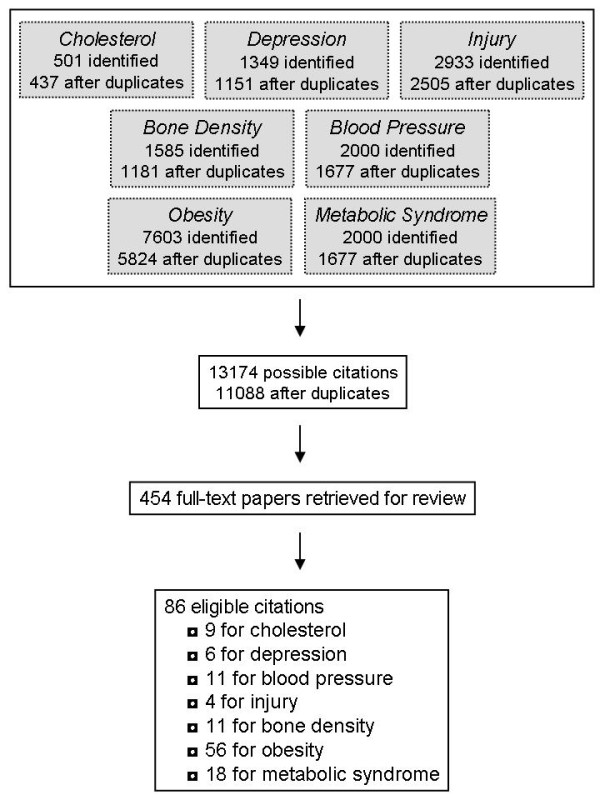
- After duplicates, 11,088 unique citations were screened; 454 full-text articles were reviewed; 86 unique citations met eligibility and 113 outcomes were abstracted. Observational studies had to report dichotomous outcomes; intervention studies were excluded if they included dietary or other behavioral components that could independently affect outcomes.
- Evidence was graded using pre-specified criteria based on quantity/quality of studies and strength of effect; meta-analyses were performed when at least 4 studies were available. RCT quality was assessed with the Downs and Black checklist, and effect sizes used Cohen’s d and ratio-score criteria.
Limitations
- Stated: unpublished and non-English studies were excluded, no extensive cross-referencing of reference lists was performed, the review was limited to 7 health outcomes, and many observational studies were excluded because they did not report dichotomous outcomes; these may have biased results and recommendations.
- Stated RCT limitations: samples were small and non-representative, statistical power was often lacking, adverse events were rarely reported, dropout details were limited, and intent-to-treat analyses were not performed; therefore Level 2 was the highest level assignable to any recommendation.
- Evident from the text: the nature of dose-response relations (linear vs curvilinear) often remained unclear, and the moderating effects of age and sex were not systematically addressed across outcomes.
Model-written summary. Check it against the paper before relying on it.
Integrity signals
Registry
Cites
Statistics
Figures
Verification
Claims the paper makes
0 Valid · 0 Not valid · 42 Not checked · 127 Own results and interpretations
A result the paper reports from its own data — it cites no other source for it, so there is none to check. The quote shows it is in the paper.
In the paper
“Results from experimental studies indicate that even modest amounts of physical activity can have health benefits in high-risk youngsters (e.g., obese).”
§ Systematic review of the health benefits of physical activity and fitness in school-aged children and youth > Abstract > Results
hedgedstates a cause- Asserted: passes — The authors put it forward as true.
- Checkable: passes — It can be checked against evidence.
- Load-bearing: passes — The paper’s conclusions depend on it.
- Based: passes — The paper gives a reason why it holds.
A result the paper reports from its own data — it cites no other source for it, so there is none to check. The quote shows it is in the paper.
In the paper
“Physical activity was associated with numerous health benefits.”
§ Systematic review of the health benefits of physical activity and fitness in school-aged children and youth > Abstract > Results
plainstates an association- Asserted: passes — The authors put it forward as true.
- Checkable: passes — It can be checked against evidence.
- Load-bearing: passes — The paper’s conclusions depend on it.
- Based: passes — The paper gives a reason why it holds.
A result the paper states — it cites no source for it, so there is none to check. The quote shows it is in the paper.
In the paper
“Aerobic-based activities had the greatest health benefit, other than for bone health, in which case high-impact weight bearing activities were required.”
§ Systematic review of the health benefits of physical activity and fitness in school-aged children and youth > Abstract > Results
plainstates an association- Asserted: passes — The authors put it forward as true.
- Checkable: passes — It can be checked against evidence.
- Load-bearing: passes — The paper’s conclusions depend on it.
- Based: passes — The paper gives a reason why it holds.
A result the paper reports from its own data — it cites no other source for it, so there is none to check. The quote shows it is in the paper.
In the paper
“The dose-response relations observed in observational studies indicate that the more physical activity, the greater the health benefit.”
§ Systematic review of the health benefits of physical activity and fitness in school-aged children and youth > Abstract > Results
hedgedstates an association- Asserted: passes — The authors put it forward as true.
- Checkable: passes — It can be checked against evidence.
- Load-bearing: passes — The paper’s conclusions depend on it.
- Based: passes — The paper gives a reason why it holds.
None of the sources cited for this claim have been checked yet.
In the paper
“The results indicated that unfit girls, defined as the lowest 20% fit, were 1.89 (95% confidence interval: 1.12-3.17) times more likely to have hypercholesterolemia and 1.03 (0.74-1.43) times more likely to have a low HDL-cholesterol by comparison to moderately and high fit girls.”
§ Systematic review of the health benefits of physical activity and fitness in school-aged children and youth > Results > Cholesterol and blood lipids
hedgedstates an associationn = 3,110- Asserted: passes — The authors put it forward as true.
- Checkable: passes — It can be checked against evidence.
- Load-bearing: passes — The paper’s conclusions depend on it.
- Based: passes — The paper gives a reason why it holds.
103 more claims
Create a free account to see all 169 claims and every source verdict.
- Probably not a substantial claim. 26
- The quote only partly states this claim. 2
- It may state two separate claims as one. 37
Claims other papers make about this one
Each is checked against this paper’s own text: does it say what the citing paper says it does?
The source backs part of the claim, not all of it — or backs it for a different population, condition or comparison.
In the citing paper
“Research indicates that those who are physically active show or report better overall physical and mental health, a higher level of fitness and a lower level of obesity than their sedentary or physically inactive counterparts1–4”
From Physical activity and health in Chinese children and adolescents: expert consensus statement (2020) (2020) · cites this paper as [2]
Experimental — accuracy not yet measuredThe cited source says what the claim attributes to it.
In the citing paper
“The association with overweight/obesity tends to be stronger when moderate to vigorous-intensity physical activities are performed.2”
From Physical activity and health in Chinese children and adolescents: expert consensus statement (2020) (2020) · cites this paper as [2]
The cited source says what the claim attributes to it.
In the citing paper
“Among physical activity interventions, the effects of physical activity independent of dietary changes on measures indicative of weight reduction (eg, BMI, total fat, abdominal fat) tend to be in the small range.2”
From Physical activity and health in Chinese children and adolescents: expert consensus statement (2020) (2020) · cites this paper as [2]
The cited source says what the claim attributes to it.
In the citing paper
“In general, as the level of physical activity increases, the likelihood of injury increases.2”
From Physical activity and health in Chinese children and adolescents: expert consensus statement (2020) (2020) · cites this paper as [2]
The cited source says what the claim attributes to it.
In the citing paper
“Systematic reviews have shown that physical activity (PA) is associated with greater mental health, 6 and a reduced risk of mental ill-health, specifically depression and anxiety.7,8”
From Domain-Specific Physical Activity and Mental Health: A Meta-analysis (2017) · cites this paper as [8]
2 more claims about this paper
Create a free account to see every claim other papers make about this one.
Self-check
Percentages, sums and reported differences re-computed from the paper’s own numbers.
Each contradiction between two passages listed here was confirmed by an independent check.
Rated major: it would touch a result — a value a result rests on, reported and recomputed p-values on opposite sides of the significance level, two passages that conflict with no sign which is right, or a cited work retracted before this paper was published.
In the paper
§ Systematic review of the health benefits of physical activity and fitness in school-aged children and youth > Discussion > Recommendations based on systematic review
“More vigorous intensity activities should be incorporated or added when possible, including activities that strengthen muscle and bone. [Level 3, Grade B].”
§ Systematic review of the health benefits of physical activity and fitness in school-aged children and youth > Discussion > Recommendations based on systematic review
“This recommendation was given a lower grade (Grade C) because of the potential increase in injury risk associated with more vigorous intensity activities and sports.”
Rated minor: it would not touch a result — a value no result rests on, a p-value that stays on the same side of the significance level, or a conflict that is clerical, resolved elsewhere in the paper, or outside its own findings.
In the paper
§ Systematic review of the health benefits of physical activity and fitness in school-aged children and youth > Results > Metabolic syndrome
“Sixteen articles examining the metabolic syndrome met the inclusion criteria.”
§ Systematic review of the health benefits of physical activity and fitness in school-aged children and youth > Results > Metabolic syndrome
“Eight of the 17 identified studies were observational in nature”
Rated minor: it would not touch a result — a value no result rests on, a p-value that stays on the same side of the significance level, or a conflict that is clerical, resolved elsewhere in the paper, or outside its own findings.
In the paper
“A total of 31 observational studies (24 cross-sectional, 3 prospective cohort, 2 case-control, 1 mixed) were retrieved”
§ Systematic review of the health benefits of physical activity and fitness in school-aged children and youth > Results > Overweight and obesity
Reported 31 · recomputed 30
Rated minor: it would not touch a result — a value no result rests on, a p-value that stays on the same side of the significance level, or a conflict that is clerical, resolved elsewhere in the paper, or outside its own findings.
In the paper
“437 citations were identified for cholesterol, 1151 for depression, 2505 for injury, 1181 for bone density, 1677 for blood pressure, 5824 for obesity, and 1677 for the metabolic syndrome. Thus, the grand total was 13174.”
§ Systematic review of the health benefits of physical activity and fitness in school-aged children and youth > Results > Literature review
Reported 13174 · recomputed 14452
Citations
Cites
Downs, S. H., & Black, N. (1998) · Journal of Epidemiology and Community Health · doi:10.1136/jech.52.6.377 · Cited by 8,252
Evidence Based Physical Activity for School-age Youth
Strong, W. B., Malina, R. M., Blimkie, C. J. R., Daniels, S. R., Dishman, R. K., Gutin, B., Hergenroeder, A. C., Must, A., Nixon, P. A., Pivarnik, J. M., et al. (2005) · The Journal of Pediatrics · doi:10.1016/j.jpeds.2005.01.055 · Cited by 4,222
Systematic Reviews: Synthesis of Best Evidence for Clinical Decisions
Cook, D. J., Mulrow, C. D., & Haynes, R. B. (1997) · Annals of Internal Medicine · doi:10.7326/0003-4819-126-5-199703010-00006 · Cited by 2,184
Andersen, L. B., Harro, M., Sardinha, L. B., Froberg, K., Ekelund, U., Brage, S., & Anderssen, S. A. (2006) · The Lancet · doi:10.1016/s0140-6736(06)69075-2 · Cited by 1,473
Lau, D. C. W., Douketis, J. D., Morrison, K. M., Hramiak, I. M., Sharma, A. M., Ur, E., & Panel, F. M. O. T. O. C. C. P. G. E. (2007) · Canadian Medical Association Journal · doi:10.1503/cmaj.061409 · Cited by 1,154
Paterson, D. H., & Warburton, D. E. (2010) · International Journal of Behavioral Nutrition and Physical Activity · doi:10.1186/1479-5868-7-38 · Cited by 953
A systematic review of the evidence for Canada's Physical Activity Guidelines for Adults
Warburton, D. E., Charlesworth, S., Ivey, A., Nettlefold, L., & Bredin, S. S. (2010) · International Journal of Behavioral Nutrition and Physical Activity · doi:10.1186/1479-5868-7-39 · Cited by 902 · cited 1×
“This report was part of a much larger project around Canada's physical activity guidelines, and comparable systematic reviews for adults [ 10 ] and older adults [11] have also been published in the journal.”
A meta-regression to examine the relationship between aerobic fitness and cognitive performance
Etnier, J. L., Nowell, P. M., Landers, D. M., & Sibley, B. A. (2006) · Brain Research Reviews · doi:10.1016/j.brainresrev.2006.01.002 · Cited by 749
Is the Canadian childhood obesity epidemic related to physical inactivity?
Tremblay, M. S., & Willms, J. D. (2003) · International Journal of Obesity · doi:10.1038/sj.ijo.0802376 · Cited by 517
Nassis, G. P., Papantakou, K., Skenderi, K., Triandafillopoulou, M., Kavouras, S. A., Yannakoulia, M., Chrousos, G. P., & Sidossis, L. S. (2005) · Metabolism · doi:10.1016/j.metabol.2005.05.013 · Cited by 469
Research works printed but not linked: 1
- Petitti DB Meta-Analysis, Decision Analysis, and Cost-Effective Analysis 1994 New York, NY: Oxford University Press
Cited by
Items 101–200 of 4,834
Yuksel, H. S., Şahin, F. N., Maksimovic, N., Drid, P., & Bianco, A. (2020) · International Journal of Environmental Research and Public Health · doi:10.3390/ijerph17010347 · Cited by 236
Ho, M., Garnett, S. P., Baur, L. A., Burrows, T., Stewart, L., Neve, M., & Collins, C. (2013) · JAMA Pediatrics · doi:10.1001/jamapediatrics.2013.1453 · Cited by 235
Herrington, S., & Brussoni, M. (2015) · Current Obesity Reports · doi:10.1007/s13679-015-0179-2 · Cited by 231
Barriers to voluntary participation in sport for children: a systematic review
Somerset, S., & Hoare, D. J. (2018) · BMC Pediatrics · doi:10.1186/s12887-018-1014-1 · Cited by 231
Valerio, G., Maffeis, C., Saggese, G., Ambruzzi, M. A., Balsamo, A., Bellone, S., Bergamini, M., Bernasconi, S., Bona, G., Calcaterra, V., et al. (2018) · Italian Journal of Pediatrics · doi:10.1186/s13052-018-0525-6 · Cited by 225
Evidence-based policies for youth sport programmes
Côté, J., & Hancock, D. J. (2016) · International Journal of Sport Policy and Politics · doi:10.1080/19406940.2014.919338 · Cited by 226
Bandini, L. G., Gleason, J., Curtin, C., Lividini, K., Anderson, S. E., Cermak, S. A., Maslin, M., & Must, A. (2013) · Autism · doi:10.1177/1362361312437416 · Cited by 226
Physical activity and health in Chinese children and adolescents: expert consensus statement (2020)
Chen, P., Wang, D., Shen, H., Yu, L., Gao, Q., Mao, L., Jiang, F., Luo, Y., Xie, M., Zhang, Y., et al. (2020) · British Journal of Sports Medicine · doi:10.1136/bjsports-2020-102261 · Cited by 225
Lees, C., & Hopkins, J. (2013) · Preventing Chronic Disease · doi:10.5888/pcd10.130010 · Cited by 226
“The benefits of physical activity on health outcomes have been documented (8,9).”
Light-Intensity Physical Activity and Cardiometabolic Biomarkers in US Adolescents
Carson, V., Ridgers, N. D., Howard, B. J., Winkler, E. A. H., Healy, G. N., Owen, N., Dunstan, D. W., & Salmon, J. (2013) · PLoS ONE · doi:10.1371/journal.pone.0071417 · Cited by 222
Physical Activity, Sedentary Time, and Obesity in an International Sample of Children
KATZMARZYK, P. T., BARREIRA, T. V., BROYLES, S. T., CHAMPAGNE, C. M., CHAPUT, J.-P., FOGELHOLM, M., HU, G., JOHNSON, W. D., KURIYAN, R., KURPAD, A., et al. (2015) · Medicine & Science in Sports & Exercise · doi:10.1249/mss.0000000000000649 · Cited by 222
“Recent reviews indicate that the crosssectional association between physical activity and adiposity is modest in children (11,22) and that further research is required to determine the amount of physical activity needed to prevent the development of excess adiposity during childhood (22).”
BackgroundInfluentialKipping, R. R., Howe, L. D., Jago, R., Campbell, R., Wells, S., Chittleborough, C. R., Mytton, J., Noble, S. M., Peters, T. J., & Lawlor, D. A. (2014) · BMJ · doi:10.1136/bmj.g3256 · Cited by 221
Marques, A., Ekelund, U., & Sardinha, L. B. (2016) · Journal of Science and Medicine in Sport · doi:10.1016/j.jsams.2015.02.007 · Cited by 218
Change in objectively measured physical activity during the transition to adolescence
Corder, K., Sharp, S. J., Atkin, A. J., Griffin, S. J., Jones, A. P., Ekelund, U., & van Sluijs, E. M. F. (2015) · British Journal of Sports Medicine · doi:10.1136/bjsports-2013-093190 · Cited by 220
Physical Activity and Physical Fitness among University Students—A Systematic Review
Kljajević, V., Stanković, M., Đorđević, D., Trkulja-Petković, D., Jovanović, R., Plazibat, K., Oršolić, M., Čurić, M., & Sporiš, G. (2021) · International Journal of Environmental Research and Public Health · doi:10.3390/ijerph19010158 · Cited by 218
Wilhite, K., Booker, B., Huang, B.-H., Antczak, D., Corbett, L., Parker, P., Noetel, M., Rissel, C., Lonsdale, C., del Pozo Cruz, B., et al. (2023) · American Journal of Epidemiology · doi:10.1093/aje/kwac212 · Cited by 213
Kalajas-Tilga, H., Koka, A., Hein, V., Tilga, H., & Raudsepp, L. (2020) · Journal of Sport and Health Science · doi:10.1016/j.jshs.2019.06.001 · Cited by 213
Marques, A., Santos, D. A., Hillman, C. H., & Sardinha, L. B. (2018) · British Journal of Sports Medicine · doi:10.1136/bjsports-2016-097361 · Cited by 213
Bélair, M.-A., Kohen, D. E., Kingsbury, M., & Colman, I. (2018) · BMJ Open · doi:10.1136/bmjopen-2017-021119 · Cited by 211
Laird, Y., Fawkner, S., Kelly, P., McNamee, L., & Niven, A. (2016) · International Journal of Behavioral Nutrition and Physical Activity · doi:10.1186/s12966-016-0405-7 · Cited by 210
Zhu, Z., Tang, Y., Zhuang, J., Liu, Y., Wu, X., Cai, Y., Wang, L., Cao, Z.-B., & Chen, P. (2019) · BMC Public Health · doi:10.1186/s12889-019-6515-9 · Cited by 207
ten Velde, G., Lubrecht, J., Arayess, L., van Loo, C., Hesselink, M., Reijnders, D., & Vreugdenhil, A. (2021) · Pediatric Obesity · doi:10.1111/ijpo.12779 · Cited by 203
Calibration of ActiGraph GT3X, Actical and RT3 accelerometers in adolescents
Romanzini, M., Petroski, E. L., Ohara, D., Dourado, A. C., & Reichert, F. F. (2014) · European Journal of Sport Science · doi:10.1080/17461391.2012.732614 · Cited by 203
Katzmarzyk, P. T., Denstel, K. D., Beals, K., Bolling, C., Wright, C., Crouter, S. E., McKenzie, T. L., Pate, R. R., Saelens, B. E., Staiano, A. E., et al. (2016) · Journal of Physical Activity and Health · doi:10.1123/jpah.2016-0321 · Cited by 199
“…worldwide are not obtaining the recommended levels of PA. 4 Given the positive associations between PA and many health parameters during childhood, 21 and the moderate tracking for PA between childhood and older ages, 22 the promotion of PA among children and youth remains a public health…”
Interventions to promote physical activity among young and adolescent girls: a systematic review
Camacho-Minano, M. J., LaVoi, N. M., & Barr-Anderson, D. J. (2011) · Health Education Research · doi:10.1093/her/cyr040 · Cited by 201
“Regular participation in physical activity (PA) provides significant health benefits for young people such as obesity prevention, improved psychological well-being, cardiovascular (CV) fitness and bone health [1–3].”
BackgroundWard, J. S., Duncan, J. S., Jarden, A., & Stewart, T. (2016) · Health & Place · doi:10.1016/j.healthplace.2016.04.015 · Cited by 201
Jones, M., Defever, E., Letsinger, A., Steele, J., & Mackintosh, K. A. (2020) · Journal of Sport and Health Science · doi:10.1016/j.jshs.2019.06.009 · Cited by 189
What Predicts the Physical Activity Intention–Behavior Gap? A Systematic Review
Rhodes, R. E., Cox, A., & Sayar, R. (2022) · Annals of Behavioral Medicine · doi:10.1093/abm/kaab044 · Cited by 197
Carlin, A., Perchoux, C., Puggina, A., Aleksovska, K., Buck, C., Burns, C., Cardon, G., Chantal, S., Ciarapica, D., Condello, G., et al. (2017) · PLOS ONE · doi:10.1371/journal.pone.0182083 · Cited by 196
“Introduction Participation in regular physical activity (PA) is associated with a multitude of health benefits across the life course [1,2] and plays a key role in the prevention and management of noncommunicable diseases (NCDs); including cardiovascular disease, type 2 diabetes, depression, osteoporosis and some canc…”
Masini, A., Marini, S., Gori, D., Leoni, E., Rochira, A., & Dallolio, L. (2020) · Journal of Science and Medicine in Sport · doi:10.1016/j.jsams.2019.10.008 · Cited by 193
Lang, J. J., Belanger, K., Poitras, V., Janssen, I., Tomkinson, G. R., & Tremblay, M. S. (2018) · Journal of science and medicine in sport · doi:10.1016/j.jsams.2017.08.002 · Cited by 194
Self-citationDong, Y., Lau, P. W. C., Dong, B., Zou, Z., Yang, Y., Wen, B., Ma, Y., Hu, P., Song, Y., Ma, J., et al. (2019) · The Lancet Child & Adolescent Health · doi:10.1016/s2352-4642(19)30302-5 · Cited by 193
The Impact of Physical Activity on Brain Structure and Function in Youth: A Systematic Review
Valkenborghs, S. R., Noetel, M., Hillman, C. H., Nilsson, M., Smith, J. J., Ortega, F. B., & Lubans, D. R. (2019) · Pediatrics · doi:10.1542/peds.2018-4032 · Cited by 189
Kerner, C., & Goodyear, V. A. (2017) · American Journal of Health Education · doi:10.1080/19325037.2017.1343161 · Cited by 192
“Health interventions are particularly important because they provide the foundation for an active lifestyle.(6,7) Schools are suitably positioned as a site to promote physical activity, given the staff, equipment, facilities, and duration of time that young people spend there.”
BackgroundBohn-Goldbaum, E. E., Phongsavan, P., Merom, D., Rogers, K., Kamalesh, V., & Bauman, A. E. (2013) · Journal of Environmental and Public Health · doi:10.1155/2013/109841 · Cited by 193
Lander, N., Eather, N., Morgan, P. J., Salmon, J., & Barnett, L. M. (2017) · Sports Medicine · doi:10.1007/s40279-016-0561-6 · Cited by 191
Pyper, E., Harrington, D., & Manson, H. (2016) · BMC Public Health · doi:10.1186/s12889-016-3245-0 · Cited by 191
Aelterman, N., Vansteenkiste, M., Van Keer, H., Van den Berghe, L., De Meyer, J., & Haerens, L. (2012) · Journal of Sport and Exercise Psychology · doi:10.1123/jsep.34.4.457 · Cited by 191
Cohen, K. E., Morgan, P. J., Plotnikoff, R. C., Callister, R., & Lubans, D. R. (2014) · International Journal of Behavioral Nutrition and Physical Activity · doi:10.1186/1479-5868-11-49 · Cited by 189
“Higher levels of physical activity in children are associated with improved fitness (both cardio-respiratory fitness and muscular strength) [2], enhanced bone health and reduced body fat [1].”
BackgroundEngel, A. C., Broderick, C. R., van Doorn, N., Hardy, L. L., & Parmenter, B. J. (2018) · Sports Medicine · doi:10.1007/s40279-018-0923-3 · Cited by 188
“Along with reduced obesity, the health benefits associated with children being physically active are numerous and spread across multiple areas of health, including improved cardiometabolic health indicators [6], reduced depressive symptoms, improved cognitive development and psychosocial well-being [12] as well as inc…”
BackgroundResaland, G. K., Aadland, E., Moe, V. F., Aadland, K. N., Skrede, T., Stavnsbo, M., Suominen, L., Steene-Johannessen, J., Glosvik, Ø., Andersen, J. R., et al. (2016) · Preventive Medicine · doi:10.1016/j.ypmed.2016.09.005 · Cited by 187
“Given the documented health benefits children derive from increased PA levels (Strong et al., 2005; Janssen and LeBlanc, 2010; Dobbins et al., 2013) and the number of hours that children spend in school, educating “healthier” children seems a justifiable use of valuable school time.”
BackgroundRecoFit: using a wearable sensor to find, recognize, and count repetitive exercises
Morris, D., Saponas, T. S., Guillory, A., & Kelner, I. (2014) · Proceedings of the SIGCHI Conference on Human Factors in Computing Systems · doi:10.1145/2556288.2557116 · Cited by 187
“Regular exercise offers numerous health benefits, including improved cardiovascular fitness and a reduction in the risk of obesity [15,16,27].”
BackgroundRemote and web 2.0 interventions for promoting physical activity
Foster, C. E., Richards, J. A., Thorogood, M., & Hillsdon, M. M. (2013) · Cochrane Database of Systematic Reviews · doi:10.1002/14651858.cd010395.pub2 · Cited by 186
Identifying a motor proficiency barrier for meeting physical activity guidelines in children
De Meester, A., Stodden, D., Goodway, J., True, L., Brian, A., Ferkel, R., & Haerens, L. (2018) · Journal of Science and Medicine in Sport · doi:10.1016/j.jsams.2017.05.007 · Cited by 183
Belanger, K., Barnes, J. D., Longmuir, P. E., Anderson, K. D., Bruner, B., Copeland, J. L., Gregg, M. J., Hall, N., Kolen, A. M., Lane, K. N., et al. (2018) · BMC Public Health · doi:10.1186/s12889-018-5897-4 · Cited by 180
Lubans, D. R., Lonsdale, C., Cohen, K., Eather, N., Beauchamp, M. R., Morgan, P. J., Sylvester, B. D., & Smith, J. J. (2017) · International Journal of Behavioral Nutrition and Physical Activity · doi:10.1186/s12966-017-0479-x · Cited by 180
“Regular physical activity provides numerous physical and mental health benefits [1, 2].”
BackgroundPhysical activity interventions in the school setting: A systematic review
Demetriou, Y., & Höner, O. (2012) · Psychology of Sport and Exercise · doi:10.1016/j.psychsport.2011.11.006 · Cited by 179
Criterion distances and environmental correlates of active commuting to school in children
D'Haese, S., De Meester, F., De Bourdeaudhuij, I., Deforche, B., & Cardon, G. (2011) · International Journal of Behavioral Nutrition and Physical Activity · doi:10.1186/1479-5868-8-88 · Cited by 178
Booth, J. N., Leary, S. D., Joinson, C., Ness, A. R., Tomporowski, P. D., Boyle, J. M., & Reilly, J. J. (2014) · British Journal of Sports Medicine · doi:10.1136/bjsports-2013-092334 · Cited by 177
on behalf of the DEDIPAC consortium, Van Hecke, L., Loyen, A., Verloigne, M., van der Ploeg, H. P., Lakerveld, J., Brug, J., De Bourdeaudhuij, I., Ekelund, U., Donnelly, A., et al. (2016) · International Journal of Behavioral Nutrition and Physical Activity · doi:10.1186/s12966-016-0396-4 · Cited by 173
Guerrero, M. D., Vanderloo, L. M., Rhodes, R. E., Faulkner, G., Moore, S. A., & Tremblay, M. S. (2020) · Journal of Sport and Health Science · doi:10.1016/j.jshs.2020.06.005 · Cited by 175
Verloigne, M., Loyen, A., Van Hecke, L., Lakerveld, J., Hendriksen, I., De Bourdheaudhuij, I., Deforche, B., Donnelly, A., Ekelund, U., Brug, J., et al. (2016) · International Journal of Behavioral Nutrition and Physical Activity · doi:10.1186/s12966-016-0395-5 · Cited by 175
Stoner, L., Rowlands, D., Morrison, A., Credeur, D., Hamlin, M., Gaffney, K., Lambrick, D., & Matheson, A. (2016) · Sports Medicine · doi:10.1007/s40279-016-0537-6 · Cited by 174
“This observation is inconsistent with a previous systematic review reporting improvements in HDL cholesterol and triglycerides following aerobic exercise in youth [56].”
Vigorous physical activity and longitudinal associations with cardiometabolic risk factors in youth
Carson, V, Rinaldi, R. L., Torrance, B., Maximova, K., Ball, G. D. C., Majumdar, S. R., Plotnikoff, R. C., Veugelers, P., Boulé, N. G., Wozny, P., et al. (2014) · International Journal of Obesity · doi:10.1038/ijo.2013.135 · Cited by 170
Wyszyńska, J., Ring-Dimitriou, S., Thivel, D., Weghuber, D., Hadjipanayis, A., Grossman, Z., Ross-Russell, R., Dereń, K., & Mazur, A. (2020) · Frontiers in Pediatrics · doi:10.3389/fped.2020.535705 · Cited by 172
Treatment of adolescent obesity
Steinbeck, K. S., Lister, N. B., Gow, M. L., & Baur, L. A. (2018) · Nature Reviews Endocrinology · doi:10.1038/s41574-018-0002-8 · Cited by 171
Fairclough, S. J., Dumuid, D., Taylor, S., Curry, W., McGrane, B., Stratton, G., Maher, C., & Olds, T. (2017) · International Journal of Behavioral Nutrition and Physical Activity · doi:10.1186/s12966-017-0521-z · Cited by 167
Richmond, R. C., Davey Smith, G., Ness, A. R., den Hoed, M., McMahon, G., & Timpson, N. J. (2014) · PLoS Medicine · doi:10.1371/journal.pmed.1001618 · Cited by 167
An Updated Systematic Review of Childhood Physical Activity Questionnaires
Hidding, L. M., Chinapaw, M. J. M., van Poppel, M. N. M., Mokkink, L. B., & Altenburg, T. M. (2018) · Sports Medicine · doi:10.1007/s40279-018-0987-0 · Cited by 167
Physical Activity Habits and Determinants, Sedentary Behaviour and Lifestyle in University Students
Carballo-Fazanes, A., Rico-Díaz, J., Barcala-Furelos, R., Rey, E., Rodríguez-Fernández, J. E., Varela-Casal, C., & Abelairas-Gómez, C. (2020) · International Journal of Environmental Research and Public Health · doi:10.3390/ijerph17093272 · Cited by 167
Kenđel Jovanović, G., Dragaš Zubalj, N., Klobučar Majanović, S., Rahelić, D., Rahelić, V., Vučak Lončar, J., & Pavičić Žeželj, S. (2021) · Nutrients · doi:10.3390/nu13113788 · Cited by 166
Breidokienė, R., Jusienė, R., Urbonas, V., Praninskienė, R., & Girdzijauskienė, S. (2021) · Healthcare · doi:10.3390/healthcare9060756 · Cited by 165
Fan, X., & Cao, Z.-B. (2017) · Journal of Sport and Health Science · doi:10.1016/j.jshs.2017.09.006 · Cited by 163
Schmidt, M., Egger, F., Benzing, V., Jäger, K., Conzelmann, A., Roebers, C. M., & Pesce, C. (2017) · PLOS ONE · doi:10.1371/journal.pone.0182845 · Cited by 163
Ikeda, E., Stewart, T., Garrett, N., Egli, V., Mandic, S., Hosking, J., Witten, K., Hawley, G., Tautolo, E. S., Rodda, J., et al. (2018) · Journal of Transport & Health · doi:10.1016/j.jth.2018.04.007 · Cited by 163
‘Happy and a bit Nervous’: the experiences of children with autism in physical education
Healy, S., Msetfi, R., & Gallagher, S. (2013) · British Journal of Learning Disabilities · doi:10.1111/bld.12053 · Cited by 163
“Physical activity provides numerous physical, psychological and social benefits for children (Janssen and Leblanc, 2010).”
BackgroundDimitri, P., Joshi, K., & Jones, N. (2020) · Archives of Disease in Childhood · doi:10.1136/archdischild-2019-318017 · Cited by 161
Santos, R., Mota, J., Okely, A. D., Pratt, M., Moreira, C., Coelho-e-Silva, M. J., Vale, S., & Sardinha, L. B. (2014) · British Journal of Sports Medicine · doi:10.1136/bjsports-2012-091610 · Cited by 159
3. Foundations of Care and Comprehensive Medical Evaluation
American Diabetes Association (2016) · Diabetes Care · doi:10.2337/dc16-s006 · Cited by 159
Rössler, R., Junge, A., Bizzini, M., Verhagen, E., Chomiak, J., aus der Fünten, K., Meyer, T., Dvorak, J., Lichtenstein, E., Beaudouin, F., et al. (2018) · Sports Medicine · doi:10.1007/s40279-017-0834-8 · Cited by 160
“dren achieving higher physical activity levels with all its positive health effects as it allows for more consistent sport participation [43, 44].”
BackgroundEffects of Motor versus Cardiovascular Exercise Training on Children’s Working Memory
KOUTSANDRÉOU, F., WEGNER, M., NIEMANN, C., & BUDDE, H. (2016) · Medicine & Science in Sports & Exercise · doi:10.1249/mss.0000000000000869 · Cited by 159
School day segmented physical activity patterns of high and low active children
Fairclough, S. J., Beighle, A., Erwin, H., & Ridgers, N. D. (2012) · BMC Public Health · doi:10.1186/1471-2458-12-406 · Cited by 158
Impact of the Safe Routes to School Program on Walking and Bicycling
McDonald, N., Steiner, R., Lee, C., Smith, T. R., Zhu, X., & Yang, Y. (2014) · Journal of the American Planning Association · doi:10.1080/01944363.2014.956654 · Cited by 189
Factors of physical activity among Chinese children and adolescents: a systematic review
Lu, C., Stolk, R. P., Sauer, P. J. J., Sijtsma, A., Wiersma, R., Huang, G., & Corpeleijn, E. (2017) · International Journal of Behavioral Nutrition and Physical Activity · doi:10.1186/s12966-017-0486-y · Cited by 155
Physical Activity and School Engagement in Youth: A Systematic Review and Meta-Analysis
Owen, K. B., Parker, P. D., Van Zanden, B., MacMillan, F., Astell-Burt, T., & Lonsdale, C. (2016) · Educational Psychologist · doi:10.1080/00461520.2016.1151793 · Cited by 153
Todd, A. S., Street, S. J., Ziviani, J. M., Byrne, N. M., & Hills, A. P. (2015) · International Journal of Environmental Research and Public Health · doi:10.3390/ijerph120202306 · Cited by 192
“cardiovascular and psychological health [58,59].”
Hebert, J. J., Møller, N. C., Andersen, L. B., & Wedderkopp, N. (2015) · PLOS ONE · doi:10.1371/journal.pone.0134621 · Cited by 151
Mountjoy, M., Andersen, L. B., Armstrong, N., Biddle, S., Boreham, C., Bedenbeck, H.-P. B., Ekelund, U., Engebretsen, L., Hardman, K., Hills, A., et al. (2011) · British Journal of Sports Medicine · doi:10.1136/bjsports-2011-090228 · Cited by 151
“In addition, scientific evidence shows that insufficient levels of PA are adversely affecting the health and the health trajectory of young people.”
Cook, C. J., Howard, S. J., Scerif, G., Twine, R., Kahn, K., Norris, S. A., & Draper, C. E. (2019) · Developmental Science · doi:10.1111/desc.12820 · Cited by 196
Vella, S. A., Cliff, D. P., Magee, C. A., & Okely, A. D. (2014) · The Journal of Pediatrics · doi:10.1016/j.jpeds.2014.01.071 · Cited by 149
“11 cognitive development in childhood and adolescence (33, 34).”
BackgroundVariables associated with children's physical activity levels during recess: the A-CLASS project
Ridgers, N. D., Fairclough, S. J., & Stratton, G. (2010) · International Journal of Behavioral Nutrition and Physical Activity · doi:10.1186/1479-5868-7-74 · Cited by 149
“Habitual physical activity is associated with numerous health benefits in children, with observational studies suggesting greater health benefits are associated with higher levels of physical activity [1].”
BackgroundSystematic review of interventions for promoting active school transport
Villa‐González, E., Barranco-Ruíz, Y., Evenson, K. R., & Chillón, P. (2018) · Preventive Medicine · doi:10.1016/j.ypmed.2018.02.010 · Cited by 178
“Physical activity (PA) is associated with lower cardiovascular disease morbidity and mortality in adults (Haskell et al., 2007) and prevents several cardiovascular risk factors in both healthy and unhealthy children (Andersen et al., 2011; Janssen and LeBlanc, 2010).”
Lima, R. A., Pfeiffer, K. A., Larsen, L. R., Bugge, A., Møller, N. C., Anderson, L. B., & Stodden, D. F. (2017) · Journal of Physical Activity and Health · doi:10.1123/jpah.2016-0473 · Cited by 188
“0 cm, (2) moving sideways on wooden boards for 20s, (3) one-legged hopping over a foam obstacle with increasing height in consecutive steps of 5cm and (4) two-legged”
BackgroundObesity, Physical Activity, and Sedentary Behavior of Youth With Learning Disabilities and ADHD
Cook, B. G., Li, D., & Heinrich, K. M. (2015) · Journal of Learning Disabilities · doi:10.1177/0022219413518582 · Cited by 147
Kokko, S. P., Martin, L., Geidne, S., Hoye, A. V., Lane, A., Meganck, J., Scheerder, J., Seghers, J., Villberg, J. J., Kudláček, M., et al. (2018) · Scandinavian Journal of Public Health · doi:10.1177/1403494818786110 · Cited by 211
Rethinking the sleep-health link
Matricciani, L., Bin, Y. S., Lallukka, T., Kronholm, E., Wake, M., Paquet, C., Dumuid, D., & Olds, T. (2018) · Sleep Health · doi:10.1016/j.sleh.2018.05.004 · Cited by 146
Meester, A. D., Maes, J., Stodden, D. F., Cardon, G., Goodway, J. D., Lenoir, M., & Haerens, L. L. (2016) · Journal of Sports Sciences · doi:10.1080/02640414.2016.1149608 · Cited by 188
Greier, K., Drenowatz, C. J., Bischofer, T., Petrasch, G., Greier, C., Cocca, A., & Ruedl, G. (2021) · AIMS Public Health · doi:10.3934/publichealth.2021043 · Cited by 153
Socio-ecological predictors of participation and dropout in organised sports during childhood
Vella, S. A., Cliff, D. P., & Okely, A. D. (2014) · International Journal of Behavioral Nutrition and Physical Activity · doi:10.1186/1479-5868-11-62 · Cited by 144
Pedišić, Ž., & Hardy, L. L. (2017) · Kinesiology · doi:10.26582/k.49.2.14 · Cited by 145
Lifting cognition: a meta-analysis of effects of resistance exercise on cognition
Landrigan, J.-F., Bell, T. R., Crowe, M. G., Clay, O. J., & Mirman, D. (2019) · Psychological Research · doi:10.1007/s00426-019-01145-x · Cited by 185
van Sluijs, E. M. F., Kriemler, S., & McMinn, A. M. (2011) · British Journal of Sports Medicine · doi:10.1136/bjsports-2011-090187 · Cited by 144
An Intervention to Increase Physical Activity in Children
Pate, R. R., Brown, W. H., Pfeiffer, K. A., Howie, E. K., Saunders, R. P., Addy, C. L., & Dowda, M. C. (2016) · American Journal of Preventive Medicine · doi:10.1016/j.amepre.2015.12.003 · Cited by 177
Morgan, P. J., Young, M. D., Barnes, A. T., Eather, N., Pollock, E. R., & Lubans, D. R. (2018) · Annals of Behavioral Medicine · doi:10.1093/abm/kay015 · Cited by 156
Adolescent Girls’ Perceptions of Physical Activity: A Systematic Review of Qualitative Studies
Corr, M., McSharry, J., & Murtagh, E. (2018) · American Journal of Health Promotion · doi:10.1177/0890117118818747 · Cited by 176
Bean, C., Fortier, M., Post, C., & Chima, K. (2014) · International Journal of Environmental Research and Public Health · doi:10.3390/ijerph111010226 · Cited by 142
School Health as a Strategy to Improve Both Public Health and Education
Kolbe, L. J. (2018) · Annual Review of Public Health · doi:10.1146/annurev-publhealth-040218-043727 · Cited by 210
The NBA and youth basketball: recommendations for promoting a healthy and positive experience
DiFiori, J. P., Güllich, A., Brenner, J. S., Côté, J., Hainline, B., Ryan, E., & Malina, R. M. (2018) · Sports Medicine · doi:10.1007/s40279-018-0950-0 · Cited by 142
Noonan, R. J., Boddy, L. M., Fairclough, S. J., & Knowles, Z. R. (2016) · BMC Public Health · doi:10.1186/s12889-016-3005-1 · Cited by 176
Hinkley, T., Teychenne, M., Downing, K. L., Ball, K., Salmon, J., & Hesketh, K. D. (2014) · Preventive Medicine · doi:10.1016/j.ypmed.2014.02.007 · Cited by 141
Metadata
- Authors
- Janssen, I., & LeBlanc, A. G.
- Affiliations
- Queen's University (CA)
- Corresponding author
- Janssen, Ian
- Venue
- International Journal of Behavioral Nutrition and Physical Activity
- Published
- 2010
- Volume
- 7
- Issue
- 1
- Pages
- 40
- ISSN
- 1479-5868 (ISSN-L)
- PMC
- PMC2885312
- OpenAlex
- W2145702257
- Semantic Scholar
- ef8d55efd11b9d5e4a4814b6a38ff3d60d820d37
- Cited by
- 4,829
- References
- 116
- Citations by year
- 2026: 185 · 2025: 257 · 2024: 310 · 2023: 304 · 2022: 371 · 2021: 451 · 2020: 459 · 2019: 401 · 2018: 387 · 2017: 490 · 2016: 302 · 2015: 280 · 2014: 250 · 2013: 191 · 2012: 109
- FWCI
- 12.18
- Type
- journal article
- Language
- en
- Open access
- gold
- doi.org
- Licence
- cc-by
- Locations
- International Journal of Behavioral Nutrition and Physical Activity (publishedVersion, cc-by)
- PubMed Central (publishedVersion, cc-by)
- PubMed (publishedVersion)
- DOAJ (DOAJ: Directory of Open Access Journals) (submittedVersion, cc-by-sa)
- Funders
- Public Health Agency of Canada
- Public Health Agency
- Topics
- Health Sciences › Medicine › Public Health, Environmental and Occupational Health › Physical Activity and Health
- Health Sciences › Medicine › Public Health, Environmental and Occupational Health › Obesity, Physical Activity, Diet
- Social Sciences › Life-span and Life-course Studies › Recreational Sport and Physical Activity
- Keywords
- physical activity, physical fitness, school-aged children, youth, health benefits, serum cholesterol, blood pressure, metabolic syndrome, childhood obesity, bone mineral density, depression, injuries, dose-response relationship, aerobic exercise, physical activity guidelines
About these checks
Registry, retraction, Cites and statistics results are computed, not judged, with one exception: a printed reference that no index lists is read once by a model before it counts as a citation error. Claims are extracted by a model and kept only when their quote appears verbatim in the text; each cited source is then checked, with a model’s help, for whether it says what the claim relies on. Those verdicts can be wrong — read the claim’s quote and the cited source before relying on one.
A language model drew the claims from the paper on 2026-10-10, under version 3 of the claim definition (model deepseek-v4.1-flash, prompt extract-v3).
A second model labelled each claim on 2026-10-10 (model jev-1.13-20260917, definition revision gold-guideline-v0.2).
Statistics and arithmetic are recomputed, not judged.
Confidence bands are shown only for fields calibrated on our annotated test set. None is calibrated yet, so no band is shown.
What counts as a claim ›How we measure confidence ›How we check this ›
Are you an author, or do you see a problem with this page? Request a review
Data sources
Bibliographic data: Semantic Scholar, OpenAlex, Crossref.
Contains information from the Semantic Scholar Academic Graph Datasets, made available under the ODC Attribution License (ODC-BY 1.0).
Semantic Scholar’s data is described in: Kinney, R., et al. (2023). The Semantic Scholar Open Data Platform. arXiv:2301.10140.
