

The DOI matches its Crossref record; 11 of the 11 references it cites were found in a registry or an index.
A systematic review of reliability and objective criterion-related validity of physical activity questionnaires
Abstract
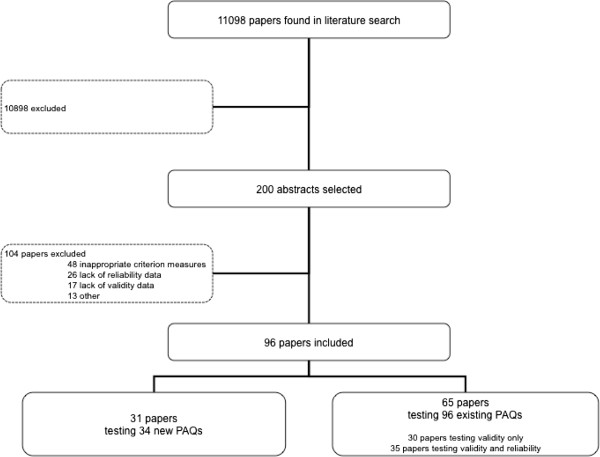
Physical inactivity is one of the four leading risk factors for global mortality. Accurate measurement of physical activity (PA) and in particular by physical activity questionnaires (PAQs) remains a challenge. The aim of this paper is to provide an updated systematic review of the reliability and validity characteristics of existing and more recently developed PAQs and to quantitatively compare the performance between existing and newly developed PAQs. A literature search of electronic databases was performed for studies assessing reliability and validity data of PAQs using an objective criterion measurement of PA between January 1997 and December 2011. Articles meeting the inclusion criteria were screened and data were extracted to provide a systematic overview of measurement properties. Due to differences in reported outcomes and criterion methods a quantitative meta-analysis was not possible. In total, 31 studies testing 34 newly developed PAQs, and 65 studies examining 96 existing PAQs were included. Very few PAQs showed good results on both reliability and validity. Median reliability correlation coefficients were 0.62–0.71 for existing, and 0.74–0.76 for new PAQs. Median validity coefficients ranged from 0.30–0.39 for existing, and from 0.25–0.41 for new PAQs. Although the majority of PAQs appear to have acceptable reliability, the validity is moderate at best. Newly developed PAQs do not appear to perform substantially better than existing PAQs in terms of reliability and validity. Future PAQ studies should include measures of absolute validity and the error structure of the instrument.
Overview
The claims and statistics of this paper haven’t been checked yet.
Run the check — free, no account needed. It reads the open-access text and checks the sources it cites.
Integrity signals
Registry
Cites
Statistics
Figures
Verification
Claims the paper makes
The claims and statistics of this paper haven’t been checked yet.
Run the check — free, no account needed. It reads the open-access text and checks the sources it cites.
Claims other papers make about this one
Each is checked against this paper’s own text: does it say what the citing paper says it does?
In the citing paper
“It has been well reported that the reliability of PA self-report tools is questionable, with most PA questionnaires reporting low-to-moderate levels of reliability.[65]”
From Associations between total physical activity levels and academic performance in adults: A systematic review and meta-analysis (2024) · cites this paper as [65]
Self-check
Percentages, sums and reported differences re-computed from the paper’s own numbers.
The self-check needs the paper’s full text.
Citations
Cites
Quality criteria were proposed for measurement properties of health status questionnaires
Terwee, C. B., Bot, S. D. M., de Boer, M. R., van der Windt, D. A. W. M., Knol, D. L., Dekker, J., Bouter, L. M., & de Vet, H. C. W. (2007) · Journal of Clinical Epidemiology · doi:10.1016/j.jclinepi.2006.03.012 · Cited by 10,764
Measuring agreement in method comparison studies
Bland, J. M., & Altman, D. G. (1999) · Statistical Methods in Medical Research · doi:10.1177/096228029900800204 · Cited by 9,619
Physical Activity in the United States Measured by Accelerometer
TROIANO, R. P., BERRIGAN, D., DODD, K. W., MÂSSE, L. C., TILERT, T., & MCDOWELL, M. (2008) · Medicine & Science in Sports & Exercise · doi:10.1249/mss.0b013e31815a51b3 · Cited by 7,638
Calibration of the Computer Science and Applications, Inc. accelerometer
FREEDSON, P. S., MELANSON, E., & SIRARD, J. (1998) · Medicine & Science in Sports & Exercise · doi:10.1097/00005768-199805000-00021 · Cited by 3,825
Warren, J. M., Ekelund, U., Besson, H., Mezzani, A., Geladas, N., & Vanhees, L. (2010) · European Journal of Cardiovascular Prevention & Rehabilitation · doi:10.1097/hjr.0b013e32832ed875 · Cited by 587
Self-citationExercise and Physical Activity: Clinical Outcomes and Applications
Kokkinos, P., & Myers, J. (2010) · Circulation · doi:10.1161/circulationaha.110.948349 · Cited by 444
Measurement of daily walking distance-questionnaire versus pedometer
BASSETT, D. R. (2000) · Medicine & Science in Sports & Exercise · doi:10.1097/00005768-200005000-00021 · Cited by 260
Validation of the International Physical Activity Questionnaire-Short Among Blacks
Wolin, K. Y., Heil, D. P., Askew, S., Matthews, C. E., & Bennett, G. G. (2008) · Journal of Physical Activity and Health · doi:10.1123/jpah.5.5.746 · Cited by 177
Assessment of Physical Activity in Older Adults
Washburn, R. A. (2000) · Research Quarterly for Exercise and Sport · doi:10.1080/02701367.2000.11082790 · Cited by 159
Validity of a Physical Activity Computer Questionnaire in 12- to 18-year-old Boys and Girls
Philippaerts, R. M., Matton, L., Wijndaele, K., Balduck, A.-L., De Bourdeaudhuij, I., & Lefevre, J. (2006) · International Journal of Sports Medicine · doi:10.1055/s-2005-837619 · Cited by 145
Research works printed but not linked: 122
- World Health Organization: Global health risks : mortality and burden of disease attributable to selected major risks. 2009, World Health Organization, Geneva
- Wareham NJ, Rennie KL: The assessment of physical activity in individuals and populations: Why try to be more precise about how physical activity is assessed?. Int J Obes. 1998, 22: S30-S38.
- Jobe JB, Mingay DJ: Cognitive research improves questionnaires. Am J Public Health. 1989, 79: 1053-1055. 10.2105/AJPH.79.8.1053. · DOI · Paper page
- Durante R, Ainsworth BE: The recall of physical activity: using a cognitive model of the question-answering process. Med Sci Sports Exerc. 1996, 28: 1282-1291. 10.1097/00005768-199610000-00012. · DOI
- Sallis JF: Self-report measures of children's physical activity. J Sch Health. 1991, 61: 215-219. 10.1111/j.1746-1561.1991.tb06017.x. · DOI · Paper page
- Pereira MA, FitzerGerald SJ, Gregg EW, Joswiak ML, Ryan WJ, Suminski RR, Utter AC, Zmuda JM: A collection of Physical Activity Questionnaires for health-related research. Med Sci Sports Exerc. 1997, 29: S1-S205. · DOI
- Kohl HW, Fulton JE, Caspersen CJ: Assessment of physical activity among children and adolescents: A review and synthesis. Prev Med. 2000, 31: S54-S76. 10.1006/pmed.1999.0542. · DOI · Paper page
- Chinapaw MJ, Mokkink LB, van Poppel MN, van Mechelen W, Terwee CB: Physical activity questionnaires for youth: a systematic review of measurement properties. Sports Med. 2010, 40: 539-563. 10.2165/11530770-000000000-00000. · DOI · Paper page
- Adamo KB, Prince SA, Tricco AC, Connor-Gorber S, Tremblay M: A comparison of indirect versus direct measures for assessing physical activity in the pediatric population: a systematic review. Int J Pediatr Obes. 2009, 4: 2-27. 10.1080/17477160802315010. · DOI · Paper page
- Oliver M, Schofield GM, Kolt GS: Physical activity in preschoolers: understanding prevalence and measurement issues. Sports Med. 2007, 37: 1045-1070. 10.2165/00007256-200737120-00004. · DOI · Paper page
- van Poppel MN, Chinapaw MJ, Mokkink LB, van Mechelen W, Terwee CB: Physical activity questionnaires for adults: a systematic review of measurement properties. Sports Med. 2010, 40: 565-600. 10.2165/11531930-000000000-00000. · DOI · Paper page
- Forsen L, Loland NW, Vuillemin A, Chinapaw MJ, van Poppel MN, Mokkink LB, van Mechelen W, Terwee CB: Self-administered physical activity questionnaires for the elderly: a systematic review of measurement properties. Sports Med. 2010, 40: 601-623. 10.2165/11531350-000000000-00000. · DOI
- Streiner DL, Norman GR: Health measurement scales : a practical guide to their development and use. 2003, Oxford University Press, Oxford; New York, 3 · DOI · Paper page
- Scientific Advisory Committee of the Medical Outcomes Trust: Assessing health status and quality-of-life instruments: attributes and review criteria. Qual Life Res. 2002, 11: 193-205. 10.1023/A:1015291021312. · DOI · Paper page
- Dwyer GM, Hardy LL, Peat JK, Baur LA: The validity and reliability of a home environment preschool-age physical activity questionnaire (Pre-PAQ). Int J Behav Nutr Phys Act. 2011, 8: 86-10.1186/1479-5868-8-86. · DOI
- Economos CD, Hennessy E, Sacheck JM, Shea MK, Naumova EN: Development and testing of the BONES physical activity survey for young children. BMC Musculoskelet Disord. 2010, 11: 195-10.1186/1471-2474-11-195. · DOI
- Martinez-Gomez D, Calabro MA, Welk GJ, Marcos A, Veiga OL: Reliability and validity of a school recess physical activity recall in Spanish youth. Pediatr Exerc Sci. 2010, 22: 218-230. · DOI
- Ridley K, Dollman J, Olds T: Development and Validation of a Computer Delivered Physical Activity Questionnaire (CDPAQ) for Children. Pediatr Exerc Sci. 2001, 13: 35-46. · DOI
- Ridley K, Olds TS, Hill A: The Multimedia Activity Recall for Children and Adolescents (MARCA): development and evaluation. Int J Behav Nutr Phys Act. 2006, 3: 10-10.1186/1479-5868-3-10. · DOI
- Telford A, Salmon J, Jolley D, Crawford D: Reliability and validity of physical activity questionnaires for children: The Children's Leisure Activities Study Survey (CLASS). Pediatr Exerc Sci. 2004, 16: 64-78. · DOI · Paper page
- Treuth MS, Sherwood NE, Butte NF, McClanahan B, Obarzanek E, Zhou A, Ayers C, Adolph A, Jordan J, Jacobs DR, Rochon J: Validity and reliability of activity measures in African-American girls for GEMS. Med Sci Sports Exerc. 2003, 35: 532-539. 10.1249/01.MSS.0000053702.03884.3F. · DOI
- Treuth MS, Hou N, Young DR, Maynard LM: Validity and reliability of the Fels physical activity questionnaire for children. Med Sci Sports Exerc. 2005, 37: 488-495. 10.1249/01.MSS.0000155392.75790.83. · DOI
- Welk GJ, Wickel E, Peterson M, Heitzler CD, Fulton JE, Potter LD: Reliability and validity of questions on the youth media campaign longitudinal survey. Med Sci Sports Exerc. 2007, 39: 612-621. 10.1249/mss.0b013e3180305c59. · DOI
- Wong SL, Leatherdale ST, Manske SR: Reliability and validity of a school-based physical activity questionnaire. Med Sci Sports Exerc. 2006, 2006 (38): 1593-1600. · DOI
- Ainsworth BE, Sternfeld B, Richardson MT, Jackson K: Evaluation of the kaiser physical activity survey in women. Med Sci Sports Exerc. 2000, 32: 1327-1338. 10.1097/00005768-200007000-00022. · DOI · Paper page
- Besson H, Brage S, Jakes RW, Ekelund U, Wareham NJ: Estimating physical activity energy expenditure, sedentary time, and physical activity intensity by self-report in adults. Am J Clin Nutr. 2010, 91: 106-114. 10.3945/ajcn.2009.28432. · DOI · Paper page
- Chasan-Taber L, Schmidt MD, Roberts DE, Hosmer D, Markenson G, Freedson PS: Development and validation of a Pregnancy Physical Activity Questionnaire. Med Sci Sports Exerc. 2004, 36: 1750-1760. 10.1249/01.MSS.0000142303.49306.0D. · DOI · Paper page
- Chinapaw MJ, Slootmaker SM, Schuit AJ, van Zuidam M, van Mechelen W: Reliability and validity of the Activity Questionnaire for Adults and Adolescents (AQuAA). BMC Med Res Methodol. 2009, 9: 58-10.1186/1471-2288-9-58. · DOI
- Craig CL, Marshall AL, Sjostrom M, Bauman AE, Booth ML, Ainsworth BE, Pratt M, Ekelund U, Yngve A, Sallis JF, Oja P: International physical activity questionnaire: 12-country reliability and validity. Med Sci Sports Exerc. 2003, 35: 1381-1395. 10.1249/01.MSS.0000078924.61453.FB. · DOI · Paper page
- Fjeldsoe BS, Marshall AL, Miller YD: Measurement properties of the Australian Women's Activity Survey. Med Sci Sports Exerc. 2009, 41: 1020-1033. 10.1249/MSS.0b013e31819461c2. · DOI
- Friedenreich CM, Courneya KS, Neilson HK, Matthews CE, Willis G, Irwin M, Troiano R, Ballard-Barbash R: Reliability and validity of the Past Year Total Physical Activity Questionnaire. Am J Epidemiol. 2006, 163: 959-970. 10.1093/aje/kwj112. · DOI
- Kurtze N, Rangul V, Hustvedt BE, Flanders WD: Reliability and validity of self-reported physical activity in the Nord-Trondelag Health Study (HUNT 2). Eur J Epidemiol. 2007, 22: 379-387. 10.1007/s10654-007-9110-9. · DOI · Paper page
- Kurtze N, Rangul V, Hustvedt BE, Flanders WD: Reliability and validity of self-reported physical activity in the Nord-Trondelag Health Study: HUNT 1. Scand J Public Health. 2008, 36: 52-61. 10.1177/1403494807085373. · DOI · Paper page
- Lowther M, Mutrie N, Loughlan C, McFarlane C: Development of a Scottish physical activity questionnaire: a tool for use in physical activity interventions. Br J Sports Med. 1999, 33: 244-249. 10.1136/bjsm.33.4.244. · DOI
- Mader U, Martin BW, Schutz Y, Marti B: Validity of four short physical activity questionnaires in middle-aged persons. Med Sci Sports Exerc. 2006, 38: 1255-1266. 10.1249/01.mss.0000227310.18902.28. · DOI
- Meriwether RA, McMahon PM, Islam N, Steinmann WC: Physical activity assessment: validation of a clinical assessment tool. Am J Prev Med. 2006, 31: 484-491. 10.1016/j.amepre.2006.08.021. · DOI
- Reis JP, Dubose KD, Ainsworth BE, Macera CA, Yore MM: Reliability and validity of the occupational physical activity questionnaire. Med Sci Sports Exerc. 2005, 37: 2075-2083. 10.1249/01.mss.0000179103.20821.00. · DOI
- Rosenberg DE, Norman GJ, Wagner N, Patrick K, Calfas KJ, Sallis JF: Reliability and validity of the Sedentary Behavior Questionnaire (SBQ) for adults. J Phys Act Health. 2010, 7: 697-705. · DOI · Paper page
- Sobngwi E, Mbanya JC, Unwin NC, Aspray TJ, Alberti KG: Development and validation of a questionnaire for the assessment of physical activity in epidemiological studies in Sub-Saharan Africa. Int J Epidemiol. 2001, 30: 1361-1368. 10.1093/ije/30.6.1361. · DOI
- Timperio A, Salmon J, Crawford D: Validity and reliability of a physical activity recall instrument among overweight and non-overweight men and women. J Sci Med Sport. 2003, 6: 477-491. 10.1016/S1440-2440(03)80273-6. · DOI
- Wareham NJ, Jakes RW, Rennie KL, Mitchell J, Hennings S, Day NE: Validity and repeatability of the EPIC-Norfolk Physical Activity Questionnaire. Int J Epidemiol. 2002, 31: 168-174. 10.1093/ije/31.1.168. · DOI · Paper page
- Wareham NJ, Jakes RW, Rennie KL, Schuit J, Mitchell J, Hennings S, Day NE: Validity and repeatability of a simple index derived from the short physical activity questionnaire used in the European Prospective Investigation into Cancer and Nutrition (EPIC) study. Public Health Nutr. 2003, 6: 407-413. · DOI · Paper page
- Yore MM, Ham SA, Ainsworth BE, Kruger J, Reis JP, Kohl HW, Macera CA: Reliability and validity of the instrument used in BRFSS to assess physical activity. Med Sci Sports Exerc. 2007, 39: 1267-1274. 10.1249/mss.0b013e3180618bbe. · DOI
- Yasunaga A, Park H, Watanabe E, Togo F, Park S, Shephard RJ, Aoyagi Y: Development and evaluation of the physical activity questionnaire for elderly Japanese: the Nakanojo study. J Aging Phys Act. 2007, 15: 398-411. · DOI
- Owen N, Leslie E, Salmon J, Fotheringham MJ: Environmental determinants of physical activity and sedentary behavior. Exerc Sport Sci Rev. 2000, 28: 153-158.
- The InterAct Consortium: Validity of a short questionnaire to assess physical activity in 10 European countries. Eur J Epidemiol. 2011, 27: 15-25. · DOI
- Olds T, Ridley K, Dollman J: Screenieboppers and extreme screenies: the place of screen time in the time budgets of 10–13 year-old Australian children. Aust N Z J Public Health. 2006, 30: 137-142. 10.1111/j.1467-842X.2006.tb00106.x. · DOI
- Brown H, Hume C, Chin AM: Validity and reliability of instruments to assess potential mediators of children's physical activity: A systematic review. J Sci Med Sport. 2009, 12: 539-548. 10.1016/j.jsams.2009.01.002. · DOI
- Kurtze N, Rangul V, Hustvedt BE: Reliability and validity of the international physical activity questionnaire in the Nord-Trondelag health study (HUNT) population of men. BMC Med Res Methodol. 2008, 8: 63-10.1186/1471-2288-8-63. · DOI
- Nang EE, Gitau Ngunjiri SA, Wu Y, Salim A, Tai ES, Lee J, Van Dam RM: Validity of the International Physical Activity Questionnaire and the Singapore Prospective Study Program physical activity questionnaire in a multiethnic urban Asian population. BMC Med Res Methodol. 2011, 11: 141-10.1186/1471-2288-11-141. · DOI
- Hagstromer M, Bergman P, De Bourdeaudhuij I, Ortega FB, Ruiz JR, Manios Y, Rey-Lopez JP, Phillipp K, von Berlepsch J, Sjostrom M: Concurrent validity of a modified version of the International Physical Activity Questionnaire (IPAQ-A) in European adolescents: The HELENA Study. Int J Obes. 2008, 32 (Suppl 5): S42-S48. · DOI · Paper page
- Ottevaere C, Huybrechts I, De Bourdeaudhuij I, Sjostrom M, Ruiz JR, Ortega FB, Hagstromer M, Widhalm K, Molnar D, Moreno LA, et al: Comparison of the IPAQ-A and actigraph in relation to VO2max among European adolescents: the HELENA study. J Sci Med Sport. 2011, 14: 317-324. 10.1016/j.jsams.2011.02.008. · DOI
- Bull FC, Maslin TS, Armstrong T: Global physical activity questionnaire (GPAQ): nine country reliability and validity study. J Phys Act Health. 2009, 6: 790-804. · DOI · Paper page
- Affuso O, Stevens J, Catellier D, McMurray RG, Ward DS, Lytle L, Sothern MS, Young DR: Validity of self-reported leisure-time sedentary behavior in adolescents. J Negat Results Biomed. 2011, 10: 2-10.1186/1477-5751-10-2. · DOI
- Allor KM, Pivarnik JM: Stability and convergent validity of three physical activity assessments. Med Sci Sports Exerc. 2001, 33: 671-676. 10.1097/00005768-200107001-00005. · DOI
- Corder K, van Sluijs EM, Wright A, Whincup P, Wareham NJ, Ekelund U: Is it possible to assess free-living physical activity and energy expenditure in young people by self-report?. Am J Clin Nutr. 2009, 89: 862-870. 10.3945/ajcn.2008.26739. · DOI · Paper page
- Eisenmann JC, Milburn N, Jacobsen L, Moore SJ: Reliability and convergent validity of the Godin Leisure-Time Exercise Questionnaire in rural 5th-grade school-children. J Human Movement Studies. 2002, 43: 135-149.
- Gwynn JD, Hardy LL, Wiggers JH, Smith WT, D'Este CA, Turner N, Cochrane J, Barker DJ, Attia JR: The validation of a self-report measure and physical activity of Australian Aboriginal and Torres Strait Islander and non-Indigenous rural children. Aust N Z J Public Health. 2010, 34 (Suppl 1): S57-S65. · DOI
- Huang YJ, Wong SH, Salmon J: Reliability and validity of the modified Chinese version of the Children's Leisure Activities Study Survey (CLASS) questionnaire in assessing physical activity among Hong Kong children. Pediatr Exerc Sci. 2009, 21: 339-353. · DOI
- Kowalski KC, Crocker PRE, Faulkner RA: Validation of the physical activity questionnaire for older children. Pediatr Exerc Sci. 1997, 9: 174-186. · DOI · Paper page
- Martinez-Gomez D, Warnberg J, Welk GJ, Sjostrom M, Veiga OL, Marcos A: Validity of the Bouchard activity diary in Spanish adolescents. Public Health Nutr. 2010, 13: 261-268. 10.1017/S1368980009990681. · DOI
- Martinez-Gomez D, Gomez-Martinez S, Warnberg J, Welk GJ, Marcos A, Veiga OL: Convergent validity of a questionnaire for assessing physical activity in Spanish adolescents with overweight. Med Clin (Barc). 2011, 136: 13-15. 10.1016/j.medcli.2010.05.013. · DOI
- Mota J, Santos P, Guerra S, Ribeiro JC, Duarte JA, Sallis JF: Validation of a physical activity self-report questionnaire in a Portuguese pediatric population. Pediatr Exerc Sci. 2002, 14: 269-276. · DOI
- Rangul V, Holmen TL, Kurtze N, Cuypers K, Midthjell K: Reliability and validity of two frequently used self-administered physical activity questionnaires in adolescents. BMC Med Res Methodol. 2008, 8: 47-10.1186/1471-2288-8-47. · DOI
- Scerpella TA, Tuladhar P, Kanaley JA: Validation of the Godin-Shephard questionnaire in prepubertal girls. Med Sci Sports Exerc. 2002, 34: 845-850. 10.1097/00005768-200205000-00018. · DOI
- Slinde F, Arvidsson D, Sjoberg A, Rossander-Hulthen L: Minnesota leisure time activity questionnaire and doubly labeled water in adolescents. Med Sci Sports Exerc. 2003, 35: 1923-1928. 10.1249/01.MSS.0000093608.95629.85. · DOI
- Treuth MS, Sherwood NE, Baranowski T, Butte NF, Jacobs DR, McClanahan B, Gao S, Rochon J, Zhou A, Robinson TN, et al: Physical activity self-report and accelerometry measures from the Girls health Enrichment Multi-site Studies. Prev Med. 2004, 38 (Suppl): S43-S49. · DOI
- Troped PJ, Wiecha JL, Fragala MS, Matthews CE, Finkelstein DM, Kim J, Peterson KE: Reliability and validity of YRBS physical activity items among middle school students. Med Sci Sports Exerc. 2007, 39: 416-425. 10.1249/mss.0b013e31802d97af. · DOI
- Weston AT, Petosa R, Pate RR: Validation of an instrument for measurement of physical activity in youth. Med Sci Sports Exerc. 1997, 29: 138-143. · DOI · Paper page
- Bonnefoy M, Normand S, Pachiaudi C, Lacour JR, Laville M, Kostka T: Simultaneous validation of ten physical activity questionnaires in older men: a doubly labeled water study. J Am Geriatr Soc. 2001, 49: 28-35. 10.1046/j.1532-5415.2001.49006.x. · DOI
- De Abajo S, Larriba R, Marquez S: Validity and reliability of the Yale Physical Activity Survey in Spanish elderly. J Sports Med Phys Fitness. 2001, 41: 479-485.
- Dinger MK, Oman RF, Taylor EL, Vesely SK, Able J: Stability and convergent validity of the Physical Activity Scale for the Elderly (PASE). J Sports Med Phys Fitness. 2004, 44: 186-192.
- Dubbert PM, Vander Weg MW, Kirchner KA, Shaw B: Evaluation of the 7-day physical activity recall in urban and rural men. Med Sci Sports Exerc. 2004, 36: 1646-1654. 10.1249/01.MSS.0000139893.65189.F2. · DOI
- Giles K, Marshall AL: Repeatability and accuracy of CHAMPS as a measure of physical activity in a community sample of older Australian adults. J Phys Act Health. 2009, 6: 221-229. · DOI
- Hagiwara A, Ito N, Sawai K, Kazuma K: Validity and reliability of the Physical Activity Scale for the Elderly (PASE) in Japanese elderly people. Geriatr Gerontol Int. 2008, 8: 143-151. 10.1111/j.1447-0594.2008.00463.x. · DOI
- Harada ND, Chiu V, King AC, Stewart AL: An evaluation of three self-report physical activity instruments for older adults. Med Sci Sports Exerc. 2001, 33: 962-970. 10.1097/00005768-200106000-00016. · DOI · Paper page
- Hurtig-Wennlof A, Hagstromer M, Olsson LA: The International Physical Activity Questionnaire modified for the elderly: aspects of validity and feasibility. Public Health Nutr. 2010, 13: 1847-1854. 10.1017/S1368980010000157. · DOI
- Kolbe-Alexander TL, Lambert EV, Harkins JB, Ekelund U: Comparison of two methods of measuring physical activity in South African older adults. J Aging Phys Act. 2006, 14: 98-114. · DOI
- Starling RD, Matthews DE, Ades PA, Poehlman ET: Assessment of physical activity in older individuals: a doubly labeled water study. J Appl Physiol. 1999, 86: 2090-2096. · DOI
- Tomioka K, Iwamoto J, Saeki K, Okamoto N: Reliability and validity of the International Physical Activity Questionnaire (IPAQ) in elderly adults: the Fujiwara-kyo Study. J Epidemiol. 2011, 21: 459-465. 10.2188/jea.JE20110003. · DOI · Paper page
- Washburn RA, Ficker JL: Physical Activity Scale for the Elderly (PASE): the relationship with activity measured by a portable accelerometer. J Sports Med Phys Fitness. 1999, 39: 336-340.
- Ainsworth BE, Richardson MT, Jacobs DR, Leon AS, Sternfeld B: Accuracy of recall of occupational physical activity by questionnaire. J Clin Epidemiol. 1999, 52: 219-227. 10.1016/S0895-4356(98)00158-9. · DOI
- Brown WJ, Burton NW, Marshall AL, Miller YD: Reliability and validity of a modified self-administered version of the Active Australia physical activity survey in a sample of mid-age women. Aust N Z J Public Health. 2008, 32: 535-541. 10.1111/j.1753-6405.2008.00305.x. · DOI · Paper page
- Mahabir S, Baer DJ, Giffen C, Clevidence BA, Campbell WS, Taylor PR, Hartman TJ: Comparison of energy expenditure estimates from 4 physical activity questionnaires with doubly labeled water estimates in postmenopausal women. Am J Clin Nutr. 2006, 84: 230-236. · DOI
- Nicaise V, Marshall S, Ainsworth BE: Domain-specific physical activity and self-report bias among low-income Latinas living in San Diego County. J Phys Act Health. 2011, 8: 881-890. · DOI
- Pettee Gabriel K, McClain JJ, Lee CD, Swan PD, Alvar BA, Mitros MR, Ainsworth BE: Evaluation of physical activity measures used in middle-aged women. Med Sci Sports Exerc. 2009, 41: 1403-1412. 10.1249/MSS.0b013e31819b2482. · DOI
- Schmidt MD, Freedson PS, Pekow P, Roberts D, Sternfeld B, Chasan-Taber L: Validation of the Kaiser Physical Activity Survey in pregnant women. Med Sci Sports Exerc. 2006, 38: 42-50. · DOI
- Staten LK, Taren DL, Howell WH, Tobar M, Poehlman ET, Hill A, Reid PM, Ritenbaugh C: Validation of the Arizona Activity Frequency Questionnaire using doubly labeled water. Med Sci Sports Exerc. 2001, 33: 1959-1967. 10.1097/00005768-200111000-00024. · DOI
- Conway JM, Seale JL, Jacobs DR, Irwin ML, Ainsworth BE: Comparison of energy expenditure estimates from doubly labeled water, a physical activity questionnaire, and physical activity records. Am J Clin Nutr. 2002, 75: 519-525. · DOI
- Ekelund U, Sepp H, Brage S, Becker W, Jakes R, Hennings M, Wareham NJ: Criterion-related validity of the last 7-day, short form of the International Physical Activity Questionnaire in Swedish adults. Public Health Nutr. 2006, 9: 258-265. · DOI · Paper page
- Philippaerts RM, Westerterp KR, Lefevre J: Doubly labelled water validation of three physical activity questionnaires. Int J Sports Med. 1999, 20: 284-289. 10.1055/s-2007-971132. · DOI · Paper page
- Philippaerts RM, Westerterp KR, Lefevre J: Comparison of two questionnaires with a tri-axial accelerometer to assess physical activity patterns. Int J Sports Med. 2001, 22: 34-39. 10.1055/s-2001-11359. · DOI
- Lee PH, Yu YY, McDowell I, Leung GM, Lam TH, Stewart SM: Performance of the international physical activity questionnaire (short form) in subgroups of the Hong Kong chinese population. Int J Behav Nutr Phys Act. 2011, 8: 81-10.1186/1479-5868-8-81. · DOI
- Macfarlane DJ, Lee CC, Ho EY, Chan KL, Chan DT: Reliability and validity of the Chinese version of IPAQ (short, last 7 days). J Sci Med Sport. 2007, 10: 45-51. · DOI · Paper page
- Richardson MT, Ainsworth BE, Jacobs DR, Leon AS: Validation of the stanford 7-Day Recall to assess habitual physical activity. Ann Epidemiol. 2001, 11: 145-153. 10.1016/S1047-2797(00)00190-3. · DOI
- Cust AE, Smith BJ, Chau J, van der Ploeg HP, Friedenreich CM, Armstrong BK, Bauman A: Validity and repeatability of the EPIC physical activity questionnaire: a validation study using accelerometers as an objective measure. Int J Behav Nutr Phys Act. 2008, 5: 33-10.1186/1479-5868-5-33. · DOI
- Cust AE, Armstrong BK, Smith BJ, Chau J, van der Ploeg HP, Bauman A: Self-reported confidence in recall as a predictor of validity and repeatability of physical activity questionnaire data. Epidemiology. 2009, 20: 433-441. 10.1097/EDE.0b013e3181931539. · DOI
- Duncan GE, Sydeman SJ, Perri MG, Limacher MC, Martin AD: Can sedentary adults accurately recall the intensity of their physical activity?. Prev Med. 2001, 33: 18-26. 10.1006/pmed.2001.0847. · DOI
- Gauthier AP, Lariviere M, Young N: Psychometric properties of the IPAQ: a validation study in a sample of northern Franco-Ontarians. J Phys Act Health. 2009, 6 (Suppl 1): S54-S60. · DOI
- Hagstromer M, Oja P, Sjostrom M: The International Physical Activity Questionnaire (IPAQ): a study of concurrent and construct validity. Public Health Nutr. 2006, 9: 755-762. · DOI · Paper page
- Hagstromer M, Ainsworth BE, Oja P, Sjostrom M: Comparison of a subjective and an objective measure of physical activity in a population sample. J Phys Act Health. 2010, 7: 541-550. · DOI · Paper page
- Hallal PC, Simoes E, Reichert FF, Azevedo MR, Ramos LR, Pratt M, Brownson RC: Validity and reliability of the telephone-administered international physical activity questionnaire in Brazil. J Phys Act Health. 2010, 7: 402-409. · DOI
- Macfarlane D, Chan A, Cerin E: Examining the validity and reliability of the Chinese version of the International Physical Activity Questionnaire, long form (IPAQ-LC). Public Health Nutr. 2011, 14: 443-450. 10.1017/S1368980010002806. · DOI
- Matton L, Wijndaele K, Duvigneaud N, Duquet W, Philippaerts R, Thomis M, Lefevre J: Reliability and validity of the Flemish physical activity computerized questionnaire in adlults. Res Q Exerc Sport. 2007, 78: 293-306. 10.5641/193250307X13082505157968. · DOI
- Saglam M, Arikan H, Savci S, Inal-Ince D, Bosnak-Guclu M, Karabulut E, Tokgozoglu L: International physical activity questionnaire: reliability and validity of the Turkish version. Percept Mot Skills. 2010, 111: 278-284. 10.2466/06.08.PMS.111.4.278-284. · DOI · Paper page
- Smitherman TA, Dubbert PM, Grothe KB, Sung JH, Kendzor DE, Reis JP, Ainsworth BE, Newton RL, Lesniak KT, Taylor HA: Validation of the Jackson Heart Study Physical Activity Survey in African Americans. J Phys Act Health. 2009, 6 (Suppl 1): S124-S132. · DOI
- Strath SJ, Bassett DR, Swartz AM: Comparison of the college alumnus questionnaire physical activity index with objective monitoring. Ann Epidemiol. 2004, 14: 409-415. 10.1016/j.annepidem.2003.07.001. · DOI
- Trinh OT, Nguyen ND, van der Ploeg HP, Dibley MJ, Bauman A: Test-retest repeatability and relative validity of the Global Physical Activity Questionnaire in a developing country context. J Phys Act Health. 2009, 6 (Suppl 1): S46-S53. · DOI
- Washburn RA, Jacobsen DJ, Sonko BJ, Hill JO, Donnelly JE: The validity of the Stanford seven-day physical activity recall in young adults. Med Sci Sports Exerc. 2003, 35: 1374-1380. 10.1249/01.MSS.0000079081.08476.EA. · DOI
- Masse LC, Fuemmeler BF, Anderson CB, Matthews CE, Trost SG, Catellier DJ, Treuth M: Accelerometer data reduction: A comparison of four reduction algorithms on select outcome variables. Med Sci Sports Exerc. 2005, 37: S544-S554. 10.1249/01.mss.0000185674.09066.8a. · DOI · Paper page
- Baptista F, Santos DA, Silva AM, Mota J, Santos R, Vale S, Ferreira JP, Raimundo AM, Moreira H, Sardinha LB: Prevalence of the Portuguese Population Attaining Sufficient Physical Activity. Med Sci Sports Exerc. 2012, 44: 466-473. 10.1249/MSS.0b013e318230e441. · DOI
- Hansen BH, Kolle E, Dyrstad SM, Holme I, Anderssen SA: Accelerometer-determined physical activity in adults and older people. Med Sci Sports Exerc. 2012, 44: 266-272. 10.1249/MSS.0b013e31822cb354. · DOI · Paper page
- Hagstromer M, Ainsworth BE, Kwak L, Bowles HR: A checklist for evaluating the methodological quality of validation studies on self-report instruments for physical activity and sedentary behavior. J Phys Act Health. 2012, 9 (Suppl 1): S29-S36. · DOI
- Sternfeld B, Goldman-Rosas L: A systematic approach to selecting an appropriate measure of self-reported physical activity or sedentary behavior. J Phys Act Health. 2012, 9 (Suppl 1): S19-S28. · DOI
- Masse LC, de Niet JE: Sources of validity evidence needed with self-report measures of physical activity. J Phys Act Health. 2012, 9 (Suppl 1): S44-S55. · DOI
- Ainsworth BE, Caspersen CJ, Matthews CE, Masse LC, Baranowski T, Zhu W: Recommendations to improve the accuracy of estimates of physical activity derived from self report. J Phys Act Health. 2012, 9 (Suppl 1): S76-S84. · DOI
- Hendelman D, Miller K, Bagget C, Debold E, Freedson P: Validity of accelerometry for the assessment of moderate intensity physical activity in the field. Med Sci Sports Exerc. 2000, 32: S442-S449. 10.1097/00005768-200009001-00002. · DOI · Paper page
- Swartz AM, Strath SJ, Bassett DR, O'Brien WL, King GA, Ainsworth BE: Estimation of energy expenditure using CSA accelerometers at hip and wrist sites. Med Sci Sports Exerc. 2000, 32: S450-S456. 10.1097/00005768-200009001-00003. · DOI · Paper page
- Pettee Gabriel KK, Morrow JR, Woolsey AL: Framework for physical activity as a complex and multidimensional behavior. J Phys Act Health. 2012, 9 (Suppl 1): S11-S18. · DOI · Paper page
- Streiner DL, Norman GR: Health measurement scales : a practical guide to their development and use. 2006, Oxford University Press, Oxford; New York, 3
- Bland JM, Altman DG: Agreed statistics: measurement method comparison. Anesthesiology. 2012, 116: 182-185. 10.1097/ALN.0b013e31823d7784. · DOI · Paper page
- Vanhees L, Lefevre J, Philippaerts R, Martens M, Huygens W, Troosters T, Beunen G: How to assess physical activity? How to assess physical fitness?. Eur J Cardiovasc Prev Rehabil. 2005, 12: 102-114. · DOI · Paper page
Cited by
Weaver, C. M., Gordon, C. M., Janz, K. F., Kalkwarf, H. J., Lappe, J. M., Lewis, R., O’Karma, M., Wallace, T. C., & Zemel, B. S. (2016) · Osteoporosis International · doi:10.1007/s00198-015-3440-3 · Cited by 1,378
Accelerometry and physical activity questionnaires - a systematic review
Skender, S., Ose, J., Chang-Claude, J., Paskow, M., Brühmann, B., Siegel, E. M., Steindorf, K., & Ulrich, C. M. (2016) · BMC Public Health · doi:10.1186/s12889-016-3172-0 · Cited by 449
Lobelo, F., Rohm Young, D., Sallis, R., Garber, M. D., Billinger, S. A., Duperly, J., Hutber, A., Pate, R. R., Thomas, R. J., Widlansky, M. E., et al. (2018) · Circulation · doi:10.1161/cir.0000000000000559 · Cited by 402
Dowd, K. P., Szeklicki, R., Minetto, M. A., Murphy, M. H., Polito, A., Ghigo, E., van der Ploeg, H., Ekelund, U., Maciaszek, J., Stemplewski, R., et al. (2018) · International Journal of Behavioral Nutrition and Physical Activity · doi:10.1186/s12966-017-0636-2 · Cited by 385
Self-citationThe Exercise is Medicine Global Health Initiative: a 2014 update
Lobelo, F., Stoutenberg, M., & Hutber, A. (2014) · British Journal of Sports Medicine · doi:10.1136/bjsports-2013-093080 · Cited by 281
Mazeas, A., Duclos, M., Pereira, B., & Chalabaev, A. (2022) · Journal of Medical Internet Research · doi:10.2196/26779 · Cited by 222
Dwyer, T., Pezic, A., Sun, C., Cochrane, J., Venn, A., Srikanth, V., Jones, G., Shook, R., Sui, X., Ortaglia, A., et al. (2015) · PLOS ONE · doi:10.1371/journal.pone.0141274 · Cited by 239
The 2017 Dutch Physical Activity Guidelines
Committee Dutch Physical Activity Guidelines 2017, Weggemans, R. M., Backx, F. J. G., Borghouts, L., Chinapaw, M., Hopman, M. T. E., Koster, A., Kremers, S., van Loon, L. J. C., May, A., et al. (2018) · International Journal of Behavioral Nutrition and Physical Activity · doi:10.1186/s12966-018-0661-9 · Cited by 227
Yan, H., Zhang, R., Oniffrey, T., Chen, G., Wang, Y., Wu, Y., Zhang, X., Wang, Q., Ma, L., Li, R., et al. (2017) · International Journal of Environmental Research and Public Health · doi:10.3390/ijerph14060596 · Cited by 137
Parker, A. G., Hetrick, S. E., Jorm, A. F., Mackinnon, A. J., McGorry, P. D., Yung, A. R., Scanlan, F., Stephens, J., Baird, S., Moller, B., et al. (2016) · Journal of Affective Disorders · doi:10.1016/j.jad.2016.02.043 · Cited by 94
Ball, T. J., Joy, E. A., Gren, L. H., & Shaw, J. M. (2016) · Preventing Chronic Disease · doi:10.5888/pcd13.150228 · Cited by 89
Baumann, E., Czerwinski, F., Rosset, M., Seelig, M., & Suhr, R. (2020) · Bundesgesundheitsblatt - Gesundheitsforschung - Gesundheitsschutz · doi:10.1007/s00103-020-03192-x · Cited by 92
Individual and environmental factors associated with green exercise in urban and suburban areas
Pyky, R., Neuvonen, M., Kangas, K., Ojala, A., Lanki, T., Borodulin, K., & Tyrväinen, L. (2019) · Health & Place · doi:10.1016/j.healthplace.2018.11.001 · Cited by 60
López-Roig, S., Pastor, M.-Á., Peñacoba, C., Lledó, A., Sanz, Y., & Velasco, L. (2016) · Rheumatology International · doi:10.1007/s00296-016-3508-1 · Cited by 36
Strain, T., Milton, K., Dall, P., Standage, M., & Mutrie, N. (2020) · British Journal of Sports Medicine · doi:10.1136/bjsports-2018-100355 · Cited by 36
Validation study of Polar V800 accelerometer
Hernández-Vicente, A., Santos-Lozano, A., De Cocker, K., & Garatachea, N. (2016) · Annals of Translational Medicine · doi:10.21037/atm.2016.07.16 · Cited by 23
van Deutekom, A. W., Chinapaw, M. J. M., Jansma, E. P., Vrijkotte, T. G. M., & Gemke, R. J. B. J. (2017) · PLOS ONE · doi:10.1371/journal.pone.0168186 · Cited by 19
Nero, H., Benka Wallén, M., Franzén, E., Conradsson, D., Ståhle, A., & Hagströmer, M. (2016) · Journal of Parkinson’s Disease · doi:10.3233/jpd-160826 · Cited by 18
“Adding on, previous studies investigating associations have only partly explained the variance in PA and some have utilized self-rated PA or pedometry, both inferior methods in comparison to accelerometry [16].”
Physical activity and academic performance: Genetic and environmental associations
AALTONEN, S., LATVALA, A., JELENKOVIC, A., ROSE, R. J., KUJALA, U. M., KAPRIO, J., & SILVENTOINEN, K. (2020) · Medicine & Science in Sports & Exercise · doi:10.1249/mss.0000000000002124 · Cited by 15
Trott, M., Kentzer, N., Horne, J., Langdown, B., & Smith, L. (2024) · Journal of Education and Health Promotion · doi:10.4103/jehp.jehp_1618_23 · Cited by 21
Semiautomatic Training Load Determination in Endurance Athletes
Dausin, C., Ruiz-Carmona, S., De Bosscher, R., Janssens, K., Herbots, L., Heidbuchel, H., Hespel, P., Cornelissen, V., Willems, R., La Gerche, A., et al. (2023) · Journal for the Measurement of Physical Behaviour · doi:10.1123/jmpb.2023-0016 · Cited by 3
Linking physical aspects to interpersonal competence in Filipino young adults
Pasno, A. (2025) · Physical Education of Students · doi:10.15561/20755279.2025.0309 · Cited by 1
Metadata
- Authors
- Helmerhorst, H. H. J., Brage, S., Warren, J., Besson, H., & Ekelund, U.
- Venue
- International Journal of Behavioral Nutrition and Physical Activity
- Published
- 2012-08-31
- Volume
- 9
- Issue
- 1
- ISSN
- 1479-5868
- PMC
- PMC3492158
- Cited by
- 552
- References
- 11
- Language
- en
About these checks
Registry, retraction, Cites and statistics results are computed, not judged, with one exception: a printed reference that no index lists is read once by a model before it counts as a citation error. Claims are extracted by a model and kept only when their quote appears verbatim in the text; each cited source is then checked, with a model’s help, for whether it says what the claim relies on. Those verdicts can be wrong — read the claim’s quote and the cited source before relying on one.
Statistics and arithmetic are recomputed, not judged.
Confidence bands are shown only for fields calibrated on our annotated test set. None is calibrated yet, so no band is shown.
What counts as a claim ›How we measure confidence ›How we check this ›
Are you an author, or do you see a problem with this page? Request a review
Data sources
Bibliographic data: Semantic Scholar, OpenAlex, Crossref.
Contains information from the Semantic Scholar Academic Graph Datasets, made available under the ODC Attribution License (ODC-BY 1.0).
Semantic Scholar’s data is described in: Kinney, R., et al. (2023). The Semantic Scholar Open Data Platform. arXiv:2301.10140.
