

Brief psychological therapies for anxiety and depression in primary care: meta-analysis and meta-regression
Open accessThe DOI matches its Crossref record; 91 of the 91 references it cites were found in a registry or an index.
Abstract
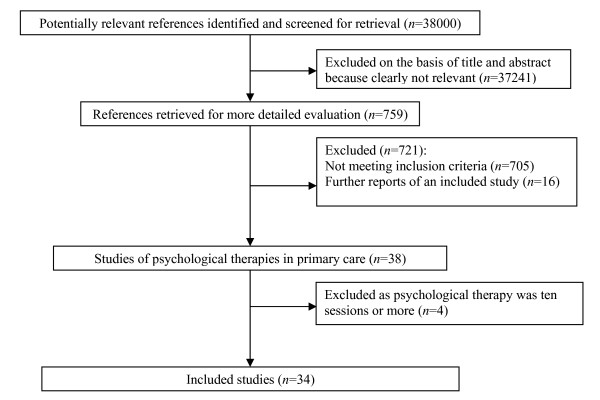
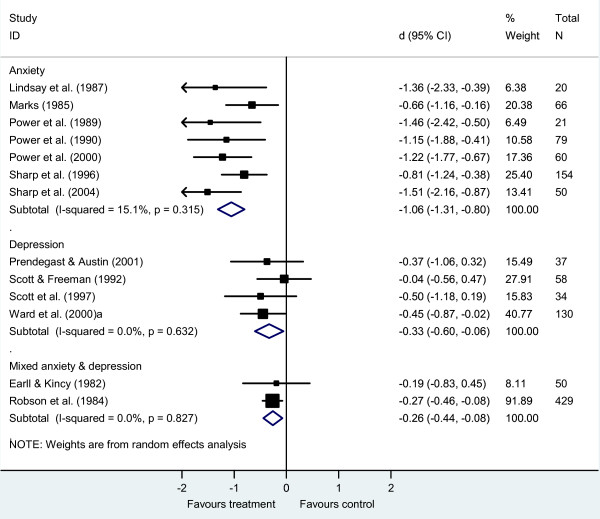
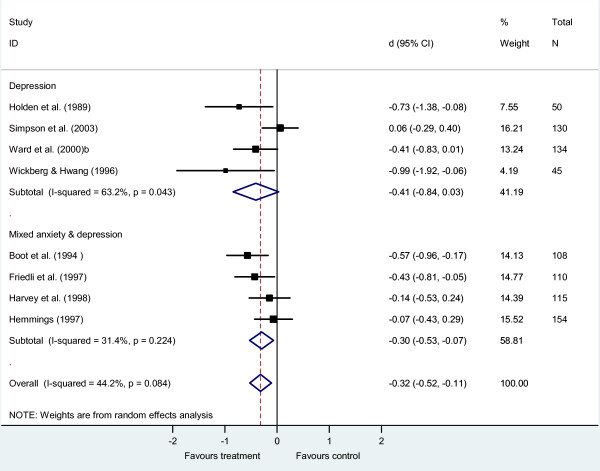
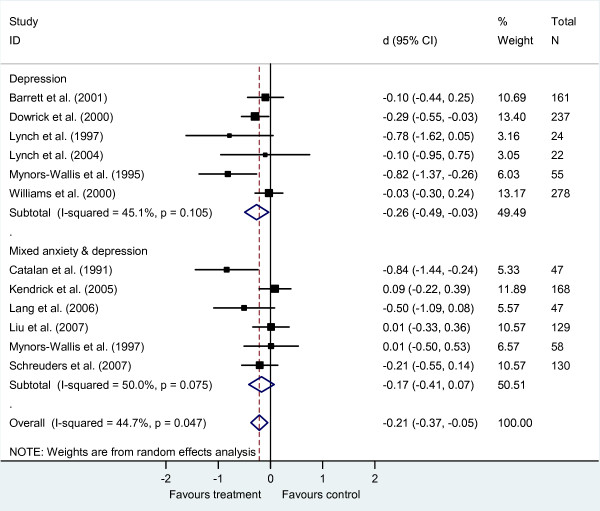
BACKGROUND: Psychological therapies provided in primary care are usually briefer than in secondary care. There has been no recent comprehensive review comparing their effectiveness for common mental health problems. We aimed to compare the effectiveness of different types of brief psychological therapy administered within primary care across and between anxiety, depressive and mixed disorders. METHODS: Meta-analysis and meta-regression of randomized controlled trials of brief psychological therapies of adult patients with anxiety, depression or mixed common mental health problems treated in primary care compared to primary care treatment as usual. RESULTS: Thirty-four studies, involving 3962 patients, were included. Most were of brief cognitive behaviour therapy (CBT; n = 13), counselling (n = 8) or problem solving therapy (PST; n = 12). There was differential effectiveness between studies of CBT, with studies of CBT for anxiety disorders having a pooled effect size [d -1.06, 95% confidence interval (CI) -1.31 to -0.80] greater than that of studies of CBT for depression (d -0.33, 95% CI -0.60 to -0.06) or studies of CBT for mixed anxiety and depression (d -0.26, 95% CI -0.44 to -0.08). Counselling for depression and mixed anxiety and depression (d -0.32, 95% CI -0.52 to -0.11) and problem solving therapy (PST) for depression and mixed anxiety and depression (d -0.21, 95% CI -0.37 to -0.05) were also effective. Controlling for diagnosis, meta-regression found no difference between CBT, counselling and PST. CONCLUSIONS: Brief CBT, counselling and PST are all effective treatments in primary care, but effect sizes are low compared to longer length treatments. The exception is brief CBT for anxiety, which has comparable effect sizes.
Overview
The claims and statistics of this paper haven’t been checked yet.
Free: it reads the open-access text and checks the first 5 claims that cite a source we can check. Create a free account to check every claim.
Integrity signals
Registry
Cites
Statistics
Figures
Verification
Claims the paper makes
The claims and statistics of this paper haven’t been checked yet.
Free: it reads the open-access text and checks the first 5 claims that cite a source we can check. Create a free account to check every claim.
Claims other papers make about this one
Each is checked against this paper’s own text: does it say what the citing paper says it does?
The source backs part of the claim, not all of it — or backs it for a different population, condition or comparison.
In the citing paper
“while 2 other meta-analyses looking at brief (8 or fewer sessions) of CBT, MBCT, and PST noted significant efficacy in symptom reduction.82,83”
From Canadian Network for Mood and Anxiety Treatments (CANMAT) 2016 Clinical Guidelines for the Management of Adults with Major Depressive Disorder (2016) · cites this paper as [82]
Experimental — accuracy not yet measuredThe source backs part of the claim, not all of it — or backs it for a different population, condition or comparison.
In the citing paper
“For instance, the meta-analysis conducted by Cape et al. (2010) revealed that, although brief interventions provided in primary care had similar efficacy than longer treatments for anxiety disorders, the effect sizes obtained for depression and mixed anxiety and depression were considerably smaller (d = 0.33 and 0.26, respectively).”
From A Multiple-Baseline Evaluation of Acceptance and Commitment Therapy Focused on Repetitive Negative Thinking for Comorbid Generalized Anxiety Disorder and Depression (2020) · cites this paper as Cape et al. (2010)
Experimental — accuracy not yet measuredThe source backs part of the claim, not all of it — or backs it for a different population, condition or comparison.
In the citing paper
“Specifically, the empirical evidence shows that brief interventions tested for this problem in primary care have obtained small effect sizes (e.g. Cape et al., 2010).”
From A Multiple-Baseline Evaluation of Acceptance and Commitment Therapy Focused on Repetitive Negative Thinking for Comorbid Generalized Anxiety Disorder and Depression (2020) · cites this paper as Cape et al., 2010
Experimental — accuracy not yet measured
Self-check
Percentages, sums and reported differences re-computed from the paper’s own numbers.
The self-check needs the paper’s full text.
Citations
Cites
Measuring inconsistency in meta-analyses
Higgins, J. P. T., Thompson, S. G., Deeks, J. J., & Altman, D. G. (2003) · BMJ · doi:10.1136/bmj.327.7414.557 · Cited by 63,139 · cited 2×
“We used I2 and the Q test of heterogeneity [37,38] to examine among-study variation in the meta-analysis.”
BackgroundMethodBias in meta-analysis detected by a simple, graphical test
Egger, M., Smith, G. D., Schneider, M., & Minder, C. (1997) · BMJ · doi:10.1136/bmj.315.7109.629 · Cited by 56,722 · cited 1×
“To check for publication bias, CMA was used to generate funnel plots and Egger's regression asymmetry test [39].”
MethodQuantifying heterogeneity in a meta‐analysis
Higgins, J. P. T., & Thompson, S. G. (2002) · Statistics in Medicine · doi:10.1002/sim.1186 · Cited by 36,763 · cited 1×
“We used I2 and the Q test of heterogeneity [ 37 ,38] to examine among-study variation in the meta-analysis.”
MethodHamilton, M. (1960) · Journal of Neurology, Neurosurgery & Psychiatry · doi:10.1136/jnnp.23.1.56 · Cited by 32,817 · cited 4×
“3 point difference between groups on the Hamilton Rating Scale for Depression [79] while the effect size for CBT for anxiety was equivalent to 7.”
BackgroundInfluentialKessler, R. C., Chiu, W. T., Demler, O., & Walters, E. E. (2005) · Archives of General Psychiatry · doi:10.1001/archpsyc.62.6.617 · Cited by 12,052 · cited 1×
“Although studies of psychological therapies in primary care frequently include patients with both anxiety and depression, reflecting the heterogeneous patient presentations in primary care where mixed anxiety and depression is the most common diagnosis [20-22], such studies are excluded when the selection criteria for…”
BackgroundThe assessment of anxiety states by rating
HAMILTON, M. (1959) · British Journal of Medical Psychology · doi:10.1111/j.2044-8341.1959.tb00467.x · Cited by 11,455 · cited 4×
“Anxiety and depressive disorders are common, with estimated combined prevalence varying between countries but over 10% in most Western countries [1-4].”
BackgroundInfluentialThe empirical status of cognitive-behavioral therapy: A review of meta-analyses
Butler, A. C., Chapman, J. E., Forman, E. M., & Beck, A. T. (2006) · Clinical Psychology Review · doi:10.1016/j.cpr.2005.07.003 · Cited by 3,215 · cited 4×
“Brief CBT for anxiety disorders was the exception, with effect sizes in the present review comparable to those obtained in reviews of longer secondary care based treatments [12,13].”
BackgroundResultInfluentialA Nonparametric “Trim and Fill” Method of Accounting for Publication Bias in Meta-Analysis
Duval, S., & Tweedie, R. (2000) · Journal of the American Statistical Association · doi:10.1080/01621459.2000.10473905 · Cited by 2,955 · cited 1×
“Where asymmetry was detected, we assessed the potential impact of the publication bias using the Duval and Tweedie nonparametric 'trim and fill' method [40].”
MethodImproved tests for a random effects meta‐regression with a single covariate
Knapp, G., & Hartung, J. (2003) · Statistics in Medicine · doi:10.1002/sim.1482 · Cited by 2,075 · cited 1×
“We used the metareg command in Stata, to conduct random-effects meta-regression analyses with restricted maximum likelihood estimation and the improved variance estimator of Knapp and Hartung [ 41 ].”
MethodRegier, D. A. (1993) · Archives of General Psychiatry · doi:10.1001/archpsyc.1993.01820140007001 · Cited by 1,999
The ESEMeD/MHEDEA 2000 Investigators, Alonso, J., Angermeyer, M. C., Bernert, S., Bruffaerts, R., Brugha, T. S., Bryson, H., de Girolamo, G., de Graaf, R., Demyttenaere, K., et al. (2004) · Acta Psychiatrica Scandinavica · doi:10.1111/j.1600-0047.2004.00327.x · Cited by 1,819
Internet-based cognitive behaviour therapy for symptoms of depression and anxiety: A meta-analysis
SPEK, V., CUIJPERS, P., NYKLÍČEK, I., RIPER, H., KEYZER, J., & POP, V. (2007) · Psychological Medicine · doi:10.1017/s0033291706008944 · Cited by 1,586 · cited 1×
“A recent review of internet-based CBT of anxiety and depression, also found differential effects between studies of internet-based CBT on depression and studies of internet-based CBT on anxiety [81], with remarkably similar effect sizes (d 0.”
ResultHoffman, S. G., & Smits, J. A. J. (2008) · The Journal of Clinical Psychiatry · doi:10.4088/jcp.v69n0415 · Cited by 1,420
What Works for Whom?: A Critical Review of Psychotherapy Research
Roth, A. D., & Fonagy, P. (1996) · Cited by 1,382
Collaborative Care for Depression: A Cumulative Meta-analysis and Review of Longer-term Outcomes
Gilbody, S. (2006) · Archives of Internal Medicine · doi:10.1001/archinte.166.21.2314 · Cited by 1,340
The Descriptive Epidemiology of Commonly Occurring Mental Disorders in the United States
Kessler, R. C., & Wang, P. S. (2008) · Annual Review of Public Health · doi:10.1146/annurev.publhealth.29.020907.090847 · Cited by 888 · cited 1×
“Background Anxiety and depressive disorders are common, with estimated combined prevalence varying between countries but over 10% in most Western countries [1-4].”
BackgroundAdult psychiatric morbidity in England, 2007: Results of a household survey
Mcmanus, S., Meltzer, H., Brugha, T., Bebbington, P., & Jenkins, R. (2009) · Unpublished · doi:10.13140/2.1.1563.5205 · Cited by 814
Common mental disorders : a bio-social model
Goldberg, D. P., & Huxley, P. J. (1992) · Cited by 757
A Nonparametric "Trim and Fill" Method of Accounting for Publication Bias in Meta-Analysis
Duval, S., & Tweedie, R. L. (2000) · Journal of the American Statistical Association · doi:10.2307/2669529 · Cited by 694
Observations are always ordinal; measurements, however, must be interval.
Wright, B., & Linacre, J. M. (1989) · PubMed · Cited by 679
Westen, D., & Morrison, K. (2001) · Journal of Consulting and Clinical Psychology · doi:10.1037/0022-006x.69.6.875 · Cited by 635 · cited 2×
“The summary effects obtained were generally lower than reviews of secondary care based treatments, involving a longer duration of psychological therapies [10,12,82].”
BackgroundMethodHolden, J. M., Sagovsky, R., & Cox, J. L. (1989) · BMJ · doi:10.1136/bmj.298.6668.223 · Cited by 509 · cited 3×
“Twelve were of cognitive behaviour therapy (CBT) [4657], seven of counselling [58-64], one of interpersonal psychotherapy [65], one of psychodynamic psychotherapy [66] and 12 of problem solving therapy (PST) [67-78].”
BackgroundWeslen, D., & Morrison, K. (2002) · PsycEXTRA Dataset · doi:10.1037/e323162004-001 · Cited by 509
Mynors-Wallis, L. M., Gath, D. H., Lloyd-Thomas, A. R., & Tomlinson, D. (1995) · BMJ · doi:10.1136/bmj.310.6977.441 · Cited by 492 · cited 4×
“Twelve were of cognitive behaviour therapy (CBT) [4657], seven of counselling [58-64], one of interpersonal psychotherapy [65], one of psychodynamic psychotherapy [66] and 12 of problem solving therapy (PST) [67-78].”
BackgroundMethodInfluentialWilliams, Jr., Barrett, J., Oxman, T., Frank, E., Katon, W., Sullivan, M., Cornell, J., & Sengupta, A. (2000) · JAMA · doi:10.1001/jama.284.12.1519 · Cited by 460 · cited 3×
“Twelve were of cognitive behaviour therapy (CBT) [4657], seven of counselling [58-64], one of interpersonal psychotherapy [65], one of psychodynamic psychotherapy [66] and 12 of problem solving therapy (PST) [67-78].”
BackgroundMethodSchulberg, H. C., Katon, W., Simon, G. E., & Rush, A. J. (1998) · Archives of General Psychiatry · doi:10.1001/archpsyc.55.12.1121 · Cited by 459
Treating Major Depression in Primary Care Practice: Eight-Month Clinical Outcomes
Schulberg, H. C. (1996) · Archives of General Psychiatry · doi:10.1001/archpsyc.1996.01830100061008 · Cited by 426 · cited 1×
“There were four studies excluded on basis of the psychological therapy being 10 sessions or more [42-45].”
BackgroundGELLATLY, J., BOWER, P., HENNESSY, S., RICHARDS, D., GILBODY, S., & LOVELL, K. (2007) · Psychological Medicine · doi:10.1017/s0033291707000062 · Cited by 419 · cited 1×
“Studies of computerized or facilitated self-help [28-30], of psycho-educational groups [31,32], and of psychological therapy carried out as part of or referral on from case management within collaborative care [33], were excluded.”
BackgroundA meta-analysis of randomized trials of behavioural treatment of depression
Ekers, D., Richards, D., & Gilbody, S. (2008) · Psychological Medicine · doi:10.1017/s0033291707001614 · Cited by 400
Kaltenthaler, E., Brazier, J., De Nigris, E., Tumur, I., Ferriter, M., Beverley, C., Parry, G., Rooney, G., & Sutcliffe, P. (2006) · Health Technology Assessment · doi:10.3310/hta10330 · Cited by 357
Bower, P., Byford, S., Sibbald, B., Ward, E., King, M., Lloyd, M., & Gabbay, M. (2000) · BMJ · doi:10.1136/bmj.321.7273.1389 · Cited by 345
Brief cognitive therapy for panic disorder: A randomized controlled trial.
Clark, D. M., Salkovskis, P. M., Hackmann, A., Wells, A., Ludgate, J., & Gelder, M. (1999) · Journal of Consulting and Clinical Psychology · doi:10.1037/0022-006x.67.4.583 · Cited by 324 · cited 1×
“secondary care, a direct comparison of brief and standard length CBT for panic disorder found equivalent effectiveness [83].”
BackgroundThe case for psychological treatment centres
Layard, R. (2006) · BMJ · doi:10.1136/bmj.332.7548.1030 · Cited by 287 · cited 1×
“With access to psychological therapies being limited [7], psychological therapy provided within primary care settings for depression and anxiety is usually brief [8].”
BackgroundWard, E., King, M., Lloyd, M., Bower, P., Sibbald, B., Farrelly, S., Gabbay, M., Tarrier, N., & Addington-Hall, J. (2000) · BMJ · doi:10.1136/bmj.321.7273.1383 · Cited by 271
Cognitive Therapy for Major Depressive Disorder in Primary Care
Teasdale, J. D., Fennell, M. J. V., Hibbert, G. A., & Amies, P. L. (1984) · British Journal of Psychiatry · doi:10.1192/bjp.144.4.400 · Cited by 248 · cited 1×
“There were four studies excluded on basis of the psychological therapy being 10 sessions or more [42-45].”
BackgroundCounselling of postnatal depression: A controlled study on a population based Swedish sample
Wickberg, B. (1996) · Journal of Affective Disorders · doi:10.1016/0165-0327(96)00034-1 · Cited by 230 · cited 2×
“Twelve were of cognitive behaviour therapy (CBT) [4657], seven of counselling [58-64], one of interpersonal psychotherapy [65], one of psychodynamic psychotherapy [66] and 12 of problem solving therapy (PST) [67-78].”
BackgroundDowrick, C., Dunn, G., Ayuso-Mateos, J. L., Dalgard, O. S., Page, H., Lehtinen, V., Casey, P., Wilkinson, C., Vazquez-Barquero, J. L., & Wilkinson, G. (2000) · BMJ · doi:10.1136/bmj.321.7274.1450 · Cited by 228 · cited 2×
“Twelve were of cognitive behaviour therapy (CBT) [46- 57], seven of counselling [58-64], one of interpersonal psychotherapy [65], one of psychodynamic psychotherapy [66] and 12 of problem solving therapy (PST) [ 67-78 ].”
BackgroundMichaels, J., Campbell, W., Brazier, J., MacIntyre, J., Palfreyman, S., Ratcliffe, J., & Rigby, K. (2006) · Health Technology Assessment · doi:10.3310/hta10130 · Cited by 225
Scott, A. I., & Freeman, C. P. (1992) · BMJ · doi:10.1136/bmj.304.6831.883 · Cited by 213
Positive thinking revisited: positive cognitions, well-being and mental health
Macleod, A. K., & Moore, R. (2000) · Clinical Psychology & Psychotherapy · doi:10.1002/(sici)1099-0879(200002)7:1<1::aid-cpp228>3.0.co;2-s · Cited by 206
Public health significance of mixed anxiety and depression: beyond current classification
Das-Munshi, J., Goldberg, D., Bebbington, P. E., Bhugra, D. K., Brugha, T. S., Dewey, M. E., Jenkins, R., Stewart, R., & Prince, M. (2008) · British Journal of Psychiatry · doi:10.1192/bjp.bp.107.036707 · Cited by 205 · cited 1×
“Although studies of psychological therapies in primary care frequently include patients with both anxiety and depression, reflecting the heterogeneous patient presentations in primary care where mixed anxiety and depression is the most common diagnosis [20-22], such studies are excluded when the selection criteria for…”
BackgroundBarrett, J. E., Williams, J. W., Oxman, T. E., Frank, E., Katon, W. J., Sullivan, M. D., Hegel, M. T., Cornell, J. E., & Sengupta, A. (2001) · PubMed · Cited by 181
Psychological treatment of depression in primary care: a meta-analysis
Cuijpers, P., van Straten, A., van Schaik, A., & Andersson, G. (2009) · British Journal of General Practice · doi:10.3399/bjgp09x395139 · Cited by 172 · cited 1×
“Recent reviews which have included analyses limited to primary care, have focussed on studies of patients with a diagnosis of depression [14-18] or studies of a specific type of psychological therapy [19].”
BackgroundMynors-Wallis, L., Davies, I., Gray, A., Barbour, F., & Gath, D. (1997) · British Journal of Psychiatry · doi:10.1192/bjp.170.2.113 · Cited by 167 · cited 2×
“Twelve were of cognitive behaviour therapy (CBT) [4657], seven of counselling [58-64], one of interpersonal psychotherapy [65], one of psychodynamic psychotherapy [66] and 12 of problem solving therapy (PST) [67-78].”
BackgroundMinimal-contact psychotherapy for sub-threshold depression in primary care: Randomised trial
Willemse, G. R. W. M., Smit, F., Cuijpers, P., & Tiemens, B. G. (2004) · British Journal of Psychiatry · doi:10.1192/bjp.185.5.416 · Cited by 149 · cited 1×
“Studies of computerized or facilitated self-help [ 28-30 ], of psycho-educational groups [31,32], and of psychological therapy carried out as part of or referral on from case management within collaborative care [33], were excluded.”
BackgroundScott, C., Tacchi, M. J., Jones, R., & Scott, J. (1997) · British Journal of Psychiatry · doi:10.1192/bjp.171.2.131 · Cited by 137 · cited 2×
“The significance of treatment in primary care is considered to be familiarity and accessibility of location and ease of liaison between GP and treating psychological therapist but this will quite probably have varied widely, given that studies varied from only one or two patients treated per participating general prac…”
BackgroundBortolotti, B., Menchetti, M., Bellini, F., Montaguti, M. B., & Berardi, D. (2008) · General Hospital Psychiatry · doi:10.1016/j.genhosppsych.2008.04.001 · Cited by 136 · cited 1×
“Recent reviews which have included analyses limited to primary care, have focussed on studies of patients with a diagnosis of depression [14-18] or studies of a specific type of psychological therapy [19].”
BackgroundA brief psycho‐educational group intervention for postnatal depression
Honey, K. L., Bennett, P., & Morgan, M. (2002) · British Journal of Clinical Psychology · doi:10.1348/014466502760387515 · Cited by 132 · cited 1×
“Studies of computerized or facilitated self-help [28-30], of psycho-educational groups [31,32], and of psychological therapy carried out as part of or referral on from case management within collaborative care [33], were excluded.”
BackgroundThe clinical effectiveness of counselling in primary care: a systematic review and meta-analysis
BOWER, P., ROWLAND, N., & HARDY, R. (2003) · Psychological Medicine · doi:10.1017/s0033291702006979 · Cited by 126 · cited 1×
“Recent reviews which have included analyses limited to primary care, have focussed on studies of patients with a diagnosis of depression [14-18] or studies of a specific type of psychological therapy [19].”
BackgroundWolf, N. J., & Hopko, D. R. (2008) · Clinical Psychology Review · doi:10.1016/j.cpr.2007.04.004 · Cited by 116 · cited 1×
“Recent reviews which have included analyses limited to primary care, have focussed on studies of patients with a diagnosis of depression [14-18] or studies of a specific type of psychological therapy [19].”
BackgroundSharp, D. M., Power, K., Simpson, R., Swanson, V., Moodie, E. M., Anstee, J. A., & Ashford, J. J. (1996) · Journal of Anxiety Disorders · doi:10.1016/0887-6185(96)00008-4 · Cited by 112 · cited 3×
“The significance of treatment in primary care is considered to be familiarity and accessibility of location and ease of liaison between GP and treating psychological therapist but this will quite probably have varied widely, given that studies varied from only one or two patients treated per participating general prac…”
BackgroundMethodLynch, D. J., Tamburrino, M., & Nagel, R. W. (1997) · PubMed · Cited by 111
Evaluation of a brief psychological treatment for emotional disorders in primary care
Catalan, J., Gath, D. H., Anastasiades, P., Bond, S. A. K., Day, A., & Hall, L. (1991) · Psychological Medicine · doi:10.1017/s0033291700030002 · Cited by 111 · cited 2×
“Twelve were of cognitive behaviour therapy (CBT) [4657], seven of counselling [58-64], one of interpersonal psychotherapy [65], one of psychodynamic psychotherapy [66] and 12 of problem solving therapy (PST) [67-78].”
BackgroundInterpersonal Psychotherapy for Elderly Patients in Primary Care
van Schaik, A., van Marwijk, H., Adèr, H. J., van Dyck, R., de Haan, M., Penninx, B. W. J. H., van der Kooy, K. G., van Hout, H. P. J., & Beekman, A. T. F. (2006) · American Journal of Geriatric Psychiatry · doi:10.1097/01.jgp.0000199341.25431.4b · Cited by 110 · cited 2×
“Van Schaik 2006 [65] IPT NL Dep - MDD MADRS 8 C 26 143 W”
BackgroundFriedlr, K., King, M., Lloyd, M., & Horder, J. (1997) · The Lancet · doi:10.1016/s0140-6736(97)05298-7 · Cited by 109 · cited 2×
“Friedli 1997 [59] COU UK Mixed Anx and Dep BDI 9 C 12 136 A”
BackgroundSharp, D. M., Power, K. G., & Swanson, V. (2004) · Clinical Psychology & Psychotherapy · doi:10.1002/cpp.393 · Cited by 108 · cited 1×
“Sharp 2004 [57] CBT UK Anx - panic HAM-A 8 C 12 59 A”
BackgroundStiles, W. B., Barkham, M., Connell, J., & Mellor-Clark, J. (2008) · Journal of Consulting and Clinical Psychology · doi:10.1037/0022-006x.76.2.298 · Cited by 98 · cited 1×
“In the UK, six sessions is a common treatment length [9].”
BackgroundClinical psychologist in primary care: controlled clinical and economic evaluation.
Robson, M., France, R., & Bland, M. (1984) · BMJ · doi:10.1136/bmj.288.6433.1805 · Cited by 92 · cited 2×
“The significance of treatment in primary care is considered to be familiarity and accessibility of location and ease of liaison between GP and treating psychological therapist but this will quite probably have varied widely, given that studies varied from only one or two patients treated per participating general prac…”
BackgroundPrimary Care Psychiatry: Health Services Research is not Enough
Shepherd, M. (1995) · British Journal of Psychiatry · doi:10.1192/bjp.166.1.1 · Cited by 89
Ross, M., & Scott, M. (1985) · PubMed · Cited by 87
Specialist mental health treatment in general practice: a meta-analysis
Balestrieri, M., Williams, P., & Wilkinson, G. (1988) · Psychological Medicine · doi:10.1017/s0033291700008400 · Cited by 87
A controlled trial of treatments for generalized anxiety
Lindsay, W. R., Gamsu, C. V., McLaughlin, E., Hood, E. M., & Espie, C. A. (1987) · British Journal of Clinical Psychology · doi:10.1111/j.2044-8260.1987.tb00718.x · Cited by 83 · cited 1×
“Lindsay 1987 [47] CBT UK Anx - GAD GHQ-28 8 C 4 20 A”
Kvaal, K., McDougall, F. A., Brayne, C., Matthews, F. E., & Dewey, M. E. (2008) · International Journal of Geriatric Psychiatry · doi:10.1002/gps.1867 · Cited by 78 · cited 1×
“Although studies of psychological therapies in primary care frequently include patients with both anxiety and depression, reflecting the heterogeneous patient presentations in primary care where mixed anxiety and depression is the most common diagnosis [ 20-22 ], such studies are excluded when the selection criteria f…”
BackgroundEarly Childhood Nurse-Delivered Cognitive Behavioural Counselling for Post-Natal Depression
Prendergast, J., & Austin, M.-P. (2001) · Australasian Psychiatry · doi:10.1046/j.1440-1665.2001.00330.x · Cited by 77
Brief Psychotherapy in Family Practice: A Controlled Prospective Intervention Trial
Brodaty, H., & Andrews, G. (1983) · British Journal of Psychiatry · doi:10.1192/bjp.143.1.11 · Cited by 77
Power, K., Simpson, R., Swanson, V., & Wallace, L. A. (1990) · Europe PMC (PubMed Central) · Cited by 77
Schulberg, H. C., Raue, P. J., & Rollman, B. L. (2002) · General Hospital Psychiatry · doi:10.1016/s0163-8343(02)00175-5 · Cited by 76 · cited 1×
“Recent reviews which have included analyses limited to primary care, have focussed on studies of patients with a diagnosis of depression [14-18] or studies of a specific type of psychological therapy [19].”
BackgroundA randomized controlled trial and economic evaluation of counselling in primary care.
Harvey, I. M., Nelson, S., Lyons, R. A., Unwin, C., Monaghan, S., & Peters, T. J. (1998) · Europe PMC (PubMed Central) · Cited by 67
Controlled trial of psychiatric nurse therapists in primary care.
Marks, I. (1985) · BMJ · doi:10.1136/bmj.290.6476.1181 · Cited by 67
Power, K. G., Jerrom, D. W. A., Simpson, R. J., Mitchell, M. J., & Swanson, V. (1989) · Behavioural Psychotherapy · doi:10.1017/s0141347300015597 · Cited by 66
SIMPSON, S., CORNEY, R., FITZGERALD, P., & BEECHAM, J. (2003) · Psychological Medicine · doi:10.1017/s0033291702006517 · Cited by 65 · cited 2×
“Twelve were of cognitive behaviour therapy (CBT) [4657], seven of counselling [58-64], one of interpersonal psychotherapy [65], one of psychodynamic psychotherapy [66] and 12 of problem solving therapy (PST) [67-78].”
BackgroundKendrick, T., Simons, L., Mynors-Wallis, L., Gray, A., Lathlean, J., Pickering, R., Harris, S., Rivero-Arias, O., Gerard, K., & Thompson, C. (2005) · Health Technology Assessment · doi:10.3310/hta9370 · Cited by 64 · cited 3×
“Twelve were of cognitive behaviour therapy (CBT) [4657], seven of counselling [58-64], one of interpersonal psychotherapy [65], one of psychodynamic psychotherapy [66] and 12 of problem solving therapy (PST) [67-78].”
BackgroundThe efficacy of psychosocial treatments in primary care
Brown, C., & Schulberg, H. C. (1995) · General Hospital Psychiatry · doi:10.1016/0163-8343(95)00072-0 · Cited by 62
Clinical psychology in general practice: a controlled trial evaluation.
Earll, L., & KINCEY, J. A. (1982) · PubMed · Cited by 59
Counselling in primary care: A randomised controlled trial
Hemmings, A. (1997) · Patient Education and Counseling · doi:10.1016/s0738-3991(97)00035-9 · Cited by 59 · cited 2×
“Twelve were of cognitive behaviour therapy (CBT) [4657], seven of counselling [58-64], one of interpersonal psychotherapy [65], one of psychodynamic psychotherapy [66] and 12 of problem solving therapy (PST) [67-78].”
BackgroundA parametric analysis of ordinal quality-of-life data can lead to erroneous results
Kahler, E., Rogausch, A., Brunner, E., & Himmel, W. (2008) · Journal of Clinical Epidemiology · doi:10.1016/j.jclinepi.2007.05.019 · Cited by 59 · cited 1×
“Dependence on such measures in the meta-analysis is likely to have increased measurement error and heterogeneity [85].”
BackgroundTelephone-Based Treatment for Family Practice Patients with Mild Depression
Lynch, D., Tamburrino, M., Nagel, R., & Smith, M. K. (2004) · Psychological Reports · doi:10.2466/pr0.94.3.785-792 · Cited by 48 · cited 2×
“Twelve were of cognitive behaviour therapy (CBT) [4657], seven of counselling [58-64], one of interpersonal psychotherapy [65], one of psychodynamic psychotherapy [66] and 12 of problem solving therapy (PST) [67-78].”
BackgroundEvaluation of the short-term impact of counseling in general practice
Boot, D., GILLIES, P. A., Fenelon, J., Reubin, R., Wilkins, M., & Gray, P. (1994) · Patient Education and Counseling · doi:10.1016/0738-3991(94)90028-0 · Cited by 45
Dissemination of Cognitive Therapy for Panic Disorder in Primary Care
Grey, N., Salkovskis, P., Quigley, A., Clark, D. M., & Ehlers, A. (2008) · Behavioural and Cognitive Psychotherapy · doi:10.1017/s1352465808004694 · Cited by 44 · cited 1×
“While this suggests that brief CBT is particularly effective with anxiety disorders and there is evidence that training in CBT may enhance effectiveness of treatment of anxiety disorders by counsellors [86], the lack of randomized studies of brief psychological therapies other than CBT for patients suffering from anxi…”
BackgroundSharp, D. M., Power, K., & Swanson, V. (2000) · PubMed · Cited by 43
A systematic review of the effectiveness of brief psychological therapies in primary health care.
Hemmings, A. (2000) · Families Systems & Health · doi:10.1037/h0091857 · Cited by 40 · cited 1×
“health disorders and types of psychological therapies used within primary care date back over a decade [23-26].”
BackgroundThomas, R. V., & Corney, R. (1992) · Europe PMC (PubMed Central) · Cited by 38
Primary care patients with mental health problems: outcome of a randomised clinical trial
Schreuders, B., van Marwijk, H., Smit, J., Rijmen, F., Stalman, W., & van Oppen, P. (2007) · British Journal of General Practice · doi:10.3399/096016407782317829 · Cited by 37 · cited 2×
“Twelve were of cognitive behaviour therapy (CBT) [4657], seven of counselling [58-64], one of interpersonal psychotherapy [65], one of psychodynamic psychotherapy [66] and 12 of problem solving therapy (PST) [67-78].”
BackgroundWiles, N. J., Hollinghurst, S., Mason, V., Musa, M., Burt, V., Hyde, J., Jerrom, B., Lewis, G., & Kessler, D. (2008) · Behavioural and Cognitive Psychotherapy · doi:10.1017/s135246580700389x · Cited by 33 · cited 1×
“There were four studies excluded on basis of the psychological therapy being 10 sessions or more [42-45].”
Counselling in general practice - a review
Friedli, K. (1996) · UCL Discovery (University College London) · Cited by 32
Hansson, M., Bodlund, O., & Chotai, J. (2007) · Journal of Affective Disorders · doi:10.1016/j.jad.2007.04.007 · Cited by 31 · cited 1×
“Studies of computerized or facilitated self-help [28-30], of psycho-educational groups [31,32], and of psychological therapy carried out as part of or referral on from case management within collaborative care [33], were excluded.”
BackgroundA randomized trial of a brief mental health intervention for primary care patients.
Lang, A. J., Norman, G. J., & Casmar, P. V. (2006) · Journal of Consulting and Clinical Psychology · doi:10.1037/0022-006x.74.6.1173 · Cited by 31
Therapist contact in cognitive behaviour therapy for panic disorder and agoraphobia in primary care
Power, K. G., Sharp, D. M., Swanson, V., & Simpson, R. J. (2000) · Clinical Psychology & Psychotherapy · doi:10.1002/(sici)1099-0879(200002)7:1<37::aid-cpp224>3.0.co;2-j · Cited by 31 · cited 2×
“The control condition for all studies was usual GP care, supplemented in a few studies [49-51,56,67,75,78] by the patient receiving some additional control intervention, for example placebo medication or a self-help booklet.”
MethodSmit, A., Tiemens, B. G., & Ormel, J. (2007) · The European Journal of Psychiatry · doi:10.4321/s0213-61632007000100005 · Cited by 12 · cited 1×
“Recent reviews which have included analyses limited to primary care, have focussed on studies of patients with a diagnosis of depression [14-18] or studies of a specific type of psychological therapy [19].”
BackgroundLiu, S., Huang, H., Yeh, Z., Hwang, L., Tjung, J.-J., Huang, C.-R., Hsu, C., Ho, C.-J., Sun, I.-W., Fang, C., et al. (2007) · General Hospital Psychiatry · doi:10.1016/j.genhosppsych.2007.06.006 · Cited by 12 · cited 2×
“Liu 2007 [72] PST TA Mixed Anx and Dep CIS-R 2.”
Background
Research works printed but not linked: 3
- Scottish Intercollegiate Guidelines Network SIGN 50: A Guideline Developer's Handbook 2004 Edinburgh: SIGN
- Borenstein M Hedges L Higgins J Rothstein H Comprehensive Meta-analysis Version 2 [Computer software] 2005 Englewood, NJ: Biostat
- StataCorp Stata Statistical Software: Release 9.2 [Computer software] 2007 College Station, TX: StataCorp
Cited by
Collaborative care for depression and anxiety problems
Archer, J., Bower, P., Gilbody, S., Lovell, K., Richards, D., Gask, L., Dickens, C., & Coventry, P. (2012) · Cochrane Database of Systematic Reviews · doi:10.1002/14651858.cd006525.pub2 · Cited by 1,126
Malhi, G. S., Bassett, D., Boyce, P., Bryant, R., Fitzgerald, P. B., Fritz, K., Hopwood, M., Lyndon, B., Mulder, R., Murray, G., et al. (2015) · Australian & New Zealand Journal of Psychiatry · doi:10.1177/0004867415617657 · Cited by 842
“Research also supports the use of psychological therapies (Cape et al., 2010), but head-to-head and combined psychological and pharmacological treatment studies are lacking.”
BackgroundBaldwin, D. S., Anderson, I. M., Nutt, D. J., Allgulander, C., Bandelow, B., den Boer, J. A., Christmas, D. M., Davies, S., Fineberg, N., Lidbetter, N., et al. (2014) · Journal of Psychopharmacology · doi:10.1177/0269881114525674 · Cited by 676
“, 2001): though a subsequent meta-analysis suggests that short-term counselling is less beneficial than longer-term treatment with other psychological interventions [I (M)] (Cape et al., 2010).”
BackgroundMeader, N., King, K., Llewellyn, A., Norman, G., Brown, J., Rodgers, M., Moe-Byrne, T., Higgins, J. P., Sowden, A., & Stewart, G. (2014) · Systematic Reviews · doi:10.1186/2046-4053-3-82 · Cited by 610
“[25] Brief psychological therapies for anxiety and depression in primary care: metaanalysis and meta-regression Psychological Mental health”
BackgroundMethodParikh, S. V., Quilty, L. C., Ravitz, P., Rosenbluth, M., Pavlova, B., Grigoriadis, S., Velyvis, V., Kennedy, S. H., Lam, R. W., MacQueen, G. M., et al. (2016) · The Canadian Journal of Psychiatry · doi:10.1177/0706743716659418 · Cited by 562
Metadata
- Authors
- Cape, J., Whittington, C., Buszewicz, M., Wallace, P., & Underwood, L.
- Affiliations
- St Pancras Hospital (GB)
- University College London (GB)
- King's College London (GB)
- Corresponding author
- Cape, John
- Venue
- BMC Medicine
- Published
- 2010-06-25
- Volume
- 8
- Issue
- 1
- Pages
- 38-38
- ISSN
- 1741-7015 (ISSN-L)
- PMC
- PMC2908553
- OpenAlex
- W2090336640
- Semantic Scholar
- f99936e4dedd3d0d915d221290398eee6f62ff11
- Cited by
- 283
- References
- 91
- Citations by year
- 2026: 12 · 2025: 12 · 2024: 15 · 2023: 8 · 2022: 14 · 2021: 27 · 2020: 14 · 2019: 20 · 2018: 25 · 2017: 27 · 2016: 16 · 2015: 18 · 2014: 22 · 2013: 14 · 2012: 23
- FWCI
- 22.05
- Type
- journal article
- Language
- en
- Open access
- gold
- doi.org
- Licence
- Locations
- BMC Medicine (publishedVersion, cc-by)
- PubMed Central (publishedVersion, cc-by)
- PubMed (publishedVersion)
- DOAJ (DOAJ: Directory of Open Access Journals) (submittedVersion, cc-by-sa)
- UCL Discovery (University College London) (submittedVersion)
- Research Portal (King's College London) (submittedVersion)
- Topics
- Social Sciences › Psychology › Experimental and Cognitive Psychology › Anxiety, Depression, Psychometrics, Treatment, Cognitive Processes
- Social Sciences › Psychology › Clinical Psychology › Psychotherapy Techniques and Applications
- Health Sciences › Medicine › Psychiatry and Mental health › Mental Health Treatment and Access
- Keywords
- primary care, anxiety disorders, depression, mixed anxiety-depressive disorder, cognitive behavioral therapy, counseling, problem-solving therapy, treatment effectiveness, common mental disorders
- MeSH terms
- Adult, Anxiety, Depression, Humans, Primary Health Care, Psychotherapy, Brief, Randomized Controlled Trials as Topic, Treatment Outcome
About these checks
Registry, retraction, Cites and statistics results are computed, not judged, with one exception: a printed reference that no index lists is read once by a model before it counts as a citation error. Claims are extracted by a model and kept only when their quote appears verbatim in the text; each cited source is then checked, with a model’s help, for whether it says what the claim relies on. Those verdicts can be wrong — read the claim’s quote and the cited source before relying on one.
Statistics and arithmetic are recomputed, not judged.
Confidence bands are shown only for fields calibrated on our annotated test set. None is calibrated yet, so no band is shown.
What counts as a claim ›How we measure confidence ›How we check this ›
Are you an author, or do you see a problem with this page? Request a review
Data sources
Bibliographic data: Semantic Scholar, OpenAlex, Crossref.
Contains information from the Semantic Scholar Academic Graph Datasets, made available under the ODC Attribution License (ODC-BY 1.0).
Semantic Scholar’s data is described in: Kinney, R., et al. (2023). The Semantic Scholar Open Data Platform. arXiv:2301.10140.
