

Brief psychological therapies for anxiety and depression in primary care: meta-analysis and meta-regression
Open accessThe DOI matches its Crossref record; 89 of the 91 references it cites were found in a registry or an index.
Abstract
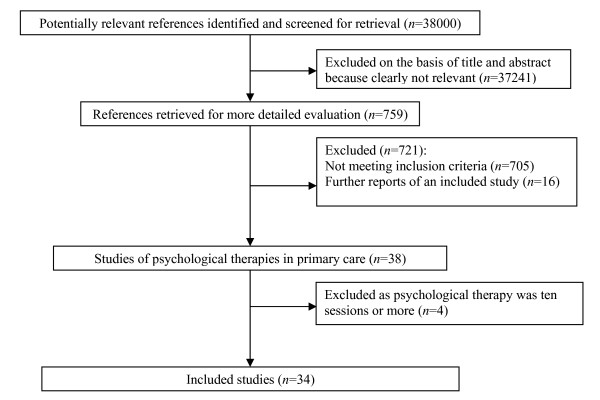
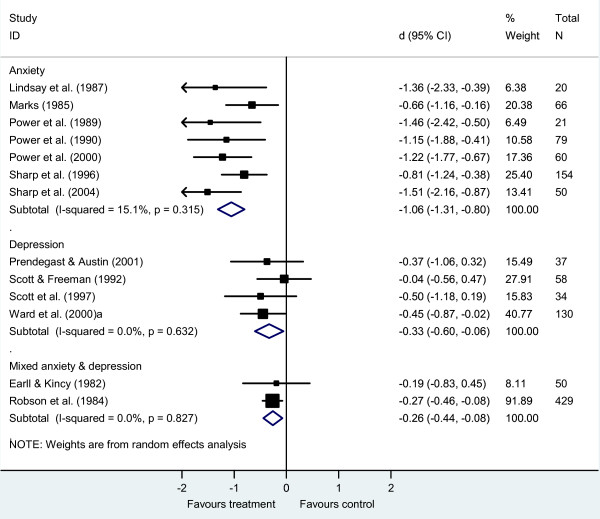
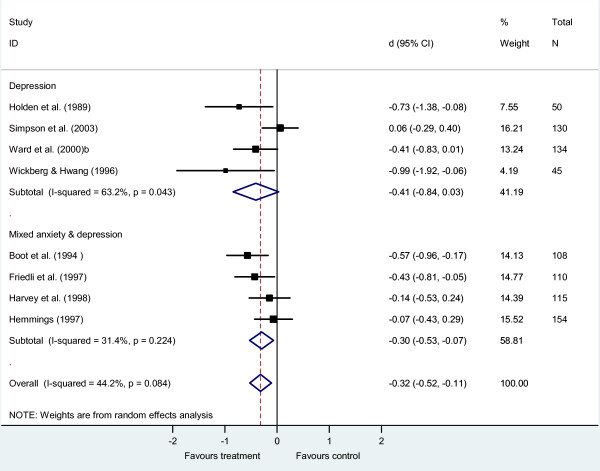
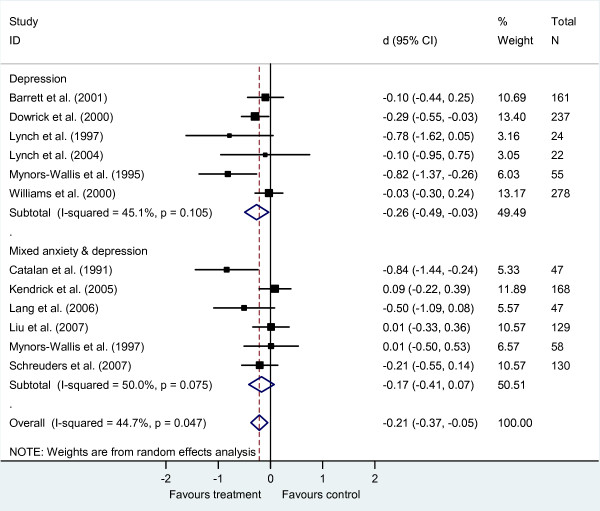
BACKGROUND: Psychological therapies provided in primary care are usually briefer than in secondary care. There has been no recent comprehensive review comparing their effectiveness for common mental health problems. We aimed to compare the effectiveness of different types of brief psychological therapy administered within primary care across and between anxiety, depressive and mixed disorders. METHODS: Meta-analysis and meta-regression of randomized controlled trials of brief psychological therapies of adult patients with anxiety, depression or mixed common mental health problems treated in primary care compared to primary care treatment as usual. RESULTS: Thirty-four studies, involving 3962 patients, were included. Most were of brief cognitive behaviour therapy (CBT; n = 13), counselling (n = 8) or problem solving therapy (PST; n = 12). There was differential effectiveness between studies of CBT, with studies of CBT for anxiety disorders having a pooled effect size [d -1.06, 95% confidence interval (CI) -1.31 to -0.80] greater than that of studies of CBT for depression (d -0.33, 95% CI -0.60 to -0.06) or studies of CBT for mixed anxiety and depression (d -0.26, 95% CI -0.44 to -0.08). Counselling for depression and mixed anxiety and depression (d -0.32, 95% CI -0.52 to -0.11) and problem solving therapy (PST) for depression and mixed anxiety and depression (d -0.21, 95% CI -0.37 to -0.05) were also effective. Controlling for diagnosis, meta-regression found no difference between CBT, counselling and PST. CONCLUSIONS: Brief CBT, counselling and PST are all effective treatments in primary care, but effect sizes are low compared to longer length treatments. The exception is brief CBT for anxiety, which has comparable effect sizes.
Overview
The claims and statistics of this paper haven’t been checked yet.
Free: it reads the open-access text and checks the first 5 claims that cite a source we can check. Create a free account to check every claim.
Integrity signals
Registry
Cites
Statistics
Figures
Verification
Claims the paper makes
The claims and statistics of this paper haven’t been checked yet.
Free: it reads the open-access text and checks the first 5 claims that cite a source we can check. Create a free account to check every claim.
Claims other papers make about this one
Each is checked against this paper’s own text: does it say what the citing paper says it does?
The source backs part of the claim, not all of it — or backs it for a different population, condition or comparison.
In the citing paper
“while 2 other meta-analyses looking at brief (8 or fewer sessions) of CBT, MBCT, and PST noted significant efficacy in symptom reduction.82,83”
From Canadian Network for Mood and Anxiety Treatments (CANMAT) 2016 Clinical Guidelines for the Management of Adults with Major Depressive Disorder (2016) · cites this paper as [82]
Experimental — accuracy not yet measuredThe source backs part of the claim, not all of it — or backs it for a different population, condition or comparison.
In the citing paper
“For instance, the meta-analysis conducted by Cape et al. (2010) revealed that, although brief interventions provided in primary care had similar efficacy than longer treatments for anxiety disorders, the effect sizes obtained for depression and mixed anxiety and depression were considerably smaller (d = 0.33 and 0.26, respectively).”
From A Multiple-Baseline Evaluation of Acceptance and Commitment Therapy Focused on Repetitive Negative Thinking for Comorbid Generalized Anxiety Disorder and Depression (2020) · cites this paper as Cape et al. (2010)
Experimental — accuracy not yet measuredThe source backs part of the claim, not all of it — or backs it for a different population, condition or comparison.
In the citing paper
“Specifically, the empirical evidence shows that brief interventions tested for this problem in primary care have obtained small effect sizes (e.g. Cape et al., 2010).”
From A Multiple-Baseline Evaluation of Acceptance and Commitment Therapy Focused on Repetitive Negative Thinking for Comorbid Generalized Anxiety Disorder and Depression (2020) · cites this paper as Cape et al., 2010
Experimental — accuracy not yet measured
Self-check
Percentages, sums and reported differences re-computed from the paper’s own numbers.
The self-check needs the paper’s full text.
Citations
Cites
Measuring inconsistency in meta-analyses
Higgins, J. P. T., Thompson, S. G., Deeks, J. J., & Altman, D. G. (2003) · BMJ · doi:10.1136/bmj.327.7414.557 · Cited by 63,139 · cited 2×
“We used I2 and the Q test of heterogeneity [37,38] to examine among-study variation in the meta-analysis.”
BackgroundMethodBias in meta-analysis detected by a simple, graphical test
Egger, M., Smith, G. D., Schneider, M., & Minder, C. (1997) · BMJ · doi:10.1136/bmj.315.7109.629 · Cited by 56,722 · cited 1×
“To check for publication bias, CMA was used to generate funnel plots and Egger's regression asymmetry test [39].”
MethodQuantifying heterogeneity in a meta‐analysis
Higgins, J. P. T., & Thompson, S. G. (2002) · Statistics in Medicine · doi:10.1002/sim.1186 · Cited by 36,763 · cited 1×
“We used I2 and the Q test of heterogeneity [ 37 ,38] to examine among-study variation in the meta-analysis.”
MethodHamilton, M. (1960) · Journal of Neurology, Neurosurgery & Psychiatry · doi:10.1136/jnnp.23.1.56 · Cited by 32,817 · cited 4×
“3 point difference between groups on the Hamilton Rating Scale for Depression [79] while the effect size for CBT for anxiety was equivalent to 7.”
BackgroundInfluentialKessler, R. C., Chiu, W. T., Demler, O., & Walters, E. E. (2005) · Archives of General Psychiatry · doi:10.1001/archpsyc.62.6.617 · Cited by 12,052 · cited 1×
“Although studies of psychological therapies in primary care frequently include patients with both anxiety and depression, reflecting the heterogeneous patient presentations in primary care where mixed anxiety and depression is the most common diagnosis [20-22], such studies are excluded when the selection criteria for…”
BackgroundThe assessment of anxiety states by rating
HAMILTON, M. (1959) · British Journal of Medical Psychology · doi:10.1111/j.2044-8341.1959.tb00467.x · Cited by 11,455 · cited 4×
“Anxiety and depressive disorders are common, with estimated combined prevalence varying between countries but over 10% in most Western countries [1-4].”
BackgroundInfluentialThe empirical status of cognitive-behavioral therapy: A review of meta-analyses
Butler, A. C., Chapman, J. E., Forman, E. M., & Beck, A. T. (2006) · Clinical Psychology Review · doi:10.1016/j.cpr.2005.07.003 · Cited by 3,215 · cited 4×
“Brief CBT for anxiety disorders was the exception, with effect sizes in the present review comparable to those obtained in reviews of longer secondary care based treatments [12,13].”
BackgroundResultInfluentialA Nonparametric “Trim and Fill” Method of Accounting for Publication Bias in Meta-Analysis
Duval, S., & Tweedie, R. (2000) · Journal of the American Statistical Association · doi:10.1080/01621459.2000.10473905 · Cited by 2,955 · cited 1×
“Where asymmetry was detected, we assessed the potential impact of the publication bias using the Duval and Tweedie nonparametric 'trim and fill' method [40].”
MethodImproved tests for a random effects meta‐regression with a single covariate
Knapp, G., & Hartung, J. (2003) · Statistics in Medicine · doi:10.1002/sim.1482 · Cited by 2,075 · cited 1×
“We used the metareg command in Stata, to conduct random-effects meta-regression analyses with restricted maximum likelihood estimation and the improved variance estimator of Knapp and Hartung [ 41 ].”
Method
Research works printed but not linked: 3
- Scottish Intercollegiate Guidelines Network SIGN 50: A Guideline Developer's Handbook 2004 Edinburgh: SIGN
- Borenstein M Hedges L Higgins J Rothstein H Comprehensive Meta-analysis Version 2 [Computer software] 2005 Englewood, NJ: Biostat
- StataCorp Stata Statistical Software: Release 9.2 [Computer software] 2007 College Station, TX: StataCorp
Cited by
Collaborative care for depression and anxiety problems
Archer, J., Bower, P., Gilbody, S., Lovell, K., Richards, D., Gask, L., Dickens, C., & Coventry, P. (2012) · Cochrane Database of Systematic Reviews · doi:10.1002/14651858.cd006525.pub2 · Cited by 1,126
Malhi, G. S., Bassett, D., Boyce, P., Bryant, R., Fitzgerald, P. B., Fritz, K., Hopwood, M., Lyndon, B., Mulder, R., Murray, G., et al. (2015) · Australian & New Zealand Journal of Psychiatry · doi:10.1177/0004867415617657 · Cited by 842
“Research also supports the use of psychological therapies (Cape et al., 2010), but head-to-head and combined psychological and pharmacological treatment studies are lacking.”
BackgroundBaldwin, D. S., Anderson, I. M., Nutt, D. J., Allgulander, C., Bandelow, B., den Boer, J. A., Christmas, D. M., Davies, S., Fineberg, N., Lidbetter, N., et al. (2014) · Journal of Psychopharmacology · doi:10.1177/0269881114525674 · Cited by 676
“, 2001): though a subsequent meta-analysis suggests that short-term counselling is less beneficial than longer-term treatment with other psychological interventions [I (M)] (Cape et al., 2010).”
BackgroundMeader, N., King, K., Llewellyn, A., Norman, G., Brown, J., Rodgers, M., Moe-Byrne, T., Higgins, J. P., Sowden, A., & Stewart, G. (2014) · Systematic Reviews · doi:10.1186/2046-4053-3-82 · Cited by 610
“[25] Brief psychological therapies for anxiety and depression in primary care: metaanalysis and meta-regression Psychological Mental health”
BackgroundMethodParikh, S. V., Quilty, L. C., Ravitz, P., Rosenbluth, M., Pavlova, B., Grigoriadis, S., Velyvis, V., Kennedy, S. H., Lam, R. W., MacQueen, G. M., et al. (2016) · The Canadian Journal of Psychiatry · doi:10.1177/0706743716659418 · Cited by 562
Baldessarini, R. J. (2013) · doi:10.1007/978-1-4614-3710-9 · Cited by 365
Chowdhary, N., Jotheeswaran, A. T., Nadkarni, A., Hollon, S. D., King, M., Jordans, M. J. D., Rahman, A., Verdeli, H., Araya, R., & Patel, V. (2014) · Psychological Medicine · doi:10.1017/s0033291713001785 · Cited by 349
“This is consistent with the findings of other meta-analyses of non-adapted PTs (Peng et al. 2009; Cape et al. 2010).”
Coventry, P., Lovell, K., Dickens, C., Bower, P., Chew-Graham, C., McElvenny, D., Hann, M., Cherrington, A., Garrett, C., Gibbons, C. J., et al. (2015) · BMJ · doi:10.1136/bmj.h638 · Cited by 325
Kazantzis, N., Whittington, C., Zelencich, L., Kyrios, M., Norton, P. J., & Hofmann, S. G. (2016) · Behavior Therapy · doi:10.1016/j.beth.2016.05.002 · Cited by 280
Self-citationKroenke, K., & Unutzer, J. (2017) · Journal of General Internal Medicine · doi:10.1007/s11606-016-3967-9 · Cited by 231
“, eight or fewer), with the most commonly studied treatments in a meta-analysis of 34 trials being cognitive-behavioral therapy (n = 13), problem-solving therapy (n = 12), and counseling (n = 8).(22) CBT for anxiety had the strongest benefits (pooled effect size of 1.”
Background(2015) · PubMed · Cited by 229
Richards, D. A., Hill, J. J., Gask, L., Lovell, K., Chew-Graham, C., Bower, P., Cape, J., Pilling, S., Araya, R., Kessler, D., et al. (2013) · BMJ · doi:10.1136/bmj.f4913 · Cited by 219
Self-citationLinde, K., Sigterman, K., Kriston, L., Rucker, G., Jamil, S., Meissner, K., & Schneider, A. (2015) · The Annals of Family Medicine · doi:10.1370/afm.1719 · Cited by 196
Integrated behavioral health in primary care: Step-by-step guidance for assessment and intervention.
Hunter, C. L., Goodie, J. L., Oordt, M. S., & Dobmeyer, A. C. (2017) · American Psychological Association eBooks · doi:10.1037/0000017-000 · Cited by 190
Goldsmith, L. P., Lewis, S. W., Dunn, G., & Bentall, R. P. (2015) · Psychological Medicine · doi:10.1017/s003329171500032x · Cited by 174
“Similarly, in a meta-analysis and meta-regression of brief CBT, counselling or problem-solving therapy for depression or anxiety in primary care, Cape et al. (2010) found that, when diagnosis was controlled for, there was no difference in the effectiveness of the three types of therapy.”
ResultGellis, Z. D., Kenaley, B. L., & Have, T. T. (2014) · Journal of the American Geriatrics Society · doi:10.1111/jgs.12776 · Cited by 160
“PST is an empirically robust and individual-centered approach to treating depression.(20,21) Telehealth PST sessions over the telephone were completed in 35 minutes and followed a manual outlining a five-step process.”
MethodAcupuncture and Counselling for Depression in Primary Care: A Randomised Controlled Trial
MacPherson, H., Richmond, S., Bland, M., Brealey, S., Gabe, R., Hopton, A., Keding, A., Lansdown, H., Perren, S., Sculpher, M., et al. (2013) · PLoS Medicine · doi:10.1371/journal.pmed.1001518 · Cited by 142
“In another review of psychological interventions, four cognitive behaviour therapy studies based in primary care covering 259 patients with depression found a similar short-term effect (SMD 20?33, 95% CI 20?60 to 20?06) [24].”
Zhang, A., Borhneimer, L. A., Weaver, A., Franklin, C., Hai, A. H., Guz, S., & Li, S. (2019) · Journal of Behavioral Medicine · doi:10.1007/s10865-019-00046-z · Cited by 150
Zhang, A., Franklin, C., Currin-McCulloch, J. A., Park, S., & Kim, J. (2017) · Journal of Behavioral Medicine · doi:10.1007/s10865-017-9888-1 · Cited by 148
Wiltsey Stirman, S., Gamarra, J. M., Bartlett, B. A., Calloway, A., & Gutner, C. A. (2017) · Clinical Psychology: Science and Practice · doi:10.1111/cpsp.12218 · Cited by 138
“…meta-analyses suggested small effects for studies of brief CBT or problemsolving therapy (PST) for depression or for mixed depression and anxiety (Cape et al., 2010; Nieuwsma et al., 2012), but larger effects on brief CBT for anxiety disorders delivered in primary care settings (Cape et al., 2010).”
InfluentialThe efficacy and effectiveness of psychological treatments for mood, anxiety, and related disorders.
Hunsley, J., Elliott, K., & Therrien, Z. (2014) · Canadian Psychology / Psychologie canadienne · doi:10.1037/a0036933 · Cited by 90
Brief Psychotherapy for Depression: A Systematic Review and Meta-Analysis
Nieuwsma, J. A., Trivedi, R. B., McDuffie, J., Kronish, I., Benjamin, D., & Williams, J. W. (2012) · The International Journal of Psychiatry in Medicine · doi:10.2190/pm.43.2.c · Cited by 135
“Only 8 of these 15 studies had been previously reviewed in either the Cuijpers [25] or Cape [26] reviews.”
BackgroundInfluentialHaug, T., Nordgreen, T., Öst, L. G., & Havik, O. E. (2012) · Clinical Psychology Review · doi:10.1016/j.cpr.2012.04.002 · Cited by 128
Lavda, A. C., Webb, T. L., & Thompson, A. R. (2012) · British Journal of Dermatology · doi:10.1111/j.1365-2133.2012.11183.x · Cited by 114
Griffith, J. E., & West, C. (2013) · The Journal of Behavioral Health Services & Research · doi:10.1007/s11414-013-9320-8 · Cited by 130
“First, it is unclear whether a 1-week program is sufficient to affect the way in which the individual appraises and reacts to stressors, especially under highly stressful conditions often necessitating immediate reaction.(49) Second, the lack of main effects and negligible buffering effects of self-reported changed MR…”
BackgroundTwomey, C., O’Reilly, G., & Byrne, M. (2015) · Family Practice · doi:10.1093/fampra/cmu060 · Cited by 123
Changes in Psychotherapy Utilization Among Veterans With Depression, Anxiety, and PTSD
Mott, J. M., Hundt, N. E., Sansgiry, S., Mignogna, J., & Cully, J. A. (2014) · Psychiatric Services · doi:10.1176/appi.ps.201300056 · Cited by 106
“Psychotherapy exposure, defined as the number of patients receiving at least one session (any exposure to psychotherapy), four sessions (approximate length of briefer forms of psychotherapy [28–30]) or eight or more sessions (the minimum length of traditional, evidence-based psychotherapies for depressive and anxiety…”
BackgroundDiagnostic Inflation: Causes and a Suggested Cure
Batstra, L., & FRANCES, A. J. (2012) · The Journal of Nervous and Mental Disease · doi:10.1097/nmd.0b013e318257c4a2 · Cited by 115
“Step 5: Brief Counseling Studies show that for many patients, brief psychological therapies, such as cognitive behavioral therapy or problem-solving therapy, are effective and cost-effective (Cape et al., 2010; Marchand et al., 2009).”
BackgroundHolvast, F., Massoudi, B., Oude Voshaar, R. C., & Verhaak, P. F. M. (2017) · PLOS ONE · doi:10.1371/journal.pone.0184666 · Cited by 102
“However, the risk of bias was lower in two of the community studies [36,42] compared with the study conducted in primary care [34], and among middle-aged adults the effectiveness of PST in primary care has been confirmed [58].”
Malhi, G. S., Outhred, T., Hamilton, A., Boyce, P. M., Bryant, R., Fitzgerald, P. B., Lyndon, B., Mulder, R., Murray, G., Porter, R. J., et al. (2018) · Medical Journal of Australia · doi:10.5694/mja17.00659 · Cited by 92
Risk factors for health‐related quality of life in children with epilepsy: A meta‐analysis
Ferro, M. A. (2014) · Epilepsia · doi:10.1111/epi.12772 · Cited by 110
“In addition, there is also support for the effective psychopharmacologic treatment of anxiety-related disorders in parents.(35) It is noteworthy that the finding that two of these modifiable risk factors, seizure severity and parental anxiety, have the strongest correlation with child HRQL and thus may be potential ta…”
BackgroundClinical Psychological Science
Queen's University, Chivers, M. L., Bowie, C., Queen's University, Buchanan, S., Queen's University, Clifford, T., Queen's University, Goodman, J., Queen's University, et al. (2019) · The Canadian Handbook for Careers in Psychological Science · doi:10.24908/008f0328a598/ch5 · Cited by 105
The concept and definition of low intensity cognitive behaviour therapy
Shafran, R., Myles-Hooton, P., Bennett, S., & Öst, L.-G. (2021) · Behaviour Research and Therapy · doi:10.1016/j.brat.2021.103803 · Cited by 104
“…such as four sessions of problem-solving for emotional disorders provided over six weeks in primary care (Catalan et al., 1991), self-help interventions for anxiety and depression (Marks et al., 2003), and abbreviated versions of full CBT protocols (Cape et al., 2010; Clark et al., 1999).”
Counselling for mental health and psychosocial problems in primary care
Bower, P., Knowles, S. E., Coventry, P. A., & Rowland, N. (2011) · Cochrane Database of Systematic Reviews · doi:10.1002/14651858.cd001025.pub3 · Cited by 106
Zhang, A., Franklin, C., Jing, S., Bornheimer, L. A., Hai, A. H., Himle, J. A., Kong, D., & Ji, Q. (2019) · Journal of Affective Disorders · doi:10.1016/j.jad.2018.12.008 · Cited by 80
Knekt, P., Lindfors, O., Sares‐Jäske, L., Virtala, E. T., & Härkänen, T. (2012) · Nordic Journal of Psychiatry · doi:10.3109/08039488.2012.680910 · Cited by 89
Hetrick, S. E., Robinson, J., Spittal, M. J., & Carter, G. (2016) · BMJ Open · doi:10.1136/bmjopen-2016-011024 · Cited by 72
“A meta-regression of psychological interventions in primary care also showed that the type of psychological intervention did not modify the overall effects of intervention on depression and anxiety symptoms compared with treatment as usual (TAU).(30) It is currently unclear whether psychological interven-”
BackgroundPybis, J., Saxon, D., Hill, A., & Barkham, M. (2017) · BMC Psychiatry · doi:10.1186/s12888-017-1370-7 · Cited by 83
“The authors reported brief CBT, counselling, and problem solving therapy all to be effective treatments in primary care, but effect sizes were lower compared to longer length treatments [8].”
BackgroundResultSocial work: Integral to interprofessional education and integrated practice
Zerden, L. D. S., Lombardi, B. M., Fräser, M. W., Jones, A., & Rico, Y. G. (2018) · Journal of Interprofessional Education & Practice · doi:10.1016/j.xjep.2017.12.011 · Cited by 83
Richards, D. A., Bower, P., Chew-Graham, C., Gask, L., Lovell, K., Cape, J., Pilling, S., Araya, R., Kessler, D., Barkham, M., et al. (2016) · Health Technology Assessment · doi:10.3310/hta20140 · Cited by 68
“Less than 50% of published collaborative care trials have followed up participants for ≥ 12 months and our levels of attrition at 4 and 12 months are comparable with those in 70% of collaborative care trials and better than those in other trials of brief interventions in this area.(78) There was no evidence that missi…”
ResultSelf-citationPuyat, J. H., Kazanjian, A., Goldner, E. M., & Wong, H. (2016) · The Canadian Journal of Psychiatry · doi:10.1177/0706743716640288 · Cited by 79
Depression in primary care: part 2—management
Ramanuj, P., Ferenchick, E. K., & Pincus, H. A. (2019) · BMJ · doi:10.1136/bmj.l835 · Cited by 78
Zhang, J., Wei, W., & Wang, C. (2012) · Lupus · doi:10.1177/0961203312447667 · Cited by 73
Cully, J. A., Armento, M. E. A., Mott, J., Nadorff, M. R., Naik, A. D., Stanley, M. A., Sorocco, K. H., Kunik, M. E., Petersen, N. J., & Kauth, M. R. (2012) · Implementation Science · doi:10.1186/1748-5908-7-64 · Cited by 72
“Recent evidence suggests the general efficacy of bCBT for patients in primary care and patients with comorbid health conditions [17,18,47,48].”
BackgroundHolding the Line against Diagnostic Inflation in Psychiatry
Batstra, L., & Frances, A. (2012) · Psychotherapy and Psychosomatics · doi:10.1159/000331565 · Cited by 64
Acupuncture for chronic pain and depression in primary care: a programme of research
MacPherson, H., Vickers, A. J., Bland, M., Torgerson, D. J., Corbett, M. S., Spackman, E., Saramago, P., Woods, B. S., Weatherly, H. L. A., Sculpher, M., et al. (2017) · Programme Grants for Applied Research · doi:10.3310/pgfar05030 · Cited by 71
Cognitive enhancers for anxiety disorders
Hofmann, S. G., Smits, J. A. J., Asnaani, A., Gutner, C. A., & Otto, M. W. (2011) · Pharmacology Biochemistry and Behavior · doi:10.1016/j.pbb.2010.11.020 · Cited by 68
When and How to Treat Subthreshold Depression
Kroenke, K. (2017) · JAMA · doi:10.1001/jama.2017.0233 · Cited by 70
Fordham, B., Sugavanam, T., Edwards, K., Hemming, K., Howick, J., Copsey, B. J., Lee, H., Kaidesoja, M., Kirtley, S., Hopewell, S., et al. (2021) · Health Technology Assessment · doi:10.3310/hta25090 · Cited by 69
Richter, T., Fishbain, B., Fruchter, E., Richter‐Levin, G., & Okon‐Singer, H. (2021) · Journal of Psychiatric Research · doi:10.1016/j.jpsychires.2021.06.044 · Cited by 69
NHG-Standaard Depressie (tweede herziening)
van Weel-Baumgarten, E. M., van Gelderen, G., Grundmeijer, H. G. L. M., Licht-Strunk, E., van Marwijk, H., van Rijswijk, E., Tjaden, B., Verduijn, M. M., Wiersma, T., Burgers, J. S., et al. (2012) · Huisarts en Wetenschap · Cited by 67
A RCT of psychotherapy in women with nausea and vomiting of pregnancy
Faramarzi, M., Yazdani, S., & Barat, S. (2015) · Human Reproduction · doi:10.1093/humrep/dev248 · Cited by 51
Poleshuck, E. L., & Woods, J. (2014) · American Psychologist · doi:10.1037/a0036044 · Cited by 51
Ruiz, F. J., Luciano, C., Flórez, C. L., Suárez-Falcón, J. C., & Cardona-Betancourt, V. (2020) · Frontiers in Psychology · doi:10.3389/fpsyg.2020.00356 · Cited by 59
Large-Scale Dissemination of Collaborative Care and Implications for Psychiatry
Katzelnick, D. J., & Williams, M. D. (2015) · Psychiatric Services · doi:10.1176/appi.ps.201400529 · Cited by 59
“The fifth program is IAPT (Improving Access to Psychological Therapies) (14).”
BackgroundMaia, A. C. C. D. O., Nardi, A. E., & Cardoso, A. (2014) · Journal of Affective Disorders · doi:10.1016/j.jad.2014.09.023 · Cited by 59
Brownlie, E., Beitchman, J. H., Chaim, G., Wolfe, D. A., Rush, B., & Henderson, J. (2019) · The Canadian Journal of Psychiatry · doi:10.1177/0706743718784935 · Cited by 48
Ejeby, K., Savitskij, R., Öst, L.-G., Ekbom, A., Brandt, L., Ramnerö, J., Åsberg, M., & Backlund, L. G. (2014) · Scandinavian Journal of Primary Health Care · doi:10.3109/02813432.2014.909163 · Cited by 57
Biella, M. M., Borges, M. K., Strauss, J., Mauer, S., Martinelli, J. E., & Aprahamian, I. (2019) · Neuropsychiatric Disease and Treatment · doi:10.2147/ndt.s223640 · Cited by 57
“A meta-analysis of brief psychological therapies (typically 8 sessions or fewer) showed that cognitive behavior therapy (13 studies), problem-solving therapy (12 studies) and counselling (8 studies) all proved effective treatments of depression in primary care.(75) Phytotherapy: many patients seek phytotherapy alterna…”
Cano-Vindel, A., Muñoz-Navarro, R., Wood, C. M., Limonero, J. T., Medrano, L. A., Ruiz-Rodríguez, P., Gracia-Gracia, I., Dongil-Collado, E., Iruarrizaga, I., Chacón, F., et al. (2016) · JMIR Research Protocols · doi:10.2196/resprot.6351 · Cited by 56
“TD-CBT has been shown to be more effective than treatment as usual (TAU) in PC settings for the treatment of depression [12] and anxiety [13]; it has also been shown to be comparable or superior to many evidence-based psychological interventions for pain [14], especially when patients are referred…”
Linde, K., Rücker, G., Sigterman, K., Jamil, S., Meissner, K., Schneider, A., & Kriston, L. (2015) · BMC Family Practice · doi:10.1186/s12875-015-0314-x · Cited by 56
(Emotion‐centered) problem‐solving therapy: An update
Nezu, A. M., Nezu, C. M., & Gerber, H. R. (2019) · Australian Psychologist · doi:10.1111/ap.12418 · Cited by 56
Morris, L., Lovell, K., McEvoy, P., Emsley, R., Carter, L., Edge, D., Bates, R., Wallwork, T., & Mansell, W. (2023) · Cognitive Behaviour Therapy · doi:10.1080/16506073.2022.2143418 · Cited by 55
“Two meta-analyses found that brief CBT was more effective than control conditions for patients with anxiety and depression (Cape et al., 2010; Nieuwsma et al., 2012).”
BackgroundSurkan, P. J., Hamdani, S. U., Huma, Z., Nazir, H., Atif, N., Rowther, A. A., Chaudhri, R., Zafar, S., Mullany, L. C., Malik, A., et al. (2020) · BMJ Open · doi:10.1136/bmjopen-2020-037590 · Cited by 52
Michelson, D., Hodgson, E. S., Bernstein, A., Chorpita, B. F., & Patel, V. (2022) · Journal of Adolescent Health · doi:10.1016/j.jadohealth.2022.05.005 · Cited by 53
“Even less systematic evidence is available on PST for youth anxiety, although adult studies suggest PST can improve the secondary outcome of anxiety in samples with primary depression [17,18].”
BackgroundQuiñones, A. R., Thielke, S. M., Beaver, K. A., Trivedi, R. B., Williams, E. C., & Fan, V. S. (2014) · Psychiatric Services · doi:10.1176/appi.ps.201300057 · Cited by 50
Generative AI–powered mental wellness chatbot for college student mental wellness: open trial
Reyes-Portillo, J. A., So, A., McAlister, K., Nicodemus, C., Golden, A., Jacobson, C., & Huberty, J. (2025) · JMIR Formative Research · doi:10.2196/71923 · Cited by 25
“These findings are consistent with prior research on brief interventions that suggests such programs have the strongest effects on anxiety symptoms [44,45].”
Werner‐Seidler, A., Hitchcock, C., Bevan, A., McKinnon, A., Gillard, J., Dahm, T., Chadwick, I., Panesar, I., Breakwell, L., Mueller, V., et al. (2018) · Behaviour Research and Therapy · doi:10.1016/j.brat.2018.03.004 · Cited by 51
Ruiz, F. J., Peña-Vargas, A., Ramírez, E. S., Suárez-Falcón, J. C., García-Martín, M. B., García-Beltrán, D. M., Henao, Á. M., Monroy-Cifuentes, A., & Sánchez, P. D. (2020) · Psychotherapy · doi:10.1037/pst0000273 · Cited by 48
“The effect sizes in outcomes obtained in this study are larger than those usually found for brief interventions (Cape et al., 2010) and for more extensive protocols for the treatment of emotional disorders.”
ResultFitzgerald, H. E., Hoyt, D. L., Kredlow, M. A., Smits, J. A. J., Schmidt, N. B., Edmondson, D., & Otto, M. W. (2021) · Clinical Psychology: Science and Practice · doi:10.1037/cps0000038 · Cited by 48
Mignogna, J., Martin, L. A., Harik, J., Hundt, N. E., Kauth, M., Naik, A. D., Sorocco, K., Benzer, J., & Cully, J. (2018) · Implementation Science · doi:10.1186/s13012-018-0768-z · Cited by 47
Kingston, D., Austin, M.-P., Hegadoren, K., McDonald, S., Lasiuk, G., McDonald, S., Heaman, M., Biringer, A., Sword, W., Giallo, R., et al. (2014) · Trials · doi:10.1186/1745-6215-15-72 · Cited by 39
LOS DESÓRDENES EMOCIONALES EN ATENCIÓN PRIMARIA
Vindel, A. C. (2011) · Ansiedad y Estrés · Cited by 47
Shepardson, R. L., Buchholz, L. J., Weisberg, R. B., & Funderburk, J. S. (2018) · Journal of Anxiety Disorders · doi:10.1016/j.janxdis.2017.12.004 · Cited by 44
“…anxiety (e.g., Haug, Nordgreen, Öst, & Havik, 2012; van Boeijen, van Balkom, et al., 2005) and primary care-based mental health interventions (e.g., Cape et al., 2010; Heideman et al., 2005; Seekles et al., 2013) to identify other articles that were not included in these databases or used other…”
InfluentialMurphy, S. M., Chowdhury, U., White, S. W., Reynolds, L., Donald, L., Gahan, H., Iqbal, Z., Kulkarni, M., Scrivener, L., Shaker-Naeeni, H., et al. (2017) · Journal of Autism and Developmental Disorders · doi:10.1007/s10803-017-3252-8 · Cited by 34
“A few trials and reviews, with adult samples, have compared CBT and to counselling head-to-head (Barrowclough et al. 2001; Cape et al. 2010; King et al. 2013; Morrell et al. 2009) all have found CBT and counselling to be equally effective.”
Maia, A. C. C. D. O., Braga, A. A., Nunes, C. A., Nardi, A. E., & Silva, A. C. (2013) · Trends in Psychiatry and Psychotherapy · doi:10.1590/s2237-60892013000200007 · Cited by 43
Psychological treatment of anxiety in primary care: a meta-analysis
Seekles, W., Cuijpers, P., Kok, R., Beekman, A., van Marwijk, H., & van Straten, A. (2013) · Psychological Medicine · doi:10.1017/s0033291712000670 · Cited by 41
“2009 ; Stewart & Chambless, 2009) ; (3) the number of treatment sessions (f7 or o8) because a recent analysis demonstrated that brief therapies are effective for treating anxiety disorders in primary care (Cape et al. 2010) ; (4) professional background of the therapist (clinical psychologist or other providers) becau…”
BackgroundSandoval, B. E., Bell, J., Khatri, P., & Robinson, P. J. (2017) · Journal of Clinical Psychology in Medical Settings · doi:10.1007/s10880-017-9516-9 · Cited by 41
Vindel, A. C. (2011) · Ansiedad y Estrés · Cited by 41
Williams, L. M., Pines, A., Goldstein-Piekarski, A. N., Rosas, L. G., Kullar, M., Sacchet, M. D., Gevaert, O., Bailenson, J., Lavori, P. W., Dagum, P., et al. (2018) · Behaviour Research and Therapy · doi:10.1016/j.brat.2017.09.012 · Cited by 40
Implementing brief cognitive behavioral therapy in primary care: A pilot study
Mignogna, J., Hundt, N. E., Kauth, M. R., Kunik, M. E., Sorocco, K. H., Naik, A. D., Stanley, M. A., York, K. M., & Cully, J. A. (2014) · Translational Behavioral Medicine · doi:10.1007/s13142-013-0248-6 · Cited by 39
“Although these brief psychotherapies for primary care settings demonstrate a moderate level of efficacy [7–9], their adoption into clinical practice has been slow [4].”
BackgroundGili, M., Castro, A., García-Palacios, A., Garcia-Campayo, J., Mayoral-Cleries, F., Botella, C., Roca, M., Barceló-Soler, A., Hurtado, M. M., Navarro, M., et al. (2020) · Journal of Medical Internet Research · doi:10.2196/15845 · Cited by 37
“In fact, meta-analyses suggest that depression can be effectively treated with brief psychotherapy (6-8 sessions), specifically with cognitive behavioral therapy (CBT), problem-solving therapy [14], and counseling approaches [15].”
BackgroundMagnée, T., Beurs, D. P. D., de Bakker, D. H., & Verhaak, P. F. M. (2016) · BMJ Open · doi:10.1136/bmjopen-2016-011579 · Cited by 37
“Previous research showed that although psychosocial treatment in primary care may be effective, it might be less effective than treatment in a specialist setting, possibly because of the shorter treatment duration.(33) It is highly likely that some of the patients visiting the MHN still need treatment in specialised c…”
BackgroundPeltzer, K., Pengpid, S., & Skaal, L. (2012) · South African Journal of Psychiatry · doi:10.4102/sajpsychiatry.v18i1.304 · Cited by 36
Sadock, E., Perrin, P. B., Grinnell, R. M., Rybarczyk, B. D., & Auerbach, S. M. (2017) · Journal of Clinical Psychology · doi:10.1002/jclp.22459 · Cited by 38
Effects of a brief ED-based alcohol and violence intervention on depressive symptoms
Ranney, M. L., Goldstick, J. E., Eisman, A. B., Carter, P. M., Walton, M. A., & Cunningham, R. M. (2017) · General Hospital Psychiatry · doi:10.1016/j.genhosppsych.2017.01.008 · Cited by 36
“Although others have studied the efficacy of “brief” depression interventions in primary care, most of these studies were conducted with adults, and none were single-session interventions.(33).”
ResultHundt, N. E., Barrera, T. L., Mott, J. M., Mignogna, J., Yu, H.-J., Sansgiry, S., Stanley, M. A., & Cully, J. A. (2014) · Psychological Services · doi:10.1037/a0036907 · Cited by 35
Kasthurirathne, S. N., Biondich, P., Grannis, S. J., Purkayastha, S., Vest, J. R., & Jones, J. (2019) · Journal of Medical Internet Research · doi:10.2196/13809 · Cited by 35
“As highlighted above, primary care facilities are the point of entry by which a majority of patients suffering from depression seek care [54,55].”
Maia, A. C. C. D. O., Sanford, J., Boettcher, H. T., Nardi, A. E., & Barlow, D. H. (2017) · Journal of Psychiatric Research · doi:10.1016/j.jpsychires.2017.05.013 · Cited by 34
Brief cognitive behavioral therapy reduces suicidal ideation in veterans with chronic illnesses
Ecker, A. H., Johnson, A. L., Sansgiry, S., Fletcher, T. L., Hundt, N. E., Petersen, N. J., Sweeney, A. C., Chaison, A. D., York-Ward, K. M., Kauth, M. R., et al. (2019) · General Hospital Psychiatry · doi:10.1016/j.genhosppsych.2019.02.002 · Cited by 33
Lu, J., Jamani, S., Benjamen, J., Agbata, E. N., Magwood, O., & Pottie, K. C. (2020) · International Journal of Environmental Research and Public Health · doi:10.3390/ijerph17228627 · Cited by 34
Crocker, A. M., Kessler, R. S., van Eeghen, C., Bonnell, L. N., Breshears, R. E., CALLAS, P. W., Clifton, J., Elder, W. G., Fox, C., Frisbie, S., et al. (2021) · Trials · doi:10.1186/s13063-021-05133-8 · Cited by 31
Corpas, J., Moriana, J. A., Martínez, J. F. V., & Gálvez‐Lara, M. (2021) · Psychotherapy Research · doi:10.1080/10503307.2021.1952331 · Cited by 31
“Following Cape et al. (2010), brief therapies should have more than 2 and less than 10 sessions.”
BackgroundMethodResultInfluentialKimura, R., Mori, M., Tajima, M., Somemura, H., Sasaki, N., Yamamoto, M., Nakamura, S., Okanoya, J., Ito, Y., Otsubo, T., et al. (2015) · Journal of Occupational Health · doi:10.1539/joh.14-0208-oa · Cited by 30
Improving the detection and management of anxiety disorders in primary care
Buszewicz, M., & Chew-Graham, C. A. (2011) · British Journal of General Practice · doi:10.3399/bjgp11x588259 · Cited by 30
Self-citationCelia, G., Cavicchiolo, E., Girelli, L., Limone, P., & Cozzolino, M. (2021) · Counselling and Psychotherapy Research · doi:10.1002/capr.12512 · Cited by 30
Barkham, M., Moller, N. P., & Pybis, J. (2017) · Counselling and Psychotherapy Research · doi:10.1002/capr.12141 · Cited by 28
Initial outcomes of a real-world multi-site primary care psychotherapy program.
Sawchuk, C. N., Craner, J., Berg, S. L., Smyth, K. T., Mack, J. D., Glader, M. A., Burke, L., Haggerty, S., Johnson, M. W., Miller, S. J., et al. (2018) · General Hospital Psychiatry · doi:10.1016/j.genhosppsych.2018.06.005 · Cited by 19
Ruths, S., Haukenes, I., Hetlevik, Ø., Smith‐Sivertsen, T., Hjörleifsson, S., Hansen, A. B., Riiser, S., Meling, H. M., & Baste, V. (2021) · BMC Health Services Research · doi:10.1186/s12913-021-06712-w · Cited by 27
Meuldijk, D., Carlier, I. V. E., van Vliet, I. M., van Veen, T., Wolterbeek, R., van Hemert, A. M., & Zitman, F. G. (2016) · Contemporary Clinical Trials · doi:10.1016/j.cct.2015.12.021 · Cited by 27
“These results are in line with other studies on the effectiveness of brief treatments for depressive and anxiety disorders (Cape et al., 2010; Nieuwsma et al., 2011; van Straten et al., 2006; Ehlers et al., 2014).”
BackgroundResult
Metadata
- Authors
- Cape, J., Whittington, C., Buszewicz, M., Wallace, P., & Underwood, L.
- Affiliations
- St Pancras Hospital (GB)
- University College London (GB)
- King's College London (GB)
- Corresponding author
- Cape, John
- Venue
- BMC Medicine
- Published
- 2010-06-25
- Volume
- 8
- Issue
- 1
- Pages
- 38-38
- ISSN
- 1741-7015 (ISSN-L)
- PMC
- PMC2908553
- OpenAlex
- W2090336640
- Semantic Scholar
- f99936e4dedd3d0d915d221290398eee6f62ff11
- Cited by
- 283
- References
- 91
- Citations by year
- 2026: 12 · 2025: 12 · 2024: 15 · 2023: 8 · 2022: 14 · 2021: 27 · 2020: 14 · 2019: 20 · 2018: 25 · 2017: 27 · 2016: 16 · 2015: 18 · 2014: 22 · 2013: 14 · 2012: 23
- FWCI
- 22.05
- Type
- journal article
- Language
- en
- Open access
- gold
- doi.org
- Licence
- Locations
- BMC Medicine (publishedVersion, cc-by)
- PubMed Central (publishedVersion, cc-by)
- PubMed (publishedVersion)
- DOAJ (DOAJ: Directory of Open Access Journals) (submittedVersion, cc-by-sa)
- UCL Discovery (University College London) (submittedVersion)
- Research Portal (King's College London) (submittedVersion)
- Topics
- Social Sciences › Psychology › Experimental and Cognitive Psychology › Anxiety, Depression, Psychometrics, Treatment, Cognitive Processes
- Social Sciences › Psychology › Clinical Psychology › Psychotherapy Techniques and Applications
- Health Sciences › Medicine › Psychiatry and Mental health › Mental Health Treatment and Access
- Keywords
- primary care, anxiety disorders, depression, mixed anxiety-depressive disorder, cognitive behavioral therapy, counseling, problem-solving therapy, treatment effectiveness, common mental disorders
- MeSH terms
- Adult, Anxiety, Depression, Humans, Primary Health Care, Psychotherapy, Brief, Randomized Controlled Trials as Topic, Treatment Outcome
About these checks
Registry, retraction, Cites and statistics results are computed, not judged, with one exception: a printed reference that no index lists is read once by a model before it counts as a citation error. Claims are extracted by a model and kept only when their quote appears verbatim in the text; each cited source is then checked, with a model’s help, for whether it says what the claim relies on. Those verdicts can be wrong — read the claim’s quote and the cited source before relying on one.
Statistics and arithmetic are recomputed, not judged.
Confidence bands are shown only for fields calibrated on our annotated test set. None is calibrated yet, so no band is shown.
What counts as a claim ›How we measure confidence ›How we check this ›
Are you an author, or do you see a problem with this page? Request a review
Data sources
Bibliographic data: Semantic Scholar, OpenAlex, Crossref.
Contains information from the Semantic Scholar Academic Graph Datasets, made available under the ODC Attribution License (ODC-BY 1.0).
Semantic Scholar’s data is described in: Kinney, R., et al. (2023). The Semantic Scholar Open Data Platform. arXiv:2301.10140.
